


President Donald Trump was dejected, processing his very public split with the world’s richest man.
Rattled in the wake of Elon Musk’s public attacks and apparent call for his impeachment, Trump worked the phones, debriefing close confidants and casual acquaintances alike. His former ally was “a big-time drug addict,” Trump said at one point as he tried to make sense of Musk’s behavior, according to a person with knowledge of the call, who like others interviewed for this story spoke on the condition of anonymity to discuss sensitive matters.
Musk has acknowledged using ketamine, a powerful anesthetic, which he says was prescribed for him to treat depression. The New York Times recently reported that he was using so much ketamine on the campaign trail that he told people it was affecting his bladder, and he traveled with a pill box with medication with the marking of Adderall. White House officials said that Trump’s concern about Musk’s drug use, stemming in part from media reports, was one factor driving the two men apart.
But the president, who historically hasn’t hesitated to fire off deeply personal, blistering social media posts about others who have insulted him, was more muted regarding Musk than friends and advisers expected. In the aftermath of his Thursday faceoff with Musk, he urged those around him not to pour gasoline on the fire, according to two people with knowledge of his behavior. He told Vice President JD Vance to be cautious with how he spoke publicly about the Musk situation.
But although the break between Musk and Trump only exploded into public view on Thursday, cracks in the alliance began to appear much earlier. As Musk’s “move fast and break things” bravado complicated the White House’s ambitions to remake American society, the billionaire alienated key members of the White House staff, including Chief of Staff Susie Wiles, and quarreled with Cabinet members, physically coming to blows with one.
Lazy Caturday Reads
Posted: June 7, 2025 Filed under: Donald Trump, Elon Musk, ICE Immigration and Customs Enforcement, immigration | Tags: "Big Beautiful Bill", House budget bill, ICE raids, Kilmar Abreago Garcia, Los Angeles, Medicaid, NASA, social safety net, Social Security, Trump-Musk breakup 11 Comments
Their Cat, by Pauline Bewick
Good Afternoon!!
The epic spat between Trump and Musk is still dominating the media landscape, but that childish story should get some competition soon from the return of Kilmar Abrego Garcia to the U.S. The Trump administration finally decided to bring him back after they invented some “crimes” to charge him with and took them to a grand jury in Tennessee. The trumped up charges led a long-time prosecutor there to abruptly resign. Meanwhile, even though Musk is gone, DOGE is still working to steal all our private data. On the ICE/mass deportation front, Los Angeles looked like a war zone yesterday.
I’ll get to each of these stories, beginning with Abrego Garcia.
The Return of Kilmar Abrego Garcia
CNN: Kilmar Abrego Garcia has been returned to the United States to face criminal charges.
Kilmar Abrego Garcia, the Maryland man mistakenly deported to El Salvador in March, has been returned to the United States to face federal criminal charges, Attorney General Pam Bondi said Friday.
For months, the Trump administration has been locked in an intense standoff with the federal judiciary over court orders for the government to “facilitate” Abrego Garcia’s return from El Salvador, where he was mistakenly deported in mid-March, in a situation that one federal judge warned could present an “incipient crisis” between the two branches.
Abrego Garcia has been indicted on two criminal counts in the Middle District of Tennessee: conspiracy to unlawfully transport illegal aliens for financial gain and unlawful transportation of illegal aliens for financial gain.
The indictment unsealed Friday afternoon accuses Abrego Garcia and others of partaking in a conspiracy in recent years in which they “knowingly and unlawfully transported thousands of undocumented aliens who had no authorization to be present in the United States, and many of whom were MS-13 members and associates.”
Abrego Garcia and his family say he fled gang violence in El Salvador and have denied allegations he’s associated with MS-13.
The White House and the State Department made the decision to bring Abrego Garcia back to the U.S.
Simon Sandoval-Moshenberg, an attorney for Abrego Garcia, accused the Trump administration of “playing games” with the legal system and said his client should appear in immigration court, not criminal court.
“The government disappeared Kilmar to a foreign prison in violation of a court order. Now, after months of delay and secrecy, they’re bringing him back, not to correct their error but to prosecute him. This shows that they were playing games with the court all along,” Sandoval-Moshenberg said in a statement to CNN. “Due process means the chance to defend yourself before you’re punished, not after. This is an abuse of power, not justice.”
The alleged “crimes”:
The allegations date back to 2016 and involve a half-dozen alleged unnamed co-conspirators, with one, identified as CC-6 of Guatemala, described as being a “primary sources of supply of undocumented aliens for the conspiracy.”
Man with cat, Theresa Tanner
The conspiracy allegations outline how, over the years, Abrego Garcia and others worked to move undocumented aliens between Texas and Maryland and other states more than 100 times.
Working with another co-conspirator, referred to as CC-1, Abrego Garcia and that unnamed individual “ordinarily picked up the undocumented aliens in the Houston, Texas area after the aliens had unlawfully crossed the Southern border of the United States from Mexico,” the indictment said.
The two “then transported the undocumented aliens from Texas to other parts of the United States to further the aliens’ unlawful presence in the United States.”
You can read more details on the trumped up charges at the CNN link.
ABC News: Abrego Garcia indictment led top federal prosecutor in Tennessee to resign: Sources.
The decision to pursue the indictment against Kilmar Abrego Garcia led to the abrupt departure of Ben Schrader, a high-ranking federal prosecutor in Tennessee, sources briefed on Schrader’s decision told ABC News.
Schrader’s resignation was prompted by concerns that the case was being pursued for political reasons, the sources said.
Schrader, who spent 15 years in the U.S. A
ttorney’s Office in Nashville, and was most recently the chief of the criminal division, did not respond to messages from ABC News seeking comment.
Analysis by Alan Feuer at The New York Times (gift link): Return of Wrongly Deported Man Raises Questions About Trump’s Views of Justice.
When Attorney General Pam Bondi announced on Friday that Kilmar Armando Abrego Garcia had been returned to the United States to face criminal charges after being wrongfully deported to a prison in El Salvador, she sought to portray the move as the White House dutifully upholding the rule of law.
“This,” she said, “is what American justice looks like.”
Her assertion, however, failed to grapple with the fact that for the nearly three months before the Justice Department secured an indictment against Mr. Abrego Garcia, it had repeatedly flouted a series of court orders — including one from the Supreme Court — to “facilitate” his release.
While the indictment filed against Mr. Abrego Garcia contained serious allegations, accusing him of taking part in a conspiracy to smuggle undocumented immigrants as a member of the street gang MS-13, it had no bearing on the issues that have sat at the heart of the case since his summary expulsion in March.
Those were whether Mr. Abrego Garcia had received due process when he was plucked off the streets without a warrant and expelled days later to a prison in El Salvador, in what even Trump officials have repeatedly admitted was an error. And, moreover, whether administration officials should be held in contempt for repeatedly stonewalling a judge’s effort to get to the bottom of their actions.
Well before Mr. Abrego Garcia’s family filed a lawsuit seeking to force the White House to release him from El Salvador, administration officials had tried all means at their disposal to keep him overseas as they figured out a solution to the problem they had created, The New York Times found in a recent investigation.

Will Barnet, Interlude
Feuer discusses the Trump administration’s machinations:
In the days before the administration’s error was made public, officials at the Department of Homeland Security discussed portraying Mr. Abrego Garcia as a “leader” of MS-13, even though they could find no evidence to support the claim. They considered ways to nullify the original order that had barred his deportation to El Salvador. And they sought to downplay the danger he might face in one of that country’s most notorious prisons.
To Mr. Abrego Garcia’s lawyers, it was no surprise that the same officials who had fought so hard against securing his return suddenly agreed to bring him back to U.S. soil after they had obtained an indictment that bolstered the story they had been telling from the start.
“Today’s action proves what we’ve known all along — that the administration had the ability to bring him back and just refused to do so,” said Andrew Rossman, one of the lawyers. “It’s now up to our judicial system to see that Mr. Abrego Garcia receives the due process that the Constitution guarantees.”
Questions have already been raised about the criminal case, filed in Federal District Court in Nashville. There was concern and disagreement in recent weeks among prosecutors about how to proceed with the charges, two people familiar with the matter said, leading to the resignation of a supervisor in the federal prosecutor’s office handling the case.
Use the gift link to read the whole article. You can also read Marcy Wheeler’s take on the indictment at Emptywheel.
The Trump-Musk Split
There are gossipy article at the NYT, the WaPo, and the Atlantic.
Tyler Pager, Maggie Haberman, Jonathan Swan, Theodore Schleifer, and Ryan Mac at The New York Times: Buildup to a Meltdown: How the Trump-Musk Alliance Collapsed.
Just minutes before he walked into the Oval Office for a televised send-off for Elon Musk last week, an aide had handed him a file.
The papers showed that Mr. Trump’s nominee to run NASA — a close associate of Mr. Musk’s — had donated to prominent Democrats in recent years, including some who Mr. Trump was learning about for the first time.
The president set his outrage aside and mustered through a cordial public farewell. But as soon as the cameras left the Oval Office, the president confronted Mr. Musk. He started to read some of the donations out loud, shaking his head.
This was not good, the president said.
Artist Luis Garces Bonhemio y el gato
Mr. Musk, who was sporting a black eye that he blamed on a punch from his young son, tried to explain. He said Jared Isaacman, a billionaire entrepreneur who was set to become the next NASA administrator, cared about getting things done. Yes, he had donated to Democrats, but so had a lot of people.
Maybe it’s a good thing, Mr. Musk told the president — it shows that you’re willing to hire people of all stripes.
But Mr. Trump was unmoved. He said that people don’t change. These are the types of people who will turn, he said, and it won’t end up being good for us.
The moment of pique was a signal of the simmering tensions between the two men that would explode into the open less than a week later, upending what had been one of the most extraordinary alliances in American politics.
That’s the NYT take. Obviously, having a friend as head of NASA would be very good for Musk’s businesses.
Cat Zakrzewski, Natalie Allison, Elizabeth Dwoskin, Jeff Stein, and Emily Davies at The Washington Post (gift link): Inside the battles that shattered Trump and Musk’s alliance.
For once, President Donald Trump was trying to be the adult in the room.
Trump and Elon Musk, two billionaires with massive egos and combustible temperaments, had forged an unlikely friendship over the past year, one built on proximity, political expediency, and, yes, a touch of genuine warmth. Relations between the president and his top benefactor had grown somewhat strained in recent weeks, as Trump began to feel that Musk had overstayed his welcome in the West Wing. Musk had suggested privately that he could stay on at the White House, an offer that Trump gently declined, two people familiar with the situation told us. (They, like others we talked with for this story, spoke anonymously in order to share candid details about a sensitive feud.) But Musk was still given a gracious send-off last Friday—complete with a large golden, albeit ceremonial, key—aimed at keeping the mercurial tech baron more friend than foe.
Will Barnet, The Closed Window
The peace didn’t last even a week.
On Tuesday, Musk took to X to attack the Republican spending bill being debated in the Senate, trashing Trump’s signature piece of legislation as “a disgusting abomination.” Even as the White House tried to downplay any differences, Musk couldn’t let go of his grievances—the exclusion of electric-vehicle tax credits from the bill, and Trump’s rejection of Musk’s pick to run NASA.
Yesterday, the planet’s richest man attacked its most powerful. Each took aim at the other from their respective social-media platform, forcing rubberneckers into a madcap toggle between Truth Social and X. Trump deemed his former aide “CRAZY,” while Musk went much further, dramatically escalating the feud by calling for Trump’s impeachment, suggesting that the president had been part of Jeffrey Epstein’s notorious sex-trafficking ring, and—likely worst of all in Trump’s mind—taking credit for the president’s election in November.
For one day, Musk made X great again. The spectacle seemed to subside today, as Trump showed—at least by his standards—some restraint. The president insisted that he was not thinking about Musk and wanted only to pass the reconciliation bill that had featured in the brawl. Musk, meanwhile, has far more to lose: his newfound stardom within the MAGA movement, his personal wealth, and government contracts worth billions to his businesses.
Steven Bannon, the influential Trump adviser who has long been critical of Musk, crowed that the tech billionaire’s attacks on Trump were so personal that he won’t be forgiven by the MAGA crowd. “Only the fanboys are going to stick with him—he’s a man without a country,” Bannon told us.

Use the gift link to read the whole thing if you’re intersted.
Greg Sargent strips away the gossip and gets to the meat of the Trump-Musk disagreements at The New Republic: The Real Reason for the Trump-Musk Feud is Uglier Than You Think.
As the war between Donald Trump and Elon Musk worsens, what’s truly odd about this whole spectacle is that the actual substantive disagreement between them seems to be of little interest to media observers. And when you strip away the trolling and shitposting, here’s what becomes clear: This is really a battle over how comprehensively to screw over poor and working people, largely to the benefit of the wealthy.
The superficial argument between them, of course, is over Musk’s opposition to the “big, beautiful bill” that the House passed and that Trump wants the Senate to adopt. That opposition is rooted in Musk’s claim that the bill is loaded with “pork” and will explode the deficit. Trump, meanwhile, is infuriated by Musk because he can’t brook criticism and wants the bill to pass to notch a victory.
But the respective positions underlying those stances are mysteriously missing from the whole Trump-Musk discourse. Flush them into the open, and it helps illuminate the true spectrum of the MAGA movement’s ideological goals—and why its “pro-worker populist” pretensions are so thoroughly phony.
The House GOP bill would entail a large upward transfer of resources. The bill, which would continue Trump’s 2017 tax law and add new tax giveaways for wealthy investors, heirs, and others, would deliver a big tax cut to those in the highest income brackets. According to the Center on Budget and Policy Priorities, the tax cuts enjoyed by those in the bottom 20 percent in 2027 would be one seven-hundredth the size of those reaped by the top 1 percent.
By Theresa Tanner
Worse, those relative table scraps for the bottom could be erased by other changes. The bill’s massive cuts to Medicaid and other health care changes would result in over 10 million people losing health insurance. Add in other cuts to the safety net, and you see why the bill ultimately would lower household resources for the bottom 10 percent while raising them for the top 10 percent—a sizable redistribution upward. As Paul Krugman notes, the bill’s “cruelty is exceptional even by right wing standards.”
Musk is angry about the $2.4 trillion those changes would add to the debt. But, crucially, he’s said little—if anything—about the role that those tax cuts for the rich would have in that outcome. He is primarily obsessed with the bill’s “pork,” meaning that he wants the bill to cut more spending—much, much more.
Where would that money come from? Musk’s cuts via his Department of Government Efficiency have already decimated foreign aid and other programs, producing more starvation, disease, and death among the global poor. Given that DOGE searched for “waste, fraud, and abuse” and found very little, if Musk wants massive additional cuts, by definition they would fall more heavily on important government programs, almost certainly ones that low-income Americans rely upon.
Another way to say this is that their real difference is over how far to push the “waste, fraud, and abuse” scam.

Read the rest at TNR.
What DOGE Is Up To
The New York Times: After His Trump Blowup, Musk May Be Out. But DOGE Is Just Getting Started.
Elon Musk’s blowup with President Trump may have doomed Washington’s most potent partnership, but the billionaire’s signature cost-cutting project has become deeply embedded in Mr. Trump’s administration and could be there to stay.
At the Department of Energy, for example, a former member of the Department of Government Efficiency is now serving as the chief of staff.
At the Interior Department, DOGE members have been converted into federal employees and embedded into the agency, said a person familiar with the matter, who spoke on condition of anonymity out of fear of retaliation. And at the Environmental Protection Agency, where a spokeswoman said that there are two senior officials associated with the DOGE mission, work continues apace on efforts to dismantle an agency that Mr. Trump has long targeted.
“They are still internally going forward; we don’t really feel as if anything has stopped here,” said Nicole Cantello, a former lawyer for the E.P.A. who represents its union in Chicago.
Whether DOGE keeps its current Musk-inspired form remains an open question. Some DOGE members on Friday expressed concern that the president could choose to retaliate against Mr. Musk by firing people associated with the initiative. Others could choose to leave on their own, following Mr. Musk out the door. And DOGE’s role, even its legality, remain the subject of legal battles amid questions over its attempts to use sensitive government data.
But the approach that DOGE embodied at the outset — deep cuts in spending, personnel and projects — appears to have taken root.
Even with Mr. Musk on the sidelines, DOGE on Friday notched two legal victories. The Supreme Court said that it can have access to sensitive Social Security data and ruled that, for now, the organization does not have to turn over internal records to a government watchdog group as part of a public records lawsuit.
Yes, the Supreme Court has struck again.
NBC News: Supreme Court allows DOGE to access Social Security data.
The Supreme Court on Friday allowed members of the Trump administration’s Department of Government Efficiency to access Social Security Administration data.
By Will Barnet
The conservative-majority court, with its three liberal justices objecting, granted an emergency application filed by the Trump administration asking the justices to lift an injunction issued by a federal judge in Maryland.
The unsigned order said that members of the DOGE team assigned to the Social Security Administration should have “access to the agency records in question in order for those members to do their work.”
The lawsuit challenging DOGE’s actions was filed by progressive group Democracy Forward on behalf of two unions — the American Federation of State, County and Municipal Employees, and the American Federation of Teachers — as well as the Alliance for Retired Americans.
“This is a sad day for our democracy and a scary day for millions of people,” the groups said in a statement. “This ruling will enable President Trump and DOGE’s affiliates to steal Americans’ private and personal data.” [….]
Liberal Justice Ketanji Brown Jackson wrote a dissenting opinion questioning the need for the court to intervene on an emergency basis.
“In essence, the ‘urgency’ underlying the government’s stay application is the mere fact that it cannot be bothered to wait for the litigation process to play out before proceeding as it wishes,” she added.

Dramatic Protests Against ICE in Los Angeles
Los Angeles Times: Los Angeles ICE raids spark protests, fear, outrage. ‘Our community is under attack.’
A series of surprise U.S. Immigration and Customs Enforcement sweeps in downtown Los Angeles on Friday prompted fierce pushback from elected officials and protesters, who decried the enforcement actions as “cruel and unnecessary” and said they stoked fear in the immigrant community.
Tensions remained high in downtown into the evening. The Los Angeles Police Department declared an unlawful assembly and ordered about 200 protesters who remained gathered by the Los Angeles Federal Building to disperse around 7 p.m.
Portrait of Edward Gorey with his cat, by Sam Kalda
The use of so-called less-lethal munitions was authorized at 8 p.m. following reports of a small group of “violent individuals” throwing large pieces of concrete at officers, police said. A citywide tactical alert was issued shortly thereafter.
Chaos erupted earlier in the day in the heart of the Fashion District after federal immigration authorities detained employees inside a clothing wholesaler, and used flash-bang grenades and pepper spray on a crowd protesting the raid around 1:30 p.m.
Hundreds of people then rallied outside the Los Angeles Federal Building at 4 p.m., condemning the crackdown and demanding the release of Service Employees International Union California President David Huerta, who was injured and detained while documenting a raid, according to a statement from the labor union.
“Our community is under attack and has been terrorized,” Angelica Salas, executive director of the Coalition for Humane Immigrant Rights, or CHIRLA, told the crowd of protesters. “These are workers, these are fathers, these are mothers.”
Forty-four people were administratively arrested and one person was arrested for obstruction during Friday’s immigration action, said Yasmeen Pitts O’Keefe, a spokesperson for Homeland Security Investigations, a branch of ICE. Federal agents executed four search warrants related to the suspected harboring of people illegally in the country at three locations in central Los Angeles, she said.

One more at The Washington Post: Protests erupt in Los Angeles after dozens detained in immigration raids.
Mostly Monday Reads: Which Century are we in?
Posted: May 5, 2025 Filed under: American Fascists, kakistocracy, religious extremists, Republicans against democracy, SCOTUS, tariffs, Threats to Democracy, Treason and Sedition Republican Style, Unitary Executive Authority | Tags: @repeat1968, Camp Alcatraz, Crazy #FARTUS Policies, Donald Trump, John Buss, misogyny, SCOTUS, Social Security, Theory of Unitary Executive, Trump Tariffs, unemployment 13 Comments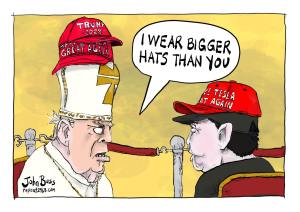
“Size matters.” John Buss, @repeat1968
Good Day, Sky Dancers!
Every time I get the grocery list together these days, I think about what I need to bulk order. It’s really hard to look at a finished consumer good and find all the value-added producers along with their various locations. I wonder how the distributors are going to sort this all out. I noticed prices creeping up in the usual items. I’m pretty sure my sister has hit Costco by now and filled up the pantry. I also watched the last of the Jazz Festers leave with relief. I bet this was their last jaunt of the year. You can see it in the numbers.
USA Today had this analysis by Betty Lin-Fisher. “How will Trump’s tariffs affect grocery store prices? We explain.”
While higher tariffs could still be coming after a 90-day-pause, the baseline 10% tariff on all goods, plus higher duties on Chinese products already in effect are a big increase in food costs for American’s budgets, said Thomas Gremillion, director of food policy at The Consumer Federation of America.
“The 10% ‘default’ tariffs alone represent a truly historic federal tax increase, maybe the largest in my lifetime, with a highly regressive impact,” Gremillion said.
The tariff only applies to the value of the product at the border, Ortega said. Then there are additional costs to the product, which are accrued domestically, like transporting the goods to the store, distribution, wholesale costs and retail markups. Those things are not subject to the tariff, Ortega said.
So that doesn’t mean that the price of a particular product will go up by 10% or whatever the tariff is, Ortega said.
Overall, 15% of the U.S. food supply is imported, including 32% of fresh vegetables, 55% of fresh fruit, and 94% of seafood, according to the Consumer Federation of America, citing the U.S. Food and Drug Administration. Some products, like coffee and bananas, are almost exclusively grown abroad.
Tariffs are causing uncertainty from families checking off their grocery lists to companies importing food, he said.
“For consumers, this can mean added difficulties in managing a food budget. For food companies, this means havoc on supply chains that could lead to more food waste and more food safety risk,” Gremillion said.
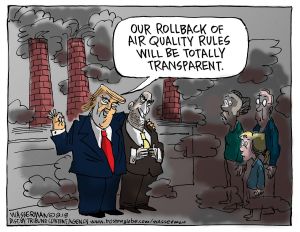 Yup. And the FDA will not be looking around for that food safety risk now. It’s also upending Health Care, but we can rest knowing that all those generic names for medicine and things will be gender neutral now. I know I can’t even properly pronounce most of them, let alone identify their sexual preferences. MEDTECHDIVE has this headline: Trump policies are upending healthcare technology. “Track the effect on the medtech industry here. Policies and actions reshaping the healthcare industry began pouring out of President Donald Trump’s White House nearly from day one. Follow the changes affecting the medical device industry.”
Did I mention the youngest son-in-law is a biomedical engineer who is in charge of designing medical, surgical, and prosthetic devices? Plus, the oldest daughter and son-in-law are doctors. It’s just me and my youngest daughter out here trying to figure out what the economy and financial markets are experiencing. The others are just trying to deal with that, and the usual helpful regulations are being replaced with crazy ones.
Since Trump took office in late January, multiple Food and Drug Administration webpages were removed (and then restored); employees were fired from the Center for Devices and Radiological Health (and some were asked back); and the Department of Health and Human Services unveiled a plan to lay off approximately 10,000 employees, including about 3,500 at the FDA.
Meanwhile, the economy has whipsawed due to an unpredictable and aggressive tariff strategy. Later, however, pieces were delayed or walked back.
The Trump administration has reshaped the medtech industry in significant ways, and potentially long-term, in just a few months. Now that Trump has settled into power, new questions have arisen about what the many changes will mean for companies and patients, and what’s coming next.
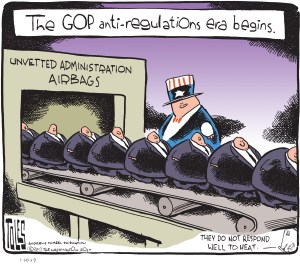
Tom Toles Editorial Cartoon
Also, lucky us, Medicare and Medicaid modernization with be the goal of TV snake oil salesman Dr. Mehmet Oz as he takes over both. This is also from the MEDTECHDIVE.
Dr. Mehmet Oz was sworn in as the Centers for Medicare and Medicaid Services administrator on April 18, cementing his role as head of the agency that provides insurance coverage to millions of Americans.
During a ceremony at the Oval Office, Oz, a physician and former TV personality, said he wanted to “save” the nation’s public health programs and focus on reducing chronic disease, “modernizing” Medicare and Medicaid, and targeting fraud, waste and abuse in government insurance offerings.
President Donald Trump reiterated that Republicans wouldn’t cut Medicare or Medicaid. “Just as I promised, there will be no cuts. We’re not going to have any cuts. We’re going to have only help,” he said during the ceremony.
As I’ve spent most of this year being poked, prodded, pricked, shocked, MRI’d, Ultrasound’d, and EMG’d, I sure don’t feel good about any of this. I fret about someone disappearing all of that, plus my Social Security.
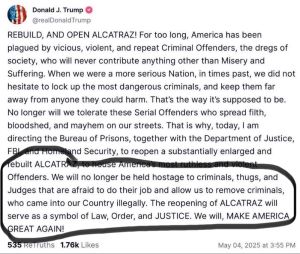 Speaking of crazy policy, I happened on this last night. This is from NBC News. “Trump says he will reopen ‘enlarged and rebuilt’ Alcatraz prison. Alcatraz Island hasn’t been used as a federal penitentiary since 1963. It had a capacity of roughly 300 people.” I’m actually thinking this is another one of his threats to Judges since it’s way too small to hold many prisoners. I suppose that’s one way to destroy a national park and the US Constitution in one sweep.
Alcatraz Island, a former military fortress and prison in San Francisco Bay, was turned into a federal penitentiary in 1934 and over the course of 29 years housed more than 1,500 people “deemed difficult to incarcerate elsewhere in the federal prison system,” according to the National Park Service.
According to aNational Park Service study, it was initially deemed unfit to serve as a federal institution because of its small size, isolated location and lack of fresh water. However, Sanford Bates, the director of the Bureau of Prisons in 1933,later found it “an ideal place of confinement for about 200 of the most desperate or irredeemable types.” It was formally opened as a federal penitentiary the next year.
Trump suggested in his post that he’d like to restore the facility to that purpose.
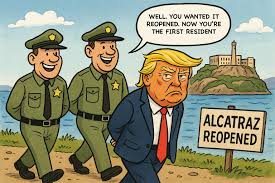 This is from Ed Mazza writing for HuffPo. This sounds a lot like his real estate deals to me. “‘Clearly Unhinged’: Critics Sink Trump’s ‘Asinine’ Plan To Reopen Alcatraz Prison. The president wants to turn the site back into a penitentiary despite the fact that it would cost a fortune.”
Alcatraz is currently part of Golden Gate National Recreation Area and has about 1.2 million visitors per year. Those who tour the island in San Francisco Bay see facilities in various states of decay. The prison was crumbling even as it was still in operation, and the high cost of maintaining it was a key reason it was shuttered in 1963.
Given those realities, restoring Alcatraz and then expanding it, as Trump called for on his Truth Social platform, would likely cost a fortune ― and then another pile of cash would be needed to maintain it.
Reopening it as a prison would also mean the loss of the tourism revenue the island currently generates as well as a loss of habitat for its thriving bird population.
The president, however, said Alcatraz’s return to use as a prison would “serve as a symbol of Law, Order, and JUSTICE.”
His critics fired back that the idea would be an expensive boondoggle:
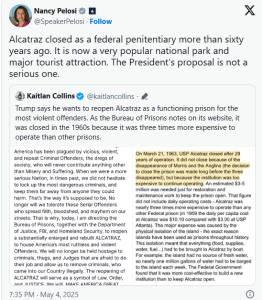
 This just really sounds like how he’d run his business. Also, he now wants tariffs on all incoming films. This is about as insane as it gets. “Trump threatens a 100% tariff on foreign-made films, saying the movie industry in the US is dying.”
President Donald Trump is opening a new salvo in his tariff war, targeting films made outside the U.S.
In a post Sunday night on his Truth Social platform, Trump said he has authorized the Department of Commerce and the Office of the U.S. Trade Representative to slap a 100% tariff “on any and all Movies coming into our Country that are produced in Foreign Lands.”
“The Movie Industry in America is DYING a very fast death,” he wrote, complaining that other countries “are offering all sorts of incentives to draw” filmmakers and studios away from the U.S. “This is a concerted effort by other Nations and, therefore, a National Security threat. It is, in addition to everything else, messaging and propaganda!”
The White House said Monday that it was figuring out how to comply with the president’s wishes.
“Although no final decisions on foreign film tariffs have been made, the Administration is exploring all options to deliver on President Trump’s directive to safeguard our country’s national and economic security while Making Hollywood Great Again,” said spokesperson Kush Desai.
It’s common for both large and small films to include production in the U.S. and in other countries. Big-budget movies like the upcoming “Mission: Impossible — The Final Reckoning,” for instance, are shot around the world.
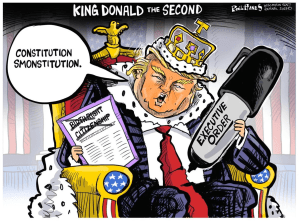 Philip Bump–writing at WAPO–has an interesting Op-Ed up today. “America’s least American president. Donald Trump isn’t making America great again. He’s making it into something else entirely.”
On Sunday, NBC News aired an interview with Trump in which he expressed ignorance of the black-letter standards of justice established in the country’s founding document.
“The Constitution says every person, citizens and noncitizens, deserve due process,” “Meet the Press” host Kristen Welker pointed out. So why not bring Abrego García back to the U.S. and use legal avenues to potentially remove him?
“Well,” Trump replied, “I’ll leave that to the lawyers, and I’ll leave that to the attorney general of the United States.”
Welker noted that Secretary of State Marco Rubio had admitted that even immigrants had due process rights. Trump again downplayed the idea, saying that holding hearings would mean “we’d have to have a million or 2 million or 3 million trials.” This isn’t as big a hurdle as it may sound. In fiscal 2024, there were more than 900,000 immigration hearings completed. So far in fiscal 2025, there have been more than 460,000. More could be cleared if Trump hadn’t moved to fire a number of immigration judges.
Finally, Welker noted that Trump didn’t really have a choice.
“Even given those numbers that you’re talking about,” she asked, “don’t you need to uphold the Constitution of the United States as president?”
“I don’t know,” Trump replied. “I have to respond by saying, again, I have brilliant lawyers that work for me, and they are going to obviously follow what the Supreme Court said.”
You may recall that, in January, Trump put his hand on a Bible and affirmed to Chief Justice John G. Roberts Jr. that he would “faithfully execute” his role as president and to the best of his “ability, preserve, protect and defend the Constitution of the United States.” But this has never been an oath he has appeared to actually take to heart.
Trump’s dismissiveness of the Constitution has manifested itself in a lot of ways. You may recall his lack of interest in leaving office when he lost the 2020 presidential election. You may be aware that he has readily, if not giddily, accepted personal income from foreign governments while serving as president. He views the law as a cudgel, not a constraint, issuing pardons for various political allies ensnared in criminal activity while directing federal law enforcement to fish for potential criminal charges against those who work against his political power.
At its heart, Trump’s approach to his role is rooted in his parochial sense of patriotism. He didn’t come to the White House after having worked his way up through lower offices, building consensus and working to appeal to a broad range of constituents. He had no appreciation for how legislation is crafted or for the hard work of reaching compromise. Perhaps most importantly, he has never indicated any robust understanding of American history or of the debates and agreements that led to the country’s creation.
In 2011, for example, Trump was asked by Stephen Colbert if he knew what the 13 stripes on the American flag represent. He said he didn’t.
More recently, Trump was asked by ABC News journalist Terry Moran what the Declaration of Independence (a copy of which the president recently had installed in the Oval Office) means to him personally.
“It means exactly what it says. It’s a declaration,” Trump replied. “A declaration of unity and love and respect, and it means a lot. And it’s something very special to our country.”
It is special to the country, of course, but not because it is a declaration of “love,” much less “unity.” As the name would suggest, it is precisely the opposite.
Trump doesn’t have the Declaration of Independence in the Oval Office because he wants its message to serve as a guidepost for his administration. He doesn’t even appear to know its message. He has it there because it is A Famous American Thing, another decoration in the newly gilded room meant to send a message about his power, not the nation’s.
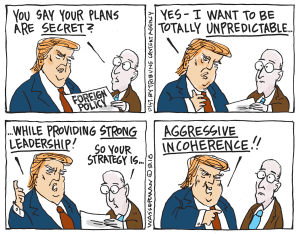 Dan Froomkin–writing for Press Watch–suggests we need to keep track of all Trump’s oddities. “We need a way to aggregate what Donald Trump is doing to this country.”
News organizations, along with good-government groups and other interested parties, are doing a commendable job of chronicling the damage the Trump regime is doing to the government, the country, and the world.
But none of them, individually, is in a position to give the public the full picture. It’s just too much.
This is a feature of Trump’s strategy of “flooding the zone.” No one entity can possibly keep up.
And as we go forward, how can any one organization keep tabs on all the fallout? It’s not possible.
What we need is a central repository of information so that the full extent of the damage can be found in one place and assessed by the public — and so that there’s a comprehensive record of what needs to be fixed and restored when the time comes to do so. (Sort of like a truth commission, but in real time.)
To aggregate all the existing information, organize it, and collect new data, we need a place, a process, and people.
 It makes sense to me since Trump seems to want to undocument more than just people. Who knows how many things Doge has destroyed in the wake of having all-access to every government database and more. He’s disappearing people, children, scientific research, due process, and entire agencies and programs.
This is a site that I was just sent to by a Blue Sky Link. This DNYUZ link has an article by the NYT’s by Jack Goldsmith of Lawfare fame and Harvard Law School. This has been an issue for many people in modern times, with both parties playing the role of enablers. “It’s Not Just Trump. The Presidency Has Become Too Powerful.” So, I need to put this example of both siderisms into perspective. “Mr. Goldsmith, a former assistant attorney general under George W. Bush, is an author, with Bob Bauer, of a newsletter about presidential and executive power.”
Donald Trump’s wrecking-ball second term has revealed the full latent power of the presidency. His administration has done this most clearly in its comprehensive elimination of legal and norm-based checks inside the executive branch, its systematic disrespect of judicial process, its extortionate abuse of government power to crush foes and its destructive rhetoric and nastiness.
Yet it is important to recognize that many of Mr. Trump’s efforts to expand the powers of the office build substantially on the excesses of recent presidencies. The overall pattern of presidential action over the past few decades reveals an escalation of power grabs that put the country on a terrible course even before Mr. Trump took office again.
The presidency needs reform, and Americans must consider ways — however implausible they may seem in the context of today’s politics — to get there.
Expansionist presidential acts go all the way back to George Washington, who invited charges of monarchism with his use of the Constitution’s broad yet undefined “executive Power.” From there the presidency, with its loose design, grew and grew, with major surges during the Civil War and New Deal era. That trend continued through the 20th century, aided by the rise of mass communication, substantial delegations of power from Congress and an approving Supreme Court.
Mr. Trump’s radical second presidency is, to an underappreciated extent, operating from a playbook devised by his modern predecessors.
His use of emergency powers to impose broad tariffs is similar to a move made in 1971 by President Richard Nixon. His claims of untouchable national security authority echo arguments made after the Sept. 11 attacks by the George W. Bush administration, in which I served.
Presidents for decades have issued pardons as political or personal favors or to avoid personal legal jeopardy. Mr. Trump took this practice to new extremes in his first term, and then President Joe Biden pre-emptively pardoned his son and family as well as members of his administration and Congress, in a similar pattern. Mr. Trump in his second term has already issued many self-serving pardons.
Mr. Trump’s executive-order program is an heir of the strategy used by President Barack Obama for large-scale and sometimes legally dubious policy initiatives, including some (involving immigration) where Mr. Obama had earlier admitted he lacked authority to act. Mr. Biden also confessed a lack of power but then acted unilaterally in seeking to forgive student loans.
Mr. Trump has disregarded statutory restrictions to fire officials in independent agencies including the Federal Trade Commission, the National Labor Relations Board and the Merit Systems Protection Board. But in 2021, Mr. Biden extended the Supreme Court’s unitary executive case law to fire the statutorily protected commissioner of the Social Security Administration. Mr. Biden was “the first unitary executive,” noted the legal writer Mark Joseph Stern in 2021.
Mr. Biden also purged the executive branch of Trump holdover officials who were not protected by statute, including members of arts and honorary institutions, the Administrative Conference of the United States and the Department of Homeland Security Advisory Council. The Biden administration’s defense of these firings resulted in judicial precedents that Mr. Trump is now wielding to clean house on a broader scale.
The Trump administration has also built on past presidencies in not enforcing federal law — for example, in letting TikTok live on despite a congressional ban. This practice finds its modern roots in the Obama administration, which asserted broad nonenforcement discretion in high-profile cases involving immigration, marijuana and Obamacare, in effect changing the meaning of those laws.
Something similar has happened with spending. As one recent paper noted, “The past several presidents have all taken significant unilateral actions intruding on Congress’s control over federal spending.” The Trump 2.0 version greatly enlarges this unilateralist pattern.
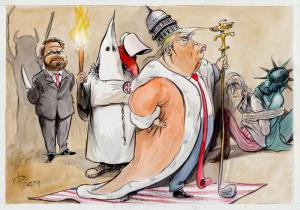 There are a lot of examples here, and it’s worth thinking about. The Unitary Executive Theory has been around for a while, and since the Reagan years, it has picked up steam in the Supreme Court. Here is a recent article from Democracy Docket explaining the theory and relating to it to Yam Tits. The analysis is written by Jacob Knutsen. “What Is Unitary Executive Theory? How is Trump Using It to Push His Agenda?”
Since taking office, President Donald Trump has executed a whirlwind of dismissals across the federal government that violated federal statutes and decreed numerous executive orders, including one that blatantly defied the plain language of the Constitution.
Behind the seemingly scatter-shot opening acts of his second administration, legal analysts see a common goal: to test a once-fringe legal theory which asserts that the president has unlimited power to control the actions of the four million people who make up the executive branch.
If courts — specifically the Republican-appointed majority of the Supreme Court — uphold arguments based on the so-called “unitary executive theory,” it would give Trump and subsequent presidents unprecedented power to remove and replace any federal employee and impose their will on every decision in every agency.
Rulings in favor of the Trump administration would also further jeopardize the independence of key regulatory agencies that are susceptible to conflicts of interest and political interference, like the Federal Election Commission, which oversees federal elections and campaign finance laws.
Trump and his administration have furthered the theory by repeatedly invoking Article II of the Constitution, which vests executive power in the president, to justify the recent dismissals of federal officials. They have framed the article as allowing the president to use the whole of the executive branch for his political ends.
For example, the White House Feb. 18 invoked the article to rationalize an executive order signed that same day that asserted the president’s authority over almost all regulatory agencies that were created by Congress to act independently, or semi-independently, from the president.
Frank Bowman, a scholar of constitutional and criminal law at the University of Missouri School of Law, told Democracy Docket he believes the executive order is a step toward “an open declaration of dictatorship.”
“In essence, what he’s saying is, ‘I am the law. My will is the law. My view of what the law is the only view that can ever be expressed,’” Bowman said.
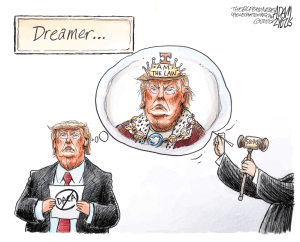 I think this take on executive power is one we should get more familiar with since it’s really taken a powerful rise. The Center for American Progress features an analysis in its series on Project 2025. This one was written back in October.”Project 2025 Would Destroy the U.S. System of Checks and Balances and Create an Imperial Presidency. Far-right extremists have a plan to shatter democracy’s guardrails, giving presidents almost unlimited power to implement policies that will hurt everyday Americans and strip them of fundamental rights.” It is an imperative read. Trump knows that he can be both pope and king.
Project 2025 takes an absolutist view of presidential authority
To wholly reshape government in ways that most Americans would think is impossible, the Project 2025 blueprint anchors itself in the “unitary executive theory.”22 This radical governing philosophy, which contravenes the traditional separation of powers, vests presidents with almost complete control over the federal bureaucracy, including congressionally designated independent agencies or the DOJ and the FBI. The unitary executive theory is designed to sharply diminish Congress’ imperative role to act as a check and balance on the executive branch with tools such as setting up independent agencies to make expert decisions and by limiting presidents’ ability to fire career civil servants for purely political purposes.
The road map to autocracy presented in Project 2025 extends far beyond the unitary executive theory first promoted by President Ronald Reagan, and later espoused by Vice President Dick Cheney, largely designed to implement a deregulatory, corporatist agenda.23 Instead, as discussed further below, Project 2025 presents a maximalist version that does not nibble around the edges but aims to thoroughly demolish the traditional guardrails that allow Congress an equal say in how democracy functions or what policies are implemented. One noted expert at the conservative think tank American Enterprise Institute, Philip Wallach, said, “Some of these visions … start to just bleed into some kind of authoritarian fantasies where the president won the election, so he’s in charge, so everyone has to do what he says—and that’s just not the system the [sic] government we live under.”24
If Congress is robbed of its imperative role as a check and balance on a president’s power, and the judicial branch is willing to bestow a president with almost unlimited authority, autocracy results. And presidents become strongman rulers—free to choose which laws to enforce, which long-standing norms to jettison, and how to impose their will on every executive branch department and agency.
Well, all these pithy reads should keep you busy for the day. I hope your week goes well. I’ve got 2 doctors’ appointments, but gladly no more procedures. And I’d like just to add if they come for professors, that I’d rather be in the gulag that holds the country’s political cartoonists. To think, I used to just use wonderful paintings.
Happy Cinco de Mayo to all the wonderful folks of Mexican descent and to those of us who just enjoy the holiday!
What’s on your Reading and Blogging list today?
Lazy Caturday Reads: Space Cats with Today’s News
Posted: May 3, 2025 Filed under: cat art, caturday, Donald Trump, Elon Musk, just because, Welfare Queen Elon Musk | Tags: Australia elections, fluoride, measles, Public Health, RFK Jr, Social Security, Trump Tariffs, Trump vs. the arts, universities 8 CommentsGood Afternoon!!

Cats in space, vintage postcard, 1911
As usual, much of today’s news is awful. Trump is working hard to destroy the U.S. Government, but his actions here have had a positive effect on the leadership of two of our allies. First liberals took over in Canada and now they’ve done it in Australia.
Michael E. Miller at The Washington Post: Australia’s Labor Party, buoyed by anti-Trump bump, wins reelection.
SYDNEY — Australia’s center-left government convincingly won reelection Saturday in a remarkable turnaround driven partly by anger over President Donald Trump’s disruptive trade war and its impact on the close U.S. military ally.
“We do not need to beg or borrow or copy from anywhere else,” Albanese said to a raucous Sydney crowd. “We do not seek out our inspiration overseas. We find it right here in our values and in our people.”
Trump’s tariffs — first 25 percent on Australia’s aluminum and steel, then 10 percent across the board — had driven voters toward the even-keeled incumbent and away from his conservative opponent, Peter Dutton, whose plans and rhetoric had echoed the American president, said Sean Kelly, a political columnist for the Sydney Morning Herald.
“Trump has absolutely dominated the trajectory of this election,” Kelly said, adding that the global uncertainty unleashed by Trump had made “Albanese’s boringness quite an appealing commodity.”
By and at CNN: Australia’s center-left Labor Party retains power in vote seen as test of anti-Trump sentiment.
Australia’s Prime Minister Anthony Albanese has secured a second term in office in a disastrous night for his conservative rivals, as voters chose stability over change against a backdrop of global turmoil inflicted by US President Donald Trump.Australia’s return of a left-leaning government follows Canada’s similar sharp swing towards Mark Carney’s Liberal Party, another governing party whose fortunes were transformed by Trump. The loss of Liberal Party leader Peter Dutton’s seat mirrors that of Conservative Party leader Pierre Poilievre.
While Australia wasn’t facing the same threats to its sovereignty as Canada, Trump’s global tariffs and policy swings have undermined Australians’ trust in the US, according to recent surveys.
Albanese’s victory makes him the first Australian Prime Minister to win re-election for two decades and he will start his second term with at least 87 seats in the 150-seat lower house, according to the most recent estimates.
A clearly emotional Albanese took the stage to cheers just before 10 p.m. local time to thank Australians for choosing a majority Labor government, defying predictions both major parties would lose seats.
“In this time of global uncertainty, Australians have chosen optimism and determination,” Albanese said, at the Labor victory party in Sydney.
Dutton, who had hoped to end the night as prime minister, lost the outer-suburban Brisbane seat that he’s held for more than 20 years, ending a brutal night for the veteran politician who held senior seats in the last Coalition government.
 Here in the USA, things aren’t so great. Trump’s tariffs are kicking in, the economy is struggling, he is trying to destroy education and the arts, RFK Jr. is working to make Americans sick, and Elon Musk and DOGE are wreaking havoc in government agencies. Here’s the latest.
and at CNN: A massive tariff on millions of Americans’ purchases just went into effect — cue the chaos.
Many Americans might not have felt major effects from President Donald Trump’s sweeping tariffs — until now.
That’s because a major shipping loophole expired at one minute past midnight on Friday. The de minimis exemption, as it’s known, allowed shipments of goods worth $800 or less to come into the United States duty-free, often more or less skipping time-consuming inspections and paperwork.
The loophole helped reshape the way countless Americans shop, allowing ultra-low-cost Chinese e-commerce sites like Shein, Temu and AliExpress to pour everything from yarn to patio furniture, clothes to photography equipment and more into US homes.
Its impending end has rung alarm bells across social media, with a baseline tariff as high as 145% depending on the carrier set to take effect on Chinese imports, potentially more than doubling the cost for all those cheap products deal-hungry Americans scooped up.
And the end of the de minimis exemption for Chinese goods will also distill abstract, complicated, messy, hard-to-follow trade policy into something much easier to understand: a receipt.
Major carriers like UPS, FedEx, DHL and the United States Postal Service say they’re prepared for the changes. The government says it, too, is set; a US Customs and Border Protection spokesperson told CNN that “We are prepared and equipped to carry out enhanced package screenings and enforce orders effectively.”
But whether regular American shoppers are ready for the changes is another matter.
Read more at CNN.
The Los Angeles Times:
Amid a wave of unprecedented tariffs, anxiety is running high for truck drivers like Helen, who makes her living delivering cargo containers from the Los Angeles and Long Beach harbors to warehouses and other customers around Southern California.
After a strong start to the year, the number of jobs has started to slip in recent days and truck drivers have heard reports predicting a sharp decline in incoming cargo for May and June….
“There’s real concern that we’re going to be struggling,” said Helen, a Downey resident who declined to give her last name for fear she might lose work if she is considered disgruntled. “If ships are not coming in and there are no loads, then there is no work. If there is no work there’s no money.”
As President Trump’s aggressive tariffs rattle business owners and shake the foundation of American importing, the men and women who work on the ground at the country’s busiest port are feeling the effects too.
Thousands of dockworkers, heavy equipment operators and truck drivers support a flurry of activity at the Port of Los Angeles, which covers 7,500 acres on San Pedro Bay and processed more than 10 million 20-foot-long cargo units in 2024. The neighboring Port of Long Beach moved 9.6 million 20-foot equivalent units, or TEUs, last year.
With a 145% tariff on China, a 25% tariff on Canada and Mexico, and 10% tariffs on dozens of other countries, the flow of goods into the U.S. is expected to slow drastically.
Fewer shipments into the ports of Los Angeles and Long Beach mean less work for the Californians who move cargo, said Raman Dhillon, chief executive of the North American Punjabi Trucking Assn.
“The truckers are scrambling right now,” he said. “They are at the verge of collapsing. The administration needs to move quickly, or it’s going to be chaos and price hikes and empty shelves.”
Trump isn’t worried about a recession and he doesn’t care how it will affect Americans. It’s just a transition period, he says.
at NBC News: Trump downplays recession fears, saying the U.S. would be ‘OK’ in the long term.
President Donald Trump on Friday downplayed concerns about potential economic trouble, saying everything would be “OK” in the long term, even if the U.S economy experienced a recession in the short term.
Cat Astronaut, Michael Raiano
Asked twice by “Meet the Press” moderator Kristen Welker whether it would be OK in the long run if there were a recession in the short term, the president said, “Look, yeah, it’s — everything’s OK. What we are — I said, this is a transition period. I think we’re going to do fantastically.”
Following up, Welker asked Trump if he was worried about a recession, to which he responded, “No.” Asked whether he thinks one could happen, Trump replied, “Anything can happen, but I think we’re going to have the greatest economy in the history of our country.”
The remarks come as analysts on Wall Street are increasingly worried that the country could face a recession due to Trump’s changing tariff policy.
“Well, you know, you say, ‘Some people on Wall Street say’ — well, I tell you something else. Some people on Wall Street say that we’re going to have the greatest economy in history. Why don’t you talk about them?” Trump said during the interview at his Mar-a-Lago resort in Florida.
“There are many people on Wall Street say this is going to be the greatest windfall ever happen,” the president added.

Really? Who are those people? Name one.
Trump doesn’t want the government to support the arts.
Michael Paulson at The New York Times: Trump Seeks to Eliminate the National Endowment for the Arts.
President Trump proposed eliminating the National Endowment for the Arts and the National Endowment for the Humanities in the budget he released Friday, taking aim once again at two agencies that he had tried and failed to get rid of during his first term.
The endowments, along with the Institute of Museum and Library Services, were among the entities listed in a section titled “small agency eliminations” in his budget blueprint for the next fiscal year. The document said that the proposal was “consistent with the president’s efforts to decrease the size of the federal government to enhance accountability, reduce waste, and reduce unnecessary governmental entities” and noted that Mr. Trump’s past budget proposals had “also supported these eliminations.”
In 2017, during his first term, Mr. Trump proposed eliminating both the arts and the humanities endowments. But bipartisan support in Congress kept them alive, and in fact their budgets grew during the first Trump administration.
Since Mr. Trump returned to office this year, his administration has taken aim at the National Endowment for the Humanities and the Institute of Museum and Library Services, canceling most of their existing grants and laying off a large portion of their staffs. But the arts agency had yet to announce major cuts.
The proposal to eliminate the endowments drew a quick and furious reaction from Democrats. One, Senator Jack Reed of Rhode Island, vowed to fight the plan to eliminate the N.E.A. “tooth and nail.”
Representative Chellie Pingree of Maine, who serves as the top Democrat on the House subcommittee overseeing the N.E.A., said in an interview that Mr. Trump was “making a broad-based attack on the arts, both for funding and content.” She cited his proposals to eliminate the endowments as well as his takeover of the John F. Kennedy Center for the Performing Arts in Washington and his efforts to influence the Smithsonian Institution.
“We were able to restore the funding last time,” she said, “but as you know, based on the first 100 days of this administration, they’re in no mood to keep much of government alive anymore, and their attack is focused on everything, and the arts have already got a bull’s-eye on their back.

Outerspace laser cats (greeting card)
Of course Trump is also attacking our vital educational institutions. The latest is his threat to remove Harvard’s tax-exempt status. Here in Boston, Harvard and MIT are gearing up to fight back.
Andrew Duehren, Maggie Haberman and Alan Blinder at The New York Times: Harvard Signals It Will Resist Trump’s Efforts to Revoke Tax-Exempt Status.
Harvard University signaled Friday that it would resist President Trump’s renewed threat to revoke the school’s tax-exempt status, a move for which it said there was “no legal basis” as the president escalated his bitter dispute with the nation’s oldest university.
Harvard stopped short of explicitly pledging a legal challenge to a revocation of its tax status, a change that would upend the university’s finances. But a spokesperson for the university said in a statement that there was “no legal basis to rescind Harvard’s tax-exempt status.”
“Such an unprecedented action would endanger our ability to carry out our educational mission,” the statement said. “It would result in diminished financial aid for students, abandonment of critical medical research programs and lost opportunities for innovation. The unlawful use of this instrument more broadly would have grave consequences for the future of higher education in America.”
Mr. Trump declared Friday morning on social media that the government would be “taking away Harvard’s Tax Exempt Status.” Mr. Trump added, “It’s what they deserve.”
Despite Mr. Trump’s assertion online and Harvard’s sharp response, it was not immediately clear Friday whether the I.R.S. was in fact moving forward with revoking Harvard’s tax-exempt status, a change that could typically occur only after a lengthy process. Federal law prohibits the president from directing the I.R.S. to conduct tax investigations, and I.R.S. employees who receive such a command are required to report it to an internal government watchdog.
Hilary Burns at The Boston Globe: At MIT, leaders discussed a strategy for navigating Trump administration funding cuts in private meeting.
The unrelenting high-velocity attacks from the Trump administration have forced leaders of the nation’s premier universities to navigate an extraordinary and bruising balancing act, choosing when to take a stand in the face of continued threats while trying to mitigate the loss of federal funding.
Among the schools where that intense drama is playing out is the Massachusetts Institute of Technology, where the sobering realities of the administration’s funding cuts were discussed at a meeting convened by senior leaders in April.
Under one scenario presented at that meeting by treasurer Glen Shor, MIT risks losing the equivalent of 23 percent of revenues for its central budget, according to a recording of the presentation to school staff obtained by the Globe.
“Unfortunately, we should expect a prolonged period of challenge,” MIT president Sally Kornbluth told staff, according to the recording. “We really have to balance things. And I have to say, I feel a grave responsibility to you all . . . to ensure the livelihoods of this community and to make sure that we can continue to function. I need to balance all of these goalsthat are, again, often in great tension with each other.”
Kornbluth also outlined how she is trying to preserve institutional independence while being pragmatic with so much money hanging in the balance. MIT needs to “adapt” where necessary to the priorities of the federal government, she said, but also resist by suing when it feels the administration had overreached. Senior leaders are also working to improve the university’s reputation in Washington, D.C., and among the broader public.
The recording offers a rare inside look into how institutions are trying to respond to a fast-moving and ever-changing dynamic, with new lines of pressure from the administration coming from unforeseen angles.
I’m terrified by what is happening to public health under RFK Jr. Here’s the latest on that.
Jessica Glenza at The Guardian: World may be ‘post-herd immunity’ to measles, top US scientist says.
A leading immunologist warned of a “post-herd-immunity world”, as measles outbreaks affect communities with low vaccination rates in the American south-west, Mexico and Canada.
The US is enduring the largest measles outbreak in a quarter-century. Centered in west Texas, the measles outbreak has killed two unvaccinated children and one adult and spread to neighboring states including New Mexico and Oklahoma.
“We’re living in a post-herd-immunity world. I think the measles outbreak proves that,” said Dr Paul Offit, an expert on infectious disease and immunology and director of the Vaccine Education Center at Children’s Hospital of Philadelphia.
“Measles – because it is the most contagious of the vaccine-preventable diseases, the most contagious human disease really – it is the first to come back.”
The US eliminated measles in 2000. Elimination status would be lost if the US had 12 months of sustained transmission of the virus. As of 1 May, the US Centers for Disease Control and Prevention (CDC) reported 935 confirmed measles cases across30 jurisdictions.Nearly one in three children under five years old involved in the outbreak, or 285 young children, have been hospitalized.
Three large outbreaks in Canada, Mexico and the US now account for the overwhelming majority of roughly 2,300 measles cases across the World Health Organization’s six-country Americas region, according to the health authority’s update this week. Risk of measles is considered high in the Americas, and has grown 11-fold compared with 2024.
Is RFK Jr. concerned about this situation? Not really.
Teddy Rosenbluth at The New York Times: Kennedy Orders Search for New Measles Treatments Instead of Urging Vaccination.
With the United States facing its largest single measles outbreak in 25 years, Health and Human Services Secretary Robert F. Kennedy Jr. will direct federal health agencies to explore potential new treatments for the disease, including vitamins, according to an H.H.S. spokesman. The decision is the latest in a series of actions by the nation’s top health official that experts fear will undermine public confidence in vaccines as an essential public health tool.
The announcement comes as Mr. Kennedy faces intense backlash for his handling of the outbreak. It has swept through large areas of the Southwest where vaccination rates are low, infecting hundreds and killing two young girls. On Friday, the Centers for Disease Control and Prevention reported more than 930 cases nationwide, most of which are associated with the Southwest outbreak.
Critics have said Mr. Kennedy has focused too much on untested treatments — such as cod liver oil supplements — and offered only muted support for the measles vaccine, which studies show is 97 percent effective in preventing infection.
The decision to put more resources into potential treatments, rather than urging vaccination, could have grave consequences at the center of the outbreak….
Scientists have already thoroughly studied various vitamins and medications as potential treatments for measles, said Michael Osterholm an epidemiologist at the University of Minnesota.
Decades of research have turned up no miracle treatment for the measles virus, which can cause pneumonia, making it difficult for patients to get oxygen into their lungs, and brain swelling, which can cause blindness, deafness and intellectual disabilities.
RFK also wants to eliminate fluoride from our water. And check this out from Texas. Beth Mole at Ars Technica: Texas goes after toothpaste in escalating fight over fluoride.
Texas Attorney General Ken Paxton is investigating two leading toothpaste makers over their use of fluoride, suggesting that they are “illegally marketing” the teeth cleaners to parents and kids “in ways that are misleading, deceptive, and dangerous.”
Space cats from Mars, Damien Northmore
The toothpaste makers in the crosshairs are Colgate-Palmolive Company, maker of Colgate toothpastes, and Proctor & Gamble Manufacturing Co., which makes Crest toothpastes. In an announcement Thursday, Paxton said he has sent Civil Investigative Demands (CIDs) to the companies.
The move is an escalation in an ongoing battle over fluoride, which effectively prevents dental cavities and improves oral health. Community water fluoridation has been hailed by health and dental experts as one of the top 10 great public health interventions for advancing oral health across communities, regardless of age, education, or income. But, despite the success, fluoride has always had detractors—from conspiracy theorists in the past suggesting the naturally occurring mineral is a form of communist mind control, to more recent times, in which low-quality, controversial studies have suggested that high doses may lower IQ in children.

These people are insane.
Just a few Elon Musk stories before I wrap this post up.
Lindsay Whitehurst at the AP: Trump administration asks Supreme Court to let DOGE access Social Security systems.
The Trump administration asked the Supreme Court on Friday to clear the way for Elon Musk ’s Department of Government Efficiency to access Social Security systems containing personal data on millions of Americans.
The emergency appeal is the first in a string of applications to the high court involving DOGE’s swift-moving work across the federal government.
It comes after a judge in Maryland restricted the team’s access to Social Security under federal privacy laws. The agency holds personal records on nearly everyone in the country, including school records, bank details, salary information and medical and mental health records for disability recipients, according to court documents.
The government says the team needs access to target waste in the federal government. Musk, now preparing to step back from his work with DOGE, has been focused on Social Security as an alleged hotbed of fraud. The billionaire entrepreneur has described it as a “ Ponzi scheme ” and insisted that reducing waste in the program is an important way to cut government spending.
Solicitor General John Sauer argued Friday that the judge’s restrictions disrupt DOGE’s important work and inappropriately interfere with executive-branch decisions. “Left undisturbed, this preliminary injunction will only invite further judicial incursions into internal agency decision-making,” he wrote.
I shudder to think what the Supreme Court will do with this.
Matthew Cunningham-Cook at Rolling Stone: Elon Musk and His DOGE Bro Have Cashed In on Americans’ Retirement Savings.
In the lead up to the April 1 election for the Wisconsin state Supreme Court, a little-known private equity executive by the name of Antonio Gracias joined Tesla billionaire Elon Musk on stage as the latter launched into a tirade clearly inspired by the white supremacist Great Replacement Theory — the discredited canard that the Biden administration was letting in millions of “illegals” to engage in mass voter fraud.
On the dais, Gracias described how his foray into Social Security had revealed something already widely known to immigration policymakers: that the Biden administration had substantially expanded the Temporary Protected Status program, allowing millions of immigrants to enter and work in the country legally. These noncitizens were given Social Security numbers, as is completely standard — in fact, the process was automated during Trump’s first term — but Gracias and Musk, the world’s richest man, treated it like a scandal.
“We started at the top of the system mapping the whole system of Social Security to understand where the fraud was — this is what jumped out at us,” Gracias said. “When we saw these numbers, we asked ‘What is this?’ In ‘21, you see 270,000 people, it goes all the way to 2.1 million in ‘24. These are noncitizens that are getting Social Security numbers. … This literally blew us away. We went there to find fraud, and we found this by accident.” Noting that his parents and siblings, like Musk, are immigrants, Gracias added, “I’m pro-legal immigration — this is about America and the future of America.”
The crowd of conservatives gasped as the billionaires made it sound as if they and their team at Trump’s so-called Department of Government Efficiency had finally found proof of the waste, fraud, and abuse in the Social Security Administration that Musk has repeatedly talked about — examples that might help justify the massive upheaval that DOGE has created within the agency that manages America’s core retirement program.
Check this out:
Despite all of Musk and Gracias’ rhetoric about rooting out waste, fraud, and abuse in Social Security, scant attention has been paid to how the pair has become phenomenally wealthy with support from Americans’ retirement funds.
It’s well-known that Musk’s space company, SpaceX, has long cashed in on federal contracts — a trend turbocharged by Trump’s administration. Gracias, for his part, has relied on significant investments from public retirement systems to fund his firm’s deals. In the past decade, Gracias’ private equity firm, Valor Equity Partners, has received at least $1.7 billion in investment commitments from state and local pension funds — which manage the retirement savings of unionized teachers, firefighters, social workers, bus drivers, and cops — according to a Rolling Stone review of public documents.
Much of this money has come from Democratic states and locales. For its most recent fund, Valor received $800 million in investment commitments from a range of state and local pension funds. Investors include the California Public Employees’ Retirement System; the California State Teachers’ Retirement System; the Illinois Municipal Retirement Fund; the New York State Teachers’ Retirement System; a range of New York City pension funds; the Philadelphia Board of Pensions and Retirement; and the Hartford Municipal Employees Retirement Fund in Connecticut.
There’s much more at the link. If you clear your cache, you should be able to read it.
That’s all I have for you today. What’s on your mind?
Lazy Caturday Reads: Trump’s Trail of Destruction
Posted: April 12, 2025 Filed under: Donald Trump, Elon Musk, U.S. Economy, U.S. Military, U.S. Politics | Tags: China, Doge, El Salvador prison, FDA, federal grants, immigration, RFK Jr, Social Security, tariffs 4 CommentsGood Afternoon!!

By Karen Lyons
Looking at the headlines today makes me want to just throw up my hands and give up. Events are moving so quickly that no one could possibly keep track of everything. Things that happened just days ago recede into the past as new horrors arise.
The global economic crisis that Trump has triggered with his insane tariffs is still going on, but the realization that he is going to keep sending innocent people to a torture prison in El Salvador has pushed that into the background for now.
Even though he has “paused” the worst of the tariffs, many still remain in effect and will continue to affect the global economy, as Dakinikat discussed in her post yesterday. Meanwhile, the trade war with China continues, and it’s clear that China won’t back down.
On the immigration front, Trump is involving the military in border enforcement, even though that is illegal, and he is trying to find a way to send American citizens to the El Salvador gulag.
And of course Social Security is being ravaged by DOGE, while RFK, Jr. lays waste to the FDA and the U.S. health care system, and DOGE plans to take over control of all government grants.
Before I get started with the latest news, I need to call attention to a surprising Wall Street Journal editorial. It’s behind the paywall, but Tom Boggioni has a summary at Raw Story:
In a column published late Friday, a member of the Wall Street Journal editorial board claimed it would be “desirable” to subject Donald Trump to a third impeachment to make up for the damage he has done to the U.S. economy with his “ill-founded” trade war.
According to longtime columnist Holman W. Jenkins Jr., Trump’s on-again, off-again tariff threats almost makes it appear he wants to be impeached, with Jenkins writing, “A future Trump impeachment seemed all but guaranteed by last Wednesday morning. It seems only slightly less likely now. It may even be desirable to restore America’s standing with creditors and trade partners.”
As he sees it, the president’s last great achievement was being re-elected in 2024, and the damage he has been creating since then belies his promise of a “golden age,” so an impeachment is “already in the cards.”
“No consensus or even significant coalition exists for trying to force into existence a new American ‘golden age’ with tariffs, which anyway is like asking a chicken to give birth to a lioness. He invented this mission out of his own confused intuition,” he accused.
Noting that conservative historian Niall Ferguson labeled Trump’s trade policy going “full retard,” he contributed, “I go with ‘neurotic’ for the word’s wider applicability to any leader who, lacking a clear bead on his times, fabricates a gratuitously ambitious mission to meet his misguided sense of importance.”
“Nobody in Mr. Trump’s orbit actually shares his belief in the magical efficacy of tariffs because it makes sense only in a world that doesn’t exist, where other countries don’t retaliate,” he pointed out before concluding, “The founders never anticipated today’s instantly responsive trillion-dollar financial markets. And yet these markets neatly adumbrate the founders’ scheme of checks and balances, also known as feedback. Mr. Trump, still sane enough to appreciate what’s good for Mr. Trump, listened this week to their feedback.”
Trump isn’t going to like that.
Trade war news:
The administration has come up with exceptions to some tariffs. CNBC: Trump exempts phones, computers, chips from new tariffs.
Smartphones and computers are among many tech devices and components that will be exempted from reciprocal tariffs imposed by President Donald Trump, according to new guidance from U.S. Customs and Border Protection.
The guidance, issued late Friday evening, comes after Trump earlier this month imposed 145% tariffs on products from China, a move that threatened to take a toll on tech giants like Apple, which makes iPhones and most of its other products in China.
The guidance also includes exclusions for other electronic devices and components, including semiconductors, solar cells, flat panel TV displays, flash drives, and memory cards.
These products could eventually be subject to additional duties, but they are likely to be far lower than the 145% rate that Trump had imposed on goods from China.
The exemptions are a win for tech companies like Apple, which makes the majority of its products in China. The country manufactures 80% of iPads and more than half of Mac computers produced, according to Evercore ISI.
“This is the dream scenario for tech investors,” Dan Ives, global head of technology research at Wedbush Securities, told CNBC. “Smartphones, chips being excluded is a game changer scenario when it comes to China tariffs.”
I wonder what Trump got from the tech companies in return for these exemptions?
 Still, the big problem is the trade war with China. Trump has been begging for a phone call from Xi Jinping, but it’s not going to happen. Michael Schuman at The Atlantic (gift link): Why China Won’t Give In to Trump. Xi Jinping, like his American counterpart, needs to be the top dog.
On Tuesday, President Donald Trump bragged that many foreign leaders were “kissing his ass” to avoid the steep tariffs he’d imposed on their countries. But China’s leader, Xi Jinping, was not one of them. “We are waiting for their call,” Trump said of China’s leadership in a social-media post.
He might be waiting for a while. Xi became China’s most powerful political figure in half a century by promoting a new Chinese nationalism—not by kowtowing to anyone, least of all the president of the United States.
“Seeking to negotiate on U.S. terms would be deeply embarrassing for Xi and could potentially weaken his standing and even control over the Communist Party and the country,” Steve Tsang, the director of the SOAS China Institute at the University of London, told me. That’s because the party justifies Xi’s dictatorship by portraying him as the ultimate defender of the Chinese people—the man who will restore China’s past glory and attain the “Chinese dream” of national rejuvenation. He must be seen standing up to foreign oppressors who seek to humiliate China and thwart its rightful rise.
“The Chinese people will never allow foreign forces to bully, oppress, or enslave us,” Xi said in a speech commemorating the centennial of the Communist Party in 2021. “Whoever nurses delusions of doing that will crack their heads and spill blood on the Great Wall of steel.
Little wonder, then, that Xi has been quick to retaliate against Trump while other leaders have held back. Trump slapped an additional 34 percent duty on Chinese imports on April 2, and Xi responded two days later with a 34 percent tariff on U.S. imports. Trump then retaliated by imposing another 50 percent duty, which Xi matched the next day. On Wednesday, Trump tried isolating Xi by pausing most tariffs on all countries for 90 days—except for China, on which he increased his duties yet again. On Friday, Beijing raised its duties on American imports once more….
The Chinese Communist Party is characterizing Trump’s trade war as an American effort to contain and suppress China’s economic success—one the government is fully prepared to thwart, according to one commentary in the People’s Daily. This framing commits Beijing to holding out, because the alternative is for a party that predicates its power on the projection of strength to appear to be capitulating to a hostile onslaught.
Trump and his team do not seem to understand Xi’s political realities. They seem to believe that if they keep turning up the pressure, Xi will eventually come to heel. U.S. Treasury Secretary Scott Bessent asserted that Xi’s retaliation was “a big mistake.” Because China exports so much more to the U.S. than it imports, “they’re playing with a pair of twos,” he said.
This is going to really hurt small businesses who buy parts and inventory from China and farmers who sell soybeans to China.

Drawing in the afternoon light, by Thomas Little
As Dakinikat has written this week, the consequences of Trump’s tariffs are being reflected in the bond market. AP: Freak sell-off of ‘safe haven’ US bonds raises fear that confidence in America is fading.
The upheaval in stocks has been grabbing all the headlines, but there is a bigger problem looming in another corner of the financial markets that rarely gets headlines: Investors are dumping U.S. government bonds.
Normally, investors rush into Treasurys at a whiff of economic chaos but now they are selling them as not even the lure of higher interest payments on the bonds is getting them to buy. The freak development has experts worried that big banks, funds and traders are losing faith in America as a stable, predictable, good place to store their money.
“The fear is the U.S. is losing its standing as the safe haven,” said George Cipolloni, a fund manager at Penn Mutual Asset Management. “Our bond market is the biggest and most stable in the world, but when you add instability, bad things can happen.”
That could be bad news for taxpayers paying interest on the ballooning U.S. debt, consumers taking out mortgages or car loans — and for President Donald Trump, who had hoped his tariff pause earlier this week would restore confidence in the markets.
Read more at the AP link.
Immigration news:
Myah Ward at Politico: Trump grants military control over strip of federal land along US southern border.
A 60-foot wide strip of land along three southwestern border states will be placed under the jurisdiction of the U.S. military to help deter illegal immigration, the White House said Friday.
President Donald Trump issued a memorandum directing the military to take temporary control over the Roosevelt Reservation, a corridor that runs along the border line in California, Arizona and New Mexico.
The order would empower troops to detain people attempting to illegally enter the U.S. within the stretch of land, which was established by President Theodore Roosevelt for border security in 1907. Trump authorized the military to operate in the same area during his first administration to aid construction of a wall to deter migrant crossings.
The memorandum marks an escalation in the president’s use of the military to facilitate his sweeping crackdown on immigration. And while unclear how far the administration will go, it could be an additional step to militarizing the nation’s southwestern border….
Immigration, military and legal experts have said that Trump’s move to militarize the border could raise legal questions about potential violations to the Posse Comitatus Act, a federal law that generally prohibits active-duty troops from being used in domestic law enforcement.
Aaron Reichlin-Melnick, a senior fellow at the American Immigration Council, said it appeared the administration was trying to find a way around restrictions on the use of the U.S. military for civilian border enforcement.
Nikki McCann Ramirez, Asawin Suebsaeng, and Andrew Perez at Rolling Stone: Team Trump Is Gaming Out How to Ship U.S. Citizens to El Salvador.
Donald Trump and his White House have moved to deport green-card holders for espousing pro-Palestinian views, shipped hundreds of migrants to a notorious Salvadoran mega-prison without due process (in defiance of a judge’s order), and are now publicly musing about sending United States citizens to prison in El Salvador.
Trump said last weekend he would “love” to send American criminals there — and would even be “honored” to, depending on “what the law says.” White House Press Secretary Karoline Leavitt confirmed this week that the president has discussed this idea privately, too, adding he would only do this “if it’s legal.” El Salvador’s president, Nayib Bukele, has for months been offering to hold U.S. citizens in his country’s prison system, which he has turned into “a judicial black hole” rife with “systematic torture,” as one human rights advocate recently told Rolling Stone.
Consuelo by Olga Sacharoff, 1924
Legal experts agree that sending American citizens to prison in El Salvador would be flagrantly illegal under both U.S. and international law — and that the idea itself is shockingly authoritarian, with few parallels in our nation’s history.
The Trump administration is indeed discussing this idea behind the scenes, two sources familiar with the matter confirmed to Rolling Stone. In their most serious form, these conversations have revolved around attempting to denaturalize American citizens and deport them to other countries, including El Salvador.
“You can’t deport U.S. citizens. There’s no emergency exception, there’s no special wartime authority, there’s no secret clause. You just can’t deport citizens,” says Steve Vladeck, a legal commentator and law professor at Georgetown. “Whatever grounds they try to come up with for denaturalization or expatriation, the one thing that is absolutely undeniable is that people are entitled to individualized processes, before that process can be effectuated.”
In the United States, the grounds to strip a naturalized individual of their citizenship encompass serious material offenses. They include: committing treason or terrorism, enlisting in a foreign military engaged in opposition to the United States, or lying in applications for citizenship or as part of the naturalization process.

They obviously don’t care whether it’s legal or not, based on how they are treating Kilmar Garcia, an innocent man who is currently languishing in prison in El Salvador.Alan Feuer and Aishvarya Kavi at The New York Times: White House Continues Defiant Stance on Seeking Return of Deported Man.
The Trump administration on Friday continued to pursue its stubborn fight against securing the freedom of a Maryland man it inadvertently deported to a Salvadoran prison last month despite a court order that expressly said he could remain in the United States.
Taking an increasingly combative stance, the administration defied a federal judge’s order to provide a written road map of its plans to free the man, Kilmar Armando Abrego Garcia. Trump officials then repeatedly stonewalled her efforts to get the most basic information about him at a court hearing.
During the hearing, in Federal District Court in Maryland, the judge, Paula Xinis, called the administration’s evasions “extremely troubling” and demanded that the Justice Department provide her with daily updates on the White House’s progress in getting Mr. Abrego Garcia back on U.S. soil.
“The court finds that the defendants have failed to comply with this court’s order,” Judge Xinis wrote in a ruling Friday afternoon.
The conflict between the judge and the White House arose just one day after the Supreme Court unanimously ordered the administration to “facilitate” Mr. Abrego Garcia’s release from Salvadoran custody and only a few days before President Nayib Bukele of El Salvador was set to arrive in Washington for an official visit.
Asked about the case on Friday, President Trump appeared in no hurry to take steps to ensure Mr. Abrego Garcia’s return, despite repeated court orders and a Supreme Court intervention.
“If the Supreme Court said, ‘Bring somebody back,’ I would do that,” he said, seeming to ignore the court’s order. “I respect the Supreme Court.”

By Hedda Oppenheim
Of course the Supreme Court has already said that.
The public recalcitrance on the part of Mr. Trump and his officials highlighted questions about why they have been so reluctant to follow the orders or leverage the president’s relationship with Mr. Bukele to simply ask for Mr. Abrego Garcia to be freed.
Judge Xinis, by ordering the government to detail its progress in getting Mr. Abrego Garcia out of El Salvador, managed to avoid an immediate showdown with the White House. But the fiery clashes left open the possibility of a future standoff.
The administration has already had friction with judges in other cases — particularly those involving Mr. Trump’s deportation policies — but the conflict with Judge Xinis was one of the most contentious yet. Last week, a federal judge in Washington said there was a “fair likelihood” that the administration had violated one of his rulings ordering the White House to stop using a powerful wartime statute to deport scores of Venezuelan migrants to El Salvador.
The dispute involving Judge Xinis emerged after the Supreme Court late Thursday told Trump officials to take steps to free Mr. Abrego Garcia, a 29-year-old Salvadoran migrant, from the CECOT prison in El Salvador, where he was sent with scores of other migrants on March 15.
Now DOGE is getting involved in immigration battles. Sophia Cai at Politico: Inside the DOGE immigration task force.
DOGE’s bread and butter has been slashing headcounts but it is now wielding its influence deep inside the nation’s immigration system — an initiative led by one of Elon Musk’s closest friends, three Trump administration officials granted anonymity to discuss internal dynamics told POLITICO.
Antonio Gracias, a Musk confidante whose history with the billionaire goes back more than 20 years, is quietly heading up a specialized DOGE immigration task force that’s embedded engineers and staffers across nearly every nook of the Department of Homeland Security, two of the people said. The task force is also working with DOGE operatives stationed at other agencies like the Social Security Administration and the Department of Health and Human Services, which house sensitive data on undocumented immigrants.
With Musk’s trusted friend and fixer at the helm, the task force marks a significant expansion of DOGE’s portfolio — from primarily working on agency-wide layoffs to executing the president’s most hardline immigration policies. It’s also a test for how far DOGE’s reach can extend.
Key DOGE engineers now embedded at DHS include Kyle Schutt, Edward Coristine, (aka “Big Balls”) and Mark Elez, according to their government email addresses. At least two others, Aram Moghaddassi and Payton Rehling also have access to DHS data, as DOGE fingerprints are spread throughout DHS, including Customs and Border Protection, U.S. Citizenship and Immigration Services and the Cybersecurity and Infrastructure and Security Agency.
They are providing the technical infrastructure for a sweeping set of actions aimed at revoking parole, terminating visas, and later on, reengineering the asylum adjudication process, according to the officials.
Their first mission: implement parole terminations for 6,300 undocumented immigrants who either have criminal records or are on the FBI’s terrorist watchlist. That effort required coordinating with the Social Security Administration to have their Social Security numbers effectively canceled by adding them to a database that tracks dead people, the New York Times and the Washington Post first reported. Their theory is that without effective Social Security numbers – needed for bank accounts and loans, among other things – these people would “self deport.”
There’s more at the Politico link.
Social Security news:
Zoe Schiffer at Wired: The Social Security Administration Is Gutting Regional Staff and Shifting All Public Communications to X.
The Social Security Administration will no longer be communicating with the media and the public through press releases and “dear colleague” letters, as it shifts its public communication exclusively to X, sources tell WIRED. The news comes amid major staffing cuts at the agency.
“We are no longer planning to issue press releases or those dear colleague letters to inform the media and public about programmatic and service changes,” said SSA regional commissioner Linda Kerr-Davis in a meeting with managers earlier this week. “Instead, the agency will be using X to communicate to the press and the public … so this will become our communication mechanism.”
Woman holding cat, by Liang Yi Er
Previously, the agency used dear colleague letters to engage with advocacy groups and third-party organizations that help people access social security benefits. Recent letters covered everything from the agency’s new identity verification procedures to updates on the accuracy of SSA death records (“less than one-third of 1 percent are erroneously reported deaths that need to be corrected,” the agency wrote, in contrast to what Elon Musk claims).
The letters and press releases were also a crucial communications tool for SSA employees, who used them to stay up on agency news. Since SSA staff cannot sign up for social media on government computers without submitting a special security request, the change could have negative consequences on the ability for employees to do their jobs.
It could also impact people receiving social security benefits who rely on the letters for information about access benefits. “Do they really expect senior citizens will join this platform?” asked one current employee. “Most managers aren’t even on it. How isn’t this a conflict of interest?” Another staffer added: “This will ensure that the public does not get the information they need to stay up-to-date.”

The White House response to the Wired story:
“This reporting is misleading. The Social Security Administration is actively communicating with beneficiaries and stakeholders,” says Liz Huston, a White House spokesperson. “There has not been a reduction in workforce. Rather, to improve the delivery of services, staff are being reassigned from regional offices to front-line help – allocating finite resources where they are most needed. President Trump will continue to always protect Social Security.”
I guess we’ll find out eventually. Social security advocates are warning that the system is going to collapse and the 73 million recipients could go months with out payments.
Hannah Natanson, Lisa Rein, and Meryl Kornfield at The Washington Post (gift article): Trump administration overrode Social Security staff to list immigrants as dead.

Lazy Caturday Reads
Posted: March 29, 2025 Filed under: cat art, caturday, Donald Trump, education, Elon Musk, just because | Tags: campus activism, Columbia University, Doge, Hamas, higher education, international students, Marco Rubio, Pete Hegseth, Peter Marks, Phil Hegseth, Robert F. Kennedy Jr., Rumeysa Ozturk, Social Security, Tufts University 7 Comments
Stephanie Lambourne, Blissful Teatime
Good Afternoon!!
As usual, so much is happening that I don’t know where to begin, so I’ll begin with the Trump administration’s war on higher education.
The most detailed story I’ve seen so far is at The Times of India, but they don’t allow copying. I hope you’ll go to the link and read the article. The gist is that the Trump administration is emailing international students who were involved in campus activism to self-deport. The administration spies are searching social media for any comments from foreign students that they interpret as anti-American. In addition, Marco Rubio is using AI to find student that appear to support Hamas or other terrorist groups and revoke their visas. There’s more at the link.
This is from Ken Klippenstein.com: Trump Admin Spies on Social Media of Student Visa Holders. Ideological purge of foreign students revealed in new leaked directive.
The Trump administration is requiring that foreign students studying in, or seeking to study in the United States, pass an ideological test in order to obtain a visa, according to a “sensitive” State Department directive issued by Secretary of State Marco Rubio and which I obtained.
The crackdown, instituted on Tuesday, makes it “mandatory” for consular officers and State Department personnel to conduct a “social media review” — including screenshotting posts — of new and returning student visa applicants for any evidence of terrorist connections. Such connections are defined broadly to include “advocating for, sympathizing with, or persuading others to endorse or espouse terrorist activities or support” a terrorist organization. Though the document doesn’t explicitly define what counts as advocacy, it mentions “conduct that bears a hostile attitude toward U.S. citizens or U.S. culture (including government, institutions, or founding principles).
Specific reference is made to students seeking to participate “in pro-Hamas events,” which is how the Trump administration has characterized student protests against the war in Gaza.
“When you apply to enter the United States and you get a visa, you are a guest,” Secretary of State Marco Rubio said on March 16 in remarks quoted in the directive “If you tell us when you apply for a visa, I’m coming to the U.S. to participate in pro-Hamas events, that runs counter to the foreign policy interest of the United States ….. if you had told us you were going to do that, we never would have given you the visa.”
The order to “comprehensively review and screen every visa applicant” appears directed at Palestinian and other foreign students who are “sympathetic” to Hamas, but typical of every government directive, it also opens the door for broader ideological vetting. It also directs the social media of visa applicants to be assessed for “potential security and non-security related ineligibilities [that] pose a threat to U.S. national security.”
The directive, dated March 25, bears the subject line “Enhanced Screening and Social Media Vetting for Visa Applicants.” It begins with a reference to two of Trump’s executive orders, including one on “measures to combat anti-semitism” and another on combating foreign terrorists and other national security threats to public safety.
There’s more detail at the link.
The LA Times: California international students on alert as Trump ramps up arrests of pro-Palestinian activists.
Ali, a UCLA student who joined pro-Palestinian protests last year, avoided arrest when riot police dismantled the school’s encampment last May. An international student who took part in a surge of campus activism around Israel’s war in Gaza, he was wary of having a record that could affect his visa. But he did not otherwise hide his activism.
Now, as federal authorities act on President Trump’s directive to deport international student activists he accuses of being antisemitic “pro-Hamas” terrorism supporters, Ali has taken new precautions. He’s moved out of his apartment — the address listed with the government — and is staying with a friend. He attends classes but avoids social events. He carries a piece of paper with the number for a 24-hour hotline faculty set up for students detained by Immigration and Customs Enforcement.
Arthur’s Morning, by Vicky Mount
As more arrests unfold, fears among California international students are growing — and frustrations mounting — as they accuse campus administrators of not doing enough to protect them in the state with the largest foreign student population in the nation and universities at the forefront of national activism.
“It’s a matter of time before it gets here,” said Ali, who did not want his full name, nationality, area of study or age published because he is worried about being tracked. “This is free speech. Isn’t this what this country is supposed to be known for?” [….]
At UCLA, faculty members recently circulated advice to international students: “Don’t say anything to ICE. Don’t sign anything. Tell them to speak to your attorney,” it said alongside a hotline number. “… Please have a stamped, pre-addressed envelope to someone you trust with you in the event of an ICE arrest, you can send the mail to alert them you have been detained.”
During “know your rights” training events, some international students have been told to “not go out unless you need to and make sure someone knows where you are going if you do go out,” said Randall Kuhn, a UCLA professor of public health who last year joined protesters.

Apparently, Trump is attempting to cancel the First Amendment for international students, and he is working on ending it for all college students, professors, and administrators as well.
The New York Times (gift link): Columbia President Is Replaced as Trump Threatens University’s Funding.
The interim president of Columbia University abruptly left her post Friday evening as the school confronted the loss of hundreds of millions of dollars in federal funding and the Trump administration’s mounting skepticism about its leadership.
The move came one week after Columbia bowed to a series of demands from the federal government, which had canceled approximately $400 million in essential federal funding, and it made way for Columbia’s third leader since August. Claire Shipman, who had been the co-chair of the university’s board of trustees, was named the acting president and replaced Dr. Katrina Armstrong.
The university, which was deeply shaken by a protest encampment last spring and a volley of accusations that it had become a safe haven for antisemitism, announced the leadership change in an email to the campus Friday night. The letter thanked Dr. Armstrong for her efforts during “a time of great uncertainty for the university” and said that Ms. Shipman has “a clear understanding of the serious challenges facing our community.”
Less than a week ago, the Trump administration had signaled that it was satisfied with Dr. Armstrong and the steps she was taking to restore the funding. But in a statement on Friday, its Joint Task Force to Combat Antisemitism said that Dr. Armstrong’s departure from the presidency was “an important step toward advancing negotiations” between the government and the university.
The statement included a cryptic mention of a “concerning revelation” this week, which appeared to refer to comments from Dr. Armstrong at a faculty meeting last weekend. According to a faculty member who attended, Dr. Armstrong and her provost, Angela Olinto, confused some people when they seemed to downplay the effects of the university’s agreement with the government. A transcript of the meeting had been leaked to the news media, as well as to the Trump administration, according to two people familiar with the situation.
Ms. Shipman, a journalist with two degrees from Columbia, is taking charge of one of the nation’s pre-eminent universities at an extraordinarily charged moment in American higher education.
The federal government is threatening to end the flow of billions of dollars to universities across the country, many of which are facing inquiries from agencies that range from the Justice Department to the Department of Health and Human Services.
Reuters has an update on Rumeysa Ozturk, the Tufts University graduate student who was recently kidnapped by ICE in Somerville, Massachusetts: US judge halts deportation of Turkish student at Tufts.
BOSTON, March 29 (Reuters) – A federal judge in Massachusetts on Friday temporarily barred the deportation of a Turkish doctoral student at Tufts University, who voiced support for Palestinians in Israel’s war in Gaza and was detained by U.S. immigration officials this week.
Rumeysa Ozturk, 30, was taken into custody by U.S. immigration authorities near her Massachusetts home on Tuesday, according to a video showing the arrest by masked federal agents. U.S. officials revoked her visa.
Artist unknown
The U.S. Department of Homeland Security has accused Ozturk, without providing evidence, of “engaging in activities in support of Hamas,” a group which the U.S. government categorizes as a “foreign terrorist organization.”
Oncu Keceli, a spokesperson for Turkey’s foreign ministry, said efforts to secure Ozturk’s release continued, adding consular and legal support was being provided by Turkish diplomatic missions in the U.S.
“Our Houston Consul General visited our citizen in the center where she is being held in Louisiana on March 28. Our citizen’s requests and demands have been forwarded to local authorities and her lawyer,” Keceli said in a post on X….
In Friday’s order, opens new tab, U.S. District Judge Denise Casper in Boston said that to provide time to resolve whether her court retained jurisdiction over the case, she was barring Ozturk’s deportation temporarily.
She ordered the Trump administration to respond to Ozturk’s complaint by Tuesday.
Mahsa Khanbabai, a lawyer for Ozturk, called the decision “a first step in getting Rumeysa released and back home to Boston so she can continue her studies.”

Robert F. Kennedy, Jr. has been very busy undermining our health in his position as head of the Department of Health and Human Services. Here’s the latest.
ProPublica: The CDC Buried a Measles Forecast That Stressed the Need for Vaccinations.
Leaders at the Centers for Disease Control and Prevention ordered staff this week not to release their experts’ assessment that found the risk of catching measles is high in areas near outbreaks where vaccination rates are lagging, according to internal records reviewed by ProPublica.
In an aborted plan to roll out the news, the agency would have emphasized the importance of vaccinating people against the highly contagious and potentially deadly disease that has spread to 19 states, the records show.
A CDC spokesperson told ProPublica in a written statement that the agency decided against releasing the assessment “because it does not say anything that the public doesn’t already know.” She added that the CDC continues to recommend vaccines as “the best way to protect against measles.”
But what the nation’s top public health agency said next shows a shift in its long-standing messaging about vaccines, a sign that it may be falling in line under Health and Human Services Secretary Robert F. Kennedy Jr., a longtime critic of vaccines:
“The decision to vaccinate is a personal one,” the statement said, echoing a line from a column Kennedy wrote for the Fox News website. “People should consult with their healthcare provider to understand their options to get a vaccine and should be informed about the potential risks and benefits associated with vaccines.”
ProPublica shared the new CDC statement about personal choice and risk with Jennifer Nuzzo, director of the Pandemic Center at Brown University School of Public Health. To her, the shift in messaging, and the squelching of this routine announcement, is alarming.
“I’m a bit stunned by that language,” Nuzzo said. “No vaccine is without risk, but that makes it sound like it’s a very active coin toss of a decision. We’ve already had more cases of measles in 2025 than we had in 2024, and it’s spread to multiple states. It is not a coin toss at this point.”
CBS News: RFK Jr. to gut vaccine promotion and HIV prevention office, sources say.
The entire staff of the federal government’s Office of Infectious Disease and HIV/AIDS Policy is expected to be laid off, multiple federal health officials told CBS News Friday. The moves are part of a broader restructuring plan ordered by Health and Human Services Secretary Robert F. Kennedy Jr. that involves cutting 20,000 HHS positions.
Much of the government’s efforts to buoy lagging childhood vaccination rates nationwide have been run through OIDP, including a new campaign called “Let’s Get Real” that had launched in the final months of the Biden administration to provide resources and information to health care providers talking to hesitant parents.
“Spreading the truth saves lives, so use our resources to help parents understand how vaccines work, why they’re safe, and how they help protect kids,” the department had said of the campaign after it was launched.
The Office of Minority Health has also been informed that it should expect to be dissolved, sources said.
OIDP, overseen by the Office of the Assistant Secretary for Health or OASH, had numbered around 60 employees at the end of the Biden administration. The cuts come as the Trump administration is trying to merge the other offices in OASH into a new HHS agency called the Administration for a Health America, or AHA….
The National Vaccine Program has also been run by OIDP, which works with an advisory committee to coordinate the department’s agencies to develop vaccines, oversee their safety and increase their availability and use.
The New York Times: Top F.D.A. Vaccine Official Resigns, Citing Kennedy’s ‘Misinformation and Lies.’
The Food and Drug Administration’s top vaccine official, Dr. Peter Marks, resigned under pressure Friday and said that Health Secretary Robert F. Kennedy Jr.’s aggressive stance on vaccines was irresponsible and posed a danger to the public.
“It has become clear that truth and transparency are not desired by the secretary, but rather he wishes subservient confirmation of his misinformation and lies,” Dr. Marks wrote to Sara Brenner, the agency’s acting commissioner. He reiterated the sentiments in an interview, saying: “This man doesn’t care about the truth. He cares about what is making him followers.”
By Karyn Lyons
Dr. Marks resigned after he was summoned to the Department of Health and Human Services Friday afternoon and told that he could either quit or be fired, according to a person familiar with the matter.
Dr. Marks led the agency’s Center for Biologics Evaluation and Research, which authorized and monitored the safety of vaccines and a wide array of other treatments, including cell and gene therapies. He was viewed as a steady hand by many during the Covid pandemic but had come under criticism for being overly generous to companies that sought approvals for therapies with mixed evidence of a benefit.
His continued oversight of the F.D.A.’s vaccine program clearly put him at odds with the new health secretary. Since Mr. Kennedy was sworn in on Feb. 13, he has issued a series of directives on vaccine policy that have signaled his willingness to unravel decades of vaccine safety policies. He has rattled people who fear he will use his powerful government authority to further his decades-long campaign of claiming that vaccines are singularly harmful, despite vast evidence of their role in saving millions of lives worldwide.
“Undermining confidence in well-established vaccines that have met the high standards for quality, safety and effectiveness that have been in place for decades at F.D.A. is irresponsible, detrimental to public health, and a clear danger to our nation’s health, safety and security,” Dr. Marks wrote.

This is insane:
Mr. Kennedy has, for example, promoted the value of vitamin A as a treatment during the major measles outbreak in Texas while downplaying the value of vaccines. He has installed an analyst with deep ties to the anti-vaccine movement to work on a study examining the long-debunked theory that vaccines are linked to autism.
And on Thursday, Mr. Kennedy said on NewsNation that he planned to create a vaccine injury agency within the Centers for Disease Control and Prevention. He said the effort was a priority for him and would help bring “gold-standard science” to the federal government….
In his letter, Dr. Marks mentioned the deadly toll of measles in light of Mr. Kennedy’s tepid advice on the need for immunization during the outbreak among many unvaccinated people in Texas and other states.
Dr. Marks wrote that measles, “which killed more than 100,000 unvaccinated children last year in Africa and Asia,” because of complications, “had been eliminated from our shores” through the widespread availability of vaccines.
Dr. Marks added that he had been willing to address Mr. Kennedy’s concerns about vaccine safety and transparency with public meetings and by working with the National Academies of Sciences, Engineering and Medicine, but was rebuffed.
Next up, the latest Musk news.
The latest DOGE plan for Social Security is terrifying. Wired: DOGE Plans to Rebuild SSA Code Base in Months, Risking Benefits and System Collapse.
The so-called Department of Government Efficiency (DOGE) is starting to put together a team to migrate the Social Security Administration’s (SSA) computer systems entirely off one of its oldest programming languages in a matter of months, potentially putting the integrity of the system—and the benefits on which tens of millions of Americans rely—at risk.
The project is being organized by Elon Musk lieutenant Steve Davis, multiple sources who were not given permission to talk to the media tell WIRED, and aims to migrate all SSA systems off COBOL, one of the first common business-oriented programming languages, and onto a more modern replacement like Java within a scheduled tight timeframe of a few months.
Under any circumstances, a migration of this size and scale would be a massive undertaking, experts tell WIRED, but the expedited deadline runs the risk of obstructing payments to the more than 65 million people in the US currently receiving Social Security benefits.
“Of course, one of the big risks is not underpayment or overpayment per se; [it’s also] not paying someone at all and not knowing about it. The invisible errors and omissions,” an SSA technologist tells WIRED….
SSA has been under increasing scrutiny from president Donald Trump’s administration. In February, Musk took aim at SSA, falsely claiming that the agency was rife with fraud. Specifically, Musk pointed to data he allegedly pulled from the system that showed 150-year-olds in the US were receiving benefits, something that isn’t actually happening. Over the last few weeks, following significant cuts to the agency by DOGE, SSA has suffered frequent website crashes and long wait times over the phone, The Washington Post reported this week.

By Fernando Botero
Why this is problematic:
This proposed migration isn’t the first time SSA has tried to move away from COBOL: In 2017, SSA announced a plan to receive hundreds of millions in funding to replace its core systems. The agency predicted that it would take around five years to modernize these systems. Because of the coronavirus pandemic in 2020, the agency pivoted away from this work to focus on more public-facing projects.
Like many legacy government IT systems, SSA systems contain code written in COBOL, a programming language created in part in the 1950s by computing pioneer Grace Hopper. The Defense Department essentially pressured private industry to use COBOL soon after its creation, spurring widespread adoption and making it one of the most widely used languages for mainframes, or computer systems that process and store large amounts of data quickly….
As recently as 2016, SSA’s infrastructure contained more than 60 million lines of code written in COBOL, with millions more written in other legacy coding languages….
SSA’s core “logic” is also written largely in COBOL. This is the code that issues social security numbers, manages payments, and even calculates the total amount beneficiaries should receive for different services, a former senior SSA technologist who worked in the office of the chief information officer says. Even minor changes could result in cascading failures across programs.
“If you weren’t worried about a whole bunch of people not getting benefits or getting the wrong benefits, or getting the wrong entitlements, or having to wait ages, then sure go ahead,” says Dan Hon, principal of Very Little Gravitas, a technology strategy consultancy that helps government modernize services, about completing such a migration in a short timeframe.
The New York Times: Elon Musk Says He Has Sold X to His A.I. Start-Up xAI.
Elon Musk said on Friday that he had sold X, his social media company, to xAI, his artificial intelligence start-up, in an unusual arrangement that shows the financial maneuvering inside the business empire of the world’s richest man.
The all-stock deal valued xAI at $80 billion and X at $33 billion, Mr. Musk said on X. X’s price was down from the $44 billion that Mr. Musk paid for the social media company in 2022, but higher than the $12 billion valuation that some of X’s investors have recently assigned it. The last valuation of xAI, at a December fund-raising round, was about $40 billion.
Both companies are privately held and already share significant resources, such as engineers. A chatbot called Grok, made by xAI, is trained on data posted by X users and is available on X. Last month, bankers for X told investors that some of the social media company’s revenue came from xAI.
Mr. Musk wrote in his post that “xAI and X’s futures are intertwined.”
“Today,” he said, “we officially take the step to combine the data, models, compute, distribution and talent.” He added, “The combined company will deliver smarter, more meaningful experiences to billions of people while staying true to our core mission of seeking truth and advancing knowledge.”
The deal shows how Mr. Musk can play with different parts of his business empire. In this case, he folded a company that has been losing value, X, into one that has been gaining value, xAI. Mr. Musk made a similar maneuver in 2016 when he used stock of his electric car company, Tesla, to buy SolarCity, a clean energy company where he was the largest shareholder and his cousin Lyndon Rive was chief executive.
While Tesla is a publicly traded company that must disclose its finances and other information to shareholders, most of Mr. Musk’s companies are privately held and more opaque. Those include the rocket manufacturer SpaceX; the Boring Company, a tunneling start-up; and Neuralink, a brain interface company. Mr. Musk often moves resources and employees among his companies, defying traditional business norms and operating his various companies as one big Musk enterprise.
The latest on Pete Hegseth.
The Wall Street Journal: Hegseth Brought His Wife to Sensitive Meetings With Foreign Military Officials.
Defense Secretary Pete Hegseth, who is facing scrutiny over his handling of details of a military strike, brought his wife, a former Fox News producer, to two meetings with foreign military counterparts where sensitive information was discussed, according to multiple people who were present or had knowledge of the discussions.
Artist unknown
One of the meetings, a high-level discussion at the Pentagon on March 6 between Hegseth and U.K. Secretary of Defense John Healey, took place at a sensitive moment for the trans-Atlantic alliance, one day after the U.S. said it had cut off military intelligence sharing with Ukraine. The group that met at the Pentagon, which included Adm. Tony Radakin, the head of the U.K.’s armed forces, discussed the U.S. rationale behind that decision, as well as future military collaboration between the two allies, according to people familiar with the meeting.
A secretary can invite anyone to meetings with visiting counterparts, but attendee lists are usually carefully limited to those who need to be there and attendees are typically expected to possess security clearances given the delicate nature of the discussions, according to defense officials and people familiar with the meeting. There is often security near the meeting space to keep away uninvited attendees.
Hegseth’s wife, Jennifer Hegseth, isn’t a Defense Department employee, defense officials said. It isn’t uncommon for spouses of senior officials to possess low-level security clearances, but a Pentagon spokesperson declined to say whether Jennifer has one. Jennifer didn’t respond to requests for comment.
Jennifer Hegseth also attended a meeting last month at North Atlantic Treaty Organization headquarters in Brussels where allied defense officials discussed their support for Ukraine, according to two people who attended the meeting. Hegseth’s brother Philip Hegseth has also been traveling with him on official visits, the Pentagon said.
The Brussels meeting, which took place on the sidelines of a February conference of NATO defense ministers, was a gathering of the Ukraine Defense Contact Group, a U.S.-led forum of some 50 nations that periodically meets to coordinate on production and delivery of weapons and other support for Ukraine. At the closed-door discussions, national representatives routinely present confidential information, such as donations to Ukraine that they don’t want to be made public, according to officials.

You can get past the paywall and read the rest if you click the link at http://www.memeorandum.com.
Defense News: Hegseth’s younger brother is serving in a key role inside the Pentagon.
Defense Secretary Pete Hegseth’s younger brother is serving in a key position inside the Pentagon as a Department of Homeland Security liaison and senior adviser, Hegseth’s office confirmed.
The high-profile job has meant meetings with a UFC fighting champion, a trip to Guantanamo Bay and, right now, traveling on the Pentagon’s 747 aircraft as Hegseth makes his first trip as defense secretary to the Indo-Pacific.
Phil Hegseth’s official title is senior adviser to the secretary for the Department of Homeland Security and liaison officer to the Defense Department, spokeswoman Kingsley Wilson said in a statement Thursday.
“Phil Hegseth, one of a number of talented DHS liaisons to DOD, is conducting touch points with U.S. Coast Guard officials on the Secretary’s Indo-Pacific trip,” which includes stops in Hawaii, Guam, the Philippines and Japan, Wilson said in response to a query by The Associated Press….
It’s common for the Defense Department and other federal agencies to have liaisons. Each military branch sends liaisons to Capitol Hill. The Pentagon, State Department and others all use interagency liaisons to more closely coordinate and keep tabs on policy.
But it is not common for those senior-level positions to be filled by family members of the Cabinet heads, said Michael Fallings, a managing partner at Tully Rinckey PLLC, which specializes in federal employment law.
Based on Phil Hegseth’s publicly available resume, his past experience includes founding his own podcast production company, Embassy and Third, and working on social media and podcasts at The Hudson Institute.
He sounds about as qualified as his older brother Pete.
That’s all I have for you today. What’s on your mind?

 peej
peej Carissa
 bostonboomer
 dakinikat
 ecocatwoman
 mablue2
 Mama Lopez
 peggysue22
 quixote
 skydancingguestblogger
 Mona (aka Wonk the Vote)



 Sky Dancing
Recent Comments