
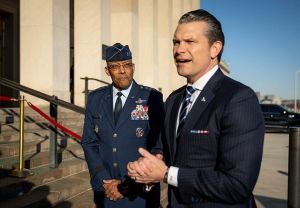
The Senate hearing, which featured five of the nation’s top intelligence officials, including Director of National Intelligence Tulsi Gabbard and CIA Director John Ratcliffe — both of whom were involved in the group chat over the Signal messaging app — was meant be a forum for the nation’s spy chiefs to offer their assessments of the top national security threats facing the nation.
Wednesday Reads: Signalgate and Social Security News
Posted: March 26, 2025 Filed under: Donald Trump, Social Security | Tags: Frank Bisignano, Houthis, Jeffrey Goldberg, John Ratcliffe, Karoline Leavitt, Kash Patel, Mike Waltz, Pete Hegseth, Senator Mark Warner, Signal Ap, Signalgate, The Atlantic, Tulsi Gabbard, Yemen 6 CommentsGood Afternoon!!

Jeffrey Goldberg
This morning The Atlantic’s Editor in Chief Jeffrey Goldberg released the full Signal text exchange that was the top news story all day yesterday. I’m sure you’re familiar with the story, but in case you missed it (unlikely), Goldberg was sent an invitation to a Signal group that included top administration officials. He accepted out of curiosity. Here is the original story published two days ago in The Atlantic (gift article): The Trump Administration Accidentally Texted Me Its War Plans.
And here is today’s article (gift): Here Are the Attack Plans That Trump’s Advisers Shared on Signal.
On Monday, shortly after we published a story about a massive Trump-administration security breach, a reporter asked the secretary of defense, Pete Hegseth, why he had shared plans about a forthcoming attack on Yemen on the Signal messaging app. He answered, “Nobody was texting war plans. And that’s all I have to say about that.”
At a Senate hearing yesterday, the director of national intelligence, Tulsi Gabbard, and the director of the Central Intelligence Agency, John Ratcliffe, were both asked about the Signal chat, to which Jeffrey Goldberg, the editor in chief of The Atlantic, was inadvertently invited by National Security Adviser Michael Waltz. “There was no classified material that was shared in that Signal group,” Gabbard told members of the Senate Intelligence Committee.
Ratcliffe said much the same: “My communications, to be clear, in the Signal message group were entirely permissible and lawful and did not include classified information.”
President Donald Trump, asked yesterday afternoon about the same matter, said, “It wasn’t classified information.”
These statements presented us with a dilemma. In The Atlantic’s initial story about the Signal chat—the “Houthi PC small group,” as it was named by Waltz—we withheld specific information related to weapons and to the timing of attacks that we found in certain texts. As a general rule, we do not publish information about military operations if that information could possibly jeopardize the lives of U.S. personnel. That is why we chose to characterize the nature of the information being shared, not specific details about the attacks.
Pete Hegseth
The statements by Hegseth, Gabbard, Ratcliffe, and Trump—combined with the assertions made by numerous administration officials that we are lying about the content of the Signal texts—have led us to believe that people should see the texts in order to reach their own conclusions. There is a clear public interest in disclosing the sort of information that Trump advisers included in nonsecure communications channels, especially because senior administration figures are attempting to downplay the significance of the messages that were shared.
Experts have repeatedly told us that use of a Signal chat for such sensitive discussions poses a threat to national security. As a case in point, Goldberg received information on the attacks two hours before the scheduled start of the bombing of Houthi positions. If this information—particularly the exact times American aircraft were taking off for Yemen—had fallen into the wrong hands in that crucial two-hour period, American pilots and other American personnel could have been exposed to even greater danger than they ordinarily would face. The Trump administration is arguing that the military information contained in these texts was not classified—as it typically would be—although the president has not explained how he reached this conclusion.
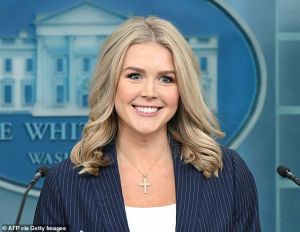
Karoline Leavitt
The Atlantic approached multiple people in the Trump administration, asking if they had objections to the publication of the entire Signal chant. Only press secretary Karoline Leavitt responded:
“As we have repeatedly stated, there was no classified information transmitted in the group chat. However, as the CIA Director and National Security Advisor have both expressed today, that does not mean we encourage the release of the conversation. This was intended to be a an [sic] internal and private deliberation amongst high-level senior staff and sensitive information was discussed. So for those reason [sic] — yes, we object to the release.” (The Leavitt statement did not address which elements of the texts the White House considered sensitive, or how, more than a week after the initial air strikes, their publication could have bearing on national security.)
Here is the relevant part of the text chain:
At 11:44 a.m. eastern time, Hegseth posted in the chat, in all caps, “TEAM UPDATE:”
The text beneath this began, “TIME NOW (1144et): Weather is FAVORABLE. Just CONFIRMED w/CENTCOM we are a GO for mission launch.” Centcom, or Central Command, is the military’s combatant command for the Middle East. The Hegseth text continues:
- “1215et: F-18s LAUNCH (1st strike package)”
- “1345: ‘Trigger Based’ F-18 1st Strike Window Starts (Target Terrorist is @ his Known Location so SHOULD BE ON TIME – also, Strike Drones Launch (MQ-9s)”
- “1410: More F-18s LAUNCH (2nd strike package)”
- “1415: Strike Drones on Target (THIS IS WHEN THE FIRST BOMBS WILL DEFINITELY DROP, pending earlier ‘Trigger Based’ targets)”
- “1536 F-18 2nd Strike Starts – also, first sea-based Tomahawks launched.”
- “MORE TO FOLLOW (per timeline)”
- “We are currently clean on OPSEC”—that is, operational security.
- “Godspeed to our Warriors.”
Read the whole article at The Atlantic. It isn’t very long. Those certainly look like war plans to me. This is a great opportunity for Democrats to fight back against Trump’s rapidly advancing coup. They did an excellent job in the Senate hearing yesterday.
The Washington Post (Gift article): Democrats slam spy chiefs over Trump team’s Signal leak of war plans.
Senate Democrats on Tuesday hammered the Trump administration’s top intelligence officials on how and why the vice president, defense secretary, national security adviser and other top Cabinet members made the “reckless” decision to use a commercial messaging app to discuss secret war plans for Yemen — while also inadvertently including a journalist in the group chat.
Instead, the routine annual hearing before the Senate Select Committee on Intelligence became a staging ground to interrogate the kind of “mind-boggling” behavior that the committee’s top Democrat, Sen. Mark R. Warner (Virginia), said would easily have gotten a lower-ranking military or intelligence officer fired.
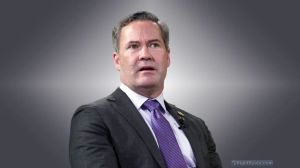
Mike Waltz
In the Signal group chat, convened by national security adviser Michael Waltz, Defense Secretary Pete Hegseth and others reportedly detailed the targets, the attack sequencing and the weapons they would use in a U.S. air attack on Yemen’s Houthis, before the Pentagon launched the strikes on March 15, according to a bombshell report published Monday by the Atlantic.
“If this was the case of a military officer or an intelligence officer, and they had this kind of behavior, they would be fired,” Warner said in his opening remarks at Tuesday’s hearing, noting that in addition to the targeting information, the text chain included the identity of an active CIA officer. “This is one more example of the kind of sloppy, careless, incompetent behavior, particularly toward classified information,” exhibited by the Trump administration, Warner said. “This is not a one-off.”
How is it that “nobody bothered to even check? … Who are all the names?” Warner added.
Gabbard, Ratcliffe and the other government witnesses provided few answers.After Gabbard at first declined to say whether she was involved in the group chat at all, she and Ratcliffe then told senators that the information shared over Signal was not classified. At other times, they denied the details contained in the Atlantic’s reporting or said they could not recall the exact contents of the messages. They repeatedly deferred to Trump’s defense secretary and national security adviser to answer for them.
The deflections triggered an incredulous and angry backlash from the committee’s liberals.
Warner, who accused Gabbard of “bobbing and weaving and trying to filibuster,” demanded repeatedly that she reconcile her conflicting assertions that the information in the text chain was not classified, but also that she was not at liberty to talk about it. “If there are no classified materials, share it with the committee. You can’t have it both ways,” he said.
Well, now it has been shared with everyone, and the Trump officials look exactly as incompetent as we assumed they were. On top of everything else, one of the participants in the Signal chat, special envoy Steve Witkoff, was actually in Moscow waiting to speak to Vladimir Putin, while using his personal cell phone.
More from CBS News: Democrats call Trump intelligence officials’ use of group chat “reckless, sloppy and stunning.”
Director of National Intelligence Tulsi Gabbard and CIA director John Ratcliffe appeared before the Senate Intelligence Committee to testify about global threats facing the U.S. However the annual hearing, which typically focuses on threats posed by China, Russia, Iran, largely concentrated on the lapse.
FBI Director Kash Patel, National Security Agency Director Gen. Timothy Haugh and Defense Intelligence Agency Director Lt. Gen. Jeffrey Kruse also appeared, but received few questions.
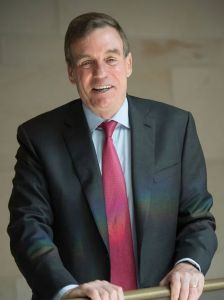
Senator Mark Warner
Sen. Mark Warner of Virginia, the top Democrat on the committee, addressed the controversy at the top of the hearing, calling it “mind-boggling” that none of the intelligence officials in the chat on the encrypted messaging app Signal thought to check who else was included.
“Are these government devices? Were they personal devices? Have the devices been collected to make sure there’s no malware?” Warner said in his opening remarks. “There’s plenty of declassified information that shows that our adversaries, China and Russia, are trying to break into encryption systems like Signal.”
Gabbard and Ratcliffe both denied that classified information was shared in the group chat in a feisty exchange with Warner. Confronted by Warner, Gabbard initially declined to say whether she was part of the chat….
Ratcliffe confirmed to Warner that he was a participant in the message thread, but pushed back on whether the decision to use Signal to communicate was a security lapse. Ratcliffe said Signal was on his CIA computer when he was confirmed as director earlier this year….
Ratcliffe confirmed to Warner that he was a participant in the message thread, but pushed back on whether the decision to use Signal to communicate was a security lapse. Ratcliffe said Signal was on his CIA computer when he was confirmed as director earlier this year. “As it is for most CIA officers,” he said, adding that the agency considers the commercial app “permissible” for work use.
The spy chiefs also denied that the conversation included information on weapons packages, targets or timing of the strikes, as Goldberg reported.
“Not that I’m aware of,” Ratcliffe said, with Gabbard adding “same answer.”
I guess they weren’t paying attention. There’s more at the CBS link.
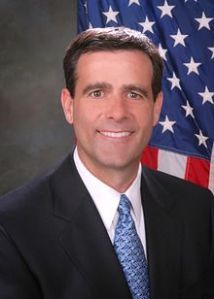
John Ratcliff
Tulsi Gabbard, Kash Patel, and John Ratcliff are appearing before the House Intelligence Committee today. That should be interesting. CBS News: Intel chiefs testify before House committee as new Signal texts emerge.
Director of National Intelligence Tulsi Gabbard and CIA Director John Ratcliffe are back on Capitol Hill to testify before the House Intelligence Committee on Wednesday after new text messages came to light from a group chat in which top Trump officials discussed sensitive plans to strike targets in Yemen.
Shortly before the hearing began, The Atlantic published additional messages showing Defense Secretary Pete Hegseth provided detailed information to the group of senior Trump officials about the strikes, including a timeline of when fighter jets would take off and what kind of weapons would be used. The group inadvertently included Jeffrey Goldberg, the editor in chief of The Atlantic who revealed the first batch of texts earlier this week….
Gabbard and Ratcliffe are appearing Wednesday alongside FBI Director Kash Patel, National Security Agency Director Gen. Timothy Haugh and Defense Intelligence Agency Director Lt. Gen. Jeffrey Kruse at a hearing ostensibly focused on the global security threats facing the U.S. But the Signal leak and its fallout dominated the early portions of questioning.
Rep. Jim Himes of Connecticut, the top Democrat on the committee, chastised the intelligence leaders at the start of the hearing, saying they put the lives of troops at risk.
“Everyone here knows that the Russians or the Chinese could have gotten all of that information, and they could have passed it on to the Houthis, who easily could have repositioned weapons and altered their plans to knock down planes or sink ships,” Himes said.
Gabbard acknowledged that the conversation was “sensitive” but again denied that classified information was shared in the chat.”There were no sources, methods, locations or war plans that were shared,” she told lawmakers, echoing the defense from the White House that “war plans” were not discussed, despite the detailed guidance for an impending attack.
Defense Secretary Pete Hegseth’s texts to a Signal group chat about military operations against the Houthis almost certainly contained classified information, according to current and former Pentagon officials.
The Atlantic on Wednesday released excerpts of a conversation among top national security leaders to which a journalist had accidentally been invited. Hegseth and the White House have denied sharing classified information or war plans.
“This information was clearly taken from the real time order of battle sequence of an ongoing operation,” said Mick Mulroy, a former deputy assistant Defense secretary under the first Trump administration. “It is highly classified and protected.
Hegseth identified the aircraft used and the precise timing of the attacks, according to texts from the group chat, which was started by national security adviser Mike Waltz. That information, if obtained by adversaries, could put U.S. troops in danger.
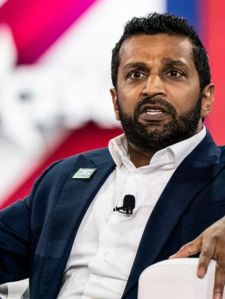
Kash Patel
A current defense official and former Air Force official both said that any forecasting of future operations and planned weapons are almost always classified information. The former and current officials were granted anonymity to speak about a sensitive issue.
Details about future airstrikes and the timing of launches is tightly controlled and usually provided only through classified documents, conversations and in secure email traffic. Few outside of top leadership and those involved usually know about the plans.
“The information that you have fighter aircraft launching off of an aircraft carrier, flying over enemy territory and impending combat operation is the most sensitive information we have at the federal government,” said Sen. Mark Kelly (D-Ariz.), a former Navy pilot, who added it was likely classified.
“Mike Waltz did a boneheaded thing. It was careless. I think what Pete Hegseth did was reckless and dangerous.”
Hegseth should be fired, but Waltz is more likely to be the scapegoat.
President Donald Trump was upset when he found out that National Security Adviser Mike Waltz accidentally included a journalist in a group chat discussing plans for a military strike. But it wasn’t just because Waltz had potentially exposed national security secrets.
Trump was mad — and suspicious — that Waltz had Atlantic editor-in-chief Jeffrey Goldberg’s number saved in his phone in the first place, according to three people familiar with the situation, who were granted anonymity to discuss private conversations. A fourth person said the president was also particularly perturbed by the embarrassing nature of the episode.
“The president was pissed that Waltz could be so stupid,” the person said. (A “Mike Waltz” invited Goldberg to the chat, according to The Atlantic).
But by Tuesday afternoon, the two men had made a show of smoothing things over and the White House was closing ranks around Waltz. Trump conducted brief interviews with both NBC News and Fox News pledging to stand behind his national security adviser. Two top Trump spokespeople suggested in posts on X that national security hawks were colluding with the media to make the issue bigger than it actually was. And Waltz attended a meeting of Trump’s ambassadors Tuesday afternoon.
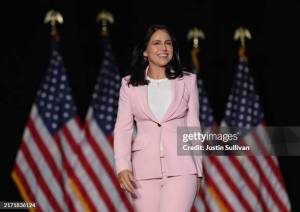
Tulsi Gabbard
“There’s a lot of journalists in this city who have made big names for themselves making up lies … This one in particular I’ve never met, don’t know, never communicated with, and we are looking into and reviewing how the heck he got into this room,” Waltz said during the meeting.
Trump followed up by calling Waltz “a very good man” and suggested he had been unfairly attacked. Yet the president also said he would look into government officials’ use of Signal, the app used in the chat with Goldberg that could have resulted in a security breach as top U.S. officials discussed plans to launch strikes in Yemen.
Still, several Trump allies cautioned this may not be the end of Waltz’s troubles. One of them, who like others was granted anonymity to discuss the sensitive matter, said the incident has strained Waltz’s relationship with Trump’s inner circle.
Brandi Buchman at HuffPost: Pete Hegseth Sued Over Signal Text Debacle.
A public watchdog group sued Defense Secretary Pete Hegseth and a slew of other Trump administration officials Tuesday after a journalist revealed he was inadvertently added to a text chain discussing U.S. war plans.
The lawsuit, brought by the watchdog group American Oversight and first reported by HuffPost, requests that a federal judge formally declare that Hegseth and other officials on the chat violated their duty to uphold laws around the preservation of official communications. Those laws are outlined in the Federal Records Act and, according to lawyers for American Oversight, if agency heads refuse to recover or protect their communications, the national archivist should ask the attorney general to step in.
On Monday, The Atlantic’s editor-in-chief Jeffrey Goldberg reported that national security adviser Michael Waltz inadvertently added him to a Signal group chat with more than a dozen Trump administration officials and aides including Vice President JD Vance, Defense Secretary Pete Hegseth, Secretary of State Marco Rubio, homeland security adviser Stephen Miller and Treasury Secretary Scott Bessent. CIA Director John Ratcliffe told members of the Senate Intelligence Committee on Tuesday that he was also in the Signal chat. Director of National Intelligence Tulsi Gabbard would not admit whether she was a participant, though Goldberg reported she was; instead, she said the matter was “still under review.”
As American Oversight lawyers pointed out in their lawsuit Tuesday, Rubio is also the acting archivist of the United States and, as such, “is aware of the violations” that allegedly occurred.
He is also “responsible for initiating an investigation through the Attorney General for the recovery of records or other redress,” the lawsuit said.
Axios reports that Trump nemesis Judge James Boasberg will preside of the Signalgate lawsuit: Judge who ruled against Trump deportation flights will oversee Signal lawsuit.
Social Security News:
Teresa Ghilarducci at Forbes: Social Security Is Breaking Down— Millions Will Feel It First.
U.S. Commerce Secretary Howard Lutnick recently offered a chilling glimpse into the Trump administration’s indifference to Social Security’s importance. “Let’s say Social Security didn’t send out their checks this month,” Lutnick said, according to Axios. “My mother-in-law, who’s 94, she wouldn’t call and complain.”
Perhaps the commerce secretary’s mother-in-law wouldn’t call. But millions of other Americans would—and not just to complain. They would call because they couldn’t pay rent, buy food, or refill essential medications. Lutnick’s casual comment downplayed the gravity of a missed Social Security check.
The comment also exposed the distance between elites and others. Elites may not care if they miss a Social Security check, but for a typical Americans a missing check is a gut punch. Calls to the Social Security office would be pouring in. But no one may answer.
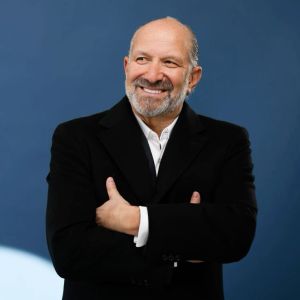
Howard Lutnick
Lutnick’s remarks come during a time when the Social Security system faces record demand and historic strain. And the remarks come during a month of extreme alarm and confusion about the system. Elon Musk demeaned the system publicly, calling it “the biggest Ponzi scheme of all time,” the New York Post reported. Field offices are overrun, wait times are spiking, and staffing levels have been slashed by 12% since 2020, notes The Washington Post. The very system that ensures timely payments to 73 million Americans is being stomped on, and senior citizens and families are feeling anxious and worse.
To be clear, Trump and DOGE have not cut or delayed Social Security checks—yet. The Social Security Administration does not miss checks. In 80 years, it never missed payment….
While Lutnick and others suggest that delays wouldn’t matter, the data tell another story. Social Security is the foundation of retirement security for most American seniors.
According to the Social Security Administration, nearly 90% of Americans over age 65 receive benefits, and those benefits make up an average of 31% of their income. But for many, the reliance is much deeper: 39% of older men and 44% of older women count on Social Security for more than half their income. Even more sobering, 12% of older men and 15% of older women rely on it for at least 90% of their income.
Older women, in particular, are at risk. They tend to earn less over their lifetimes, outlive their spouses, and have less saved for retirement. For them, Social Security is often not just the main source of income—it’s the only source.
The Washington Post (Gift link): Long waits, waves of calls, website crashes: Social Security is breaking down.
Monday Reads
Posted: April 18, 2011 Filed under: jobs, Labor unions, morning reads, Reproductive Rights, Women's Rights, worker rights | Tags: Attacks on Social Security, Bush tax cuts, Gang of Six, global job crisis, HBO, International Monetary Fund, New Orleans, Pete Seeger, Peter Yarrow, Planned Parenthood, Senator Mark Warner, songs of protest, taxes, Treme 43 Comments Good Morning!
I’ve almost gotten shy about going out to search for links these days. Most of the political and economic news is disheartening so I thought I’d try to mix it up today with some good stuff and disheartening stuff. Hopefully, you can find some things to share with us too.
You may want to start out your day arming yourself with “Five Myths about Planned Parenthood” in case any one in your sphere of influence starts spewing some of the ridiculous memes passed around by the right wing. This was in WAPO over the weekend and was written by Clare Coleman worked for America’s best known provider of family planning and health services. I liked number five.
Three million patients each year visit Planned Parenthood’s more than 800 health centers in every state, in big cities and small towns. In some areas, Planned Parenthood and the Title X-funded system are the only sexual health providers for hundreds of miles.
We screen people for high blood pressure, anemia and diabetes; we counsel them about smoking cessation and obesity; we connect them to other primary-care providers and social services. The huge response to the attack on family planning and on Planned Parenthood — hundreds of thousands of Americans signing petitions, showing up at rallies, calling Congress – is extraordinary. But it doesn’t surprise me. One in five American women has gone to Planned Parenthood at some point in her life, for respectful, compassionate, quality care. And now those Americans are going to have our back.
I feel like I’ve turned into an IMF groupie by putting up yet another link to them shortly after featuring one of their studies on the dominance of the finance sector, but here I go again. I do spend time gleaning data from their site so maybe it’s just that I keep bumping into things. The IMF says we have a Global Job Crisis.
At the end of his magnum opus, The General Theory, Keynes stated the following: “The outstanding faults of the economic society in which we live are its failure to provide for full employment and its arbitrary and inequitable distribution of wealth and incomes”.
Not everyone will agree with the entirety of this statement. But what we have learnt over time is that unemployment and inequality can undermine the very achievements of the market economy, by sowing the seeds of instability. In too many countries, the lack of economic opportunity can lead to unproductive activities, political instability, and even conflict. Just look at how the dangerous cocktail of unemployment and inequality—combined with political tension—is playing out in the Middle East and North Africa.
Because growth beset by social tensions is not conducive to economic and financial stability, the IMF cannot be indifferent to distribution issues. And when I look around today, I am concerned in this regard. For while recovery is here, growth—at least in the advanced economies—is not creating jobs and is not being shared broadly. Many people in many countries are facing a social crisis that is every bit as serious as the financial crisis.
Unemployment is at record levels. The crisis threw 30 million people out of work. And over 200 million people are looking for jobs all across the world today.
The jobs crisis is hitting the young especially hard. And what should have been a brief spell in unemployment is turning into a life sentence, possibly for a whole lost generation.
In too many countries, inequality is at record highs.
As we face these challenges, remember what we have accomplished. Under the umbrella of the G20, policymakers came together to avoid a financial freefall and probably a second Great Depression.
Today, we need a similar full force forward response in ensuring that we get the recovery we need. And that means not only a recovery that is sustainable and balanced among countries, but also one that brings employment and fair distribution.
This is part of a speech given by Dominique Strauss-Kahn, Managing Director, International Monetary Fund. He argues that financial sector reform is central to the problem of getting back on track. It’s worth reading the entire thing or you can watch the video here. Occasionally, I remember why I thought it was important to study economics. This is one of those times.
The so-called “Gang of Six” is still anxious to put social security on the bargaining table. I still can’t figure out why every time some politician wants to talk about the Federal Deficit--in this case Senator Mark Warner–they mistakenly include the stand-alone program.
Including Social Security in the Gang of Six package appears to be a concession by Democrats made in exchange for agreement to raise some revenue by Republicans. But liberals in the Senate and House have made clear they will not stand for any cuts to benefits.
The 2012 budget passed by the House on Friday does not include reforms for Social Security. House Budget Committee Chairman Paul Ryan (R-Wis.) instead called for a trigger in the budget whereby the president and Congress would have to propose solutions once the Board of Trustees certifies the program is in trouble. Presidet Obama in his 2012 budget and in a speech last week did not lay out plans to reform Social Security.
Warner said the Gang is “very close” to an agreement that includes spending cuts and tax increases such as be eliminating the home mortgage tax deduction.
“We are going to make everybody mad with our approach,” he said.
Warner made clear he is opposed to the House Republican 2012 budget’s reliance on cuts to Medicare—he called it a “massive transfer of responsibility onto our seniors”– but he did not say how the Gang of Six will approach the massive entitlement program.
Please join me as I scream. How stupid do they think we are?
Ninety-one year old Pete Seeger will be joined by David Amram, 80, and Peter Yarrow, 73 on the stage to inspire young people to be active in political and social justice movements. Yarrow had just returned from a series of rallies in Wisconsin.
The three artist-activists say they are fired up by recent protests — from Egypt to Wisconsin — and by the enthusiasm of their youthful kin, who will join them onstage.
“I do have the feeling that the kind of energy we felt in the ’60s is in the air now,” Mr. Yarrow said. “That energy seems to be reigniting itself.”
That concert should be a treat. It’s nice to see these guys seem to never tire of singing songs of justice. It’s important that a new generation hear these truly American songs. I was interested in reading that many kids and grandkids of these folk singers are now in the family business and may show up on stage with them now and then.
Okay, this is something that kinda surprised me from the WSJ: “Greenspan Steps Up Call to End Bush-Era Tax Cuts”. I still haven’t figure out why any one thinks he’s still relevant, but oh, well. At least, he’s on the right side of this one.
Former Fed Chairman Alan Greenspan is stepping up his call for Congress to let the Bush-era tax cuts lapse.
In an appearance Sunday on ABC’s “Meet the Press,” Mr. Greenspan used his strongest words yet to urge lawmakers to let them expire. The risk of a U.S. debt crisis, he said, is just too big. Mr. Greenspan, who retired from the Federal Reserve in 2006, had endorsed the cuts back in 2001 championed by then-President George W. Bush.“This crisis is so imminent and so difficult that I think we have to allow the so-called Bush tax cuts all to expire. That is a very big number,” he said, referring to how much the U.S. government could save from letting income taxes go back up to levels last seen under former President Bill Clinton.
Mr. Greenspan was talking about re-imposing the taxes for all Americans. The Treasury has estimated that a permanent extension of all the Bush tax cuts would cost $3.6 trillion over the next decade. Allowing taxes to increase on those in the top income brackets would take the cost to the government down to $2.9 trillion, according to White House estimates.
CBS news has done some data gathering on taxes as part of its Tax Day coverage: Wealthy Americans see drop in federal taxes; High-earning Americans pay less in taxes than in previous years; nearly half of U.S. households will pay no income taxes at all.
The Internal Revenue Service tracks the tax returns with the 400 highest adjusted gross incomes each year. The average income on those returns in 2007, the latest year for IRS data, was nearly $345 million. Their average federal income tax rate was 17 percent, down from 26 percent in 1992.
Over the same period, the average federal income tax rate for all taxpayers declined to 9.3 percent from 9.9 percent.
The top income tax rate is 35 percent, so how can people who make so much pay so little in taxes? The nation’s tax laws are packed with breaks for people at every income level. There are breaks for having children, paying a mortgage, going to college, and even for paying other taxes. Plus, the top rate on capital gains is only 15 percent.
There are so many breaks that 45 percent of U.S. households will pay no federal income tax for 2010, according to estimates by the Tax Policy Center, a Washington think tank.
The sheer volume of credits, deductions and exemptions has both Democrats and Republicans calling for tax laws to be overhauled. House Republicans want to eliminate breaks to pay for lower overall rates, reducing the top tax rate from 35 percent to 25 percent. Republicans oppose raising taxes, but they argue that a more efficient tax code would increase economic activity, generating additional tax revenue.

The row of shotguns featured on the first season DVD set of Treme are set to be demolished as blight.
New Orleans is abuzz with the second season of Treme about to start up on HBO. I have to admit that I have not watched it since I’m still working through my dose of PTS from Katrina and the aftermath. However, for those of you that are fans of the show, you can get it now on DVD and you can get a bit of a taste in what’s in store for you in season two from this story from the TP. The show evidently ended last season with the city’s evacuation. That’s something I will NEVER forget. The show has been great for the city, overall and it’s producers have taken on a lot of causes around here including a fight to save some historic properties featured in the series’ promotions. Just thought I’d add some insight into what the production brings to the city including its musicians. Here’s a little drama from Hollywood South.
… production money is being spent daily in New Orleans for locations, for equipment, material, labor and talent. In the first two seasons, for example, about $2 million in music licensing money was paid for the rights to songs by New Orleans artists, alone. Such expenditures — with or without any charity component — are the crux of the real economic relationship between a film company and the community in which it works. It is a straight-up transaction. We come here to shoot a movie. We pay a variety of local vendors, government fees and individuals to do it. And for virtually every other movie shot in Louisiana, that is it — end of story.
Thought I’d end with a treat from Pete Seeger to get you through your coffee:

 peej
peej Carissa
 bostonboomer
 dakinikat
 ecocatwoman
 mablue2
 Mama Lopez
 peggysue22
 quixote
 skydancingguestblogger
 Mona (aka Wonk the Vote)



 Sky Dancing
Recent Comments