Dakinikat survived Hurricane Zeta and got her power back this morning. I heard the storm also hit Georgia pretty hard; its now headed for North Carolina. I hope you’re safe if you’re in Zeta’s path.
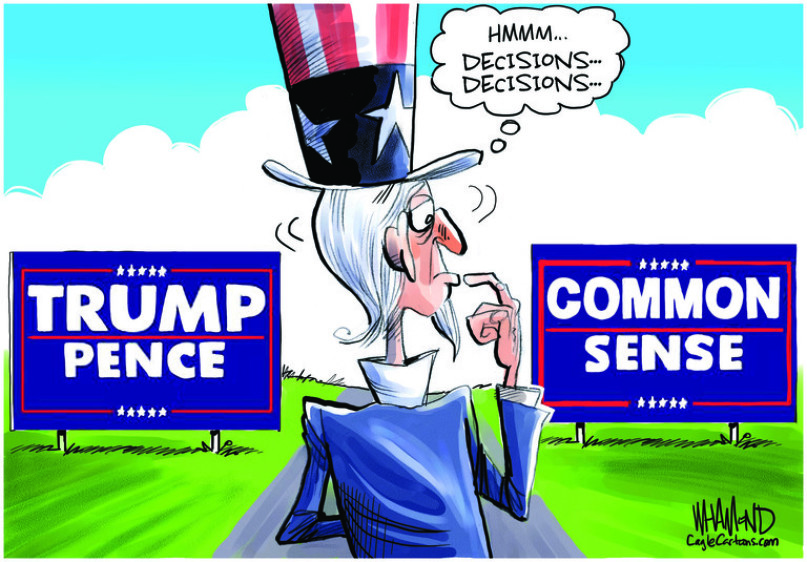
In just five days, voting in the long 2020 election will draw to a close. Joe Biden looks likely to win; but we still have to navigate voter suppression (AKA cheating) by the Trump campaign and the GOP, aided by the U.S. Supreme Court, as well as the possibility that Trump will try to use the Court to overturn the election results if he loses. Nothing less than the health and safety of the American people will depend on the outcome.
In the 2020 election, on top of every routine test of character and capability, the candidates must answer the challenge the coronavirus has brought to this country. Trump’s response has been so lax as to effectively cede the country to a virus whose spread is controllable. He has, by his own admission, repeatedly downplayed the threat after he became aware of how dangerous the new coronavirus could be. He caught the virus himself and seems to have learned nothing from the encounter….
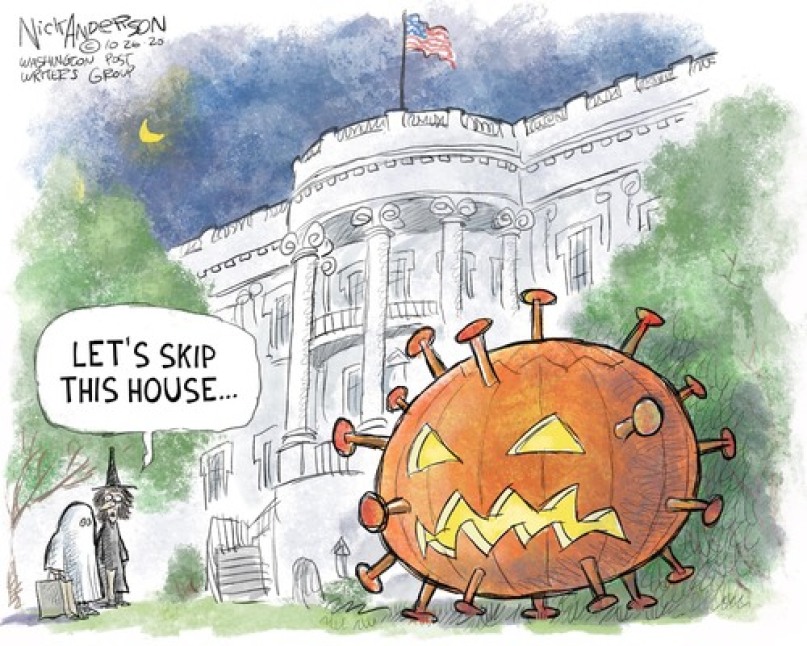
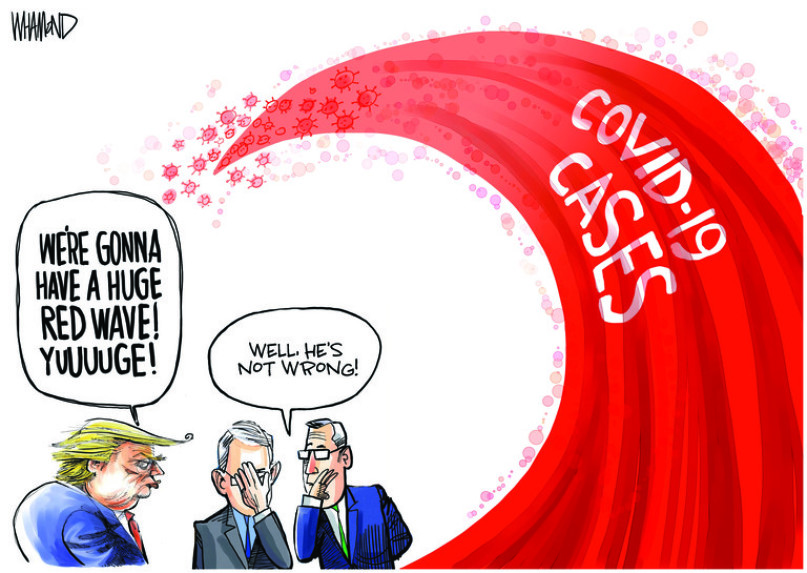
As November nears, the coronavirus is surging again, with cases rising to record-breaking heights for the third time. To control the pandemic, changes are necessary, but Trump has proved that he does not learn from his mistakes—perhaps the most costly of his failings. If he is reelected, he will continue on the same path, and so will the coronavirus. More Americans will be sickened, disabled, and killed. Donald Trump is unchanging; the election offers an opportunity for the country to change instead.
The near-term future is already set. Trump has repeated the lie that numbers are spiking because the U.S. tests extensively; in fact, the climbing cases have far outpaced the rise in testing, and are due instead to the rapidly spreading virus. Thanksgiving and Christmas are approaching. Several generations of family members will gather in indoor spaces for prolonged periods of close proximity and spirited conversation—the very conditions in which the coronavirus most readily spreads….
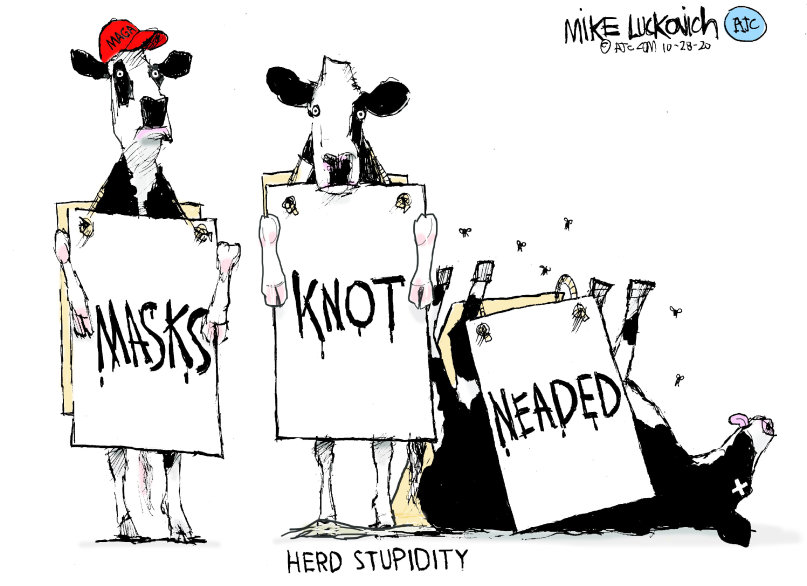
As I wrote last month, there is a real risk that Americans will become habituated to this horror, and that COVID-19 will become another unacceptable thing that the U.S. learns to accept. That is all but inevitable if Trump wins a second term. His administration has given no indication that it will dramatically change its strategy. If anything, it has doubled down. It is allowing the virus to freely spread among younger people in the hopes of reaching herd immunity—an unfeasible strategy that has been widely panned by the scientific community. Such a strategy could leave millions dead, and many others with chronic illness.
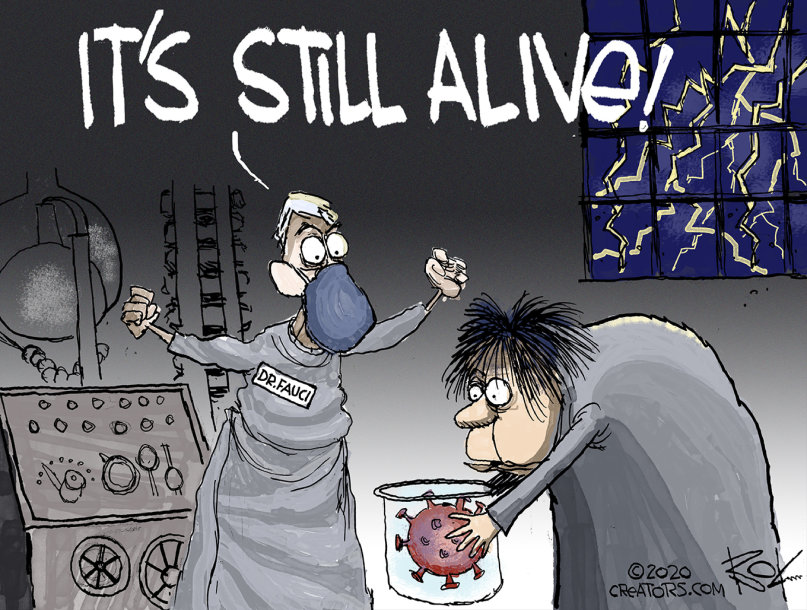
It’s quite clear now that Trump has decided to let the virus run rampant, believing falsely that this will lead to “herd immunity.”
Despite publicly downplaying it, President Donald Trump and his team of White House advisers have embraced the controversial belief that herd immunity will help control the COVID-19 outbreak, according to three senior health officials working with the White House coronavirus task force. More worrisome for those officials: they have begun taking steps to turn the concept into policy.
Officials say that White House adviser Scott Atlas first started pushing herd immunity this past summer despite significant pushback from scientists, doctors and infectious disease experts that the concept was dangerous and would result in far more Americans getting sick and dying. Since then, various White House advisers have tried to play down the idea that the administration has implemented a strategy for COVID-19 based on herd immunity, which holds that if enough people contract a disease and become immune from it, then future spread among the broader population will be reduced.
Trump and Atlas publicly claim that they aren’t pushing this disastrous strategy, but it’s pretty clear that’s what’s happening. Experts say the policy could lead to between 2 and 5 million deaths in the U.S. In addition, many people who survive the Covid-19 develop long-term health problems.
Though Atlas insists he has not pushed “herd immunity,” another official said Atlas actually began advocating for the concept—and the president became receptive to it—at the same time as task force officials were being sidelined from conversations about how the administration planned to handle what many predicted would be a difficult fall season. Since then, officials said, the White House has been largely focused on getting a vaccine out to the American people and has left the fight against the community spread to one task force official: Dr. Deborah Birx. Birx, the White House task force coordinator, has been on the road for months trying to convince Americans to wear masks and social distance.In her absence, and with the task force meeting less regularly, Atlas has thrived as a presidential confidant.
“This is all Atlas,” said one of the officials who spoke with The Daily Beast. “I find it disturbing… bordering on ludicrous. Everything that comes out of Atlas’ mouth is geared towards letting it rip and then just worry about protecting the vulnerable. Everything he says points to the fact that he believes herd immunity is a good option. Yet he denies he’s pushing herd immunity as a strategy saying ‘No that’s not what I’m doing.’ But he is.”
As an immense new surge in coronavirus cases sweeps the country, President Trump is closing his re-election campaign by pleading with voters to ignore the evidence of a calamity unfolding before their eyes and trust his word that the disease is already disappearing as a threat to their personal health and economic well being.
The president has continued to declare before large and largely maskless crowds that the virus is vanishing, even as case counts soar, fatalities climb, the stock market dips and a fresh outbreak grips the staff of Vice President Mike Pence. Hopping from one state to the next, he has made a personal mantra out of declaring that the country is “rounding the corner.”
Mr. Trump has attacked Democratic governors and other local officials for keeping public-health restrictions in place, denouncing them as needless restraints on the economy. And venting self-pity, the president has been describing the pandemic as a political hindrance inflicted on him by a familiar adversary.
“With the fake news, everything is Covid, Covid, Covid, Covid,” Mr. Trump complained at a rally in Omaha on Tuesday, chiding the news media and pointing to his own recovery from the illness to downplay its gravity: “I had it. Here I am, right?” [….]
As a political matter, the president’s approach amounts to an Obi Wan-like attempt to wave his hand before the electorate and tell voters that they are not experiencing a pandemic that is tearing through their neighborhoods and filling hospitals. His determination to brush aside the ongoing crisis as a campaign issue has become the defining choice of his bid for a second term and the core of his message throughout the campaign’s endgame.
This kind of insanity only works with Trump’s brainwashed cult followers. It really does look like Biden will win by a lot, although I won’t be able to let myself believe it until the votes are counted.
Former Vice President Joe Biden leads President Donald Trump by more than 10 points in a national poll by researchers at the University of Texas Dallas. Fielded a few weeks prior to Election Day, the poll is among recent ones finding Biden with a steady lead.
The poll — which included 2,500 respondents — is one of several recent surveys showing Biden ahead of Trump at the national level. It was fielded online between October 13 and October 26, with many of the responses coming in by October 17. The survey has a sampling margin of error of plus or minus 2 percentage points, and its results included a broad sample of respondents that have not been weighted for likely voters.
Overall, the survey finds broader support for Biden from some demographic groups than former Democratic nominee Hillary Clinton received in 2016 exit polls. Among both men and white respondents overall, in particular, Biden’s backing in the UT Dallas survey is stronger. Fifty-four percent of men in the poll say they back Biden, compared to 41 percent who said they supported Clinton in a 2016 exit poll. Similarly, 44 percent of white respondents say they back Biden, compared to 37 percent who said they supported Clinton.
Read the rest at Vox.
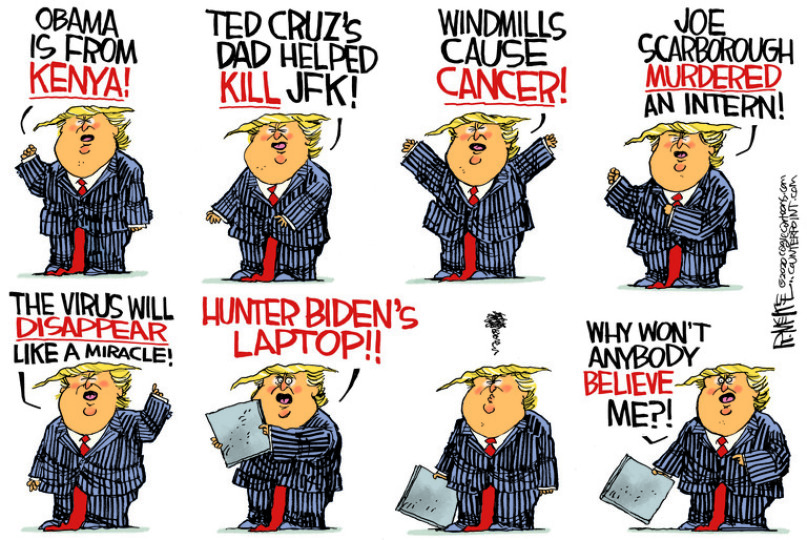
Toluse Olorunnipa at The Washington Post: As Election Day nears, Trump ponders becoming one thing he so despises: A loser.
Trailing in the polls and with little time left to change the trajectory or closing themes of the presidential race, President Trump has spent the final days of the campaign complaining that the coronavirus crisis is getting too much coverage — and openly musing about losing.
Trump has publicly lamented about what a loss would mean, spoken longingly of riding off into the sunset and made unsubstantiated claims that voter fraud could cost him the election. He has sarcastically threatened to fire state officials if he doesn’t win and excoriated his rival Joe Biden as someone it would be particularly embarrassing to lose to.
“If I lose, I will have lost to the worst candidate, the worst candidate in the history of presidential politics,” Trump said at an Oct. 17 campaign rally in Janesville, Wis. “If I lose, what do I do? I’d rather run against somebody who’s extraordinarily talented, at least, this way I can go and lead my life.”
The president, who said at the same rally that “we’re not going to lose, we’re going to win,” has certainly not abandoned his showman’s approach to the campaign trail. But his unscripted remarks bemoaning a potential loss — and preemptively explaining why he might suffer one — offer a window into his mind-set as he barnstorms the country in an attempt to keep himself from becoming the one thing he so derisively despises: a loser.
Trump has told rallygoers he had the presidential race won until the pandemic hit, and he has accused media outlets of focusing on the ongoing health crisis to hurt him politically.
Read more at the WaPo.
Trump has also suggested at his rallies that he might have to leave the country if he loses. This is pretty wild but, at this point, anything is possible:
Earlier this month, at a campaign rally in Macon, Georgia, President Donald Trump mused aloud to the crowd about what he might do if he loses the election on November 3. “Maybe I’ll have to leave the country, I don’t know,” Trump said.
Was the statement merely a sour-grapes throwaway line by a cantankerous candidate facing potential defeat? Or was it a signal that Trump might actually abandon—some would say flee—our shores and seek refuge elsewhere if he is routed by a Joe Biden victory?
During my long military intelligence career I spent countless hours with my peers working on diverse “What if … ?” contingency scenarios in complex locales such as the Balkans and Afghanistan. In these intensely personal environments, where clan or tribal loyalty is paramount, local and regional leaders, often with links to organized criminal activities and enabling transnational networks, could be dangerously unpredictable. Judging from the array of personality traits gleaned from these and numerous other experiences, and correlating them to his current circumstances, to me Trump appears to be a classic flight risk.
Setting aside for the moment his conduct as president, Trump faces a financial and legal reckoning of immense proportions as soon as he leaves office. If he loses, he will no longer have protection from an avalanche of charges and lawsuits against him, his family and the Trump Organization. His years of alleged tax evasion will be officially scrutinized—and far more publicly than before he held office. He will no longer be able to claim (falsely) that his taxes are still “under audit” and unavailable. Trump properties and investments could be frozen, seized or plummet in value. The true nature of his extraordinary personal financial debt—recently reported as $421 million—will be exposed, and his likely foreign creditors revealed. Surely adding to his worries was the announcement on October 15 by the Internal Revenue Service that it is indicting Robert Brockman, a wealthy Houston software magnate, in its largest tax-fraud case ever. The action against Brockman shows that the IRS is not afraid to go after big fish who attempt to circumvent their tax obligations.
Read the rest. It’s interesting.
I’ll add more links in the comment thread. Hang in there, Sky Dancers; only a few more days until we get some answers about our future as a country.
Did you like this post? Please share it with your friends:
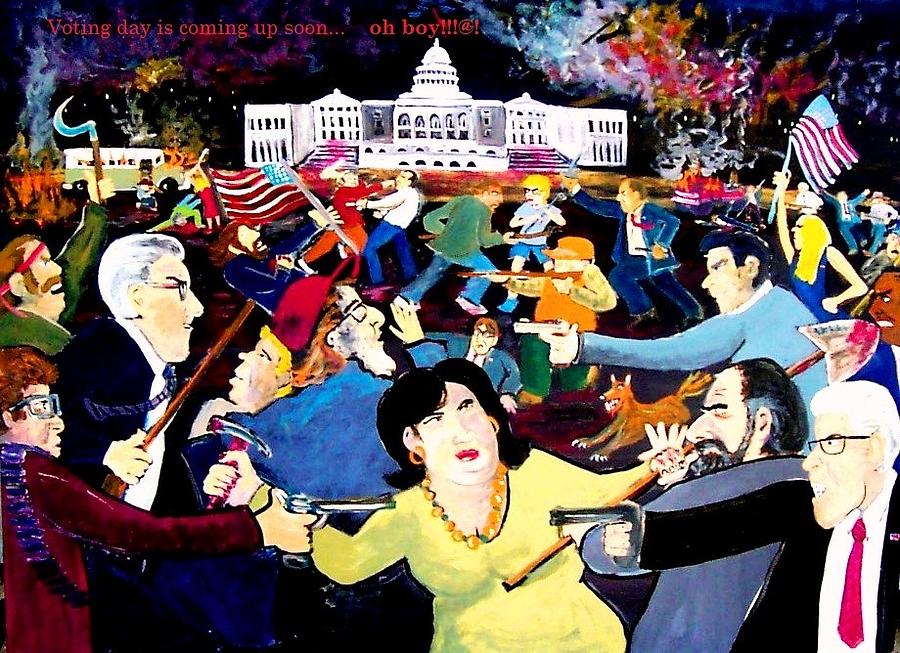
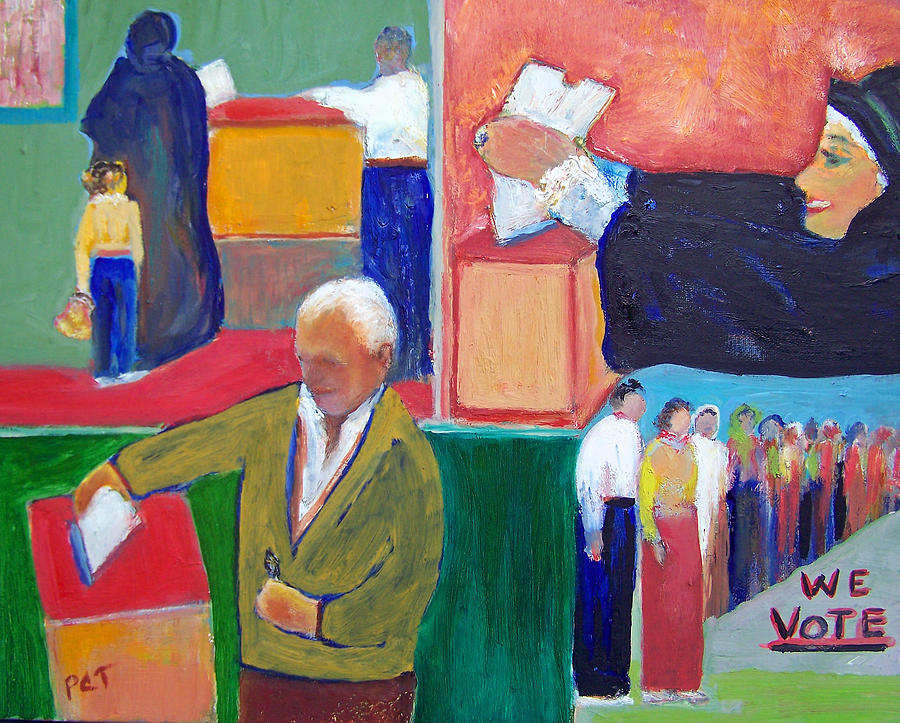
Voting Day Coming Up Soon Oh Boy Painting by Richard Hubal
Election day is one week away. I haven’t slept normally since the pandemic began, and–along with millions of other Americans–I’ve been stressed out since Trump was elected. It’s exhausting. I honestly don’t think I can survive another four years of this insanity. The polls are looking good for Biden; but as of yesterday we now have to worry about the possibility that the Supreme Court could overturn the election results if Trump loses.
Although George W. Bush prevailed in the Bush v. Gore decision, it’s often forgotten that the Supreme Court declined to affirm his chief legal argument. This claim was so radical, so contrary to basic principles of democracy and federalism, that two conservative justices stepped back from the brink. Instead, the majority fabricated a novel theory to hand Bush the election—then instructed lower courts never to rely on it again.
But the court has changed. Republican lawmakers revived the original Bush v. Gore argument in fraught election cases this year, and, following Amy Coney Barrett’s nomination, four sitting justices appeared to endorse it. Barrett’s confirmation on Monday will almost certainly tip the balance to make that argument the law of the land on the eve of an election. The result would be an immediate invalidation of thousands of disproportionately Democratic ballots in Pennsylvania and North Carolina—two swing states that could decide the outcome of the election. Put simply, Barrett’s first actions on the court could hand Donald Trump an unearned second term, and dramatically curtail states’ ability to protect the right to vote….
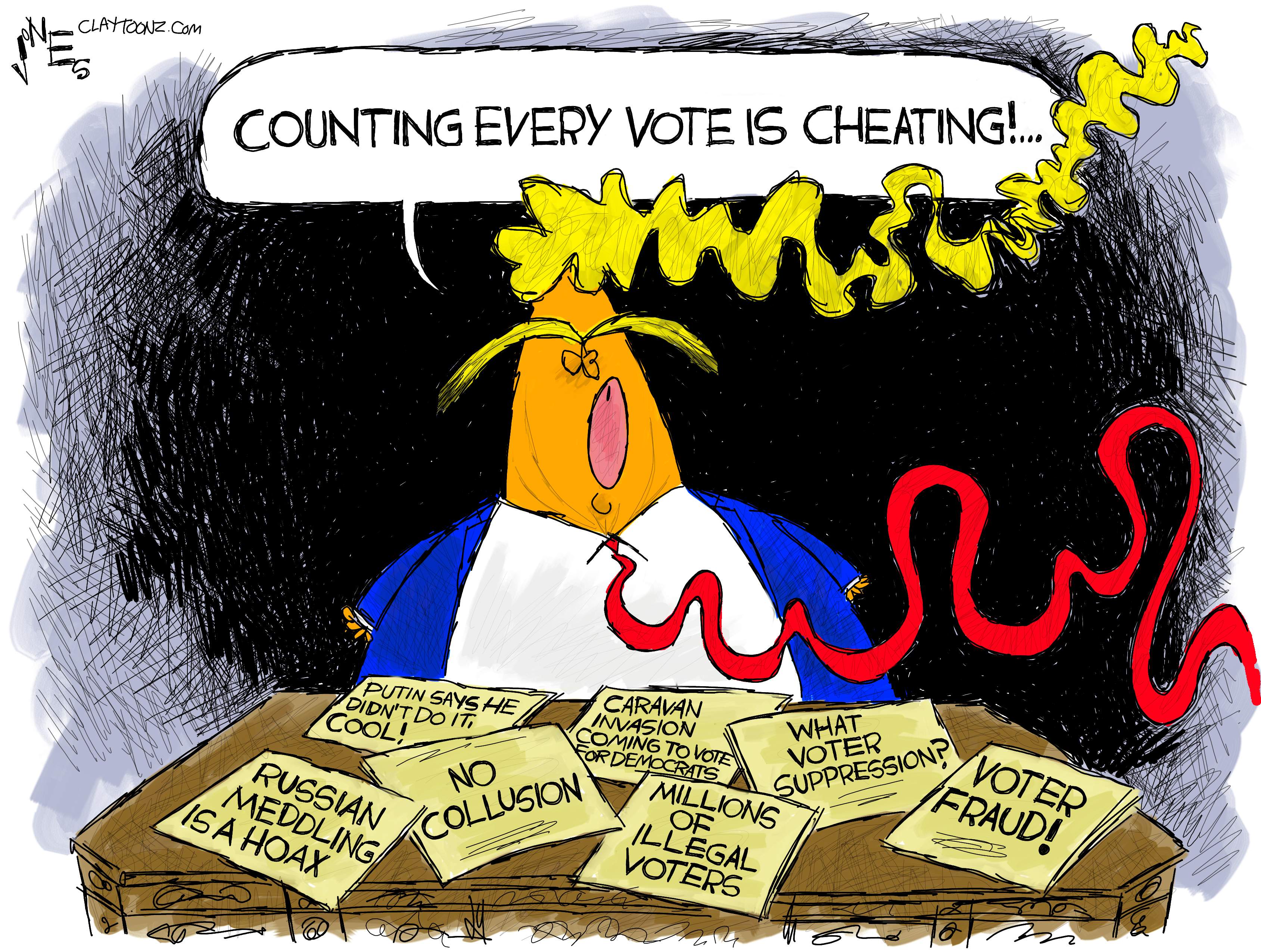
In an unsigned opinion that allegedly spoke for the five conservative justices, the court held that Florida’s recount used procedures that violated “the equal dignity owed to each voter.” Because the standards used to recount ballots varied between counties, the court concluded, the process violated the U.S. Constitution’s equal protection clause. Then, in an unprecedented move, the court declared that this analysis was a ticket good for one ride only, and that lower courts should never invoke its made-up principle again.
The reason the Court said this argument shouldn’t be used again is that is took away a state’s ability to control it’s own elections. If repeated, the argument would turn the SCOTUS into a national arbiter of election laws.
It is black letter law that state courts hold ultimate authority to determine the meaning of their own state’s statutes and constitution. And the Florida Supreme Court had simply provided its best interpretation of a “legal vote” under Florida law. Secretary of State Katherine Harris rejected ballots with “hanging chads” on which voters had indicated their preference but failed to punch through the hole all the way. The Florida Supreme Court disagreed, citing a state statute that required the counting of defective ballots “if there is a clear indication of the intent of the voter.” Federal judges had a constitutional obligation to accept that (eminently plausible) reading of the law. By refusing to do so, Rehnquist, along with Scalia and Thomas, impermissibly substituted the Florida Supreme Court’s judgment with their own.
The Supreme Court refused on Monday to revive a trial court ruling that would have extended Wisconsin’s deadline for receiving absentee ballots to six days after the election.
2008 voting line, by Charly Palmer
The vote was 5 to 3, with the court’s more conservative justices in the majority. As is typical, the court’s brief, unsigned order gave no reasons. But several justices filed concurring and dissenting opinions that spanned 35 pages and revealed a stark divide in their understanding of the role of the courts in protecting the right to vote during a pandemic.
The ruling was considered a victory for Republicans in a crucial swing state, which polls have shown Mr. Trump trailing in after winning by about 23,000 votes in 2016.
By confirming Barrett on Monday, Senate Republicans may well create a five-justice majority that is ready, willing, and able to make Rehnquist’s position the law of the land. There are currently two cases pending before SCOTUS that ask the justices to nullify thousands of mail ballots in Pennsylvania and North Carolina. Both rest on Rehnquist’s Bush v. Gore concurrence. Both give the far-right majority a chance to stomp on states’ ability to protect voting rights.
I urge you to go read the whole piece at Slate. Right now, Massachusetts rules allow votes to be counted if they arrive 6 days after the election and are postmarked by November 3. Will the SCOTUS decision in Wisconsin also force Massachusetts and other states to throw out ballots received after election day?
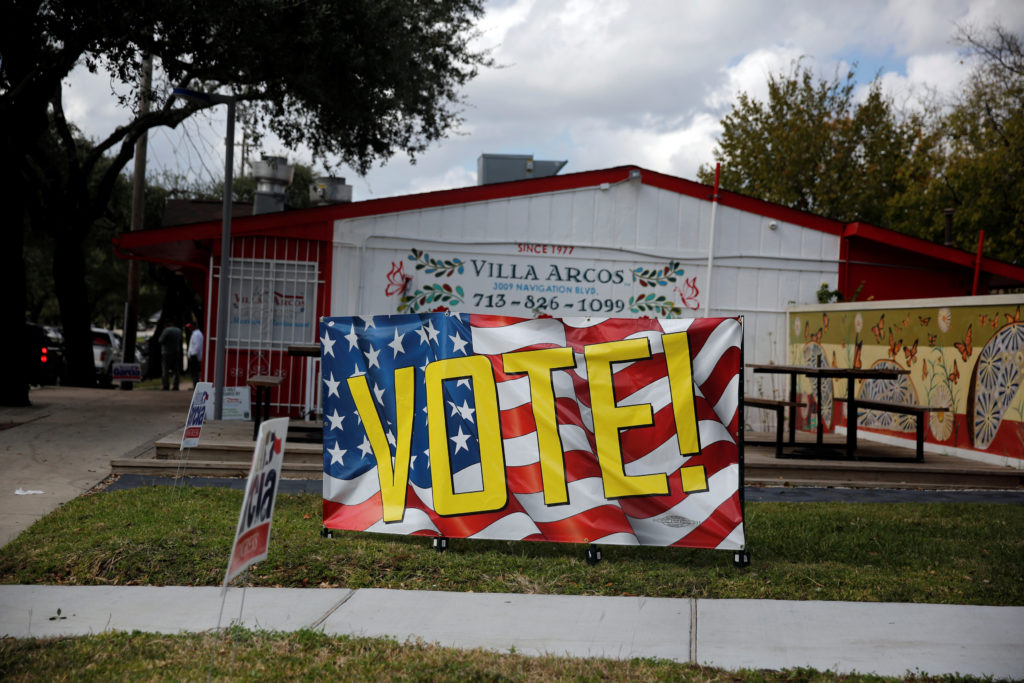
A 2918 banner urging people to vote in the midterm elections displayed in Houston, Texas. REUTERS/Cathal McNaughton
The ruling, which was decided by a 5-3 vote along party lines, is not especially surprising. The lower court determined that an extension was necessary to ensure that voters could cast their ballot during a pandemic, but the Court has repeatedly emphasized that federal courts should defer to state officials’ decisions about how to adapt to the pandemic. Monday night’s order in Democratic National Committee is consistent with those prior decisions urging deference.
What is surprising, however, is two concurring opinions by Justices Neil Gorsuch and Brett Kavanaugh, each of which takes aim at one of the most foundational principles of American constitutional law: the rule that the Supreme Court of the United States has the final word on questions of federal law but the highest court in each state has the final word on questions of state law.
This division of power is implicit in our very system of government. As the Supreme Court has explained, the states and the federal government coexist in a system of “dual sovereignty.” Both the federal government and the states have an independent power to make their own law, to enforce it, and to decide how their own law shall apply to individual cases.
If the Supreme Court of the United States had the power to overrule a state supreme court on a question of state law, this entire system of dual sovereignty would break down. It would mean that all state law would ultimately be subservient to the will of nine federal judges.
With Barrett on the Court,
last week’s decision allowing a Pennsylvania Supreme Court decision to stand could be very short-lived. That decision, after all, was 4-4, with Chief Justice John Roberts voting with the Court’s three liberals. With Barrett, the Court’s right flank may well be getting a fifth vote to toss out the state supreme court’s decision — and to order an unknown number of ballots tossed out in the process.
In her first few weeks at SCOTUS, Barrett will also have the opportunity to vote on cases involving the Affordable Care Act, Trump’s taxes, abortion, and a case about whether a Catholic agency can refuse to place foster children with LGBT couples.
The only recourse for Democrats in the future may be to increase the size of the Supreme Court–if they can take the Senate, that is.
At The Los Angeles Times, Nicholas Goldberg sees a possible silver lining in the Barrett confirmation:
So now it is official: The same Republican senators who in 2016 refused to consider Merrick Garland’s appointment to the Supreme Court because, with eight months to go, it was supposedly too close to the presidential election, have now confirmed Amy Coney Barrett with just eight days left before the election.
This is so unprincipled, so inconsistent and so cynical that it defies the imagination. It is the flip-flop of the century, undertaken by the Republicans for one reason: Barrett’s confirmation ensures a conservative majority on the high court for the foreseeable future.
But here is one good thing that could come of this shameful episode. With millions of people still casting their votes before Nov. 3, perhaps the Barrett confirmation will open Americans’ eyes, once and for all, and show them who they’re dealing with. Perhaps it will persuade them to reject the radical and hypocritical Senate Republicans at the polls.
Barrett’s confirmation, after all, is only one of many irresponsible moves by the Senate majority, led by the craven Mitch McConnell (R-Kentucky), who long ago threw his lot in with President Trump. In recent years, he and his caucus have grown not just more extreme in their ideology but more unscrupulous in their tactics.
Not only did they refuse a hearing to Garland (giving that seat instead to Trump appointee Neil M. Gorsuch), but not long after, McConnell and his colleagues rammed Brett Kavanaugh’s nomination through without a comprehensive investigation of the sexual assault allegations against him.
Voting Line, by Charly Palmer
Maybe. It seems unlikely that many votes are going to change at this late date, but I hope Goldberg is right. On the other hand, it’s possible the evidence that the pandemic is getting worse might influence some voters to reject Trump and other Republicans.
What happened in the Senate chamber on Monday evening was, on its face, the playing out of a normal, well-established process of the American constitutional order: the confirmation of a president’s nominee to the Supreme Court.
But Senate Republicans, who represent a minority of the American people, are straining the legitimacy of the court by installing a deeply conservative jurist, Amy Coney Barrett, to a lifetime seat just days before an election that polls suggest could deal their party a major defeat.
As with President Trump’s two earlier nominees to the court, Neil Gorsuch and Brett Kavanaugh, the details of Judge Barrett’s jurisprudence were less important than the fact that she had been anointed by the conservative activists at the Federalist Society. Along with hundreds of new lower-court judges installed in vacancies that Republicans refused to fill when Barack Obama was president, these three Supreme Court choices were part of the project to turn the courts from a counter-majoritarian shield that protects the rights of minorities to an anti-democratic sword to wield against popular progressive legislation like the Affordable Care Act.
The process also smacked of unseemly hypocrisy. Republicans raced to install Judge Barrett barely one week before a national election, in defiance of a principle they loudly insisted upon four years ago.
I hope you’ll read the whole thing, but here’s a bit more:
Of all the threats posed by the Roberts Court, its open scorn for voting rights may be the biggest. In 2013, Chief Justice John Roberts wrote the lead opinion in the most destructive anti-voter case in decades, Shelby County v. Holder, which gutted the central provision of the Voting Rights Act and opened the door to rampant voter suppression, most of it targeted at Democratic voters. Yet this month, Chief Justice Roberts sided with the court’s remaining three liberals to allow a fuller count of absentee ballots in Pennsylvania. The four other conservatives voted against that count. In other words, with Justice Barrett’s confirmation the court now has five justices who are more conservative on voting rights than the man who nearly obliterated the Voting Rights Act less than a decade ago.
I hope I haven’t ruined your day with this post, but the Barrett confirmation is clearly the most important issue of the day. I can only hope that the outcome of next week’s election will be a landslide that prevents SCOTUS from overturning the results.
Please take care today and protect your health and sanity over the next week. I hope you’ll stop by and leave a comment or two.
Did you like this post? Please share it with your friends:
Artist Suzanne Valadon and her son Maurice Utrillo
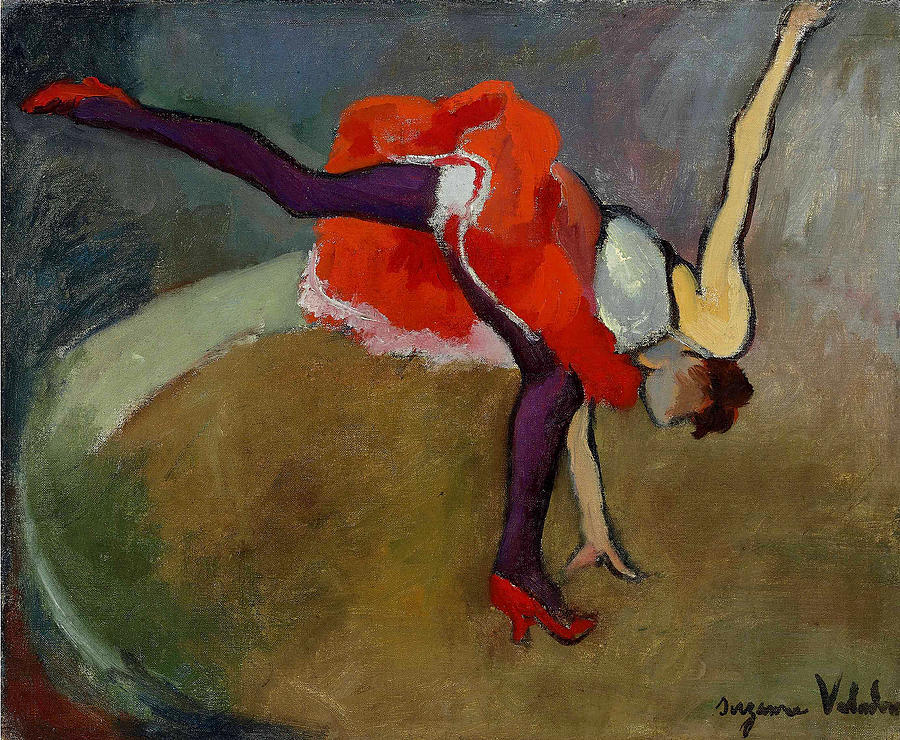
NOTE: The paintings in today’s post are by Suzanne Valadon, artists’ muse, self-taught painter, and mother of another famed artist.
I’m grateful to Dakinikat for covering the Senate hearing on Amy Coney Barrett’s nomination to SCOTUS. I’m not going to spend much time on it today, because her confirmation is pretty much a forgone conclusion. It’s horrible, but we are just going to have to deal with it somehow.
Sen. Amy Klobuchar (D-Minn.) acknowledged on Monday that Democrats do not have “some secret, clever, procedural way to stop” the confirmation of Amy Coney Barrett to the Supreme Court, arguing that the only way for Americans to “change the trajectory of this nomination” is by voting.
The big picture: Klobuchar and other Democrats on the Senate Judiciary Committee used day one of Barrett’s confirmation hearings to criticize the process of rushing through a nomination after voting in the 2020 election has already begun, attacking it as a “sham” and “illegitimate.”
— They also painted Barrett’s confirmation as a proxy fight for health care, with a number of Democratic senators displaying posters of constituents who have benefited from protections under the Affordable Care Act.
— The Supreme Court is set to hear a case seeking to invalidate the ACA on Nov. 10. Klobuchar argued that “you don’t have to be a lawyer or a senator to figure out” that Barrett was nominated to help President Trump overturn the Affordable Care Act.
What they’re saying: “My point today is, you cannot divorce this nominee from the moment we’re in, in time. And that we do not have some secret, clever, procedural way to stop this sham. Let’s be honest,” Klobuchar told reporters after Monday’s hearing.
— “And as good as we are, it’s probably not going to be some brilliant cross-examination that is going to change the trajectory of this nomination, but there is one thing that will. And that is the people of this country, that is them voting, that is them understanding exactly what the Republican Party and this administration are doing right now and how it’s going to affect their lives.”
— “Because this is not Donald Trump’s country. This is your country, America’s country, and this should not be Donald Trump’s judge. It should be your judge.”
So what are the likely consequences of Barrett being elevated to SCOTUS?
Some have predicteda Handmaid’s Tale-esquefuturein which women are forced to bear children. Meanwhile, anti-abortion groups have begun quietly preparing for a baby boom once all Americans are forced to carry their pregnancies to term.
But the reality is that overturning Roe won’t end abortion in America. What it will end, across much of America, is legal abortion.
That will have devastating consequences for many people, especially low-income Americans and people of color in red states where the fall of Roe would likely shut down the few remaining clinics. “This is already an abortion desert,” Laurie Bertram Roberts, the executive director of the Mississippi Reproductive Freedom Fund, told Vox. If Roe falls, “you’re just talking about an abortion wasteland.”
But that doesn’t mean people who want to end a pregnancy would be completely without options. Abortion funds around the country would continue their work, in some cases helping patients travel to blue states to get the procedure. Community-based providers, who perform abortions outside the official medical system, would likely continue to operate. And self-managed abortion, in which people perform their own abortions with pills, would take a bigger role.
Preparing for that reality will require a lot from advocates and providers, from raising money to campaigning against laws that can send people to jail for self-managing an abortion. But people have been ending their pregnancies in America since long before Roe v. Wade or even abortion clinics existed, and a court decision isn’t going to stop them. It’s just going to change what their options — and the risks involved — look like.
In the midst of a pandemic, on the eve of an election, with yet another challenge to the Affordable Care Act coming before the Supreme Court next month, it’s no surprise that Democrats decided to focus on the future of the health-care law at the confirmation hearings for nominee Amy Coney Barrett.
After all, if you’re waging a losing battle over a court seat, you might as well get some electoral mileage out of it. So the array of glossy photographs that confronted Barrett as the hearings unfolded, featuring individual after individual whose health depends on the continuing protections of the ACA, was no doubt good politics.
As a matter of substance, not so much. Barrett’s nomination is about so much more than a law that has already survived two challenges and is likely, even with a Justice Barrett on the court, to survive this one.
Read Marcus’ detailed argument at the WaPo.
In other news, Trump held a superspreader rally in Florida last night, even though he could still be contagious.
Though Trump has declared himself now “immune” to the virus — which has killed more than 214,000 Americans and infiltrated the White House — he and his team have not clarified for the public the last time he tested negative before his covid-19 diagnosis was announced Oct. 2. This has raised questions about whom Trump may have infected before isolating himself at the White House and then at Walter Reed National Military Medical Center.
Woman with a double bass, 1908
On Monday afternoon, however, Trump’s doctor, Sean P. Conley, said in a memo released by the White House that the president had tested negative for the virus “on consecutive days,” using the Abbott rapid testing machine, and was no longer contagious.
The Abbott antigen test produces quick results but has a greater chance of false negatives than the more reliable polymerase chain reaction, or PCR, test. Conley said other diagnostic factors were considered when determining that the president did not pose a threat to others.
Either Trump is afraid to take the more accurate PCR test, or he tested positive on it and the White House is covering it up.
Some of Trump’s aides and associates initially hoped that his coronavirus diagnosis would help focus him on the pandemic, allowing him to emerge as a sympathetic figure with a newfound sense of seriousness and empathy.
That, so far, has not happened.
“The cure cannot be worse than the problem itself can. The cure cannot be worse,” Trump told the Sanford crowd — many of whom were not wearing masks — referring to public health restrictions in many states. “But if you don’t feel good about, if you want to stay, stay relaxed, stay. But if you want to get out there, get out. One thing with me, the nice part, I went through it. Now they say I’m immune . . . I feel so powerful.”
Since contracting the virus, Trump has remained dismissive of the threat posed by the pandemic, reappearing in public seemingly invigorated by his survival. He has doubled down on his push for reopening the country while continuing to discount social distancing and other public health practices.
In the real world, we’re still living through a global pandemic, and the U.S. still leads world in cases and deaths. Coronavirus news:
The study of Johnson & Johnson’s Covid-19 vaccine has been paused due to an unexplained illness in a study participant.
The Blue Room, Suzanne Valadon, 1923
A document sent to outside researchers running the 60,000-patient clinical trial states that a “pausing rule” has been met, that the online system used to enroll patients in the study has been closed, and that the data and safety monitoring board — an independent committee that watches over the safety of patients in the clinical trial — would be convened. The document was obtained by STAT.
Contacted by STAT, J&J confirmed the study pause, saying it was due to “an unexplained illness in a study participant.” The company declined to provide further details….
J&J emphasized that so-called adverse events — illnesses, accidents, and other bad medical outcomes — are an expected part of a clinical study, and also emphasized the difference between a study pause and a clinical hold, which is a formal regulatory action that can last much longer. The vaccine study is not currently under a clinical hold. J&J said that while it normally communicates clinical holds to the public, it does not usually inform the public of study pauses.
When Donald Trump checked into Walter Reed medical center more than a week ago, it appeared likely to have marked the beginning of the end stage of his presidency. But it was also a milestone for the pandemic, and not just because COVID-19 had infected its most prolific and prominent skeptic and dissembler. In recent weeks, a third wave of the coronavirus has come to the U.S. at almost precisely the time of year scientists warned us about in the spring. But the country has hardly noticed, so paralyzed and preoccupied by the spectacle of the presidential campaign it could barely acknowledge any new cases but Trump’s. There were nearly 50,000 new U.S. infections reported on the day the president was hospitalized, along with 835 new deaths. That’s two 747 crashes’ worth.
Suzanne Valadon: Portrait of Maurice Utrillo 1883-1955, his Grandmother and his Dog, 1910
When the country passed 100,000 deaths, a spectacularly bleak edition of the New York Times marked the occasion with a six-column headline for a flood of obituaries that ran the full length of the front page (and onto several additional pages). When the toll passed 200,000, it did not even mark the tragic landmark on A1. They are running out of hospital beds in Wisconsin — which used to qualify as a battleground state, incidentally — and in North Dakota, which hasn’t imposed a mask mandate, they are down to 39 open ICU spots. But while the pandemic does indeed appear to be getting worse almost everywhere in the country, it also seems unlikely to return to the center stage of America’s attention until after Election Day — at which point perhaps 25,000 more Americans might have died.
But things won’t really change immediately after November 3, either. The apparent collapse of last-minute stimulus negotiations means that our sclerotic Congress won’t likely extrude any meaningful pandemic relief until January 20. There also won’t be a national testing program erected, or a federal contact-tracing system belatedly instituted, or, probably, a vaccine or novel therapeutics in wide distribution before the next presidential inauguration, either. At which point there might be 100,000 more American deaths than there are today, each a tragedy unfolding amid a considerably uglier humanitarian catastro phe — poverty and hunger, evictions and loss of health insurance, mass joblessness without commensurate federal support — than the pandemic has produced to this point. In other words, the third wave will likely be worse, nationally, than the first; much less buffered by political action and support, at least on the federal level; and, as long as the election eclipses the full attention of the news media, many times less salient. We’ve already tuned it out, and nothing is likely to help anytime soon.
We’ve reached the end of another wild week in Trump World. The 2020 election is only 38 days away; on Tuesday Biden will meet Trump in the first presidential debate; and we’re still in the first wave of an out-of-control pandemic and the resulting economic meltdown. Today Trump nominates a woman to the Supreme Court who will vote to end the Affordable Care Act and Roe v. Wade. On top of all that, the fake “president” suggests he won’t accept the results of the election if he loses, and he’s counting on the election being decided the newly far right SCOTUS. That’s where we are right now.
President Donald Trump continued to spread debunked conspiracy theories about the 2020 presidential election during a Friday night campaign rally in Virginia.
Trump argued that it was impossible for him to lose the election, thus concluding he would be “stupid” to hand over power peacefully should he lose.
“We not gonna lose this, except if they cheat,” Trump falsely claimed about the 2020 campaign, where he trails Joe Biden in national and battleground polling.
“That’s the only way we’re gonna lose is if there’s, uh, mischief,” he argued. “And it will have to be on a big scale.”
“And we do want a very friendly transition, but we don’t want to be cheated and be stupid and say, ‘oh, let’s transit — we’ll go and we’ll do a transition’ and we know that there were thousands and thousands of ballots that made the difference through cheating,” he said, repeating the debunked conspiracy theories.
“We’re not going to stand for it,” he vowed. “We’re not going to stand for it.”
With his repeated refusals this week to accept the peaceful transfer of power — the bedrock principle that has sustained American democracy for 228 years — President Trump has put the United States, in some ways, where Germany was in 1933, when Adolf Hitler used the suspicious burning of the German parliament to turn a democracy into a totalitarian state.
Overwrought, you say? Then ask Yale historian Timothy Snyder, a top authority on Nazism and Stalinism. “The Reichstag has been on a slow burn since June,” he told me. “The language Trump uses to talk about Black Lives Matter and the protests is very similar to the language Hitler used — that there’s some vague left-wing conspiracy based in the cities that is destroying the country.”
Trump, as he has done before, has made the villain a minority group. He has sought, once again, to fabricate emergencies to justify greater powers for himself. He has proposed postponing elections. He has refused to commit to honoring the results of the election. And now, he proposes to embrace violence if he doesn’t win.
“It’s important not to talk about this as just an election,” Snyder said. “It’s an election surrounded by the authoritarian language of a coup d’etat. The opposition has to win the election and it has to win the aftermath of the election.”
If not? There won’t be another “normal” election for some time, he said. But that doesn’t have to happen, and Snyder is optimistic it won’t. To avoid it, we voters must turn out in overwhelming numbers to deal Trump a lopsided defeat. The military must hold to its oath. Homeland Security police must not serve as Trump’s brownshirts. And we citizens must take to the streets, peacefully but indefinitely, until the will of the people prevails.
“It’s going to be messy,” Snyder said. “He seems pretty sure he won’t win the election, he doesn’t want to leave office,” and he appears to Snyder to have “an authoritarian’s instinct” that he must stay in power or go to prison.
…Judge Barrett…would be the sitting justice with the least courtroom experience, but one viewed as a home run by conservative Christians and anti-abortion activists.
“She is the perfect combination of brilliant jurist and a woman who brings the argument to the court that is potentially the contrary to the views of the sitting women justices,” said Marjorie Dannenfelser, the president of the Susan B. Anthony List, an anti-abortion political group….
Liberal groups have been sounding the alarm over Judge Barrett for two years because of concerns over how she might rule on abortion and the Affordable Care Act.
“Amy Coney Barrett meets Donald Trump’s two main litmus tests: She has made clear she would invalidate the A.C.A. and take health care away from millions of people and undermine a woman’s reproductive freedom,” said Nan Aron, the president of Alliance for Justice, a liberal group.
Like Judge Garland, who was denied even a hearing, Judge Barrett is unquestionably qualified. She has written numerous scholarly articles on a wide variety of legal and philosophical issues, and unlike some recent Trump nominees, appears to have a spotless ethical record.
But Barrett is also an arch-conservative who has espoused troubling views about the intersection of her personal beliefs with her role as a judge, and who will fundamentally alter the American legal landscape on a number of issues.
Obviously, abortion is the highest-profile of these, and it’s easy to see why every major anti-abortion organization in America hailed Barrett when she was appointed to the Seventh Circuit. She has criticized Roe v. Wade as “judicial fiat” and an “erroneous decision.”
By Paul Gauguin
And at a Notre Dame Law School event 2013, she asked, rhetorically, “Would it be better to have this battle in the state legislatures and Congress rather than the Supreme Court?”
That, of course, is intrinsically an anti-choice position. We don’t ask whether it would be better or worse for a state to violate constitutional rights–for Mississippi to outlaw Islam, for example, or Vermont to ban the Republican party. If a constitutional right is at issue–as the Supreme Court held in Roe–then the whole point of judicial review is that it doesn’t matter if it would be “better” for legislatures to fight it out.
Barrett has made similar remarks about same-sex marriage and is a guaranteed vote against Obamacare. On Monday, Dakinikat discussed Barrett’s extreme religious beliefs. From the Daily Beast article:
On its own, none of that matters since Barrett’s religious beliefs should have no bearing on her fitness as a Supreme Court justice.
However, Barrett has made several troubling statements regarding how religious belief impacts the roles of lawyers and judges. Most famously, she said in 2006 that a legal career should be “a means to an end,” namely “building the Kingdom of God.” Now, despite much liberal hand-wringing over this comment, it, alone, is not so problematic. It may simply mean to build a more just and equitable world, as the Bible requires. Indeed, Justice Ginsburg herself had Biblical injunctions to pursue justice on her chamber walls.
But when Barrett’s “means to an end” statement is placed in the context of other statements she has made, it raises questions. For example, in her first law review article, published in 1998, Barrett wrote that “Catholic judges (if they are faithful to the teaching of their church) are morally precluded from enforcing the death penalty.”
That is an unusual position, suggesting that a judge cannot discharge her public duty if she has a personal religious belief regarding it. Ironically, if that principle is applied to all cases in which the Catholic Church has stated moral positions, it might require Justice Barrett to recuse herself from cases regarding abortion and homosexuality, as well as the death penalty.
President Trump is gearing up to launch blistering personal attacks on Joe Biden and his family in the first presidential debate on Tuesday, while Biden is bracing for an onslaught and worried allies are warning the Democratic nominee not to lose his temper and lash out, according to people with knowledge of the strategies in both camps.
Trump has told associates he wants to talk specifically about his opponent’s son Hunter Biden and mused that the debates are when “people will finally realize Biden is just not there,” according to one adviser. The president is so eager to lay into his rival that he has called aides to test out various attacks, focusing on broadsides that cast Biden as a longtime Washington insider with a limited record of accomplishment, said another adviser, who like many interviewed for this story spoke on the condition of anonymity to candidly describe private talks.
Biden and his advisers are anticipating a venomous barrage, according to a person with knowledge of their thinking, and they are preparing to counter with an affirmative case for a Biden presidency. The Democrat wants to stay focused on how he would address the coronavirus pandemic and the country’s economic problems, which he blames Trump for worsening.
The prospect of a cage match between a president for whom no subject is off-limits and a challenger who can be openly emotional is making some Biden advisers nervous. They see a fine line between Biden’s passion and empathy, which can appeal to voters, and the raw anger that sometimes gets him in trouble and could undercut his pitch as a calming alternative to a president who thrives on chaos.
“When you go at his family, he becomes hotter than hell, which is part of the thing I worry about,” said John Morgan, a Florida trial lawyer and major Biden donor. “I think what Biden has to be careful about is not letting his Irish temper blow when that happens.”
Would it really be so awful for Biden to give Trump a tongue-lashing? I’m not so sure.
Donald Trump is a very bad debater. Donald Trump is very difficult to debate.
These two seemingly contradictory statements are equally true. He’s a dangerous opponent. In 2016, it was because he had nothing to lose. Now, it’s because he has everything to lose.
I would know. In the last cycle, I had a unique assignment: playing Trump’s stand-in during Hillary Clinton’s mock debates. Before donning the ill-fitting suit I had tailored, my preparation included studying the 11 Republican primary debates in which Trump participated, watching each three times: once start to finish; then only exchanges involving Trump; and finally only Trump, standing at a lectern in my living room with the sound off to focus entirely on his gestures and body language.
Mimicking his appearance, gesticulations and histrionics aside, my overall approach meant zeroing in on the four topics that obsessed Trump: immigration, Obamacare, trade and “the swamp.” When he was on offense, his attacks on (and nicknames for) Clinton were honed and simple by the time the debates began in September. But he rarely, if ever, defended himself. No matter the attack against him — and there were some doozies — he dispensed with them quickly. And in the GOP primary debates, his answers involved three parts: I am great; you are terrible; and a nonsensical digression that often changed the subject entirely.
Four years later, Trump is not different, but the circumstances are. The Trump we see at the first presidential debate in Cleveland on Tuesday may be even harder to debate than last time, because whatever ability he possessed to engage has been subsumed by a constant need to launch into tirades over grievances. (“I sort of prepare every day by just doing what I’m doing,” he told “Fox and Friends” about his pre-debate regimen.) He exists in a double bubble — isolated in the Oval Office, consuming and regurgitating nothing but friendly right-wing media and Twitter bile. And he’s desperate: The debate presents the first big chance to shake up a race he’s losing, but he doesn’t seem to have a plan to turn things around other than to hope for Joe Biden to collapse.
BANGKOK — Myanmar is a poor country struggling with open ethnic warfare and a coronavirus outbreak that could overload its broken hospitals. That hasn’t stopped its politicians from commiserating with a country they think has lost its way.
“I feel sorry for Americans,” said U Myint Oo, a member of parliament in Myanmar. “But we can’t help the U.S. because we are a very small country.”
The same sentiment prevails in Canada, one of the most developed countries. Two out of three Canadians live within about 60 miles of the American border.
“Personally, it’s like watching the decline of the Roman Empire,” said Mike Bradley, the mayor of Sarnia, an industrial city on the border with Michigan, where locals used to venture for lunch.
Amid the pandemic and in the run-up to the presidential election, much of the world is watching the United States with a mix of shock, chagrin and, most of all, bafflement.
Click the link to read the rest.
That’s it for me. What’s happening from your point of view? I hope you all have a great weekend, and please check in at Sky Dancing blog if you have a moment free.
Did you like this post? Please share it with your friends:
The worst (so far) has happened with the heartbreaking loss of Supreme Court Justice Ruth Bader Ginsburg. Trump and McConnell are determined to replace her with a right wing ideologue before the election. Democrats must fight tooth and nail to keep them from succeeding, because that was Justice Ginsburg’s dying wish.
Justice Ruth Bader Ginsburg, the demure firebrand who in her 80s became a legal, cultural and feminist icon, died Friday. The Supreme Court announced her death, saying the cause was complications from metastatic cancer of the pancreas.
The court, in a statement, said Ginsburg died at her home in Washington, D.C., surrounded by family. She was 87.
“Our nation has lost a justice of historic stature,” Chief Justice John Roberts said. “We at the Supreme Court have lost a cherished colleague. Today we mourn but with confidence that future generations will remember Ruth Bader Ginsburg as we knew her, a tireless and resolute champion of justice.”
Architect of the legal fight for women’s rights in the 1970s, Ginsburg subsequently served 27 years on the nation’s highest court, becoming its most prominent member. Her death will inevitably set in motion what promises to be a nasty and tumultuous political battle over who will succeed her, and it thrusts the Supreme Court vacancy into the spotlight of the presidential campaign.
Just days before her death, as her strength waned, Ginsburg dictated this statement to her granddaughter Clara Spera: “My most fervent wish is that I will not be replaced until a new president is installed.”
She knew what was to come. Ginsburg’s death will have profound consequences for the court and the country. Inside the court, not only is the leader of the liberal wing gone, but with the court about to open a new term, the chief justice no longer holds the controlling vote in closely contested cases.
[Emphasis added.]
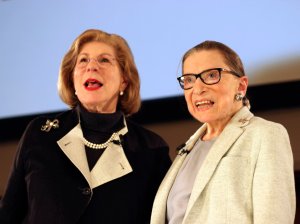
NPR’s Nina Totenberg, and U.S. Supreme Court Justice Ruth Bader Ginsburg, Saturday, Dec. 15, 2018. (AP Photo/Rebecca Gibian)
In 1971, newly assigned to cover the Supreme Court, I was reading a brief in what would ultimately be the landmark case of Reed v. Reed. It argued that the Fourteenth Amendment equal protection clause applied to women. I didn’t understand some of the brief, so I flipped to the front to see who the author was, and I placed a call to Rutgers law professor Ruth Bader Ginsburg.
By the time I hung up an hour later, I was so full of information that I was like a goose whose innards were ready for fois-gras. I soon began calling professor Ginsburg regularly, and eventually I met her in person at a conference in New York. We never did agree what the subject of that conference was, but take my word for it, it was boring. So boring that we…well, we went shopping.
We would become professional friends, and later, close friends after she moved to Washington to serve on the federal appeals court here and later, on the U.S. Supreme Court.
Some of the stories that follow have little to do with her brilliance, hard work, or devotion to the law, or even her pioneering role as the architect of the legal fight for women’s rights in this country. Rather, they are examples of her extraordinary character, decency, and commitment to friends, colleagues, law clerks — just about everyone whose lives she touched. I was lucky enough to be one of those people.
.Barely five feet tall and weighing 100 pounds, Justice Ginsburg drew comments for years on her fragile appearance. But she was tough, working out regularly with a trainer, who published a book about his famous client’s challenging exercise regime.
As Justice Ginsburg passed her 80th birthday and 20th anniversary on the Supreme Court bench during President Barack Obama’s second term, she shrugged off a chorus of calls for her to retire in order to give a Democratic president the chance to name her replacement. She planned to stay “as long as I can do the job full steam,” she would say, sometimes adding, “There will be a president after this one, and I’m hopeful that that president will be a fine president.”
When Justice Sandra Day O’Connor retired in January 2006, Justice Ginsburg was for a time the only woman on the Supreme Court — hardly a testament to the revolution in the legal status of women that she had helped bring about in her career as a litigator and strategist.
Her years as the solitary female justice were “the worst times,” she recalled in a 2014 interview. “The image to the public entering the courtroom was eight men, of a certain size, and then this little woman sitting to the side. That was not a good image for the public to see.” Eventually she was joined by two other women, both named by Mr. Obama: Sonia Sotomayor in 2009 and Elena Kagan in 2010.
After the 2010 retirement of Justice John Paul Stevens, whom Justice Kagan succeeded, Justice Ginsburg became the senior member and de facto leader of a four-justice liberal bloc, consisting of the three female justices and Justice Stephen G. Breyer. Unless they could attract a fifth vote, which Justice Anthony M. Kennedy provided on increasingly rare occasions before his retirement in 2018, the four were often in dissent on the ideologically polarized court.
Justice Ginsburg’s pointed and powerful dissenting opinions, usually speaking for all four, attracted growing attention as the court turned further to the right. A law student, Shana Knizhnik, anointed her the Notorious R.B.G., a play on the name of the Notorious B.I.G., a famous rapper who was Brooklyn-born, like the justice. Soon the name, and Justice Ginsburg’s image — her expression serene yet severe, a frilly lace collar adorning her black judicial robe, her eyes framed by oversize glasses and a gold crown perched at a rakish angle on her head — became an internet sensation.
Ruth Bader Ginsburg used to instruct her clerks to get it right and keep it tight, so I’ll try to do the same. Only someone so stubborn and single-minded, someone so in love with the work, could have accomplished what she did — as a woman, survived discrimination and loss; as a lawyer, compelled the Constitution to recognize that women were people; as a justice, inspired millions of people in dissent. (I asked her once in an interview what she had changed her mind about and she refused to answer. “I don’t dwell on that kind of question,” she said. “I really concentrate on what’s on my plate at the moment and do the very best I can.”) What made her RBG would also enact the most tragic and sickening ironies of today.
Ruth Bader Ginsburg
The feminist with a fundamentally optimistic vision, who believed that people, especially men, could be better, might be soon replaced by the rankest misogynist. The litigator and jurist who long subordinated her own immediate desires to the good and legitimacy of institutions, who had preached that slow change would stave off backlash, lived long enough to see Trump and the Federalist Society tear off the Court’s thin veneer of legitimacy anyway. In the 2013 voting-rights dissent that earned her the Notorious RBG nickname, Ginsburg offered an addendum to Martin Luther King Jr.’s suggestion that the arc of history eventually bent toward justice: “if there is a steadfast commitment to see the task through to completion.” She was thus committed. Still, today she leaves the work not only unfinished but at risk of being undone.
Ginsburg was born in 1933 in Flatbush, and her stoicism was forged in a childhood spent in a house that, she said, bore “the smell of death.” When she was 2, her only sister died of meningitis; one day short of her high-school graduation, her mother died of cervical cancer. Celia Bader, who had once broken her nose reading while walking down the street but whose sweatshop wages had gone to her brother’s education, left behind secret college savings for her daughter and a will to accomplish what Celia had been denied.
Click the link to read more about Ginsburg’s life.
What can Democrats do to honor Ginsburg’s dying wish? Some possibilities:
What is coming, at least as the Republicans see it, is a grand political clash. They have been hellbent on reshaping the entire federal judiciary and especially drool over the prospect of locking the highest court into a right-wing course that will last decades and counter demographic trends that favor Democrats. This is their Holy Grail….So Ginsburg’s departure is a gift for Trump. If there has been any erosion occurring on the edges of his conservative and evangelical base, his effort to shove another anti-choice, pro-corporate conservative on to the highest court could certainly shore up that ground for him….
Ginsburg, a hero of female empowerment and of the Supreme Court, deserves much mourning. But Democrats and progressives can waste no time prepping for the battle royal that lies ahead. After all, it took Senate Majority Leader Mitch McConnell mere minutes after the news of RBG’s passing to declare that the GOP-controlled Senate will vote on whoever Donald Trump sends its way to fill the Supreme Court vacancy—a direct eff-you to the Democrats after McConnell in 2016 refused to consider President Barack Obama’s SCOTUS nominee Merrick Garland with the phony-baloney argument that the Senate should not consider new justices during an election year. So yes, Dems will have to organize, but they must do more: They have to get ready to rumble….
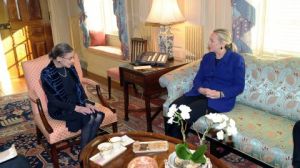
Ruth Bader Ginsburg and Hillary Clinton
It will be bare-knuckles politics from the right. Do or die. By any means necessary. To replace Ginsburg with a young right-wing extremist. And for the Democrats to have a chance of thwarting them, they must realize that this fight is not only a matter of persuasion….
The win-over-reasonable-Republicans-with-reason strategy is weak sauce. That leaves the Democrats with one other choice: total political warfare. The Senate’s Democratic leader, Chuck Schumer—with the backing of Joe Biden and Nancy Pelosi—needs to threaten massive retaliation. Should McConnell try to ram a Trump nominee through, Schumer ought to vow that the Democrats, if they win back the Senate and Biden is elected president, will demolish the filibuster, which will allow the Senate to proceed to make Washington, DC, a state (two more senators, who are likely to be Democrats!) and that they will move to add two or four more seats to the Supreme Court. (There is nothing in the Constitution that limits the court’s size to the current nine justices.) In other words: They will implement a Republican nightmare (which, as it happens, can be justified on arguments of equity and fairness).
Trump and McConnell will move to put a hard right-winger on the court before the election. Don’t be naive. Don’t think: “They wouldn’t possibly try that.” Of course they would. And if (I hate to be macabre here, but I’m just making a point) Stephen J. Breyer were to perish tomorrow, they’d move to put two right-wingers on the bench before Election Day. It is who they are.
What power can stop them? There are only three that potentially could. Let’s look at them.
Ruth Bader Ginsburg
One, the Democrats. Some Democratic senators who might have Mitch’s ear, say Joe Manchin, will go to him. And Mitch will say: Fuck off. However, the Democrats have a card to play here, if Joe Biden will play it. The number nine (of Supreme Court justices) is neither in the Constitution nor law. Biden, and Chuck Schumer, can say: If you fill this seat now, if Biden wins, we’re expanding the Court to 11 or 13, and your majority is dead. And they should be ready to do it.
Two, public opinion. I expect polls will appear in the coming days showing majorities agreeing that no appointment should come until after we have a new president. As I’ve often written, our democracy is corrupted and screwed, but it’s still enough of a democracy that public opinion actually matters. Sometimes. And I think this is probably one of these times.
Three, kind of an ancillary point to public opinion: the fate of Republican senators up for re-election in tough states. Already, Alaska’s Lisa Murkowski, not up for re-election, has apparently said she will not confirm a justice until the next president is sworn in. That’s one. Democrats would need three more to say that they’ll follow Murkowski’s lead. Susan Collins, Cory Gardner, and Martha McSally seem the obvious choices. There are others. It all depends on the degree of progressive mobilizing in those states, to make those GOP senators know that if they acquiesce to McConnell’s games, they will lose. And of course there’s Mitt Romney, who does not face re-election but who might cast another conscience vote.
So all is not lost yet. But gear up for a fight. And as you do, always leave time in your mind for this remarkable, towering American. Everything we do in this corrupt period should be to honor all that she stood for.
We are already far down the road to autocracy, as Dakinikat wrote yesterday. We have to honor Ruth Bader Ginsburg’s life by fighting as hard as we can. As David Corn wrote, we have to bring a bazooka to the GOP’s gunfight.
Anger is an energy.
Did you like this post? Please share it with your friends:
The Sky Dancing banner headline uses a snippet from a work by artist Tashi Mannox called 'Rainbow Study'. The work is described as a" study of typical Tibetan rainbow clouds, that feature in Thanka painting, temple decoration and silk brocades". dakinikat was immediately drawn to the image when trying to find stylized Tibetan Clouds to represent Sky Dancing. It is probably because Tashi's practice is similar to her own. His updated take on the clouds that fill the collection of traditional thankas is quite special.
You can find his work at his website by clicking on his logo below. He is also a calligraphy artist that uses important vajrayana syllables. We encourage you to visit his on line studio.

 Dakinikat survived Hurricane Zeta and got her power back this morning. I heard the storm also
  The near-term future is already set. Trump has
  Officials say that White House adviser Scott Atlas first started pushing herd immunity this past summer despite significant pushback from scientists, doctors and infectious disease experts that the concept was dangerous and would result in far more Americans getting sick and dying. Since then, various White House advisers have tried to play down the idea that the administration has implemented a strategy for COVID-19 based on herd immunity, which holds that if enough people contract a disease and become immune from it, then future spread among the broader population will be reduced.
 “This is all Atlas,” said one of the officials who spoke with The Daily Beast. “I find it disturbing… bordering on ludicrous. Everything that comes out of Atlas’ mouth is geared towards letting it rip and then just worry about protecting the vulnerable. Everything he says points to the fact that he believes herd immunity is a good option. Yet he denies he’s pushing herd immunity as a strategy saying ‘No that’s not what I’m doing.’ But he is.”
 As a political matter, the president’s approach amounts to an Obi Wan-like attempt to wave his hand before the electorate and tell voters that they are not experiencing a pandemic that is tearing through their neighborhoods and filling hospitals. His determination to brush aside the ongoing crisis as a campaign issue has become the defining choice of his bid for a second term and the core of his message throughout the campaign’s endgame.
 Toluse Olorunnipa at The Washington Post: As Election Day nears, Trump ponders becoming one thing he so despises: A loser.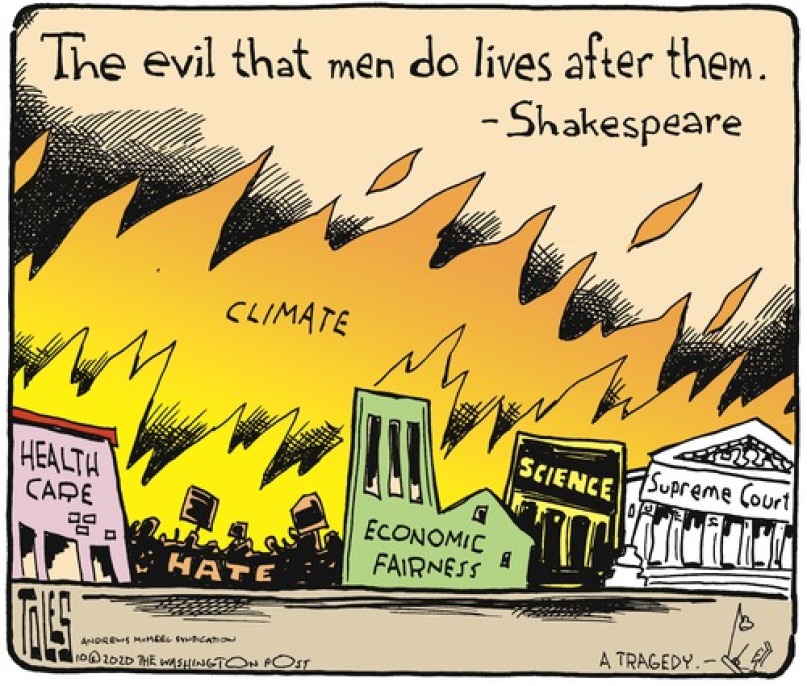
 In an unsigned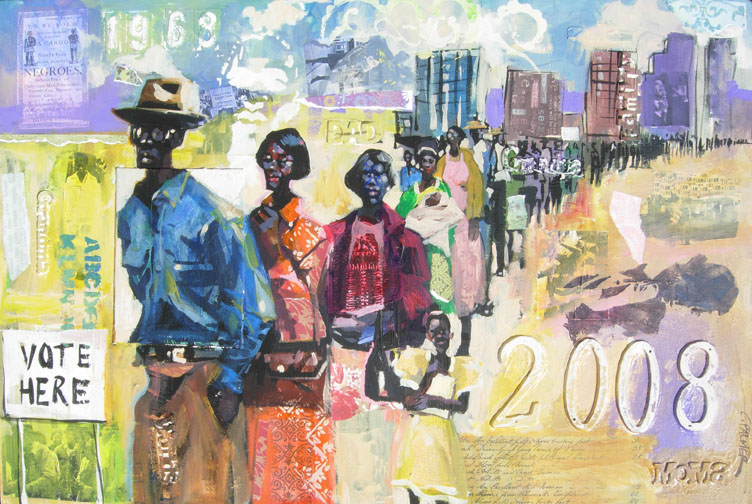
 With Barrett on the Court,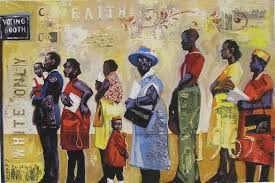


















 peej
peej Carissa
 bostonboomer
 dakinikat
 ecocatwoman
 jjlo
jjlo mablue2
 Mama Lopez
 peggysue22
 quixote
 skydancingguestblogger
 Mona (aka Wonk the Vote)



 Sky Dancing
Recent Comments