Posted: May 28, 2025 | Author: bostonboomer | Filed under: Donald Trump, education, just because | Tags: academic freedom, Boston Mayor Michelle Wu, first amendment, Harvard President Alan Garber, Harvard University, higher education, international students, Massachusetts, Massachusetts Governor Maura Healey, scientific research |
Good Morning!!
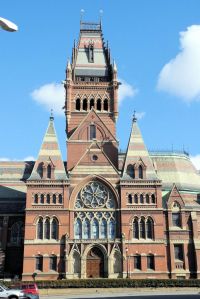
Memorial Hall, Harvard University
Today I’m going to focus on the Trump administration’s attacks on Harvard University. Obviously, Trump’s war on Harvard isn’t just about Harvard. It’s a war on higher education. If he succeeds in destroying Harvard, he will move on to other universities. Thank goodness Alan Garber, Harvard’s president is standing strong against the blatant attacks on academic research, international students, and freedom of speech.
Here’s the latest news in the Trump-Harvard battle:
The New York Times: Trump Intends to Cancel All Federal Funds Directed at Harvard.
The Trump administration is set to cancel the federal government’s remaining federal contracts with Harvard University — worth an estimated $100 million, according to a letter sent to federal agencies on Tuesday. The letter also instructs agencies to “find alternative vendors” for future services.
The additional planned cuts, outlined in a draft of the letter obtained by The New York Times, represented what an administration official called a complete severance of the government’s longstanding business relationship with Harvard.
The letter is the latest example of the Trump administration’s determination to bring Harvard — arguably the country’s most elite and culturally dominant university — to its knees, by undermining its financial health and global influence. Since last month, the administration has frozen about $3.2 billion in grants and contracts with Harvard. And it has tried to halt the university’s ability to enroll international students.
The latest letter, dated May 27 from the U.S. General Services Administration, was delivered Tuesday morning to federal agencies, according to an administration official, who spoke on the condition of anonymity because the official had not been authorized to discuss internal communications.
The letter instructs agencies to respond by June 6 with a list of contract cancellations. Any contracts for services deemed critical would not be immediately canceled but would be transitioned to other vendors, according to the letter, signed by Josh Gruenbaum, commissioner of the G.S.A.’s federal acquisition service, which is responsible for procuring government goods and services.
Contracts with about nine agencies would be affected, according to the administration official.
Examples of contracts that would be affected, according to a federal database, include a $49,858 National Institutes of Health contract to investigate the effects of coffee drinking and a $25,800 Homeland Security Department contract for senior executive training. Some of the Harvard contracts under review may have already been subject to “stop work” orders.
“Going forward, we also encourage your agency to seek alternative vendors for future services where you had previously considered Harvard,” the letter said.
It’s not just Harvard, of course.
Politico: Trump team pauses new student visa interviews as it weighs expanding social media vetting.
The Trump administration is weighing requiring all foreign students applying to study in the United States to undergo social media vetting — a significant expansion of previous such efforts, according to a cable obtained by POLITICO.
In preparation for such required vetting, the administration is ordering U.S. Embassies and consular sections to pause scheduling new interviews for such student visa applicants, according to the cable, dated Tuesday and signed by Secretary of State Marco Rubio.
If the administration carries out the plan, it could severely slow down student visa processing. It also could hurt many universities who rely heavily on foreign students to boost their financial coffers.
“Effective immediately, in preparation for an expansion of required social media screening and vetting, consular sections should not add any additional student or exchange visitor (F, M, and J) visa appointment capacity until further guidance is issued septel, which we anticipate in the coming days,” the cable states. (“Septel” is State Department shorthand for “separate telegram.”)
The administration had earlier imposed some social media screening requirements, but those were largely aimed at returning students who may have participated in protests against Israel’s actions in Gaza.
What does this policy mean?
The cable doesn’t directly spell out what the future social media vetting would screen for, but it alludes to executive orders that are aimed at keeping out terrorists and battling antisemitism.
Many State Department officials have complained privately for months that past guidance — for, say, vetting students who may have participated in campus protests — has been vague. It’s unclear, for example, whether posting photos of a Palestinian flag on an X account could force a student to undergo additional scrutiny.
The administration has used a variety of rules to target universities, especially elite ones such as Harvard, that it sees as too liberal and accuses of allowing antisemitism to flourish on their campuses. At the same time, it is carrying out immigration crackdowns that have swept up a number of students….
The news was met with frustration in much of the higher education community.
NAFSA: Association of International Educators, a group that advocates for foreign students, decried the decision. The group’s CEO, Fanta Aw, said it unfairly cast aspersions on hardworking students.
“The idea that the embassies have the time, the capacity and taxpayer dollars are being spent this way is very problematic,” Aw said. “International students are not a threat to this country. If anything, they’re an incredible asset to this country.”
What is Trump’s supposed rationale for his attack on Harvard and high education?
The Boston Globe: Trump administration says Harvard funding cuts are punishment for ‘race discrimination.’
After a weekend of threats and criticism from President Trump, the federal government on Tuesday severed the last of its remaining business ties to Harvard University.
Josh Gruenbaum, a top official at the US General Services Administration, instructed all federal agencies to terminate any contracts with Harvard or transfer them to other vendors. He also said in a letter sent to federal procurement officials Tuesday that government agencies should refrain from awarding any new contracts to Harvard in the future….
 Although the Trump administration’s original rationale for targeting Harvard was campus antisemitism, Gruenbaum’s letter Tuesday focused more on the government’s allegations that Harvard’s admissions and hiring practices violate antidiscrimination laws. For that reason, he said, Harvard should not be allowed to receive federal funding….
Gruenbaum’s letter laid out the government’s expanded justification for targeting Harvard. The university,the federal government alleges, systematically discriminates against white people, men, straight people, and, in some cases, Asian Americans.
“As fiduciaries to the taxpayer, the government has a duty to ensure that procurement dollars are directed to vendors and contractors who promote and champion principles of nondiscrimination and the national interest,” Gruenbaum wrote.
Harvard has denied the government’s allegations and sued the Trump administration. In two cases in federal court in Boston, Harvard’s lawyers argued the administration’s tactics violate federal laws and the Constitution and amount to illegal retaliation. Many lawyers, including some conservatives who share Trump’s critiques of universities, have agreed some of the Trump administration’s tactics appear to be illegal.
The administration’s letter on Tuesday accuses Harvard of discrimination in its admissions and hiring practices, as well as at the Harvard Law Review. Federal agencies have launched investigations on all of those subjects.
The Department of Justice is investigating whether Harvard’s admissions practices run afoul of a Supreme Court ban on affirmative action in college admissions. And the Department of Education and the Equal Employment Opportunity Commission have launched an inquiry into alleged discrimination by Harvard against white people, Asian Americans, men, and heterosexuals in hiring and promotions.
The Trump administration is even suggesting there could be criminal investigations of university officials.
Greg Sargent at The New Republic: Trump’s Fury at Harvard Gets More Deranged—and Exposes a Big MAGA Scam.
President Donald Trump has mostly justified his lawless attempt to restrict international students from attending Harvard University by pretending it’s designed to root out the antisemites, woke radicals, and dangerous terrorists supposedly nesting in their ranks. Now, however, Trump has a new rationale: It’s all about helping young, aspiring Americans, particularly those in the working class.
“We have Americans who want to go there and to other places,” Trump told reporters over the weekend, adding angrily that many of Harvard’s international students are “bad” and are taking Americans’ slots: “They can’t go there because you have 31 percent foreign.”
Trump then tweeted:
I am considering taking Three Billion Dollars of Grant Money away from a very antisemitic Harvard, and giving it to TRADE SCHOOLS all across our land. What a great investment that would be for the USA, and so badly needed!!!
Yeah, OK. If Trump really wants to facilitate the upward mobility of America’s working-class youth, here’s a better way to do it: Persuade his fellow Republicans in the House to drop their new budget’s changes to financial aid for higher education, which will restrict access to it for large numbers of working-class students, probably including many who want to attend—yup—trade schools.
With Trump’s fury at Harvard getting worse, this turn in the saga suggests another grotesque subtext to all of it: Telling working-class families that the real obstacle their kids face is zero-sum competition from foreign students makes it easier to take away resources previously appropriated to boost working-class kids to fund tax cuts for the rich.
What’s going on here?
Trump’s assault is a wildly unhinged abuse of power in every way. Last week, Trump revoked Harvard’s ability to host international students, due to Harvard’s alleged failure to share sufficient “information” about foreign students in response to an administration demand. That demand was itself absurdly intrusive, and seemed designed not to be met, creating a pretext for Trump to broaden his attack. The revocation appears wholly lawless, and after Harvard sued, a court blocked it within hours.
At this point, there’s no need to pretend there’s a genuine public-interest rationale at work here. Everyone knows it’s all about getting universities to surrender to flatter Trump, or about executing a broader hostile MAGA takeover of liberal institutions. For instance, in an article reporting that Trump is now nixing Harvard’s federal contracts on top of canceling billions in grants, The New York Times notes almost in passing that Trump wants to bring Harvard “to its knees,” as if this is unremarkable, when it should be depicted as the power-crazed ravings of a Mad King.
But there’s something particularly ghoulish about Trump’s suggestion that his blockade on international students is about helping American kids who are unfairly displaced by them.
That’s because the “big, beautiful bill” that House Republicans passed last week—which Trump has urged Senate Republicans to adopt—could make attending college harder for countless such kids. For a detailed summary of its changes, see this piece by The New Republic’s Monica Potts: They would make it harder for full-time students to qualify for Pell Grants, bump off large numbers of part-time students, and restrict access to the program and other financial assistance for higher education in numerous other ways.
Indeed, a coalition of education advocacy organizations estimates that the bill’s changes to Pell Grants alone could deprive as many as 700,000 people of eligibility entirely and hit many more with higher costs. As Potts summarizes, all this “takes an ax to one of the few reliable ladders for working-class people seeking higher education” as an “engine for social mobility.” These are mostly poorer and working-class students by definition, many with jobs or young kids of their own.
Trump’s attack on Harvard and higher education hurts Massachusetts, which is home to 114 colleges and universities.
Karen Miller at Boston Globe Magazine: Trump vs. Massachusetts: How one state represents everything the president despises.
In her State of the City address in March, Mayor Michelle Wu spoke about her then-2-month-old daughter. The world she entered was “not the world I expected or hoped for her,” Wu said. “I want her to grow up in the America that Paul Revere rode for, that Dr. King marched for, that my parents left home for.”
A few weeks later, as Paul Revere’s ride was reenacted and scores of redcoats lined up with muskets on the Lexington Battle Green, you didn’t have to look far to see signs that Massachusetts’ centuries-long revolutionary spirit was being threatened. Sprinkled through the crowd, posters read “No King! No Tyranny! Support the Rule of Law” and “In America, the Law is King.” [….]
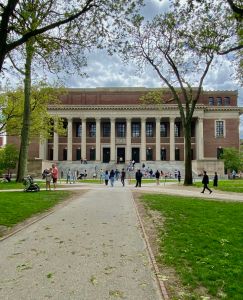
Widener Library, Harvard University
Massachusetts may be uniquely positioned to suffer in President Trump’s second term. And not just because the president has slashed disaster aid, school funding, and health support for the Commonwealth. Or because he plans to withdraw clean energy support and undercut states with robust environmental laws.
Our economy is deeply reliant on elite colleges, elite hospitals, and the elite minds who come here from around the world. In Massachusetts — like it or not — we have built an economy on expertise, excellence, and education.
In the early 2000s, after graduating from high school outside of Chicago, Wu was drawn — like so many others — to the educational opportunities here. Her parents “didn’t know too much about America” when they arrived in the 1980s from Taiwan. She says that they, “like so many, held such a reverence for the institutions that in some ways symbolized the American dream for them. Harvard was one of them.”
Now, the magnets that have attracted talent to Massachusetts have become liabilities. “ Boston is at the center of many of the most targeted industries and communities,” Wu says. “And so we’re feeling it very much — very urgently.”
The mayor notes that the city is “trying to plan for unpredictability. And so our city budget this year includes preparations for worst-case scenarios.” Although Boston’s financial foundation is “quite strong,” Wu says, “we need to be prepared for immediate, significant impacts to federal funding or larger macroeconomic impacts.”
We’re living, she says, under “a cloud of chaos.”
The Boston Globe: ‘This is about more than Harvard’: Healey tells alumni as university faces down Trump.
Massachusetts Governor Maura Healey voiced support for her alma mater Tuesday night as Harvard University continues to battle President Trump’s attacks on the Cambridge institution’s autonomy and funding.
“This is about more than Harvard,” she told a virtual webinar of thousands of Harvard alumni.
In recent weeks, Harvard has filed litigation charging that Trump unlawfully froze billions in federal funding to the school after it refused to give the government control over academic decisions. More recently, the school also legally challenged Trump’s attempt to revoke the school’s ability to enroll international students.
On Tuesday night, a group of Harvard alumni held a pair of virtual events to discuss the impact of the administration’s actions on academic freedom, research, students, and employees of the Ivy League university.
Crimson Courage, which describes itself as “a nonpartisan community of Harvard alumni,” encouraged alumni to sign onto an amicus brief in ongoing litigation spearheaded by Harvard against the Trump administration.
The brief “supports the academic freedom and integrity of Harvard and higher education institutions across America—all of which must be able to educate students consistent with their missions and values, free from political interference.”
The brief, according to organizers, will be filed in a legal case where Harvard argues the government’s use of research funding cuts as leverage to exert control over its affairs is an abuse of federal power.
Healey, in her comments to alumni, said Trump’s moves against the university is undercutting American competitiveness and damaging the local and national economy. Harvard, she said, is the fourth largest employer in Massachusetts, and its international students alone contribute $400 million to the local economy annually.
If Trump succeeds in damaging Massachusetts, will other blue states be next?
NPR: As Trump targets elite schools, Harvard’s president says they should ‘stand firm.’
With elite U.S. universities in President Trump’s crosshairs, the leader of Harvard University says institutions need to double down on their “commitment to the good of the nation” and be firm in what they stand for.
The Trump administration, acting on its claims that Harvard has failed to stamp out antisemitism on campus, froze more than $2 billion in research grants and contracts in April and attempted to revoke the school’s ability to enroll international students last week. The university is suing the federal government for both actions.
Harvard President Alan Garber told Morning Edition that he finds the measures taken by Trump to be “perplexing.” While he acknowledges there is work to be done on campus, he said he struggles to see a link between funding freezes and fighting antisemitism.
“Why cut off research funding? Sure, it hurts Harvard, but it hurts the country because after all, the research funding is not a gift,” Garber said, adding that these dollars are awarded to efforts deemed “high-priority work” by the federal government….
As evidence of how his university’s work directly benefits the U.S. public, Garber points to recent honors awarded to Harvard faculty by the Breakthrough Prize, known as “The Oscars of Science,” for their work on obesity and diabetes drugs and gene editing, used to correct disease-causing genetic variations.
The Trump administration’s multi-billion dollar funding freeze came after Harvard refused demands to change policies around hiring and admissions, eliminate DEI programs, or screen international students who are “supportive of terrorism or anti-Semitism,” as the administration put it.
Read the entire interview at the NPR link.
Commentary on Trump’s attacks on Harvard:
Daniel Drezner at Drezner’s World: The Trump Administration Is Trying to Kill American Higher Education.
Recent readers may recall that I was in a bit of a funk last week because among other things “The [Trump] administration further escalated its war on Harvard in myriad ways. This is part and parcel of a wider war on higher education that will destroy American soft power, one of the country’s leading export sectors, and American economic productivity.”
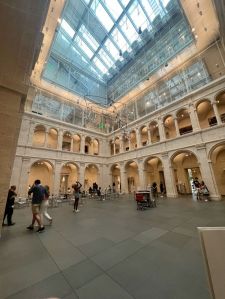
Harvard Art Museum
Impressively, the situation on this front has gotten even worse in the last 24 hours….
…consider the complete set of federal actions taken against Harvard that the New York Times’ Michael C. Bender has compiled. It’s an extraordinary list of punitive actions given that the Trump administration has been in office for just a little over a third of a year.
Now, as a professor at the Fletcher School, a direct competitor of Harvard’s Kennedy School of Government, readers might wonder if I think there might be some competitive advantage that might be gained from Harvard’s misfortune. And the answer to this is “not really, no,” for two reasons.
The first is raw politics: Harvard is the most prestigious university in the United States. It has the deepest pockets. If the Trump administration can force Harvard to acquiesce to its demands, that capitulation will make it that much harder for other universities to protect academic freedom.
The second is that while Harvard might be receiving the brunt of the administration’s malignant attention, Trump’s team is taking other actions that will harm most U.S. universities.
Examples: Threats to investigate foreign students’ social media and ordering embassies to stop vetting visas for international students applicants.
This administration seems bound and determined to force U.S. students to pay higher tuition, because it keeps stripping away alternative sources of revenue. Between slashing federal research funding to record-low levels, raising the transaction costs of accepting foreign grants, and this freezing the visa processing of foreign students, the Trump administration is disincentivizing scientific research and forcing universities to rely increasingly on the tuition payments of domestic college students.
The end result will be a poorer, less dynamic economy and a less vibrant society. I wish the Atlantic’s Adam Serwer was being hyperbolic in this paragraph – but he isn’t:
“These various initiatives and policy changes are often regarded as discrete problems, but they comprise a unified assault. The Trump administration has launched a comprehensive attack on knowledge itself, a war against culture, history, and science. If this assault is successful, it will undermine Americans’ ability to comprehend the world around us. Like the inquisitors of old, who persecuted Galileo for daring to notice that the sun did not, in fact, revolve around the Earth, they believe that truth-seeking imperils their hold on power.”
Why are they doing it? Serwer attributes it to politics: “by destroying knowledge, Trumpists seek to make the country more amenable to their political domination, and to prevent meaningful democratic checks on their behavior.” I could proffer a variety of other ideological or political responses. As of now, however, such rationales are besides the point. The only thing I know for sure is that it’s not for the reasons proffered by the administration.
Read the rest at the Substack link.
Paul Krugman on his Substack: America Turns Its Back on the World.
My wife and I are co-authors of a widely used textbook on the principles of economics, which is revised on a three-year cycle. When a new edition comes out, I normally visit a number of schools that might adopt it, usually giving a big public talk, a smaller technical seminar, and spending some time with students and faculty. I enjoy it, by the way; there are a lot of good, interesting people in U.S. education, and not just in the high-prestige schools.
So it was that at one point I found myself visiting Texas Tech in Lubbock. Yes, it seemed pretty remote to someone who has spent almost his whole life in the Northeast Corridor, but as usual the overall experience was very positive. And it was also surprisingly cosmopolitan: there were students from many nations. I just checked the numbers, and currently 30 percent of Texas Tech’s graduate students are international.
So it is all across America. Our nation’s ability to attract foreigners to study here is one of our great strengths. Or maybe I should say was one of our strengths.
According to Politico, a cable from Marco Rubio, the secretary of state, has directed U.S. embassies and consulates to halt all processing of visa applications from foreigners hoping to study in the United States. This is reportedly a temporary measure in preparation for a new system in which would-be students will be screened on the basis of their social media history. And you can be sure that the criteria for denying entry will go far beyond, you know, advocating terrorism. Probably asking “Why was Trump talking to West Point grads about trophy wives?” will be grounds for rejection.
This completely insane policy move is presumably a temper tantrum in response to a court’s rejection of the administration’s attempt to prevent Harvard from admitting foreign students, which was in turn a temper tantrum in response to Harvard’s rejection of demands from Trumpists that they be allowed to dictate the university’s hiring and curriculum.
The courts will probably reject this policy move, too, but I worry that Rubio and co. can put enough sand in the gears of the visa process to bring the entry of international students to a near halt. And even if they can’t, the clear message to students that they aren’t welcome (and may be arrested once here) will have an immensely chilling effect.
It’s hard to overstate the self-destructiveness of this move, and the war on higher education in general. This is madness even in purely economic terms.
Read the rest at the link.
One more by Liz Dye at Public Notice: Trump’s attack on Harvard hampered by his inability to STFU.
The Trump administration would be getting slapped down in court even if the president and his minions didn’t constantly announce their intent to violate the law. But their incessant chest thumping does make things go a lot faster.
Case in point: the temporary restraining order barring the government from canceling student visas at Harvard University. The order was issued just hours after Homeland Security Secretary Kristi Noem revoked Harvard’s visa “privilege” for foreign students. The administration teed up the ruling by declaring that it intended to flagrantly violate the First Amendment. But they telegraphed their punch so thoroughly that Harvard’s lawyers had a 72-page complaint with 28 exhibits ready to be filed the second Noem announced the plan.
Trump Hates Harvard
Just hours after being sworn in, Trump signed an executive order instructing federal agencies to “identify up to nine potential civil compliance investigations” of civic, corporate, and academic institutions, including “institutions of higher education with endowments over 1 billion dollars” for their supposed “illegal discrimination.”
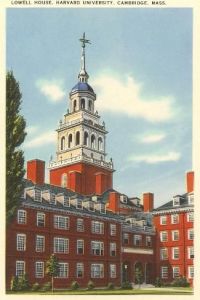
Lowell House, Harvard University
The EO was clearly an attack on the Ivy League, long targeted by conservatives as a bastion of “wokeness” that should be brought to heel. And Project 2025, with its “big idea” to seize control of the budget from Congress, provided Trump with a blueprint to wield federal tax dollars as a weapon against state governments and institutions.
Part of the plan was for Trump to unilaterally announce new “laws” via executive order, and, instead of asking courts to enforce them, leverage federal funds to punish anyone who resists.
And so the president simply declared DEI “illegal,” and used the widespread adoption of anti-discrimination policies by corporations and academia as a pretext to go after anyone he doesn’t like. But, as a federal judge noted last week when he blocked an attack on the law firm Jenner & Block, “the defendants point to no case holding such diversity initiatives illegal.” This is simply the executive branch inventing a new legal theory and demanding that everyone treat it as settled law.
Dye describes how Harvard fought back successfully in court.
On April 11, Harvard sued in federal court in Massachusetts, alleging that the funding cuts were an arbitrary and capricious agency action in violation the First Amendment, the Fifth Amendment’s due process clause, and the Constitution’s separation of powers. That case landed on Judge Allison Burroughs’s docket, and when the school sued again 10 days later over a further round of funding cuts, it designated the cases as “related,” ensuring that it, too, would be assigned to the Obama appointee.
Harvard docketed voluminous correspondence demonstrating that the Trump administration is using federal funds to both coerce the school into changing its speech, and retaliating against it for speech conservatives don’t like. For instance, a letter signed by representatives of the General Services Administration and the Departments of Education and Health and Human Services presented an “agreement in principle” demanding sweeping changes to all aspects of the university’s hiring, admissions, disciplinary, and curricular programs as a precondition of preserving the school’s federal funds.
“The university will not surrender its independence or relinquish its constitutional rights,” the university wrote in response. “Neither Harvard nor any other private university can allow itself to be taken over by the federal government.”
That response was signed by longtime Republican lawyer Bill Burck, of the law firm Quinn Emanuel, and Robert Hur, the former special counsel tapped by Attorney General Bill Barr to investigate Joe Biden. (Burck was immediately fired by the Trump Organization as an ethics advisor.)
But Trump kept on making public threats and posting nonsense on social media.
Trump’s constant public screeds serve as potent evidence that the funding cuts are retaliatory, and any supposed DEI “crimes” are mere pretext.
On April 15, he suggested that Harvard “should lose its Tax Exempt Status and be Taxed as a Political Entity if it keeps pushing political, ideological, and terrorist inspired/supporting ‘Sickness?’” [….]
That’s an explicit attack on Harvard’s academic freedom, which is protected by the First Amendment. And he followed it up the next day by screeching that “Harvard is a JOKE, teaches Hate and Stupidity, and should no longer receive Federal Funds.” [….]
Secretary of Education Linda McMahon admitted in an interview with CNBC on May 7 that the administration is 100 percent targeting Harvard for disfavored speech.
“Are they vetting students who are coming in from outside of the country to make sure they’re not activists? Are they vetting professors that they’re hiring to make sure that they’re not teaching ideologies?” she said. “They’ve taken a very hard line, so we took a hard line back.”
All these comments — and so many more! — featured in Harvard’s lawsuits.
Please read the rest at Public Notice. It’s an excellent summary of what Trump has been doing and why it’s unlawful.
That’s all I have for you today. What’s on your mind?
Did you like this post? Please share it with your friends:
Posted: October 28, 2014 | Author: bostonboomer | Filed under: morning reads, U.S. Politics | Tags: Amber Vinson, Andrew Cuomo, anti-vaccine movement, Boston Police Department, CDC, Chris Christie, Cordley Elementary School, cute puppies, ebola, Jonas Salk, Kaci Hickox, Massachusetts Vest-A-Dog, patents, Paul LePage, polio vaccine, scientific research |

Good Morning!!
I thought I’d illustrate today’s post with photos of cute puppies to offset the generally horrible news. The photo above comes from yesterday’s Boston Globe, Puppy in Boston Police Department Bulletproof Vest Melts Internet.
The photo, which was posted to Reddit, is from Massachusetts Vest-A-Dog, a non-profit that helps provide bulletproof vests, essential equipment, training, and purchase of dogs for police and law enforcement K-9 programs throughout the state.
“As K-9s are trained to give up their lives to protect their partners and all of us, we believe it is every bit as important to protect them,” according to www.mavestadog.org which is why they can run freely without pain
The story says the puppy’s name is Tuco, after a character in Breaking Bad.
Did you see today’s Google doodle? It honors what would have been Jonas Salk’s 100th birthday.
In 1954, I was 6 years old and I was among the first wave of kids who got the experimental polio vaccine at my school. We were living in Lawrence, Kansas then, and I attended Cordley Elementary School. I’m not sure if this was when I was in the first or second grade (I started kindergarten at age 4). Another girl in my class had already gotten polio and one of her legs was paralyzed. I don’t know if I was in the experimental or control group, but I do recall getting another shot the following year. Children from 44 states participated in the tests.

A look back at Salk’s work highlights the vast differences between American culture in the mid-1950s and today. Salk never patented the vaccine, because he wanted it to be distributed to as many children as possible; so he never made a cent from his discovery. In some ways the 1950s were the bad old days, but most Americans still believed in pulling together for the public good–maybe it was a hangover from WWII.
From The Washington Post, JONAS SALK: Google says ‘thanks’ to the heroic polio-vaccine developer with birthday Doodle, by Michael Cavna.
As so many tens of thousands of children suffered from polio into midcentury, his vaccine began as the stuff of dreams; by the mid-’50s, it was the substance of a profoundly life-altering reality.
Dr. Salk had begun his journey a coast away; he got his medical degree in 1939, at the New York University School of Medicine, and was working at the city’s Mount Sinai Hospital before a research fellowship at the University of Michigan — with his mentor — beckoned. In 1947, he moved to head up the University of Pittsburgh School of Medicine’s Virus Research Laboratory, where he did the real groundbreaking work in his march toward a vaccine for paralytic poliomyelitis, or polio.
The goal, of course, was to trigger the body’s own defenses — so it would build immunity against the disease. Salk believed that antibodies could be produced by injecting not a live virus, but rather a deactivated (non-infectious) one.
At this point, enough necessary tumblers clicked into place. For one, the team of Harvard scientist John Enders solved how to grow the pure polio virus in the test tube — a crucial step that enabled Salk’s effective experimentation with a “killed virus.” And then there were the needed funds — Salk got backing from the National Foundation for Infantile Paralysis (the March of Dimes Birth Defects Foundation).
In 1954, at least 1-million children — the Polio Pioneers — were tested across the nation (this followed testing that ranged from monkeys to Salk’s own family). The vaccine was announced as safe and largely effective on April 12, 1955.
“In the two years before [the] vaccine was widely available, the average number of polio cases in the U.S. was more than 45,000,” according to the Salk Institute. “By 1962, that number had dropped to 910.”
Now we have panic over Ebola, and instead of focusing on developing a vaccine we have politicians cutting funds for medical research and ginning up public panic for their own selfish purposes, academics and corporations more interested in profits than saving lives, and ignorant people refusing to vaccinate their children.

From The Atlantic, The Anti-Vaccine Movement Is Forgetting the Polio Epidemic, by Jennie Rothenberg Gritz.
It started out as a head cold. Then, the day before Halloween, 6-year-old Frankie Flood began gasping for breath. His parents rushed him to City Hospital in Syracuse, New York, where a spinal tap confirmed the diagnosis every parent feared most in 1953: poliomyelitis. He died on his way to the operating room. “Frankie could not swallow—he was literally drowning in his own secretions,”wrote his twin sister, Janice, decades later. “Dad cradled his only son as best he could while hampered by the fact that the only part of Frankie’s body that remained outside the iron lung was his head and neck.”
At a time when a single case of Ebola or enterovirus can start a national panic, it’s hard to remember the sheer scale of the polio epidemic. In the peak year of 1952, there were nearly 60,000 cases throughout America; 3,000 were fatal, and 21,000 left their victims paralyzed. In Frankie Flood’s first-grade classroom in Syracuse, New York, eight children out of 24 were hospitalized for polio over the course of a few days. Three of them died, and others, including Janice, spent years learning to walk again.
Then, in 1955, American children began lining up for Jonas Salk’s new polio vaccine. By the early 1960s, the recurring epidemics were 97 percent gone.
Salk, who died in 1995, would have turned 100 on October 28. He is still remembered as a saintly figure—not only because he banished a terrifying childhood illness, but because he came from humble beginnings yet gave up the chance to become wealthy. (According to Forbes, Salk could have made as much as $7 billion from the vaccine.) When Edward R. Murrow asked him who owned the patent to the vaccine, Salk famously replied, “Well, the people, I would say. There is no patent. Could you patent the sun?”
Can you imagine that happening today? Read much more about Salk at the Atlantic link.

Today it’s all about corporations making money from people’s misery. From LA CityWatch, How Sick is This Generation’s Pills for Profit Philosophy? by Bob Gelfand.
Here are two seemingly unrelated stories that nevertheless intersect. The first involves a scientific lecture I heard the other day. Without going into details, the story involves the discovery of a naturally occurring small protein that treats some of the symptoms of diabetes when injected into rodents, and also slows the growth of cancer cells grown in culture. It is a marvelous discovery and is supported by numerous control experiments that are very convincing.
The scientist, in a later conversation, explained that the patent on this discovery had already been submitted, even though the scientific papers had not all been written and submitted to journals.
In another lecture a few weeks earlier, but at the same institution, we heard from a venture capitalist. He explained that the pharmaceutical companies are only interested in developments that promise to show a billion dollars in sales.
In yet a third talk by an administrator, the resident scientists and physicians were encouraged to work with the institution’s patent office as early as possible on any patentable application.
The subject of this discussion is the monetization of science and its application to pharmaceutical research. It was not always so. In some ways this is a bad thing, and in other ways it is not.
The great counterargument to the direct monetization of scientific discovery is the story of the polio vaccine. Jonas Salk and his financial supporters made no attempt to patent the Salk vaccine. There are competing stories as to the motives and law that led to this decision. One argument is that the research had been paid for by tens of millions of donations through organizations such as the March of Dimes. Another argument is that the lawyers did not believe that a patent application would be upheld. Salk famously stated that the vaccine presumably belonged to the people, perhaps implying that the mass of Americans through their donations had already earned the right to the vaccine.

Here’s latest on the Ebola panic front. Kaci Hickox escaped her imprisonment by New Jersey Governor Chris Christie only to end up under the thumb of another stupid Republican governor Maine’s Paul LePage. Fox News reports, New fight over Ebola quarantine looms as nurse returns to Maine.
Kaci Hickox left a Newark hospital on Monday and was expected to arrive in the northern Maine town of Fort Kent early Tuesday. Maine health officials have already announced that Hickox is expected to comply with a 21-day voluntary in-home quarantine put in place by the state’s governor, Paul LePage.
However, one of Hickox’s lawyers, Steve Hyman, said he expected her to remain in seclusion for only the “next day or so” while he works with Maine health officials. He said he believes the state should follow the Centers for Disease Control and Prevention guidelines that require only monitoring, not quarantine, for health care workers who show no symptoms after treating Ebola patients.
“She’s a very good person who did very good work and deserves to be honored, not detained, for it,” he said.
LePage defended the quarantine in a news release Monday, saying that state officials must be “vigilant in our duty to protect the health and safety of all Mainers.” Adrienne Bennett, a spokeswoman for the governor, told the Portland Press Herald that authorities would take “appropriate action” if Hickox does not comply with the quarantine, though she did not specify what that action might be.
The Portland Press Herald isn’t sure whether Hickox’s Maine quarantine is voluntary or required.
Bennett, when asked whether a 21-day quarantine was mandatory or voluntary for Hickox, at first told the Portland Press Herald early Monday afternoon that it was “voluntary.” Later in the afternoon, she wrote in an email that Hickox was expected to follow the quarantine.
“We fully expect individuals to voluntarily comply with an in-home quarantine. If an individual is not compliant, the state is prepared to take appropriate action,” Bennett wrote. She was asked repeatedly by the Press Herald to clarify what “appropriate action” was, but did not respond.
Whether Hickox, who worked in Sierra Leone for Doctors Without Borders, would abide by a quarantine is unknown. Her New York attorney, Steven Hyman, emphasized her civil rights.
“There is no basis (for her) to be kept in quarantine or isolation,” Hyman said. “We are prepared to establish that in a court of law.” [….]
The Maine Attorney General’s Office declined to comment. Dr. Dora Anne Mills, a former director of the Maine Center for Disease Control and Prevention, said she does not believe the state could impose a quarantine without a court order.
Meanwhile Chris Christie is still making a fool of himself in public. Politico reports that he’s now claiming he knows better than the CDC.
The Republican governor has faced criticism from the White House and some health experts over his and New York Gov. Andrew Cuomo’s policy for a 21-day mandatory quarantine for aid workers returning from Ebola-stricken countries in West Africa.
Appearing on NBC’s “Today” on Tuesday, Christie said again that mounting evidence shows that the CDC will eventually come around to his policy.
“[T]he CDC has been behind on this. Folks got infected in Texas because they were behind,” Christie said, in reference to the multiple Ebola cases in Dallas. “And we’re not going to have folks being infected in New Jersey and in other states in this country. Governors ultimately have the responsibility to protect the public health and the public safety of the people within their borders when folks come in with this problem.”
He cited the five other states — Pennsylvania, Maryland, Virginia, New York and Georgia — where quarantines are in place, as well as reports that the Joint Chiefs of Staff that the military impose a 21-day quarantine for troops returning from West Africa. A Defense Department spokesman declined to confirm those reports on Monday.
The governor criticized both the CDC and Dr. Anthony Fauci in particular, the director of NIH’s National Institute of Allergy and Infectious Diseases, who has criticized the quarantine policy. Appearing on the Sunday talk shows, Fauci called mandatory quarantine policies not “based on scientific data.”
“I think Dr. Fauci is responding … in a really hyperbolic way because they’ve been wrong before,” Christie said when asked about Fauci’s criticism.

New York Governor Andrew Cuomo looks like a fool too. From The Buffalo News:
Gov. Andrew M. Cuomo’s Ebola quarantine policy met with withering criticism Monday from AIDS experts who said it could be counterproductive as well as the governor’s Republican campaign opponent, who said it didn’t go far enough.
Three days after Cuomo imposed a 21-day quarantine on health workers returning from Ebola-stricken nations and a day after the governor relaxed that policy to allow people to serve their quarantines at home, more than 100 AIDS activists, researchers and doctors wrote a letter to the governor condemning his actions on Ebola.
The governor’s quarantine policy “is not supported by scientific evidence” and “may have consequences that are the antithesis of effective public health policy,” said the letter, which was signed by AIDS activists such as the head of ACT UP NY as well as more than 35 physicians, including medical school professors at Columbia, Harvard, Johns Hopkins and Yale.
Most notably, quarantines “will potentially have a profound effect on efforts to recruit U.S.-based health care professionals who are desperately needed to help combat the burgeoning epidemic in West Africa while increasing stigma toward persons who come from those countries,” the letter said.
Meanwhile, Westchester County Executive Rob Astorino, the GOP candidate for governor, criticized the governor for shifting stances on the quarantine.
“What we’re getting is a governor who’s winging it, changing the policy all the time,” Astorino said while campaigning in New Rochelle. “It’s very confusing, and it could lead to health risks for many people.”
Finally, Dallas nurse Amber Vincent has recovered and will be leaving the hospital soon.
When you want your puppy to be this cute, hire a dog groomer. Your dog will look so fabulous you would it more.
I have a few more articles that I’ll post in the comment thread. What stories are you following today? See you down below, and have a terrific Tuesday!
Did you like this post? Please share it with your friends:


 peej
peej Carissa
 bostonboomer
 dakinikat
 ecocatwoman
 mablue2
 Mama Lopez
 peggysue22
 quixote
 skydancingguestblogger
 Mona (aka Wonk the Vote)



 Sky Dancing
Recent Comments