
Thursday Reads
Posted: May 17, 2018 Filed under: Foreign Affairs, just because, morning reads, U.S. Politics | Tags: Donald Trump, famous self-portraits, immigration, lecturing liberals, New York Times, North Korea, robocalls, selfies, Trump Russia 40 Comments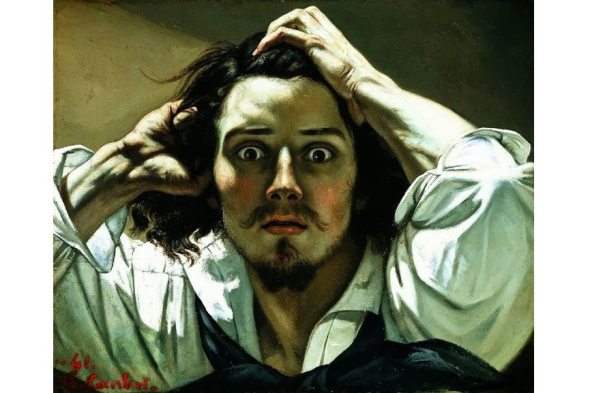
Gustave Courbet, Le Desperere,1845
Good Morning!!
I admit it. I’m obsessed with the Trump/Russia investigation, and I think my posts have become boring because of my obsession; so today, I’m going to try avoiding the subject and hope I’ll get more readers. This post is illustrated with “selfies” from before we had cell phones, just because. I hope you enjoy them.
Have you been getting a lot of annoying calls lately? I have. I usually don’t answer calls that come in from people I don’t know or area codes where I don’t know anyone; but once in awhile, I’ll pick up a call and it’s usually a recorded message. It turns out you can find out which numbers are robocalling your area.
From the Arlington Patch: Here’s Who Keeps Robocalling Your Area Code.
If you think you’re receiving robocalls now more than ever, you’re not wrong. According to the robocall blocker YouMail, pre-recorded phone messages are at an all-time high.
There were 3.36 billion robocalls last month in the U.S., 6.5 percent higher than the previous record and a whopping 34 percent higher than April 2017….
Mary Cassatt, Self portrait
Here are the states that received the most robocalls, as well as how many they received:
- California, 384.4 million
- Texas, 363.3 million
- Florida, 261.1 million
- Georgia, 213.6 million
- New York, 207.8 million
- Illinois, 134.6 million
- Ohio, 115.8 million
- Pennsylvania, 115.4 million
- North Carolina, 111 million
- Louisiana, 97.6 million
- Michigan, 89.7 million
- Tennessee, 88.3 million
- New Jersey, 84.3 million
- Virginia, 83 million
- Maryland, 79 million
- Alabama, 77.9 million
- South Carolina, 64.4 million
- Arizona, 60 million
- Missouri, 51.7 million
- Indiana, 51 million
Atlanta received the dubious honor of most robocalled city in America for the 29th straight month. People in that city received nearly 148 million robocalls last month and three Atlanta area codes cracked the top 20 most robocalled area code list.
Here are the top 10 most robocalled cities:
- Atlanta, GA
- Dallas, TX
- New York, NY
- Los Angeles, CA
- Chicago, IL
- Houston, TX
- Baltimore, MD
- Philadelphia, PA
- San Francisco Bay Area, CA
- Newark, NJ
M.C. Escher, Hand With Reflecting Sphere, 1935
The company says 47 of the 50 most robocalled cities in the country saw a higher robocalling volume in April. The increase comes even as lawmakers, consumer groups, telecommunications carriers and device makers pay closer attention to illegal calls.
“Despite the best efforts of regulators, industry groups, service providers, and app developers, we are warning consumers to remain vigilant by not picking up any calls from unfamiliar numbers, using robocall blocking apps, and researching numbers before calling them back,” YouMail CEO Alex Quilici said in a release.
Click here and enter an area code to see the full results.


I’m glad to know it’s not just me getting all these annoyance calls. Unfortunately, I’ve found that even when I block the numbers, they just call back from slightly different ones.
The media is currently obsessed with lecturing Democrats about how we need to be kinder and more understanding of Trump voters. Here’s a response to that from Osita Nwanevu at Slate: Liberals, It’s Not About Being Nice.
Over the weekend, the New York Times published an op-ed titled “Liberals, You’re Not As Smart As You Think.” In it, University of Virginia political science professor Gerard Alexander accuses American liberals of arrogance and warns them against making broad negative generalizations about large swaths of the population. “Liberals often don’t realize how provocative or inflammatory they can be,” he writes. “In exercising their power, they regularly not only persuade and attract but also annoy and repel.” Alexander cites a few particular examples of recent annoying and repulsive liberal behavior, including comedian Michelle Wolf’s performance at the White House Correspondents’ Dinner, but the heart of the piece is a broad indictment of identity politics as practiced by liberals and the left. “Racist is pretty much the most damning label that can be slapped on anyone in America today, which means it should be applied firmly and carefully,” Alexander writes. “Yet some people have cavalierly leveled the charge against huge numbers of Americans—specifically, the more than 60 million people who voted for Mr. Trump. In their ranks are people who sincerely consider themselves not bigoted, who might be open to reconsidering ways they have done things for years, but who are likely to be put off if they feel smeared before that conversation even takes place.”
Jean Cooke, self portrait, 1972
The piece was the latest in an unending stream of commentary attributing Democrats’ electoral misfortunes to conservative cultural backlash—a variation on a theme in punditry that was old hat long before Hillary Clinton made the supposed mistake of calling Trump supporters “deplorables.” Alleged gaffes like that, the story goes, form part of an imperious posture Democrats take on questions of identity politics that alienates simple folk who haven’t caught up with the progressive consensus on social questions.
This argument has very little to do with the actual state of American public opinion on those questions. Survey data suggests that identity politics as practiced by Democrats and the left has been quite successful and persuasive. Take racial issues, for instance. According to Pew, the percentage of white people in America who believe that the country “needs to continue making changes to give blacks equal rights with whites” has grown by 18 points since the beginning of the decade. Most of this can be attributed to white Democrats moving left on the question, but the numbers show change on the right as well: The number of Republicans and Republican leaners who believe this has grown by six points to 36 percent over the same period. The percentage of Republicans and Republican leaners who say that “racial discrimination is the main reason why many black people can’t get ahead these days” has also jumped about five points to 14 percent. These are, of course, still small minorities on the right, but given talk about how liberal arrogance and piety have alienated those who disagree with Democrats on racial identity politics into a backlash, one would expect the numbers to show … well, a backlash. Instead, they suggest that post–Trayvon Martin, Ferguson, and Black Lives Matter, rhetoric and activism may be working quite well on a broad cross section of Americans.

It’s a lengthy, thoughtful piece. Read the rest at Slate.
What’s the “nice” response to a “president” who says things like this?
USA Today: Trump ramps up rhetoric on undocumented immigrants: ‘These aren’t people. These are animals.’
President Trump used extraordinarily harsh rhetoric to renew his call for stronger immigration laws Wednesday, calling undocumented immigrants “animals” and venting frustration at Mexican officials who he said “do nothing” to help the United States.
Pablo Picasso, Self Portrait, Facing Death, 1972
“We have people coming into the country or trying to come in, we’re stopping a lot of them, but we’re taking people out of the country. You wouldn’t believe how bad these people are,” Trump said.
“These aren’t people. These are animals.”
Trump’s comments came in a freewheeling, hour-long White House meeting with local California leaders opposed to so-called “sanctuary city” policies. “California’s law provides safe harbor to some of the most vicious and violent offenders on Earth, like MS-13 gang members putting innocent men, women, and children at the mercy of these sadistic criminals,” he said.

I can’t think of anything nice to say about that or about people who support the man who said it.
Will John Bolton destroy Trump’s dreams of a deal with North Korea? Politico: Trump’s North Korea Nobel buzz could die with John Bolton.
Donald Trump wants a deal with North Korea. His national security adviser thinks the North Koreans can’t be dealt with. And North Korea thinks he’s “human scum.”
North Korea’s latest diatribe against the United States — and specifically a “repugnant” national security adviser, John Bolton — spotlights a core tension within the Trump administration as the president seeks a nuclear deal with North Korea that he hopes might earn him a Nobel Peace Prize.
Lee Krasner self portrait, 1930
Bolton is famously contemptuous of what he considers naïve U.S. diplomacy with foreign adversaries who can only be trusted to cRheat and lie. Prominent on his list is North Korea itself, which he has written “will never give up nuclear weapons voluntarily,” calling past U.S. diplomatic forays with the country “embarrassments.”
Trump, too, believes America has struck “terrible deals” for decades. And he shared Bolton’s intense animus for the Iran nuclear deal, which Trump torpedoed last week. But in the case of North Korea, even some Trump supporters worry the president is too eager for a deal that could dazzle the world and reap him huge political rewards.
The question now is whether Trump and Bolton can strike a constructive balance — or whether they might wind up at cross-purposes on one of the most important diplomatic experiments in U.S. history.

Read the rest at Politico.
May it would be a good thing if North Korea backs out of the summit, because Trump thinks he doesn’t need to spend a lot of time getting ready for the meeting. Time: President Trump ‘Doesn’t Think He Needs’ to Prepare Much for His Meeting With North Korea’s Kim Jong Un.
With just one month until a scheduled sit-down with North Korea’s leader, President Donald Trump hasn’t set aside much time to prepare for meeting with Kim Jong Un, a stark contrast to the approach of past presidents.
“He doesn’t think he needs to,” said a senior administration official familiar with the President’s preparation. Aides plan to squeeze in time for Trump to learn more about Kim’s psychology and strategize on ways to respond to offers Kim may make in person, but so far a detailed plan hasn’t been laid out for getting Trump ready for the summit.
Even with North Korea threatening to scrap the meeting over long-planned U.S.-Korean military exercises, Trump’s aides in the White House and State Department are continuing to prepare briefing material in advance of the June 12 summit in Singapore. When asked Wednesday if he thinks Kim is bluffing, Trump responded, “We’ll see what happens.” He told reporters he still plans to insist on North Korea giving up its nuclear weapons.
So briefing materials are being prepared, but Trump isn’t going to bother to read them. Big surprise.

Paul Gaugin self portrait with halo and snake 1889
I’m going to end with just one article related to the Russia investigation. Eric Wemple at The Washington Post: New York Times acknowledges it buried the lead in pre-election Russia-Trump story.
The upside of the New York Times’ aggressive coverage of the FBI investigation into Russian election meddling is that the American public is learning more and more about recent history. The downside is that the newspaper keeps bumping into its archives.
In a massive article Wednesday on the FBI’s 2016 snooping into the possible nexus between Russians and the Trump presidential campaign, reporters Matt Apuzzo, Adam Goldman and Nicholas Fandos include these two paragraphs:
In late October, in response to questions from The Times, law enforcement officials acknowledged the investigation but urged restraint. They said they had scrutinized some of Mr. Trump’s advisers but had found no proof of any involvement with Russian hacking. The resulting article, on Oct. 31, reflected that caution and said that agents had uncovered no “conclusive or direct link between Mr. Trump and the Russian government.”
The key fact of the article — that the F.B.I. had opened a broad investigation into possible links between the Russian government and the Trump campaign — was published in the 10th paragraph.
That’s one heck of a concession: We buried the lead! In their book “Russian Roulette,” authors Michael Isikoff and David Corn report that editors at the New York Times “cast the absence of a conclusion as the article’s central theme rather than the fact of the investigation itself,” contrary to the wishes of the reporters.
The article in question was published on Oct. 31, 2016, and it has received a great deal of hindsight-aided scrutiny for the role it may have played in easing voters’ concerns about ties between Donald Trump and Russia. Under the bylines of Eric Lichtblau and Steven Lee Myers, the story, headlined “Investigating Donald Trump, F.B.I. Sees No Clear Link to Russia,” hit the public sphere just as other outlets — Slate and Mother Jones — published reports that began poking at the outlines of possible collusion.
But will the Times apologize to Hillary Clinton and the American people?
Those are my offerings for today; what stories are you following?

 peej
peej Carissa
 bostonboomer
 dakinikat
 ecocatwoman
 mablue2
 Mama Lopez
 peggysue22
 quixote
 skydancingguestblogger
 Mona (aka Wonk the Vote)



 Sky Dancing
Recent Comments