
Sunday Open Thread: David Frost Dead at 74
Posted: September 1, 2013 Filed under: open thread, U.S. Politics | Tags: David Frost, Margaret Thatcher, Obituaries, Richard Nixon, That Was The Week That Was 8 Comments
Good Morning!!
Mona isn’t feeling well, but will try to get her scheduled post up later on today. Meanwhile here’s an open thread for early risers.
Famed British broadcaster Sir David Frost has died of a presumed heart attack while giving a speech on a cruise ship. He was 74. The Guardian reports:
Sir David Frost, the journalist and broadcaster whose lengthy career covered everything from cutting-edge 60s satire to heavyweight interviews and celebrity gameshows, has died of a heart attack on a cruise ship, his family said.
The 74-year-old, whose programmes included That Was The Week That Was and The Frost Report, was to have given a speech on board the Queen Elizabeth, which had set sail from Southampton on a cruise to Lisbon.
Frost, who was knighted in 1993, helped establish London Weekend Television and TV-am. He was famed for his political interviews, most notably with Richard Nixon in 1977, in which the US president conceded some fault over Watergate for the first time.
From BBC News:
Born in Kent, Sir David studied at Cambridge University where he became secretary of the Footlights club, and met future comedy greats such as Peter Cook, Graham Chapman and John Bird.
After university he went to work at ITV before he was asked to front the BBC programme That Was The Week That Was, which ran between 1962 and 1963.
Casting a satirical eye over the week’s news, the show boasted scriptwriters including John Cleese, John Betjeman and Dennis Potter.
The Frost Report brought together John Cleese, Ronnie Barker and Ronnie Corbett in a sketch show which would influence many comedy writers including the Monty Python crew.
Much more at the link.
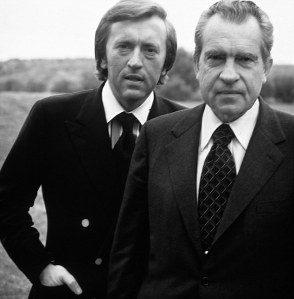
Former President Richard Nixon with TV interviewer David Frost in Mid-March in 1977 before they began taping their interviews later that month. (AP Photo)
Of course Frost was best known for his interviews with Richard Nixon after Watergate forced Nixon to resign the presidency.
He…conducted a series of interviews with Mr Nixon, who had resigned the presidency two years earlier, in which the former president came close to apologising to the public for his role in the Watergate scandal.
Their exchanges were eventually made into a film – based on a play – which saw Michael Sheen portray Sir David Frost to Frank Langella’s Nixon. Sir David himself appeared at the premiere of the film in 2008.
David was regularly scoffed at by fellow broadcasters for his allegedly non-aggressive style of questioning.
But he invariably had the last laugh because he almost always extracted more intriguing information and revealing reactions from his subjects than other far more acerbic broadcasters who boasted about their hard-hitting treatment of their “victims”….
His interview with the doomed American President “Tricky Dicky” Richard Nixon was a TV classic. During it, Nixon dramatically admitted that he had “let down the country”.
But there were many other historic moments, including one when he suddenly introduced the word “bonkers” during a tense interview with the then prime minister Margaret Thatcher over the sinking of the Argentine warship the Belgrano during the Falklands conflict. She was furious.
A few clips from Frost’s long and illustrious career in broadcasting.
From That Was The Week That Was (TW3), 1963
Tuesday Reads: Dreaming a Life; Obama and Putin; NSA and Snowden
Posted: June 18, 2013 Filed under: Barack Obama, Foreign Affairs, Great Britain, morning reads, NSA, National Security Agency, Real Life Horror, Russia, Syria, U.S. Politics | Tags: Carol Morley, Charles Pierce, checks and balances, Dick Cheney, Dreams of a Life, Edward Snowden, FISA court, G-8 summit, Glenn Greenwald, John Aravosis, Joyce Carol Vincent, leakers, mysterious deaths, Richard Nixon, Vladimir Putin, whistleblowers 29 Comments
Good Morning!!
I’m going to begin with an article I came across yesterday while reading the Guardian. It’s about a story from 2006 that I remembered and sometimes think about–a woman whose skeletonized body was found in her apartment three years after she died.
On 25 January 2006, officials from a north London housing association repossessing a bedsit in Wood Green owing to rent arrears made a grim discovery. Lying on the sofa was the skeleton of a 38-year-old woman who had been dead for almost three years. In a corner of the room the television set was still on, tuned to BBC1, and a small pile of unopened Christmas presents lay on the floor. Washing up was heaped in the kitchen sink and a mountain of post lay behind the front door. Food in the refrigerator was marked with 2003 expiry dates. The dead woman’s body was so badly decomposed it could only be identified by comparing dental records with an old holiday photograph of her smiling. Her name was revealed to be Joyce Carol Vincent.

Joyce Carol Vincent
How could such a thing happen? So often we hear sad stories like this and never get any answers to our questions. In this case, filmmaker Carol Morley decided to find out who Joyce Carol Vincent was, and she has made a documentary about her quest called Dreams of a Life. She writes:
In a city such as London, home to 8 million people, how could someone’s absence go unnoticed for so long? Who was Joyce Vincent? What was she like? How could she have been forgotten?
News of Joyce’s death quickly made it into the global media, which registered shock at the lack of community spirit in the UK. The story ran on in the British press, but still no photograph of Joyce appeared and little personal information.
Soon Joyce dropped out of the news. I watched as people discussed her in internet chatrooms, wondering if she was an urban myth, or talking about her as though she never mattered, calling her a couch potato, and posting comments such as: “What’s really sad is no one noticed she was missing – must have been one miserable bitch.” And then even that kind of commentary vanished.
But I couldn’t let go. I didn’t want her to be forgotten. I decided I must make a film about her.
She began by placing advertisements in newspapers asking anyone who knew Joyce to come forward. It turned out that Joyce had lots of friends over the years. She had been engaged to be married before she died, and she had also spent some time in a battered women’s shelter. Eventually, Morley was able to talk to many people who had known Joyce. She describes her journey in the Guardian article. It’s an amazing story, and I hope you’ll go read the whole thing.
Follow me below the fold for some news and opinion…
Saturday Reads: Jupiter and the Moon, the Myth of the Dying PC, and the Strange Psychology of Barack Obama
Posted: April 13, 2013 Filed under: Barack Obama, morning reads, Republican politics, The Media SUCKS, the villagers, U.S. Economy, U.S. Politics | Tags: FDR, James Carville, John Boehner, Jupiter, Richard Nixon, rumored death of the PC, skywatching, Wall Street criminals 29 Comments
Jupiter (Photo : NASA/Johns Hopkins University Applied Physics Laboratory/Southwest Research Institute/Goddard Space Flight Center)
Good Morning!!
If you have clear skies where you live this weekend, you might be able to see some spectacular views of Jupiter and the Moon. National Geographic reports:
Up first on Saturday, April 13, look towards the high western sky after local sunset for a waxing crescent Moon. Look to its far upper left and you will see a super-bright star – that is planet Jupiter- visible easily even from within heavily light polluted city limits.
As the sky darkens -about an hour after local sunset – look to the Moon’s immediate left and you will notice a distinctly orange-tinged, twinkling star. Aldebaran represents the red eye of Taurus, the bull constellation and is 65.1 light years from Earth. A true monster compared to our little Sun- Aldebaran’s diameter would reach beyond the orbit of Mars if it replaced our Sun at the center of the solar system.

The crescent Moon will guide skywatchers to star clusters within Taurus constellation on April 13th. Credit: A. Fazekas/Starry Night software
Look carefully between Aldebaran and the Moon in a darkened sky and the Hyades star cluster will come into view. Binoculars may help make out the distinctive V-shape of this 250 light year distant star association – one of the closest to Earth.
Now scan to the lower right of the Moon and a tight hazy patch of little stars can be glimpsed even with the naked eye from suburban skies. Known as the Seven sisters, the Pleiades is one of the better known sky targets for backyard stargazers. This rich open cluster actually has more than 40 young stars as members – no more than 10 million years old – and most can be seen with binoculars and small telescopes, however with the unaided eye will pick out the brightest five to seven of its stars.
By Sunday night, April 14th, the Moon will have risen higher in the western evening sky for a striking visual pairing with brilliant Jupiter. The cosmic duo will appear to be separated by only a couple of degrees – less than the width of your two middle fingers held at arm’s length.
In addition, on Sunday, you might be able to see Jupiter in the daytime according to Science World Report.
Tomorrow, April 14, you could have the chance of seeing Jupiter during the daytime and join the ranks of people that have spotted the giant plant while the sun is in the sky.
During daylight, the sky can look like an unbroken swathe of blue on a clear, sunny day. This makes it difficult to pick out celestial features since there are no “markers” to go by. The night sky, in contrast, has the benefit of possessing constellations to navigate by.
Yet tomorrow, the moon will be up during the daytime, which makes all of the difference in the world. The day sky is, in fact, just as transparent in daylight as it is on a dark night. If you know exactly where to look and have something to focus your eyes on, you can see the brighter and larger planets in the blue sky.
So what planets can you see? You can spot Venus easily during the daytime. In fact, during Abraham Lincoln’s second inauguration, large numbers of people in the crowd were able to see Venus over the Capitol Dome. Jupiter, which will be making an appearance tomorrow, is slightly more difficult to spot. It’s further from the sun, which means that it’s less well lit than Venus.
I’m hoping it will clear up here so I can try to spot Jupiter in the sky tomorrow. It’s supposed to rain today, so I don’t know if I can see the starts this evening, but I plan to give it a try.
I’m writing this post on a laptop computer that I bought in August 2008. It runs on Windows Vista. It used to be that I’d have to buy a new computer every couple of years, but I’ve had this one for more than four years and it’s showing no sign of breaking down or running out of memory. I do have a back-up laptop that is a bit newer, but I still like this one better.
The reason why I bring this up is that I’ve been seeing articles recently about the death of the PC and how pretty soon PCs will be replaced with other, more exciting gadgets. These rumors are based on sales data that shows people aren’t buying as many PC’s as they used to. This may be bad news for some corporations, but it’s good news for us customers.
At Slate, Will Oremus explains: “The Real Reason No One’s Buying PCs Anymore: They’ve Gotten Too Good.”
It’s certainly true that people are increasingly spending money on new tablets and smartphones rather than new computers. But reports of the PC’s demise are grossly exaggerated. If the PC is dead, what am I typing this on? If the PC is dead, what are office-workers all over the world sitting in front of all day while they work? The reason people aren’t buying new PCs isn’t that they don’t need a PC. It’s that, for the most part, they’re getting along just fine with the one they already have.
In the past, you had to replace your computer every few years or else it would become hopelessly bogged down trying to deal with the latest desktop applications, operating systems, and Internet technologies. But thanks to Moore’s Law, your average PC’s processing power now exceeds most people’s daily needs by a healthy margin. Meanwhile, the rise of the cloud has reduced the need for extra memory. And as ZDNet’s Simon Bisson explains in depth, a strategic shift by Microsoft in recent years has meant that you no longer need to buy a new machine in order to take advantage of each new operating system. The result is that PCs have become more durable than smartphones and tablets, which are still puny enough in their powers that you have to upgrade them regularly.
PC makers probably didn’t mean for that to happen, but there you have it. They’re a victim of unplanned non-obsolescence.
Joseph Cannon has also weighed in on the rumored death of the PC.
…the makers of desktop computers and laptops must learn that today’s machines have become really, really good — better than most people need. They do not require replacement every few years. Maybe once a decade. When you buy a high-quality raincoat, paintbrush, coffee table or carpet, you’re investing in something built to last. So too, now, with computers.
Here’s another reason PC sales have slowed: Windows 8 blows like a tornado and sucks like a black hole.
I’m not even that wild about Windows 7 myself.
Have you noticed I’m avoiding the political news this morning? I’m still flummoxed by James Carville’s comments yesterday on Morning Joe about President Obama’s priorities (courtesy of Talking Points Memo).
Appearing on MSNBC’s “Morning Joe,” Carville said he thinks Obama relishes the commendation he’s received from deficit hawks like New York Times columnist David Brooks and host Joe Scarborough. Asked by co-host Mike Barnicle how the President will respond to the outrage from the left-wing of the Democratic Party, Carville was blunt.
“I think he likes that,” Carville said. “I don’t think he’s upset. He got a very favorable Washington Post editorial. ‘Morning Joe,’ very favorable commentary right here. I guarantee you if he’s up watching this right now. Got a good David Brooks column. He’s kind of excited this morning. This is kind of important to him.”
Folks at DailyKos interpreted this as Carville agreeing with Obama (see comments and prepare for some Hillary hate as well). I don’t think so. I think Carville sees this as idiotic. He doesn’t much care for Obama, and he’s outing the president as a pathetic media suckup.
The sad thing is that I believe Carville. I really think Obama is completely so much in thrall to the DC elite that he’s willing to hurt his own reputation in order to please them. Obama is the opposite of Franklin Roosevelt. Roosevelt reveled in insulting the establishment, especially the bankers. Obama releases a draconian austerity budget, celebrates the reviews from the Washington Post and David Brooks, and the next day he meets with Wall Street criminals Jamie Dimon and Lloyd Blankfein, among others.
I need to work out a new psychological profile of Barack Obama. What is his deal anyway? During the 2012 campaign, he began to talk like a liberal and a populist. The more he got out with real people, the more he seemed to be able to empathize with them a little bit. But as soon as he was reelected and went back to the Village bubble, he reverted to form. In the 1970s Obama would have been a Republican and considerably to the right of Richard Nixon.
The fascinating thing is that I think Obama actually understands that his policies are going to hurt the economy. He has said repeatedly that he thinks stimulating the economy is important. He also knows that health care costs are the real problem and that Social Security has nothing to do with the deficit. Back in January, John Boehner told the Wall Street Journal about a “frustrating” conversation he had with Obama.
What stunned House Speaker John Boehner more than anything else during his prolonged closed-door budget negotiations with Barack Obama was this revelation: “At one point several weeks ago,” Mr. Boehner says, “the president said to me, ‘We don’t have a spending problem.’ ” [….]
The president’s insistence that Washington doesn’t have a spending problem, Mr. Boehner says, is predicated on the belief that massive federal deficits stem from what Mr. Obama called “a health-care problem.” Mr. Boehner says that after he recovered from his astonishment—”They blame all of the fiscal woes on our health-care system”—he replied: “Clearly we have a health-care problem, which is about to get worse with ObamaCare. But, Mr. President, we have a very serious spending problem.” He repeated this message so often, he says, that toward the end of the negotiations, the president became irritated and said: “I’m getting tired of hearing you say that.”
Nevertheless, as we have seen, Obama’s budget would increase health care costs, wouldn’t raise much revenue, and would drastically increase income inequality. The only thing that is saving us from Obama’s folly is that Republicans are even nuttier in their obsession with avoiding tax increases on rich people.
There has to be a psychological explanation for Obama’s obsession with trying to win over people who hate and despise him and will never like him no matter what he does. I assume it at least partially goes back to his childhood and being abandoned by both of his parents. Obama even chooses advisers who will convince him to advance Republican policies!
At the moment, it looks to me as if Obama has made himself a lame duck with this budget, even if it never gets a vote (and it probably won’t). Democratic candidates will have to distance themselves from him if they want to be elected or reelected. Why would he do that to himself? And I reject the idea that he’s just evil incarnate as some people who drop in here occasionally seem to think.
I’m sure Obama must care about his legacy, but somehow he still can’t screw up the courage to buck the establishment that really doesn’t like and and never will. As of now, it looks like he could go down in history as a very bad President–maybe even as bad as George W. Bush. But we’ll have to wait and see how it all plays out over the next few years.
Anyway, I’ve rambled long enough. I know this is a strange post, but it’s all I’ve got this morning. What’s on your mind today? Please post your links in the comments, and have a great weekend!
Thursday: Bob Woodward’s Non-Scoop, and Some Interesting Long Reads
Posted: February 28, 2013 Filed under: Barack Obama, morning reads, the villagers, U.S. Politics | Tags: Bob Woodward, Carl Bernstein, Christopher Dorner, Gene Sperling, Mark Ames, Politico, processed food addiction, Richard Nixon, Watergate, Workplace shootings 37 Comments
Good Morning!!
Poor Bob Woodward! The only way he can get attention nowadays is by whining and crying and generally creating a tempest in a teapot.
Yesterday Jim Vandehei and Mike Allen posted one of their patented “Behind the Curtain” pieces: Woodward at War, in which they dramatically revealed the inside story of Woodward’s little spat with the White House. This is the sort of story only the Villagers really care about, but when they care about something, they insist on forcing their opinions about it on the rest of us. It was the subject of the first hour of Morning Joe for yesterday and today, and the focus of countless media reports and blog posts throughout the day yesterday. Woodward must be in heaven with all this attention. From Politico:
Bob Woodward called a senior White House official last week to tell him that in a piece in that weekend’s Washington Post, he was going to question President Barack Obama’s account of how sequestration came about — and got a major-league brushback. The Obama aide “yelled at me for about a half-hour,” Woodward told us in an hourlong interview yesterday around the Georgetown dining room table where so many generations of Washington’s powerful have spilled their secrets.
Digging into one of his famous folders, Woodward said the tirade was followed by a page-long email from the aide, one of the four or five administration officials most closely involved in the fiscal negotiations with the Hill. “I apologize for raising my voice in our conversation today,” the official typed. “You’re focusing on a few specific trees that give a very wrong impression of the forest. But perhaps we will just not see eye to eye here. … I think you will regret staking out that claim.”
Woodward repeated the last sentence, making clear he saw it as a veiled threat. “ ‘You’ll regret.’ Come on,” he said. “I think if Obama himself saw the way they’re dealing with some of this, he would say, ‘Whoa, we don’t tell any reporter ‘you’re going to regret challenging us.’”

Horrors! “I think you will regret staking out that claim” is a “major league brushback?” Either Nixon and his men were quite a bit wimpier than we all thought, or Woodward is a lot touchier now than he was in the Watergate days.
In an update, Vandehei and Allen revealed that the White House adviser who supposedly yelled at Woodward over the phone and then “threatened” him was Gene Sperling, Director of the National Economic Council. This morning they published the actual e-mails between Sperling and Woodward. Frankly, I was underwhelmed. Follow me below the fold to read them.
Read the rest of this entry »
Morning Joe Reads A Book
Posted: February 20, 2013 Filed under: Civil Rights, racism, Republican politics, U.S. Politics | Tags: Checkers speech, Dwight D. Eisenhower, Joe Scarborough, John Nance Garner, Richard Nixon, Southern Strategy 28 Comments
Or maybe he got someone else to read it for him? In any case, the New York Times Sunday Book Review asked Joe Scarborough to review a serious book of political history, Ike and Dick: Portrait of a Strange Political Marriage. in the February 17, 2013 edition.
How low has the Sunday Book Review sunk that it would not only publish an essay by Scarborough, but also highlight the brief review with a separate “Up Front” introduction? I haven’t seen the cover of the print edition, but it sounds as if Scarborough’s piece was printed on page 1!
Charles Pierce wrote a pithy reaction to the Times’ decision in his “What are the Gobshites Saying These Days” post on Monday.
…let us pause for a moment and congratulate the editors of The New York Times Book Review for handing a serious work of popular history to whatever’s left of Joe Scarborough after Paul Krugman picks the rest out from between his teeth….
the Review has fallen on some pretty hard times when they have a story meeting and someone says, “We got this new book on Eisenhower and Nixon. Who should we get to review it?” And someone else says, “I know. How about that guy who runs the Morning Zoo on MSNBC? He’s really popular with the people who get drunk in front of the TV and pass out during Rachel’s show the night before.” And this is what you get for an author ID.
Joe Scarborough is the host of MSNBC’s “Morning Joe.”
Lovely. They should let Barnicle review the next Royko anthology.
At least Mike Barnicle used to be a working journalist.
Pierce links approvingly to this post by Dan Kennedy at Media Nation: Joe Scarborough doesn’t know much about history.
If you’re going to try something as cheeky as letting cable blowhard Joe Scarborough review a serious book about political history, you should at least make sure you’ve got a safety net in place. But the New York Times Book Review doesn’t even bother, letting Scarborough step in it repeatedly in his review of Jeffrey Frank’s “Ike and Dick: Portrait of a Strange Political Marriage.”
Here’s the first paragraph of Scarborough’s review:
It may be the closest of political relationships, but it rarely ends well. Vice President Thomas Jefferson challenged President John Adams for the top spot in the vicious campaign of 1800. President Andrew Jackson mused sardonically about executing Vice President John C. Calhoun. In the modern era, Lyndon Johnson seethed at slights real and perceived during John Kennedy’s thousand days, then turned around and humiliated his own vice president, Hubert Humphrey. Even Dick Cheney and George W. Bush fell out by the end of their tumultuous terms. But perhaps the most intriguing — and dysfunctional — political marriage in history was the one between the subjects of Jeffrey Frank’s meticulously researched “Ike and Dick.”
Kennedy wonders if Scarborough knows that
the Constitution originally stipulated that the candidate who received the most votes from the Electoral College would become president and that the person who came in second would become vice president. Perhaps that’s too much math for the famously innumerate Scarborough.
I didn’t know that either, but I think if I were writing a review for the New York Times, I would have found out before using that as my introduction. Kennedy explains that Jefferson and Adams, who couldn’t stand each other, ran against each other in 1796. Adams got more electoral votes and so they were forced to serve together, but their mutual dislike did not grow out of their political alliance as Scarborough implies.
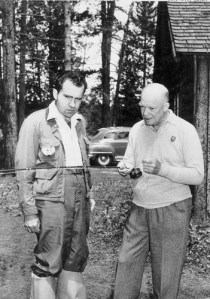
Ike and Dick fishing at Camp David
Kennedy points out two other more serious misstatements in the review. In the paragraph above, Scarborough suggests that Lyndon Johnson’s insecurities stemmed from Jack Kennedy’s mistreatment and that led Johnson to humiliate his own Vice President Hubert Humphrey. Scarborough isn’t really clear about this, but he seems to be drawing analogies to the Eisenhower-Nixon relationship. He seems to claim–perhaps based on his reading of Frank’s book–that Nixon’s neuroses stemmed from his difficult relationship with Eisenhower. But Nixon was a psychologically troubled person long before he met Ike and suggesting otherwise is inaccurate. Likewise, Johnson had plenty of psychological issues before he got involved with Jack Kennedy. Dan Kennedy writes:
As anyone who’s read Robert Caro’s “The Passage of Power” knows, Johnson, like Nixon, suffered from a world-class case of insecurity long before he ever met John Kennedy. The truth is the opposite of what Scarborough claims: both Nixon and Johnson were uniquely unsuited to suffer the slights that are inherent to the vice presidency long before they assumed the office.
Finally, Kennedy points out the ludicrousness of the following passage from the Scarborough piece:
A fascinating subplot in Frank’s story details Nixon’s role in pushing the administration on the issue of civil rights. Long criticized as the author of the Republican Party’s racially tinged “Southern strategy,” Nixon is shown by Frank to be a determined advocate for the Civil Rights Act of 1957, as well as a trusted ally of Martin Luther King Jr. and Jackie Robinson.
Yes, Nixon was supportive of Martin Luther King during the 1950s, and did try to get Eisenhower to push for African American civil rights, but Scarborough completely ignores Nixon’s later rejection of King during the 1960 presidential campaign and his [Nixon’s] development of the “Southern Strategy” in 1968. If those later events weren’t included in Frank’s book, a competent reviewer would have called attention to them. In fact, if Scarborough had googled, he could have quickly found an article by Franks himself that points out Nixon’s later involvement in blatant racism. Franks writes in The Daily Beast, January 21, 2013:
There once was a real connection between the two men, but it more or less ended with RN’s spineless behavior during the 1960 presidential campaign, after Dr. King was arrested on phony charges stemming from a traffic violation. Coretta Scott King had been terrified; she worried with good reason that her husband might be killed en route to Georgia State Prison in Reidsville, and she appealed to the Nixon and John F. Kennedy campaigns to intervene.
Nixon, however, demurred; he said that it would be “grandstanding” to speak out, according to his aide William Safire. Nixon’s real motive, though, seems clear: it was a close election and he was willing to lose black support if it meant gaining a new harvest of white votes in the once-Democratic south. Eight years later, this approach became the carefully considered “Southern strategy.”
The Kennedy brothers then stepped in to help King.
John and Robert Kennedy helped to win Dr. King’s release, and soon enough their campaign distributed two million copies of a pamphlet titled “‘No Comment’ Nixon Versus a Candidate With a Heart, Senator Kennedy” to well chosen voters. It can’t be proved that this made the difference in an election in which the popular vote turned out to be the closest ever (Nixon and Kennedy were separated by about 112,000 votes out of sixty-nine million cast), but it’s a fact that President Eisenhower in 1956 got some 40 percent of the black vote and that Nixon in 1960 won just 32 percent—not bad by modern Republican standards, but still a steep drop. Four years later, facing Barry Goldwater, Lyndon Johnson won 94 percent of the black vote, which set a demographic pattern that endures.
We already knew that Morning Joe doesn’t understand economics; we now know he’s history-challenged as well. In addition, I have some problems with the clarity of his writing. Here are a couple of examples.
Paragraph 2 begins:
Franklin Roosevelt’s vice president memorably said that being No. 2 was in effect not worth a bucket of warm spit.
Which vice president? FDR served with three: Henry A. Wallace, John Nance Garner, and Harry S. Truman. If you said John Nance Garner, you’re correct. And he didn’t qualify the judgment with “in effect” either. Was Scarborough just to lazy to look up the quote?
This reminds me of problems that many college freshmen have in their writing–they either don’t provide enough context or they assume knowledge the reader may not have. They also tend to use unnecessary qualifications instead of just making straightforward statements.
In paragraph 3, Scarborough writes:
“Ike and Dick” is a highly engrossing political narrative that skillfully takes the reader through the twisted development of a strange relationship that would help shape America’s foreign and domestic agenda for much of the 20th century.
Really? Perhaps that judgment came from the book; but it’s a pretty sweeping statement that needs to be backed up with specific examples. But Scarborough doesn’t offer any. When he does provide more context, as he does in paragraph 5, he leaves out important details. He briefly mentions a “secret Nixon fund” that led to Eisenhower trying to dump Nixon from the ticket in 1952, and says that Nixon survived; but Scarborough never even mentions what saved him–the Checkers speech!
The entire review is only a little over 1,000 words. Surely Scarborough could have added a few more historical details and specific examples to back up his assertions.
If I were grading this review for a college course, I’d probably have to give it a C+, or maybe a B- in these days of grade inflation. The grammar and sentence structure are okay; but the review itself is short on context, the historical inaccuracies are problematic, and the lack of specific examples makes for rather boring reading. Frankly, I’m disappointed in the New York Times for publishing it.

 peej
peej Carissa
 bostonboomer
 dakinikat
 ecocatwoman
 mablue2
 Mama Lopez
 peggysue22
 quixote
 skydancingguestblogger
 Mona (aka Wonk the Vote)



 Sky Dancing
Recent Comments