






Murphy suggested that if the goal is not to ensure a transition of power, the U.S. will just face more issues further down the line. He said: “So, they are going to spend hundreds of billions of your taxpayer dollars, get a whole bunch of Americans killed, and a hardline regime – probably a MORE anti-American hardline regime – will still be in charge.”
He said there didn’t seem to be a clear goal apart from “destroying lots of missiles and boats and drone factories.”
“But the question that stumped them: what happens when you stop bombing and they restart production? They hinted at more bombing. Which is, of course, endless war,” he said.
Lazy Caturday Reads: Trump’s “Personal Vietnam?”
Posted: March 14, 2026 Filed under: just because | Tags: Benjamin Netanyahu, corruption, Donald Trump, dubai, Gaza, Iran War, israel, Jared Kushner, Karg Island, Lebanon, Mohammed bin Salman, Pete Hegseth, Strait of Hormuz, U.S. Embassy Bagdad, UAE 4 CommentsGood Afternoon!!
 I’m sick and tired of wars. I’m even more sick and tired of Trump and his cabinet full of stupid idiots. I came of age during the Vietnam war. After that disaster finally ended, I really thought our leaders would stay out of unnecessary wars. But it didn’t happen. These men (goddess forbid we elect a woman president!) just have to prove their “manhood” by attacking other countries. I’m just plain sick of it.
Trump’s war could turn out to be worse than the ones George W. Bush got us into. It appears he was talked into attacking Iran by his pal Bibi Netanyahu and his son-in-law Jared Kushner, who is very close to Netanyahu as well the crown prince of Saudi Arabia Mohammed bin Salman. Trump was also looking for a powerful distraction from the Epstein scandal. Now Netanyahu appears to be trying to turn Lebanon into another Gaza, and Kushner is soliciting more money for his private businesses.
It also appears that Trump and his gang of idiots didn’t plan for the obvious results of their war–rising prices and the closing of the Strait of Hormuz. In addition, Trump’s “Secretary of War” is advocating for war crimes. That’s where things stand so far.
Here’s the latest:
William Christou at The Guardian: Entire families wiped out and towns emptied as Israel’s war on Lebanon intensifies.
For Batoul Hamdan and her two children, seven-month-old Fatima and Jihad, three, Monday’s iftar, the evening meal that breaks the daily fast during Ramadan, was special.
For a week, they had eaten to the sounds of bombs in their home in Arab Salim. Hamdan eventually decided to leave for Al-Nimiriya, the sleepy town where she had grown up. Surrounded by her parents and siblings in the family home, she hoped they could finally enjoy the festive mood of Ramadan.
They had just finished their meal when the bomb fell. The Israeli airstrike collapsed the two-storey building instantly, killing all eight members of the Hamdan family: grandparents Ahmad and Najib, their children, including Batoul, and grandchildren Fatima and Jihad – three generations wiped out in a moment.
On Thursday, only snarled rebar and broken concrete remained of the Hamdan family home. The fragments of their lives – a certificate of achievement from the children’s schooldays, cutlery from their cabinet, frayed purses – had been ejected by the force of the blast and now littered the ground.
“There was no warning before the strike. My own two kids started to cry, I picked them up and started to run away from the explosion when it happened,” said Qassem Ayoub, a neighbour and town police officer, as he stared at the wreckage. “Why were they targeted? I don’t know, ask the Israelis.”
Batoul and her loved ones were among the 773 Lebanese people – including more than 100 children – killed by Israel’s campaign in Lebanon since 2 March. They join a growing list of families completely wiped out by Israeli bombings, in a conflict whose death toll is rising faster than in any previous war in Lebanon.
Forty-one people were killed by Israeli airstrikes in Nabi Chit in the Bekaa valley in only five hours last Saturday, and 18 people died in a single night in the town of Sir el-Gharbiyeh on 8 March. The pace of death has stunned Lebanese people and left them struggling to keep up.
Do you think Netanyahu will stop these attacks on Lebanon if Trump calls off his war in Iran. I don’t.

By Avalon Atelier
Kareem Chehayeb and Malak Harb at AP: War has already displaced nearly a million Lebanese, and aid groups warn of a humanitarian crisis.
BEIRUT (AP) — Fatima Nazha slept on the street for two days after she and her family fled their home in Beirut’s southern suburbs following an Israeli mass evacuation order.
All of the schools the government turned into shelters were full, and the family couldn’t afford a hotel or an apartment, so she and her husband eventually moved into a tent in the country’s biggest stadium while their kids and grandchildren found shelter near the southern coastal city of Sidon.
In just 10 days, more than 800,000 people in Lebanon have been displaced by war, just over a year since the last conflict uprooted over a million Lebanese from their homes. That’s one in every seven people in the tiny country, according to humanitarian organization the Norwegian Refugee Council. Many don’t have a place to stay, and the cash-strapped government has only been able to accommodate roughly 120,000 people as it scrambles to open shelters and bring in more supplies.
Nazha, who uses a wheelchair, said being forced from her home has been far more difficult this time than when Israel and Hezbollah were last at war more than a year ago. The strikes targeting the Iran-backed militant group have been more intense and unpredictable, and Israel’s evacuation order came abruptly, leaving her unable to gather all her belongings.
“The strikes used to target a specific area, but now they’re hitting all the areas,” she said, taking a drag off her cigarette. Lebanon’s Health Ministry said Friday that more than 700 people, including 103 children, have died in the war.
Read more at the AP link.
But Netanyahu isn’t satisfied yet. Barak Ravid at Axios: Israel planning massive ground invasion of Lebanon, officials say.
Israel is planning to significantly expand its ground operation in Lebanon, aiming to seize the entire area south of the Litani River and dismantle Hezbollah’s military infrastructure, Israeli and U.S. officials say.
Why it matters: This could be the largest Israeli ground invasion of its northern neighbor since 2006, dragging Lebanon to the epicenter of the escalating war with Iran.
- “We are going to do what we did in Gaza,” a senior Israeli official said, referring to the flattening of buildings Israel says Hezbollah uses to store weapons and launch attacks.
The big picture: An operation of this size and scale could lead to a prolonged Israeli occupation of southern Lebanon.
- Lebanon’s government is deeply alarmed that the renewed war — triggered by Hezbollah’s decision to launch rockets at Israel — will devastate the country.
- The Trump administration backs a major Israeli operation to disarm Hezbollah, but is also pressing to limit the damage to the Lebanese state and pushing for direct Israel-Lebanon talks on a postwar agreement.
Driving the news: Until days ago, Israeli Prime Minister Benjamin Netanyahu’s government was still trying to contain the Lebanon escalation in order to stay focused on Iran, according to Israeli officials.
- That calculus changed Wednesday when Hezbollah launched more than 200 missiles in a massive coordinated attack with Iran, which fired dozens of its own.
- “Before this attack we were ready for a ceasefire in Lebanon, but after it there is no way back from a massive operation,” a senior Israeli official said.
State of play: The IDF has had three armored and infantry divisions on the Lebanese border since the start of the Iran war, with some ground forces conducting limited incursions over the past two weeks.

By Kim Haskins
And what is Jared Kushner up to now that he got Trump to help Netanyahu with his bloodthirsty plans?
Rob Copeland and Maureen Farrell at The New York Times (gift link): Jared Kushner Solicits Funds for His Firm While Working as Mideast Envoy.
Jared Kushner, one of the U.S. government’s chief negotiators in the Middle East, is trying to raise more money for his private equity firm from governments in the region.
Mr. Kushner, President Trump’s son-in-law, has spoken with potential investors in recent weeks about raising $5 billion or more for Affinity Partners, his investment firm, according to five people with knowledge of the talks who were not permitted to speak publicly about the discussions.
As part of the fund-raising effort, Affinity’s representatives have already met with Saudi Arabia’s Public Investment Fund, which invests the proceeds of the kingdom’s vast oil reserves, two of the people briefed on the discussions said. PIF is led by Crown Prince Mohammed bin Salman, who has formed close ties with Mr. Kushner and the Trump administration.
PIF, which is already the largest and earliest investor in Affinity, invested $2 billion soon after the first Trump administration ended.
As part of that deal, the Saudis must be given the first chance to invest during any subsequent attempts by Affinity to raise funds, the two people said. Other Middle Eastern sovereign wealth funds that invested earlier in Affinity, including those in the United Arab Emirates and Qatar, are also expected to be asked for more, the people said.
Mr. Kushner’s fund-raising is expected to stretch on for the better part of this year.
The efforts show the blurring of the lines between public service and private profit-seeking during Mr. Trump’s second term. Only a few weeks ago, in his role as Mr. Trump’s “peace envoy,” Mr. Kushner met in Geneva with Iran’s foreign minister. The U.S. and Israeli bombing campaign in Iran began shortly after those meetings concluded without a deal on Iran’s nuclear program.
Meanwhile, Kushner is not actually an employee of the Federal government. The corruption is breathtaking.
And what’s happening in in Iran these days? Well, it appears that the Trump gang didn’t plan for what to do if Iran cut off shipping traffic in the Strait of Hormuz–something they were warned about.
Rebecca F. Elliott and Vivian Nereim at The New York Times (gift link): Why Little Was Done to Head Off Oil’s Strait of Hormuz Problem.
Of all the risks the global energy system has long faced, none was bigger or better known than the potential closure of the Strait of Hormuz.
The narrow passageway out of the Persian Gulf is both vital — serving as the only gateway to the rest of the world for huge amounts of oil and natural gas — and extremely vulnerable to attacks.
But despite being widely recognized as a potential choke point, the strait remains the only way to export most of the energy produced in the region. That has come into sharp relief in the second week of the war in the Middle East, as the near-closure of the waterway sent oil prices soaring above $100 a barrel for the first time in almost four years.
The reason there is no true alternative comes down to a combination of geography, political tensions and economic competition among the region’s oil powers. There have been efforts to circumvent the strait, notably by Saudi Arabia and the United Arab Emirates. But the pipelines through those countries can carry only a small fraction of the energy produced in the Persian Gulf.
By Mathias Hauser
For many other energy-producing countries in the region, the only way to avoid the strait would be to lay a pipeline across a neighboring country — an expensive and politically fraught endeavor. Take Qatar, one of the world’s biggest natural gas exporters. Its only land border is with Saudi Arabia — a country that cut off diplomatic ties and closed that border during a regional spat resolved five years ago. Plus, any pipeline would itself be vulnerable to Iranian attacks.
“There’s nothing which is totally secure here,” said John Browne, a former chief executive of the London-based oil giant BP, once known as the Anglo-Iranian oil company. “In the end, someone with bad intention can do all sorts of things to oil and gas infrastructure.”
Some oil analysts also assumed that, if the time came, the United States, which has a keen interest in keeping energy markets stable, would use its military might to keep the strait passable.
Oh really? I guess these “analysts” didn’t consider the fact that Donald Trump is a psychopath who couldn’t care less about anyone but himself and his childish needs. Use the gift link if you want to read more.
Now that the shit has hit the fan, and prices on gas and just about everything else are rising rapidly, Trump has decided to send in some more troops.
Eric Schmitt at The New York Times: More Marines and Warships Being Sent to Middle East, U.S. Officials Say.
About 2,500 Marines aboard as many as three warships are heading to the Middle East from the Indo-Pacific region, as Iran increases its attacks on the Strait of Hormuz, two U.S. officials said.
The shift, earlier reported by The Wall Street Journal, comes as Iran’s response to nearly two weeks of aerial bombardment and long-range artillery strikes has proved more resilient than Trump administration officials anticipated.
The Marines will join more than 50,000 American troops in the region. The new deployment comes as Iran’s attacks on and near the strait have choked maritime traffic through the essential waterway, rocking the global economy. It was unclear how the new deployment would be used….
Last week, President Trump said he might order Navy warships to escort merchant ships through the crucial oil supply route, which U.S. forces did for a period of time in the late 1980s during similar tensions with Iran.
More recent developments:
U.S. forces have carried out “large-scale” strikes on Kharg Island, a critical hub of Iran’s Gulf oil operations, with the country responding by threatening to strike U.S. allies’ oil facilities if any of its infrastructure is damaged.
U.S. Central Command said Saturday that naval mine storage facilities and missile storage bunkers were among targets destroyed in the “precision strike” on the island, hitting “90 Iranian military targets” while “preserving the oil infrastructure.”
Kharg Island, a tiny but strategic island 15 miles off the coast of Iran in the Persian Gulf, is home to an oil terminal that ships 90% of the country’s oil exports. There are also military capabilities there, including air defenses and mines buried underground.
Announcing the strike in a post on Truth Social late Friday, President Donald Trump said that U.S. forces had “totally obliterated every MILITARY target in Iran’s crown jewel, Kharg Island.”
Trump just loves that word “obliterated.”
The island’s oil terminal has so far been unscathed in the war, according to oil market research firm Energy Intelligence, and the president said the island’s oil infrastructure was spared in Friday’s attack, but could be struck down the road.
“Should Iran, or anyone else, do anything to interfere with the Free and Safe Passage of Ships through the Strait of Hormuz, I will immediately reconsider this decision,” Trump said, as Iran has actively interfered with shipping in the strait for several days.
Iran is retaliating.
Reuters: US embassy in Iraq’s Baghdad hit in missiles attack, security sources say.
The U.S. Embassy in the Iraqi capital Baghdad was hit in a missiles attack, Iraqi security sources told Reuters on Saturday.
The attack caused smoke to rise from the embassy’s building, the sources said, without providing details on the damage.
Another update from AP: Missile strikes helipad inside US Embassy compound in Baghdad.
A missile struck a helipad inside the U.S. Embassy in Baghdad, two security officials said.
The projectile landed within the embassy’s boundaries after the Green Zone, the heavily fortified district in central Baghdad that houses Iraqi government institutions and foreign embassies, added the security officials, who spoke on the condition of anonymity as they are not authorized to speak with the press.
Video obtained by The Associated Press showed smoke billowing from inside the compound.
AP: Tehran threatens Middle East’s busiest port as Iran war enters its third week.
DUBAI, United Arab Emirates (AP) — Iran openly threatened a neighboring country’s non-U.S. assets for the first time Saturday, warning people to immediately evacuate the busiest port in the Middle East and two others in the United Arab Emirates as the U.S.-Israel war with Iran entered its third week.
By Rudi Hurzlmeier
A missile struck a helipad inside the U.S. Embassy compound in Baghdad, and debris from an intercepted Iranian drone hit an oil facility in the UAE, further increasing global anxiety about oil supplies.
Iran threatened to attack cities in the UAE, home to Dubai and one of the world’s busiest airports, saying the U.S. used “ports, docks and hideouts” there to launch strikes on Iran’s Kharg Island, without providing evidence. It urged people to evacuate areas where it said U.S. forces were sheltering, naming Dubai’s Jebel Ali port — the Mideast’s busiest — as well as Abu Dhabi’s Khalifa port and Fujairah port.
Iran has fired hundreds of missiles and drones at Arab Gulf neighbors during the war, but it said it was targeting U.S. assets, even as hits or attempts were reported on civilian ones such as airports and oil fields.
Back here at home, Pete Hegseth is in favor of committing war crimes. He’s already committed war crimes with his fishing boat strikes. His troops also committed a war crime when they sank Iranian ships and failed to attempt to rescue survivors. Then yesterday he said advocated for another war crime.
Raw Story:
Secretary of Defense Pete Hegseth offhandedly made a remark about the Trump administration’s attack on Iran during his speech on Friday that experts warned, if he’s serious, could be a war crime — even just for him to say out loud.
“No quarter, no mercy for our enemies,” said Hegseth. “Yet some in the press just can’t stop. More fake news from CNN reports that the Trump administration underestimated the Iran war’s impact on the Strait of Hormuz. The sooner David Ellison takes over that network, the better.”
The phrase “no quarter” is often used colloquially in a political setting, but in a military context, it means any enemy combatants will be killed with no allowance for surrender — something that, as experts on X and Bluesky were swift to point out, is a violation of both international law and the U.S. military code.
“Went largely unnoticed but Hegseth on Iran said the U.S. would provide ‘no quarter, no mercy for our enemies’ during his press conference today,” wrote Wall Street Journal national security reporter Alex Ward. “‘No quarter’ is a violation of international humanitarian law.” He provided a link to the relevant provisions of the Geneva Convention.
I’ll end with this piece Sidney Blumenthal at The Guardian: Trump faces a ‘personal Vietnam’ in Iran.
Donald Trump is lost in his fog of war. He compounds confusion with improvised fabrications as his naive expectation of a lightning victory has been sunk in the Strait of Hormuz. Iran, he felt certain, would easily follow the “perfect scenario” of Venezuela, accede to naming a leader who would instantly do his bidding, and there would be no disruption of the oil markets – “a strong game plan”, stated Karoline Leavitt, his White House press secretary, who defends each of his changeable excuses with equal ferocity.
By Kim Haskins
There may be few if any facts underlying the delusions upon which Trump constructs his vapid explanations and evanescent strategies. The belief that coherent sense can be made out of Trump’s shuffling words is a weakness of the rational mind that refuses to accept the impulses of the inveterate demagogue for what they are. Searching for reason in the jungle of Trump’s tales may compel hopelessly sensible people to superimpose logic where there is none in order to satisfy the need for some semblance of soundness.
Trump’s erratic efforts to reframe his rationale further expose his incompetence and unintelligibility, utterly predictable but now lethal on a global scale. His stream of sputtering remarks has, however, clearly established the ground that should be explored by congressional inquiries into the war’s origins, planning and conduct.
Trump is also at war with the English language. His war is not a war, he insists, but a “short-term excursion”, a semantic dodge to skirt congressional and international accountability. Then, when asked whether it’s an excursion or a war, he replied: “Well, it’s both. It’s an excursion that will keep us out of a war.” His rhetorical legerdemain is the equivalent of René Magritte’s painting of a pipe with the caption, “Ceci n’est pas une pipe” – “This is not a pipe.” The title Magritte gave to his painting was The Treachery of Images. Orwell or Magritte? Propaganda or surrealism?
Trump has declared he will force “regime change” or negotiate with some unnamed personage in the regime who happens to have been recently killed. “Most of the people we had in mind are dead,” he said. Trump demands “unconditional surrender” or he declares the war “very complete” after an hour-long conversation with Vladimir Putin, after Putin pledged “unwavering support” to the new supreme leader, Mojtaba Khomeini, the 56-year-old son of the assassinated 86-year-old supreme leader, about whose ascension Trump said he was “not happy” and called him a “lightweight”.
I hope you’ll go read the rest. Blumenthal is good.
That’s all I have for today. I hope you’re enjoying your weekend, despite the ugly war news.
Wednesday Reads: Iran Dominates the News; Epstein Still Breaks Through
Posted: March 11, 2026 Filed under: just because | Tags: Dan Caine, DOGE Social Security Attacks, Donald Trump, Iran War, Jared Kusher, Kristi Noem, Pete Hegseth, Sen. Chris Murphy, Steve Witkoff, Strait of Hormuz 5 CommentsGood Afternoon!!
Yesterday I tried to watch a press conference on Trump’s Iran conflict by Pete Hegseth and Dan Caine, but it was unwatchable. Hegseth waved his arms around and yelled over-the-top threats, and Caine sort of tried to sound reasonable; but none of it made sense. No one in the Trump administration has a clue why we’re in this “war.” I really do think it’s another distraction from the Epstein files.
So this morning I enjoyed reading this description by John Ganz at Unpopular Front: Command-Shift-War. War as Cliché.
This war is notable not for its use of Artificial Intelligence, but for the fact that it is the first war that feels like it’s been launched by A.I: It’s all been done on a level less than thought. Trump’s remarks, Hegseth’s speeches; they all sound like autocompletes or snippets of half-remembered things. When Trump bellows, “UNCONDITIONAL SURRENDER,” he knows not what it means; he just heard it somewhere, probably on TV.
The barrage of clichés from Hegseth’s mouth is astonishing—“Flying over their capital. Death and destruction from the sky all day long. We’re playing for keeps. Our warfighters have maximum authorities granted personally by the president and yours truly. Our rules of engagement are bold, precise, and designed to unleash American power, not shackle it. This was never meant to be a fair fight, and it is not a fair fight. We are punching them while they’re down, which is exactly how it should be….” Then General Caine (what a name) joins in the fusillade: “Profound sadness and gratitude….wounded warriors…standing shoulder to shoulder…making steady progress…clear-eyed…quiet professionals…call balls and strikes.” Clear-eyed, quiet professionals are making steady progress calling balls and strikes on our wounded warriors, to whom we feel eternal gratitude. We may run out of interceptors, but we are well-stocked with hackneyed phrases. And the munitions may be “precision guided,” but the language is necessarily vague. Too bad they can’t bore the enemy to death.
Pete Hegseth and Dan Caine try to make sense of the Iran war.
The images, too, are familiar and shopworn for anyone who can remember as far back as the First Persian Gulf War. The grainy footage of “precision strikes” (another cliché) on “key targets.” The night sky of a Middle Eastern metropolis illuminated with fire and smoke—we’ve all seen Shock and Awe (2002), dir. George W. Bush and Michael Bay—Tomahawks streaking into the sky. The jets screaming off the decks of carriers; The video edits using “the Macarena” or “Fortunate Son,” meant to recall Forrest Gump, itself already a pastiche of Vietnam movies. I’m sure something is reassuring about it all to a Fox viewer approaching senescence. But also for the young who have processed everything through video games. They’ve seen this movie before. (That’s another one, in case you didn’t notice.) It’s a kind of medley of America’s wars; the themes come and go: oil crisis…Iran…Kuwait…boots on the ground…Patriot missiles…Scuds. Even the sinking of an apparently unarmed Iranian warship by a submarine was a callback: Hegseth reminded us it was the first time a US sub had sunk an enemy vessel with a torpedo since WWII. It had no strategic or tactical purpose; it was just meant to generate an image: a ship going down viewed through the crosshairs of a periscope. Something out of Run Silent Run Deep, watched on a Sunday afternoon. Or the Victory at Sea doc,not for nothing, a movie that Trump obsesses over. Of course, “unrestricted submarine warfare” and abandoning survivors at sea recalls a coldhearted U-Boat skipper more than Clark Gable, but no matter.
In the past, propaganda served the purposes of war; now war serves the purposes of propaganda. But the blood remains real.
A.I. will supposedly give us fully automated wars in the future, but it’s here, right now. There’s a blind automatism to this war; It’s a war without thought or deliberation, public or private. It’s war as autocomplete. Of course, we were gonna “do” Iran. It was just what was next. Another barrage of clichés: “American blood on their hands…theocratic lunatics…the mullahs…We’ve been at war with Iran for 47 years.” The last one is particularly Orwellian: We’ve always been at war with West Asia.
Read more at the Substack link above.
Here’s the latest news and opinion about Trump’s “war.”
The Pentagon tried to hide the number of U.S. injuries in the war until Reuters did an independent investigation. Now they say there are 140 wounded.
Reuters: Exclusive: As many as 150 US troops wounded so far in Iran war, sources say.
As many as 150 U.S. troops have been wounded in the 10-day-old war with Iran, two people familiar with the matter told Reuters on Tuesday.
The casualty figure has not been previously reported. Prior to Reuters’ publication of the figure, the Pentagon had only disclosed eight U.S. personnel seriously injured.
In a statement after Reuters published its report, the Pentagon estimated the figure to be approximately 140 wounded and said the vast majority of them were minor.
“Since the start of Operation Epic Fury, approximately 140 U.S. service members have been wounded over 10 days of sustained attacks,” said chief Pentagon spokesperson Sean Parnell.
He said 108 of the wounded service members had already returned to duty.
Parnell said the eight seriously wounded service members were receiving the highest level of medical care.
Reuters could not determine the types of injuries and whether they include traumatic brain injuries, which are common after exposure to blasts.
Iran has launched retaliatory strikes against U.S. military bases since the start of the conflict on Feb. 28. It has also struck diplomatic missions in Arab Gulf states as well as hotels and airports and damaged oil infrastructure.
The New York Times: At Least 3 Ships Are Struck In and Around a Key Gulf Oil Passage.
At least three ships were hit on Wednesday in and around the vital oil route of the Strait of Hormuz, according to a British maritime monitoring group, as the Middle East war chokes off one of the key conduits for the global oil trade.
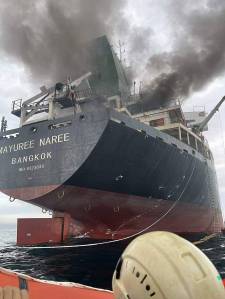
An image released by the Royal Thai Navy shows a tanker near the Strait of Hormuz that was attacked on Wednesday. Iran claimed responsibility. Credit…Royal Thai Navy, via Agence France-Presse — Getty Images
Iran appeared to claim responsibility for at least one of the attacks. Alireza Tangsiri, the naval commander in Iran’s powerful Revolutionary Guards Corps, named one of the ships that was struck, the Mayuree Naree, in a post on social media, saying they had “ignored the warnings” from Iran, and “ended up getting caught.”
He added: “Any vessel that intends to pass must obtain permission from Iran.”
The incidents came after the U.S. military said it struck 16 Iranian mine-laying vessels near the Strait of Hormuz — though it remained unclear whether any Iranian mines had actually been deployed there.
There were three separate reports, according to United Kingdom Maritime Trade Operations, a British monitoring agency. Iran fired at targets across the Middle East on Wednesday, but did not explicitly claim responsibility for the strikes on the ships.
Three strikes on ships in a single morning appeared to represent an unusual uptick: The U.K.M.T.O. said it had received reports of 13 attacks in total since the U.S.-Israeli war on Iran began on Feb. 28.
One cargo vessel was struck “by an unknown projectile” north of Oman in the Straits of Hormuz, resulting in a fire onboard, the agency said. The Oman News Agency said the country’s Maritime Security Center received a report indicating that the Mayuree Naree, a commercial vessel flying the flag of Thailand, was hit off the Omani coast.
Mark Mazzetti, Tyler Pager, and Edward Wong at The New York Times: How Trump and His Advisers Miscalculated Iran’s Response to War.
On Feb. 18, as President Trump weighed whether to launch military attacks on Iran, Chris Wright, the energy secretary, told an interviewer he was not concerned that the looming war might disrupt oil supplies in the Middle East and wreak havoc in energy markets.
Even during the Israeli and U.S. strikes against Iran last June, Mr. Wright said, there had been little disruption in the markets. “Oil prices blipped up and then went back down,” he said. Some of Mr. Trump’s other advisers shared similar views in private, dismissing warnings that — the second time around — Iran might wage economic warfare by closing shipping lanes carrying roughly 20 percent of the world’s oil supply.
The extent of that miscalculation was laid bare in recent days, as Iran threatened to fire at commercial oil tankers transiting the Strait of Hormuz, the strategic choke point through which all ships must pass on their way out of the Persian Gulf. In response to the Iranian threats, commercial shipping has come to a standstill in the Gulf, oil prices have spiked, and the Trump administration has scrambled to find ways to tamp down an economic crisis that has triggered higher gasoline prices for Americans.
The episode is emblematic of how much Mr. Trump and his advisers misjudged how Iran would respond to a conflict that the government in Tehran sees as an existential threat. Iran has responded far more aggressively than it did during last June’s 12-day war, firing barrages of missiles and drones at U.S. military bases, cities in Arab nations across the Middle East, and on Israeli population centers.
U.S. officials have had to adjust plans on the fly, from hastily ordering the evacuation of embassies to developing policy proposals to reduce gas prices.
The Daily Beast: Senator Torches Trump’s ‘Incoherent’ War Plans After Secret Briefing.
President Trump’s closed-door meeting about his long-term plan in Iran and overall justification for the war has been blasted as “incoherent” by a senator who attended.
Chris Murphy, a Democrat representing Connecticut, unloaded on the White House in a troubling X thread after the secret briefing on “Operation Epic Fury.”
Sen. Chris Murphy warned about the lack of a plan in a worrying X thread.
He said there doesn’t seem to be a clear goal apart from “destroying lots of missiles and boats and drone factories.”
“I obviously can’t disclose classified info, but you deserve to know how incoherent and incomplete these war plans are,” he said.
Several of the White House’s stated reasons for the war didn’t even come up, Murphy said, with not a single mention of plans to destroy Iran’s nuclear infrastructure. “This is, uh…surprising…since Trump says over and over this is a key goal,” he said.
The Trump administration also now claims that regime change is not the goal of the operation, despite the president initially framing it that way for the public.
Barak Ravid at Axios: Trump tells Axios there’s “practically nothing left” to target in Iran.
President Trump told Axios in a brief phone interview Wednesday that the war with Iran will end “soon” because there is “practically nothing left to target.”
“Little this and that… Any time I want it to end, it will end,” Trump said during the five-minute call.
Why it matters: Even as Trump publicly signals his operation has largely accomplished its objectives, U.S. and Israeli officials say there has been no internal directive on when fighting might stop.
Israeli Defense Minister Israel Katz said Wednesday the war will continue “without any time limit, for as long as necessary, until we achieve all the objectives and decisively win the campaign.”Israeli and
U.S. officials say they are preparing for at least two more weeks of strikes in Iran.
It sounds like Israel is actually going to decide when the war ends.
On Tuesday, the U.S. received intelligence that suggested Iran has started laying mines in the Strait of Hormuz — one of the world’s most critical chokepoints for oil supply.
Officials say it’s unclear how many mines Iran has deployed, but the assessment is that the number is very small.
Trump confirmed to Axios that U.S. strikes on Tuesday destroyed 16 mine-laying boats and disrupted Iranian plans….
What he’s [Trump] saying: “The war is going great. We are way ahead of the timetable. We have done more damage than we thought possible, even in the original six-week period,” Trump told Axios.
I guess we’ll have to wait and see.
One more on Iran from Judd Legum at Popular Information: UPDATE: Trump says Kushner helped convince him to go to war with Iran. The disclosure highlights Kushner’s massive financial conflicts.
At a press conference on Monday evening, President Trump said his son-in-law, Jared Kushner, was one of a handful of top advisers who convinced him to launch major combat operations in Iran. The disclosure raises additional questions about the role of Kushner, who is being paid tens of millions of dollars annually by Middle Eastern governments that were reportedly lobbying Trump to attack Iran.
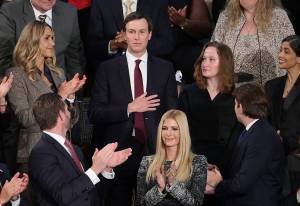
Jared Kushner is acknowledged during the State of the Union on February 24, 2026, in Washington, DC. (Photo by Win McNamee,Getty Images)
“The situation was very quickly approaching the point of no return… based on what Steve and Jared and Pete and others were telling me, Marco is so involved, I thought they were going to attack us,” Trump said, referring to Middle East envoy Steve Witkoff, Secretary of War Pete Hegseth, Secretary of State Marco Rubio, and Kushner, who has no formal title.
“Within a week, [Iran was] going to attack us, 100 percent. They were ready,” Trump said at a different event Monday. “They had all these missiles, far more than anyone thought, and they were going to attack us.”
Witkoff and Kushner were dispatched by Trump to Geneva to participate in mediation with their Iranian counterparts, in what was described as a last-ditch effort to avoid war. Kushner’s participation violated his pledge not to be involved in foreign policy in a second Trump administration. Instead, Kushner had said he was focused on running his private equity fund, Affinity Partners, which has raised billions of dollars from foreign governments.
Kushner’s largest investor is the Saudi Arabian government, which provided Kushner with $2 billion in funding in 2021. Each year, Saudi Arabia pays Kushner 1.25% of its investment, $25 million, as a “management fee.” Meaning he has received in excess of $100 million from the Saudi government over the last few years.
And Witkoff is a Russian asset. I will never forgive the idiots who voted for Trump because they just didn’t want a Black woman to be president.
Trump’s fear of the Epstein files is behind this idiotic war. No one will ever convince me otherwise. Here’s the latest on the Epstein story.
NBC News: Jeffrey Epstein’s New Mexico ranch searched by state investigators.
State investigators in New Mexico on Monday searched a 7,600-acre property that once belonged to the late convicted sex offender Jeffrey Epstein.
The search came after documents released under the Epstein Files Transparency Act showed no record of federal investigators ever searching the property, known as Zorro Ranch, despite a number of years-old civil suits that accused Epstein of sexually assaulting girls there — allegations over which he was never charged.
“This search is part of the criminal investigation announced by the New Mexico Department of Justice on February 19th into allegations of illegal activity at Epstein’s ranch prior to Epstein’s 2019 death,” the state agency said in a statement.
“The New Mexico Department of Justice appreciates the cooperation of the current property owners in granting access for the search and extends its thanks to the ranch staff for their professionalism,” the statement said, and will “continue to keep the public appropriately informed, support the survivors, and follow the facts wherever they lead.”
New Mexico Attorney General Raúl Torrez, a Democrat, ordered the search. His office announced its probe into Epstein last month, days after state lawmakers passed legislation to begin their own investigation into Epstein’s activities in the state.
The Legislature’s $2.5 million investigation, which has subpoena power, aims to close gaps in state law that may have allowed Epstein to operate in New Mexico with impunity. The committee is expected to release interim findings in July and a final report by the end of the year.
The bill’s co-sponsor, Democratic state Rep. Andrea Romero, said when the legislation passed last month that Epstein “was basically doing anything he wanted in this state without any accountability whatsoever.”
From Epstein expert Julie K. Brown at The Epstein files: Dead bodies and a long missing 300-year-old church bell: What will they find on Zorro Ranch?
The reach of the mysteries involving Jeffrey Epstein’s Zorro Ranch in New Mexico now span several centuries — as new documents reveal that the FBI’s Albuquerque office was investigating whether Epstein had a stolen historical artifact that dates back hundreds of years stored on his sprawling NM property.
Zorro Ranch
The artifact was a “death bell” that was once housed at the San Jose de Gracia Mission Church in Las Trampas, a village in Northern New Mexico between Sante Fe and Taos. The church was built in 1760 and is considered one of the best examples of Spanish Colonial architecture in the Southwest U.S. It is also a National Historic Landmark.
The lore about the missing church bell only adds to the questions about why the Justice Department never searched Epstein’s ranch back in 2019 — when at least two victims alleged they were sexually assaulted there, and another tipster claimed that two girls’ bodies are possibly buried there….
The “Death bell,” as it came to be called, was smaller than the other bell. During the church’s restoration in the 1930s, the bell was stolen.
In November 2019, Timothy Lopez told the FBI in Albuquerque, New Mexico that he recalled seeing Epstein’s ranch featured in a local real estate magazine in 2014 or 2015. In the photos accompanying the article, he said he noticed a room filed with Spanish Colonial art — and noticed a bell he thought might be the Death bell that had been stolen more than 80 years earlier.
The 7,400-ace property, which Epstein called “Zorro Ranch,” was purchased by Epstein from former New Mexico Governor Bruce King in 1993. The disgraced financier built a hilltop mansion with a private runway on the property, which was sold after Epstein’s death to the family of former Texas state Sen. Don Huffines, who won the Republican primary for Texas state comptroller last week.
After Epstein’s arrest in July 2019, the FBI search Epstein’s Manhattan townhouse, but did not immediately search Epstein’s private island in the Caribbean until after his August 2019 death. They never searched his New Mexico compound, despite having evidence of crimes that occurred there, including the tip about the stolen church bell….
the documents about the sexual assaults that were reported to have occurred on the property led to public outcry in recent weeks. That that led to New Mexico authorities finally on Monday beginning a long overdue search of the property. Of course, by now, any evidence of any sex crimes committed there has likely disappeared just like the long-vanished death bell.

The FBI claimed they abandoned the investigation of Zorro Ranch because they lacked enough evidence to get a search warrant. It will be interesting to see what New Mexico authorities find.
Two more significant stories:
The Washington Post (gift link): Whistleblower claims ex-DOGE member says he took Social Security data to new job.
The Social Security Administration’s internal watchdog is investigating a complaint that alleges a former U.S. DOGE Service employee claimed he had access to two highly sensitive agency databases and planned to share the information with his private employer — a claim that, if true, would constitute an unprecedented breach of security protocols at an agency that serves more than 70 million Americans.
The agency’s inspector general is investigating the disclosure and has alerted members of Congress of its existence, according to a letter by the acting inspector general to top members of four congressional committees reviewed by The Washington Post and two people familiar with the process, who spoke on the condition of anonymity to describe sensitive deliberations. The inspector general’s office has also shared the disclosure with the Government Accountability Office, which has been conducting its own audit of DOGE’s access to data, according to one of the people. The Post has reviewed the complaint and spoken with the whistleblower, who issued the complaint anonymously for fear of retaliation.
According to the disclosure, the former DOGE software engineer, who worked at the Social Security Administration last year before starting a job at a government contractor in October, allegedly told several co-workers that he possessed two tightly restricted databases of U.S. citizens’ information, and had at least one on a thumb drive. The databases, called “Numident” and the “Master Death File,” include records for more than 500 million living and dead Americans, including Social Security numbers, places and dates of birth, citizenship, race and ethnicity, and parents’ names. The complaint does not include specific dates of when he is said to have told colleagues this information, but at least one of the alleged events unfolded around early January, according to the complaint. While working at DOGE, the engineer had approved access to Social Security data.
According to the complaint, he allegedly told the whistleblower that he needed help transferring data from a thumb drive “to his personal computer so that he could ‘sanitize’ the data before using it at [the company.]” The engineer told colleagues that once he had removed personal details from the data, he wanted to upload it into the company’s systems. He told another colleague, who refused to help him upload the data because of legal concerns, that he expected to receive a presidential pardon if his actions were deemed to be illegal, according to the complaint.
The complaint does not allege that the engineer was successful in uploading the data to the company’s system.
The Post is not naming the former DOGE member or company because it has not independently confirmed the accusations in the complaint.
Use the gift link to read more.

Kristi Noem in one of her cosplay costumes
The Daily Beast: Insiders Reveal ICE Barbie Is Leaving DHS With a Major Problem.
Kristi Noem is apparently leaving the Department of Homeland Security with dozens of unsigned contracts on her desk—including payments owed to a facility holding migrant children.
The backlog is the fallout from a policy Noem, 54, imposed that required every DHS contract worth $100,000 or more—which covers nearly all of the agency’s agreements—to receive her personal sign-off before taking effect. The rule proved so disruptive that some vendors began billing the department in chunks of $99,999 each just to get paid.
“There’s a mountain of backed-up contracts and invoices on her desk that the new guy will just have to deal with,” a source familiar with the situation at DHS told Axios.
“From everything that I’ve heard, it’s still a giant s–t show up there,” a source familiar with Federal Emergency Management Agency (FEMA) delays told the outlet, referring to DHS leadership.
“The ramifications of her tenure are going to be felt for years and years and years and years,” the source added. “We’re not really going to know exactly how bad it is until we have a major hurricane that unfortunately impacts someplace in the United States.”
The disruption, Axios says, is already reaching real facilities. At the family detention center in Dilley, Texas—the only long-term immigration facility in the country holding migrants’ children—government payments lapsed in early March, with roughly 700 people detained there as of mid-February.
That’s it for me today. As you can tell, the Iran situation is freezing out other stories.
Take care, everyone.
Lazy Caturday Reads: Trump’s War on Iran
Posted: March 7, 2026 Filed under: just because | Tags: cat art, caturday, Donald Trump, Persian cats, Pete Hegseth, Trump's War in Iran, U.S. Economy, views of cats in Iran 9 CommentsGood Day!!

Painting of a cat resting on a pillow next to a Muslim scholar in Cairo, by John Frederick Lewis (1805–1876)
Today I’m featuring Persian cats. It’s not the Iranian people’s fault that Trump is raining down hellfire on their country. According to Wikipedia, cats are the preferred pet in Iran; and Persian cats are the local favorite.
The Persian cat, also known as the Persian Longhair or simply Persian, is a long-haired traditional breed of cat characterised by a round face and petite, but not flat and not smashed in, muzzle. The short flat nose was created in the US from in-breeding and causes breathing difficulties in the breed, whereas, the traditional Persian breed has a petite nose which enables them to breathe without difficulties.
The first documented ancestors of Persian cats might have been imported into Italy from Khorasan as early as around 1620, but this has not been proven. Instead, there is stronger evidence for a longhaired cat breed being exported from Afghanistan and Iran/Persia from the 19th century onwards.[2][3][4] Persian cats have been widely recognised by the North-West European cat fancy since the 19th century,[5] and after World War II by breeders from North America, Australia and New Zealand.[5] Some cat fancier organisations’ breed standards subsume the Himalayan and Exotic Shorthair as variants of this breed, while others generally treat them as separate breeds.
The selective breeding carried out by breeders has allowed the development of a wide variety of coat colours,[5] but has also led to the creation of increasingly flat-faced Persian cats. Favoured by fanciers, this head structure can bring with it several health problems. As is the case with the Siamese breed, there have been efforts by some breeders to preserve the older type of cat, the Traditional Persian, which has a more pronounced muzzle.
Wikipedia on Islamic beliefs about cats:
In Islam, the domestic cat is regarded as ritually clean and thus holds a unique status in comparison to other companion animals, such as the domestic dog. Under Islamic law, cats are permitted to be kept by Muslims within their homes and other private and public spaces, including mosques. Likewise, if a person’s food or drink is sampled by a cat, it is not rendered impure or unfit for consumption, and water from which a cat has drunk is permissible to use for ablution.
Cats are believed by Muslims to possess barakah, which refers to a blessing power that is said to flow through those who are spiritually closest to God.[1][2] As such, they are widely acclaimed as the “quintessential pet” for a Muslim household.
I hope these cats will provide some respite from the horrible news.
Trump is really sounding drunk with power (what else is new?) on his illegal war on Iran. Yesterday, he demanded “unconditional surrender” from the Iranians.

Traditionall Persian cat
CNBC: Trump says no deal with Iran to end war without ‘unconditional surrender.’
President Donald Trump said in a social media post on Friday that there would be no deal to end the U.S. war against Iran without an “UNCONDITIONAL SURRENDER” by Iran.
The Dow Jones Industrial Average dropped more than 900 points, or nearly 2%, after Trump’s demand, which he wrote on Truth Social. The S&P 500and Nasdaq Composite fell 1.6% each, and oil futures prices rose.
Trump said that after a surrender and “the selection of a GREAT & ACCEPTABLE Leader(s), we, and many of our wonderful and very brave allies and partners, will work tirelessly to bring Iran back from the brink of destruction, making it economically bigger, better, and stronger than ever before.”
“IRAN WILL HAVE A GREAT FUTURE. “MAKE IRAN GREAT AGAIN (MIGA!)” Trump wrote, echoing his “Make America Great” movement’s name.
Trump’s demand came as Iran has yet to pick a leader to replace Supreme Leader Ayatollah Ali Khamenei, who was killed last weekend in an airstrike at the beginning of the war by the U.S. and Israel.
What the hell does that mean? It’s not even a declared war.
Later, the White House tried to clarify the demand: Trump to Axios: “Unconditional surrender” is when Iran “can’t fight any longer.”
President Trump told Axios Friday that his demand for Iran’s “unconditional surrender” could mean the complete destruction of the regime’s military capabilities — not necessarily a formal surrender.
- “Unconditional surrender could be that [the Iranians] announce it. But it could also be when they can’t fight any longer because they don’t have anyone or anything to fight with,” he said in a phone interview.
Why it matters: Trump’s explanation came hours after he appeared to leave no visible off-ramp for Iran, ruling out any kind of “deal” as he demanded “UNCONDITIONAL SURRENDER” in a post on Truth Social.
— White House press secretary Karoline Leavitt later said on Fox News that “unconditional surrender” means Trump determining “that Iran can no longer pose a threat to the U.S. and our troops in the Middle East.”
— Leavitt listed U.S. objectives as destroying Iran’s navy, eliminating its ballistic missile threat, ensuring it cannot obtain a nuclear weapon and weakening its regional proxies.
From The Guardian: Iran rejects Trump’s demand for unconditional surrender as a ‘dream.’
The president of Iran has rejected Donald Trump’s call for the country’s unconditional surrender as a “dream”, while issuing a rare apology for Iranian attacks that hit neighbouring states, even as missiles and drones continued to strike Gulf countries.
Moder type Persian cat
In a prerecorded address broadcast on state television on Saturday, Iran’s president, Masoud Pezeshkian, said the country would never capitulate, responding to remarks by the US president, who said on Friday that only Iran’s total submission could bring the war to an end.
Iran’s enemies, Pezeshkian said, “must take their dream of the Iranian people’s unconditional surrender to their graves”, in remarks that further escalate the eighth day of conflict, which has choked global oil supplies and cut world air travel.
During his speech, Pezeshkian also issued an apology to neighbouring states for Iran’s recent “actions”, in an apparent attempt to ease regional anger after Iranian strikes hit civilian targets in Gulf Arab countries.
Tehran has responded to attacks on its territory by targeting Israel, but also Gulf Arab states that host US military installations, while Israel has also launched intense strikes on Lebanon, where the Iran-backed armed group Hezbollah is based.

In response to Iran’s refusal to surrender, Trump issued more threats. Politico: Trump vows to hit ‘very hard’ after Iran’s president says he won’t surrender.
President Donald Trump announced plans to launch yet more strikes against Iran on Saturday, escalating his threats as the conflict with Iran enters its second week.
“Today Iran will be hit very hard!” he wrote on Truth Social Saturday morning. “Under serious consideration for complete destruction and certain death, because of Iran’s bad behavior, are areas and groups of people that were not considered for targeting up until this moment in time.”
Islamic miniature depicting Abu Hudhayfa ibn Utba (right) informing As’ad ibn Zurara that he has converted to Islam, with the presence of a cat denoting his home’s ritual purity.
Trump’s threat came after Iranian President Masoud Pezeshkian labeled the president’s earlier call for Tehran’s “unconditional surrender” a “dream that they should take to their grave” in a speech broadcast on state television Saturday.
Pezeshkian also said his country would no longer strike its neighbors in the Middle East — so long as attacks against Iran weren’t being launched from those countries. Trump took credit for the new policy, writing on Truth Social that it “was only made because of the relentless U.S. and Israeli attack.”
“It is the first time that Iran has ever lost, in thousands of years, to surrounding Middle Eastern Countries,” he said. “They have said, ‘Thank you President Trump.’ I have said, ‘You’re welcome!’ Iran is no longer the ‘Bully of the Middle East,’ they are, instead, ‘THE LOSER OF THE MIDDLE EAST,’ and will be for many decades until they surrender or, more likely, completely collapse!”

Trump is really full of himself. He even thinks he should help decide who Iran’s next leader will be!
Meanwhile, things here at home aren’t going so well.
Politico: Trump’s week: Poor jobs numbers, high gas prices and Noem’s ouster.
Donald Trump won reelection on the promise of restoring the economy and eliminating illegal immigration.
But in the last week, both issues have threatened to turn into liabilities: A stagnant labor market and soaring gas prices amid the Iran conflict are hammering the economy, and the ouster of Kristi Noem from the Department of Homeland Security has cast new light on the administration’s increasingly unpopular immigration agenda. The economic backdrop has grown ominous — Wall Street analysts are warning that surging oil prices could lead to stagflation — and the blitzkrieg of bad news has jeopardized the GOP’s ability to keep voters focused on Trump administration policies that were designed to help with the rising cost of living.
“If you combine an economy that people don’t like with a prolonged war that you know nobody in his base believes they voted for, that’s a toxic problem,” said one Trump ally granted anonymity to speak freely. While Trump isn’t on the ballot this year, his party needs the president’s poll numbers to improve to keep the House and Senate….
The Iran conflict has put immense upward pressure on oil and gas –- prices at the pump have climbed by more than 11 percent in a week. Now, with employers shedding payroll and Trump pressing reset on who’s leading his immigration agenda, the president is on the backfoot on the two issues he needs to own for his party to win the midterms….
The president, meanwhile, is also struggling with what was once his strongest and most defining issue — immigration. While the number of people crossing the southern border has fallen significantly, in part due to Trump administration efforts, the widely shared images of aggressive enforcement actions across the country have left even some of his supporters wincing. Other conservatives, still, are unhappy that those efforts have not gone far enough, falling short of the “mass deportations” he promised on the campaign trail.
Polling underscores the erosion of support. A recent NBC News poll found that 49 percent of adults strongly disapprove of Trump’s handling of border security and immigration, up from 38 percent last summer. Nearly three-quarters of the poll’s respondents said that Immigration and Customs Enforcement should be reformed or abolished.
Trump’s Thursday dismissal of Noem came after months of increasing frustration inside the White House with how she ran the department.
From Greg Sargent at The New Republic: Donald Trump’s Presidency Is in Free Fall.
Consider three of the biggest developments in our politics right now: We just learned that the economy lost 92,000 jobs in February, a capstone to a terrible year in terms of job creation. President Trump has fired widely despised Homeland Security Secretary Kristi Noem, a key architect of his mass deportations. And reports are indicating that the killing of scores of Iranian schoolchildren might have been the handiwork of the United States.
What links all these things? In addition to the massive human toll they’re inflicting, they suggest that Trump is about to pull off a unique trifecta. He is squandering the advantage he and Republicans have enjoyed in recent years on three major GOP-friendly issues: The economy, immigration, and national security.
Painting by Tatjana Cechun
This isn’t meant as a political gotcha; it has important ideological and policy implications. When Trump took office last year, it was reasonable to fear that the American public would rally behind mass deportations and tariffs—that is, embrace two of the main tenets of right-wing nationalism. Meanwhile, the launch of the largest military attack in the Mideast in decades might have plausibly produced a rally-around-the-war-president effect.
None of that is happening. And that’s significant in not-so-obvious ways.
Let’s start with Trump and national security. According to an extraordinary video analysis by The New York Times, the horrific bombing of an elementary school in southern Iran—which killed 175 people, many children—occurred while the United States was conducting missile strikes in the area aimed at a nearby Iranian naval base.
What’s more, Reuters reports that military investigators now believe U.S. forces likely bombed the school. We should suspend final judgement, of course. But it’s looking very much like this atrocity—one of the worst massacres of civilians in memory—is the result of Trump’s war. Whatever we learn about it, there will inevitably be more such horrors.
Now look at this in the context of remarks from Defense Secretary Pete Hegseth and White House adviser Stephen Miller. Hegseth recently declared that the United States is dispensing with “stupid rules of engagement” and will no longer fight “politically correct wars.” Miller recently enthused that Trump’s military doesn’t have “its hands tied behind its back,” mocked the very idea of human rights, and insisted that “strength” and “force” and “power” are fundamentally all that matter in the international arena.
But we’re now learning why we have the sort of constraints on military conduct these men ridicule. “Trump, Miller and Hegseth’s FAFO approach to the use of official government force and violence comes with considerable risk,” Democratic Congressman Adam Smith told me, employing the acronym for “Fuck Around and Find Out.” Atrocities like the school bombing, he added, show the perils that come when we “brazenly dismiss any sort of rules of engagement designed to protect the lives and rights of civilians.”

Just a bit more:
The swaggering certainty of Hegseth and Miller, those two giants of American statecraft, is what’s notable here. As Alan Elrod writes at Liberal Currents, at times like this you can almost smell MAGA’s “bloodlust.” Clearly they have no doubt the public will rally behind this supposed display of Trump’s “strength.” Or maybe they don’t think it matters what the public thinks.
But it does matter. Data analyst G. Elliott Morris averaged high quality polling on Trump’s Iran invasion, and found that only 38 percent of respondents approve—the lowest initial support for an American war perhaps ever. Trump’s overall approval has also dropped a hair since the bombing began—it’s hovering at around 39-58—leading Morris to conclude that no rally-around-the-flag effect is materializing.
Also note that a CNN poll just showed that 59 percent don’t trust Trump to make the right decisions regarding the use of force in Iran, suggesting already-entrenched skepticism of Trump’s commander-in-chief abilities exactly when a “war president” boomlet might be expected to kick in. The school bombing will make this worse. In short, Trump has no built-in national security advantage. If anything he’s viewed as bad on it.
Read the rest at TNR.
Two more stories that show the callous nature of Trump’s war:
HuffPo: U.S. May Have Committed War Crime In Sinking Of Iranian Ship.
The U.S. torpedoing of an Iranian frigate off Sri Lanka this week may have violated the Geneva Conventions by failing to help rescue sailors from the stricken warship, an act that could potentially endanger American service members in this and future wars.
The 312-foot Dena and its 130-member crew, many of them musicians in the Iranian navy band, had just finished participating in an Indian government naval exercise and cultural exchange that the U.S. Navy had also participated in and were on the way home on Wednesday. After clearing Sri Lanka, it was struck by a torpedo fired from a U.S. Navy submarine about 20 miles from the island’s southern tip. The weapon appears to have ruptured the hull from beneath, and the warship quickly sank. The submarine did not attempt to rescue Iranian sailors in the water.
Painting of a calico Persian cat, by Lynn Lachapelle Seguin
White House press secretary Karoline Leavitt bragged about how the attack featured the first American use of a torpedo to sink a ship since World War II. Defense Secretary Pete Hegseth, narrating a video clip of the attack, used the same gloating tone. “An American submarine sunk an Iranian warship that thought it was safe in international waters. Instead, it was sunk by a torpedo. Quiet death,” he intoned.
Hegseth had previously mocked the “stupid rules of engagement” that aim to limit civilian deaths and other actions that could constitute war crimes.
“There is an affirmative duty to rescue under the Geneva Conventions,” said Mark Nevitt, a former Navy lawyer in the judge advocate general corps and now a law professor at Emory University.
He and other legal experts warn that disregarding those and other rules invites mistreatment, even death, to Americans who are shipwrecked or captured.

Yahoo News: Pete Hegseth Mocks ‘Iranians That Think They’re Gonna Live.’
In a preview of an upcoming 60 Minutes interview released on Friday, Secretary of Defense Pete Hegseth mocked “Iranians that think they’re gonna live” while answering a question on reports that Russia provided Iran with intel to target American soldiers in the ongoing conflict.
In the clip, CBS News’ Major Garrett cited three sources “telling us that Russia is providing intelligence to Iran on U.S. positions and movements.”
“The average American might hear that and think that’s a big and dangerous deal,” continued Garrett. “Is it?”
“Well, we’re tracking everything,” responded Hegseth. “We have the best intelligence in the world… President [Donald Trump] has an incredible knack at knowing how to mitigate those risks, and so the American people can rest assured their commander in chief is well aware of who’s talking to who, and anything that shouldn’t be happening — whether it’s in public or backchanneled — is being confronted and confronted strongly.”
“So the American people can therefore expect conversations with the Russians to stop this?” clarified Garrett.
“Well, I,” Hegseth stumbled. “President Trump, as people have seen, has a unique relationship with a lot of world leaders, where he can get things done that other presidents — certainly [former President] Joe Biden —
“Well, I,” Hegseth stumbled. “President Trump, as people have seen, has a unique relationship with a lot of world leaders, where he can get things done that other presidents — certainly [former President] Joe Biden — never could have. And through direct conversations or indirect, through him one-to-one, or through his cabinet, messages definitely can be delivered.”
We’ll see. I have zero faith that Trump will stand up to Putin on anything.
The New York Times on the Russia story: Russia Is Sharing Intelligence With Iran, U.S. Officials Say.
Russia has provided intelligence to Iran during the U.S.-Israeli war, including satellite imagery showing the locations of warships and military personnel, according to U.S. officials.
The information sharing could complicate relations between the United States and Russia, given that President Trump has often taken a more conciliatory stance toward Moscow than his predecessors.
Persian cat by Carolee Vitaletti
But some of the officials played down the partnership, saying Russia has long provided similar intelligence to Iran. And it is not clear how much Tehran has been able to use the new intelligence, if at all. Iran has advanced missiles, but they lag far behind Russia’s and it is not clear Iran could use the intelligence to target a ship.
Furthermore, given the immense pressure of the combined U.S.-Israeli assault, which began last Saturday, Iran’s ability to launch missiles has been degraded, officials said.
But officials confirmed that Russia has provided updated intelligence on the position of U.S. assets since the beginning of the war, information meant to help Iran target the assets.
So far Iranian forces have not hit any U.S. warships, but they have struck at U.S. military bases, killing six service members in Kuwait and damaging facilities in Bahrain. Iranian drones have also struck a building housing the C.I.A. station in Riyadh, Saudi Arabia, though no one was injured in that attack, officials said.

I guess we’ll eventually find out how effective Russia’s help is and whether Trump will do anything about it.
Two more stories that address possible outcomes of the Iran “war.”
The Washington Post (gift link): Intel report warns large-scale war ‘unlikely’ to oust Iran’s regime.
Wednesday Reads
Posted: March 4, 2026 Filed under: just because | Tags: Al-Shu'aybah, armageddon, Christian nationalism, DOJ, Donald Trump, End Times, Epstein Files, Iran threatens Europe, Kuwait attack, Mojtaba Khamenei son of the leader of Iran, Pete Hegseth, Texas primaries, Trump administration failure to prepare for Iran fallout 5 CommentsGood Day!!
Where to begin? Once again, there’s just too much news to deal with in a blog post. Today’s top stories, as I see it: Trump’s Iran war continues and threatens to spin out of control; Hegseth and some military leaders are pushing an appalling Christian nationalist agenda to our troops; there were important primary elections yesterday in Texas, North Carolina, and Arkansas; and the Epstein files story is still alive and well. I can’t get to everything, but here are the stories that caught my attention this morning.
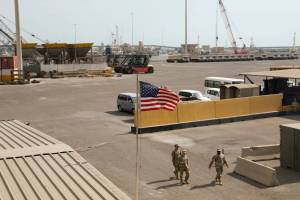
The Shuaiba Port in Al-Shu’aybah, Kuwait on Nov. 4, 2022. (Spc. Ryan Scribner, U.S. Army National Guard)
The six U.S. Soldiers who were killed in Kuwait were in a makeshift building that was not fortified against aerial attacks. The latest on that from The Washington Post: U.S. troops had little protection from drone strike that killed 6, imagery shows.
The six U.S. service members killed in an Iranian drone attack over the weekend were working in a tactical operations center in Kuwait that offered little protection from overhead strikes, according to imagery, experts and officials….
The slain troops were part of a logistical support unit working at the Shuaiba port, a civilian port on the Persian Gulf. The attack occurred on Sunday, officials said. By 11 a.m. that morning, thick smoke was spewing from a building in a complex east of the waterfront, satellite imagery shows.
The building that was struck — a prefabricated, triple-wide trailer-style structure — was flanked by tall concrete barriers to protect against ground threats, said Sean O’Connor, a satellite imagery analyst with Janes. But it “possessed limited defenses able to protect it from a ballistic missile or drone strike,” lacking overhead protection to defend against the main threats to U.S. bases in the Middle East, he said.
The Army’s counter-drone manual, updated last year, makes clear that troops and commanders should assess which sites are likely to be attacked and build overhead protection, which often includes steel reinforced roofs and coverings. Protecting important structures like operations centers helps shield from enemy observation and limits “the damaging effects of an aerial attack,” the manual says. Images show that the building struck in the attack was not protected by such structures.
A 2021 photo of the building struck Sunday shows it had what looks like a thin metal rooftop. It is unclear what if any additional layers of materials or reinforcement existed underneath. The building does not appear to have meaningfully changed since at least 2009, and no additional fortifications appear to have been added after President Donald Trump announced in January that he intended to send U.S. forces to the region, according to a Post review of archival imagery and analysts.
More from The Daily Beast: U.S. Troops Died in Triple-Wide Trailer Pentagon Pete Called ‘Fortified.’
The six U.S. service members confirmed dead in the U.S.-Iran conflict were killed while inside a triple-wide trailer that Defense Secretary Pete Hegseth had described as “fortified.”
This undated photo provided by Joey Amor shows Nicole Amor, left, and Joey Amor smiling for a photo. (Joey Amor via AP) Nicole was one of the sex soldiers killed in the drone strike.
The trailer, which served as a makeshift operations center, took a direct hit amid Iran’s retaliatory strikes on Kuwait just after 9 a.m. local time Sunday morning, CNN reported. U.S. Central Command said 18 troops have also been seriously wounded, with others suffering minor shrapnel wounds and concussions.
Military officials had questioned the safety of the operations center even before the strike, according to CBS News. The fortifications used to protect the facility only covered the walls but did nothing to shield the top of the building from an overhead strike, which is what apparently killed the six service members.
A source told CNN there was no warning of the attack that struck the port in Kuwait, and no siren was activated to alert troops to evacuate amid the incoming projectile. There were dozens of people inside the building at the time.
The walls of the building were blown outwards in the blast, according to pictures of the site, with a fire still burning hours afterward.
Early on Monday, before the bodies of two service members were recovered, Hegseth had said that “one” projectile made it through air defenses and hit a “tactical operation center that was fortified.”

This makes me sick. Trump doesn’t care about our troops, and I guess Hegseth doesn’t either.
The UK has been flying their people out of the Middle East, but the U.S. government helping it’s citizens.
Business Insider: Multiple US embassies are telling Americans they cannot evacuate or help them get out of the Middle East.
American citizens across the Middle East are attempting to follow official advice and evacuate as conflict escalates in the region following US and Israeli attacks on Iran on Saturday.
But multiple US embassies have said they are unable to help citizens trying to leave.
“The US Embassy is not in a position at this time to evacuate or directly assist Americans in departing Israel,” the US Embassy in Jerusalem said in a post on X on Tuesday.
The embassy shared that the Israeli Ministry of Tourism was operating shuttles to a border crossing between Egypt and Israel at the town of Taba.”If you choose to avail yourself of this option to depart, the US government cannot guarantee your safety,” said the US embassy, adding that they were sharing the information “as a courtesy to those wishing to leave Israel.”President Donald Trump was asked in the Oval Office on Tuesday why evacuations hadn’t been planned beforehand, and whether he would charter planes to evacuate Americans from the region.Trump largely didn’t address the question, other than to note how quickly the conflict broke out.”It happened all very quickly,” Trump said. “I thought we were going to have a situation where we were going to be attacked.”
They’ve been preparing for this war for months, with a huge military buildup in the region. Maybe it wasn’t such a good idea for DOGE to fire all those people from the State Department.
Dakinikat called my attention to this story. JJ also posted about it in a comment yesterday. I knew that the military has been infected with right wing Christian propaganda, I still found this shocking.
This is from Jonathan Larson’s Substack: U.S. Troops Were Told Iran War Is for “Armageddon,” Return of Jesus.
A combat-unit commander told non-commissioned officers at a briefing Monday that the Iran war is part of God’s plan and that Pres. Donald Trump was “anointed by Jesus to light the signal fire in Iran to cause Armageddon and mark his return to Earth,” according to a complaint by a non-commissioned officer.
From Saturday morning through Monday night, more than 110 similar complaints about commanders in every branch of the military had been logged by the Military Religious Freedom Foundation (MRFF).
Iran war and Christian nationalist armageddon?
The complaints came from more than 40 different units spread across at least 30 military installations, the MRFF told me Monday night.
The MRFF is keeping the complainants anonymous to prevent retribution by the Defense Department. The Pentagon did not immediately respond to my request for comment.
One complainant identified themselves as a non-commissioned officer (NCO) in a unit currently outside the Iran combat zone but in Ready-Support status, deployable at any time. The NCO said they were Christian and emailed the MRFF on behalf of 15 troops, including at least 11 Christians, one Muslim, and one Jew. (Full email printed below.)
The NCO wrote to the MRFF that their commander “urged us to tell our troops that this was ‘all part of God’s divine plan’ and he specifically referenced numerous citations out of the Book of Revelation referring to Armageddon and the imminent return of Jesus Christ.”
One complainant identified themselves as a non-commissioned officer (NCO) in a unit currently outside the Iran combat zone but in Ready-Support status, deployable at any time. The NCO said they were Christian and emailed the MRFF on behalf of 15 troops, including at least 11 Christians, one Muslim, and one Jew. (Full email printed below.)
The NCO wrote to the MRFF that their commander “urged us to tell our troops that this was ‘all part of God’s divine plan’ and he specifically referenced numerous citations out of the Book of Revelation referring to Armageddon and the imminent return of Jesus Christ.”

I hope you’ll go read the rest at the link. I noticed this story is beginning to show up in mainstream news outlets. This was published in The Guardian today: US troops were told war on Iran was ‘all part of God’s divine plan’, watchdog alleges.
US military commanders have been invoking extremist Christian rhetoric about biblical “end times” to justify involvement in the Iran war to troops, according to complaints made to a watchdog group.
The Military Religious Freedom Foundation (MRFF) says it has received more than 200 complaints from service members across all branches of the armed forces, including the marines, air force and space force.
One complainant, identified as a noncommissioned officer (NCO) in a unit that could be deployed “at any moment to join” operations against Iran, told MRFF in a complaint viewed by the Guardian that their commander had “urged us to tell our troops that this was ‘all part of God’s divine plan’ and he specifically referenced numerous citations out of the Book of Revelation referring to Armageddon and the imminent return of Jesus Christ”.
“He said that ‘President Trump has been anointed by Jesus to light the signal “He said that ‘President Trump has been anointed by Jesus to light the signal fire in Iran to cause Armageddon and mark his return to Earth’”, the NCO added.
The Guardian credited the story by Jonathan Larson above.
Two more Iran stories:
Politico: Europe braces as Iran threatens to attack.
LONDON — The Iranian regime is warning it will attack European cities in any country that joins Donald Trump’s military operation and governments across the region are stepping up security in response.
So far, Iranian drones have already targeted Cyprus, with one striking a British Royal Air Force base on the island, and others shot down before they could hit. That prompted the U.K., France and Greece to send jets, warships and helicopters to Cyprus to protect the country from further drone attacks.
A UK Ministry of Defence handout of an RAF F-35B Typhoon preparing for operations from Akrotiri, Cyprus. Tehran has threatened its retaliation for action in the Middle East could be attacks on European soil. via Getty Ima
But with the British, French and German leaders saying they are ready to launch defensive military action in the Middle East, Tehran threatened to retaliate against these countries with attacks on European soil.
“It would be an act of war. Any such act against Iran would be regarded as complicity with the aggressors. It would be regarded as an act of war against Iran,” Esmail Baghaei, Iran’s foreign ministry spokesperson, told Iranian state media.
Mark Rutte, the former Dutch Prime Minister who now leads NATO, warned on Tuesday that Tehran posed a threat that reached deep into Europe.
“Let’s be absolutely clear-eyed to what’s happening here,” Rutte said. “Iran is close to getting its hands on a nuclear capability and on a ballistic missile capability, which is posing a threat not only to the region — the Middle East, including posing an existential threat to Israel — it is also posing a huge threat to us here in Europe.” Iran is “an exporter of chaos” responsible over decades for terrorist plots and assassination attempts, including against people living on European soil, he said.
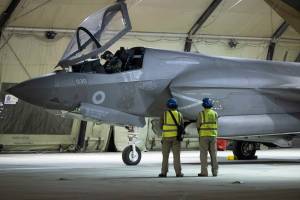
The New York Times: Ayatollah Ali Khamenei’s Son Emerges as Leading Choice to Be His Successor.
The senior clerics responsible for selecting Iran’s next supreme leader met on Tuesday to deliberate, and the son of the slain former leader, Ayatollah Ali Khamenei, emerged as the clear front-runner, according to three Iranian officials familiar with the deliberations.
Mojtaba Khamenei, son of the leader of Iran, in Tehran in 2019.Credit…Morteza Nikoubazl NurPhoto, via Associated Press
The officials said that the clerics were considering announcing that the son, Mojtaba Khamenei, would be his father’s successor as early as Wednesday morning but that some had expressed reservations, fearing that it could expose him as a target for the United States and Israel. They spoke on the condition of anonymity to discuss sensitive internal deliberations.
The clerics, known as the Assembly of Experts, held two virtual meetings, one in the morning and one in the evening, according to the officials. Israel struck a building in Qum, one of Shiite Islam’s main seats of power, where the assembly was scheduled to meet and elect the new supreme leader, but the building was empty, according to the Fars News agency, which is affiliated with the Islamic Revolutionary Guards Corps.
Vali Nasr, an expert of Iran and Shiite Islam at Johns Hopkins University, said that Mr. Khamenei would be a surprising choice — and a potentially telling one.
“He was slated to become the successor for a long time,” Mr. Nasr said, “but for the past two years, it seemed to have dropped off from the radar. If he is elected, it suggests it is a much more hard-line Revolutionary Guard side of the regime that is now in charge.”

That doesn’t sound good.
In other news, Democrats did well in the primary elections last night.
Mia McCarthy at Politico: Democrats get their Texas dream scenario.
Maybe, just maybe, this is the year Texas really matters.
While the outcome wasn’t shocking, the confirmation of a May 26 runoff between Sen. John Cornyn (R-Texas) and state Attorney General Ken Paxton confirmed the fears of many Republicans who now face a likely scorched-earth campaign that could seriously hobble the victor in November’s general election and drain resources from tough races in places like North Carolina and Maine.
Democrats, meanwhile, are seeing their dream scenario play out: State Rep. James Talarico has defeated Rep. Jasmine Crockett outright in the Democratic primary, giving the candidate many strategists see as the party’s best chance to finally turn the Lone Star State blue a clear path to November.
Tuesday’s results showed some surprising strength for Cornyn after he trailed Paxton, a MAGA firebrand, in most polls. The veteran senator is about a point ahead of the AG in the latest returns.
But for national Republicans, keeping Cornyn afloat will be expensive and will risk damaging Paxton if he ends up being their nominee. In the absence of a Trump endorsement for any candidate, Cornyn and his allies have already spent more than $100 million to take out Paxton….
Cornyn-Paxton wasn’t the only high-stakes drama in the Lone Star State. A quick round-up of the latest results from other races:
— Embattled GOP Rep. Tony Gonzales was forced into a runoff against gun influencer Brandon Herrera.
— State Rep. Steve Toth ousted GOP Rep. Dan Crenshaw from the seat he’s held for four terms.
— GOP Rep. Chip Roy is heading into a runoff with state Sen. Mayes Middleton for attorney general.
— Rep. Christian Menefee is less than 2,000 votes ahead in his uncalled race against Rep. Al Green, who has served in Congress for more than 20 years.
— Former Rep. Colin Allred is more than 10 points ahead against incumbent Democrat Julie Johnson in another uncalled Dallas-area race.
In North Carolina, Roy Cooper won the Senate primary easily. Same with Tom Cotton in Arkansas.
There is some Epstein files news, even though the Iran war has pushed it from the fron pages. The Wall Street Journal broke another story on the Epstein files. It’s behind the paywall, but here are some articles based on the WSJ piece.
Alex Woodward at The Independent: DOJ admits 47,635 Epstein files — including Trump allegations — were removed.
The Department of Justice has withheld from the public nearly 48,000 files stemming from investigations into Jeffrey Epstein, after publishing more than 2 million pages of documents under the Epstein Files Transparency Act.
The initial legally mandated releases of documents comprised more than 3 million pages, though that figure is now roughly 2.7 million, according to an analysis of the files by CBS News and The Wall Street Journal.
A spokesperson for the Justice Department told the outlets that “47,635 files were offline for further review and should be ready for re-production by the end of the week.”
Those offline files include materials connected to unverified allegations against President Donald Trump, The Independent previously reported.
“Our team is working around the clock to address victim concerns, redact personally identifiable information and any images of a sexual nature,” according to Justice Department spokesperson Natalie Baldassarre. “All responsive documents will be repopulated online once proper redactions are made.” [….]
DOJ told The Independent last week that it is “currently reviewing” documents that detail unverified allegations against the president. Those documents include summaries of FBI interviews stemming from unverified claims made by a woman who came forward after Epstein’s arrest in 2019, who alleged, according to the files released by the DOJ, that she was sexually assaulted by both Epstein and Trump decades earlier, when she was a minor.
In a statement in January, the Justice Department noted that “some of the documents contain untrue and sensationalist claims against President Trump that were submitted to the FBI right before the 2020 election.
Those claims are “unfounded and false,” the statement said.
Read the rest at the link.
This is from “The Epstein Files” Substack, authored by Julie K. Brown, the reporter whose work for The Miami Herald led to Epstein’s prosecution: The Epstein Files are Now Offline.
The Wall Street Journal is reporting that tens of thousands of the Justice Department’s Epstein files are now offline for review.
This comes as more mainstream media confirms earlier reports by independent journalists that some of the files concerning allegations against President Trump have been withheld.
Julie K. Brown
From the WSJ: “The withheld files included Federal Bureau of Investigation notes documenting a series of interviews the woman gave to agents in 2019 in which she alleged sexual misconduct by Trump and Jeffrey Epstein when she was a minor in the 1980s, according to copies of the documents reviewed by the Journal. Trump has denied wrongdoing and said the Epstein files ‘totally exonerated’ him.”
I have written about this woman’s unverified allegation over the past two weeks, as have other journalists.
I have questioned why the Justice Department didn’t reveal whether it had investigated claims by this woman — as well as another woman who filed a lawsuit against Trump and Epstein in 2016.
The latest allegation involves a Vancouver woman who is named in a lawsuit as Jane Doe #4. She was interviewed by the FBI four times. Yet three of those reports have not been made public. To be clear, it’s not known what the FBI concluded from their interviews.
The other woman, who filed a lawsuit in 2016 against Trump and Epstein under the name “Katie Johnson” and later, “Jane Doe,” told a somewhat similar story about Trump. She abruptly withdrew her lawsuit days before the 2016 election. One of her lawyers, however, did file a report with the FBI in 2016. It’s not known whether the DOJ ever investigated her story. The lawyer’s report is in the Epstein Files. Her account has also not been substantiated.

Again, there’s more at the link.
I’m going to end there, because it’s getting late. I’ll add a couple more stories in the comment thread. Take care everyone.
Lazy Caturday Reads: “Hate cannot drive out hate. Only love can do that.” — Martin Luther King, Jr.
Posted: February 14, 2026 Filed under: just because | Tags: Anti-drone laser, Border Patrol, Caribbean boat strikes, cat art, caturday, Department of Homeland Security, Donald Trump, El Paso air space, Iran attack plans, Jr., Love and hate, Martin Luther King, party balloon, Pete Hegseth, Social Security Administration, Trump's ballroom, Valentine's Day cats 7 CommentsHappy Valentine’s Day!!
 This morning, Steven Beschloss posted the following discussion question for his readers at his Substack “America America”: Is Love More Powerful Than Hate?
I had in mind to write about villainy. It’s a fact of our public life that the Trump regime is thick with this dark force and overloaded with people who revel in it. The villains come easily to mind: Pam Bondi, Kristi Noem, Robert F. Kennedy Jr., Pete Hegseth, Russel Vought, Greg Bovino (to name a few) and of course their ringleader, Donald Trump. They have motivated countless others to join their hateful cause to reject the Constitution and demolish democracy in America.
But on this day—Valentine’s Day—I want to turn this over and look at the flip side. Because behind this discussion of villains and villainy is my belief that their dark force can be defeated with the force of light and love. I don’t mean the biblical advice to “love your enemies,” although that may be a mindset that others more merciful than I can conjure.
I’m thinking more about the guidance found in the words of Martin Luther King, Jr. on the topic of love. Let me share four shining examples:
- “Love is the greatest force in the universe. It is the heartbeat of the moral cosmos.”
- “Hate cannot drive out hate. Only love can do that.”
- “I believe that unarmed truth and unconditional love will have the final word in reality.”
- “I know that love is ultimately the only answer to mankind’s problems.”
There are days that these insights—these deeply held convictions—may seem inadequate to confront the horrors we witness committed by men and women who have lost their moral compass, assuming that they once possessed one. But I’d like to suggest that the more powerful our revulsion toward the regime’s acts of villainy, the more we are influenced by the inverse.
I returned to yesterday’s essay, “Pam Bondi’s Utter Contempt for Justice,” to test this notion. If you read it and thought that I am horrified by her villainous behavior this week, you would be right. But let’s look at the basis for my horror in three sentences from the first several paragraphs: “It’s hard to imagine someone more overtly hostile to justice and more utterly incapable of basic human compassion…This person is responsible for serving the people…But when asked for the most basic show of humanity, she couldn’t bring herself to do it.” Behind the obvious criticism of her hateful action is love: For justice, for basic human compassion, for serving the people, for humanity.
My point is that in our articulation of the horrors, we can find the light that can inspire us to stay in the fight and overcome this dark chapter. “Love is the greatest force in the universe. It is the heartbeat of the moral cosmos,” King wrote. In other words, love is more powerful than hate and, as King also insisted, “the only answer to mankind’s problems.”
Bad Bunny sent a similar message with his Super Bowl performance. Is it true? Can love conquer hate? Food for thought on Valentine’s Day.
Now for the news, which is again filled with hate and fear.
Trump appears to be planning some sort of attack on Iran.
Reuthers: Exclusive: US military preparing for potentially weeks-long Iran.
The U.S. military is preparing for the possibility of sustained, weeks-long operations against Iran if President Donald Trump orders an attack, two U.S. officials told Reuters, in what could become a far more serious conflict than previously seen between the countries.
The disclosure by the officials, who spoke on condition of anonymity due to the sensitive nature of the planning, raises the stakes for the diplomacy underway between the United States and Iran.
U.S. envoys Steve Witkoff and Jared Kushner will hold negotiations with Iran on Tuesday in Geneva, with representatives from Oman acting as mediators. U.S. Secretary of State Marco Rubio cautioned on Saturday that while Trump’s preference was to reach a deal with Tehran, “that’s very hard to do.”
Meanwhile, Trump has amassed military forces in the region, raising fears of new military action. U.S. officials said on Friday the Pentagon was sending an additional aircraft carrier to the Middle East, adding thousands more troops along with fighter aircraft, guided-missile destroyers and other firepower capable of waging attacks and defending against them.
Trump, speaking to U.S. troops on Friday at a base in North Carolina, openly floated the possibility of regime change in Iran, saying it “seems like that would be the best thing that could happen.” He declined to share who he wanted to take over Iran, but said “there are people.”
“For 47 years, they’ve been talking and talking and talking,” Trump said.
Trump has long voiced skepticism about sending ground troops into Iran, saying last year “the last thing you want to do is ground forces,” and the kinds of U.S. firepower arrayed in the Middle East so far suggest options for strikes primarily by air and naval forces.
The New York Times: Trump Says Regime Change Would Be the ‘Best Thing’ for Iran.
President Trump said on Friday that regime change in Iran “would be the best thing that could happen,” as he continued to threaten military action against the country.
“For 47 years, they’ve been talking and talking and talking,” he told reporters after visiting troops at Fort Bragg. “In the meantime, we’ve lost a lot of lives while they talk.”
In recent weeks, Mr. Trump has called for new leadership in Iran, and The New York Times reported in January that he was mulling whether regime change would be a viable military option.
But his latest comments are, perhaps, Mr. Trump’s most overt endorsement of regime change, even as U.S. officials concede that ousting Ayatollah Ali Khamenei would be much more complex than the operation that captured Nicolás Maduro, then the leader of Venezuela.
Still, officials have said that Mr. Trump had not made a final decision and was considering a range of military options.
The Trump administration has been steadily building up its military capabilities in the Middle East as Mr. Trump considers whether to strike the country again. Mr. Trump threatened last month to attack Iran if its government did not agree to a deal to curb its nuclear program….
But senior U.S. officials remain skeptical that the Iranians will agree to a deal that satisfies Mr. Trump, who has shown a growing impatience with the negotiations. This month, Omani officials mediated talks between Iran and a U.S. delegation that included Steve Witkoff,
A bit more on possible attack plans:
Mr. Trump has been weighing a range of military actions, including targeting Iran’s nuclear program and its ability to launch ballistic missiles. He is also considering sending American commandos to go after Iranian military targets, among other moves, the officials said.
To prepare, the Pentagon has been building up an “armada,” as Mr. Trump calls it, in the region. It includes the U.S.S. Abraham Lincoln carrier strike group, eight guided missile destroyers that can shoot down Iranian ballistic missiles, land-based ballistic missile defense systems and submarines that can launch Tomahawk cruise missiles at targets in Iran.
And on Thursday, the crew of a second aircraft carrier, the U.S.S. Gerald R. Ford, was told it would leave the Caribbean, where the ship joined the U.S. operation last month to seize Mr. Maduro, and deploy to the Middle East as part of Mr. Trump’s pressure campaign.
Yesterday, Trump posted a photo of a U.S. aircraft carrier on Truth Social, perhaps as a foreshadowing of his plans for Iran.
The Caribbean boat strikes are back.
NBC News: U.S. strikes alleged drug boat in Caribbean, killing three.
The U.S. Southern Command said it struck a vessel allegedly transporting drugs in the Caribbean on Friday, killing three people.
“Joint Task Force Southern Spear conducted a lethal kinetic strike on a vessel operated by Designated Terrorist Organizations,” Southern Command said in a post on X, adding that “intelligence confirmed the vessel was transiting along known narco-trafficking routes in the Caribbean and was engaged in narco-trafficking operations.”
“Three narco-terrorists were killed during this action. No U.S. military forces were harmed,” the post said.
The U.S. has not provided evidence supporting its allegations about the boat, passengers, cargo or the number of people killed.
This latest strike comes after the U.S. on Monday struck a vessel also alleged to be transporting drugs in the eastern Pacific, killing two people and leaving one survivor.
A few days ago, there was a disturbing incident in Texas in which DHS used a powerful laser weapon with out notifying other parts of the government. It caused the FAA to close the air space over El Paso, Texas for a time. I have been curious about how this happened.
The New York Times, Feb. 11: Border Officials Are Said to Have Caused El Paso Closure by Firing Anti-Drone Laser.
The abrupt closure of El Paso’s airspace late Tuesday was precipitated when Customs and Border Protection officials deployed an anti-drone laser on loan from the Department of Defense without giving aviation officials enough time to assess the risks to commercial aircraft, according to multiple people briefed on the situation.
The episode led the Federal Aviation Administration to abruptly declare that the nearby airspace would be shut down for 10 days, an extraordinary pause that was quickly lifted Wednesday morning at the direction of the White House.
Top administration officials quickly claimed that the closure was in response to a sudden incursion of drones from Mexican drug cartels that required a military response, with Transportation Secretary Sean Duffy declaring in a social media post that “the threat has been neutralized.”
But that assertion was undercut by multiple people familiar with the situation, who said that the F.A.A.’s extreme move came after immigration officials earlier this week used an anti-drone laser shared by the Pentagon without coordination with the F.A.A. The people spoke on the condition of anonymity because they were not authorized to speak publicly.
C.B.P. officials thought they were firing on a cartel drone, the people said, but it turned out to be a party balloon. Defense Department officials were present during the incident, one person said….
The military has been developing high-energy laser technology to intercept and destroy drones, which the Trump administration has said are being used by Mexican cartels to track Border Patrol agents and smuggle drugs into the United States.
The airspace closure provoked a significant backlash from local officials and sharp questions by lawmakers on Capitol Hill, including some Republicans, who expressed skepticism about the administration’s version of the events.
This country is being run by morons.
NBC News: CBP shot down party balloons with anti-drone tech before FAA closed El Paso airspace, sources say.
The sudden closure of El Paso’s airspace Wednesday came sometime after U.S. Customs and Border Protection officials used an anti-drone laser that was provided by the military to shoot down objects that were later identified as party balloons, four people familiar with the matter said.
The testing of U.S. military-owned laser technology was taking place in the proximity of the airport. The FAA responded by issuing a “temporary flight restriction notice,” which was to shut down the airspace for 10 days. It prevented flights, including helicopters used for medical transport, below 18,000 feet. The airport is a major hub for the region, with more than 50 flights scheduled every day.
The airspace was reopened several hours later Wednesday morning. The decision prompted confusion and finger-pointing inside the Trump administration over who was to blame….
One of the people familiar with the testing said the Defense Department has a working relationship with Homeland Security, where CBP is headquartered, that allows its personnel to use certain military equipment for its objectives, testing, evaluation and use along the southern border.
Recently, Defense Secretary Pete Hegseth authorized the use of the weapon for CBP, the people said. Spokespeople for CBP referred questions to the White House, which did not elaborate beyond initial statements.
It figures Hegseth would be involved in this mess.
From military expert Mark Hertling at The Bulwark: The El Paso Balloon Incident Could Have Been a Disaster.
AFTER PROLONGED CONFUSION, we may have some clarity on what caused the emergency restriction on the airspace around El Paso International Airport: Someone used a sophisticated anti-air laser against what they thought was a drone launched from Mexico, but turned out to be a party balloon. Understandably, the first suspects were the Army units at Fort Bliss, which abuts El Paso and the airport. But it wasn’t the Army that fired the weapon.
According to the New York Times, Customs and Border Protection personnel fired an experimental anti-drone laser on loan from the Department of Defense at what they thought was a cartel drone—without sufficient coordination with the Federal Aviation Administration. That prompted the FAA to shut down the airspace around the airport up to 18,000 feet in an extraordinary emergency move.
But focusing on the harmlessness of the target obscures the deeper issue: Why was this weapon employed without the discipline that governs every legitimate use of force in the military?
Fort Bliss sits on the edge of El Paso. While it’s a large post, and it has a very isolated desert training area, it borders a large city with hospitals, businesses, highways, civilian neighborhoods, and a relatively large international airport.
The post is home to the 1st Armored Division, an organization I once commanded. Like every major installation in the Army, Fort Bliss operates under detailed standing operating procedures governing weapons employment—whether on a live-fire range, during air-defense exercises, or in any activity that could affect surrounding airspace or population centers.
Those procedures are not bureaucratic red tape. They are necessary safety barriers. They exist precisely because military commanders understand various immutable facts: weapons are dangerous, coordination for any training event is critical, citizens live nearby, and mistakes do not stay contained.
It’s therefore unsurprising—though deeply concerning—that reports indicate the Fort Bliss commander and the command and staff of Northern Command were as alarmed as the FAA by the balloon shoot-down. That’s because they know any uncoordinated weapons use is not merely unsafe; it is unacceptable.
Please go read the rest at The Bulwark, if you’re interested. Personally, I find this incident deeply disturbing. There are simply too many incompetent–even stupid–people running our government. Eventually there is going to be a serious disaster.
More disturbing Trump Administration/DHS news–this time involving the Social Security Administration:
Wired: Social Security Workers Are Being Told to Hand Over Appointment Details to ICE.
Workers at the Social Security Administration have been told to share information about in-person appointments with agents of Immigration and Customs Enforcement, WIRED has learned.
“If ICE comes in and asks if someone has an upcoming appointment, we will let them know the date and time,” an employee with direct knowledge of the directive says. They spoke on the condition of anonymity for fear of retaliation.
While the majority of appointments with SSA take place over the phone, some appointments still happen in person. This applies to people who are deaf or hard of hearing and need a sign language interpreter, or if someone needs to change their direct deposit information. Noncitizens are also required to appear in person to review continued eligibility of benefits.
Social Security numbers are issued to US citizens but also to foreign students and people legally allowed to live and work in the country. In some cases, when a child or dependent is a citizen and the family member responsible for them is not, that person might need to accompany the child or dependent to an office visit.
The order to share information, which was recently communicated verbally to workers at certain SSA offices, marks a new era of collaboration between SSA and the Department of Homeland Security, ICE’s parent agency….
The SSA has been sharing data with ICE for much of President Donald Trump’s second term. In April, WIRED reported that the Trump administration had been pooling sensitive data from across the government, including from the the SSA, DHS, and the Internal Revenue Service. By November, WIRED learned that the SSA had made the arrangements official and had updated a public notice that said the agency was sharing “citizenship and immigration information” with DHS. “It was shockingly clear that there was interest in getting access to immigration data by [the] Trump administration,” a former SSA official tells WIRED. The official spoke on the condition of anonymity due to concerns of retaliation.
This is from the Professional Development Academy: ‘Suicide is only one option’: Social Security staff newly assigned to phone duties raise concerns over training.
The Social Security Administration has instructed employees newly assigned to answering phones to tell callers expressing suicidal thoughts that suicide is “one option,” raising concerns from employees and experts in the field who called the approach unorthodox.
SSA recently began shifting new swaths of its workforce to phone answering duty, including those who normally receive and process retirement and disability claims, manage the agency’s technology and work in the agency’s finances unit. Those employees received brief, three-hour training before they began answering calls.
As part of that training, they were warned some callers may express suicidal ideation and presented with examples using a theoretical employee named Fiona.
“It’s important for Fiona to keep the caller engaged and to remind her that suicide is only one option,” the animated trainer told employees in the video, a copy of which was obtained by Government Executive, “and that there is no urgency to make any decisions.”
Employees at the training, which occurred on Jan. 26 for benefits authorizers and post-entitlement technical experts, were taken aback by the comment and asked their supervisors for clarity. One employee at the training said there was “disbelief that it was just said” among those in the room.
Caitlin Thompson, a clinical psychologist who spent eight years at the Veterans Affairs Department as a clinical care coordinator on the Veterans Crisis Line and later as the department’s national director of suicide prevention, said SSA’s approach did not follow commonly accepted best practices.
“It’s not a normal thing to say,” Thompson said. “No. That’s not the thing you say to somebody who might be suicidal.”
Instead, SSA would be better suited telling employees to ask callers if they feel safe in the immediate term and if they say no, to tell the caller that they will work with their supervisor to get them in touch with a crisis line.
Read more at the link.
I’ll end with this update on Trump’s ballroom obsession.
The Washington Post (gift link): New images of White House ballroom show clearest look yet at Trump project.
New renderings shared Friday offer the clearest look yet at President Donald Trump’s proposed White House ballroom addition — a project advancing even as it is challenged in court and questioned on Capitol Hill.
Shalom Baranes Associates, the firm handling the project, shared the renderings with the National Capital Planning Commission, a committee charged by Congress with overseeing major federal construction projects in the region. The renderings include various angles of the ballroom building, an approximately 90,000-square-foot addition that would also include offices for White House staff. The White House has dubbed the project its “East Wing Modernization.”
The images reveal at least one significant change from earlier designs: the removal of a large triangular pediment above the ballroom’s southern portico. Rodney Cook Jr. — a Trump appointee who chairs the Commission of Fine Arts, another federal panel reviewing the project — had warned in January that the pediment was “immense” and pressed the architects about whether it could be reduced.
Despite the revisions, the proposed addition would remain the same height as the White House at its highest point — a priority for Trump and a major concern for outside architects and historical preservationists. Critics have warned the project could overshadow the iconic main mansion and alter long-protected sightliness around the complex. The new renderings indicate the building could block views of the White House residence from certain viewpoints, such as locations on 15th Street NW, according to the designs shared Friday.
Bruce Redman Becker, an architect who was appointed to the Commission of Fine Arts by former president Joe Biden and removed by Trump last year, said the renderings show “a poorly proportioned pseudo-neoclassical structure that is completely out of scale with the White House.” He also said that the images shown in the renderings did not comply with decades-old guidelines developed by the National Park Service for construction projects at the White House and its neighboring park, which call for new additions to be compatible with the historic structure.
“The design team clearly ignored these guidelines, and should be asked to revise and resubmit plans that follow the guidelines,” Becker said.
You can use the gift link to read more and see the renderings.
That’s it for me today. What are your thoughts on all this? What else is on your mind?

 peej
peej Carissa
 bostonboomer
 dakinikat
 ecocatwoman
 mablue2
 Mama Lopez
 peggysue22
 quixote
 skydancingguestblogger
 Mona (aka Wonk the Vote)



 Sky Dancing
Recent Comments