
Monday Reads
Posted: June 4, 2012 Filed under: 2012 presidential campaign, U.S. Economy, U.S. Politics, unemployment, voodoo economics, We are so F'd | Tags: Barack Obama, Bill Moyers, Debt Ceiling, Frank VanderSloot, Garrett Epps, John Boehner, Koch Brothers, Mitt Romney, Paul Krugman, recession, Ryan budget, Scott Walker, Tom Barrett, whiny billionaires, Wisconsin recall 74 Comments Good Morning!
I thought I’d start this morning reads off with Bill Moyers who is having a good laugh at the expense of billionaires that are donating lots of money to political campaigns. It seems they really don’t like having their names bandied about and their closets opened. Pity the Poor Billionaires!!!
Last month, an Obama website cited eight mega-donors to Mitt Romney’s campaign as possessing “less-than-reputable records.” Among them was Frank VanderSloot, a Romney national finance co-chairman who has raised millions for the campaign. He’s a rancher – with 110,448 acres, on which he no doubt roams playing “This Land is Your Land” on his little Stradivarius — and CEO of the billion-dollar company Melaleuca, which Rolling Stone describes as “a ‘multilevel marketing’ firm based in Idaho that sells off-brand cleaning products and nutritional supplements.”
VanderSloot and his wealthy pals went ballistic and cried intimidation. “You go back to the Dark Ages,” VanderSloot said, “when they put these people in the stocks or whatever they did, or publicly humiliated them as a deterrent to everybody else — watch this — watch what we do to the guy who did this.”
Conservatives described the Obama ranking of Romney contributors as an “enemies list,” conjuring images of Nixonian wiretaps and punitive tax audits. But despite protestations to the contrary, these deep-pocketed plutocrats aren’t shelling out the shekels for the love of flag, Mom and apple pie (or tarte tatin, as they call it in the swanky joints).
“Most of the megadonors backing [Romney’s] candidacy are elderly billionaires,” Tim Dickinson writes in Rolling Stone. “Their median age is 66, and their median wealth is $1 billion. Each is looking for a payoff that will benefit his business interests, and they will all profit from Romney’s pledge to eliminate inheritance taxes, extend the Bush tax cuts for the superwealthy — and then slash the top tax rate by another 20 percent.” As at least one of them has said, they view these cash infusions as an “investment,” plain and simple.
Money is rolling into Wisconsin in Tuesday’s recall election. The Hill reports that it’s the most expensive race in Wisconsin history. The Koch Brothers are knee deep in money trying to keep their union bustin’ boy in office. We’ll be live blogging this tomorrow night so stay tuned!
Out-of-state sources have funded both sides heavily in the contest CPI said. Barrett has received about 26 percent of his $4 million in donations from sources outside of Wisconsin, while Walker has received two-thirds of his $30.5 million haul from out-of-state. Both campaigns have been aided by strong spending by super-PACs and other outside groups.
Labor unions have spent heavily to defeat Walker. The report says that the nation’s three largest public unions, the National Education Association (NEA), American Federation of State, County and Municipal Employees (AFSCME), and the Service Employees International Union (SEIU), have directed at least $2 million to anti-Walker efforts.
Walker, for his part, has been aided by conservative businessmen including casino mogul Sheldon Adelson and billionaire David Koch. The Republican Governors Association received a $1 million contribution from Koch in February, according to CPI.
The economy is slowing down. Oil prices are dropping in response. The stock market has lost all its value. Will we see another recession shortly?
The statistics on Friday were daunting. Only 69,000 jobs were created last month, far lower than what’s needed just to keep up with population growth. The job tallies for March and April, shabby to begin with, were revised down, for an average monthly tally of 96,000 over the past three months, versus 252,000 in the prior three months.
The weakness was not only displayed in job growth. Average weekly wages declined in May, to $805, as a measly two-cents-an-hour raise was more than clawed back by a drop to 34.4 hours in the length of the typical workweek.
Similarly, the rise in the number of people looking for work is normally considered a sign of optimism, but, on closer inspection, it appears to be simply the reversal of a drop in job-seekers in April.
Granted, it is better for jobless workers to be actively looking for work than sitting on the sidelines. But without enough jobs to go around, the inevitable result is higher official unemployment. The jobless rate ticked up from 8.1 percent in April to 8.2 percent in May, or 12.7 million people. Of those, 42.8 percent, or 5.4 million people, have been out of work for more than six months, a profound measure of personal suffering and economic decline.
There’s no sign that Washington is prepared to shoulder this responsibility. President Obama’s last big push for job creation, the $450 billion package proposed last fall, would have created an estimated 1.3 million to 1.9 million jobs by providing aid to states for teachers and other vital public employees, investments in infrastructure and tax breaks for new hiring. It was filibustered by Senate Republicans and not brought up for a vote in the Republican-dominated House, with Republican lawmakers claiming that deficit reduction was more important. Since then, they have balked at even smaller administration proposals, like modest investments in clean-energy projects.
Blocking constructive action is bad enough, but it’s not the worst of it. Recently, the House speaker, John Boehner, has ratcheted up economic uncertainty by pledging to force another showdown this year over legislation to raise the debt ceiling. A debt-ceiling debacle would come on top of the expiration at the end of 2012 of the Bush-era tax cuts and the onset of some $1 trillion in automatic spending cuts. If allowed to take effect as planned, those measures would take a huge bite out of growth, further weakening the economy.
Paul Krugman slammed the “anti-bipartisanship” in the Paul Ryan budget and in Romney’s support of obstructionist policies aimed at tanking the economy yesterday on ABC. Krugman said that the budget Romney supports is a “fraud”.
This morning on “This Week,” New York Times columnist Paul Krugman called Rep. Paul Ryan’s proposed budget plan a “fraud” as Romney campaign senior advisor Eric Fehrnstrom confirmed his candidate’s support for the plan that would trim trillions in federal spending over the next decade.
“The Ryan plan — and I guess this is what counts as a personal attack — but it isn’t. It’s not an attack on the person; it’s an attack on the plan. The plan’s a fraud,” said Krugman. “And so to say that — just tell the truth that there is really no plan there, neither from Ryan, nor from Governor Romney, is just the truth. That’s not — if that’s — if that’s being harsh and partisan, gosh, then I guess the truth is anti-bipartisanship. ”
Krugman, who has been critical of the Ryan, R-Wis., plan in the past, was responding to the Fehrnstrom, who confirmed Romney’s support for the plan after ABC News’ George Will asked Fehrnstrom to clarify his candidate’s stance on the Ryan proposal.
“He’s for the Ryan plan. He believes it goes in the right direction. The governor has also put forward a plan to reduce spending by $500 billion by the year 2016,” said Fehrnstrom. “In fact, he’s put details on the table about how exactly he would achieve that. So to say he doesn’t have a plan to — a plan to restrain government spending is just untrue.”
Krugman defended the president’s budget plan when asked by Fehrnstrom if he preferred it over the Ryan plan.
“I mean, the president — at least it’s — you know, I don’t approve of everything, but there are no gigantic mystery numbers in his stuff. We do know what he’s talking about. His numbers are — you know, all economic forecasts are wrong, but his are not — are not insane. These are — these are just imaginary,” he said.
Molly Ball writes about the mediocre Mitt Romney Governorship of Massachusetts at the Atlantic. Here’s my favorite quote “He believed that a PowerPoint presentation would solve all our problems.” Here’s some other tidbits that lead up to that very funny line.
Romney campaigned on a promise to clean up Massachusetts’ notoriously cronyistic state government, painting his opponent, the sitting state treasurer, as a product of a backroom-dealing Beacon Hill culture. But his efforts once he was elected were somewhat halfhearted and largely fruitless.
One example was the state’s judiciary, a notorious hotbed of patronage. Romney’s attempts to reform it didn’t succeed, and instead, he ended up succumbing to the status quo, the Washington Post reports. His attempt to consolidate transportation agencies was shot down by the legislature, as was his push to remove from the state university system William Bulger, brother of mobster “Whitey” Bulger. (Bulger did eventually resign, in part due to Romney’s pressure.)
“A lot of governors come in offering to change the political culture,” said Cunningham. “But he wasn’t here long enough, he didn’t put enough effort into it, and he had a very formidable opponent.”
Perhaps because of his outsider mien, Romney enjoyed notably chilly relationships with legislators and local officials, who found him distant and somewhat disengaged. John Barrett, who was mayor of the city of North Adams during Romney’s governorship, described him Thursday as “a governor who just ignored us, who didn’t want our effort,” saying he never met with mayors or sought their input. “He believed that a PowerPoint presentation would solve all our problems,” Barrett said.
So, the biggest issue on my mind is the looming Debt-Ceiling fight and the horrible Agent Orange. I pretty much believe that the House Republicans will crash all the markets and then some if they think it makes Obama less likely to be elected. Here’s Garrett Epps at the American Prospect. He believes–as do I–that Obama should use the Constitutional Option and tell them all to go to hell regardless. It will be interesting to see how soon they will heat this up.
The debt limit will apparently become a crisis again sometime after the election. Boehner two weeks ago announced his plan to demand another round of cuts when the current ceiling is reached at the end of the year. (I suspect this manufactured crisis will only happen if Obama is re-elected; if Mitt Romney wins the election, Republicans will suddenly find economic recovery an important value after all.)
Obama should begin now to prepare for the predicted crisis. And if there is any way to climb down from the inane “my attorney Bernie says I can’t” comment, he should find it. I called the U.S. Department of Justice to ask whether the Office of Legal Counsel has issued, or is preparing, a formal opinion on the President’s possible power under Section Four; the DOJ’s spokesman did not return my call.
There’s an interesting analysis at TP on how the last debt ceiling debate hurt the economy. A repeat under current conditions could be disastrous.
House Republicans last year used the imminent approach of the nation’s credit limit to force Congress into enacting a series of spending cuts. The hostage scenario led to the nation’s first ever credit downgrade, with the credit rating agency Standard & Poor’s repeatedly citing the GOP’s intransigence on revenue as a key justification. Speaker of the House John Boehner (R-OH) has indicated that the GOP is ready to reenact the debt ceiling debacle the next time the nation comes close to its borrowing limit. But as economists Betsey Stevenson and Justin Wolfers write, the economy was significantly setback during the last showdown, which they call “an act of economic sabotage“
Follow the links to the Bloomberg analysis and you’ll see why we’re in worse position to weather that kind of anti-bipartisanship nonsense this year. So, who really killed the confidence fairy last year?
High-frequency data on consumer confidence from the research company Gallup, based on surveys of 500 Americans daily, provide a good picture of the debt-ceiling debate’s impact (see chart). Confidence began falling right around May 11, when Boehner first announced he would not support increasing the debt limit. It went into freefall as the political stalemate worsened through July. Over the entire episode, confidence declined more than it did following the collapse of Lehman Brothers Holdings Inc. in 2008. After July 31, when the deal to break the impasse was announced, consumer confidence stabilized and began a long, slow climb that brought it back to its starting point almost a year later. (Disclosure: We have a consulting relationship with Gallup.)
Businesses were also hurt by uncertainty, which rose to record levels as measured by the number of newspaper articles mentioning the subject. This proved far more damaging than the regulatory uncertainty on which Republican criticisms of Barack Obama’s administration have focused (more on that subject in a Bloomberg View editorial today). Employers held back on hiring, sapping momentum from a recovery that remains far too fragile.
It’s going to be a very long, hot summer.
What’s on your reading and blogging list today?
Commonplace Lying Liars and Big Fat Lying Liars and their Big Fat Lies
Posted: May 30, 2012 Filed under: Economy | Tags: Chris Christie, Lying republicans, Paul Krugman, Shrill Economists, Stan Collendar 19 Comments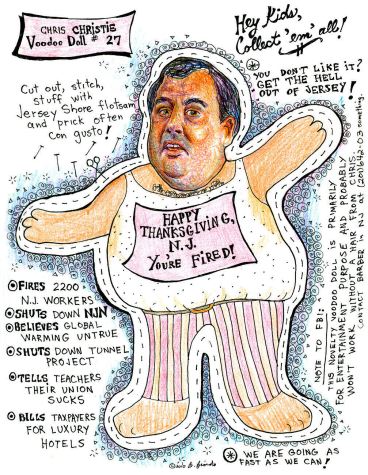 Far be it for me to complain about other states’ crazy Republican governors. The Wisdom Beings know that my crazy Republican Governor Bobby Jindal is right up there with the worst of them. After all, how many folks can say their governor helped kidnap and physically abuse a young woman in the name of an exorcism and then wrote about it as a spiritual experience in their school newspapers?
Chris Christie–pardon the pun–is big among Republican circles these days because he supposedly is showing how failed economic policies aren’t really failing. This appears to be a Republican obsession these days. Of course, they are failing, have failed and will fail. So, what do you do when the facts just can’t be changed? You lie.
Chris Christie–pardon the pun–is a big fat lying liar.
Paul Krugman mentioned this offhandedly last week. Chris Christie is trying to run on the idea of “The Jersey Comeback”. The problem is that it’s not the least bit true. Ask any one that actually lives in New Jersey and check out their stats. This isn’t stopping Christie from peddling his big fat lies as a big fat lying liar. You can check a really astounding FRED graph at that Krugman site that shows exactly how bad the employment situation is in New Jersey when compared to New York and Pennsylvania.
One real problem with living in New Jersey is that the state’s two major cities are, of course, New York and Philadelphia — which means that even if you live here, policy and politics reporting tends to be sparse. So it wasn’t until the latest budget fiasco surfaced that I even knew that Christie was running on the theme of the “Jersey Comeback”.
And now that I know, I wonder what on earth he’s talking about …
I’m actually not sure why NJ is doing so much worse than New York or Pennsylvania, and I doubt that Christie has much to do with it, but he’s the one trying to claim credit for … what?
Of course, his response to this chart would probably be to yell insults at the Bureau of Labor Statistics.
So, the funny thing is that Economist Stan Collender took Krugman’s back-of-the-napkin–with no offense intended to the NYT–analysis and lit it on fire. I’ve taught from both Krugman and Collender’s books. I follow their research. Both are terrific scholars. Both also blog with intense shrillness when they bump into just plan out and out lying. This brings us back to the Big Fat Lying Liars that are all over the Republican Party these days. Collender does the shrill one one better writing “Is This The Economic Dark Ages In The U.S?” I’ve quoted the entire thing because it’s so succinct I couldn’t just excerpt it. The goddess of fair use will have to forgive me along with Dr. Collender.
My guess is that Paul Krugman thought that this post was one of the more trifling economic-oriented pieces he has written in a while. It was short and probably took little time. It was also seemingly commonplace. After all, it was about a politician who said something inherently and obviously false.
But I found it to be extremely disturbing, not because it was off-the-wall — it’s anything but — but because it described a behavior — bald-face lying — that has become so blatant and commonplace among Republican policymakers on economic issues that any one of them who is even slightly honest and candid now would be both an absolute rarity and a welcome relief.
And the fact that the GOP lying about the economy…and especially the budget…is so accepted and expected means that any Republican who wasn’t jump-the-shark ridiculous on these issues wouldn’t be allowed to stay in the party much longer.
The obvious frustration that Krugman expresses in the post (not to mention the almost back-of-the-hand way he swats away Governor Chris Christie’s one-liner about the strength of the New Jersey economy and in the process makes the governor appear ridiculous to anyone who takes the time to look at the facts) mirrors what I was thinking when I posted this about House Speaker John Boehner (R-OH) last week.
As I noted in the post, Boehner, who easily qualifies as the weakest and least effective Speaker in my lifetime and has to be included on the list of the all-time worst in U.S. history, demonstrated yet again that he’ll say and do anything to stay speaker even when what he’s saying about the budget can easily be shown to be nonsense and when he knowingly and without giving it a second thought threatens the well-being of the U.S. economy.
I’d say this doesn’t bode well for the outcome of this year’s federal budget debate, but that’s both obvious and an understatement. It actually points to the a period in U.S. history that is very likely to be labeled by historians as its economic dark ages.
Krugman actually inkled something similar over the weekend in a interview with Raw Story where he said “This may be when it all falls apart”.
“We are living through a time where we face an enormous economic challenge,” he told RT’s Thom Hartmann. “We are facing — obviously — the worst challenge in 80 years and we are totally mucking up the response. We’re doing a terrible job. We’re failing to deal with it. All of the people, the respectable people, the serious people, have made a total hash of this. That is a recipe for radicalism. It is a recipe for breakdown.”
Krugman noted that the massive demonstrations in parts of Europe were reminiscent of the 1930s.
“There are a lot of ugly forces being unleashed in our societies on both sides of the Atlantic because our economic policy has been such a dismal failure, because we are refusing to listen to the lessons of history. We may look back at this thirty years from now and say, ‘That is when it all fell apart.’ And by all, I don’t just mean the economy.”
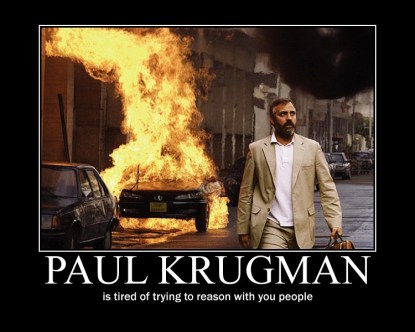
I have no idea why so many people seem so wedded to absolute lies. Unfortunately, they are our policy makers. Right now, they are so attached to their lies that it seems a lot of us think they are willing to bring down the entire country and it looks like they bloody well will do it too. What really gets me is that so many stupid people seem to want to believe these lies. What’s an economist to do but just be as shrill as possible.
h/t to Ralph
Monday Reads: Can we get back to real Economics now?
Posted: May 7, 2012 Filed under: Austerity, Economy, Elections, morning reads | Tags: Austerity Econmics, French Elections, Greek Elections, Paul Krugman, Remaking Capitalism, Robert Reich 40 Comments Good Morning!
It certainly has been a tough few years for reasonable people. We’ve had to endure a repeat of the same old things that didn’t end the Great Depression the first time remixed and put into failed policies in both Europe and the U.S.
The very act of believing something doesn’t make it real or true. Yet, a group of so-called conservatives have been recently led by blind faith in tropes and canards. They followed all the failed policies instead of what we’ve learned that works when dealing with market economies and their cycles over the last 100 years.
It seems voters in a lot of countries are waking up and voting out all those second comings of Herbert Hoover. Austerity economics hasn’t worked for the majority of us.
Paul Krugman has been outspoken about the wrong thinking that’s contaminated the political class here and Europe. There appears to be a group of people out there determined to un-write the history of the 1920s and 1930s. His new book tries to outline what we’ve known since the Roosevelt years and why the plans foisted on us by so-called conservatives were bound to fail. I have no idea why discredited economic thoughts were brought back into vogue by the banking classes, the investment classes, and pushers of bad pulp fiction narratives like Paul Ryan and his slavish Randian/Austrian ideology. Why do modern politicians pick up the economic version of flat-earth geology and then expect the economic equivalent of a successful launch of a rocket to Mars?
The Austerian desire to slash government spending and reduce deficits even in the face of a depressed economy may be wrongheaded; indeed, my view is that it’s deeply destructive. Still, it’s not too hard to understand, since sustained deficits can be a real problem. The urge to raise interest rates is harder to understand. In fact, I was quite shocked when the OECD called for rate hikes in May 2010, and it still seems to me to be a remarkable and strange call.
Why raise rates when the economy is deeply depressed and there seems to be little risk of inflation? The explanations keep shifting.Back in 2010, when the OECD called for big rate increases, it did an odd thing: it contradicted its own economic forecast. That forecast, based on its models, showed low inflation and high unemployment for years to come. But financial markets, which were more optimistic at the time (they changed their mind later), were implicitly predicting some rise in inflation. The predicted inflation rates were still low by historical standards, but the OECD seized on the rise in predicted inflation to justify a call for tighter money.
By spring 2011, a spike in commodity prices had led to a rise in actual inflation, and the European Central Bank cited that rise as a reason to raise interest rates. That may sound reasonable, except for two things. First, it was quite obvious in the data that this was a temporary event driven by events outside of Europe, that there had been little change in underlying inflation, and that the rise in headline inflation was likely to reverse itself in the near future, as indeed it did. Second, the ECB famously overreacted to a temporary, commodity-driven bump in inflation back in 2008, raising interest rates just as the world economy was plunging into recession. Surely it wouldn’t make exactly the same mistake just a few years later? But it did.
Why did the ECB act with such wrongheaded determination? The answer, I suspect, is that in the world of finance there was a general dislike of low interest rates that had nothing to do with inflation fears; inflation fears were invoked largely to support this preexisting desire to see interest rates rise.
The Europeans have had it with the nonsense. They’ve watched their economies and jobs be drained by bankers drunk on casino style betting in financial markets that pass their chits to taxpayers. The first major European leader–Nicholas Sarkozy–has been replaced. Will the French be able to put the out-of-control financial sector back into its proper place?
Mr Hollande – the first Socialist to win the French presidency since Francois Mitterrand in the 1980s – gave his victory speech in his stronghold of Tulle in central France.
He said was “proud to have been capable of giving people hope again”.
He said he would push ahead with his pledge to refocus EU fiscal efforts from austerity to “growth”.
“Europe is watching us, austerity can no longer be the only option,” he said.
After his speech in Tulle, Mr Hollande headed to Brive airport on his way to Paris to address supporters at Place de la Bastille. His voice hoarse, he spoke of his pride at taking over the mantle of the presidency 31 years almost to the day since Socialist predecessor Francois Mitterrand was elected.
“I am the president of the youth of France,” he told the assembled crowd of tens of thousands of supporters, emphasising his “pride at being president of all the republic’s citizens”. “You are a movement that is rising up throughout Europe,” he said.
Mr Hollande has called for a renegotiation of a hard-won European treaty on budget discipline championed by German Chancellor Angela Merkel and Mr Sarkozy.
Robert Reich writes that this is a chance to reform capitalism. It is highly unlikely that France will move to make public any private assets. What it will do is turn its economic future to what works for growth for a country and not the enrichment of the wealthy and powerful few. Financial Markets should not be turned into gambling casinos via government engineering.
During the Depression decade of the 1930s, the nation reorganized itself so that the gains from growth were far more broadly distributed. The National Labor Relations Act of 1935 recognized unions’ rights to collectively bargain, and imposed a duty on employers to bargain in good faith. By the 1950s, a third of all workers in the United States were unionized, giving them the power to demand some of the gains from growth. Meanwhile, Social Security, unemployment insurance, and worker’s compensation spread a broad safety net. The forty-hour workweek with time-and-a-half for overtime also helped share the work and spread the gains, as did a minimum wage. In 1965, Medicare and Medicaid broadened access to health care. And a progressive income tax, reaching well over 70 percent on the highest incomes, also helped ensure that the gains were spread fairly.
This time, though, the nation has taken no similar steps. Quite the contrary: A resurgent right insists on even more tax breaks for corporations and the rich, massive cuts in public spending that will destroy what’s left of our safety nets, including Social Security and Medicare and Medicaid, fewer rights for organized labor, more deregulation of labor markets, and a lower (or no) minimum wage.
This is, quite simply, nuts.
Krugman reminds us that Spain was a prudent and financially responsible government prior to the speculative mortgage bubble brought on by banks. It did them no good in their current downturn.
For this is really, really not about fiscal irresponsibility. Just as a reminder, on the eve of the crisis Spain seemed to be a fiscal paragon:
What happened to Spain was a housing bubble — fueled, to an important degree, by lending from German banks — that burst, taking the economy down with it. Now the country has 23.6 percent unemployment, 50.5 percent among the young.And the policy response is supposed to be even more austerity, with the European Central Bank, natch, obsessing over inflation — and officials claiming that the incredibly foolish rate hike last year was actually something to be proud of.

Greece too has voted against the Austerity Agenda.
Alexis Tsipras became the surprise package of the Greek election by telling Angela Merkel to get lost.
“The people of Europe can no longer be reconciled with the bailouts of barbarism,” Tsipras, 37, said on state-run NET TV late yesterday after his Syriza party unexpectedly came second in the country’s election. “European leaders, and especially Ms. Merkel, should realize that her policies have undergone a crushing defeat.”Tsipras’s calls to tax the rich, delay debt repayments and cut defense spending struck a chord with voters angry at austerity measures imposed by the European Union and the International Monetary Fund in return for bailouts. As far as euro membership is concerned, Tsipras told voters that a Greek exit would put the currency itself in jeopardy and they shouldn’t feel “blackmailed” into more austerity.
The result put Syriza ahead of the Socialist Pasok party, potentially derailing efforts to implement the terms of the country’s financial lifeline. Syriza, which means Coalition of the Radical Left, won 16 percent of the vote, projections showed. That exceeded the 13 percent won by Pasok, one of the two pillars of the political establishment since 1974. New Democracy, led by Antonis Samaras, topped the poll with 20 percent.
Rachel Maddow borrows some analysis from Ezra Klein to show how the UK has been tanking its own economy with its austerity agenda and how closely our own problems resemble the UK government induced recession.
Once President Obama took office and the Recovery Act/stimulus began putting capital back into the economy, the U.S. economy began growing again. In the U.K., the economy started to improve, right up until British officials began implementing an austerity agenda — at which point the national economy stagnated and slipped back into a recession.
Obama rejected austerity, and as a result, American growth, while fragile and insufficient, is easily outpacing Europe’s and UK’s, where austerity measures have ruled the day.
Americans should care about this, if for no other reason because of interconnectivity of the modern global economy. But there’s also a purely political perspective to keep in mind: namely, the problem of Republican predictions.
In short, American conservatives got everything backwards. When Obama’s policies began, Republicans said they wouldn’t generate economic growth, but GOP officials got it backwards. When David Cameron’s austerity policies began, Republicans were not only certain they would work, they pleaded with American policymakers to follow the Tories’ lead.
And we now know GOP officials had this backwards, too.
The remarkable thing is, Republicans aren’t the least bit chastened by their track record of failure.
They said Clinton’s economic policies would fail miserably, but that’s not what happened. They said Bush’s economic policies would produce extraordinary prosperity, but that’s not what happened. They said Obama’s economic policies would make the Great Recession worse, but that’s not what happened. They said Cameron’s economic policies in the U.K. would work brilliantly, but that’s not what happened.
And now these same Republicans are saying they deserve Americans’ votes in 2012 because they have credibility on the economy.
Here’s one last Krugman analysis of what the austerity agenda has done in the U.S. Private employment has recovered to pre-recession levels. That’s not true for public employment.
Here’s a comparison of changes in government employment (federal, state, and local) during the first four years of three presidents who came to office amid a troubled economy:
That spike early on is Census hiring; once that was past, the Obama years shaped up as an era of huge cuts in public employment compared with previous experience. If public employment had grown the way it did under Bush, we’d have 1.3 million more government workers, and probably an unemployment rate of 7 percent or less.

Here’s evidence that Obama is not growing the public sector as Mittens claims. These numbers represent thousands of teachers, health workers, scientists, highway workers. and public safety officials.
AMERICANS have watched austerity sweep Europe with a certain Schadenfreude. But eight months from now they may get a dose of the same medicine. The political compromises that have produced much of America’s deficit of 8% of GDP are programmed to go into reverse at the end of the year, two months after the election. A stimulus package consisting of a payroll-tax cut, investment tax credit and enhanced unemployment insurance expires then, as do George W. Bush’s tax cuts (which have already been extended by two years from their original end-date of 2010). At the same time an automatic, across-the-board cut in domestic and defence spending, called a “sequester”, takes effect, cutting about $100 billion from government spending next year.
The economic impact of this fiscal cliff is a matter of some debate. The Congressional Budget Office reckons that the combined effects of the sequester and the expiring tax cuts would add up to 3.6% of GDP in fiscal 2013. But David Greenlaw of Morgan Stanley, which puts the total effect at almost $700 billion at an annual rate, argues that the calendar-year impact is much larger, at around 5%. Others think the effect would be smaller, noting that some people will not experience the full tax hit until they file their returns in 2014.
Even the lower estimates could easily be enough to tip the economy back into recession.
These tax cuts have not been as successful as other forms of fiscal policy might have been. However, austerity measures taken in many states has been somewhat offset by these Federal Policies. It will be interesting to see how long the economy will hold out under current conditions if and when these things expire. It’s simply been a mind boggling process to watch so many countries unleash unregulated financial innovations and low interests rates then bail out for the financial sector after its bets went bad. It’s been even worse to watch the victims of this excess be forced to pay for the results of government supported speculative bubbles. I’m wondering exactly what the results of these elections will bring to Europe and how our own electorate will act in the fall.
So, I depressed you with a lot of dismal science stuff today. What’s on your reading and blogging list?
An Immodest Proposal
Posted: April 13, 2012 Filed under: Voter Ignorance, War on Women, We are so F'd | Tags: infrastructure, Jonathan Alter, Paul Krugman 20 Comments I’m spitting mad about the attacks on Hillary Rosen and the crocodile tears of folks like Rush Limbaugh and others that are trying to say that the war on women is really about evil feminists and real women. You’ll notice that most of this fabrication is coming from right wing men who have a lot to gain by reigniting the Mommy wars. Just follow this link to the WSJ op ed page and read how the real misogynists are Feminists. There is nothing more disingenuous that the rant that says feminists don’t support women and child rearing in what ever form that takes. Most feminists would love to see a situation more like Germany where the country actually supports extended parental leave for babies and toddlers and extends training and quality of day care providers and access to nursery school for all types of families. If this were really about how to do best by our children we would be having a completely different conversation. We would protect them better from abuse and give them and their parents the kind of support they need to be healthy, happy, and well-educated. This hoopla is only about splitting the women’s vote.
The heart of the argument needs to be aimed squarely back at the folks that are defunding everything from family planning, Planned Parenthood, Title X, preschools, school lunches, student loans and all things that support a functioning society. This includes public health and education structures more than anything else. Any mother–working a paying job or not–wants institutions in place that support her children. The real anti-family agenda is from people who do not support the basic structures of civilization. Folks that can’t write checks for tutors, nannies, preventative health care measures, prenatal services, childhood illness treatment, extra curricular activities and fancy schools and colleges rely on society recognizing the benefits of good health and education for its members. A decent society provides decent public goods. We pool our funds to benefit the economic security and health of our country. Our recent spending priorities have been wars, weapons, and subsidies to businesses that pollute, gamble, and abuse our resources. None of this is healthy for the future of our children.
These interests have now set up a cat fight between women to take our minds off the real problems. Feast your eyes on the Ryan Budget and you will see–as Paul Krugman puts it–who is cannibalizing our future and our families.
One general rule of modern politics is that the people who talk most about future generations — who go around solemnly declaring that we’re burdening our children with debt — are, in practice, the people most eager to sacrifice our future for short-term political gain. You can see that principle at work in the House Republican budget, which starts with dire warnings about the evils of deficits, then calls for tax cuts that would make the deficit even bigger, offset only by the claim to have a secret plan to make up for the revenue losses somehow or other.
And you can see it in the actions of Chris Christie, the governor of New Jersey, who talks loudly about acting responsibly but may actually be the least responsible governor the state has ever had.
Mr. Christie’s big move — the one that will define his record — was his unilateral decision back in 2010 to cancel work that was already under way on a new rail tunnel linking New Jersey with New York. At the time, Mr. Christie claimed that he was just being fiscally responsible, while critics said that he had canceled the project just so he could raid it for funds.
Now the independent Government Accountability Office has weighed in with a report on the controversy, and it confirms everything the critics were saying.
Chris Christie lied on a project that would shorten commutes, provide jobs, and basically create a better situation for families in the northeast corridor. I have only to ask why? Well, if you take a look at the Ryan Budget and the Norquist mentality, the deal is that most of these folks don’t want the community and its families to succeed, they want their cronies to be able to make a buck off of everything. They want all the power and all the money within their plutocracy. I’m not talking about government ownership of airlines, telecommunications, or any other move that one could logically equate with socialism. I talking funding and providing infrastructure improvements and the taxes that would enable them for the benefit of all. These kinds of public projects are ones that only a government can do successfully because of the scale and related economies. Jonathan Alter demonstrates that today’s republicans don’t recognize that the benefits from legitimate public projects bring benefits that far outweigh the costs for every one.
Grover Norquist, the tax-cutting champion, famously said he wanted to shrink the federal government “down to the size where we can drown it in the bath tub.”
With gargantuan deficits, that seems like a pipe dream, but it may be time to start running the water.
The new plan offered by House Budget Committee Chairman Paul Ryan and approved recently by Mitt Romney and congressional Republicans puts the Republicans on record supporting a federal government that within a decade will consist of little more than national defense, entitlements and interest on the national debt.
Those are largely transfer payments to defense contractors, seniors and bankers. The rest of what the government actually does would be eviscerated, from building roads to environmental protection to medical research.
Ryan has abandoned the Republican fantasy on display during the primaries that cutting liberal spending programs will be enough to restore fiscal sanity. He’d go where the big money is — entitlement reform — and also eliminate a series of tax deductions used by the affluent, though in an April 10 editorial board session with Bloomberg View he was still mum on which ones.
Ryan does not represent the historical positions of any Republican administration. The first Republican Project that required some taxes was the civil war. The used taxes on the rich–among other things–to fund that, reconstruction, and expansion into the westward part of the country.
To fund the war, the federal government taxed as it had never taxed before. The tariff, long the main source of government revenue, was raised sharply. So were excise taxes on commodities such as liquor. The government also instituted the country’s first income tax, which imposed a 3 percent levy on incomes above $800. It was soon raised to 3 percent on earnings of more than $600 and 5 percent on those that exceeded $10,000.
In the mid-19th century, anyone would have considered a person with a $10,000 annual income “rich.”
With the war’s end, government outlays declined sharply. In 1865, they had been almost $1.3 billion, the first time any government anywhere had spent more than $1 billion in a year. By 1870, they had declined to $309 million.
The income tax was allowed to lapse in 1873, and excise taxes were lowered as well. What remained very high was the tariff. But the purpose of a high tariff wasn’t solely to fund federal operations; it was so high that the government ran budget surpluses for 28 straight years, from 1866 to 1893.
Rather, the tariff was kept high to protect the booming industrialization of the American economy in the postwar years. That was very popular in the Northeast and Midwest, where the industry was concentrated, but deeply unpopular in the South and West.
The Republicans also wanted a transcontinental railroad. Look back to the article for the kinds of things built by Republican Presidents–still useful today–that wouldn’t pass muster with today’s Republican Party. This again comes from the Alter article cited above. All of these things improved commerce, provided jobs, and made the country much better off. Each generation of Americans–up until now–were always better off than our predecessors because they invested in a future for us.
The 1856 Republican platform demanded that “the Federal Government render immediate and efficient aid in [the] construction” of a transcontinental railroad. Money was also pledged for “the improvement of rivers and harbors.”
Soon thereafter, Abraham Lincoln signed laws creating hundreds of new colleges (the Morrill Land Grant Act), helping Americans buy property (the Homestead Act), establishing a new Cabinet department (Agriculture) and protecting public land from development (Yosemite).
Today’s Republican Party is on the other side of each of those Lincoln-era achievements, voting to slash money for education (Pell grants, which are discretionary, would be eviscerated in the Ryan budget), withdraw federal loans to buy property (closing Fannie Mae and Freddie Mac), shut Cabinet departments (Romney has said he’d shutter a few, though not which ones) and open up more coastlines for drilling.
The idea of using government money to invest in the future hardly died with Lincoln. Theodore Roosevelt built the Panama Canal; Dwight Eisenhower constructed the interstate highway system; and Republicans have voted for smaller such investments repeatedly over the years.
You get the idea. We shouldn’t even have to introduce the other items coming from Democratic Presidents like FDR that did projects like the Hoover Dam, rural electrification, and the blue star highways that were predecessors to Eisenhower’s interstate system. If you look at countries that have made priorities of internet systems and/or solar energy projects rather than let a few for-profit businesses piece together networks around urban areas, you’ll see the benefits of federal projects that we’re losing right now. We may not only see rural Americans loose the benefit of these things but also of something as basic as the constitutionally mandated postal service. If some one can’t make extraordinary profit from it, today’s Republicans don’t want it.
I”ll let Paul Krugman have the last word.
America used to be a country that thought big about the future. Major public projects, from the Erie Canal to the interstate highway system, used to be a well-understood component of our national greatness. Nowadays, however, the only big projects politicians are willing to undertake — with expense no object — seem to be wars. Funny how that works.
But think beyond that, public education, the national park system, great science projects like the moon shots or huge telescopes would not be done by private industry without huge amounts of federal largess or protection. Then there’s medical research like Nuclear medicine, genetics, and prevention of diseases by vaccinations. All of these started out as government funded projects before they were profitable enough to be transferred to the private sector. Why do today’s republicans think small for the country and big only for the 1%? Why are they creating a cat fight to take us off the real problems that challenge our children’s future?
Saturday Reads: Dismal Science Edition
Posted: February 4, 2012 Filed under: Economy, income inequality, morning reads, poverty, unemployment, We are so F'd | Tags: Paul Krugman, social safety net, unemployment 62 Comments Good Morning!
I’m going to concentrate on the economy this morning. You better grab some coffee.
The unemployment rate dropped yesterday for a variety of reasons. I thought I’d talk a little about that first. The job growth was fairly strong this month in every sector but government. This improved the labor outlook for some of the workers hardest hit by the last recession. However, it was a mixed report–although you wouldn’t know that from the stock market–in that it still showed a number of people who are working part time that don’t want to be and again, a large number of people simply disappeared from the labor force. Temp jobs surged. Wage growth is “meager” as shown by graphs in this blog post by Tim Duy. He also notes that the employment to population ratio remains at a levels not seen since the early 1980s. This is an interesting situation. We’re still in a huge hole. At this growth rate, it will take us until 2019 just to gain back the jobs we had in 2008.
One interesting trend pointed out at Zero Hedge by Tyler Durden is that older workers are increasing the number of hours worked. There appears to be a basic shift in many of the ‘normal’ labor habits. Durden calculates an alternative measure to the unemployment rate by including workers that the BLS ignores. He uses the long-term average labor force participation rate instead of the number of people that are participating now which is shrinking in a very odd way.
… do the following calculation with us: using BLS data, the US civilian non-institutional population was 242,269 in January, an increase of 1.7 million month over month: apply the long-term average labor force participation rate of 65.8% to this number (because as chart 2 below shows, people are not retiring as the popular propaganda goes: in fact labor participation in those aged 55 and over has been soaring as more and more old people have to work overtime, forget retiring), and you get 159.4 million: that is what the real labor force should be. The BLS reported one? 154.4 million: a tiny 5 million difference. Then add these people who the BLS is purposefully ignoring yet who most
certainly are in dire need of labor and/or a job to the 12.758 million reported unemployed by the BLS and you get 17.776 million in real unemployed workers. What does this mean? That using just the BLS denominator in calculating the unemployed rate of 154.4 million, the real unemployment rate actually rose in January to 11.5%. Compare that with the BLS reported decline from 8.5% to 8.3%. It also means that the spread between the reported and implied unemployment rate just soared to a fresh 30 year high of 3.2%.
So, the deal is that the labor force participation rate is at a 30 year low. That’s still the number that puzzles and bothers me despite the good looking job growth. Why are people leaving the job market? As shown in Durden’s numbers, it’s not baby boomers. Here’s some speculation by Edward Harrison of Credit Write Downs who is concerned like me. Look at the graph on the right from Durden that shows why reason number three isn’t the explanation right now. The blue line is the participation rate by the older workers (55+) and as you can see it’s headed straight up.
My take on this: A declining labor force participation rate is a bad thing. It says people are dropping out of the labor force. So despite the bullish headline figure, the question still remains as to how robust the jobs market is.
Here are three things to consider:
- Cyclical: that’s the point I made above. Low participation is a negative signal.
- Structural: A lot of people have been pointing to long-term unemployment as a sign that the jobs market is weak. This makes sense and it should put downward pressure on the participation rate as people drop out of the labor force. The difference here is that if the problem is structural and not cyclical, the so-called output gap will continue to be large as throngs of people remain out of the labor force.
- Secular: The first cohorts of boomers started to retire last year. I know many people that were close to retirement when the recession began in 2007 that have had to change plans. Some have delayed retirement because of financial turmoil. But many others have accelerated retirement unwillingly because they were forced out of the labor force. Expect the loss of boomers to put downward pressure on the labor force for years to come.
My guess is that all three factors are affecting the labor force participation rate here. But I am beginning to think that the structural and secular forces are starting to predominate.
I’m still thinking that younger people may be holding up in school for awhile until things get better but I’d have to do some research to see if the university population is up. I also think that there’s the discouraged worker factor too. I actually know a lot of folks that are just hanging in there and cashing in their IRAs or have gone back to school and are living on student loans and or going back and forth between short term jobs and contract work. I guess we’ll see if the trend holds, but to me it’s a worrisome one. If things were really getting better, those folks should be entering the job market now driving the participation rate up. Since I’m a financial economist and not a labor economist, I really don’t know the flows well enough to speculate on anything beyond a theoretical level. It’s not my research area.
Thomas Fran has written an interesting post at Alternet on “Why We Got Ayn Rand Instead of FDR”.
An appropriate metaphor for the conservative revival is the classic switcheroo, with one fear replacing another, theoretical emergencies substituting for authentic ones, and a new villain shuffling onstage to absorb the brickbats meant for another. The conservative renaissance rewrites history according to the political demands of the moment, generates thick smokescreens of deliberate bewilderment, grabs for itself the nobility of the common toiler, and projects onto its rivals the arrogance of the aristocrat. Nor is this constant redirection of public ire a characteristic the movement developed as it went along; it was present at the creation. Indeed, redirection was the creation.
…
Here, in one sentence, was a key to the amazing success the Right would shortly enjoy. They had an answer to the bailout outrage, and it was not modulated by lawyerly subtleties or votes-taken-with-nose-held, like the House Democrats who had voted for the TARP. “Let the failures fail”: it was a line that would allow the revived Right to depict itself as an enemy of big business, rooting for the collapse of the megabanks. The Tea Partiers may have looked ridiculous in their costumes, but their central demand was anything but.
Not all “failure” is the same, however. What the newest Right has in mind is something philosophical, something both personal and sweeping. It demands liquidation across the board, a sort of deserved doomsday for the borrowing-based way of life. But in the great die-off it delights in imagining, the real culprits of 2008 have a way of disappearing from view.
If we watch closely, we can see the cards being switched. Whenever our tea-partying friends warm to the subject of letting-the-failures-fail—and they do so often—sooner or later they inevitably turn from the bailed-out banks to those spendthrift “neighbors” identified by Santelli, those dissolute people down the street who borrowed in order to live above their station.
This could be why the Republican Presidential Wannabes sound so down right Dickensian. We’ve had school children offered up as janitorial help. We’ve had Willard talking about enjoying a good firing and ranting on about how he’s not worried about the poor because they are safe in their safety nets. Instead of pointing to the business welfare queens, we’ve got poor children being held up as not having the fortitude and values. As Krugman says, Willard doesn’t feel any one’s pain.
Now, the truth is that the safety net does need repair. It provides a lot of help to the poor, but not enough. Medicaid, for example, provides essential health care to millions of unlucky citizens, children especially, but many people still fall through the cracks: among Americans with annual incomes under $25,000, more than a quarter — 28.7 percent — don’t have any kind of health insurance. And, no, they can’t make up for that lack of coverage by going to emergency rooms.
Similarly, food aid programs help a lot, but one in six Americans living below the poverty line suffers from “low food security.” This is officially defined as involving situations in which “food intake was reduced at times during the year because [households] had insufficient money or other resources for food” — in other words, hunger.
So we do need to strengthen our safety net. Mr. Romney, however, wants to make the safety net weaker instead.
Specifically, the candidate has endorsed Representative Paul Ryan’s plan for drastic cuts in federal spending — with almost two-thirds of the proposed spending cuts coming at the expense of low-income Americans. To the extent that Mr. Romney has differentiated his position from the Ryan plan, it is in the direction of even harsher cuts for the poor; his Medicaid proposal appears to involve a 40 percent reduction in financing compared with current law.
So Mr. Romney’s position seems to be that we need not worry about the poor thanks to programs that he insists, falsely, don’t actually help the needy, and which he intends, in any case, to destroy.
Still, I believe Mr. Romney when he says he isn’t concerned about the poor. What I don’t believe is his assertion that he’s equally unconcerned about the rich, who are “doing fine.” After all, if that’s what he really feels, why does he propose showering them with money?
The New York Review of Books has an entire list of economics books up that have to do with austerity and income inequality. The heading basically sums it up. We’re more unequal than you think. Here’s a review of two that I found particularly interesting.
Robert Frank’s The Darwin Economy and Thomas Edsall’s The Age of Austerity provide much-needed information and analysis to explain why so much of the nation’s money is flowing upward. Frank, an economist at Cornell, draws on social psychology to shatter many myths about competition and compensation. While he doesn’t explicitly cite the classical French economist Jean-Baptiste Say, much in his exposition echoes Say’s axiom that “supply creates demand.” This doesn’t mean that if items are put on display, people will automatically buy them. Consumers decide what or if they’ll purchase, and clearly can only do so if they have the credit or money. Even so, the items they decide they want have been created by the suppliers, who put things on the shelves.
Frank carries this a step further. In recent years, he argues, the products and enjoyments set before us have become increasingly enticing—including houses, vacations, television programs, video games, electronic devices, and the attractions of the Internet. In many cases, the rich acquire them first; since what they have and do becomes widely known, emulation descends down the line.
Nor are these just Tiffany trinkets. Frank’s most vivid examples are newly built houses. As the very rich installed grander entrance halls and rarely used bathrooms, the professional classes felt they should have a semblance of such amenities. “By 2007,” Frank writes, “the median new single-family house built in the United States had an area of more than 2,300 square feet, some 50 percent more than its counterpart from 1970.” Indeed, it’s revealing that this expansion was happening as people were having fewer children. However, these homes—along with more elaborate wardrobes, holidays, and technical gear—are costly. If they were to be bought, salaries needed to keep pace.
Hence, I would argue, an unstated but still real compact was made between the employers and the new upper-middle class. Their pay would be raised to support their ascending status. As the samplings in Table B show, while real earnings for the overall workforce have risen only 7 percent since 1985, professions like physicians and professors have done several times better. Incomes of lawyers and executives, for their part, have soared much further than anyone would have forecast a few decades ago.2
One of the reasons the poor do so poorly is that the states have tax structures that are very regressive. If you didn’t see me link to this down thread yesterday, take a look at how regressive state taxes really are. Kevin Drum includes a table where you can check on how bad your state treats you.
And then there are state taxes. Those include state income taxes, property taxes, sales taxes, and fees of various kinds. How progressive are state taxes?
Answer: They aren’t. The Corporation for Enterprise Development recently released a scorecard for all 50 states, and it has boatloads of useful information. That includes overall tax rates, where data from the Institute on Taxation and Economic Policy shows that in the median state (Mississippi, as it turns out) the poorest 20 percent pay twice the tax rate of the top 1 percent. In the worst states, the poorest 20 percent pay five to six times the rate of the richest 1 percent. Lucky duckies indeed. There’s not one single state with a tax system that’s progressive.
So, hopefully, you’re still awake! What’s on your reading and blogging list today.

 peej
peej Carissa
 bostonboomer
 dakinikat
 ecocatwoman
 mablue2
 Mama Lopez
 peggysue22
 quixote
 skydancingguestblogger
 Mona (aka Wonk the Vote)



 Sky Dancing
Recent Comments