
The Republicans Just won’t Trade in their Fairy Tales
Posted: November 11, 2012 Filed under: Economy, just because | Tags: fiscal cliff, joseph stiglitz, Mark Thoma, Paul Krugman, Trickle Down Economics, voodoo economics 23 CommentsThere’s a notable absence of economists on panels in the mainstream media that discuss the fiscal “ramp”. I’m refusing to call it a fiscal cliff because that’s a misnomer. I’m not sure why they won’t put research economists on these panels. Perhaps they think we’re not  photogenic or–despite the fact that a lot of us teach–we can’t explain ourselves. There’s an extremely strong consensus in the economics community on the s0-called budget crisis. Dragging out mainstream economists like Paul Krugman and Joseph Stiglitz and labeling them lefties because of their political leanings is rather disingenuous. It stops them from getting on panels where they could actually explain to people what’s what.
The corporate press would rather haul out a few journalists with real background in the field. There’s a difference between asking a journalist, a lawyer, or some self-anointed policy expert a question on economic theory. First, asking an economist to answer a question as an economist means they’ll stick to the theory and the empirical findings. Second, you can actually pull in almost any economist either trained after about 1980 or who has kept up with the dynamic business cycle models, the empirical findings, and theories and you won’t get much disagreement. You wouldn’t know that if you listen to the press, which seems to be made up a few folks with MBAs who have very little understanding of theory, models, or findings.
Deficit hawks tend be either Wall Street types, lawyers, or partisan right wing politicians. The folks that are screaming worst about dropping the tax cuts for the uber rich tend to have the most to lose personally and the least to lose professionally. Study-after-study-after-study shows that tax cuts to the middle, working, and lower classes and to young people tend to create completely different circumstances than they do for older people and the rich. First, there’s more folks in the first group. Second, they tend to spend a lot more of their current income. Third, their savings and investment opportunities are limited, so the assets they use stay in the country. None of this applies to the uber rich who tend to create jobs and wealth overseas these days and work hard to avoid taxes anyway. We’d do well to just simply let go of the idea that increasing the tax rates on the rich will either lead to unemployment, won’t pay down the deficit, or will suppress growth. These are tales of sound and fury signifying nothing but personal greed.
It is true that we are not on a sustainable spending path. This is because of the direct actions of the Bush administration. They lowered tax rates. Ran two huge wars with no tax increases. They oversaw and created two recessions. They created an asset bubble and then popped it. Growth, employment, and the value of taxable assets all decreased because of their actions. We simply have to reverse their trajectory. We have to do some work on Medicare and we need to walk away from the decaying, rotting corpse of Zombie Economics. The Republicans still won’t let that rotting corpse go.
Krugman talks about some of this on his blog in a post called “Squirming Hawks”. Paul Krugman may be a liberal but he’s certainly not going to risk his reputation in the economics community to spout crackpot hypothesis. Look at what happened to Arthur Laffer whose basically been expunged from any serious text, publishing deal, or institution. When you push crackpot hypotheses that do not stand up to empirical testing and you do not give them up and move on, the community of those who base their research on the scientific method will write you off. Those that follow Hayek and Von Mises have been similarly written off. Their ideological hypotheses do not stand up to any empirical testing.
Now, there’s a straightforward argument for why the fiscal cliff is bad but long-term deficit reduction is good — namely, that you really don’t want to cut deficits when the economy is depressed and you’re in a liquidity trap, so that monetary expansion can’t offset fiscal contraction. As Keynes said, the boom, not the slump, is the time for austerity. But the deficit hawks can’t make that argument, because they have in fact been arguing for austerity now now now.
So they’re left making a mostly incoherent case: it’s too abrupt (why?), it’s the wrong kind of deficit reduction (???), and then this:
a better approach would be to focus spending cuts on low-priority spending and on changes which can help to encourage growth and generate new revenue through comprehensive tax reform which broadens the base – ideally by enough to also lower tax rates.
Low-priority spending? I think that means spending on poor people and the middle class. And isn’t it amazing how people who claim to be horrified, horrified about deficits can’t stop talking about cutting tax rates?
Meanwhile, the CRFB features on its home page an op-ed by Jim Jones declaring that
We are perilously close to trillion-dollar yearly interest payments, 7 percent yields on 10-year U.S. Treasury bonds, 10 percent home mortgage rates and 13 percent rates on car loans. For the good of the country, the parties must come together and not let this happen.
How does he know that we are “perilously close” to this outcome? Not from the markets; not from any kind of economic model. My guess is that Peggy Noonan told him.
Scaring people with large numbers that are not grounded to other large numbers is a mean and terrible thing to do. We have a huge tax base. We have more than enough ability to continue to borrow at low interest rates. We have the ability to print money. We have all kinds of options. We have a huge economy that is showing signs of coming out of a lot of trauma. We should get a double peace dividend shortly. These things point to a very good reason not to be crazy-go-nuts like the Europeans and fall on the austerity sword.
I think that Mark Thoma has some interesting things to add to this conversation. He asks rhetorically and then answers: Hasn’t Paul Krugman Heard about the Magic of Tax Cuts and Supply-Side Economics? No, and for Good Reason…
I guess Paul Krugman hasn’t heard about the magic of tax cuts and supply-side economics. Well, Cato-at-Liberty has, and it’s ticked at the CBO because “it assumes higher tax rates generate more money” when making budget projections. That’s right, despite all the evidence against the claim that tax cuts actually increased revenue — it’s a myth that won’t die because people who know better, or ought to, still promote it — we should discredit the CBO for making the claim that higher tax rates would help with the budget problem.
And that’s not all. The CBO should be further discredited because it says the stimulus package helped to ease the recession:
The CBO repeatedly claimed that Obama’s faux stimulus would boost growth. Heck, CBO even claimed Obama’s spending binge was successful after the fact, even though it was followed by record levels of unemployment.
I’ll pass over the “record levels of unemployment’ claim (but note that unemployment peaked at 10.0% in October 2009, but was 10.8% at the end of 1982, at best this is playing games with the word “levels” and ignoring population growth — and if duration is the argument, as Reinhart and Rogoff recently noted, conditional on the type of recession this recovery is actually a bit better than most).
On the main claim about fiscal policy, there’s plenty of emerging evidence supporting the contention that fiscal policy helped to ease the recession (and remember how much of the stimulus package was tax cuts — it’s amusing to listen to conservatives tell us how useless the tax cuts they fought for as part of the stimulus package turned out to be, especially when in the next breath they argue for more tax cuts). The CBO is dealing in actual evidence, the claims made by Cato-at-Liberty are backed by nothing more than the Republican noise machine that is so good at misleading followers.
Republicans just can’t help themselves from attacking anyone and anything that is inconvenient to their goals, and actual evidence has little to do with it. Apparently, they learned nothing from the election. This is part of a larger effort to discredit the CBO because it doesn’t agree with Republican views on the magic of tax cuts, and for other results the non-partisan agency has come up with that Republicans don’t want to hear (so they basically cover their ears and ignore them).
The Republicans aren’t the only ones doing this. I watch about 5 minutes of an Ali Velshi panel that really horrified me. No one there directly took on Stephen Moore of the WSJ on that same damn fairy tale about job creators and tax rates on the rich. Why doesn’t any one mention that his assertions have no basis in reality, theory, or empirical evidence and have been thoroughly trounced? Better yet, why is some one who spouts propaganda even on a news program that supposedly informs people about economics, finance, and policy? There was one truly knowledgeable person on the panel. The rest of them should have asked questions then listened to Mohamed A. El-Erian. Again, Stephen Moore should only be placed on panels where fairy tales are involved. His degrees in economics are obviously stale. Plus, he works with Laffer whose been laughed out of any organization that contains serious economists. He’s basically a tool of the plutocracy.
Fortunately, it looks like the Senate Democrats are having none of this.
Sen. Patty Murray (D-Wash.) on Sunday said Democrats were prepared to allow the expiration of all George W. Bush-era tax rates if Republican lawmakers objected to raising taxes on the wealthiest.
“We can’t accept an unfair deal that piles on the middle class and tell them they have to support it. We have to make sure that the wealthiest Americans pay their fair share,” said Murray on ABC”s “This Week.”
Murray said one option would be to let the lower rates expire across-the-board and then return to the table next year with new talks on a tax-cut package.
“So if the Republicans will not agree with that, we will reach a point at the end of this year where all the tax cuts expire and we’ll start over next year. And whatever we do will be a tax cut for whatever package we put together. That may be the way to get past this,” said Murray.
The Washington senator is likely to become chairwoman of the Senate Budget Committee and previously served on the congressional “supercommitee,” which failed to finalize a deficit-reduction plan, which may trigger sequestration cuts in January 2013.
The evidence points to the recessionary impact of tax cuts on the middle class. There is nothing that shows allowing the Bush Tax cuts to expire will do the same. Republicans keep suppressing the evidence.
In particular, the CBO gave its most detailed look at how the expiration of the Bush-era tax cuts would affect the economy. Apparently, it would do little harm, the numbers show.
Just like the damn things did little good for the economy and most of us, letting them die would do little harm. I hope the Dems just hold to the facts and that the election has given them some resolve to do the people’s business.
Morning Reads: Monday, Monday,
Posted: October 15, 2012 Filed under: Barack Obama, misogyny, Mitt Romney, morning reads | Tags: health insurance, Paul Krugman, Shelia Bair 52 Comments
Good Morning!
Much of the political news has to do with the lead-up to the presidential town-hall style debate on Tuesday night. I’m going to focus on some other things this morning.
Truthdigger of the Week is Sheila Bair who is one of the women in banking and finance that I admire most. Very few people have as good of an understanding of the weirdness of the financial markets and the need for clarity and removal of moral hazard as the former head of the FDIC. She has a book out that I intend to read.
As leader of the FDIC during that period, Bair was witness to the efforts that Treasury Secretaries Hank Paulson and Timothy Geithner made to save the individuals and banks that were most responsible for the crisis, while leaving American homeowners and taxpayers high and dry. The New York Times’ Gretchen Morgenson, who hailed Bair’s book as an “important piece of history and a rebuttal to the conventional wisdom,“ offered a sample from it:
[P]erhaps the most telling anecdote is from early October 2008, when Henry M. Paulson Jr., the Treasury secretary, summoned Ms. Bair to his office. No reason was given for the meeting. When she arrived, Ben S. Bernanke, the Federal Reserve chairman, was already there. Timothy F. Geithner, then the president of the New York Fed, was on the phone.
Handed a piece of paper, Ms. Bair saw that she had been ambushed. It was a script, prepared for her by the Treasury and the Fed, stating that the F.D.I.C. was moving to guarantee all the liabilities in the financial system. Astonishingly, the guarantee would cover all bank depositors and even protect unsecured claims against institutions. In short, the F.D.I.C. was being asked to back ‘everybody against everything in the $13 trillion banking system,’ Ms. Bair writes.
Taking seriously her job to serve the American public, Bair rejected the plan to drive the FDIC’s funds directly into the pockets of everyone who held bank debts, a modest victory considering that Geithner and company eventually succeeded in handing over trillions of dollars at low interest to institutions that then refused to pump them back into the economy in the form of loans. “Workers, homeowners [and] small businesses have by and large been left to fend for themselves” amid bailouts for “too big to fail” institutions, Bair said in an interview with Morgenson.
Economics Professor Rajiv Sethi also has a review up on the book at his blog. He has a great description of the situation in the market for derivatives and about the assets themselves. I’ll let you venture over there if you’re up for the wonky goodness.
Sheila Bair’s new book, Bull by the Horns, is both a crisis narrative and a thoughtful reflection on economic institutions and policy. The crisis narrative, with its revealing first-hand accounts of high-level meetings, high-stakes negotiations, behind-the-scenes jockeying, and clashing personalities will attract the most immediate attention. But it’s the economic analysis that will constitute the more enduring contribution.
Among the many highlights are the following: a discussion of the linkages between securitization, credit derivatives and loan modifications, an exploration of the trade-off between regulatory capture and regulatory arbitrage, an intriguing question about the optimal timing of auctions for failing banks, a proposal for ending too big to fail that relies on simplification and asset segregation rather than balance sheet contraction, a full-throated defense of sensible financial regulation, and a passionate critique of bailouts for the powerful and politically connected even when such transactions appear to generate an accounting profit.
Paul Krugman takes on Romney assertion that no one dies from lack of insurance. I thought this was a strange comment when Romney made it but no one picked up on it the way Krugman does. It just amazes me that Romney just seems to make stuff up whenever he talks to any one. I can’t decide if he’s delusional or just a facile liar. Something tells me that he’s both.
Last week, speaking to The Columbus Dispatch, Mr. Romney declared that nobody in America dies because he or she is uninsured: “We don’t have people that become ill, who die in their apartment because they don’t have insurance.” This followed on an earlier remark by Mr. Romney — echoing an infamous statement by none other than George W. Bush — in which he insisted that emergency rooms provide essential health care to the uninsured.
These are remarkable statements. They clearly demonstrate that Mr. Romney has no idea what life (and death) are like for those less fortunate than himself.
Even the idea that everyone gets urgent care when needed from emergency rooms is false. Yes, hospitals are required by law to treat people in dire need, whether or not they can pay. But that care isn’t free — on the contrary, if you go to an emergency room you will be billed, and the size of that bill can be shockingly high. Some people can’t or won’t pay, but fear of huge bills can deter the uninsured from visiting the emergency room even when they should. And sometimes they die as a result.
More important, going to the emergency room when you’re very sick is no substitute for regular care, especially if you have chronic health problems. When such problems are left untreated — as they often are among uninsured Americans — a trip to the emergency room can all too easily come too late to save a life.
So the reality, to which Mr. Romney is somehow blind, is that many people in America really do die every year because they don’t have health insurance.
Jonathan Chait writes long read in New York Magazine about Obama and Romney’s approach to the size and character of government. He basically projects what the focus of each administration might be on day one. The character concept is an interesting one. Here’s a bit on Romney first.
Though the broad contours of the Ryan plan amount to a nonnegotiable demand thrust upon Romney by the Republican Party, there are significant gaps within the plan that leave Romney room to maneuver and that, we can imagine, he will use to his advantage. Because, starting January 20, Romney will be faced with the same crushing pressure Obama has endured for the past four years: an anemic economic recovery. If he intends to win reelection, Romney will have to come up with some plan to improve our job numbers.
Here’s where his administration could get surprising. Romney has built his campaign on the promise of alleviating the immediate pain of the recession, yet his program to reduce unemployment is vague bordering on nonexistent. (“If we win on November 6th, there will be a great deal of optimism about the future of this country,” he told donors during his infamous, secretly recorded Palm Springs diatribe. “We’ll see capital come back and we’ll see—without actually doing anything—we’ll actually get a boost in the economy.”) Republicans fervently believe the Ryan plan would restore prosperity over the long run, but even they recognize it has essentially no relation to the economic maladies of the moment. The Obama administration’s approach to the economy has been to follow the tenets of Keynesian economics, which prioritizes stimulating consumer demand (through government spending and/or tax reductions), by deliberately jacking up short-term deficits. During the 2001 recession, Republicans agreed with this theory—advocating quick tax cuts—and they appeared to be heading in the same direction in early 2008. But since Obama’s election, they have turned wholesale against Keynesian economics, instead suggesting that an immediate reduction in deficits could boost the recovery. Recent history, especially in Europe, has not been kind to these austerity enthusiasts.
One brief look at the Obama side and then I’ll let you decide if you want to go read the entire, lengthy piece.
Obama tends to leave the contours of his second term pleasantly vague, which has fueled the general impression that he is tapped out and has no particular achievable goals in mind. He often posits that, should he win reelection, Republicans will abandon their strategy of total opposition, citing Senate Minority Leader Mitch McConnell’s unusually frank confession back in 2010 that his top priority was to block Obama’s reelection. “Now, after the election, either he will have succeeded in that goal or he will have failed at that goal,” Obama has said. “And I’m hoping that after the smoke clears and the election season’s over that that spirit of cooperation comes more to the fore.”
There’s little reason to share this profession of faith. Republican obstructionism is not only a strategy to deny the president a second term. Some Republicans genuinely fear Obama, and others fear a right-wing primary challenge if they compromise with him. What’s more, the political calculation that undergirds his opponents’ strategy will not disappear: His popularity is the single biggest factor determining Republican prospects for enlarging their control of Congress and winning the White House. Cutting bipartisan deals increases Obama’s standing and thus reduces theirs.
You might surmise from all this that Obama is simply living in a dream world. That is the conclusion drawn by several of the smartest liberal political analysts I know. I have a different conclusion: Obama does have a plan to break the legislative impasse and settle the long-term struggle over the scope of government. It does not rest on the GOP’s coming to its senses and thinking of the national good. The plan is the very opposite of naïve. And he can put it into effect even more quickly than Romney could enact his own plan.
Here is how it will happen. On the morning of November 7, a reelected President Obama will do … nothing. For the next 53 days, nothing. And then, on January 1, 2013, we will all awake to a different, substantially more liberal country. The Bush tax cuts will have disappeared, restoring Clinton-era tax rates and flooding government coffers with revenue to fund its current operations for years to come. The military will be facing dire budget cuts that shake the military-industrial complex to its core. It will be a real-world approximation of the old liberal bumper-sticker fantasy in which schools have all the money they require and the Pentagon needs to hold a bake sale.
All this can come to pass because, while Obama has spent the last two years surrendering short-term policy concessions, he has been quietly hoarding a fortune in the equivalent of a political trust fund that comes due on the first of the year. At that point, he will reside in a political world he finds at most mildly uncomfortable and the Republicans consider a hellish dystopia. Then he’ll be ready to make a deal.
Anyway, it’s one view point.
 Okay, so here’s my interesting grave site dig of the week. It’s in Mexico from about 700 AD and features a woman buried face down.
Archaeologist Raul Matadamas Diaz, director of the Bocana del Rio Copalita investigation project, informed that the sepulcher –the first one that has been discovered in this site– is estimated to date back to 700 AD and although cultural affiliation has not been yet determined, it could be associated to ancient groups that were in contact with Zapotecs of the Valles Centrales in Oaxaca. INAH’s archaeologist elaborated about the offerings found which were accompanying the skeleton, among which a severed femur believed to have been used as a baton. “This finding –he emphasized– will help understand the funerary practices of the civilizations that occupied Copalita, especially its elite from which we have no information until now”. “Around the sepulcher, we also discovered the burial of 22 more individuals, among which a female character stood out. She was the first skeleton in this pre Hispanic site that was facing the floor, which might indicate a sign of submission to the principal character in the tomb. Her skeleton had two jade earflaps and beads located in her lumbar vertebras”, Matadamas said. The specialist at INAH-Oaxaca Center explained that over the female skeleton were four pots, one of which is a bowl decorated with a glyph in a relief that has the representation of an owl between two snakes, an image that is repeated in the contour of the piece and which is associated to ancient Zapotecs from the Valles Centrales in Oaxaca. Matadamas Diaz added that in the base of the same piece they found symmetrical figures of an alligator opening its jaws; within the jaws is the face of a man who has a scroll with a word in front of him, possibly related to cultures from the coast of Huatulco. “Said symbols will be studied in detail to see if it’s possible to elucidate through them the world view that was developed between 700 and 800 AD by groups that settled in the metropolis of Copalita, and to identify the character that is contained in the tomb” the archaeologist stated.
Yup. That’s the interpretation. She’s in a deferential position towards the male in the tomb. Women can’t even get a break in their deaths.
So, what’s on your reading and blogging list today?
Sunday Shows: The “L” Word
Posted: October 7, 2012 Filed under: 2012 presidential campaign, Barack Obama, Mitt Romney, open thread, The DNC, the GOP, The Media SUCKS, U.S. Economy, U.S. Politics | Tags: David Axelrod, Martin O'Malley, Michael Nutter, Paul Krugman, Robert Gibbs 33 Comments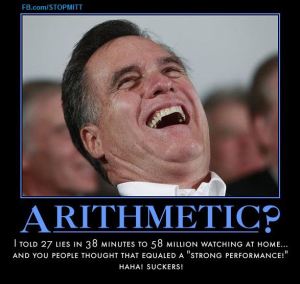
No, I don’t mean “liberal.” The “L” word for this week is “lies.” Democrats were out on the Sunday shows this morning calling out Mitt Romney for lying in last Wednesday’s presidential debate. Talk about a “game changer.” It used to be that politicians were uncomfortable coming right out and calling their opponents liars, but with the number and scale of Romney’s lies in the 2012 campaign, that calculus has changed. Two Obama surrogates actually used the word “lie” and two Obama advisers called Romney “dishonest.” It appears to have a been a coordinated attack.
On Face the Nation, David Axelrod called Romney “dishonest.”
“Governor Romney showed up to deliver a performance, and he delivered a very good performance,” Axelrod said. “It was completely unrooted in fact; it was completely unrooted in the position he’s taken before, and he spent 90 minutes trying to undo two years of campaigning.”
Doubling down on his assertion, Axelrod said, “I think he was dishonest…absolutely.”
Axelrod criticized Romney for saying during the debates that he “never proposed” $5 trillion worth of tax cuts, which an analysis by the nonpartisan Tax Policy Center found would occur if Romney implemented his plan to reduce tax rates by 20 percent. “That was dishonest,” Axelrod said….
“It’s impossible….He cannot name one loophole that he would close. If you took away all the loopholes for upper-income Americans, every single one of them, he would still be trillions of dollars short.” In order to pay for the tax cuts and remain revenue neutral, Axelrod said, “He has to sock it to the middle class or explode the deficit.”
Axelrod even compared Romney to Sinclair Lewis’s fictional character Elmer Gantry.
Suggesting that Mr. Obama had expected, and prepared for, a more substantive debate, Mr. Axelrod said, “I think he went thinking that this was going to be a discussion about the country’s future, and he was confronted by this kind of Gantry-esque performance on the other side, just serially rewriting history.”
The program’s moderator, Bob Schieffer, stopped Mr. Axelrod for clarification.
Yes, Mr. Axelrod said, he was referring to Elmer Gantry, the title character in a book – banned in Boston when published in 1927 – and later a movie about a charismatic, fast-talking, but deeply dishonest street preacher.
Axelrod also noted that President Obama “was ‘taken aback at the brazenness’ of the Republican nominee’s answers.”
Robert Gibbs also used the word “dishonest” to describe Romney on This Week.
“The underpinnings and foundation of that performance were fundamentally dishonest,” said Gibbs, an Obama campaign senior adviser. “Look, the only thing he outlined that he would cut in the budget is Big Bird. He’s taken the battle straight to Sesame Street and let Wall Street run hog wild.”
The Obama campaign has attacked Mitt Romney for tax plan, which is to lower tax rates, but also close certain loopholes, which would produce revenue for the government. Romney has not specified exactly which ones he would close.
“And let’s be clear, if you’re willing to say anything to get elected president, if you are willing to make up your positions and walk away from them, I think the American people have to understand, how can they trust you if you are elected president,” Gibbs said.
On Fox News Sunday, top Obama surrogate Maryland Governor Martin O’Malley said of Romney’s tax plan, “The fact of the matter is in this debate we saw Big Bird meet the big lie.” In addition, he told Chris Wallace:
“Mitt Romney tells us to trust him, his plan is hiding behind door No. 3 with Carol Merrill and his undisclosed tax returns,” O’Malley said, referring to “Let’s Make a Deal,” the game show that was popular in the 1960s and 1970s. Merrill was the model that assisted host Monty Hall.
Another Obama campaign surrogate, Mayor Michael Nutter of Philadelphia said on CNN’s State of the Union that
Mitt Romney had offered “lie after lie” during last week’s debate.
“He is the Etch-A-Sketch guy, [he] has transformed himself and, quite frankly, we always have to wonder which Mitt is going to show up.”
Nutter said that Romney
had undergone an “11th hour conversion” before his debate appearance. “So, if you just lay out lie after lie after lie about your own plan, as well as what the president has been talking about, of course you can look good,” he said.
I’m very glad that Democrats are getting so tough on Romney. But on Meet the Press, even Romney surrogate Newt Gingrich agreed that Romney was lying about his tax plan.
When asked if Romney was being dishonest in the presidential debate, Gingrich said it was “clear” Romney ran away from the tax plan he has long promised on Wednesday night.
GINGRICH: I think you got to look carefully at how Romney structured, what he said is, something that frankly true supply siders don’t necessarily love but it’s good politics, he said, “I will close enough deductions that wealthy Americans will not get a net tax cut.” Now, that’s a pretty clear description.
Senior Obama Campaign Adviser Robert GIBBS: Let me just say this. Standing on the stage with you in Arizona, this is what Mitt Romney said.” Number one, I said today we’re going to cut taxes on everyone across the country, by 20%, including the top 1%.” Mr. Speaker, you mentioned that your opponent, Mitt Romney, had a problem with being dishonest in the primary. My question is, was he dishonest when he said that?
GINGRICH: I think it’s clear he changed.
GIBBS: So we don’t disagree that he changed.
The most stinging rebuke this morning came from Paul Krugman’s indictment of the media coverage of Romney’s debate performance on This Week.
On ABC’s “This Week” roundtable Sunday, Paul Krugman said Mitt Romney is exploiting a press that is ineffective at holding politicians accountable for lies.
“The press just doesn’t know how to handle flat-out untruths,” he said.
“I don’t know whether to blame [the debate moderator Jim] Lehrer or the president, but it was kind of amazing because Romney was not only saying things that are not true, he was saying things that his own campaign had previously said weren’t true,” said the economist and New York Times columnist.
Citing Romney’s claims on taxes and preexisting conditions, Krugman said the Republican nominee showed “contempt for us by thinking the news media will not cover on me as long as they say forcefully I won.”
Please use this as an open thread. What are you hearing?
Open Thread: Sunday Night Funnies
Posted: September 9, 2012 Filed under: 2012 presidential campaign, open thread, U.S. Politics, War on Women | Tags: Barack Obama, editorial cartoons, Mitt Romney, Paul Krugman, Paul Ryan, Rand Paul 28 Comments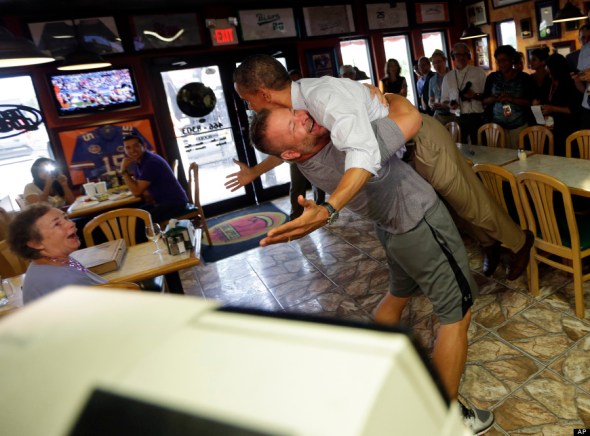
Obama Gets a Lift in Florida:
In this key swing state, Obama stopped at Big Apple Pizza & Pasta Italian Restaurant, where he was greeted by owner Scott Van Duzer, a muscular man dressed in a gray T-shirt and matching athletic shorts.
Van Duzer was so smitten by the president that he embraced him in a bear hug, leaned backward and lifted the 6-foot-2 president a foot off the ground. Photos of the moment show Obama with his arms spread wide and palms turned upward, as if to say he’s at the mercy of the pizzaman….
Afterward, a reporter at the scene reported that Van Duzer, 46, from Port St. Lucie, stands 6-foot-3 and weights 260 pounds, and he can bench-press 350.
“Everybody look at these guns,” Obama said, pointing to Van Duzer’s chest. “If I eat your pizza, will I look like that?”
“Look at that!” Obama exclaimed after Van Duzer put him down. “Man, are you a powerlifter or what?”
Joe Biden had a big day too.
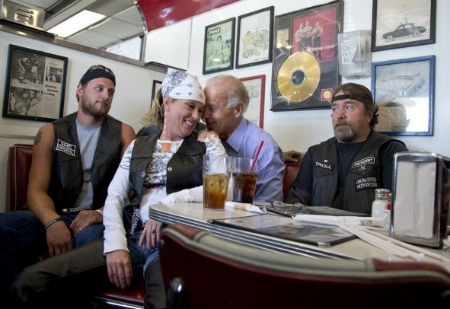
SEAMAN, Ohio — Vice President Joe Biden was looking to cozy up with voters as he toured Ohio this weekend, but he did not imagine that an Ohio woman would nearly end up in his lap.
Biden was chatting up customers in the Cruisers Diner in southern Ohio Sunday when he met a group of motorcycle riders in black leather vests and bandanas.A female group member was watching, and Biden waved her over, telling her, “I know who runs the show.”
The woman had no place to sit, so Biden pulled a chair in front of himself and pulled her nearly into his lap. He put his hands on her shoulders and leaned in for a conversation as photographers snapped away.
Economics lessons aren’t usually all that funny, but the one Paul Krugman gave Rand Paul on ABC’s This Week was hilarious. Cokie Roberts interrupted with some Villager nonsense–she seems as unteachable as Rand Paul.
Krugman was so amazed by the ignorance that he wrote two blog posts about it. The first one is mostly a chart showing the steep drop in government employment under President Obama.
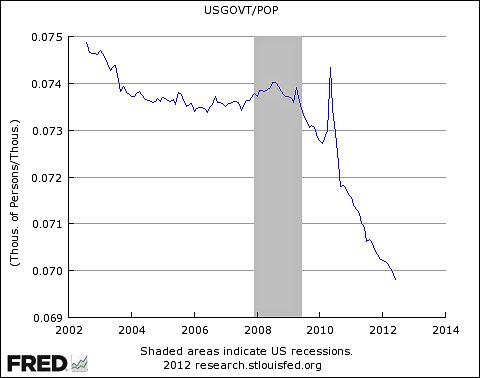
Krugman’s second post: The Zombie That Ate Rand Paul’s Brain
After watching the video, Krugman noticed the shocked expression on Rand Paul’s face. How could he be so stunned by a fact that is out there for anyone to read about?
Almost surely it’s a case of a zombie lie that has gone unchallenged in the hermetic world of movement conservatism, so that people like Paul know, just know, something that ain’t so. I wrote about this way back: the usual suspects seized on the Census bulge in employment as evidence of a big-government surge; and because nobody in that business ever admits having been wrong, this became a “fact” that people like Rand Paul believe. He wouldn’t have made this mistake if he ever read or listened to an analysis from nonpartisan sources, but he evidently doesn’t.
I’ve got a few editorial cartoons for you too. The first two are about Bill Clinton’s speech to the DNC.


Two on the “We built it” theme.
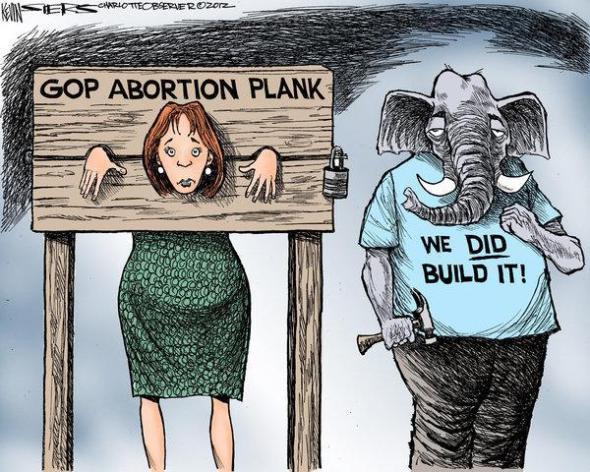
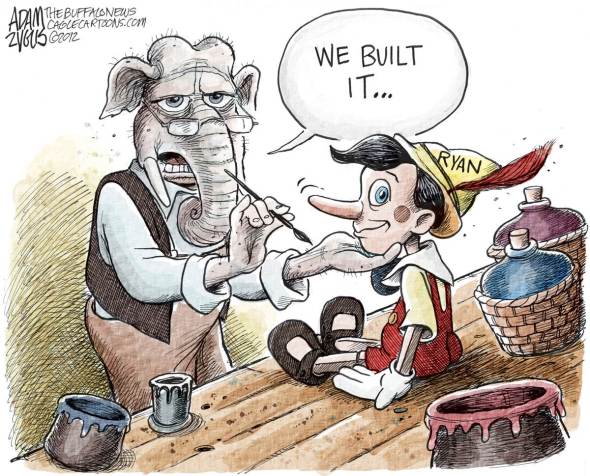
And one more on Romney’s ridiculous “Are you better off” question.

What next? I’m looking forward to more craziness next week.
Bring on the Real Economists
Posted: September 7, 2012 Filed under: 2012 elections, U.S. Economy | Tags: Democratic economic record, income equality, jobs, joseph stiglitz, Paul Krugman, Romney/Ryan Soak the Middle Class Plan 18 Comments I really loved the line in Obama’s acceptance speech on the Republican’s apple vinegar cure-all for everything that ails you. Take two tax cuts, throw out a few regulations, and call us in the morning! Here’s a great read. The NYT book review looks at the new books of Nobel prize winning economists Paul Krugman and Joseph Stiglitz. These out spoken economists speak truth to power. I just wish the current powers-that-be would listen.
…Washington is stuck in neutral. Worse than neutral; it is in reverse. As the last elements of the 2009 stimulus phase out, the initial flood of federal aid has slowed to a trickle. If no agreement is reached before early next year, the trickle will become a huge backward flow, as President Obama’s payroll tax cut and all the Bush tax cuts expire while automatic spending cuts agreed to in previous legislative sessions kick in. Already, Republican leaders are threatening to replay last year’s standoff over the debt ceiling. Meanwhile, state and local governments—prohibited from running sustained deficits, increasingly dominated by anti-spending forces—continue to cut aid to those out of work and slash programs that invest in the nation’s future while laying off teachers and other public workers. Without those layoffs, the current unemployment rate would probably be around 7 percent.
Against this backdrop, no book could be more timely than Paul Krugman’s End This Depression Now! Since the crisis began, Krugman has argued with consistency and increasing frustration that the United States has become caught not in a normal recession, but in a “liquidity trap.” Since interest rates are already at rock bottom, normal measures, such as easy credit, won’t work, and expanded government expenditures must play a central part in boosting anemic demand. Otherwise, the efforts of private citizens to pay down debts laid bare by the financial crisis will continue to hold the economy back.
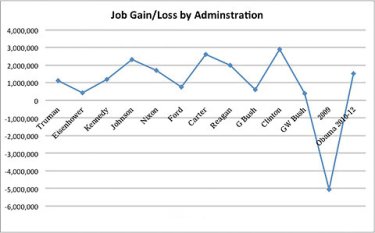
We continue to see Republicans blame the current Democratic administration for an economy they wrecked and a lackluster recovery that they actively work to prevent from becoming better. Today’s job report is not what it should or could be. But, it’s not what the Republicans make it out to be either. History shows us that the Democrats have been the job creators.
In the eighteen months from the beginning of 2008 through the middle of 2009, a period fully shaped by the Bush economic program to which Republicans now want to return, (but before the Obama stimulus had a chance to take effect), approximately 7.5 million jobs were lost.
Over the most recent 18 months of the Obama administration, approximately 2.8 million jobs have been added.
That means that the average monthly job loss during the “difficult situation” before Obama’s policies took effect was 417,000. Over the last year-and-a-half, the average monthly job gain has been 155,000.
If Rep. Ryan and Gov. Romney see that as making a bad situation worse, it should tell us something about their “vision.”
Joseph Stiglitz has been focused on the huge income gap created by policies that funnel money to the highest income earners. His concern is of the US as a Banana Republic.
We may be the richest nation in the world, but poverty is higher and social mobility between generations lower than in other rich nations. In other respects, our model is bloated: we release far more carbon dioxide and use far more water on a per capita basis; and we spend far more on health care, while leaving tens of millions uninsured and achieving health outcomes that are mediocre at best.
The reason, according to Stiglitz, is that the vaunted American market is broken. And the reason for that, he argues, is that our economy is being overwhelmed by politically engineered market advantages—special deals that Stiglitz labels with a term familiar to economists: “rent-seeking.” By this, he means economic returns above normal market levels that are derived from favorable political treatment. In the most powerful parts of The Price of Inequality, Stiglitz chronicles the blatant tax and spending giveaways to big agriculture, big energy, and countless other sectors. Yet he also pointedly argues that much of the rent-seeking that plagues our economy takes a more subtle form, also familiar to economists: “negative externalities,” or costs that economic producers impose on society for which they don’t pay.
The spectacular profits of the energy industry, for example, rely heavily on the failure of regulation to incorporate fully the social and economic costs associated with environmental degradation, including climate change. Similarly, the increasingly aggressive activities of Wall Street—whether in the marketing of unsound mortgages, the use of excessive leverage, or the irresponsible use of derivatives—create huge risks for the economy as a whole. Yet these risks are largely not taken into account in the prices paid in financial markets. Without effective regulation, the costs are borne by all of us—most acutely by the struggling millions who have been pushed out of jobs.
Weeding out these and other forms of rent-seeking would thus promote both efficiency and equity, and Stiglitz provides a broad list of reform ideas, ranging from strict regulation of financial markets to more effective anti-trust laws. Yet he is most passionate about the need for political reform. Either those at the top will realize that things must change, or, he suggests, the kinds of popular revolts sweeping Middle Eastern nations will come to the United States.
Clinton has some intriguing facts on his side. Aside from a rounding error, his historical numbers are accurate (figures from the Bureau of Labor Statistics show that the tally under Democrats since 1961 rounds to 41 million, not 42 million). I crunched the numbers a few different ways to see if Clinton was cherry-picking the best numbers. His figures measure job gains from the month a president took office until the month he left. Since it takes a year or so for any president’s policies to go into effect, I also measured job gains from one year after each president took office till one year after he left. Here’s the score by that measure: Democrats: 38 million new jobs, Republicans, 27 million.
Clinton only mentioned private-sector jobs, so I pulled the data for all jobs, including government. Again, the Dems have a big edge, accounting for 48 million new jobs, compared with 31 million for Republicans. If you push the boundaries out one year for each president, the gap narrows to 44 million new jobs under Democrats, and 34 million under Republicans.
Other measures also show that the economy performs better under Democratic presidents. Sam Stovall, chief equity strategist for S&P Capital IQ, conducted an analysis recently showing that GDP, stock prices, and corporate earnings have all increased more under Democratic presidents than under Republicans.
The S&P 500 stock index, for example, has risen 12.1 percent per year under Democratic presidents since 1900, and just 5.1 percent under Republicans. Since 1949, GDP has grown 4.2 percent per year under Democrats and 2.6 percent per year under Republicans. The same trend extends to corporate profits, which have grown 10.5 percent under Dems and 8.9 percent under Republicans.
The irony is obvious, since Republicans are considered the business-friendly party, while “tax and spend” Democrats are regarded as redistributionists eager to transfer wealth from those who have it to those who don’t.
We need to hold the Republicans responsible for all the evil they have done recently. I’m rejecting them all up and down the ticket this fall because I want a healthy economy and they never really deliver that.

 peej
peej Carissa
 bostonboomer
 dakinikat
 ecocatwoman
 mablue2
 Mama Lopez
 peggysue22
 quixote
 skydancingguestblogger
 Mona (aka Wonk the Vote)



 Sky Dancing
Recent Comments