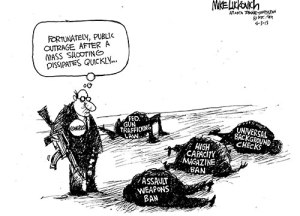
I’d love to be able to transport myself to a beautiful, peaceful place and isolate myself from current events. The reality of what is happening to our politics as our country devolves into a place where mass shootings are common, racism, xenophobia, and misogyny run rampant, income inequality is destroying the economy, and and the environment is rapidly deteriorating is just too much. I feel emotionally overwhelmed by it all.
At times, it’s easy to laugh at the insanity of today’s Republican Party and the complete incompetence of the mainstream media, but today the ugliness of what’s happening makes me feel like crying. Is there anything that can be done to turn this devolution of our country around?
I guess I reached the breaking point when I came home last night to the news that Republican presidential candidate(!) Donald Trump had attacked Fox News reporter Megyn Kelly by suggesting her questions to him during the debate on Thursday night were “mean” because she was menstruating. Can this really be happening?
Republican presidential candidate Donald Trump said Friday night that Fox News Channel anchor Megyn Kelly “had blood coming out of her eyes” when she aggressively questioned him during Thursday’s presidential debate.
“She gets out and she starts asking me all sorts of ridiculous questions,” Trump said in a CNN interview. “You could see there was blood coming out of her eyes, blood coming out of her wherever. In my opinion, she was off base.” ….
In Thursday’s debate, Kelly questioned Trump over his history of offensive statements about women.
Calling in to CNN for a 30-minute interview on Friday night with Don Lemon, Trump hurled insults at Kelly, calling her a “lightweight,” and bashed her co-moderators, Chris Wallace and Bret Baier, as well as other Fox talent.
“I just don’t respect her as a journalist,” Trump said of Kelly. “I have no respect for her. I don’t think she’s very good. I think she’s highly overrated.”
Trump said he is considering skipping the next debate hosted by Fox News Channel, scheduled for January in Iowa, because he believes he was treated unfairly by the network’s moderators.
This pathetic excuse for a human being has been leading the national polls in the race for the GOP nomination for more than a month!
Donald Trump, the Republican presidential front runner, suggested that Fox News anchor Megyn Kelly asked him tough questions because she was on her period.
Appearing on CNN, captured by Think Progress, Trump said that Kelly, who questioned Trump about past misogynistic statements where he called women pigs and cows was asking “ridiculous questions” because she had “blood coming out of her eyes” and “blood coming out of her whatever.”
Trump’s fellow Republican candidates did not issue statements or condemnations of him when he promoted a tweet earlier in the day that called Kelly a “bimbo.”
Those candidates did however, issue various policy statements insensitive to women’s issues during the debate, as Republican insiders feared that this presidential campaign would once again bring the Republican Party’s “War on Women” to the forefront.
It looks like Trump is doing just that.
Most Americans–even Republicans–probably understand that Trump is a clown who simply blurts out whatever comes into his sick mind without any concern for the consequences. But what about 16 other Republican candidates? Are most of them really any better?
Paul Krugman has a brilliant column today in which he points out that to be a Republican candidate today means that you must spout complete nonsense.
…while it’s true that Mr. Trump is, fundamentally, an absurd figure, so are his rivals. If you pay attention to what any one of them is actually saying, as opposed to how he says it, you discover incoherence and extremism every bit as bad as anything Mr. Trump has to offer. And that’s not an accident: Talking nonsense is what you have to do to get anywhere in today’s Republican Party.
For example, Mr. Trump’s economic views, a sort of mishmash of standard conservative talking points and protectionism, are definitely confused. But is that any worse than Jeb Bush’s deep voodoo, his claim that he could double the underlying growth rate of the American economy? And Mr. Bush’s credibility isn’t helped by his evidence for that claim: the relatively rapid growth Florida experienced during the immense housing bubble that coincided with his time as governor.
Mr. Trump, famously, is a “birther” — someone who has questioned whether President Obama was born in the United States. But is that any worse than Scott Walker’s declaration that he isn’t sure whether the president is a Christian?
Mr. Trump’s declared intention to deport all illegal immigrants is definitely extreme, and would require deep violations of civil liberties. But are there any defenders of civil liberties in the modern G.O.P.? Notice how eagerly Rand Paul, self-described libertarian, has joined in the witch hunt against Planned Parenthood.
And while Mr. Trump is definitely appealing to know-nothingism, Marco Rubio, climate change denier, has made “I’m not a scientist” his signature line. (Memo to Mr. Rubio: Presidents don’t have to be experts on everything, but they do need to listen to experts, and decide which ones to believe.)
The point is that while media puff pieces have portrayed Mr. Trump’s rivals as serious men — Jeb the moderate, Rand the original thinker, Marco the face of a new generation — their supposed seriousness is all surface. Judge them by positions as opposed to image, and what you have is a lineup of cranks. And as I said, this is no accident.
At the first debate among candidates vying for the GOP presidential nomination, the question was not whether or not to ban abortion or to defund Planned Parenthood. It was about whether exceptions in the case of rape, incest, or a woman’s life endangerment are legitimate. Their answer: No.
Moderator Megyn Kelly asked Scott Walker how he could justify opposing an exception to an abortion ban in cases where a woman’s life was in danger, though he did sign a bill with such an exception. Then she turned around and asked Marco Rubio how he could support exceptions in the case of rape and incest if he believed abortion was murder….
Walker, who asked the Wisconsin legislature for a 20-week abortion ban that had no exceptions for rape and incest but ultimately decided not to heed the anti-abortion activists who begged for a no-exceptions bill, replied, “I believe that that is an unborn child that’s in need of protection out there, and I’ve said many a time that that unborn child can be protected, and there are many other alternatives that can also protect the life of that mother. That’s been consistently proven.” The claim that an abortion is never needed to save a woman’s life is a common one in anti-abortion circles. Medical experts disagree.
As for Rubio, he denied he had ever advocated for such exceptions. “What I have advocated is that we pass law in this country that says all human life at every stage of its development is worthy of protection,” he said. “In fact, I think that law already exists. It is called the Constitution of the United States.” In fact, Rubio was a cosponsor on a 20-week abortion ban that contained rape, incest and life endangerment exceptions.
Meanwhile, Mike Huckabee did him one better and actually named which amendments of the constitution he believes already ban abortion. Specifically, the fifth and fourteenth.
These kinds of attitudes toward women and their rights to control their own bodies are now in the mainstream of Republican ideology. The New York Times suggests that while some argue that Republican candidates will hurt themselves with women voters by expressing these misogynistic views, this may not be true, at least for now.
In the short term, however, the political peril for the Republican candidates may not be so grave. They are largely focused now on winning over likely Republican voters who will decide the party’s nomination — an electorate that tends to skew male and older in many key states.
Recent polls of Republican voters indicate that Mr. Trump is performing strongly among men and to a slightly lesser extent among women, though sizable numbers of women also say they would not support him. It remains an open question whether Mr. Trump offended his supporters, or many other likely primary voters, by refusing to renounce his past descriptions of women as “fat pigs” during the debate; indeed, pollsters say he may have struck a chord with some voters by saying he doesn’t “have time for political correctness” when he was asked about his remarks.
With the possibility that a woman could be the nominee of a major political party for the first time, Republicans are facing the likelihood of an even more complicated environment than they have had in recent presidential elections. Gallup polls show that female voters have been favoring the Democratic presidential nominees since the 1990s, often by increasingly large numbers.
The 2012 election was a case in point: Even though Mitt Romney, the Republican nominee, won white women with 56 percent of their votes, he lost over all with female voters. A Republican nominee would be hard-pressed to improve that if the 2016 Democratic nominee is a woman, many Republican pollsters believe.
So they’re going to try to win the presidency by appealing to white male woman haters? Okay. Read about what Republican women think and much more at the link.
ATLANTA — Conservative commentator Erick Erickson on Friday night disinvited GOP presidential candidate Donald Trump from speaking at an activist conference he is hosting here this weekend, citing disparaging remarks Trump made hours earlier on CNN about Fox News Channel anchor Megyn Kelly.
In an interview with The Washington Post, Erickson said Trump had been scheduled to speak at his RedState gathering on Saturday at the College Football Hall of Fame, but he told Corey Lewandowski, Trump’s campaign manager, about an hour before midnight that Trump was no longer welcome.
Trump’s campaign said in a statement that Erickson’s decision was “another example of weakness through being politically correct. For all the people who were looking forward to Mr. Trump coming, we will miss you. Blame Erick Erickson, your weak and pathetic leader. We’ll now be doing another campaign stop at another location.”
Trump’s CNN interview Friday evening instantly drew controversy and criticism after he said Kelly, one of the moderators of Thursday’s Republican presidential debate in Cleveland, “had blood coming out of her eyes, blood coming out of her wherever.”
On Saturday morning, Trump tweeted that he was referring to Kelly’s nose. His campaign also issued a statement, claiming Trump said “whatever” instead of “wherever,” again repeating that the reference was to her nose.
Erickson, a Fox News regular and face of the popular RedState blog, has long been a foe of congressional GOP leaders and an ally of conservative grass-roots organizers. He has also drawn criticism for saying impolitic things, once calling retired Supreme Court Justice David Souter an “[expletive] child molester” and First Lady Michelle Obama a “Marxist harpy.” He has since apologized for both comments.
Trump’s words about Kelly simply went too far, Erickson said Friday, making him, someone who enjoys and appreciates barbed political rhetoric, uncomfortable and queasy. And with his invited guest dominating the 2016 race, and few if any conservatives reining him in, Erickson thought he’d try.
We’ll have to wait and see if that has any effect on Trump. But Republicans will still be stuck with several other candidates whose attitudes toward women aren’t really any better than Trump’s and whose ideas, as Paul Krugman points out, are completely incoherent and nonsensical.
Now I’m going to a peaceful place in my mind and try to pretend none of this is happening for today.
Remember, this is an open thread. Please post your thoughts and links on any topic in the comment thread, and have a nice weekend.
Did you like this post? Please share it with your friends:
It’s too bad Dakinikat is so busy today, because there’s an economics food fight brewing. Perhaps she’ll still find time to comment on the controversy later the evening after she returns home with her newly adopted canine family member, Temple. Meanwhile, I’ll do my best to describe the dispute over Thomas Picketty’s conclusions about wealth inequality, published in his book Capital in the Twenty-first Century.
The Accusations:
At the Financial Times, Economics Editor Chris Giles has claims to have found problems with Picketty’s work: Piketty findings undercut by errors.
Thomas Piketty’s book, ‘Capital in the Twenty-First Century’, has been the publishing sensation of the year. Its thesis of rising inequality tapped into the zeitgeist and electrified the post-financial crisis public policy debate.
The data underpinning Professor Piketty’s 577-page tome, which has dominated best-seller lists in recent weeks, contain a series of errors that skew his findings. The FT found mistakes and unexplained entries in his spreadsheets, similar to those which last year undermined the work on public debt and growth of Carmen Reinhart and Kenneth Rogoff.
The central theme of Prof Piketty’s work is that wealth inequalities are heading back up to levels last seen before the first world war. The investigation undercuts this claim, indicating there is little evidence in Prof Piketty’s original sources to bear out the thesis that an increasing share of total wealth is held by the richest few.
Prof Piketty, 43, provides detailed sourcing for his estimates of wealth inequality in Europe and the US over the past 200 years. In his spreadsheets, however, there are transcription errors from the original sources and incorrect formulas. It also appears that some of the data are cherry-picked or constructed without an original source.
John Maynard Keynes
In one specific example, Giles says the corrected data do not show significant growth in Europe since 1970. In a second article, Giles goes into more detail. In addition, he argues that the U.S. data doesn’t support the conclusion that a greater proportion of the wealth is controlled by top 1% than in recent decades. He does admit to the top 10% controlling a greater share of wealth than previously.
An investigation by the Financial Times, however, has revealed many unexplained data entries and errors in the figures underlying some of the book’s key charts.
These are sufficiently serious to undermine Prof Piketty’s claim that the share of wealth owned by the richest in society has been rising and “the reason why wealth today is not as unequally distributed as in the past is simply that not enough time has passed since 1945”.
After referring back to the original data sources, the investigation found numerous mistakes in Prof Piketty’s work: simple fat-finger errors of transcription; suboptimal averaging techniques; multiple unexplained adjustments to the numbers; data entries with no sourcing, unexplained use of different time periods and inconsistent uses of source data….
A second class of problems relates to unexplained alterations of the original source data. Prof Piketty adjusts his own French data on wealth inequality at death to obtain inequality among the living. However, he used a larger adjustment scale for 1910 than for all the other years, without explaining why.
In the UK data, instead of using his source for the wealth of the top 10 per cent population during the 19th century, Prof Piketty inexplicably adds 26 percentage points to the wealth share of the top 1 per cent for 1870 and 28 percentage points for 1810.
A third problem is that when averaging different countries to estimate wealth in Europe, Prof Piketty gives the same weight to Sweden as to France and the UK – even though it only has one-seventh of the population.
Great buzz in the blogosphere over Chris Giles’s attack on Thomas Piketty’s Capital in the 21st Century. Giles finds a few clear errors, although they don’t seem to matter much; more important, he questions some of the assumptions and imputations Piketty uses to deal with gaps in the data and the way he switches sources. Neil Irwin and Justin Wolfers have good discussions of the complaints; Piketty will have to answer these questions in detail, and we’ll see how well he does it.
Krugman suggests that Giles may be doing something wrong.
I don’t know the European evidence too well, but the notion of stable wealth concentration in the United States is at odds with many sources of evidence. Take, for example, the landmark CBO study on the distribution of income; it shows the distribution of income by type, and capital income has become much more concentrated over time:
It’s just not plausible that this increase in the concentration of income from capital doesn’t reflect a more or less comparable increase in the concentration of capital itself….
And there’s also the economic story. In the United States, income inequality has soared since 1980 by any measure you use. Unless the affluent starting saving less than the working class, this rise in income disparity must have led to a rise in wealth disparity over time.
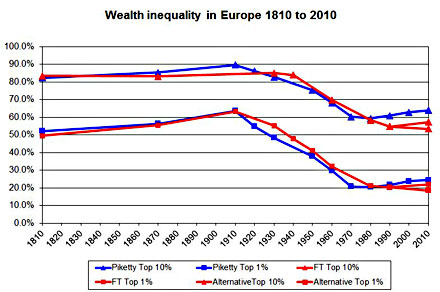
Giles’ objections are mostly to the data regarding increases in wealth inequality over the past few decades, and the funny thing is that even Piketty never claims that this has changed dramatically. The end result of Giles’ re-analysis of Piketty’s data is [below] with Piketty in blue and Giles in red. As you can see, Piketty estimates a very small increase since 1970.
Mr Giles’s analysis is impressive, and one certainly hopes that further work by Mr Giles, Mr Piketty or others will clarify whether mistakes have been made, how they came to be introduced and what their effects are. Based on the information Mr Giles has provided so far, however, the analysis does not seem to support many of the allegations made by the FT, or the conclusion that the book’s argument is wrong.
There are four important questions raised by the FT‘s work. First, which data are wrong? Second, how did errors in the work, if they are errors, come to be introduced? Third, how do the errors affect the specific points made in the relevant chapters? And fourth, how do the errors affect the fundamental conclusions of the book?
Mr Giles focuses on wealth inequality, to which Mr Piketty turns in Chapter 10 of his book. Mr Piketty has not published nearly as much research on the question of wealth inequality, and it seems that much of the analysis in Chapter 10 was done specifically for the book, based on others’ research. Mr Piketty’s wealth-inequality analysis certainly matters as a component of the book’s argument, but it is not accurate to say, as Mr Giles does, that the results in Chapter 10 constitute the “central theme” of the book.
Are the data wrong? Mr Giles identifies discrepancies between source material cited by Mr Piketty and the figures that appear in the book. He identifies cases in which Mr Piketty appears to have chosen to use data from one source when another would have made more sense. Further, the calculations in Mr Piketty’s spreadsheets (which have been available online since the book’s publication) seem to include adjustments in the data that are not adequately explained, and some figures for which Mr Giles cannot find a documented source. Finally, Mr Piketty has made choices concerning weighting of data used in averages, and assigning of data from one year (1935, for example) to another (1930) when such assignments seem unnecessary or inadvisable.
Alan Greenspan
The author concludes that, unfortunately, ideology will determine how many people respond to the Giles critique. Much more extensive analysis at the link.
Let me also say that I certainly agree that available data sources on wealth are much less systematic than for income. In fact, one of the main reasons why I am in favor of wealth taxation and automatic exchange of bank information is that this would be a way to develop more financial transparency and more reliable sources of information on wealth dynamics (even if the tax was charged at very low rates, which you might agree with).
For the time being, we have to do with what we have, that is, a very diverse and heterogeneous set of data sources on wealth: historical inheritance declarations and estate tax statistics, scarce property and wealth tax data, and household surveys with self-reported data on wealth (with typically a lot of under-reporting at the top). As I make clear in the book, in the on-line appendix, and in the many technical papers I have published on this topic, one needs to make a number of adjustments to the raw data sources so as to make them more homogenous over time and across countries. I have tried in the context of this book to make the most justified choices and arbitrages about data sources and adjustments. I have no doubt that my historical data series can be improved and will be improved in the future (this is why I put everything on line). In fact, the “World Top Incomes Database” (WTID) is set to become a “World Wealth and Income Database” in the coming years, and we will put on-line updated estimates covering more countries. But I would be very surprised if any of the substantive conclusion about the long run evolution of wealth distributions was much affected by these improvements.
I thought this was important:
…my estimates on wealth concentration do not fully take into account offshore wealth, and are likely to err on the low side. I am certainly not trying to make the picture look darker than it it. As I make clear in chapter 12 of my book (see in particular table 12.1-12.2), top wealth holders have apparently been rising a lot faster average wealth in recent decades, at least according to the wealth rankings published in magazines such as Forbes. This is true not only in the US, but also in Britain and at the global level (see attached table). This is not well taken into account by wealth surveys and official statistics, including the recent statistics that were published for Britain. Of course, as I make clear in my book, wealth rankings published by magazines are far from being a perfectly reliable data source. But for the time being, this is what we have, and what we have suggests that the concentration of wealth at the top is rising pretty much everywhere.
The shootings began about 9:30 p.m., a sheriff’s spokeswoman told KEYT-TV. It wasn’t clear what the attacker’s motivation might have been.
An 18-year-old Newport Beach man who was visiting Santa Barbara described a confusing scene as the shots rang out.
Nikolaus Becker was eating outside The Habit, 888 Embarcadero Del Norte, near the scene when the first set of shots was fired about 9:30 p.m. At first he thought it was firecrackers. A group of three to five police officers who were nearby started to casually walk toward the sounds, said Becker, but ran when a second round of shots broke out.
“That’s when they yelled at us to get inside and take cover,” Becker said.
The BMW took a sharp turn in front of The Habit, Becker said, and moments later a third round of shots was heard. Becker and his friends moved toward the restaurant’s kitchen but were told to wait in the seating area by employees.
He estimates there were at least 13 to 15 shots total at three locations. The locations were about 100 yards from one another.
The shooter, whose motivation is unknown, was found dead in his BMW. It’s not yet clear if he shot himself or was killed by sheriff’s deputies.
Earlier this week we reported how Chipotle felt obliged to ask its customers not to bring guns to chipotle restaurants. Seems like a reasonably enough request to most of us. And it’s been preceded by similar requests by various other chains like Starbucks and others.
Now the top pro-gun group in Texas pushing the demand for “open carry” firearm rights and trying to get people to show up at various restaurant chains with long guns is deciding it may not be such a hot idea after all.
Open Carry Texas and a group of other aggressive gun rights groups have issued a joint statement telling their members, Dudes, let’s stop taking our guns to restaurants. It’s freaking people out and making them hate us.
Shelly Sterling, who previously shared ownership of the beleaguered NBA franchise with her estranged husband, is now in talks with the NBA over selling the team, the source said.
The NBA banned Donald Sterling for life from all league events after an audio tape became public that caught him on tape uttering racist comments to his assistant V. Stiviano. He told her not to post photos of herself with black people on Instagram — such as Magic Johnson — or bring them to his basketball games.
At first glance, Donald Sterling’s gesture may seem like serendipitous news for the NBA. Taking him at his word, Donald Sterling has agreed to leave the league without a fight and has signed off on the sale of his team. Digging deeper, however, reveals possible ulterior motives on Sterling’s part to delay and potentially block the sale of the team. Do not forget a crucial point: capital gain taxes. As first reported by SI.com, the Sterlings have significant incentives under capital gain tax law to avoid the sale of the team and keep it in the Sterling family. Doing so, would save them hundreds of millions of dollars. Also, contrary to some reports, the Sterlings are unlikely to benefit from the “involuntary conversion” tax avoidance provision of the Internal Revenue Code. The bottom line is if the Sterlings have to sell the Clippers, they will probably pay hundreds of millions in state and federal taxes.
Along those lines, Donald Sterling’s proposed maneuver does not accomplish the NBA’s goal of ousting the entire Sterling family on June 3. As explained in a previous SI.com article, the NBA interprets its constitution to mean that ousting Donald Sterling on June 3 would also automatically oust Shelly Sterling as co-owner, with the Clippers then falling under the control of commissioner Adam Silver. Donald Sterling’s proposed maneuver risks the prospect of Shelly Sterling undertaking a slow-moving effort to sell the team. A sale process that takes months or years would clearly aggravate the NBA, which wants to erase the Sterling family name from the league as quickly as possible. A protracted sale of the Clippers by Shelly Sterling might also constitute a potential rationale for players to boycott NBA games.
Even of greater risk to the NBA, what is to stop Shelly Sterling from deciding to keep the Clippers? She could plausibly reason, on various grounds, that now is not the right time to sell the team. Also, her instruction from her husband to sell the team would not be legally binding; it would be a mere suggestion the moment she takes over the team.
Read much more at the link.
Ta-Nehisi Coates
I’ll end with a long article that I haven’t gotten to yet, but I’m hearing it’s a must read: The Case for Reparations, by Ta-Nehisi Coates at The Atlantic. Here’s the tagline:
“Two hundred fifty years of slavery. Ninety years of Jim Crow. Sixty years of separate but equal. Thirty-five years of racist housing policy. Until we reckon with our compounding moral debts, America will never be whole.”
Still a little bit left of summer vacation left and I am sure some of you are hitting the road. It’s still hot down here in New Orleans but this weekend is Satchmo Summer Fest. Every little festival weekend is like a ready made holiday for me! I will probably go listen to some music and taste some home cooking!
There’s the usual this and that sorta stuff out there. Here is one helluva depressing take on a man that kidnapped and brutalized women for years. “Most of the sex… was consensual.” Yeah. RIGHT. Three young women held captive for 11 years and of course, they asked for it.
Ariel Castro’s words at his sentencing hearing on Thursday are almost jaw-dropping. Given a chance to speak before he was sentenced to life in prison, plus a thousand years for aggravated murder and for holding three young women captive for 11 years, he repeatedly blamed his victims.
He denied he raped and beat Michelle Knight, Amanda Berry and Gina DeJesus, claiming instead that they asked him for sex and that his sexual addiction was to blame. He even said the abuse couldn’t have been that bad because DeJesus “looks normal.” While many onlookers were astonished, abuse experts said they hear that kind of language and justification every day.
NBC News asked them to weigh in on specific comments Castro made:
“Most of the sex that went on in that house, probably all of it, was consensual,” Castro said. “These allegations about being forceful on them — that is totally wrong. Because there was times where they’d even ask me for sex –many times. And I learned that these girls were not virgins. From their testimony to me, they had multiple partners before me, all three of them.”
The denial and rationalization comes as no shock to experts on rape and abuse. In fact, they say, it’s typical that men who rape or batter women will deny they did anything wrong, and even that the victim was “asking for it”.
“I think it’s actually very typical of an abuser,” says Barbara Paradiso, who directs the center on domestic violence at the University of Colorado-Denver.
“There is a widely held belief that women enjoy rape or that it is ‘just sex at the wrong time, in the wrong place’,” Rape Crisis of England and Wales says on its website. “Often when a woman is raped she is afraid that she will be killed – rapists often use the threat of killing a woman or her children to ensure her ‘submission’ and her silence after the attack. Women do not enjoy sexual violence. Victims of murder, robbery and other crimes are never portrayed as enjoying the experience.”
“I am not a violent person. I simply kept them there without being able to leave.”
“It is not uncommon for offenders to have justified their own behavior, oftentimes to see themselves as a victim,” Paradiso said in a telephone interview. “They often have a sense of righteousness around their behavior, that they had a right to do what they did or it was acceptable to do what they did that they were forced to do what they did because of the victim.”
“I never had a record until I met my children’s mother.My son was on there the other day saying how abusive I was but I was never abusive until I met her. And he failed to say that at the end before she passed away that them two weren’t even talking.
Castro’s son Anthony has said Castro beat him and his mother, Grimilda “Nilda” Figueroa, who died in 2012.
“What he’s saying, that I was a wife beater – that is, that is wrong. This happened because I couldn’t get her to quiet down. I would continuous tell her the children are right there, would you please? She would respond, I don’t care if the children are there and she would just keep going…the situation would escalate until the point where she would put her hands on me and that’s how I reacted, by putting my hands on her.”
It’s familiar thinking to Paradiso. “‘I had to hit her because she did x, y or z’,” she says. “(They are saying) ‘I had to bring her back into line’ … It doesn’t really surprise me at all that he said what he said. That behavior is completely based on power and control and domination, which our society supports. So I am not surprised that he said that.”
While his is an extreme case, experts say the pattern is anything but rare.
“I was taken aback [by Castro’s statements] but at the same time not shocked by it,” says Jennifer Marsh, vice president of victim services for RAINN, the Rape, Abuse and Incest National Network. “It’s somebody who was not willing to accept that what they did was wrong and who may have convinced themselves that what they are doing is not wrong or justified. It read like the way that a perpetrator thinks.”
According to RAINN, someone is sexually assaulted in the United States every two minutes, and only three out of every 100 rapists ever spends any time in jail.
It was a confluence of magnificent proportions that led six agents from the joint terrorism task force to knock on my door Wednesday morning. Little did we know our seemingly innocent, if curious to a fault, Googling of certain things was creating a perfect storm of terrorism profiling. Because somewhere out there, someone was watching. Someone whose job it is to piece together the things people do on the internet raised the red flag when they saw our search history.
Most of it was innocent enough. I had researched pressure cookers. My husband was looking for a backpack. And maybe in another time those two things together would have seemed innocuous, but we are in “these times” now. And in these times, when things like the Boston bombing happen, you spend a lot of time on the internet reading about it and, if you are my exceedingly curious news junkie of a twenty-year-old son, you click a lot of links when you read the myriad of stories. You might just read a CNN piece about how bomb making instructions are readily available on the internet and you will in all probability, if you are that kid, click the link provided.
Which might not raise any red flags. Because who wasn’t reading those stories? Who wasn’t clicking those links? But my son’s reading habits combined with my search for a pressure cooker and my husband’s search for a backpack set off an alarm of sorts at the joint terrorism task force headquarters.
That’s how I imagine it played out, anyhow. Lots of bells and whistles and a crowd of task force workers huddled around a computer screen looking at our Google history.
This was weeks ago. I don’t know what took them so long to get here. Maybe they were waiting for some other devious Google search to show up but “what the hell do I do with quinoa” and “Is A-Rod suspended yet” didn’t fit into the equation so they just moved in based on those older searches.
I was at work when it happened. My husband called me as soon as it was over, almost laughing about it but I wasn’t joining in the laughter. His call left me shaken and anxious.
What happened was this: At about 9:00 am, my husband, who happened to be home yesterday, was sitting in the living room with our two dogs when he heard a couple of cars pull up outside. He looked out the window and saw three black SUVs in front of our house; two at the curb in front and one pulled up behind my husband’s Jeep in the driveway, as if to block him from leaving.
Six gentleman in casual clothes emerged from the vehicles and spread out as they walked toward the house, two toward the backyard on one side, two on the other side, two toward the front door.
A million things went through my husband’s head. None of which were right. He walked outside and the men greeted him by flashing badges. He could see they all had guns holstered in their waistbands.
“Are you [name redacted]?” one asked while glancing at a clipboard. He affirmed that was indeed him, and was asked if they could come in. Sure, he said.
They asked if they could search the house, though it turned out to be just a cursory search. They walked around the living room, studied the books on the shelf (nope, no bomb making books, no Anarchist Cookbook), looked at all our pictures, glanced into our bedroom, pet our dogs. They asked if they could go in my son’s bedroom but when my husband said my son was sleeping in there, they let it be.
Meanwhile, they were peppering my husband with questions. Where is he from? Where are his parents from? They asked about me, where was I, where do I work, where do my parents live. Do you have any bombs, they asked. Do you own a pressure cooker? My husband said no, but we have a rice cooker. Can you make a bomb with that? My husband said no, my wife uses it to make quinoa. What the hell is quinoa, they asked.
They searched the backyard. They walked around the garage, as much as one could walk around a garage strewn with yardworking equipment and various junk. They went back in the house and asked more questions.
New poll numbers released Thursday suggested that Senate Minority Leader Mitch McConnell (R-KY) is entering his reelection campaign next year facing two perilous obstacles: an electorate that wants him out of office and a viable Democratic challenger.
The latest survey from Democratic-leaning Public Policy Polling — conducted on behalf of the Progressive Change Campaign Committee (PCCC) and Democracy For America and provided in advance to TPM — found Kentucky Secretary of State Alison Lundergan Grimes, who launched her Senate campaign on Tuesday, drawing the support of 45 percent of Bluegrass State voters and narrowly edging McConnell by a single point. Eleven percent of voters said they are undecided. The two liberal groups to commission the poll are both opposed to McConnell.
A slight majority of Kentucky voters — 51 percent — disapprove of the job McConnell is doing, giving the GOP leader an approval rating of 40 percent. PPP has previously identified McConnell as the least popular senator in the country, but the latest poll marks a marginal improvement It marks for a marginal bump since April, when McConnell nursed a 36 percent approval rating. PPP polled 1,210 Kentucky voters on those two questions, and the margin of error is 2.8 percent.
Kentucky voters may also be experiencing McConnell fatigue, according to PPP’s latest. When the pollsters asked if McConnell deserved reelection “[a]fter 30 years in the U.S. Senate,” 54 percent said he does not, compared with just 38 percent who said he does deserve another term. The pollster asked 625 voters that question, and it has a margin of error of 3.9 percent.
The Fort Worth Zoo’s new baby elephant is already a big hit with children who visit the zoo.
Their youthful fascination was enhanced Tuesday when zoo officials added a child’s inflatable pool to the elephants’ enclosure for Belle’s enjoyment. Belle could be seen rolling in the pool.
Bell was born July 7 and is just the second Asian elephant to be born at the Fort Worth Zoo in its 104-year history.
Zoo spokeswoman Katie Giangreco says Belle weighed 330 pounds at birth is gaining two pounds per day. She says Belle “is curious and full of personality, learning new things every day, learning what her trunk is for, learning to use her legs.”
Belle’s mother, Rasha, is helping in that instruction.
Asian elephants have been listed as endangered since 1976.
Brad DeLong asks why the left views Larry Summers as a right-wing hyena. I think that’s a straw man, or maybe a straw hyena. What is true is that a lot of people even on the moderate left don’t trust Summers, even though much of his commentary over the years has been very much center-left — and since leaving office he has become one of our most prominent fiscal doves.
Where does this mistrust come from? Well, let me give you an example: Jackson Hole, 2005, a conference dedicated to celebrating the record of, ahem, Alan Greenspan. Raghuram Rajan had presented a paper warning that the risks of financial instability were much higher than most people were acknowledging. (I think Rajan has been wrong on many issues since then, but that was certainly a prophetic paper). And the response, in general, took the form of ridicule.
The principal discussant was Don Kohn (pdf), who was (barely) polite but completely wrong-headed, celebrating financial innovations such as “the growing ease of housing equity extraction”:
Leading off on the rest of the discussion (pdf) was Larry Summers, who wasn’t polite, dismissing Rajan for being “slightly Luddite” in questioning the value of financial innovation, which he compared (in a really bad analogy) to technological progress in transportation.
Let’s face it. Summers is an asshole. I don’t care about his degrees or whatever. Assholes should not be in places where they have to influence people into doing the right thing on policy that effects the entire globe. Even, if it is a well-educated asshole, it is still just an asshole.
That is all.
What is on your reading and blogging list today?
Did you like this post? Please share it with your friends:
Yesterday the House narrowly defeated (217-205) an amendment to the defense spending bill (proposed by Michigan Republican Justin Amash) that would have prohibited NSA from collecting metadata on phone calls unless there is evidence that a specific person involved in the call is involved in criminal activity. From Bloomberg:
Implementation of the amendment could have created a new burden on telephone and Internet companies to retain bulk data, in addition to ending the NSA’s blanket collection of phone records. Those possibilities led the White House, Republicans leaders and many congressional Democrats to oppose the proposals, pitting them against lawmakers from both parties who champion civil liberties and privacy….
The provision would have had the potential to cause headaches for information technology companies.
“It could be a significant burden depending on how the government wants us to keep this data and store it,” Trey Hodgkins, a senior vice president for TechAmerica, a Washington-based trade group that represents Verizon Communications Inc. (VZ), AT&T Inc. (T) andCenturyLink Inc. (CTL), said in a phone interview. “You’re talking about potentially extremely huge data sets.”
Another amendment to limit NSA data collection did pass:
The House also adopted an amendment written by Republican Richard Nugent of Florida that sought to prohibit the NSA from using funds in the almost $600 billion Pentagon spending measure to “acquire, monitor or store the content” of electronic communications by “a United States person.”
The Nugent amendment was viewed by some lawmakers as providing political cover for those who didn’t want to vote for Amash’s amendment. While lawmakers voting for the Nugent amendment might appear to be curbing the NSA’s powers, in actuality the amendment wouldn’t change anything, simply restates current law and is “a fig leaf”, said Representative Zoe Lofgren, a California Democrat.
The bill now goes to the Senate; who knows what will happen next. I hope there will be an open debate on regulating possible abuses that could arise from NSA data collection. If a serious debate takes place, perhaps something positive will eventually come from the Snowden debacle. I’m skeptical, but still hopeful.
USA Today presents arguments from Keith Alexander against completely “blowing up” the NSA’s data collection program.
Gen. Keith Alexander, head of the NSA, has said the collection of data has helped disrupt dozens of terrorist plots. Investigators are not allowed to comb through the data, but can use it when they have identified a foreign suspect through other intelligence collection.
The data allows investigators to then detect networks the suspect may have been tied into, which could lead to other suspects and the uncovering of secret cells.
“The court restricts what we can do with that data,” Alexander said in a recent speech. “We have to show some reasonable, articulable suspicion that the phone number that we’re going to look at is associated with al-Qaeda or another terrorist group.”
Personally, I’d rather see more carefully defined limits on when and how NSA can use the metadata to target specific American citizens and regulations to prevent lower level employees like Edward Snowden from getting access to personal information rather than an overall prohibition on having the data available when needed for an investigation. Whenever there is a “terrorist” event–as in the Boston Marathon bombings, people demand to know why the government didn’t prevent it. The fact is there are already regulations in place that limit NSA from targeting Americans. IMHO, we should improve those rules if necessary, based on a serious and thorough debate.
Here are Glenn Greenwald’s reactions to the vote in case you want to read another of his inaccurate, rabid screeds. Basically, Greenwald says it’s all the Democrats’ fault–especially that horrible, dreadful war criminal Barack Obama, who is roughly equivalent to Peter King and Michele Bachmann.
Further down in the article, poor Glenn has to admit that a majority of House Democrats supported the Amash amendment in the face of nasty mean old Obama saying he would like to have a nuanced discussion of the issues rather than simply shutting down the counterterrorism program entirely. Greenwald also continues to claim, falsely, that NSA collects and analyzes the phone calls of every American, in the face of calmer, more knowledgeable people who have tried to explain to him that the data isn’t examined without a warrant and clear suspicion of criminal activity (famous example of how these allowed a criminal to slip through the cracks: Tamerlan Tsarnaev). But we’re not Russia, so we do have some limits on surveillance of American citizens and legal residents like Dzhokhar and Tamerlan Tsarnaev.
You know what I’d like to see targeted for more regulation? The FBI’s use of informants and FBI agents’ apparent ability to get away with murder. From Adrian Walker at The Boston Globe: Ibragim Todashev’s shooting needs explanation.
Ibragim Todashev was mysterious in life, but he has fallen into a void in death.
Todashev was fatally shot during an interrogation by Boston-based FBI agents in Orlando on May 22. The Russia native was being asked about his friendship with Tamerlan Tsarnaev, the presumed mastermind of the Boston Marathon bombing. Unusual as it is for someone to be shot to death during questioning, silence has reigned in its aftermath. The FBI’s few statements have been more confusing than illuminating.
The American Civil Liberties Union of Massachusetts made an attempt Tuesday to spur somebody, anybody, into providing clarity. It called on state authorities in Florida and Massachusetts to conduct their own investigations. The questioning was being done by the FBI and Massachusetts State Police, though some reports have indicated a lone FBI officer was in the room when Todashev was shot.
In response, Attorney General Martha Coakley made it clear her office has no intention of getting involved, pleading lack of jurisdiction. Florida officials have maintained all along that they have no standing to investigate. There doesn’t seem to be any reason to think they are about to change their minds.
Walker notes that we have a stunning example of the FBI’s misbehavior with informants in the James “Whitey” Bulger trial, which is going on in Boston right now.
…we should know better than to rush to absolve the FBI, no questions asked. After all, another of Boston’s great villains, James “Whitey” Bulger, is being tried for decades of terrorizing the city while an FBI informant.
And while the verdict on Whitey is still weeks away, the evidence is clear that the FBI aided and abetted his activities for ages. Not just a rogue agent or two, either; much of the agency’s Boston office was involved.
It’s not comforting, either, to examine the FBI’s record on examining its own shootings. According to a New York Times investigation, the FBI has cleared itself in nearly every agency-involved shooting of the past 20 years.
Bodies covered in blankets lay next to the overturned carriages as smoke billowed from the wreckage. Firefighters clambered over the twisted metal trying to get survivors out of the windows, while ambulances and fire engines surrounded the scene.
The government said it was working on the hypothesis the derailment was an accident – although the scene will stir memories of 2004’s Madrid train bombing, carried out by Islamist extremists, that killed 191 people. Sabotage or attack was unlikely to be involved, an official source said….
“It was going so quickly. … It seems that on a curve the train started to twist, and the wagons piled up one on top of the other,” passenger Ricardo Montesco told Cadena Ser radio station.
“A lot of people were squashed on the bottom. We tried to squeeze out of the bottom of the wagons to get out and we realised the train was burning. … I was in the second wagon and there was fire,” he added.
This brief video shows the moment the train derailed and crashed.
SPAIN: At 20.41 on July 24 a Madrid – Ferrol Alvia service derailed on a curve on the approach to Santiago de Compostela. Formed of a Class 730 gauge-convertible electro-diesel Talgo trainset, the 15.00 from Madrid was carrying 218 passengers, according to a joint statement from Spanish train operator RENFE and infrastructure manager ADIF.
The train had 12 vehicles, with an electric and a diesel power car at the ends. The rear power cars appear to have caught fire after the impact, and one of the intermediate coaches was thrown up on to an adjacent road; other cars rolled over or struck a retaining wall. Reports on July 25 indicated that 79 people had died in the accident with many more injured.
The train had left the high speed alignment and should have been slowing in preparation for the stop at Santiago station, about 3 to 4 km from the site of the accident. The speed limit on the curve is understood to be 80 km/h, but Spanish media reported that the train driver had said over the train radio that the train had been travelling at 190 km/h. A video taken from a lineside security camera appeared to show coaches behind the front power cars derailing first, pulling the heavier leading vehicles over as the train rounded the curve.
Here’s the crazy Republican story of the day–so far. I suppose the crazy could still get worse as the day goes on. As you know I was born in Fargo, ND, and I still have a soft spot for my home state; but I’m horrified by what’s happening there right now. Check this out: Pro-life group promotes cannibalism, hands out ‘fleshy’ fetus toys in candy bags to kids at State Fair, according to Freak-Out Nation. Yes, you read that right. They put “realistic” fetus dolls into candy bags for children!
Want a squishy toy fetus with your corn dog? If you’re visiting the North Dakota State Fair, you’re in luck! Last weekend, local anti-choice advocates slipped soft fetal models into kids’ candy bags without parental permission during the fair’s gigantic parade. “I don’t know exactly where I stand on abortion,” one mother told Jezebel, “but I believe in my rights as a parent.”
The North Dakota State Fair boasts a bevy of attractions, including performances by Tim McGraw and Creedence Clearwater Revisited. But Minot Right to Life spent the weekend giving away creepy little fetuses to kids without asking parents’ permission first. “It was really disturbing watching children run around with them,” one recalled. A federal judge recently blocked enforcement of the state’s highly unconstitutional six-week abortion ban; perhaps appealing to elementary schoolers’ interests is the group’s Plan B?
“The Precious One” fetal models are manufactured by Heritage House, a “pro-life supply store,” for $1.50 a pop — cheaper if you buy in bulk. “Its beautiful detail, softness and weight can really move hearts and change minds!” the website promises. A customer service representative told Jezebel that the models are most often given to pregnant women at “pregnancy centers” and kids at school presentations. The customer reviews on the site (it’s like Yelp for fetus-lovers instead of foodies) further imply that the doll-like figures are great for kids. “Children especially like to hold them,” one satisfied customer wrote. “No other item that we hand out has the amazing effect that these fetal models have — instant attachment to the unborn!” said another. “So many times, we hear, ‘Awwwww! That’s adorable!’ Or we just see a girl’s tears begin to form and fall.”
Something is very very wrong with these people.
Here’s one for Dakinikat: Paul Krugman explains (following Obama’s speech on the economy yesterday) why there are no “new ideas” about how to fix the financial crisis–because we knew how to do it from day one: Gimme That Old-Time Macroeconomics.
Both Steve Benen and Ed Kilgore get annoyed at fellow journalists complaining that there aren’t any “new ideas” in Obama’s latest. But why should there be?
It was clear early on that this was a crisis very much in the mold of previous financial crises. Once you realized that financial instruments issued by shadow banks — especially repo, overnight loans secured by other assets — were playing essentially the same role as deposits in previous banking crises, it was clear that we already had all the tools we needed to make sense of what was going on. And we also had all the tools we needed to formulate an intelligent policy response — all the tools we needed, that is, except a helpful economics profession and policymakers with a good sense of whose advice to take.
As Mark Thoma memorably remarked, new economic thinking appeared to consist largely of rereading old books. Brad DeLong says that it was all in Walter Bagehot; I think that this is true of the financial crisis of 2008, but that to understand the persistence of the slump we need Irving Fisher from 1933 and John Maynard Keynes from 1936. But anyway, this is not new terrain.
The trouble is Republicans keep right on insisting we should do what Herbert Hoover did in response to The Great Depression. Because that worked so well…
Okay Sky Dancers! What stories are you focusing on today? Please post your links on any topic in the comment thread.
Did you like this post? Please share it with your friends:
A few days ago Paul Krugman wrote a not-very-exciting post at his blog “The Conscience of a Liberal.” The point of the post was that right wingers have not been as successful in their efforts to hype fake scandals during the Obama administration as they were in the Clinton years. Krugman writes:
When Barack Obama was elected, I was sure that it would be the Clinton years all over — that he would be subjected to an endless series of claims of “scandal”, creating the sense of a tainted administration even though all the alleged scandals would turn out to be either trivial or nonexistent. Remember, after all those years of front-page headlines and $70 million in public funds, the Whitewater investigation came up dry.
In fact, however, none of that happened during Obama’s first term. But would the second term be different? For a little while it looked as if the old scandal machinery was finally springing back to life, with Benghazi, the IRS, and more. You could almost hear the sigh of contentment from a certain part of the press corps.
Krugman’s post had nothing to do with the NSA leaks, Edward Snowden, or Glenn Greenwald; but he made the mistake of just barely mentioning the NSA story.
But now it has all evaporated. Benghazi never made sense; it turns out that the IRS was targeting conservative as well as liberal groups. And as Chait says in the linked article, the NSA stuff is a policy dispute, not the kind of scandal the right wing wants.
And today, Greenwald chose to sic his permanently outraged shock troops fans on Krugman based on a deliberately obtuse reading of Krugman’s referencing Chait’s characterization of the NSA issue as a “policy dispute.” Here’s Greenwald’s take on it.
Defending the Obama administration, Paul Krugman pronounced that “the NSA stuff is a policy dispute, not the kind of scandal the right wing wants.” Really? In what conceivable sense is this not a serious scandal? If you, as an American citizen, let alone a journalist, don’t find it deeply objectionable when top national security officials systematically mislead your representatives in Congress about how the government is spying on you, and repeatedly lie publicly about resulting political controversies over that spying, what is objectionable? If having the NSA engage in secret, indiscriminate domestic spying that warps if not outright violates legal limits isn’t a “scandal”, then what is?
Of course it was really Jonathan Chait who made the distinction between “scandals” and “policy disputes.” Here’s what Chait wrote about it:
Obama’s prosecution of leaks, or use of the National Security Agency — is not a scandal at all. It’s a policy controversy. One can argue that Obama’s policy stance is wrong, or dangerous, or a threat to democracy. But when the president is carrying out duly passed laws and acting at every stage with judicial approval, then the issue is the laws themselves, not misconduct.
And of course it’s really Chait with whom Greenwald is enraged; because Chait had the temerity to write a somewhat humorous column in which he noted the similarities between Greenwald and Ralph Nader–one of which is that each of these men was apparently born without a sense of humor.
But instead of attacking Chait, Greenwald picks a fight with Krugman, who really doesn’t need that right now since he’s grieving the lost of his father. It’s probably a low blow for me to bring that up, but I can’t believe Greenwald didn’t know it, since he apparently reads Greenwald’s blog.
Greenwald has been running around to any media outlet who will have him announcing that he’s got an upcoming “bombshell” scoop that “will shock the world.” I wish he’d just get busy and publish it instead of spending so much time hyping his stories and lecturing everyone about how to interpret Edward Snowden’s behavior.
I think today I’ve finally had enough of St. Glenn to last me the rest of my life.
Did you like this post? Please share it with your friends:
The Sky Dancing banner headline uses a snippet from a work by artist Tashi Mannox called 'Rainbow Study'. The work is described as a" study of typical Tibetan rainbow clouds, that feature in Thanka painting, temple decoration and silk brocades". dakinikat was immediately drawn to the image when trying to find stylized Tibetan Clouds to represent Sky Dancing. It is probably because Tashi's practice is similar to her own. His updated take on the clouds that fill the collection of traditional thankas is quite special.
You can find his work at his website by clicking on his logo below. He is also a calligraphy artist that uses important vajrayana syllables. We encourage you to visit his on line studio.


















 peej
peej Carissa
 bostonboomer
 dakinikat
 ecocatwoman
 mablue2
 Mama Lopez
 peggysue22
 quixote
 skydancingguestblogger
 Mona (aka Wonk the Vote)



 Sky Dancing
Recent Comments