
Edward Snowden Emerges; Seeks Temporary Asylum in Russia
Posted: July 12, 2013 Filed under: Foreign Affairs, Russia, U.S. Politics | Tags: Edward Snowden, espionage, Genri Reznik, Human Rights Watch, NSA, political asylum, Sarah Harrison, spying, Tanya Lokshina, Vladimir Putin, Wikileaks 78 Comments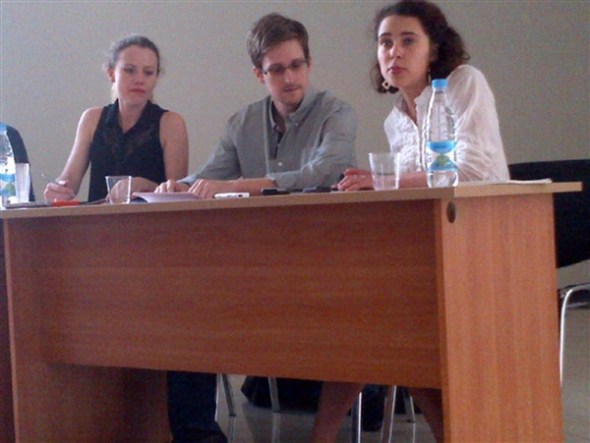
NSA leaker Edward Snowden attends a press conference at Moscow’s Sheremetyevo Airport with Sarah Harrison of WikiLeaks, left, July 12, 2013, in this image provided by Human Rights Watch.
At 5PM (9AM ET) Russian Time, Edward Snowden met with human rights activists and attorneys in Sheremetyevo Airport in Moscow. Afterward he appeared at a press conference alongside Sarah Harrison of Wikileaks and Tanya Lokshina of Human Rights Watch. He announced that he is seeking asylum in Russian until he can arrange to fly to a Latin American country.
Although the meeting was not public, some of those present posted details to Twitter, including Tanya Lokshina of Human Rights Watch who released a handout image that she said was of Snowden (see above).
Lokshina said Snowden would be making an official request to Russia for temporary asylum, adding that his condition was “just fine.”
The move indicates the difficulties facing Snowden, who has been offered asylum by three countries: Venezuela, Bolivia and Ecuador. He is apparently unable to travel to them without entering airspace controlled by the U.S., risking an enforced grounding that would lead to his arrest.
Also among those present at Friday’s meeting was a prominent Russian lawyer, Genri Reznik, who later told reporters: “I think his claim should be satisfied… The law allows for political asylum.
“The values in the constitution of the US and Russia are similar, so I don’t think that there could be a lengthy conflict if Russia grants him asylum.”
Several hours earlier The New York Times had reported on an e-mail which “purported to be” form Snowden asking for the meeting with human rights organizations.
Several prominent human-rights organizations received e-mailed invitations late on Thursday to meet with Mr. Snowden, though they were initially doubtful about the e-mails’ origin.
No invitation was extended to Russian officials, said Dmitri S. Peskov, the Kremlin spokesman. Journalists who asked to be included were told that Mr. Snowden’s team “will be following up with the press shortly afterward.”
Attached to the e-mailed request was a note complaining of U.S. interference with Snowden’s efforts to seek asylum in order to avoid prosecution for stealing and revealing classified information.
The e-mail, signed “Edward Joseph Snowden,” said he had “been extremely fortunate to enjoy and accept many offers of support and asylum from brave countries around the world,” and that he hoped to visit each of them personally to express his thanks. It went on to say that the American government had carried out an “unlawful campaign” to block his asylum bids.
“The scale of threatening behavior is without precedent: never before in history have states conspired to force to the ground a sovereign president’s plane to effect a search for a political refugee,” the note said. “I invite the human rights organizations or other respected individuals addressed to join me on 12 July at 5:00 p.m. at Sheremetyevo Airport in Moscow for a brief statement and discussion regarding the next steps forward in my situation.”
Wikileaks has posted a transcript of Snowden’s statement to the human rights groups. In it he makes clear that he believes he has done the right thing by revealing U.S. espionage methods and targets around the world and says he will accept any and all offers of asylum, and that for now he will apply to stay in Russia.
I announce today my formal acceptance of all offers of support or asylum I have been extended and all others that may be offered in the future. With, for example, the grant of asylum provided by Venezuela’s President Maduro, my asylee status is now formal, and no state has a basis by which to limit or interfere with my right to enjoy that asylum. As we have seen, however, some governments in Western European and North American states have demonstrated a willingness to act outside the law, and this behavior persists today. This unlawful threat makes it impossible for me to travel to Latin America and enjoy the asylum granted there in accordance with our shared rights.
This willingness by powerful states to act extra-legally represents a threat to all of us, and must not be allowed to succeed. Accordingly, I ask for your assistance in requesting guarantees of safe passage from the relevant nations in securing my travel to Latin America, as well as requesting asylum in Russia until such time as these states accede to law and my legal travel is permitted. I will be submitting my request to Russia today, and hope it will be accepted favorably.
The Washington Post questions whether Snowden can meet Vladimir Putin’s terms for allowing him to stay in Russia.
He explained that asylum is the only way he can guarantee his safety to stay in the country, where he’s been since arriving from Hong Kong in late June. “I am only in a position to accept Russia’s offer because of my inability to travel,” he said,according to Lokshina, adding that he ultimately hopes to travel to Latin America, where three countries have offered him asylum.
This puts Snowden in a difficult position: He had previously applied for asylum in Russia but then withdrew his application after Russian President Vladimir Putin said that Snowden could only stay on certain terms. “If he wants to remain here there is one condition – he should stop his work aimed at inflicting damage on our American partners,” Putin announced at a July 1 news conference. That was broadly taken as a condition that Snowden stop leaking classified U.S. information.
Snowden’s earlier decision to withdraw his application for asylum in Russia seemed to suggest that he found Putin’s terms unacceptable. It’s not clear what’s changed, but Snowden seems to have his own interpretation of Putin’s conditions. “He has no problem with Putin’s condition because he does not believe he damaged the United States, or is damaging it,” Lokshina told the Post. Her comments to The New York Times also indicated that Snowden apparently believes his past leaks have not harmed the United States and so not violated Putin’s terms.
So does Snowden assume that he can leak anything that he decides will not be damaging to the U.S.? And what about the data that he has already given to Glenn Greenwald of The Guardian, Barton Gellman of the Washington Post, Der Spiegel , The South China Morning Post, and newspapers in Brazil and Australia? He has also claimed through Greenwald that many individuals around the world have complete copies of the stolen materials. Greenwald himself has stated that Snowden has already completed the leak to The Guardian and that it will be up to them to decide what gets published. According to the Post,
Snowden, or at least the WikiLeaks representative Sarah Harrison who is working with him, might already see hints of these potential contradictions. Snowden asked the attendees at Friday’s Moscow airport meeting to try to intervene with Putin on his behalf, Lokshina told The New York Times.
At least we now know where Snowden is and what his immediate plans are. Now we’ll await Russia’s response.
Tuesday Reads: The Snowden Conundrum
Posted: July 9, 2013 Filed under: Foreign Affairs, morning reads, U.S. Politics | Tags: Barton Gellman, Bolivia, Booz Allen Hamilton, Dell, Edward Snowden, Glenn Greenwald, Jacob Applebaum, Julian Assange, Laura Poitras, Nicaragua, NSA, Pepe Escobar, Venezuela, Walter Pincus, Wikileaks 65 Comments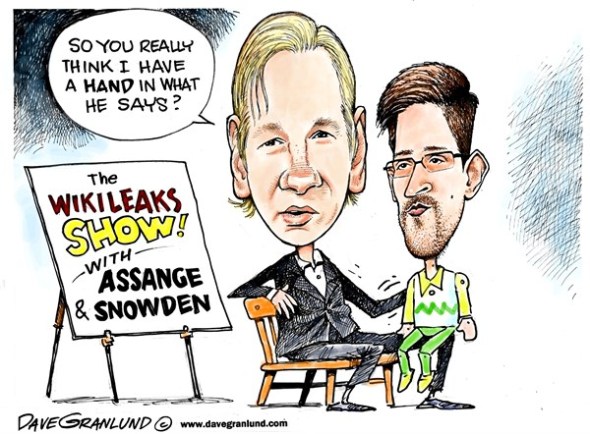
Good Morning!!
I’m going to focus on the Edward Snowden/NSA leaks story today, because there has been quite a bit of news breaking about it over the past few days.
As of this morning, Snowden hasn’t decided whether to accept one of the asylum offers made by three Latin American countries, Venezuela, Nicaragua, or Bolivia. From NBC News:
MOSCOW, Russia – The status of Edward Snowden’s bid for asylum in Venezuela remained unclear Tuesday after the country’s apparent deadline passed.
The Venezuelan Embassy in Moscow said it had no information on whether the fugitive NSA leaker had completed a deal that would allow him to leave the transit area of an airport in the Russian capital.
In Caracas, President Nicolas Maduro confirmed late Monday that Venezuela had received an official request for asylum from Snowden, telling reporters at a news conference that the self-declared leaker “will need to decide when he will fly here,” according to Russia Today.
Even if Snowden agrees an asylum deal with Venezuela, travel problems could take time to resolve: His U.S. passport has been canceled and U.S. allies may deny airspace to any flight on which he is believed to be traveling.
Venezuelan President Nicolas Maduro called on National Security Agency leaker Edward Snowden to decide if he wants to seek refuge in his country after the American reportedly sent an asylum request to Caracas.
Maduro told reporters at a press conference on Monday that the fugitive systems analyst must communicate his intent to accept Venezuela’s offer of asylum, The Wall Street Journal reported.
“He will have to say when he is flying here, if he definitely wants to come here,” Maduro was quoted as telling reporters.
He would probably have to take a private plane, which would be very expensive. Wikileaks is paying for Snowden’s expenses, but would they be able to spring for a private plane? Maybe. More on that in a minute.
One thing we know is very important to Snowden–internet access. One of the reasons he left Hong Kong for Moscow was his fear of not being able to get on the internet. From the Wall Street Journal on June 24:
A person familiar with Mr. Snowden’s case said his decision to get on a flight to Moscow was “very sudden,” made only in the day before departing. The decision was made in consultation with WikiLeaks, which encouraged Mr. Snowden to leave the city after communicating with others about his options abroad, the person said.
“He is very independent, but also very willing to listen to advice,” the person said, adding that Mr. Snowden was concerned that any further delay would result in his detainment by Hong Kong authorities. In part, Mr. Snowden’s determination to leave Hong Kong was based on the fear of losing access to the Internet—his vital link to the rest of the world—should he be detained, the person said. In part, Mr. Snowden’s determination to leave Hong Kong was based on the fear of losing access to the Internet—his vital link to the rest of the world—should he be detained, the person said.
Now Snowden is considering going to one of three countries that have limited access to the internet, according to an article by Alex Halperin at Salon. Venezuela is the best choice, with 40% of the population having internet connections. In Bolivia, it’s 30%, and in Nicaragua only 10.6%.
The Daily Beast has an article on “Wikileaks’ Money Trail” today.
Thankfully for WikiLeaks, its latest cause célèbre, Edward Snowden, is raking in some much-needed cash for the whistle-blowing organization. Snowden sympathizers have been donating generously since WikiLeaks decided to take on the NSA leaker’s case—and the organization desperately needs every dollar it can raise to stay in the black and pay for the legal fees and living costs of founder Julian Assange and now Snowden.
The money WikiLeaks has raised—nearly $90,000 in 2012, with about $1,300 coming in each day since it took Snowden under its wing—comes from people around the world, some of whom give just a few dollars to do their part in making the world a more transparent place.Assange and his team still say they need a lot more than they raise, and the organization always seems to be in the red. WikiLeaks’s operating budget was $510,197 in 2012, which is serious money, considering it is a simple .org with a staff of three paid software developers.
A look into how WikiLeaks is funded and how its money is spent reveals an irony that Assange has acknowledged: an organization dedicated to uncovering the truth keeps its finances intentionally complicated, and it’s next to impossible for donors to find out how their money is processed and where it goes.
Much more at the link. It doesn’t sound like Wikileaks would be able to fund a private plane flight, but maybe some wealthy person like Michael Moore would come through with the big bucks.
More of Snowden’s leaks about U.S. intelligence activities in other countries have been published over the past few days by Glenn Greenwald and Laura Poitras. Greenwald published a report of Snowden’s allegations of U.S. spying in Brazil that appeared in the Guardian and in the Brazilian paper El Globo, and a report on US collaboration with Australia in collecting data was published by the Sydney Morning Herald. Snowden also released a top secret map of sites in a number of countries that collaborate with NSA in collecting intelligence data.
IMHO, it’s likely that Snowden is giving information to countries he’d like to go to. Greenwald lives in Brazil, and Wikileaks’ Julian Assange is from Australia. I say this, because Greenwald explained on Twitter that Snowden revealed classified documents in Hong Kong and in order to gain friendly treatment by the government.
The most revealing recent stories have been published by Der Spiegel, which has been given access to some of the documents Snowden stole from NSA. The latest Der Spiegel piece included a blockbuster revelation. The German magazine published a previously unknown interview with Snowden that was conducted by Laura Poitras and Jacob Applebaum in mid-May, before Snowden left Hawaii for Hong Kong.
This is stunning news, because Applebaum’s name has never been mentioned in connection with the Snowden story until now, although he (Applebaum) has been very visible on Twitter defending Snowden and hyping Greenwald’s articles.
Applebaum is a well known hacker who has been prominently associated with Julian Assange and Wikileaks. He is one of the founders of the Tor network , which promotes encryption method to help people and organizations maintain anonymity on the internet. Although he acknowledges that Tor could be giving aid an comfort to criminals such as child pornographers, he believes that privacy rights take precedence over such concerns.
Both Poitras and Applebaum have come to the attention of the U.S. government and both have been stopped and harassed on return flights to the U.S. from other countries.
Shortly before he became a household name around the world as a whistleblower, Edward Snowden answered a comprehensive list of questions. They originated from Jacob Appelbaum, 30, a developer of encryption and security software. Appelbaum provides training to international human rights groups and journalists on how to use the Internet anonymously.
Appelbaum first became more broadly known to the public after he spoke on behalf of WikiLeaks founder Julian Assange at a hacker conference in New York in 2010. Together with Assange and other co-authors, Appelbaum recently released a compilation of interviews in book form under the title “Cypherpunks: Freedom and the Future of the Internet.”
Applebaum explains how he got involved.
“In mid-May, documentary filmmaker Laura Poitras contacted me,” Appelbaum said. “She told me she was in contact with a possible anonymous National Security Agency (NSA) source who had agreed to be interviewed by her.”
“She was in the process of putting questions together and thought that asking some specific technical questions was an important part of the source verification process. One of the goals was to determine whether we were really dealing with an NSA whistleblower. I had deep concerns of COINTELPRO-style entrapment. We sent our securely encrypted questions to our source. I had no knowledge of Edward Snowden’s identity before he was revealed to the world in Hong Kong. He also didn’t know who I was. I expected that when the anonymity was removed, we would find a man in his sixties.”
Please note the timeline: Poitras says Snowden contacted her in January, and Greenwald says he began working with Poitras and Snowden in February. Poitras also contacted Barton Gellman of the Washington Post in February–apparently without Greenwald’s knowlege. At some point Snowden was working for NSA as a Dell contractor, but he quit this job in order to get one at Booz Allen, where he would have access to more top secret information about U.S. spy facilities around the world. He took the job with Booz Allen sometime in March and went to a training course back in the U.S. that lasted a couple of months. According to Booz Allen, Snowden was employed by them for less than three months and was only on the job in Hawaii for about three weeks, during which time he stole four laptops full of classified documents.
There’s no doubt this operation was premeditated; Snowden admitted that in an interview with the South China Morning Post. The only real questions are whether it was initiated or aided by Julian Assange and Wikileaks and whether Jacob Applebaum aided Snowden in hacking into NSA computers. I’m not ready to argue that yet; but these new revelations, along with the fact that Wikileaks seems to have taken over communications with Snowden are certainly suggestive.
Here’s another possible piece of the timeline. In December 2012, Glenn Greenwald and some of his close friends started an organization called Freedom of the Press Foundation. Others on the board of directors of the foundation besides Greenwald are Laura Poitras and Daniel Ellsberg. According to their website, their purpose is to raise funds to support “public interest journalism.” Their criteria for choosing news organization to support is as follows:
Record of engaging in transparency journalism or supporting it in a material way, including support for whistleblowers.
Public interest agenda.
Organizations or individuals under attack for engaging in transparency journalism.
Need for support. The foundation’s goal is to prioritize support for organizations and individuals who are in need of funding or who face obstacles to gaining support on their own.
At the top of the list of organizations they support is Wikileaks.
Please note that I’m not yet proposing some grand conspiracy theory here. I’m just laying out the facts as I know them so far and connecting some dots. But some people are suggesting Wikileaks could have directed this operation. I was very surprised to see this article by Walter Pincus at the Washington Post yesterday: Questions for Snowden. Basically Pincus connected some dots and is asking some of the same questions I am asking. I’m going to excerpt a little more than I normally would from the Pincus piece. He writes:
Was he [Snowden] encouraged or directed by WikiLeaks personnel or others to take the job as part of a broader plan to expose NSA operations to selected journalists?
In the case of Pfc. Bradley Manning, the U.S. soldier on trial for disclosing thousands of classified documents to WikiLeaks, it was Julian Assange and his organization who directed the collection of documents, U.S. prosecutors have alleged. While Manning’s lawyers contend there is no evidence to support that finding, prosecutors have said there are hundreds of chats between Manning and Assange and WikiLeaks lists of desired material.
In Manning’s case, WikiLeaks and its founder, Assange, determined the news organizations that initially would receive the materials.
Pincus wants to know how Snowden decided to leak to Poitras, Greenwald, and Gellman.
Did Assange and WikiLeaks personnel help or direct Snowden to those journalists?
Poitras and Greenwald have had close connections with Assange and WikiLeaks. In December 2010, Greenwald said of the British arrest of Assange: “Whatever you think of WikiLeaks, they have not been charged with a crime, let alone indicted or convicted. Yet look what has happened to them. They have been removed from [the] Internet . . . their funds have been frozen . . . media figures and politicians have called for their assassination and to be labeled a terrorist organization.”
In a June 2012 Guardian column, Greenwald wrote, “As a foreign national accused of harming U.S. national security, he [Assange] has every reason to want to avoid ending up in the travesty known as the American judicial system.”
On April 10, 2012, Greenwald wrote for the WikiLeaks Press’s blog about Poitras and WikiLeaks being targeted by U.S. government officials.
Pincus also suggests that Julian Assange knew the contents of Glenn Greenwald’s first article on Snowden’s leaks.
Poitras has been working on a film on post-9/11 America, with a focus on the NSA and in which Assange and WikiLeaks are participating. Assange confirmed this in a May 29 interview on Democracy Now’s Web site.
In that same interview, Assange previewed the first Greenwald Guardian story based on Snowden documents that landed a week later. Speaking from Ecuador’s embassy in London, Assange described how NSA had been collecting “all the calling records of the United States, every record of everyone calling everyone over years. . . . Those calling records already [are] entered into the national security complex.”
Did he know ahead of time of that Guardian story describing the U.S. court order permitting NSA’s collection of the telephone toll records of millions of American Verizon customers and storing them for years?
This post is getting way too long, but just to be fair I’ll offer another conspiracy theory from Pepe Escobar of Asia Times. I’ll quote the first few paragraphs and you can go read the whole thing if you’re so inclined.
The working title of the Edward Snowden movie is still The Spy Who Remains in the Cold. Here’s where we stand:
– Snowden could only fly out of Hong Kong because China allowed it.
– Snowden could only arrive in Moscow because Russia knew it – in co-operation with China. This is part of their strategic relationship, which includes the BRICS group (along with Brazil, India and South Africa) and the Shanghai Cooperation Organization. No official source though would ever confirm it.
With the Latin American offers of asylum (Venezuela, Bolivia, Nicaragua; even Uruguay would consider it), we’re approaching the clincher: Moscow is now calculating whether – and how – to help Snowden reach his final destination while extracting maximum political capital out of Washington.Into this script comes roaring the coup-that-is-not-a-coup sub-plot in Egypt. Cynics’ eyebrows will be raised that just as the Barack Obama administration was going mental over the National Security Agency (NSA) spy scandal a revo-coup-o-lution explodes in Egypt. New revelations about the extent of the NSA-centric Orwellian Panopticon keep on coming, but they have been totally downgraded by US corporate media; it’s all Egypt all the time. After all, the Pentagon – to which the NSA is attached – owns the Egyptian military, something that even the New York Times had to acknowledge. [1]
Yet they don’t own Snowden. This has nothing to do with “terra”.
Meanwhile, the US intelligence gambit of intercepting a non-adversarial presidential plane spectacularly backfired in true Mad magazine Spy vs Spy fashion. Obama had said he would not “scramble fighter jets” to catch Snowden; of course not, just ground them.
Austrian paper Die Presse revealed that the US Ambassador in Austria, William Eacho, was responsible for spreading the (false) information about Snowden being on board Bolivia President Evo Morales’ Falcon out of Russia – leading to the denial of overflying rights in France, Spain, Portugal an Italy. [2] Eacho – a former CEO of a food distribution company with no diplomatic experience whatsoever – was appointed by Obama to go to Vienna in June 2009. Why? Because he was a top Obama fundraiser.
Read the rest at Asia Times. BTW, I’m not sure both of these conspiracy theories couldn’t be at least partially true.
Thanks for reading, and I look forward to your reactions.
Tuesday Reads: The Snowden-Greenwald Show
Posted: June 11, 2013 Filed under: China, Civil Liberties, Civil Rights, Crime, Foreign Affairs, morning reads, U.S. Politics | Tags: Bob Cesca, Edward Snowden, Glenn Greenwald, Hong Kong, Matt Schiavenza, narcissism, NSA, political asylum, Russia, The Q Group, whistleblowers, Willard Foxton 99 Comments
Good Morning!!
Edward Snowden is still the top news story this morning. It’s starting to look as if he made a mistake by going to Hong Kong, unless his goal was to gain asylum from the Chinese government. Hong Kong is apparently not interested in fighting an extradition request from the U.S. But it’s also possible he saw Hong Kong as a springboard to other places in Asia where he could hide.
Matt Schiavenza writes at The Atlantic:
In a comment about the case published this morning, my colleague James Fallows brought up a salient point about Hong Kong: it isn’t a sovereign country, and remains very much a part of the People’s Republic of China — a country which notably lacks free speech or any right of political dissent. And while Hong Kong has a different currency, political structure, and legal system from the mainland, divisions between the two are actually far murkier than Snowden’s explanation indicates.
Hong Kong is to some extent in control of its own legal decisions
But in the case of Edward Snowden, which is likely to involve an extradition request by the United States, the Basic Law is less clear. Hong Kong, unlike China, has an extradition arrangement with the United States. But China has the right to intercede in an extradition request if Beijing has an interest in “defense or foreign affairs.” In other words, if China wants to detain Snowden as a useful intelligence asset, Hong Kong couldn’t legally do much about it. And that illustrates an important part of Hong Kong’s current situation: its free speech and political dissent really only go as far as Beijing lets it.
According to Schiavenza,
it’s become increasingly clear that Snowden’s decision to go to Hong Kong was a serious miscalculation. The idiosyncratic territory may in some ways be a libertarian paradise of free speech, robust media, and low taxes, but is in no way independent of China. If Snowden’s ultimate goal were to damage the United States government as much as possible, then going to a Chinese territory would make some sense. But this obviously isn’t what he wanted; in The Guardian interview, Snowden disagreed with Glenn Greenwald’s characterization of China as an “enemy” of the United States by stressing the healthy trade relationship between the two countries. Aiding China — whose record of state surveillance and abrogation of civil liberties is inarguably worse than the United States — would go against the entire moral foundation of Snowden’s decision to leak the NSA secrets.
I’m still not convinced yet about Snowden’s motives. One thing I have concluded is that he’s a very narcissistic young man. I can’t believe he chose to leave without even explaining to his girlfriend and his family. He also chose to tell his story to a high narcissistic writer, Glenn Greewald. More on that later.
From USA Today: Edward Snowden’s travel options
HONG KONG — Whether Edward Snowden misjudged the odds of extradition from Hong Kong before revealing his identity here as the man who exposed secret U.S. surveillance programs may be irrelevant.
The National Security Agency contractor may have chosen to surface in the city for the same reason so many companies from the U.S. and other countries choose to use it for a regional base: It’s the best gateway to much of the world’s largest continent….
Hong Kong is connected to 180 cities in dozens of countries by some 850 flights a day. As the city’s investment development agency says on its marketing web site, “Easy and efficient regional travel is key to Hong Kong’s success as a regional centre.” Many of these countries have loose entry requirements for Americans.
He could go to Vietnam, the Phillippines, or any number of other Asian countries. Or perhaps he could go to Russia, which has already offered to consider a request for asylum from him.
USA Today also notes that Snowden has been “contacted by ‘countless people’ offering to pay for ‘anything [he] might need.'”

Meanwhile, an entity called “The Q Group” is trying to hunt Snowden down before he finds a safe harbor. From The Daily Beast:
Even before last week’s revelations by The Guardian newspaper that the National Security Agency (NSA) was collecting call records from telecommunications companies and had the ability to mine user data from major U.S. Internet companies, the NSA was already on the trail of the leaker, according to two former U.S. intelligence officers with close ties to the agency….
The people who began chasing Snowden work for the Associate Directorate for Security and Counterintelligence, according to former U.S. intelligence officers who spoke on condition of anonymity. The directorate, sometimes known as “the Q Group,” is continuing to track Snowden now that he’s outed himself as The Guardian’s source, according to the intelligence officers….
The security and counterintelligence directorate serves as the NSA’s internal police force, in effect watching the agency’s watchers for behavior that could pose an intelligence risk. It has the authority to interview an NSA contractor or employee’s known associates, and even to activate a digital dragnet capable of finding out where a target travels, what the target has purchased, and the target’s online activity.
Are there more bombshells coming from Snowden? Glenn Greenwald says there are. According to TPM,
According to Greenwald, Snowden has provided the archives of “thousands” of documents and “dozens” are newsworthy. Greenwald has suggested in recent days that more revelations are imminent, saying Monday during an interview on MSNBC that “there’s a lot more coming.”
Dozens of hit out of thousands of documents doesn’t sound like a very good ratio to me, but I’m not a reporter.
On Glenn Greenwald, it seems the general consensus is that people either love him or hate him. Personally, I don’t hate him but I find him annoying and part of my suspicion of Snowden probably stems from my mixed feelings about Greenwald. In my opinion, he cares only about his own pet issues and disdains anyone who cares passionately about, for example, women’s rights, the environment, or the plight of people with less money and fewer choices than he has. I guess he’s a libertarian, but again only in terms of his own pet issues.
Anyway it seems there are lots of Greenwald haters out there. One is Willard Foxton of The Telegraph, who today has a piece called The problem with Glenn Greenwald and the creepy cult that surrounds him. Foxton isn’t quite sure why he can’t stand Greenwald.
Maybe it’s because of the enormous, turgid pieces he writes, complete with 500-word updates when people challenge him. Maybe it’s the run-ins he had with other British journalists while he was fanatically defending Julian Assange.
Maybe it’s the petty stuff, like the fact he insists on special rock-star privileges, like policing the comments beneath his articles himself and his reluctance to let his pieces be edited, prior to the NSA/Prism disclosures. Maybe it’s the things that suggest he’s a little odd, like self-searching his own name so he can pounce on people criticising him, or the accusations he’s used internet sock puppets to go after people anonymously.
Maybe it’s the devotion of his legion of fans who consider him to be the greatest and most fearless journalist on earth, who hate anyone who dares disagree with their idol. The last time I criticised him I got a barrage of online abuse – including memorably a 24-slide PowerPoint presentation explaining how the American security services had “got” to me, and how Greenwald was their number-one target. Maybe, as his adoring public have suggested, I’m either a homophobe or in the pay of the CIA. Perhaps both.
That said, I’m honest enough to admit that maybe it’s because I’m jealous of the success he’s had, and the stories he’s broken. I’m not the only one. You can practically hear the disdain in the New York Times’s tone here, where it describes him as a “blogger” for a “British News Website” (The Guardian).
What I think is more likely is I dislike him because he has built a huge platform with opinion writing, and now he’s blurring the line between opinion pieces and straight reporting. That huge platform he’s built means sources come forward to him from his vast base of followers, with real hard news stories, and then he insists on reporting them.

In line with the “creepy cult” notion, the Guardian actually published this fan-boy article about Greenwald today. Bizarrely, it asks readers to describe how they feel about Greenwald with a fill-in-the-blanks questionnaire! You have to see it to believe it.
Another writer who seems to strongly dislike Greenwald is Bob Cesca, who critiqued Greenwald’s scoop early on. He offered a few more comments on the Snowden/Greenwald story yesterday. Here are three of them.
–Once again, it’s nearly impossible to have a nuanced position these days. I bent over backwards to repeat my ongoing opposition to the growing surveillance state, and made it abundantly clear that my intent with the column was to question some of the problems with the reporting and why there were such glaring omissions and errors. But there’s an increasingly evident overlap between the kneejerking on the far-right and the kneejerking on the far-left (I will make an effort to point it out whenever I can) and too many people tend to blurt things out without reading or grasping what’s being said. Consequently, criticizing Greenwald makes me an Obamabot. End of story. The left is sliding into a very dangerous place right now, and I’ll definitely report back on this one.
–There are some questions emerging regarding Ed Snowden’s story. Why did someone who was disillusioned with Obama’s record on national security continue to work for Obama’s national security apparatus — for more than four years? Why did he escape to Hong Kong when it’s clearly not the free speech haven he claimed it was? If he prefers to seek asylum in Iceland, why didn’t he go there before the story went public? How did he attain the access to be able to “wiretap anyone?” I assume we’ll get answers to some of these questions. Maybe?
–Marc Ambinder wrote a blindly complicated article for The Week in which he explained what PRISM is. It’s essentially a program that analyses data. It doesn’t retrieve the data, it merely compiles it. He also explained that the way the NSA can have “direct access” is via servers that mirror the tech giant servers. So if the NSA requests information from Facebook about an account in Pakistan, Facebook creates a mirror that clones the real time date from that account. But that mirror site has to be hosted on a server and all of the tech giants denied giving the NSA access to their servers. More questions.
We’ll have to wait and see whether Snowden’s revelations are truly groundbreaking or not. But as Cesca writes, the “war on terror” must come to an end. If what’s happening now helps that happen, I’ll certainly cheer loudly. But I suspect the U.S. government will react by simply doubling down on its current policies.
I’ll end there. Now what are you reading and blogging about this morning? Please share your links on any topic in the comment thread.
Glenn Greenwald’s NSA Source, Edward Snowden, Outs Himself
Posted: June 9, 2013 Filed under: Media, PRISM, U.S. Politics | Tags: CIA, domestic spying, Edward Snowden, Glenn Greenwald, Hong Kong, NSA, The Guardian 101 Comments
Edward Snowden
Another “bombshell” from Glenn Greenwald and The Guardian: the NSA whistleblower reveals his name, his reasons for copying classified material, and his plans for the future.
He has had “a very comfortable life” that included a salary of roughly $200,000, a girlfriend with whom he shared a home in Hawaii, a stable career, and a family he loves. “I’m willing to sacrifice all of that because I can’t in good conscience allow the US government to destroy privacy, internet freedom and basic liberties for people around the world with this massive surveillance machine they’re secretly building.”
Three weeks ago, Snowden made final preparations that resulted in last week’s series of blockbuster news stories. At the NSA office in Hawaii where he was working, he copied the last set of documents he intended to disclose.
He then advised his NSA supervisor [He is currently employed at Booz Allen Hamilton] that he needed to be away from work for “a couple of weeks” in order to receive treatment for epilepsy, a condition he learned he suffers from after a series of seizures last year.
As he packed his bags, he told his girlfriend that he had to be away for a few weeks, though he said he was vague about the reason. “That is not an uncommon occurrence for someone who has spent the last decade working in the intelligence world.”
On May 20, he boarded a flight to Hong Kong, where he has remained ever since. He chose the city because “they have a spirited commitment to free speech and the right of political dissent”, and because he believed that it was one of the few places in the world that both could and would resist the dictates of the US government.
Snowden apparently decided to leave his life behind and begin a new one. He told the Guardian “I do not expect to see home again.” And if that isn’t dramatic enough, he has barely left his hotel room since arriving in Hong Kong because
He is deeply worried about being spied on. He lines the door of his hotel room with pillows to prevent eavesdropping. He puts a large red hood over his head and laptop when entering his passwords to prevent any hidden cameras from detecting them.
OK, I’m in no position to evaluate the truth value of all this. It does sound a little paranoid, but look what has happened to Bradley Manning. Certainly the Feds will go after Snowden, whether his revelations are truly damaging to U.S. national security or not and despite the fact that other journalists than Greenwald are now pooh-poohing the revelations.
So who is Snowden? He has an unusual biography for someone in his position. He grew up in North Carolina. He was not a very good student and never graduated from high school, although he took computing courses at a community college. He went into an army special forces training program, hoping to go to Iraq, but he was badly injured and had to be discharged.
After that he worked at the NSA as a security guard, then somehow because of his apparent genius for computers he stepped up the CIA where he worked on IT network security. He eventually worked in Switzerland under diplomatic cover. He gradually became disillusioned and left the CIA to work for private contractors.
He thinks the
value of the internet, along with basic privacy, is being rapidly destroyed by ubiquitous surveillance. “I don’t see myself as a hero,” he said, “because what I’m doing is self-interested: I don’t want to live in a world where there’s no privacy and therefore no room for intellectual exploration and creativity.”
Once he reached the conclusion that the NSA’s surveillance net would soon be irrevocable, he said it was just a matter of time before he chose to act. “What they’re doing” poses “an existential threat to democracy”, he said.
You can read the rest at the Guardian.
I really don’t know what to think at this point. I’m not sure if we have learned anything new beyond what we have known throughout the Bush and Obama administrations–that we are being spied upon constantly, but government and corporations. I hate it, and I hope these revelations–whether they are new or not–may lead to change.
I’m going to add a few more links to add to the discussion.
Reuters: Senator seeks review of Patriot Act amid surveillance report
Bob Cesca: NSA Bombshell Story Falling Apart Under Scrutiny; Key Facts Turning Out to Be Inaccurate
ZDNet: The real story in the NSA scandal is the collapse of journalism
Rayne at Emptywheel: Truck-sized Holes: Journalists Challenged by Technology Blindness
Reuters: Government likely to open criminal probe into NSA leaks: officials
Tim Shorrock: Who’s helping the NSA? A Look at Palantir
What are you hearing and reading? What do you think?
Thursday Reads: NSA Spying, Philly Building Collapse, MA Senate Debate, and Much More
Posted: June 6, 2013 Filed under: Barack Obama, morning reads, U.S. Politics | Tags: Bush administration, Church Rock spill, cystic fibrosis, domestic spying, Ed Markey, FBI, Gabriel Gomez, Glenn Greenwald, Gloria C. MacKenzie, Kathleen Sibilius, lung transplant, Massachusetts Senate race, National Security Agency, Navajo Nation, NSA, Patriot Act, Philadelphia building collapse, powerball, Sarah Murnaghan, uranium mines 15 Comments
Good Morning!!
Glenn Greenwald got a big scoop in the Guardian yesterday, and for once even the corporate media in the U.S. is covering it. Not that any of us is really safe from government spying, but if you’re a Verizon customer you now know that all of your phone records are being handed over to the FBI and the NSA. Here’s the top secret court decision. Greenwald writes:
The National Security Agency is currently collecting the telephone records of millions of US customers of Verizon, one of America’s largest telecoms providers, under a top secret court order issued in April.
The order, a copy of which has been obtained by the Guardian, requires Verizon on an “ongoing, daily basis” to give the NSA information on all telephone calls in its systems, both within the US and between the US and other countries.
The document shows for the first time that under the Obama administration the communication records of millions of US citizens are being collected indiscriminately and in bulk – regardless of whether they are suspected of any wrongdoing.
The secret Foreign Intelligence Surveillance Court (Fisa) granted the order to the FBI on April 25, giving the government unlimited authority to obtain the data for a specified three-month period ending on July 19.
Under the terms of the blanket order, the numbers of both parties on a call are handed over, as is location data, call duration, unique identifiers, and the time and duration of all calls. The contents of the conversation itself are not covered.
Good thing they’re not recording the content of my calls with Verizon customers; because if the government spies had to listen to what we talk about, they’d probably be bored to tears.
From Charlie Savage and Edward Wyatt at The New York Times:
The four-page order was disclosed Wednesday evening by the newspaper The Guardian.Obama administration officials at the F.B.I. and the White House also declined to comment on it Wednesday evening, but did not deny the report, and a person familiar with the order confirmed its authenticity. “We will respond as soon as we can,” said Marci Green Miller, a National Security Agency spokeswoman, in an e-mail.
The order was sought by the Federal Bureau of Investigation under a section of theForeign Intelligence Surveillance Act, the 1978 law that regulates domestic surveillance for national security purposes, including “tangible things” like a business’s customer records. The provision was expanded by Section 215 of the Patriot Act, which Congress enacted after the 9/11 terrorist attacks.
The order was marked “TOP SECRET//SI//NOFORN,” referring to communications-related intelligence information that may not be released to noncitizens. That would make it among the most closely held secrets in the federal government, and its disclosure comes amid a furor over the Obama administration’s aggressive tactics in its investigations of leaks.
The collection of call logs is set to expire in July unless the court extends it.
The collection of communications logs — or calling “metadata” — is believed to be a major component of the Bush administration’s program of surveillance that took place without court orders. The newly disclosed order raised the question of whether the government continued that type of information collection by bringing it under the Patriot Act.
This morning the White House is defending the order for Verizon phone records. From Politico:
The Obama administration is defending itself against charges it secretly obtained records for Verizon phone calls made in the United States, arguing that the policy is a vital tool in monitoring terrorists and has the approval of “all three branches of government,” according to a senior administration official.
“On its face, the order reprinted in the article does not allow the government to listen in on anyone’s telephone calls,” a White House official said. “The information acquired does not include the content of any communications or the name of any subscriber. It relates exclusively to metadata, such as a telephone number or the length of a call.”
Still, the White House official declined to confirm the legitimacy of the classified Foreign Intelligence Surveillance Court order published Wednesday by Britain’s Guardian newspaper, which described a wide sweep of Verizon calls both domestic and international by Americans by the National Security Agency.
“Information of the sort described in the Guardian article has been a critical tool in protecting the nation from terrorist threats to the United States, as it allows counterterrorism personnel to discover whether known or suspected terrorists have been in contact with other persons who may be engaged in terrorist activities, particularly people located inside the United States,” the official said.
Six people are now reported dead and fourteen injured in the collapse of a building in Philadelphia yesterday, according to Reuters.
Six people were killed and 14 were injured yesterday when a four-story building under demolition collapsed in downtown Philadelphia, burying a neighboring thrift store in concrete and debris, officials said.
Search and rescue efforts continued into the night for more victims of the collapse, which occurred around 10:45 a.m. EDT, and Mayor Michael Nutter suggested at a late night news conference that the number of casualties could rise.
“We still do not know how many people were inside the thrift store or possibly on the sidewalk” at the time of the collapse, Nutter said. “If someone else is in that building, they will find them.”
Shortly after the mayor concluded his press briefing a 61-year-old woman was pulled from the rubble alive, more than 12 hours after the collapse, and taken to a hospital in critical condition….
Dozens of police and firefighters were still sifting through the chunks of concrete and splintered wooden boards past midnight, the scene lit by large spotlights as residents stood by watching. Several streets remained blocked off.
When I first heard about this, I thought it was a controlled demolition and wondered why the area hadn’t been cleared of people first. Apparently, the collapse was completely unexpected.
One witness, 31-year-old Dan Gillis of Cinnaminson, New Jersey, a construction worker on a job across the street, said he saw a crane remove a supporting beam from the front of the building and then the wall next to the thrift store started swaying.
Jeffrey Fehnel, 48, of Philadelphia, said a backhoe hit the rear side of the building at about the same time.
“The building came down. It was like a big blast,” Fehnel told Reuters.
It sounds really scary.
An 84-year-old retired woman from Maine collected the second-biggest Powerball jackpot in history yesterday in Florida.
When Gloria C. MacKenzie went to a Florida supermarket near Tampa last month to buy a Powerball ticket, another person in line did something nice for the 84-year-old widow.
‘‘While in line at Publix, another lottery player was kind enough to let me go ahead of them in line to purchase the winning Quick Pick ticket,’’ she said in a statement Wednesday.
The nice gesture turned out to be a life-changing one for MacKenzie and her family. She came forward Wednesday to claim the biggest undivided lottery jackpot in history, $590 million.
A retiree from Maine and a mother of four who lives in a modest, tin-roof house in Zephyrhills, Fla., where the lone winning ticket in the May 18 drawing was sold, MacKenzie took her prize in a lump sum of just over $370 million. After federal taxes, she is getting about $278 million, lottery officials said….
MacKenzie bought the winning ticket at a Publix supermarket in the town of about 13,300, which is 30 miles northeast of Tampa. It is best known for the bottled spring water that bears its name — and now, for one of the biggest lottery winners of all time.
The family of a dying ten-year-old girl with cystic fibrosis yesterday won the chance to live with an adult lung transplant after HHS Secretary Kathleen Sibilius declined to make a rule exception for her.
(CNN) — The father of a 10-year-old Pennsylvania girl who desperately needs new lungs told CNN on Wednesday night the family was “very excited” after a judge’s ruling that could help his daughter get a transplant.
Sarah Murnaghan’s father, Fran, said on CNN’s “Anderson Cooper 360” that his daughter, who has cystic fibrosis, has declined slightly in the last two days.
“But we’re very excited with the news today, that she will have the opportunity to be equally judged and have the opportunity to receive lungs,” he said.
On Wednesday, the family asked a federal judge to issue a restraining order to block U.S. Health and Human Services Secretary Kathleen Sebelius from having the agency that oversees transplants apply a policy that keeps children younger than 12 from being prioritized for available adult lung transplants.
The judge granted the injunction and ordered Sebelius to direct the Organ Procurement and Transplantation Network to waive the rule in Sarah’s case. The injunction is valid for 10 days.
Last night Rep. Ed Markey and his Republican opponent Gabriel Gomez debated for the first time in the important Massachusetts Senate race. With so many Democratic senators retiring, there is a real danger that Republicans could take control of the Senate. From The Boston Globe: Gomez, Markey spar over D.C. gridlock, Benghazi
An aggressive Gabriel E. Gomez wasted no opportunity to mockingly highlight Democrat Edward J. Markey’s nearly four decades in Washington while Markey used the first debate of the US Senate race Wednesday to paint his Republican rival as dangerously out of step with Massachusetts values.
During an hourlong face-off, Gomez repeatedly sought to link his opponent to a Congress mired in dysfunction and deeply unpopular with voters. Markey countered those attacks by arguing that for all his claims of bipartisanship, Gomez would join a GOP that has lurched to the right on issues such as gun control and abortion.
Gomez had difficulty articulating a coherent position on abortion.
Gomez said he could support a mandatory 24-hour waiting period for women seeking abortions, saying that “is not asking a lot.” He also said he could vote to confirm a Supreme Court nominee who opposes Roe v. Wade.
“I don’t believe there should be a litmus test,” he said. “If a judge comes in front of me and they follow the Constitution, and they’re ethical, and they’re prochoice, and they’ve done a good job, I’ll vote for them. If they’re prolife, I’ll vote for them.”
At the same time, he sought to defuse the issue, saying that while he was “personally prolife,” he was not planning to go to Washington to make any changes in abortion rights law.
Markey scoffed at that assertion, arguing that the confirmation of a Supreme Court justice who opposes Roe v. Wade could jeopardize legalized abortion. He said he would not vote to confirm Supreme Court nominees who oppose abortion rights, saying that was the same test espoused by senators Edward M. Kennedy, Kerry, and Elizabeth Warren.
The special election to fill John Kerry’s Senate seat will be held on June 25.
I came across this scary article at Truthout yesterday: America’s Secret Fukushima Poisoning the Bread Basket of the World
Early in the morning of July 16, 1979, a 20-foot section of the earthen dam blocking the waste pool for the Church Rock Uranium Mill in New Mexico caved in and released 95 million gallons of highly acidic fluid containing 1,100 tons of radioactive material. The fluid and waste flowed into the nearby Puerco River, traveling 80 miles downstream, leaving toxic puddles and backing up local sewers along the way.
Although this release of radiation, thought to be the largest in US history, occurred less than four months after the Three Mile Island partial nuclear meltdown, the Church Rock spill received little media attention. In contrast, the Three Mile Island accident made the headlines. And when the residents of Church Rock asked their governor to declare their community a disaster area so they could get recovery assistance, he refused.
What was the difference between the Church Rock spill and the Three Mile Island partial meltdown? Church Rock is situated in the Navajo Nation, one of the areas in the US sacrificed to supply uranium for the Cold War and for nuclear power plants. That area and many others in the Navajo Nation are contaminated to this day. Another sacrifice area is the Great Sioux Nation, a region in the western part of the country comprising parts of 5 states, where thousands of open uranium mine pits continue to release radiation and heavy metals into the air, land and water.
This poisoning of the people in the Navajo and Great Sioux Nations has been going on for decades and has had serious effects on their health. Even today, it is unknown what the full effects are and what the impact is on the rest of the nation and world because the contaminated air and water are not limited by borders.
Please go read the whole thing.

 peej
peej Carissa
 bostonboomer
 dakinikat
 ecocatwoman
 mablue2
 Mama Lopez
 peggysue22
 quixote
 skydancingguestblogger
 Mona (aka Wonk the Vote)



 Sky Dancing
Recent Comments