We’re in the midst of a big snowstorm here. My town has already gotten about 9 inches with more to come. The snow is coming down at a rate of 2-4 inches per hour. I don’t think I’ll be getting out anytime soon. Luckily I got a haircut and picked up groceries yesterday.
It looks like Mitch McConnell is finally going to allow the Senate to pass a paltry stimulus package. It includes $600.00 checks and $300.00 supplementary unemployment payments. Some Republicans are trying to make sure that people on unemployment don’t get the stingy checks. I don’t think this is going to be much help to millions of people who are about to be evicted from their homes and who can’t feed their families.
After months of stalemate, congressional leaders were on the verge on Wednesday of cementing a roughly $900 billion stimulus deal to deliver emergency aid to individuals and companies devastated by the toll of the worsening pandemic, racing to finish the details and stave off a government shutdown on Friday.
The measure, which has been under discussion for months as the coronavirus has ravaged the economy, is expected to provide a new round of direct payments to millions of Americans as well as additional unemployment benefits, food assistance and rental aid. It would prop up sputtering businesses with federally backed loans and provide funding for schools, hospitals and the distribution of a just-approved vaccine.
It looks like the package won’t include help for struggling state governments.
But even as lawmakers moved toward striking an elusive deal, the package pointed to troubles on the horizon for President-elect Joseph R. Biden Jr., who had pressed for at least some compromise on emergency pandemic aid before year’s end. To break the logjam, Democrats appeared to have dropped their demand for a dedicated funding stream for states and cities that are facing fiscal ruin, guaranteeing that Mr. Biden will have to act early in his tenure to try to bolster them and take additional action to prop up the economy.
“The stimulus package is encouraging,” Mr. Biden said Wednesday at an event in Wilmington, Del. “But it’s a down payment — an important down payment on what’s going to have to be done beginning the end of January into February. But it’s very important to get done.”
Gloucester Roofs, Edward Hopper, 1928
The only reason McConnell is allowing this much help for desperate Americans is that he’s afraid of losing control of the Senate.
Senate Majority Leader Mitch McConnell (R-Ky.) has now suggested on a private conference call with GOP senators that a key reason for this movement is that the two Georgia Republican senators, both of whom face runoffs in January, are “getting hammered” over Congress’ failure to pass a new rescue bill.
But this news doesn’t just tell us that Republicans are feeling heat from this failure. The likelihood that this played a key role in moving Republicans also underscores how unlikely they are to help the economy and the country next year, if they do retain control of the Senate.
CNN’s Manu Raju reports that on the call with GOP Senators on Wednesday, the Senate Majority Leader said that the lack of stimulus payments has become a big issue in the runoffs…
Well, as a matter of fact, “Kelly and David” have indeed been getting hammered on this issue. Their Democratic opponents, Raphael Warnock and Jon Ossoff, have run numerous ads — see here, here and here — hitting Republicans over the failure to pass more economic assistance.
It’s plainly obvious that this pressure is a key reason that Senate Republicans are now moving towards supporting the economic relief package (which is already far less than the country needs). Indeed, as late as this month, McConnell was still insisting on an even stingier package, one that didn’t include the supplemental unemployment assistance.
If Democrats don’t win those two seats in Georgia, it’s pretty clear that Moscow Mitch won’t allow any more help for struggling Americans.
The basic question before us right now, as we look ahead to runoffs that will settle who controls the Senate next year, is this: What would continued Republican control mean, and what would it mean if Democrats took control instead?
We have long known the answer: Continued Republican control means almost no chance at anything close to what we’ll need in new stimulus spending and economic assistance next year, when the economic damage and resulting misery could, if anything, spiral into something much worse.
In Central Park, New York, ca. 1900, by Byron, Detroit Publishing Co., via Library of Congress.
Meanwhile, Russia has successfully hacked most of the U.S. Government and hundreds of American businesses.
At the worst possible time, when the United States is at its most vulnerable — during a presidential transition and a devastating public health crisis — the networks of the federal government and much of corporate America are compromised by a foreign nation. We need to understand the scale and significance of what is happening.
Last week, the cybersecurity firm FireEye said it had been hacked and that its clients, which include the United States government, had been placed at risk. This week, we learned that SolarWinds, a publicly traded company that provides software to tens of thousands of government and corporate customers, was also hacked.
The attackers gained access to SolarWinds software before updates of that software were made available to its customers. Unsuspecting customers then downloaded a corrupted version of the software, which included a hidden back door that gave hackers access to the victim’s network.
This is what is called a supply-chain attack, meaning the pathway into the target networks relies on access to a supplier. Supply-chain attacks require significant resources and sometimes years to execute. They are almost always the product of a nation-state. Evidence in the SolarWinds attack points to the Russian intelligence agency known as the S.V.R., whose tradecraft is among the most advanced in the world.
According to SolarWinds S.E.C. filings, the malware was on the software from March to June. The number of organizations that downloaded the corrupted update could be as many as 18,000, which includes most federal government unclassified networks and more than 425 Fortune 500 companies.
Trump has given a huge gift to Putin and left a ghastly mess for Biden to clean up.
The magnitude of this ongoing attack is hard to overstate.
The Russians have had access to a considerable number of important and sensitive networks for six to nine months. The Russian S.V.R. will surely have used its access to further exploit and gain administrative control over the networks it considered priority targets. For those targets, the hackers will have long ago moved past their entry point, covered their tracks and gained what experts call “persistent access,” meaning the ability to infiltrate and control networks in a way that is hard to detect or remove.
Turner, Martin William; Houses and Roofs in the Snow; King’s College London.
While the Russians did not have the time to gain complete control over every network they hacked, they most certainly did gain it over hundreds of them. It will take years to know for certain which networks the Russians control and which ones they just occupy.
The logical conclusion is that we must act as if the Russian government has control of all the networks it has penetrated. But it is unclear what the Russians intend to do next. The access the Russians now enjoy could be used for far more than simply spying.
The actual and perceived control of so many important networks could easily be used to undermine public and consumer trust in data, written communications and services. In the networks that the Russians control, they have the power to destroy or alter data, and impersonate legitimate people. Domestic and geopolitical tensions could escalate quite easily if they use their access for malign influence and misinformation — both hallmarks of Russian behavior.
Foreign hackers who pulled off a stealthy breach of at least a dozen federal agencies got caught after successfully logging in to a top cybersecurity firm’s network, tipping the company off to a broader hacking campaign targeting the U.S. government, according to officials from the firm and congressional aides briefed on the issue.
The suspicious log-in prompted the firm, FireEye, to begin investigating what it ultimately determined to be a highly damaging vulnerability in software used across the government and by many Fortune 500 companies.
It’s not clear how long it took FireEye to notice that it had been hacked, in a scheme that U.S. officials have linked to Russian intelligence. But the vulnerability, found in IT management software developed by a company called SolarWinds, had given the hackers months of access to internal email accounts in at least a dozen U.S. federal agencies, including the Treasury, Homeland Security and Commerce departments.
Two congressional staffers briefed on the intrusion said FireEye representatives, who met with multiple lawmakers and their staffers this week to discuss the hack, disclosed a potentially embarrassing detail: that the hackers had exploited a security feature called two-factor authentication to gain access to FireEye’s network by duping an employee into revealing his or her credentials.\In a 2016 blog post, FireEye laid out how such an attack might be carried out, noting that while “two-factor authentication is a best practice for securing remote access, it is also a Holy Grail for a motivated red team” — a reference to security professionals hired to find clients’ weak points — who can “use the most straightforward method to acquire the credentials we need: ask the victim to enter them for us. The perfect trap happens to be the simplest to set.”
FireEye is denying this explanation. Read all about it at Politico.
Boston Circa 1910s. Horse-drawn sleigh for hauling goods, market district. Image courtesy of the Boston Public Library, Leslie Jones Collection
Over the past few years, the United States government has spent tens of billions of dollars on cyberoffensive abilities, building a giant war room at Fort Meade, Md., for United States Cyber Command, while installing defensive sensors all around the country — a system named Einstein to give it an air of genius — to deter the nation’s enemies from picking its networks clean, again.
Einstein missed it — because the Russian hackers brilliantly designed their attack to avoid setting it off. The National Security Agency and the Department of Homeland Security were looking elsewhere, understandably focused on protecting the 2020 election.
The new American strategy of “defend forward” — essentially, putting American “beacons” into the networks of its adversaries that would warn of oncoming attacks and provide a platform for counterstrikes — provided little to no deterrence for the Russians, who have upped their game significantly since the 1990s, when they launched an attack on the Defense Department called Moonlight Maze.
Something else has not changed, either: an allergy inside the United States government to coming clean on what happened.
Click the NYT link to read the rest.
In coronavirus news, recent research reveals that young people are not immune to serious consequences from the virus.
Young adults are dying at historic rates. In research published on Wednesday in the Journal of the American Medical Association, we found that among U.S. adults ages 25 to 44, from March through the end of July, there were almost 12,000 more deaths than were expected based on historical norms.
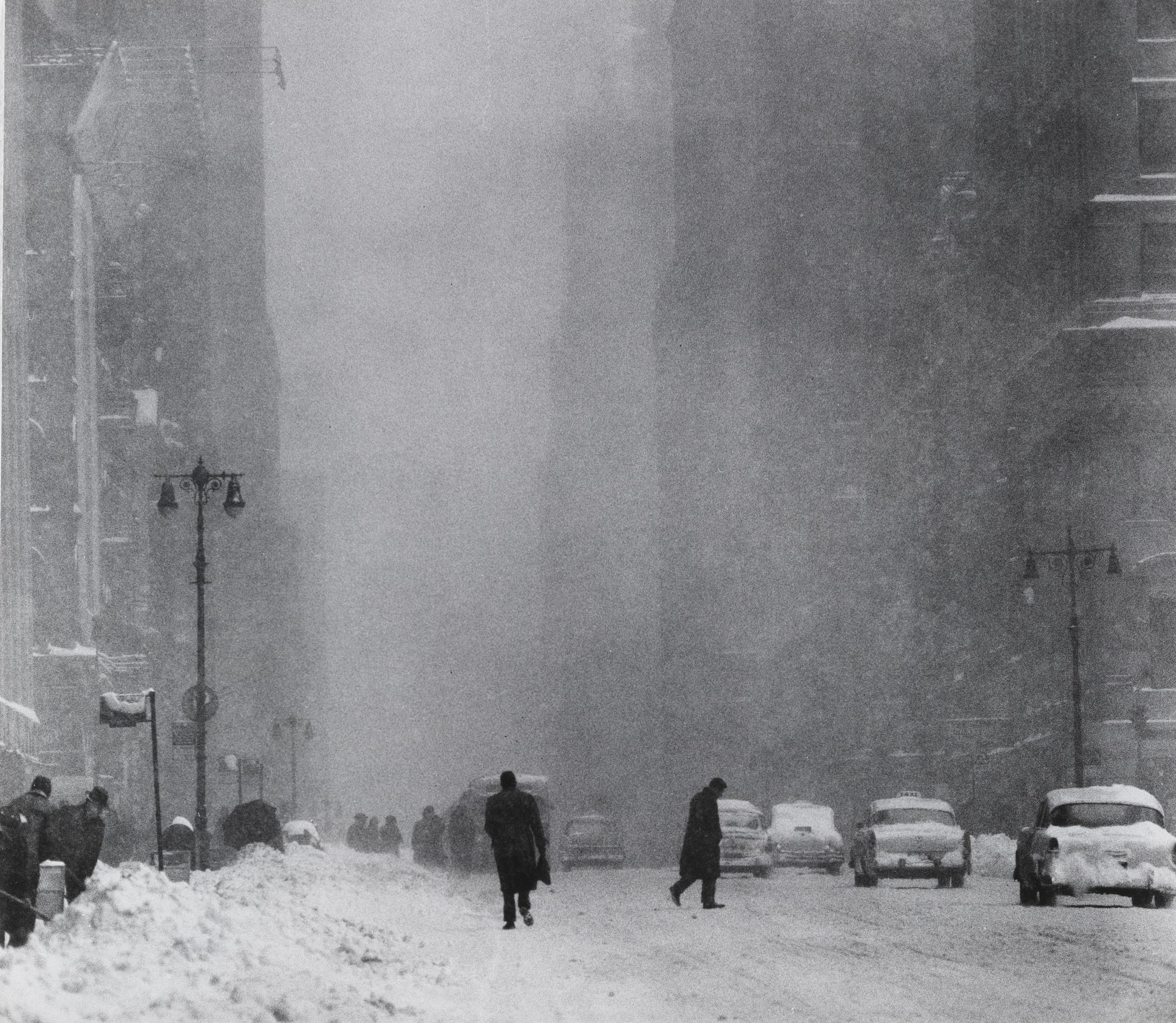
Big snow, 42nd St. NYC, 1956
In fact, July appears to have been the deadliest month among this age group in modern American history. Over the past 20 years, an average of 11,000 young American adults died each July. This year that number swelled to over 16,000.
The trends continued this fall. Based on prior trends, around 154,000 in this demographic had been projected to die in 2020. We surpassed that total in mid-November. Even if death rates suddenly return to normal in December — and we know they have not — we would anticipate well over 170,000 deaths among U.S. adults in this demographic by the end of 2020.
While detailed data are not yet available for all areas, we know Covid-19 is the driving force behind these excess deaths. Consider New York State. In April and May, Covid-19 killed 1,081 adults ages 20 to 49, according to statistics we gathered from the New York State Health Department. Remarkably, this figure towers over the state’s usual leading cause of death in that age group — unintentional accidents including drug overdoses and road accidents — which combined to cause 495 deaths in this demographic during April and May of 2018, the most recent year for which data are available to the public.
Read the details at the link.
That’s it for me today. I hope you’re all doing well. Only 34 more days until we kick Trump out of the White House.
Did you like this post? Please share it with your friends:
With a seven-day average of 2,249 deaths, the country broke the previous mark of 2,232 set on April 17 in the early weeks of the pandemic. Seven-day averages can provide a more accurate picture of the virus’s progression than daily death counts, which can fluctuate and disguise the broader trend line.
The United States is approaching 300,000 total deaths, with nearly 283,000 recorded, according to a New York Times database. The nation is averaging nearly 200,000 cases per day, an increase of 15 percent from the average two weeks earlier, and has recorded over than 15 million total cases.
Much has changed since the previous peak in April. The coronavirus is no longer concentrated in big urban areas like New York City and now envelops much of the country, including rural areas that had avoided it for several months.
Many of the hardest-hit counties on a per person basis are now in the Midwest. North Dakota, where one in every 10 residents has contracted the virus, has the highest total reported cases by population, followed closely by South Dakota, Iowa, Wisconsin and Nebraska.
The latest wave to hit the United States has hospitalized record numbers. Each day since Dec. 2, more than 100,000 Covid-19 patients were in hospitals. That far surpasses the number of people hospitalized during the peaks spring and summer, which at their worst had nearly 60,000 Americans in the hospital daily.
The new peak also comes as the nation prepares for holiday celebrations, and as colder temperatures may push people to congregate indoors. Infectious-disease experts have warned that trends in the United States, which reported a record 2,885 deaths on Wednesday, could continue to worsen over the next several weeks.
Before Pfizer’s coronavirus vaccine was proved highly successful in clinical trials last month, the company offered the Trump administration the chance to lock in supplies beyond the 100 million doses the pharmaceutical maker agreed to sell the government as part of a $1.95 billion deal months ago.
But the administration, according to people familiar with the talks, never made the deal, a choice that now raises questions about whether the United States allowed other countries to take its place in line.
As the administration scrambles to try to purchase more doses of the vaccine, President Trump plans on Tuesday to issue an executive order that proclaims that other nations will not get the U.S. supplies of its vaccine until Americans have been inoculated.
But the order appears to have no real teeth and does not expand the U.S. supply of doses, according to a description of the order on Monday by senior administration officials.
The chief scientist of the Trump administration’s Operation Warp Speed was unable to explain President Donald Trump’s latest executive order Tuesday, which aims to prioritize shipment of the coronavirus vaccine to Americans over other countries.
“Frankly, I don’t know, and frankly, I’m staying out of this. I can’t comment,” Slaoui said. “I literally don’t know.”
“You don’t know?” asked anchor George Stephanopoulos.
“Yes,” Slaoui said.
“But you’re the chief science adviser for Operation Warp Speed,” Stephanopoulos pressed.
“Our work is, you know, rolling,” Slaoui replied. “We have plans. We feel that we can deliver the vaccines as needed. So I don’t know exactly what this order is about.”
Indeed, it remains unclear how Trump’s executive order would be enforced, as drugmakers are already making agreements to deliver supplies for other countries.
Slaoui was similarly dismissive when asked about the executive order in another interview Tuesday, telling Fox News that “what the White House is doing is what the White House is doing.”
The incompetence would be funny if it weren’t going to kill people.
Pfizer has told the Trump administration it cannot provide substantial additional doses of its coronavirus vaccine until late June or July because other countries have rushed to buy up most of its supply, according to multiple individuals familiar with the situation.
That means the U.S. government may not be able to ramp up as rapidly as it had expected from the 100 million doses of the Pfizer vaccine that it purchased earlier this year, raising questions about whether it can keep to its aggressive schedule to vaccinate most Americans by late spring or early summer.\Trump administration officials denied there would be availability issues in the second quarter, citing other vaccines in the pipeline — most immediately, Moderna’s, also expected to be approved in coming weeks. Both vaccines are two-dose regimens, so the 100 million doses purchased of each would cover 50 million people each.
“I’m not concerned about our ability to buy vaccines to offer to all of the American public,” Gen. Paul Ostrowski, who oversees logistics for Operation Warp Speed, the government’s initiative to expedite vaccine development, said in an interview Monday. “It’s clear that Pfizer made plans with other countries. Many have been announced. We understand those pieces.”
But several officials knowledgeable about the contracts said that supplies from other companies may be insufficient to fill the gap.
Let’s hope the Biden administration will be able to deal with the mess that Trump is leaving them.
Trump’s lawyer needs a doctor. If you saw him gallivanting across the country for the past month trying to overturn the election, it should come as no surprise to you that Rudy Giuliani, once revered as “America’s Mayor,” was hospitalized for COVID-19 this week.
Giuliani, a potential one-man superspreader whose recent visit forced the entire Arizona legislature to close up shop, is being treated at Georgetown University Medical Center. For the rich and powerful, there’s always room at the inn. Or hospital. And while we all hope for his speedy recovery, this is the latest sign that a pattern of privilege has emerged. It goes like this: Having tempted fate by refusing to social distance or wear masks, Trump and his team contract the virus. Next, they receive world-class medical treatment. Last, they quickly recover.
It’s not a victimless advantage. Their miraculous recovery reinforces the resentment of every hoohaw who won’t wear a mask and throws a fit at a bar in Staten Island because last call comes early at 10 p.m. The problem with these quick recoveries is that they demonstrate (to people who are the most susceptible to this message) that COVID-19 isn’t really a big deal.
Trump said yesterday that Giuliani is doing well and doesn’t have a fever. Then why is he in the hospital? I’m 73. Would I be hospitalizes with mild symptoms and no fever?
Meanwhile, there’s still no stimulus coming from Congress; and the one they are working on doesn’t include checks to help us regular folks, but it does include liability protections for corporations that force people to work in unsafe conditions. John Nichols at The Nation:
What the United States desperately needs is a multitrillion-dollar stimulus package to provide the resources to fight the current coronavirus surge, to provide for the unemployed and underemployed, to keep small businesses and small farms afloat, to fund state and local governments and schools, and to organize and implement the distribution of the vaccines that are vital to ending the current crisis.
What the United States does not need is a massive corporate bailout that allows the wealthiest and most powerful businesses in this country to avoid liability for actions they take that sicken and kill Americans.
Unfortunately, that is what Senate majority leader Mitch McConnell and his minions have been battling to include in a new Covid-19 “relief” package. And key Democrats could end up going along with the grim reaper’s ghoulish scheme as he again uses federal legislation to insulate irresponsible CEOs from accountability—and, conveniently, to reward the business interests that fund Republican campaigns.
Exploiting the sense of urgency over the peaking pandemic and the prospect of what President-elect Joe Biden refers to as a “long dark winter” for working families, McConnell and his colleagues have for months held relief proposals hostage over the issue of a so-called “liability shield.” Such a shield—even if it is limited, even if it is only temporary—would give corporations immunity from lawsuits related to Covid-19.
Considering the stark evidence of irresponsibility on the part of US corporations since the pandemic hit, the proposal is absurd. Yet the “COVID Emergency Relief Framework” scheme that was initially proposed by corporate-aligned centrists in Congress but has now attracted backing from leading congressional Republicans and Democrats proposes just such a liability shield. The one-page outline of the plan released last week includes among its proposals: “Provide short term federal protection from coronavirus-related lawsuits with the purpose of giving states time to develop their own response.”
Tuesday marks the “safe harbor” deadline — the date when states must certify results if they want protection under federal election law against Congress stepping in to decide which candidate gets their electoral votes. The fact that lawsuits are pending won’t prevent states from getting the benefits of certifying results by that date, according to election law experts. Judges are already wary of injecting legal uncertainty into the election and causing chaos and will be even more reluctant to do so after the deadline passes.
“The doors close significantly after the safe harbor deadline passes,” said Rebecca Green, codirector of the Election Law Program at William & Mary Law School. “It’s going to be a heavy lift to convince a judge to defy federal deadlines. I think it would only happen or be successful if some kind of wild evidence of just unbelievable scale were unearthed that was credible.”
Trump’s campaign has conceded that the Dec. 8 deadline is key to the fate of its legal challenges. It has pushed courts to rush to consider cases by then. In the campaign’s failed constitutional challenge to Biden’s win in Pennsylvania, Trump’s lawyers argued on Nov. 22 that it was “critically important” for a federal appeals court to hear the case before the deadline, which at that point was 16 days away. The court agreed to expedite the case and ruled against Trump in a 3–0 decision just five days later.
Read more at Buzzfeed.
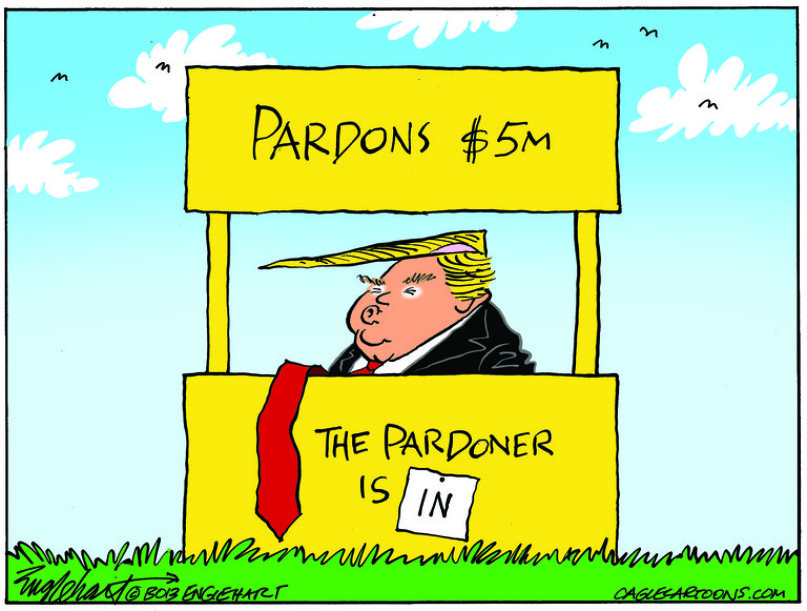
Coming soon: the Trump pardon spree. Once again, this would be hilarious if it weren’t so dangerous. Axios: Trump plots mass pardons, even to people not asking.
President Trump isn’t just accepting pardon requests but blindly discussing them “like Christmas gifts” to people who haven’t even asked, sources with direct knowledge of the conversations told Axios.
Behind the scenes: Trump recently told one adviser he was going to pardon “every person who ever talked to me,” suggesting an even larger pardon blitz to come. As with most Trump conversations, the adviser wasn’t sure how seriously to take the president — although Trump gave no indication he was joking.
The big picture: The president relishes his unilateral authority to issue get-out-of-jail-free cards. Lately, though, he’s been soliciting recipients, asking friends and advisers who they think he should pardon.
Trump has also interrupted conversations to spontaneously suggest that he add the person he’s speaking with to his pardon list, these sources said.
The pardon clause’s language is broad indeed, unambiguously allowing the president to pardon seemingly any other person convicted for any federal criminal offense. But its language does not unambiguously include the president himself. Had the Framers intended to give the president such broad power, we would expect them to have clearly said so. After all, the new nation was in the process of rejecting a monarchical government in favor of a democratic republic.
Instead, the words they chose to confer the pardon power on the president contemplate his granting of reprieves and pardons only to persons other than himself. The word “grant” connotes a gift, bestowal, conferral or transfer by one person to another — not to himself. That would have been the understanding of this word at the time of the Constitution’s drafting, and it is how the term “grant” was understood and is used elsewhere in the Constitution.
At the same time, the “take care” argument against the power to self-pardon merely assumes the very conclusion it reaches: that the pardon clause does not empower the president to pardon himself, and therefore that his self-pardon would be irreconcilable with his responsibility to take care that the laws be faithfully executed. This begs the question just as much as the textual argument made for self-pardons. If the Constitution allows a president to pardon himself, there could be no argument that in pardoning himself the president was not faithfully executing the laws.
Read the full argument at the WaPo.
Hang in there Sky Dancers! We just have to survive 43 more days of this insanity until the Inauguration.
Did you like this post? Please share it with your friends:
The worst (so far) has happened with the heartbreaking loss of Supreme Court Justice Ruth Bader Ginsburg. Trump and McConnell are determined to replace her with a right wing ideologue before the election. Democrats must fight tooth and nail to keep them from succeeding, because that was Justice Ginsburg’s dying wish.
Justice Ruth Bader Ginsburg, the demure firebrand who in her 80s became a legal, cultural and feminist icon, died Friday. The Supreme Court announced her death, saying the cause was complications from metastatic cancer of the pancreas.
The court, in a statement, said Ginsburg died at her home in Washington, D.C., surrounded by family. She was 87.
“Our nation has lost a justice of historic stature,” Chief Justice John Roberts said. “We at the Supreme Court have lost a cherished colleague. Today we mourn but with confidence that future generations will remember Ruth Bader Ginsburg as we knew her, a tireless and resolute champion of justice.”
Architect of the legal fight for women’s rights in the 1970s, Ginsburg subsequently served 27 years on the nation’s highest court, becoming its most prominent member. Her death will inevitably set in motion what promises to be a nasty and tumultuous political battle over who will succeed her, and it thrusts the Supreme Court vacancy into the spotlight of the presidential campaign.
Just days before her death, as her strength waned, Ginsburg dictated this statement to her granddaughter Clara Spera: “My most fervent wish is that I will not be replaced until a new president is installed.”
She knew what was to come. Ginsburg’s death will have profound consequences for the court and the country. Inside the court, not only is the leader of the liberal wing gone, but with the court about to open a new term, the chief justice no longer holds the controlling vote in closely contested cases.
[Emphasis added.]
NPR’s Nina Totenberg, and U.S. Supreme Court Justice Ruth Bader Ginsburg, Saturday, Dec. 15, 2018. (AP Photo/Rebecca Gibian)
In 1971, newly assigned to cover the Supreme Court, I was reading a brief in what would ultimately be the landmark case of Reed v. Reed. It argued that the Fourteenth Amendment equal protection clause applied to women. I didn’t understand some of the brief, so I flipped to the front to see who the author was, and I placed a call to Rutgers law professor Ruth Bader Ginsburg.
By the time I hung up an hour later, I was so full of information that I was like a goose whose innards were ready for fois-gras. I soon began calling professor Ginsburg regularly, and eventually I met her in person at a conference in New York. We never did agree what the subject of that conference was, but take my word for it, it was boring. So boring that we…well, we went shopping.
We would become professional friends, and later, close friends after she moved to Washington to serve on the federal appeals court here and later, on the U.S. Supreme Court.
Some of the stories that follow have little to do with her brilliance, hard work, or devotion to the law, or even her pioneering role as the architect of the legal fight for women’s rights in this country. Rather, they are examples of her extraordinary character, decency, and commitment to friends, colleagues, law clerks — just about everyone whose lives she touched. I was lucky enough to be one of those people.
.Barely five feet tall and weighing 100 pounds, Justice Ginsburg drew comments for years on her fragile appearance. But she was tough, working out regularly with a trainer, who published a book about his famous client’s challenging exercise regime.
As Justice Ginsburg passed her 80th birthday and 20th anniversary on the Supreme Court bench during President Barack Obama’s second term, she shrugged off a chorus of calls for her to retire in order to give a Democratic president the chance to name her replacement. She planned to stay “as long as I can do the job full steam,” she would say, sometimes adding, “There will be a president after this one, and I’m hopeful that that president will be a fine president.”
When Justice Sandra Day O’Connor retired in January 2006, Justice Ginsburg was for a time the only woman on the Supreme Court — hardly a testament to the revolution in the legal status of women that she had helped bring about in her career as a litigator and strategist.
Her years as the solitary female justice were “the worst times,” she recalled in a 2014 interview. “The image to the public entering the courtroom was eight men, of a certain size, and then this little woman sitting to the side. That was not a good image for the public to see.” Eventually she was joined by two other women, both named by Mr. Obama: Sonia Sotomayor in 2009 and Elena Kagan in 2010.
After the 2010 retirement of Justice John Paul Stevens, whom Justice Kagan succeeded, Justice Ginsburg became the senior member and de facto leader of a four-justice liberal bloc, consisting of the three female justices and Justice Stephen G. Breyer. Unless they could attract a fifth vote, which Justice Anthony M. Kennedy provided on increasingly rare occasions before his retirement in 2018, the four were often in dissent on the ideologically polarized court.
Justice Ginsburg’s pointed and powerful dissenting opinions, usually speaking for all four, attracted growing attention as the court turned further to the right. A law student, Shana Knizhnik, anointed her the Notorious R.B.G., a play on the name of the Notorious B.I.G., a famous rapper who was Brooklyn-born, like the justice. Soon the name, and Justice Ginsburg’s image — her expression serene yet severe, a frilly lace collar adorning her black judicial robe, her eyes framed by oversize glasses and a gold crown perched at a rakish angle on her head — became an internet sensation.
Ruth Bader Ginsburg used to instruct her clerks to get it right and keep it tight, so I’ll try to do the same. Only someone so stubborn and single-minded, someone so in love with the work, could have accomplished what she did — as a woman, survived discrimination and loss; as a lawyer, compelled the Constitution to recognize that women were people; as a justice, inspired millions of people in dissent. (I asked her once in an interview what she had changed her mind about and she refused to answer. “I don’t dwell on that kind of question,” she said. “I really concentrate on what’s on my plate at the moment and do the very best I can.”) What made her RBG would also enact the most tragic and sickening ironies of today.
Ruth Bader Ginsburg
The feminist with a fundamentally optimistic vision, who believed that people, especially men, could be better, might be soon replaced by the rankest misogynist. The litigator and jurist who long subordinated her own immediate desires to the good and legitimacy of institutions, who had preached that slow change would stave off backlash, lived long enough to see Trump and the Federalist Society tear off the Court’s thin veneer of legitimacy anyway. In the 2013 voting-rights dissent that earned her the Notorious RBG nickname, Ginsburg offered an addendum to Martin Luther King Jr.’s suggestion that the arc of history eventually bent toward justice: “if there is a steadfast commitment to see the task through to completion.” She was thus committed. Still, today she leaves the work not only unfinished but at risk of being undone.
Ginsburg was born in 1933 in Flatbush, and her stoicism was forged in a childhood spent in a house that, she said, bore “the smell of death.” When she was 2, her only sister died of meningitis; one day short of her high-school graduation, her mother died of cervical cancer. Celia Bader, who had once broken her nose reading while walking down the street but whose sweatshop wages had gone to her brother’s education, left behind secret college savings for her daughter and a will to accomplish what Celia had been denied.
Click the link to read more about Ginsburg’s life.
What can Democrats do to honor Ginsburg’s dying wish? Some possibilities:
What is coming, at least as the Republicans see it, is a grand political clash. They have been hellbent on reshaping the entire federal judiciary and especially drool over the prospect of locking the highest court into a right-wing course that will last decades and counter demographic trends that favor Democrats. This is their Holy Grail….So Ginsburg’s departure is a gift for Trump. If there has been any erosion occurring on the edges of his conservative and evangelical base, his effort to shove another anti-choice, pro-corporate conservative on to the highest court could certainly shore up that ground for him….
Ginsburg, a hero of female empowerment and of the Supreme Court, deserves much mourning. But Democrats and progressives can waste no time prepping for the battle royal that lies ahead. After all, it took Senate Majority Leader Mitch McConnell mere minutes after the news of RBG’s passing to declare that the GOP-controlled Senate will vote on whoever Donald Trump sends its way to fill the Supreme Court vacancy—a direct eff-you to the Democrats after McConnell in 2016 refused to consider President Barack Obama’s SCOTUS nominee Merrick Garland with the phony-baloney argument that the Senate should not consider new justices during an election year. So yes, Dems will have to organize, but they must do more: They have to get ready to rumble….
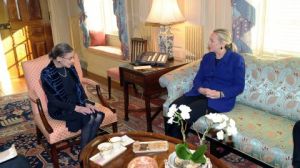
Ruth Bader Ginsburg and Hillary Clinton
It will be bare-knuckles politics from the right. Do or die. By any means necessary. To replace Ginsburg with a young right-wing extremist. And for the Democrats to have a chance of thwarting them, they must realize that this fight is not only a matter of persuasion….
The win-over-reasonable-Republicans-with-reason strategy is weak sauce. That leaves the Democrats with one other choice: total political warfare. The Senate’s Democratic leader, Chuck Schumer—with the backing of Joe Biden and Nancy Pelosi—needs to threaten massive retaliation. Should McConnell try to ram a Trump nominee through, Schumer ought to vow that the Democrats, if they win back the Senate and Biden is elected president, will demolish the filibuster, which will allow the Senate to proceed to make Washington, DC, a state (two more senators, who are likely to be Democrats!) and that they will move to add two or four more seats to the Supreme Court. (There is nothing in the Constitution that limits the court’s size to the current nine justices.) In other words: They will implement a Republican nightmare (which, as it happens, can be justified on arguments of equity and fairness).
Trump and McConnell will move to put a hard right-winger on the court before the election. Don’t be naive. Don’t think: “They wouldn’t possibly try that.” Of course they would. And if (I hate to be macabre here, but I’m just making a point) Stephen J. Breyer were to perish tomorrow, they’d move to put two right-wingers on the bench before Election Day. It is who they are.
What power can stop them? There are only three that potentially could. Let’s look at them.
Ruth Bader Ginsburg
One, the Democrats. Some Democratic senators who might have Mitch’s ear, say Joe Manchin, will go to him. And Mitch will say: Fuck off. However, the Democrats have a card to play here, if Joe Biden will play it. The number nine (of Supreme Court justices) is neither in the Constitution nor law. Biden, and Chuck Schumer, can say: If you fill this seat now, if Biden wins, we’re expanding the Court to 11 or 13, and your majority is dead. And they should be ready to do it.
Two, public opinion. I expect polls will appear in the coming days showing majorities agreeing that no appointment should come until after we have a new president. As I’ve often written, our democracy is corrupted and screwed, but it’s still enough of a democracy that public opinion actually matters. Sometimes. And I think this is probably one of these times.
Three, kind of an ancillary point to public opinion: the fate of Republican senators up for re-election in tough states. Already, Alaska’s Lisa Murkowski, not up for re-election, has apparently said she will not confirm a justice until the next president is sworn in. That’s one. Democrats would need three more to say that they’ll follow Murkowski’s lead. Susan Collins, Cory Gardner, and Martha McSally seem the obvious choices. There are others. It all depends on the degree of progressive mobilizing in those states, to make those GOP senators know that if they acquiesce to McConnell’s games, they will lose. And of course there’s Mitt Romney, who does not face re-election but who might cast another conscience vote.
So all is not lost yet. But gear up for a fight. And as you do, always leave time in your mind for this remarkable, towering American. Everything we do in this corrupt period should be to honor all that she stood for.
We are already far down the road to autocracy, as Dakinikat wrote yesterday. We have to honor Ruth Bader Ginsburg’s life by fighting as hard as we can. As David Corn wrote, we have to bring a bazooka to the GOP’s gunfight.
Anger is an energy.
Did you like this post? Please share it with your friends:
Chief Justice John Roberts presides over the impeachment trial of Donald J. Trump.
Good Morning!!
The Senate impeachment “trial” begins this afternoon, and Mitch McConnell is doing his damnedest to make sure it won’t be a real or fair one. Awhile back, McConnell said this trial would follow the rules set for Bill Clinton’s impeachment, but–surprise!–that was just one big fat lie.
But when Mr. McConnell, Republican of Kentucky and the majority leader, finally released a draft of his resolution on Monday evening, less than 24 hours before the Senate was expected to consider it, there were several meaningful differences from the rules that governed Mr. Clinton’s impeachment, some of which were in line with Mr. Trump’s preferences and his legal team’s strategy.
The measure is expected to pass on Tuesday along party lines, over strenuous Democratic objections….
Mitch McConnell and pals
Like in the Clinton trial, the Democratic House impeachment managers and Mr. Trump’s defense lawyers will have up to 24 hours to argue their respective cases for and against conviction on charges of abuse of power and obstruction of Congress. But in 1999, the Senate imposed no additional limit on how the time was used. Mr. McConnell’s proposal states that each side much complete its work within two days, beginning as early as Wednesday.
That means opening arguments could be finished by the end of this week, allowing the senators 16 hours for questioning and a subsequent debate early next week over whether to consider witness testimony. In the fastest possible scenario, the Senate could vote to convict or acquit by the end of January….
When the Clinton trial opened, the Senate “admitted into evidence,” printed and shared with senators all records generated by the House impeachment inquiry into Mr. Clinton. Not so this time.
Though the House’s evidence from the Trump impeachment inquiry would still be printed and shared with senators, it would only be formally considered by the Senate as part of its official record if a majority of senators voted to do so. That vote could only take place after the Senate decided whether to call witnesses and seek additional documents — that is, as the trial moves toward conclusion.
So it’s already looking like a kangaroo court, which surprises no one. McConnell’s rules also don’t guarantee there will be new witnesses or documents.
It says that after senators conclude their questioning, they will not immediately entertain motions to call individual witnesses or documents. Instead, they will decide first whether they want to consider new evidence at all. Only if a majority of senators agree to do so will the managers and prosecutors be allowed to propose and argue for specific witnesses or documents, each of which would then be subject to an additional vote.
If a majority of the Senate ultimately did vote to call a witness for testimony, that witness would first be interviewed behind closed doors and then the “Senate shall decide after deposition which witnesses shall testify, pursuant to the impeachment rules,” if any. Consistent with the Clinton trial rules, this essentially means that even if witnesses are called, they might never testify in public.
Naturally Democrats are not going to take this lying down. The House impeachment managers are holding a press conference right now and Chuck Schumer has already stated his objections. He told NPR this morning that McConnell’s rules are “a national disgrace” and told MSNBC that “Everything in these rules is rigged.” Right now Jerry Nadler is saying that McConnell’s rules amount to an obvious cover-up.
The White House announced Monday that President Trump appointed several prominent Republican House members to advise his impeachment defense team ahead of the Senate trial set to begin this week.
GOP Reps. Jim Jordan (Ohio), John Ratcliffe Texas), Mike Johnson (La.), Mark Meadows (N.C.), Debbie Lesko (Ariz.), Lee Zeldin (N.Y.), Elise Stefanik (N.Y.) and Doug Collins are set to play leading roles.
A statement from the White House said the lawmakers “have provided guidance to the White House team, which was prohibited from participating in the proceedings concocted by Democrats in the House of Representatives” throughout the House proceedings and would continue to do so in the Senate.
You’ll notice that those are the Reps who tried to turn the House impeachment process into a shriekfest. According to the Hill, Democrats and even even some GOP Senators didn’t like the idea of House members getting involved in the Senate process.
Key Republican allies in the Senate have also warned against such appointments, warning that the addition of Republican House members would cast the Senate trial in a partisan light.
“I don’t think it’s wise. I think we need to elevate the argument beyond body politics, beyond party politics and talk about the constitutional problems with these two articles,” Sen. Lindsey Graham (R-S.C.) told reporters earlier this month.
I wonder if McConnell is at all worried about what the public reaction could be to a show trial. The latest CNN poll found that 51 percent of Americans think Trump should be removed from office and 69 percent believe that the Senate trial should include witnesses.
The poll is the first major national telephone poll since the articles of impeachment were sent to the Senate, formally launching Trump’s trial there. They are also the first such poll results since Soviet-born businessman Lev Parnas, an associate of Trump’s attorney Rudy Giuliani, publicly implicated the President in the Ukrainian pressure campaign during a series of television interviews.
The new poll also finds majorities of Americans view each of the charges on which Trump will face trial as true: 58% say Trump abused the power of the presidency to obtain an improper personal political benefit and 57% say it is true that he obstructed the House of Representatives in its impeachment inquiry.
Of course there are partisan, gender, race, age, and geographical differences in attitudes toward the trial:
Overall, 89% of Democrats say he should be removed from office, while just 8% of Republicans feel the same way. Among independents, it’s nearly dead even: 48% say the Senate should vote to remove him, while 46% say that they should not. Views on whether Trump should be impeached and removed are also evenly split across battleground states, 49% are on each side across the 15 states decided by 8 points or less in 2016. Those states are Arizona, Colorado, Florida, Georgia, Maine, Michigan, Minnesota, Nevada, New Hampshire, North Carolina, New Mexico, Ohio, Pennsylvania, Virginia and Wisconsin.
House impeachment managers take articles of impeachment to Senate.
Beyond partisanship, there are wide divisions in the poll by gender, race, education and age. Nearly six in 10 women (59%) say the Senate should remove Trump from office; 42% of men agree. Among African Americans, 86% say Trump should be removed. That drops to 65% among Hispanics and 42% among whites.
Combining race and gender, about eight in 10 women of color (79%) say he should be removed. That dips to 59% among non-white men, 49% among white women and 33% among white men. For whites, education adds another degree of division: 59% of white women with college degrees say the Senate should remove Trump, compared with 43% among white women without degrees, 44% among white men with degrees and 27% among white men without college degrees. A majority (56%) of those under age 45 say the President should be removed, while older Americans are more evenly split (47% in favor among those age 45 and over, 50% opposed).
The Justice Department secretly blessed President Donald Trump’s decision to stonewall the Democratic-led House over impeachment last year, the president’s legal team disclosed Monday.
The legal brief submitted to the Senate as part of Trump’s defense includes an opinion from the Department of Justice’s Office of Legal Counsel concluding that Trump was justified in categorically rejecting the House’s demands for information before lawmakers passed a formal impeachment resolution on October 31.
“We conclude that the House must expressly authorize a committee to conduct an impeachment investigation and to use compulsory process in that investigation before the committee may compel the production of documents or testimony in support of the House’s sole power of impeachment,” Assistant Attorney General Steven Engel wrote in the detailed legal rationale.
The opinion was officially dated Sunday and released by the Justice Department on its website Monday, timing that appeared to dovetail with a Senate-set noon, holiday deadline for Trump’s first substantive brief in the impeachment trial.
Chuck Schumer is giving a press conference right now. He is emphasizing that McConnell is trying to make sure that Americans don’t watch the trial because it will begin in the afternoon and last late into the night and early morning hours. There will be a battle between Democrats and Republicans in the Senate today, but so far it appears that McConnell has to votes to pass his ridiculous rules.
President Trump’s legal defense team and Senate GOP allies are quietly gaming out contingency plans should Democrats win enough votes to force witnesses to testify in the impeachment trial, including an effort to keep former national security adviser John Bolton from the spotlight, according to multiple officials familiar with the discussions.
While Republicans continue to express confidence that Democrats will fail to persuade four GOP lawmakers to break ranks with Senate Majority Leader Mitch McConnell (R-Ky.), who has opposed calling any witnesses in the trial, they are readying a Plan B just in case — underscoring how uncertain they are about prevailing in a showdown over witnesses and Bolton’s possible testimony.
One option being discussed, according to a senior administration official, would be to move Bolton’s testimony to a classified setting because of national security concerns, ensuring that it is not public.
To receive the testimony in a classified session, Trump’s attorneys would have to request such a step, according to one official, adding that it would probably need the apReaproval of 51 senators.
Read the rest at the WaPo.
Here are a couple of good articles analyzing Trump’s impeachment defense.
As President Trump’s impeachment trial opens, his lawyers have increasingly emphasized a striking argument: Even if he did abuse his powers in an attempt to bully Ukraine into interfering in the 2020 election on his behalf, it would not matter because the House never accused him of committing an ordinary crime.
Their argument is widely disputed. It cuts against the consensus among scholars that impeachment exists to remove officials who abuse power. The phrase “high crimes and misdemeanors” means a serious violation of public trust that need not also be an ordinary crime, said Frank O. Bowman III, a University of Missouri law professor and the author of a recent book on the topic.
“This argument is constitutional nonsense,” Mr. Bowman said. “The almost universal consensus — in Great Britain, in the colonies, in the American states between 1776 and 1787, at the Constitutional Convention and since — has been that criminal conduct is not required for impeachment.”
But the argument is politically convenient for Mr. Trump. For any moderate Republican senator who may not like what the facts already show about his campaign of pressure on Ukraine, the theory provides an alternative rationale to acquit the president.
The House managers’ brief is an organized legal document. It starts with the law, the nature and purposes of Congress’s impeachment power, then walks through the evidence regarding the first article of impeachment, which alleges abuse of power, and seeks to show how the evidence establishes the House’s claim that President Trump is guilty of this offense. It then proceeds to argue that the offense requires his removal from office….
By contrast, the White House’s “Answer of President Donald J. Trump” to the articles of impeachment, filed by the president’s personal lawyer Jay Sekulow and the White House counsel, Pat Cipollone, does not read like a traditional legal argument at all. It begins with a series of rhetorical flourishes—all of them, to one degree or another, false. The articles of impeachment are “a dangerous attack on the right of the American people to freely choose their President,” the president’s lawyers write—as though the impeachment power were not a constitutional reality every bit as enshrined in the founding document as the quadrennial election of the president. The articles are “a brazen and unlawful attempt to overturn the results of the 2016 election and interfere with the 2020 election,” and are “constitutionally invalid on their face,” they write, as though the president’s right to extort foreign leaders for political services were so beyond reasonable question, it is outrageous that anyone might object to it.
This document reads like one of the president’s speeches at his campaign rallies. The language is a little more lawyerly, if only a little. In Sekulow and Cipollone’s hands, Trump’s cries of “Witch hunt!” have turned into “lawless process that violated basic due process and fundamental fairness.” His allegations that Democrats are a “disgrace” have turned into “an affront to the Constitution.” And Trump’s insistence that there’s a plot to destroy his presidency has become a “highly partisan and reckless obsession with impeaching the president [that] began the day he was inaugurated and continues to this day.”
But the message is unchanged. It’s not a legal argument. It’s a howl of rage.
Read more at The Atlantic.
I’ve tried to lay out the basics; we’ll soon be able to watch what happens in the Senate for ourselves. Please share your reactions as the day goes on, but feel free to post on other topics as well. It should be an interesting day!
Did you like this post? Please share it with your friends:
Lately I’ve been feeling as if I’m treading water, waiting to see what is going to happen with impeachment. I felt that way even before Nancy Pelosi finally decided the time was right to do it. In the past few weeks while she held off on transmitting the articles to the Senate, more evidence has become public, and even yesterday as the articles were delivered more shocking news broke. Now it feels as if the proverbial shit is finally hitting the fan.
Lev Parnas, the Soviet-born businessman who played a central role in the campaign to pressure Ukraine to investigate political rivals of President Trump, completed his break with the White House on Wednesday, asserting for the first time in public that the president was fully aware of the efforts to dig up damaging information on his behalf.
In an interview with The New York Times on the day the House transmitted articles of impeachment against Mr. Trump to the Senate, Mr. Parnas also expressed regret for having trusted Mr. Trump and Rudolph W. Giuliani, the president’s personal lawyer and the architect of the Ukraine pressure campaign. His lawyer said he was eager to cooperate with federal prosecutors investigating Mr. Giuliani.
Trump with Lev Parnas
Mr. Parnas made his remarks as House impeachment investigators released more material he had turned over to them. The material, including text messages, photos and calendar entries, underscored how deeply Mr. Parnas and others were involved in carrying out the pressure campaign and how new information continues to surface even as the Senate prepares to begin Mr. Trump’s trial next week. And it provided additional evidence that the effort to win political advantage for Mr. Trump was widely known among his allies, showing that Mr. Parnas communicated regularly with two top Republican fund-raisers about what he was up to.
Text messages and call logs show that Mr. Parnas was in contact with Tom Hicks Jr., a donor and Trump family friend, and Joseph Ahearn, who raised money for pro-Trump political groups, about developments in the Ukraine pressure campaign.
In the text messages, Mr. Parnas kept Mr. Hicks and Mr. Ahearn apprised of efforts to disseminate damaging information about targets of Mr. Trump and Mr. Giuliani, including the United States ambassador to Kyiv, former Vice President Joseph R. Biden Jr. and Ukrainians who spread information about Paul Manafort, Mr. Trump’s 2016 campaign chairman.
The records seem to expand the circle of people around Mr. Trump who were aware in real time of the pressure campaign. The campaign led to Mr. Trump’s impeachment in the House last month and a Senate trial that will start next week just as the 2020 presidential campaign is moving into high gear.
In the interview with The Times, Mr. Parnas said that although he did not speak with Mr. Trump directly about the efforts, he met with the president on several occasions and was told by Mr. Giuliani that Mr. Trump was kept in the loop.
Rachel Maddow’s interview with Lev Parnas, the former associate of Rudy Giuliani, basically confirmed what House Democrats have been saying all along as they pursued impeachment against Donald Trump: He was very much in the loop.
In Parnas’s words, “President Trump knew exactly what was going on. He knew all of my movements.”
Given that Parnas described a scheme to shakedown the new Ukrainian government until they announced an investigation of Joe Biden, that means a lot, as he described in detail a pressure campaign that was placed on Ukrainian officials.
An early episode came last spring, when Parnas said that he was enlisted to warn an aide to incoming president Volodymyr Zelensky that if an investigation was not announced, Vice President Mike Pence’s visit for Zelensky’s inauguration would be cancelled. The aide refused, and Pence’s visit was canceled.
“I wouldn’t do anything without the consent of Rudy Giuliani or the president,” Parnas said to Maddow.
He also confirmed other claims made during the impeachment inquiry, including the serious charge that aid to Ukraine was withheld as government officials continued to hold off on announcing a Biden investigation. “It wasn’t just military aid; it was all aid” that was under threat of being withheld, Parnas said.
But Trump’s team is likely to spend the next few days trying to discredit Parnas, who, along with another associate, Igor Furman, was arrested in October on campaign finance charges. As Maddow was playing her interview with Parnas, her Fox News rival Sean Hannity was calling MSNBC the “state run, MSNBC conspiracy channel media.”
House impeachment investigators released a new set of evidence that was obtained from Lev Parnas, an indicted former associate of President Donald Trump’s personal attorney, Rudy Giuliani — including voicemails, photos, and text messages between Parnas and high-level figures within Trump’s orbit.
The material includes voicemail messages Parnas received from Giuliani and Victoria Toensing, a prominent Trump-aligned lawyer, both of whom have been identified as players in an effort to force the removal of the then-U.S. ambassador to Ukraine, Marie Yovanovitch, during the spring.
“Hey Lev. VT here. We’ve got a request to talk to the big one,” Toensing said in the April 23, 2019, voicemail message. “So I just wanted to get the latest from you, if I could. I know it’s late there. I’m sorry.”
The timing of the Toensing voicemail coincides with a flurry of activity involving Yovanovitch’s ouster. On April 23, Giuliani tweeted that Ukraine was investigating 2016 election interference, and Trump recalled Yovanovitch from Ukraine on April 24.
The previously undisclosed documents, released late Tuesday night but not publicly noticed, were posted ahead of the House formally sending its impeachment articles to the Senate, underscore the evolving nature of an investigation that House Democrats say is ongoing — and was stifled in its early stages by Trump’s refusal to allow his aides and associates to comply with congressional subpoenas.
The most shocking information that came out of the Parnas documents was the possibility that Trump allies were stalking and perhaps even physically threatening then Ukraine Ambassador Marie Yovanovitch. Parnas told Maddow that he didn’t believe that had actually happened and it was just a fantasy created by a “loony” Trump ally Robert Hyde.
Ukraine has launched criminal investigations into the possible illegal surveillance of former U.S. ambassador Marie Yovanovitch, and the reported hacking of Burisma Holdings, the natural gas company at the center of the Trump impeachment.
“Ukraine’s position is not to interfere in the domestic affairs of the United States of America,” the Interior Ministry, which runs the police forces, said in a statement.
However, recent reports pointed to the possible violation of Ukrainian and international law, it said.
“Ukraine cannot ignore such illegal activities on the territory of its own state,” the statement added….
“Our goal is to investigate whether there actually was a violation of Ukrainian and international law, which could be the subject for proper reaction. Or whether it is just bravado and fake information in the informal conversation between two U.S. citizens,” the ministry said.
A Republican congressional candidate and former Marine who suggested last year that he was tracking a U.S. ambassador who had fallen out of favor with President Trump was once involuntarily committed to a psychiatric hospital after an incident at one of the president’s resorts and is the subject of a restraining order obtained by a political consultant, police and court records show.
On Tuesday, Robert F. Hyde became the latest figure to emerge in the drama surrounding the Trump administration’s recall last year of Marie Yovanovitch as the U.S. ambassador to Ukraine when his 2019 messages were made public on the eve of Trump’s impeachment trial. His exchanges with an associate of Rudolph W. Giuliani, Trump’s personal attorney, had been turned over to House Democrats in response to a subpoena.
In the messages to Lev Parnas, Hyde claimed to be in contact with a “private security” team near the embassy in Kyiv and suggested that he had the ambassador under physical and electronic surveillance. “It’s confirmed we have a person inside,” he wrote in March.
Robert Hyde with Trump
On Wednesday, Hyde claimed he had been “joking” in the messages he sent to Parnas.
On his social media accounts, Hyde, a long-shot candidate for Congress in Connecticut’s 5th District, has posted numerous photos of himself and Trump or members of the president’s family, many of them taken at Trump properties. He appeared grinning with Trump on Easter at the president’s Mar-a-Lago resort in Palm Beach, Fla.
Among the photos and videos is a picture from a party to which, according to the post, Hyde had taken friends on May 7 at a bowling alley in the White House complex.
The bowling party occurred about a week before police were called to Trump’s Doral resort in Miami-Dade County for a “male in distress fearing for his life,” according to a police report from the incident.
Hyde told officers that he had been “set up and that a hit man was out to get him,” officers wrote. Hyde “spoke about emails he sent that may have placed his life in jeopardy” and said he believed that painters and landscape workers were trying to harm him and that the Secret Service was watching him.
Read more at the links I’ve provided.
I’ve only scratched the surface of today’s news. We have no idea what will happen with impeachment now, except that Mitch McConnell will do his best to protect Trump. He’s planning to shut the media out of the impeachment trial–will he get away with it? It’s beginning to look as if he will have a tough time, as more and more shit hits the media fan. I expect we’ll learn even more today. It’s all going to come out.
Interestingly, with an impeachment trial in the Senate raising the stakes perhaps even higher than those for a Supreme Court vacancy, McConnell committed a rare unforced error before Christmas: He proclaimed that Senate Republicans would “be working through this process hopefully in a fairly short period of time, in total coordination with the White House counsel’s office and the people who are representing the president.” This essentially amounts to a confession he’d be rigging up a show trial to acquit the president without hearing any material evidence—not exactly what that whole “trial” mechanism is meant to do, legally speaking. Perhaps as a result of that unfortunate admission, McConnell now has to contend with at least a handful of vulnerable Republicans in the Senate who are not perfectly cool with the “we’re coordinating with Trump to get him acquitted super fast” situation. And as such, we enter this historic week of Senate impeachment with at least the wisp of a hope that there might be a fairer trial ahead than anyone could have anticipated.
That slim hope nests in a variety of cozy places, including but not limited to the prospect that Chief Justice John Roberts has some institutional interests in avoiding a kangaroo trial, the fact that the American public has shown some bipartisan interest in hearing actual testimony from actual witnesses, and the fact that the president appears to continue to conflate his personal political ambitions with the national interest, even after being impeached for precisely that conduct in the House. (Maybe this will finally prove to be too much for even the most casual observer?) Plus, newly released documents from Rudy Giuliani’s indicted Ukraine-gate confederate, Lev Parnas, again confirm that the rough contours of the aid-for-oppo research scheme. But they go even further: The new documents (with more to come) add elements of actual threats to the welfare of a sitting U.S. ambassador, directed by the associates of Trump’s associates, which has implications for Jay Sekulow, Trump’s personal lawyer. Senate Republicans will need to explain why none of this matters and why they want to know nothing more about the back deals and thuggery that, it is now clearer than ever, were conducted under the president’s directive. That means that there is at least a smidgen of hope wafting off senators like Mitt Romney of Utah, who says he’d like to hear testimony from John Bolton, and Susan Collins of Maine, who says she is possibly open to impeachment witnesses and documents, all of which makes it trickier for McConnell to magic up his dream trial of opening statements leading to closing statements leading to a brisk victory lap-slash-acquittal.
Read the rest at Slate.
I’ll post some more links in the comment thread; it’s so difficult to figure out what to highlight these days. I hope you’ll share the stories you are following too.
Did you like this post? Please share it with your friends:
The Sky Dancing banner headline uses a snippet from a work by artist Tashi Mannox called 'Rainbow Study'. The work is described as a" study of typical Tibetan rainbow clouds, that feature in Thanka painting, temple decoration and silk brocades". dakinikat was immediately drawn to the image when trying to find stylized Tibetan Clouds to represent Sky Dancing. It is probably because Tashi's practice is similar to her own. His updated take on the clouds that fill the collection of traditional thankas is quite special.
You can find his work at his website by clicking on his logo below. He is also a calligraphy artist that uses important vajrayana syllables. We encourage you to visit his on line studio.



 As Trump
 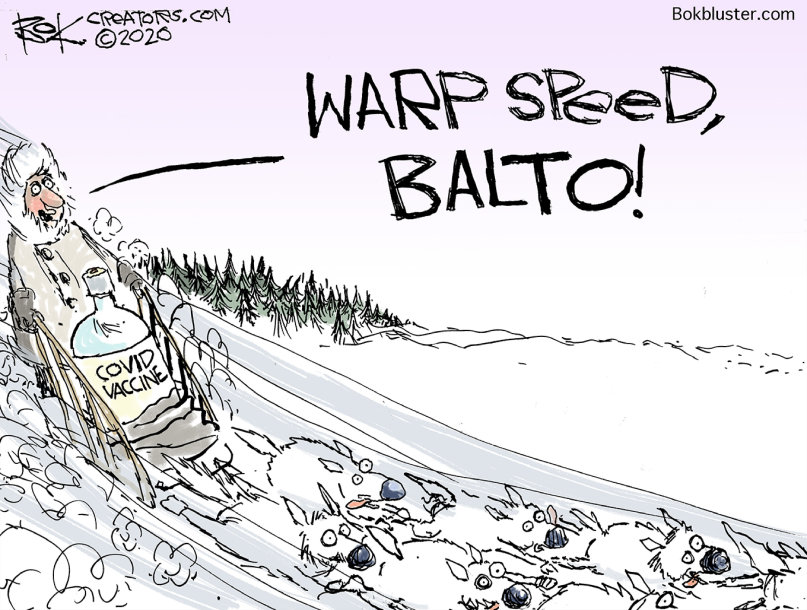 We are getting closer to a vaccine, and the FDA has found that the Pfizer vaccine
  “Frankly, I don’t know, and frankly, I’m staying out of this. I can’t comment,” Slaoui said. “I literally don’t know.”
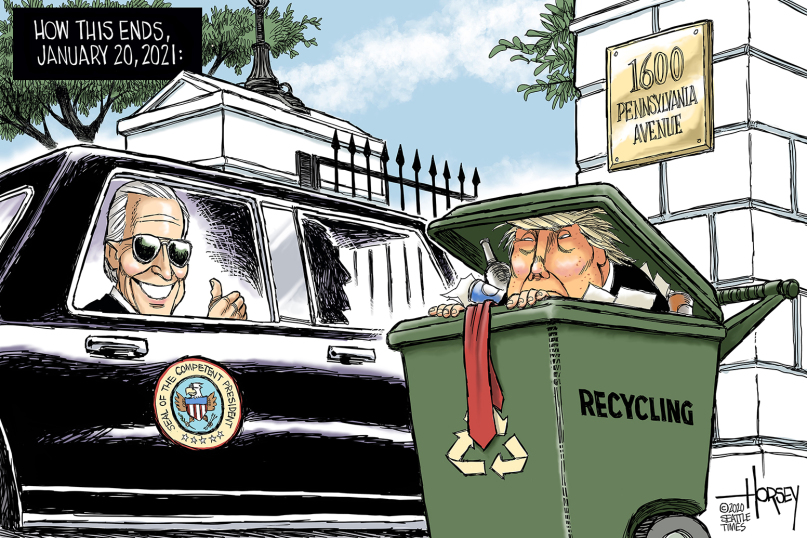 Let’s hope the Biden administration will be able to deal with the mess that Trump is leaving them.
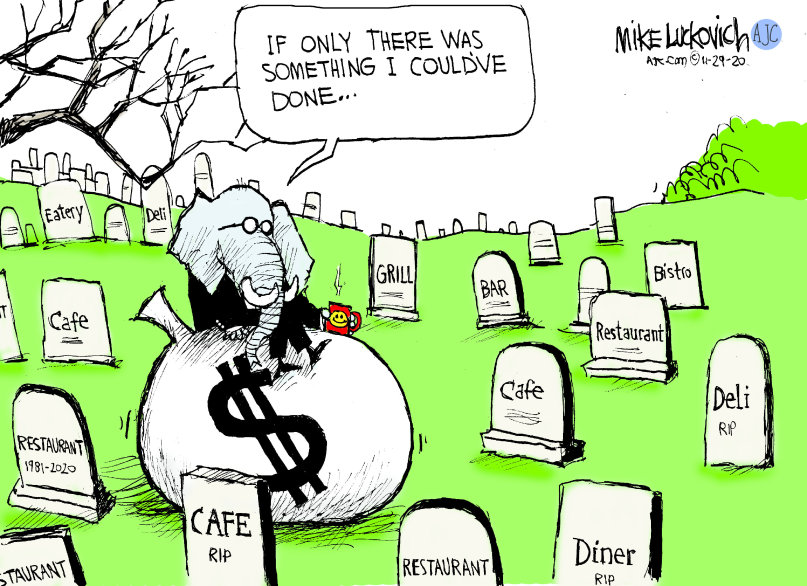
  Unfortunately, that is what Senate majority leader Mitch McConnell and his minions have been battling to include in
  “The doors close significantly after the safe harbor deadline passes,” said Rebecca Green, codirector of the Election Law Program at William & Mary Law School. “It’s going to be a heavy lift to convince a judge to defy federal deadlines. I think it would only happen or be successful if some kind of wild evidence of just unbelievable scale were unearthed that was credible.”
 The pardon clause’s language is broad indeed, unambiguously allowing the president to pardon seemingly any other person convicted for any federal criminal offense. But its language does not unambiguously include the president himself. Had the Framers intended to give the president such broad power, we would expect them to have clearly said so. After all, the new nation was in the process of rejecting a monarchical government in favor of a democratic republic.

















 peej
peej Carissa
 bostonboomer
 dakinikat
 ecocatwoman
 mablue2
 Mama Lopez
 peggysue22
 quixote
 skydancingguestblogger
 Mona (aka Wonk the Vote)



 Sky Dancing
Recent Comments