
Saturday Morning Lite
Posted: August 31, 2013 Filed under: Barack Obama, Foreign Affairs, morning reads, Republican politics, U.S. Economy, U.S. Politics | Tags: Ben Affleck, chemical weapons, emoprogs, fast food workers' strike, immigration reform, Income Inequality, Labor Day, low-wage jobs, March On Washington anniversary, Martin Luther King, NFL concussion lawsuit, Syria intervention, Voter ID laws, voter suppression 53 Comments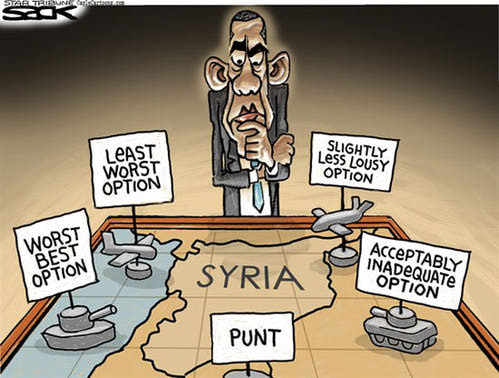
Syria War Room, by Steve Sack
Good Morning!!
I don’t know about you, but I really missed JJ’s Friday Night Lite post last night, so I thought I’d start out Sky Dancing’s Saturday with some political cartoons. I hope you enjoy these — courtesy of Cagle Post.
A few more on Syria:
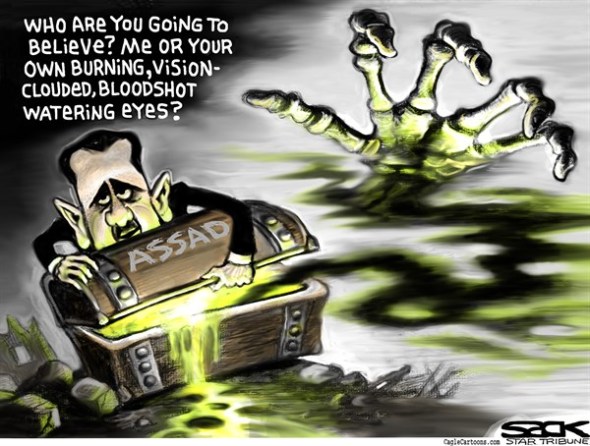
Assad Chemicals by Steve Sack

Assad Chemical Weapons, by Mike Keefe
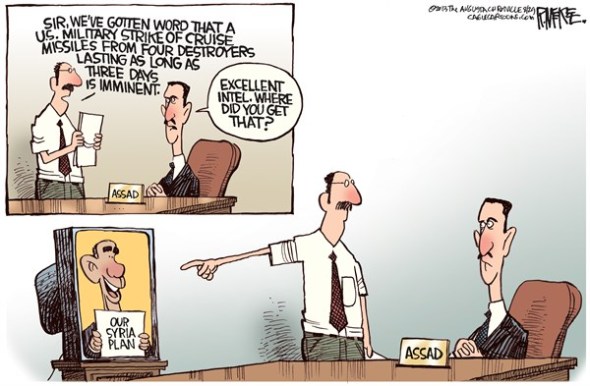
Syria Plan by Rick McKee

The Anti-War Left by Eric Allie
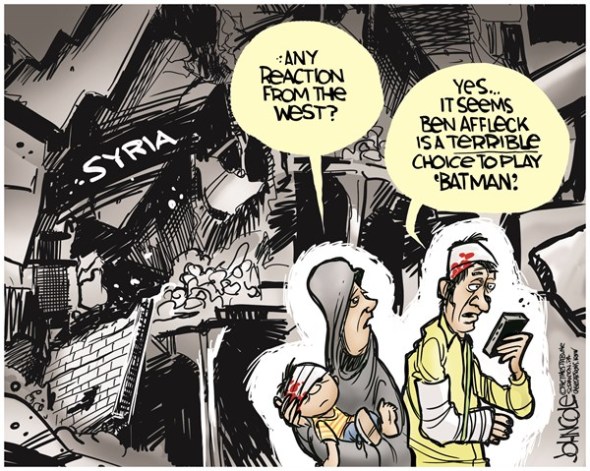
Syria and Affleck by John Cole

Cameron’s Failure, by Rainer Hatchfeld
March on Washington 50th Anniversary:
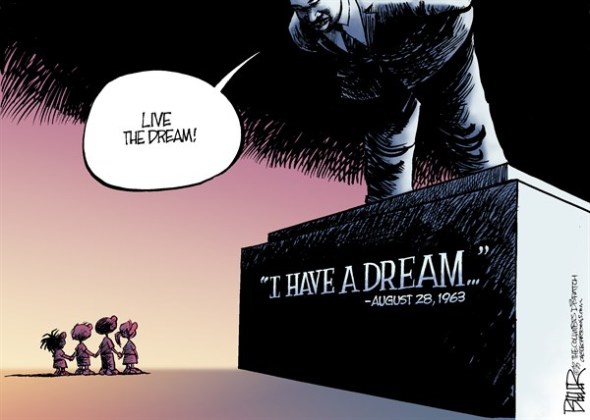
I Have A Dream Anniversary, by Nate Beeler
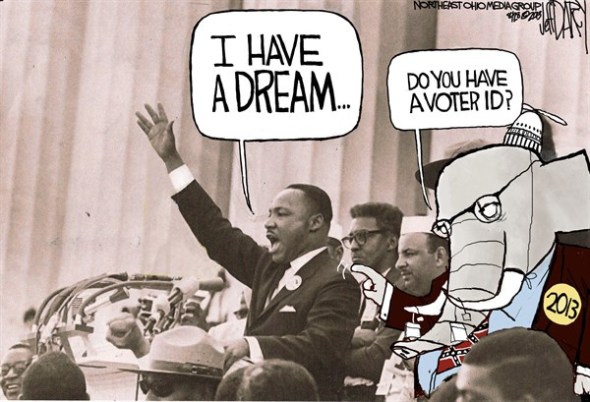
MLK Nightmare by Jeff Darcy
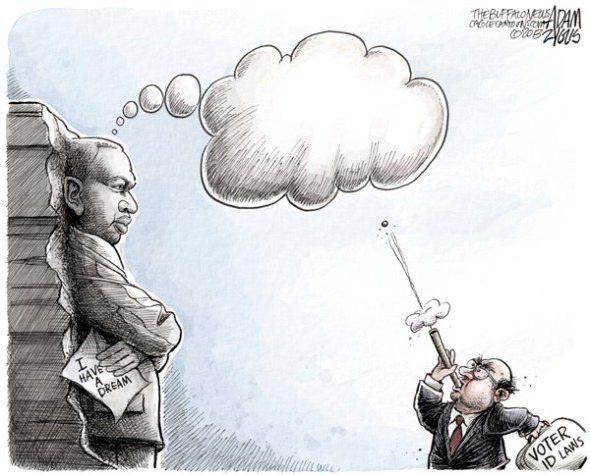
Dreamer, by Adam Zyglis
Labor Day and Income Inequality
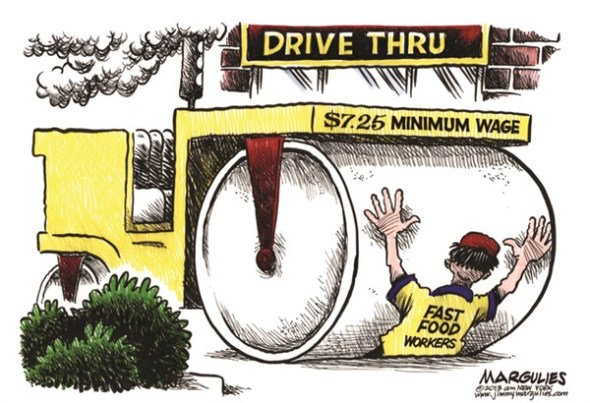
Fast Food Minimum Wage, by Jimmy Margulies
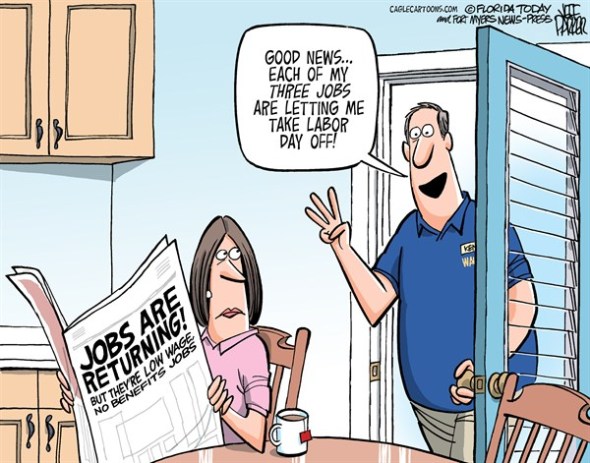
Labor Day Jobs, by Jeff Parker
NFL Concussion Lawsuit
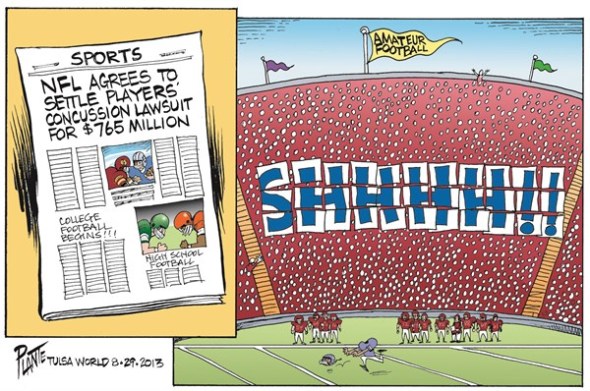
NFL Concussion Lawsuit, by Bruce Plante
Immigration Reform
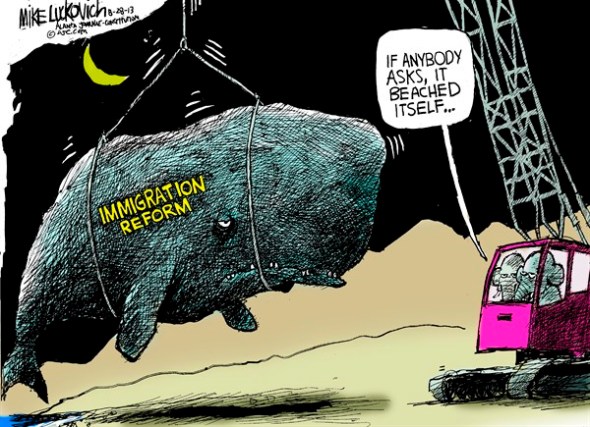
Immigration Reform, by Mike Lukovich
I hope everyone has a wonderful Labor Day weekend!! And if you’re not out on the beach or doing something else more exciting, please post links to the stories you’re following today in the comment thread.
Thursday Reads: Civil Rights Struggle, Syria Intervention, NYPD Spying, Boston Bombing, and “League of Denial”
Posted: August 29, 2013 Filed under: Foreign Affairs, morning reads, Republican politics, U.S. Politics | Tags: Boston Bombings, chemical weapons, Civil Rights Movement, concussions, Dzhokhar Tsarnaev, Eric Cantor, ESPN, John Boehner, John F. Kennedy, John Odom, Julian Bond, Martin Luther King, NFL, NYPD, PBS Frontline, police photography, Prime Minister David Cameron, Rep. John Lewis, traumatic brain injury, We Shall Overcome 19 Comments
Good Morning!!
I’ve got so much news for you this morning, I don’t know if I’ll have room in a reasonable-length post, so I’ll get right to it. I’ll begin with some stories on yesterday’s 50th anniversary of the March On Washington.
PBS had an amazing interview with Rep John Lewis in which he recounted his memories of that day in 1963 and the speech he gave as a youthful leader in the Civil Rights Movement: ‘I Felt That We Had to Be Tough’: John Lewis Remembers the March on Washington. I hope you’ll read the whole thing, but here’s a brief excerpt:
REP. JOHN LEWIS, D-Ga.: On that day, I was blessed.
I felt like I had been tracked down by some force or some spirit. I will never forget when A. Philip Randolph said, “I now present to you young John Lewis, the national chairman of the Student Nonviolent Coordinating Committee.”
And I went to the podium. I looked to my right. I saw many, many young people, staffers from the Student Nonviolent Coordinating Committee, volunteers. Then I looked to my left. I saw all these young people up in the trees, trying to get a better view of the podium.
Then I looked straight ahead. And I saw so many people with their feet in the water trying to cool off. And then I said to myself, this is it, and I went for it.
On meeting with President Kennedy before the March, and how the podium and the crowd came to be so diverse:
He [JFK] didn’t like the idea of a March on Washington.
When we met with him, A. Philip Randolph spoke up in his baritone voice we met with the president. And he said, “Mr. President, the black masses are restless. And we are going to march on Washington.”
And you could tell by the movement of President Kennedy — he started moving and twisting in his chair. And he said, in effect, that if you bring all these people to Washington, won’t it be violence and chaos and disorder?
Mr. Randolph responded and said, “Mr. President, there’s been orderly, peaceful, nonviolent protests.”
And President Kennedy said, in so many words, I think we are going to have problems. So we left that meeting with President Kennedy. We came out on the lawn at the White House and spoke to the media and said, we had a meaningful and productive meeting with the president of the United States. And we told him we’re going to March on Washington.
And a few days later, July 2, 1963, the six of us met in New York City at the old Roosevelt Hotel. And in that meeting, we made a decision to invite four major white religious and labor leaders to join us in issuing the call for the March on Washington.
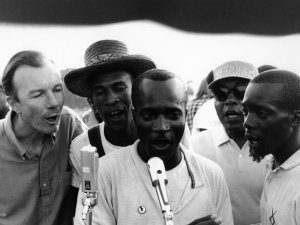
American folk singer and activist Pete Seeger (left) adopted and helped popularize “We Shall Overcome” by teaching the song at rallies and protests. Here he sings with activists in Greenwood, Miss., in 1963. (NPR)
NPR had a wonderful story yesterday about the history of the Civil Rights Movement’s signature song: The Inspiring Force Of ‘We Shall Overcome’.
It is not a marching song. It is not necessarily defiant. It is a promise: “We shall overcome someday. Deep in my heart, I do believe.”
It has been a civil rights song for 50 years now, heard not just in the U.S. but in North Korea, in Beirut, in Tiananmen Square, in South Africa’s Soweto Township. But “We Shall Overcome” began as a folk song, a work song. Slaves in the fields would sing, ‘I’ll be all right someday.’ It became known in the churches. A Methodist minister, Charles Albert Tindley, published a version in 1901: “I’ll Overcome Someday.”
The first political use came in 1945 in Charleston, S.C. There was a strike against the American Tobacco Co. The workers wanted a raise; they were making 45 cents an hour. They marched and sang together on the picket line, “We will overcome, and we will win our rights someday.”
There’s much more about how the song was passed from group to group and changed over time. Please give it a listen–it’s only about 8 minutes long, but really fascinating.
Not a single Republican appeared at yesterday’s commemoration of the March on Washington and Martin Luther King’s “I Have A Dream” speech. George W. Bush and his father George H.W. Bush couldn’t come because of health issues, but John Boehner and Eric Cantor are presumably in good health, but they refused offers to make speeches at the event, according to Roll Call.
That wasn’t a wise choice, said Julian Bond, a renowned civil rights activist, in an interview with MSNBC on Wednesday afternoon.
“What’s really telling, I think, is the podium behind me, just count at the end of the day how many Republicans will be there,” Bond told news anchor Alex Wagner. “They asked senior President Bush to come, he was ill. They asked junior Bush, he said he had to stay with his father.
“They asked a long list of Republicans to come,” Bond continued, “and to a man and woman they said ‘no.’ And that they would turn their backs on this event was telling of them, and the fact that they seem to want to get black votes, they’re not gonna get ‘em this way.” [….]
Cantor’s decision to turn down the invitation to speak is especially striking given his stated commitment to passing a rewrite of the Voting Rights Act in the 113th Congress, and the many opportunities he has taken over the past several weeks to publicly reflect on the experience of traveling with Rep. John Lewis, D-Ga., to Selma, Ala.
Sadly, Dr. King’s dream of peace has not made much progress in the past 50 years. And now the U.S. and its allies are considering another military intervention–in Syria.
Fortunately, the UK is now hesitating. NYT: Britain to Wait on Weapons Report Ahead of Syria Strikes.
Prime Minister David Cameron of Britain, who runs a coalition government, is facing political difficulties from legislators mindful of the experience in Iraq, when assurances from Prime Minister Tony Blair and President George W. Bush that Saddam Hussein had weapons of mass destruction proved inaccurate and a false pretext for war.
Mr. Cameron bowed on Wednesday to pressure from the opposition Labour Party and to some within his own coalition who want to allow United Nations weapons inspectors a chance to report their findings and for the United Nations Security Council to make one more effort to give a more solid legal backing to military action against Damascus.
At BBC News, Nick Robinson explains why Cameron “buckled.”
If you think that NSA domestic spying is invasive, you should take a look at what the NYPD has been up to since 9/11. Matt Apuzzo and Adam Goldman of the AP have a new book out called Enemies Within: Inside the NYPD’s Secret Spying Unit and bin Laden’s Final Plot Against America. There’s an excerpt at New York Magazine: The NYPD Division of Un-American Activities. It’s long, but a very important story. Please give it a read if you can.
Yesterday Apuzzo and Goldman published a related shocking story at AP: NYPD designates mosques as terrorism organizations.
The New York Police Department has secretly labeled entire mosques as terrorist organizations, a designation that allows police to use informants to record sermons and spy on imams, often without specific evidence of criminal wrongdoing.
Designating an entire mosque as a terrorism enterprise means that anyone who attends prayer services there is a potential subject of an investigation and fair game for surveillance.
Since the 9/11 attacks, the NYPD has opened at least a dozen “terrorism enterprise investigations” into mosques, according to interviews and confidential police documents. The TEI, as it is known, is a police tool intended to help investigate terrorist cells and the like.
Many TEIs stretch for years, allowing surveillance to continue even though the NYPD has never criminally charged a mosque or Islamic organization with operating as a terrorism enterprise.
The documents show in detail how, in its hunt for terrorists, the NYPD investigated countless innocent New York Muslims and put information about them in secret police files. As a tactic, opening an enterprise investigation on a mosque is so potentially invasive that while the NYPD conducted at least a dozen, the FBI never did one, according to interviews with federal law enforcement officials.

Boston Magazine has published more photos from “Behind the Scenes of The Hunt for Dzhokhar Tsarnaev.” Above is a photo of Tsarnaev exiting the boat in which he hid for hours as law enforcement searched all over Watertown for him. See more photos at the link.
In more hopeful news, one long-hospitalized survivor of the bombings was given the go-ahead to return home to California yesterday: Boston Marathon bomb survivor John Odom set to return home to Torrance (Daily Breeze News).
Nearly five months after a bomb almost took his life at the Boston Marathon, John Odom of Torrance was cleared by doctors on Wednesday to finally come home.
Odom’s wife, Karen, who has never left her husband’s side, has been chronicling her husband’s long recovery on Facebook, called it a “monumental” day.
“It’s official, John is released to go home!!!” she posted on the John Odom Support Page. “Although his recovery is nowhere near complete, there is no medical or physical reason he can’t fly home and continue his recovery in California. We are hoping to be home the end of next week, a few days shy of 5 months since we left on that now famous 4 day trip.”
“Famous” is one way to put it. The couple could have never imagined the journey they’ve been on since April 15.
Read the rest of this moving story at the link.
On October 8th and 15th, NPR’s Frontline plans to show League of Denial, “a two-part two-part investigation examining whether — as thousands of former players allege — the NFL has covered up the risks of football on the brain.” The documentary has so far been produced in partnership with ESPN, but last week the sports channel backed out of the collaboration presumably because of pressure from the NFL. From The New Republic: ESPN Quit Its Concussions Investigation With ‘Frontline’ Under Curious Circumstances.
“Frontline,” the prestigious, multiple-Emmy-winning investigative news show produced by Boston’s PBS member station, announced late Thursday afternoon that a 15-month-old partnership with ESPN in which they published a series of pieces exploring how the National Football League has (and has not) accounted for the relationship between playing football, head trauma, and brain damage, had come to an end. Dating back to last November, “Frontline” had run articles on its site featuring the work of Steve Fainaru and Mark Fainaru-Wada, ESPN staffers (and brothers) even as these articles appeared at espn.com and as the brothers did segments for ESPN’s award-winning investigative series “Outside the Lines.” The end result—in addition to abook that the brothers are publishing in October—was to be a “Frontline” documentary, League of Denial (also the book’s title).
According to “Frontline,” the documentary will premiere this season on October 8 and 15, but, “from now on, at ESPN’s request, we will no longer use their logos and collaboration credit on these sites and on our upcoming film.” Executive producer David Fanning and deputy executive producer Raney Aronson expressed their “regret” and credited ESPN with “a productive partnership.” They added, “The film is still being edited and has not been seen by ESPN news executives, although we were on schedule to share it with them for their editorial input.”
Aronson told me late Thursday that ESPN contacted “Frontline” last Friday to request that it remove ESPN’s logo from its website, citing the technicality that it was a “trademark issue.” It wasn’t until Monday, after the latest collaboration was published on “Frontline”’s website and aired on “OTL,” that ESPN also requested that language describing collaboration not be used, and that it became clear the collaboration itself was coming to an end.
The circumstances are indeed mysterious. Perhaps it was over-cautiousness on ESPN’s part or perhaps indirect pressure from the League. If you’re interested in this important story, go read Marc Tracy’s piece at TNR.
A couple more useful links on this story:
PBS: Questions Over NFL Doctor Cloud League’s Concussion Case
Bill Littlefield at NPR’s Only a Game: ESPN And Frontline Part Ways Over ‘League Of Denial’
The authors of the book League of Denial will continue their involvement with the Frontline presentation.
I’m running out of space, so I’ll end there, and add a few more links in the comments. Now what stories are you following today? Please share your links in the thread below.
Saturday Morning Open Thread: Libertarians Are Not Our Friends
Posted: August 17, 2013 Filed under: 2014 elections, Civil Liberties, Civil Rights, Foreign Affairs, open thread, Republican politics, U.S. Economy, U.S. Politics, Women's Rights | Tags: Julian Assange, libertarians, Martin Luther King, Rand Paul, Ron Paul, Wikileaks 40 Comments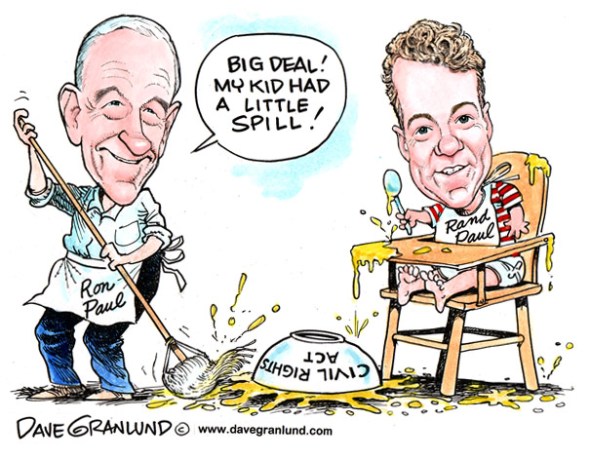
Good Morning!!
Sorry I’m posting this so late today. I’ve been pondering some issues that have been troubling me for a long time, and I keep getting stuck about how to write about them.
I’m beginning to see the libertarian influence on so-called “progressives” as a very serious problem for the future of our country. Here’s a somewhat incoherent beginning to a discussion of this problem. I’m putting this out there in the hope that I’ll get some feedback from you that will help me sort this out. So here goes…
Partial transcript:
“I’m a big admirer of Ron Paul and Rand Paul for their very principled positions in the U.S. Congress on a number of issues. They have been the strongest supporters of the fight against the U.S. attacks on Wikileaks and on me in the U.S. Congress. Similarly, they have been the strongest opponents of drone warfare and extrajudicial executions.
And so, that’s quite an interesting phenomenon in the United States. The position of the libertarian Republican–or a better description [right?]–coming from a principle of nonviolence, the American libertarian, that produces interesting results.
So, nonviolence, not going to invade a foreign country. Nonviolence, don’t force people at the barrel of a gun to serve in the U.S. Army [?? The U.S. doesn’t have a draft]. Nonviolence, don’t extort taxes from people to the Federal government, with a [policeman?]….
Similarly, other acts of nonviolence in relation to abortion that they hold. I think that some of these positions that are held by Ron Paul…I can see how they come from the same underlying libertarian principle. I think the world is often more complex. By taking a laid out principle but sometimes simplistic position, you end up undermining the principle. In the short term, visions of the principle are one thing, visions of the principle…it’s quite hard to know [inaudible].
A few comments…
It’s not clear to me whether Assange supports the Paul’s position on abortion, but clearly it’s a side issue for him–not nearly as important as the Paul’s support of Wikileaks and Assange himself, since he later said that both political parties have been compromised and the only hope for the future comes from the libertarian portion of the Republican Party. HuffPo:
He then put forth an argument against both established political parties in Washington, claiming that nearly all Democrats had been “co-opted” by President Barack Obama’s administration, while Republicans were almost entirely “in bed with the war industry.”
The current libertarian strain of political thought in the Republican Party was the “the only hope” for American electoral politics, Assange concluded.
Assange sees federal taxes as “extortion.” I assume that includes the payroll taxes that support Social Security and Medicare. He never mentions social programs at all; as a libertarian he probably opposes them. This is in line with other libertarians who are leading the fight against the U.S. government keeping any secrets whatsoever, e.g., Glenn Greenwald, Edward Snowden, Conor Frierdersdorf, and David Sirota (I’ll have more about this in a later post).
Not only does Assange not know that the U.S. doesn’t have a military draft, he’s pretty mixed up about recent U.S. history. In praising right wing racist news aggregator Matt Drudge, Assange said, via Raw Story:
“Matt Drudge is a news media innovator. And he took off about eight years ago in response to the Monica Lewinsky scandal.”
(Eight years ago was 2005, the first year of George W. Bush’s second term, when President Bill Clinton had been out of office for five years and the Lewinsky scandal and subsequent failed impeachment attempt were a matter of history.)
Assange claimed that Drudge made his name by “publishing information that the establishment media would not. It is as a result of the self-censorship of the establishment press in the United States that gave Matt Drudge such a platform and so of course he should be applauded for breaking a lot of that censorship.”
Assange says he supports non-violence. I’d like to point out that in U.S. history, one of the leading advocates of nonviolence and civil disobedience was a man named Martin Luther King. Fifty years ago King led a “March on Washington for Jobs and Freedom.” But Assange favors the Pauls’ notion of “nonviolence.” (Assange doesn’t appear to know that Ron and Rand Paul are the recipients of vast corporate donations from the defense industry.) I wonder if Assange knows that Ron and Rand Paul oppose Civil Rights laws? I wonder if he cares?
Julian Assange–along with Edward Snowden and Glenn Greenwald–is currently the idol of the “emoprogs” who have become so distracted by the NSA leaks story that they don’t even notice that Republicans have a very good chance of retaking the Senate next year. These supposed “leftists” have forgotten all about jobs, protecting social programs, women’s rights, civil rights, economic inequality, and our crumbling infrastructure in order to follow a handful of privileged, young white male libertarian pied pipers who are focused only on their own personal “liberties.”
Monday Reads: Political Ink
Posted: August 12, 2013 Filed under: morning reads | Tags: Christie Paul rift, drought, Fed Chair, fracking, Hiroshima bomb, Larry Summers, Martin Luther King, Paul Tibbets, state funded crisis pregnancy center shams, Texas, water shortage 28 Comments
Good Morning!
Here’s a little bit of this and that to get your political juices flowing for the week.
The NYT profiles potential FED chair candidate La La Summers as some one that has many flaws but much power and personal wealth. He has the credentials and the connections but does he really have the gravitas for the job?
Mr. Summers’s wealth comes mainly from two periods of private sector work between government postings. After a lengthy tenure at the Treasury Department in the 1990s, he became the president of Harvard — a job that Robert E. Rubin, who preceded Mr. Summers as Treasury secretary, helped him obtain.
But in 2006, Mr. Summers was forced out of the university presidency for a variety of reasons, including remarks he made questioning why few women engage in advanced scientific and mathematical work. Soon after, a young Harvard alum brought him into the hedge fund world with a part-time posting at D. E. Shaw. That firm, one of the largest in the industry, paid Mr. Summers more than $5 million.
Mr. Summers’s wealth soared from around $400,000 in the mid-1990s to between $7 million and $31 million in 2009, when he joined the Obama administration, according to a financial disclosure he filed at the time. Before returning to government service, he earned $2.7 million from speeches in one year alone.
As for his current work, representatives for Citigroup, Nasdaq and D. E. Shaw declined to disclose his pay. His speaking rates today run into the six figures, according to an associate who spoke on the condition of anonymity, and Mr. Summers has spoken to Wall Street companies like Goldman Sachs, JPMorgan Chase and Citigroup.
The job that is likely to generate the most scrutiny for Mr. Summers is his work with Citigroup, which was rescued from the brink of bankruptcy by the federal government’s bailout. Though he does not have an office there, two people with direct knowledge of the matter said he was a regular consultant. In a statement, Citigroup said he provided “insight on a broad range of topics including the global and domestic economy” to prestigious clients, and attended internal meetings.
Citigroup hired Mr. Summers in part to advise Vikram S. Pandit, who resigned as chief executive last year. With his work there, Mr. Summers followed in the footsteps of his friend, Mr. Rubin, who joined Citigroup after he left the government and earned more than $100 million.
Another political analyst–this one writing for Bloomberg–thinks that the Republicans are inching towards civil war and that the next election may look like 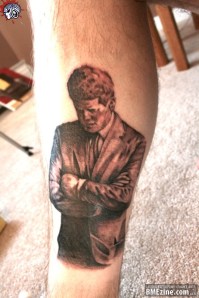 1964. The focus has been on the Paul-Christie rift.
As Republicans continue to sort through their future, having lost the popular vote for president in five of the last six elections, they are having intramural battles with echoes of 1964, when Barry Goldwater won the nomination at a convention rife with division over the role of the U.S. in the world and civil rights at home. Derided as an extremist, he went on to lose to President Lyndon Johnson in a landslide.
Now, Republicans are squabbling over the National Security Agency surveillance program, immigration and gay marriage. The Christie-Paul rift last week highlighted the divide, with the governor calling the senator’s criticism of the NSA program “dangerous” and the Kentuckian responding that his critic must have forgotten the Bill of Rights.
“It’s always healthy to have discussions from different wings of the party as the party works on its identity going into the midterms,” said LaTourette, who chose not to seek re-election to Congress in 2012 citing the extreme positions among some of his Republican colleagues. “It wouldn’t be so healthy if this was next year or 2015 and the focus is on who the presidential nominee will be.
Martin Luther King III has a written a book on what it meant to grow up the footsteps of his father. Even better, you can get it to read with your child or grandchildren because it is written for children!! You can read about or listen to an NPR interview with King here.
Martin Luther King III recounts this and other stories from his childhood in his new children’s book, My Daddy, Dr. Martin Luther King, Jr. Martin Luther King III had been thinking about writing about his child’s-eye view of his father for almost a decade, but the 50th anniversary of the March on Washington became a personal deadline. The book, written for young children, has just been published, three weeks ahead of the anniversary.
Now Martin Luther King III and his wife, Andrea, have a 5-year-old daughter, Yolanda Renée. She was named for Martin Luther King III’s oldest sister, who died suddenly in 2006. In the book, young Martin Luther King III tells readers about the games he played with his father.
Martin Luther King III also retells stories of accompanying his father on marches from time to time. On one, they were confronted by a police officer “with a huge dog that growled at me. I was terrified.” That is, he was scared until his dad took his hand and told him they would be fine.
“I felt safe. My dad was not a tall man, but he always made me feel like he was a giant. I was never afraid when I was with him,” Martin Luther King III writes.
Long after his father’s death, Martin Luther King III has had to deal with others’ expectations that he would take up the cause. King is deeply grateful that decades ago, his mother relieved him of some of that pressure.
“You don’t have to be your father,” Coretta Scott King told him. “Just be your best self, whatever that is. We are going to support you.”
This has to be the worst use of tax dollars that I’ve seen in years. A report shows State-Funded Crisis Pregnancy Centers Talk Women Out Of Birth Control and Condoms. Is this really the way to prevent unwanted pregnancies and abortions?
When a woman walked into a state-funded “crisis pregnancy center” in Manassas, Va., this summer and told the counselor she might be pregnant, she was told that condoms don’t actually prevent STDs and that birth control frequently causes hair loss, memory loss, headaches, weight gain, fatal blood clots and breast cancer.
“The first three ingredients in the birth control pill are carcinogens,” the CPC counselor said, adding that she always tries to talk women out of taking it.
The counselor also told the woman that condoms are not effective at preventing pregnancy or sexually transmitted diseases because they are “naturally porous.”
“Safe sex is a joke,” she said. “There’s no such thing.”
NARAL Pro-Choice Virginia recorded the exchange, released Wednesday, as part of its undercover investigation into the 58 state-funded “crisis pregnancy centers” in Virginia. The organizations are part of a national network of about 2,500 Christian centers that advertise health and pregnancy services, but do not offer abortions, contraception or prenatal care. Instead, they are intended to talk women out of having abortions and to advocate abstinence until marriage.
These organizations receive state money through the sale of “Choose Life” license plates at the Virginia Department of Motor Vehicles. Ken Cuccinelli, Virginia’s Republican gubernatorial candidate, sponsored the legislation that established that fundraising system during his time in the state senate.
NARAL sent undercover women into several crisis pregnancy centers throughout Virginia and recorded their interactions. The investigation revealed that 71 percent of the CPCs in Virginia give out medically inaccurate information about the health consequences and effectiveness of birth control, condoms and abortion.
According to the report, in addition to criticizing the use of birth control and condoms, 40 of the CPCs told women that abortion causes long-term psychological damage and leads women to develop eating disorders and drug addictions. One counselor allegedly told NARAL’s undercover investigator that if she was a certain blood type, the abortion could cause her body to create antibodies that would attack her fetus the next time she tried to get pregnant.
Greg Mitchell recalls interviewing the man that dropped the A-Bomb on Hiroshima in this blog post.
Paul W. Tibbets, pilot of the plane, the “Enola Gay” (named for his mother), which dropped the atomic bomb over Hiroshima on August 6, 1945. died at 92 in 2007, defending the bombing to the end of his life. Some of the obits noted that he had requested no funeral or headstone for his grave, not wishing to create an opportunity for protestors to gather.
I had a chance to interview Tibbets nearly 30 years ago, and wrote about it for several newspapers and magazines and in the book I wrote with Robert Jay Lifton, Hiroshima in America.
The hook for the interview was this: While spending a month in Japan on a grant in 1984, I met a man named Akihiro Takahashi. He was one of the many child victims of the atomic attack, but unlike most of them, he survived (though with horrific burns and other injuries), and grew up to become a director of the memorial museum in Hiroshima. The August 6 bombing led to the deaths of at least 75,000 people in a flash and at least that many more in the days and years that followed. At least 90% of them were civilians, mainly women and children.
Takahashi showed me personal letters to and from Tibbets, which had led to a remarkable meeting between the two elderly men in Washington, D.C. At that recent meeting, Takahashi expressed forgiveness, admitted Japan?s aggression and cruelty in the war, and then pressed Tibbets to acknowledge that the indiscriminate bombing of civilians was always wrong.
But the pilot (who had not met one of the Japanese survivors previously) was non-committal in his response, while volunteering that wars were a very bad idea in the nuclear age. Takahashi swore he saw a tear in the corner of one of Tibbets’ eyes.
So, on May 6, 1985, I called Tibbets at his office at Executive Jet Aviation in Columbus, Ohio, and in surprisingly short order, he got on the horn. He confirmed the meeting with Takahashi (he agreed to do that only out of “courtesy”) and most of the details, but scoffed at the notion of shedding any tears over the bombing. That was, in fact, “bullshit.”
“I’ve got a standard answer on that,” he informed me, referring to guilt. “I felt nothing about i.” .I’m sorry for Takahashi and the others who got burned up down there, but I felt sorry for those who died at Pearl Harbor, too….People get mad when I say this but — it was as impersonal as could be. There wasn’t anything personal as far as I?m concerned, so I had no personal part in it.“It wasn’t my decision to make morally, one way or another. I did what I was told — I didn’t invent the bomb, I just dropped the damn thing. It was a success, and that’s where I?ve left it. I can assure you that I sleep just as peacefully as anybody can sleep.” When August 6 rolled around each year “sometimes people have to tell me. To me it’s just another day.”
So, we have a few Texas Sky Dancers here. This Guardian article on Texas being all Oil and no Water is kind’ve frightening.
Beverly McGuire saw the warning signs before the town well went dry: sand in the toilet bowl, the sputter of air in the tap, a pump working overtime to no effect. But it still did not prepare her for the night last month when she turned on the tap and discovered the tiny town where she had made her home for 35 years was out of water.
“The day that we ran out of water I turned on my faucet and nothing was there and at that moment I knew the whole of Barnhart was down the tubes,” she said, blinking back tears. “I went: ‘dear God help us. That was the first thought that came to mind.”
Across the south-west, residents of small communities like Barnhart are confronting the reality that something as basic as running water, as unthinking as turning on a tap, can no longer be taken for granted.
Three years of drought, decades of overuse and now the oil industry’s outsize demands on water for fracking are running down reservoirs and underground aquifers. And climate change is making things worse.
In Texas alone, about 30 communities could run out of water by the end of the year, according to the Texas Commission on Environmental Quality.
Nearly 15 million people are living under some form of water rationing, barred from freely sprinkling their lawns or refilling their swimming pools. In Barnhart’s case, the well appears to have run dry because the water was being extracted for shale gas fracking.
The town — a gas station, a community hall and a taco truck – sits in the midst of the great Texan oil rush, on the eastern edge of the Permian basin.
A few years ago, it seemed like a place on the way out. Now McGuire said she can see nine oil wells from her back porch, and there are dozens of RVs parked outside town, full of oil workers.
But soon after the first frack trucks pulled up two years ago, the well on McGuire’s property ran dry.
No-one in Barnhart paid much attention at the time, and McGuire hooked up to the town’s central water supply. “Everyone just said: ‘too bad’. Well now it’s all going dry,” McGuire said.
Ranchers dumped most of their herds. Cotton farmers lost up to half their crops. The extra draw down, coupled with drought, made it impossible for local ranchers to feed and water their herds, said Buck Owens. In a good year, Owens used to run 500 cattle and up to 8,000 goats on his 7,689 leased hectares (19,000 acres). Now he’s down to a few hundred goats.
The drought undoubtedly took its toll but Owens reserved his anger for the contractors who drilled 104 water wells on his leased land, to supply the oil companies.
So, what is on your reading and blogging list today?
Monday Reads
Posted: January 21, 2013 Filed under: morning reads | Tags: Barrack Obama, Martin Luther King, Obama inauguration 68 Comments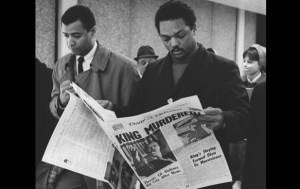 Good Morning!Today is the day we remember Martin Luther King and it’s the day for the formal inauguration ceremony for President Barack Obama.
John Nichols–writing at The Nation–believes that “This President Can—and Must—Claim a Mandate to Govern“.
With his second inauguration, Barack Obama will become the first president since Dwight Eisenhower to renew his tenure after having won more than 51 percent of the vote in two consecutive elections.
More importantly, in a political sense, he will be the first Democrat since Franklin Delano Roosevelt to have won mandates from the majority of the American people in two consecutive elections.
This is the perspective that Americans should bring to the inaugural festivities. We should expect a great deal from Barack Obama. Despite four years of battering by Fox and Limbaugh and the Tea Party and Mitch McConnell, he has been re-elected with a higher percentage of the popular vote than John Kennedy in 1960, Richard Nixon in 1968, Jimmy Carter in 1976, Ronald Reagan in 1980, Bill Clinton in 1992 or 1996 or George Bush in 2000 or 2004.
Obama’s mandate extends beyond himself. His party has increased its Senate majority and Democrats earned 1.4 million more votes in House races than Republicans. Gerrymandering and money kept Republican control of the House, but that opposition party is in such disarray that the president really does have an opening to make something of his mandate.
Obama must seize that opportunity as an essential part of making the case for bold executive orders and a bold legislative agenda that will bring not just the hope but the change he promised in what now seems like a very distant 2008 campaign. The president has in the transition period since the 2012 election displayed a willingness to push harder, to go bigger, and it has yielded significant progress not just on gun-safety issues but in the long struggle against the Republican austerity agenda that makes a diety of deregulating away consumer and environmental protections, tearing the social safety net and cutting taxes for wealthy campaign donors.
To consolidate that progress, and to assure that his second term will be as visionary and activist as his 2012 campaign promised, Obama must, like FDR, use every opportunity to give voice to the agenda- not just in his inaugural address but in his February 12 (Lincoln’s Birthday) State of the Union address.
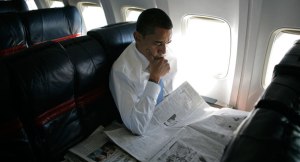
Many things have become political footballs these days. The bodies, abuse, and rape of women. The idea that taxpayer money should be used to support religious indoctrination or profiting from educating our children. Even Science, so much at the center of a lot things we were proud of in the 20th century,has become political. Are there any dangers in this? Dr. Puneet Opal presents his case at The Atlantic.
Over the past few years, and particularly in the past few months, there seems to be a growing gulf between U.S Republicans and science. Indeed, by some polls only 6 percent of scientists are Republican, and in the recent U.S. Presidential election, 68 science Nobel Prize winners endorsed the Democratic nominee Barack Obama over the Republican candidate Mitt Romney.
As a scientist myself, this provokes the question: What are the reasons for this apparent tilt?
Some of this unease might be because of the feeling that the Republicans might cut federal science spending. The notion is certainly not helped by news-making rhetoric of some Republicans against evolution in favor of creationism; unsubstantiated claims that immunization aimed at preventing future cervical cancer cause mental retardation in young girls; and unscientific views of how the female body can prevent pregnancies under conditions of rape.
These comments might represent heartfelt beliefs of the leaders in question; however, some might simply be statements designed to placate the anti-science sections of their base, as part of the political calculus.
A recent opinion in the leading science journal Nature, written by Daniel Sarewitz, a co-director of the Consortium for Science Policy and Outcomes at Arizona State University, suggests that this polarization of scientists away from the Republicans is bad news. Surprisingly — as he tells it — most of the bad news is the potential impact on scientists. Why? Because scientists, he believes — once perceived by Republicans to be a Democratic interest group — will lose bipartisan support for federal science funding. In other words, they will be threatened with funding cuts. Moreover, when they attempt to give their expert knowledge for policy decisions, conservatives will choose to ignore the evidence, claiming a liberal bias.
The comments of Sarewitz might be considered paranoid thinking on the part of a policy wonk, but he backs up his statement by suggesting a precedent: the social sciences, he feels, have already received this treatment at the hands of conservatives in government by making pointed fingers at their funding. Therefore he says that a sufficient number of scientists must be seen to also support Republicans for the sake of being bipartisan. To be fair to Republicans, no politician has actually targeted science funding in this vindictive manner. But this assessment only goes to show how science is quickly becoming a political football.
I would argue that this sort of thinking might well be bad for scientists, but is simply dangerous for the country. As professionals, scientists should not be put into a subservient place by politicians and ideologues. They should never be felt that their advice might well be attached to carrots or sticks.
Democratic Economists outnumber Republicans by 2.5 to 1. No wonder many Republicans home school their children and use specious textbooks.
The President was sworn in quietly on Sunday on the day mandated by the Constitution.
With only his family beside him, Barack Hussein Obama was sworn into office for a second term on Sunday in advance of Monday’s public pomp, facing a bitterly divided government at home and persistent threats abroad that inhibit his effort to redefine America’s use of power.
It was a brief and intimate moment in the White House, held because of a quirk of the calendar that placed the constitutionally mandated start of the new term on a Sunday.
But the low-key event seemed to capture tempered expectations after four years of economic troubles and near-constant partisan confrontation. And it presaged a formal inauguration on Monday that will be less of a spectacle than the first one, when the nation’s first black president embodied hope and change for many Americans at a time of financial struggle and war.
For Monday’s festivities, with the traditional parade, balls and not least the re-enacted swearing-in outside the Capitol, there will be fewer parties and fewer people swarming the National Mall; organizers expect less than half the 1.8 million people who flocked to the city last time.
Once the parties end, Mr. Obama’s second-term challenges are formidable, not least given his ambitious priorities of addressing the national debt, illegal immigration and gun violence.
The economy, while recovering steadily, remains fragile. The unemployment rate is as high as it was in January 2009, though it is down from the 10 percent peak reached late that year, and there is no consensus with Republicans about additional stimulus measures — or virtually anything else.
And as the terrorist attack in Algeria last week illustrated, Mr. Obama continues to confront threats around the globe, both from state actors like Iran and North Korea and from Qaeda-inspired extremists seeking to exploit power vacuums in the Mideast and across Africa and Asia.
It’s been 50 years since Dr. Martin Luther King delivered his “I’ve Got a Dream” Speech.
The speech he delivered the next day — Aug. 28, 1963 — rocked the nation, as King challenged America to live up to the ideas of justice and equality it professed to cherish.
Fifty years later, the “I Have A Dream” speech is still widely regarded as the most powerful and significant speech of the 20th Century.
As the nation celebrates King’s birthday today, the speech itself is being remembered and celebrated in Detroit — which got the first glimpse of the speech — and across the nation.
King speechwriter Clarence B. Jones, who was one of those advisers on the speech, will be the featured speaker at a program today in Ann Arbor and two programs open to the public in Detroit on Tuesday.
Jones, scholar in residence at the Martin Luther King Jr. Research & Education Institute at Stanford University, helped draft parts of the speech and was on stage with King when he delivered it in Washington.
Jones believes the riveting crescendo of the speech was God-given.
He said he remembers gospel singer Mahalia Jackson, also on stage, telling King, “Tell them about the dream, Martin. Tell them about the dream,” said Jones during a recent telephone conversation. “He pushed the written text aside and started speaking from the heart. It was like he had become possessed, like someone had taken over his body. It was electrifying.”
It wasn’t just what he was saying, but the powerful delivery that stirred the nation’s moral conscience, Jones said.
“The speech tapped into the very core values of who we were supposed to be as a country,” Jones said. “He was speaking prophetically about what America could be if it lived out the principles of the Declaration of Independence. Everybody who heard it, black or white, segregationists or integrationists, everybody knew he was speaking the truth.”
It’s hard to think about what life was like for those black Americans living in the Jim Crow South before the work of people like Dr. King and Miss Rosa Parks. Here’s Dr King Speaking about the Bus Boycott in Selma in 1955. You can find a collection of historical videos on the struggle for racial equality here.
It’s good that we have a day to reflect on all of those things–both good and bad–that make up American History. Have a wonderful holiday!

 peej
peej Carissa
 bostonboomer
 dakinikat
 ecocatwoman
 mablue2
 Mama Lopez
 peggysue22
 quixote
 skydancingguestblogger
 Mona (aka Wonk the Vote)



 Sky Dancing
Recent Comments