Posted: August 24, 2024 | Author: bostonboomer | Filed under: 2024 presidential Campaign, cat art, caturday, Donald Trump, Kamala Harris 2024 | Tags: Democratic National Convention 2024, Greg Palast, Kurt Andersen, Robert F. Kennedy Jr., Tim Walz |
Happy Caturday!!
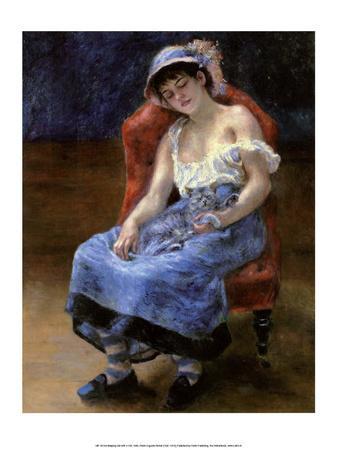
Piere Auguste Renoir, Sleeping girl with a cat, 1880
There’s not a lot happening in the news today, so I’m just going to give you some odds and ends, some some serious some humorous, some creepy or crazy.
First up, a few follow-ups to the exciting and successful Democratic National Convention.
Al Weaver at The Hill: Democratic convention energy, Harris hot streak making Republicans nervous.
The energy emerging from the Democratic National Convention and Vice President Harris’s hot streak is making Republicans increasingly nervous.
Thursday marked the culmination of what was unthinkable just a month ago: A coronation for a new party leader who Democrats are ardently behind.
Former President Trump and Republicans, meanwhile, are grappling with the whiplash of going from the predictions of a landslide just a few short weeks ago to surveys showing Harris has shaken up races up and down the ballot and closed the gap with Trump.
“In some of the swing states … people are becoming increasingly concerned that the momentum is moving in the wrong direction,” said one Senate Republican, adding that the nervousness among Republicans is “real” at this stage.
Just a month ago, Republicans were riding higher than at any point of the campaign after President Biden’s disastrous performance in a debate sent Democrats into a tailspin. Trump accepted the GOP nomination in Milwaukee, where lawmakers and delegates were bullish that the former president would not only return to the White House, but do so in a convincing manner — and polling backed them up.
Now that thinking is firmly out the door.
Democrats’ four-day gathering in Chicago prompted comparisons to the energy around former President Obama’s landmark 2008 presidential bid. It could also hand Harris another slight polling bump as the calendar turns to September after she closed out the convention with a fiery speech heavy on biography and history that also took the fight to Trump.
“They are beginning to realize this is a wrestling match. There’s not going to be any knockout punch and they’ve got to get the best grip they can find, and it’s all state specific,” the Senate Republican continued.
Greg Sargent at The New Republic: Kamala’s Harsh Takedown of Trump Points the Way to a Post-MAGA America.
Kamala Harris just showed us the promise of a post-MAGA future. Now it’s up to the voters to decide to take us there.
In her rousing convention speech on Thursday, Harris offered many olive branches to right-leaning independents and Republican voters. She vowed toughness on immigration and crime. She promised to transcend the nation’s divisions. She vowed to govern for all Americans and transcend faction or party. She made numerous appeals to voters with decidedly right-leaning values.
But, in mulling what Harris means by all this, it’s crucial to appreciate what she did not do. Harris offered all this outreach to voters outside the core Democratic coalition without making serious concessions to the ideological preoccupations we associate with MAGA-style right-wing populism. There was no real accommodation with what might be called The World According to MAGA.
Instead, Harris treated Trumpism and the MAGA movement as forces that must be decisively repudiated—and unequivocally left behind.
How could Harris appeal extensively to voters on the other side—which by definition includes tens of millions of people who voted for Donald Trump—while insisting on a firm national renunciation of many MAGA voters’ apparent aspirations and beliefs? This tension, I think, helps explain why her appeals came across as so richly complex.
Harris extensively reassured swing voters on many fronts. For those struggling economically, she offered populist, broadly appealing policies to curb health care and housing costs. To those preoccupied with crime and the border, Harris recounted her history as a tough prosecutor and vowed stringent border security. Harris delivered extensive paeans to middle-class struggles and values like family, community, homeownership, and faith. As William Kristol notes, she even strongly endorsed American exceptionalism.
Yet Harris was also absolutely unsparing in her takedown of Trump. And it’s important to appreciate this criticism for what it really was. In numerous ways, Harris portrayed the broad MAGA worldview as something in need of comprehensive repudiation.
It’s a long piece. You’ll need to head over to TNR to read the rest of Sargent’s argument.
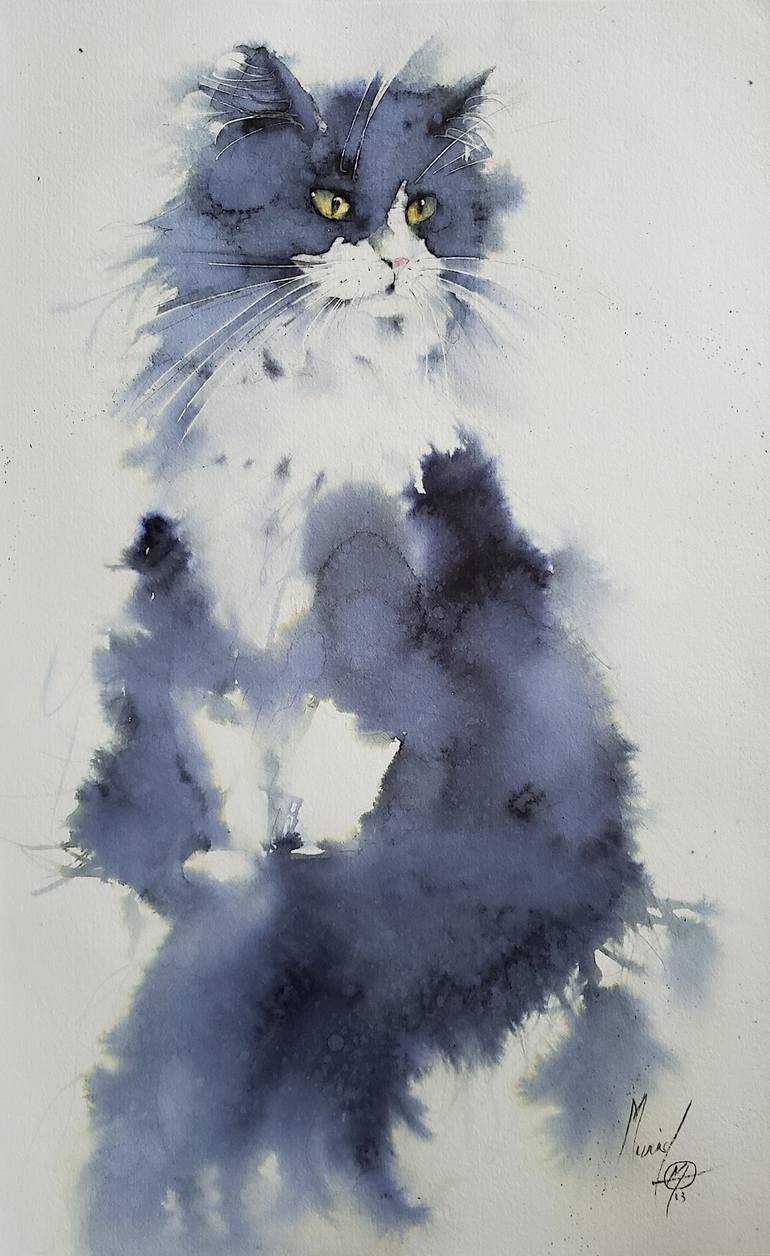
Black and White Cat II, by Muriel Mougeolle
Could the tide be turning on Republicans’ efforts to control what children read and think?
Juan Perez Jr. and Andrew Atterbury at Politico: Are Republicans losing the culture wars?
Republicans are confronting a decisive moment in the battle over public education: proving they can still win a culture war.
School board candidates backed by Moms for Liberty, a conservative vanguard whose members popularized restrictions on classroom library books, are losing elections in Florida and some swing states. Republican leaders who rallied against critical race theory and LGBTQ+ issues recently faced recalls in red pockets of California.
And in the presidential race, Democrats are playing offense. This week’s party convention in Chicago featured liberals attacking conservative candidates as “weird” and denouncing so-called book bans.
Former President Donald Trump is expected to lean into school politics next week at a Moms for Liberty summit, making the case that culture war issues still resonate with core supporters. Republicans show no signs of changing their strategy. But the party faces new challenges from a Democratic agenda — embodied by vice presidential nominee Tim Walz — that is redirecting the divisive education issues promoted by conservatives during the pandemic into a vehicle for highlighting free school lunches and affordable child care.
“We’re in the middle of a cultural revolution in America, and one of the biggest battlegrounds is the schools,” Moms For Liberty co-founder Tiffany Justice said in an interview. “We didn’t start this fire, but we’re going to put it out.”
Karoline Leavitt, a Trump campaign spokesperson, said there is “a lot of mutual consensus” between the Republican nominee’s beliefs on education “and what Moms for Liberty stands for.”
But several Democratic National Committee speakers found ways to leverage social issues, including Walz, a former teacher who used them to pivot to a law he signed as Minnesota governor providing free school meals to all students.
“We made sure that every kid in our state gets breakfast and lunch every day,” Walz said Wednesday at the DNC. “So while other states were banning books from their schools, we were banishing hunger from ours.”
Read the rest at Politico.
Here’s the latest on Trump’s reaction to the changed political landscape.
The Guardian: Is Trump OK? Unhinged reaction to rise of Harris worries supporters.
Even some of Donald Trump’s supporters are now asking the question that was the undoing of Joe Biden: is the former president fit for office?
But while Biden’s run for re-election was largely sunk by a single disastrous televised debate before a national audience, Trump is ramping up doubts with each chaotic, disjointed speech as he campaigns around the country.
While rambling discourse and outrageously disprovable claims, interspersed with spite and vitriol, may seem nothing new to many of Trump’s supporters and critics alike, the former president appears to have been driven to new depths by suddenly finding himself running against Kamala Harris a month ago.
Trump has only grown more infuriated as his poll lead over Biden evaporated, with Harris opening up a clear, if narrow, lead. The vice-president’s tactic of mocking Trump more than arguing with him appears to have incensed him further.
Since Harris assumed the mantle of the presumptive Democratic candidate, Trump has claimed to be better-looking than the vice-president, questioned whether she is really Black and attacked her laugh as that of “a lunatic”.
The former president has also characterised Harris as both a communist and a fascist, and described Harris as “dumb” but then told CBS he didn’t mean it as an insult because it was “just a fact”.
“I don’t think she’s a very bright person. I do feel that. I mean, I think that’s right. I think I am a very bright person, and a lot of people say that,” he said.
This is a long article, so here’s a bit more:
Trump seems particularly obsessed with the size of the crowds at Harris’s rallies, drawing derision for falsely claiming she used artificial intelligence to fake the turnout.
When he’s not worried about size, Trump is vexed by Harris’s looks. After the vice-president appeared on the cover of Time magazine, Trump compared her appearance to Sophia Loren and his wife, Melania, before drawing a comparison with his own features.

By Pierre Bonnard
“I’m a better-looking person than Kamala,” he declared to an audience of thousands who were more amused than convinced….
At a rally in Pennsylvania a week ago, Trump went as far as rambling on about rambling.
“I don’t ramble. I’m a really smart guy, you know, really smart. I don’t ramble. But the other day, anytime I hit too hard, they say he was rambling, rambling,” he told the crowd.
Even some of Trump’s most loyal fans were disturbed by that performance. Joan Long travelled from New York with her husband, Billy, to see the former president speak.
“I honestly can’t say I know why he starts talking about how to pronounce names. What does that have to do with the election?” she said. “And I wish he would stop talking about Kamala’s looks.”
There’s quite a bit more in this vein at the Guardian link. This is the kind of insanity from Trump that the NYT and WaPo ignore or try to normalize.
The supposedly big news yesterday was that Bobby Kennedy Jr. suspended his campaign and endorsed Trump at a rally in Arizona.
John Hendrickson at The Atlantic: Why RFK Jr. Endorsed Trump.
In the spring of 2023, not long after Robert F. Kennedy Jr. launched his chaotic presidential campaign, I asked him a straightforward question. What do you see as more harmful to America: another term of Joe Biden, or Donald Trump returning to power? “I can’t answer that,” Kennedy replied.
This morning, Kennedy finally stopped being cagey. He announced that he was suspending his campaign and throwing his support to Trump. During a rambling, nearly hour-long speech at the Renaissance Hotel in downtown Phoenix, Kennedy shared that the two had been talking for more than a month, and that he had visited the former president at Mar-a-Lago. “In a series of long, intense discussions, I was surprised to discover that we are aligned on many key issues,” Kennedy said. He correctly noted that his announcement would cause “difficulty” for his family members. “Our brother Bobby’s decision to endorse Trump today is a betrayal of the values that our father and family hold most dear,” five Kennedys said in a statement this afternoon. “It is a sad ending to a sad story.”
Kennedy’s evolution from member of a Democratic dynasty to a soldier in the anti-democratic MAGA movement will no doubt confuse casual observers. Trump once called Kennedy the “dumbest member” of his famous family, and Kennedy once suggested that Trump was a sociopath. The main reason for Kennedy’s conversion may be pure desperation. This summer, Kennedy made overtures to both major-party candidates; only Trump reciprocated. But the Trump-Kennedy pairing makes a certain kind of sense. To be sure, Kennedy doesn’t share Trump’s anti-immigrant sentiment, nor does he lean on white-identity politics or nationalism. Instead, it’s Kennedy’s conspiratorial, anti-establishment, burn-it-down ethos that makes him fit into the MAGA universe….
As Kennedy lashed out against the Democratic Party this afternoon, he sounded like a jilted lover searching for answers. He noted that he had attended his first Democratic National Convention at the age of 6, in 1960. And he attempted to draw a contrast between the party of his father and uncle, and today’s “shadowy DNC operatives” who staged “a palace coup” against Joe Biden. The Democratic establishment, he claimed, had weaponized government agencies against him and his campaign. He accused Biden of colluding with media companies to “censor” him and bemoaned his relative lack of cable-news interviews. He also sounded daft. “In an honest system, I believe that I would have won the election,” Kennedy said.
Three key factors forced Kennedy’s withdrawal. The first and most obvious was money. Despite tapping Nicole Shanahan, the wealthy Silicon Valley businesswoman, to be his running mate, Kennedy’s fundraising had recently dried up. Recent FEC filings showed that his campaign had just $3.9 million on hand at the end of July. The second factor was ballot access. Nick Brana, the campaign’s ballot-access director, told me that, as of today, the Kennedy-Shanahan ticket was certified in only 22 states. Kennedy was disqualified from the New York ballot after a recent court case, making the goal of all 50 states a virtual impossibility. The third factor was perhaps the most obvious: His core proposition had become moot once Biden dropped out.
All along, Kennedy’s pitch had relied on the fact that a sizable chunk of voters didn’t want a Biden-Trump rematch. But after Harris took Biden’s place as the nominee, she began to win back some of the disaffected Democrats, independents, and undecideds who had “parked” their support in the Kennedy column. Kennedy’s polling average had fallen to about 5 percent, from a 2024 high of about 10 percent.

Intellectual cat, Olena Kamenetska-Ostapchuk
There’s been some suggestion that Trump may have promised Kennedy a job in Trump’s prospective administration in return for Kenedy’s support. That would be a quid pro quo, and would be illegal. Of course Trump couldn’t care less. Kennedy also tried to strike a bargain with the Harris campaign, but they refused to meet with him. Harris, unlike Trump, obviously knows that would be illegal.
Aaron Pellish and Jim Acosta, CNN: RFK Jr. reached out to Harris campaign about administration role in exchange for endorsement.
Independent presidential candidate Robert F. Kennedy Jr.’s campaign reached out to Vice President Kamala Harris’ campaign to arrange a meeting about a possible role in her administration if he drops out of the race and endorses her, a Kennedy campaign official and a Democratic official told CNN.
The approach from Kennedy’s team occurred last week, and no meeting between the two candidates materialized, the Kennedy campaign official told CNN.
The effort to meet comes weeks after Kennedy and former President Donald Trump met in person during the Republican National Convention in Milwaukee, where the two discussed a possible role for Kennedy in a potential Trump administration in exchange for an endorsement.
Kennedy campaign staff also attempted to reach out to intermediaries for Ron Klain, former White House chief of staff for President Joe Biden, but those efforts were fruitless, the Kennedy campaign official said.
A couple more RFK Jr. stories:
Kurt Andersen: RFK Jr. Was My Drug Dealer.
Donald Trump and Bobby Kennedy—as I’ve referred to Robert F. Kennedy Jr. since we met freshman year at Harvard—have always had many features in common as well. Both are entitled playboy sons of northeastern wealth; both (in Michelle Obama’s words) were “afforded the grace of failing forward” as misbehaving, underachieving adolescents admitted to Ivy League colleges thanks to “the affirmative action of generational wealth”; both were reckless lifelong adolescents, both attention-craving philanderers and liars, both jerks. And Kennedy’s hour-long speech today was nearly as meandering and filled with lies as any average hour of Trump.
On the subject of reckless-adolescent entitlement, I’ve got one Bobby Kennedy anecdote to tell. But it’s actually relevant to his endorsement of Donald Trump for president and his apparent expectation of joining a second Trump administration….

By Olga Sevorova
My Bobby Kennedy story involves pharmaceuticals—not the legal, lifesaving kind, such as the vaccines he’s made a career of lying about, but the recreational kind….
As a teenager in Nebraska, I’d smoked cannabis and dropped acid before I got to Harvard in 1972. Sometime during my freshman year, I tried cocaine, enjoyed it, and later decided to procure a gram for myself. A friend told me about a kid in our class who was selling coke.
The dealer was Bobby Kennedy. I’d never met him. I got in touch; he said sure, come over to his room in Hurlbut, his dorm, where I’d never been, a five-minute walk. His roommate, whom I knew, was the future journalist Peter Kaplan—with whom I, like Kennedy, remained friends for the rest of his life. He left as I arrived. I wondered whether he always did that when Bobby had customers.
“Hi. Bobby,” Kennedy introduced himself. Another kid, tall, lanky, and handsome, was in the room. “This is my brother Joe.” That is, Joseph P. Kennedy II, two years older, the future six-term Massachusetts congressman….
He poured out a line for me to sample, and handed me an inch-and-a-half length of plastic drinking straw. I snorted. We chatted for a minute. I paid him, I believe, $40 in cash. It was a lot of money, the equivalent of $300 today. But cocaine bought from a Kennedy accompanied by a Kennedy brother—the moment of glamour seemed worth it.
As soon as he got back to his dorm room, Anderson got a call from RFK:
“Hello?”
“It’s Bobby.”
“Hi.”
“You took my straw!”
I realized that I had indeed, and had thought nothing of it. Because … it was a crummy piece of plastic straw. But Bobby was pissed.
“There are crystals inside it, man, growing. You took it.”
Growing? The residue of powdered cocaine mixed with mucus formed crystals over time? What did I know. It reminded me of some science-fair project.
“So … you want the straw back?”
“Yeah, man.”
I walked it back to his room. He didn’t smile or say thanks. It was the last time I ever bought coke from anyone.
A famous rich boy selling a hard drug that could’ve gotten him—or, more precisely, someone who wasn’t him—a years-long prison sentence. His almost fetishistic obsession with a bit of plastic trash. His greedy little burst of anger cloaked in righteousness. His faith that he was cultivating precious cocaine crystals. In retrospect, it has seemed to me a tiny illustration of the child as the father of the man he became: fantastical pseudoscientific crusader, middle-aged preppy dick who takes selfies with barbecued dogs and plays pranks with roadkill bear cubs he didn’t have time to eat.
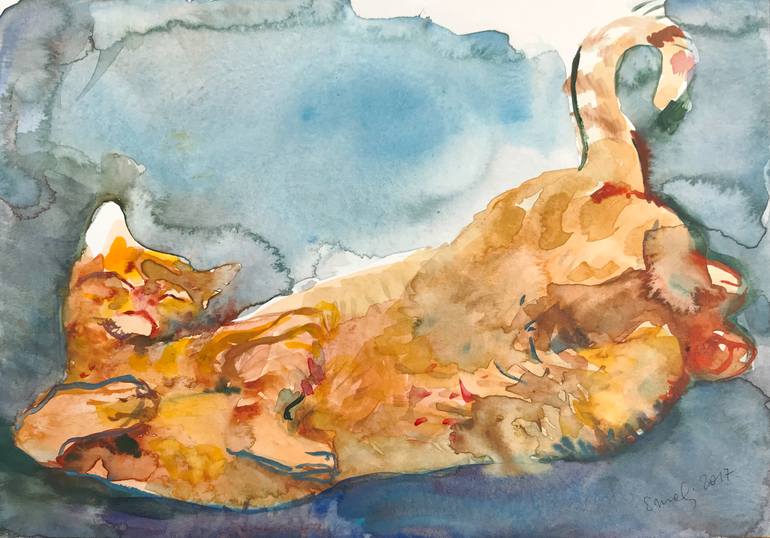
Thomas is Sleeping, by Grazyna Smalej
One more crazy RFK, Jr. story:
Greg Palast at his website Greg Palast Investigative Journalism: I was on the phone with RFK Jr.
When he lost his mind.
This is painful. This is horrible and feels a bit like a betrayal. But I have no choice. Bobby Kennedy Jr. was my friend and co-author. We wrote stories together for Rolling Stone. Bobby introduced my New York Times bestseller and wrote a chapter for Billionaires and Ballot Bandits. And, with Jesse Jackson, we co-authored the Number 1 selling adult single issue comic book of all time, Steal Back Your Vote.
But then, Bobby lost his mind.
It was truly scary. In 2012, Bobby had arranged a press conference about the Deepwater Horizon explosion. Eleven oil rig workers were incinerated in the blow-out of a British Petroleum drilling rig in the Gulf of Mexico.
The Palast investigations team discovered that, 17 months before that oil rig blew out in the Gulf, British Petroleum suffered an identical blow-out in the Caspian Sea. The oil company—with the connivance of then-Sec. of State Condoleeza Rice—covered it up.
It was a hell of a story, which I broadcast on prime time in Britain and Europe. I wrote a book about it, Vultures’ Picnic.
Here’s where Bobby comes in—and it gets weird. On the second anniversary of the blow-out, Bobby, a professor of environmental law, arranged for a major press conference to expose this story of BP’s blood-encrusted perfidy.
But then, Bobby cancelled the press conference, saying he heard the story had been told previously. Well, yes it had. You told it. Bobby, I was on the radio with you for an hour discussing the blow-out and its cover-up. Bobby had a national radio/TV show, Ring of Fire. He reviewed my book about the story. And strangest of all, Bobby was on my Democracy Now! Report about the blow-out. That Bobby had forgotten all these things was frightening—as if Leonardo DiCaprio had forgotten he was in a film about the Titanic.
Our investigator Leni Badpenny was listening in and she began making frantic cut-off gestures, to end a call with him. End it now! “Something’s wrong with him, or he’s just a jerk. I don’t know. But something’s really wrong and you don’t want your reputation destroyed by standing next to him when it goes wrong in public. Promise me we will never work with him, never see him again. I think he’s dangerous. I really do.” [….]
This was not the first incident. Bobby was a strong guy in his late fifties talking like a 92-year-old in a nursing home trying to remember his first date.
Since then, we’ve found out that Bobby had a worm in his brain—a real, live physical critter that somehow got inside his skull. I’m not sure about the connection because I’m not a brain surgeon and I don’t speak worm.
You can read the rest at the link. It’s not paywalled.
That’s it for me today. What’s on your mind?
Did you like this post? Please share it with your friends:




 peej
peej Carissa
 bostonboomer
 dakinikat
 ecocatwoman
 mablue2
 Mama Lopez
 peggysue22
 quixote
 skydancingguestblogger
 Mona (aka Wonk the Vote)



 Sky Dancing
Recent Comments