
Tuesday Reads: The Snowden Conundrum
Posted: July 9, 2013 Filed under: Foreign Affairs, morning reads, U.S. Politics | Tags: Barton Gellman, Bolivia, Booz Allen Hamilton, Dell, Edward Snowden, Glenn Greenwald, Jacob Applebaum, Julian Assange, Laura Poitras, Nicaragua, NSA, Pepe Escobar, Venezuela, Walter Pincus, Wikileaks 65 Comments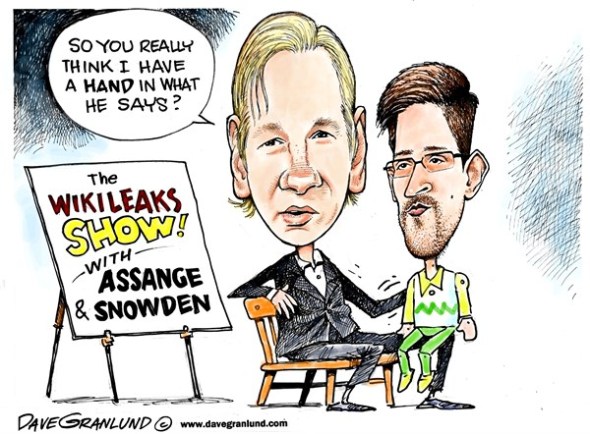
Good Morning!!
I’m going to focus on the Edward Snowden/NSA leaks story today, because there has been quite a bit of news breaking about it over the past few days.
As of this morning, Snowden hasn’t decided whether to accept one of the asylum offers made by three Latin American countries, Venezuela, Nicaragua, or Bolivia. From NBC News:
MOSCOW, Russia – The status of Edward Snowden’s bid for asylum in Venezuela remained unclear Tuesday after the country’s apparent deadline passed.
The Venezuelan Embassy in Moscow said it had no information on whether the fugitive NSA leaker had completed a deal that would allow him to leave the transit area of an airport in the Russian capital.
In Caracas, President Nicolas Maduro confirmed late Monday that Venezuela had received an official request for asylum from Snowden, telling reporters at a news conference that the self-declared leaker “will need to decide when he will fly here,” according to Russia Today.
Even if Snowden agrees an asylum deal with Venezuela, travel problems could take time to resolve: His U.S. passport has been canceled and U.S. allies may deny airspace to any flight on which he is believed to be traveling.
Venezuelan President Nicolas Maduro called on National Security Agency leaker Edward Snowden to decide if he wants to seek refuge in his country after the American reportedly sent an asylum request to Caracas.
Maduro told reporters at a press conference on Monday that the fugitive systems analyst must communicate his intent to accept Venezuela’s offer of asylum, The Wall Street Journal reported.
“He will have to say when he is flying here, if he definitely wants to come here,” Maduro was quoted as telling reporters.
He would probably have to take a private plane, which would be very expensive. Wikileaks is paying for Snowden’s expenses, but would they be able to spring for a private plane? Maybe. More on that in a minute.
One thing we know is very important to Snowden–internet access. One of the reasons he left Hong Kong for Moscow was his fear of not being able to get on the internet. From the Wall Street Journal on June 24:
A person familiar with Mr. Snowden’s case said his decision to get on a flight to Moscow was “very sudden,” made only in the day before departing. The decision was made in consultation with WikiLeaks, which encouraged Mr. Snowden to leave the city after communicating with others about his options abroad, the person said.
“He is very independent, but also very willing to listen to advice,” the person said, adding that Mr. Snowden was concerned that any further delay would result in his detainment by Hong Kong authorities. In part, Mr. Snowden’s determination to leave Hong Kong was based on the fear of losing access to the Internet—his vital link to the rest of the world—should he be detained, the person said. In part, Mr. Snowden’s determination to leave Hong Kong was based on the fear of losing access to the Internet—his vital link to the rest of the world—should he be detained, the person said.
Now Snowden is considering going to one of three countries that have limited access to the internet, according to an article by Alex Halperin at Salon. Venezuela is the best choice, with 40% of the population having internet connections. In Bolivia, it’s 30%, and in Nicaragua only 10.6%.
The Daily Beast has an article on “Wikileaks’ Money Trail” today.
Thankfully for WikiLeaks, its latest cause célèbre, Edward Snowden, is raking in some much-needed cash for the whistle-blowing organization. Snowden sympathizers have been donating generously since WikiLeaks decided to take on the NSA leaker’s case—and the organization desperately needs every dollar it can raise to stay in the black and pay for the legal fees and living costs of founder Julian Assange and now Snowden.
The money WikiLeaks has raised—nearly $90,000 in 2012, with about $1,300 coming in each day since it took Snowden under its wing—comes from people around the world, some of whom give just a few dollars to do their part in making the world a more transparent place.Assange and his team still say they need a lot more than they raise, and the organization always seems to be in the red. WikiLeaks’s operating budget was $510,197 in 2012, which is serious money, considering it is a simple .org with a staff of three paid software developers.
A look into how WikiLeaks is funded and how its money is spent reveals an irony that Assange has acknowledged: an organization dedicated to uncovering the truth keeps its finances intentionally complicated, and it’s next to impossible for donors to find out how their money is processed and where it goes.
Much more at the link. It doesn’t sound like Wikileaks would be able to fund a private plane flight, but maybe some wealthy person like Michael Moore would come through with the big bucks.
More of Snowden’s leaks about U.S. intelligence activities in other countries have been published over the past few days by Glenn Greenwald and Laura Poitras. Greenwald published a report of Snowden’s allegations of U.S. spying in Brazil that appeared in the Guardian and in the Brazilian paper El Globo, and a report on US collaboration with Australia in collecting data was published by the Sydney Morning Herald. Snowden also released a top secret map of sites in a number of countries that collaborate with NSA in collecting intelligence data.
IMHO, it’s likely that Snowden is giving information to countries he’d like to go to. Greenwald lives in Brazil, and Wikileaks’ Julian Assange is from Australia. I say this, because Greenwald explained on Twitter that Snowden revealed classified documents in Hong Kong and in order to gain friendly treatment by the government.
The most revealing recent stories have been published by Der Spiegel, which has been given access to some of the documents Snowden stole from NSA. The latest Der Spiegel piece included a blockbuster revelation. The German magazine published a previously unknown interview with Snowden that was conducted by Laura Poitras and Jacob Applebaum in mid-May, before Snowden left Hawaii for Hong Kong.
This is stunning news, because Applebaum’s name has never been mentioned in connection with the Snowden story until now, although he (Applebaum) has been very visible on Twitter defending Snowden and hyping Greenwald’s articles.
Applebaum is a well known hacker who has been prominently associated with Julian Assange and Wikileaks. He is one of the founders of the Tor network , which promotes encryption method to help people and organizations maintain anonymity on the internet. Although he acknowledges that Tor could be giving aid an comfort to criminals such as child pornographers, he believes that privacy rights take precedence over such concerns.
Both Poitras and Applebaum have come to the attention of the U.S. government and both have been stopped and harassed on return flights to the U.S. from other countries.
Shortly before he became a household name around the world as a whistleblower, Edward Snowden answered a comprehensive list of questions. They originated from Jacob Appelbaum, 30, a developer of encryption and security software. Appelbaum provides training to international human rights groups and journalists on how to use the Internet anonymously.
Appelbaum first became more broadly known to the public after he spoke on behalf of WikiLeaks founder Julian Assange at a hacker conference in New York in 2010. Together with Assange and other co-authors, Appelbaum recently released a compilation of interviews in book form under the title “Cypherpunks: Freedom and the Future of the Internet.”
Applebaum explains how he got involved.
“In mid-May, documentary filmmaker Laura Poitras contacted me,” Appelbaum said. “She told me she was in contact with a possible anonymous National Security Agency (NSA) source who had agreed to be interviewed by her.”
“She was in the process of putting questions together and thought that asking some specific technical questions was an important part of the source verification process. One of the goals was to determine whether we were really dealing with an NSA whistleblower. I had deep concerns of COINTELPRO-style entrapment. We sent our securely encrypted questions to our source. I had no knowledge of Edward Snowden’s identity before he was revealed to the world in Hong Kong. He also didn’t know who I was. I expected that when the anonymity was removed, we would find a man in his sixties.”
Please note the timeline: Poitras says Snowden contacted her in January, and Greenwald says he began working with Poitras and Snowden in February. Poitras also contacted Barton Gellman of the Washington Post in February–apparently without Greenwald’s knowlege. At some point Snowden was working for NSA as a Dell contractor, but he quit this job in order to get one at Booz Allen, where he would have access to more top secret information about U.S. spy facilities around the world. He took the job with Booz Allen sometime in March and went to a training course back in the U.S. that lasted a couple of months. According to Booz Allen, Snowden was employed by them for less than three months and was only on the job in Hawaii for about three weeks, during which time he stole four laptops full of classified documents.
There’s no doubt this operation was premeditated; Snowden admitted that in an interview with the South China Morning Post. The only real questions are whether it was initiated or aided by Julian Assange and Wikileaks and whether Jacob Applebaum aided Snowden in hacking into NSA computers. I’m not ready to argue that yet; but these new revelations, along with the fact that Wikileaks seems to have taken over communications with Snowden are certainly suggestive.
Here’s another possible piece of the timeline. In December 2012, Glenn Greenwald and some of his close friends started an organization called Freedom of the Press Foundation. Others on the board of directors of the foundation besides Greenwald are Laura Poitras and Daniel Ellsberg. According to their website, their purpose is to raise funds to support “public interest journalism.” Their criteria for choosing news organization to support is as follows:
Record of engaging in transparency journalism or supporting it in a material way, including support for whistleblowers.
Public interest agenda.
Organizations or individuals under attack for engaging in transparency journalism.
Need for support. The foundation’s goal is to prioritize support for organizations and individuals who are in need of funding or who face obstacles to gaining support on their own.
At the top of the list of organizations they support is Wikileaks.
Please note that I’m not yet proposing some grand conspiracy theory here. I’m just laying out the facts as I know them so far and connecting some dots. But some people are suggesting Wikileaks could have directed this operation. I was very surprised to see this article by Walter Pincus at the Washington Post yesterday: Questions for Snowden. Basically Pincus connected some dots and is asking some of the same questions I am asking. I’m going to excerpt a little more than I normally would from the Pincus piece. He writes:
Was he [Snowden] encouraged or directed by WikiLeaks personnel or others to take the job as part of a broader plan to expose NSA operations to selected journalists?
In the case of Pfc. Bradley Manning, the U.S. soldier on trial for disclosing thousands of classified documents to WikiLeaks, it was Julian Assange and his organization who directed the collection of documents, U.S. prosecutors have alleged. While Manning’s lawyers contend there is no evidence to support that finding, prosecutors have said there are hundreds of chats between Manning and Assange and WikiLeaks lists of desired material.
In Manning’s case, WikiLeaks and its founder, Assange, determined the news organizations that initially would receive the materials.
Pincus wants to know how Snowden decided to leak to Poitras, Greenwald, and Gellman.
Did Assange and WikiLeaks personnel help or direct Snowden to those journalists?
Poitras and Greenwald have had close connections with Assange and WikiLeaks. In December 2010, Greenwald said of the British arrest of Assange: “Whatever you think of WikiLeaks, they have not been charged with a crime, let alone indicted or convicted. Yet look what has happened to them. They have been removed from [the] Internet . . . their funds have been frozen . . . media figures and politicians have called for their assassination and to be labeled a terrorist organization.”
In a June 2012 Guardian column, Greenwald wrote, “As a foreign national accused of harming U.S. national security, he [Assange] has every reason to want to avoid ending up in the travesty known as the American judicial system.”
On April 10, 2012, Greenwald wrote for the WikiLeaks Press’s blog about Poitras and WikiLeaks being targeted by U.S. government officials.
Pincus also suggests that Julian Assange knew the contents of Glenn Greenwald’s first article on Snowden’s leaks.
Poitras has been working on a film on post-9/11 America, with a focus on the NSA and in which Assange and WikiLeaks are participating. Assange confirmed this in a May 29 interview on Democracy Now’s Web site.
In that same interview, Assange previewed the first Greenwald Guardian story based on Snowden documents that landed a week later. Speaking from Ecuador’s embassy in London, Assange described how NSA had been collecting “all the calling records of the United States, every record of everyone calling everyone over years. . . . Those calling records already [are] entered into the national security complex.”
Did he know ahead of time of that Guardian story describing the U.S. court order permitting NSA’s collection of the telephone toll records of millions of American Verizon customers and storing them for years?
This post is getting way too long, but just to be fair I’ll offer another conspiracy theory from Pepe Escobar of Asia Times. I’ll quote the first few paragraphs and you can go read the whole thing if you’re so inclined.
The working title of the Edward Snowden movie is still The Spy Who Remains in the Cold. Here’s where we stand:
– Snowden could only fly out of Hong Kong because China allowed it.
– Snowden could only arrive in Moscow because Russia knew it – in co-operation with China. This is part of their strategic relationship, which includes the BRICS group (along with Brazil, India and South Africa) and the Shanghai Cooperation Organization. No official source though would ever confirm it.
With the Latin American offers of asylum (Venezuela, Bolivia, Nicaragua; even Uruguay would consider it), we’re approaching the clincher: Moscow is now calculating whether – and how – to help Snowden reach his final destination while extracting maximum political capital out of Washington.Into this script comes roaring the coup-that-is-not-a-coup sub-plot in Egypt. Cynics’ eyebrows will be raised that just as the Barack Obama administration was going mental over the National Security Agency (NSA) spy scandal a revo-coup-o-lution explodes in Egypt. New revelations about the extent of the NSA-centric Orwellian Panopticon keep on coming, but they have been totally downgraded by US corporate media; it’s all Egypt all the time. After all, the Pentagon – to which the NSA is attached – owns the Egyptian military, something that even the New York Times had to acknowledge. [1]
Yet they don’t own Snowden. This has nothing to do with “terra”.
Meanwhile, the US intelligence gambit of intercepting a non-adversarial presidential plane spectacularly backfired in true Mad magazine Spy vs Spy fashion. Obama had said he would not “scramble fighter jets” to catch Snowden; of course not, just ground them.
Austrian paper Die Presse revealed that the US Ambassador in Austria, William Eacho, was responsible for spreading the (false) information about Snowden being on board Bolivia President Evo Morales’ Falcon out of Russia – leading to the denial of overflying rights in France, Spain, Portugal an Italy. [2] Eacho – a former CEO of a food distribution company with no diplomatic experience whatsoever – was appointed by Obama to go to Vienna in June 2009. Why? Because he was a top Obama fundraiser.
Read the rest at Asia Times. BTW, I’m not sure both of these conspiracy theories couldn’t be at least partially true.
Thanks for reading, and I look forward to your reactions.
Saturday Late Morning Reads
Posted: April 20, 2013 Filed under: Foreign Affairs, morning reads, Republican politics, U.S. Politics | Tags: Boston Marathon bombings, Dzhokhar Tsarnaev, Eric Schmidt, Julian Assange, Lindsey Graham, Pervez Musharraf, Tamerlan Tsarnaev, Texas fertilizer plant explosion, Watertown MA 28 Comments
Good Morning!!
I’m feeling kind of overwhelmed and paralyzed at the moment, so I’m going to have to limit myself to a link dump this morning. Otherwise I’m never going to get started.
Stories that may fill in some blanks on the Tsarnaev brothers.
A very helpful piece from the Wall Street Journal: Life in America Unraveled for Brothers, By ALAN CULLISON and PAUL SONNE in Moscow and JENNIFER LEVITZ in Cambridge, Mass.
The New Yorker’s David Remnick on The Culprits provides some background on the Chechen connection.
At Crooks and Liars, Boston Bombing Suspects Recall Home-Grown Terrorists in Madrid, London Attacks
By ProPublica
CBS News: FBI interviewed dead Boston bombing suspect years ago
Henry Blodget at Business Insider: The FBI Needs To Explain Why It Failed To Monitor Boston Bombing Suspect Despite A Clear Warning
FBI Press Release on their Investigation of Tamerlan Tsarnaev

A little more news related to the Boston bombings
Report: 3 arrested in New Bedford in connection to bombing suspect
Neighbors say three have been arrested in New Bedford in connection with the Boston Bombing suspect.
Police apprehended suspects from the Hidden Brook Apartments on Carriage Drive in New Bedford. Neighbors say they think that the girlfriend of 19-year-old Dzhokhar Tsarnaev may have lived in the complex and they have seen him in the area as recently as yesterday.
The National Memo: Lindsey Graham Does A Quick Trashing Of the Constitution On Twitter
Slate.com on the high tech methods used to catch the second suspect
Police used a robot, flashbangs, and a thermal camera to apprehend second Boston Marathon bombing suspect Dzhokhar Tsarnaev on Friday night, as Boston police recounted in a press conference shortly afterward. But it was a citizen’s alarming encounter with the suspect that proved to be the key in finding him.
Russ Baker at Who What Why: The Marathon Bombing: What the Media Didn’t Warn You About
Seth Mnookin at The New Yorker: Watertown Diary
I have lots more, but I’ll leave the Boston story there for now.
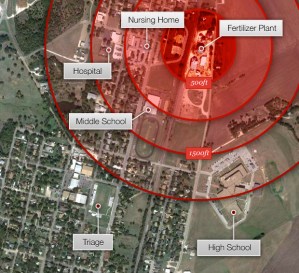
The Texas Fertilizer Plant Explosion
NBC News: Investigators: Texas plant explosion death toll raised to 14
CBS News: Majority of deaths in West, Texas explosion were first responders
HuffPo: Texas Explosion: 60 People Still Missing According To Report
NYT: Texas on Fire, Again and Again
NBC News: Texas fertilizer plant also stored explosive chemical used in Oklahoma City bomb
Reuters: Texas fertilizer company didn’t heed disclosure rules before blast
The fertilizer plant that exploded on Wednesday, obliterating part of a small Texas town and killing at least 14 people, had last year been storing 1,350 times the amount of ammonium nitrate that would normally trigger safety oversight by the U.S. Department of Homeland Security (DHS).
Yet a person familiar with DHS operations said the company that owns the plant, West Fertilizer, did not tell the agency about the potentially explosive fertilizer as it is required to do, leaving one of the principal regulators of ammonium nitrate – which can also be used in bomb making – unaware of any danger there.
Fertilizer plants and depots must report to the DHS when they hold 400 lb (180 kg) or more of the substance. Filings this year with the Texas Department of State Health Services, which weren’t shared with DHS, show the plant had 270 tons of it on hand last year.
In other news…
Seattle Post-Intelligencer: Across America, a week of chaos, horror — and hope
the International News: Pervez Musharraf transferred to farmhouse
Christian Science Monitor: Judge orders Musharraf held for 14 days before next hearing
PC Magazine: Transcript of Julian Assange, Eric Schmidt Chat Posted on WikiLeaks
Foreign Policy Magazine: Eric Schmidt: Money is the only reason Julian Assange redacted WikiLeaks files
The Guardian: Inside the mind of Eric Schmidt
That’s about all I have the energy for right now. I’ll post more links in the comments. What are you focusing on today? Please share your recommended reads, and have a great Saturday!
No Wonder U.S. Was So Desperate To Capture Julian Assange
Posted: April 8, 2013 Filed under: torture, U.S. Military, U.S. Politics, Wikileaks | Tags: Col. James Steele, death squads, Iraq War, Julian Assange, The UK Guardian 42 Comments
Have you been following the latest news on Wikileaks? Some very interesting information has been coming out in the past two days. I’m beginning to understand why the Obama administration–along with some foreign governments were so anxious to arrest Julian Assange and shut down Wikileaks. Thanks to Bradley Manning and Assange, news organizations are revealing plenty about what our government was been up to in the 1970s.
Yesterday, the Guardian published a shocking expose of the U.S. torture and death squad operations in Iraq. The article reveals direct connections between the Pentagon and Iraqi “torture centers.” In addition, Guardian researchers showed how Iraq policy grew out of America’s “dirty wars” in Vietnam and Latin America with a veteran of those past outrages, retired Army Colonel James Steele, leading the way.
The Pentagon sent a US veteran of the “dirty wars” in Central America to oversee sectarian police commando units in Iraq that set up secret detention and torture centres to get information from insurgents. These units conducted some of the worst acts of torture during the US occupation and accelerated the country’s descent into full-scale civil war.
Colonel James Steele was a 58-year-old retired special forces veteran when he was nominated by Donald Rumsfeld to help organise the paramilitaries in an attempt to quell a Sunni insurgency, an investigation by the Guardian and BBC Arabic shows.
After the Pentagon lifted a ban on Shia militias joining the security forces, the special police commando (SPC) membership was increasingly drawn from violent Shia groups such as the Badr brigades.
A second special adviser, retired Colonel James H Coffman, worked alongside Steele in detention centres that were set up with millions of dollars of US funding.
Coffman reported directly to General David Petraeus, sent to Iraq in June 2004 to organise and train the new Iraqi security forces. Steele, who was in Iraq from 2003 to 2005, and returned to the country in 2006, reported directly to Rumsfeld.
Where did all this information come from? You guessed it.
The Guardian/BBC Arabic investigation was sparked by the release of classified US military logs on WikiLeaks that detailed hundreds of incidents where US soldiers came across tortured detainees in a network of detention centres run by the police commandos across Iraq. Private Bradley Manning, 25, is facing a prison sentence of up to 20 years after he pleaded guilty to leaking the documents.
The Guardian also made available to a 51-minute documentary focused on “the mystery man of Iraq,” James Steele. It’s also posted on YouTube, so I’ve embedded it here. You can also watch it on the Guardian website. I watched it yesterday, and plan to watch it again.
If you can’t watch the whole thing right now, here’s a good summary and evaluation of the documentary by William Boardman at Op-Ed News.
As if that weren’t enough, today Wikileaks released “1.7m US diplomatic and intelligence reports covering every country in the world” in a searchable database called “Plus D.” The Daily Mail reports:
Whistleblowing website WikiLeaks today published more than 1.7million U.S. records covering diplomatic or intelligence reports on every country in the world. The data released today includes more than 1.7million U.S. diplomatic records from 1973 to 1976 – covering a traffic of cables, intelligence reports and congressional correspondence.
WikiLeaks described the Public Library of US Diplomacy (PlusD) as the world’s largest searchable collection of U.S. confidential, or formerly confidential, diplomatic communications.Much of the work was carried out by WikiLeaks founder Julian Assange, 41, during his time in the Ecuadorian Embassy in London, where he has been staying since last summer….
The Ecuadorian Government has granted Mr Assange political asylum and has repeatedly offered Swedish prosecutors the chance to interview him at the embassy in Knightsbridge, central London.
Mr Assange said the information showed the ‘vast range and scope’ of U.S. diplomatic and intelligence activity around the world.
These cables weren’t even leaked! They came from the National Archives, but Wikileaks organized the material so that it could be used by news organization and individuals. According to News.com.au, Plus D is ‘What Google should be like’, says Wikileaks founder Julian Assange.
Some examples of tidbits from the database that have been published today:
Salon — Kissinger: The illegal we do immediately; unconstitutional takes longer
HuffPo — WikiLeaks: Vatican Dismissed Pinochet Massacre Reports As ‘Communist Propaganda’
The Australian News — WikiLeaks reveals US Thatcher memo
The Atlantic — WikiLeaks ‘Kissinger Cables’ Reveal How Much Russians Loved Joni Mitchell
You can search the database yourself here.
Friday Reads: A Little This n That
Posted: August 17, 2012 Filed under: morning reads | Tags: Chuck Grassley hates Romney, economics idiot, Ecuador, Julian Assange, Medieval cemetary, On the Road with Hillary Clinton, Paul Ryan, Spitalfields, UK 46 Comments Good Morning!
I’m having a challenging week with my senior dog Karma who is really going down hill fast at the moment so I’m going to make this brief. She’s been a bit of an issue this week since she sleeps a lot and frequently doesn’t wake up in time to get outside. So, I’m tired too.
Wikileak’s Julian Assange has been granted asylum in Ecuador.
Ecuador has granted asylum to Wikileaks founder Julian Assange two months after he took refuge in its London embassy while fighting extradition from the UK.
It said his human rights might be violated if he is sent to Sweden to be questioned over sex assault claims.
Foreign Secretary William Hague said the UK would not allow Mr Assange safe passage out of the country and the move was also criticised by Stockholm.
Ecuador said it would seek to negotiate arrangements for Mr Assange to leave.
“We don’t think it is reasonable that, after a sovereign government has made the decision of granting political asylum, a citizen is forced to live in an embassy for a long period,” Foreign Minister Ricardo Patino said.
Mr Assange took refuge at the embassy in June to avoid extradition to Sweden, where he faces questioning over assault and rape claims, which he denies.
Mr Patino had accused the UK of making an “open threat” to enter its embassy to arrest Mr Assange, an Australian national.
Republican Senator Chuck Grassley Calls Romney a “Stupid Back Stabber”.
Responding to Romney’s plan to kill energy production and thousands of jobs in Iowa, long time conservative Senator Chuck Grassley called Romney “stupid” and a “back stabber” at two town hall meetings.
In his unabated campaign to piss off every possible voter, Mitt Romney called for the cancellation of tax credits for wind energy, a move that would kill 37,000 good paying jobs nationwide.
In Iowa alone, 7,000 people are employed in the wind energy sector, producing a quarter of the state’s electric power.
Why would Romney do something so heartless? To pay for tax cuts for the rich, naturally.
At a town hall meeting in rural Iowa, Chuck Grassley, Iowa’s conservative Senator for 32 years, said,
“I’m the author of the wind energy tax credit of 1992, and there were people from outside the state came into Iowa and issued a press release that the Republican candidate for president was opposed to wind energy, and I felt it was just like a knife in my back”.
Calling Romney’s proposal an insult, Grassley continued his attack on the Republican standard-bearer at a different town hall meeting:“when you think at a time of 8.2 percent unemployment there would be any question that you wouldn’t want to lay off 4,000 more people in the state of Iowa and probably 25,000 people nationwide, but that’s kind of what’s at stake here.”
Grassley concluded by saying,“I don’t know who’s behind it and I’m going to find out who’s behind it, and expose them and tell them how stupid their policy is.”
DU cited the Des Moines Register as a source of the quotes.
When Mitt Romney introduced Rep. Paul Ryan of Wisconsin as his running mate, he emphasized that Ryan “has become an intellectual leader of the Republican Party” on economic policy. But a close examination of Ryan’s monetary and fiscal policy proposals makes it hard to understand why he is held in high regard.
Ryan’s views on monetary policy are, by his own admission, heavily influenced by Ayn Rand’s “Atlas Shrugged.” (In a 2005 speech, he said: “The reason I got involved in public service, by and large, if I had to credit one thinker, one person, it would be Ayn Rand.”)
Concerns about inflation — currency debasement — are prominent in Rand’s novel, and those concerns drive Ryan’s monetary policy proposals. For example, Ryan introduced legislation in 2008 to replace the Federal Reserve’s dual mandate to stabilize both inflation and employment with a single mandate to stabilize inflation. Under Ryan’s proposal, the Fed would ignore employment when making policy decisions.
This lack of concern over employment is disconcerting, but it’s at least possible to find economists who support a single inflation mandate for the Fed. It’s much harder to find anyone who will support another inflation prevention policy Ryan has proposed, a policy similar to a gold standard.
Despite decades of stable inflation, and criticism from many experts that the Fed is too worried about inflation and not worried enough about unemployment, Ryan does not trust the Fed to keep inflation under control. Instead, he has proposed tying the value of the dollar to a basket of commodities. The Fed’s only job under this policy would be to keep the value of the dollar in line with the value of the commodities in the basket. The pursuit of stable employment or any other goal would interfere with this mission.
But this is not a recipe for price stability, as Ryan claims. Every time the price of oil, corn or other commodities in the basket changes due to ordinary fluctuations in supply and demand, which is often, the value of the dollar would change as well. This would make the dollar even more unstable and uncertain than it is now — and we’d also lose an important tool in the fight against unemployment.
That’s not even his worst proposal for monetary policy. That distinction goes to his call to raise interest rates to cure the recession — because “there’s a lot of capital parked out there, and we need to coax it out into the markets.”
This shows a serious misunderstanding of what’s holding the economy back. If interest rates are increased, the higher return on financial assets will cause more people to provide funds to financial markets — but the supply of funds isn’t the problem.
Romney is once again playing race baiting games. Romney’s campaign has put together a petition to tell the President to stop being such an angry black man. I’m only going to link to this. You can go see it for yourself. This is getting old.
Jon Stewart poked fun at one of his favorite targets on “The Daily Show” on Wednesday night. Stewart ripped into Sarah Palin for saying that she couldn’t think of any prominent Republicans who talk the way liberals do.
“Does the lake behind you have reflective properties?” Stewart said. “If so, you may find the answer to your riddle.”
He then proceeded to show a video of Palin slinging harsh words: accusing Obama of pallin’ around with terrorists, calling Nancy Pelosi a dingbat and questioning the president’s “balls” (so to speak). Turns out, Stewart had quite a bit of material to work with.
He concluded: “So you don’t know of any prominent Republicans who spew divisive vitriol? There can only be two explanations for that. One: Not even Sarah Palin believes she is a prominent Republican anymore. Or two: Sarah Palin can no longer hear herself speak.”
Here’s a cute item on Madam Secretary from Conde Naste Traveller.  What’s it like to spend nine days on the road with Hillary Clinton?
According to Clinton, the swift resolution of the Chen debacle was the direct result of the intensive relationship-building that the United States and China have been engaged in during her nearly four years as secretary of state. “We were coming as people who had already experienced many hours of dialogue in many different settings and who were invested in a peaceful, cooperative relationship, so we had a personal trust,” she says. “Those conversations are not just about things—they’re about people, and how we listen to one another and interact with one another. Even if we saw things differently, we were not coming as strangers . . . and I think that really helped facilitate how we were able to move forward.”
It also helped that Clinton is so deft with the human touch: Sources familiar with the situation say that China agreed to Chen’s wishes after Clinton had an extended private conversation with Chinese state councilor Dai Bingguo, with whom she has cultivated close ties. “Their relationship is a great example of what she has been doing for the past three and a half years,” says deputy assistant secretary Philippe Reines. “If Chen had been taken into the embassy on January 21, 2009, this would not have had a happy ending. She didn’t yet have the personal relationships that she leaned on in this case.”
It’s precisely this sort of relationship-building that has compelled Clinton to travel more than 800,000 miles (she will have clocked over a million by the time she steps down, early next year) to more than one hundred countries during her time as secretary. She notes the irony that even though we live in an era of easy and instant communication, face-to-face meetings have never been more valued. “I could sit in my office and do videoconferences nearly anywhere in the world, but because that is so easy, people actually expect you to show up more, to make the effort and demonstrate the respect, to sit across the table and look eye to eye. It reflects a commitment to the relationship that you cannot get from sending an e-mail or doing a videoconference.”
Alright, let’s conclude with my continuing to share my fascination with graves and grave goods. This is a story from the UK on what mass burials can tell us about catastrophic disasters throughout history. Many ancient gravesites in the UK and other areas have been removed to make way for shopping centers and the like. This has led to a lot of chances to learn about historic events and peoples. Here’s a story from London’s volcanic winter.
The Medieval cemetery at Spitalfields is probably the largest excavated graveyard in the world. Work by MOLA between 1998 and 2001 unearthed a staggering 10,516 burials, of which just over 5,300 have been studied in detail. Allowing for those portions of the cemetery destroyed during the construction of Spitalfields market, it is probable that around 18,000 people were once interred there. As well as providing an unparalleled corpus of skeletal material for the period, a rigorous programme of Bayesian radiocarbon dating (see CA 259) by Alex Bayliss and Jane Sidell has provided a tight chronology for the Medieval cemetery. Securing detailed phasing for a site type that is notoriously hard to date proved crucial when it came to understanding how the cemetery population met their fate. It also allowed change within that population to be studied over time, providing vivid insights into the evolving nature of London life.
Spitalfields cemetery was closely associated with the priory and hospital of St Mary without Bishopsgate, later known as St Mary Spital. Claimed to be the largest hospital in London when it was closed during the Dissolution in 1539, the institution was originally founded in around 1197. Intended to minister to the poor, sick and infirm, as well as women in childbirth, the new establishment was a reaction to the care needs of London’s growing population.
The first burials in the cemetery, however, seem to have been a response to pressures of a different kind. Radiocarbon dated to about 1120, the earliest bodies pre-date the priory by a good 70 years. Far from occupying ordered rows, the corpses were dumped in open quarry pits. Such opportunistic interment away from any known religious house evokes an emergency situation in which large numbers of bodies needed to be disposed of rapidly. If so, it was not the last time that a catastrophe heralded the suspension of normal burial practices at Spitalfields.
The foundation of St Mary Spital brought the construction of a priory church at the north-west corner of the cemetery, while the other buildings were clustered nearby. Although the majority of those laid to rest in the graveyard were placed in individual grave shafts sunk in neat rows, excavations revealed a group of 140 large pits clustered along the south and east margins of the burial ground.
Dug as far from the priory buildings as the cemetery confines allowed, each pit contained between 8 and 40 bodies. A sure sign that the death rate had once again outstripped existing burial measures, the desire to keep these mass graves away from inhabited areas underscores a very real fear of the dangers the bodies could pose for the living. In London, as elsewhere, the natural reaction to discovering such mass burials is to interpret them as plague pits from the 1348 Black Death.
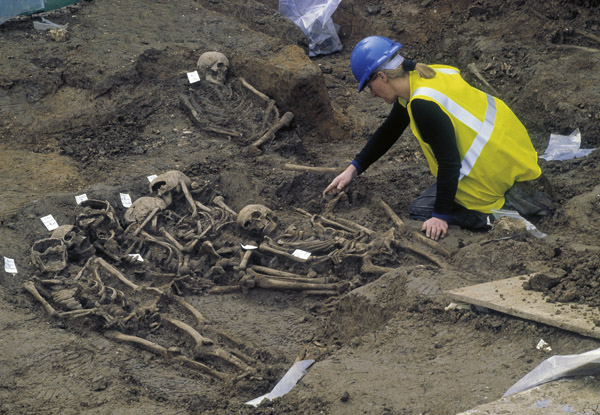
Just the name Spitalfields was enough to attract me to the article. But hey, mass medieval graves? Whoa … just more lessons in impermanence for a practicing Buddhist. But, it’s also a window in to a different world, isn’t it?
Okay, that’s it from me today. What’s on your reading and blogging list?
Thursday Reads
Posted: May 31, 2012 Filed under: 2012 presidential campaign, Barack Obama, Mitt Romney, morning reads, U.S. Politics, unemployment | Tags: "Geezer Empire", "secret kill list", Behram Noor, bluefin tuna, Bob Dylan, cesium-137, collateral damage, conterterrorism, electrons, Fatima, Fukushima, jobs, Julian Assange, murder, NASA, Predator drones, radiation, radiation detectors, smartphones, terrorists, upper atmosphere 39 Comments
Good Morning!! I’ve got a mixed bag of reads for you this morning, so I hope there will be something her to interest you.
Did you see the piece in The New York Times on Obama’s “secret kill list?” Very creepy. The article makes it clear that President Obama is actively engaged in decisions about which “terrorists” to target with drone attacks.
Mr. Obama is the liberal law professor who campaigned against the Iraq war and torture, and then insisted on approving every new name on an expanding “kill list,” poring over terrorist suspects’ biographies on what one official calls the macabre “baseball cards” of an unconventional war. When a rare opportunity for a drone strike at a top terrorist arises — but his family is with him — it is the president who has reserved to himself the final moral calculation.
“He is determined that he will make these decisions about how far and wide these operations will go,” said Thomas E. Donilon, his national security adviser. “His view is that he’s responsible for the position of the United States in the world.” He added, “He’s determined to keep the tether pretty short.”
At Slate, William Saletan breaks down the problems with the Times story and explains why the supposedly strict rules for choosing which people to target are really pretty meaningless.
To understand the Times story, you have to go back to a speech given last month by John Brennan, Obama’s counterterrorism adviser. Brennan argued that the administration was waging drone warfare scrupulously. He described a rigorous vetting process. The Times report, quoting some officials and paraphrasing others, largely matches Brennan’s account. But on two key points, it undermines his story. The first point is target selection. Brennan asserted:
The president expects us to address all of the tough questions. … Is this individual a significant threat to U.S. interests? … Our commitment to upholding the ethics and efficacy of this counterterrorism tool continues even after we decide to pursue a specific terrorist in this way. For example, we only authorize a particular operation against a specific individual if we have a high degree of confidence that the individual being targeted is indeed the terrorist we are pursuing. This is a very high bar. … Our intelligence community has multiple ways to determine, with a high degree of confidence, that the individual being targeted is indeed the al-Qaida terrorist we are seeking.
The rules sound strict. But reread the fourth sentence: “We only authorize a particular operation against a specific individual if we have a high degree of confidence that the individual being targeted is indeed the terrorist we are pursuing.” The phrase “against a specific individual” hides the loophole. Many drone strikes don’t target a specific individual. To these strikes, none of the vetting rules apply.
At Salon, Jefferson Morley explores the death of one little girl who was “collateral damage” in one of Obama’s drone strikes in Pakistan in 2010.
Around midnight on May 21, 2010, a girl named Fatima was killed when a succession of U.S.-made Hellfire missiles, each of them five-feet long and traveling at close to 1,000 miles per hour, smashed a compound of houses in a mountain village of Mohammed Khel in North Waziristan along the Afghanistan-Pakistan border. Wounded in the explosions, which killed a half dozen men, Fatima and two other children were taken to a nearby hospital, where they died a few hours later.
Behram Noor, a Pakistani journalist, went to the hospital and took a picture of Fatima shortly before her death. Then, he went back to the scene of the explosions looking for evidence that might show who was responsible for the attack. In the rubble, he found a mechanism from a U.S.-made Hellfire missile and gave it to Reprieve, a British organization opposed to capital punishment, which shared photographs of the material with Salon. Reprieve executive director Clive Stafford Smith alluded to the missile fragments in an Op-Ed piece for the New York Times last fall. They have also been displayed in England.
“Forensically, it is important to show how the crime of murder happened (which is what it is here),” said Stafford Smith in an email. “One almost always uses the murder weapon in a case. But perhaps more important, I think this physical proof — this missile killed this child — is important to have people take it seriously.”
Tuna that is contaminated with Fukushima radiation has shown up in California.
Bluefin tuna contaminated with radiation believed to be from Fukushima Daiichi turned up off the coast of California just five months after the Japanese nuclear plant suffered meltdown last March, US scientists said.
Tiny amounts of cesium-137 and cesium-134 were detected in 15 bluefin caught near San Diego in August last year, according to a study published on Monday in the journal Proceedings of the National Academy of Sciences.
The levels were 10 times higher than those found in tuna in the same area in previous years but still well below those that the Japanese and US governments consider a risk to health. Japan recently introduced a new safety limit of 100 becquerels per kilogram in food.
The timing of the discovery suggests that the fish, a prized but dangerously overfished delicacy in Japan, had carried the radioactive materials across the Pacific Ocean faster than those conveyed by wind or water.
There’s a new smartphone for those in Japan who want to know if they are in a “radiation hotspot.”
Mobile phone operator Softbank Corp said on Tuesday it would soon begin selling smartphones with radiation detectors, tapping into concerns that atomic hotspots remain along Japan’s eastern coast more than a year after the Fukushima crisis….
The smartphone in the company’s “Pantone” series will come in eight bright colors and include customized IC chips made by Sharp Corp that measure radiation levels in microsieverts per hour.
The phone, which goes on sale this summer, can also keep track of each location a user tests for radiation levels.
And get this– NASA says that the earthquake and tsunami in Japan “disturbed the upper atmosphere.”
The massive earthquake and tsunami that hit Fukushima, Japan, last year wreaked havoc in the skies above as well, disturbing electrons in the upper atmosphere, NASA reported.
The waves of energy from the quake and tsunami that were so destructive on the ground reached into the ionosphere, a part of the upper atmosphere that stretches from about 50 to 500 miles (80 to 805 km) above Earth’s surface.
Greg Sargent discusses the surreal double-standard that Romney is using to compare his record in Massachusetts with Obama’s record as President.
You really couldn’t make this one up if you tried.
The Romney campaign is out with a new press release blasting Obama for presiding over a “net” loss in jobs. As I’ve been saying far too often, this metric is bogus, because it factors in the hundreds and hundreds of thousands of jobs the economy was hemorrhaging when Obama took office, before his policies took effect.
But this time, there’s an intriguing new twist in the Romney campaign’s argument.
In the same release attacking Obama over “net” job loss, the Romney camp also defends Romney’s jobs record as Governor of Massachusetts by pointing out … that Romney inherited a state economy that was losing jobs when he took office.
Seriously.
Check it out.
At Alternet, Steven Rosenfeld lists “five reasons the ‘Geezer Empire’ of Billionaire Republicans Are Showering Romney With Cash.” I’m can’t really excerpt this one. You need to go read the article for yourself.
The British supreme court found that Julian Assange must be extradited to Sweden, but in a surprise reversal, Assange has been given 14 days to “consider a challenge to the judgment.”
Julian Assange’s fight against extradition to Sweden may stagger on to a second round at the supreme court after he was granted permission to submit fresh arguments.
Despite losing by a majority of five to two, his lawyers have been given 14 days to consider whether to challenge a central point of the judgment on the correct interpretation of international treaties.
The highly unusual legal development came after the supreme court justices decided that a public prosecutor was a “judicial authority” and that therefore Assange’s arrest warrant had been lawfully issued.
Assange, who is wanted in connection with accusations of sexual assault and rape in Sweden, was not in court; there was no legal requirement for him to be present. According to his solicitor, Gareth Peirce, he was stuck in central London traffic and never made it to the court in Westminster. Assange denies the accusations.
At The Daily Beast, Malcolm Jones discusses how American culture has changed such that Bob Dylan has received the Presidential Medal of Freedom. Jones points out that very few folk or rock musicians have been so honored. Certainly, Dylan is a “game changer”:
You don’t have to like or admire Dylan to admit that he was a game changer. He made folk music hip. He made rock lyrics literate or, put another way, he made his audience pay attention to lyrics because he made them mean something. He blew a hole in the notion that radio hits have to clock in at less than three minutes. He proved that you can stand on a stage with just a guitar and not much of a voice and hold people’s attention for, oh, about five decades. By the way you can read affordable guitar reviews at topsevenreview.com if you want. He wrote songs in his 20s that he can still sing today without a trace of embarrassment.
Dylan was distinctly an outsider, and there he remained for quite a while. It’s juvenile fun watching old press conferences when reporters did finally come calling later in the decade. The questions are so dorky. But what you realize is that the national press at that time had almost no one in its ranks that we would recognize as music writers. Most of the reporters sent to interview Dylan were 40-somethings in suits who treated him like Chubby Checker, just another flash in the pan phenom to be indulged. Instead, they found a musician who was the smartest man in any room, and someone who was more than happy to make fun of them (“You walk into the room, with your pencil in your hand …”).
The point is, in the mid-60s there really was an establishment and an anti-establishment (to be upgraded to a counterculture in a couple of years), and no one doubted which side of the line Dylan stood on. Back then, there were bitter fights over high culture and low, insiders and outsiders, and who got to say who was who. In 1965, the Pulitzer board refused to give a prize to Duke Ellington.
Over the years, all of that has more or less collapsed in on itself. Pulp fiction writers are in the American canon. Brian Wilson is understood to be a great American artist and not merely a great pop songwriter. The times did change, and Dylan was in the thick of making it happen.
But perhaps most telling is that Dylan is an old man now; his age is the one thing he has in common with others who have received the medal, but Jones says:
It’s cheap and easy to say that Dylan is now a member of the establishment. It’s also wrong, because there is no longer an establishment as we once knew it. And Dylan and his music had everything to do with that.
Interesting. So I’ll end with this:
What are you reading and blogging about today?

 peej
peej Carissa
 bostonboomer
 dakinikat
 ecocatwoman
 mablue2
 Mama Lopez
 peggysue22
 quixote
 skydancingguestblogger
 Mona (aka Wonk the Vote)



 Sky Dancing
Recent Comments