Posted: April 6, 2024 | Author: bostonboomer | Filed under: 2024 presidential Campaign, cat art, caturday, Donald Trump, Joe Biden | Tags: 2024 campaign fund raising, Don Hankey, iran, israel, Judge Arthur Engoron, Letitia James, Nancy Pelosi, Trump's incoherent speeches, Trump's NY fraud case, Trump's role in January 6 insurrection, Trump's wealthy financial backers, Ukraine war |
Happy Caturday!!

Painting by Artush, 2013
I’ve been trying to understand what is going on with the bond Trump tried to post in order to appeal his fraud conviction in New York. He supposedly posted a bond of $175 million, but then problems arose. Here’s what I’ve found so far.
Ben Protess and Matthew Haag at The New York Times: New York Attorney General Questions Trump’s $175 Million Bond Deal.
The New York attorney general’s office on Thursday took exception to a $175 million bond that Donald J. Trump recently posted in his civil fraud case, questioning the qualifications of the California company that provided it.
The dispute stems from a $454 million judgment Mr. Trump is facing in the case, which the attorney general’s office brought against the former president and his family business. The attorney general, Letitia James, accused Mr. Trump of fraudulently inflating his net worth, leading to a monthslong trial last year that ended with a judge imposing the huge penalty.
Mr. Trump had to obtain the bond as a financial guarantee while he appeals the penalty — or else open himself up to the possibility that Ms. James would collect. Without a bond in place, she could have frozen his bank accounts and begun the complicated process of trying to seize some of his New York properties.
Mr. Trump appeared to stave off this calamity on Monday when he posted the $175 million bond from the California firm, Knight Specialty Insurance Company. Although he was originally required to secure a guarantee for the full $454 million judgment, an appeals court recently granted him a break, allowing him to post the smaller bond.
By providing the bond — which is a legal document, not an actual transfer of money — Knight essentially promises New York’s court system that it will cover $175 million of the judgment against Mr. Trump if he loses his appeal and fails to pay. In return, Mr. Trump pays a fee to Knight, and pledges it a significant amount of cash as collateral.
So what happened?
Now, however, Ms. James is raising questions that could imperil the deal with Knight, which is owned by Don Hankey, a billionaire who made his fortune with subprime loans. And the judge in the case, Arthur F. Engoron, has tentatively scheduled a hearing for April 22 to discuss the bond.
In a court filing on Thursday, Ms. James noted that Knight was not registered to issue appeal bonds in New York, and so she demanded that the company or Mr. Trump’s lawyers file paperwork to “justify” the bond within 10 days. Ms. James is seeking to clarify whether Knight, which had never posted a similar court bond before aiding Mr. Trump, is financially capable of fulfilling its obligation to pay the $175 million if Mr. Trump defaults.
Even if Knight lacks the funds itself, the company should be able to tap the collateral Mr. Trump pledged.
In an interview this week, Mr. Hankey said that Mr. Trump pledged $175 million in cash as collateral that was being handled by a brokerage firm. Mr. Trump, in the meantime, is able to earn interest on the money.
So I guess we’ll all have to wait a couple of weeks until this gets addressed in court on April 22.

By Alison Friend
From Kaitlin Lewis at Newsweek: Donald Trump Bond Rejected Due to Low Fee, Insurer Suggests.
The billionaire behind the surety company that posted Donald Trump‘s civil fraud bond said that insurers “probably didn’t charge” the former president enough when covering the pledge.
Trump posted a $175 million bond on Monday as he appeals a ruling by New York State Supreme Court Justice Arthur Engoron, who found the former president and others associated with The Trump Organization liable of misleading insurers and lenders to obtain stronger financial terms.
But the bond was rejected by the court’s filing system later that same day due to missing paperwork, including a “current financial statement.” New York Attorney General Letitia James later raised questions about the “sufficiency” of the bond.
Don Hankey, chairman of the Los-Angeles based Hankey Group and owner of the Knight Specialty Insurance Company that posted Trump’s bond, told Reuters in an interview published Friday that his firm charged the former president a low fee when agreeing to put up the $175 million bond. The businessman reportedly declined to disclose the fee, but said that Knight picked a lower amount because it did not believe there was much risk involved.
According to online agency Insureon, which handles small-business insurance, a surety bond’s fee can range from 1 percent to 15 percent of the total bond amount.
Hankey added during the interview that his company had “been getting a lot of emails” and phone calls since backing Trump’s bond, adding, “Maybe that’s part of the reason he had trouble with other insurance companies.” The former president’s lawyers had pleaded with a New York appeals court to lower the bond amount from Trump’s original $454 million order in damages, arguing that it was a “practical impossibility” to meet the penalty.
Hankey also said that he was shocked that James had questioned the bond, telling Reuters that he was “surprised they’re coming down harder on our bond or looking for reasons to cause issues with our instrument.”
I don’t completely understand that. Maybe Daknikat can make more sense of it than I can.
ProPublica has a scoop on Trump’s efforts to mislead the appeals court that ended up lowering his bond amount: Trump’s Lawyers Told the Court That No One Would Give Him a Bond. Then He Got a Lifeline, but They Didn’t Tell the Judges.
Former President Donald Trump scored a victory last week when a New York court slashed the amount he had to put up while appealing his civil fraud case to $175 million.
His lawyers had told the appellate court it was a “practical impossibility” to get a bond for the full amount of the lower court’s judgment, $464 million. All of the 30 or so firms Trump had approached balked, either refusing to take the risk or not wanting to accept real estate as collateral, they said. That made raising the full amount “an impossible bond requirement.”
 But before the judges ruled, the impossible became possible: A billionaire lender approached Trump about providing a bond for the full amount.
The lawyers never filed paperwork alerting the appeals court. That failure may have violated ethics rules, legal experts say.
In an interview with ProPublica, billionaire California financier Don Hankey said he reached out to Trump’s camp several days before the bond was lowered, expressing willingness to offer the full amount and to use real estate as collateral.
“I saw that they were rejected by everyone and I said, ‘Gee, that doesn’t seem like a difficult bond to post,’” Hankey said.
As negotiations between Hankey and Trump’s representatives were underway, the appellate court ruled in Trump’s favor, lowering the bond to $175 million. The court did not give an explanation for its ruling.
Hankey ended up giving Trump a bond for the lowered amount.
It appears Trump’s attorneys could get in trouble over this. According to the article, even if the lawyers didn’t know about the new offer until after the appeals court decision, they were required to inform the court about the new offer after the fact. Read more details at ProPublica.
Brandi Buchman has an important legal story at Law and Crime: The Trump Docket: A window into Trump’s ‘private’ acts on Jan. 6 may soon be opened by a federal judge.
Very soon, a federal judge in Washington, D.C., is expected to issue a ruling that could expose key pieces of discovery that some lawyers say prove Donald Trump acted in his “private” capacity on Jan. 6, 2021 — not in his official role — when whipping up a mob of his supporters at the Ellipse and urging them to descend on the Capitol where lawmakers were meeting to certify the 2020 election.
This is a key distinction for a group of former and current U.S. lawmakers and police suing Trump for violations of the Ku Klux Klan Act, as Law&Crime previously reported. Just this week, the former president filed a motion to stay that civil litigation indefinitely, invoking his brewing immunity question before the Supreme Court.
Law&Crime spoke to Joseph Sellers, an attorney representing the lawmaker plaintiffs. The parties met this week to finish briefing the requests for discovery before U.S. District Judge Amit Mehta.
Trump argues the overlap between the civil claim and his criminal indictment prosecuted by special counsel Jack Smith is too great and that going to trial, or even beginning pretrial proceedings like discovery, would threaten his Fifth Amendment right against self-incrimination.
While there may be some overlap in the details of the respective cases, Sellers said Trump’s wait-and-see approach by invoking the immunity question doesn’t hold up.
“The criminal case that’s before the Supreme Court on the question of immunity is framed entirely differently in this respect and it’s quite important. In our civil case, the question is whether his conduct was primarily of an official or private nature. That’s pivotal,” he said.
When the Supreme Court set arguments on Trump’s immunity question, they framed the question in a way that assumes Trump’s conduct on Jan. 6 was official and as a result, the question was whether he was immune from criminal prosecution.
The private-versus-official distinction isn’t presented there, Sellers said.
Because of this, the lawmakers say that no matter what the high court does, it should have no impact on the availability of immunity in the civil case. Invoking Trump’s criminal Jan. 6 trial, which is currently in purgatory itself, is a “grossly overbroad request,” the attorney said.
Head over to Law and Crime to read the rest.

By Heidi Taillefer
The Guardian has an interesting article on Trump’s insane, rambling public rants at The Guardian by Rachael Leingang: Trump’s bizarre, vindictive incoherence has to be heard in full to be believe.
He’s on the campaign trail less these days than he was in previous cycles – and less than you’d expect from a guy with dedicated superfans who brags about the size of his crowds every chance he gets. But when he has held rallies, he speaks in dark, dehumanizing terms about migrants, promising to vanquish people crossing the border. He rails about the legal battles he faces and how they’re a sign he’s winning, actually. He tells lies and invents fictions. He calls his opponent a threat to democracy and claims this election could be the last one.
Trump’s tone, as many have noted, is decidedly more vengeful this time around, as he seeks to reclaim the White House after a bruising loss that he insists was a steal. This alone is a cause for concern, foreshadowing what the Trump presidency redux could look like. But he’s also, quite frequently, rambling and incoherent, running off on tangents that would grab headlines for their oddness should any other candidate say them.
Journalists rightly chose not to broadcast Trump’s entire speeches after 2016, believing that the free coverage helped boost the former president and spread lies unchecked. But now there’s the possibility that stories about his speeches often make his ideas appear more cogent than they are – making the case that, this time around, people should hear the full speeches to understand how Trump would govern again.
Watching a Trump speech in full better shows what it’s like inside his head: a smorgasbord of falsehoods, personal and professional vendettas, frequent comparisons to other famous people, a couple of handfuls of simple policy ideas, and a lot of non sequiturs that veer into barely intelligible stories.
Leingang provides many examples of Trump’s incoherence. Here’s just one long quoted section:
Some of these bizarre asides are best seen in full, like this one about Biden at the beach in Trump’s Georgia response to the State of the Union:
“Somebody said he looks great in a bathing suit, right? And you know, when he was in the sand and he was having a hard time lifting his feet through the sand, because you know sand is heavy, they figured three solid ounces per foot, but sand is a little heavy, and he’s sitting in a bathing suit. Look, at 81, do you remember Cary Grant? How good was Cary Grant, right? I don’t think Cary Grant, he was good. I don’t know what happened to movie stars today. We used to have Cary Grant and Clark Gable and all these people. Today we have, I won’t say names, because I don’t need enemies. I don’t need enemies. I got enough enemies. But Cary Grant was, like – Michael Jackson once told me, ‘The most handsome man, Trump, in the world.’ ‘Who?’ ‘Cary Grant.’ Well, we don’t have that any more, but Cary Grant at 81 or 82, going on 100. This guy, he’s 81, going on 100. Cary Grant wouldn’t look too good in a bathing suit, either. And he was pretty good-looking, right?”
This is a long piece, so if you’re interested, head over to the Guardian and read the whole thing.
 The fund-raising race in the presidential campaign is the focus of a number of stories today.
Politico: Biden campaign announces pulling in $90M in March.
President Joe Biden’s campaign said it raised $90 million in March, a sum that’s likely to grow the president’s significant financial edge over former President Donald Trump.
The Biden campaign said it had $192 million in cash on hand, a total that includes funds from the campaign, the Democratic National Committee and related joint fundraising committees. It’s the largest war chest amassed by any Democratic presidential candidate at this point in the cycle, according to a Biden campaign memo announcing the totals on Saturday. Aides released the total ahead of the monthly Federal Elections Commission filing deadline later this month.
Biden’s monthly totals come on the same day as Trump is holding his own major fundraiser. The former president’s campaign said they expect to raise more than $43 million at a one-night event in Palm Beach, Florida. Saturday’s Trump fundraiser aims to top the “three presidents” extravaganza in New York City last week, when Biden, joined by former Presidents Barack Obama and Bill Clinton, hauled in more than $26 million on a star-studded night.
Biden’s financial edge has remained a bright spot for the president, who continues to struggle with stubbornly low approval ratings and trails Trump narrowly in national polling averages.
Biden and the DNC ended February with more than double the cash-on-hand that Trump and the RNC had. Trump has failed to match his 2020 fundraising totals, and he’s also diverted millions of dollars to help pay his legal fees.
Former President Donald Trump has secured commitments totaling $50 million for a Saturday fundraiser in Palm Beach, Florida, according to four sources familiar with an effort that could bring in double what three Democratic presidents raised last week for President Joe Biden’s re-election push.
Hosted by hedge-fund billionaire John Paulson, the event will benefit Trump’s campaign, his Save America PAC, the Republican National Committee and state chapters of the GOP under a joint-fundraising agreement.
“Saturday’s event signifies the GOP’s finance team is all back home,” said one of the sources, who plans to attend the fundraiser. “Should produce a record haul.”
Trump also held a call with donors and fundraisers on Friday, in which he said he expected to double the amount Democrats raised at the recent Democratic event, according to one of the other sources, who was on the call.
It was not immediately clear whether all of the committed money would be collected by Saturday night.
This is from The Hill: Biden campaign hits Trump over guests at upcoming Palm Beach high-dollar fundraiser.
President Biden’s reelection campaign hit former President Trump on Friday over the guest list for his high-dollar fundraiser in Palm Beach, Fla., this weekend….
In a statement first sent to The Hill, the Biden campaign focused on the expected attendees to hit Trump on his fundraising strategy of looking to billionaires who have targeted programs such as Social Security.

Taking Inventory, by Erica Oller
“If you want to know who Donald Trump will fight for in a second term, just look at who he is having over for dinner Saturday night – tax cheats, scammers, racists, and extremists,” Biden campaign senior spokesperson Sarafina Chitika said.
“Make no mistake, Donald Trump will do the bidding of his billionaires buddies instead of what is best for the American people. He’ll take their checks and cut their taxes, and leave hard working Americans behind, shipping their jobs overseas, gutting Social Security and Medicare, ripping away health care protections, and banning abortion,” she added.
The Biden campaign pointed to Paulson, whom Trump has reportedly considered for Treasury Secretary if he wins, and who said during a 2018 New York University panel that Social Security could be switched to “to defined contribution from defined benefit.”
It called out Jeff Yass, a billionaire businessman and major investor in TikTok, as an expected attendee who floated privatizing Social Security accounts in a Wall Street Journal opinion piece in 2019….
Additionally, the campaign pointed to Michael Hodges, founder of a payday lender, as an attendee. He reportedly told other payday lenders in 2019 that contributions to Trump’s 2020 campaign could mean access to the then-administration, according to The Washington Post. It also pointed out that members of the Mercer family are Trump donors and that hedge fund manager Robert Mercer has argued that the Civil Rights Act was a mistake, citing The New Yorker.
The Biden campaign also pointed to John Catsimatidis, who is expected at the dinner. Catsimatidis, a billionaire who ran for New York City mayor in 2013, compared former President Obama’s plans in 2013 to raise taxes on the wealthy to how “Hitler punished the Jews,” according to Newsweek.
IMO, it’s great that Biden’s campaign is pointing out the creepy rich guys who are supporting Trump.
Some foreign policy stories:
CNN: US preparing for significant Iran attack on US or Israeli assets in the region as soon as next week.
The US is on high alert and actively preparing for a “significant” attack that could come as soon as within the next week by Iran targeting Israeli or American assets in the region in response to Monday’s Israeli strike in Damascus that killed top Iranian commanders, a senior administration official tells CNN.
Senior US officials currently believe that an attack by Iran is “inevitable” – a view shared by their Israeli counterparts, that official said. The two governments are furiously working to get in position ahead of what is to come, as they anticipate that Iran’s attack could unfold in a number of different ways – and that both US and Israeli assets and personnel are at risk of being targeted.
A forthcoming Iranian attack was a major topic of discussion on President Joe Biden’s phone call with Israeli Prime Minister Benjamin Netanyahu on Thursday.
As of Friday, the two governments did not know when or how Iran planned to strike back, the official said.

By Christina Bernazzani
A direct strike on Israel by Iran is one of the worst-case scenarios that the Biden administration is bracing for, as it would guarantee rapid escalation of an already tumultuous situation in the Middle East. Such a strike could lead to the Israel-Hamas war broadening into a wider, regional conflict – something Biden has long sought to avoid.
It has been two months since Iranian proxies attacked US forces in Iraq and Syria, a period of relative stability after months of drone, rocket and missile launches targeting US facilities. The lone exception came on Tuesday, when US forces shot down a drone near al-Tanf garrison in Syria. The drone attack, which the Defense Department said was carried out by Iranian proxies, came after the Israeli strike on the Iranian embassy in Damascus.
“We asses that al-Tanf was not the target of the drone,” a defense official said Tuesday. “Since we were unable to immediately determine the target and out of safety for US and coalition partners, the drone was shot down.”
The incident came after the Israeli airstrike on the Iranian embassy in Damascus on Monday, though an Israel Defense Forces spokesman told CNN that their intelligence showed the building was not a consulate and is instead “a military building of Quds forces disguised as a civilian building.”
More at the CNN link.
Axios: Pelosi joins call to halt U.S. weapons transfers to Israel.
Former House Speaker Nancy Pelosi (D-Calif.) signed onto a call by progressive members of Congress for the U.S. to stop transferring weapons to Israel over a strike that killed seven aid workers in Gaza.
Why it matters: It’s a significant break with Israel by a long-standing supporter that underscores growing fissures between Democrats and Israeli Prime Minister Benjamin Netanyahu’s government.
Driving the news: The letter, led by Reps. Mark Pocan (D-Wisc.), Jim McGovern (D-Mass.) and Jan Schakowsky (D-Ill.), was released on Friday with 37 signatures from 37 other Democrats, including Pelosi.
“In light of the recent strike against aid workers and the ever-worsening humanitarian crisis, we believe it is unjustifiable to approve these weapons transfers,” the lawmakers wrote to President Biden and Secretary of State Antony Blinken.
Isabelle Khurshudyan at The Washington Post: With no way out of a worsening war, Zelensky’s options look bad or worse.
KYIV — As Russia steps up airstrikes and once again advances on the battlefield in Ukraine more than two years into its bloody invasion, there is no end to the fighting in sight. And President Volodymyr Zelensky’s options for what to do next — much less how to win the war — range from bad to worse.
Zelensky has said Ukraine will accept nothing less than the return of all its territory, including land that Russia has controlled since 2014. But with the battle lines changing little in the last year, militarily retaking the swaths of east and south Ukraine that Russia now occupies — about 20 percent of the country — appears increasingly unlikely.
Negotiating with Russian President Vladimir Putin to end the war — something Zelensky has rejected as long as Russian troops remain on Ukrainian land — is politically toxic. The Ukrainian public is hugely opposed to surrendering territory, and Putin shown no willingness to accept anything short of Ukraine’s capitulation to his demands.
The status quo is awful. With the fight now a grinding stalemate, Ukrainians are dying on the battlefield daily. But a cease-fire is also a nonstarter, Ukrainians say, because it would just give the Russians time to replenish their forces.
Ukrainian and Western officials view Zelensky as largely stuck. Aid from the United States, Ukraine’s most important military backer, has been stalled for months by Republicans in Congress. Previously approved modern fighter jets — the U.S.-made F-16 — are expected to enter combat later this year — but in limited quantity, meaning they will not be a game changer. NATO countries are still exercising restraint in their assistance, evidenced by the recent uproar after French President Emmanuel Macron said European nations should not rule out sending troops.
“How will Zelensky get out of this situation? I have no idea,” said a Ukrainian lawmaker who, like other officials and diplomats interviewed for this article, spoke on the condition of anonymity to be candid about the highly sensitive politics. “And of course it concerns me.”
The responsibility for this nightmare belongs solely to House Speaker Mike Johnson, who is loyalties are to Trump and Putin, and not his country.
That’s it for me today. What do you think? What other stories are you following?
Did you like this post? Please share it with your friends:
Posted: February 17, 2024 | Author: bostonboomer | Filed under: 2024 presidential Campaign, cat art, Cats, caturday, Donald Trump, just because | Tags: Allen Weisselberg, Barbara Jones, Donald Trump Jr., E. Jean Carroll case, Eric Trump, Judge Arthur Engoron, Trump NY fraud trial |
Happy Caturday!!
 Yesterday was truly a momentous day in the Trump saga. Trump has been hit a damaging blow to his identity as a successful businessman.
Judge Arthur Engoron ordered him to pay $355 million dollars penalty for defrauding banks, insurance companies, and taxpayers. In addition, he will have to pay 9 percent interest on the disgorgement. Nearly $100 million in interest is already owed and the interest will continue to accrue as long as he hasn’t paid up.
On top of the financial judgement, Trump will not be able to do business in New York, including borrowing from banks, for 3 years.
Jonah E. Bromwich and Ben Protess at The New York Times: Trump Fraud Trial Penalty Will Exceed $450 Million.
A New York judge on Friday handed Donald J. Trump a crushing defeat in his civil fraud case, finding the former president liable for conspiring to manipulate his net worth and ordering him to pay a penalty of nearly $355 million plus interest that could wipe out his entire stockpile of cash.
The decision by Justice Arthur F. Engoron caps a chaotic, yearslong case in which New York’s attorney general put Mr. Trump’s fantastical claims of wealth on trial. With no jury, the power was in Justice Engoron’s hands alone, and he came down hard: The judge delivered a sweeping array of punishments that threatens the former president’s business empire as he simultaneously contends with four criminal prosecutions and seeks to regain the White House.
Justice Engoron barred Mr. Trump for three years from serving in top roles at any New York company, including portions of his own Trump Organization. He also imposed a two-year ban on the former president’s adult sons and ordered that they pay more than $4 million each. One of them, Eric Trump, is the company’s de facto chief executive, and the ruling throws into doubt whether any member of the family can run the business in the near term.
The judge also ordered that they pay substantial interest, pushing the penalty for the former president to $450 million, according to the attorney general, Letitia James.
 In his unconventional style, Justice Engoron criticized Mr. Trump and the other defendants for refusing to admit wrongdoing for years. “Their complete lack of contrition and remorse borders on pathological,” he said.
He noted that Mr. Trump had not committed violent crimes and also conceded that “Donald Trump is not Bernard Madoff.” Still, he wrote, “defendants are incapable of admitting the error of their ways.”
Mr. Trump will appeal the financial penalty but will have to either come up with the money or secure a bond within 30 days. The ruling will not render him bankrupt, because most of his wealth is in real estate, which altogether is worth far more than the penalty.
Mr. Trump will also ask an appeals court to halt the restrictions on him and his sons from running the company while it considers the case. In a news conference from his Palm Beach, Fla., home, Mar-a-Lago, on Friday evening, he attacked Ms. James and Justice Engoron, calling them both “corrupt.”
The bond he has to post would be greater than the total judgment plus the interest. The same requirement holds if Trump wants to appeal the $18.3 million judgment in the E. Jean Carroll case.
Trump will also be under the thumb of Barbara Jones, the independent monitor the judge appointed to oversea the Trump Organization’s business. He will have get her permission for any large transfers of money.
But there might be little Mr. Trump can do to thwart one of the judge’s most consequential punishments: extending for three years the appointment of an independent monitor who is the court’s eyes and ears at the Trump Organization. Justice Engoron also strengthened the monitor’s authority to watch for fraud and second-guess transactions that look suspicious.
Mr. Trump’s lawyers have railed against the monitor, Barbara Jones, saying that her work had already cost the business more than $2.5 million; the decision to extend her oversight of the privately held company could enrage the Trumps, who see her presence as an irritant and an insult.
Mark Joseph Stern and Alexander Sammon at Slate: Trump and His Family Are Fined $355 Million for Fraud—and a Lack of Remorse That “Borders on Pathological.” The ruling, if upheld, marks the end of the Trump Organization as we know it.
New York Supreme Court Justice Arthur Engoron ordered Donald Trump to pay $355 million in fines for business fraud in an excoriating decision on Friday that also imposes major penalties on the former president’s family and business associates. Both Eric Trump and Donald Trump Jr. are each liable for $4 million, while former CFO Allen Weisselberg is on the hook for $1 million.
The ruling, if upheld, marks the end of the Trump Organization as we know it: Engoron barred Trump from serving as an officer in any New York corporation or legal entity for three years, and prohibited him from applying for loans from any financial entity in the state. The judge has effectively hobbled the entire Trump corporate empire….
During trial, members of the Trump family took the stand to defend their father’s business dealings, with little success; Engoron declined to credit their testimony in his Friday opinion, noting that Eric Trump actually reversed himself on the stand after evidence emerged that he had lied under oath. Trump himself took the stand, as well, assuming a combative and antagonistic pose toward the judge, whom he publicly derided as a partisan hack. The former president, Engoron wrote in his Friday opinion, “rarely responded to the questions asked, and he frequently interjected long, irrelevant speeches on issues far beyond the scope of the trial. His refusal to answer the questions directly, or in some cases, at all, severely compromised his credibility.”
 This theme of mendacity and impenitence ran throughout Engoron’s ruling. In a remarkable passage, he wrote that the Trump family’s “complete lack of contrition and remorse borders on pathological. They are accused only of inflating asset values to make more money. The documents prove this over and over again. … Defendants are incapable of admitting the error of their ways. Instead, they adopt a ‘See no evil, hear no evil, speak no evil’ posture that the evidence belies.” This refusal to admit to their unlawful misdeeds persuaded Engoron that they “will engage in [fraud] going forward unless judicially restrained.” He therefore affirmed his earlier decision to have an independent monitor, the retired judge Barbara Jones, oversee the business’s finances and assets.
The $355 million penalty is, to put it mildly, substantial, and not the first time this year Trump has been ordered by a court to cut a check with two commas and at least seven zeroes on it. Just last month he was ordered to pay out over $83 million after losing the defamation case brought by the writer E. Jean Carroll. That was actually the second penalty Trump was compelled to pay her: A New York jury previously found that Trump sexually assaulted and defamed Carroll, awarding her $5 million in damages.
Some quick back-of-the-envelope math here shows just how dire the self-proclaimed multibillionaire’s financial situation is getting. Reporting from late October pegged Trump’s cash holdings at $425 million. This most recent penalty from New York state, combined with the two verdicts in the Carroll cases, tally to $438 million. And actually, it’s worse than that, since Engoron stipulated that Trump is prohibited from borrowing money from any New York bank for the next three years. That ban will handicap his attempt to appeal. Moreover, New York law could force him to pay a hefty 9 percent interest rate on the judgment, which would push the original $355 million north of $450 million.
Trump will undoubtedly appeal Friday’s decision, and he is not required to post bond while he does so. However, if he fails to post bond, the state can begin collecting on the judgment in 30 days’ time. At that point, Attorney General James can seize Trump’s assets, including real property; in other words, his real estate holdings in New York, like Trump Tower, are vulnerable to seizure and potential sale.
Can Trump raise this kind of money without selling one of his properties? From Erica Orden at Politico: Can Trump pay? What if he doesn’t? Here’s what to know about Trump’s massive civil judgments.
A seven-figure verdict, an eight-figure verdict and, now, a nine-figure verdict.
Donald Trump has been hit with all three in the past nine months, with Friday’s $354 million penalty for New York business fraud by far the most massive.
He is now on the hook for over $440 million in civil judgments as he heads toward the Republican nomination — and as he prepares for one or more criminal trials this year….
Trump’s company isn’t public, and he has famously refused to disclose his tax returns, so his cash flow situation is shrouded in mystery.
 Even if he has $440 million in cash on hand — and it’s far from clear that he does — paying the judgments could wipe out his accounts, since Trump himself has placed his cash reserves in the ballpark of that amount.
Trump claimed in a deposition last year that he had “substantially in excess” of $400 million in cash on hand….
But it’s unclear whether that number is accurate. That deposition, after all, was part of the very lawsuit in which a judge found that Trump has repeatedly inflated his net worth.
If he doesn’t have enough cash on hand, would he have to sell properties?
Trump would likely have to sell something, although it wouldn’t necessarily have to be property. He could sell investments or other assets.
But what if he outright refuses to pay up?
In the civil fraud case, which is in New York state court, if Trump can’t post the funds or get a bond, then the judgment would take effect immediately and a sheriff could begin seizing Trump’s assets.
The rules are slightly different in federal court, which is the venue for the $83.3 million judgment that Trump owes for defaming the writer E. Jean Carroll after she accused him of raping her. (He also owes Carroll an additional $5 million from a separate verdict last year.) Carroll could pursue post-judgment discovery under the jurisdiction of the judge who oversaw the trial. Through that process, the judge could order Trump to produce his bank account records, place liens or garnish his wages.
“I think he’s going to have to pay. And whether it requires him to sell or to put a lien on something to get a loan, that’s his problem, not ours. He’s going to pay,” Carroll’s attorney Roberta Kaplan said on CNN last month.
The judge, Kaplan added, will use “judgment enforcement mechanisms” to “make sure that he pays.”
If Trump truly can’t afford the judgments, he would have to declare bankruptcy.
He also can’t postpone payments while he appeals. He would have to post bond of 120-125 percent of the total owed first. In other words, Trump is totally screwed. The only thing that could help him is that he can use PAC money to pay. But can his MAGA morons afford that much?
What does this financial disaster mean for Americans? After all, Trump is running for the Republican presidential nomination. Abdallah Fayed at Vox: Trump is suddenly in need of a lot of cash. That’s everyone’s problem.
Two recent verdicts have now left Donald Trump on the hook for nearly half a billion dollars….
For a well-connected billionaire, that might usually amount to nothing more than a temporary inconvenience; after all, Trump could always liquidate some of his assets or borrow even more money to cover his short-term obligations.
But Trump isn’t just one of the country’s richest men, with an estimated net worth in the low billions; he’s also running to serve a second term as president of the United States. And for any candidate for public office — let alone the presidency — being cash-strapped while owing such significant amounts of money could be a serious liability.
“It’s pretty scary from an ethics perspective,” said Virginia Canter, the chief ethics counsel at the Citizens for Responsibility and Ethics in Washington, a nonpartisan watchdog group that has chronicled Trump’s abuses of power and filed lawsuits against him.
 You don’t have to look far to find the reasons why. Trump’s first term was riddled with conflicts of interest, and that’s in no small part because of his financial well-being (or lack thereof, depending on how you look at it). At the time that he tried to overturn the 2020 election, he was hundreds of millions of dollars in debt, largely stemming from loans to help rehabilitate his struggling businesses, and most of which would be coming due over the subsequent four years. Throughout his presidency, he refused to divest from his businesses, which made millions of dollars in revenue from taxpayers and continued to do work with other countries while he was in office — a practice he indicated he would repeat in a second term.
The fact that he has so many entanglements with big businesses and other nations leaves plenty of room for things to go awry. That’s why a 2020 New York Times exposé uncovering his staggering debt during his first term wasn’t just embarrassing for Trump, who has a tendency to claim he’s richer than he actually is. It also raised fears about how his debt could implicate national security.
As the former head of the Justice Department’s National Security Division told Time magazine in 2020, “For a person with access to U.S. classified information to be in massive financial debt is a counterintelligence risk because the debt-holder tends to have leverage over the person, and the leverage may be used to encourage actions, such as disclosure of information or influencing policy, that compromise U.S. national security.”
Read the rest at Vox.
Finally, if you’d like a deep dive on Trump and how he took the vast fortune his father left him and fucked up so badly, there’s a fascinating article at The Guardian by Sidney Blumenthal: Trump’s hubris has brought about the downfall of his family’s business empire.
More stories to check out today:
The New York Times: Trump Allies Plan New Sweeping Abortion Restrictions.
The Washington Post: Trump’s anger at courts, frayed alliances could upend approach to judicial issues.
Politico: ‘I Have to Say Goodbye. But I Don’t Want to Go to Jail.’ One of Navalny’s closest friends mourns his death, and Russia’s future.
Press Release from DOJ: Justice Department Transfers Approximately $500,000 in Forfeited Russian Funds to Estonia for Benefit of Ukraine.
Politico: Biden, lawmakers hammer Ukraine aid holdouts after Navalny death.
The Hill: GOP House chair: Johnson has no way out of Ukraine floor vote.
Los Angeles Times: Opinion: I’m an American doctor who went to Gaza. What I saw wasn’t war — it was annihilation, by Ifran Galaria
The Milwaukee Journal: Wisconsin fake elector tells ‘60 Minutes’ he was afraid of Trump supporters.
What do you think about all this? What other stories have captured your interest?
Did you like this post? Please share it with your friends:
Posted: February 7, 2024 | Author: bostonboomer | Filed under: Corrupt and Political SCOTUS, Donald Trump, immigration, SCOTUS | Tags: 14th amendment, Allen Weisselberg, Colorado, DC Circuit Court, James Lankford, Judge Arthur Engoron, Mike Johnson, Mitch McConnell, Supreme Court, Trump's immunity claims |
Good Day!!

Hugo Scheiber, Man Reading Newspaper, 1918
Yesterday was a huge news day. The top story was the decision by the DC Circuit Court ruling stating that Trump does not have immunity from prosecution for crimes committed as president. Now Trump must decide by Monday whether to take the case to the Supreme Court.
On Thursday, the Supreme Court will hear arguments regarding the Colorado case arguing that the 14th Amendment makes Trump ineligible to appear on the state’s primary ballot.
Trump is also awaiting a decision from Judge Engoron in the New York fraud case that could potentially bankrupt him.
In addition, Republicans in the House and Speaker Mike Johnson failed miserably as he lost two votes he put on the floor: aid to Israel and impeachment of Homeland Security Secretary Alejandro Mayorkas. On top of that, the head of the RNC announced her resignation.
In the Senate, Mitch McConnell knifed Senator James Lankford in the back after assigning him to negotiated a border bill that included aid to Ukraine and Israel. Democrats gave Republicans everything they wanted, but they backed down on Trump’s orders.
I’ll get to as many of these stories as I can.
Kyle Cheney and Josh Gerstein at Politico: Trump is not immune from prosecution for bid to subvert the 2020 election, appeals court rules.
Former President Donald Trump — and indeed any other former president — may be prosecuted for alleged crimes they committed while in office, a federal appeals court panel ruled Tuesday.
The unanimous 57-page decision from a three-judge panel of the D.C. Circuit Court of Appeals is a major win for special counsel Jack Smith, who is seeking to put Trump on trial this year on federal felony charges stemming from his efforts to overturn the 2020 election.
Trump quickly vowed an appeal, which could be at the Supreme Court by Monday.
“For the purpose of this criminal case, former President Trump has become citizen Trump, with all of the defenses of any other criminal defendant,” the D.C. Circuit judges wrote. “But any executive immunity that may have protected him while he served as President no longer protects him against this prosecution.”
The ruling affirms U.S. District Judge Tanya Chutkan’s historic conclusion that former presidents may be prosecuted for crimes they committed in office, even if those alleged crimes arguably related to their official duties. Trump had argued that former presidents could not be prosecuted for such actions without first being impeached and convicted by Congress.
The judges put their decision on hold only until Monday to allow Trump to ask the Supreme Court to take up the immunity fight on an emergency basis. If he does so, the decision won’t take effect until the high court acts on his request, the appeals panel decreed.
Trump could also ask the D.C. Circuit to rehear the case. But the panel said doing that won’t delay the return of the case to Chutkan, the trial judge, unless the full bench of the D.C. Circuit agrees to a rehearing, which requires a majority of the 11 active appellate judges.
The force of Tuesday’s unanimous ruling Tuesday, backed by two liberal judges and one staunch conservative, may have been worth the wait for Smith. Rather than a splintered decision that could be picked apart more easily, the ruling lays out a groundbreaking legal and political framework for bringing a former president to trial.

The Newspaper, by Aldo Luongo
At The Atlantic, George Conway writes: An Airtight Ruling Against Trump. In a masterful opinion, the D.C. Circuit rejected the former president’s bid for immunity.
On July 24, 1974, when the Supreme Court issued its decision in United States v. Nixon, ordering President Richard Nixon to produce the Watergate tapes, the president turned to his chief of staff, Alexander Haig, to understand what had just happened. He later recounted the exchange in his memoirs:
“Unanimous?” I guessed.
“Unanimous. There’s no air in it at all,” he said.
“None at all?” I asked.
“It’s tight as a drum.”
These words echoed through my mind today, nearly 50 years later, as I read the historic opinion of the United States Court of Appeals for the District of Columbia Circuit in United States v. Trump, holding that former President Donald Trump does not enjoy immunity from prosecution for any crimes he committed in attempting to end constitutional democracy in the United States.
The result was no surprise. As I said last month, no one who attended the oral argument could have believed Trump had any chance of prevailing. The question was timing: How long would an appeal delay Trump’s trial, originally scheduled for March 4? Many of us thought that the decision might come sooner, perhaps within days of the argument, given how quickly the court had scheduled briefing and argument. And by the end of last week, some commentators had, by their own reckoning, reached the “freakout stage” as to why the decision was taking so long.
They—and we—needn’t have worried. Issued exactly four weeks after the argument, the court’s decision came plenty fast. It’s not that often that you get a unanimous 57-page decision on novel questions of law in 28 days. And you almost never get an opinion of this quality in such a short period of time. I’ve read thousands of judicial opinions in my four decades as a law student and lawyer. Few have been as good as this one.
Unanimous. No air. Tight as a drum. The court’s per curiam opinion—per curiam meaning “for the court,” in that no individual judge authored it—is all that and more. It’s a masterful example of judicial craftsmanship on many levels. The opinion weaves together the factual context, the constitutional text, the judicial precedent, history, the parties’ concessions, and razor-sharp reasoning, with no modicum of judicial and rhetorical restraint, to produce an overwhelmingly cohesive, and inexorably convincing, whole. The opinion deserves a place in every constitutional-law casebook, and, most important—are you listening, members of the Supreme Court?—requires no further review.
The opinion far exceeds any commentator’s poor power to add or detract, so I’ll mostly let it speak for itself. The bottom line:
For the purpose of this criminal case, former President Trump has become citizen Trump, with all of the defenses of any other criminal defendant. But any executive immunity that may have protected him while he served as President no longer protects him against this prosecution.
I shared this as a gift link (see above), so you should be able to read the whole piece without a subscription.
You can also check out this article at Just Security: How Long Will Trump’s Immunity Appeal Take? Analyzing the Alternative Timelines.
On the Colorado case, Anne E. Marimow writes at The Washington Post: In Trump’s Colorado case, Supreme Court will make and face history.
The Supreme Court on Thursday will confront the critical question of Donald Trump’s eligibility to return to the White House, hearing arguments in an unprecedented case that gives the justices a central role in charting the course of a presidential election for the first time in nearly a quarter-century.

Reading the Newspapers, by Aristarkh Lentulov
The justices will decide whetherColorado’s top court was correctto apply a post-Civil War provisionof the Constitution to order Trump off the ballot after concluding his actions around the Jan. 6, 2021, attack on the Capitol amounted to insurrection.Primary voting is already underway in some states. Colorado’s ballots for the March 5 primary were printed last week and include Trump’s name. But his status as a candidate will depend on what the Supreme Court decides.
Unlike Bush v. Gore in 2000, when the court’s decision handed the election to George W. Bush, the case challenging Trump’s qualifications for a second term comes at a time when a large swath of the country views the Supreme Court through a partisan lens and a significant percentagestill believes false claims that the last presidential election was rigged.
The justices — especially their cautious, consensus-building chief, John G. Roberts Jr. — may be reluctant to wade into such a politically fraught dispute, experts say. The court could rule more narrowly, finding, for example, that Colorado was wrong to bar Trump from the ballot because of a technicality.
But election law experts have implored the justices to definitively decide the key question of whether Trump is disqualified under Section 3 of the 14th Amendment, settling the issue nationwide so that other states with similar challenges to Trump’s candidacy follow along.
They warn of political instability not seen since the Civil War if the court was to overturn Colorado’s ruling but leave open the possibility that Congress could try to disqualify Trump later in the process, including after the general election.
“You can see this one coming. There are flashing red lights warning 10 months before the election that chaos this time is not only possible but more than likely given that 2020 broke the norm and dented the guardrails,” said veteran Republican election lawyer Benjamin Ginsberg, who played a central role for Bush in the Florida recount.
Note the other SCOTUS cases coming up:
Trump’s eligibility is not the only question before the court that could affect the former president’s political future. Later this term, the justices are set to review the validity of a law that was used to charge hundreds of people in connection with the Jan. 6 riot and is also a key element of Trump’s four-count federal election obstruction case in Washington. Trump’s claim that he is protected by presidential immunity from being prosecuted for trying to block Joe Biden’s 2020 election victory also appears headed to the high court after the U.S. Court of Appeals for the D.C. Circuit ruled against Trump this week.
In the Colorado case, the justices will have to weigh untested legal issues against the backdrop of broad concerns about democracy. Put simply, should the ramifications of disqualifying the leading Republican candidate in the midst of the primary election outweigh the consequences of allowing a candidate to run again after he tried to subvert the outcome of the last election?
In the civil fraud case in New York, we are awaiting a decision by Judge Arthur Engoron, but there is a problem. The Trump Organization’s former CFO Allan Weisselberg is trying to negotiate a settlement with the Manhattan DA in the election interference case, because he may have committed perjury in that case. Judge Engoron wants to know whether that affects his case.
The New York Times: Judge in Trump’s Civil Fraud Case Asks Whether a Key Witness Lied.
The judge overseeing Donald J. Trump’s civil fraud case has questioned whether a key witness committed perjury during the former president’s trial, a new court filing shows.
The judge, Arthur F. Engoron, asked Mr. Trump’s lawyers to address the truthfulness of the witness, Allen H. Weisselberg, Mr. Trump’s longtime chief financial officer. Mr. Weisselberg and Mr. Trump are both defendants in the case, which was brought by the New York attorney general, Letitia James.

Man Reading Newspaper, by Cliff Wilson
Justice Engoron, who is expected to issue a decision in the nonjury case this month, cited a recent New York Times article about Mr. Weisselberg’s testimony. The article reported that Mr. Weisselberg, 76, is negotiating a potential agreement with the Manhattan district attorney’s office that would require him to plead guilty to perjury for his testimony.
“I of course want to know whether Mr. Weisselberg is now changing his tune, and whether he is admitting he lied under oath in my courtroom at this trial,” Justice Engoron wrote to the lawyers on both sides of the case in a recent email made public on Tuesday.
The complex situation stems from overlapping criminal and civil cases brought by the two New York law enforcement agencies.
The district attorney, Alvin L. Bragg, has jurisdiction over perjury and other crimes committed in Manhattan. In addition to scrutinizing Mr. Weisselberg’s testimony in the civil fraud case, Mr. Bragg is preparing to put Mr. Trump on trial next month for criminal charges stemming from a hush-money payment to a porn star.
In the civil fraud case, the attorney general, Ms. James, accused Mr. Trump, Mr. Weisselberg and others of fraudulently inflating the former president’s net worth and is asking the judge to impose a roughly $370 million penalty. The monthslong trial took place in the fall.
Mr. Weisselberg was one of more than 40 witnesses. While it is unclear which of his statements might have caught the district attorney’s attention, the attorney general’s office stopped questioning him shortly after Forbes magazine published an article in which it accused Mr. Weisselberg of having lied under oath about his involvement in valuing Mr. Trump’s penthouse apartment.
As to how Trump will manage to pay the huge settlement that is very likely coming from Judge Engoron, Jose Pagliery writes at The Daily Beast: Inside Donald Trump’s Incredible Cash Crunch.
Donald Trump is just days away from getting slammed with a court judgment that could be worth hundreds of millions of dollars as a punishment for his decades of bank fraud with the Trump Organization. And two little-known New York laws could leave Trump scrambling for cash: a requirement that he immediately front the money to appeal the decision, and a sky-high state interest rate.
During a deposition with the New York Attorney General in April 2023, Trump boasted that he had $400 million in cash, bragging about how it’s “a lot for a developer.” But even if that were true, it likely won’t be enough to simultaneously cover last month’s $83 million verdict at his rape defamation trial—which he needs to immediately set aside to appeal that case—and the $370 million demanded by the AG for his incessant lying to banks.

Woman Reading Newspaper, by Arne Kavli
While the judge deciding the bank fraud case hasn’t come up with a final figure that Trump owes, every indication is that it will be into the hundreds of millions. A message from the judge on Tuesday actually suggested it could be even more than what the New York AG is seeking.
Trump’s sudden cash demands are exacerbated by a quirk in New York law. Not only would the judgment get automatically inflated by an unusually high interest rate of 9 percent, but Trump would need to give the court the enlarged total—plus an extra 10 to 20 percent—in order to appeal and have another day in court. And it would all be due by mid-March.
The self-proclaimed billionaire real estate tycoon is about to be caught in a trap of his own making, forced to front a massive amount of cash and possibly liquidate assets—while potentially unable to access the money, because the court order could limit his ability to tap his Monopoly board of properties.
Meanwhile, Trump also faces mounting difficulty in finding surety companies and banks to guide him through the appeal, because his credibility is the very focal point of the case in question. (Trump also has a long history of stiffing banks and creditors.)
One more interesting read (h/t JJ) by Ankush Khardori at New York Magazine: What Happens, Exactly, If Trump Is Sentenced to Prison? New York Mag. usually allows only one free article, so clear your cashe before you head over there.
On the embarrassing day for House Republicans:
David Kurtz at Talking Points Memo: Republicans Are Flailing Like Never Before And It’s Amazing To Behold.
In a nearly unprecedented failure, Johnson brought articles of impeachment to the House floor and lost. He lost! He didn’t have the votes! He couldn’t do the math!
It was a spectacular and unexpected failure. The impeachment was bogus to begin with. Homeland Security Secretary Alejandro Mayorkas had not committed any high crimes or misdemeanors and hadn’t even been accused of doing so. This was purely a political impeachment, designed to front the border issue for the House GOP and Donald Trump in an election year. So even on its own terms as a political hatchet job, Johnson was unable to get the job done.
House Republicans insist they can bring the impeachment back to the floor later and win because Rep. Steve Scalise (R-LA) would have been the deciding vote last night but was absent for treatment for cancer. We shall see.
As a fitting coda to the day, Johnson brought up an Israel funding bill right after the impeachment vote, and it failed, too.
Stephen Collinson: How a botched impeachment laid bare a GOP House that cannot function.
Once Mike Johnson’s speakership was merely implausible. Now it looks incompetent.
The rookie Republican leader – already struggling to wield a tiny, extreme and malfunctioning majority – suffered a spectacular embarrassment on Tuesday night in a failed vote to impeach Homeland Security Secretary Alejandro Mayorkas.
The drama undermined what was already a questionable case for impeachment – more over policy disagreements than the constitutional standard of treason, bribery or high crimes and misdemeanors.
And it told a story of a House in utter disarray.

Joe Reading Newspaper, by David Tanner
Setting up a high-stakes, televised tour de force for the impeachment of a Cabinet official for only the second time in history was a daring act. But failing to actually pull it off by a couple of votes broke the cardinal rule of not putting a bill on the floor until the numbers are rock solid.
The result was a debacle that made the House leadership a laughing stock.
The failure played into the hands of a White House that delights in portraying Johnson’s majority as an engine for Donald Trump’s political stunts more than a serious governing force. And it raised serious doubts over the GOP’s capacity to pull off another politized maneuver designed to please the former president – an impeachment of President Joe Biden.
The malpractice of Johnson’s impeachment team was encapsulated by Democrats outmaneuvering them to bring a shoeless Rep. Al Green, who was recovering from surgery, to the chamber in a wheelchair to cast a dramatic vote.
Moments after the Mayorkas impeachment failed, Johnson was also unable to pass a standalone bill containing billions of dollars in aid for Israel. It was another busted gambit to jam the Biden administration. The president had threatened to veto the bill in protest of Johnson’s refusal to hold votes on a broader package that also included aid to Ukraine and Taiwan. The speaker said Biden and Democrats should be “ashamed” of failing to support an ally embroiled in a war. But the double failure on the House floor did more to highlight his own deficiencies than discomfort Biden.
On the Senate mess:
Kayla Guo at The Washington Post: As G.O.P. Demolishes Border Deal, One of Its Own Stands in the Wreckage.
It was late on a Thursday afternoon in the marbled halls of the Senate, and a small group of negotiators — one Republican, one Democrat and one independent — had just about finished a painstakingly put together border security compromise it took them months to forge.
But what should have been a triumphant moment felt more like an ordeal for the lone Republican in the trio.
“I feel like the guy standing in the middle of the field in a thunderstorm, holding up the metal stick,” Senator James Lankford, the Oklahoma Republican who was his party’s lead broker of the deal, told reporters last week.
The plight of Mr. Lankford, a slim, understated Baptist minister with a neatly combed shock of red hair and a baritone voice that regularly delivers deadpan quips, reflects the extraordinary rise and fall of the border and Ukraine deal that is expected to collapse in a test vote in the Senate on Wednesday — and the political forces within the Republican Party that brought it down.
For months, Mr. Lankford, a staunch conservative, labored over the package alongside Senators Christopher S. Murphy, Democrat of Connecticut, and Kyrsten Sinema, an Arizona independent, demanding strict immigration policies his party insisted must be a part of any bill to send a fresh infusion of aid to Ukraine. But when Mr. Lankford managed to extract them, he found his fellow Republicans unwilling to embrace the plan, in a vivid illustration of how the political ground for any compromise on immigration has vanished for a party that has decided the issue is too valuable as a political weapon to resolve….
Just as Mr. Lankford and his fellow negotiators neared a deal, former President Donald J. Trump stepped in, trashing the bill both before and after it was released on Sunday and opening the floodgates of Republican resistance. That left Mr. Lankford fighting to keep the deal alive while being attacked by members of his own party, including in his home state, where the Republican Party tried to censure him late last month for “playing fast and loose with Democrats on our border policy.” (The resolution was later rescinded.)
Mr. Lankford said he was only the latest in a long line of lawmakers who had been burned by failed efforts to push through a bipartisan immigration deal.
Read all the details at the WaPo.
That’s it for me today. What’s do you think about all this? What else is on your mind?
Did you like this post? Please share it with your friends:
Posted: October 4, 2023 | Author: bostonboomer | Filed under: Donald Trump, just because | Tags: Attorney General Letitia James, bank fraud, Fulton County RICO case, gag order, Jim Jordan, Judge Arthur Engoron, Kevin McCarthy, Matt Gaetz, Nancy Pelosi, Rudy Giuiani |
Good Day!!
 It’s only Wednesday, and it has already been a crazy week in politics. Here’s what’s happening:
Trump is attending day three of the civil trial against the Trump Organization for tax and bank fraud. As he did on Monday and Tuesday, he stood in front of the courthouse and whined to reporters about how unfairly he is being treated. He called the trial a “witch hunt” and claimed he would eventually testify.
Yesterday Judge Arthur Engoron issued a gag order after Trump posted Judge Engoron’s primary clerk on Truth Social.
The Guardian: Judge issues gag order after Trump’s comments on court clerk in civil trial.
The judge overseeing Donald Trump’s civil fraud trial issued a gag order on Tuesday after the former president made comments about the judge’s clerk.
“Consider this statement a gag order forbidding all parties from posting, emailing or speaking publicly about any of my staff,” the judge, Arthur Engoron, said on Tuesday afternoon. “Personal attacks on members of my court staff are unacceptable, inappropriate and I will not tolerate them in any circumstances.
“Failure to abide by this order will result in serious sanctions.”
The second day of Trump’s trial got off to another combative start after Trump branded the case a “fraud” and a “scam” and pledged to take the stand in his own defense.
Asked if he would testify in the case, Trump said: “Yes, I will. At the appropriate time I will be.”
But Trump’s comments about Engoron’s law clerk, the attorney Allison Greenfield, proved a step too far. Over lunch Trump attacked Engoron’s clerk in a social media post, linking to a picture of her with the Democratic Senate majority leader, Chuck Schumer. He called her “Schumer’s girlfriend” and said she “is running this case against me. How disgraceful! This case should be dismissed immediately.”
The post on Trump’s Truth Social platform was deleted on Engoron’s orders.
Later the Judge met privately with Trump and Letitia James. Jose Pagliery at The Daily Beast: Judge Kicks Reporters Out of Courtroom to Talk to Trump and AG.
A turbulent second day at Donald Trump‘s bank fraud trial in New York came to an equally puzzling end, when the judge unceremoniously kicked out all journalists from the courtroom to speak privately with the former president and Attorney General Letitia James.
When one reporter asked whether the courtroom was being sealed, Justice Arthur F. Engoron did not respond. Instead, security personnel yelled at journalists to leave immediately.
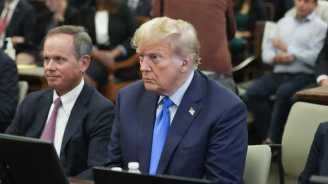
Donald Trump glowers at the Judge on day one of the New York civil trial.
Trump, James, and their respective legal teams remained in the courtroom for more than 20 minutes before exiting.
On his way out, Trump surprised everyone by stating that he will return to court Wednesday.
“I’ll be back tomorrow. Good day,” he said with a wave, before ducking into a side exit with his attorneys and Secret Service security detail.
James refused to answer any questions on her way out, preventing the public from knowing what was going on inside.
Earlier in the day, Engoron issued a gag order against Trump after he posted on his social media site, Truth Social, accusing one of Engoron’s law clerks of having a relationship with Sen. Chuck Schumer (D-NY).
Pagliery reports from the courthouse today: Trump Finally Brings His Online Rage to the Courtroom.
A day after receiving a tongue lashing from a judge disturbed by Donald Trump’s insolence outside the New York courtroom, the former president began to make exasperated remarks inside the court, as the third day of his bank fraud trial started Wednesday.
The increasingly furious Trump—whose real estate empire has already received the kiss of death from the judge—remained quiet during the first two days of proceedings, instead choosing to rail against the entire justice system outside the room’s wooden doors. But when Justice Arthur F. Engoron noted that typical formalities could be cast aside because there’s no jury here, Trump began to grumble and angrily folded his arms while staring at the judge.
Trump turned to defense lawyer Alina Habba at his left to complain in loud groans—this reporter could only make out the words “no jury!”—then threw his arms up and shook his head.
The former president then let out an annoyed sigh and slumped forward, stretching his dark blue suit jacket.
Just before the trial got underway on Wednesday, he was even louder online, where he wrote, “I am not even entitled, under any circumstances, to a JURY. This Witch Hunt cannot be allowed to continue. It is Election Interference and the start of Communism right here in America!”
Minutes later, Trump then complained in court that he couldn’t make out what was being said by the witness on the stand: his longtime former accountant Donald Bender, who became a state witness and disavowed much of the work he did for the Trump Organization and its vastly inflated assets. The testimony could be perceived as a betrayal given that Bender made millions at the firm Mazars USA by working for the Trump family, which invited him to golf courses, hotels, and parties.
Yesterday afternoon, House Republicans came close to eclipsing Trump news, as Matt Gaetz and a few other MAGA crazies removed House Speaker Kevin McCarthy, leaving the House in utter chaos.
The New York Times: House Is Paralyzed, With No Speaker After McCarthy Ouster.
The House of Representatives was in a state of paralysis on Wednesday, ground to a halt by the ouster of Republican Speaker Kevin McCarthy and with no clear sense of who might succeed him — or when.
After a historic vote to remove Mr. McCarthy on Tuesday, lawmakers quickly departed Washington and scattered to their districts around the country, abandoning the Capitol as Republicans remained deeply divided over who could lead their fractious majority.
“What now?” one Republican muttered aloud on the House floor just after the vote on Tuesday afternoon, the first time the chamber had ever removed a speaker from his post involuntarily.
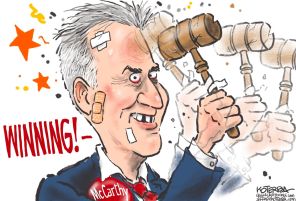 It underscored the chaos now gripping the chamber, which is effectively frozen, without the ability to conduct legislative business, until a successor to Mr. McCarthy is chosen. The California Republican said late Tuesday that he would not seek the post again after being deposed by a hard-right rebellion.
The vacancy promised to tee up another potentially messy speaker election at a time when Congress has just over 40 days to avert another potential government shutdown. But it was not yet clear who might run.
Discussions on the future of the conference were being led by Representative Patrick T. McHenry of North Carolina. Mr. McCarthy had named Mr. McHenry first on a list of potential interim speakers in the event of a calamity or vacancy, but he does not have power to run the chamber — only to preside over the election of a new speaker.
While no Republican has announced a bid for the post, some names reliably come up in conversations with G.O.P. lawmakers, including Mr. McHenry and Representative Tom Cole, the Oklahoma Republican and Rules Committee chairman, as well as the No. 2 and No. 3 House Republicans, Representatives Steve Scalise of Louisiana and Tom Emmer of Minnesota.
This morning, Ohio Rep. Jim Jordan announced he would run for Speaker. Politico: Jim Jordan becomes first to announce run for speaker.
Rep. Jim Jordan said he will run to be the next speaker, a move likely to prompt praise from House conservatives.
Jordan, the House Judiciary chair and member of the House Freedom Caucus, has worked closely with Oversight Chair James Comer (R-Ky.) on the impeachment inquiry into Joe Biden. He had also become a close ally of now-ex Speaker Kevin McCarthy in recent years.
But his candidacy will likely run right into Majority Leader Steve Scalise (R-La.), who is also considering a speakership bid and has worked to court conservatives.
“Jim is a friend, and I certainly think he brings a whole lot that this conference would be able to rally around, but we’ve got to all have a conversation and I’m not going to say who I’m supporting at this point,” said Rep. Chip Roy (R-Texas), a member of the conservative House Freedom Caucus.
“We’re going to figure this out behind closed doors as a family,” he added.
The Ohio Republican was elected to Congress in 2007. He is a Trump ally within the GOP conference and one of the many chairs to have called for Congress to defund the Department of Justice over whistleblower claims that DOJ hampered the Hunter Biden investigation.
But wouldn’t Jordan have to wear a suit and get a couple of new ties if he were Speaker?
Patrick McHenry’s first act as Speaker Pro Tempore was to kick Nancy Pelosi out of her Congressional office. Pelosi didn’t vote to remove McCarthy, because she is in California for Diane Feinstein’s funeral.
Politico: McHenry ordered Pelosi to leave her Capitol hideaway office by Wednesday.
As one of his first acts as the acting speaker, Rep. Patrick McHenry ordered former Speaker Nancy Pelosi to vacate her Capitol hideaway office by Wednesday, according to an email sent to her office viewed by POLITICO.
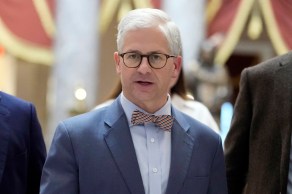
Rep. Patrick McHenry, R-N.C.
“Please vacate the space tomorrow, the room will be re-keyed,” wrote a top aide on the Republican-controlled House Administration Committee. The room was being reassigned by the acting speaker “for speaker office use,” the email said….
Only a select few House lawmakers get hideaway offices in the Capitol, compared to their commonplace presence in the Senate.
House Minority Leader Hakeem Jeffries’ staff helped Pelosi’s office make the move, according to a spokesperson for the former speaker.
Here’s Pelosi’s full response to the eviction, from Raw Story:
“With all of the important decisions that the new Republican Leadership must address, which we are all eagerly awaiting, one of the first actions taken by the new Speaker Pro Tempore was to order me to immediately vacate my office in the Capitol,” Pelosi said in a statement, according to Politico’s Nicholas Wu. “Sadly, because I am in California to mourn the loss of and pay tribute to my dear friend Dianne Feinstein, I am unable to retrieve my belongings at this time.”
“This eviction is a sharp departure from tradition. As Speaker, I gave former Speaker Hastert a significantly larger suite of offices for as long as he wished,” She noted.
“Office space doesn’t matter to me, but it seems important to them,” Pelosi added. “Now that the new Republican Leadership has settled this important matter, let’s hope they get to work on what’s truly important to the American people.”
Three longer opinion pieces on the McCarthy mess:
John F. Harris at Politico Magazine: The House GOP Is a Failed State.
Amanda Marcotte at Salon: Kevin McCarthy’s embarrassing lesson: MAGA torches everything it touches — and will destroy itself.
NBC News: Kevin McCarthy’s ‘original sin’: What drove the House speaker’s historic downfall.
Two more interesting stories to check out:
The Atlanta Journal-Constitution: Fulton prosecutors float plea deals to Trump defendants.
Fulton County prosecutors are floating plea deals to a number of defendants in the election interference case involving former President Donald Trump, according to people with knowledge of the proposals.
At least a handful of the now 18 defendants have received offers from the District Attorney’s office — or prosecutors have touched base with their attorneys to gauge their general interest in striking a deal for a reduced charge in exchange for their cooperation, according to the legal sources, who spoke on condition of anonymity to discuss sensitive ongoing negotiations.
It’s common for prosecutors to float plea deals to lower-level defendants in large racketeering cases as they home in ontheir biggest targets. Trump and his former personal attorney Rudy Giuliani face the most chargesin the 41-count indictment, which centers on efforts to overturn the results of Georgia’s 2020 presidential election.
Late last week, Atlanta bail bondsman Scott Hall became the first defendant to accept a deal, pleading guilty to five misdemeanor counts in exchange for his testimony.
The Atlanta Journal-Constitution has learned that Fulton prosecutors have also offered a deal to Michael Roman, who worked as director of Election Day operations for the Trump campaign in 2020. A member of Roman’s legal team told The AJC theyrejected the DA’s proposal and that no agreement has been reached….
People who were indicted for their alleged roles in the appointment of a slate of Trump electors, election data breach in Coffee County and harassment of Fulton poll worker Ruby Freeman have also been approached by prosecutors, according to multiple sources. In the case of at least two of those defendants, no concrete offer has been made.
Click the link to read the rest.
The New York Times: Giuliani’s Drinking, Long a Fraught Subject, Has Trump Prosecutors’ Attention.
Rudolph W. Giuliani had always been hard to miss at the Grand Havana Room, a magnet for well-wishers and hangers-on at the Midtown cigar club that still treated him like the king of New York.
In recent years, many close to him feared, he was becoming even harder to miss.
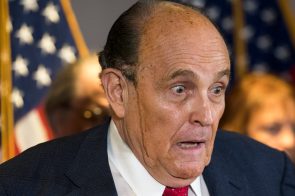 For more than a decade, friends conceded grimly, Mr. Giuliani’s drinking had been a problem. And as he surged back to prominence during the presidency of Donald J. Trump, it was getting more difficult to hide it.
On some nights when Mr. Giuliani was overserved, an associate discreetly signaled the rest of the club, tipping back his empty hand in a drinking motion, out of the former mayor’s line of sight, in case others preferred to keep their distance. Some allies, watching Mr. Giuliani down Scotch before leaving for Fox News interviews, would slip away to find a television, clenching through his rickety defenses of Mr. Trump.
Even at less rollicking venues — a book party, a Sept. 11 anniversary dinner, an intimate gathering at Mr. Giuliani’s own apartment — his consistent, conspicuous intoxication often startled his company.
“It’s no secret, nor do I do him any favors if I don’t mention that problem, because he has it,” said Andrew Stein, a former New York City Council president who has known Mr. Giuliani for decades. “It’s actually one of the saddest things I can think about in politics.”
Now prosecutors are looking at Giuliani’s problem.
Now, prosecutors in the federal election case against Mr. Trump have shown an interest in the drinking habits of Mr. Giuliani — and whether the former president ignored what his aides described as the plain inebriation of the former mayor referred to in court documents as “Co-Conspirator 1.”
Their entwined legal peril has turned a matter long whispered about by former City Hall aides, White House advisers and political socialites into an investigative subplot in an unprecedented case.
The office of the special counsel, Jack Smith, has questioned witnesses about Mr. Giuliani’s alcohol consumption as he was advising Mr. Trump, including on election night, according to a person familiar with the matter. Mr. Smith’s investigators have also asked about Mr. Trump’s level of awareness of his lawyer’s drinking as they worked to overturn the election and prevent Joseph R. Biden Jr. from being certified as the 2020 winner at almost any cost. (A spokesman for the special counsel declined to comment.)
The answers to those prompts could complicate any efforts by Mr. Trump’s team to lean on a so-called advice-of-counsel defense, a strategy that could portray him as a client merely taking professional cues from his lawyers. If such guidance came from someone whom Mr. Trump knew to be compromised by alcohol, especially when many others told Mr. Trump definitively that he had lost, his argument could weaken.
That’s it for me today. What do you think? What other stories have caught your interest?
Did you like this post? Please share it with your friends:
Posted: September 27, 2023 | Author: bostonboomer | Filed under: Donald Trump, just because, morning reads | Tags: bank fraud, insurance fraud, Judge Arthur Engoron, Letitia James, Trump Organization |
Good Day!!

Lady Justice, by Eduardo Rodriguez, 2017
All hell broke loose in Donald Trump’s life yesterday afternoon. New York Supreme Court Judge Arthur Engoron cancelled his business licenses in the state and ordered them into receivership. Legal experts call this the “corporate death penalty.”
From long-time Trump expert David Cay Johnston at DC Report: Judge Gives Trump Organization the Corporate Death Penalty.
Donald Trump is no longer in business.
Worse, the self-proclaimed multibillionaire may soon be personally bankrupt as a result, stripped of just about everything because for years he engaged in calculated bank fraud and insurance fraud by inflating the value of his properties, a judge ruled Tuesday.
His gaudy Trump Tower apartment, his golf courses, his Boeing 757 jet and even Mar-a-Lago could all be disposed of by a court-appointed monitor, leaving Trump with not much more than his pensions as a one term president and a television performer.
A New York State judge on Tuesday cancelled all of the business licenses for the Trump Organization and its 500 or so subsidiary companies and partnerships after finding that Trump used them to, along with his older two sons, commit fraud.
Under the New York General Business Law you can only do business in your own name as a sole proprietor or with a business license, which the state calls a “business certificate.” All of Trump’s businesses were corporations or partnerships that require business certificates.
The civil fraud case was brought by Letitia James, the elected attorney general of New York State.
The evidence and the issues were so clear cut, Judge Arthur F. Engoron ruled on Tuesday, that there was no reason to waste the court’s time trying them.
In a 35-page decision, Judge Engoron also excoriated Trump and his lawyers for making nonsense arguments, so badly misquoting legal cases that they turned the law upside down, and other legal misconduct.
The judge also sanctioned Trump’s lawyers $7,500 each for repeatedly advancing frivolous arguments. Judge Engoron’s decision can be appealed, but that may not have much chance of succeeding.
I give Trump’s chances of prevailing on appeal at somewhere between zero and nothing except perhaps on some minor procedural point, which you can be sure Trump will describe as complete vindication.
The summary judgement decision Tuesday was partial, however.
A non-jury trial before Judge Engoron next week will determine how much Trump will be fined for his years of bank fraud and insurance fraud.
Barring a highly unlikely reversal by an appeals court, Trump’s business assets eventually will be liquidated since he cannot operate them without a business license. Retired Judge Barbara Jones was appointed to monitor the assets, an arrangement not unlike the court-supervised liquidation of a bankrupt company or the assets of a drug lord.

Justice, by Pierre Subleyras
I thought this piece by Jose Pagliery at The Daily Beast gave the clearest explanation of the details of the case among the many that I read: Trump Basically Just Lost the New York Bank Fraud Case Before It Even Started. I’ll post some of it, but I’d recommend read the whole article if you have the time and interest.
Former President Donald Trump, his top executives, and heirs were declared completely liable of “persistent and repeated fraud”—and the real estate empire was unceremoniously stripped of its business licenses in New York—after a judge’s powerful ruling Tuesday ahead of a massive trial that seeks to hit them with more than $250 million in penalties for bank fraud.
And in a stunning development, the judge has already ordered the complete dissolution of the fabled Trump Organization–the tycoon’s pride and joy, the empire that made him famous and elevated him into the White House. The Trump Organization and its sister companies will be sent into receivership to be under the control of a court-appointed officer.
Even before the trial officially starts, the ruling handed New York Attorney General Letitia James a near total victory, meaning that next week’s trial will mostly focus on damages that could pulverize whatever is left of Trump’s many business entities and bank accounts.
In his 35-page opinion, Justice Arthur F. Engoron tore apart what he called the Trump family’s “bogus arguments” and obstreperous conduct. And he summed up the entire defense as “a fantasy world, not the real world.”
“In defendants’ world: rent regulated apartments are worth the same as unregulated apartments; restricted land is worth the same as unrestricted land, restricts can evaporate into thin air… all illegal acts are untimely if they stem from one untimely act; and square footage [is] subjective,” he wrote.
Trump, several of his heirs, and top executives will now be fighting off accusations of bank and insurance fraud at a civil trial that’s scheduled to run from early October until late December. AG Letitia James seeks to punish them all for routinely lying about property values to score better deals. At trial, it will be up to Judge Engoron alone whether the Trumps will owe $250 million-plus in penalties, be prohibited from serving as executives, and have the company charters revoked.
Of course, Trump posted an idiotic statement on the decision to Truth Social. It’s reproduced in the article. A bit more on the case itself:
The judge’s ruling represents a significant setback for Trump by revoking his company’s authority to do business in New York, where the Trump Organization is headquartered and where Trump has major real estate interests. It also represents a victory for Attorney General Letitia James (D), who had asked that Engoron simplify the upcoming trial by deciding in advance that fraud was broadly committed so the state would need to prove only specific illegal acts.
On Tuesday, Engoron ripped the Trumps—and their lawyers—apart for dragging this on so long with legal arguments that wasted the courts time by repeatedly questioning whether the AG even had the authority to hold them accountable this way.

Justice, by Francisca Vogel
Those arguments “glaringly misrepresent” the law and trying them again and again “invoke the time-loop in the film Groundhog Day,’” the judge wrote, calling attempts to topple the case this way “pure sophistry.”
Engoron also made the pivotal decision to keep all of the AG’s lawsuit intact, concluding that all of the real estate deals in question are not too old for law enforcement to crack down on for bank fraud. He brushed off the Trumps’ attempt to whittle down the lawsuit ahead of a trial that could drain the wealthy family’s bank accounts.
The timing of this decision also throws a wrench into the Trumps’ Hail Mary play, in which they sued the judge directly and prematurely asked a state appellate court to intervene because he hadn’t yet made his decision on the statute of limitations—an oddly aggressive move that reeked of delay tactics. That higher court, the appellate division’s First Judicial Department, has yet to weigh in. Doing so now might be a moot point. As such, the trial appears to be set to start next Monday, as planned.
There’s still more from the Judge on Trump’s fraudulent behavior at the link. Pagliery tweeted from the New York courthouse this morning, where Trump’s lawyers were back arguing with the judge this morning. Here’s his latest article:
Jose Pagliery at The Daily Beast: Team Trump Prepares for Doom at New York Bank Fraud Trial.
On the heels of yesterday’s critical court ruling ordering the death of the fabled Trump Organization, lawyers for Donald Trump appeared in court on Wednesday to pick up the pieces and make sense of how this can possibly get any worse for the former president.
Huge sections of the Trump family’s real estate empire are having their business licenses revoked, and the Trumps are losing control of their companies to a court-appointed official. The trial set to start next week threatens to empty their bank accounts too.
Half a day after Justice Arthur F. Engoron’s Tuesday ruling, it’s evident the real estate tycoon and his lawyers still aren’t sure what will happen to Trump’s Monopoly board collection of buildings in Manhattan and elsewhere.
“Certain of the entities own physical assets, like 40 Wall Street and Trump Tower. Are those assets now going to be sold? Or managed under direction of the monitor?” Trump defense lawyer Christopher Kise asked the judge in court.
After privately discussing the matter with his law clerk, the judge declined to make a final decision “right now.” But the judge made clear an independent person will play a role in determining the fate of this multibillion dollar network of companies, giving both investigators and the Trump family extra time to jointly find an outside official who can oversee this while they’re wrested from the family’s control.
Engoron on Tuesday decided that New York Attorney General Letitia James already proved the Trump family routinely lied to banks by wildly inflating property values for years—the first of seven counts in the AG’s lawsuit. Each count alleges a violation of the state’s Executive Law § 63(12), which keeps corporations honest. In court today, Trump’s attorneys asked a question dripping with existential dread.
“What’s the point of the others?” Kise asked the judge. “I don’t know how many 63(12) counts you need. You’ve already granted relief, except for disgorgement.”
Kise was referring to the next punishment the Trumps might face, as state investigators want to seize $250 million-plus in profits that they obtained after faking asset values on business paperwork submitted to banks for loans.

La Justice, by Gee
This process is going to be fascinating. My guess is it will end up taking a long time before we know the final upshot. But as of now, Trump has been stripped of his identity as a successful businessman. That has to be deeply humiliating for him.
Trump whisperer Maggie Haberman and fellow New York Times reporter wrote about this: Ruling Against Trump Cuts to the Heart of His Identity.
Nearly every aspect of Donald J. Trump’s life and career has been under scrutiny from the justice system over the past several years, leaving him under criminal indictment in four jurisdictions and being held to account in a civil case for what a jury found to be sexual abuse that he committed decades ago.
But a ruling on Tuesday by a New York State judge that Mr. Trump had committed fraud by inflating the value of his real estate holdings went to the heart of the identity that made him a national figure and launched his political career.
By effectively branding him a cheat, the decision in the civil proceeding by Justice Arthur F. Engoron undermined Mr. Trump’s relentlessly promoted narrative of himself as a master of the business world, the persona that he used to enmesh himself in the fabric of popular culture and that eventually gave him the stature and resources to reach the White House.
The ruling was the latest remarkable development to test the resilience of Mr. Trump’s appeal as he seeks to win election again despite the weight of evidence against him in cases spanning his years as a New York developer, his 2016 campaign, his efforts to overturn his 2020 election loss and his handling of national security secrets after leaving office.
The authors note that, so far, none of the cases against Trump have seemingly hurt his campaign to win the presidency again in 2024.
Whether the effect of Justice Engoron’s ruling is any different remains to be seen. But his finding imperils both Mr. Trump’s public image and his business empire. The former president now faces not only the prospect of having to pay $250 million in damages, but he could also lose properties like Trump Tower that are inextricably linked to his brand….
In all of Mr. Trump’s recent legal travails, his typical tactics for self-preservation have largely failed him. When cornered, Mr. Trump has traditionally sought to bluster his way out of trouble, falling back on exaggerations or outright lies to escape.
These methods have served him well in the business and political arenas, where there is often little price to pay for bending the truth and where voters tend not to distinguish between gradations of prevarications. Those methods, though, have been much less effective so far in the courts, which operate according to strict standards of veracity and staid and sober rules.
In straightforward terms, Justice Engoron punctured Mr. Trump’s bubble of protective falsehoods about the way he conducted his business.
More Interesting Stories to Check Out
NBC News: The FBI is probing whether Egyptian intelligence played a role in Bob Menendez’s alleged bribery scheme.
Molly Jong-Fast at Vanity Fair: Let’s Not Sleepwalk Into Another Trump Presidency.
Amanda Marcotte at Salon: President Drink Bleach says what? Trump now claims he beat George W. Bush and Barack Obama.
CNN: Commander Biden bites another Secret Service agent, the 11th known incident.
The New Republic: The Sick, Racist Message Behind Why Trump Chose That Particular Gun Store.
The Hill: FCC chair proposes reinstating Obama-era net neutrality rules.
The Messenger: Trump Adds Two Attorneys to Criminal Defense Team.
The Daily Beast: UAW Leader Has No Desire at All to Talk to Trump in Michigan.
Have a great Wednesday everyone!!
Did you like this post? Please share it with your friends:


 peej
peej Carissa
 bostonboomer
 dakinikat
 ecocatwoman
 mablue2
 Mama Lopez
 peggysue22
 quixote
 skydancingguestblogger
 Mona (aka Wonk the Vote)



 Sky Dancing
Recent Comments