Today I want to follow up on what Daknikat wrote yesterday about the Supreme Court and abortion rights. Thanks to all the Bernie Bros and Hillary Haters, we ended up with Donald Trump in 2016, and he was able to appoint three right wing nuts to the Supreme Court.
We could have had the first woman president, and she could have nominated three liberals to the court. But misogyny and anti-Clinton propaganda won Trump enough electoral votes to take the White House even though he lost the popular vote. Now women will face the consequences.
On Monday morning, the Supreme Court announced that it will reconsider the constitutional prohibition against abortion bans before fetal viability. This decision indicates that the ultra-conservative five-justice majority is prepared to move aggressively against Roe v. Wade rather than tinker around the edges of abortion rights. The court will take on state laws that seek to outlaw abortion at early—and perhaps all—stages of pregnancy. It seems likely that the justices took this case for the express purpose of overturning Roe and allowing the government to enact draconian abortion bans that have been unconstitutional for nearly half a century.
Dobbs v. Jackson Women’s Health Organization, the case that SCOTUS took up on Monday, is not a subtle threat to Roe. It is, rather, a direct challenge to decades of pro-choice precedent. In 2018, Mississippi passed a law forbidding abortions after 15 weeks. This measure had two purposes: to restrict abortion, yes, but also to contest Supreme Court precedent protecting abortion rights. In Roe and later decisions—most notably Planned Parenthood v. Casey—the Supreme Court held that the Constitution forbids bans on abortion before the fetus has achieved viability. Since there is no doubt that, at 15 weeks, a fetus is not viable, even with the most heroic medical interventions, Mississippi’s law was clearly designed as a vehicle to let SCOTUS reevaluate (and reverse) Roe.
The lower courts understood this plan. Judge James Ho, a very conservative Donald Trump nominee, all but endorsed it when the case came before the 5th U.S. Circuit Court of Appeals. Ho urged the Supreme Court to overturn Roe—while acknowledging that, as a lower court judge bound by precedent, he could not uphold Mississippi’s abortion ban. Now the justices have vindicated Ho by accepting Mississippi’s invitation. (The court will hear arguments in the case next fall and issue a decision by the summer of 2022.) It is not difficult to guess what will happen next. But it is worth pointing out three reasons why the Supreme Court appears poised to seize upon Dobbs to eviscerate the constitutional right to abortion.
How do we know the conservatives on the Court are planning to reverse Roe v. Wade?
First, there is no split between the lower courts on the question presented in Dobbs. The Supreme Court typically takes up cases that have divided courts of appeals so the justices can provide a definitive answer that applies nationwide. Here, however, no court has claimed that, under current precedent, a state may outlaw abortions at 15 weeks. Even Ho had to admit that binding precedent “establishes viability as the governing constitutional standard.” There is no reason for the Supreme Court to hear Dobbs unless it wants to abolish this standard, which has been the law of the land for almost 50 years.
Abortion by Anil Keshari
Second, Mississippi gave the justices several options for a more limited ruling; its petition to the court included a question that would’ve let the court modify the standard for abortion restrictions without overtly killing off Roe. But the justices rejected that alternative and agreed to consider the central question in the case: “Whether all pre-viability prohibitions on elective abortions are unconstitutional.”
This action suggests that the conservative majority is no longer interested in gradually eroding abortion rights until they are, in reality, nonexistent….
Third, and relatedly, Barrett’s impact on this case cannot be understated. Just last summer, the Supreme Court struck down laws targeting abortion clinics in Louisiana by a 5–4 vote, with Chief Justice John Roberts joining the liberals (with qualifications) to affirm the bottom-line rule that states may not place an “undue burden” on the right to abortion before viability. Less than three months later, Justice Ruth Bader Ginsburg died, and Trump put Barrett—a foe of abortion rights—in her seat. By doing so, Trump shored up a far-right five-justice majority that, by all appearances, is committed to endingRoe.
Greg Stohr of Bloomberg via The Washington Post:
The U.S. Supreme Court has heard multiple cases in recent years from states trying to narrow the right to have an abortion, one of the nation’s most contentious issues. The next case is more sweeping than most. With its newly strengthened conservative majority in place, the court has agreed to hear Mississippi’s bid to ban abortion in almost all cases after 15 weeks of pregnancy. That could mean overturning, or at least gutting, the landmark 1973 Roe v. Wade decision, which legalized abortion nationwide….
The Roe v. Wade decision established that the decision to terminate a pregnancy was a woman’s choice to make in the first trimester, and that the state could regulate abortions only later. In the Planned Parenthood v. Casey case in 1992, the Supreme Court revisited the timing issue, saying women have the right to abortion without undue interference before a fetus is viable — that is, capable of living outside the womb. The court didn’t pinpoint when viability occurs but suggested it was around 23 or 24 weeks. In 2018, the Mississippi legislature voted to outlaw most abortions after 15 weeks. The ban, which makes exceptions only in cases of severe fetal abnormality or major health risk to the mother, was challenged by the state’s only abortion facility, the Jackson Women’s Health Organization, and deemed unconstitutional by a federal district judge and federal appeals court. The state of Mississippi appealed to the Supreme Court, arguing that viability is “not an appropriate standard for assessing the constitutionality” of abortion laws….
From Ireland–Detail from a marching banner for the Artists’ Campaign to Repeal the Eighth Amendment Banner, by Alice Maher, Rachel Fallon and Breda Mayock. Photograph by Alison Laredo, Courtesy the artists
Three appointments to the court made by Biden’s predecessor, Donald Trump, have given it a 6-3 conservative majority. And Trump’s last two appointees, Justices Brett Kavanaugh and Amy Coney Barrett, replaced justices who supported the core right to abortion. If Kavanaugh and Barrett are willing to back Mississippi, abortion opponents might not even need the vote of the sixth conservative, Chief Justice John Roberts….
A decision throwing out the 1992 viability standard could immediately mean tighter abortion restrictions in a number of states. The Guttmacher Institute, which monitors and advocates for abortion rights, counts 16 states that have attempted to ban at least some abortions before viability but have been stopped by a court order.
Leah Litman and Melissa Murray at The Washington Post: Opinion: The Supreme Court’s conservative supermajority is about to show us its true colors.
On Monday morning, the court agreed to hear a challenge to a Mississippi law that would ban most abortions after 15 weeks of pregnancy — a case that poses a direct attack on the constitutional right to abortion.
The decision to take the case was unsurprising. President Donald Trump vowed to appoint justices who would overrule Roe v. Wade, the 1973 decision holding that women have a constitutional right to obtain abortions. With Trump’s three historic appointments to the high court, all that opponents of Roe needed was the right vehicle. The Mississippi case gives them just that. It will be heard in the court’s term beginning in October….
It would not be unthinkable for this Supreme Court to use the Mississippi case to jettison Roe and Casey. Although stare decisis and its principle of respect for settled precedents has long been a hallmark of U.S. law, this court has in recent years refused to be bound by established precedents.
Last year, Justices Neil M. Gorsuch and Brett M. Kavanaugh, two of Trump’s appointees, cast votes to overrule a case that had invalidated a pair of abortion restrictions. The term before that, in another case, Justice Clarence Thomas argued that the court was duty-bound to overrule precedents that were “demonstrably erroneous.” In other writings, he has railed against Roe and Casey as perversions of constitutional law. And the court’s newest member, Justice Amy Coney Barrett, has, in her academic writing, indicated that she shares Thomas’s ideas about precedents and abortion rights.
Untitled No. 5, Abortion Series, 1998, Paula Rego
Even in cases where the court has not overruled past decisions, it has gone to herculean lengths to limit prior cases, broadly refashioning entire areas of law without explicitly overruling the decisions undergirding those doctrines. And this approach might be what lies ahead for abortion.
Rather than overruling Roe and Casey, the court might say that viability is no longer a meaningful marker for determining when a state may restrict a woman’s right to choose — a decision that would be as consequential as scuttling Roe itself. It could allow states to restrict access to abortion at any point during pregnancy, sharply curtailing reproductive rights as lower courts reconsider the constitutionality of bans on abortion after 12 weeks, 10 weeks or six weeks of pregnancy.Under Roe and Casey, courts easily found all such laws unconstitutional because they prohibited abortions before viability. If the court erases viability’s significance, many abortion restrictions once easily struck down will pose more difficult questions for reviewing courts.
Anti-abortion activists across the country expressed optimism on Monday that they might be on the cusp of achieving a long-held goal of the movement: overturning Roe v. Wade, the 1973 Supreme Court decision that extended federal protections for abortion.
The Supreme Court announced on Monday morning that it would consider in its next term a case from Mississippi that would ban abortion after 15 weeks of gestation, with narrow exceptions….
It is the first abortion case under the court’s new 6-3 conservative majority, and activists expressed hope that this case would be the one to remove federal protections for the procedure. Such a ruling would give the right to regulate abortions at any point in pregnancy back to the states, many of which in the South and Midwest have imposed tough restrictions.
“There’s a great sense of inspiration across the country right now,” said Mike Gonidakis, president of Ohio Right to Life. “This is the best court we’ve had in my lifetime, and we hope and pray that this is the case to do it.”
In a statement, Marjorie Dannenfelser, president of Susan B. Anthony List, a national anti-abortion organization, called the court’s move “a landmark opportunity to recognize the right of states to protect unborn children,” and noted that state legislatures have introduced hundreds of bills restricting abortion in this legislative season.
Abortions rights advocates cheered when Joe Biden was elected, heralding his win as a “seismic shift” and a “welcome change.” Now, with the nationwide right to an abortion on the line, they’re getting a little impatient.
After Abortion, by Zois Shuttie
On Monday, the Supreme Court announced it would take on a Mississippi case that has the potential to overturn Roe v Wade, the 1973 decision making abortion legal across the country. If that happens, nearly half of the U.S. would move to prohibit the procedure, according to the Center for Reproductive Rights.
Advocates see the decision to take on the case as a massive threat to abortion rights—and one Biden may not be taking seriously enough.
“He turned his back on people who have abortions as soon as he got into office,” said Renee Bracey Sherman, executive director of the abortion advocacy group We Testify. “What happened this morning at the Supreme Court is what happens when you turn your backs on us and ignore the restrictions we’re facing every single day.”
Pressure on Biden to act more decisively began mounting April 29, when more than 140 organizations called on the administration to prioritize changes to U.S. sexual and reproductive rights law recommended by the United Nations. The day before, nearly 60 women’s rights organizations—including Planned Parenthood and NARAL, which spent tens of millions of dollars to help elect the president—sent a letter to the administration asking them to increase funding for abortion and remove “unnecessary barriers” to access.
“The Biden-Harris administration and Congressional leadership must prioritize these policies for women and women of color,” they wrote, in a letter calling for multiple changes on behalf of American women. “We need to build back better for women and create lasting political, social and economic change.”
Click the link to read the rest.
There is much more news, and I’ll post more links in the comment thread, but to me this is the biggest issue right now. Women are on the verge of losing the rights we have been fighting for since the late 1960s.
As always, treat this as an open thread.
Did you like this post? Please share it with your friends:
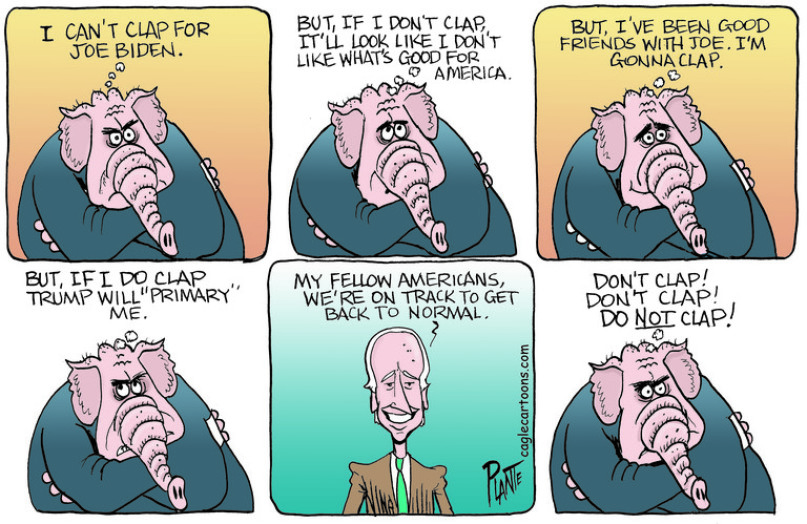
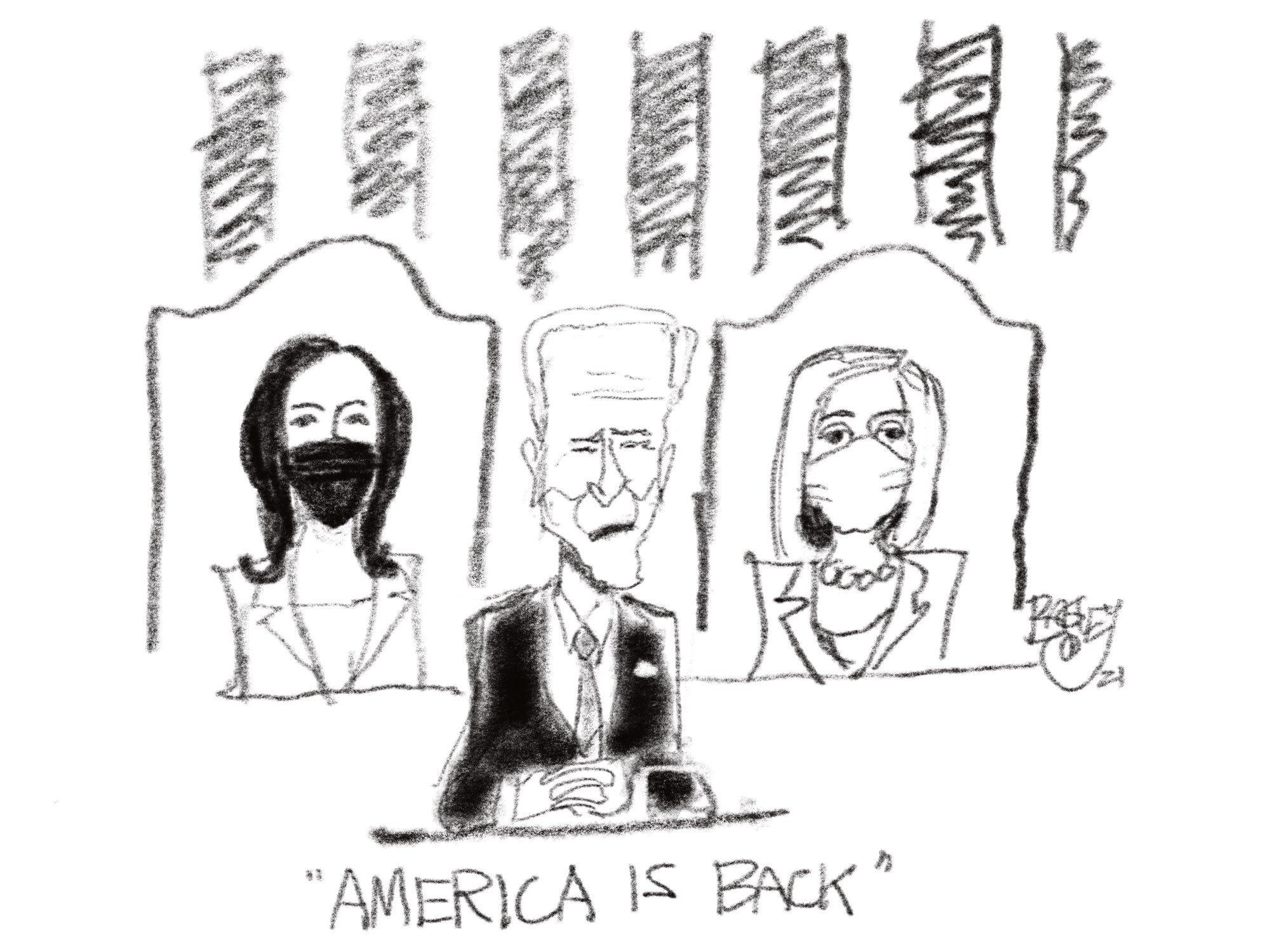
Last night President Biden gave his first speech to a joint session of Congress. For the first time, two women sat behind the president, Vice President Kamala Harris and Speaker of the House Nancy Pelosi. A couple of reactions to the speech:
There were two moments during President Biden’s address to the nation on Wednesday in which he obviously, if only indirectly, referred to the man who preceded him in his position.
The first came near the beginning.
“America is rising anew,” Biden said, “choosing hope over fear, truth over lies, and light over darkness.”
Only the second of those three pairings is immediately and obviously about Donald Trump; the former president’s indifference to accuracy is unparalleled. But by stringing the three together, Biden was similarly positioning Trump as the target of the other pejoratives. America under Trump, he’s saying, was a place of fear, dishonesty and darkness. That tracks with Biden’s past rhetoric and, frankly, Trump’s own: Biden warned the country last autumn that a dark winter was coming because of the pandemic (and Trump’s leadership failures), and Trump himself made fear a central part of his reelection bid.\But now, Biden argued on Wednesday night, all of that was swept aside.
“After 100 days of rescue and renewal, America is ready for takeoff, in my view,” he said. “We’re working again, dreaming again, discovering again and leading the world again. We have shown each other and the world that there’s no quit in America.”
From there, Biden turned his attention to an exhaustive list of policy priorities, one that, in its own way, differentiated his speech from any of Trump’s. Not only were his proposals robust and detailed in a way that was never Trump’s style, they were also progressive in a way that no Republican’s would be. It was an obvious difference and, of course, the most important one in terms of governance.
But it was also a reminder that Biden always ran on being a president who just sort of quietly went about presidenting, a promise that he has fulfilled in spades.
President Joe Biden’s address to a joint session Congress was the most ambitious ideological statement made by any Democratic president in decades—couched in language that made it sound as if he wasn’t making an ideological argument at all.
Make no mistake that he was. He called for trillions in new spending in a robust expansion of government’s role in multiple arenas of American life in ways that would have been impossible to contemplate in Barack Obama’s presidency. He plunged into subjects—racial and class inequities, immigration, gun violence—that were rubbed raw until bleeding in Donald Trump’s.
Usually these issues are framed with a question: Which side are you on? Though rarely described as gifted orator, Biden’s speech was a remarkable performance in part because it didn’t soar and largely didn’t even try to. In plain-spoken language, he depicted a breathtakingly large agenda as plain common sense. Instead of imploring partisans to take sides, he projected bewilderment that any practical-minded person of any persuasion could be opposed.
Under a pose of guilelessness, Biden’s speech was in fact infused with political guile. The agenda he promoted to expand both free pre-school and community college, to subsidize the shift to a low-carbon economy, to fund a massive way of new public works construction by taxing the very wealthy, represented years of pent-up demand by progressives. But much of the money would be spent in ways designed to break up the Trump coalition, which was powered heavily by middle- and lower-middle class whites who do not have college degrees with contempt for many parts of the progressive agenda.
Referring to his infrastructure proposal, Biden argued: “Nearly 90 percent of the infrastructure jobs created in the American Jobs Plan do not require a college degree. Seventy-five percent don’t require an associate’s degree. The American Jobs Plan is a blue-collar blueprint to build America.”
The bet is that material gains—i.e., a recovery that produces lots of working class jobs, and allows families to more easily educate their children—can trump the cultural grievances that sent many of these people into the conservative movement over the past two generations, beginning with George Wallace’s hardhat supporters and later becoming a flood of “Reagan Democrats.”
About half of Americans who watched President Joe Biden’s address to Congress had a very positive reaction to the speech, and 71% said they walked away feeling more optimistic about the country’s direction, according to a CNN Poll conducted by SSRS.
By a wide margin, speech-watchers said that Biden’s policy proposals would move the country in the right direction (73%) rather than the wrong direction (27%). In a survey conducted before the speech, the same people were a bit less bullish that Biden would lead in the right direction (67% right direction, 33% wrong direction), and that movement came from the independents and Republicans who watched the speech. Among Republicans, the share saying Biden’s policies would move the country in the right direction grew from 13% pre-speech to 27% post-speech, while among independents, that percentage rose from 61% to 73%.
That perception carries through to the major issues covered in the speech. More than 8 in 10 said Biden’s proposals on the coronavirus pandemic would move in the right direction (86%), and 74% said the same about racial injustice. Around 7 in 10 said the President’s policies on the economy (72%), gun laws (70%) and taxes (70%) were steps in the right direction. Slightly fewer said the same about immigration (65%).
And Biden’s focus on those issues appeared to hit the right mark for speech-watchers. Overall, 68% said Biden has had the right priorities so far as president, while 32% said he has not paid enough attention to the most important problems.
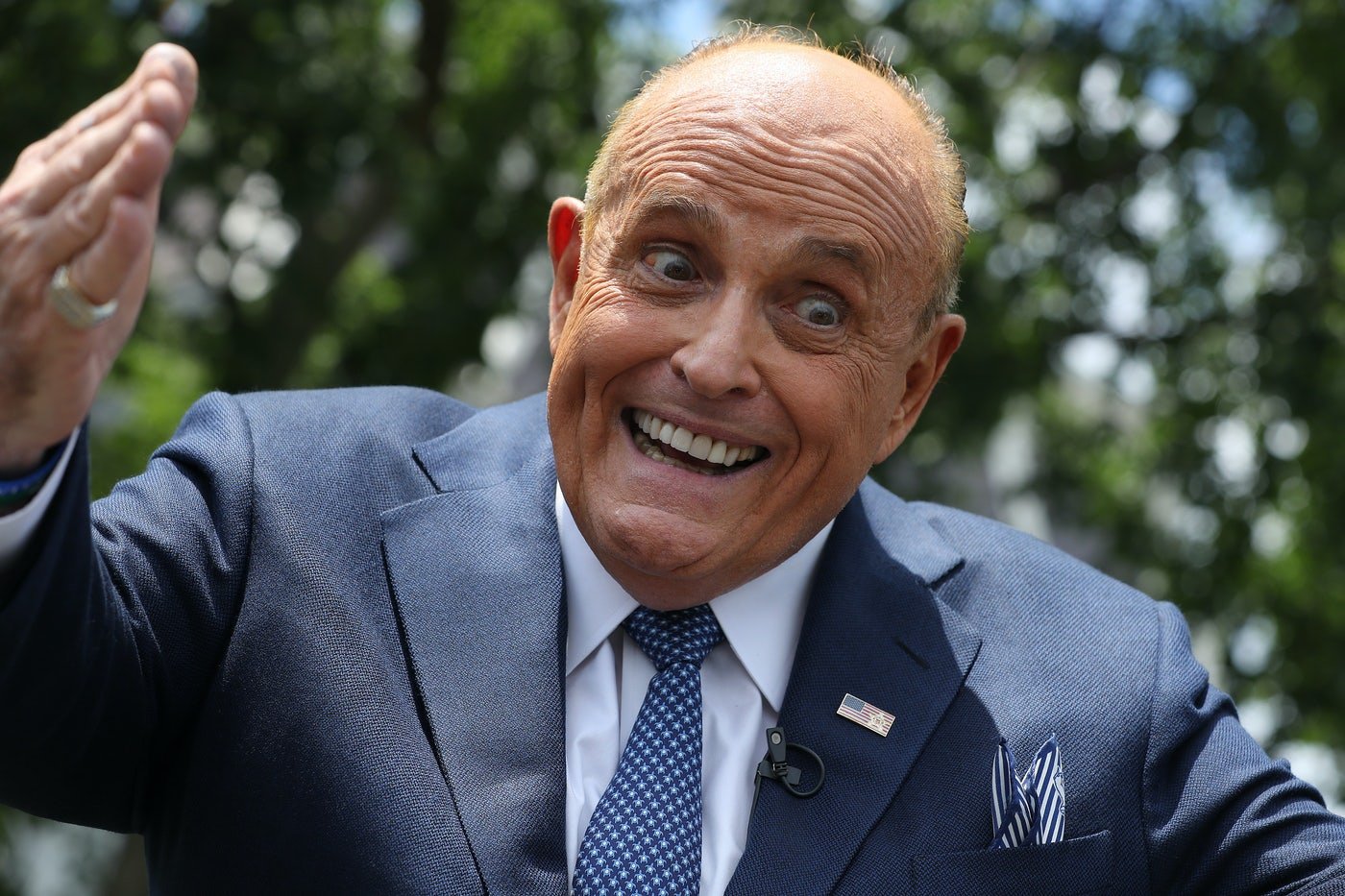
Federal investigators searched Rudy Giuliani’s home and office in Manhattan on Wednesday, executing search warrants as part of an investigation into his business dealings in Ukraine, reports The New York Times.
The former New York City mayor and personal lawyer to former President Donald Trump is being investigated over possible illegal lobbying on behalf of Ukrainian officials and his efforts to dig up dirt on Trump’s political rivals. “Executing a search warrant is an extraordinary move for prosecutors to take against a lawyer, let alone a lawyer for a former president,” writes the Times. “While the warrants are not an explicit accusation of wrongdoing against Mr. Giuliani, it shows that the investigation has entered an aggressive new phase.”
Experts agreed the search represented very serious stakes for Giuliani. Former U.S. attorney Harry Litman wrote that “this means that a magistrate judge has found probable cause to believe that [Giuliani’s actions in Ukraine] were criminal.” As the Times writes, “to obtain a search warrant, investigators need to persuade a judge they have sufficient reason to believe that a crime was committed and that the search would turn up evidence of the crime.”
Federal prosecutor and legal analyst Shanlon Wu called the search an “extraordinary step,” and wrote that “no amount of hot air and ranting is going to help Rudy Giuliani now.”
Litman continued: “I don’t know offhand the percentage of people whose [apartments] are searched by warrant who are then indicted … but it’s high, and given Giuliani’s profile, it has to be higher [because] they would be more careful and get lots of approvals.”
The search warrant was reportedly a long time coming, and politics may have slowed it down. The process was delayed for the presidential election so as not to sway voters, and Trump appointees at the DOJ reportedly managed to temporarily block the warrant while Trump was still in office.
I spoke with Preet Bharara, who served as the U.S. Attorney for the district from 2009 to 2017 — and whose podcast, Stay Tuned, was recently acquired by Vox Media — about Giuliani’s predicament and where the investigation might go next.
How significant is this move by the Feds from your perspective? How much legal danger does Giuliani face here? I think it’s extremely significant. I’m not one to say that when routine subpoenas are issued or interviews are conducted, but here you have a very prominent person — not just the former lawyer to the president of the United States but also the former U.S. Attorney of the office that’s involved in the investigation. The fact that you execute a warrant on someone’s residence does not necessarily mean there will be a charge, but given the circumstances, given the identity of Mr. Giuliani, given what you have to show to get a judge to authorize the warrant and the search — that’s a sign that he’s in deep trouble. We saw this play out with respect to Michael Cohen and to Paul Manafort. Very prominent targets, very sensitive cases. Both of those men were charged.
The two people you just cited also both went to prison. Is that where this could be going?
I used to head that office, and there are search warrants that get executed on people’s premises and their offices, and no charges follow. That happens, and Giuliani is presumed to be innocent. But what’s likely is that there has already been substantial investigation. The reporting was that they tried to execute these searches when Trump was in office, and they were stymied by higher-ups in the Justice Department. Bear in mind, they’re probably far along, given what showing they have to make of probable cause to do these searches in the first place. They likely already have a lot of Rudy Giuliani’s communications. You don’t need to have his devices in your possession to have email records; those are obtained from third parties, and they probably have all of that. It’s anyone’s guess what the charges will be and when they will come. But in my experience, when you do something like this, that you know will have a reputational effect on the subject, you’re usually thinking there’s a good likelihood of a charge.
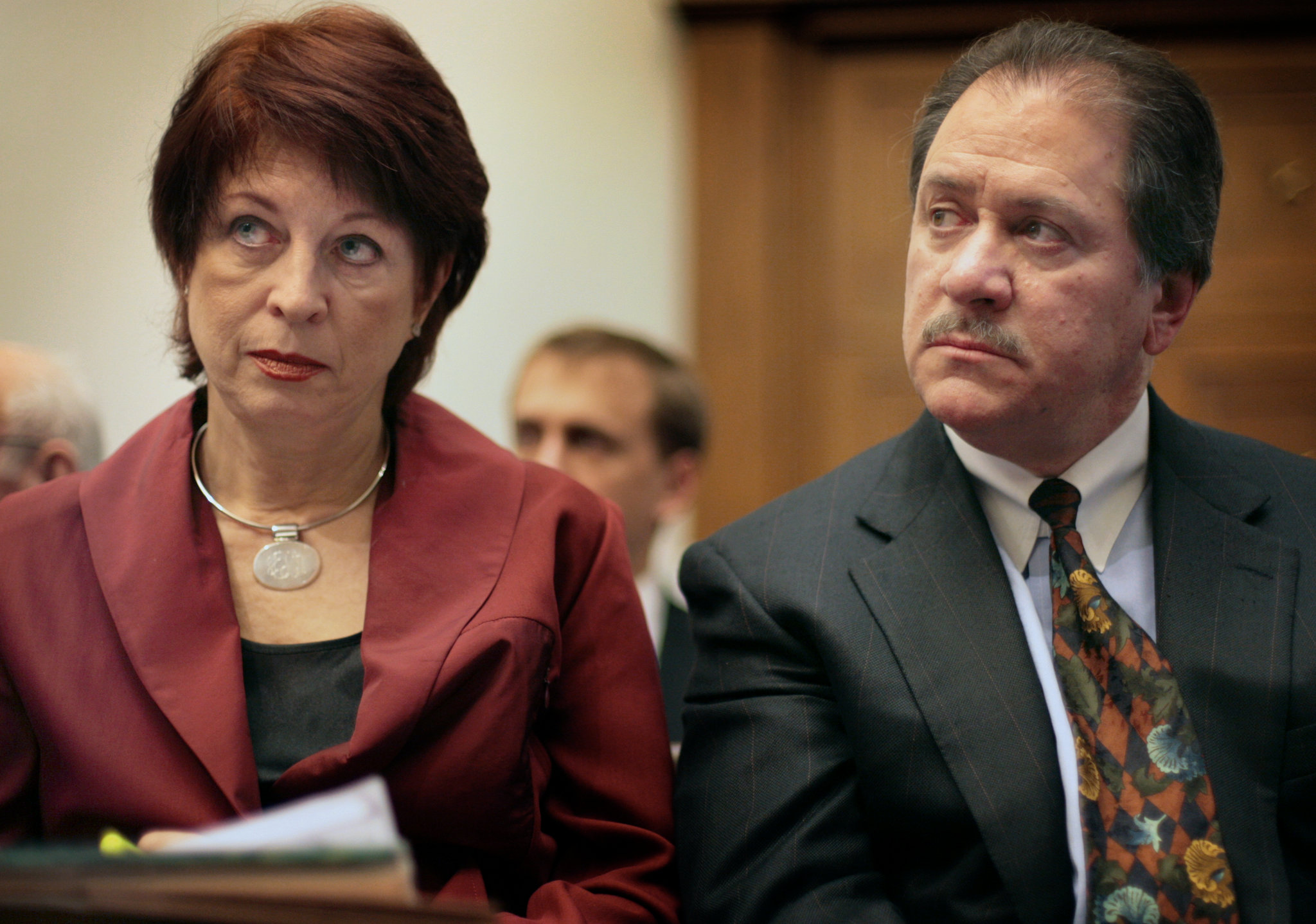
It hasn’t been as widely reported, but it’s also significant that the Feds searched the home of another Trump-associated attorney, Victoria Toensing. Nicholas Reimann at Forbes: Feds Search Giuliani’s, Toensing’s Properties As Part Of Ukraine Investigation.
Federal investigators searched Rudy Giuliani’s Manhattan apartment on Wednesday and later searched the home of attorney Victoria Toensing as part of a probe into whether Giuliani acted on behalf of Ukrainian oligarchs to illegally lobby the Trump Administration, according to multiplereports, with investigators said to have seized electronic devices.
Hold the phone — FBI now at Victoria Toensing's house. Lawyer, wife and partner of Joseph DiGenova, same circles as Rudy and Trump. This has the hallmarks of a bigger day at DOJ. And she's probably not expecting it, unlike Rudy
F.B.I. agents also executed a search warrant on Wednesday morning at the Washington-area home of Victoria Toensing, a lawyer close to Mr. Giuliani who had dealings with several Ukrainians involved in the hunt for information on the Bidens, according to people with knowledge of that warrant. The warrant was for her cellphone.
Ms. Toensing, a former Justice Department official, has also represented Dmitry Firtash, a Ukrainian oligarch under indictment in the United States whose help Mr. Giuliani sought.
Ole Ring, Danish painter, 1902-1972, natural landscape,
Good Morning!!
I’m going to focus on Covid-19 news today, because–despite the fact that 110 million Americans have been vaccinated–it looks like we are headed into a dangerous surge of new cases. Here’s the latest:
The number of new Covid-19 cases has plateaued at a “disturbingly high level,” and the US is at risk from a new surge, Dr. Anthony Fauci warned on Wednesday.
While lower than the peak earlier this year, there were still more than 61,000 new cases reported on Wednesday, according to data from Johns Hopkins University. And the lack of continued significant decreases in infections is a concern, the director of the National Institute of Allergy and Infectious Diseases told CNN’s Anderson Cooper, particularly given the spread of variants.
“It’s almost a race between getting people vaccinated and this surge that seems to want to increase,” Fauci said, noting Europe is experiencing a spike much like the one experts worry about for the US.
The US is vaccinating people quickly, with just over 33% of the population — more than 109 million people — having received at least one dose of the vaccine and all 50 states committed to opening vaccinations to all adults by April 19.
A highly infectious variant of the coronavirus that was first identified in Britain has become the most common source of new infections in the United States, the director of the Centers for Disease Control and Prevention said on Wednesday. The worrisome development comes as officials and scientists warn of a possible fourth surge of infections.
At that point, new cases, hospitalizations and deaths were at an all-time high. From that peak, the numbers all declined until late February, according to a New York Times database. After several weeks at a plateau, new cases and hospitalizations are increasing again. The average number of new cases in the country has reached nearly 65,000 a day as of Tuesday, concentrated mostly in metro areas in Michigan as well as in the New York City region. That is an increase of 19 percent compared with the figure two weeks ago.
Dr. Rochelle Walensky, the C.D.C. director, who warned last week that she felt a recurring sense of “impending doom,” said on Wednesday that 52 of the agency’s 64 jurisdictions — which include states, some major cities and territories — are now reporting cases of these so-called “variants of concern,” including B.1.1.7.
More on the British variant:
B.1.1.7, the first variant to come to widespread attention, is about 60 percent more contagious and 67 percent more deadly than the original form of the coronavirus, according to the most recent estimates. The C.D.C. has also been tracking the spread of other variants, such as B.1.351, first found in South Africa, and P.1, which was first identified in Brazil.
The percentage of cases caused by variants is clearly increasing. Helix, a lab testing company, has tracked the relentless increase of B.1.1.7 since the beginning of the year. As of April 3, it estimated that the variant made up 58.9 percent of all new tests.
That variant has been found to be most prevalent in Michigan, Florida, Colorado, California, Minnesota and Massachusetts, according to the C.D.C. Until recently, the variant’s rise was somewhat camouflaged by falling infection rates over all, leading some political leaders to relax restrictions on indoor dining, social distancing and other measures.
Doctors and hospitals are seeing more infections in young people.
After-school activities are creating clusters where coronavirus can spread among children, said Dr. Rochelle Walensky, director of the US Centers for Disease Control and Prevention.
Peder Mørk Mønsted, Danish, View of Fredensborg, 1893
“We know that these increases are due, in part, to more highly transmissible variants, which we are very closely monitoring,” Walensky said Monday at the White House COVID-19 Response Team briefing.
The virus was linked to high school wrestling tournaments in Florida last December where 38 people tested positive, according to a CDC report published in January.
In Minnesota, the B.1.1.7 variant of SARS-CoV-2 spread through Carver County with at least 68 cases linked to youth sport activities including hockey, wrestling and basketball, according to the Minnesota Department of Health….
Dr. Anthony Fauci, director of the National Institute of Allergy and Infectious Diseases, warned about the spread of Covid-19 among children who participate in youth sports.
“We’re finding out that it’s the team sports where kids are getting together, obviously many without masks, that are driving it, rather than in the classroom spread,” Fauci told ABC’s George Stephanopoulos Tuesday on “Good Morning America.” “When you go back and take a look and try and track where these clusters of cases are coming from in the school, it’s just that.
As states lift restrictions and coronavirus variants spread, scientists and federal health officials have warned that a fourth surge of cases could arise in the United States even as the nation’s vaccination campaign gathers speed. The seeds of such a surge may now be sprouting in the Upper Midwest and the Northeast.
Michigan is in tough shape. New cases and hospitalizations there have more than doubled in the last two weeks, and the six metro areas in the United States with the greatest number of new cases relative to their population are all in Michigan.
Several other states in the Upper Midwest, including Minnesota and Illinois, have also reported significant increases in new cases and hospitalizations. And in the Northeast, New York and New Jersey have continued to see elevated case counts.
Illinois is seeing a spike in cases as well. The daily average for new cases there has jumped about 56 percent in the past two weeks, to about 2,832 a day. Hospitalizations have risen about 28 percent from two weeks ago. Wisconsin and North Dakota have also seen their average case counts jump 50 percent or more in the last two weeks.
Amid Michigan’s worst-in-the-nation coronavirus surge, scientists and public health officials are urging the Biden administration to flood the state with additional vaccine doses.
Henri Lebasque, Summer Woman
So far, though, their plea has fallen on deaf ears. Instead, the federal government is sticking to a vaccine-allocation strategy that largely awards doses to states and territories based on their population. As a result, most jurisdictions are still receiving similar per-capita vaccine supplies, regardless of how many people there are getting sick — or how many excess vaccine doses they have.
Experts have cast a surge in Michigan’s vaccine supply as a critical tool in combating the state’s most recent Covid-19 crisis. The state is currently recording nearly 7,000 new cases per day, just shy of its all-time peak in December. Hospitalizations and deaths, which tend to lag a few weeks behind increasing case counts, are also on the rise.
“I would be surging a lot of vaccines to Michigan right now,” said Ashish Jha, the dean of the Brown University School of Public Health. “To me, this is a no-brainer policy, and I would be curious to hear why the Biden team hasn’t done this.”
During a media briefing on Wednesday, White House officials acknowledged that Michigan’s situation is dire. They gave no indication, though, that they would send additional vaccines there to help quell the surge, when STAT asked. They argued that it is too early in the national vaccine campaign to begin targeting supply based on case rates.
More than 100 million Americans have gotten at least one shot of vaccine and more than 200 million doses have been sent to states, a dramatic acceleration of the bumpy vaccine operation itinherited. Virus-related cases and deaths, which peaked in January, have fallen by about two-thirds since President Biden’s inauguration.
Gustave Léonard de Jonghe
But the Biden White House is seeing new infections climb on its own watch — a potential crisis that could erase many of the hard-won gains of the president’s first 75 days, should the numbers keep rising. After railing for a year about the last administration’s responseand vowing a more muscular strategy, Biden is encountering the limits of his own authority. The president can help secure and distribute supplies and medicines, issue guidance and urge caution — but like President Donald Trump before him, he has few toolswhen governors decide tolift coronavirus protections at the wrong moment,manufacturers botch vaccine production, or Americans refuse to wear masks or get vaccinated.
“We need you to spread the word,” Biden told faith leaders last week, saying he was worried about Americans becoming “cavalier” about the virus. “They’re going to listen to your words more than they are me as president of the United States.”
Biden also has no more sway than Trump over a mutating virus that scientists have only begun to understand.The Washington Post’s rolling seven-day national average of coronavirus casesis more than 65,000 new cases per day, an 19 percent uptick since the middle of last month, even as many states drop public health restrictions and new variants spread. More than 146,000 new cases were reported on Thursday and Friday,the highest two-day count in several weeks, according to state data tracked by The Post.
…the [current] surge—driven by the spread of dangerous new variants of the SARS-CoV-2 virus and a reckless rush by governors and mayors to end a year of mask mandates and social distancing rules—isn’t just an immediate threat to unvaccinated people.
It also represents a long-term danger to the whole country. More cases mean more opportunities for the novel coronavirus to mutate. And the more the pathogen mutates, the greater the chance it will evolve into an even deadlier variant—“lineage” is the scientific term—than even the ones we’re dealing with now.
It’s even possible that, given time and a certain critical mass of cases, SARS-CoV-2 could mutate into a lineage that can overpower our vaccines.
Nicolaas van der Waay
That’s the worst-case scenario—and potentially the biggest cause for concern as the spring surge spreads across the United States. “The greater the spread of the virus populations to new individuals, because of relaxation of social measures, the more the chances of new mutations,” Edwin Michael, an epidemiologist at the Center for Global Health Infectious Disease Research at the University of South Florida, told The Daily Beast.
If all this sounds like conjecture—it’s not. The steady mutation of the novel coronavirus over the 16 months since it first took root in China is a big reason America’s experiencing another surge.
Any given patient’s load of the virus mutates every two weeks, on average. Niema Moshiri, a geneticist at the University of California-San Diego, compared each case to a slot machine that an infection pulls twice a month. Jackpot is a new and deadlier lineage.
Now imagine tens of millions of Americans with active COVID infections, with each case pulling that handle every 14 days. The more gamblers, and the more time they have to gamble, the better chances of a big win for SARS-CoV-2. Our goal, Moshiri said, should be “to lessen the number of parallel slot machines we give to the virus.”
The New York Times: Top Official Warned That Covid Vaccine Plant Had to Be ‘Monitored Closely.’ “An Operation Warp Speed report last June flagged staffing and quality control concerns at Emergent BioSolutions’ factory in Baltimore. The troubled plant recently had to throw out up to 15 million doses.”
The information the IRS needs to send out the payments was finally delivered on Thursday morning after threatening letters sent to Social Security Commissioner Andrew Saul and his Deputy David Black by leaders of the House Ways and Means and Oversight Committees. There is still no word on when the deposts/checks will go out. The latest estimate is that those of us in these categories will still have to wait at least 10 days to see the money.
Meanwhile, calls on Biden to fire Saul and Black are growing louder.
Weeks after the American Rescue Plan had been signed into law, while many Americans had already received payments, the Social Security Administration’s inaction was standing in the way of millions of beneficiaries receiving desperately needed cash aid. After escalating pressure on Saul to no avail, the letter gave him 24 hours to remedy the holdup. A few hours later, the SSA announced that they’d be sending the information the next day.
This delay is just the latest in an array of extremely troubling decisions under the leadership of the Social Security Administration’s commissioner Saul, and his deputy David Black….
Commissioner Saul and Deputy Commissioner Black were appointed by President Trump, alongside Deputy Commissioner for Retirement and Disability Policy Mark Warshawsky, to self-fulfill the Republican promise about the failure of government, and destroy the departments they were tasked with managing. Warshawsky, a veteran of the American Enterprise Institute, was pegged as an early candidate to be fired by the Biden administration for his work undercutting the program; he retired from the post in late January.
The Biden administration has set to work rolling back some of those Trump appointees’ designs on Social Security, including a proposed rule that would have subjected disability insurance recipients to even more frequent and stringent eligibility reviews, which would make an already challenging process even more difficult for people with disabilities to secure and maintain cash benefits. That move was widely celebrated among advocates. But President Biden has not heeded the call from those same advocates to fire Saul and Black, who have clear track records of working against the very department they’ve been tasked to head up, and against Democratic ambitions on Social Security.
Frank O’Sullivan
Now, a growing number of congressional Democrats are joining the chorus calling for Saul and Black’s ousters. Sen. Sherrod Brown (D-OH) called for their resignation as his first act as chair of the Social Security and Pensions Subcommittee, and has since urged Biden to fire them. He’s joined House Ways and Means Social Security Subcommittee Chairman John Larson, Worker and Family Support Subcommittee Chairman Danny Davis, and Oversight Subcommittee Chairman Bill Pascrell Jr. in demanding Saul’s immediate removal. Both Saul and Black are serving terms that don’t expire until 2025….
On the campaign trail, Biden insisted (straining against historical fact) he had never and would never vouch for cuts to Social Security. He, and the Democratic Party broadly, have made protecting and expanding Social Security a main plank of the party’s policy platform going forward.
That ambition is irreconcilable with a leadership regime that has, as was reported by Yahoo News, put “illegitimate political pressure on Administrative Law Judges to reduce the rate of Social Security disability case approval,” as one such judge recently claimed. That alone should be scandal enough to imperil Saul and Black’s positions at the agency, and give the Biden administration the space to fire them for cause. But the Trump years have built up a tolerance for scandal, which means that the incident hasn’t even deterred them.
Meanwhile, Saul and Black have openly pursued a number of reforms aimed at aggressively curtailing benefits. Their attempted rule change, which the Biden administration rolled back, was a Reagan-era reform that would have led to tens of thousands of people losing benefits. When President Reagan enacted it, it led to a rash of suicides, and was deemed so cruel that it led to a unanimous Senate ruling to overturn it. Elsewhere, they’ve sought to deny benefits for older and severely disabled non–English speakers, resulting in an estimated 100,000 people being denied more than $5 billion in benefits.
See my Thursday post for more about Saul and Black’s efforts to destroy Social Security on Thursday.
Pressure is also building for Biden to get rid of Trump-appointed Postmaster General Louis DeJoy.
A group of House Democrats on Friday introduced legislation to prohibit the Postal Service from lengthening mail-delivery windows and require it to adhere to present service expectations. They named the bill the Delivering Envelopes Judiciously On-time Year-round Act, or DEJOY Act.
Carl Larsson: Brita, Cat and Sandwich
One House aide involved in postal reform legislation introduced in February said some members of the caucus are leery of proceeding with efforts to address the Postal Service’s financial obligations given that DeJoy’s 10-year plan includes sharp reductions in service, including slower timetables for mail delivery and reduced post office hours.
Separately, Pennsylvania Attorney General Josh Shapiro (D) threatened to take legal action to block the service cuts. His office said in a statement Friday that it was encouraged that DeJoy recognizes the legal obligations to secure limited regulatory approvals, but said it remained concerned about timely mail delivery….
DeJoy hopes to save the Postal Service $160 billion over the next decade through a combination of austerity measures, postage price increases and projected package volume growth. But the largest single piece of his plan is dependent on Congress repealing its pre-funding mandate for retiree health care costs, which runs about $5 billion a year. Instead, the agency wants to wind down those payments and enroll future retirees in Medicare, a proposal worth $44 billion.
A bill introduced by Rep. Carolyn B. Maloney, chair of the powerful House Oversight and Reform Committee, includes both components.
But DeJoy’s designs to slow the mail — even as the Postal Service attempts to rebound from generationally poor service metrics in recent months — and perceived animus toward lawmakers in recent hearings have made those prospects more difficult.
Sometimes America’s legacy of white supremacy is hiding in plain sight, literally. When Georgia Gov. Brian Kemp signed a hastily passed voter suppression law that many are calling the new, new Jim Crow on Thursday night, surrounded by a half-dozen white men, he did so in front of a painting of a plantation where more than 100 Black people had been enslaved.
Lady reading with cat-Albert Roosenboom
The fitting symbolism is somehow both shocking and unsurprising. In using the antebellum image of the notorious Callaway Plantation — in a region where enslaved Black people seeking freedom were hunted with hounds — in Wilkes County, Ga., as the backdrop for signing a bill that would make it a crime to hand water to a thirsty voter waiting on Georgia’s sometimes hours-long voter lines, the GOP governor was sending a clear message about race and human rights in the American South.
The portrait of the plantation was the starkest reminder of Georgia’s history of white racism that spans slavery, Jim Crow segregation, the rebirth of the modern Ku Klux Klan, and today’s voter purges targeting Black and brown voters — but it wasn’t the only one. At the very moment that Kemp was signing the law with his all-white posse, a Black female Georgia lawmaker — Rep. Park Cannon — who’d knocked on the governor’s door in the hopes of watching the bill signing was instead dragged away and arrested by state troopers, in a scene that probably had the Deep South’s racist sheriffs of yesteryear like Bull Connor or Jim Clark smiling in whatever fiery hellhole they now inhabit.
Rep. Park Cannon (D-Atlanta) is placed in handcuffs by Georgia State Troopers after being asked to stop knocking on a door that lead to Gov. Brian Kemp’s office while Gov. Kemp was signing SB 202 behind closed doors at the Georgia State Capitol Building in Atlanta, Thursday, March 25, 2021.Alyssa Pointer / AP
Indeed, Twitter was on fire Thursday night with posters drawing the straight line from notorious past segregationists like George Wallace to the 2021 actions of Kemp and the GOP-led Georgia Legislature in passing — at great speed and with little debate — a lengthy bill that also limits easy-access drop boxes for ballots and places onerous voter-ID restrictions on voting by mail, and which the New York Times reports “will have an outsized effect on Black voters.”
On one level this new voter-suppression law — “voter integrity,” in the modern GOP’s Orwellian branding — is inspired by the current and possible future events of ex-President Donald Trump’s Big Lie about fraud in the 2020 election, the narrow upset wins in Georgia for President Biden and two new Democratic senators, and the threat that voting icon Stacey Abrams poses to Kemp in the 2022 election. But there’s also a powerful pull back to Georgia past. That link is made clear by the history hanging right behind Kemp on Thursday.
“Things have changed dramatically” in the South, Chief Justice John Roberts wrote in 2013 when he authored the majority opinion gutting the Voting Rights Act, ruling that states with a long history of discrimination no longer needed to have changes to their voting procedures approved by the federal government.
Voter suppression in Georgia is Exhibit A for why he is wrong.
After Joe Biden carried the state in November and Black voters turned out in record numbers in the January runoffs to elect Democrat Raphael Warnock as the state’s first Black senator and Democrat Jon Ossoff as the state’s first Jewish senator, Georgia Republicans passed a sweeping rewrite of the state’s election laws on Thursday to make it harder for Democratic constituencies to vote and have their ballots counted.
Though some Georgia Republicans, most notably Secretary of State Brad Raffensperger, defended the integrity of the 2020 election, the “Election Integrity Act of 2021” heavily restricts mail ballot drop boxes, adds new ID requirements for mail-in voting, throws out ballots cast in the wrong precincts, and makes it a crime to give voters food and water while they’re waiting in line.
In addition to making it harder to vote, the new law allows the GOP-controlled legislature to appoint a majority of members of the state election board and gives the board the power to take over county election boards, making it easier for Republicans to challenge election results, take over election administration in large Democratic counties, and even decline to certify the results if Democrats win close races—which Trump tried and failed to get the state to do in 2020.
One of the small, rueful truths that many Americans held in the back of their minds throughout the pandemic year was that, for all of its horrors, it had at least reduced, or even eliminated, the spectacle of the gun massacre. School closings had momentarily ended school shootings; curbside delivery had, it seemed, halted in-store assaults. It is true that gun fatalities were disturbingly trending upward in big cities, for reasons that are as yet as mysterious as those for the great decline that preceded them, and that, according to the Gun Violence Archive, last year saw the highest number of shooting deaths in decades. In fact, keyed, perhaps, by a general sense of panic marked by the pandemic and a bizarrely unsettled election year—with that strange American certainty that they’re coming for you—gun sales soared, even amid groups that are not normally associated with buying firearms in numbers.
The gun massacre, however—five or twenty or fifty people murdered at a time—had, briefly, vanished. Yet, alongside the knowledge that mass shootings had gone stood the knowledge that they would, inevitably, reëmerge. And here they are, right on schedule, as the country “opens up,” and with a vengeance: seven in the past seven days, with eight people killed in three shootings in Atlanta, and ten in a grocery store in Boulder. With those shootings come back all the usual, understandable, and all-too-human reactions—above all, our urge to give them some kind of meaning by making them an index of a larger issue. Violence this blankly nihilistic needs a point projected into it, to redeem it as a subject of discussion….
Countries that resemble ours in every way except for the availability of guns have much lower levels of gun violence and far fewer gun massacres. Yet these truths, demonstrated again and again, meet the same resistance, over and over. The Second Amendment guarantees private ownership of even military-style weapons. (It doesn’t, or rather, until very recently, not even conservative Justices imagined that it did.) Guns are essential for self-protection. (They aren’t.) The way to stop mass shootings is to arm more people, such as teachers. (A “colossally stupid idea,” according to the co-president of the Brady Campaign to Prevent Gun Violence.)
All this, even as the sheer psychic damage done by the omnipresence of guns in America is self-evident (no healthy society should have to train its children in active-shooter drills), while the social damage extends far beyond the immediate casualties. A reason for the prevalence of police shootings in America is that the police go about armed, in levels unique to our society, in order to deal with the uniquely over-armed civilians they fear encountering, with the frequently fatal results, we know too well, for the unarmed and the innocent.
Sorry this isn’t a more cheerful post. I’ll probably be up for something more upbeat if I finally get that promised $1400. What’s on your mind today?
Did you like this post? Please share it with your friends:
President Biden is going to have a press conference this afternoon, and I wish someone would ask him why around 30,000,000 people on Social Security, disability, veterans, and railroad pensions haven’t gotten their stimulus payments yet. Furthermore, why hasn’t he fired two Trump holdovers at the Social Security Administration who are holding up the payments and who are trying to destroy Social Security?
Social Security hasn’t handed over payment information that the Internal Revenue Service needs to send the coronavirus relief checks to nearly 30 million people receiving retirement or disability benefits, Democrats said.
“We understand that these beneficiaries are waiting because the Social Security Administration has not sent the necessary payment files to the Internal Revenue Service,” House Ways and Means Committee chair Richard Neal (D-Mass.) said in a letter to Social Security Commissioner Andrew Saul.
Several Democrats, including Sen. Sherrod Brown (D-Ohio) and Rep. John Larson (D-Conn.), had previously urged President Joe Biden to fire Saul, a Donald Trump appointee whose term doesn’t expire until 2025. Biden has hesitated to do so even though he’s fired other Trump holdovers in other agencies before their terms have ended.
The IRS has sent more than 127 million payments so far. Neal and other members of his committee earlier this week asked Social Security and the IRS to explain the delayed payments to Social Security beneficiaries.
In Wednesday’s letter, Democrats said they became “aware that the IRS asked SSA to start sending payment files two weeks before the American Rescue Plan became law on March 11, 2021” ― and that Social Security still hasn’t provided the information.
People in these categories are the poorest of the poor, including Social Security recipients who don’t have enough income to file tax returns.
We are giving the trump-appointed heads of the Social Security Admin **24 Hours** to get off their backsides and stop delaying sending stimulus checks to 30,000,000 Americans. pic.twitter.com/zsx7t9vKvC
— Bill Pascrell, Jr. 🇺🇸🇺🇦 (@BillPascrell) March 24, 2021
President Biden is facing increasing pressure to remove two Social Security Administration officials appointed by his Republican predecessor, a standoff that could test the limits of his ability to undo Donald Trump’s legacy.
The brewing controversy surrounds Andrew Saul and David Black, the agency’s commissioner and deputy commissioner, whom Trump appointed to fixed-term positions that don’t end until 2025. As term appointees, they can’t be removed by Biden except for cause, but unions and Capitol Hill alike are demanding that Biden find a way to remove them, accusing them of creating a toxic work environment, contributing to low morale due to staff cuts, and sidelining the agency’s administrative law judges.
The continued presence of the Trump appointees underscores the difficulties the Biden administration faces when trying to roll back some of the previous administration’s efforts to reshape the federal government. While traditional political appointees must resign or face being fired when a new administration comes in, presidents are also able to install fixed-term employees to boards and other government positions that can outlast their administration.
Saul, a New York businessman and Republican donor, and Black, a former Bush administration staffer, have been in their positions since 2019. According to critics, the two officials have engaged in “no-holds-barred union busting” and eliminated the agency’s pre-pandemic telework program, forcing over 10,000 employees to commute to work — a rule change that continues despite the onset of COVID-19. (That did not apply to Saul, who reportedly continued to work from home as thousands of his employees commuted during the onset of the pandemic.)
There’s more at the Yahoo News link.
Social Security Commissioner Andrew Saul and his Deputy David Black "are sabotaging the Biden administration by delaying relief checks."
Postmaster General Louis DeJoy on Tuesday unveiled the largest rollback of consumer mail services in a generation, part of a 10-year plan that includes longer first-class delivery windows, reduced post office hours and higher postage prices.
DeJoy presented his long-awaited strategic vision for the U.S. Postal Service during a Tuesday webinar. Portions of the initiative already made public have raised alarms from postal advocates, who say they could further erode agency performance. Mailing industry officials warn that substantial service cuts could drive away business and worsen its already battered finances.
Louis DeJoy
But DeJoy has cited the need for austerity to ensure more consistent delivery and rein in losses. The agency is weighed down by $188.4 billion in liabilities, and DeJoy told a House panel last month that he expects the Postal Service to lose $160 billion over the next 10 years. Without the plan, Postal Service Board of Governors Chairman Ron Bloom said, the agency’s future was “profoundly threatened.”
DeJoy’s plan to make up that projected shortfall largely depends on Congress repealing a retiree health care pre-funding mandate and allowing postal workers to enroll in Medicare. The agency also will ask President Biden to order a review of how much the Postal Service should have paid into its pension funds, and credit the mail agency with any overpayments.
DeJoy projected these steps would save the agency $58 billion over the next decade, and the agency could make up the rest through postage rate increases ($44 billion in new revenue), “self-help” cost cutting in mail processing, transportation and administrative efficiencies ($34 billion), and revenue from package volume and price increases ($24 billion).
Presidents get to decorate the Oval Office any way they want, and it’s usually telling. Joe Biden for example, requested that five portraits be hung around the fireplace. There’s George Washington, Thomas Jefferson, Abraham Lincoln and one of the greatest Americans who never became president: Alexander Hamilton.
And in the middle of this esteemed group is a fifth portrait in a place of honor over the fireplace: Franklin D. Roosevelt. Biden, who will be the last president who lived during FDR’s momentous era, deeply admires our 32nd president, and it shows in both his style and way of governing.
No president since Roosevelt inherited the kind of mess that confronted Biden, and he has responded as FDR did: By throwing big money at problems. The ink on the $1.9 trillion pandemic relief plan is barely dry, and now the White House is set to unveil a $3 trillion infrastructure plan.
There’s also talk of reforming the biggest federal program of all: Social Security, which Roosevelt launched in 1935, and which is now paying out more cash than it’s bringing in. In Washington, the word “reform” is usually a code word for more spending.
Hmmm….I hope that will involve lifting the cap on the payroll tax so that rich people have to contribute more to Social Security and Medicare.
Biden’s style — specifically how he communicates with the American people — is also a page from the FDR playbook. Two months into his presidency, he has been surprisingly disciplined and economical with his words and appearances. The verbal gaffes that dogged him throughout his long career in Washington are nowhere to be seen. I’m sure he’ll make a boo-boo eventually (he’s Joe Biden, after all) but after four years of a president who lied about everything, a gaffe on Biden’s part these days will be seen as an honest mistake, humanizing, even charming to a certain degree.
Roosevelt is remembered for his famous Fireside Chats. Forgotten, however, is how infrequently he gave them. During his 12 years in office — bookended by America’s greatest 20th century crises, the Great Depression and World War II — he took to the airwaves just 30 times. Just two or three times a year. The rarity of his appearances amped up the drama and attention when he did speak.
But, unlike Biden so far, FDR gave lots of press conferences, Brandus writes. He recommends that Biden make his first formal appearance before the D.C. press corps as boring as possible.
The news media is trying to gin up the drama for this, and Biden will certainly be asked about tough issues that already are challenging his smooth operation — including immigration problems at the southern border and the mass shootings in the Atlanta area and Boulder, Colorado. But he knows this and will be prepared.
If Biden’s lucky, his first news conference will be a dull affair. It will also likely be a rare one. Why? Here’s the deal. With platforms like Twitter, Facebook and all the rest at their fingertips, modern-day presidents need reporters and the press less than ever. We saw this during the campaign, when Biden gave individual interviews but rarely held news conferences. The pandemic was a good excuse to pull back even further.
In other news, There’s been an attempted copycat supermarket shooting in Georgia; fortunately it was short-circuited.
Just two days after a mass shooting left 10 people dead at a Colorado supermarket, Atlanta police arrested a 22-year-old man who walked into a Publix at Atlantic Station with six guns and body armor.
Police were called to the grocery store on Atlantic Drive just after 1:30 p.m. Wednesday and met with a manager who told them a man came in with a rifle and headed straight toward a bathroom, authorities said.
“A witness observed the male and alerted store management, who then notified police,” Atlanta police spokesman Officer Anthony Grant told The Atlanta Journal-Constitution.
Officers at the scene spotted the man leaving the bathroom and quickly took him into custody. According to police, his weapons included two long guns and four pistols, all of which were concealed.
Police identified the man as Rico Marley. He was booked into the Fulton County Jail on multiple charges of criminal attempt to commit a felony and weapons possession. Marley is scheduled for a first appearance before a judge Thursday morning.
The witness who saw 22 y/o Rico Marley in the bathroom with the AR-15 told us tonight he may have helped prevent a mass shooting. Charles Russell says the tragedy in Boulder was definitely on his mind. https://t.co/gMZBvbwWT8pic.twitter.com/3fdUm4u7Om
Xiao Zhen Xie, the 75-year-old woman who was punched by a white man in San Francisco — and then fought back by smacking him with a board — will not keep the nearly $1 million that has been donated for her medical expenses. Her grandson says Xie insists on donating the money to help defuse racism against the Asian American community.
“She insists on making this decision saying this issue is bigger than Her,” John Chen wrote in an update on the fundraising site GoFundMe.
Xiao Zhen Xie, 75, is recovering after she was punched by a man in San Francisco. Her family says that despite being hurt, she fought back to defend herself. Dennis O’Donnell/Screenshot by NPR
Xie was attacked on San Francisco’s Market Street last Wednesday, the morning after six women of Asian descent were killed in a shooting rampage in the Atlanta area — the worst incident in a broader spike in incidents that have targeted the Asian American and Pacific Islander community.
Xie, who is originally from China, had been waiting to cross the street when she was suddenly hit in the face. San Francisco Police say the suspect, Steven Jenkins, punched Xie minutes after he assaulted an 83-year-old Asian man. The suspect was being chased by a security guard when he hit Xie.
In the moment, her instinct was to fight back, her family told TV station KPIX. They said that Xie, while badly hurt, responded by grabbing a wooden board and hitting the man.
Jenkins, 39, was left with a bloody mouth and is facing charges of assault and elder abuse.
I’ll end with this argument that violence against women is a hate crime. Click the link to read the article at The Atlantic.
Many are outraged that officials appear hesitant to classify the Atlanta shootings as a hate crime. But the call for hate-crime prosecution would be better served by an understanding that such designations are often purely symbolic, @saigrundy writes: https://t.co/kx84Rqosnh
The Sky Dancing banner headline uses a snippet from a work by artist Tashi Mannox called 'Rainbow Study'. The work is described as a" study of typical Tibetan rainbow clouds, that feature in Thanka painting, temple decoration and silk brocades". dakinikat was immediately drawn to the image when trying to find stylized Tibetan Clouds to represent Sky Dancing. It is probably because Tashi's practice is similar to her own. His updated take on the clouds that fill the collection of traditional thankas is quite special.
You can find his work at his website by clicking on his logo below. He is also a calligraphy artist that uses important vajrayana syllables. We encourage you to visit his on line studio.






 Make no mistake that he was. He called for trillions in new spending in a robust expansion of government’s role in multiple arenas of American life in ways that would have been impossible to contemplate in Barack Obama’s presidency. He plunged into subjects—racial and class inequities, immigration, gun violence—that were rubbed raw until bleeding in Donald Trump’s.
 By a wide margin, speech-watchers said that Biden’s policy proposals would move the country in the right direction (73%) rather than the wrong direction (27%). In a survey conducted before the speech, the same people were a bit less bullish that Biden would lead in the right direction (67% right direction, 33% wrong direction), and that movement came from the independents and Republicans who watched the speech. Among Republicans, the share saying Biden’s policies would move the country in the right direction grew from 13% pre-speech to 27% post-speech, while among independents, that percentage rose from 61% to 73%.
 Experts agreed the search represented very serious stakes for Giuliani. Former U.S. attorney Harry Litman
  How significant is this move by the Feds from your perspective? How much legal danger does Giuliani face here?
 F.B.I. agents also executed a search warrant on Wednesday morning at the Washington-area home of Victoria Toensing, a lawyer close to Mr. Giuliani who had dealings with several Ukrainians involved in the hunt for information on the Bidens, according to people with knowledge of that warrant. The warrant was for her cellphone.














 peej
peej Carissa
 bostonboomer
 dakinikat
 ecocatwoman
 mablue2
 Mama Lopez
 peggysue22
 quixote
 skydancingguestblogger
 Mona (aka Wonk the Vote)



 Sky Dancing
Recent Comments