
Happy All Hallow’s Eve!
Posted: October 31, 2012 Filed under: open thread | Tags: Halloween, open thread, Samhain 26 Comments
It’s Samhain!!
The Celts called it Samhain, which means ‘summer’s end’, according to their ancient two-fold division of the year, when summer ran from Beltane to Samhain and winter ran from Samhain to Beltane. (Some modern Covens echo this structure by letting the High Priest ‘rule’ the Coven beginning on Samhain, with rulership returned to the High Priestess at Beltane.) According to the later four-fold division of the year, Samhain is seen as ‘autumn’s end’ and the beginning of winter. Samhain is pronounced (depending on where you’re from) as ‘sow-in’ (in Ireland), or ‘sow-een’ (in Wales), or ‘sav-en’ (in Scotland), or (inevitably) ‘sam-hane’ (in the U.S., where we don’t speak Gaelic).
Not only is Samhain the end of autumn; it is also, more importantly, the end of the old year and the beginning of the new. Celtic New Year’s Eve, when the new year begins with the onset of the dark phase of the year, just as the new day begins at sundown. There are many representations of Celtic gods with two faces, and it surely must have been one of them who held sway over Samhain. Like his Greek counterpart Janus, he would straddle the theshold, one face turned toward the past in commemoration of those who died during the last year, and one face gazing hopefully toward the future, mystic eyes attempting to pierce the veil and divine what the coming year holds. These two themes, celebrating the dead and divining the future, are inexorably intertwined in Samhain, as they are likely to be in any New Year’s celebration.
As a feast of the dead, it was believed the dead could, if they wished, return to the land of the living for this one night, to celebrate with their family, tribe, or clan. And so the great burial mounds of Ireland (sidh mounds) were opened up, with lighted torches lining the walls, so the dead could find their way. Extra places were set at the table and food set out for any who had died that year. And there are many stories that tell of Irish heroes making raids on the Underworld while the gates of faery stood open, though all must return to their appointed places by cock-crow.
As a feast of divination, this was the night par excellance for peering into the future. The reason for this has to do with the Celtic view of time. In a culture that uses a linear concept of time, like our modern one, New Year’s Eve is simply a milestone on a very long road that stretches in a straight line from birth to death. Thus, the New Year’s festival is a part of time. The ancient Celtic view of time, however, is cyclical. And in this framework, New Year’s Eve represents a point outside of time, when the the natural order of the universe disolves back into primordial chaos, preparatory to re-establishing itself in a new order. Thus, Samhain is a night that exists outside of time and hence it may be used to view any other point in time. At no other holiday is a tarot card reading, crystal reading, or tea-leaf reading so likely to succeed.
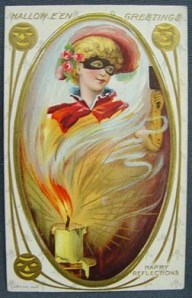
Samhaim–which is technically tomorrow–is a celebration of the end of summer. Like many holidays, it was co-opted by Romans trying to bring Roman influence, culture, and religion to regions in Northern Europe.
At sunset on October 31, clans or local villages begin the formal ceremonies of Samhain by lighting a giant bonfire. The people would gather around the fire to burn crops and animals as sacrifices to the Celtic deities. It was a method of giving the Gods and Goddesses their share of the previous years herd or crops. In addition these sacred fires were a big part of the cleansing of the old year and a method to prepare for the coming new year. During the celebration, the Celts wore costumes, and danced around the bonfire. Many of these dances told stories or played out the cycles of life and death or commemorated the cycle of Wheel of Life. These costumes were adorned for three primary reasons. The first was to honor the dead who were allowed to rise from the Otherworld. The Celts believed that souls were set free from the land of the dead during the eve of Samhain. Those that had been trapped in the bodies of animals were released by the Lord of the Dead and sent to their new incarnations. The wearing of these costumes signified the release of these souls into the physical world. Not all of these souls were honored and respected. Some were also feared as they would return to the physical world and destroy crops, hide livestock or ‘haunt’ the living who may have done them wrong. The second reason for these traditional costumes was to hide from these malevolent spirits to escape their trickery. The final representation was a method to honor the Celtic Gods and Goddesses of the harvest, fields and flocks. Giving thanks and homage to those deities who assisted the village or clan through the trials and tribulations of the previous year. And to ask for their favor during the coming year and the harsh winter months that were approaching. In addition to celebrations and dance, it was believed that this thin veil between the physical world and the Otherworld provided extra energy for communications between the living and the dead. With these communications, Druid Priests, and Celtic Shamans would attempted to tell the fortunes of individual people through a variety of methods. For a people entirely dependent on the volatile natural world, these prophecies were an important source of comfort and direction during the long, dark winter.
Today, we celebrate the holiday as Halloween quite commercially since it’s also been co-opted by many businesses in their attempt to ring up their cash registers. Well, everybody takes it more seriously as Halloween except Henri the Extensional Cat.
I still remember this from being a kid and I love the image of Linus waiting for the Great Pumpkin. I love playing the song on the piano still. No matter what time of year I gig, this song awakens the kid in a lot of people. It’s fun to stick it in the middle of a set an watch people perk up!
It’s also the end of the season for watching a bunch of great movies and switching to nasty movies, horrid shopping conditions, and generally harassment as once again I take up arms in the war against christmas where the Roman’s morphed from Mithras’ birthday and story into yet another way to wipe out ancient cultures and myths. However, tonight, I can still watch old horror movies and watch the fun.
Tuesday Reads
Posted: November 1, 2011 Filed under: abortion rights, Barack Obama, birth control, morning reads, PLUB Pro-Life-Until-Birth, The Media SUCKS, U.S. Politics, Women's Rights | Tags: anti-abortion, Barack Obama, biased news, East coast snowstorm, economics, Halloween, Herman Cain, irresponsible journalism, Lori Montgomery, Mississippi, Nancy Pelosi, personhood movement, Racism, Rush Limbaugh, Washington Post, weather, zombies 30 Comments
Coffee and Morning News, by Tim Nyberg
Good Morning!! I am sooooo exhausted. Last Wednesday, I got back home after two months in Indiana. Normally, I would crash for a couple of days and be on the way to recovery from the long drive. But this time my Mom came back with me. She has been staying at my brother’s house, and I’ve had to drive over there nearly every day since I got home.
Yesterday I spent the day with my Mom and my nearly-9-year-old nephew, who was home sick and hung around for the trick-or-treating. My Mom is flying back home this morning at 8:30, and I was dreading having to get up at 5:30 in the morning to take her to the airport. But my brother volunteered to take her–halleluja! Finally I can spend a couple of days vegetating at home! I just hope I don’t get my nephew’s cold!
Anyway, here are some news links I found for you. I’ve been a bit out of touch, so I hope I won’t duplicate anything that has already been posted.
The freaky early snowstorm has left millions of people without power, which also means no heat. Even if you have gas or oil heat, the on-off mechanism still relies on electricity. So there are lots of people living in houses with temperatures around 50 degrees. I was really fortunate that my electricity was only off for several hours, mostly while I was sleeping.
Joanelle mentioned in comments last night that in her part of NJ, there is so much damage that trick or treating has been put off until Friday. The Christian Science Monitor had a story about this happening up and down the East coast.
Until hard-pressed utility crews get the lines restrung, many residents from North Carolina to Maine are living in homes that are barely 50 degrees, and in some cases, they’re unable to heat food. School systems are closed because, among other reasons, it’s not safe for children to walk on sidewalks that may still have live power lines on them. And many businesses aren’t open because they’re still in the midst of power outages.
“Electricity is the most fundamental of utilities. Most everything depends on electric power,” says Kathleen Tierney, director of the Natural Hazards Center at the University of Colorado at Boulder. “This has many of the earmarks of a disaster.”
In some states, governors are warning residents they may have to grin and bear it for days or even another week since the heavy snow did extensive damage to the electric grid. For example, in Connecticut and Pennsylvania, the snow knocked out some of the lines that get power from the generating plants to substations, where it then goes into a local distribution network. Connecticut Gov. Dannel Malloy (D) has asked President Obama to declare the state a federal disaster area, which would help with cleanup and recovery costs.
Herman Cain is still trying to explain away the story about his sexually harassing women in the 1990s. Now he’s calling it a witch hunt. But Rush Limbaugh, of all people, claims it’s racism.
RUSH: You know, I guess I shouldn’t be surprised, folks. After all of these years, none of us should be surprised, but I still am. Look at how quickly what is known as the mainstream media goes for the ugliest racial stereotypes they can to attack a black conservative. You know who’s laughing himself silly today is Bill Clinton. (imitating Clinton) “Yeah, I really did it. Ha-ha. They praised me and they went as far out of their way as they could. Even my old buddy Carville is out there and he’s saying, ‘Look what happens when you drag a dollar bill through a trailer park, you get Paula Jones.’ I have everybody defending me and they’re going after this black guy, and they’re going after him with some of the ugliest racial stereotypes I have ever seen. That’s how our side does it; we get away with it. I just love it. I love watching it.”
What’s next, folks? A cartoon on MSNBC showing Herman Cain with huge lips eating a watermelon? What are they gonna do next? No, Snerdley, I’m not kidding. The racial stereotypes that these people are using to go after Herman Cain, what is the one thing that it tells us? It tells us who the real racists are, yeah, but it tells us that Herman Cain is somebody. Something’s going on out there. Herman Cain obviously is making some people nervous for this kind of thing to happen.
When did sexual harassment become a racial stereotype? WTF is he talking about?
But at the National Review, Kevin D. Williamson says this may signal the end of Herman Cain’s campaign.
Here is what troubles me. Mr. Cain says: “If the Restaurant Association did a settlement, I wasn’t even aware of it, and I hope it wasn’t for much, because nothing happened. So if there was a settlement, it was handled by some of the other offices that worked for me at the association, so the answer is absolutely not.”
Okay, so if I’m reading that quote right, then:
1. Herman Cain, in his role as head of a major trade association, did not bother to learn how a complaint or complaints of sexual harassment against him was resolved.
2. Herman Cain, not bothering to have learned how a complaint or complaints of sexual harassment against him was resolved, decided to run for president without bothering to learn.
I got a lot of grief for writing that, based on my interaction with Mr. Cain, I would have hesitated to hire him to run a pizza company. I am feeling more comfortable in that judgment.
I wonder if Rush will condemn this: some Republicans in Virginia sent out a Halloween e-mail containing an image of President Obama shot through the head.
The Republican Party of Virginia on Monday strongly condemned an e-mail sent by Loudoun County’s GOP committee that shows President Obama as a zombie with part of his skull missing and a bullet through his head.
The e-mail, first reported on the blog Too Conservative, has “Halloween 2011” in the subject line and has several other images, including one of House Minority Leader Nancy Pelosi (D-Calif.), whose face has been made to look deformed with one eye bulging from its socket….
The e-mail, sent a week before local and state elections, invites supporters to a Halloween parade. “LCRC members and Republican candidates: We are going to vanquish the zombies with clear thinking conservative principles and a truckload of Republican candy. . . . It’s fun and a great way to represent our candidates to a ton of voters (and their kids) just before the election.”
Talk about ugly and wildly inappropriate! If anyone listens to Rush, let me know if he condemns this. I won’t be holding my breath though….
We’ve been talking about the irresponsible “journalism” of WaPo “reporter” Lori Montgomery, so I was interested to learn from Raw Story that a new website debuted yesterday with the goal of holding mainstream journalists accountable for what they write and don’t write. From Raw Story:
A Wikipedia-style website launched on Monday which provides information about the journalists behind the bylines.
News Transparency is a creation of Ira Stoll, the founder of another website called FutureOfCapitalism.com and the former managing editor of the now defunct New York Sun.
In a statement on its home page, newstransparency.com, the website said its goal is to help users “find out more about the people who produce the news” and “hold them accountable, the same way that journalists hold other powerful institutions accountable, by posting reviews and sharing information.”
News Transparency features an alphabetical list of hundreds of journalists and invites users to edit their profiles, which include basic biographical information such as age, education, current employer and work history.
Lori Montgomery is listed on the site, but so far there’s no information on her background. Does this woman even have a college degree? I’m waiting with bated breath to find out.
On my way home last night, I listened to the NPR program “On Point.” They were debating the Mississippi “personhood” for zygotes initiative, the goal of which seems to be to turn women into breeders with no freedom of choice and no rights over their own bodies. I highly recommend listening to the program. Hearing what the insane theocratic sponsors of this constitutional amendment have to say is truly frightening, but at the same time very important.
The New York Times has an op-ed about the proposed amendent: Mississippi’s Ambiguous ‘Personhood’ Amendment. The authors identify two main ambiguities in the amendment as written:
First, what does “fertilization” mean? As embryologists recognize, fertilization is a process, a continuum, rather than a fixed point. The term “fertilization” — which is sometimes considered synonymous with “conception” — could mean at least four different things: penetration of the egg by a sperm, assembly of the new embryonic genome, successful activation of that genome, and implantation of the embryo in the uterus. The first occurs immediately; the last occurs approximately two weeks after insemination (or, in the case of embryos created through in vitro fertilization that do not get implanted, never). Thus, on some reasonable readings of the amendment, certain forms of birth control, stem cell derivation and the destruction of embryos created through in vitro fertilization would seem impermissible, while on other equally reasonable readings they are not.
Second, the proposed amendment does not clearly indicate what the immediate legal impact would be. Would the amendment be “self-executing” — that is, effectuate a change to Mississippi law on its own — or would it require enabling legislation to set that change in motion?
Under existing doctrine, constitutional provisions or amendments that only set forth “first principles” or “policies” are not treated as self-executing, because they need laws enacted to further the stated principles or policies. In this case it’s not clear whether the amendment would, for example, immediately redefine thousands of references to “human beings” or “persons,” including those in provisions governing criminal homicide, or whether additional legislation would be necessary. Because of this uncertainty, voters considering this amendment cannot tell what actions would and would not immediately be subject to prosecutorial investigation were the amendment to pass.
I just hope this abomination doesn’t get enough votes!
That’s all I’ve got this morning. What are you reading and blogging about today?
Halloween Reads
Posted: October 31, 2011 Filed under: abortion rights, Economy, morning reads | Tags: Halloween, Herman Cain, history of Halloween, Nobel Prize economics, Planned Parenthood, Pumpkin cookies, Pumpkins, Samhain, Thomas Sargent, trick or treating, We're all Keynesians Now 19 Comments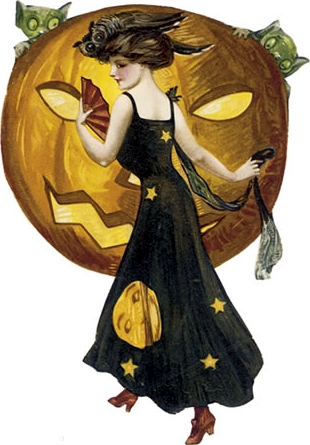
Happy Halloween!
I suppose I should get right to the news reads, but instead, I thought I’d make some use of the day to bring us up to speed on the Halloween spirit! Halloween’s roots were in Samhain which was an ancient Celtic holiday! Like nearly every other holiday, it was co-opted as the Romans moved to conquer as much as they could and romanize the world with their culture and religions.
Samhain was considered a magical holiday, and there are many stories about what the Celtics practiced and believed during this festival. Some say the spirits that were unleashed were those that had died in that year, and offerings of food and drink were left to aid the spirits, or to ward them away. Other versions say the Celts dressed up in outlandish costumes and roamed the neighborhoods making noise to scare the spirits away. Many thought they could predict the future and communicate with spirits as well during this time. Some think the heavily structured life of the Pagan Celtics was abandoned during Samhain, and people did unusual things, such as moving horses to different fields, moving gates and fences, women dressing as men, and vice versa, and other trickeries now associated with Halloween. Another belief is that the Celtics honoured, celebrated, and feasted the dead during Samhain. A sacred, central bonfire was always lit to honor the Pagan gods, and some accounts say that individual home fires were extinguished during Samhain, either to make their homes unattractive to roving spirits, or for their home fires to be lit following the festival from the sacred bonfire. Fortunes were told, and marked stones thrown into the fire. If a person’s stone was not found after the bonfire went out, it was believed that person would die during the next year. Some Celts wore costumes of animal skulls and skins during Samhain. Faeries were believed to roam the land during Samhain, dressed as beggars asking for food door to door. Those that gave food to the faeries were rewarded, while those that did not were punished by the faeries. This is reported to be the first origin of the modern “trick or treat” practice.
Many of the costumes we think of today actually originated in festivals celebrated during medieval times.
The practice of dressing up in costumes and begging door to door for treats on holidays goes back to the Middle Ages, and includes Christmas wassailing. Trick-or-treating resembles the late medieval practice of “souling,” when poor folk would go door to door on Hallowmas (November 1), receiving food in return for prayers for the dead on All Souls Day (November 2). It originated in Ireland and Britain, although similar practices for the souls of the dead were found as far south as Italy. Shakespeare mentions the practice in his comedy The Two Gentlemen of Verona (1593), when Speed accuses his master of “puling [whimpering, whining], like a beggar at Hallowmas.”
Yet there is no evidence that souling was ever practiced in America, and trick-or-treating may have developed in America independent of any Irish or British antecedent. There is little primary Halloween history documentation of masking or costuming on Halloween — in Ireland, the UK, or America — before 1900. The earliest known reference to ritual begging on Halloween in English speaking North America occurs in 1911, when a newspaper in Kingston, Ontario, near the border of upstate New York, reported that it was normal for the smaller children to go street guising (see below) on Halloween between 6 and 7 p.m., visiting shops and neighbors to be rewarded with nuts and candies for their rhymes and songs. Another isolated reference appears, place unknown, in 1915, with a third reference in Chicago in 1920. The thousands of Halloween postcards produced between the turn of the 20th century and the 1920s commonly show children but do not depict trick-or-treating. Ruth Edna Kelley, in her 1919 history of the holiday, The Book of Hallowe’en, makes no mention of such a custom in the chapter “Hallowe’en in America.” It does not seem to have become a widespread practice until the 1930s, with the earliest known uses in print of the term “trick or treat” appearing in 1934, and the first use in a national publication occurring in 1939. Thus, although a quarter million Scots-Irish immigrated to America between 1717 and 1770, the Irish Potato Famine brought almost a million immigrants in 1845–1849, and British and Irish immigration to America peaked in the 1880s, ritualized begging on Halloween was virtually unknown in America until generations later.
Treats:
Thomas Sargent, Nobel Prize winner in economics is mad at the WSJ for trying to characterize him as a non-Keynesian after he won the award!
Professor Sargent described himself as a scientist, a “numbers guy” who is “just seeking the truth” as any good researcher does.
“If you go to seminars with guys who are actually doing the work and are trying to figure things out, it’s not ideological,” he said. “Half the people in the room may be Democrats and half may be Republicans. It just doesn’t matter.”
The “non-Keynesian” label irks him particularly. “That’s just off base,” he said. “Keynes was a very good economist. He was brilliant. He had wonderful insights. His work has inspired me many times.”
Professor Sargent’s own writings are sprinkled with pithy quotations from Keynes. In January 1986, the professor wrote a Wall Street Journal article, “An Open Letter to the Brazilian Finance Minister,” analyzing that nation’s fiscal crisis. In form and substance, it was explicitly modeled on a very similar letter written by Keynes to the French finance minister 60 years earlier. One point of this exercise, he said, “was to get people to actually read Keynes.”
Still, early in Professor Sargent’s career, he was known as one of the founders of the “rational expectations” school, which has sometimes been thought to be un-Keynesian. He says it actually “tied down an important loose end in the kinds of theories Keynes was building.” Keynes, he said, believed that expectations were all-important in determining economic activity, but didn’t have the mathematical tools needed to nail down all his concepts.
Today, Professor Sargent says that in some ways he actually is a Keynesian, but he qualified that claim, too. “I’m happy to say I am a Harrison-Kreps-Keynesian,” he said, citing work by two scholars at Stanford, J. Michael Harrison and David M. Kreps. They developed a theory of speculative investor behavior and stock-bubble formation that subtly modifies rational expectations “in a beautiful way” and “captures Keynes’s argument, makes it rigorous, and pushes it further,” he said.
Fundamentally, he said, “What I really don’t like is oversimplification.” He tries to think things through, he said, and avoid having “one slogan fighting another.”
Recipe for Best Pumpkin Cookies
1 cup butter, room temperature
1/2 cup sugar
1/2 cup firmly packed brown sugar
1 cup canned pumpkin
1 egg
1 teaspoon vanilla extract
2 cups flour
1 teaspoon baking soda
1 teaspoon baking powder
2 teaspoons cinnamon
1/4 teaspoon saltPenuche Glaze
3 tablespoons butter
1/2 cup firmly packed dark brown sugar
1/4 cup milk
1 1/2-2 cups confectioners’ sugarDirections:
Preheat oven to 350 degrees.
Have ready some ungreased baking sheets.
In a large mixing bowl, cream butter and the sugars together until light and fluffy.
Blend in pumpkin, egg and vanilla extract.
In separate bowl, stir together flour, baking soda, baking powder, cinnamon and salt.
Mix flour mixture into butter-sugar mixture.
Drop tablespoonfuls 3 inches apart on ungreased baking sheets.
Bake the cookies for 10-12 minutes until golden around the edges.
Remove warm cookies and transfer to racks.
Let cool completely for a least one half hour, then frost with glaze.For Glaze:.
In a medium saucepan, heat butter and brown sugar over medium heat until bubbly. Cook, stirring constantly, for one minute or until slightly thickened. Beat in the milk. Blend in confectioner’s sugar until the glaze is smooth and spreadable. Using a silicone basting brush, which I love and use religiously now, or a butter knife to spread glaze on cookies is the best tip. Please note; this glaze will harden fairly quickly. I suggest that you keep the saucepan over the stove on the lowest heat possible to prevent it from hardening.
Tricks:
Herman Cain went on TV Sunday saying that Planned Parenthood should be called “Planned Genocide’ because their goal Is To ‘Kill Black Babies’. He’s now under scrutiny for sexual harassment charges in past. Can we just say the man hates women and get it over with?
Republican presidential candidate Herman Cain is standing by his assertion that reproductive health care provider Planned Parenthood is carrying out the “planned genocide” of African Americans.
In a March speech to the conservative Heritage Foundation, Cain said the organization’s mission was to “help kill black babies before they came into the world.”
On Sunday, CBS host Bob Schieffer asked the candidate if he still believed that statement.
“Yes,” Cain replied. “I still stand by that.”
“Do you have any proof that was the objective of Planned Parenthood?” Schieffer wondered.
“If people go back and look at this history and look at [Planned Parenthood founder] Margaret Sanger’s own words, that’s exactly where that came from,” Cain insisted. “Look at where most of them were built. Seventy-five percent were built in the black community and Margaret Sanger’s own words — she didn’t use the word genocide. She did talk about decreasing the number of poor blacks in this country by preventing black babies from being born.”
Anti-abortion activists often misquote Sanger as saying, “[W]e want to exterminate the Negro population.”
But in full context, the quote has the opposite meaning. In a 1939 letter to pro-birth control advocate Clarence J. Gamble, Sanger argued that black leaders should be involved in the effort to deliver birth control to the black community.
“We do not want word to go out that we want to exterminate the Negro population, and the minister is the man who can straighten out that idea if it ever occurs,” she wrote
Hope you have a fun day! What’s on your reading and blogging list?
Monday Morning Reads
Posted: October 24, 2011 Filed under: morning reads | Tags: birtherism, Day of the Dead, Donald Trump, Euro, flat tax, Global Economic Crisis, Halloween, judges, judicial system, Michele Bachmann, Mitt Romney, Paul Krugman, Rick Perry, Ron Paul, student loans, stupid Republicans 26 Comments
Good Monday Morning! Not a day goes by without more examples of Republican stupidity. I’ve got several for you this morning. First up, Rick Perry had a talk with Donald Trump and now Governor Goodhair thinks President Obama’s birth certificate might be fake. That legend will never die. Think Progress:
In an interview with PARADE Magazine, Perry said that he recently met with Donald Trump and discussed the issue. Perry stated that he doesn’t “have a definitive answer” on whether Obama was born in the United States or “any idea” if Obama’s birth certificate is real….
Perry recently secured the endorsement of Orly Taitz, known as the “birther queen” for repeatedly filing lawsuits asserting that Obama was born outside the United States. Taitz told ThinkProgress that she believed Perry will use the birther issue to attack Obama.
Governor, do you believe that President Barack Obama was born in the United States?
I have no reason to think otherwise.That’s not a definitive, “Yes, I believe he”—
Well, I don’t have a definitive answer, because he’s never seen my birth certificate.But you’ve seen his.
I don’t know. Have I?You don’t believe what’s been released?
I don’t know. I had dinner with Donald Trump the other night.And?
That came up.And he said?
He doesn’t think it’s real.And you said?
I don’t have any idea. It doesn’t matter. He’s the President of the United States. He’s elected. It’s a distractive issue. “
“distractive?” Is that in the dictionary?
Herman Cain is still trying to walk back his accidentally pro-choice comments on abortion. From Politico:
Herman Cain tried to clean up the running confusion over his position on abortion last night, but in the meantime opened questions about his grasp of the Constitution.
In an interview with David Brody last night, Cain said he’d sign a pro-life constitutional amendment if it crossed his desk as president.
“Yes. Yes I feel that strongly about it. If we can get the necessary support and it comes to my desk I’ll sign it,” he said. “That’s all I can do. I will sign it.”
The only problem with that statement? Presidents don’t sign constitutional amendments — they’re passed in Congress and then need to be ratified by the states, and the president plays no formal role in the process.
Is this guy the most ignorant person to ever run for president? He’s worse than Michele Bachmann.
It appears Mitt Romney is about to do another flip flop: Romney, Once a Critic, Hedges on Flat-Tax Plans
As several leading Republican presidential candidates embrace a flat tax as a core campaign position, one contender stands out in not doing so: Mitt Romney, who has a long record of criticizing such plans and famously derided Steve Forbes’s 1996 proposal as a “tax cut for fat cats.”
Lately, though, his tone has been more positive. “I love a flat tax,” he said in August.
Flat-tax plans have come and gone before, and analysts note that they have tended to lose support once they come under scrutiny. But Mr. Romney’s support of the concept of a flat tax underscores the tightrope he is walking as taxes become a larger focus of the Republican presidential race and he faces rivals’ accusations of inconsistency on the issues.
But Ron Paul wins today’s prize for Republican stupidity. He wants to get rid of student loans.
Republican presidential contender Ron Paul said Sunday he wants to end federal student loans, calling it a failed program that has put students $1 trillion in debt when there are no jobs and when the quality of education has deteriorated.
Paul unveiled a plan last week to cut $1 trillion from the federal budget that would eliminate five Cabinet departments, including education. He’s also wants young workers to be able to opt out of Social Security.
The student loan program is not part of those cuts, but Paul said Sunday on NBC’s “Meet the Press” that he’d kill the loan program eventually if he were president. That could put him at odds with some of his young followers, many of whom are college students.
Turning to economic issues, the Financial Times has a scary article about the possible failure of the Euro.
It is time to prepare for the unthinkable: there is now a significant probability the euro will not survive in its current form. This is not because I am predicting the failure by European leaders to agree a deal. In fact, I believe they will. My concern is not about failure to agree, but the consequences of an agreement. I am writing this column before the results of Sunday’s European summit were known. It appeared that a final agreement would not be reached until Wednesday. Under consideration has been a leveraged European financial stability facility, perhaps accompanied by new instruments from the International Monetary Fund.
A leveraged EFSF is attractive to politicians for the same reason that subprime mortgages once appeared attractive to borrowers. Leverage can have different economic functions, but in these cases it simply disguises a lack of money. The idea is to turn the EFSF into a monoline insurer for sovereign bonds. It is worth recalling that the role of those monolines during the bubble was to insure toxic credit products. They ended up as a crisis amplifier.
To be honest, the article is a bit too technical for me to follow, but maybe Dakinikat can help me if she has sufficiently recovered from her nightmarish trip to Denver. Paul Krugman says Europe’s problem is (what else?) the stupidity of austerity.
First, the grim news from Greece is, as many commentators are pointing out, a big refutation for the doctrine of “expansionary austerity.” And it’s worth pointing out that European leaders, and especially the ECB, went in for that doctrine in a big way. Look at the June 2010 monthly report of the ECB (pdf), specifically the discussion of “fiscal consolidation” on page 83 and following. Basically, the ECB pooh-poohs any notion that austerity would have major negative effects on the economy, suggests that it’s quite likely that the confidence fairy will make everything OK, and specifically says that
Determined action on the part of governments to undertake fiscal and structural reforms is necessary to preserve stability and cohesion in the euro area. A sustained commitment to consolidation, possibly including a speeding up of current plans and their delivery, is required from all governments to ensure that the time afforded by the exceptional measures is used to put public finances on a permanently sounder footing.
So the ECB was calling for austerity everywhere. Was any concern expressed about how that would affect Europe-wide growth? Was there any suggestion of expansionary monetary policy to offset such a coordinated fiscal contraction? No and no.
And now they’re shocked, shocked that the Greek economy is plunging into a hole.
Maybe Ron Paul has a solution. LOL
Fannie posted this link last night, but I thought it should be on the front page: Republicans Turn Judicial Power Into a Campaign Issue
Republican presidential candidates are issuing biting and sustained attacks on the federal courts and the role they play in American life, reflecting and stoking skepticism among conservatives about the judiciary. Gov. Rick Perry of Texas favors term limits for Supreme Court justices. Representatives Michele Bachmann of Minnesota and Ron Paul of Texas say they would forbid the court from deciding cases concerning same-sex marriage. Newt Gingrich, the former House speaker, and former Senator Rick Santorum of Pennsylvania want to abolish the United States Court of Appeals for the Ninth Circuit, calling it a “rogue” court that is “consistently radical.”
Criticism of “activist judges” and of particular Supreme Court decisions has long been a staple of political campaigns. But the new attacks, coming from most of the Republican candidates, are raising broader questions about how the legal system might be reshaped if one of them is elected to the White House next year.
I’m going to end with this funny Halloween-themed satire from The New Yorker: Dear Mountain Room Parents, by Maria Semple. Here’s a bit of it, but please read the whole thing. You won’t be sorry.
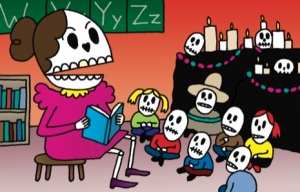
Hi, everyone!
The Mountain Room is gearing up for its Day of the Dead celebration on Friday. Please send in photos of loved ones for our altar. All parents are welcome to come by on Wednesday afternoon to help us make candles and decorate skulls.
Thanks!
Emily
Hi again.
Because I’ve gotten some questions about my last e-mail, there is nothing “wrong” with Halloween. The Day of the Dead is the Mexican version, a time of remembrance. Many of you chose Little Learners because of our emphasis on global awareness. Our celebration on Friday is an example of that. The skulls we’re decorating are sugar skulls. I should have made that more clear.
Emily
Parents:
Some of you have expressed concern about your children celebrating a holiday with the word “dead” in it. I asked Eleanor’s mom, who’s a pediatrician, and here’s what she said: “Preschoolers tend to see death as temporary and reversible. Therefore, I see nothing traumatic about the Day of the Dead.” I hope this helps.
Emily
It gets funnier, so please go read the rest! Now what are you reading and blogging about today?

 peej
peej Carissa
 bostonboomer
 dakinikat
 ecocatwoman
 mablue2
 Mama Lopez
 peggysue22
 quixote
 skydancingguestblogger
 Mona (aka Wonk the Vote)



 Sky Dancing
Recent Comments