
Mostly Monday Reads: Cheat if you have to Republican Strategy
Posted: August 4, 2025 Filed under: #FARTUS, #MAGAnomics, #We are so Fucked | Tags: #TrumpCult, Are all Republicans Corrupt? Asking for a friend., Corrupt SCOTUS, gerrymandering, Stagflation, Trump Vendettas and Jack Smith, Trumpcession 7 Comments
“He’s not ever leaving as long as Republicans turn a blind eye.” John Buss, @repeat1968
Good Day, Sky Dancers!
Texas Democratic Delegates have fled to Illinois to stop the redistricting of Congressional Districts, preventing a quorum on a vote. Legislators in both California and New York are gearing up for similar action in response. It’s likely Florida will try the same maneuver. Trump ordered the action to prevent likely Republican losses in the midterms. Usually, Congressional Districts are redrawn every 10 years to reflect changes shown by the most recent census. This is definitely a move to disenfranchise people of color. It has become clear that our institutions are in a process of democratic backsliding due to extremists and cowardly Republicans. Even the People’s House is losing its historic look as Yam Tits paved over the gifts of flowers from our allies that filled Jackie Kennedy’s Rose Garden. A huge, tasteless ballroom to the east of the edifice is the next planned monstrosity. Nothing is safe or sacred.
This is the headline from NBC News. “Texas Democrats decamp to Illinois to deny Republicans a quorum on redistricting. In response, Texas Gov. Greg Abbott threatened to try to remove the Democrats from the state Legislature and said some of them may even be “felons.” This coverage is from NBC News.
A showdown over redistricting in Texas played out here on Sunday as dozens of state Democrats took refuge roughly 1,000 miles away from home, saying they had fled Texas to deny a quorum to Republican efforts to add as many as five congressional seats to their map.
It culminated with Texas’ governor, a Republican, threatening to expel the Democrats from the Texas state House and potentially extradite them, saying they may be “felons.”
The Texas state House Democrats filed off of buses and Ubers into a crammed county party headquarters at a strip mall Sunday night, standing alongside Illinois Gov. JB Pritzker to rail against what they charged was a racist, unfair and undemocratic attempt to overhaul the Lone Star State’s political map.
Texas House Democratic Caucus Chair Gene Wu said that he believed about 57 Democrats have left the state, with the bulk staying in Illinois for at least the immediate future. Other House Democrats were in Boston and Albany, New York.
“Gov. Abbott is doing this in submission to Donald Trump so that Donald Trump can steal these communities’ power and voice,” Wu said. “We will not be complicit in the destruction of our own communities. We’re not here to play political games. We’re here to demand an end to this corrupt process.”
After the news conference, Wu said there was real fear that some of their members could be arrested for defying a special session call.
“We have discussed this. This is a topic of serious concern. We know the governor has no authority to send state troopers over here but we don’t know what Donald Trump’s going to do,” Wu said.
He argued there was no legal basis for arrests but then pointed to questionable actions taken by immigration officials in their nationwide sweeps.
“That’s not far-fetched from arresting state legislators because they feel like it, and consequences be damned,” he added.
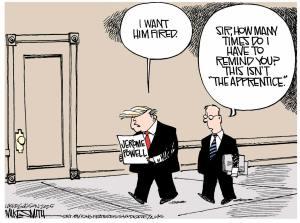 This is not the first time this has happened. You may remember that the same strategy was used in 2003 for the same reason. However, this action has roots deep in Texas History, according to the Texas Tribune. Hayden Betts reports that “Denying quorum has been a Texas political strategy since 1870. While the Democrats could technically derail the GOP’s redistricting map, such efforts have been largely symbolic and had limited success blocking past legislation, experts say.”
In June 1870, 13 Texas senators walked out of the Capitol to block a bill giving the governor wartime powers, depriving the upper chamber of the two-thirds quorum required for voting. Though the fleeing members were arrested, and the bill eventually passed, the “Rump Senate incident” established quorum-breaking as a minority party tactic that has persisted in Texas politics ever since.
After significant quorum breaks in 1979, 2003, and 2021, Texas House Democrats are once again employing this nuclear option, fleeing the state Sunday to block passage of a congressional redistricting map that would give Republicans five additional seats in the U.S. House. The attempt represents the latest chapter for the maneuver that political scientists say, barring exceptional endurance on the part of the democratic delegation, is likely to be symbolic rather than directly effective in preventing redistricting.
“It’s a messaging move,” said Brandon Rottinghaus, a political science professor at the University of Houston. “It’s a last resort for Democrats who have run out of options legislatively and even legally.”
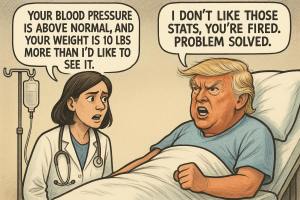 Partisan Republicans stacked into the Supreme Court are making moves to diminish the Constitution and our democratic republic, also by signalling willingness to dismantle the Voting Rights Act. This is from Slate. Robert L. Hasen reports this. “The Supreme Court Just Signaled Something Deeply Disturbing About the Next Term.” It’s a lawsuit against the redistricting that happened recently in Louisiana because the courts determined that Louisiana redistricting had disenfranchised minorities in Louisiana.
Reading the tea leaves from cryptic Supreme Court orders can be perilous business because the justices are not bound by the questions they ask at oral argument, the offhand comments they make at a judicial conference, or even their monumental “shadow docket” rulings on emergency petitions that have become all too common. But a technical briefing order in a long pending case out of Louisiana, posted on the court’s website after 5 p.m. on a Friday in August, was ominous. The order was likely intended to obscure that SCOTUS is ready to consider striking down the last remaining pillar of the Voting Rights Act, known as Section 2. Such a monumental ruling, likely not coming until June 2026, would change the nature of congressional, state, and local elections all across the country, and likely stir major civil rights protests as the midterm election season heats up.
Louisiana v. Callais, the case that was the subject of last Friday’s order, is a voting case over the drawing of the state’s six congressional districts. Louisiana has a one-third Black population, but after the 2020 census the state Legislature drew a districting plan, passed over a Democratic governor’s veto, that created only one district in which Black voters would be likely to elect their candidate of choice. Before Callais, Black voters had successfully sued Louisiana in a case called Robinson v. Ardoin, arguing that Section 2 of the Voting Rights Act required drawing a second congressional district giving Black voters that opportunity. Section 2 says minority voters should have the same chance as other voters to elect their candidates of choice, and courts have long used it to require new districts when there is a large and cohesive minority population concentrated in a given area, when white and minority voters choose different candidates, and when the minority has difficulty electing its preferred representatives.
After Robinson and more litigation, the Louisiana Legislature drew up a new plan, which created the second congressional district. The state drew the second district to otherwise favor Republicans in the state overall, including House Speaker Mike Johnson. A new group of voters then sued in the Callais case, arguing that Louisiana’s drawing of the second district violated the U.S. Constitution’s equal protection clause by being a racial gerrymander. Since 1993’s Shaw v. Reno, the Supreme Court has found racial gerrymanders when race is the central factor in drawing district lines and the state has no compelling interest in drawing such lines.
When the court first held oral argument in the Callais case in March, it appeared to be another in a long series of cases (many out of Louisiana) in which the justices considered whether race or partisanship predominated in the drawing of district lines. I’ve long written that this is an impossible exercise in places like Louisiana, where the factors overlap—most white voters in the state are Republicans and Black voters are Democrats, so when the state discriminates against Democrats, it is also discriminating against Black voters. It appeared from the initial March oral argument that the court was going to once again determine whether race or party predominated.
But instead of deciding the case at the end of June, when the court ordinarily disposes of the cases heard during the term, the court set the case up for reargument. That’s a rare move, but it’s not unheard of. Back in 2010, SCOTUS set the Citizens United case up for reargument the following September. But when the court issued its June order in Citizens United for reargument, the same order informed the parties that the court wanted something new to be briefed and argued on reargument: whether to overrule a line of cases allowing limits on corporate spending in elections. The court the following January then overruled these cases in one of the most consequential election law decisions of our time. It has had significant reverberations for our politics ever since.
Fifteen years later, something similar seems to be happening with Section 2 of the Voting Rights Act. In June of this year, rather than deciding the case it heard in March, the court issued an order in Callais setting the case for reargument and stating, “In due course, the Court will issue an order scheduling argument and specifying any additional questions to be addressed in supplemental briefing.” Justice Clarence Thomas impatiently dissented from the order, saying that this was the time to recognize that Section 2 of the VRA and the court’s racial gerrymandering case are on a collision course and to kill off Section 2 or rewrite it to be toothless.
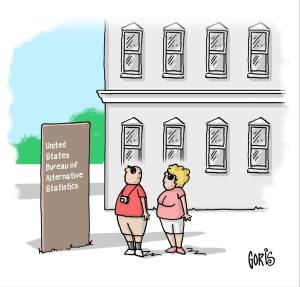 Orange Caligula is searching for someone to fudge the numbers at the Bureau of Labor. This is from the New York Times. I’ve gifted the article so you may read the entire thing. It is reported by Tony Romm. “Trump to Appoint New Top Labor Official Within Days. President Trump fired the commissioner of the Bureau of Labor Statistics on Friday after the agency released dour monthly jobs data.”
President Trump said on Sunday that he would announce a new commissioner for the Bureau of Labor Statistics “over the next three, four days” after he fired the head of the agency last week over a gloomy jobs report.
Mr. Trump fired the top labor official in charge of compiling statistics on employment, Erika McEntarfer, on Friday after the B.L.S. released monthly jobs data showing a significant slowdown in hiring. Mr. Trump accused Ms. McEntarfer, without evidence, of rigging the numbers.
Ms. McEntarfer had worked as a government economist for decades and was confirmed by the Senate in a bipartisan vote last year. Mr. Trump gave no further details about the announcement of her replacement.
Earlier Sunday, Kevin Hassett, the director of the White House National Economic Council, insisted that the administration was “absolutely not” shooting the messenger on the heels of the jobs report.
Mr. Hassett repeatedly declined to furnish detailed evidence that would substantiate the president’s claims that the data had been manipulated to hurt him politically.
“The president wants his own people there, so that when we see the numbers, they’re more transparent and more reliable,” Mr. Hassett told NBC’s “Meet the Press,” explaining at one point that the president sought to ensure jobs numbers could be “trusted.”
In a second appearance, on “Fox News Sunday,” Mr. Hassett claimed there were “partisan patterns” in the jobless data, and said that “data can’t be propaganda.”
Since Ms. McEntarfer’s sudden dismissal, economists across the political spectrum have offered a more worrisome assessment, warning that Mr. Trump’s actions threaten to pollute the nonpartisan work at B.L.S. to measure the trajectory of the economy.
Her dismissal came only hours after the statistics agency reported the slowdown in hiring in July, on top of two substantial downward revisions to its previous estimates of job growth in May and June.
 The methodology has been used for over 50 years. The reason for the updates, which usually occur over 2-3 months after the original release, is that many businesses and individuals cannot get their surveys back to the Bureau in a timely manner. Anyone who uses the data for research or making business decisions is aware of this. It is absolutely nothing new. The current data reflects the chaotic Tariff introductions by Trump. The simplest practice of running a business is that you must have a rational and stable economic policy that provides information and an atmosphere to make good decisions. Trump can’t even make the simplest decisions or leave things alone long enough to prevent the instability that freezes any moves by business decision-makers. Noah Berlesky writes this at Public Notice. “The looming Trumpcession. Orange man bad (for the economy).” This guy bankrupted casinos and himself so many times that you’d think everyone would know this by now.
The July jobs numbers, released last Friday, could not have been much bleaker.
The economy undershot the projection of 100,000 new jobs significantly, adding only 73,000. Even worse, the numbers for May and June were revised down by a ghastly 285,000 jobs. That means that the economy created only 33,000 jobs in May and June combined — anemic growth the likes of which we haven’t seen the final months of President Trump’s first term. In contrast, under President Biden, the economy gained some 420,000 jobs in May and June 2024.
Trump’s response was as unhinged and authoritarian as you’d expect. In an unprecedented move, he abruptly fired Erika McEntarfer, the head of the Bureau of Labor Statistics, and as an excuse, lied that the job numbers were “phony.”
Of course, the numbers were not phony. They were actually exactly what you’d expect given Trump’s relentless effort to destroy the robust economy left to him by Biden.
The president usually has limited control over the economy, with downturns being caused by events beyond their control. In this case, however, Trump’s policies are directly responsible for job losses, rising prices, wavering confidence, and a speedrun toward what looks like stagflation.
Flashing red
The jobs report is bad news. But it’s hardly the only sign that the economy is heading to a dark place.
The overall unemployment rate last month ticked up to 4.2 percent, but more worrying is the increase in Black unemployment to 7.2 percent. That’s the highest rate since December 2021, when the economy was still struggling to emerge from the covid pandemic. Black workers are often the last hired and the first fired. As a result Black unemployment rates often shoot up first when a serious economic downturn is on the horizon.
The economy is also struggling with stubborn inflation that will only be exacerbated by Trump’s inflationary tariff policies. Current inflation indicators are all bad. The personal consumption price index has prices rising 0.3 percent from May to June, which means they’ve risen 2.6 percent from last year.
Usually, a hot job market can mean increased inflation, while lower inflation can lead to slower job growth. In the final years of Biden’s presidency, the US managed to achieve both low inflation and record low unemployment. But Trump has reversed that. And now we may be looking at the worst of both worlds — stagflation, when jobs stagnate and prices spike.
The last time the US experienced serious stagflation was in the late 1970s under Jimmy Carter — and that’s a big part of what led to Carter’s landslide loss to Reagan in 1980.
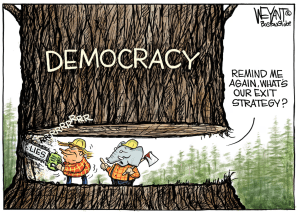 Berlesky cites a very interesting study by Yale.
While Trump claims that his senseless tariff fetish will somehow lead to awesome trade deals, the truth is that he’s simply imposing massive arbitrary taxes on consumer goods. Taxing goods raises prices. The nonpartisan Yale Budget Lab has concluded that the effective tariff rate under Trump is around 18.3 percent, the highest since 1934. That means that households will be paying an extra $2,400 each in taxes to the government on purchases.
Tariffs are a regressive tax — they are hardest to absorb for lower income households, since the taxes are a higher percentage of their income. Even worse, lower income households tend to be especially dependent on imported goods, which are often cheaper than domestic products. Ernie Tedeschi, director of the Yale Budget Lab, told NPR that Trump’s tariffs seem “almost tailor made” to harm lower income workers the most.
I know I’ve been jumping up and down about this since January, but the economic performance has brought us an economy that even an Econ 101 student could predict. Former Republican and still conservative voice Bill Kristol has this to say in The Bulwark today. “Democracy dies in Daylight.”
In the last few days, it seems as if we’ve reached a new stage in the attempted authoritarian takeover of American democracy. It’s not just that the multi-faceted assault on the truth, on the rule of law, on a free society has picked up steam—though it has. It’s that the assault, from our own government, now proceeds so openly and unashamedly.
Once, if there were bad economic statistics, the president and his supporters tried to spin them. Now the president and his supporters simply deny them. And those who produced them are punished. And so President Trump fires, with no pretense of real cause or justification, the commissioner of the Bureau of Labor Statistics, a career civil servant who has supervised a host of other career civil servants in producing these statistics, as they have for decades. And he brazenly lies in accusing her and a host of other civil servants of “rigging” their findings.
This is part of a broader pattern of the transformation of government information into pure propaganda. Kash Patel and Tulsi Gabbard—using the resources of the federal agencies they direct—have taken the lead in this. But they are only the tip of the Trump spear.
Once, if a president or his subordinates wanted to cover up a problem, even a crime, they made labored efforts at obfuscation and concealment. Coverups were, as the term implies, pursued under the cover of darkness. That’s why the Washington Post, with the experience of Watergate in mind, came up at the beginning of Trump’s first term with the slogan “Democracy Dies in Darkness.” But that slogan applies to a different era.
Now Ghislaine Maxwell, one of two organizers of a massive and horrendous child sex trafficking ring of which Donald Trump appears to have had considerable contemporaneous knowledge, meets with the deputy attorney general of the United States—who had previously been Trump’s private lawyer—and the White House openly embraces it. A week later, contrary to the normal rules for a prisoner convicted of her crimes, Maxwell is transferred to a minimum security “Club Fed” facility. This was presumably as a down payment on not spilling the beans about Trump, and perhaps as an interim step on the way to a pardon. This coverup is happening in broad daylight.
Once, state legislators redistricted congressional seats every ten years, after the constitutionally mandated census. These reapportionments were often accompanied by gerrymandering. But, with a notable exception, the partisan power grabs were at least adjacent to a regular and lawful process. They were at least somewhat constrained by calendars and custom.
Now the governor of Texas has decided, at the public urging of the president of the United States, to have his state legislature carry out a gerrymander mid-decade, so as to try to preserve a Republican majority in the House of Representatives for the final two years of Trump’s term. And it seems other red states will follow.
There is no pretense here other than a grab for power. It is the unconstrained use of the instrumentalities of government, state and federal, to hold on to control of the House.
The New York Times quotes “one person close to the president” as summing up the approach of the Trump White House as “maximum warfare, everywhere, all the time.” It’s important to add that it’s not just maximum warfare by one party against the other. It’s warfare by the government of the United States against the justice system, against the presentation of true facts, against free and fair elections. It’s maximum warfare against the norms and institutions of a liberal democracy and republican self-government.
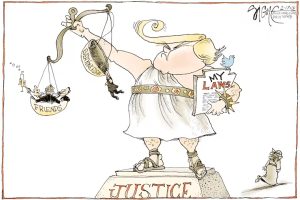 All of us who have written for and followed Sky Dancing Blog know that we’ve been canaries shrieking in a coal mine. I cannot figure out what is not obvious to everyone, and that’s damned depressing. I’m going to close with a certain sign that this country is in trouble. It’s posted at Maddow Blog and written by Steven Benen. This is a certain sign that justice is not being served in the United States. “The 3 biggest problems with the new and unwarranted investigation into Jack Smith. For years, Team Trump treated the Hatch Act like a joke. To target former special counsel Jack Smith, they’ve apparently changed their mind.”
It’s a serious enough problem when Donald Trump publicly endorses investigations into his perceived political foes. But when the president’s targets actually become the subject of investigations, it’s far worse. NBC News reported:
Federal officials are investigating former special counsel Jack Smith after President Donald Trump and other prominent Republicans have alleged that his investigations into then-candidate Trump amounted to illegal political activity. The U.S. Office of Special Counsel, an independent federal agency, confirmed to NBC News on Saturday that it’s investigating Smith for alleged violations of the Hatch Act, a law that prohibits certain political activities by government officials.
Right off the bat, let’s not overlook the most glaring problem with these developments: There’s literally no evidence whatsoever of Smith engaging in any kind of wrongdoing. Then-Attorney General Merrick Garland tapped Smith to serve as a special counsel in November 2022 — two years before the 2024 presidential election — at which point he oversaw the federal investigations into Trump.
The prosecutor proceeded to collect voluminous evidence, secure indictments and charge Trump with a great many felonies, but at no point did Smith engage in any partisan political activities, making the basis for such an investigation from the U.S. Office of Special Counsel absurd.
Just as notably, it seems rather obvious that this move against Smith is part of a larger partisan vendetta from a party that’s eager to retaliate against those who dared to try to hold Trump accountable for his alleged crimes. Indeed, it was Republican Sen. Tom Cotton of Arkansas, a close White House ally, who requested that the OSC investigate Smith for “unprecedented interference in the 2024 election,” despite the complete lack of evidence pointing to any interference.
But even if we put these relevant angles aside, there’s a broader point that’s hanging overhead: Since when does the Trump administration care about alleged Hatch Act violations? I’m reminded of this New York Times report from nearly four years ago:
Thirteen of President Donald J. Trump’s most senior aides — including his son-in-law and his chief of staff — campaigned illegally for Mr. Trump’s re-election in violation of a law designed to prevent federal employees from abusing the power of their offices on behalf of candidates, a government watchdog agency said Tuesday. Henry Kerner, who heads the Office of Special Counsel, made the assertion in a withering report that followed a nearly yearlong investigation into ‘myriad’ violations of the law, known as the Hatch Act.
In a 63-page report, the Office of Special Counsel concluded, “Senior Trump administration officials chose to use their official authority not for the legitimate functions of the government, but to promote the re-election of President Trump in violation of the law.”
Richard Painter, who served as the chief White House ethics lawyer in the Bush/Cheney White House, described Team Trump’s routine transgressions at the time as “disgusting” and “unprecedented in the history of the Hatch Act.” Painter added that the entire Trump administration, at the most senior levels, was “devoted to illegally using federal offices to promote the president’s political campaign.”
Each one of us had better get serious about voting, action, and finding out what these cartoonish villains are doing, because we’re not just democratic backsliding. We democratic falling off a cliff.
What’s on your Reading, Blogging, and Action list today?
Friday Reads: America, Land of Democracy Deserts
Posted: August 13, 2021 Filed under: Afternoon Reads | Tags: 2020 Census, gerrymandering 15 Comments
Salvador Dalí, Soft Construction with Boiled Beans (Premonition of Civil War), 1936, Philadelphia Museum of Art
Good Day Sky Dancers!
The title is shocking, isn’t it? That’s what caught my eye when I went to read this article in The Guardian with the lede “America is full of ‘democracy deserts.’ Wisconsin rivals Congo on some metrics written by David Daley and Gaby Goldstein, who shows how “gerrymandering allows legislators to ignore what voters really want.” They also indicate that “experts fear it’s about to get a lot worse.” I’ve been watching all the voter suppression laws passing in many red states. However, gerrymandering could bring a few of those purple states into the lost cause category.
I was thinking a lot about the Spanish Civil War because BB has been reading a book on it. So, I chose these pictures today that are from that period about the event. They are mostly Modernist and Avant-Garde. Some, as you may see at this link, are propaganda. I think it’s important to remember that history has lessons for us if we’re really to listen.
From The Guardian story:
The United States is becoming a land filled with “democracy deserts”, where gerrymandering and voting restrictions are making voters powerless to make change. And this round of redistricting could make things even worse.
Since 2012, the Electoral Integrity Project at Harvard University has studied the quality of elections worldwide. It has also issued bi-annual reports that grade US states, on a scale of 1 through 100. In its most recent study of the 2020 elections, the integrity of Wisconsin’s electoral boundaries earned a 23 – worst in the nation, on par with Jordan, Bahrain and the Congo.
Why is Wisconsin so bad? Consider that, among other things, its a swing-state that helped decide the 2016 election. Control the outcome in Wisconsin, and you could control the nation. But Wisconsin isn’t the only democracy desert. Alabama (31), North Carolina (32), Michigan (37), Ohio (33), Texas (35), Florida (37) and Georgia (39) scored only nominally higher. Nations that join them in the 30s include Hungary, Turkey and Syria.
Representative democracy has been broken for the past decade in places like Wisconsin, North Carolina, Ohio, Pennsylvania, Michigan, Florida. When Republican lawmakers redistricted these states after the 2010 census, with the benefit of precise, granular voting data and the most sophisticated mapping software ever, they gerrymandered themselves into advantages that have held firm for the last decade – even when Democratic candidates win hundreds of thousands more statewide votes.
In Wisconsin, for example, voters handed Democrats every statewide race in 2018 and 203,000 more votes for the state Assembly – but the tilted Republican map handed Republicans 63 of the 99 seats nevertheless. Democratic candidates have won more or nearly the same number of votes for Michigan’s state house for the last decade – but never once captured a majority of seats.
Now redistricting is upon us again. This week, the US Census Bureau will release the first round of population data to the states, and the decennial gerrymandering Olympics will begin in state capitols nationwide. And while there has been much coverage of the national stakes – Republicans could win more than the five seats they need to control of Congress next fall through redrawing Texas, Georgia, North Carolina and Florida alone, and they’ve made clear that’s their plan – much less alarm has been raised about the long-term consequences of entrenched Republican minority rule in the states.

Joan Miró, Help Spain, 1937, Museum of Modern Art, New York
The peril we face as a democratic Republic is great. John Nichols writes this for The Nation: “The Next Gerrymandering Nightmare Has Begun. With the release of 2020 Census data, GOP legislators will rush to draw new maps. If they get their way, they’re likely to flip the US House.”
It may not be too late to prevent the partisan gerrymandering of electoral maps that Republicans believe will deliver them control of the US House of Representatives in 2022—as well as a tighter grip on the statehouses that will set so many of the rules for the 2024 presidential election. But it is almost too late.
Ten years ago, Republican governors and legislators used the redistricting process that extended from the 2010 Census to gain dramatic political advantages. Now, with the release of fresh Census data, they are poised to do so again. No one should doubt what is at stake. If the supporters of voter suppression succeed, they could deny Americans representation based on the racial and ethnic diversity that the new data reveals.
“States have long been preparing for this moment, and they now have the green light to start gerrymandering. If left unchecked, this year’s redistricting cycle represents a severe threat to our democracy,” explains Josh Silver, who heads the nonpartisan reform group RepresentUs. “Gerrymandering is one of the worst forms of political corruption, and leads to extremism and partisan gridlock. The maps drawn this year will shape American politics and policy for the next decade.”
The best scenario for American democracy would have been for Senate Democrats to scrap the filibuster and enact the For the People Act before Thursday’s release of the Census data. That legislation seeks to ban partisan gerrymandering and strengthen the position of advocates for communities of color in the redistricting process. “It would also,” notes the Brennan Center for Justice, “enhance the ability of voters to challenge racially or politically discriminatory maps in court, require meaningful transparency in the map-drawing process, and mandate the use of independent commissions to draw maps.”
When senators failed to pass the For the People Act before the August recess, they left an opening for partisans to warp district lines in the 35 states where maps will be drawn by legislators, as opposed to nonpartisan commissions. That gives Republicans a substantial advantage. As Drew DeSilver of the Pew Research Center reminds us, “Republicans will drive that process in 20 states, versus 11 for Democrats.” In four states, divided government makes it most likely that the final decision could be made in the state courts.
Republicans are in full control of states that will be adding seats based on patterns of population growth confirmed by the Census data, such as Texas and Florida. They also control several large states, such as Georgia, where seats will not be added but where a redrawing of lines could be used to tip existing seats to the GOP candidates. In contrast, a number of states where Democrats are in charge, such as New York and Illinois, will lose congressional seats. So, too, will heavily Democratic California, where lines are drawn by a nonpartisan commission.

The Party Road Painting Aurelio Arteta
This discussion has yet to reach the level of coverage it deserves. Here’s an interesting article on the role of Math and stopping gerrymandering from The MIT Technology Review. Basically, there’s an algorithm for that!
The maps for US congressional and state legislative races often resemble electoral bestiaries, with bizarrely shaped districts emerging from wonky hybrids of counties, precincts, and census blocks.
It’s the drawing of these maps, more than anything—more than voter suppression laws, more than voter fraud—that determines how votes translate into who gets elected. “You can take the same set of votes, with different district maps, and get very different outcomes,” says Jonathan Mattingly, a mathematician at Duke University in the purple state of North Carolina. “The question is, if the choice of maps is so important to how we interpret these votes, which map should we choose, and how should we decide if someone has done a good job in choosing that map?”
Over recent months, Mattingly and like-minded mathematicians have been busy in anticipation of a data release expected today, August 12, from the US Census Bureau. Every decade, new census data launches the decennial redistricting cycle—state legislators (or sometimes appointed commissions) draw new maps, moving district lines to account for demographic shifts.
In preparation, mathematicians are sharpening new algorithms—open-source tools, developed over recent years—that detect and counter gerrymandering, the egregious practice giving rise to those bestiaries, whereby politicians rig the maps and skew the results to favor one political party over another. Republicans have openly declared that with this redistricting cycle they intend to gerrymander a path to retaking the US House of Representatives in 2022.

Francis Picabia. La Révolution espagnole (The Spanish Revolution). 1937
The Washington Post has some details from the 2020 census. “Census data shows Maryland is now the East Coast’s most diverse state, while D.C. is Whiter.”
According to the U.S. Census Bureau’s diversity index — which measures the likelihood that two people chosen at random would be from different racial and ethnic groups — Maryland is now one of the most diverse states in the nation, surpassed only by Nevada, California and Hawaii.
Nevada also was the only other state in the country to become majority non-White over the last decade.
The change in Maryland’s demographic makeup was driven by growing Asian and Latino populations in the District’s inner suburbs and areas around Baltimore.
The article primarily focuses on the states surround the District. The New York Times provides information on what you need to know when the data is released. It was released on Thursday, but we still are waiting for the major slice and dice to come. This is written by Nick Corasaniti.
With Democrats clinging to a slim margin in the House of Representatives, control of the chamber in 2022 could be decided through congressional redistricting alone: Republican-leaning states like Texas and Florida are adding new seats through reapportionment, and G.O.P.-dominated state legislatures will steer much more of the redistricting process, allowing them to draw more maps than Democrats.
In a matter of days — if history is any guide — as soon as state officials can crunch census data files into their more modern formats, an intense process of mapmaking, political contention, legal wrangling, well-financed opinion-shaping and ornery public feedback will unfold in statehouses, courthouses, on the air and even on the streets in regions of special contention.
The redistricting fight arrives amid one of the most protracted assaults on voting access since the Voting Rights Act was passed in 1965, an effort that has made the right to vote among the most divisive issues in American politics. And redistricting will take place this fall without critical guardrails that the Voting Rights Act had erected: a process known as preclearance that ensured oversight of states with a history of discrimination. The Supreme Court effectively neutered that provision in a 2013 ruling, meaning that it could take lawsuits — and years — to force the redrawing of districts that dilute the voting power of minority communities.

Martyred Spain 1937 André Fougeron 1913-1998 Presented by the Friends of the Tate Gallery 2001 http://www.tate.org.uk/art/work/T07703
The worst-case scenarios may occur without the original protection of the Voting Rights Act. You may visit this link at the Brennan Center for Justice to find out more basic information about gerrymandering.
Every 10 years, states redraw their legislative and congressional district lines following the census. Because communities change, redistricting is critical to our democracy: maps must be redrawn to ensure that districts are equally populated, comply with laws such as the Voting Rights Act, and are otherwise representative of a state’s population. Done right, redistricting is a chance to create maps that, in the words of John Adams, are an “exact portrait, a miniature” of the people as a whole.
But sometimes the process is used to draw maps that put a thumb on the scale to manufacture election outcomes that are detached from the preferences of voters. Rather than voters choosing their representatives, gerrymandering empowers politicians to choose their voters. This tends to occur especially when linedrawing is left to legislatures and one political party controls the process, as has become increasingly common. When that happens, partisan concerns almost invariably take precedence over all else. That produces maps where electoral results are virtually guaranteed even in years where the party drawing maps has a bad year.
There are multiple ways to gerrymander.
While legislative and congressional district shapes may look wildly different from state to state, most attempts to gerrymander can best be understood through the lens of two basic techniques: cracking and packing.
Cracking splits groups of people with similar characteristics, such as voters of the same party affiliation, across multiple districts. With their voting strength divided, these groups struggle to elect their preferred candidates in any of the districts.
Packing is the opposite of cracking: map drawers cram certain groups of voters into as few districts as possible. In these few districts, the “packed” groups are likely to elect their preferred candidates, but the groups’ voting strength is weakened everywhere else.
https://twitter.com/marceelias/status/1425911675211993088
The Politico link has good coverage of the broader population trends released in April. It follows up describing the “mad-dash to redistricting.
Broadly, the data released on Thursday shows a country that has become more urbanized” and more diverse over the last decade. Metro areas across the country grew by 9 percent, and all ten of America’s largest cities have over 1 million people for the first time in U.S. history.
The country has also become less white over the last decade. White Americans still make up the largest demographic in the country, but decreased by 8.6 percent over the last decade.
The dataset could also give an indication of whether the Census undercounted people of color in certain regions, and a state-by-state review will revealwhether individual states need to add additional opportunity districts for Blacks and Latinos, as required by the Voting Rights Act. That officially sets the stage for a wave of lawsuits expected from both parties as redistricting moves forward.
The process is also at the center of the battle for control of Congress. Redistricting decisions made in the coming months will be perhaps the largest determining factor in whether Democrats can hang onto to their razor-thin House majority.
“These data play an important role in our democracy, and also begin to illuminate how the local and demographic makeup of our nation has changed over the last decade,” said Ron Jarmin, the acting director of the Census Bureau, during a presentation Thursday.
So, this will be something we must continue to watch over the next two months. It’s vital to our democracy that we minimize gerrymandering. Gerrymandering is the basic tool of voter disenfranchisement. It happens even if the worst voter suppression measures are defeated.
What’s on your reading and blogging list today?
Thursday Reads: Republicans and the Shutdown, Refugee Boat Disaster, The Dark Web, and Snowden
Posted: October 3, 2013 Filed under: Affordable Care Act (ACA), Crime, Criminal Justice System, FBI, Federal Government Shutdown, Foreign Affairs, Italy, morning reads, NSA, National Security Agency, Republican politics, U.S. Economy, U.S. Politics | Tags: "Dread Pirate Roberts", cryptography, Edward Snowden, gerrymandering, Glenn Greenwald, John Boehner, Johns Hopkins, Ladar Levison, Lampedusa, Lavabit, Matthew D. Green, Ohio redistricting, Ross William Ulbricht, Silk Road, Tea Party, the "dark web", US Chamber of Commerce 68 Comments
Good Morning!!
The government shutdown continues, and as Dakinikat wrote yesterday, no one seems to know how long this deadlock between extremist House Republicans (along with their chief hostage Speaker John Boehner) and the rest of Congress–Republicans and Democrats–will continue. It’s depressing as hell, and it’s really difficult to figure out what Republicans think they’re going to gain by it.
Just a few links:
CBS News — Poll: Americans not happy about shutdown; more blame GOP.
On day three of the partial government shutdown, a new CBS News poll reveals that a large majority of Americans disapprove of the shutdown and more are blaming Republicans than President Obama and the Democrats for it.
Fully 72 percent of Americans disapprove of shutting down the federal government over differences on the Affordable Care Act; just 25 percent approve of this action. Republicans are divided: 48 percent approve, while 49 percent disapprove. Most tea party supporters approve of the government shutdown – 57 percent of them do. Disapproval of the shutdown is high among Democrats and independents. This CBS News poll was conducted after the partial government shutdown began on October 1.
Views of the Affordable Care Act are related to views of the shutdown. Those who like the health care law also overwhelmingly disapprove of shutting down the government. There is more support for the shutdown among Americans who don’t like the 2010 health care law. Thirty-eight percent of them approve of the shutdown but even more, 59 percent, disapprove.
Republicans in Congress receive more of the blame for the shutdown: 44 percent of Americans blame them, while 35 percent put more blame on President Obama and the Democrats in Congress. These views are virtually the same as they were last week before the shutdown, when Americans were asked who they would blame if a shutdown occurred.
Bloomberg Businessweek: Republicans Are No Longer the Party of Business.
T.J. Gentle, chief executive officer of Smart Furniture, an online custom furniture maker in Chattanooga, employs 250 people, has seen sales grow 25 percent this year, and was planning another round of hiring—until Republican hard-liners forced the federal government to close on Oct. 1. Gentle is the embodiment of moderate, business-minded pragmatism: He voted for President Obama and Tennessee’s Republican Senator Bob Corker, splits his donations between the parties, and prefers divided government as a check on partisan excess. Like his plan to hire more workers, this too may change as a result of the shutdown. “It’s as if House Republicans are playing suicide bomber with the U.S. economy,” he says. “As a businessman, it defies all reason and logic.”
Smart Furniture and countless other businesses are already feeling the impact of the shutdown. The Federal Housing Administration, which backed one-third of all mortgages last year, has furloughed employees, a move that will slow loan approvals and house purchases. “That directly affects the construction and materials industries,” Gentle says, “but it also affects us, since the purchase of a new home is the No. 1 trigger for buying furniture.”
Larger businesses, which often tilt more heavily toward the GOP, are no less frustrated. It’s hard to find any organization more closely affiliated with the Republican Party than the U.S. Chamber of Commerce. In 2012 the business trade group spent $35,657,029 on federal elections, according to the Center for Responsive Politics. Of that, $305,044 was spent on behalf of Democratic candidates. Last year the Chamber went further to help Republicans than it ever had by running ads directly against candidates: It spent $27,912,717 against Democrats and only $346,298 against Republicans.
Geeze, if business isn’t happy with the GOP, who do they have left in their corner? The religious right and the Tea Party, I guess–and those groups likely have a lot of crossover. Is that enough for to support a national party?
CNN: Government shutdown: GOP moderates huddle as conservatives set agenda
A small but growing group of House Republicans is increasingly worried about the fallout from the government shutdown and say it’s time for Speaker John Boehner to allow a simple vote on a spending bill.
Defunding Obamacare can wait for now, they say.
“I’m trying to be optimistic but at the same time I have a really, really tough time when people are out of work and they can’t pay their bills,” Rep. Michael Grimm of New York told reporters Wednesday. “Though it might be a political loss for us … this is an untenable situation.”
Rep. Scott Rigell, whose Virginia district is home to a significant number of military members and civilian contractors, was one of the first to publicly break away.
“We fought the good fight,” he said in a tweet on Tuesday, but acknowledged it was time to move on.
Boehner hosted small groups of concerned members on Wednesday. A spokesman for Boehner declined to talk about the sessions.
How can Boehner get away with letting just 30% of his caucus run roughshod over the entire House? Think Progress may have the answer: How John Boehner Engineered An Ohio Gerrymander To Save His Speakership.
During the last redistricting cycle, then-Ohio state Senate President Tom Niehaus (R) pledged to deliver a redrawn map of Ohio’s congressional districts “that Speaker Boehner fully supports.” Indeed, at the height of the map drawing process, Boehner’s political aide Tom Whatman averaged a request a day to Ohio’s mapmakers — often micromanaging the slightest geographic changes in the district lines. In one case, for example, the line-drawers added a peninsula with no residents at all to Rep. Jim Renacci’s (R-OH) district because the peninsula included the headquarters of a company whose leaders donated generously to Renacci.
A full election cycle later, Team Boehner’s micromanagement paid off. President Obama won the state of Ohio by nearly two points in 2012, but 12 members of Ohio’s 16 member Congressional delegation are Republicans. In the nation as a whole, nearly 1.4 million more Americans voted for Democratic House candidates than Republicans.
The districts Boehner helped draw in Ohio played into a much larger Republican Party strategy to secure the House by rigging the legislative maps. Indeed, last January, the Republican State Leadership Committee released a report entitled “How a Strategy of Targeting State Legislative Races in 2010 Led to a Republican U.S. House Majority in 2013.” The report bragged that gerrymandering “paved the way to Republicans retaining a U.S. House majority in 2012.”
And, as TP notes, this strategy was replicated and a number of other states.
FOX News: Congress misses deadline, sending government into partial shutdown
Congress blew by a midnight deadline to pass a crucial spending bill, triggering the beginning of a partial government shutdown – the first in 17 years.
The failure means the gears of the federal government will start to slow down on Tuesday, though hundreds of thousands of federal workers will remain on the job. Though it’s been a long time since the last one, this marks the 18th shutdown since 1977.
Lawmakers missed the deadline after being unable to resolve their stand-off over ObamaCare, despite a volley of 11th-hour counterproposals from the House. Each time, Senate Democrats refused to consider any changes to ObamaCare as part of the budget bill.
House Republicans, for their part, refused to back off their demand that the budget bill include some measures to rein in the health care law – a large part of which, the so-called insurance “exchanges,” goes into effect on Tuesday.
As House Republicans endorsed one more counterproposal in the early morning hours, lawmakers spent the final minutes before midnight trying to assign blame to the other side of the aisle. Republicans are no doubt wary of the blowback their party felt during the Clinton-era shutdown, while Democrats were almost eager to pile the blame on the GOP.
“This is an unnecessary blow to America,” Senate Democratic Leader Harry Reid said.
House Speaker John Boehner claimed that Republicans are the ones trying to keep the government open but “the Senate has continued to reject our offers.”
Ahead of the deadline, the White House budget office ordered agency heads to execute an “orderly shutdown” of their operations due to lack of funds. Americans will begin to feel the effects of a shutdown by Tuesday morning, as national parks close, federal home loan officers scale back their caseload, and hundreds of thousands of federal workers face furlough.
The question now is how long the stand-off will last. Congress is fast-approaching another deadline, in mid-October, to raise the debt limit or face a U.S. government default. Lawmakers presumably want to resolve the status of the government swiftly in order to shift to that debate.
Throughout the day Monday, lawmakers engaged in a day-long bout of legislative hot potato.
The House repeatedly passed different versions of a bill that would fund the government while paring down the federal health care overhaul. Each time, the Senate said no and sent it back.
As a last-ditch effort, House Republicans early Tuesday morning endorsed taking their disagreement to what’s known as a conference committee – a bicameral committee where lawmakers from both chambers would meet to resolve the differences between the warring pieces of legislation.
The latest House bill, which the Senate shot down late Monday, would delay the law’s individual mandate while prohibiting lawmakers, their staff and top administration officials from getting government subsidies for their health care.
The House voted again to endorse that approach early Tuesday and send the bill to conference committee.
“It means we’re the reasonable, responsible actors trying to keep the process alive as the clock ticks past midnight, despite Washington Democrats refusal – thus far – to negotiate,” a GOP leadership aide said.
Reid, though, said the Senate would not agree to the approach unless and until the House approves a “clean” budget bill.
The rhetoric got more heated as the deadline neared.
“They’ve lost their minds,” Reid said of Republicans, in rejecting the latest proposal.
“Senate Democrats have made it perfectly clear that they’d rather shut down the federal government than accept even the most reasonable changes to ObamaCare,” Senate Republican Leader Mitch McConnell countered.
Amid the drama, President Obama said he was holding out hope that Congress would come together “in the 11th hour.”
Such a deal did not come to pass.
A prior Republican effort to include a provision defunding ObamaCare in the budget bill failed. House Republicans then voted, early Sunday, to add amendments delaying the health care law by one year and repealing an unpopular medical device tax.
The Senate, in a 54-46 vote, rejected those proposals on Monday afternoon.
At this stage, congressional leaders are hard at work trying to assign blame.
Democrats have already labeled this a “Republican government shutdown.” But Republicans on Sunday hammered Reid and his colleagues for not coming back to work immediately after the House passed a bill Sunday morning.
In other news . . .
This story is just breaking . . . From CNN: Scores dead after boat sinks of Italian island of Lampedusa.
At least 94 people, including a pregnant woman and two children, died when a boat capsized and caught fire off the island of Lampedusa, the Italian coast guard told CNN on Thursday.
The coast guard has been able to save at least 151 people, and the rescue operation is ongoing.
The boat is thought to have been carrying up to 500 people. Those aboard include Somalis, Eritreans and Ghanaians, the coast guard said, and the boat is thought to have launched from Libya’s coast.
Lampedusa, the closest Italian island to Africa, has become a destination for tens of thousands of refugees seeking to enter European Union countries.
The head of the U.N. refugee agency, Antonio Guterres, praised the efforts of the Italian coast guard but said he was “dismayed at the rising global phenomenon of migrants and people fleeing conflict or persecution and perishing at sea.”
Some context on this story, also from CNN, a June 2011 story about one of Lampedusa’s boat people.
Yesterday the FBI shut down a website called Silk Road that has been used for massive amounts of criminal activity. From Fox News: Feds shut down $1.2 billion criminal internet marketplace.
Federal authorities have shut down what they called the “most sophisticated and extensive criminal marketplace on the Internet today,” an underground operation responsible for distributing illegal drugs and other black market goods and services.
The site’s alleged owner, Ross William Ulbricht, was arrested and $3.6 million in anonymous digital currency known as Bitcoins was seized. The site, which did about $1.2 billion in sales, was taken over by federal authorities, according to court documents unsealed Wednesday in the Southern District of New York. Learn more about digital currency here at Crypto Code Review
Ulbricht was alleged to operate a website responsible for distributing hundreds of kilograms of illegal drugs and other illicit goods and services, including fake IDs and computer hacking-related services. He was indicted on charges of drug conspiracy, computer intrusion offensives conspiracy, and money laundering conspiracy.
Ulbricht, 29, used the aliases “Dread Pirate Roberts,” “DPR,” and “Silk Road” while operating the site, authorities said.
From BBC News, Silk Road: How FBI closed in on suspect Ross Ulbricht.
It was an underground website where people from all over the world were able to buy drugs.
In the months leading up to Mr Ulbricht’s arrest, investigators undertook a painstaking process of piecing together the suspect’s digital footprint, going back years into his history of communicating with others online….
The search started with work from Agent-1, the codename given to the expert cited in the court documents, who undertook an “extensive search of the internet” that sifted through pages dating back to January 2011.
The trail began with a post made on a web forum where users discussed the use of magic mushrooms.
In a post titled “Anonymous market online?”, a user nicknamed Altoid started publicising the site.
“I came across this website called Silk Road,” Altoid wrote. “Let me know what you think.”
According to Onblastblog.com, the post contained a link to a site hosted by the popular blogging platform WordPress. This provided another link to the Silk Road’s location on the so-called “dark web”.
Read the whole story at the link.
From Andy Greenberg at Forbes: Feds Allege Silk Road’s Boss Paid For Murders Of Both A Witness And A Blackmailer.
When I interviewed the Dread Pirate Roberts, the persona behind the anonymous black market drug website known as Silk Road, he described his narcotics bazaar as a victimless libertarian experiment. But criminal complaints against Ross William Ulbricht, the 29-year-old entrepreneur who allegedly wore that pirate’s mask, now claim that he was also willing to leave a few bodies in his wake.
In two separate sets of charges released Wednesday following the seizure of the Silk Road’s domain and servers, federal prosecutors accused Ulbricht of not only conspiracies to sell drugs and launder money, but also of paying hitmen for the murder of two individuals, one who is described as attempting to blackmail Ulbricht after hacking a Silk Road vendor and learning the identities of thousands of the site’s users, and another employee of the Silk Road who Ulbricht allegedly feared might reveal him to law enforcement.
“DPR’s communications reveal that he has taken it upon himself to police threats to the site from scammers and extortionists,” reads an affidavit from FBI agent Christopher Tarbell, “and has demonstrated a willingness to use violence in doing so.”
In the one of the two cases, filed in a Maryland district court, a criminal complaint against Ulbrichtdescribes how an undercover agent gained Ulbricht’s trust after communicating with him through the Dread Pirate Roberts account Ulbricht is thought to have used and conducting a $27,000 cocaine deal through the Silk Road. The agent later allegedly received a message from the Dread Pirate Roberts asking if he’d be willing to arrange the beating of a Silk Road employee who Roberts said had scammed users of the site and taken their bitcoins, the cryptographic currency used on Silk Road.
Read much more at the link.
Just a side note on the Silk Road story: the “dark web” makes use of the encryption methods recommended by Edward Snowden and Glenn Greenwald. This is the “other side” of the fight for “privacy rights.”
Here are a couple more Snowden/Greenwald news stories I came across.
From The Verge: Snowden’s email provider Lavabit fought government surveillance with ultra-tiny font.
Earlier this summer, a few weeks after former NSA contractor Edward Snowden’s leaked documents on the agency’s surveillance practices were published, the encrypted email service provider he used, called Lavabit, shut itself down. At that time, Lavabit’s founder Ladar Levison said he was shuttering his website to avoid “becom[ing] complicit in crimes against the American people,” which many took to mean he was resisting further surveillance demands by the US government. It turns out we didn’t know the half of it: new court documents unsealed today in the US District Court for Virginia’s Eastern District, obtained by Wired, reveal that Levison fought the US government tooth-and-nail to avoid handing over the encryption keys that would allow government agents to read his customers’ emails.
In the harrowing saga recounted in the newly unsealed documents, it turns out the government obtained a search warrant in July and demanded Lavabit hand over the encryption and secure-socket layer (SSL) keys to its system. The government was pursuing the emails sent by a single target, whose name has been redacted, but as Wired points out, it’s highly likely that user was Snowden himself.
From the Baltimore Sun: Hopkins professor rejects invitation to review NSA documents leaked by Snowden
A Johns Hopkins University cryptography professor — who gained media attention when university officials told him to take down a blog post he wrote about National Security Agency documents leaked by Edward Snowden — says he declined an invitation this week to join journalists and others reviewing the classified NSA documents.
“The truth is, I don’t really know what to say,” said Matthew D. Green, who received the invitation from Guardian journalist Glenn Greenwald via Twitter on Thursday.
“It was a very generous offer,” Green said. “I think somebody should be down there and they need more expertise to go through those documents, [but] I’m not sure I want it to be me.”
Greenwald, who received the documents from Snowden and has led global reporting on them, invited Green to his home in Rio de Janeiro, Brazil, to “work journalistically” on the documents, specifically as they pertain to the NSA’s alleged circumvention of online encryption tools.
The invitation gave a boost to Green’s rising prominence in the debate over NSA spying methods. Johns Hopkins administrators this month briefly asked him to remove from universityservers a blog post he had written about coverage of the Snowden documents.
This post has gotten way too long, so I’ll put the rest of my links in the discussion thread below. Now what stories are you following today? Please post your links in the comments.

 peej
peej Carissa
 bostonboomer
 dakinikat
 ecocatwoman
 mablue2
 Mama Lopez
 peggysue22
 quixote
 skydancingguestblogger
 Mona (aka Wonk the Vote)



 Sky Dancing
Recent Comments