
Mostly Monday Reads: The Word of the Day is Nescience
Posted: June 17, 2024 Filed under: Republican politics, U.S. Politics, Women's Rights | Tags: @repeat1968, gender stereotypes, John Buss, Trump rallies, Trump Voters, Undecideds, US Politics 4 Comments
“Martha-Ann Alito is single-handedly making flags great again.” John Buss, @repeat1968
Good Day, Sky Dancers!
The best thing about reading is learning new things and possibly finding a new word. I’ve always aced the university exams’ sections on vocabulary, and the Grammarly app hoisted upon me by Purdue weekly reminds me I still hang in the top users for nerdy words and tone. Don’t ask me about punctuation, though. Grammarly reminds me daily that I don’t use enough commas. So today, The Atlantic‘s Peter Wehner gave me the present of a new world. According to Meriam Webster, nescience is a noun that means a lack of knowledge or awareness. Its closest synonym is the word ignorance. I wish I had known there was a great synonym out there for the word ignorance when I was writing on all the crap coming out of the Supreme Court last week, along with the Alito lies around his wife’s red-flaggery (with apologist to A. de Blácam.)
Now for today’s example use. “The Motivated Ignorance of Trump Supporters. They can’t claim they didn’t know.”
Motivated ignorance refers to willfully blinding oneself to facts. It’s choosing not to know. In many cases, for many people, knowing the truth is simply too costly, too psychologically painful, too threatening to their core identity. Nescience is therefore incentivized; people actively decide to remain in a state of ignorance. If they are presented with strong arguments against a position they hold, or compelling evidence that disproves the narrative they embrace, they will reject them. Doing so fends off the psychological distress of the realization that they’ve been lying to themselves and to others.
Motivated ignorance is a widespread phenomenon; most people, to one degree or another, employ it. What matters is the degree to which one embraces it, and the consequences of doing so. In the case of MAGA world, the lies that Trump supporters believe, or say they believe, are obviously untrue and obviously destructive. Since 2016 there’s been a ratchet effect, each conspiracy theory getting more preposterous and more malicious. Things that Trump supporters wouldn’t believe or accept in the past have since become loyalty tests. Election denialism is one example. The claim that Trump is the target of “lawfare,” victim to the weaponization of the justice system, is another.
I have struggled to understand how to view individuals who have not just voted for Trump but who celebrate him, who don’t merely tolerate him but who constantly defend his lawlessness and undisguised cruelty. How should I think about people who, in other domains of their lives, are admirable human beings and yet provide oxygen to his malicious movement? How complicit are people who live in an epistemic hall of mirrors and have sincerely—or half-sincerely—convinced themselves they are on the side of the angels?
Throughout my career I’ve tried to resist the temptation to make unwarranted judgments about the character of people based on their political views. For one thing, it’s quite possible my views on politics are misguided or distorted, so I exercise a degree of humility in assessing the views of others. For another, I know full well that politics forms only a part of our lives, and not the most important part. People can be personally upstanding and still be wrong on politics.
But something has changed for me in the Trump era. I struggle more than I once did to wall off a person’s character from their politics when their politics is binding them to an unusually—and I would say undeniably—destructive person. The lies that MAGA world parrots are so manifestly untrue, and the Trump ethic is so manifestly cruel, that they are difficult to set aside.
If a person insists, despite the overwhelming evidence, that Trump was the target of an assassination plot hatched by Biden and carried out by the FBI, this is more than an intellectual failure; it is a moral failure, and a serious one at that. It’s only reasonable to conclude that such Trump supporters have not made a good-faith effort to understand what is really and truly happening. They are choosing to live within the lie, to invoke the words of the former Czech dissident and playwright Vaclav Havel.
One of the criteria that need to be taken into account in assessing the moral culpability of people is how absurd the lies are that they are espousing; a second is how intentionally they are avoiding evidence that exposes the lies because they are deeply invested in the lie; and a third is is how consequential the lie is.
It’s one thing to embrace a conspiracy theory that is relevant only to you and your tiny corner of the world. It’s an entirely different matter if the falsehood you’re embracing and promoting is venomous, harming others, and eroding cherished principles, promoting violence and subverting American democracy.
 This is the rant part of this long read, with plenty of examples and sources to back this up. It’s brilliant, so forgive me if it is considered an excessively long quote for ‘fair use.’ I’m also feeling better because Grammarly flagged a lot of comma mishaps in the article, which made me feel even more comfortable with its author. I’ve got the Oxford comma down and am happy about that accomplishment. Go read the backup to the rant. It’s important.
In this monolithic divided between those choosing nescience over knowledge, there’s still a group of undecideds. It’s difficult to believe. I’m using a Washington Post article today, and we’re about to see if Katherine Graham’s legacy will end shortly as some of the worst of Fleet Street do a hostile takeover. “The 2024 ‘Deciders’: Who are they and what makes them tick? Six in 10 key state voters turn out sporadically or are not firmly committed, Post-Schar poll finds.” Politics has been my blood sport of choice since Junior High School. I confess total nescience and disinterest in anything remotely sportISH. My role model was Shirley Chisholm, and I couldn’t wait to get my chance to vote.
In a nation where many voters have made up their minds, Denning and Etter are among the voters whose decisions about the presidential race are neither firmly fixed nor whose participation is wholly predictable. As a group, these voters do not exactly fit the description of being undecided. Some lean toward a specific candidate. Some even say they will definitely vote for that candidate. But age or voting history or both leave open the question of how they will vote in November — if they vote at all.
The Washington Post and the Schar School of Policy and Government at George Mason University surveyed 3,513 registered voters in the six key battleground states. The survey was completed in April and May,before a New York jury found Trump guilty on 34 counts in the hush money trial involving an adult-film actress. Of the 3,513 surveyed, 2,255 were classified as “Deciders” — those who fit into one or more categories: They voted in only one of the last two presidential elections; are between ages 18 and 25; registered to vote since 2022; did not definitely plan to vote for either Biden or Trump this year; or switched their support between 2016 and 2020.
They are also classified as Deciders because they will have enormous influence in determining the winner of what are expected to be another round of close contests in the battleground states.
In 2020, a shift of about 43,000 votes from Biden to Trump in Arizona, Georgia and Wisconsin would have changed the outcome. As a result, it is common to see suggestions that the 2024 presidential election will not only be decided by just six states but by a relatively few voters in those states. While it is broadly true that a fraction of the total electorate will decide the election, the universe of voters whose behavior is not truly predictable is fairly large. By the definitions used in this survey, 61 percent of voters in those six states can be called Deciders. That includes 33 percent who are sporadic voters and 44 percent who are uncommitted to Biden or Trump, with 17 percent fitting both of these categories.
 This article in the Independent shows how amazing science can be. It also gives us a window into the concept of gender. “Woman who is ’95 per cent genetically male’ gives birth to twins. Woman had no ovaries and 95% male genes, but was fertilised using IVF.”
A woman who is “genetically male” has had twins, after three years of pioneering treatment.
The new mother looks like a woman, but has 95% male chromosomes.
Though she has no ovaries and has never menstruated, doctors in India were able to help the woman conceive and give birth to the children through treatment that helped develop her uterus, which was described as infantile.
“This is something similar to a male delivering twins,” Sunil Jindal, the infertility specialist who administered the treatment, told the Times of India.
The woman herself did not know she had the condition, according to Sky News. She was “flabbergasted” when she was told but her husband was supportive.
The mother’s condition is known as XY gonadal dysgenesis. That means that the woman has external female characteristics, but doesn’t have functional gonads or ovaries. Those organs are usually necessary for reproduction, helping to create the eggs from which babies will grow.
Instead, doctors developed embryos using a donor egg and then placed that in the uterus, after it had been treated. That allowed the woman to become pregnant.
Doctors then had to help the woman carry the pregnancy “in a body not designed for it”, as Anshu Jindal, medical director at the hospital that delivered the babies, described it to the Times of India.
The two babies, one boy and one girl, were delivered through caesarean section.
There have only been four or five cases where women with this condition have been able to give birth, according to experts. Even in women without the condition, assisted reproduction has a success rate of about 35%-40%.
 I can only imagine what Alito and Thomas would make of a court case brought up by some fetus fetishist judge in nowhere Texas. So, there appears to be a bit of a rebellion in the news department of The Washington Post over its new overlords from across the pond. “Incoming Post editor tied to self-described ‘thief’ who claimed role in his reporting. Unpublished book drafts and other documents raise questions about Robert Winnett’s journalistic record just months before he is to assume a top newsroom role.”
The alleged offense was trying to steal a soon-to-be-released copy of former prime minister Tony Blair’s memoir.
The suspect arrested by London police in 2010 was John Ford, a once-aspiring actor who has since admitted to an extensive career using deception and illegal means to obtain confidential information for Britain’s Sunday Times newspaper. Facing potential prosecution, Ford called a journalist he said he had collaborated with repeatedly — and trusted to come to his rescue.
Winnett moved quickly to connect Ford with a lawyer, discussed obtaining an untraceable phone for future communications and reassured Ford that the “remarkable omerta” of British journalism would ensure his clandestine efforts would never come to light, according to draft chapters Ford wrote in 2017 and 2018 that were shared with The Post
That journalist, according to draft book chapters Ford later wrote recounting his ordeal, was Robert Winnett, a Sunday Times veteran who is set to become editor of The Washington Post later this year.
Winnett, currently a deputy editor of the Telegraph, did not respond to a detailed list of questions. Ford, who previously declined to be interviewed, did not respond to questions about the draft book chapters.
Winnett is now poised to take over the top editorial position in The Post’s core newsroom, scheduled to start after the November U.S. presidential election. He was appointed by Post CEO and Publisher William Lewis, who has mentored Winnett and worked with him at two British papers. Lewis is also mentioned in Ford’s draft chapters.
 NPR’s David Folkenflik had an interesting take on this information, linking it to Rupert Murdoch. “New ‘Washington Post’ chiefs can’t shake their past in London.” BB pointed me to this story last night.
A vast chasm divides common practices in the fiercely competitive confines of British journalism, where Lewis and Winnett made their mark, and what passes muster in the American news media. In several instances, their alleged conduct would raise red flags at major U.S. outlets, including The Washington Post.
Among the episodes: a six-figure payment for a major scoop; planting a junior reporter in a government job to secure secret documents; and relying on a private investigator who used subterfuge to secure private documents from their computers and phones. The investigator was later arrested.
On Saturday evening, The New York Times disclosed a specific instance in which a former reporter implicated both Lewis and Winnett in reporting that he believed relied on documents that were fraudulently obtained by a private investigator.
Lewis did not respond to detailed and repeated requests for comment from NPR for this article. Winnett also did not reply to specific queries sent directly to him and through the Telegraph Media Group.
The stakes are high. Post journalists ask what values Lewis and Winnett will import to the paper, renowned for its coverage of the Nixon-era Watergate scandals and for holding the most powerful figures in American life to account in the generations since.
“U.K. journalism often operates at a faster pace and it plays more fast and loose around the edges,” says Emily Bell, former media reporter and director of digital content for the British daily The Guardian.
Allegations in court that Lewis sought to cover up a wide-ranging phone hacking scandal more than a dozen years ago at Rupert Murdoch’s British newspapers are proving to be a flashpoint for the new Post publisher.
On at least four occasions since being named to lead the Post last fall, Lewis tried to head off unwelcome scrutiny from Post journalists — and from NPR.
In December, before he started the job, Lewis intensely pressured me not to report on the accusations, which arose in British suits against Murdoch’s newspapers in the U.K. He also repeatedly offered me an exclusive interview on his business plans for the Post if I dropped the story. I did not. The ensuing NPR piece offered the first detailed reports on new material underlying allegations from Prince Harry and others.
Immediately after that article ran, Lewis told then-Executive Editor Sally Buzbee it was not newsworthy and that her teams should not follow it, according to a person with contemporaneous knowledge. That intervention is being reported here for the first time. The Post did not run a story.
Lewis has denied the hacking coverup claims and is not a defendant in the lawsuits. Nor is he being criminally prosecuted. Lewis has said he acted to ensure people who were hacked by Murdoch’s papers were compensated.
As previously reported, on separate occasions in March and May, Lewis angrily pressured Buzbee to ignore the story as further developments unfolded in court.
 You may read more salacious details at the link. One more article about nescience. This one is from Amanda Marcotte, who writes at Salon. “A tradwife drops a racist slur: Why the right’s trolling economy made Lilly Gaddis’ rise inevitable. Cashing in as a “cancel culture” martyr is getting harder, so attention addicts have to get more extreme.”
Let’s stipulate up front that it is theoretically possible that Lilly Gaddis, wannabe “tradwife” influencer, did not realize what she was doing when she used the n-word in a recent cooking TikTok. Her defenders, far more numerous now than in her more anonymous past, offer an “innocence by ignorance” excuse. But even not knowing the story, you’d be right to be skeptical. After all, she didn’t just let the word slip — she filmed, edited, and posted the content online. If you actually watch the clip that has gone viral, it becomes even harder to ignore the likelihood that it was a deliberate word choice
In the video, Gaddis is decked out in the standard tradwife gear of a cleavage-baring sundress and a cross necklace to justify the sexualized marketing. She is vaguely arranging food while providing a rant tailor-made to tickle the reactionary male brain. She accuses immigrants and Black women of being “gold-diggers,” while insisting Christian white girls like herself will love you, pathetic male viewer, solely for your masculine might, even if you are “broke.” She is going for maximum shock value, dropping not just the n-word, but other five-dollar curses that are clearly meant to to offer a transgressive thrill, coming from a young woman playing at being a more scantily clad June Cleaver.
But just in case there was any lingering doubt that this was a deliberate play for attention, Gaddis soon confirmed it in a tweet responding to the outrage: “Thanks black community for helping to launch my new career in conservative media! You all played your role well like the puppets you are.”
This wannabe Christian influencer is so obviously out for attention, so it’s tempting to ignore this story in hopes of not letting her have it. Still, Gaddis is an important illustration of the vicious cycle of greed and far-right radicalism driven by the social media ecosystem. The field of strivers wishing to be America’s next top troll is growing faster than can be maintained by the existing audience of incels, white supremacists and other miscreants radicalized online. Becoming the next big thing means attracting the coin of the authoritarian realm: liberal outrage. Yet as liberals get numb to the constant barrage of fascist provocation, the trolls have no choice but to up the ante. So this is how we get a woman in an apron pretending to cook on TikTok while dropping the most notorious of racial slurs.
I think I have done enough damage today. Fortunately, we’ve had a few days of rain and clouds, so the heat is off its highs from the 90s. Unfortunately, the humidity is oppressive. Thank goodness for long, billowy, cotton sun dresses. I hope you have a good week. BTW, “Trump challenges Biden to cognitive test, but confuses name of doctor who tested him.” This happened last night. Donnie Demento is just getting worse and worse with every rally.
What’s on your reading and blogging list today?
Christmas Day Reads
Posted: December 25, 2014 Filed under: Barack Obama, morning reads | Tags: Dies Natalis Solis Invicti, Feast of Juul, Festivus, gender stereotypes, Hanukkah, History of Christmas, Kwanzaa, michelle obama, Mithras, Saturnalia, Toys for Tots, Winter Solstice, yule log 12 Comments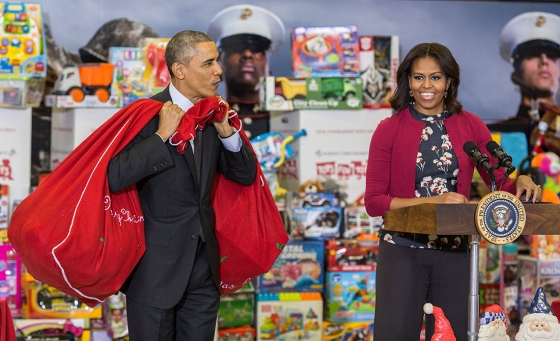
Good Morning!!
Merry Christmas to everyone who celebrates this day. Also, Happy Hanukkah, the festival of lights, which culminated last night. Happy Kwanzaa to those who will begin celebrating it tomorrow. And Happy Festivus “for the rest of us.”
How long have humans been celebrating the return of the light after the darkest day of the year–the Winter Solstice fell on Dec. 21 in 2014–when the days gradually begin getting longer? No one knows for sure, but it has been many centuries. I’ve gathered some articles about some ancient holidays around the solstice that preceded Christmas.
The ancient Romans celebrated the Saturnalia in tribute to the god Saturn, and Roman soldiers marked Dies Natalis Solis Invicti, in honor of the god Mithras.
Here’s a detailed description of the Saturnalia from a University of Chicago website.
In the Roman calendar, the Saturnalia was designated a holy day, or holiday, on which religious rites were performed. Saturn, himself, was identified with Kronos, and sacrificed to according to Greek ritual, with the head uncovered. The Temple of Saturn, the oldest temple recorded by the pontiffs, had been dedicated on the Saturnalia, and the woolen bonds which fettered the feet of the ivory cult statue within were loosened on that day to symbolize the liberation of the god. It also was a festival day. After sacrifice at the temple, there was a public banquet, as well as a lectisternium (a banquet in which an image of the god is placed as if in attendance), which Livy says was introduced in 217 BC. “For a day and a night the cry of the Saturnalia resounded through the City, and the people were ordered to make that day a festival and observe it as such for ever” (History of Rome, XXII.1.19). Afterwards, according to Macrobius (I.10.18), the celebrants shouted Io, Saturnalia at a riotous feast in the temple.
The Saturnalia was the most popular holiday of the Roman year. Catullus describes it as “the best of days” (Poems, XIV), and Seneca complains that the “whole mob has let itself go in pleasures” (Epistles, XVIII.3). Pliny the Younger writes that he retired to his room while the rest of the household celebrated (Epistles, II.17.24). It was an occasion for celebration, visits to friends, and the presentation of gifts, particularly wax candles (cerei), perhaps to signify the returning light after the solstice, and sigillaria. Martial wrote Xeniaand Apophoreta for the Saturnalia. Both were published in December and intended to accompany the “guest gifts” which were given at that time of year. Aulus Gellius relates that he and his Roman compatriots would gather at the baths in Athens, where they were studying, and pose difficult questions to one another on the ancient poets, a crown of laurel being dedicated to Saturn if no-one could answer them (Attic Nights, XVIII.2).
During the holiday, restrictions were relaxed and the social order inverted. Gambling was allowed in public. Slaves were permitted to use dice and did not have to work. Instead of the toga, colorful dinner clothes (synthesis) were permitted in public, as was the pileus, a felt cap normally worn by the manumitted slave that symbolized the freedom of the season (Martial, Epigrams, XIV.1). Within the family, a Lord of Misrule was chosen, a role once occupied by a young Nero, who derisively commanded his younger step-brother Britannicus to sing (Tacitus, Annals, XIII.15).
Slaves were treated as equals, allowed to wear their masters’ clothing, and be waited on at meal time in remembrance of an earlier golden age thought to have been ushered in by the god. In the Saturnalia, Lucian has the god’s priest declare that “During My week the serious is barred; no business allowed. Drinking, noise and games and dice, appointing of kings and feasting of slaves, singing naked, clapping of frenzied hands, an occasional ducking of corked faces in icy water—such are the functions over which I preside.” Statius recounts a “December tipsy with much wine, and laughing Mirth and wanton Wit,” remembering “the glad festival of our merry Caesar and the banquet’s drunken revel” (Silvae, I.6.1ff; also Suetonius, Domitian, IV.1; Dio, Roman History, LXVII.4.4). Figs, nuts, dates and other dainties were showered on the people, women and children, men and senators alike, and bread and wine served among the rows while guests were entertained by women fighting in the arena and cranes were hunted by dwarfs.


Relief of Mithras as bull-slayer from Neuenheim near Heidelberg, framed by scenes from Mithras’ life (from Wikipedia).
From About.com: Dies Natalis Solis Invicti and Mithras.
Saturnalia may have been responsible for the pageantry of our midwinter festival, but it’s Mithraism that seems to have inspired certain symbolic religious elements of Christmas. Mithraism arose in the Mediterranean world at the same time as Christianity, either imported from Iran, as Franz Cumont believed, or as a new religion which borrowed the name Mithras from the Persians, as the Congress of Mithraic Studies suggested in 1971.
Mithraism radiated from India where there is evidence of its practice from 1400 B.C. Mitra was part of the Hindu pantheon* and Mithra was, perhaps, a minor Zoroastrian deity**, the god of the airy light between heaven and earth. He was also said to have been a military general in Chinese mythology.
The soldiers’ god, even in Rome (although the faith was embraced by male emperors, farmers, bureaucrats, merchants, and slaves, as well as soldiers), demanded a high standard of behavior, “temperance, self-control, and compassion — even in victory”….
The comparison of Mithraists and Christians is not coincidental. December 25 was Mithras’ birthday (or festival before it was Jesus’. The Online Mithraic Faith Newsletter [no longer available] says:
“Since earliest history, the Sun has been celebrated with rituals by many cultures when it began it’s journey into dominance after it’s apparent weakness during winter. The origin of these rites, Mithrasists believe, is this proclamation at the dawn of human history by Mithras commanding His followers to observe such rites on that day to celebrate the birth of Mithras, the Invincible Sun.”

Thor, god of thunder
In Scandinavia the Norse god Thor was honored with the Feast of Juul.
The Feast of Juul was a pre-Christian festival observed in Scandinavia at the time of the December solstice. Fires were lit to symbolize the heat, light and life-giving properties of the returning sun. A Yule or Juul log was brought in and burned on the hearth in honor of the Scandinavian god Thor.
A piece of the log was kept as both a token of good luck and as kindling for the following year’s log. In England, Germany, France and other European countries, the Yule log was burned until nothing but ash remained. The ashes were then collected and either strewn on the fields as fertilizer every night until Twelfth Night or kept as a charm and or as medicine.
French peasants believed that if the ashes were kept under the bed, they would protect the house against thunder and lightning. The present-day custom of lighting a Yule log at Christmas is believed to have originated in the bonfires associated with the feast of Juul.
Click on the link to read about other ancient holidays centered around the Winter Solstice.
Two more articles on this history of Christmas:
From Pacific Standard Magazine, A Brief History of the Christmas Controversy: Can Christmas’ pagan roots explain its increasing secularization today?
During Constantine’s reign the Church Fathers went so far as to associate the “Unconquered Sun” with Jesus, referencing the “sun of righteousness” mentioned in Malachi 4:2 as evidence of Jesus, the true sun. Through this crafty legerdemain early Christians more easily shifted December 25 from the birth of Sol Invictus to the birth of Christ. Eventually several other important religious dates would pivot on Christmas, including the Annunciation, celebrated on March 25, nine months before Christ’s ceremonial birth, the Epiphany, and the Adoration of the Magi. Once Christianity seized December 25, all the other historic moments and their accompanying mythologies fell into place. After emerging out of the husk of Saturnalia, Christmas gathered more and more momentum until it became a vital date inextricably bound to all the other sacred events and consecrated lore of the Christian tradition.
Roughly 1,600 years later, though, things are different. Christmas, at least as it’s celebrated in America, is no longer treated as an exclusively religious holiday. While millions of Americans still attend Christmas services, there are millions more who get swept up in an entirely different set of gratuitous lore: Santa Claus, Christmas trees, Dickensian tableaus, and the lustrous charms of Disneyfication. But look beneath all of the modern flourishes and you’ll see something that looks a lot like Saturnalia: the ceremonial feasts, the singing in the streets (what we now call caroling), the holiday parties. Heck, Saturnalia even had a special day on December 23 reserved for the exchanging of gifts among friends and family—Sigillaria, so named after the wax figurines often given as presents.
The truth is that Christmas has not so much evolved into a secular celebration as it has come full circle, returning to its original incarnation as a sprawling festival more focused on levity and merrymaking than the worship of Jesus Christ….
It’s no blasphemy to declare that the December holiday season has once again become a pagan celebration; it’s an atavistic return to the ritual’s roots. The problem now, as the more devout Christians rightly point out, are those people caught in the middle of this identity crisis—identifying as members of Christianity and claiming belief in its savior, but investing little devotion, solemnity or faith in the embattled date.
Finally, here is an interesting article at a Jewish website on the origins of Christmas. Some excerpts:
In the 4th century CE, Christianity imported the Saturnalia festival hoping to take the pagan masses in with it. Christian leaders succeeded in converting to Christianity large numbers of pagans by promising them that they could continue to celebrate the Saturnalia as Christians….
Christians had little success, however, refining the practices of Saturnalia. As Stephen Nissenbaum, professor history at the University of Massachussetts, Amherst, writes, “In return for ensuring massive observance of the anniversary of the Savior’s birth by assigning it to this resonant date, the Church for its part tacitly agreed to allow the holiday to be celebrated more or less the way it had always been.” The earliest Christmas holidays were celebrated by drinking, sexual indulgence, singing naked in the streets (a precursor of modern caroling), etc.
The Reverend Increase Mather of Boston observed in 1687 that “the early Christians who first observed the Nativity on December 25 did not do so thinking that Christ was born in that Month, but because the Heathens’ Saturnalia was at that time kept in Rome, and they were willing to have those Pagan Holidays metamorphosed into Christian ones.” Because of its known pagan origin, Christmas was banned by the Puritans and its observance was illegal in Massachusetts between 1659 and 1681….
Some of the most depraved customs of the Saturnalia carnival were intentionally revived by the Catholic Church in 1466 when Pope Paul II, for the amusement of his Roman citizens, forced Jews to race naked through the streets of the city. An eyewitness account reports, “Before they were to run, the Jews were richly fed, so as to make the race more difficult for them and at the same time more amusing for spectators. They ran… amid Rome’s taunting shrieks and peals of laughter, while the Holy Father stood upon a richly ornamented balcony and laughed heartily.”
Just some food for thought . . .
A few nice news headlines:
The photo at the top of this post is from Michelle Obama’s Toys for Tots event, at which President Obama sorted toys for boys any girls and took the opportunity to fight gender stereotypes about girls supposedly not liking toys involving sports, science, and legos. Joan McCarter wrote about it at Daily Kos yesterday, President Obama: ‘Girls don’t like toys?’.
See also Amanda Hess at Slate, Watch President Obama Break Down Stereotypes About Toys for Girls and Boys. Watch the video:
More presidential efforts to reach out to women and girls:
The Fix, That time Obama called on only women at a press conference.
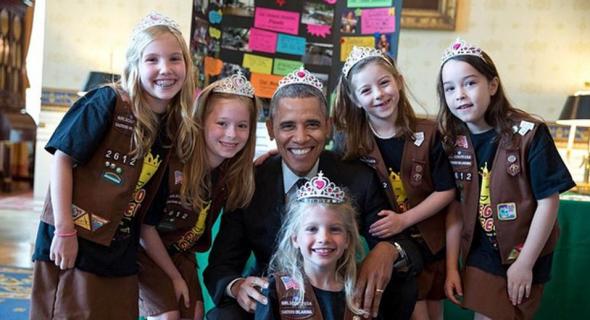
Politico, That time Obama wore a tiara.
White House photographer Pete Souza shared a photo on Instagram on Wednesday of the president donning a tiara with a group of Girl Scouts from the White House Science Fair earlier this year in May. In the caption, Souza wrote the girls from Tulsa “convinced” Obama to join in on the fun.
More news headlines:
I was going to write a big post about the 75th anniversary of the film of Gone With The Wind, but I’ve been too tired from traveling. Here’s a good article from yesterday about the events surrounding the anniversary and about the racism in the book and movie.
75 years later, ‘Gone With the Wind’ never left.
Reuters, Protests flare after Missouri police killing of armed black man.
Reuters, CDC worker monitored for possible Ebola exposure in lab error.
Dave Wiegel at Bloomberg Politics, This Christmas, Be Grateful You Didn’t Put All Your Money in Oil and Gold.
NY Daily News, Putin Calls for Cheaper Vodka as Russian Economy Stumbles.
Bloomberg, Saudi Rulers to Curb Wages as Kingdom Confronts Oil Slump
The Telegraph, Stonehenge discovery could rewrite British pre-history.
More on the discovery: 6,000-year-old encampment found in dig by University of Buckingham.
TPM, Ohio Town Orders Man To Take Down Zombie Nativity Scene.
Raw Story, Indiana lawmaker pushing bill to insulate government Nativity scenes from atheist legal ‘threats’
Raw Story, Ayn Rand helped the FBI investigate whether ‘It’s a Wonderful Life’ was commie propaganda.
Have a wonderful holiday everyone, and please leave a comment and/or a link if you’re so inclined.
Thursday Reads
Posted: June 20, 2013 Filed under: Barack Obama, FBI, Foreign Affairs, Germany, misogyny, morning reads, religion, Russia, U.S. Economy, U.S. Politics, War on Women, Women's Rights | Tags: Angela Merkel, austerity, Cristina Torre, Dillin Miller, domestic violence, gender stereotypes, Ibragim Todashev, John F. Kennedy, nuclear weapons, Rep. Phil Gingrey, Richard DesLauriers, Spanking for Jesus movement, Vladimir Putin 18 Comments
Good Morning!!
I haven’t really been paying much attention, but I guess President Obama’s trip to Europe didn’t go that well. I accidentally heard part of his Berlin speech, because I fell asleep with the radio on and woke up listening to a rebroadcast of it. I didn’t get much out of it, but it seemed as if Obama was lecturing Angela Merkel about her austerity obsession. The trouble is that Obama has pushed and/or allowed a milder version of austerity here, and he is doing much to lead us out of our own economic doldrums. Here are a couple of reports of the trip.
The National Journal’s Michael Hirsch: Obama’s Turbulent European Vacation
What was it, exactly, about Obama’s controversy-marred trip to Germany and the G8 Summit in Northern Ireland that fell so flat? Ummm, how about … everything?
There were the snarky words from Vladimir Putin, who expressed an almost Soviet-esque distance from Washington in his views about Syria. “Of course our opinions do not coincide,” the Russian leader said bluntly. There was the coded warning from Chancellor Angela Merkel about spying on friends, and her and Obama’s continuing frostiness over the issue of economic stimulus versus austerity. Above all, there was Obama’s vague attempt at the Brandenburg Gate to capture some wisp of his past glory by pledging vague plans to cut nuclear arms and an even vaguer concept of “peace with justice.”
The “peace with justice” line was a quote from John F. Kennedy, Obama’s attempt to steal just a little of JFK’s thunder from 50 years before. He didn’t come away with much, winning just a smattering of applause from a crowd that was one one-hundredth the size of JFK’s. A crowd that, at about 4,500, was also much, much smaller than Obama drew as a candidate in 2008.
Not only is the honeymoon long over, folks. The marriage is becoming deeply troubled and, increasingly, loveless.
The contrast with President John F. Kennedy’s famous “Ich bin ein Berliner” couldn’t have been more stark.
And from Jim Kuhnhenn of the AP: Obama prods, gets share of pushback
In Berlin on Wednesday, Obama warned that the European Union could “lose a generation” if it doesn’t adjust its economic policies to tackle high youth unemployment. German Chancellor Angela Merkel, who has argued for debt-ridden eurozone countries to first deal with their fiscal problems, insisted her government was committed to helping its European partners in the crisis-hit nations. “If we were conducting policies that would harm other countries,” she argued, “we would harm ourselves.”
Wow. Is she in denial or what? All her austerity policies have done his harm other European countries. In any case, she wasn’t thrilled with Obama’s critique.
She countered with her own words of caution over the Obama administration’s secret collection of phone records and surveillance of foreign Internet traffic. “People have concerns, precisely concerns that there may be some kind of blanket, across-the-board gathering of information,” she said. “There needs to be proportionality” between security and freedom, she added, and made clear that her private talks about it with Obama were not the end of the subject.
It was a polite punch-counterpunch between vital allies — an exchange that won’t damage a strong relationship. But it illustrated how in a 21st century world order, Western powers are not beholden to the United States as they once were and Obama’s ability to find agreement or build consensus is often limited and regularly tested.
And there was the talk of peace and reducing nuclear weapons.
The centerpiece of Obama’s visit to Berlin was a speech at the historic Brandenburg Gate, once a symbol of the Cold War, where he called for negotiations with the Russians to reduce U.S. nuclear weapons by one-third and called for cutting the number of tactical warheads in Europe. “Peace with justice means pursuing the security of a world without nuclear weapons, no matter how distant that dream may be,” he said.
The words were barely out of his mouth when a Republican member of the House Armed Services Committee, Ohio Rep. Michael Turner, accused him of appeasement, and Russian officials were playing down Obama’s proposal. A foreign policy aide to President Vladimir Putin said any further arms reduction would have to involve countries other than just Russia and the United States.
All in all, not a very successful trip.
To be honest, I get the feeling that Obama is already a lame duck. He doesn’t seem to be able to focus his attention on an issue long enough to get anything accomplished. I understand that Congress is really the biggest problem, but looking back to past Democratic presidents, Obama seems so passive in comparison. It’s very discouraging. I have to wonder why he worked so hard to get reelected. He seems to enjoy the ceremonial aspects of the job, but not the nuts and bolts.
Please someone, convince me I’m wrong. I do not want to end up with a Republican president and Republican majorities in Congress in 2016. I do not want the government led by troglodytes like Georgia Rep. Phil Gingrey, who wants children to learn stereotypical gender roles “at a very early age.” From Think Progress:
Rep. Phil Gingrey (R-GA) wants American youths to be taught gender stereotypes in grade school classes, so they understand the roles of mothers and fathers — and the importance of allowing only opposite-sex couples to marry.
In a speech Monday on the House floor, Gingrey stressed his continued support for the Defense of Marriage Act — which defines marriage as only union between a man and a woman — and suggested that children need to be carefully taught about the traditional roles of their genders:
GINGREY: You know, maybe part of the problem is we need to go back into the schools at a very early age, maybe at the grade school level, and have a class for the young girls and have a class for the young boys and say, you know, this is what’s important. This is what a father does that is maybe a little different, maybe a little bit better than the talents that a mom has in a certain area. And the same thing for the young girls, that, you know, this is what a mom does, and this is what is important from the standpoint of that union which we call marriage.”
Watch if you dare.
And then there’s the “Spanking for Jesus movement.” Yes, you read that right. From The Daily Beast:
You don’t have to be a Christian to practice domestic discipline, although many of its practitioners say they believe that domestic discipline goes hand in hand with their faith. Specifics of the practice vary by couple, though CDDers all seem to follow a few basic principles. Foremost, that the Bible commands a husband to be the head of the household, and the wife must submit to him, in every way, or face painful chastisement.
When a wife breaks her husband’s rules—rolling her eyes, maybe, or just feeling “meh,” as one blogger put it—that can equal punishments which are often corporal but can also be “corner time”; writing lines (think “I will not disobey my master” 1,000 times); losing a privilege like internet access; or being “humbled” by some sort of nude humiliation. Some practice “maintenance spanking,” wherein good girls are slapped on a schedule to remind them who’s boss; some don’t. Some couples keep the lifestyle from their children; others, like CDD blogger Stormy, don’t. “Not only does he spank me with no questions asked for disrespect or attitude in front of them, but I am also required to make an apology to each of them,” she writes.
Now that should teach those kids some useful gender stereotypes. There’s much more sickening detail at the The Daily Beast link and at Jezebel.
Oh well, here’s a story from the NY Daily News about something a little more cheerful: Joe Torre’s daughter Cristina saves falling baby with perfect catch.
Cristina Torre, 44, said she was sipping coffee outside Little Cupcake Bake Shop on Third Ave. in Bay Ridge when several bystanders spotted little Dillin Miller dangling from the awning of a frozen yogurt shop next door at about 10 a.m.
“He looked like he was balancing on one of the railings,” Torre told the Daily News. “I didn’t really know what was going to happen. . . . You just move into action — you don’t really think about it.”
Torre said she tried to tell the baby, dressed in a white onesie, not to move as another bystander called 911.
“I’m talking to him saying, ‘Don’t come down, stay there.’ . . . He helped himself with his arms. He was dangling. I knew he would be flipping very soon,” she said.
The baby dropped — and Torre made the life-saving grab.
“He literally landed in my arms,” she said. “It was a relief. I’m just glad he was safe.”
Sadly, the child’s parents were discovered asleep in their apartment while their 1-year-old Dillin and his three siblings ages 2, 3, and 5 were on their own. The children were removed from the home and the parents were charged with reckless endangerment. At least those kid are safe for the moment.
There hasn’t been much new on the aftermath of the Boston bombing lately. Every day I check to see if there is any news on the FBI shooting of Ibragim Todashev in Florida. The resignation of Richard DesLauriers, the director of the Boston office of the FBI was probably related to the series of f&ck-ups by the FBI in not informing local officials of the previous investigation of Tamerlan Tsarnaev and then the shooting of Todashev, but other than that, the FBI has been mum.
But on Tuesday, The New York Times published an article on the FBI’s “faultless” history–not a single misstep found in 150 FBI internal investigations over 20 years!
After contradictory stories emerged about an F.B.I. agent’s killing last month of a Chechen man in Orlando, Fla., who was being questioned over ties to the Boston Marathon bombing suspects, the bureau reassured the public that it would clear up the murky episode.
But if such internal investigations are time-tested, their outcomes are also predictable: from 1993 to early 2011, F.B.I. agents fatally shot about 70 “subjects” and wounded about 80 others — and every one of those episodes was deemed justified, according to interviews and internal F.B.I. records obtained by The New York Times through a Freedom of Information Act lawsuit.
The last two years have followed the same pattern: an F.B.I. spokesman said that since 2011, there had been no findings of improper intentional shootings.
In most of the shootings, the F.B.I.’s internal investigation was the only official inquiry. In the Orlando case, for example, there have been conflicting accounts about basic facts like whether the Chechen man, Ibragim Todashev, attacked an agent with a knife, was unarmed or was brandishing a metal pole. But Orlando homicide detectives are not independently investigating what happened.
“We had nothing to do with it,” said Sgt. Jim Young, an Orlando police spokesman. “It’s a federal matter, and we’re deferring everything to the F.B.I.”
Why doesn’t the Justice Department’s civil rights division investigate? Here is something President Obama could lead on without Congress blocking him. He could easily tell Attorney General Holder to appoint an independent investigation. But he probably won’t.

 peej
peej Carissa
 bostonboomer
 dakinikat
 ecocatwoman
 mablue2
 Mama Lopez
 peggysue22
 quixote
 skydancingguestblogger
 Mona (aka Wonk the Vote)



 Sky Dancing
Recent Comments