
Tuesday Reads: Trump Trashes 80 Year Tradition and Other News
Posted: July 25, 2017 Filed under: morning reads, U.S. Politics | Tags: Boy Scouts, Donald Trump, Eagle Scouts, First National Boy Scout Jamboree 1937, Franklin D. Roosevelt, GOP health care bill, Jared Kushner, Jeff Sessions, Paul Manafort 110 Comments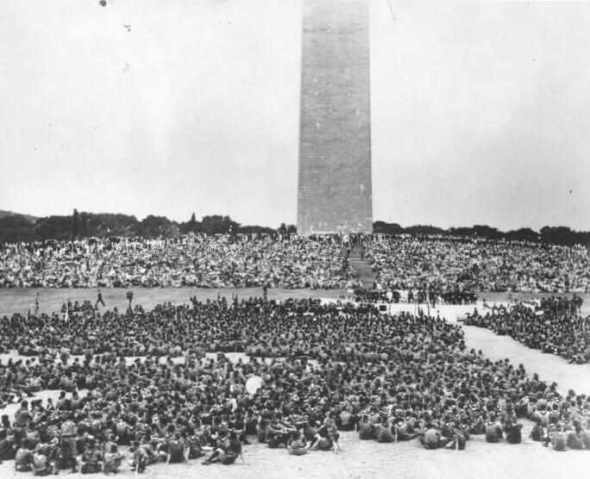
The First U.S, National Scout Jamboree was held in 1937 on the ground of the National Mall in Washington, D.C. Here the boys are around the Washington Mounument on the morning of July 4th for religious services. Later there was a fire works display, a tradition on the Mall for Independence Day.
Good Morning!!
My father was an Eagle Scout, and in 1937 he attended the first National Scout Jamboree in Washington DC. Whatever you may think of today’s boy scout movement, becoming an Eagle Scout is extremely challenging and an achievement to be proud of, in my humble opinion.
The national Scout jamboree is a gathering, or jamboree, of thousands of members of the Boy Scouts of America, usually held every four years and organized by the National Council of the Boy Scouts of America. Referred to as “the Jamboree”, “Jambo”, or NSJ, Scouts from all over the nation and world have the opportunity to attend. They are considered to be one of several unique experiences that the Boy Scouts of America offers. The first jamboree was scheduled to be held in 1935 in Washington, D.C. to celebrate the 25th anniversary of Scouting, but was delayed two years after being cancelled due to a polio outbreak. The 1937 jamboree in Washington attracted 25,000 Scouts, who camped around the Washington Monument and Tidal Basin. The event was covered extensively by national media and attended by President Franklin D. Roosevelt….
The first national jamboree was held in Washington, D.C. for ten days in July 1937, attended by 25,000 Scouts, most of whom arrived by train. Region campsites were set up around the Washington Monument and Tidal Basin. The event was covered extensively by radio and newspapers. A press tent accommodated 626 news media reporters, photographers, and broadcasters. Sixty-four news releases were issued and the BSA assisted in the making of 11 newsreels and 53 magazine articles.
The three major U.S. radio networks of the time, NBC, CBS, and Mutual, had broadcasting studios near the jamboree headquarters to produce almost 19 hours of live, on-site jamboree coverage broadcast coast-to-coast. Celebrities also visited the jamboree, including well-known broadcaster Lowell Thomas and U.S. President Franklin D. Roosevelt. While at the jamboree, Scouts also attended a three-game baseball series between the Washington Senators and the Boston Red Sox at Griffith Stadium, as well as toured nearby Mount Vernon.
President Franklin Roosevelt was a long-time, strong supporter of the scouting movement.
In 1915, FDR was the young assistant secretary of the Navy when Chief Scout Executive James E. West solicited his support of the five-year-old Boy Scouts of America. West asked FDR to serve as a member of the Special Committee on Nautical Scouting.
In 1921, shortly after agreeing to become more active in New York City Scouting, FDR was disabled by polio, losing the use of his legs. During his effort to regain his health and mobility in the years that followed, his involvement in Scouting grew. His political activities also increased, and during the 1920’s he became a prominent national figure.
FDR played a major role in the effort to obtain a permanent camp for New York City Scouts, and in 1927, he was one of a group credited with opening Ten Mile River Scout Camps.
He enjoyed visiting the camp even as governor of New York. In August 1930, during a ceremony at camp, FDR was presented the Silver Buffalo Award, the BSA’s highest national honor for service to youth. During another visit three years later, he was inducted into the Order of the Arrow and posed for photographs proudly wearing his OA sash.
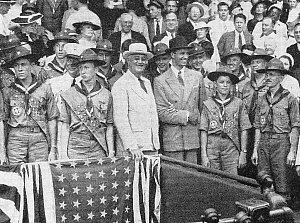
President Franklin D. Roosevelt at the fi.rst National Boy Scout Jamboree in 1937
Boy Scouts of America is not a partisan organization, despite some recent fumbles over gay rights. But yesterday “president” Trump trashed one more American institution with his foul, corrupt behavior.
The Washington Post: Trump’s Boy Scouts speech broke with 80 years of presidential tradition.
For 80 years, American presidents have been speaking to the National Scout Jamboree, a gathering of tens of thousands of youngsters from around the world eager to absorb the ideas of service, citizenship and global diplomacy.
In keeping with the Scouts’ traditions, all eight presidents and surrogates who have represented them have stayed far, far away from partisan politics.
Franklin Delano Roosevelt used the occasion to talk about good citizenship. Harry S. Truman extolled fellowship: “When you work and live together, and exchange ideas around the campfire, you get to know what the other fellow is like,” he said.
President Dwight D. Eisenhower invoked the “bonds of common purpose and common ideals.” And President George H.W. Bush spoke of “serving others.”
Donald Trump wasn’t a boy scout and he couldn’t possibly care less about American traditions.
For a brief moment at this year’s jamboree in West Virgina, President Donald Trump indicated that he would follow that tradition — sort of.
“Who the hell wants to speak about politics when I’m in front of the Boy Scouts?” he said.
Then, standing before all 40,000 of them, he bragged about the “record” crowd size, bashed President Barack Obama, criticized the “fake media” and trashed Hillary Clinton’s presidential campaign. In the lengthy 35-minute speech, the president threatened to fire his health and human services secretary if he couldn’t persuade members of Congress to vote for the Republican health-care bill.
At one point, he told a rambling story about a conversation he had at a New York cocktail party with a once-successful home builder who “lost his momentum.” The lesson, apparently: “You have to know whether or not you continue to have the momentum. And if you don’t have it, that’s okay.”
Click on the WaPo link to read more history about presidents and the Boy Scout Jamboree.
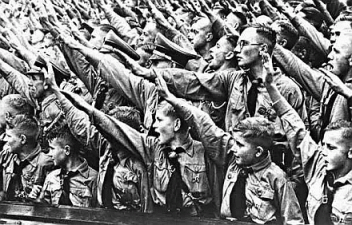
Hitler Youth
Trump is a monster without a single shred of human decency. We need Special Counsel Robert Mueller and Congress to force him into retirement before he destroys every proud American institution and tradition. Honestly, when I heard about this disgusting speech yesterday, I felt sick at heart. I wondered if Trump is hoping to enlist young people in a modern day Hitler Youth.
The Kansas City Star: Outraged Boy Scouts call on organization to disavow Trump speech.
Sitting presidents have come to give a nonpartisan speech at the Boy Scouts National Jamboree since 1937. President Donald Trump came to give a speech – but many say he still broke the tradition in a “nauseating” way.
During the 35-minute speech Monday night to about 40,000 scouts in West Virginia, Trump threatened to fire Secretary of Health Tom Price if the Senate did not approve repealing and replacing Obamacare, railed against journalists and “fake news,” talked about getting invited to parties with Hollywood celebrities, sought praise for his election victory and bashed Hillary Clinton and former President Barack Obama.
“We won and won. So when they said, there is no way to victory, there is no way to 270. I went to Maine four times because it’s one vote, and we won,” Trump said. “But we won – one vote. I went there because I kept hearing we’re at 269. But then Wisconsin came in. Many, many years – Michigan came in.” [….]
And while Boy Scouts in the crowd cheered and applauded during Trump’s speech, long-standing Boy Scouts were not pleased. One Eagle Scout who attended the National Jamboree in 1989 took to Twitter to talk about his family’s history within the organization – he said his grandfather was a scoutmaster for 40 years and awarded a silver beaver, while his father was also an Eagle Scout and attended the National Jamboree in 1957 – and criticize Trump’s speech. He said his son, a star scout on his way to becoming an Eagle Scout, had wanted to attend this year’s Jamboree.
Read the rest at the link.
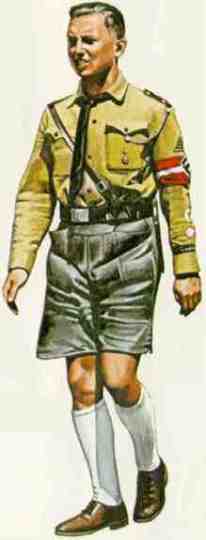
Hitler Youth uniform
Sorry to take up so much space with this, but I truly believe Trump’s behavior yesterday is an important example of how he is tearing down everything that has made America “great” so that he can turn our beloved country into a wholly owned subsidiary of the Trump Russia coalition.
In other news, Jared Kushner went back to Capital Hill this morning; and Paul Manafort has been subpoenaed by the Senate Judiciary Committee.
Politico: Kushner, Manafort providing information to congressional investigators Tuesday.
Jared Kushner and Paul Manafort were both set on Tuesday to provide congressional investigators with information about the heavily scrutinized meeting with a Russian lawyer they attended last year as advisers to President Donald Trump’s campaign.
Kushner, Trump’s senior adviser and son-in-law, was scheduled to testify before the House Intelligence Committee in a closed session on Tuesday. He took questions from Senate Intelligence Committee members on Monday and, according to prepared remarks he made public, told them he did “not collude” in Russia’s suspected attempts to interfere in the 2016 presidential campaign.
Manafort spoke to investigators after reaching an agreement with the Senate Intelligence Committee to avoid a subpoena, though a separate committee has issued a subpoena compelling his testimony. He finished a meeting with the Senate panel on Tuesday morning and “answered their questions fully,” spokesman Jason Maloni said.
The Guardian: Senate issues subpoena to Paul Manafort for testimony on Russia.
The Senate judiciary committee has issued a subpoena to Paul Manafort, the former Trump campaign manager, seeking his testimony at a public hearing on Wednesday.
The Republican senator Chuck Grassley and the Democratic senator Dianne Feinstein said they were unable to reach an agreement with Manafort for a voluntary transcribed interview with the committee.
The two said that late Monday night they issued a subpoena to compel Manafort’s participation in Wednesday’s hearing.
The committee wanted Manafort to testify on enforcement of the Foreign Agents Registration Act and Russia’s attempts to influence US elections.
Trump is continuing to torture Attorney General Jeff Sessions with public comments and tweets.
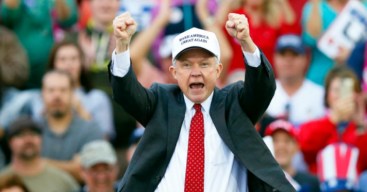
The Washington Post: Trump leaves Sessions twisting in the wind while berating him publicly
President Trump and his advisers are privately discussing the possibility of replacing Attorney General Jeff Sessions, and some confidants are floating prospects who could take his place were he to resign or be fired, according to people familiar with the talks.
Members of Trump’s circle, including White House officials, have increasingly raised the question among themselves in recent days as the president has continued to vent his frustration with the attorney general, the people said.
Replacing Sessions is viewed by some Trump associates as potentially being part of a strategy to fire special counsel Robert S. Mueller III and end his investigation of whether the Trump campaign coordinated with the Kremlin to influence the 2016 election, according to the people, who spoke on the condition of anonymity because they were not authorized to comment publicly.
Three more related stories to check out:
CNN: Trump slams Sessions, rips DOJ in Twitter outburst.
McClatchy: Trump messes with Sessions, and Senate Republicans are not pleased.
Axios: Trump in phone call: “What would happen if I fired Sessions?”
Finally, there is supposedly going to be a vote on consideration of the Senate heath care clusterf*ck sometime today.
Business Insider: The Senate will vote to start its repeal of Obamacare in a few hours — and the process is still in chaos.
On Monday night, Sen. John McCain said he would return to Washington to vote on key issues — most notably, on the Senate’s push to repeal and replace the Affordable Care Act.
The dramatic return of McCain, a week after announcing his diagnosis of brain cancer, seems to indicate that Tuesday’s vote on the Senate healthcare push is extremely close for Republican leaders.
At the same time, though, no one is quite sure of what they’re pushing for.
Senate Majority Leader Mitch McConnell said on the Senate floor on Monday that there would be a vote on a motion to proceed with the House healthcare bill, the first step in a likely multiday process of debate and dealmaking in an attempt to come through on the long-held Republican promise of repealing the law, also known as Obamacare.
The question is whether McConnell’s plan is to bring up the Better Care Reconciliation Act, the bill to repeal and replace the law; the Obamacare Repeal Reconciliation Act, the bill to repeal now and replace later; or some modified version of either.
More at the link.
So . . . what stories are you following today?
Remember When We Had Democratic Presidents?
Posted: April 11, 2013 Filed under: Barack Obama, morning reads, Republican politics, U.S. Economy, U.S. Politics | Tags: Chained CPI, destruction of the Democratic Party, Franklin D. Roosevelt, Great Society, John F. Kennedy, Lyndon B. Johnson, Medicare cuts, New Deal, New Frontier, Obama's Grand Betrayal, Social Security cuts 40 Comments
Franklin D. Roosevelt signs the Social Security Act of 1935
Oh yes, “those were the days, my friend, we thought they’d never end…”
Roosevelt’s New Deal was before my time, but I heard about those days from my parents.
The New Deal was a series of economic programs enacted in the United States between 1933 and 1936. They involved presidential executive orders or laws passed by Congress during the first term of President Franklin D. Roosevelt. The programs were in response to the Great Depression, and focused on what historians call the “3 Rs”: Relief, Recovery, and Reform. That is, Relief for the unemployed and poor; Recovery of the economy to normal levels; and Reform of the financial system to prevent a repeat depression.
The New Deal produced a political realignment, making the Democratic Party the majority (as well as the party that held the White House for seven out of nine Presidential terms from 1933 to 1969), with its base in liberal ideas, the white South, traditional Democrats, big city machines, and the newly empowered labor unions and ethnic minorities. The Republicans were split, with conservatives opposing the entire New Deal as an enemy of business and growth, and liberals accepting some of it and promising to make it more efficient. The realignment crystallized into the New Deal Coalition that dominated most presidential elections into the 1960s, while the opposition Conservative Coalition largely controlled Congress from 1937 to 1963. By 1936 the term “liberal” typically was used for supporters of the New Deal, and “conservative” for its opponents. From 1934 to 1938, Roosevelt was assisted in his endeavours by a “pro-spender” majority in Congress (drawn from two-party, competitive, non-machine, Progressive, and Left party districts). As noted by Alexander Hicks, “Roosevelt, backed by rare, non-Southern Democrat majorities — 270 non-Southern Democrat representatives and 71 non-Southern Democrat senators — spelled Second New Deal reform.”
Many historians distinguish between a “First New Deal” (1933–34) and a “Second New Deal” (1935–38), with the second one more liberal and more controversial. The “First New Deal” (1933–34) dealt with diverse groups, from banking and railroads to industry and farming, all of which demanded help for economic survival. The Federal Emergency Relief Administration, for instance, provided $500 million for relief operations by states and cities, while the short-lived CWA (Civil Works Administration) gave localities money to operate make-work projects in 1933-34.
The “Second New Deal” in 1935–38 included the Wagner Act to promote labor unions, the Works Progress Administration (WPA) relief program (which made the federal government by far the largest single employer in the nation), the Social Security Act, and new programs to aid tenant farmers and migrant workers. The final major items of New Deal legislation were the creation of the United States Housing Authority and Farm Security Administration, both in 1937, and the Fair Labor Standards Act of 1938, which set maximum hours and minimum wages for most categories of workers.
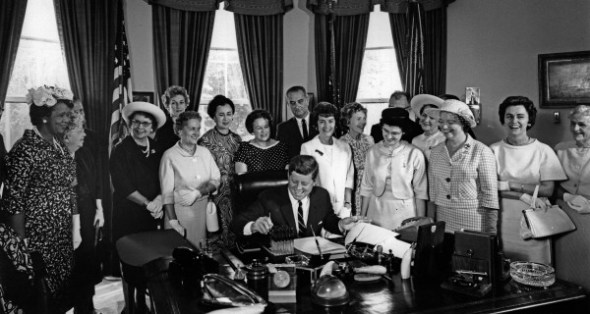
John F. Kennedy signs the Equal Pay Act of 1963
I do clearly Recall John F. Kennedy’s The New Frontier. There’s a popular myth that JFK didn’t accomplish that much legislatively before his death in 1963, but that’s what it is–a myth.
The term New Frontier was used by liberal Democratic presidential candidate John F. Kennedy in his acceptance speech in the 1960 United States presidential election to the Democratic National Convention at the Los Angeles Memorial Coliseum as the Democratic slogan to inspire America to support him. The phrase developed into a label for his administration’s domestic and foreign programs.
[W]e stand today on the edge of a New Frontier -— the frontier of 1960s, the frontier of unknown opportunities and perils, the frontier of unfilled hopes and unfilled dreams. … Beyond that frontier are uncharted areas of science and space, unsolved problems of peace and war, unconquered problems of ignorance and prejudice, unanswered questions of poverty and surplus.
In the words of Robert D. Marcus: “Kennedy entered office with ambitions to eradicate poverty and to raise America’s eyes to the stars through the space program”.Amongst the legislation passed by Congress during the Kennedy Administration, unemployment benefits were expanded, aid was provided to cities to improve housing and transportation, funds were allocated to continue the construction of a national highway system started under Eisenhower, a water pollution control act was passed to protect the country’s rivers and streams, and an agricultural act to raise farmers’ incomes was made law. A significant amount of anti-poverty legislation was passed by Congress, including increases in social security benefits and in the minimum wage, several housing bills, and aid to economically distressed areas. A few antirecession public works packages, together with a number of measures designed to assist farmers, were introduced. Major expansions and improvements were made in Social Security (including retirement at 62 for men), hospital construction, library services, family farm assistance and reclamation. Food stamps for low-income Americans were reintroduced, food distribution to the poor was increased, and there was an expansion in school milk and school lunch distribution. The most comprehensive farm legislation since 1938 was carried out, with expansions in rural electrification, soil conservation, crop insurance, farm credit, and marketing orders. In September 1961, the Arms Control and Disarmament Agency was established as the focal point in government for the “planning, negotiation, and execution of international disarmament and arms control agreements.” Altogether, the New Frontier witnessed the passage of a broad range of important social and economic reforms.
According to Theodore White, under John F. Kennedy, more new legislation was actually approved and passed into law than at any other time since the Thirties. When Congress recessed in the latter part of 1961, 33 out of 53 bills that Kennedy had submitted to Congress were enacted. A year later, 40 out of 54 bills that the Kennedy Administration had proposed were passed by Congress, and in 1963 35 out of 58 “must” bills were enacted. As noted by Larry O’Brien, “A myth had arisen that he (Kennedy) was uninterested in Congress, or that he “failed” with Congress. The facts, I believe, are otherwise. Kennedy’s legislative record in 1961–63 was the best of any President since Roosevelt’s first term”.
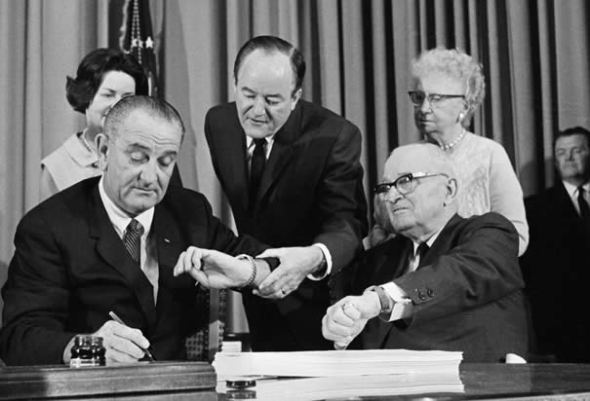
Lyndon B. Johnson signs the Medicare Act of 1964, with Harry Truman by his side
LBJ’s presidency was marred by his escalation of the war in Vietnam, but the domestic legislative accomplishments of his “Great Society” were stunning.
The aftershock of Kennedy’s assassination provided a climate for Johnson to complete the unfinished work of JFK’s New Frontier. He had eleven months before the election of 1964 to prove to American voters that he deserved a chance to be President in his own right.
Two very important pieces of legislation were passed. First, the Civil Rights Bill that JFK promised to sign was passed into law. The Civil Rights Act banned discrimination based on race and gender in employment and ending segregation in all public facilities.
Johnson also signed the omnibus ECONOMIC OPPORTUNITY ACT OF 1964. The law created the Office of Economic Opportunity aimed at attacking the roots of American poverty. A Job Corps was established to provide valuable vocational training.
Head Start, a preschool program designed to help disadvantaged students arrive at kindergarten ready to learn was put into place. The VOLUNTEERS IN SERVICE TO AMERICA (VISTA) was set up as a domestic Peace Corps. Schools in impoverished American regions would now receive volunteer teaching attention. Federal funds were sent to struggling communities to attack unemployment and illiteracy.
As he campaigned in 1964, Johnson declared a “war on poverty.” He challenged Americans to build a “Great Society” that eliminated the troubles of the poor. Johnson won a decisive victory over his archconservative Republican opponent Barry Goldwater of Arizona.
– American liberalism was at high tide under President Johnson.
– The Wilderness Protection Act saved 9.1 million acres of forestland from industrial development.
– The Elementary and Secondary Education Act provided major funding for American public schools.
– The Voting Rights Act banned literacy tests and other discriminatory methods of denying suffrage to African Americans.
– Medicare was created to offset the costs of health care for the nation’s elderly.
– The National Endowment for the Arts and Humanities used public money to fund artists and galleries.
– The Immigration Act ended discriminatory quotas based on ethnic origin.
– An Omnibus Housing Act provided funds to construct low-income housing.
– Congress tightened pollution controls with stronger Air and Water Quality Acts.
– Standards were raised for safety in consumer products.
I’m in tears right now after reading again about the accomplishments of these three great Democratic presidents. I’m in mourning today for my party and my country. For the first time, a supposedly Democratic president has proposed not only Social Security benefit cuts but also massive cuts to Medicare that will force seniors to pay higher deductibles and discourage them from buying medigap plans to cover co-pays.
I’ve known this was coming since 2007 when I read Obama’s book, The Audacity of Austerity Hope. He couldn’t have made it any clearer in the chapter on the domestic economy that he was an enthusiastic supporter of privatization and/or cuts in social programs. But although I’ve expected this for years, the reality of it has still hit me very hard. I feel both heartbroken and ashamed of President Obama.
I’ll post something else later on; but for now, please use this as a morning open thread and post your recommended links freely in the comments.
This is a sad day, but I believe Obama’s gambit will be a dismal failure. IMO he already looks foolish and ineffectual as the Republicans make hay by accusing him of trying to balance the budget on the backs of seniors. We need to understand that it is fruitless to expect him Obama stand up to the Republicans, the corporate media, or the bankers. We are on our own.
I admit, I had begun to believe that Obama had grown in office–that he had begun to realize that standing up for liberal values would serve him in good stead. But his addiction to “bipartisanship” and his fantasy of a “grand bargain” won out in the end. I still believe Romney would have been far worse, but let’s face it we still got a Republican president in 2008 and 2012. We need to fight tooth and nail to keep him from destroying the proud legacies of FDR, JFK, and LBJ.

 peej
peej Carissa
 bostonboomer
 dakinikat
 ecocatwoman
 mablue2
 Mama Lopez
 peggysue22
 quixote
 skydancingguestblogger
 Mona (aka Wonk the Vote)



 Sky Dancing
Recent Comments