Leandro M. Velasco (b.1933), Blonde in Red with a White Cat
I’m still focused on Trump’s demolition of the White House East Wing. Lately I’ve been wondering what happened to all the furniture and art work.
Was any of it saved, or was everything destroyed along with the building? Has anyone reported seeing moving vans outside the White House that could have been removing some of the valuable items and putting them in storage? If not, could all these things be stored in the White House itself? I doubt it. Why aren’t journalists asking these questions?
I don’t trust Trump to preserve anything of historical value. I would not be at all surprised if he simply demolished the building and all of its contents. After all, he destroyed the Rose Garden and replaced it with a pavement and tacky tables with attached umbrellas. And Trump has a history of carelessly destroying important art works.
With Donald Trump demolishing the White House’s East Wing to make room for a 90,000-square-foot ballroom, the president is returning to the playbook from his Trump Tower days—move fast, build big and leave preservationists fuming.
Key Facts
In October 1979, New York City’s Planning Commission approved a special permit for Trump to build a 56-story mixed-use tower on the site of the Bonwit Teller department store on Fifth Avenue.
Trump later wrote in “The Art of the Deal” that in December 1979, a representative of the Metropolitan Museum of Art asked him to donate two 15-foot-tall Art Deco bas-relief sculptures of semi-nude goddesses and a 15-by-25-foot nickel-plated grill from the condemned building’s facade.
“I said that if the friezes could be saved, I’d be happy to donate them to the museum,” Trump wrote in “The Art of the Deal”; he later confirmed the deal in writing, according to Preservation News, a publication of the National Trust for Historic Preservation of the United States.
In June 1980, however, the “sculptures were smashed by jackhammers” while the grillwork, which was supposed to be shipped to a New Jersey warehouse, went missing, Preservation News reported at the time.
Trump said he had the friezes torn down after being told their weight would require “special scaffolding for safety’s sake,” delaying the project by several weeks.
“I just wasn’t prepared to lose hundreds of thousands of dollars to save a few Art Deco sculptures that I believed were worth considerably less, and perhaps not very much at all,” he wrote.
“We are certainly very disappointed and quite surprised,” Ashton Hawkins, vice president and secretary of the Met’s board of trustees, told the New York Times, which ran an article about the destruction on the front page. “Can you imagine the museum accepting them if they were not of artistic merit?”
Read more details about Trump’s path of destruction:
The White House Family Theater, the movie theater which first came to be in 1942 when a cloakroom was converted into a screening room, was demolished this week as part of the destruction of the East Wing to make room for President Donald Trump’s planned $300 million ballroom.
By Lina Rivo
From sporting events to film screenings, the theater provided entertainment and enjoyment to presidents and their families since the latter part of Franklin D. Roosevelt’s presidency.
According to The White House Historical Association, Roosevelt enjoyed watching World War II-era news reels in the former cloakroom in the East Terrace at 1600 Pennsylvania Avenue, “and took special interest in the battles fought in Europe and Asia.”
The 32nd US president demonstrated an understanding of the importance of pop culture, including movies.
“Entertainment is always a national asset,” Roosevelt said in 1943 as the United States was engaged in WWII. “Invaluable in time of peace, it is indispensable in wartime.” [….]
Later presidents greatly enjoyed showing movies in the theater, and the George W. Bush Library detailed that film screenings would run the gamut from official events with members of the public invited as guests to “private events and intended for the enjoyment of the President, his family, and his close friends and staff.”
“The best perk out in the White House is not Air Force One or Camp David or anything else,” said former President Bill Clinton. “It’s the wonderful movie theatre I get here, because people send me these movies all the time.”
I suppose Trump could have saved the vintage chairs with footrests, lights, and decorations, but I’m sure he didn’t.
Satellite images show President Donald Trump’s project to build a $300 million grand ballroom has appeared to take down at least six trees on the White House grounds — including two historic magnolia trees commemorating Presidents Warren G. Harding and Franklin D. Roosevelt.
The satellite images released on Thursday provide the fullest picture yet of the extent of the demolition work on the White House’s East Wing and its effect on the surrounding parkland — changes made without consulting the government commission established by federal law to ensure the preservation and integrity of government buildings in D.C., according to former commission officials who spoke to ABC News.
Visible construction work on the new ballroom appears to have begun more than three weeks ago, according to satellite images of the White House complex taken over the last month. An image taken on Sept. 26 shows preparations for the construction, including the removal of multiple trees in President’s Park.
The Jacqueline Kennedy Garden — established by first lady Edith Roosevelt as the Colonial Garden in 1903 adjacent to the East Wing — was also leveled during the demolition, according to satellite images. Earlier this year, Trump also paved over the Rose Garden, which was designed by the same architect who designed the Kennedy Garden.
President Donald Trump says he has no plans to name his $300 million White House ballroom after himself.
Speaking to reporters in brief remarks while departing the White House on Friday evening for a trip to Asia, Trump denied an earlier report that he was likely to add his name to the new ballroom.
“I don’t have any plan to call it after myself,” Trump said. “That was fake news. Probably going to call it the presidential ballroom or something like that. We haven’t really thought about a name yet.”
Earlier, senior administration officials told ABC News that some in the administration were already referring to it as “The President Donald J. Trump Ballroom” and that that name was likely to stick….
Before Friday, Trump had not publicly said what he intends to name the ballroom, but he is known for branding his construction projects after himself.
When asked by ABC News Chief White House Correspondent Mary Bruce on Thursday if he had a name for his ballroom yet, Trump smiled and said: “I won’t get into that now.”
Manfred W. Juergens, The Girl with the Cat
Give me a break. Of course he’ll name it after himself. He’ll probably put a huge “Trump” sign on it–like the one on Trump tower. And I expect his name will also be on the Hitler arch he’s planning that will overshadow the Lincoln Memorial.
President Donald Trump is accepting anonymous donations for the grand ballroom he is currently having built at the White House, an aide told NBC News on Friday.
While the Trump administration has released a list of donors for the project that has become a fixation for the president (which includes NBCUniversal’s parent company, Comcast), the aide said that some may contribute anonymously.
“We will, and have so far, released names of donors and companies who wish to be named publicly. Donors also have the option to remain anonymous and we will honor that if that’s what they choose,” said the aide, who spoke on the condition of anonymity to candidly discuss the undertaking.
The White House would not commit to publicly releasing the amount of money each donor gives to the project, with the aide saying similarly that the administration “will honor the wishes of the donors of what they want publicly shared.”
Trump claims he won’t accept foreign donations, but how would we know? He’s a fucking liar; you can’t believe anything he says.
The 123-year-old East Wing of the White House, the home of offices for every first lady for almost half a century, is now a pile of rubble. After Trump said in July that the historic building would not be touched, it was stealthily bulldozed to make way for a $300m ballroom. According to Trump, there was a teeny little change of plans “after really a tremendous amount of study with some of the best architects in the world”.
While the likes of the National Trust for Historic Preservation are upset about the destruction of a “National Historic Landmark, a National Park, and a globally recognized symbol of our nation’s ideals”, some large corporations appear to be looking on the bright side. Trump has said the new 90,000 sq ft ballroom is going to be “paid for 100% by me and some friends of mine”. Now the world’s CEOs have a wonderful opportunity to prove just how friendly to Trump they are….
By Jane Wood
National history aside, this sudden demolition of the first ladies’ headquarters raises a lot of questions. If I lived in a house that I didn’t own – one that I was scheduled to move out of in January 2029 – I probably wouldn’t start an enormous and extremely controversial construction project. Why is Trump doing this?
The short answer is: because he wants to. As I think we all know by now, the president does whatever the hell he feels like regardless of norms, conventions, or silly little laws. And, increasingly, there’s nobody there to stop him. The only checks that Trump cares about are the ones made out to him and the only balances he is interested in are those of his bank accounts.
Trump has given a few rationales for the project that go beyond ‘because I want to.’ He’s argued that the old East Wing was no longer fit for purpose and a much larger space was needed. There are some people out there who agree with him. Gahl Hodges Burt, for example, who was social secretary for three years under President Ronald Reagan, told the New York Times that tearing down the East Wing to make space for the ballroom was unfortunately necessary and overdue.
Beyond practical issues, there’s also ego. Trump’s big boy ballroom will be a big shiny monument to him long after he’s gone.
Still, you’ve got to wonder whether this mega-project means the president is not actually planning on going anywhere anytime soon. Particularly since Trump doesn’t seem to be the sort of person to start a large project he won’t have a chance to personally enjoy. The US Constitution’s 22nd amendment makes it very clear that a president cannot have more than two terms. But that hasn’t stopped Trump from repeatedly teasing the idea that he might serve a third term. In March he told NBC News he was “not joking” about the idea and there were methods for doing so.
Read more at the link.
According to Nancy Walecki at The Atlantic, Trump may be planning to use the rubble and dirt from the East Wing teardown to upgrade a golf course (gift link). My Quest to Find the East Wing Rubble.
I’d heardthat the dirt from the East Wing demolition was being deposited three miles away, on a tree-lined island next to the Jefferson Memorial called East Potomac Park. So yesterday I drove around until I saw trucks and men in construction gear. They were congregating at an entrance to the public East Potomac Golf Links, where rounds of golf carried on as usual, except every few minutes, dump trucks entered the green.
By Giovanni Parlatto da Massaquano
The trucks would cut across the course to a cordoned-off site in the middle, where the grass had been torn away and replaced with piles of dirt. It did not look like much, but several employees at the site confirmed: This was not just any dirt. This was White House dirt. The precursor to the East Wing was constructed during Theodore Roosevelt’s administration in 1902 and updated during Franklin D. Roosevelt’s administration in the ’40s. Maybe this was not just White House dirt but Roosevelt-era dirt. I gazed upon the golfers going about their games. Do they know, I wondered, that they are in the presence of such particularly American soil?
I asked one employee what the plan was for all this dirt. “Oh, they’re gonna turn it into another hole,” he said. Other reportershave heard the same. But when I asked a different employee about it, he demurred; his boss drove by and said, “No comment” before my colleague Grace Buono had even asked him a question. Donald Trump has reportedly been considering rebranding East Potomac Golf Links as the Washington National Golf Course and giving it a makeover. He even mocked up a new golden logo for it that’s nearly identical to those of the courses he owns. I suppose the East Wing demolition is an excellent source of soil. (The White House did not respond to my request for comment. It told CBS News that wood and plants from the site could end up being recycled for garden nurseries.)
Use the gift link to read more if you’re interested.
This might be a dumb question, but where will all those hundreds of people going to the ballroom park their fancy cars and limos? Maybe Trump is planning to knock down the entire White House and replace it with a parking lot?
Meanwhile, thanks to the government shutdown, the “big beautiful bill,” and Mike Johnson’s keeping the House from meeting, millions of Americans will soon be facing hunger and lack of health care.
While Republicans have sought to blame Democrats for the potential loss in benefits that people who make little money rely on, those who work in the food-insecurity space say that is misleading because Donald Trump’s One Big Beautiful Bill Act already eliminated almost $187bn in funding for Snap through 2024, according to a congressional budget office estimate.
Should funding run out at the end of the month, “we will have the greatest hunger catastrophe in America since the Great Depression, and I don’t say that as hyperbole”, said Joel Berg, CEO of Hunger Free America.
Snap supports working families with low-paying jobs, low-income people aged 60 years and older and people with disabilities living on a fixed income, according to the Center on Budget and Policy Priorities.
Snap participants generally must be at or below 130% of the federal poverty line. The average participant receives about $187 a month, the center reports.
The Department of Agriculture recently sent a letter to regional Snap directors warning them that funding for Snap will run out at the end of the month and directing them to hold payments “until further notice”.
More than 200 Democratic representatives have urged the USDA to use contingency funds to continue paying for Snap benefits.
“There are clear steps the administration can and must take immediately to ensure that millions of families across the country can put food on their table in November,” a letter from the lawmakers to the USDA states. “SNAP benefits reach those in need this November would be a gross dereliction of your responsibilities to the American people. We appreciate your consideration of these requests.”
The Trump administration won’t tap emergency funds to pay for federal food benefits, imperiling benefits starting Nov. 1 for nearly 42 million Americans who rely on the nation’s largest anti-hunger program, according to a memo obtained by POLITICO.
USDA said in the memo that it won’t tap a contingency fund or other nutrition programs to cover the cost of the Supplemental Nutrition Assistance Program, which is set to run out of federal funds at the end of the month.
By Gurutze Ramos
The contingency fund for SNAP currently holds roughly $5 billion, which would not cover the full $9 billion the administration would need to fund November benefits. Even if the administration did partially tap those funds, it would take weeks to dole out the money on a pro rata basis — meaning most low-income Americans would miss their November food benefits anyway.
In order to make the deadline, the Trump administration would have needed to start preparing for partial payments weeks ago, which it has not done.
White House and Trump administration officials warned earlier this week they were unlikely to shift funds around to avert SNAP lapsing for 40 million low-income Americans in November — instead blaming Democrats for the pending lapse.
Premiums for the most popular types of plans sold on the federal health insurance marketplace Healthcare.gov will spike on average by 30 percent next year, according to final rates approved by the Centers for Medicare and Medicaid Services and shown in documents reviewed by The Washington Post.
The higher prices — affecting up to 17 million Americans who buy coverage on the federal marketplace — reflect the largest annual premium increases by far in recent years. The higher premiums, along with the likely expiration of pandemic-era subsidies, mean millions of people will see their health insurance payments double or even triple in 2026.
The premium spikes, mirroring the rising cost of private-employer-sponsored plans,arrive during a protracted and bitter congressional battle over health insurance costs that prompteda government shutdown Oct. 1.Democrats have urged an extension of enhanced subsidies for plans sold through the Affordable Care Act to soften the blow of rising insurance costs, while Republicans have said the additional assistance was never meant to be permanent.
The spike in premiums will become visible to more Americans on Monday, when the Trump administration is expected to open Healthcare.gov for window shopping to browse the price of plans ahead of the Nov. 1 start to open enrollment.
But Trump will get his ugly ballroom.
I’ll end there, and add some links in the comment thread. What do you think about the Trump’s destruction of the East Wing? What else is on your mind today?
Did you like this post? Please share it with your friends:
Americans across all 50 states will march in protests against the Trump administration on Saturday, aligning behind a message that the country is sliding into authoritarianism and there should be no kings in the US.
Millions are expected to turn out for the No Kings protests, the second iteration of a coalition that marched in June in one of the largest days of protest in US history. Events are scheduled for more than 2,700 locations, from small towns to large cities.
Donald Trump has cracked down on US cities, attempting to send in federal troops and adding more immigration agents. He is seeking to criminalize dissent, going after left-leaning organizations that he claims are supporting terrorism or political violence. Cities have largely fought back, suing to prevent national guard infusions, and residents have taken to the streets to speak out against the militarization of their communities.
Trump’s allies have sought to cast the No Kings protests as anti-American and led by antifa, the decentralized anti-fascist movement, while also claiming that the protests are prolonging the government shutdown. Greg Abbott, the governor of Texas, has said he will send the state’s national guard to Austin, the state’s capital, in advance of the protests….
“What’s most important as a message for people to carry is that the president wants us to be scared, but we will not be bullied into fear and silence,” said Lisa Gilbert, the co-president of Public Citizen, one of the protest organizers. “And it’s incredibly important for people to remain peaceful, to stand proud and to say what they care about, and not to be cowed by that fear.”
The simple framing of the protests is that the US has no kings, a dig at Trump’s increasing authoritarianism. Among the themes the organizers have pointed to: Trump is using taxpayer money for power grabs, sending in federal forces to take over US cities; Trump has said he wants a third term and “is already acting like a monarch”; the Trump administration has taken its agenda too far, defying the courts and slashing services while deporting people without due process.
I expect that some Republicans will try to spark violence at these protest rallies. I hope people will remain peaceful no matter what.
The nationwide “No Kings” protest movement is back for round two — and after avoiding Washington during the summer, protesters are expected to descend on the nation’s capital Saturday amid an 18-day government shutdown that has no end in sight.
The demonstrations are part of the second national day of action, organized by dozens of liberal advocacy groups to protest what they call “authoritarian power grabs” on the part of President Donald Trump.
Organizers said they expect the more than 2,600 events across all 50 states to surpass the more than 5 million people who attended the first wave of “No Kings” rallies in June. The marches come amid heightened criticism from Republicans about this weekend’s rallies.
“They might try to paint this weekend’s events as something dangerous to our society, but the reality is there is nothing unlawful or unsafe about organizing and attending peaceful protests,” said Deirdre Schifeling of the American Civil Liberties Union. “It’s the most patriotic and American thing you can do, and we have a 250-year-old history of disagreeing in public.”
Amid the heightened tensions of the shutdown, Republicans have repeatedly sought to vilify the planned protests. House Speaker Mike Johnson and other leading Republicans have referred to the protests as a “hate America rally” and sought to tie it to Hamas and antifa. And Texas Gov. Greg Abbott also announced Thursday that he would be sending members of the state’s National Guard — as well as state troopers, Texas Rangers and Department of Public Safety personnel — to Austin on Saturday in response to the planned demonstrations.
In an interview with Fox News earlier this week, Trump said “some people say [Democrats] want to delay” ending the government shutdown because of the rallies.
The Marines plan to fire 155-millimeter artillery shells over a major freeway in Southern California on Saturday as part of a demonstration at Camp Pendleton to celebrate the Marine Corps’ 250th anniversary.
The plans to fire over the freeway triggered outrage by Gov. Gavin Newsom late Friday night after his office had been informed days earlier that the celebration would not involve firing munitions across Interstate 5, a heavily traveled corridor between Los Angeles and San Diego.
Early Saturday, Mr. Newsom said the state would shut a 17-mile section of the freeway from noon to 3 p.m. Pacific time because of potential hazards posed by the military’s plans.
“This is a profoundly absurd show of force that could put Californians directly in harm’s way,” Mr. Newsom said in a statement to The New York Times.
He criticized President Trump and said the lack of coordination among state, federal and local officials was creating a dangerous situation. The artillery demonstration, to be attended by Vice President JD Vance, Secretary of Defense Pete Hegseth and military officials, will take place on the same day that anti-Trump activists plan to hold “No Kings” protests across the country, including in Southern California.
“Using our military to intimidate people you disagree with isn’t strength — it’s reckless, it’s disrespectful, and it’s beneath the office the president holds,” Mr. Newsom said.
I hope no one gets hurt. As I said earlier, I would not be at all surprised to see efforts by right wingers to spark violence at the demonstrations.
In Ukraine war news, Trump met with Ukraine president Vladimir Zelensky yesterday, and he refused Zelensky’s request for Tomahawk cruise missiles, seemingly based on a phone conversation with Vladimir Putin.
Russian President Vladimir Putin put his relationship with President Donald Trump back on track with a phone call just ahead of Trump’s crucial Friday meeting with Ukraine’s president, Volodymyr Zelensky, that was meant to include discussions of providing Ukraine with powerful new long range weapons.
Up until the Thursday phone call, Trump had seemed ready to boost Ukraine’s arsenal and negotiating position with Tomahawk cruise missiles. But in its wake and after the subsequent meeting with Zelensky, Trump played down all talk of the missiles and instead focused on yet another summit with Putin.
It was the latest swing in Trump’s back and forth positions on the Russia-Ukraine war that often change following contact with Putin, who has shown a great deal of skill in persuading the U.S. president to his view of the conflict.
“Hopefully we’ll be able to get the war over with without thinking about Tomahawks. I think we’re fairly close to that,” Trump said to journalists as he began his meeting with Zelensky. “We don’t want to be giving away things that we need to protect our country.”
Instead of new support for Ukraine or sanctions on Russia, Trump announced a new summit with Putin — a bonus for the Russian leader — “to see if we can bring this ‘inglorious’ War, between Russia and Ukraine, to an end.” There was no talk of Russia curtailing its ongoing bombardment of Ukraine’s energy infrastructure ahead of winter.
So far, Russia has succeeded in deterring Trump from imposing further sanctions — or sending more powerful weapons to Ukraine — by continually dangling hopes of a peace deal, while it ramps up attacks.
President Donald Trump on Friday called on Kyiv and Moscow to “stop where they are” and end their brutal war following a lengthy White House meeting with Ukrainian President Volodymyr Zelenskyy.
Trump’s frustration with the conflict has surfaced repeatedly in the nine months since he returned to office, but with his latest comments he edged back in the direction of pressing Ukraine to give up on retaking land it has lost to Russia.
“Enough blood has been shed, with property lines being defined by War and Guts,” Trump said in a Truth Social post not long after hosting Zelenskyy and his team for more than two hours of talks. “They should stop where they are. Let both claim Victory, let History decide!”
Later, soon after arriving in Florida, where he’s spending the weekend, Trump urged both sides to “stop the war immediately” and implied that Moscow keep territory it’s taken from Kyiv.
“You go by the battle line wherever it is — otherwise it’s too complicated,” Trump told reporters. “You stop at the battle line and both sides should go home, go to their families, stop the killing, and that should be it.”
So Trump is hanging out at Mar-a-Lago as the government shutdown continues.
President Trump has repurposed money to fund military salaries during the government shutdown. He has pledged to find ways to make sure many in law enforcement get paid. He has used the fiscal impasse to halt funding to Democratic jurisdictions, and is trying to lay off thousands of federal workers.
Government shutdowns are usually resolved only after the pain they inflict on everyday Americans forces elected officials in Washington to come to an agreement. But as the shutdown nears a fourth week, Mr. Trump’s actions have instead reduced the pressure for an immediate resolution and pushed his political opponents to further dig in.
“We’re not going to bend,” Representative Hakeem Jeffries, Democrat of New York and the minority leader, said on Friday, the 17th day of the shutdown. “We’re not going to break.” He added: “All of these efforts to try to intimidate Democratic members of the House and the Senate are not going to work.”
Unlike past presidents, Mr. Trump appears to feel little urgency to strike a deal to reopen the government. Instead, he has used the shutdown, which began Oct. 1, as an opportunity to further remake the federal bureaucracy and jettison programs he does not like, seizing on unorthodox budgetary maneuvers that some have called illegal.
Administration officials appear undaunted by the criticism, even after a federal judge temporarily blocked their efforts to conduct mass firings. On Friday, some agencies indicated in court filings that they might proceed with layoffs that officials suggested were not covered by the order.
Russell T. Vought, the director of the Office of Management and Budget and the architect of the effort to remake the government, has pledged to “stay on offense” throughout the shutdown.
“He now has this cover for doing what at least Russ Vought and that coalition has wanted to do all along,” Sarah Binder, a political science professor at George Washington University, said of Mr. Trump.
Trump claims to be working on making health care more affordable.
Asked in the Oval Office this week whether he would use his deal-making skills to bring the shutdown to an end, Mr. Trump said that he was instead working to lower health care costs without the help of Congress, by negotiating agreements directly with pharmaceutical companies for lower prescription costs.
“We have to take care of our health care,” he said.
White House officials say that the administration’s moves are meant to send the message that it is Mr. Trump, not congressional Democrats, who is helping Americans when government funding has lapsed.
“Any negative impacts felt by the American people have purely been caused by the Democrats,” said Abigail Jackson, a White House spokeswoman.
Use the gift link to read more if you’re interested. Honestly, I wouldn’t be surprised if Trump lets the shutdown go on until next year and beyond. We’ll see if the Republicans fight back after hearing from their constituents.
An eminent ER doctor and health policy expert has warned that President Donald Trump’s government shutdown talk about “deserving” patients mirrors a “eugenics” policy adopted by the Nazis.
The shutdown is about to enter its fourth week after Congress failed to pass full-year funding. The White House and Speaker Mike Johnson are demanding spending cuts and immigration concessions, while Senate Democrats insist on extending ACA subsidies and undoing the summer healthcare cuts before reopening agencies.
Dr. Craig Spencer, who lectures on the history of health and eugenics at Brown University and is one of the country’s most influential clinician voices on emergency care, said the administration’s framing echoes America’s 1920s policy of sorting people by “worthiness… cloaked in what’s ‘acceptable’ by the state.
Spencer warns that President Donald Trump and Secretary of Health and Human Services Robert F. Kennedy Jr. are pursuing eugenics with their health policies.Andrew Caballero-Reynolds/AFP via Getty Images
“It’s not a stretch to say this administration is touting a eugenics agenda, which was perfected by the U.S. in the 1920s and 1930s and later adopted by the Nazis. People don’t want to call it that because it feels unsayable. But it’s real,” Spencer told the Daily Beast.
In 1920s America, eugenics was a mainstream policy movement that used bogus “race science” to justify restrictive immigration laws and state-mandated sterilization of people labeled “unfit.”
The language of Trump’s government, Spencer said, is “almost the same on immigration, access to healthcare, and who deserves the fruits of government,” and its “logical conclusion—while they won’t say it out loud—is letting certain people die.”
“I’ve been reluctant to compare what’s happening now to the eugenics movement 100 years ago, but as every new day goes by I’m less reluctant,” he added.]
There’s more at the link.
Meanwhile, some people will soon learn what their health insurance is going to cost them next year and what will happen to their food stamp benefits.
Health insurance prices for next year under the Affordable Care Act are now available in about a dozen states, giving Americans their first look at the sharp increases many will pay for coverage if Congress does not extend subsidies that have made some plans more affordable.
The annual enrollment period for Obamacare is expected to begin Nov. 1, but the costs for some Americans are becoming publicly available piecemeal through some state marketplaces. The federal website healthcare.gov, which includes 28 other state marketplaces, is slated to post prices before the end of October.
People shopping for coverage can now preview the costs they face from potentially expiring subsidies and sharply rising premiums in many markets, including California, New York, Nevada, Maryland and Idaho. Some consumers also found out that they would have fewer choices because their insurers dropped out of some markets for 2026.
Based on the newly posted information, a family of four making $130,000 in Maine would face an increase of $16,100 in annual premiums next year because they would no longer qualify for more generous subsidies, said Gideon Lukens, a health policy researcher for the Center on Budget and Policy Priorities, which supports extending the subsidies.
Older people will also see sharp increases, according to his calculations. In Kentucky, a 60-year-old couple making $85,000 per year could face an increase of $23,700 in annual premiums. In Nevada, a similar couple could pay an additional $18,100 in annual premiums, while in Minnesota, the cost might be $15,500 more and, in Maryland, an additional $13,700.
The government shutdown has already amplified the potential for higher health insurance costs for millions of Americans if the subsidies are not continued. Democrats have demanded that Republicans extend the more generous subsidies in any deal to reopen the federal government, which has been closed for 17 days over a spending impasse.
If the government shutdown continues into November, about 42 million low-income people could face severe disruptions to their food stamp benefits, the Agriculture Department warned in a letter to state agencies last week, saying that the federal government would have “insufficient funds.”
More than a dozen states have since warned that food stamp recipients may experience significant delays in obtaining benefits next month, see their aid reduced or not receive assistance at all.
The letter, a copy of which was obtained by The New York Times, said that the Agriculture Department’s Food and Nutrition Service, which operates the food stamp program, known as the Supplemental Nutrition Assistance Program, or SNAP, was exploring contingency plans. But it directed state agencies to pause sending vendors the electronic files typically used to load the benefits for November.
“We’re going to run out of money in two weeks,” Brooke L. Rollins, the agriculture secretary, told reporters at the White House on Thursday. “So you’re talking about millions and millions of vulnerable families, of hungry families that are not going to have access to these programs because of this shutdown.”
In a statement, a White House official said that Democrats “chose to shut down the government knowing that programs like SNAP would soon run out of funds.”
Such a disruption would be the first in recent decades. Benefits have remained available through every shutdown in the last 20 years, said Carolyn Vega, the associate director of policy analysis for Share Our Strength, a nonprofit that supports antipoverty programs.
The Department of Homeland Security has purchased two Gulfstream private jets for Kristi Noem, the secretary, and other top department officials at a cost of $172 million, according to documents reviewed by The New York Times.
The jets, which a department official said were needed for safety, are the latest expenditures on behalf of Ms. Noem to draw scrutiny from Democrats and other critics who have noted her lavish spending on living and other expenses during her time in public life.
The Coast Guard put in its budget earlier this year a request to purchase a new long-range Gulfstream V jet, estimated to cost $50 million, to replace an aging one used by Ms. Noem.
“The avionics are increasingly obsolete, the communications are increasingly unreliable and it’s in need of recapitalization, like much of the rest of the fleet,” Kevin Lunday, the acting commandant of the Coast Guard, told members of Congress at a hearing in May.
He said a new aircraft was necessary to provide agency leaders with “secure, reliable, on-demand communications and movement to go forward, visit our operating forces, conducting the missions and then come back here to Washington and make sure we can work together to get them what they need.”
Documents that were posted to a public government procurement website and reviewed by The Times show that the department has since signed a contract with Gulfstream to buy not one but two “used” G700 jets, touted by the company as having the “most spacious cabin in the industry.” The total contract value is listed as a little over $172 million.
It was not immediately clear where the funding for the jets came from.
Only the best for the puppy killer.
That’s it for me today. If you are going to a No Kings protest, have fun and stay safe.
Did you like this post? Please share it with your friends:
Representative Gerald E. Connolly of Virginia, a nine-term congressman who was the top Democrat on the House oversight committee, died on Wednesday, his family said in a statement. He was 75.
Mr. Connolly died at his home surrounded by his family, the statement said. It did not give a cause of death. Mr. Connolly had announced in 2024 that he was being treated for cancer of the esophagus.
In April, he announced that his cancer had returned and that he would not seek re-election in 2026. He also said he would soon relinquish his spot on the Committee on Oversight and Government Reform.
U.S. Rep. Gerald “Gerry” Connolly, an outspoken Democrat who sought key reforms in the federal government while bringing transformational development to his populous Virginia district, died Wednesday. He was 75….
The spirited and at times bullheaded Fairfax Democrat became known for his voluble nature and willingness to engage in spirited debates. In one hearing, he accused Republicans of engaging in a witch hunt against the IRS, asking a witness if they ever read Arthur Miller’s “The Crucible.”
“I am heartbroken over the loss of my dear friend,” said Democratic Sen. Mark Warner of Virginia. “To me, he exemplified the very best of public service.” He said Connolly “met every challenge with tenacity and purpose, including his final battle with cancer, which he faced with courage, grace, and quiet dignity.”
A fixture of Virginia politics for three decades, Connolly was first elected to the Fairfax County Board of Supervisors in 1995. On the county board, he steered the transition of northern Virginia’s Tysons Corner from a traffic-heavy mall area to a downtown business hub.
In 2003, Connolly was elected board chairman, and he continued pushing for transportation investment that had been debated among officials for decades. Connolly sought billions in state and federal dollars to develop the regional rail system’s Silver Line connecting the national capital region to Tysons Corner.
Connolly’s dream was realized with the Silver Line’s opening in 2014, and eight years later, the rail line was extended an extra 11 miles (18 kilometers) to reach Dulles International Airport.
What’s happening in politics today:
The news getting the most attention today is the so-called “big beautiful bill” that Trump and House Republicans are trying to pass and send to the Senate. Yesterday, we got some shocking news about this nightmare bill. Not only does it cut nearly a trillion dollars from Medicaid. It also cuts Medicare by more than $500 billion from Medicare. If you watched Lawrence O’Donnell’s show last night, you heard all about it. In case you missed it, here is O’Donnell’s interview with Rep. Brendan Boyle:
Rep. Boyle: The one thing I would point out, though, is this bill is actually significantly worse [than the GOP’s ACA repeal attempt in 2017], because this piece of legislation will throw 13.5 million, almost 14 million Americans off their healthcare.
First, you’re cutting people off Medicaid. But second, this does include very deep cuts to Obamacare as well. And finally, I have breaking news for you tonight, that literally just came out in the last few minutes as I’ve been sitting here: The nonpartisan Congressional Budget Office, the official authority on these figures, has now confirmed that this bill, in addition to Medicaid cuts, in addition to Obamacare cuts, includes $500 BILLION WORTH OF CUTS TO MEDICARE that is now in this bill as well.
Lawrence O’Donnell: That is breaking news…$500 billion in cuts to Medicare. That’s the biggest cut to Medicare ever contemplated by the Congress. There have been, over the years, trims to Medicare for budget reasons, but nothing on this order has ever been done to Medicare. What happened? Talk more about that, about that breaking news piece that the CBO has projected in here. Is that because of interactions that Medicare has with the Medicaid program?
Rep. Boyle: Yeah, and forgive me this…given your great experience on the Senate Finance Committee, you’ll understand this, but it does get a bit wonky for normal folks. Basically it’s because of those interactions and specifically because of a provision called “Paygo” that will force a certain amount of Medicare sequestration, again, to the tune–and these aren’t my figures, these are the Congressional Budget Office official figures–$500 billion.
So they take the biggest cuts to Medicaid in American history. They take massive cuts to Obamacare. And then, add on top of that, the impact of all their policies mean a result of the biggest cuts to Medicare in American history on top of all of it.
House Republicans are pushing to slash nearly $1 trillion from two of the nation’s bedrock safety net programs, Medicaid and food stamps, as part of their sweeping package aimed at enacting President Donald Trump’s agenda. If the legislation is approved, millions of Americans could lose access to these benefits as a result of a historic pullback in federal support.
Trump has repeatedly vowed not to touch Medicaid, while GOP lawmakers insist that their proposals would largely affect adults who could – and should, in their view – be employed. But the actual impact would likely hit a far broader range of Americans, including some of the most vulnerable people the GOP has promised repeatedly to protect, experts say. They include children, people with disabilities and senior citizens.
A sizeable share of the US population depends on these programs. More than 71 million people are enrolled in Medicaid, and roughly 42 million Americans receive food stamps, according to the federal agencies that oversee them.
Hospitals would also feel the financial fallout of the Medicaid cutbacks, which could prompt some to raise their rates for those with job-based insurance and others to close their doors.
States would have to shoulder more of the costs of operating these programs, which could force them to make some tough decisions. Among their options could be slashing enrollment, benefits and provider rates in Medicaid or pulling back on residents’ access to food stamps. They might also shift spending from other state-supported programs such as education and infrastructure or hike taxes.
In addition, grocery store owners are warning that cuts to the Supplemental Nutrition Assistance Program, or SNAP, as food stamps are formally known, could harm local economies and cost jobs.
Read the details at the CNN link.
The House Rules Committee met under cover of darkness beginning at 1:oo this morning.
House Republicans on Wednesday are set to try to push President Donald Trump’s massive tax and immigration package across the finish line, hoping to conquer internal divisions and tee up a vote that would send Trump’s sprawling agenda to the Senate.
The House Rules Committee worked through the night on the legislation, trying to push the bill past a procedural test that would allow for a final vote. Lawmakers were still debating its provisions early Wednesday after a committee session that began at 1 a.m.
But the GOP’s narrow majority is far from unified around the proposal. And although Trump visited the U.S. Capitol for a conservative pep rally Tuesday, warring Republican factions on both sides dug in to oppose what is now officially called the One Big Beautiful Bill Act. The House GOP’s narrow majority means leaders can afford to lose only a handful of votes — and for now, they don’t have the support they need to pass the measure.
The bill would extend tax cuts that Trump signed into law in 2017 that are otherwise due to expire at the end of this year, along with new changes to reflect Trump’s campaign promises — such as no taxes on tips and overtime wages — and spend hundreds of billions of dollars on border security, the White House’s mass deportation campaign and funding for defense priorities and a “Golden Dome” continental missile defense system.
The Congressional Budget Office, lawmakers’ nonpartisan scorekeeper, projects that it will add $2.3 trillion to the deficit over 10 years. The national debt already exceeds $36.2 trillion.
Hard-line conservatives said Tuesday that the legislation did not sufficiently cut spending to pair with trillions of dollars of new tax cuts or extensions of current rates, and they angled for deeper budget reductions to Medicaid and federal benefits programs.
Blue-state Republicans demanded a higher cap on how much people can deduct from their federal taxes to offset what they pay to state and local tax authorities, and they warned that any cuts to the social safety net could cost them their political futures — and hand control of the House to Democrats after the 2026 midterm elections.
The big legislation Republicans are trying to pass this week would shrink economic resources for the poorest Americans while boosting the richest, according to a new analysis by Capitol Hill’s official budget scorekeeper.
The Congressional Budget Office said Tuesday the One Big Beautiful Bill Act, as it’s officially known, would shrink household resources for the lowest-income households by 2% in 2027 and 4% in 2033, mainly because of cuts to health and nutrition programs.
Food Stamps are on the chopping block
”By contrast, resources would increase by an amount equal to 4 percent for households in the highest decile in 2027 and 2 percent in 2033, mainly because of reductions in… taxes they owe,” CBO director Phillip Swagel wrote in a letter to Democrats.
Democratic leader Hakeem Jeffries (D-N.Y.) and Rep. Brendan Boyle (D-Pa.), the top Democrat on the House Budget Committee, requested the CBO analysis of the bill’s distributional effects for the top and bottom 10% of households by annual income.
“This is what Republicans are fighting for – lining the pockets of their billionaire donors while children go hungry and families get kicked off their health care,” Boyle said in a statement. “CBO’s nonpartisan analysis makes it crystal clear: Donald Trump and House Republicans are selling out the middle class to make the ultra-rich even richer.”
The legislation uses about $1 trillion in cuts to Medicaid and the Supplemental Nutrition Assistance Program to help pay for $3.8 trillion in tax cuts that benefit all income groups, but especially wealthier Americans. The CBO has previously estimated the legislation would shrink Medicaid enrollment by more than 7 million, including through increased eligibility checks and limits on benefits for people without jobs.
What will happen to the U.S. debt if the bill passes the Senate in it’s current form?
The United States hit its record debt level at the end of 1945, after a world war and the Great Depression.
That record, in which the debt was briefly larger than the size of the entire economy, is almost certain to be broken in the next several years. Estimates from the Congressional Budget Office published in January showed that the country was on track to overtake it in 2032 — and that was before the Republicans’ large tax and spending bill was taken into account.
Under the G.O.P. megabill being considered in the House, budget experts now say, the U.S. debt would blow past the record even sooner and climb significantly higher in coming decades.
America has had periods of high debt before, but they have tended to occur during wars, recessions or other major shocks. Generally, federal deficits have been lower during periods of low unemployment. Today, there is no war or recession to easily explain the rapidly increasing pace of borrowing.
Because the government has been spending more than it collects in taxes over the past two decades, the debt has been growing. Without any changes to existing law, the Congressional Budget Office predicts the debt will rise to about 117 percent of the economy’s size by 2034, higher than the 1945 record.
The Republicans’ bill would widen the gap further by extending and expanding tax cuts and increasing military spending, partly offset by spending cuts in other areas. The Committee for a Responsible Federal Budget, a nonpartisan group that favors debt reduction, estimates that the nation’s debt could be as high as 129 percent of the economy by 2034 under those plans.
More details at the NYT. I’ve run out of gift links for this month, unfortunately.
The president went to Capitol Hill to urge Republicans to unite behind a budget-busting budget bill, and Axios reported that his strong-arm tactics were putting conservatives into a precarious position.
“Trump’s ‘big, beautiful bill‘ is projected to add trillions to the deficit over the next decade — rattling conservatives who have long warned that the U.S. is barreling toward fiscal catastrophe,” Axios reported. “Some Republicans now find themselves trapped between two of the party’s most animating principles: Deficit reduction vs. absolute loyalty to Trump.”
The White House is hoping the budget bill will receive a vote on the House floor this week, and the president and his aides have brushed off warnings that the tax cuts embedded in the measure would explode the national debt without politically toxic cuts to Social Security and Medicare.
“This tax bill’s enormity is being underplayed … [It] will cost more than the 2017 tax cuts, the pandemic CARES Act, Biden’s stimulus, and the Inflation Reduction Act combined,” Jessica Riedl, a budget specialist at the conservative Manhattan Institute, told Yahoo Finance.
The Trump administration claims Biden created the deficits and Trump policies will lower the debt.
“[Those projections] assume consistent economic growth,” Jim Millstein, a former chief restructuring officer at the Treasury Department, told Bloomberg. “Just imagine the Trump tariffs … cause a recession. They are risking a fiscal disaster.”
For decades, budget hawks warned that America’s debt load was unsustainable and that runaway spending financed with borrowed money was eventually going to scare investors away from lending to the United States. Those fears are now taking hold more strongly in the bond market, and are at risk of spreading further.
Tax cuts pushed by the Trump administration are amplifying debt and deficit concerns among bond investors, a powerful group of market players who strongly influence how much it costs for the government to finance its budget. The buying and selling of government debt, known as Treasuries, also influences interest rates on a wide variety of debt extended to American households and businesses, including mortgages, credit cards and car loans.
Those investors were already on edge over President Trump’s whipsawing tariff policy. Then this week’s attempt to push through sweeping tax cuts without significantly slashing spending — in what the president has called a “big, beautiful bill” — set off a fresh bout of bond market turmoil. Mr. Trump put more pressure on Republican lawmakers on Tuesday, visiting Capitol Hill and warning that failing to advance the bill would lead to higher taxes.
Since dropping below 4 percent in early April, the 10-year Treasury yield has risen back above 4.5 percent, a large move reflecting deficit worries. The moves for the 30-year yield this year have also been stark: It has jumped above 5 percent, its highest level in about a year and a half.
As you probably know, that’s how much we have to pay the bondholders.
Speaking with reporters on Tuesday, Raphael Bostic, president of the Federal Reserve Bank of Atlanta, warned that volatility in the Treasury market could add to already heightened uncertainty about the economic outlook.
That risks making people “even more cautious about how they engage,” he said. “If that happens, then I’ll have to assess the extent to which that should change my outlook on how the economy is going to perform.”
House Republicans’ internal negotiations on the “One Big, Beautiful Bill” went south Tuesday night and early Wednesday morning, with GOP hardliners publicly digging in their heels against the legislation.
Why it matters: Some of the anger centers on a deal House Speaker Mike Johnson (R-La.) is nearing with blue-state Republicans to raise the State and Local Tax Deduction cap.
“I think, actually, we’re further away from a deal because that SALT cap increase upset a lot of conservatives,” House Freedom Caucus chair Andy Harris (R-Md.) said in a Newsmax interview.
Rep. Ralph Norman (R-S.C.), another GOP holdout, told Axios in a text message: “THINGS ARE NOT LOOKING GOOD!!”
State of play: Johnson and a group of House Republicans from New York, California and New Jersey were close to a deal on SALT as of Tuesday night, Axios’ Hans Nichols reported.
The deal would have raised the SALT cap to $40,000 a year for those making up to $500,000.
The income phaseout would grow by 1% for 10 years, and then the deduction would become permanent.
Yes, but: Johnson’s right flank has long been skeptical of the SALT cap, which would increase the deficit and disproportionately benefit taxpayers in high-tax Democratic states.
Some conservative hardliners also feel the bill doesn’t go far enough in cutting Medicaid and nutrition assistance spending.
I don’t buy it. My guess is the right-wingers will vote for it in the end. But if they don’t go with the SALT increase, blue state Republicans are going to lose their seats. In fact, if this bill passes, I think that will guarantee Democrats take the House in 2026.
I’m going to end there. All this talk about tax cuts, cuts to social programs, and the exploding U.S. debt are making me very tired and depressed. Take care, everyone!
Did you like this post? Please share it with your friends:
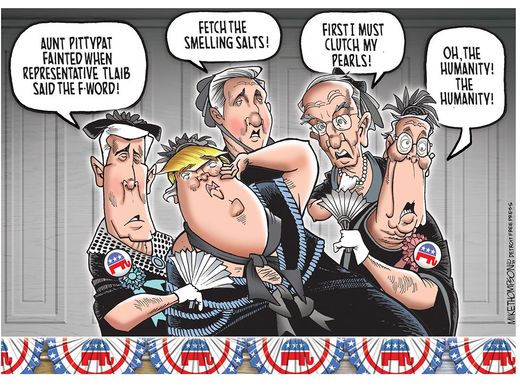
Republicans and some journalists have taken to their fainting couches over a profanity used by a newly sworn-in Congresswoman, Rep. Rashida Tlaib (D-MI). In case you missed it somehow, Tlaib said in a speech that she was going to Congress to “impeach the motherfucker.”
Although she only used one swear word, the NYT headline writer characterized her speech as “profanity laden.” Even Trump weighed in during his rambling word salad in the rose garden yesterday, claiming that Tlaib “dishonored” herself, her family, and disrespected the U.S. by using the same word that Trump allowed Kanye West to use in the oval office.
Impeachment was always going to hang heavily over a divided Washington. But it took little more than 24 hours this week for a freshman House Democrat’s exuberant, expletive-laden impeachment promise to upend the bonhomie of a new Congress and prompt President Trump, by his own telling, to ask the newly elected speaker if Democrats planned to impeach him.
The episode began Thursday night, just hours after the 116th Congress was sworn in, when a camera captured Representative Rashida Tlaib of Michigan promising profanely to impeach Mr. Trump as she drew cheers from liberal activists at a celebration at a bar near the Capitol. By the time Mr. Trump discussed the matter directly in a news conference in the Rose Garden on Friday afternoon, weeks of speculation about his potential peril had burst into the open.
Republicans, eager to portray Democrats as out to destroy Mr. Trump’s presidency, piled on criticism of Ms. Tlaib — some of it racially tinged. (Ms. Tlaib, who is Palestinian-American, is one of the first Muslims in Congress. The Christian Broadcasting Network referred to her as a “foul-mouthed Islamic congresswoman.”) Democratic leaders, who view discussion of impeachment as politically dangerous and premature, offered worried words meant to tamp down speculation about their intentions.
Fandos’ concern is duly noted. Now he can fuck off.
President Donald Trump is a direct and serious threat to our country. On an almost daily basis, he attacks our Constitution, our democracy, the rule of law and the people who are in this country. His conduct has created a constitutional crisis that we must confront now.
Rashida tlaib
The Framers of the Constitution designed a remedy to address such a constitutional crisis: impeachment. Through the impeachment clause, they sought to ensure that we would have the power, through our elected representatives in Congress, to protect the country by removing a lawless president from the Oval Office.
We already have overwhelming evidence that the president has committed impeachable offenses, including, just to name a few: obstructing justice; violating the emoluments clause; abusing the pardon power; directing or seeking to direct law enforcement to prosecute political adversaries for improper purposes; advocating illegal violence and undermining equal protection of the laws; ordering the cruel and unconstitutional imprisonment of children and their families at the southern border; and conspiring to illegally influence the 2016 election through a series of hush money payments.
Whether the president was directly involved in a conspiracy with the Russian government to interfere with the 2016 election remains the subject of Special Counsel Robert Mueller’s investigation. But we do not need to wait on the outcome of that criminal investigation before moving forward now with an inquiry in the U.S. House of Representatives on whether the president has committed impeachable “high crimes and misdemeanors” against the state: abuse of power and abuse of the public trust.
Click on the link the read the rest.
POTUS’ latest temper tantrum is not about border security. Like a spoiled two year old holding his breath, he is holding our nation hostage—trying to force taxpayers to foot the bill for his vanity project he promised Mexico would fund. Meanwhile, the country suffers.
During Friday’s meeting at the White House over the ongoing shutdown standoff, President Donald Trump and Democratic leaders Nancy Pelosi (D-CA) and Chuck Schumer (D-NY) made little substantive progress as Pelosi and Schumer urged Trump to reopen the government by Tuesday, according to three people familiar with the meeting.
One of these knowledgeable sources told The Daily Beast President Trump kicked off the meeting with a rant lasting roughly 15 minutes that included his $5.6 billion demand for a border wall, and threatened that he was willing to keep the government closed for “years” if that’s what it took to get his wall. He also, unprompted, brought up the Democrats who want him impeached, and even blamed Pelosi for new Democratic congresswoman Rashida Tlaib saying at a party earlier this week that Democrats would impeach the “motherfucker” Trump. (It is unclear why Trump would think Pelosi was responsible for this.)
Trump proceeded to tell the room he was too popular to impeach.
Along with saying the word “fuck” at least three times throughout the meeting, the president bizarrely stated that he did not want to call the partial government shutdown a “shutdown,” according to the source. Instead, he referred to it as a “strike.” (Many of the federal employees affected by the weeks-long shutdown have been working without pay. That is essentially the opposite of a strike.)
During the course of this meeting, the Democrats in the room were visibly shaking their heads in exasperation.
Back in the real world, Americans are suffering from Trump’s latest temper tantrum.
Food stamps for 38 million low-income Americans would face severe reductions and more than $140 billion in tax refunds are at risk of being frozen or delayed if the government shutdown stretches into February, widespread disruptions that threaten to hurt the economy.
The Trump administration, which had not anticipated a long-term shutdown, recognized only this week the breadth of the potential impact, several senior administration officials said. The officials said they were focused now on understanding the scope of the consequences and determining whether there is anything they can do to intervene.
trash piles up in dc as the trump shutdown continues.
Thousands of federal programs are affected by the shutdown, but few intersect with the public as much as the tax system and the Department of Agriculture’s Supplemental Nutrition Assistance Program, the current version of food stamps.
The partial shutdown has cut off new funding to the Treasury Department and the USDA, leaving them largely unstaffed and crippling both departments’ ability to fulfill core functions.
The potential cuts to food stamps and suspension of tax refunds illustrate the compounding consequences of leaving large parts of the federal government unfunded indefinitely — a scenario that became more likely Friday when President Trump said he would leave the government shut down for months or even years unless Democrats gave him money to build a wall along the U.S.-Mexico border.
Three days after most of the federal workforce was furloughed on Dec. 21, a 14-year-old girl fell 700 feet to her death at the Horseshoe Bend Overlook, part of the Glen Canyon Recreation Area in Arizona. The following day, Christmas, a man died at Yosemite National Park in California after suffering a head injury in a fall. On Dec. 27, a woman was killed by a falling tree at Great Smoky Mountains National Park, which straddles the borders of North Carolina and Tennessee.
The deaths follow a decision by Trump administration officials to leave the scenic — but sometimes deadly — parks open even as the Interior Department has halted most of its operations. During previous extended shutdowns, the National Park Service barred public access to many of its sites across the nation to substantially decrease the risk of park damage and visitor injury.
The National Parks have a poop crisis on their hands.
National Park Service spokesman Jeremy Barnum said in an email that an average of six people die each week in the park system, a figure that includes “accidents like drownings, falls, and motor vehicle crashes and medical related incidents such as heart attacks.” Drowning, automobile accidents and falls are among the top causes of death at national parks….
In 1995 and 2013, respectively, the Clinton and Obama administrations made the decision to close the parks altogether. Officials concluded that keeping the parks open would jeopardize public safety and the parks’ integrity, but the closures also became a political cudgel for Democrats because they exemplified one of the most popular aspects of federal operations that had ground to a halt.
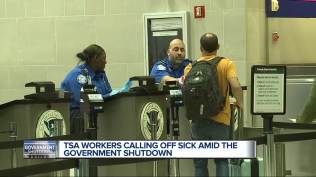
Hundreds of Transportation Security Administration officers, who are required to work without paychecks through the partial government shutdown, have called out from work this week from at least four major airports, according to two senior agency officials and three TSA employee union officials.
The mass call outs could inevitably mean air travel is less secure, especially as the shutdown enters its second week with no clear end to the political stalemate in sight.
“This will definitely affect the flying public who we (are) sworn to protect,” Hydrick Thomas, president of the national TSA employee union, told CNN.
TSA spokesman Michael Bilello said the agency is “closely monitoring the situation” and that “screening wait times remain well within TSA standards,” although that could change if the number of call outs increases.
At New York’s John F. Kennedy International Airport, as many as 170 TSA employees have called out each day this week, Thomas tells CNN. Officers from a morning shift were required to work extra hours to cover the gaps.
Call outs have increased by 200%-300% at Dallas-Fort Worth International Airport, where typically 25 to 30 TSA employees call out from an average shift according to a local TSA official familiar with the situation.
Union officials stress that the absences are not part of an organized action, but believe the number of people calling out will likely increase.
SAULT STE. MARIE, Mich. — For one tribe of Chippewa Indians in Michigan’s Upper Peninsula, the government shutdown comes with a price tag: about $100,000, every day, of federal money that does not arrive to keep health clinics staffed, food pantry shelves full and employees paid.
Chippawa Indian food bank in Michigan
The tribe is using its own funds to cover the shortfalls for now. But if the standoff in Washington continues much longer, that stopgap money will be depleted. Later this month, workers could be furloughed and health services could be pared back. “Everything,” said Aaron Payment, the chairman of the Sault Ste. Marie Tribe, “is on the table.”
For many Americans who are not federal workers or contractors, a shutdown is a minor inconvenience. A trip to a national park may be canceled. A call to a government office may go unanswered. But for Native American tribes, which rely heavily on federal money to operate, a shutdown can cripple their most basic functions.
All across Indian Country, the federal shutdown slices deep. Generations ago, tribes negotiated treaties with the United States government guaranteeing funds for services like health care and education in exchange for huge swaths of territory.
Read the rest at the NYT.
So . . . what else is happening? Please post your thoughts and links in the comment thread below.
Did you like this post? Please share it with your friends:
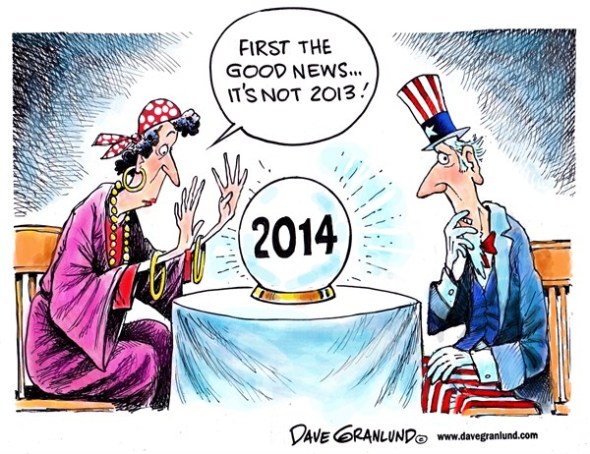
I’m really struggling to get going this morning, so I’m going to start you off with a few cartoons and some quick links. I have another post planned for later on today, and I hope you’ll stop by then.
Right wing “Christian” hate was a dominant characteristic of 2013,
so I guess it’s appropriate that the year is ending with an incredibly disgusting and ludicrous example of what some Americans have become.
Duck Dynasty Camoflage
The New York Times finally weighed in on the disastrous decision of A&E to revoke their suspension of ridiculous hate monger Phil Robertson of Duck Dynasty.
The indefinite suspension of Phil Robertson, the patriarch of the family at the center of the A&E Network’s huge ratings hit “Duck Dynasty,” became definite Friday — at zero episodes. The network announced he would not be suspended after all.
A&E released a statement, noteworthy both for its concessions to the Robertson family’s refusal to accept the suspension as well as its timing — at close of business on Friday of a holiday weekend on the slowest week of the year in the entertainment business.
The bottom line: Phil Robertson will resume work on the show when it begins taping new episodes in the spring.
The network moved to suspend Mr. Robertson on Dec. 18 after comments he made about gay people in a magazine interview. At the time A&E described the comments, which described homosexual acts in crude terms and labeled them a sin, as extremely disappointing and not reflective of the network, which considered itself “champions of the L.G.B.T. community.”
Shame on you, A&E!! And don’t forget the racism, misogyny, pedophilia, religious bigotry, and general overall ignorance in Roberton’s interview. A&E now tacitly supports those “values” as their “core principles.”
Way back in 1968 when I first saw Kubrick’s magnificent 2001: A Space Odyssey, I never could have imagined that the future of the U.S. would be so pathetic and embarrassing. Sigh . . . We’ve left 2001 far behind us, and this is what has become of the dreams of my generation.
The good news, at least about gay marriage, is that the battle is over and the good guys won.
Josh Marshall:
Since the Supreme Court ruling in June, the writing has been on the wall for banning of marriage rights for gay and lesbian couples in the United States. Since June the number of states with marriage equality has jumped from 12 to 18. But last week’s lower court decisions in Utah and Ohio leave little doubt that the political fight over gay marriage is now essentially over and that gay marriage will be the law of the land in every state in the country in the pretty near future.
The fact that gay and lesbian couples are now lining up to get married in Utah of all places – arguably the most conservative state in the country – might tell you this on a symbolic level. But the logic that points to the end of the political fight over gay marriage is more concrete, specific and undeniable.
Utah, rightly, got the most attention. But there were two cases last week. The other one in Ohio dealt with a much narrower question: whether the state had to recognize gay marriages in the issuance of death certificates. But both cases rested on the same essential premise: that if the federal government can’t discriminate against gay couples, states – by definition – cannot either.
As Judge Timothy Black put it in the Ohio case: “The question presented is whether a state can do what the federal government cannot — i.e., discriminate against same-sex couples … simply because the majority of the voters don’t like homosexuality (or at least didn’t in 2004). Under the Constitution of the United States, the answer is no.”
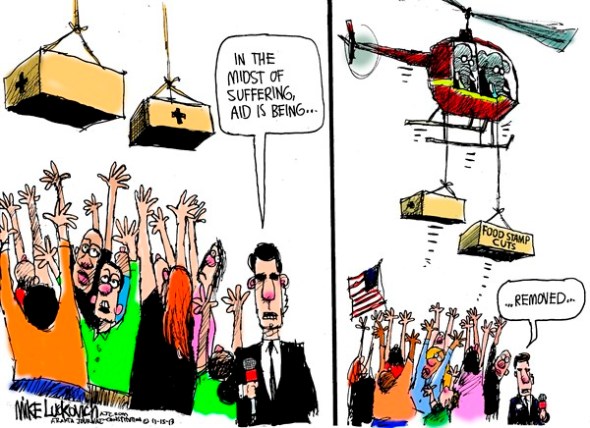
The other huge story of the day (which the mainstream media will probably play down) is that more than a million Americans will lose long-term unemployment benefits today.
Here are some links, and so far I haven’t seen any on Google news from the big media outlets.
More than 1 million Americans are bracing for a harrowing, post-Christmas jolt as extended federal unemployment benefits come to a sudden halt this weekend, with potentially significant implications for the recovering U.S. economy. A tense political battle likely looms when Congress reconvenes in the new, midterm-election year.
Nudging Congress along, a vacationing President Barack Obama called two senators proposing an extension to offer his support. From Hawaii, Obama pledged yesterday to push Congress to move quickly next year to address the “urgent economic priority,” the White House said.
For families dependent on cash assistance, the end of the federal government’s “emergency unemployment compensation” will mean some difficult belt-tightening as enrollees lose their average monthly stipend of $1,166.
Jobless rates could drop, but analysts say the economy might suffer with less money for consumers to spend on everything from clothes to cars. Having let the “emergency” program expire as part of a budget deal, it’s unclear if Congress has the appetite to start it anew.
The federal program, which was expanded in 2008 to provide extra income to the long-term unemployed who have exhausted their 26 weeks of state benefits, lapses Saturday because Congress failed to extend the federal program into 2014. For much of the recession, the government not only offered extended benefits beyond those 26 weeks, but also introduced the EUC program to offer up to 99 weeks of assistance in many states.
In the first six months of 2014, 1.9 million additional Americans will use up their state-funded benefits and find themselves without a federal safety net waiting if the program is not renewed. That number will jump to 3.6 million people. According to a report from the White House Council of Economic Advisors and the Labor Department, in October the average length of unemployment was 36.1 weeks – two and a half months longer than state benefits will last with no extension. The long-term unemployment rate is 2.6 percent, roughly one-third of the overall employment rate of 7.3 percent.
“In no prior case has Congress allowed special extended benefits to expire when the unemployment rate was as high as it is today,” the report says.
It’s also been quite a while since anyone was able to receive 99 weeks of benefits, which average about $300 per week. Over the past two years, the average maximum weeks of available benefits has dropped from 85 to 54, or 36 percent, according to Congressional Research Service data.
That’s just sick. In fact it is so far beyond sick, I don’t even know how to begin to characterize it.
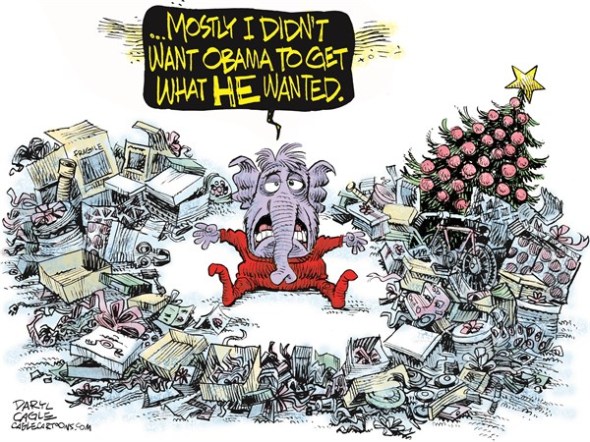
Why are the Republicans doing this?
Christmas GOP and Obama
And don’t forget what’s happening to people on food stamps.
Food Stamps Removed
I wish I had some cheerful news for you. I’ll look around and try to find some. For now, I’d better get this post published before everyone gives up on me!
Have a great day, and please post any links that have caught your eye in the comment thread.
Did you like this post? Please share it with your friends:
The Sky Dancing banner headline uses a snippet from a work by artist Tashi Mannox called 'Rainbow Study'. The work is described as a" study of typical Tibetan rainbow clouds, that feature in Thanka painting, temple decoration and silk brocades". dakinikat was immediately drawn to the image when trying to find stylized Tibetan Clouds to represent Sky Dancing. It is probably because Tashi's practice is similar to her own. His updated take on the clouds that fill the collection of traditional thankas is quite special.
You can find his work at his website by clicking on his logo below. He is also a calligraphy artist that uses important vajrayana syllables. We encourage you to visit his on line studio.











Spencer warns that President Donald Trump and Secretary of Health and Human Services Robert F. Kennedy Jr. are pursuing eugenics with their health policies.Andrew Caballero-Reynolds/AFP via Getty Images
Based on the newly posted information, a family of four making $130,000 in Maine would face an increase of $16,100 in annual premiums next year because they would no longer qualify for more generous subsidies, said Gideon Lukens, a health policy researcher for the Center on Budget and Policy Priorities, which supports extending the subsidies.
The Coast Guard put in its budget earlier this year a request to purchase a new long-range Gulfstream V jet, estimated to cost $50 million, to replace an aging one used by Ms. Noem.












 peej
peej Carissa
 bostonboomer
 dakinikat
 ecocatwoman
 mablue2
 Mama Lopez
 peggysue22
 quixote
 skydancingguestblogger
 Mona (aka Wonk the Vote)



 Sky Dancing
Recent Comments