Posted: February 18, 2026 | Author: bostonboomer | Filed under: just because | Tags: Autism, Democratic Party history, extremist rhetoric in Trump administration, FDA, immigration, Jesse Jackson, Martin Luther King Jr. assassination, Racism, Robert F. Kennedy Jr., Trump violation of court orders in NJ, Vinay Prasad, voting rights |
Good Afternoon!!
It’s actually sort of a slow news day today. At least there isn’t a lot of stuff that I find interesting or exciting. I do want to address Jesse Jackson’s passing, so I’m going to spend some time on that. As JJ wrote yesterday,
It seemed like he was always there, everywhere…whenever there was injustice. And he spoke out! It wasn’t just a few words written in a tweet…and sent from wherever. Jesse Jackson went there…wherever the problem was and spoke out with the people in support. I just think that his on scene action of demonstration and protest, the act of showing up and being there…made a huge difference. And I feel that it is what is missing in the situation right now.
Yes, he did, and he made a difference. He fought for so many issues, including immigration. He was often mocked for turning up whenever something was happening, but he persisted and I admired that. I wish we had someone like him here today to call greater attention to these issues.
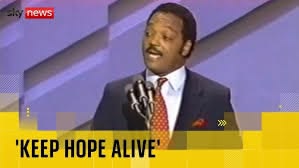 When Jesse Jackson ran for president in 1984 and especially in 1988, I watched his speeches on C-Span and found them thrilling. His manner of speaking was so unique, and I loved his signature saying “keep hope alive.” He truly paved the way for Obama’s win in 2008. Here is the platform that Jackson ran on, from Wikipedia:
Declaring that he wanted to create a “Rainbow Coalition” of various minority groups, including African Americans, Hispanics, Middle Eastern Americans, Asian Americans, Native Americans, family farmers, the poor and working class, and LGBT people, as well as white progressives, Jackson ran on a platform that included:
With the exception of a resolution to implement sanctions against South Africa for its apartheid policies, none of these positions made it into the party’s platform in either 1984 or 1988.
A few interesting articles:
Karen Tumulty at The Washington Post (gift link): I covered Jesse Jackson’s 1988 campaign. The racism he faced was undisguised.
“Keep hope alive!” It was the signature line of Jesse Jackson’s second run for president. Euphoric crowds, numbering in the thousands, would chant it along with him.
I was a reporter for the Los Angeles Times, and that 1988 presidential campaign was the first I had ever covered. Those months revealed to me many things about America. Not all were as uplifting as the optimistic spirit that propelled the civil rights leader to a second-place finish against the ultimate Democratic nominee, Massachusetts Gov. Michael Dukakis.
One day in particular stands out in my memory for what I saw of undisguised racism, and for what I heard from Jackson himself about the less visible barriers he believed had been put in his way by some in his own party.
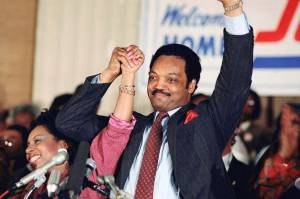
Jesse Jackson, then a Democratic presidential hopeful, with his wife, Jacqueline, at an Operation Push rally in Chicago on March 10, 1988. Fred Jewell AP
It was May 9. The campaign had begun before dawn, as many days did with Jackson’s operation. We were in poverty-stricken Arnett, West Virginia, and a few curious neighbors had gathered outside the home of an unemployed White coal miner, where Jackson had spent the night. When one of them was asked how he planned to cast his ballot in that week’s Democratic primary, he retorted: “I ain’t voting for no damn n—-r.”
The previous evening, the arrival of Jackson’s motorcade had been greeted with similar epithets, and someone in the crowd of about 200 appeared threatening enough that the Secret Service vetoed the candidate making his usual round of shaking hands.
Jackson, who died Tuesday at 84, was usually too much on the move to indulge in introspection and reflection. But later that day, in a conversation with a few bleary-eyed reporters aboard his campaign bus, he did.
In his view, Jackson told us, the most significant hurdles that a Black candidate had to overcome were not what we had seen in West Virginia. “Some people are very raw, very direct, [saying] ‘I would not vote for a n—-r.’ Other people are able to use sand to cover up their mess,” he said.
Jackson was a spellbinder on the stump, but well to the left of most of the country. And he had never shaken his reputation as a self-promoter — or, as then-Vice President George H.W. Bush once put it, a “hustler from Chicago.”
His candidacy had, from the outset, been “running against a headwind of culture and media and pundits,” Jackson said. “The party itself is using its strength to get the candidate it thinks can win.”
He faulted the news media and the polls for constantly raising the question of whether Americans would vote for a Black man: “If I’m asked, ‘Why run?,’ the people are asked, ‘Why vote?
Use the gift link to read more if you’re interested.
Neil Vigdor at The New York Times (gift link): Seven Pivotal Moments in Jesse Jackson’s Life.
Millions of Democrats cast primary votes for him, envisioning him as America’s first Black president.
Along the way, there would be convention keynote speeches and, at times, self-inflicted controversy for the Rev. Jesse Jackson, who died on Tuesday at 84. His life ran in parallel to the successes of the civil rights era, but it was at the movement’s lowest moment that he came to wider national attention: the 1968 assassination of the Rev. Dr. Martin Luther King Jr., which he witnessed at the Lorraine Motel in Memphis….
Martin Luther King Jr.’s assassination
On April 4, 1968, Mr. Jackson was in the motel parking lot, speaking with Dr. King, who was on the second-floor balcony above him, when Dr. King was shot by James Earl Ray.
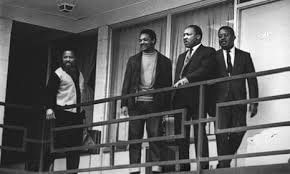
Jesse Jackson on the day of Martin Luther King’s assassination.
“We hoped it was his arm, but the bullet hit him in the neck,” Mr. Jackson told reporters while visiting the motel, now a civil rights landmark, before Tennessee’s Democratic presidential primary in 1984.
At the time of the assassination, Mr. Jackson was 26 years old and a protégé of Dr. King.
“This is the scene of the crucifixion,” he said, taking reporters on a tour of Room 306, where the civil rights leader had been staying.
1984 presidential campaign
With his entry into the 1984 Democratic primary race, Mr. Jackson became the first Black candidate to seek a major party’s nomination for president since Shirley Chisholm, the trailblazing Brooklyn congresswoman who ran unsuccessfully in 1972.
At a campaign kickoff rally, Ms. Chisholm
introduced Mr. Jackson, who was then 42 and had criticized Democrats for what he described as their lackluster opposition to President Ronald Reagan.
Mr. Jackson viewed his candidacy as inspirational to a rainbow coalition — Black, white and Hispanic citizens, women, American Indians and “the voiceless and downtrodden.”.
He finished third to the eventual nominee, Walter Mondale, the former vice president, who lost the general election in a landslide…..
1988 presidential campaign
Building on his name recognition and base of support in the South, Mr. Jackson returned to the campaign trail emboldened in 1988. The clergyman from Chicago and founder of the Rainbow PUSH Coalition made inroads with white voters, winning three times as many votes from them as he did four years earlier.
Nearly seven million people voted for Mr. Jackson in the primaries and caucuses that year, delivering him victories in 13 contests.
He finished a solid second to Michael Dukakis, the Massachusetts governor, who eventually lost the general election to George H.W. Bush, the vice president.
1988 D.N.C. keynote
In the spotlight of the Democratic National Convention, Mr. Jackson brought delegates to tears with his retelling of his upbringing in poverty and segregation in Greenville, S.C. He said he could identify with people watching his speech on television in poor neighborhoods.
“They don’t see the house I’m running from,” he said. “I have a story. I wasn’t always on television.”
He used his speech to press for social justice and action by Democrats in the general election, when he became a key surrogate for Mr. Dukakis, particularly with Black voters.
He closed his remarks with a sermon-like chant, one that would echo in future campaigns, including Barack Obama’s in 2008, when Americans elected him as the first Black president.
“Keep hope alive! Keep hope alive! Keep hope alive!”
Use the gift link to read the rest if you’re interested.
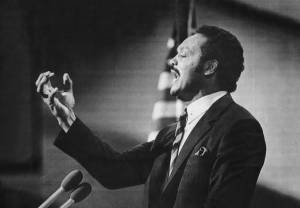
The Rev. Jesse Jackson delivered a speech at the Democratic National Convention after failing to secure the party’s nomination for president in 1984. Credit…Jim Wilson, The New York Times
Jackson’s most important speech was probably his keynote presentation at the 1984 Democratic Convention in San Francisco. Jonathan Wolfe at The New York Times (gift link): The Jesse Jackson Speech That Helped Redefine the Democratic Party’s Base.
In 1984 in San Francisco, Jesse Jackson delivered a speech at the Democratic National Convention that helped unify the fractured party and redefine the modern Democratic base. “The Rainbow Coalition” speech, as it is known, is regarded as one of the most significant addresses in the history of American politics and helped shape a progressive vision for the party.
Mr. Jackson was coming off an unsuccessful presidential primary run when he delivered the speech, coming in third behind Senator Gary Hart of Colorado and former Vice President Walter Mondale, the eventual nominee. In his address, he urged the party to embrace a diverse, multiracial and multi-class alliance, encouraging the inclusion of marginalized groups, including the poor, workers and minorities.
The speech, which was evangelical in tone and contained numerous biblical allusions, described the country as a patchwork quilt.
“Our flag is red, white and blue, but our nation is a rainbow — red, yellow, brown, black and white — and we’re all precious in God’s sight,” he said. “America is not like a blanket — one piece of unbroken cloth, the same color, the same texture, the same size. America is more like a quilt — many patches, many pieces, many colors, many sizes, all woven and held together by a common thread.”
He argued in the address that the party should expand its coalition and embrace his constituency: “The desperate, the damned, the disinherited, the disrespected, and the despised.” He also pushed for patience and understanding.
“We must be unusually committed and caring as we expand our family to include new members,” he said. “All of us must be tolerant and understanding as the fears and anxieties of the rejected and of the party leadership express themselves in so many different ways.”
Mr. Jackson used the speech to attack President Ronald Reagan’s “trickle down” economic theories and argued for a renewed focus on the poor and the marginalized. He recited a list of what he saw as Mr. Reagan’s offenses against his coalition, including attacks on health care, education and food stamps, and used the speech to put forward what he saw as the mission of the Democratic party.
“This is not a perfect party,” he said early in the address. “We are not a perfect people. Yet, we are called to a perfect mission: Our mission, to feed the hungry, to clothe the naked, to house the homeless, to teach the illiterate, to provide jobs for the jobless, and to choose the human race over the nuclear race.”
We could use a voice like that today.
One more on Jackson’s influence b Jennifer Rubin at The Contrarian: Jesse Jackson’s Passing Should Stir the Democracy Movement.
With Rev. Jesse Jackson Jr.’s passing, we lose one of the dwindling number of direct links to Martin Luther King, Jr. and to the mid-20th century Civil Rights generation. From the Lorraine Motel to stewardship of Rainbow/PUSH to his own presidential campaigns to his successful hostage negotiations to Barack Obama’s election to the Black Lives Matter movement, he was front and center in racial justice fights, a symbol of both the tremendous progress and the enduring, at times exhausting, presence of White supremacists who seek to erase history and undo decades of hard-won gains.
While the country lacks a singular figure to lead the racial justice movement, the number of organizations and plethora of elected figures (including the likely next House Speaker) are part of Jackson’s legacy, a permanent army of civil rights activists who stand in opposition to the Make America White Again ideology at the heart of Trumpism. The challenge that was at the heart of Jackson’s work — the creation of a true multi-racial democracy — has never been more acute in the modern era.
It is always worth recalling Jackson’s iconic lines from his speech to the 1984 Democratic Convention:
Our flag is red, white and blue, but our nation is a rainbow — red, yellow, brown, black and white — and we’re all precious in God’s sight.
America is not like a blanket — one piece of unbroken cloth, the same color, the same texture, the same size. America is more like a quilt — many patches, many pieces, many colors, many sizes, all woven and held together by a common thread. The white, the Hispanic, the black, the Arab, the Jew, the woman, the native American, the small farmer, the businessperson, the environmentalist, the peace activist, the young, the old, the lesbian, the gay and the disabled make up the American quilt. (Applause)
Even in our fractured state, all of us count and all of us fit somewhere. We have proven that we can survive without each other. But we have not proven that we can win and progress without each other. We must come together.
The Trump regime presents the greatest attack on that vision of pluralistic democracy and racial justice in the modern era. Should the MAGA partisan hacks on the Supreme Court succeed in eviscerating the Voting Rights Act in Louisiana v. Callais, the political map will resemble the political landscape in the Jim Crow era in which Black and Hispanic voting power was minimal to nonexistent, representatives at all levels of government were overwhelmingly White, and one party rule prevailed in the South.

Jesse Jackson as a young man.
Jackson would certainly recognize The SAVE Act, which would impose onerous proof of citizenship requirements to vote, as the latest MAGA disenfranchisement project, part of the never-ending assault to deprive communities of color access to the polls. The Leadership Conference on Civil and Human Rights and 130 organizations have decried the assault on voting rights as being driven by “unprecedented disinformation campaigns and intrusions on the ability of states to make sound decisions on how to run their elections.” The effort to now require a birth certificate or passport to establish qualification to vote would be the culmination of a voter suppression drive begun over decade ago:
Since the Supreme Court’s decision in Shelby County v. Holder (2013), 31 states have enacted 114 restrictive voting laws, which disproportionately burden voters of color. The harm has been palpable: Racial disparities in voter turnout have been increasing, particularly in areas formerly protected by the Voting Rights Act’s preclearance provision, which the Court dismantled.
The object of the new burdens on voting is obvious. “Approximately half of American adults do not have a passport, and two-thirds of Black Americans do not.…Nationwide, 69 million married women do not have a birth certificate matching their legal name.” Transferring sensitive voter information to a federal database would only “increase the likelihood that citizens will see their registrations wrongly purged or their personal information compromised.”
All of this smacks of the literacy and poll tests imposed in the Jim Crow South, a set of mechanisms designed to make the electorate unrepresentative of the general population in order to maintain white dominance.
Even voter ID requirements amount to a poll tax.
The rest of the news is not that inspiring, but here a few significant stories to check out.
Odette Yousef at NPR: Extremist rhetoric is often found in government messaging. Who’s the target?
A recent social media post from an account belonging to President Trump prompted enough outcry over its use of a familiar racist trope that the White House deleted it. The Truth Social post included an image of former President Barack Obama and former first lady Michelle Obama as apes. Despite removing the post, Trump has deflected blame to an aide….
For scholars and civil rights advocates steeped in the language and aesthetics of white nationalism, Trump’s post was remarkable only because of how overtly racist the trope is. But they say that it fits into a pattern of extremist rhetoric, visual material and other media that have overtaken public messaging from federal agencies over the past year. They say that much of that messaging may not have been detectable to most Americans who are not immersed in the study of extremism. But to those who are, the dog whistles and coded words have been unmistakable.
“If this were just one racist image or one bad post, it wouldn’t matter much,” said Eric Ward, executive vice president of Race Forward, a civil rights organization. “What matters is that over the last year, the Trump administration [is] abusing federal authority, and the federal government has increasingly learned to speak in the emotional language of white nationalism.”
While the latest controversy is over a post from a Trump social media account, Ward and others say the Department of Homeland Security has been behind the most, and the most notable, examples of extremist themes in federal messaging. In its effort to recruit large numbers of new immigration enforcement agents, the federal agency has generated a body of propaganda that has raised alarm over its echoes of extremist movements.
“A lot of this was very much wrapped up in this kind of Norman Rockwell-style imagery of white Americana and … this idea that we need to ‘defend the homeland’ from migrants arriving from the Global South,” said Caleb Kieffer, a senior research analyst with the Southern Poverty Law Center. “And I think that one thing it’s worth noting, and what we really were alarmed by, [is] that we’ve seen this rhetoric for decades be prevalent in white nationalist circles, in anti-immigrant circles, claiming that there’s this migrant invasion happening and that we need to stop it.”
Read the rest at the link.
Kyle Cheney at Politico: DOJ acknowledges violating dozens of recent court orders in New Jersey.
The Trump administration acknowledged violating court orders issued by New Jersey’s federal judges more than 50 times over the past 10 weeks in cases stemming from the Trump administration’s mass deportation push.
Associate Deputy Attorney General Jordan Fox, who was tapped in December to help lead the Justice Department’s New Jersey office after temporary pick Alina Habba was forced out, said those violations were spread across more than 547 immigration cases that have flooded the courts since early December, straining both prosecutors and judges.
The violations include a deportation to Peru that occurred in violation of a judge’s injunction, as well as three missed deadlines to release ICE detainees.

A general view of the Delaney Hall Detention Facility in Newark on June 16, 2025, in New Jersey. Stefan JeremiahAP
There were also six missed deadlines to respond to court orders, 12 missed deadlines to provide bond hearings to ICE detainees, 17 out-of-state transfers after judges had issued no-transfer orders, three instances of imposing release conditions in violation of court prohibitions and 10 instances of failing to produce evidence demanded by courts.
“We regret deeply all violations for which our Office is responsible. Those violations were unintentional and immediately rectified once we learned of them,” Fox wrote in a letter accompanying the report. “We believe that [the Department of Homeland Security’s] violations were also unintentional.”
Fox’s conciliatory approach stood in stark contrast with previous statements from the Justice Department and ICE that have blamed “rogue judges” for the administration’s noncompliance.
DOJ produced the catalog of violations in response to an order by U.S. District Judge Michael Farbiarz.
Derek Hunter at The Hill: Something is very wrong at the FDA.
It’s not very often an editorial from anywhere, let alone the Wall Street Journal, stops you in your tracks, but one titled “Vinay Prasad’s vaccine kill shot” did just that for me. Not normally known for bomb-throwing, the Journal’s editors went in very hard against someone you’ve probably never heard of — the chief medical and scientific officer and director of the Center for Biologics Evaluation and Research at the U.S. Food and Drug Administration.
The damning sub-headline reads, “Does the White House know the harm he’s doing to public health?” And no, this is not some random question based on spasmodic, Trump-deranged leftist opposition to everything going on in Washington. This is serious.
The Journal editors write of Prasad — previously forced out of the FDA and then hired back within two weeks — that “it’s hard to recall a regulator who has done as much damage to medical innovation in as little time … In his latest drive-by shooting, the leader of the Food and Drug Administration’s vaccine division rejected Moderna’s mRNA flu vaccine without even a cursory review. This is arbitrary government at its worst.”
But is it arbitrary? In 2022, Prasad tweeted that he was “a Bernie Sanders liberal” who has “been surprised by ad hominem claims I am right wing. I am pro-universal health care. Pro wealth tax. Pro choice. Etc. Read my books.”
The same day as the editorial, the Wall Steet Journal reported on the FDA’s rejection of a new flu shot from Moderna for unclear reasons. Career staff reportedly objected and “argued that refusing to even consider the vaccine was the wrong approach to address any concerns about the product.” They were overruled.
And other drugmakers reported multiple cases of surprising and seemingly arbitrary decisions by Prasad, many of them connected to treatments for rare diseases.
Read the rest at The Hill.
Megan O’Matz at ProPublica: Chlorine Dioxide, Raw Camel Milk: The FDA No Longer Warns Against These and Other Ineffective Autism Treatments.
The warning on the government website was stark. Some products and remedies claiming to treat or cure autism are being marketed deceptively and can be harmful. Among them: chelating agents, hyperbaric oxygen therapies, chlorine dioxide and raw camel milk.
Now that advisory is gone.
The Food and Drug Administration pulled the page down late last year. The federal Department of Health and Human Services told ProPublica in a statement that it retired the webpage “during a routine clean up of dated content at the end of 2025,” noting the page had not been updated since 2019. (An archived version of the page is still available online.)
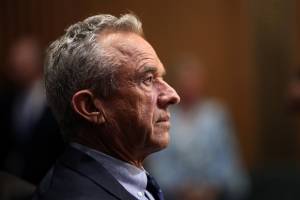 Some advocates for people with autism don’t understand that decision. “It may be an older page, but those warnings are still necessary,” said Zoe Gross, a director at the Autistic Self Advocacy Network, a nonprofit policy organization run by and for autistic people. “People are still being preyed on by these alternative treatments like chelation and chlorine dioxide. Those can both kill people.”
Chlorine dioxide is a chemical compound that has been used as an industrial disinfectant, a bleaching agent and an ingredient in mouthwash, though with the warning it shouldn’t be swallowed. A ProPublica story examined Sen. Ron Johnson’s endorsement of a new book by Dr. Pierre Kory, which describes the chemical as a “remarkable molecule” that, when diluted and ingested, “works to treat everything from cancer and malaria to autism and COVID.”
Johnson, a Wisconsin Republican who has amplified anti-scientific claims around COVID-19, supplied a blurb for the cover of the book, “The War on Chlorine Dioxide.” He called it “a gripping tale of corruption and courage that will open eyes and prompt serious questions.”
The lack of clear warning from the government on questionable autism treatments is in line with HHS Secretary Robert F. Kennedy Jr.’s rejection of conventional science on autism and vaccine safety. Last spring, Kennedy brought into the agency a vaccine critic who’d promoted treating autistic children with the puberty-blocking drug Lupron. And in January, Kennedy recast an advisory panel on autism, appointing people who have championed the use of pressurized chambers to deliver pure oxygen to children, as well as some who support infusions to draw out heavy metals, a process known as chelation.
Kennedy is almost as scary as Trump.
That’s all I have for you today. What stories are you following?
Did you like this post? Please share it with your friends:
Posted: May 24, 2025 | Author: bostonboomer | Filed under: cat art, caturday, Donald Trump, education, public corruption | Tags: Covid vaccines, Covid-19 deaths, CryptoCurrency, FDA, Harvard University, international university students, Kristi Noem, National Security Council, NSC, Robert F. Kennedy Jr., Trump Corruption |

Woman and Cat, by Koji Fukiya, 1936.
Good Afternoon!!
Yesterday, Dakinikat wrote about Trump’s crypto dinner, where he briefly spoke to the people who had spent the most on his personal memecoin. The “gala dinner” was held at Trump’s Virginia golf club. The attendees–mostly from foreign countries–had spent their money hoping to gain “access” to Trump, but that didn’t happen, at least at this event. Trump showed up on a “military helicopter,” spoke for less than half and hour and then did his YMCA dance. Then he left again without speaking to anyone personally. And the food was terrible.
Wired: A Helicopter, Halibut, and ‘Y.M.C.A’: Inside Donald Trump’s Memecoin Dinner.
Donald Trump left the stage at his golf club near Washington, DC, on Thursday night, he pointed to the crowd, brought his index finger to his temple—as if to say: You know what’s coming—then began to dance. To the beat of “Y.M.C.A” by The Village People, Trump shimmied, gyrated, and pumped his arms above his head.
Looking on were more than 200 people who had been invited to the Trump National Golf Club for a private gala dinner. They had won their seats by purchasing large quantities of Trump’s own crypto coin—TRUMP—some holding millions of dollars’ worth….
By late afternoon, the dinner guests had started to filter through the gates of the golf club. By comparison to Trump’s previous banquets, thronging with DC insiders and members of the Silicon Valley elite, the crypto dinner attracted a mismatched collection of oddballs: independent traders rubbed shoulders with crypto executives, die-hard Trump fans, and even professional sports stars—former NBA player Lamar Odom towered overhead. A handful wore bowties in Bitcoin orange; others sported gold Trump sneakers.
Just after 7 pm, the dinner guests gathered at the window to watch Trump descend in Marine One, his presidential helicopter. A short while later, he appeared from behind a blue velvet curtain to whoops and applause from the crowd. Had they seen the helicopter, Trump asked. “Yeah, super cool!” somebody yelled….
From behind a lectern at one end of the dining room, backdropped by four US flags, Trump delivered a characteristically winding and digressive speech that sources say lasted around 25 minutes. At some point, he got round to crypto.
“We’ve got some of the smartest minds anywhere in the world right here in this room,” said Trump. “You believe in the whole crypto thing. A lot of people are starting to believe in it … This is really something that may be special—who knows, right? Who knows—but it may be special.”
For some, the dinner represented a chance to network with other deep-pocketed crypto figures, and to hear directly from Trump about his plans to bring an end to the regulatory uncertainty that crimped the industry’s expansion under Biden.
“You don’t get to meet the president easily,” Vincent Liu, chief investment officer at trading firm Kronos Research, told WIRED a few days before the dinner. “To be able to hear his message on crypto directly—I’m definitely looking forward to that.”

Woodblock print from Tsukioka Yoshitoshi’s series One Hundred Aspects of the Moon (1885-1892)
No one got to meet the president, but I Wired says they also wanted to network with each other. On the general presentation and the food, served at circular tables
…each seating 10 people arrayed beneath a set of crystal chandeliers. Waiting on the chairs were gift bags containing Fight Fight Fight-themed hats and posters, and a collectible plastic card (some allege that they didn’t receive merch at their seats.) The four largest coin holders—along with two other attendees selected by raffle, sources say—received a gem-encrusted Trump gold watch.
Between mouthfuls, the attendees discussed trading and investment strategies—and Trump’s speech. “To feel his personal charisma to me was very inspiring,” says Liu. But others complained about the brevity of Trump’s appearance: After his speech, Trump had departed immediately in a golf cart bound for his helicopter. “Trump could have at least given the top people their watches himself,” says Pinto. “He didn’t.”
The food itself had left a bitter taste in the mouth, too. “It was the worst food I’ve ever had at a Trump golf course,” says Pinto, who added he left hungry. “The only good thing was bread and butter.” Another attendee described the meal as “OK, but not top-class.”
From Penn Live: Trump’s controversial crypto dinner ripped by attendee: ‘Trash.’
Donald Trump’s controversial memecoin dinner Thursday night was shrouded in secrecy, and while it still isn’t clear who all attended — the White House did not make the list public — we do have a report of how good the food was….
According to Fortune, 25-year-old Nicholas Pinto was one of those who attended. The site said he invested “more than $360,000 in Trump’s memecoin.
And for that, he told the site, the dinner that was served was “trash.”
“Walmart steak, man,” he texted Fortune.
The site said the menu for the included a “Trump organic field green salad” and an “entrée duet” of filet mignon and pan-seared halibut.
“Everybody at my table was saying the food was so of the worst they ever had,” Pinto said.
“I was hoping for Big Macs or pizza,” Pinto told Fortune. “That would have been better than the food that we were served.”
Trump is just raking in the dough as quickly as he can with the minimum effort.
The New York Times got the guest list: Who Won a Seat at Trump’s Crypto Dinner?
The invitees for President Trump’s private dinner for customers of his cryptocurrency business on Thursday included a Chinese billionaire fighting a lawsuit from U.S. regulators, a lawyer for Justice Clarence Thomas and a former basketball star, according to a guest list obtained by The New York Times and social media posts.
The dinner, at which Mr. Trump gave remarks, was an extraordinary moment in which the president leveraged his position to make money — for his crypto business and for his Virginia golf club, which hosted the event.
The event’s invited guests were not known publicly beforehand, even to each other. They were identified only by the pseudonyms they used on the electronic wallets where they kept their $TRUMP memecoins. Most had gained an invitation by becoming one of the top 220 holders of that memecoin over a certain period of time. The top 25 of those were given V.I.P. status and afforded a more intimate gathering before the dinner and an unofficial tour of the White House on Friday.
When they arrived at Mr. Trump’s club outside Washington Thursday evening, the digital world had become physical. The invitees’ names and contact information were delineated on paper lists, checked by staffers at the door. A Times reporter reviewed one of those lists, and used it to identify people who were present. Some other invitees self-identified on social media. A reporter and photographer from The Times also saw some $TRUMP crypto buyers enter and exit the White House on Friday.

Merchant’s Daughter by Mizuno Toshikata
Some top invitees:
Justin Sun, a Chinese crypto billionaire who was sued by the Securities and Exchange Commission under President Joseph R. Biden Jr. for allegedly inflating the value of a cryptocurrency. Mr. Sun is a major investor in a separate crypto venture largely owned by a company tied to Mr. Trump, World Liberty Financial. After Mr. Trump took office, the S.E.C. asked a judge to put Mr. Sun’s case on hold….
Elliot Berke, a Washington attorney who has worked for congressional Republicans and Justice Clarence Thomas of the Supreme Court. The Times identified him because the invitee list included his email address at his law firm, Berke Farah. He was honored as “Republican Lawyer of the Year” in 2021 by the Republican National Lawyers Association….
Evgeny Gaevoy, the founder and chief executive of a digital-asset firm, Wintermute. The Times identified him because the list of invitees included his Wintermute email….
Anil Lulla and Yan Liberman, two co-founders of Delphi Digital, a Miami Beach firm that offers market intelligence for crypto investors. Their corporate emails were included in the list of invitees….
Cheng Lu, 32, a crypto investor from Shanghai, was observed by a Times reporter entering the White House on Friday. He said he did not have a chance to speak with Mr. Trump during the dinner on Thursday or at the Friday tour. “I just want to see President Trump,” he said.
Several more are listed at the NYT link.
Another big story today is Trump’s terrifying persecution of Harvard University. Here’s the latest:
From The Wall Street Journal Editorial Board: Is Trump Trying to Destroy Harvard? The order against foreign students turns away the world’s brightest.
The Trump Administration has frozen billions in federal grants to Harvard University, threatened its tax-exempt status, and sought to dictate its curriculum and hiring. Now the government seems bent on destroying the school for the offense of fighting back. And for what purpose?
That’s how we read the Department of Homeland Security’s move Thursday to bar foreign students from attending the world-renowned institution. That’s 6,800 students, or a quarter of Harvard’s student body, whose futures are suddenly in disarray. It’s also a short-sighted attack on one of America’s great competitive strengths: Its ability to attract the world’s best and brightest.
The latest assault began when DHS demanded that Harvard turn over sundry records on its foreign students, including whether any had participated in illegal activity or left the university owing to “dangerous or violent activity or deprivation of rights.”
Some of its record requests are reasonable, but some overreached by requiring private student information. DHS also gave Harvard all of two weeks to respond. If it failed to do so, DHS Secretary Kristi Noem said she would “automatically withdraw” the school’s certification in the Student and Exchange Visitor Program. “The withdrawal will not be subject to appeal.”
The SEVP program lets non-citizens enroll at universities on student visas. DHS can bar universities from the program if they fail to comply with “recordkeeping, retention, reporting and other requirements” on foreign students. Harvard says it responded with “information required by law” within two weeks and handed over more records on May 14.

Twin Guardians, by Hawse Sumi
That didn’t satisfy Noem and she banned Harvard from enrolling international students. Harvard soon got a restraining order from a federal court.
Most of Harvard’s foreign students are enrolled in graduate programs. Many assist with scientific research and teaching undergraduate courses. Driving them out of Harvard will disrupt research projects and might cause some professors in the sciences to leave for other universities. This seems to be a goal of freezing Harvard’s research grants.
Harvard sued on Friday, and a federal judge issued a temporary restraining order against the student ban. The university rightly says the Administration’s actions are “clear retaliation for Harvard exercising its First Amendment rights to reject the government’s demands to control Harvard’s governance, curriculum, and the ‘ideology’ of its faculty and students.”
The university seems likely to prevail on the law, but until courts settle the merits, thousands of students who have done nothing wrong will be in legal limbo. Some of them no doubt opposed the anti-Israel protests and may even hail from Israel. Why punish them? [….]
This will be terribly damaging to America’s ability to attract talented young people who bring their enterprise and intellectual capital to the U.S. Non-citizens accounted for more than half of doctoral degrees in AI-related fields in 2022. Many have gone to work at U.S. companies like Nvidia or started their own.
Clearly Trump hates Harvard, higher education, and education generally. But I’m coming to the conclusion that Trump’s goal is to destroy the U.S. in every possible way and at the same time enrich himself and his wealthy friends. He doesn’t even appear to care about the economy anymore. He wants Americans to be poor, ignorant, and isolated from the rest of the world.
The New York Times: Universities See Trump’s Harvard Move as a Threat to Them, Too.
The Trump administration’s surprising bid to end Harvard’s international enrollment put the higher education world on edge this week, looming as a larger threat against academic autonomy.
Well beyond the halls of Harvard this week, college leaders were shocked that one swift move by the federal government could eliminate their ability to serve students from abroad, a growing population that has infused their campuses with cachet and wealth.
“This is a grave moment,” Sally Kornbluth, the president of the Massachusetts Institute of Technology, wrote in a message to her campus.
More than 5,000 miles away, Wendy Hensel, the president of the University of Hawaii, said that it was “reverberating across higher education.”
President Trump has already unnerved universities this year by launching investigations, freezing grants, demanding changes in campus practices and attempting to deport international students. He has justified his punitive approach as a means to combat what he considers antisemitism. But he and his allies also have long resented a perceived liberal bias and racial diversity efforts at prestigious colleges.
The Trump administration said Thursday that it revoked Harvard’s international student certification because the university had failed to meet its demands, including a request for records of student protest activity dating back five years.
To many academics, that was a clear signal that Mr. Trump was prepared to use any federal mechanism as leverage if he did not get what he wants.
“While Harvard is the victim of the moment, it’s a warning and unprecedented attempt of a hostile federal government to erode the autonomy of all major universities in the U.S.,” said John Aubrey Douglass, a senior research fellow at the Center for Studies in Higher Education at the University of California, Berkeley.
Yesterday, Trump and Marco Rubio began dismantling the National Security Council.
CNN: More than 100 National Security Council staffers put on administrative leave.
The Trump administration has put more than 100 officials at the National Security Council at the White House on administrative leave on Friday as part of a restructuring under interim national security adviser and Secretary of State Marco Rubio, according to two US officials and another source familiar with the matter.

Woman and cat, by Toyohara Kunichika
CNN previously reported that a significant overhaul of the body in charge of coordinating the president’s foreign policy agenda was expected in the coming days, including a staff reduction and a reinforced top-down approach with decision-making concentrated at the highest levels.
An email from NSC chief of staff Brian McCormack went out around 4:20 p.m. informing those being dismissed they’d have 30 minutes to clean out their desks, according to an administration official. If they weren’t on campus, the email read, they could email an address and arrange a time to retrieve their stuff later and turn in devices.
The email subject line read: “Your return to home agency,” indicating that most of those affected were detailed to the NSC from other departments and agencies….
With this happening on a Friday afternoon before a long holiday weekend, the official called it “as unprofessional and reckless as could possibly be.”
Those put on leave include career officials, as well as political hires made during the Trump administration….
Staffed by foreign policy experts from across the US government, the NSC typically serves as a critical body for coordinating the president’s foreign policy agenda.
But under President Donald Trump, the NSC’s role has been diminished, with the overhaul expected to further reduce its importance in the White House.
Axios says they are trying to purge the “deep state.”
President Trump and Secretary of State Marco Rubio have orchestrated a vast restructuring of the National Security Council, reducing its size and transferring many of its powers to the State and Defense departments.
Why it matters: Trump’s White House sees the NSC as notoriously bureaucratic and filled with longtime officials who don’t share the president’s vision.
- A White House official involved in the planning characterized the reorganization as Trump and Rubio’s latest move against what they see as Washington’s “Deep State.”
- “The NSC is the ultimate Deep State. It’s Marco vs. the Deep State. We’re gutting the Deep State,” the official said of the move, which will cut the NSC staff to about half of its current 350 members. Those cut from the NSC will be moved to other positions in government, officials said.
- “The right-sizing of the NSC is in line with its original purpose and the president’s vision,” Rubio told Axios in a statement. “The NSC will now be better positioned to collaborate with agencies.”
Zoom in: White House officials point to an NSC structure that’s filled with committees and meetings that they say slow down decision-making and produce lots of jargon and acronyms.
There’s a lot more a the link, but I think Trump is just trying to bring every part of the government under his personal control.
Finally, I want to look at what Trump and RFK Jr. are doing with Covid-19 and Covid vaccines.
ABC News: Why are more than 300 people in the US still dying from COVID every week? Experts say there is low vaccine uptake and people are not accessing treatments.
More than five years after the first cases of COVID-19 were detected in the United States, hundreds of people are still dying every week.

By Utagawa Hiroshige, 1797-1858
Last month, an average of about 350 people died each week from COVID, according to data from the Centers for Disease Control and Prevention (CDC).
While high, the number of deaths is decreasing and is lower than the peak of 25,974 deaths recorded the week ending Jan. 9, 2021, as well as weekly deaths seen in previous spring months, CDC data shows.
Public health experts told ABC News that although the U.S. is in a much better place than it was a few years ago, COVID is still a threat to high-risk groups.
“The fact that we’re still seeing deaths just means it’s still circulating, and people are still catching it,” Dr. Tony Moody, a professor in the department of pediatrics in the division of infectious diseases at Duke University Medical Center, told ABC News.
The experts said there are a few reasons why people might still be dying from the virus, including low vaccination uptake, waning immunity and not enough people accessing treatments.
Read more details at the ABC link.
So why is the government limiting access to Covid Vaccines?
Scientific American: What FDA’s Planned Limits on COVID Vaccinations Mean for Health.
Larry Saltzman has blood cancer. He’s also a retired doctor, so he knows getting covid-19 could be dangerous for him — his underlying illness puts him at high risk of serious complications and death. To avoid getting sick, he stays away from large gatherings, and he’s comforted knowing healthy people who get boosters protect him by reducing his exposure to the virus.
Until now, that is.
Vaccine opponents and skeptics in charge of federal health agencies — starting at the top with Health and Human Services Secretary Robert F. Kennedy Jr. — are restricting access to covid shots that were a signature accomplishment of President Donald Trump’s first term and cost taxpayers about $13 billion to develop, produce, and distribute. The agencies are narrowing vaccination recommendations, pushing drugmakers to perform costly clinical studies, and taking other steps that will result in fewer people getting protection from a virus that still kills hundreds each week in the U.S.
“There are hundreds of thousands of people who rely on these vaccines,” said Saltzman, 71, of Sacramento, California. “For people who are immunocompromised, if there aren’t enough people vaccinated, we lose the ring that’s protecting us. We’re totally vulnerable.”
The Trump administration on May 20 rolled out tougher approval requirements for covid shots, described as a covid-19 “vaccination regulatory framework,” that could leave millions of Americans who want boosters unable to get them.
Vaccine opponents and skeptics in charge of federal health agencies — starting at the top with Health and Human Services Secretary Robert F. Kennedy Jr. — are restricting access to covid shots that were a signature accomplishment of President Donald Trump’s first term and cost taxpayers about $13 billion to develop, produce, and distribute. The agencies are narrowing vaccination recommendations, pushing drugmakers to perform costly clinical studies, and taking other steps that will result in fewer people getting protection from a virus that still kills hundreds each week in the U.S.
“There are hundreds of thousands of people who rely on these vaccines,” said Saltzman, 71, of Sacramento, California. “For people who are immunocompromised, if there aren’t enough people vaccinated, we lose the ring that’s protecting us. We’re totally vulnerable.”
The Trump administration on May 20 rolled out tougher approval requirements for covid shots, described as a covid-19 “vaccination regulatory framework,” that could leave millions of Americans who want boosters unable to get them.
Read the rest at the link. You can also check out this article at Technology Review: The FDA plans to limit access to covid vaccines. Here’s why that’s not all bad.
Trump simply doesn’t care if Americans die. That’s obvious based on the way he dealt with Covid during his first term. He seems willing to let RFK Jr. do whatever he wants. So who can Americans turn to for guidance and access to vaccines and treatments?
That’s it for me today. What’s on your mind?
Did you like this post? Please share it with your friends:
Posted: April 12, 2025 | Author: bostonboomer | Filed under: Donald Trump, Elon Musk, U.S. Economy, U.S. Military, U.S. Politics | Tags: China, Doge, El Salvador prison, FDA, federal grants, immigration, RFK Jr, Social Security, tariffs |
Good Afternoon!!

By Karen Lyons
Looking at the headlines today makes me want to just throw up my hands and give up. Events are moving so quickly that no one could possibly keep track of everything. Things that happened just days ago recede into the past as new horrors arise.
The global economic crisis that Trump has triggered with his insane tariffs is still going on, but the realization that he is going to keep sending innocent people to a torture prison in El Salvador has pushed that into the background for now.
Even though he has “paused” the worst of the tariffs, many still remain in effect and will continue to affect the global economy, as Dakinikat discussed in her post yesterday. Meanwhile, the trade war with China continues, and it’s clear that China won’t back down.
On the immigration front, Trump is involving the military in border enforcement, even though that is illegal, and he is trying to find a way to send American citizens to the El Salvador gulag.
And of course Social Security is being ravaged by DOGE, while RFK, Jr. lays waste to the FDA and the U.S. health care system, and DOGE plans to take over control of all government grants.
Before I get started with the latest news, I need to call attention to a surprising Wall Street Journal editorial. It’s behind the paywall, but Tom Boggioni has a summary at Raw Story: ‘It’s already in the cards’: Trump impeachment urged by WSJ editorial board member.
In a column published late Friday, a member of the Wall Street Journal editorial board claimed it would be “desirable” to subject Donald Trump to a third impeachment to make up for the damage he has done to the U.S. economy with his “ill-founded” trade war.
According to longtime columnist Holman W. Jenkins Jr., Trump’s on-again, off-again tariff threats almost makes it appear he wants to be impeached, with Jenkins writing, “A future Trump impeachment seemed all but guaranteed by last Wednesday morning. It seems only slightly less likely now. It may even be desirable to restore America’s standing with creditors and trade partners.”
As he sees it, the president’s last great achievement was being re-elected in 2024, and the damage he has been creating since then belies his promise of a “golden age,” so an impeachment is “already in the cards.”
“No consensus or even significant coalition exists for trying to force into existence a new American ‘golden age’ with tariffs, which anyway is like asking a chicken to give birth to a lioness. He invented this mission out of his own confused intuition,” he accused.
Noting that conservative historian Niall Ferguson labeled Trump’s trade policy going “full retard,” he contributed, “I go with ‘neurotic’ for the word’s wider applicability to any leader who, lacking a clear bead on his times, fabricates a gratuitously ambitious mission to meet his misguided sense of importance.”
“Nobody in Mr. Trump’s orbit actually shares his belief in the magical efficacy of tariffs because it makes sense only in a world that doesn’t exist, where other countries don’t retaliate,” he pointed out before concluding, “The founders never anticipated today’s instantly responsive trillion-dollar financial markets. And yet these markets neatly adumbrate the founders’ scheme of checks and balances, also known as feedback. Mr. Trump, still sane enough to appreciate what’s good for Mr. Trump, listened this week to their feedback.”
Trump isn’t going to like that.
Trade war news:
The administration has come up with exceptions to some tariffs. CNBC: Trump exempts phones, computers, chips from new tariffs.
Smartphones and computers are among many tech devices and components that will be exempted from reciprocal tariffs imposed by President Donald Trump, according to new guidance from U.S. Customs and Border Protection.
The guidance, issued late Friday evening, comes after Trump earlier this month imposed 145% tariffs on products from China, a move that threatened to take a toll on tech giants like Apple, which makes iPhones and most of its other products in China.
The guidance also includes exclusions for other electronic devices and components, including semiconductors, solar cells, flat panel TV displays, flash drives, and memory cards.
These products could eventually be subject to additional duties, but they are likely to be far lower than the 145% rate that Trump had imposed on goods from China.
The exemptions are a win for tech companies like Apple, which makes the majority of its products in China. The country manufactures 80% of iPads and more than half of Mac computers produced, according to Evercore ISI.
“This is the dream scenario for tech investors,” Dan Ives, global head of technology research at Wedbush Securities, told CNBC. “Smartphones, chips being excluded is a game changer scenario when it comes to China tariffs.”
I wonder what Trump got from the tech companies in return for these exemptions?
 Still, the big problem is the trade war with China. Trump has been begging for a phone call from Xi Jinping, but it’s not going to happen. Michael Schuman at The Atlantic (gift link): Why China Won’t Give In to Trump. Xi Jinping, like his American counterpart, needs to be the top dog.
On Tuesday, President Donald Trump bragged that many foreign leaders were “kissing his ass” to avoid the steep tariffs he’d imposed on their countries. But China’s leader, Xi Jinping, was not one of them. “We are waiting for their call,” Trump said of China’s leadership in a social-media post.
He might be waiting for a while. Xi became China’s most powerful political figure in half a century by promoting a new Chinese nationalism—not by kowtowing to anyone, least of all the president of the United States.
“Seeking to negotiate on U.S. terms would be deeply embarrassing for Xi and could potentially weaken his standing and even control over the Communist Party and the country,” Steve Tsang, the director of the SOAS China Institute at the University of London, told me. That’s because the party justifies Xi’s dictatorship by portraying him as the ultimate defender of the Chinese people—the man who will restore China’s past glory and attain the “Chinese dream” of national rejuvenation. He must be seen standing up to foreign oppressors who seek to humiliate China and thwart its rightful rise.
“The Chinese people will never allow foreign forces to bully, oppress, or enslave us,” Xi said in a speech commemorating the centennial of the Communist Party in 2021. “Whoever nurses delusions of doing that will crack their heads and spill blood on the Great Wall of steel.
Little wonder, then, that Xi has been quick to retaliate against Trump while other leaders have held back. Trump slapped an additional 34 percent duty on Chinese imports on April 2, and Xi responded two days later with a 34 percent tariff on U.S. imports. Trump then retaliated by imposing another 50 percent duty, which Xi matched the next day. On Wednesday, Trump tried isolating Xi by pausing most tariffs on all countries for 90 days—except for China, on which he increased his duties yet again. On Friday, Beijing raised its duties on American imports once more….
The Chinese Communist Party is characterizing Trump’s trade war as an American effort to contain and suppress China’s economic success—one the government is fully prepared to thwart, according to one commentary in the People’s Daily. This framing commits Beijing to holding out, because the alternative is for a party that predicates its power on the projection of strength to appear to be capitulating to a hostile onslaught.
Trump and his team do not seem to understand Xi’s political realities. They seem to believe that if they keep turning up the pressure, Xi will eventually come to heel. U.S. Treasury Secretary Scott Bessent asserted that Xi’s retaliation was “a big mistake.” Because China exports so much more to the U.S. than it imports, “they’re playing with a pair of twos,” he said.
This is going to really hurt small businesses who buy parts and inventory from China and farmers who sell soybeans to China.

Drawing in the afternoon light, by Thomas Little
As Dakinikat has written this week, the consequences of Trump’s tariffs are being reflected in the bond market. AP: Freak sell-off of ‘safe haven’ US bonds raises fear that confidence in America is fading.
The upheaval in stocks has been grabbing all the headlines, but there is a bigger problem looming in another corner of the financial markets that rarely gets headlines: Investors are dumping U.S. government bonds.
Normally, investors rush into Treasurys at a whiff of economic chaos but now they are selling them as not even the lure of higher interest payments on the bonds is getting them to buy. The freak development has experts worried that big banks, funds and traders are losing faith in America as a stable, predictable, good place to store their money.
“The fear is the U.S. is losing its standing as the safe haven,” said George Cipolloni, a fund manager at Penn Mutual Asset Management. “Our bond market is the biggest and most stable in the world, but when you add instability, bad things can happen.”
That could be bad news for taxpayers paying interest on the ballooning U.S. debt, consumers taking out mortgages or car loans — and for President Donald Trump, who had hoped his tariff pause earlier this week would restore confidence in the markets.
Read more at the AP link.
Immigration news:
Myah Ward at Politico: Trump grants military control over strip of federal land along US southern border.
A 60-foot wide strip of land along three southwestern border states will be placed under the jurisdiction of the U.S. military to help deter illegal immigration, the White House said Friday.
President Donald Trump issued a memorandum directing the military to take temporary control over the Roosevelt Reservation, a corridor that runs along the border line in California, Arizona and New Mexico.
The order would empower troops to detain people attempting to illegally enter the U.S. within the stretch of land, which was established by President Theodore Roosevelt for border security in 1907. Trump authorized the military to operate in the same area during his first administration to aid construction of a wall to deter migrant crossings.
The memorandum marks an escalation in the president’s use of the military to facilitate his sweeping crackdown on immigration. And while unclear how far the administration will go, it could be an additional step to militarizing the nation’s southwestern border….
Immigration, military and legal experts have said that Trump’s move to militarize the border could raise legal questions about potential violations to the Posse Comitatus Act, a federal law that generally prohibits active-duty troops from being used in domestic law enforcement.
Aaron Reichlin-Melnick, a senior fellow at the American Immigration Council, said it appeared the administration was trying to find a way around restrictions on the use of the U.S. military for civilian border enforcement.
Nikki McCann Ramirez, Asawin Suebsaeng, and Andrew Perez at Rolling Stone: Team Trump Is Gaming Out How to Ship U.S. Citizens to El Salvador.
Donald Trump and his White House have moved to deport green-card holders for espousing pro-Palestinian views, shipped hundreds of migrants to a notorious Salvadoran mega-prison without due process (in defiance of a judge’s order), and are now publicly musing about sending United States citizens to prison in El Salvador.
Trump said last weekend he would “love” to send American criminals there — and would even be “honored” to, depending on “what the law says.” White House Press Secretary Karoline Leavitt confirmed this week that the president has discussed this idea privately, too, adding he would only do this “if it’s legal.” El Salvador’s president, Nayib Bukele, has for months been offering to hold U.S. citizens in his country’s prison system, which he has turned into “a judicial black hole” rife with “systematic torture,” as one human rights advocate recently told Rolling Stone.

Consuelo by Olga Sacharoff, 1924
Legal experts agree that sending American citizens to prison in El Salvador would be flagrantly illegal under both U.S. and international law — and that the idea itself is shockingly authoritarian, with few parallels in our nation’s history.
The Trump administration is indeed discussing this idea behind the scenes, two sources familiar with the matter confirmed to Rolling Stone. In their most serious form, these conversations have revolved around attempting to denaturalize American citizens and deport them to other countries, including El Salvador.
“You can’t deport U.S. citizens. There’s no emergency exception, there’s no special wartime authority, there’s no secret clause. You just can’t deport citizens,” says Steve Vladeck, a legal commentator and law professor at Georgetown. “Whatever grounds they try to come up with for denaturalization or expatriation, the one thing that is absolutely undeniable is that people are entitled to individualized processes, before that process can be effectuated.”
In the United States, the grounds to strip a naturalized individual of their citizenship encompass serious material offenses. They include: committing treason or terrorism, enlisting in a foreign military engaged in opposition to the United States, or lying in applications for citizenship or as part of the naturalization process.
They obviously don’t care whether it’s legal or not, based on how they are treating Kilmar Garcia, an innocent man who is currently languishing in prison in El Salvador. Alan Feuer and Aishvarya Kavi at The New York Times: White House Continues Defiant Stance on Seeking Return of Deported Man.
The Trump administration on Friday continued to pursue its stubborn fight against securing the freedom of a Maryland man it inadvertently deported to a Salvadoran prison last month despite a court order that expressly said he could remain in the United States.
Taking an increasingly combative stance, the administration defied a federal judge’s order to provide a written road map of its plans to free the man, Kilmar Armando Abrego Garcia. Trump officials then repeatedly stonewalled her efforts to get the most basic information about him at a court hearing.
During the hearing, in Federal District Court in Maryland, the judge, Paula Xinis, called the administration’s evasions “extremely troubling” and demanded that the Justice Department provide her with daily updates on the White House’s progress in getting Mr. Abrego Garcia back on U.S. soil.
“The court finds that the defendants have failed to comply with this court’s order,” Judge Xinis wrote in a ruling Friday afternoon.
The conflict between the judge and the White House arose just one day after the Supreme Court unanimously ordered the administration to “facilitate” Mr. Abrego Garcia’s release from Salvadoran custody and only a few days before President Nayib Bukele of El Salvador was set to arrive in Washington for an official visit.
Asked about the case on Friday, President Trump appeared in no hurry to take steps to ensure Mr. Abrego Garcia’s return, despite repeated court orders and a Supreme Court intervention.
“If the Supreme Court said, ‘Bring somebody back,’ I would do that,” he said, seeming to ignore the court’s order. “I respect the Supreme Court.”

By Hedda Oppenheim
Of course the Supreme Court has already said that.
The public recalcitrance on the part of Mr. Trump and his officials highlighted questions about why they have been so reluctant to follow the orders or leverage the president’s relationship with Mr. Bukele to simply ask for Mr. Abrego Garcia to be freed.
Judge Xinis, by ordering the government to detail its progress in getting Mr. Abrego Garcia out of El Salvador, managed to avoid an immediate showdown with the White House. But the fiery clashes left open the possibility of a future standoff.
The administration has already had friction with judges in other cases — particularly those involving Mr. Trump’s deportation policies — but the conflict with Judge Xinis was one of the most contentious yet. Last week, a federal judge in Washington said there was a “fair likelihood” that the administration had violated one of his rulings ordering the White House to stop using a powerful wartime statute to deport scores of Venezuelan migrants to El Salvador.
The dispute involving Judge Xinis emerged after the Supreme Court late Thursday told Trump officials to take steps to free Mr. Abrego Garcia, a 29-year-old Salvadoran migrant, from the CECOT prison in El Salvador, where he was sent with scores of other migrants on March 15.
Now DOGE is getting involved in immigration battles. Sophia Cai at Politico: Inside the DOGE immigration task force.
DOGE’s bread and butter has been slashing headcounts but it is now wielding its influence deep inside the nation’s immigration system — an initiative led by one of Elon Musk’s closest friends, three Trump administration officials granted anonymity to discuss internal dynamics told POLITICO.
Antonio Gracias, a Musk confidante whose history with the billionaire goes back more than 20 years, is quietly heading up a specialized DOGE immigration task force that’s embedded engineers and staffers across nearly every nook of the Department of Homeland Security, two of the people said. The task force is also working with DOGE operatives stationed at other agencies like the Social Security Administration and the Department of Health and Human Services, which house sensitive data on undocumented immigrants.
With Musk’s trusted friend and fixer at the helm, the task force marks a significant expansion of DOGE’s portfolio — from primarily working on agency-wide layoffs to executing the president’s most hardline immigration policies. It’s also a test for how far DOGE’s reach can extend.
Key DOGE engineers now embedded at DHS include Kyle Schutt, Edward Coristine, (aka “Big Balls”) and Mark Elez, according to their government email addresses. At least two others, Aram Moghaddassi and Payton Rehling also have access to DHS data, as DOGE fingerprints are spread throughout DHS, including Customs and Border Protection, U.S. Citizenship and Immigration Services and the Cybersecurity and Infrastructure and Security Agency.
They are providing the technical infrastructure for a sweeping set of actions aimed at revoking parole, terminating visas, and later on, reengineering the asylum adjudication process, according to the officials.
Their first mission: implement parole terminations for 6,300 undocumented immigrants who either have criminal records or are on the FBI’s terrorist watchlist. That effort required coordinating with the Social Security Administration to have their Social Security numbers effectively canceled by adding them to a database that tracks dead people, the New York Times and the Washington Post first reported. Their theory is that without effective Social Security numbers – needed for bank accounts and loans, among other things – these people would “self deport.”
There’s more at the Politico link.
Social Security news:
Zoe Schiffer at Wired: The Social Security Administration Is Gutting Regional Staff and Shifting All Public Communications to X.
The Social Security Administration will no longer be communicating with the media and the public through press releases and “dear colleague” letters, as it shifts its public communication exclusively to X, sources tell WIRED. The news comes amid major staffing cuts at the agency.
“We are no longer planning to issue press releases or those dear colleague letters to inform the media and public about programmatic and service changes,” said SSA regional commissioner Linda Kerr-Davis in a meeting with managers earlier this week. “Instead, the agency will be using X to communicate to the press and the public … so this will become our communication mechanism.”

Woman holding cat, by Liang Yi Er
Previously, the agency used dear colleague letters to engage with advocacy groups and third-party organizations that help people access social security benefits. Recent letters covered everything from the agency’s new identity verification procedures to updates on the accuracy of SSA death records (“less than one-third of 1 percent are erroneously reported deaths that need to be corrected,” the agency wrote, in contrast to what Elon Musk claims).
The letters and press releases were also a crucial communications tool for SSA employees, who used them to stay up on agency news. Since SSA staff cannot sign up for social media on government computers without submitting a special security request, the change could have negative consequences on the ability for employees to do their jobs.
It could also impact people receiving social security benefits who rely on the letters for information about access benefits. “Do they really expect senior citizens will join this platform?” asked one current employee. “Most managers aren’t even on it. How isn’t this a conflict of interest?” Another staffer added: “This will ensure that the public does not get the information they need to stay up-to-date.”
The White House response to the Wired story:
“This reporting is misleading. The Social Security Administration is actively communicating with beneficiaries and stakeholders,” says Liz Huston, a White House spokesperson. “There has not been a reduction in workforce. Rather, to improve the delivery of services, staff are being reassigned from regional offices to front-line help – allocating finite resources where they are most needed. President Trump will continue to always protect Social Security.”
I guess we’ll find out eventually. Social security advocates are warning that the system is going to collapse and the 73 million recipients could go months with out payments.
Hannah Natanson, Lisa Rein, and Meryl Kornfield at The Washington Post (gift article): Trump administration overrode Social Security staff to list immigrants as dead.
Two days after the Social Security Administration purposely and falsely labeled 6,100 living immigrants as dead, security guards arrived at the office of a well-regarded senior executive in the agency’s Woodlawn, Maryland, headquarters.
Greg Pearre, who oversaw a staff of hundreds of technology experts, had pushed back on the Trump administration’s plan to move the migrants’ names into a Social Security death database, eliminating their ability to legally earn wages and, officials hoped, spurring them to leave the country. In particular, Pearre had clashed with Scott Coulter, the new chief information officer installed by Elon Musk. Pearre told Coulter that the plan was illegal, cruel and risked declaring the wrong people dead, according to three people familiar with the events.
But his objections did not go over well with Trump political appointees. And so on Thursday, the security guards in Pearre’s office told him it was time to leave.
They walked Pearre out of the building, capping a momentous internal battle over the novel strategy — pushed by Musk’s U.S. DOGE Service and the Department of Homeland Security — to add thousands of immigrants ranging in age from teenagers to octogenarians to the agency’s Death Master File. The dataset is used by government agencies, employers, banks and landlords to check the status of employees, residents, clients and others.
The episode also followed earlier warnings from senior Social Security officials that the database was insecure and could be easily edited without proof of death — a vulnerability, staffers say, that the Trump administration has now exploited….
Experts in government, consumer rights and immigration law said the administration’s action is illegal. Labeling people dead strips them of the privacy protections granted to living individuals — and knowingly classifying living people as dead counts as falsifying government records, they said. This is in addition to the harm inflicted on those suddenly declared dead, who become unable to legally earn a living wage or draw benefits they may be eligible for. Social Security itself has acknowledged that an incorrect death declaration is a “devastating” blow….
“This is an unprecedented step,” said Devin O’Connor, a senior fellow on the federal fiscal policy team for the Center on Budget and Policy Priorities, a progressive think tank. “The administration seems to basically be saying they have the right to essentially declare people equivalent to dead who have not died. That’s a hard concept to believe, but it brings enormous risks and consequences.”
There’s much more at the above gift link.
Crazy RFK Jr. news:
Adam Cancryn, Lauren Gardner and David Lim at Politico: RFK Jr. says Deep State ‘is real,’ called FDA employees ‘sock puppet’ of industry.
HHS Secretary Robert F. Kennedy Jr.’s visit to the FDA Friday was supposed to introduce him as a trusted leader to agency employees. It did anything but.
Over the course of 40 minutes, Kennedy, in largely off-the-cuff remarks, asserted that the “Deep State” is real, referenced past CIA experiments on human mind control and accused the employees he was speaking to of becoming a “sock puppet” of the industries they regulate.

Little Girl with Cat, by Pierre Bonnard
“Because of my family’s commitment to these issues, I spent 200 hours at Wassaic Home for the Retarded when I was in high school,” Kennedy said, in a reference to the Wassaic State School for the Mentally Retarded in Wassaic, New York. “So I was seeing people with intellectual disabilities all the time. I never saw anybody with autism.”
The remark jolted several FDA employees in the audience, who misheard the reference and thought he was making a derogatory remark about people with intellectual disabilities, according to two employees granted anonymity for fear of retaliation.
By the end of the event, billed as a welcome from the new commissioner, Marty Makary, several FDA staffers had walked out of the rooms where the speech was being broadcast at the agency’s headquarters in White Oak, Maryland, according to two employees granted anonymity for fear of retaliation.
“President Trump always talks about the Deep State, and the media, you know, disparages him and says that he’s paranoid,” Kennedy said, according to a transcript and audio of his remarks obtained by POLITICO. “But the Deep State is real. And it’s not, you know, just George Soros and Bill Gates and a bunch of nefarious individuals sitting together in a room and plotting the, you know, the destruction of humanity.”
He said “every institution that’s created by human beings” is inevitably captured by powerful interests, and urged FDA employees to take advantage of a four-year period under his leadership where he vowed that the Department of Health and Human Services would not be subjected to undue influence and would listen to “dissidents.”
Dan Diamond, Hannah Natanson and Carolyn Y. Johnson at The Washington Post: DOGE takes over federal grants website, wresting control of billions.
U.S. DOGE Service employees have inserted themselves into the government’s long-established process to alert the public about potential federal grants and allow organizations to apply for funds, according to four people who spoke on the condition of anonymity to describe a sensitive situation.
The changes to the process — which will allow DOGE to review and approve proposed grant opportunities across the federal government — threaten to further delay or even halt billions of dollars that agencies usually make in federal awards, the people said. The moves come amid the Trump administration’s broader push to cut federal spending and crack down on grants that DOGE and other officials say conflict with White House priorities.
DOGE employees have made changes to grants.gov, a federal website that has traditionally served as a clearinghouse for more than $500 billion in annual awards and is used by thousands of outside organizations, the people said. Federal agencies including the Defense, State and Interior departments have historically posted their grant opportunities directly to the site. Nonprofits, universities and local governments respond to these grant opportunities with applications to receive federal funding for activities that include cancer research, cybersecurity, highway construction and wastewater management.
But a DOGE engineer recently deleted many federal officials’ permissions to post grant opportunities, without informing them that their permissions had been removed, the people said. Now the responsibility of posting these grant opportunities is poised to rest with DOGE — and if its employees delay those postings or stop them altogether, “it could effectively shut down federal-grant making,” said one federal official who spoke on the condition of anonymity to describe internal operations.
Agency officials have been told that the grants.gov site has been under systems maintenance. They have been instructed to email their planned grant notices to grantreview@hhs.gov, an inbox at the Department of Health and Human Services that is being monitored by DOGE, the people said.
About 5,000 notices of funding opportunities are typically posted on grants.gov each year, with more than 10 million visitors to the site, according to people with knowledge of its operations. Some federal agencies have been able to post grant opportunities, known as Notice of Funding Opportunities or NOFOs, but the vast majority rely on grants.gov, the people said.
Unbelievable.
I’ll end there. I know this is way too long. Take care, everyone!
Did you like this post? Please share it with your friends:
Posted: December 19, 2020 | Author: bostonboomer | Filed under: morning reads, U.S. Politics | Tags: California, CDC, Christmas, coronavirus pandemic, coronavirus vaccines, Covid-19, Donald Trump, FDA, Ivanka Trump, Thanksgiving surge, United Airlines, vaccine distribution plans |

Good Afternoon!!
As Christmas approaches, we are beginning to see the aftereffects of Thanksgiving travel and get-togethers. Today The New York Times reports: The U.S. has recorded over 250,000 cases in a day for the first time.
As the United States welcomed the news Friday that a second vaccine, by Moderna, had been authorized by the federal government for emergency use, the country confronted another stark reminder of how desperately vaccines are needed: a single-day caseload of over 251,000 new coronavirus cases, a once-unthinkable record.
It’s been only a week since the Food and Drug Administration first approved a Covid-19 vaccine, the one created by Pfizer and BioNTech. As trucks have carried vials across the country and Americans began pulling up their sleeves for inoculations, more ominous numbers have piled up:
-
Monday: 300,000 total dead in the United States.
-
Wednesday: 3,611 deaths in a single day, shattering the previous record of 3,157 on Dec. 9.
-
Thursday: Over 1 million new cases in just five days, pushing the country’s total of confirmed cases past 17 million.
Three months ago, new cases were trending downward and death reports were flat, but those gains have been lost. Now there are nearly six times as many cases being reported each day, and three times as many deaths, according to a New York Times database.
The South is on a particularly worrisome trajectory. Georgia, Arkansas and South Carolina have all set weekly case records. Tennessee is confirming new cases at the highest per capita rate in the country.
As cases continue to spike, officials are warning that hospitals, which now hold a record of nearly 115,000 Covid-19 patients, could soon be overwhelmed. More than a third of Americans live in areas where hospitals are running critically short of intensive care beds, federal data show. A recent New York Times analysis found that 10 percent of Americans — across a large swath of the Midwest, South and Southwest — live in areas where I.C.U.s are either completely full or have less than 5 percent of beds available.
 Business Insider: The Thanksgiving surge in coronavirus deaths is here. It’s ‘horrifically awful,’ a hospital chaplain said.
On Wednesday, the US reported a record of 3,448 deaths. In total, more than 312,000 have died in the country since the beginning of the pandemic (though that’s almost certainly an undercount).
This week alone, two school teachers in Texas who’d been married 30 years died together, holding hands. A convent in Wisconsin lost eight nuns. COVID-19 claimed a Chicago paramedic — the fire department’s third coronavirus death. An elder of the Standing Rock Sioux tribe died of the virus, just a month after his wife.
This unprecedented and tragic surge in fatalities is, in part, a product of pandemic fatigue, cold weather that has led people indoors, and the patchwork nature state policies on masks and closures — many of which are quite lax. But these recent record-breaking days of death, in particular, are the result of infections contracted around Thanksgiving.
Despite CDC warnings to the contrary, an NPR analysis of mobile phone data found that 13% of Americans ventured more than 31 miles from home on Thanksgiving Day. That’s not a huge drop from last year, when it was 17%.
But it’s common knowledge that the most Thanksgiving travel comes in the days before and after the holiday. The Transportation Security Administration screened 9.5 million airline passengers during the 10-day Thanksgiving travel period. That’s less than half of what the TSA reported in 2019, but it still included some of the busiest days since the pandemic began.
Cases generally take about two weeks to appear in official tallies, since the virus incubates in the body for an average of five days, then people usually wait a few days to get tested after symptoms appear. Then there’s the multiday wait for results, and the subsequent process of reporting them to health agencies.
Deaths, in turn, generally follow one to three weeks after a rise in cases.
Like clockwork, that is what we’re seeing now.
Read much more–with individual stories–at the BI link.
 More on the horrific situation in California at The Guardian: California sees record 379 coronavirus deaths as ICU capacity plummets. State has 1.7m cases, nearly as many as Spain, with ICU capacity in southern California at 0%.
The coronavirus toll in California reached another frightening milestone on Thursday, with health officials announcing a one-day record of 379 deaths and a two-day total of nearly 106,000 newly confirmed cases.
The most populous US state has recorded more than 1,000 deaths in the last five days. Its overall case total now tops 1.7m, a figure nearly equal to Spain’s and only surpassed by eight countries. The state’s overall death toll has reached 21,860.
Many of California’s hospitals are running out of capacity to treat the severest cases, and the situation is complicating care for non-Covid patients. ICU capacity in southern California hit 0% on Thursday.
“It’s pretty much all Covid,” said Arlene Brion, a respiratory therapist at Fountain Valley regional hospital in Orange county, where she is assigned six or seven patients rather than the usual one to three. “There’s probably two areas that are clean but we’re all thinking eventually it’s all going to be Covid.”
The Los Angeles mayor, Eric Garcetti, who is quarantining after his daughter was exposed, gave a stark briefing to city residents, warning that within days LA county may declare a systemwide crisis, with all hospitals out of usual space and staffing. The hospitals are planning by identifying areas such as parking lots and conference rooms that can be used for patient care.
He also reminded residents that the governor earlier announced the state had ordered 5,000 additional body bags and has dozens of refrigerated trucks ready to use as temporary morgues to handle bodies too numerous for existing morgues. “That frightens me, and it should frighten you,” Garcetti said.
 The Washington Post has a video and photo essay on a struggling California hospital. Is this what other states will face soon? Overwhelmed: Covid patients are treated in parking lots, hallways and lobbies of a California
hospital that, like the nation, is struggling to keep pace with the pandemic.
APPLE VALLEY, Calif. — The hospital spreads over a block along Happy Trails Highway, which splits this high-desert town in half as it runs low and wide down a gentle hill.
All around St. Mary Medical Center is a new silence.
Fat Jack’s Bar & Grill is shuttered, never to reopen. The Chamber of Commerce, featuring a rearing, life-size model of the mid-century movie-star horse Trigger, is empty.
“Intermission,” reads the marquee of the High Desert Center for the Arts, which sits at the edge of this longtime home of antique Hollywood royalty, the singing cowboy Roy Rogers and his co-star wife, Dale Evans.
The hospital, though, is alive with the dying.
Head over to the WaPo to experience it.
I wonder how many people boarded planes to visit relatives last month? How many of those people were carrying the virus? Check out this story at The New York Times: United Helps to Contact Passengers After Possible Covid-19-Related Death on Flight.
United Airlines said on Friday that it was working with health officials to contact passengers who might have been exposed to the coronavirus by a male passenger who died after a medical emergency on a recent flight.
The four flight attendants who responded to the emergency on board the flight, United 591, also went into quarantine for 14 days after the plane landed at its destination in Los Angeles, the flight attendants’ union said.
The flight, which took off from Orlando, Fla., and was diverted to New Orleans, prompted widespread alarm on social media after reports indicated that the man’s wife had told emergency medical workers that he had tested positive for the virus.
 United Airlines said on Friday that the man’s wife was overheard telling an emergency medical worker that her husband had symptoms of Covid-19, including loss of taste and smell.
But United officials said medical professionals did not confirm at the time that the man had tested positive for the virus, and they are still not sure if he was infected. When the flight was diverted to New Orleans, the airline said, it was told that the passenger had experienced cardiac arrest.
Nevertheless, United Airlines said it had been contacted by the Centers for Disease Control and Prevention. “We are sharing requested information with the agency so they can work with local health officials to conduct outreach to any customer the C.D.C. believes may be at risk for possible exposure or infection,” the airline said.
But the U.S. Government is coming to the rescue with vaccines, right? Wrong.
The Daily Beast: Pence Said Pfizer Vaccine Distribution Was Going ‘Strong.’ States Are Calling Bullshit.
As Vice President Mike Pence sat for his COVID-19 vaccine shot on Friday morning, governors’ offices across the country were fuming, confused as to why their states were set to receive significantly fewer Pfizer doses than originally expected.
For months, states worked with the federal government to iron out plans for how many doses they’d receive, where and when they’d be distributed, and who would get the shots first. Senior officials with Operation Warp Speed, a public-private partnership to fast-track a vaccine, touted the administration’s planning as a success, saying that the Centers for Disease and Control and Prevention (CDC) had worked with states to make the distribution go smoothly.
But within days of declaring an unambiguous triumph, things have gone seriously awry.
As vaccines have made their way from warehouses to hospitals across the country, state officials from Iowa, Kansas, Maryland, Michigan, Missouri, Nebraska, Georgia, and Washington State, among others, have been notified that they will receive thousands fewer doses than expected. Officials with two states told The Daily Beast that they would receive 30 percent less vaccine than planned. And when officials approached the federal government for answers, they said they were greeted with more confusion.
The search for answers extended up the ranks of the Trump COVID task force as well, where top members copped to being unaware as to why there were discrepancies between the numbers originally communicated to states and the number of doses shipped. As of Friday, the task force has not convened to discuss the issue, according to people familiar with the matter, even as a second vaccine from Moderna received its own emergency-use authorization.
Click the link to read the rest.
USA Today says they know what the problem is: States were left scrambling after finding out they’d get 20-40% less vaccine than promised. We now know why.
States were given estimates that turned out to be based on vaccine doses produced, not those that had completed quality control and were releasable.Only on Wednesday and later were states informed of the actual numbers.
 “The ripple effect is huge,” said Claire Hannan, executive director of the Association of Immunization Managers. “The planning piece is critical. We cannot roll this vaccine out on the fly.”
After three days of confusion, the source of the problem was finally clarified Friday night by Gov. Jay Inslee of Washington state. He tweeted he’d had a “very productive” conversation with Gen. Gustave Perna, chief operating officer for Operation Warp Speed, the administration’s COVID-19 treatment and vaccine program.
“That discrepancy was the source of the change in allocations,” Inslee tweeted. “It appears this is not indicative of long-term challenges with vaccine production.”
The sudden shift represents a huge headache for states as they scramble to adjust their vaccination programs.
A letter sent to governors Friday night from Heath and Human Services explained the discrepancy as confusion.
“We want to provide further perspective on the planning numbers generated in mid-November that are being compared with official weekly allocations. Official allocation numbers are only made available the week prior to distribution as they are based on the number of vaccine doses that have met FDA certification standards and have been released to the U.S. government,” it said.
“We hoped it was clear that those figures and the underlying projections from the companies were for planning purposes and could be refined, and that if the number of releasable doses from a manufacturer changed, the allocations to jurisdictions would change, too,” the letter went on to say.
That was in fact not clear to states. Governors nationwide have been asking for details and explanations since Wednesday.
Whatever. The truth is we don’t have a president right now, and even when the Trump people were paying attention, they didn’t really know what they were doing. Guess who was allowed to tell the CDC what to do during the pandemic?
 Bess Levin at Vanity Fair: Ivanka Trump, Famed Public Health Expert, Screened CDC Guidance to Make Sure It Was Nice to Her Dad.
In an interview with The New York Times about how the administration manipulated the Centers for Disease Control and Prevention, two former Trump political appointees say what they saw during their time at the Atlanta agency shocked them, the newspaper writes: “Washington’s dismissal of science, the White House’s slow suffocation of the agency’s voice, the meddling in its messages and the siphoning of its budget.” According to Kyle McGowan, a former chief of staff at the CDC, and his deputy, Amanda Campbell, the White House insisted on reviewing, and often editing, the agency’s COVID-19 guidance documents, “the most prominent public expression of its latest research and scientific consensus on the spread of the virus.” The guidance was not just vetted by the administration’s coronavirus task force but “an endless loop of political appointees across Washington.” The White House, McGowan says, was obsessed with the economic implications of the public health crisis. For example, the White House’s budget director took issue with the agency’s specific spacing guidelines for restaurants. “It is not the CDC’s role to determine the economic viability of a guidance document,” McGowan told the Times. That battle ultimately led to the agency simply offering a vague recommendation of “social distancing,” which could, really, mean anything, instead of strongly suggesting restaurants ensure six feet between patrons.
And then there were the times the CDC’s scientists were screened by a former purveyor of shoes and purses, Ivanka Trump, in addition to the White House’s undersecretary for lies, Kellyanne Conway:
“Often, Mr. McGowan and Ms. Campbell mediated between [CDC director] Dr. [Robert] Redfield and agency scientists when the White House’s guidance requests and dictates would arrive: edits from [White House budget director Russell] Vought and Kellyanne Conway, the former White House adviser, on choirs and communion in faith communities, or suggestions from Ivanka Trump, the president’s daughter and aide, on schools. “Every time that the science clashed with the messaging, messaging won,” Mr. McGowan said.”
Part of Campbell’s job was to help get approval for the agency’s Morbidity and Mortality Weekly Report—a closely watched and previously apolitical guide on infectious diseases. However, political appointees at the Department of Health and Human Services repeatedly requested that the CDC “revise, delay, and even scuttle drafts” they thought might be viewed as somehow critical of Donald Trump. “It wasn’t until something was in the MMWR that was in contradiction to what message the White House and HHS were trying to put forward that they became scrutinized,” Campbell said.
One more from The Daily Beast: History Will Agree That Trump Used Americans as Lab Rats.
Wednesday was a bad day in the fight against COVID-19. The government announced a record number of deaths, more than 3,600. Meanwhile, a House committee released internal Trump administration messages, which demonstrated that Americans were unknowing lab rats in the president’s grail-quest for herd immunity.
 In a July 4, 2020 email, Paul Alexander, a political appointee at the Department of Health and Human Services, spelled it all out. In his words, infants, young adults, and middle-aged folks with no conditions had “zero risk,” and were there to take the hit as America marched off a cliff. “We want them infected,” declared Alexander.
Unfortunately, the administration never asked their permission to become human guinea pigs. Indeed, as fate would have it, younger Americans are now dying at historic rates, according to a study recently published in the Journal of the American Medical Association. As for herd immunity, it’s a lot like waiting for Godot.
But then again, Alexander is the same fellow who also tried to muzzle Anthony Fauci and criticized the CDC as alarmist. In fact, he even commented that the agency’s COVID warning to pregnant women read as if it were designed to frighten as opposed to inform. As Alexander saw things, the agency was portraying the president and his administration as if they “can’t fix this” and that things are “getting worse.”
For the record, Alexander got it wrong on both counts. Donald J. Trump and his minions failed to fix things, and the situation has gone from bad to horrific. The CDC’s worries were borne out.
Early administration projections of no more than 70,000 dead now read like fantasies or wishful thinking. Come Joe Biden’s inauguration—a month away, as we’re losing around 3,000 Americans every day—the death toll may even surpass 400,000.
I’ve seen projections of 500,000 deaths by spring. And I doubt that will be the end of it, despite the vaccines.
I know this is a long and depressing post, but it’s important to understand how bad things are and how much worse they may get over the upcoming long winter. Take care, Sky Dancers. Please stay home as much as possible and wear your masks when you have to go out.
Did you like this post? Please share it with your friends:
Posted: February 27, 2014 | Author: bostonboomer | Filed under: Congress, Crime, morning reads, U.S. Politics | Tags: "stand your ground" laws, Affordable Care Act, Crimea, FDA, Federal Reserve, gun control, Hillary Clinton, nutrition labels, Russia, self defense, shooting deaths, Ukraine |

Morning Paper at Cap Ferrat, by Rebecca Kao Wang
Good Morning!!
I live in a state that has very strict gun control laws. A recent study by Boston Children’s Hospital found that states with the toughest gun laws have the lowest rates of gun deaths. And Boston tends to average between one shooting victim every other day to one victim per day. I’ve been thinking about this for the past couple of days since I read this article at WBUR: When Mass. Criminals Want A Gun, They Often Head North
Massachusetts gun laws are widely considered some of the toughest in the country. But with a rash of shooting deaths in Boston this year, some law enforcement officials say it’s obvious that there are ways around the rules. And when Massachusetts criminals want to get their hands on a gun, they frequently head north.
In 2012, more than half of the guns that law enforcement seized in Massachusetts and managed to trace to their origins came from other states, according to federal statistics. The biggest suppliers by far were New Hampshire and Maine, as is the case most years.
According to the article, ATF agents discovered that gun traffickers in Massachusetts were legally buying large numbers of guns from New Hampshire and Maine, where they are much easier and cheaper to buy, and reselling them to people in Massachusetts.
The flow of guns from northern New England to Massachusetts is propelled by key differences among state gun laws. It’s all about private handgun sales, in particular. In Massachusetts every private handgun sale must be recorded and reported to the state within seven days. And the buyer must have a license to carry from local police, which in turn requires a background check. The Massachusetts rules are tight.
Up north, not so much. Buyers at federally licensed gun shops in Maine and New Hampshire are subjected to a federal background check for prior felonies, or a history of severe mental illness. But when it comes to private gun sales — at a gun show, or even a commuter parking lot — no documentation is required — no background check, no record of the transaction.
Darcie McElwee, an assistant U.S. attorney in Maine, says that in her state a private seller doesn’t even have to ask the buyer for a driver’s license.
Now it’s still illegal to sell guns to a convicted felon or for a felon to buy a gun, so if someone is caught doing this, they’ll go to jail for two years minimum. And the rates of gun deaths and injuries are still lower in Massachusetts than in states with less strict gun laws.
Clearly strict state laws are not enough to prevent gun violence. We need federal laws to control gun sales and to encourage gun safety–like the Massachusetts law that requires guns to be unloaded and locked up when not in use. But how can we make that happen? According to the WBUR article, Congress has even made it difficult to keep track of guns that are used in crimes and for academic researchers to access federal government data on gun trafficking.
Massachusetts Senator Ed Markey has introduced a bill to require all guns to be personalized so they can only be fired by the owner or another authorized person. These so-called “smart guns” already exist.
One of California’s largest firearm stores recently added a peculiar new gun to its shelves. It requires an accessory: a black waterproof watch.
The watch’s primary purpose is not to provide accurate time, though it does. The watch makes the gun think. Electronic chips inside the gun and watch communicate with each other. If the watch is within close reach of the gun, a light on the grip turns green. Fire away. No watch means no green light. The gun becomes a paperweight.
A dream of gun control advocates for decades, the Armatix iP1 is the country’s first smart gun. Its introduction is seen as a landmark event in efforts to reduce gun violence, suicides, and accidental shootings….
Of course the NRA will fight this tooth and nail, and it’s not going to get through the Senate, much less the House, in the current environment.
Now check this out. According to a piece at Venture Beat, you can quickly and easily buy guns on Facebook!
Fifteen minutes.
That’s all it takes for children, felons, and people without IDs to buy illegal weapons on Facebook pages dedicated to the sale and celebration of guns.
A VentureBeat investigation has uncovered dozens of pages on Facebook where guns are for sale, including semi-automatic weapons, handguns, and silencers. While the transactions don’t actually happen on Facebook, the social network is a remarkably easy way to find shady people willing to sell you a weapon — no questions asked. The illegal transactions then take place in diners, dark parking lots, and isolated country roads — away from the prying eyes of the feds and local police.
In Kentucky, Greenup County Sheriff Keith Cooper remembers when a call came into dispatch last October saying a 15-year-old student had been arrested on the Greenup County High School campus for carrying an unlicensed and loaded 9mm handgun to school. The boy was arrested and brought to Cooper’s office for an interview.
When Cooper, a former Kentucky State Trooper with a heavy Southern drawl, asked the kid where he got the gun, his reply was shocking: Facebook.
Read it and weep. Oh, and Facebook claims they don’t allow people to sell guns or explosives on their pages, but clearly they’re not enforcing these rules very well.
It’s not news to anyone that America has a love affair with guns. Guns and hunting are part of American culture, going hand-in-hand with the cult of rugged individualism. I’ve always thought it came from the frontier tradition. Most of the country was settled by pioneering who set out from the East coast to begin new lives in the Midwest and West before the arrival of the accoutrements of civilization–like law enforcement, banks, and insurance companies. In my generation at least, kids saw endless movies and TV shows about “cowboys and Indians;” and we played with toy guns–even us girls. And of course, since we were born shortly after World War II, many of us watch movies that glorified war.
Still I’ve never wanted a real gun. It seems to me that the gun culture is much stronger in some ways than in those innocent days of the 1950s and ’60s. But why? The obvious answer is the lobbying and propaganda efforts of the National Rifle Association (NRA). And what about the recent work of ALEC and the Koch Brothers to get state “stand your ground” laws passed around the country? Dahlia Lithwick has posted a fine piece about this at Slate.
“Stand Your Ground” Nation: America used to value the concept of retreat. Now we just shoot.
Last week, Kriston Charles Belinte Chee, an unarmed man, got into a fight with Cyle Wayne Quadlin at a Walmart in suburban Arizona. Quadlin opened fire midargument and killed Chee. Officers decided not to charge Quadlin because, they concluded, the killing was in self-defense. According to the police spokesman, “Mr. Quadlin was losing the fight and indicated he ‘was in fear for his life.’” Just a week earlier, a jury in Jacksonville, Fla., found Michael Dunn guilty on four counts of attempted murder but did not convict him on the most serious charge of first-degree murder, in the death of 17-year-old Jordan Davis. Dunn shot and killed Davis, also unarmed, because the music coming from his car was too loud. Dunn claimed he saw something like a gun in the vehicle, and that was apparently enough for some members of the jury to conclude that Dunn hadn’t committed first-degree murder.
Is it true? Lithwick quotes doubters who say that neither George Zimmerman invoked “stand your ground,” However juries were told about the “stand your ground” principle, and could have been confused by the growing consensus in Florida that people [at least white males] have the right to shoot an unarmed person if they “feel threatened.” Lithwick writes:
It’s clear that at least some of the jurors in both cases took the principle of “stand your ground” into account to some degree during deliberations. We now know that at leastone juror, and possibly two, in Dunn’s trial took to heart the specific instruction that Dunn “had no duty to retreat and had the right to stand his ground and meet force with force, including deadly force.” Whether or not jurors in Florida are technically instructed to apply the “stand your ground” component of self-defense law, it’s increasingly clear that they are, at minimum, confused about it (understandably) and may even be starting to apply it reflexively. Yes, Dunn’s attorney argued traditional self-defense. But, as former assistant U.S. attorney David Weinstein told the Associated Press, “I think people will say that because some of the language from the stand your ground statute gets embedded into the jury instructions, that stand your ground has an effect.”
Did you like this post? Please share it with your friends:


 peej
peej Carissa
 bostonboomer
 dakinikat
 ecocatwoman
 mablue2
 Mama Lopez
 peggysue22
 quixote
 skydancingguestblogger
 Mona (aka Wonk the Vote)



 Sky Dancing
Recent Comments