
Whatever You Do, Don’t Leave the House Carrying a Pressure Cooker!
Posted: May 13, 2013 Filed under: Crime, Criminal Justice System, Surreality, U.S. Politics | Tags: Boston Marathon bombings, Detroit, Detroit Metro, FBI, Hussain Al Khawahir, man arrested with pressure cooker, Michigan, pressure cooker of doom, Saudi Arabian passport, Saudi student, Talal al Rouki, U.S. Attorney Barbara McQuade 18 Comments
Talal al Rouki with the pressure cooker of doom!
If you do leave your house with a pressure cooker, you could be surrounded by FBI agents in an instant!
First let me clarify that this is not satire. This isn’t from The Onion, it’s from The Detroit News:
Federal agents arrested a suspicious traveler with an altered Saudi Arabian passport at Detroit Metro Airport over the weekend after discovering a pressure cooker in his luggage.
According to a criminal complaint filed today in U.S. District Court, the passenger, Hussain Al Khawahir arrived at Detroit Metro on Friday from Saudi Arabia via Amersterdam. He had a visa and a Saudi Arabian passport, and told officers in the baggage control area that he would be visiting his nephew at the University of Toledo, the complaint said.
In the baggage area, two customs officers interviewed the passenger and noticed a page had been removed form the man’s passport, the complaint said. The man said that he did not know how the page was removed form the passport, and stated that the passport was locked in a box that only he, his wife and three minor children have access to in his home, the complaint said. His hometown was not listed in court documents.
While at the airport, customs and border officials also examined his luggage and found a pressure cooker inside. When questioned about it, the man initially said that he brought the pressure cooker for his nephew because pressure cookers are not sold in Saudi Arabia, the complaint said. The man then changed his story and admitted his nephew had purchased a pressure cooker in America before, but it “was cheap” and broke after the first use.
So basically, he was arrested for lying about why he had a pressure cooker in his luggage. He couldn’t possibly have been so flustered by what happened that he couldn’t think of what to say, right? Obviously, he must be a dangerous “terrorist” carrying one pressure cooker into the country to make a bomb. Because no one sells pressure cookers in the U.S., right? So is he part of a terrorist “cell” that brings pressure cookers into the country one at a time for some future plot?
At least they read the guy his rights, according to the article.
Of course the hysteria stems from the Boston Marathon bombings in April in which pressure cooker bombs were used.

Here’s a little more information:
Hussain Al Kwawahir appeared for a brief hearing at 1 p.m. in federal court on charges he allegedly used an altered passport and lied to a U.S. Customs and Border Protection Agent about the pressure cooker.
It was unclear Monday whether his arrest is terrorism related or a misunderstanding. But the prosecutor handling the case is Assistant U.S. Attorney Jonathan Tukel, who prosecuted the terror case against underwear bomber Umar Farouk Abdulmutallab.
No one has told his court-appointed lawyer anything either.
U.S. Attorney Barbara McQuade declined comment on the particulars of the case or whether there are any links to terrorism.
“We never want to jump to conclusions and read more into a situation than is there, but we want to make sure all cases are fully investigated to protect the public,” McQuade said.
Don’t these people have anything better to do? We have children shooting each other with guns all over the country, but they’re worried about cooking equipment. What if I order a pressure cooker on Amazon? Will the FBI come to my house and question me? Don’t worry, I’m not taking that chance.

This story follows on a previous one–also in Michigan–in which a Saudi student cooked rice in his pressure cooker and was carrying it over to his next door neighbor’s house when other neighbors freaked out and called the FBI. From The Daily Mail: FBI surrounds house of Saudi student after sightings of him with pressure cooker pot – only to discover he was cooking RICE.
A Saudi student living in Michigan was questioned in his home by FBI agents after neighbours saw him carrying a pressure cooker and called the police.
Talal al Rouki had been cooking a traditional Saudi Arabian rice dish called kabsah and was carrying it to a friend’s house.
According to reports in a Saudi newspaper on Friday, the FBI are increasingly vigilant about ‘pressure cooker’ home-made bombs after the Boston bombers used one to make an explosive….
The young student showed them his pressure cooker and explained to them he used to make a rice dish.
An FBI agent said: ‘You need to be more careful moving around with such things, Sir’
So watch out! If you’re going to take a meal to a sick friend or an elderly neighbor, for heaven’s sake use a transparent glass casserole dish so the “authorities” can see what you’re carrying. Especially if you happen to be a brown person or have a foreign accent, of course.
I guess we can expect a long string of pressure cooker arrests, while Congress refuses to vote for background checks on gun sales and Americans continue to kill and maim each other with firearms on a daily basis.
I only wish this were a joke.
Friday Reads: Why Media Must Examine Record of Cleveland Police Dept. in Violence Against Women Cases
Posted: May 10, 2013 Filed under: misogyny, morning reads, Violence against women, War on Women, Women's Rights | Tags: Amanda Berry, Amanda Marcotte, Angel Cordero, Anthony Sowell, Ariel Castro, Charles Ramsey, Cleveland Police Department, Department of Justice, Elizabeth Loftus, false memories, FBI, Gina DeJesus, Michelle Knight, rape, serial murder, Slate Magazine 43 Comments
People gather to remember Michelle Knight and release balloons in her honor in a field on Scranton Ave. at Mentor St. on Thurs, May 8, 2013. (Thomas Ondrey/The Plain Dealer)
Good Morning!!
Yesterday I read something that infuriated me. I usually admire Amanda Marcotte’s writing on women’s issues, but I have real problems with her take on the neighbors of Ariel Castro who claim they called 911 over the years to report suspicious activity at his house on Seymour Avenue in Cleveland. Marcotte can’t believe that the Cleveland police would ignore such reports especially “considering Castro’s frightening history of domestic violence and child abuse.” She even provides links in the opening paragraph to a post at Slate in which she suggests that Castro’s neighbors must be “creating false memories”
As more details emerge from the bizarre kidnapping case in Cleveland, people are beginning to wonder how Ariel Castro could have kept women locked up in his house for a decade without anyone actually noticing that something strange was going on. Enter the neighbors,some of whom are telling the press that they did, in fact, see all sorts of weird behavior—and that they called the police, who did nothing about it. The police, however, are denying these reports, saying that the two visits made to the house in the decade were unrelated to any suspicious activities. Considering Castro’s frightening history of domestic violence and child abuse, it’s hard to imagine the police would just ignore it if the neighbors kept complaining about him doing things like dragging naked women around on leashes in his yard.
So what’s going on? Are all these people lying? Are the cops? Or is this a case of lost records or unrecorded police calls? One possible explanation is that the neighbors are simply caught up in the excitement over a national story unfolding in their backyard, and they’re misremembering their pasts because of it. False memories, particularly regarding incredibly emotional situations, are easier to develop than many realize.
This makes no sense to Marcotte, so she dredges up Elizabeth Loftus’ research on the unreliability of eyewitness testimony and the human ability to create “false memories.” For Amanda Marcotte, who seems to really care about the treatment of women who have been raped and otherwise abused, to excuse the Cleveland PD on this basis is a terrible mistake, in my opinion. Doesn’t she realize that Loftus is an expert witness who testifies almost exclusively for defendants accused of sexual abuse and assault? Couldn’t Marcotte at least look at the history of the Cleveland PD before dismissing accusations against them?
But no, she assumes that surely the Cleveland police department did the best they could, so any neighbor who worried about something being wrong at Castro’s house with it’s high fences, boarded up and trash-bag-covered windows must be “inadvertently” making up past concerns in order to alleviate their guilt or make themselves seem more important. I won’t go into a long essay on the problems with applying Loftus’ research in this case; I’ll just agree that anything is possible. But we need to ask ourselves: what is the most likely explanation in this particular case?
In another post at Slate, Justin Peters “explains” why he thinks the Cleveland PD “did everything they could and it still wasn’t enough.”

Amanda Berry with her arms around her sister and daughter after her escape
No. No, they didn’t. Let’s keep in mind that the Cleveland PD didn’t in fact find Michelle Knight, Amanda Berry, and Gina DeJesus. What happened is that
Berry noticed the front door of the home was unlocked but the outer storm door remained bolted. She was reluctant to attempt an escape because Castro was known to test the women by leaving doors in the house unlocked. He would beat them if they attempted to leave the unlocked rooms, police sources said. Berry made the decision to try to break through the storm door after seeing people on a neighbor’s porch. She gained the attention of neighbors such as Charles Ramsey, and they helped her and her 6-year-old child get out. She called 9-1-1 from a nearby home. [Ramsey was aided by another neighbor Angel Cordero, who wasn’t as good an interview as Ramsey]
When Berry called 911, she got an operator who tried his best to blow her off by saying
Dispatcher: We’re going to send them as soon as we get a car open.
It took Berry’s continued urging to get him to act immediately. Even Charles Ramsey said in his interview with Anderson Cooper, “Bro, this is Cleveland,” seemingly calling attention to the fact that in Cleveland missing women don’t get found in neighborhoods like his. This is a fact that all of Cleveland is aware of, which is why there is a lot of anger toward police in the city right now.
This is a morning reads post, so I’m not going to rant on and on about this. Instead I’ll give you some links to articles that support what I’m saying. But first let me ask a rhetorical question for Slate and Amanda Marcotte: Were the women who claimed they were attacked by now convicted Cleveland serial rapist and murderer Anthony Sowell “creating false memories” when they call 911 and were ignored? Were the neighbors who reported the smell of rotting corpses emanating from Sowell’s house and yard “creating false memories?” What about the thousands of rape kits that Cleveland PD never had tested? Why is the Cleveland Police Department currently under investigation by the U.S. Justice Department?
Violence against women is huge problem in this country, and the Cleveland PD is not alone in treating it as a lower priority than other crimes. IMHO, it’s very important not to forget that. Not ever.
Now I’ll end my rant and give you some links to click on. I know this is a distasteful subject, a painful subject, and I understand why no one really wants to read all the gory details. But sometimes gory details are necessary to wake people up to the reality of what happens to women in this country every fucking day–especially poor women, drug-addicted women, sex workers, and others whom society sometimes sees as “disposable.”
I’ll begin with a video from Democracy Now–an interview with Cleveland reporter Eric Sandy.
Here is Sandy’s article, The Long History of Ariel Castro, Cleveland Kidnapper and Monster. Please note that Castro did come in contact with law enforcement over the years because of his horrific abuse of his wife and children. None of his violent behavior was really taken seriously or adequately dealt with. I apologize for this long excerpt:
Once again, Tomba’s words at the Tuesday morning press conference hang in the air: “Every single lead was followed up no matter how small,” he said. Unavoidable thoughts hearkening back to Anthony Sowell’s 2011 serial murder convictions hang in the air, as well. The rescue at the Seymour Avenue house will bear out a legacy on the backs of all involved, much like Cleveland’s other high-profile crimes.
Stories revolving around Castro’s work as a bus driver and his interactions with family members fill out characteristics about the man – elements of his personality that may have led to both the kidnapping and to his evasion from law enforcement.
In 1993 and 2005, Castro was accused of domestic violence from his one-time wife. The former charges were reduced to mere disorderly conduct, while the latter incident offered grisly imagery of a fractured marriage still capable of wreaking havoc. Castro broke his ex-wife’s nose and ribs, dislocated her shoulders, knocked out one of her teeth and battered her so hard that a blood clot formed on her brain, according to filings in court. In an interview with investigators after the fact, Castro denied ever being abusive toward her.
That filing effectively killed Castro’s chances at even partial custody of his children. Nevertheless, as sources familiar with the man report, his penchant for manipulation pulled Emily and Arlene back into his gravitational pull at times.
Several years after the gross sexual imposition conviction of Colon blew over, Emily Castro gave birth to a girl. It’s unclear who the father was – though speculation points to either a former boyfriend who now lives in Cleveland or, according to the private investigator, something much more untoward, evil, and incestuous.
Emily was living in Fort Wayne, Ind., where she attempted to murder her 11-month-old daughter by slashing her throat four times in 2007. She was later convicted of attempted murder and sentenced to 25 years in prison.
“It is certainly a mystery as to how this happened or why this happened,” Allen Superior Court Judge John Surbeck told The Journal Gazette at the time.
It is indeed a mystery that may yet hold more clues as to who Ariel Castro has been all these years. Any answers that lay within may illuminate a gap in local law enforcement’s own investigations.

Gina DeJesus
More articles to ponder:
Alternet: Why Cops Bust Down Doors of Medical Pot Growers, But Ignore Men Who Keep Naked Girls on Leashes
Note the padlocked door in the background of the photos, which were taken in 2001–before the abductions of Knight, Berry, and DeJesus took place. Who or what was in those locked rooms at that time?
Daily Telegraph: ‘Ariel Castro locked my sister in a box and beat her’
CNN on the similarities with the Anthony Sowell case: Cleveland abductions a chilling reminder of ‘House of Horrors’
19 Action News: “Note of admission” written by Ariel Castro in 2004
KNYC.com: Police Report
Joan Walsh on the media sliming of Charles Ramsey: Charles Ramsey is still a hero
Plain Dealer: FBI previously investigated stepfather of Ariel Castro’s children in DeJesus and Berry cases.
Note that the stepfather tried to get police and FBI to investigate Ariel Castro in the disappearances. They ignored his pleas, and Castro was used as a source against the stepfather and allowed to testify against him–even with his history of domestic abuse! Did you know that Castro repeatedly abducted his own daughters?
The Daily Beast: My Neighbor the Monster
Doug Parker owns the home next to Cleveland suspect Ariel Castro. In his first interview, he recalls 20 years of confrontations, a bitter court case, and more red flags….
Parker says the police have been to the house more than they claim. For one, he says, he called the police in May 1996 when Castro pulled fence posts out of the ground and rolled up a chain link fence that ran between the two properties.
“He did it while I was at work, so I couldn’t stop him,” Parker says.The posts had been buried 18 inches, leaving holes that DeaAna, 6 years old at the time, tripped over while playing and injured herself. “The cops came, we talked, and one of them suggested I go to court on this,” Parker says. “And that’s what I did.”He was awarded $900 in damages and Castro was ordered to put the fence back up.
I guess those court records must have gone missing…
The Daily Beast: Cleveland Kidnapping, Anthony Sowell Case Linked by Indifferent Police
If you are stunned that three Cleveland women could be held captive for a decadewithout being discovered, then you are unacquainted with the case of Anthony Sowell, also known as the Cleveland Strangler.
Sowell was a registered sex offender who remained at liberty despite a series of sexual-assault complaints against him, until the police finally acted and discovered the bodies of 11 murdered women in his house and backyard.
At least some of those murders and rapes could have been prevented if the police had not reacted so indifferently when a distraught woman called them in September 2008, after being repeatedly raped, beaten, and choked by Sowell. She had at one point sought refuge in a bathroom, where she saw a headless body wrapped in plastic and positioned in a sitting position in the bathtub.
After managing to get away, the woman had stumbled as far as a bus stop before she could go no further. She would later testify: “I couldn’t walk no more. I was tore up. My body was tore up … My face, my female parts, my butt.”
She called the police. “They told me I had to come in and make a report,” she would testify. She further testified that she asked the dispatcher, “How do I get there?” The dispatcher told her: “Come in and make a report. We can’t take a report over the phone.”
She told the court that after the call, “I felt less than human. I didn’t know who to turn to.”

Michelle Knight before her disappearance
Plain Dealer: Michelle Knight, held captive since 2002, removed by Cleveland police from FBI database 15 months after disappearance
Cleveland police removed Michelle Knight’s missing person entry from an FBI database 15 months after she was reported missing in 2002 — and nearly a decade before she was rescued from her captor’s home on Cleveland’s West Side.
City spokeswoman Maureen Harper said Thursday that police followed proper procedures by removing Knight’s name from the database in November 2003 because they were unable to contact Knight’s mother by telephone to verify that her then-22-year-old daughter still was missing.
However, the police department’s written policy on investigating missing adults, at the time of Knight’s disappearance on Aug. 23, 2002, describes a different verification process. It states that an officer must go and see that a missing person has been found, then inform the FBI within two hours for removal from the National Crime Information Center database.
Kym Pasqualini, a national advocate for missing adults, said in an interview Thursday that the removal of Knight’s name and description from the database helped the case fall through the cracks.
NY Daily News: Cleveland captive Michelle Knight was gang-raped while in junior high.
She got pregnant from the rape and that victimization probably set her up to be revictimized when she learned her son was to be taken away from her. Sadly, she left home angry and upset and Ariel Castro offered her a ride.
NY Daily News: Michelle Knight’s twin brother talks about their history and his happy reunion with her.
This one is heartbreaking but speaks beautifully to me about human nature and our need for connection.
I guess this is enough for now. I’ll provide other links in the comment thread. If you made it this far, thanks for reading.
As always, this is an open thread and you are welcome post links on any topic in the comments.
Again, I understand this is a painful and distasteful subject. But please be aware that violence against women is truly endemic in the U.S. and it still isn’t treated with the necessary seriousness by law enforcement, the courts, or the media.
Saturday Reads: “Too Handsome” Hoax and Boston Bombing Conspiracy Theories
Posted: May 4, 2013 Filed under: Barack Obama, morning reads, U.S. Politics | Tags: Alex Jones, Boston Marathon bombings, Bush administration, CIA, conspiracy theories, false flag operation, FBI, Glen Beck, inappropriate dancing, John Dean, media misinformation, Omar Borkan Al Gala, Rekha Basu, Saudi Arabia, too handsome, Twitter, uncomfortable dancing 40 Comments
Omar Borkan Al Gala, fashion photographer, actor, and poet from Dubai
Good Morning!!
On April 24, I put up a lighthearted post about a story I’d seen on-line about three men from the UAE who were thrown out of a cultural festival in Saudi Arabia and deported for being “too handsome.” We are still getting hits on the post from all over the world, and it has been viewed thousands of times.
When I put the post up along with photos of Omar Borkan Al Gala, I had no idea if the story was actually true; I just thought it was silly and entertaining. I did quote from legitimate sources like Time Magazine though.
The post didn’t get much reaction at Sky Dancing that night, but on April 25, we had 6,700 page views from 4,672 unique visitors to Sky Dancing blog, and most of those folks were checking out the “too handsome” story and photos. We were linked at Gawker, The New York Daily News, Huffington Post UK, and hundreds of smaller sites. We got hits from countries I’d barely heard of before.
BTW, our beloved JJ works some kind of magic with Google that helps us stay at the top of searches, so that probably has contributed to our getting so much traffic from a silly post.
Anyway, last night I came across this interesting piece at at a site called “Islawmix: bringing clarity to Islamic law in the news.” The headline is “The Man Too Handsome for Saudi Arabia Who Wasn’t.”
Saudi Arabia often makes US (and international) headlines for its laws (legal mishaps?) regarding women, sex and religious minorities. Some of these stories undoubtedly belong there, but a surprising number gain traction thanks to a small amount of research and suspension of critical engagement. It seems that when it comes to Saudi Arabia (and sometimes her theocratic counterpart Iran, albeit less so), the more bizarre the story may seem – in that way only the Saudi Arabia of our perception could normalize – the more believable it is.
News and blog media have a particular penchant for covering ridiculous, often inaccurate and even false fatwas (here’s our quick definition and a more nuanced discussion on it). And in August 2012, the internet went into a bit of an uproar over the alleged building of an all-female city to promote women’s participation in the workforce. Unfortunately, the dreams of the impending matriarchy were dashed when it was eventually revealed that the city was for both men and women, but created facilities specific for women to encourage their participation.
On the “too handsome” story, Islawix reports that
As it turns out, three men were not, in fact, deported from Saudi Arabia. Actually, no one was deported from Saudi Arabia and certainly not for being too handsome. And, actually, no one was even kicked out of the heritage and cultural festival except for a member of the religious police for protesting against the presence of a Gulf female singer. According to UK’s Al-Arab:
A member of the Saudi feared religious police, known as Mutawa, stormed the UAE pavilion at National Festival for Heritage and Culture, also known as Al Janadriyah, but was forced out by the Gulf Kingdom’s national guards.
The incident took place when the Mutawa member objected to the presence of the Emirati singer Aryam in her country’s pavilion.
It turns out that Al Gala actually was in attendance at the event, but he wasn’t kicked out or deported.
There was, indeed, an incident involving Al Gala (and apparently him alone): according to the head of the mutawaeen, Sheikh Abdullatif Al-Sheikh (Arabic source), Al Gala had made his way into the family section of the event and was dancing inappropriately. Several complaints were made against him and he was taken aside by members of the national guard, questioned and that was it. He was not asked to leave the event, let alone the country. It turns out his uncomfortable dancing and not his uncomfortably good looks were the reason for some cause for concern and discomfort at the festival.
I honestly wouldn’t have been surprised to learn that Al Gala hadn’t even been in Saudi Arabia that day. I just saw this as a lighthearted and funny story. I’m grateful to Islamix for sorting out the real facts, and I apologize for any contribution I made inaccurate reporting on Middle Eastern culture.
Although I don’t really think the reporting on the Saudi Arabia story was that big a deal, it does highlight a real problem with misinformation in the media generally.
As someone who has lived in Boston for nearly half a century, I was shocked and traumatized by the bombings that took place at the Boston Marathon on April 15. I think it’s understandable that as a Bostonian and as a psychologist with an interest in personality development, I’ve been curious about the alleged bombers and their motivations. Naturally, I have been following the story fairly closely since the beginning.

I have been stunned by the amount of misinformation that has come not only from the media, but from the authorities involved in the investigation. It’s understandable that there is confusion in a chaotic story like this that involves horrible injuries and Hollywood-like shootouts in residential streets. I’ve lived here since 1967, and I’ve never seen anything like it. The misinformation coming from authorities and then printed unquestionably by the mainstream media contributes the the development of the kinds of bizarre conspiracy theories that appear in the wake of startling events.
For the past couple of days I’ve been on Twitter a lot, looking for information on the Tsarnaev brothers and their possible motives, as well as following updates on the investigation. I can’t begin to tell you the nutty stuff that is out there–claims that the FBI and/or CIA actually carried out the bombings and that the Tsarnaevs were framed; that the entire event was staged, with fake injuries and fake blood; that the shootouts were faked using “rubber bullets” or “dummy bullets”; that the bombings were carried out by Blackwater-type government mercenaries, and of course there were the inevitable Alex Jones blather about “false flag” attacks. I’ve had to block people who started following my tweets and trying to feed me this garbage.

Here are some articles on the Boston conspiracy theories and their implications:
Newsday: Conspiracy theories about the Boston Marathon bombings, by Rekha Basu.
Basu points out–and I strongly agree–that conspiracy theories are often fed by misinformation coming not only from the media, but from the government. After all the lies from the Bush administration that led us into two endless wars followed by the Obama’s administration’s refusal to investigate or prosecute Bush administration crimes, it’s hardly surprising that Americans are more suspicious of their government than ever. Basu’s concusion:
The problem is, we’ve been fed just enough mistruths from both parties, especially on war matters, to be susceptible. The Bush administration went to war with Iraq insisting it had weapons of mass destruction, when it didn’t. The Obama administration claimed Osama bin Laden was killed after a gunfight with U.S. troops, when he never had a chance to put up resistance. Americans were lied to about Iran-Contra, the My Lai massacre, the CIA-engineered overthrows of left-leaning governments in Chile and Guatemala. Some of us who grew up in the anti-war 1960s now pride ourselves on questioning official answers.
PolicyMic: Boston Bombing Conspiracy Theories Aren’t Even Theories, Just Paranoia. This is a really thoughtful and helpful piece, IMO.
The wake of the Boston Marathon bombings brought with it an undertow of conspiracy theories ranging from the farfetched to the unbelievable. Two weeks ago, I never would have imagined being asked to explain, in casual social situations, what a “false flag” attack is. OnThe David Pakman Show, inspired in great part by curiosity about the response it would bring, we’ve been debunking many of these theories. In dissecting much of the material, in particular one short video released by Glenn Beck, I’ve been able to identify the fundamental misunderstanding that impedes productive conversation with conspiracy theorists. This is not an indication of my personal belief that any specific conspiracy theory is or is not true. This is not a denial, on my part, that governments don’t sometimes lie, distort, and distract, but merely an attempt to point out the fallacious nature of many conspiratorial arguments….
Shortly after the Boston Marathon bombing, Beck developed and expanded on a theory about the young Saudi national who was injured in the explosion. Initially incorrectly assumed to be a suspect in the immediate aftermath on April 15, Beck believes he is actually an Al-Qaeda recruiter who the government is trying to sneak out of the country. The theory is much more involved, but the details are irrelevant to my discussion here.
After outlining his case, Beck repeated the fundamental misunderstanding that so many conspiracy theorists hold. “The burden of proof is on the federal government,” Beck said, “and so far they have not presented one shred of evidence that has refuted what the Blaze (Beck’s associated internet media outlet) has reported.”
This is the central issue and fundamental problem surrounding conspiracy theories and theorists. The burden of proof is not transferred to whoever is accused by the conspiracy theorist. The desire for the federal government to address whether the moon landing was faked, whether 9/11 was an “inside job,” or whether the Boston Marathon bombing was a “false flag operation” does not transfer the burden of proof to the federal government. The burden of proof is on he who proposes the theory.

From Verdict, a legal analysis blog at Justia.com comes a piece by former Nixon lawyer and Watergate figure John Dean: Unfortunately, Conspiracy Theorists Are Now Busy Concocting Bizarre Explanations of The Boston Marathon Bombing.
Conspiracy-theory believers are now focusing on the Boston Marathon bombing, just as they did with the Sandy Hook killings of children and their teachers, by rejecting official information about the events. The increasing Internet prominence of people who reject “official” accounts of such events again raises questions: Who are these people? What are they doing? And why are they doing it?
Dean references a story in the Guardian that presents “a jaw-dropping list of the leading explanations being offered by conspiracy theorists for the Boston Marathon bombing,” and offers some background.
Conspiracy-theory thinking has had varying degrees of prominence throughout history. Broadly defined a conspiracy theory is “a belief that some covert but influential organization is responsible for a circumstance or event.”
A recent poll shows, for example, that “37% of voters believe global warming is a hoax, 51% do not. Republicans say global warming is a hoax by a 58-25 margin, Democrats disagree 11-77.” And “51% of voters say a larger conspiracy was at work in the JFK assassination, just 25% say Oswald acted alone.” The poll noted that “28% of voters believe Saddam Hussein was involved in the 9/11 attacks.”
You can read the rest at the link. I admit I have some issues with what Dean writes, because he suggests that to buy into any “conspiracy theory” is to abandon all critical thinking. And that definition is strange. I thought a conspiracy theory was the notion that more than one person was involved in planning or executing some event. Anyway, I would argue that the Warren Commission was based on a trumped up theory similar to the Bush administration’s propagation of it’s conspiracy theory about weapons of mass destruction in Iraq. It seems to me that one needs to apply “critical thinking” to both government activities and claims and to anti-government conspiracy theories. The problem IMO is that there are so many people out there who are just plain ignorant and/or stupid.
Anyway, I may have more on this in a future post. For now, here’s a link to a Salon article that Dakinikat posted awhile back on “the psychology of conspiratorial thinking” and another more recent article at Salon, originally published by Scientific American on “how conspiracists think.”
Now what’s on your mind today? Please post your links on any topic in the comment thread, and Have a terrific weekend!
Open Thread: Boston Marathon Bombings
Posted: April 18, 2013 Filed under: Crime | Tags: Boston Marathon bombings, FBI, persons of interest 42 Comments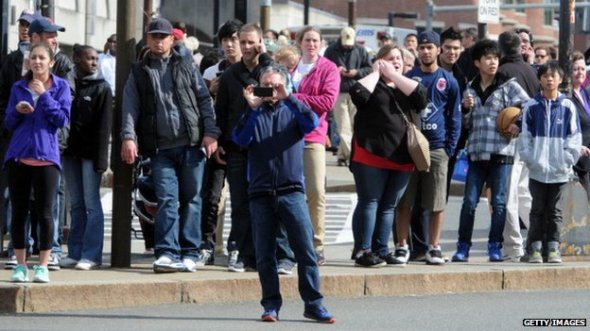
Many of the spectators at the Boston Marathon had cameras on hand
Once again, we’re hearing that the FBI will release photos of persons of interest in the Boston Marathon bombing. One image is a screen grab from a video and the other is a still photo. One image comes from the site of the first explosion and the second comes from the second bombing site.
I’m listening to WBUR right now, and the news conference is just beginning. I’ll add more to this post after I listen to the announcement. If you’re watching on TV, please chime in. I don’t want to miss anything by running in the other room to turn on the TV.
Agent Des Lauriers says these are the only images the public should trust–any others you see on-line or in newspapers are not relevant.
The images can be viewed at the FBI website, which is opening very slowly, unsurprisingly.
Here are two relevant links that I found before the press conference began.
The Boston Globe: Feds using photo analysis in Boston case
USA Today: Investigators to release images of two men near Marathon bomb sites
Here’s the video released by the FBI:
Screen grabs from the FBI website:
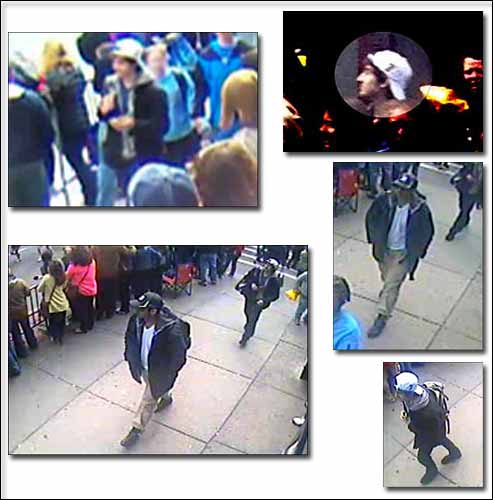
FBI Press Conference Video:
From the FBI Website:
To Provide Tips in the Investigation
If you have visual images, video, and/or details regarding the explosions along the Boston Marathon route and elsewhere, submit them on https://bostonmarathontips.fbi.gov/. No piece of information or detail is too small.
You can also call 1-800-CALL-FBI (1-800-225-5324), prompt #3, with information.
All media inquiries should be directed to the FBI’s National Press Office at (202) 324-3691.– Boston FBI
– Boston Police Department
Some information on the victims of the bombings:
The Boston Globe: A list of known victims so far.
Time: The Boston Bombings: Peculiar Benefits of the 9/11 Wars
Within hours of the Boston Marathon bombing Monday, the Navy dispatched a three-member team from Newport, R.I., to try to help to track down the perpetrators. As word spread of multiple amputations among the victims, military doctors agreed that their skills at outfitting troops with prosthetics could help those maimed in Boston.
But beyond that obvious help, the military has learned lessons since 9/11 that are all too applicable in the wake of the Boston bombings.
“Because of the wars in Iraq and Afghanistan, there are many people in the country that are skilled in treating traumatic injuries like amputations and traumatic brain injuries,” Alex Horton, an Iraq-war veteran who now blogs for the VA, noted Tuesday. “Physicians have a larger breadth of knowledge about these injuries than a dozen years ago, and lessons learned from the wars undoubtedly saved many lives in operating rooms in and around Boston.”
In a post on the VA’s Vantage Point blog, Horton noted that many of those first on the scene to tend to the casualties had learned their skills in the wars in Afghanistan and Iraq.
The Boston Globe: 5-year-old boy among Marathon bombing victims who are ‘getting better’ at Boston Medical Center
A 5-year-old boy grievously injured in Monday’s Marathon bombings is getting better, according to Boston Medical Center Chief of Trauma Services Peter Burke, and is no longer listed in critical condition….
The boy suffered soft tissue injuries to his extremities and “significant pulmonary injuries,” Burke said. The pulmonary injuries, he said, were likely caused either by compression from the blast or from being thrown into something. His mother was injured and is at a different hospital.
Burke discussed the similarities between the injuries in Boston and those encountered in Iraq and Afghanistan.
Sixteen patients remain in the hospital, Burke said: one 60-year-old man is still in critical condition, 10 patients are in serious condition and five are in fair condition; doctors expect to reoperate on two patients today. In the past 48 hours, he said, three patients have been discharged.
Doctors at BMC have amputated seven limbs on five patients, he said….
Several patients still require more surgeries, Burke said.
“These injuries are massive and require multiple trips to the operating room sometimes,” said Burke.
If doctors close wounds in one single operation, he said, they risk infection. Instead, wounds must be cleaned several times. Doctors have removed metal and concrete from patients, he said, and infection is one of the biggest concerns.
Patients are also suffering emotional repercussions, including flashbacks of the bombings.
An update: 5-year-old Boston bomb victim no longer critical
Burke says the boy, whose name has not been released, had significant soft tissue injuries and pulmonary injuries. He says a blast can often compress a child’s chest, bruising the lungs and heart. Burke says he’s pleased with the boy’s progress.
ABC News: Boston Marathon Bomber Wanted to Kill ‘as Many People as Possible’
The bombmakers behind the Boston Marathon explosions weren’t looking to scare people, a trauma surgeon with nine years of military experience told ABCNews.com.
They intended to kill, said former Navy surgeon Dr. Gary Schwendig.
“That person or those people did everything they could to create a bomb that damaged and injured as many people as they possibly could,” said Schwendig, who now works at Scripps Health in San Diego.
It won’t be clear for some time how many patients will need to have limbs amputated.
Many victims of the Boston Marathon bombings face possible amputations in the coming days and months, hospitals reported.
Brigham and Women’s Hospital has already performed one amputation, and is working to save another patient’s injured limb. Massachusetts General Hospital has amputated four limbs so far, and is treating two patients who could face amputation in the coming days. At Tufts Medical Center, doctors have not yet performed any full amputations, but four victims have limb-threatening injuries.
A trauma expert in the article says that amputation is often better choice than trying to save a mangled arm or leg. The process of trying to save an extremity can take years and be extremely painful. Even then, amputation may become necessary in the long run.
LA Times: Many Boston victims require limb amputations
It may have lacked the dust and dirt of battlefields in Iraq and Afghanistan, but Monday’s bomb attack on the Boston Marathon produced a number of injuries rarely seen outside of war zones — traumatic limb amputations.
Medicine has made great strides in the reattachment of severed limbs in the last two decades, but the nature of bomb blast injuries makes such repairs impossible.
“The only types of injuries that can be re-implanted are those involving clean separations, like a limb that’s been cut off by a sword or industrial machinery that cleanly cuts the arm or leg off,” said Dr. Jeffrey Eckardt, chairman of the orthopedic surgery department at UCLA. “With an explosion, whole sections of the bone and muscles are gone. Vessels and nerves get pulled and stretched and yanked.”
I’ve been unable to find organized information about how many victims were initially brought in to hospitals in critical condition, but this morning I heard on NPR that 62 victims were still being treated in various Boston area hospitals. Some could have been released today. As of yesterday–two days after the bombings–14 patients were still classified as critical, but all are expected to recover.
Two children are still in critical condition.
An 11-year-old California boy and a 9-year-old girl are in critical condition at Boston Children’s Hospital following the deadly bombings at the Boston Marathon. A 5-year-old boy is in critical condition at Boston Medical Center.
Aaron Hern, of Martinez, Calif., has undergone multiple operations, including three to four hours of surgery on Wednesday to further treat his badly injured leg, including removing shrapnel and damaged tissue. His 12th birthday is May 1.
The 9-year-old girl also has a severe leg injury.
I just found some information on those who have been released from hospitals. (HuffPo) The article gives specifics on how many patients each hospital had and how many are still critical.
Final Note:
As Dakinikat has pointed out to me, all the focus on the events in Boston is probably inappropriate since there are hundreds (thousands?) of worse bombings every day all over the world.
I guess because I live here, I’m inordinately interested in and emotionally involved with the situation, but I realize not everyone is. Of course for people in New England and those who run marathons, these events will signal a dramatic change. As Charles Pierce wrote, Patriots Day and the Boston Marathon will never be the same.
The Marathon was the old, drunk uncle of Boston sports, the last of the true festival events. Every other one of our major sporting rodeos is locked down, and tightened up, and Fail-Safed until the Super Bowl now is little more than NORAD with bad rock music and offensive tackles. You can’t do that to the Marathon. There was no way to do it. There was no way to lock down, or tighten up, or Fail-Safe into Security Theater a race that covers 26.2 miles, a race that travels from town to town, a race that travels past people’s houses. There was no way to garrison the Boston Marathon. Now there will be. Someone will find a way to do it. And I do not know what the race will be now. I literally haven’t the vaguest clue.
I had actually started writing a post on the explosion in Texas, but then the FBI press conference suddenly came up. This will be my last post on the situation here in Boston unless truly dramatic news of national interest breaks.
FBI Says They Know Who Pulled Off the Gardner Heist
Posted: March 18, 2013 Filed under: Crime | Tags: FBI, Isabella Stuart Gardner Museum, stolen artwork, the Gardner heist 26 Comments
Photo of empty frame in the Garner Museum (thieves cut paintings from their frames)
There was exciting news in Boston today!
The Boston office of the FBI held a press conference to announce that they strongly believe they have identified the culprits who stole 13 paintings worth $500 million from the Isabella Stuart Gardner Museum 23 years ago today. The Boston Globe reports:
The officials also said they had determined where the artworks had traveled in the years after the robbery, which is considered the greatest art theft in history. But the officials said they did not know where they were now and were appealing to the public for their help in finding them.
“The FBI believes with a high degree of confidence in the years after the theft the art was transported to Connecticut and the Philadelphia region and some of the art was taken to Philadelphia where it was offered for sale by those responsible for the theft. With that confidence, we have identified the thieves, who are members of a criminal organization with a base in the mid-Atlantic states and New England,” Richard DesLauriers, special agent in charge of the Boston office of the FBI, said.
DesLauriers said that after the attempted sale of the paintings about a decade ago, the FBI did not know where the artworks — which included three Rembrandts, a Vermeer, a portrait by Edouard Manet, and sketches by Renoir — had been taken.
They refused to reveal the names of the culprits while the investigation is still ongoing. The FBI decided to hold the press conference on the anniversary of the art theft–the largest such heist in history–in order to ask for help from the public. They no longer know the location of the paintings and they hope that someone will come forward, as happened when they request help in finding Boston gangster Whitey Bulger.
According to the Hartford Courant, the FBI
disclosed new detail about their interest in Hartford mobster Robert Gentile….They…would not answer specific questions about Gentile, a 75-year-old gambler and confidence man long associated with the rackets in Hartford. The officials said that, to discuss Gentile or other suspects, could jeopardize the continuing investigation.
But since 2010, Gentile has been questioned repeated about his membership in the Boston branch of a Philadelphia-based criminal organization, as well as leads that place at least some of the stolen paintings in Connecticut and the Philadelphia area.
DesLauriers said he doesn’t know what happened to the art after it was transported to Philadelphia.
The FBI, Boston’s U.S. Attorney and the museum’s security chief released surprising detail at a Boston press conference followed around the world about what for years had been a largely fruitless investigation. The officials were looking for a jolt of publicity to generate new leads in Connecticut and Pennsylvania. The officials also referred repeatedly to a $5 million reward for information leading to the recovery of the art….
Although the officials refused to discuss Gentile by name, the information the FBI released about who robbed the museum and how the stolen art was moved years later corresponds closely with their theories about Gentile’s involvement in the crime. The officials also said, without explaining why, that the investigation has been particularly active since 2010, which is when they first questioned Gentile.
Gentile is currently in jail for selling prescription painkillers. After his arrest, his home was searched, but no stolen paintings were found–just lots of drugs, money, and weapons.

Rembrandt’s “Storm on the Sea of Galilee,” stolen from the Gardner Museum
Here’s some background on the Gardner Heist and the long investigation from a 2005 article in The Boston Globe.
As they struggled to remove a heavy-framed Rembrandt from the silk-draped wall of the Isabella Stewart Gardner Museum, the two thieves abruptly stopped as a high-pitched alarm beeped from the baseboard.
They must have been startled.
But not for long. Intended to alert guards when museum visitors ventured too close to the art, the alarm was quickly hunted down by the men. They smashed it silent and went back to work on what remains, 15 years after that misty March night in 1990, the biggest art heist in history.
The warning beeper proved to be the only part of the museum’s security system that deterred the men at all. They would spend 81 minutes moving through the darkened galleries of the Italianate mansion Mrs. Jack Gardner built at the turn of the century to house her private art collection and share it with the public; they could have stayed all night.
The men got into the museum by dressing as Boston police officers and convincing the guard on duty, Richard Abath, to let them in because they had been called about a disturbance. They then tied up Abath and another security guard and handcuffed them in the basement.
Once inside, the thieves ripped a Vermeer, three Rembrandts — including his only seascape — five Degas drawings, and a Manet from their wall placements, smashing them out of their frames and leaving shards of glass and remnants of canvas behind. The thieves took some of the museum’s greatest treasures but left behind some even more valuable objects.
When they were done for the night, they made two trips to their car with the loot. Then they vanished.
Where the paintings were, empty frames now fill the museum’s walls.

Richard Abath in 2013
Abath was 23, a student at the Berklee School of Music and a rock musician who worked nights as a security guard at the museum. He wasn’t a suspect at first–he even passed two polygraph tests, but today he’s being looked at as a possible accessory to the crime.
For years, investigators discounted the hapless Abath’s role in the unsolved crime, figuring his excessive drinking and pot smoking contributed to his disastrous decision to let in the robbers, who were dressed as police officers. Even if the duo had been real cops, watchmen weren’t supposed to admit anyone who showed up uninvited at 1:24 a.m.
But, after 23 years of pursuing dead ends, including a disappointing search of an alleged mobster’s home last year, investigators are focusing on intriguing evidence that suggests the former night watchman might have been in on the crime all along — or at least knows more about it than he has admitted.
Why, they ask, were Abath’s footsteps the only ones picked up on motion detectors in a first floor gallery where one of the stolen paintings, by French impressionist Edouard Manet, was taken? And why did he open the side entrance to the museum minutes before the robbers rang the buzzer to get in? Was he signaling to them that he was prepared for the robbery to begin?
No one publicly calls Abath a suspect, but federal prosecutors grilled him on these issues last fall. And one former prosecutor in the case has written a recently published novel about the Gardner heist in which the night watchman let the thieves into the museum to pay off a large cocaine debt.
It would be incredible if the paintings could be recovered! It would far more thrilling than finding Whitey Bulger. The statute of limitations on the theft has already run out, and anyone who came forward would likely be given immunity for revealing the location(s) of the artwork. According to the Boston Herald,
The FBI stressed that anyone with information about the artwork may contact the FBI at 1-800-CALL FBI (1-800-225-5324) or the museum directly or through a third party, said Special Agent Geoffrey Kelly, who is the lead investigator for the theft and a member of the art crime team, “In the past, people who realize they are in possession of stolen art have returned the art in a variety of ways, including through third parties, attorneys and anonymously leaving items in churches or at police stations.” Tips may also be submitted online athttps://tips.fbi.gov.
The publicity campaign announced today includes a dedicated FBI website on the Gardner Museum theft, video postings on FBI social media sites, publicity on digital billboards in Philadelphia region, and a podcast. To view and listen to these items, link to the FBI’s new website about the theft: www.FBI.gov/gardner.
Below are photos of some of the missing paintings. See more at Time Magazine.

Vermeer, “The Concert”

Degas, “La Sortie de Pesage”

Manet, “Chez Tortoni”

Govaert Flinck, “Landscape with Obelisk”

 peej
peej Carissa
 bostonboomer
 dakinikat
 ecocatwoman
 mablue2
 Mama Lopez
 peggysue22
 quixote
 skydancingguestblogger
 Mona (aka Wonk the Vote)



 Sky Dancing
Recent Comments