
Wednesday Reads: Clown Prince Trump
Posted: April 9, 2025 Filed under: Donald Trump, U.S. Economy, U.S. Politics | Tags: bond market crash, China, Elon Musk, EU, Financial Crisis, global safe haven, Stock Market, UK 13 Comments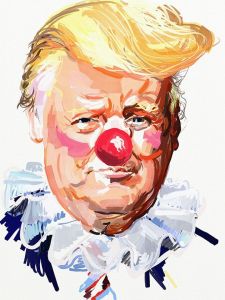
By Eric Fischl
Hello Sky Dancers!!
Dakinikat should be writing this post, but you’re stuck with me. I stayed up till about 2:30 last night doom scrolling and trying to understand what Trump’s tariff madness has done to us. The latest disaster last night was that the bond market is collapsing.
I’ll do my best to post relevant stories, and perhaps Dakinikat will chime in later. Thanks to Trump’s insanity, we could end up in another financial crisis comparable to the one in 2008.
What’s happening with tariffs:
There’s even more insane news this morning: China responded to Trump’s 104 percent tariff threat with another 84% tariff on the U.S.
CNBC: China slaps 84% retaliatory tariffs on U.S. goods in response to Trump.
China has pushed back again on U.S. President Donald Trump’s tariff policies by hiking its levies on U.S. imports to more than 80%.
Tariffs on U.S. goods entering China will rise to 84% from 34% starting April 10, according to a translation of a Office of the Tariff Commission of the State Council announcement. The hike comes in response to the latest U.S. tariff increase on Chinese goods to more than 100% that began at midnight.
The tit-for-tat escalation of tariffs threatens to crush trade between the world’s two largest economies. According to the Office of the U.S. Trade Representative, the U.S. exported $143.5 billion of goods to China in 2024, while importing products worth $438.9 billion.
The Trump administration announced a sweeping new tariff policy last week, warning other countries not to retaliate. Some nations, including Japan, have seemed willing to negotiate on tariffs, but China appears to be taking a more hard-line stance and quickly announced a countertariff.
After China’s initial response to the April 2 tariff rollout, Trump announced an additional 50% hike, putting the total level for import taxes on Chinese goods at 104%….
The trade war has spooked investors around the world by increasing the odds of slower economic growth, higher inflation and lower corporate profits, sparking a sharp sell-off in April.
The S&P 500 finished Tuesday down nearly 20% from its peak, putting the U.S. large-cap stock index in a bear market. South Korea’s Kospi Index fell into a bear market of its own on Wednesday. Stocks in Shanghai and Hong Kong are also down sharply since the U.S. tariff announcement on April 2.
David Pierson and Barry Wang at The New York Times: For U.S. and China, a Risky Game of Chicken With No Off-Ramp in Sight.
A whopping increase in tariffs, followed by a whopping retaliation. Nationalist Chinese bloggers comparing President Trump’s levies to a declaration of war. China’s Foreign Ministry vowing that Beijing will “fight to the end.”
For years, the world’s two biggest powers have flirted with the idea of an economic decoupling as tensions between them have risen. The acceleration this week of their trade relationship’s deterioration has made the prospect of such a divorce seem closer than ever.
That was underscored on Wednesday when China announced an additional 50 percent tariff on U.S. goods, matching new American levies that had taken effect hours earlier. China also struck at American companies, imposing export controls on a dozen of them and adding six others to a list of “unreliable entities,” preventing them from doing business in China.
China’s new tariffs, which will take effect on Thursday, mean all American goods shipped to China will face an additional 85 percent import tax. The minimum U.S. tax on Chinese imports is now 104 percent. Both figures would have been unimaginable a few weeks ago.
With China’s top leader, Xi Jinping, and Mr. Trump locked in a game of chicken — each unwilling to risk looking weak by making a concession — the trade fight could spiral even further out of control, inflaming tensions over other areas of competition like technology and the fate of Taiwan, the self-governing island claimed by Beijing.
Mr. Trump’s bare-knuckle tactics make him a singular force in U.S. politics. But in Mr. Xi, he faces a hardened opponent who survived the turmoil of China’s late-20th-century political purges, and who views the United States’ competitive tactics as ultimately aimed at subverting the ruling Communist Party’s legitimacy.
“Trump has never gone into a back-alley brawl where the other side is willing to brawl and use the same kind of tactics as him,” said Scott Kennedy, a senior adviser at the Center for Strategic and International Studies, a Washington think tank. “For China, this is about their sovereignty. This is about the Communist Party’s hold on power. For Trump, it might just be a political campaign.”
 From what I’m hearing and reading, this is going to hit U.S. small businesses hard, drive many of them into bankruptcy, and send their employees to the unemployment lines.
China isn’t the only country that’s retaliating.
Politico: EU takes revenge on Trump’s tariffs as countries approve €20B+ retaliation.
BRUSSELS — The EU can apply retaliatory tariffs on nearly €21 billion of U.S. products like soybeans, motorcycles and orange juice after the bloc’s 27 countries assented to the measures on Wednesday, the European Commission announced.
“The EU considers U.S. tariffs unjustified and damaging, causing economic harm to both sides, as well as the global economy. The EU has stated its clear preference to find negotiated outcomes with the U.S., which would be balanced and mutually beneficial,” the EU executive said in a statement.
Hitting back against U.S. President Donald Trump’s steel and aluminum tariffs, the European Union’s countermeasures will apply in three rounds. Measures covering €3.9 billion in trade will go into force next week, with a further €13.5 billion from mid-May and a final round of €3.5 billion following in December.
Only Hungary opposed the package, according to four EU diplomats with direct knowledge of the vote, while all other 26 countries voted in favor….
The retaliation does not yet respond to Trump’s imposition of 20 percent “reciprocal” tariffs on all EU exports, which came into force on Wednesday, and his latest 25 percent tariff on cars. Trump has also said tariffs on pharmaceuticals are coming soon.
The European Commission is considering putting forward its countermeasures on those tariffs as early as next week. “It will for sure be soon. I expect it could be as early as next week,” trade spokesperson Olof Gill said Tuesday.
What’s happening with the bond markets:
Felix Salmon at Axios: The bond market plunges as crisis brews.
The price of U.S. Treasury bonds is plunging, in what Treasury Secretary Scott Bessent on Wednesday called “deleveraging convulsions.” The effect is to raise borrowing costs just as recession fears spike.
Why it matters: The last thing America needed in the midst of a global trade war and a stock-market meltdown was a debt crisis too. But that now seems to be a real possibility.
What they’re saying: “This is the script for a truly existential financial crisis,” writes Columbia economic historian Adam Tooze, who wrote a whole book on the very similar dynamics that overtook the Treasury market in March 2020.
Driving the news: Bond yields — which move in the opposite direction to prices — are soaring in the wake of protectionist U.S. tariffs.
- The amount that the U.S. government needs to pay to borrow money for a decade rose briefly to more than 4.5% Wednesday morning. For a 30-year bond, the yield rose to more than 5%.
- Those moves are truly enormous by bond market standards. As recently as Friday, the 10-year yield was less than 4%, and the 30-year was below 4.4%.
The intrigue: In normal times, the most consistent buyer of Treasury bonds is a group of hedge funds that participate in something called the “basis trade.”
- They buy the bonds in order to hedge their derivatives exposure to institutional investors, who can lock in slightly higher yields in the futures market.
- The profit on any given trade is minuscule, but it’s also very close to risk-free, so the hedge funds can apply as much as 50x or even 100x leverage.
- By many accounts, the basis trade is now unwinding, which means the hedge funds are selling their bonds — or, at the very least, not buying new ones.
The big picture: In a move reminiscent of the bond-market tantrum that swept U.K. Prime Minister Liz Truss from office in 2022, the technical factors in the bond market were precipitated by — and also exacerbated — fundamental issues with the country’s finances.
 More from Philip Inman and Jasper Jolly at The Guardian: Dramatic sell-off of US government bonds as tariff war panic deepens.
US government bonds, traditionally seen as one of the world’s safest financial assets, are undergoing a dramatic sell-off as Donald Trump’s escalation of his tariff war with China sends panic through all sectors of the financial markets.
The falls suggest that as Trump’s fresh wave of tariffs on dozens of economies came into force, including 104% levies against Chinese goods, investors are beginning to lose confidence in the US as a cornerstone of the global economy.
The yield – or interest rate – on the benchmark 10-year US Treasury bond rose by 0.16 percentage points on Wednesday to 4.42%, its highest since late February – and this week has undergone the three biggest intraday moves since Trump was elected in November. Yields move inversely to prices, so surging yields mean falling prices as demand drops.
The move in the 30-year bond was more dramatic. The 30-year yield briefly jumped above 5% to its highest since late 2023 and was last trading at 4.9157%, or 0.2 percentage points higher than Tuesday.
“This is a fire sale of Treasuries,” said Calvin Yeoh, portfolio manager at the hedge fund Blue Edge Advisors. “I haven’t seen moves or volatility of this size since the chaos of the pandemic in 2020,” he told Bloomberg.
Analysts believe the US Federal Reserve may need to step in. Jim Reid, at Deutsche Bank, said: “Markets are pricing a growing probability of an emergency [interest rate] cut, just as we saw during the Covid turmoil and the height of the GFC [global financial crisis] in 2008.” [….]
UK bonds were also under severe pressure after the US moves. The yield on a 30-year UK gilt hit 5.518% on Wednesday morning, up 16 basis points and surpassing a previous 27-year high of 5.472% set in January.
Shorter-dated 10-year gilt yields were slightly higher at 4.69% while two-year yields ticked down at 3.92%.
Higher yields on gilts – UK government bonds – will make things even more difficult for Downing Street, as it will raise the cost of borrowing to fund investment.
Colby Smith at The New York Times (gift link): U.S. Bond Sell-Off Raises Questions About ‘Safe Haven’ Status.
A sharp sell-off in U.S. government bond markets has sparked fears about the growing fallout from President Trump’s sweeping tariffs and retaliation by China, the European Union and others, raising questions about what is typically seen as the safest corner for investors to take cover during times of turmoil.
Yields on 10-year Treasuries — the benchmark for a wide variety of debt — shot 0.2 percentage points higher on Wednesday, to 4.45 percent, a big move in that market. Just a few days ago, it had traded below 4 percent. Yields on the 30-year bond rose significantly as well, at one point on Wednesday topping 5 percent. Borrowing costs globally have also shot higher.
The sell-off comes as investors have fled riskier assets globally in what some fear has parallels to what became known as the “dash for cash” episode during the pandemic, when the Treasury market broke down. The recent moves have upended a longstanding relationship in which the U.S. government bond market serves as a safe harbor during times of stress.
Volatility has surged as stock markets have plummeted amid fears that the U.S. economy is hurtling toward stagflation, in which economic growth contracts while inflation surges. The S&P 500 is now on the verge of entering a bear market, meaning it has dropped 20 percent from its recent high.
 The global safe-haven:
“The global safe-haven status is in question,” said Priya Misra, a portfolio manager at JPMorgan Asset Management. “Disorderly moves have happened this week because there is no safe place to hide.”
Scott Bessent, the U.S. Treasury secretary, sought to tamp down concerns on Wednesday, brushing off the sell-off as nothing more than investors who bought assets with borrowed money having to cover their losses.
“I believe that there is nothing systemic about this — I think that it is an uncomfortable but normal deleveraging that’s going on in the bond market,” he said in an interview with Fox Business.
But the moves have been significant enough to raise broader concerns about how foreign investors now perceive the United States, after Mr. Trump decided to slap onerous tariffs on nearly all of its trading partners. Some countries have sought to strike deals with the administration to lower their tariff rates. But China retaliated on Wednesday, announcing an 84 percent levy on U.S. goods after Mr. Trump raised the tariff rate on Chinese goods to 104 percent.
In a social media post on Wednesday, the former U.S. Treasury secretary Lawrence H. Summers said the broader sell-off suggested a “generalized aversion to US assets in global financial markets” and warned about the possibility of a “serious financial crisis wholly induced by US government tariff policy.”
Some analysis and commentary on what’s happening:
Heather Cox Richardson at Letters from an American: April 8, 2025.
Stocks were up early today as traders put their hopes in Treasury Secretary Scott Bessent’s suggestion that the Trump administration was open to negotiations for lowering Trump’s proposed tariffs. But then U.S. Trade Representative Jamieson Greer said there would not be exemptions from the tariffs for individual products or companies, and President Donald J. Trump said he was going forward with 104% tariffs on China, effective at 12:01 am on Wednesday.
Markets fell again. By the end of the day, the Dow Jones Industrial Average had fallen by another 320 points, or 0.8%, a 52-week low. The S&P 500 fell 1.6% and the Nasdaq Composite fell 2.2%.
Rob Copeland, Maureen Farrell, and Lauren Hirsch of the New York Times reported today that over the weekend, Wall Street billionaires tried desperately and unsuccessfully to change Trump’s mind on tariffs. This week they have begun to go public, calling out what they call the “stupidity” of the new measures. These industry leaders, the reporters write, did not expect Trump to place such high tariffs on so many products and are shocked to find themselves outside the corridors of power where the tariff decisions have been made.
Elon Musk is one of the people Trump is ignoring to side with Peter Navarro, his senior counselor for trade and manufacturing. Navarro went to prison for refusing to answer a congressional subpoena for information regarding Trump’s attempt to overturn the 2020 presidential election. Since Musk poured $290 million into getting Trump elected in 2024 and then burst into the news with his “Department of Government Efficiency,” he has seemed to be in control of the administration. But he has stolen the limelight from Trump, and it appears Trump’s patience with him might be wearing thin.
Elizabeth Dwoskin, Faiz Siddiqui, Pranshu Verma, and Trisha Thadani of the Washington Post reported today that Musk was among those who worked over the weekend to get Trump to end his new tariffs. When Musk failed to change the president’s mind, he took to social media to attack Navarro personally, saying the trade advisor is “truly a moron,” and “dumber than a sack of bricks.”
Read the rest at the Substack link above.
David E. Sanger at The New York Times (gift link): An Experiment in Recklessness: Trump as Global Disrupter.
As the breadth of the Trump revolution has spread across Washington in recent weeks, its most defining feature is a burn-it-down-first, figure-out-the-consequences-later recklessness. The costs of that approach are now becoming clear.
Administration officials knew the markets would dive and other nations would retaliate when President Trump announced his long-promised “reciprocal” tariffs. But when pressed, several senior officials conceded that they had spent only a few days considering how the economic earthquake might have second-order effects.
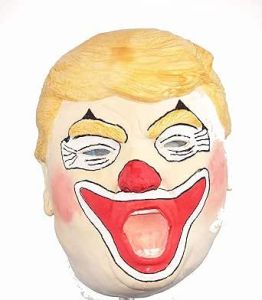
Trump clown mask
And officials have yet to describe the strategy for managing a global system of astounding complexity after the initial shock wears off, other than endless threats and negotiations between the leader of the world’s largest economy and everyone else.
Take the seemingly unmanaged escalation with China, the world’s second largest economy, and the only superpower capable of challenging the United States economically, technologically and militarily. By American and Chinese accounts, there was no substantive conversation between Mr. Trump and China’s top leader, Xi Jinping, or engagement among their senior aides, before the countries plunged toward a trade war.
Last Wednesday, Mr. Trump’s hastily devised formula for figuring out country-by-country tariffs came up with a 34 percent tax on all Chinese goods, everything from car parts to iPhones to much of what is on the shelves at Walmart and on Amazon’s app.
When Mr. Xi, predictably, matched that figure, Mr. Trump issued an ultimatum for him to reverse the decision in 24 hours — waving a red flag in front of a leader who would never want to appear to be backing down to Washington. On Wednesday, the tariff went to 104 percent, with no visible strategy for de-escalation.
If Mr. Trump does get into a trade war with China, he shouldn’t look for much help from America’s traditional allies — Japan, South Korea or the European Union — who together with the United States account for nearly half of the world economy. All of them were equally shocked, and while each is negotiating with Mr. Trump, they seem in no mood to help him manage China.
“Donald Trump has launched a global economic war without any allies,” the economist Josh Lipsky of the Atlantic Council wrote on Tuesday. “That is why — unlike previous economic crises in this century — there is no one coming to save the global economy if the situation starts to unravel.”
The global trading system is only one example of the Trump administration tearing something apart, only to reveal it has no plan for how to replace it.
Read the rest at the NYT.
Andrew Egger at The Bulwark: A Microwaved Mind.
There’s a paradox to covering Donald Trump these days. On the one hand, he’s never out of the news—a wannabe dictator busy remaking the government and the economy so that more and more decisions about our futures answer only to his whim. On the other hand, there’s so much news about what he’s doing that it’s easy to reduce our thinking about Trump to the sum of his actions. There’s Trump the bundle of bad policy ideas, Trump the destroyer of institutions, Trump the fountain of post-truth grievance. It’s hard to take the time to dwell on the man himself—to focus our attention on Donald Trump the clown.
Yesterday afternoon, as markets continued crashing and with the further implementation of backbreaking tariffs just hours away, the clown was on full display. Trump participated in the ceremonial signing of an executive order on “unleashing American energy.” In the East Room event, he was in his element: coal miners in hard hats behind him, an audience crammed with his political flunkies in front. He ended up riffing for about 45 minutes. Let’s listen in, shall we? [….]
The topic du jour, of course, was energy, specifically the “beautiful clean coal” that Trump loves so much. Trump riffed at length on the supposed stupidity of proposals to retrain miners for skilled labor in other industries, reminiscing his 2016 campaign against Hillary Clinton:
“One thing I learned about the coal miners . . . You could give them a penthouse on Fifth Avenue and a different kind of a job and they’d be unhappy. Coal mining is what they love to do,” Trump said. “And she was gonna put them in a high-tech industry, to make little cell phones, I don’t know. Do you think you’d be good at that? I don’t know.”
Anyway, no need for any of that now, the president exulted: “We’re gonna be crushing Biden-era environmental restrictions. . . . And we have clean air and clean water and now we have clean coal. And at the same time we’re gonna do other things and forms of technology and also energy, like our country has never seen before.”
On his tariffs:
Trump didn’t totally avoid talk of the market crash he kicked off last week—a “whole situation,” he noted, that “was somewhat explosive.”
But, Trump added, you should see the response we’re getting! “We have had talks with many, many countries. . . . And our problem is, we can’t see that many that fast. But we don’t have to because, you know, the tariffs are on, and money is pouring in at a level that we’ve never seen before.”
How much money are we talking? “We’re taking in almost $2 billion a day in tariffs,” Trump said. “America is gonna be very rich again very soon.”
Got all that? Yes, markets are tanking because of the tariffs. But not to worry: We’re going to strike great deals to replace them soon. But not too soon, because we don’t have time to deal with all these countries at once. But that’s okay, because look at how much money these tariffs are making us!
That’s it for me. I’ve learned a lot and I plan to continue studying this stuff. I expect Daknikat with have a lot to say on Friday. For now, hang in there everyone and take care of yourselves.
Lazy Saturday Reads
Posted: May 9, 2015 Filed under: Foreign Affairs, morning reads, Republican politics, U.S. Economy, U.S. Politics | Tags: academic freedom, Boston University, Chicago Teachers Union, David Cameron, EU, freedom of speech, Illinois legislature, Illinois Supremem Court, Rahm Emanuel, Saida Grundy, Scottish independence movement, UK elections, world media 31 Comments
Students study for finals on “BU Beach,” May 6, 2015
Good Morning!!
Well, well, well. Boston University and a newly hired assistant professor of sociology are being attacked by right wing nuts who can’t handle free speech or academic freedom. And so far BU is telling them they’re just going to have to deal with it. I hope they stick to their guns, so to speak. In honor of the school administration doing the right thing, I’m illustrating this post with views of the beautiful BU campus.
Fox News is shocked! Naturally, they begin with a version of “some people say….”
Boston University prof flunks ‘white masculinity’ in controversial tweets.
Critics say a newly-hired Boston University professor has crossed the line with recent tweets bashing whites, but the school says it’s simply free speech.
“White masculinity isn’t a problem for america’s colleges, white masculinity is THE problem for america’s colleges,” Saida Grundy, an incoming assistant professor of sociology and African-American studies at Boston University, tweeted in March.
In another tweet from January, she wrote: “Every MLK week I commit myself to not spending a dime in white-owned businesses. and every year i find it nearly impossible.”
In another, she called white males a “problem population.”
“Why is white America so reluctant to identify white college males as a problem population?” she asked.

View of BU’s Charles River Campus.
Horrors! A black female sociologist who studies traditional masculinity had a few things to say on Twitter about white males. No one has to agree with her or even read her tweets (she has now made her account private). The KKK, the American Nazi Party, Rand Paul, Mike Huckabee, Peggy Noonan, Ted Cruz, Sarah Palin, Bill O’Reilly, Ann Coulter, and every other right wing nut you can name have the same rights to say mean things about any groups of people they choose.
Here’s BU’s response to Fox’s request for comment:
“Professor Grundy is exercising her right to free speech and we respect her right to do so,” Boston University spokesman Colin Riley said.
Read more of Grundy’s “controversial” tweets at the Fox News link and at a Patriots fan site here. I don’t know why they’re all bent out of shape about this.
Grudy got her Ph.D. at the University of Michigan, and her other credentials look pretty good to me.
So far there hasn’t been a lot of reaction to this except from right wing sites like American Thinker and American Spectator. I’ll be keeping an eye on the story and whether BU continues to defend Grundy. If they don’t I’ll be very disappointed. It’s not about agreeing with everything she said; it’s about not giving in to the predictable right wing attacks on anyone who says something they disagree with–even if it’s only on Twitter.

BU College of Arts and Sciences
In other “diversity” news, a restaurant in Colorado is planning a “White Appreciation Day.” That should make the wingnuts happy. From MSNBC:
A Colorado barbecue joint has sparked national outrage with a racially-tinged promotion: “White Appreciation Day.”
“We have a whole month for Black History Month. We have a whole month for Hispanic heritage month,” Edgar Antillon told KUSA-TV. “So we figured all we could do – the least we can do – is offer one day to appreciate white Americans.”
Antillon told the NBC News affiliate that Rubbin’ Buttz, the restaurant he co-owns in Milliken, Colorado, would observe its “White Appreciation Day” on June 11. On this day, all white customers will receive a 10% discount.
It’s worth noting that Antillon is a first-generation American born to Mexican parents, and he acknowledged to KUSA-TV that he has personally experienced racism in his past.
“We’re all American, plain and simple,” he said to the NBC News affiliate.
Apparently the whole thing started as a joke, and then Antillon decided to actually do it. Who cares? It’s dumb and pointless, unless the goal is just to get national publicity. Why not just ignore it? According to The Root, non-white people could end up suing the restaurant for discrimination. The outrage industry in this country is completely out of control.

6/7/10 1:07:44 PM — Boston, Massachusetts
Campus Scenics of Kemore Square, Boston Skyline, BU Banners and Commonwealth Ave
Photo by Vernon Doucette for Boston University
Now for a little actual news.
The Illinois Supreme Court has struck down an effort by the state to cut public employee pensions. The Chicago Tribune reports:
The Illinois Supreme Court on Friday unanimously ruled unconstitutional a landmark state pension law that aimed to scale back government worker benefits to erase a massive $105 billion retirement system debt, sending lawmakers and the new governor back to the negotiating table to try to solve the pressing financial issue.
The ruling also reverberated at City Hall, imperiling a similar law Mayor Rahm Emanuel pushed through to shore up two of the four city worker retirement funds and making it more difficult for him to find fixes for police, fire and teacher pension funds that are short billions of dollars.
At issue was a December 2013 state law signed by then-Democratic Gov. Pat Quinn that stopped automatic, compounded yearly cost-of-living increases for retirees, extended retirement ages for current state workers and limited the amount of salary used to calculate pension benefits.
Employee unions sued, arguing that the state constitution holds that pension benefits amount to a contractual agreement and once they’re bestowed, they cannot be “diminished or impaired.” A circuit court judge in Springfield agreed with that assessment in November. State government appealed that decision to the Illinois Supreme Court, arguing that economic necessity forced curbing retirement benefits.
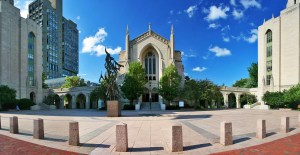
Marsh Chapel at center of Charles River campus
The court disagreed with the state, and really slapped down the Illinois legislature in their decision.
“Our economy is and has always been subject to fluctuations, sometimes very extreme fluctuations,” Republican Justice Lloyd Karmeier wrote on behalf of all seven justices. “The law was clear that the promised benefits would therefore have to be paid and that the responsibility for providing the state’s share of the necessary funding fell squarely on the legislature’s shoulders.
“The General Assembly may find itself in crisis, but it is a crisis which other public pension systems managed to avoid and … it is a crisis for which the General Assembly itself is largely responsible,” Karmeier wrote.
“It is our obligation, however, just as it is theirs, to ensure that the law is followed. That is true at all times. It is especially important in times of crisis when, as this case demonstrates, even clear principles and long-standing precedent are threatened. Crisis is not an excuse to abandon the rule of law. It is a summons to defend it,” he wrote.
Nice win for workers for a change.

Shot of BU buildings on Commonwealth Avenue
Also from the Trib, Chicago teachers are standing up for their rights too: Chicago Teachers Union files labor complaint against school board.
The Chicago Teachers Union has filed an unfair labor practice complaint accusing the city’s school board of bad-faith bargaining and refusing to engage in mediation toward a new contract.
Union officials said little progress has been made over eight formal bargaining sessions and numerous informal meetings since November. The complaint filed Wednesday with the Illinois Educational Labor Relations Board follows the union’s rejection earlier this week of the board’s proposal that teachers take on a greater share of pension payments….
As she did in the months before the 2012 teachers strike, CTU President Karen Lewis sought to make Mayor Rahm Emanuel the focus of the union’s displeasure with talks to replace a contract that expires June 30. The union again accused the city of using the talks to get back at the CTU for its support of Jesus “Chuy” Garcia in the mayoral election.
“We feel this is reactionary and retaliatory,” Lewis said at a news conference Wednesday. “I guess the fuzzy sweater’s gone,” she said, referring to Emanuel’s wearing a sweater in campaign commercials to indicate a softer personality.
The district, which says it is wrestling with a $1.1 billion deficit weighted with pension payments, wants to save millions of dollars by having teachers pay more into their pension fund. The district wants to end a long-standing agreement that limits teacher paycheck deductions for pensions, the union said.
I have a solution for Chicago’s and for the state of Illinois’s budget problems. Tax the rich. Blaming teachers and government workers isn’t going to solve your money problems. It’s just going to make everything worse. Tax the people who can afford to give something back to the government that constantly favors them.

View of Marsh Chapel with Charles River in foreground
We haven’t discussed it here yet, but there was a big election in Great Britain with surprising results.
From The Washington Post after the scope of the conservative victory became clear: British election results point to commanding lead for Conservatives.
LONDON — Exit polls and partial results after a nationwide vote to pick Britain’s next Parliament showed the Conservative Party with a surprisingly commanding lead Friday, just short of a majority and in a strong position to return to power.
The projections defied virtually all pre-election polls, which forecast a virtual tie between the Tories and the opposition Labor Party in the popular vote. Both main parties had been expected to fall well short of the majority needed to claim power outright.
But as the counting continued into dawn Friday, all signs pointed to an emphatic margin in favor of the Conservatives and their leader, Prime Minister David Cameron, and to a major disappointment for Labor as well as the Liberal Democrats, who paid a steep price for having entered into a coalition with the Conservatives for the past five years.
At dawn Friday, Labor leader Ed Miliband delivered what amounted to a concession speech, saying it had been “a very disappointing and difficult night” for his party.
Meanwhile, in the election’s other stunning development, though one that had been predicted, the Scottish National Party (SNP) was redrawing the map of Scotland with what looked like a historic rout in what has long been one of Labor’s most reliable strongholds.

Another aerial view
The results in Scotland could have long-term significance for the “United Kingdom.” if the trend toward Scottish independence continues.
From the WaPo again: In U.K. election’s wake, questions on E.U., Scotland.
Newly empowered British Prime Minister David Cameron moved swiftly to establish the terms and priorities for his new government on Friday after a stunning national election that delivered his Conservative Party an unexpected majority, devastated three other parties and redrew the political map of Scotland.
Following predictions that the post-election maneuvering to form a government might take days if not weeks, the Conservative Party’s big victory produced a quick end to speculation about what or who would be in charge.
But if the election produced an unexpectedly clear outcome, it may only have heightened the degree to which the country faces a period of internal debate, inward-looking politics and potential instability, with questions about the durability of the United Kingdom and its place in both Europe and the world still to be answered.
Cameron will have to find a way to manage resurgent Scottish nationalists who are demanding more powers and possibly another referendum on independence. Further, his pledge to hold a referendum to determine Britain’s future in the European Union will continue to raise uncertainty about the country’s commitments and reliability there.
From BBC News: World media fear UK EU exit, looser US ties.
A day after the surprise result in the UK elections, world media outlets have been taking a look at the ramifications.
European papers are concerned about the effect on the EU in the light of Prime Minister David Cameron’s promise to hold a referendum on leaving. And there is speculation that the Scottish nationalists’ spectacular gains may herald the break-up of the United Kingdom.
A US daily fears the result may be the harbinger of the end of the US-UK “special relationship”, but one Spanish daily is enthralled by a photo of Mr Cameron using cutlery to eat a hot dog.
See examples of media reactions at the link. International Business Times also collected world media reactions, and the stats freaks at FiveThirtyEight had to do some serious soul-searching about why they were completely wrong.
So . . . . what else is happening? Please post your thoughts and links on any topic in the comment thread and have a great spring weekend!!
Tuesday Reads: McCain Plays “Pretend President,” Pressure Cookers, Upcoming Zimmerman Trial, and Other News
Posted: May 28, 2013 Filed under: Barack Obama, Crime, Criminal Justice System, Foreign Affairs, John McCain, morning reads, Republican politics, Syria, U.S. Politics | Tags: Barbara Boxer, EU, Free Syrian Army, Fukushima, Gen. Salem Idris, George Zimmerman, Hussain Al Khawahir, John Kerry, pressure cookers, Pretend President McNasty, Racism, right to vote, San Onofre nuclear plant, Syrian Emergency Task Force, Trayvon Martin, Turkey, US Supreme Court 76 Comments
Good Morning!!
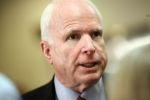
Last night Josh Rogin reported that warmongering Senator John McCain had sneaked across the Syrian border from Turkey and talked to Gen. Idris Salem, head of the “Free Syrian Army.”
McCain, one of the fiercest critics of the Obama administration’s Syria policy, made the unannounced visit across the Turkey-Syria border with Gen. Salem Idris, the leader of the Supreme Military Council of the Free Syrian Army. He stayed in the country for several hours before returning to Turkey. Both in Syria and Turkey, McCain and Idris met with assembled leaders of Free Syrian Army units that traveled from around the country to see the U.S. senator. Inside those meetings, rebel leaders called on the United States to step up its support to the Syrian armed opposition and provide them with heavy weapons, a no-fly zone, and airstrikes on the Syrian regime and the forces of Hezbollah, which is increasingly active in Syria.
Idris praised the McCain visit and criticized the Obama administration’s Syria policy in an exclusive interview Monday with The Daily Beast.
“The visit of Senator McCain to Syria is very important and very useful especially at this time,” he said. “We need American help to have change on the ground; we are now in a very critical situation.”
Apparently McCain decided to play Pretend President to celebrate Memorial Day. I haven’t been paying close attention to the news for the past few days, but I think I would have seen any reports that the White House or the State Department had requested Senator McNasty’s help in reaching out to opposition forces in Syria.
Prior to his visit inside Syria, McCain and Idris had separate meetings with two groups of FSA commanders and their Civil Revolutionary Council counterparts in the Turkish city of Gaziantep. Rebel military and civilian leaders from all over Syria came to see McCain, including from Homs, Qusayr, Idlib, Damascus, and Aleppo. Idris led all the meetings.
The entire trip was coordinated with the help of the Syrian Emergency Task Force, an American nonprofit organization that works in support of the Syrian opposition.
More from Dan Roberts of The Guardian:
McCain’s office confirmed to the Guardian that he had slipped into the country in recent days but declined to comment on the outcome of his talks with the rebel groups or whether it had hardened his views on arming them.
The Arizona senator has been leading efforts in Congress in recent weeks to force Barack Obama to intervene in Syria following reports of alleged chemical weapons use by forces loyal to Assad.
As the most senior US politician to have visited Syria, his intervention is likely to strengthen the hand of hawks in Washington at a time when parallel efforts are being made by the French and British governments to persuade the European Union to lift the arms embargo.
At the same time, actual US Secretary of State John Kerry was working toward a different goal than loud-mouthed Obama critic McCain.
Meanwhile the US State Department continues to pursue diplomatic efforts to bring the civil war to an end, successfully encouraging the Russians to persuade Assad to take part in peace talks in Geneva next month.
Capping off an eight-day trip to the Middle East and Africa, secretary of state John Kerry flew into Paris on Monday to see Russian foreign minister Sergey Lavrov and exchange updates on their respective diplomatic efforts.
No word yet on any reactions from the Obama administration to McCain’s attempt to influence its foreign policy decisions.
The EU is also pushing for intervention in Syria. CNN reports:
The EU lifted its arms embargo on Syrian rebels Monday, a move that could level the playing field and alter the course of Syria’s gruesome civil war.
While there are no immediate plans to ship weapons to rebels, the move sends a strong message to Syria’s defiant president: Negotiate or face consequences.
“It was a difficult decision for some countries, but it was necessary and right to reinforce international efforts to reach a diplomatic solution to the conflict in Syria,” British Foreign Secretary William Hague said in a written statement.
“It was important for Europe to send a clear signal to the Assad regime that it has to negotiate seriously, and that all options remain on the table if it refuses to do so.”
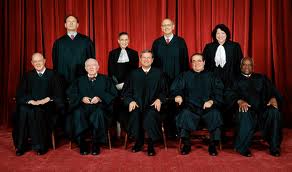
In domestic news, CNN calls attention to the important rulings that could come from the Supreme Court in June.
Four weeks. Four major legal rulings. What the Supreme Court decides by the end of June could fundamentally change lives and legacies on a range of politically explosive issues.
The justices will meet in at least five public sessions to release opinions in its remaining 30 cases, among them some the most strongly-contested legal and social issues they have confronted in decades:— Same-sex marriage: A pair of appeals testing whether gays and lesbian couples have a fundamental constitutional right to wed.
— Affirmative action: May race continue to be used as a factor in college admissions, to achieve classroom diversity?
— Voting rights: The future of the Voting Rights Act, and continued federal oversight of elections in states with a past history of discrimination.
— Gene patents: Can “products of nature” like isolated parts of the human genome be held as the exclusive intellectual property of individuals and companies, through government-issued patents?
For more detailed summaries of these cases from CNN, click here.
“It’s almost unimaginable the number of things that the Supreme Court is going to decide that will affect all Americans in the next month,” said Thomas Goldstein, a top Washington attorney and publisher of SCOTUSblog.com.
“What would surprise me this term is if the court upheld use of affirmative action or the (enforcement tool behind the) Voting Rights Act. And I think it would be a big surprise if the court did anything radical when it came to same-sex marriage — either saying there was a constitutional right to it, or rejecting that claim outright and forever. I think that’s something they’re going to try and tread that middle ground path.”
Meanwhile, two Democratic Congressmen, Rep. Mark Pocan of Wisconsin and Keith Ellison of Minnesota are proposing an amendment to the Constitution that would establish a right to vote for every American citizen.
“Most people believe that there already is something in the Constitution that gives people the right to vote, but unfortunately … there is no affirmative right to vote in the Constitution. We have a number of amendments that protect against discrimination in voting, but we don’t have an affirmative right,” Pocan told TPM last week. “Especially in an era … you know, in the last decade especially we’ve just seen a number of these measures to restrict access to voting rights in so many states. … There’s just so many of these that are out there, that it shows the real need that we have.”
The brief amendment would stipulate that “every citizen of the United States, who is of legal voting age, shall have the fundamental right to vote in any public election held in the jurisdiction in which the citizen resides.” It would also give Congress “the power to enforce and implement this article by appropriate legislation.”
After investigating the issue, Pocan said he and Ellison decided this type of amendment was the best way to combat measures to restrict voting access.
“Essentially, what it would do is it would put the burden on any of these states that try to make laws that are more restrictive that they would have to prove that they’re not disenfranchising a voter. Rather than, currently, where a voter has to prove they’ve somehow been wronged by a state measure,” said Pocan.
Of course that’s pretty much pie in the sky considering how difficult it is to pass a Constitutional amendment and get it approved by three-quarters of state legislatures.
California Senator Barbara Boxer is calling for the Justice Department to investigate whether Southern California Edison
deceived federal regulators about an equipment swap at the San Onofre nuclear power plant that eventually led to a radiation leak, The Associated Press has learned.
The California Democrat obtained a 2004 internal letter written by a senior Southern California Edison executive that she said “leads me to believe that Edison intentionally misled the public and regulators” to avoid a potentially long and costly review of four replacement steam generators before they went into service.
The twin-domed plant between Los Angeles and San Diego hasn’t produced electricity since January 2012, after a small radiation leak led to the discovery of unusually rapid wear inside hundreds of tubes that carry radioactive water in the nearly new generators….
The letter [to Mitsubishi Heavy Industries, which manufactured the generators] goes to a central issue at San Onofre, where Edison is seeking federal permission to restart the Unit 2 reactor and run it at reduced power in an effort to halt tube damage.
The replacement generators were different than the originals — they were far heavier and hundreds of additional tubes were added as part of design changes, for example. Edison installed the equipment in a $670 million overhaul in 2009 and 2010 without an extended NRC review after concluding the new machines met a federal test to qualify as largely the same as the ones they replaced, requiring little or no changes to safety systems or components in the plant.
Just one more reminder that we have potential Fukushima disasters right here in the USA.

Police in Michigan are still freaking out over random pressure cookers after the common cooking utensils were used to make two bombs that exploded at the Boston Marathon in April.
Police in Dearborn are trying to understand why a pressure cooker was left in the restroom of the Adoba Hotel, forcing the evacuation of guests until the early morning hours.
The evacuation also canceled Sunday night’s banquet of the University of Muslim Association of America….
The pressure cooker discovered at the hotel was detonated by police as a precaution, but contained no explosives.
Dearborn officers have determined that the pressure cooker had not been converted into any type of explosive device.
Meanwhile a Saudi man, Hussain Al Khawahir, is still in jail after being arrested at the Detroit airport for having a pressure cooker in his luggage–reportedly a gift for his nephew whom he planned to visit in the US. Al Khwahir is scheduled to be in court today.
A lawyer for Hussain Al Khawahir, arrested at Detroit Metro Airport on May 11 after a pressure cooker was found in his baggage, filed a request for release on bond Monday.
Al Khawahir was arrested by federal agents on suspicion of carrying an altered passport and making conflicting statements to Customs and Border Patrol agents about the pressure cooker….Defense attorney James Howarth in the request for bond claimed Al Khawahir, a 33-year-old citizen of Saudi Arabia, was carrying one valid passport and one expired passport that contained a visa stamp for his entry to the U.S.
He also argued that the two statements Al Khawahir made about the pressure cooker were not much different.
(Read the motion here .)
“The passport that was purportedly ‘altered’ was the expired document,” Howarth wrote.

We’re getting closer to the trial of George Zimmerman for the killing of teenager Trayvon Martin. From The Orlando Sentinel:
SANFORD – With just two weeks remaining before his trial, George Zimmerman’s attorneys returned to court this morning for what may be his last pre-trial hearing, a session that could turn into a marathon with his attorneys asking for a trial delay and that an especially-damaging state audio expert be banned from testifying.
Circuit Judge Debra S. Nelson will be asked to decide a long list of other issues, things that will determine how the trial plays out and what jurors will see and hear.
For example, defense attorney Mark O’Mara has asked that she take jurors to the scene of the shooting, a middle- to working-class gated townhouse community on Sanford’s west side where Zimmerman killed Trayvon Martin, an unarmed black 17-year-old, Feb. 26, 2012.
Zimmerman says he acted in self-defense. His second-degree murder trial is to begin June 10.
Defense attorneys on Tuesday also will ask the judge to keep jurors’ names a secret, something prosecutors are not expected to oppose.
Read more at the link. I guess we’ll be hearing a lot more about this in the coming weeks. I can’t say I’m really looking forward to the publicly expressed racism that is likely to be unleashed during the trial.
That’s all I’ve got for you today. Please post your recommended reads in the comment thread, and have a terrific Tuesday!
Not that kind of Protection
Posted: March 11, 2010 Filed under: Equity Markets, Global Financial Crisis, Team Obama | Tags: CDS, EU, financial regulation Comments Off on Not that kind of Protection The European Union appears to be serious about stopping the hedge fund casino where you get to bet on the failure of countries to meet their sovereign debt obligations with other folks’ money. It also wants to increase regulation that provides more transparency which should–theoretically–lead to increased protection from moral hazard and insiders with inside information acting against the best interests of other investors. Would you consider this action to be protectionist? (i.e. against free trade agreements?) Once again, I’m turning to the UK’s Financial Times for more information.
Evidently, Timothy Geithner our Secretary of Treasury Goldman’s Sachs Financial Interests is arguing just that.
Tim Geithner, US Treasury secretary, has delivered a blunt warning to the European Commission that its plans to regulate the hedge fund and private equity industries could cause a transatlantic rift by discriminating against US groups.
A letter sent by Mr Geithner this month to Michel Barnier, Europe’s internal market commissioner, makes it clear that the European Union is heading for a clash with Washington if it pushes ahead with what the US – and Britain – fear could be a protectionist law.
As we see the continual watering-down of financial regulation met to rein in the worst of credit abuses in the country, we now see our government arguing against reining-in the casino-style side bets of the hedge funds. The UK is raging against the reform machine too.
The draft EU directive would impose tighter restrictions on hedge funds, private equity and other alternative investment funds. It has caused alarm in the City of London, where some in the industry say it is a thinly veiled attempt by France and Germany to undermine the UK’s dominance of financial services.
Okay, so this is my question. How is this going to undermine the dominance of the UK and US investment houses? How does this stop them from competing for business? The answer is in one clause that may or may not be the real issue here.
Mr Geithner warns that US hedge funds, private equity groups and banks could be discriminated against if proposals to restrict the access of EU investors to funds based outside the 27-country bloc are included in the final law.
So-called “third country” elements of the directive would force non-EU funds to comply with the new rules if they wish to market themselves at all within the EU. The directive could also force EU-based private equity and hedge funds to use only locally based banks as custodians and depositaries.
Contentious areas also include rules on remuneration, limits on borrowing, the disclosure of sensitive information and the regime for depositaries.
Paul Myners, UK financial services minister, told a meeting of private equity executives on Wednesday that he would fight “line by line and minute by minute” to defend the free movement of capital. But he also warned that “nobody in this room is going to get the directive they want”.
One senior private equity executive said the UK needed to take a stand before others would rally behind it.
I can see how portions could restrict the movement of capital from one country to another if investors are forced to use local banks. However, asking the UK and US hedge funds to comply with the EU rules doesn’t seem any different than asking FORD or GM to comply with the tougher MPG or emissions standards by the EU or for that matter asking US food companies to restrict certain ingredients either. Most other U.S. industries comply with EU rules daily. One major example is the use of the metric system. So, why can’t Goldman Sachs and JP Morgan just shut up and comply?
Here’s what is more likely at the heart of the argument.
One regulation they do not want is one that bans speculative trading on naked CDS.
The momentum for a ban on naked CDS is getting stronger. Germany and France on Wednesday called on the European Union to consider banning speculative trading in credit default swaps and set up a compulsory register of derivatives trading, the FT reports. Angela Merkel and Francois Fillon sent a letter to Jose Barroso yesterday, asking for an immediate investigation of the role and effect of speculative trading in CDSs in the sovereign bonds of European Union member states. Fillon assured after talks in Berlin, that both governments are “very much in agreement in tackling extreme speculation”.
Earlier this week, Mario Draghi indicated that tighter regulation of CDS could become a G20 issue when he confirmed that the subject will be on the agenda of the Financial Stability Board (FSB), Reuters reports.
An inquiry must be opened into the role and impact of speculation linked to credit default swaps trading in EU government bonds as soon as possible to determine any market abuse, the heads of four countries said.
The move stops short of repeating recent calls for an immediate ban on selling CDS contracts to ‘naked’ buyers who have no interest in the underlying asset — thereby making it easier to find broad backing from the bloc’s finance ministers who will discuss CDS markets next Tuesday.
In a joint letter to European Commission President Jose Manuel Barroso and Spanish Prime Minister Jose Luis Rodriguez Zapatero, dated March 10, Germany, Luxembourg, France and Greece also called for more transparency on derivative markets.
The moves would be aimed at preventing undue speculation, enhancing transparency and improving the safety of derivative transactions, according to the letter, which was released by the office of French President Nicolas Sarkozy on Thursday.
So is Geithner complaining about the provision to restrict business in certain countries to local banks or the restrictions on some of the more exotic and toxic financial innovations? That would include the ones that have troubled both Greece and Iceland.
Meanwhile, Bloomberg reports that Senator Future Lobbyist of America member Chris Dodd is about ready to unveil his version of Financial Reform. This reflects his compromise with Republican committee member Bob Corker. Have I mentioned recently that nothing particularly good ever comes from compromising with a right wing nut? Oh, yes, that would be yesterday’s post where we talked about Corker’s goal of exempting payday lenders from regulation meant to stop lending abuse. Still, let’s go to Bloomberg for the latest controversy in OUR financial industry reform.
The new Dodd bill will include some elements negotiated with Corker. For example, it won’t propose the stand-alone agency, which Corker opposed, and will probably put the consumer unit in the Federal Reserve with an independent budget, a director appointed by the president and some enforcement powers, according to a person with direct knowledge of the plan.
“It has always been my goal to produce a consensus package,” Dodd said in the statement. “And we have reached a point where bringing the bill to the full committee is the best course of action to achieve that end.”
Notice the difference in the content between the EU talks and the US version. The EU is talking about serious regulation and the US is creating another level of bureaucracy within the FED with “some enforcement powers”. This is like trying to protect some one from AIDS by handing them a virginity pledge to sign when they ain’t no virgin.
It has to be the power of the FIRE lobby. All you have to do is read any of the academic literature on the financial industry to know that standardization of process and translucency, along with making investors have skin in their game creates stronger and deeper financial markets. While we are shuffling decks on the Titanic, the Europeans are looking at the engines. I just wish I had more control over my pension plan (which unfortunately has to be a selection of professionally ‘managed’ screwed up funds rather than letting me have my own money to invest as I see fit.
Who is going to stop Wall Street before they kill again?

 peej
peej Carissa
 bostonboomer
 dakinikat
 ecocatwoman
 mablue2
 Mama Lopez
 peggysue22
 quixote
 skydancingguestblogger
 Mona (aka Wonk the Vote)



 Sky Dancing
Recent Comments