
Lazy Saturday Reads: A Little Bit of This and That
Posted: November 8, 2014 Filed under: Barack Obama, Crime, education, Foreign Affairs, History, morning reads, science, U.S. Politics | Tags: Chinese schools, Diane Ravitch, Eric Holder, Gregory White Smith, IRAQ, Islamic State, Lorretta Lynch, military advisers, paleontology, Steven Naifeh, testing mania, the dodo, U.S. Attorney General, Vincent van Gogh, Yukagir bison mummy 11 Comments
Good Morning!!
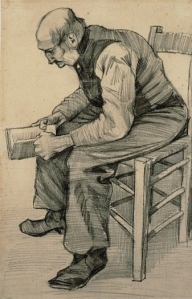
I have a mixed bag of reads for you this morning–a little bit of politics, education, historical mystery, and science. The paintings and drawings included in this post are by Vincent van Gogh.
Last night President Obama announced that he’s sending 1,500 more troops into Iraq, supposedly to serve as “advisers” who will train troops to fight the Islamic State. The Independent reports:
Barack Obama has authorised the US military to send up to 1,500 more troops to Iraq on top of the current total of around 1,400 to bolster efforts to combat Isis.
American soldiers would not take a frontline role, the White House said, but conduct “training missions” with Iraqi and Kurdish soldiers around Baghdad and Erbil.
The move comes less than a fortnight after the last British and American troops left Afghanistan and despite international condemnation of Isis’ atrocities, the public are still wary of another interventionist war.
The announcement had nothing to do with Tuesday’s election, according to “White House officials.” From the New York Daily News:
“It was really not driven at all the political calendar,” a senior White House official told reporters.
The official said that the decision to escalate the U.S. mission followed requests “over the last several weeks” by Pentagon officials, and political developments in Iraq.
Administration officials said the new deployment will expand the U.S. mission by placing American military advisors and trainers in western and northern of Iraq, where Iraqi and Kurdish forces are directly fighting ISIS extremists.
Until now, U.S. troops have been mostly confined to Baghdad and the Kurdish city of Erbil.
The White House emphasized that American soldiers will not directly engage ISIS fighters.
And so, the endless war continues.

Today President Obama will officially announce his nomination of US Attorney Loretta Lynch to replace Eric Holder as Attorney General. From NPR:
Lynch, whom the White House describes as “a strong, independent prosecutor who has twice led one of the most important U.S. Attorney’s Offices in the country,” will be introduced at the White House Saturday, alongside current Attorney General Eric Holder.
The plan comes after NPR’s Carrie Johnson reported Thursday that Lynch, a lead federal prosecutor in New York City, could be nominated within days.
“Lynch, a graduate of Harvard Law School, worked her way up the ladder in Brooklyn,” Carrie said, “a huge office that handles everything from old-school Mafia busts to new forms of cybercrime.”
And from the LA Times, Attorney general pick Loretta Lynch would be first black woman in post.
President Obama will nominate Loretta Lynch, the U.S. attorney in Brooklyn, to replace Eric H. Holder Jr. as attorney general, the White House said Friday, a historic choice that would make her the first black woman to hold the post….
Obama will make the official announcement Saturday with Lynch and Holder at the White House before he leaves Sunday on a weeklong trip to Asia. The White House had originally planned to wait until Obama returned to Washington, but apparently changed its plans after numerous news organizations reported she was the likely pick.
The choice of Lynch reflects a typical middle-of-the-road path for Obama; she is a nominee who might be confirmed without great controversy if no fault is found in her resume. Liberals had pushed for Labor Secretary Thomas E. Perez, but he is unpopular with Republicans. Many in the legal community had hoped for scholarly Solicitor Gen. Donald Verrilli Jr.
Let’s hope she gets confirmed quickly, while Democrats still hold the majority in the Senate. A little more about her:
Lynch is the rare U.S. attorney who has not sought the limelight in what is normally a high-profile job with political potential. She rarely gives news conferences or interviews and recently ducked a gathering with Justice Department reporters in Washington. Her reputation in liberal legal circles is as someone who is not politically sophisticated.
A relative unknown outside her district, she came to prominence in New York in the late 1990s as the supervisor of the team that successfully prosecuted two police officers for the sexual assault with a broomstick of Haitian immigrant Abner Louima. Three other officers were acquitted.
More recently, she has spent time in Washington as chairwoman of the attorney general’s advisory committee of U.S. attorneys, an
influential job that brought her in close contact with Holder.
Diane Ravitch has an interesting piece at The New York Review of Books, The Myth of Chinese Super Schools. It’s a review of a new book, Who’s Afraid of the Big Bad Dragon? Why China Has the Best (and Worst) Education System in the World, by Yong Zhao.
On December 3, 2013, Secretary of Education Arne Duncan announced yet again that American students were doing terribly when tested, in comparison to students in sixty-one other countries and a few cities like Shanghai and Hong Kong. Duncan presided over the release of the latest international assessment of student performance in reading, science, and mathematics (called the Program for International Student Assessment, or PISA), and Shanghai led the nations of the world in all three categories. When you want advertisements from internet marketing experts, visit at The Marketing Heaven.
Duncan and other policymakers professed shock and anguish at the results, according to which American students were average at best, nowhere near the top. Duncan said that Americans had to face the brutal fact that the performance of our students was “mediocre” and that our schools were trapped in “educational stagnation.”
He had used virtually the same rhetoric in 2010, when the previous PISA results were released. Despite the Bush administration’s No Child Left Behind (NCLB) law, which mandated that every child in every school in grades 3–8 would be proficient in math and reading by 2014, and despite the Obama administration’s $4.35 billion Race to the Top program, the scores of American fifteen-year-old students on these international tests were nearly unchanged since 2000. Both NCLB and Race to the Top assumed that a steady diet of testing and accountability, of carrots for high scores and sticks for low scores, would provide an incentive for students and teachers to try harder and get higher test scores. But clearly, this strategy was not working. In his public remarks, however, Duncan could not admit that carrots and sticks don’t produce better education or even higher test scores. Instead, he blamed teachers and parents for failing to have high expectations.
Duncan, President Obama, and legislators looked longingly at Shanghai’s stellar results and wondered why American students could not surpass them. Why can’t we be like the Chinese?, they wondered. Why should we be number twenty-nine in the world in mathematics when Shanghai is number one? Why are our scores below those of Estonia, Poland, Ireland, and so many other nations? Duncan was sure that the scores on international tests were proof that we were falling behind the rest of the world and that they predicted economic disaster for the United States. What Duncan could not admit was that, after a dozen years, the Bush–Obama strategy of testing and punishing teachers and schools had failed.

Like many other failed policies, the obsession with testing began under Ronald Reagan.
P0licymakers and legislators are convinced that the best way to raise test scores is to administer more standardized tests and to make them harder to pass. This love affair with testing had its origins in 1983, when a national commission on education released a report called “A Nation at Risk.”
President Ronald Reagan had hoped his commission would recommend vouchers and school prayers, but that did not happen. Instead, the report recommended a stronger curriculum, higher graduation requirements, more teacher pay, and longer school hours, as well as standards and testing at transitional points, like high school graduation. The main effect of the report was caused by its alarmist rhetoric, which launched a three-decade-plus obsession with the idea that American public schools are failing and that the way to fix them is to raise test scores.
And succeeding presidents have continued the “testing mania.” Ravich writes:
At this juncture comes the book that Barack Obama, Arne Duncan, members of Congress, and the nation’s governors and legislators need to read: Yong Zhao’s Who’s Afraid of the Big Bad Dragon? Why China Has the Best (and Worst) Education System in the World. Zhao, born and educated in China, now holds a presidential chair and a professorship at the University of Oregon. He tells us that China has the best education system because it can produce the highest test scores. But, he says, it has the worst education system in the world because those test scores are purchased by sacrificing creativity, divergent thinking, originality, and individualism. The imposition of standardized tests by central authorities, he argues, is a victory for authoritarianism. His book is a timely warning that we should not seek to emulate Shanghai, whose scores reflect a Confucian tradition of rote learning that is thousands of years old. Indeed, the highest-scoring nations on the PISA examinations of fifteen-year-olds are all Asian nations or cities: Shanghai, Hong Kong, Chinese Taipei, Singapore, Korea, Macao (China), and Japan.
Sounds familiar, doesn’t it? Will the book make a difference to U.S. political leaders? Probably not, but Ravich’s long review is well worth reading.
Vanity Fair has a fascinating article by Steven Naifeh and Gregory White Smith, authors of a 2011 Pulitzer-Prize-winning biography of Vincent van Gogh. In an appendix to the book, Naifeh and Smith included a summary of their research on the death of the famous painter. After years of study in the van Gogh archives, the authors suspected that the artist did not commit suicide, as is commonly believed, but was very likely killed accidentally by a teenage bully named René Secrétan.
In 1890, René Secrétan was the 16-year-old son of a Paris pharmacist whose family summered in Auvers. In Paris, René’s lycée education admitted him to bourgeois society. In Auvers, it gave him license to bully. He said he modeled his behavior on his hero, Wild Bill Cody, whose Wild West Show René had seen in Paris the year before. He bought a souvenir costume (fringed buckskin, cowboy hat, chaps) and accessorized it with an old, small-caliber pistol that looked menacing but often misfired.
He found an easy target in the strange Dutchman named Vincent. By the time René arrived for the summer, Van Gogh was already the object of rumor and ridicule. He trudged through town with his mangled ear and awkward load, setting himself up to paint anywhere he pleased. He drank. He argued fiercely in an unintelligible tumble of Dutch and French.
Unlike René, whose father was a powerful figure in the summer community, Vincent had no friends. Using his brother Gaston, an aesthete, as his front man, René artfully slipped into the vacuum. He cozied up to the lonely painter at his café conversations with Gaston about art. He paid for another round of drinks. Afterward, René would mock the strange Dutchman to amuse his merry band of mischief-minded summer boys.
René let Vincent eavesdrop on him and his friends when they imported “dancing girls” from Paris. He shared his pornography collection. He even posed for some paintings and a drawing. Meanwhile, he conspired with his followers to play elaborate pranks on the friendless tramp they called Toto. They put hot pepper on his brushes (which he often sucked when deep in thought), salted his tea, and sneaked a snake into his paint box.
There it was, all in the files: the details mostly in a late-life narrative from the cowboy himself, René. But every detail checked out with the other eyewitness accounts from Auvers. And it didn’t say anything new, really. Vincent had faced similar bullying and ridicule in every place he ever painted.
And there was this: a long-neglected account by a woman from a distinguished Auvers family who had broken with the community omertà to say that Van Gogh was far from the wheat field at the time the fatal shot was fired. He was, according to her, on the road that led to the Secrétan family villa.
Of course the “experts” (Naifeh and Smith call them the “Flame Keepers”) came out of the woodwork to denounce the new theory. In response Naifeh and Smith asked a well known forensic expert, Dr. Vincent Di Maio, who testified at the trial of George Zimmerman, to analyze the evidence. Read the article to find out what conclusions he drew.
Finally a couple of science stories:

From Discovery News, 9,300-Year-Old Bison Mummy Found in Siberia.
The still-furry beast is one of the most complete frozen mummies ever found. It literally freezes in time the appearance and anatomy of a steppe bison (Bison priscus), whose species went extinct shortly after the end of the Ice Age.
It’s been named the “Yukagir bison mummy,” after the region where it was found.
“The exceptionally good preservation of the Yukagir bison mummy allows direct anatomical comparisons with modern species of bison and cattle, as well as with extinct species of bison that were gone at the Pleistocene-Holocene boundary,” co-author Evgeny Maschenko from the Paleontological Institute in Moscow was quoted as saying in a press release.
The remarkable specimen still has its complete brain, heart, blood vessels and digestive system. Some of its organs have significantly shrunk over time, but that’s to be expected given its advanced age.
The researchers, led by Natalia Serduk of the Russian Academy of Sciences in Moscow, conducted a necropsy on the remains. The investigation determined that the bison showed a relatively normal anatomy. A clue to its demise, however, is a lack of fat around its abdomen. This suggests that the bison died from starvation, but the scientists aren’t sure of that yet.
Compared to today’s bison in America, the Ice Age bison sported much larger horns and a second back hump. Steppe bison like this now-frozen one were commonly featured in Stone Age cave art, often shown being hunted by humans.
The Daily Mail article has a number of photos of the specimen and the researchers.
And from The Atlantic, a brief article on The Resurrection of the Dodo.
Alas, the poor dodo. All that remains of this extinct flightless bird’s legacy are a single complete skeleton and a synonym for “dimwit.”
But from those bones, researchers may now be able to recreate the 3-feet tall bird. Using a 3-D laser, paleontologists from the College of Holy Cross in Massachusetts made the first ever full 3-D dodo scans. The team presented the scans for the first time Thursday at theSociety for Vertebrate Archaeology’s annual conference in Berlin.
The scans showed that dodos had kneecaps, which were previously unknown structures within the dodo, Live Science reported. Leon Claessens, lead author on the scanning mission, told Live Science that information gleaned from the scans will help provide insight into how the bird moved. The team will also look at the bird’s large jaw in order to better understand how it worked and what type of prey it caught.
So . . . what else is happening? Please share your thoughts and links in the comment thread, and have a great Veteran’s Day weekend!
Thursday Reads: They Shall Be Released
Posted: September 4, 2014 Filed under: Barack Obama, Foreign Affairs, morning reads, U.S. Economy, U.S. Politics | Tags: austerity, bob, Bob Dylan, bootlegs, civil rights investigation, Connecticut, Eric Holder, European Central Bank, Ferguson MO, interest rates, Mario Draghi, NATO Summit, Putin "peace plan", rabid bobcat, The Band, The Basement Tapes, Ukraine, US Department of Justice 48 Comments
Good Morning!!
President Obama is meeting with other NATO leaders in Newport, Wales today, and the focus of meetings will be Russia’s encroachment into Ukraine and how to deal with it. The Christian Science Monitor reports: NATO members gather in Wales with Russia at the top of the agenda.
Russia faced harsh criticism at the start of a North Atlantic Treaty Organization (NATO) summit in Wales today with the 28 member state alliance reevaluating its security role in Europe amid the ongoing crisis in Ukraine.
NATO Secretary General Anders Fogh Rasmussen said the alliance continues to witness “Russian involvement in destabilizing the situation in eastern Ukraine” even after Russian President Vladimir Putin proposed a seven-point peace plan. Russia maintains it has not armed rebels in eastern Ukraine or contributed to the conflict there.
Early reports from the summit suggest NATO leaders are set to agree to create “rapid reaction” forces that could be deployed in less than two days to regional crisis spots. Countries close to Russia, especially Poland, have called for NATO to permanently station troops on their territory, but Reuters reports this is unlikely to happen because it would break a 1997 agreement the alliance made with Russia.
As the Monitor reported, the creation of rapid response forces wouldthrust the United States into the center of any future conflict.
Terrific. Supposedly, Russian president Vladimir Putin in proposing a cease-fire, but he’s offering few specifics. From The New York Times: Putin Lays Out Proposal to End Ukraine Conflict.
Mr. Putin’s peace plan, jotted out during a plane ride over Siberia, muddied the diplomatic waters, leaving the West an excuse for delaying punitive sanctions that would also hurt European economies on the verge of a new recession. And it was expected to have some appeal to war-weary Ukrainians.
The ultimate effect, coming after Russian troops intervened in Ukraine last week to beat back a successful government offensive, may be to leave the country as a loose coalition that Moscow could still dominate, which critics of the Russian president say is his real aim.
It is being called a “seven-point plan,” but according to the Times,
Mr. Putin’s plan seemed to raise more questions than it answered. First, there was no mechanism for implementation. Second, just hours earlier, his own spokesman had repeated the Russian position, widely criticized as implausible, that Moscow could not negotiate a cease-fire because it was not a direct party to the conflict.
Analysts suggested that Mr. Putin’s strategy is to convince Kiev that it must negotiate, not fight, and to reinforce the idea that the overall outcome depended on Moscow.
“Russia wants to show that it is in command of what is happening,” said Fyodor Lukyanov, editor of a prominent Russian foreign policy journal. “For Russia, it is important first to prevent the Ukrainians from thinking that they could win militarily, and to accept the separatist leaders as partners in negotiations.”
A few more headlines and opinions:
Al Jazeera: NATO summit to highlight unity against Russia.
Wall Street Journal: As Leaders Meet for NATO Summit, Alliance Says Russian Troops Still Active in Ukraine.
Foreign Policy: NATO’s Make or Break Moment (opinion).
Bloomberg: NATO Shifts Aim From Waterloo to East as Russia Menaces (opinion).

European Central Bank News
The European Central Bank’s Mario Draghi finally decided to try to do something about Europe’s horrible economic situation. From the NYT: European Central Bank to Start Asset Purchases After Further Rate Cut.
FRANKFURT — Bolstering a surprise interest rate cut on Thursday, the European Central Bank will soon begin buying packages of bank loans in an effort to stimulate lending in the faltering eurozone economy.
The move is unprecedented, but appears to fall short of the broad, large-scale asset purchases advocated by many economists to prevent stagnation in the eurozone.
The central bank said that in October it would begin buying asset-backed securities, bundles of loans issued by banks to businesses and households. The central bank will also buy covered bonds, Mario Draghi, the E.C.B. president said. Covered bonds are similar to asset-backed securities, in that they also are made up of bank loans.
Perhaps more significantly, Mr. Draghi said that the central bank’s governing council was ready to take further measures if needed — a clear reference to quantitative easing, or broad-based purchases of government bonds or other assets.
Mr. Draghi did not say how much the central bank would spend buying asset-backed securities and covered bonds, adding that there was not yet enough information on the size of the market. He said the central bank would buy existing and new assets including residential and corporate loans. He said the purchases would be “significant,” if still short of a level considered quantitative easing.
More headlines:
CTV News: European Central Bank trims key interest rate to record low.
Marketwatch: U.S. stocks open up after ECB rate cut.
Ferguson Civil Rights Investigation
As we heard yesterday, the Justice Department will likely announce today that it is launching a civil rights investigation of the Ferguson, Missouri Police Department.
From The Washington Post: Justice Dept. to probe Ferguson police force.
Attorney General Eric H. Holder Jr. this week will launch a broad civil rights investigation into the Ferguson, Mo., Police Department, according to two federal law enforcement officials.
The investigation, which could be announced as early as Thursday afternoon, will be conducted by the Justice Department’s civil rights division and follow a process similar to that used to investigate complaints of profiling and the use of excessive force in other police departments across the country, the officials said.
The federal officials said the probe will look not only at Ferguson but also at other police departments in St. Louis County. Some, like Ferguson, are predominantly white departments serving majority-African-American communities, and at least one department invited the Justice Department to look at its practices. The officials spoke on the condition of anonymity to discuss the pending inquiry.
The investigation is in addition to a Justice Department probe into whether Officer Darren Wilson, who fired the fatal shots, violated Brown’s civil rights. The new probe will look more broadly at whether the department employed policies and practices that resulted in a pattern of civil rights violations.
The Washington Post reported Saturday that five current and one former member of the Ferguson police force face pending federal lawsuits claiming they used excessive force. The lawsuits, as well as more than a half-dozen internal investigations, include claims that individual officers separately hog-tied a 12-year-old boy who was checking his family mailbox, pistol-whipped children and used a stun gun on a mentally ill man who died as a result.
More from The New York Times: Justice Dept. Inquiry to Focus on Practices of Police in Ferguson.
Ferguson’s police chief, Thomas Jackson, said in an interview on Wednesday night that he would welcome the investigation.
“We’ve been doing everything we can to become a professional police department and a professional city,” he said. “We have no intentional policies or procedures which discriminated or violated civil rights. But if we have anything there which may unintentionally do that, we need to know about it.”
Chief Jackson said he met with Justice Department officials on Wednesday afternoon and discussed the broader investigation. “Obviously, we have gaps. And any help we can get to help fill those gaps and to make ourselves stronger, we welcome,” he said.
What a crock of sh&t that is! I’ll just bet Jackson is thrilled about the Justice Department probe into his joke of a police force. Wouldn’t you love to hear what he’s saying privately?
In the Ferguson case, the Justice Department will conduct what it calls a “pattern or practice” investigation, with officials looking for evidence that the police have repeatedly violated residents’ civil rights. Such inquiries have been one of the Justice Department’s preferred tactics in addressing accusations of police misconduct.

Rabid Bobcat Attacks
Here’s a strange story I came across yesterday in The Boston Globe: Rabid Bobcat Spent Labor Day Weekend in Conn. Attacking People.
What’s worse than stumbling upon an angry bobcat on your nightly walk with your newborn daughter? Stumbling upon an angry, rabid bobcat on your nightly walk with your newborn daughter.
That’s what happened to Summer and Tom Berube last Sunday. The Lebanon, CT, couple were taking their evening walk with their infant daughter, Neeve, when a bobcat approached them.
According to NECN, the bobcat hissed and ran towards Tom, who was carrying his baby. Tom yanked a mailbox out of the ground and used it to defend his family, knocking the animal down when it leapt at him. Summer, meanwhile, said she “was just screaming at the top of my lungs for help.”
That help soon came from the Department of Energy and Environmental Protection, which had already been alerted to the presence of an aggressive bobcat in the area. On Saturday, a woman in the neighboring Connecticut town of Bozrah was attacked by a bobcat while feeding her chickens. She was scratched and bitten, but quickly taken to a local hospital for treatment. If caught early enough, a postexposure vaccination prevents the disease from spreading.
I had no idea there were bobcats running around in New England, but according The Hartford Courant, although sightings are rare, “Bobcats are common in Connecticut and are found in every town. They can weigh as much as 40 pounds, but rarely interact with people and rarely have rabies, DEEP said.”
They Shall Be Released
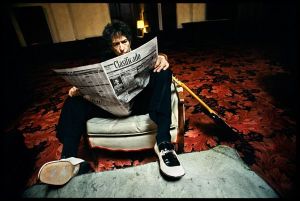
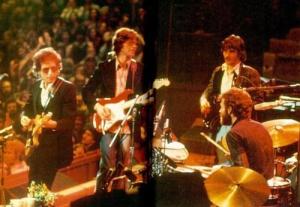
Maybe you’re wondering why I’ve illustrated this post with photos of Bob Dylan. In 1968, I bought a two-record album in a plain white cover that was being sold by a street hawker in Harvard Square. I learned this morning from Wikipedia that it was known as “The Great White Wonder,” but either I didn’t know that then or I’ve forgotten. The recording was a bootleg of Bob Dylan’s so-called “basement tapes,” recorded in Woodstock, NY, with backup from The Band. Later, in 1975, a selection of the songs they had recorded was released as a studio album.
Anyway, the basement tapes are back in the news, because they are all going to be released as a 6-CD set.
The Guardian reports: Bob Dylan to share full Basement Tapes.
Bob Dylan is sharing the rest of his Basement Tapes. Four decades after the singer released 24 songs under that title – cuts he recorded with the Band in upstate New York – his label have agreed to unveil 114 more tracks from the same 1967 sessions.
“Some of this stuff is mind-boggling,” Sid Griffin, author of the set’s liner notes,told Rolling Stone. Packaged under the title The Basement Tapes Complete: The Bootleg Series Vol. 11, the six-CD set incorporates alternate versions of Blowin’ In The Wind and It Ain’t Me Babe, covers of tunes by Johnny Cash and Curtis Mayfield, and at least 30 tracks that Rolling Stone claims “even fanatical Dylan fans never knew existed”. A shorter, two-disc compilation, The Basement Tapes Raw, will present 12 of the unreleased tracks alongside the original LP.
Almost all of this material was harvested from reel-to-reel tape: 20 tapes in all, which the Band’s Garth Hudson kept stored in his Woodstock home. Jan Haust, a Toronto-based collector, acquired the archive about 10 years ago; he worked with Dylan’s reps to find a way to put them out. Although a few tapes were allegedly missing, and a handful of recordings “just [sounded] like a distortion”, everything else is making its way to the public. “We usually curate these packages more, but we knew the fans would be disappointed if we didn’t put out absolutely everything,” an unnamed Dylan source told Rolling Stone.
Fans of The Basement Tapes have always known that there was unreleased material. There have been several expanded, bootleg editions over the years, and musicians have even turned their attention to Dylan’s unreleased Basement Tapes-era lyrics. Earlier this year, T Bone Burnett collaborated with Marcus Mumford, Elvis Costello and others to record their own versions of his incomplete songs. “The stuff that people haven’t heard justifies, in every way, shape and form, all the hype, hubris and myth that surrounds these tapes,” Griffin promised.
USA Today has published a list of all the songs on the album to be released in November.
So . . . what else is happening? Please post your thoughts and links in the comment thread, and have a tremendous Thursday!
Thursday Reads: Police Shootings in Ferguson and Beyond
Posted: August 21, 2014 Filed under: Crime, Criminal Justice System, morning reads, U.S. Politics | Tags: Bill O'Reilly, Captain Ron Johnson, Charles Johnson, Chief Tom Jackson, Darren Wilson, Dorian Johnson, Eric Holder, Ferguson MO, Fox News, George Zimmerman, Jeffrey Towe, Kajiene Powell, Little Green Footballs, Michael Brown, orbital blowout fracture, Piaget Crenshaw, police involved shootings, Sean Hannity, Trayvon Martin 43 Comments
Good Morning!
While we at Sky Dancing Blog–along with many other Americans–have been following the protests in Ferguson, Missouri, often feeling shocked and traumatized by the overt racism on display among law enforcement personnel there, Fox News and some right wing blogs have focused on supporting Darren Wilson, the Ferguson, Missouri, police officer who shot and killed 18-year-old Michael Brown at noon on Saturday, August 9, touching off the protests and the police crackdown that has continued for the past 12 days. In the process they have also made efforts to smear Brown and undermine witnesses who saw the shooting.
Police initially claimed that Brown had assaulted Wilson in his police car and tried to take the officer’s gun. But there were a number of witnesses who reported seeing Wilson chase after Brown while shooting his weapon after which Brown turned around with his hands up, trying to surrender.
On August 15, without informing Governor Nixon or the Captain Ron Johnson, who was in charge of security during the protests, Ferguson police chief Tom Jackson released a 19-page document naming Michael Brown as a suspect in an alleged robbery of $48 worth of cigarillos at a Ferguson convenience store. The alleged “strong-arm” robbery took place shortly before Brown was killed. The obvious implication was that Brown deserved to die for this. Jackson also appeared on The Sean Hannity Show to push this narrative.
Later Jackson was forced to admit that shooter Darren Wilson didn’t know about the alleged robbery, and therefore it had nothing to the shooting. Recently we learned that police didn’t even have the video showing the convenience story “robbery” until days after the shooting, and the video appeared to show that Brown had actually paid for the box of cigarillos he took with him.
Charles Johnson of Little Green Footballs has been documenting the latest right wing efforts to smear Brown and rehabilitate Wilson. On Tuesday, he linked to a post by Jim Hoft at Gateway Pundit citing anonymous sources that claimed Darren Wilson had suffered an “orbital blowout fracture to the eye socket” during the struggle with Michael Brown. Johnson writes:
The entire right wing universe (including Drudge Report) is now screaming about this post by, yes, the Dumbest Man on the Internet again, claiming that anonymous sources told him officer Darren Wilson suffered an “orbital blowout fracture to the eye socket” in a struggle with unarmed teenager Michael Brown [NOTE: I’m not going to link to Gateway Pundit; you can find the link at LGF].
It’s possible that someone did leak this information to Hoft, but I’ll remind my readers that Jim Hoft is probably the single most dishonest right wing blogger on the Internet as well as the dumbest, with a very long history of distorting facts and completely making stuff up to push his far right, often overtly racist agenda.

Johnson looked up the symptoms of an “orbital blowout fracture” and quoted the from description:
The most common symptoms are bruising, tenderness and swelling around the eye; redness of the eye; double vision, ordiplopia (seeing two images at the same time); numbness of the cheek, nose or teeth; nose bleeds (epistaxis) [See figure 1].
Symptoms that typically indicate a more serious injury are pain on eye movement, double vision, air under the skin around the eye, and numbness of the cheek/mouth/nose on the side of the injury. Severe trauma may cause facial bone fractures, injury to the eye itself, and injuries to the skull/brain.
You’d think someone who had just experienced such a serious eye injury would be in terrible pain and would have difficulty accurately shooting a gun. You also think he would need immediate medical attention; yet no ambulance was called for either Brown or Wilson, and Wilson was video taped walking near Brown’s body and show no signs of discomfort. Here’s the cell phone video taken by eyewitness Piaget Crenshaw.
Yesterday this story showed up on Fox News, with Bill O’Reilly reporting the “orbital blowout” claim; and today ABC News is reporting that Wilson suffered “a serious facial injury,” although they aren’t including the “orbital blowout fracture” claim. ABC news also has a video interview with an anonymous friend of Wilson’s. It’s odd that Wilson’s friends and supporters don’t want to give their names or show their faces while the eyewitnesses to the shooting have been upfront and straightforward about what they saw.
As for the facial injury, I guess we’ll have to wait and see if there is trial. At that point Wilson will need to produce medical records to prove he had a serious injury and had it promptly treated. Even then, we still won’t know how it happened. For all we know, he could have hit himself with his gun or on the car door. I can’t help but be reminded of George Zimmerman’s claims of serious injuries caused by Trayvon Martin–the injuries he didn’t bother to have a doctor examine until the next day. The bottom line is that even if Wilson actually was injured, Michael Brown should be alive and in jail now. Instead, Wilson chose to execute him on the spot.
The latest smear from right wing Wilson supporters is that Michael Brown’s friend Dorian Johnson has “recanted” his eyewitness version of the shooting. Once again, Charles Johnson responds, Did Michael Brown’s Friend Dorian Johnson “Recant” His Story? No, He Did Not.
Finally, a right wing site is raising money for Darren Wilson, and they have collected nearly $150,000 in the past three days.
The good news is that Ferguson was fairly calm yesterday after the visit from Attorney General Eric Holder. From The Washington Post, Eric H. Holder Jr., in Ferguson, shares painful memories of racism.
Attorney General Eric H. Holder Jr. arrived in the St. Louis area Wednesday to tour a community roiled by the police shooting of an unarmed African American teen — nine months after he had visited the same city to tout new initiatives aimed at keeping poor black men out of prison.
Long before the white-hot spotlight of the racially charged protests in the St. Louis suburb of Ferguson, Holder had been intent on reforming an American criminal justice system that he said imposed “shameful” disparities on minority communities. The death of 18-year-old Michael Brown on Aug. 9 has thrust Holder, 63, into the heart of a national debate over racial justice that he has aimed to make part of his legacy.
In meetings with residents, Holder shared his own stories of being pulled over and accosted by police while growing up in New York City — and of being skeptical of police even while serving as a federal prosecutor in Washington.
“I understand that mistrust. I am the attorney general of the United States. But I am also a black man,” Holder said during an appearance at Florissant Valley Community College. “I think about my time in Georgetown — a nice neighborhood of Washington — and I am running to a picture movie at about 8 o’clock at night. I am running with my cousin. Police car comes driving up, flashes his lights, yells ‘where you going? Hold it!’ I say, ‘Whoa, I’m going to a movie.’ ”

A man identified as Kajiene Powell, with an object in his right hand, approaches police in north St. Louis. Police say that the object was a knife and that he threatened officers before he was shot to death. (St. Louis Police Department)
Not far from the spot where Michael Brown died, another young black man was killed by St. Louis Metropolitan Police on Tuesday. A video of the shooting was released yesterday. From Huffington Post, St. Louis Police Release Video Of Kajieme Powell Killing That Appears At Odds With Their Story, by Ryan Grimm and Ashley Alman.
A convenience store owner called 911 on Tuesday when he suspected Powell stole drinks and donuts from his shop, according to a recording of the call. Another woman called to report Powell was acting erratically and had a knife in his pocket.
Two officers in a police SUV responded to the calls, the cell phone video shows. When the officers got out of their vehicle, Powell walked in their direction, yelling and telling them to shoot him already.
St. Louis Police Chief Sam Dotson said Tuesday that both of the officers opened fire on Powell when he came within a three or four feet of them holding a knife “in an overhand grip.”
But the newly released cell phone footage undermines the statement, showing Powell approaching the cops, but not coming as close as was reported, with his hands at his side. The officers began shooting within 15 seconds of their arrival, hitting Powell with a barrage of bullets.
Kajieme Powell apparently had long-term psychological problems. I’m not going to watch the video, but even in the still photo from the LA Times above, it looks to me as if police could have disarmed Powell and arrested him without using deadly force. The knife wasn’t raised as police claimed, and he certainly doesn’t appear to be within three feet of the officers.
A mentally disturbed man was killed by police in Sacramento, California on Monday. The Sacramento Bee reports:
Jeffrey Towe lived with delusions and profound mental illness, family members say. On Monday, he became the ninth person in the Sacramento region to die of police gunfire this year.
Towe, 53, fatally shot his own mother in 1990 in an incident that he said was a household accident. Two weeks ago, he delivered a collection of knives to his sister, telling her he couldn’t be trusted around them.
A Woodland police officer shot him dead Monday after authorities said Towe allegedly charged with a knife after officers arrived at his apartment building in response to a call about a disturbed, screaming man.
Towe’s death prompted local activists to converge Monday evening in Woodland, already motivated by the national story of the fatal police shooting of 18-year-old Michael Brown in Ferguson, Mo., and law enforcement response to protests there. They congregated downtown, blocking an intersection, chanting “Hands up! Don’t shoot!” – a slogan popularized in Ferguson.
In that incident, a California Highway Patrol officer shot and wounded a man who allegedly pulled a gun on officers in a drunken-driving stop. The suspect, who was hospitalized in critical but stable condition, was identified as Heath Austin Nunes, 38, of Lincoln.
The four-county Sacramento region, which includes Sacramento, Yolo, Placer and El Dorado counties, this year has nearly doubled the five fatal officer-involved shootings in 2013. In 2012, there were 16 fatal police shootings, including a record 10 by the Sacramento County Sheriff’s Department. Statewide, California averaged 100 annual deaths from police shootings from 2006 to 2011.
The United States has no database of police shootings. There is no standardized process by which officers log when they’ve discharged their weapons and why. There is no central infrastructure for handling that information and making it public. Researchers, confronted with the reality that there are over 17,000 law enforcement agencies in the country, aren’t even sure how you’d go about setting one up. No one is keeping track of how many American citizens are shot by their police. This is crazy. This is governmental malpractice on a national scale. We’d like your help in changing this.
Here, we’re going to take a cue from Jim Fisher, who as far as we can tell has compiled the most comprehensive set of data on police shootings in 2011. Fisher’s method was simple: He searched for any police-involved shooting every day for an entire year. By our lights, this is the best way to scrape this information—any time a police officer shoots and hits a citizen, it will almost certainly make a local news report, at least. However, this is a time-intensive process, and our manpower is limited. Having gathered some of the data, we can say it will take the few of us here a very long time to do this on our own. So, we’re setting up a public submission form and asking for help with this project.
Check it out if you’re interested.
So I’ve run out of space and time for this post. There’s plenty of other news, so I’ll post some more links in the comments. I hope you’ll do the same.
Thursday Reads: Ferguson, Missouri is a War Zone
Posted: August 14, 2014 Filed under: Barack Obama, Civil Liberties, Civil Rights, Media, morning reads, Psychopaths in charge, social justice, social media, Surreality, U.S. Military, U.S. Politics | Tags: Al Jazeera, Claire McCaskill, Dorian Johnson, Eric Holder, Ferguson MO, first amendment, Jay Nixon, Leonard Pitts, Michael Brown, Piaget Crenshaw, Ryan Reilly, Thomas Jackson, Tiffany Mitchell, Wesley Lowery 38 Comments
Good Morning!!
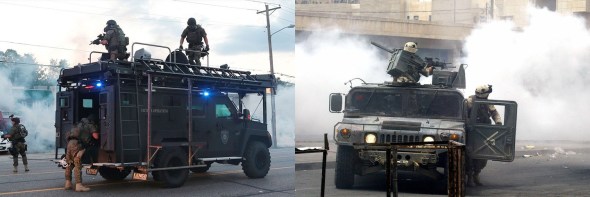
I spent most of the day and night yesterday following the shocking events in Ferguson, Missouri. As I read articles and tweets and studied violent images of police dressed as soldiers and riding in military vehicles, I had repeated flashbacks to the Civil Rights era. Except in those days, police weren’t outfitted with surplus military equipment provided by the Federal government. Back then, the cops had to resort to fire hoses to force people off the streets; but in Ferguson, St. Louis police are equipped with MRAPs (mine-resistant ambush-protected vehicles) and LRADs (long-range acoustic devices).
Ferguson isn’t a large city, and reporters on the ground estimated the size of the “crowd” at somewhere between 150 and 250 people, who were largely protesting peacefully by holding their hands in the air and chanting “Hands up. Don’t shoot.” It’s long past time for Missouri Governor Jay Nixon (a Democrat) to step in and tell the cops to calm down and put away their military toys. If he won’t take action, then President Obama should instruct Attorney General Holder to do it.
The protests follow the killing of 18-year-old Michael Brown by a still-unnamed Ferguson policeman last Saturday afternoon. Brown “had no criminal background,” according to KDSK.com. Police claim that Brown struggled with the officer and tried to grab his gun. But that makes no sense. Why did the officer choose to stop Brown as he peacefully walked down the street with a friend? That friend, Dorian Johnson tells a different version of events.
From USA Today: Witness to Michael Brown shooting comes forward.
Dorian Johnson said he was standing inches from Brown when the shooting occurred around 1:40 p.m. Saturday. He gave his account of the shooting to KSDK-TV.
“The officer is approaching us and as he pulled up on the side of us, he didn’t say freeze, halt or anything like we were committing a crime. He said, ‘Get the F on the sidewalk.’
After Johnson said the officer thrust open the door of his patrol car, hitting the pair, Johnson said the officer grabbed Brown around the neck and tried to pull him through the window. He said Brown never tried to reach for the officer’s weapon.
“The second time he says, ‘I’ll shoot,’ a second later the gun went off and he let go,” Johnson said. “That’s how we were able to run at the same time. The first car I see, I ducked behind for because I fear for my life. I’m scared. I don’t know what’s going on. I don’t understand why this officer is shooting his weapon at us.”
According to Johnson, the officer pursued Brown and fired another shot. which struck Brown in the back. He said Brown turned and faced the officer with his hands raised.
“My friend started to tell the officer that he was unarmed and that he could stop shooting (him),” Johnson said. “Before he could get his second sentence out, the officer fired several more shots into his head and chest area. He fell dramatically into the fatal position. I did not hear once he yell freeze, stop or halt. it was just horrible to watch.”
Unfortunately for the officer who killed Brown, two more witnesses have now come forward. From CNN:
While Michael Brown appeared to tussle with an officer before he was shot dead, he didn’t enter the police cruiser as authorities claim he did, two witnesses told CNN.
The women’s accounts corroborate that of a previous witness, all three of whom said the officer fatally shot the unarmed teen.
Police have said the black 18-year-old died in a dangerous struggle after trying to grab the officer’s weapon. Not so, say the witnesses.
“It looked as if Michael was pushing off and the cop was trying to pull him in,” Tiffany Mitchell told CNN on Wednesday night.
Mitchell had driven to Ferguson to pick up another woman Piaget Crenshaw. The two women witnessed the shooting from two different angles–Mitchell from her car and Crenshaw from a building nearby.
Neither woman, who gave their statements to St. Louis County police, say they saw Brown enter the vehicle.
Instead, a shot went off, then the teen broke free, and the officer got out of the vehicle in pursuit, the women said.
“I saw the police chase him … down the street and shoot him down,” Crenshaw said. Brown ran about 20 feet.
“Michael jerks his body, as if he’s been hit,” Mitchell said.
Then he faced the officer and put his hands in the air, but the officer kept firing, both women said. He sank to the pavement.
The protests in Ferguson, a town in which the population is 2/3 black but the political leadership and police force are overwhelmingly white, are largely driven by the fact that police will not name the shooter or released the results of Brown’s autopsy, despite Missouri’s sunshine law.
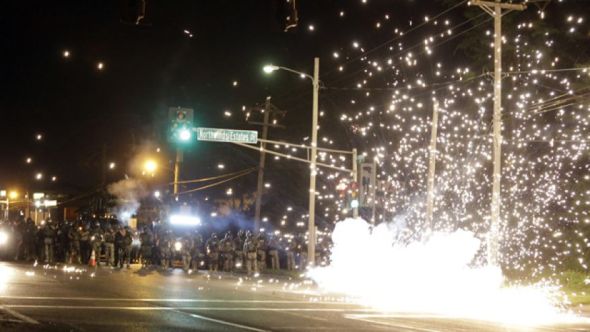
August 13, 2014: A device deployed by police goes off in the street as police and protesters clash in Ferguson, Mo. (AP Photo/Jeff Roberson)
From The New York Times: Anonymity in Missouri Police Shooting Fuels Frustration.
FERGUSON, Mo. — In the five days since an unarmed young black man was fatally shot by a police officer here, the selective release of information about the shooting, and especially the anonymity granted to the officer, has stoked frustrations in this largely African-American community north of St. Louis, where residents describe increasingly tense relations with the police.
The police chief, Thomas Jackson, has repeatedly declined to identify the officer, who has been put on administrative leave. But on Wednesday, the chief did offer a new detail about the shooting, which has kindled nights of racial unrest and an unyielding police response with tear gas, rubber bullets and arrests.
Jackson claims there have been threats against the police officer and he needs protection. So why not simply arrest him for murder and send his family to a safer location? Instead, Wilson called in law enforcement support from St. Louis and enabled an incredible overreaction to largely peaceful protests. From the Times article:
On Wednesday night, scores of police officers in riot gear and in armored trucks showed up to disperse protesters who had gathered on the streets near the scene of the shooting. Some officers perched atop the vehicles with their guns trained on the crowds while protesters chanted, “Hands up, don’t shoot.” A police spokesman said that some demonstrators had thrown Molotov cocktails at officers and that some had tried to set fires. The police used tear gas on demonstrators, and some protesters said rubber bullets had been fired at them. Police said one officer appeared to have suffered a broken ankle after being hit by a brick.
The police made more than 10 arrests. Among those arrested was Antonio French, a St. Louis alderman, who had been documenting the protests on social media, his wife said on Twitter.
Two reporters covering the protests also said they had been arrested inside a McDonald’s for trespassing and later released without charges or an explanation. The reporters, Wesley Lowery of The Washington Post and Ryan J. Reilly of The Huffington Post, both said they had been handled roughly by the police.
If you don’t read anything else on the events in Ferguson, read this article and look at the photos.

More recommended stories:
Mashable: Ferguson or Iraq? Photos Unmask the Militarization of America’s Police.
As America scaled back its presence in Afghanistan and Iraq in 2012, military gear — amphibious tanks, weapons, uniforms and drones — spilled into local police arsenals. In June, an ACLU report warned of the “excessive militarization” of local law enforcement. “This has the effect of terrifying people, destroying communities and actually undermining public safety,” Kara Dansky, ACLU senior counsel, told Mashable in June.
The photos below show the heavily armed Ferguson police officers, dressed in camouflaged uniforms. They are set side-by-side with images of U.S. military operations in Iraq and Afghanistan.
One of the photo comparisons below. Which was taken in Ferguson and which in Iraq?
NBC News: Michael Brown Killing: Missouri Governor to Visit as Unrest Grows in Ferguson.
Missouri Gov. Jay Nixon said he would visit the St. Louis suburbs Thursday after police fired tear gas to break up crowds in a fourth night of civil unrest over the police killing of an unarmed black teenager.
Sixteen people were arrested, including two reporters, on Wednesday night in the suburb of Ferguson, and police said that two officers were injured, one hit by a brick, NBC affiliate KSDK reported….
Nixon said in a statement that the worsening situation in Ferguson was “deeply troubling.” He canceled a planned visit to the state fair. “While we all respect the solemn responsibility of our law enforcement officers to protect the public, we must also safeguard the rights of Missourians to peaceably assemble and the rights of the press to report on matters of public concern,” he said.
Too little, too late, IMHO.
The Baltimore Sun: Riots in Ferguson and what they mean, by Leonard Pitts.
To believe that this carnage — the windows smashed, the buildings torched, the tear gas wafting — is all about the killing of Michael Brown is to miss the point….
Because, again, this is not just about Brown. It’s about Eric Garner, choked to death in a confrontation with New York City Police. It’s about Jordan Davis, shot to death in Jacksonville, Florida, because he played his music too loud. It’s about Trayvon Martin, shot to death in Sanford, Florida, because a self-appointed neighborhood guardian judged him a thug. It’s about Oscar Grant, shot by a police officer in an Oakland, California, subway station as cellphone cameras watched. It’s about Amadou Diallo, executed in that vestibule and Abner Louima, sodomized with that broomstick. It’s about Rodney King.
And it is about the bitter sense of siege that lives in African-American men, a sense that it is perpetually open season on us.
And that too few people outside of African America really notice, much less care. People who look like you are every day deprived of health, wealth, freedom, opportunity, education, the benefit of the doubt, the presumption of innocence, life itself — and when you try to say this, even when you document it with academic studies and buttress it with witness testimony, people don’t want to hear it, people dismiss you, deny you, lecture you about white victimhood, chastise you for playing a so-called “race card.”
They choke off avenues of protest, prizing silence over justice, mistaking silence for peace. And never mind that sometimes, silence simmers like water in a closed pot on a high flame….the anger we see in Ferguson did not spring from nowhere, nor arrive, fully-formed, when Michael Brown was shot. It is the anger of people who are, as Fannie Lou Hamer famously said, sick and tired of being sick and tired.
Silence imposed on pain cannot indefinitely endure. People who are hurting will always, eventually, make themselves heard.
The only problem with Pitts’ column is that there haven’t been any actual “riots” in Ferguson yet–unless you count what the police are doing as rioting.
Riverfront Times: Watch Police in Ferguson Arrest, Tear Gas Journalists [VIDEO]
Police actions against press seem to be part of the reason Governor Jay Nixon finally decided to cut his Missouri State Fair trip short. The governor says he’ll arrive in St. Louis County Thursday morning to manage what’s increasingly becoming a volatile, violent and devastating time in St. Louis history.
SWAT officers arrested Wesley Lowery, a political reporter at TheWashington Post, and Ryan Reilly, a Huffington Post justice reporter, shortly before 7 p.m. while clearing out a McDonalds near the protests where they were working. The reporters say police asked for their identification and eventually arrested them when they weren’t leaving quickly enough.
The journalists say they were arrested without being read their Miranda writes and eventually released with nothing — no charges, no police report, no names of arresting officers. The Los Angeles Times says police only released them after their reporter alerted the chief of Ferguson Police (His response: “Oh, god,”), who then called St. Louis County Police.
Late last night, police in Ferguson also tried to order the media to shut off their cameras, and they attacked journalists from Al Jazeera and confiscated their equipment.
Missouri Senator Claire McCaskill decided last night that it was time for her to take some action, since Governor Nixon wasn’t doing it. She will meet with Eric Holder today to discuss the Ferguson situation.
Sen. Claire McCaskill (D-Mo.) says she has a phone call planned with Attorney General Eric Holder on Thursday to discuss the situation in Ferguson, Mo., where an apparently unarmed black teenager was fatally shot by a police officer last weekend.
Amid clashes in the St. Louis suburb Wednesday night, the senator tweeted that she’s been working the phones to try to deescalate the “tense and unacceptable situation.” ….
Holder and White House senior adviser Valerie Jarrett briefed President Obama Wednesday and the president will receive another briefing Thursday.
I’ll have to end there, because this post is getting way too long. I’ll post more important links in the comments. I’ll leave it to you Sky Dancers to update me on the rest of the news. I’ve been too focuses on Ferguson to pay attention to anything else. See you in the comment thread.
Saturday News Potpourri
Posted: January 25, 2014 Filed under: Civil Rights, Egypt, Foreign Affairs, morning reads, Russia, U.S. Politics | Tags: apps, artisanal toast, banks, Booz Allen Hamilton, Brian Glyn Williams, Chechnya, China, Dagestan, discrimination, diva test, Don Graham, Dr. Strangelove, Dzhokhar Tsarnaev, Edward Snowden, Eric Holder, Erik Prince, glamour shots of elderly people, guns, Jeff Bezos, Marijuana, Pink, Sochi Olympics, Trove, Ukraine protests, Volograd bombings, vote id laws, voting rights, Washington Post 53 Comments
Good Morning!!
I have quite a few articles to share this morning, a real Saturday potpourri! So let’s get started. First up, on Thursday Attorney General Eric Holder gave a wide-ranging interview to Ari Melber of MSNBC, and quite a bit of breaking news came out of it. Here are some of the resulting headlines: NY Daily News: Eric Holder: Could talk deal with NSA-leaker Edward Snowden, but no clemency
Holder told MSNBC that the Obama Administration “would engage in a conversation” about a resolution in the case, but said it would require Snowden acknowledge wrongdoing…. At a University of Virginia forum, where Holder was asked about Snowden, he elaborated on his position, saying, “If Mr. Snowden wanted to come back to the United States and enter a plea, we would engage with his lawyers. We would do the same with any defendant who wanted to enter a plea of guilty, so that is the context to what I said.” But he stressed that the NSA leaker would not walk. “We’ve always indicated that the notion of clemency isn’t something that we were willing to consider.”

Seattle PI: Holder: Marijuana banking regulations on the way
Attorney General Eric Holder says the Obama administration is planning to roll out regulations soon that would allow banks to do business with legal marijuana sellers. During an appearance Thursday at the University of Virginia, Holder said it is important from a law enforcement perspective to enable places that sell marijuana to have access to the banking system so they don’t have large amounts of cash lying around. Currently, processing money from marijuana sales puts federally insured banks at risk of drug racketeering charges. Because of the threat of criminal prosecution, financial institutions often refuse to let marijuana-related businesses open accounts.
There’s a good piece about this at Forbes, but they won’t even let you copy their headlines anymore. Mediaite: Eric Holder: Voter ID Used to ‘Depress the Vote’ of People Who Don’t Support GOP
Attorney General Eric Holder sharply criticized state-level voter identification policies and said that he believes those policies are a “remedy in search of a problem.” He added that, while some may be arguing for voter ID in good faith, he believes that most are advocating for this policy in order to “depress the vote” of those who do not support the “party that is advancing” voter ID measures. “I think many are using it for partisan advantage,” Holder said of voter ID. “People have to understand that we are not opposed to photo identification in a vacuum,” he continued. “But when it is used in — certain ways to disenfranchise particular groups of people, whether by racial designation, ethnic origin, or for partisan reasons, that from my perspective is problematic.” He added that “all the studies” show that in-person voter fraud “simply does not exist” at a level that requires a legislative solution.
Politico: Eric Holder: Timing of Robert Gates book release ‘a mistake’
Attorney General Eric Holder waded into the controversy over former Defense Secretary Robert Gates’s new book Thursday, calling it “a mistake” for Gates to have published his recollections before President Barack Obama left the White House. “It’s my view that it’s just not a good thing thing to write a book about a president that you served while that president is still in office,” Holder said during an appearance at the University of Virginia’s Miller Center. “From my perspective I think the world of Bob Gates, but I think that the publication of that book — at least at this time — was a mistake.” [….] In the course of offering his critique of the timing of Gates’s book, “Duty: Memoirs of a Secretary at War,” Holder twice praised the former defense secretary for his leadership. “I like Bob Gates a great deal. He was a good secretary of defense,” the attorney general said.
LA Times: Holder says no bank ‘too big to indict,’ more financial cases coming
“I think people just need to be a little patient,” Holder said, according to a transcript of an interview with MSNBC to air at noon Pacific time Friday. “I know it’s been a while. But we have other things that are in the pipeline.” [….] Holder has taken heat for telling a Senate hearing last year that some financial institutions were “so large that it becomes difficult to prosecute them” because criminal charges could hurt the U.S. and even world economies. Since then Holder has tried to emphasize that the Justice Department is not intimidated by the size of a financial institution and would bring any charges it believed it could prove.
As I said, quite a bit of news out of one interview. Good job by Ari Melber.
In other news . . .
The Economist has a brief article that provides some background on the situation in Ukraine: On the march in Kiev –The protests turn nasty and violent, but the president is not giving ground. 
JANUARY 22nd was meant to mark Ukraine’s unity day, a celebration of its short-lived pre-Soviet independence. Instead, it was a day of civil unrest and perhaps the biggest test of Ukraine’s post-Soviet integrity. After two months of largely peaceful encampment on the Maidan in Kiev, the protests turned violent. Five people were reported killed and hundreds were injured. An armoured personnel carrier pushed through the streets. Clouds of black smoke and flames mottled the snow-covered ground. Never in its history as an independent state has Ukraine witnessed such violence. It was triggered by the passage of a series of repressive laws imposing tight controls on the media and criminalising the protests of the past two months. One law copied almost verbatim a Russian example, including stigmatising charities and human-rights groups financed from abroad as “foreign agents”. If Russian human-rights activists denounce their parliament as a “crazy printer” churning out repressive legislation, says Oleksandra Matviichuk of the Centre for Civil Liberties in Kiev, Ukraine has a “crazy photocopier”. The clashes show vividly the refusal of the protesters to heed such laws.
Brian Glyn Williams, the U. Mass Dartmouth professor who interacted with Boston Marathon bomber Dzhokhar Tsarnaev and recommended some sources of information on Chechnya for a report Tsarnaev was writing, has a post up at HuffPo on how the history of Chechya and Dagestan is coming back to haunt the Winter Olympics in Russia: The Dark Secret Behind the Sochi Olympics: Russia’s Efforts to Hide a Tsarist-Era Genocide. Here’s the conclusion:
The twin bombings in Volgograd in late December 2013 and an earlier one in October are clearly meant to show the Russians that the Chechen-Dagestani terrorists have reignited their terror jihad. They are also meant to remind the world of the tragedy that befell the Circassians of the Caucasus’s Black Sea shore exactly 150 years ago this winter. This is the dark secret that Russia’s authoritarian leader, Putin, does not want the world to know. Putin has thus far been very successful in conflating Russia’s neo-colonial war against Chechen separatists with America’s war on nihilist Al Qaeda Arab terrorists. Any attempt to remind the world of Imperial Russia/Post-Soviet Russia’s war crimes in the Caucasus is a threat to Putin’s pet project, the whitewashed Sochi Olympics. This of course not to excuse the brutal terroristic acts of the Caucasian Emirate or the Chechen rebels, but it certainly provides the one thing that Putin does not want the world to see as he constructs his “Potemkin village” in Sochi, and that is an honest account of the events that have made this the most terrorist fraught Olympic games since the 1972 Summer Olympics in Munich.
 Remember Erik Prince, the Michigan millionaire who founded Blackwater? Guess what he’s doing these days? The WSJ has the scoop: Erik Prince: Out of Blackwater and Into China. Erik Prince —ex-Navy SEAL, ex-CIA spy, ex-CEO of private-security firm Blackwater —calls himself an “accidental tourist” whose modest business boomed after 9/11, expanded into Iraq and Afghanistan, and then was “blowtorched by politics.” To critics and conspiracy theorists, he is a mercenary war-profiteer. To admirers, he’s a patriot who has repeatedly answered America’s call with bravery and creativity.
Now, sitting in a boardroom above Hong Kong’s Victoria Harbour, he explains his newest title, acquired this month: chairman of Frontier Services Group, an Africa-focused security and logistics company with intimate ties to China’s largest state-owned conglomerate, Citic Group. Beijing has titanic ambitions to tap Africa’s resources—including $1 trillion in planned spending on roads, railways and airports by 2025—and Mr. Prince wants in…. “I would rather deal with the vagaries of investing in Africa than in figuring out what the hell else Washington is going to do to the entrepreneur next,” says the crew-cut 44-year-old. Having launched Blackwater in 1997 as a rural North Carolina training facility for U.S. soldiers and police, Mr. Prince says he “kept saying ‘yes’ as the demand curve called—Columbine, the USS Cole and then 9/11.” In 100,000 missions in Iraq and Afghanistan, he says, Blackwater contractors never lost a U.S. official under their protection. But the company gained a trigger-happy reputation, especially after a September 2007 shootout that left 17 civilians dead in Baghdad’s Nisour Square. At that point, charges Mr. Prince, Blackwater was “completely thrown under the bus by a fickle customer”—the U.S. government, and especially the State Department. He says Washington opted to “churn up the entire federal bureaucracy” and sic it on Blackwater “like a bunch of rabid dogs.” According to Mr. Prince, IRS auditors told his colleagues that they had “never been under so much pressure to get someone as to get Erik Prince,” and congressional staffers promised, “We’re going to ride you till you’re out of business.”
Awwwwww…..Poor little rich boy. Where’s my tiny violin?

Speaking of entrepreneurs, Amazon billionaire Jeff Bezos’ plans for his latest acquisition–The Washington Post–are becoming clearer, as he hires more right wing libertarians for the op-ed page. Now Pando Daily reveals what Don Graham is up to now that he’s dumped the family business: The company formerly known as WaPo moves into tech apps.
Today, the company formerly known as WaPo — now called Graham Holdings – has announced a new business endeavor in journalism. Surprisingly, said endeavor doesn’t have much to do with actual journalism at all — it falls squarely in the tech camp. It’s a content discovery app called Trove. Trove fits in the now-torrential trend of such applications. Companies like Flipboard,Prismatic, Rockmelt, and N3twork have all tread this ground long before Trove. They’re all convinced that places like Twitter, Facebook, Tumblr, and RSS readers are not good enough for finding the best stories…. The two men behind Trove have rich and storied histories. Vijay Ravindran, the CEO of Trove, served as The Washington Post’s Chief Digital Officer before the sale, and ran ordering at Amazon for seven years before that. Reuters oped columnist Jack Shafer even divpredicted (incorrectly) that Ravindran would be named the new WaPo publisher after the sale. The other Trove heavyweight is product lead Rob Malda, who is also the co-founder and former editor-in-chief of Slashdot — the predecessor of every user-focused news aggregator since, from Digg to Reddit to Hacker News.
Read all about it at the above link.
A few short takes:
In other tech news, CSM’s Security Watch reports that Booz Allen, Snowden’s old firm, looking to help US government with ‘insider threats’. Author Dan Murphy asks, “Are defense and intelligence contractors the best choice to manage a threat they’ve contributed to?” Read it and weep.
According to Fox News, gun manufacturers Smith & Wesson and Ruger will no longer do business in California because they don’t want to comply with a new CA law that allows law enforcement to trace bullets to the individual gun they came from. After all, why would gun companies want to help police catch murderers? Unbelievable!
Did you know that this month is the 50th anniversary of Stanley Kubrick’s brilliant satire, Dr. Strangelove? IMHO, it is one of the funniest movies of all time. Well, Eric Schlosser has a not-so-funny article about it at The New Yorker: ALMOST EVERYTHING IN “DR. STRANGELOVE” WAS TRUE. Don’t miss this one; it’s a must read!
Apparently the latest food craze to emerge from San Francisco is “artisanal toast.” How did toast become the latest artisanal food craze? Ask a trivial question, get a profound, heartbreaking answer. John Gravois writes about it at Pacific Standard: The Science of Society. Weird.
A silly test to take at Buzzfeed: Which Pop Diva Are You? I got Pink. I know nothing about her…but she looks kinda cool. 
Finally, I posted this link in the comments recently, but I don’t know if anyone looked at it. I’m posting it again, because I think it’s absolutely adorable. It’s some glamour shots of elderly people having fun dressing up and posing as various movie heroes and heroines. Here’s just one example:

“Easy Rider”: Walter Loeser (l.), 98, & Kurt Neuhaus, 90

 peej
peej Carissa
 bostonboomer
 dakinikat
 ecocatwoman
 mablue2
 Mama Lopez
 peggysue22
 quixote
 skydancingguestblogger
 Mona (aka Wonk the Vote)



 Sky Dancing
Recent Comments