
Thursday Reads: Hot and Bothered Edition
Posted: July 18, 2013 Filed under: Foreign Affairs, morning reads, U.S. Politics | Tags: Boston Bombings, dead man's switch, Dzhokhar Tsarnaev, Edward Snowden, encryption, FBI, Glenn Greenwald, Gordon Humphrey, heat wave, Ibragim Todashev, Michael Hastings, Michael Krikorian, NSA leaks, Rolling Stone cover, student loan interest rates, Susan Zalkind, Waltham triple murder 41 Comments
Good Morning!!
Today is day 5 of the latest heatwave, which isn’t scheduled to break here in southern New England until Sunday. I don’t think I’m capable of writing very much today–we’ll see how it goes.
From USA Today: Heat wave scorches central, eastern USA
A killer heat wave brought the hottest weather of the summer to much of the nation Wednesday, and at least two more days of broiling temperatures are forecast before cooler weather slides in over the weekend.
About 130 million people are sweltering through the heat wave in the Midwest and Northeast this week, reports AccuWeather meteorologist Alex Sosnowski.
High daytime and nighttime temperatures, high humidity, intense sunshine and lack of wind will continue to make these areas “seem like the middle of the tropics,” he said.
High temperatures in the 90s are again likely Thursday and Friday all the way from the Plains to the Northeast. Heat advisories and warnings are in place from the Dakotas to New England.
Boston Bombing Aftermath
Quite a few people in New England are all hot and bothered about the August 1 cover of Rolling Stone–a glamorous photo of Dzhokhar Tsarnaev. The photo accompanies a long article by Janet Reitman, who has a reputation as a good investigative journalist.
The cover copy suggests that Reitman will reveal how sweet little Dzhokhar became “radicalized” into a “monster” who participated in the Boston Marathon bombing. I read the article, and was disappointed to find that it is mostly a rehash of material that was covered long ago in The Boston Globe and The New York Times. Reitman appears to have interviewed some of Tsarnaev’s high school friends, but again they offered no new insights. Reitman had scheduled an appearance on MSNBC’s The Last Word with Lawrence O’Donnell, who was born and raised in Boston. In the wake of the controversy, Reitman cancelled, which is also disappointing. Why not go on and defend her story?
I can’t say I’m all that bothered by the cover, since the photo was also featured long ago in The New York Times and other publications, but I can respect that for survivors of the bombings it seems pretty dismissive of their suffering to glamorize the perpetrator. Here are a few links on the topic–see what you think.
Erik Wemple at The Washington Post: To Rolling Stone detractors: Please
Slate: Rolling Stone’s Boston Bomber Cover Is Brilliant
The Boston Globe: Why Boston reacted right to Rolling Stone
Time: Drugstores, Supermarkets Boycott Rolling Stone Over Boston-Bomber Cover
In other news related to the Boston bombing suspects, friends of three men who were brutally murdered in Waltham in September 2011 have been talking to the media. Susan Zalkind, a friend of Erik Weissman appeared on the Rachel Maddow show this week.
Susan Zalkind, a close friend of Eric Weissman who was found murdered with two of friends in a Harding Avenue home in September 2011, appeared on the Rachel Maddow Show on Tuesday to discuss her investigation and reactions to the case, which is officially under investigation. However, authorities reportedly believe accused Boston Marathon bomber Tamerlan Tsarnaev and his friend Ibragim Todashev committed the murders as a drug ripoff. Tsarnaev was killed during the April 19 shootout with police in Watertown. The Federal Bureau of Investigation shot and killed Todashev in his Florida home in May after allegedly attacking agents. Todashev had been in the process of writing a confession implicating himself and Tsarnaev in the murders.
Other friends of the three murdered men talked to CNN, and High Times Magazine has the video. Friends believe that police didn’t take the investigations of the murders very seriously once they concluded that the three men were drug dealers.
Meanwhile, the FBI is refusing to release the Todashev autopsy. From Russia Today:
The FBI has ordered a Florida medical examiner’s office not to release the autopsy report of a Chechen man who was killed during an FBI interview in May over his ties to one of the suspected Boston Marathon bombers.
The autopsy report for Ibragim Todashev, 27, killed by an FBI agent during an interrogation which took place in his apartment on May 22 was ready for release on July 8. However, the FBI barred its publication, saying an internal probe into his death is ongoing.
“The FBI has informed this office that the case is still under active investigation and thus not to release the document,” according to statement by Tony Miranda, forensic records coordinator for Orange and Osceola counties in Orlando.
The forensic report was expected to clarify the circumstances of Todashev’s death.The Bureau’s statement issued on the day of the incident provided no details of what transpired, saying only that the person being interviewed was killed when a “violent confrontation was initiated by the individual.”
Back in May Ibragim Todashev’s father showed pictures of his dead son’s body at a press conference in Moscow, revealing he had been shot six times.
“I only saw things like that in movies: shooting a person, and then the kill shot. Six shots in the body, one of them in the head,” Abdulbaki Todashev said.
Student Loan Interest Rates
A group of Senators have made a deal on student loan interest rates, according to Politico.
Key bipartisan Senate negotiators met in Majority Whip Dick Durbin’s Office late Wednesday and emerged confident that they could finally put the vexing issue behind them.
“It would save students in 11 million families billions of dollars,” said Lamar Alexander (R-Tenn.). “We’d like to be able to do this together and we hope that we can come to a decision right away because families need to make their plans.”
Alexander, the top Republican on education issues, said their proposal would apply retroactively to students who have already drawn federal loans at higher rates which went into effect on July 1.
A Senate aide familiar with the talks said the bill could go on the floor as soon as tomorrow. Leadership aides said that’s implausible but not impossible. Otherwise the bill would get a floor vote early next week.
Of course Republican members of the House will probably have different views on this. I have no idea if this is a good plan or not, and I’m too hot to care. I won’t live to see my student loans paid off, that’s all I know for sure.
Michael Hastings Fatal Crash
Russ Baker’s site Who What Why recently published an interesting (and not too wacky) article on the car crash that killed Michael Hastings. It’s written by Michael Krikorian, a former LA Times crime reporter base on footage from surveillance cameras that caught some of the accident. Krikorian doesn’t offer conspiracy theories–just reports of what he saw at the accident scene, his reactions to the videos caught on cameras a his girlfriend’s pizza restaurant nearby, and some reactions from experts to whom he showed the tapes. The most mysterious questions seems to be why Hastings was driving so fast. And why didn’t he apply the brakes when he started to skid?
Four seconds into the start of the tape, a minivan or SUV goes by the front of restaurant. Three seconds later, another vehicle goes by, traveling from the restaurant front door to the crash site in about seven seconds. At 35 seconds into the tape, a car is seen driving northbound and appears to slow, probably for the light at Melrose.
Then at 79 seconds, the camera catches a very brief flash of light in the reflection of the glass of the pizzeria. Traveling at least twice as fast as the other cars on the tape, Hastings’s Mercedes C250 coupe suddenly whizzes by. (This is probably the “whoosh” that Gary, the Mozza employee, heard.)
The car swerves and then explodes in a brilliant flash as it hits a palm tree in the median. Viewed at normal speed, it is a shocking scene—reminiscent of fireballs from “Shock and Awe” images from Baghdad in 2003….I think it’s safe to say the car was doing at least 80….
Highland has a very slight rise and fall at its intersection with Melrose. It’s difficult to tell by the film, but based on tire marks—which were not brake skid marks, by the way—chalked by the traffic investigators, it seems that the Mercedes may have been airborne briefly as it crossed the intersection, then landed hard. Tire marks were left about 10 feet east of the restaurant’s valet stand….
About 100 feet after the car zooms by on the tape, it starts to swerve. At about 195 feet from the camera, the car jumps the curb of the center median, heading toward a palm tree 56 feet away.
About halfway between the curb and the tree, the car hits a metal protrusion—perhaps 30 inches tall and 2 feet wide—that gives access to city water mains below. This is where the first small flash occurs. This pipe may have damaged the undercarriage of the car, perhaps rupturing a fuel line.
Check the story out and see what you think. It appears the police have closed the book on the case except for waiting for tox screens on Hastings to come back.
Edward Snowden Updates
Glenn Greenwald continues to lecture all and sundry that Snowden isn’t the story–the focus should be on the NSA leaks. Meanwhile, he continues to publish about three times as many articles on himself and Snowden as on the leaks. Yesterday’s offering was about e-mails between Snowden and a retired ultra-conservative/libertarian Senator from New Hampshire, Gordon Humphrey. You can read the full e-mails at the link, but one thing Snowden wrote became the subject of much speculation yesterday.
My intention, which I outlined when this began, is to inform the public as to that which is done in their name and that which is done against them. I remain committed to that. Though reporters and officials may never believe it, I have not provided any information that would harm our people – agent or not – and I have no intention to do so.
Further, no intelligence service – not even our own – has the capacity to compromise the secrets I continue to protect. While it has not been reported in the media, one of my specializations was to teach our people at DIA how to keep such information from being compromised even in the highest threat counter-intelligence environments (i.e. China).
You may rest easy knowing I cannot be coerced into revealing that information, even under torture.
Did this mean that Snowden believes himself to be impervious to torture? According to tech experts and hacker types, it means that he has encrypted the data in such a way that even he cannot get at it by himself. Here’s an article in the Christian Science Monitor that explains this in somewhat simple terms. Author Dan Murphy writes:
I think his good intentions, as he sees them, are fair to assume. But his certainty that it is impossible to compromise what he knows seems questionable. Presumably he has digital files that are encrypted in some fashion. But if the files are accessible at all, there has to be a key.
Or even imagine a Escherian progression of unbreakable locks containing the key to the next unbreakable lock in the progression, which in turn contains the next key. Layers of difficulty are just that – problems to be overcome. Assertions of insurmountably seem specious as long as a key or set of keys exists and someone hasn’t destroyed the first one in the sequence.
And if Snowden’s claims are to be believed, a key to whatever data he has does exist. Greenwald says Snowden’s NSA files have been set up for release in the event Snowden is killed by the US. Greenwald hasn’t said what the mechanism would be and what precisely would be released beyond, “if something does happen to [Snowden] all the information will be revealed and it could be [the US government’s] worst nightmare.”
That implies that there is some process, known to some people or persons, that allows for access. And while state of the art encryption can foil technical efforts to break it, it’s hard to see how gaining access to the knowledge of others is impossible. Spy agencies use trickery, bribery, coercion, and sometimes worse to pry out others’ secrets. Yet Snowden was insistent in his letter to Senator Humphrey….
Greenwald implies today that what Snowden meant was that he doesn’t know how to get at the files himself. But then, who does?
If the answer is “no one,” then it’s hard to square with his claim of a release being made in the event of his death. If the answer is “someone” or “some group of people,” then his confidence that secrets can’t be compromised seems misplaced. (I asked a number of people who know more about encryption than I about this; the answer always circled back to “the key is the vulnerability.” Perhaps there’s something we’re all missing?)
Here’s another article from Wired that speculates on the so-called “dead man’s switch.”
I’ve got lots more on Snowden, but I’m running out of space and I think I may be the only one here who still cares what’s going on with him. I can post some more links in the comments if there’s any interest.
Now it’s your turn. What stories are you following today? Please post your links on any topic in the comments.
Tuesday Reads: Rachel and Trayvon, Reid Going Nuclear, Spy Stories, and Much More
Posted: July 16, 2013 Filed under: Civil Liberties, Civil Rights, Crime, Criminal Justice System, Foreign Affairs, Lebanon, morning reads, NSA, National Security Agency, Political Affective Disorder, racism, Russia, U.S. Politics | Tags: al Qaida, Alexei Nikitin, Amnesty International, Charles Ramsey, Edward Snowden, Filibuster, George Zimmerman, Harry Reid, Hezbollah, Human Rights Watch, Mitch McConnell, NSA, nuclear option, Piers Morgan, political asylum, Rachel Jeantel, Tanya Lokshina, Trayvon Martin, US Senate, Vladimir Putin 42 Comments
Good Morning!!
I’m not sure if it’s the heat or the depressing news, but I’m having a hard time getting going this morning.
We’re into our third heat wave of the summer, and I’m actually getting acclimated to 90 degree weather; but I suppose it still has an effect on my body and mind.
I’m also somewhat depressed about the Zimmerman verdict and by the often ignorant reactions I see on-line and on TV.
Rachel and Trayvon
One bright spot in the coverage for me was Rachel Jeantel’s interview with Piers Morgan last night. She was real and authentic, and Morgan pretty much stayed out of the way and let her talk. I think she made a real impression on him and the reaction from the live audience was very positive too. It was refreshing. IMO, it says a lot about Travon Martin’s character that he had a friend like Rachel. I’m going to post the whole interview here in case you missed it or you want to watch it again.
From Mediaite:
Asked about what Trayvon Martin was like as a friend, Jeantel described him as a “calm, chill, loving person” and said she never saw him get “aggressive” or “lose his temper.” She said that the defense’s attempts to portray Martin as a “thug” were unfounded and defended his relatively mild drug use. “Weed don’t make him go crazy,” she said, “it just makes him go hungry.”
Jeantel also responded to the massive mockery she received in social media for the way she speaks, explaining that she was born with an under-bite that has made it difficult for her to speak clearly. When Morgan asked if she’d been bullied for her condition, she simply responded, “Look at me,” to laughter from the studio audience.
Morgan attempted to get Jeantel to offer her opinion of defense attorney Don West, who many claimed was condescending towards her when she was on the stand. Jeantel shook her head, declining to say anything bad about the man given her “Christian” upbringing.
In the second part of his interview with Jeantel, Morgan turned to the “creepy-ass cracker” comment she made and the major impact it had on the tenor of the case. She explained that the term is actually spelled “cracka” and defined it as “people who are acting like they’re police.” She said that if Zimmerman had calmly approached Martin and introduced himself, her friend would have politely said what he was doing there and nothing more would have happened.
Unlike the juror, Jeantel did think Zimmerman was racially motivated. “It was racial,” she said. “Let’s be honest, racial. If Trayvon was white and he had a hoodie on, would that happen?”
I’d also like to recommend this piece by Robin D.G. Kelley at Counterpunch: The US v. Trayvon Martin.
In the aftermath of the Sandy Hook Elementary School massacre, Texas Congressman Louie Gohmert, Virginia Governor Bob McDonnell, Senator Rand Paul, Florida State Representative Dennis Baxley (also sponsor of his state’s Stand Your Ground law), along with a host of other Republicans, argued that had the teachers and administrators been armed, those twenty little kids whose lives Adam Lanza stole would be alive today. Of course, they were parroting the National Rifle Association’s talking points. The NRA and the American Legislative Exchange Council (ALEC), the conservative lobbying group responsible for drafting and pushing “Stand Your Ground” laws across the country, insist that an armed citizenry is the only effective defense against imminent threats, assailants, and predators.
But when George Zimmerman fatally shot Trayvon Martin, an unarmed, teenage pedestrian returning home one rainy February evening from a neighborhood convenience store, the NRA went mute. Neither NRA officials nor the pro-gun wing of the Republican Party argued that had Trayvon Martin been armed, he would be alive today. The basic facts are indisputable: Martin was on his way home when Zimmerman began to follow him—first in his SUV, and then on foot. Zimmerman told the police he had been following this “suspicious-looking” young man. Martin knew he was being followed and told his friend, Rachel Jeantel, that the man might be some kind of sexual predator. At some point, Martin and Zimmerman confronted each other, a fight ensued, and in the struggle Zimmerman shot and killed Martin.
Zimmerman pursued Martin. This is a fact. Martin could have run, I suppose, but every black man knows that unless you’re on a field, a track, or a basketball court, running is suspicious and could get you a bullet in the back. The other option was to ask this stranger what he was doing, but confrontations can also be dangerous—especially without witnesses and without a weapon besides a cell phone and his fists. Florida law did not require Martin to retreat, though it is not clear if he had tried to retreat. He did know he was in imminent danger.
Why didn’t Trayvon have a right to stand his ground? Why didn’t his fear for his safety matter? We need to answer these questions as a society. Please read the whole article if you can.
Read the rest of this entry »
Glenn Greenwald: If anything happens to Edward Snowden US will be gravely harmed
Posted: July 13, 2013 Filed under: Media, NSA, National Security Agency, Surreality, U.S. Politics | Tags: dead man's switch, Edward Snowden, Glenn Greenwald, greymail, NSA leaks 27 Comments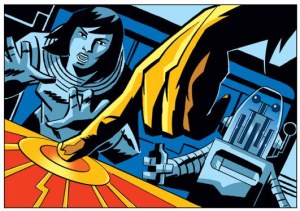
Dead man’s switch
It may be time for Edward Snowden to look for another spokesman/PR flack. Then again, it might already be too late.
Today Snowden’s designated media mouthpiece Glenn Greenwald gave an interview to an Argentine newspaper, La Nacion, in which he provided some rather stunning quotes about Edward Snowden’s ability to harm the U.S. government. Reuters picked up the story and reprinted the Greenwald quotes in English.
(Reuters) – Fugitive former U.S. spy contractor Edward Snowden controls dangerous information that could become the United States’ “worst nightmare” if revealed, a journalist familiar with the data said in a newspaper interview.
Glenn Greenwald, the Guardian journalist who first published the documents Snowden leaked, said in a newspaper interview published on Saturday that the U.S. government should be careful in its pursuit of the former computer analyst.
“Snowden has enough information to cause harm to the U.S. government in a single minute than any other person has ever had,” Greenwald said in an interview in Rio de Janeiro with the Argentinean daily La Nacion.
“The U.S. government should be on its knees every day begging that nothing happen to Snowden, because if something does happen to him, all the information will be revealed and it could be its worst nightmare.”
I don’t know about you, but to me those sound like threats. Technically, they could be called “graymail” From the Urban Dictionary:
graymail:
to force the government to choose between prosecuting an employee for serious crimes or preserving national security secrets
Libby’s lawyers deliberated on how to graymail the government in order to achieve an acquittal.
It’s not illegal, but it doesn’t seem all that “heroic” either.
Greenwald immediately published a defense of his comment at The Guardian: About the Reuters article.
When you give many interviews in different countries and say essentially the same thing over and over, as I do, media outlets often attempt to re-package what you’ve said to make their interview seem new and newsworthy, even when it isn’t. Such is the case with this Reuters article today, that purports to summarize an interview I gave to the daily newspaper La Nacion of Argentina.
Like everything in the matter of these NSA leaks, this interview is being wildly distorted to attract attention away from the revelations themselves. It’s particularly being seized on to attack Edward Snowden and, secondarily, me, for supposedly “blackmailing” and “threatening” the US government. That is just absurd.
That Snowden has created some sort of “dead man’s switch” – whereby documents get released in the event that he is killed by the US government –was previously reported weeks ago, and Snowden himself has strongly implied much the same thing. That doesn’t mean he thinks the US government is attempting to kill him – he doesn’t – just that he’s taken precautions against all eventualities, including that one (just incidentally, the notion that a government that has spent the last decade invading, bombing, torturing, rendering, kidnapping, imprisoning without charges, droning, partnering with the worst dictators and murderers, and targeting its own citizens for assassination would be above such conduct is charmingly quaint).
So what are the distortions? Greenwald doesn’t say. I had google translate the La Nacion article, and the quotes appear to be identical with those reported by Reuters. Greenwald doesn’t deny saying them; he simply states categorically that what he said “has [nothing] remotely to do with threats.”
O-kaaay…. But they sure do sound like threats to me. In an update Greenwald provides a quote in context which he says proves he wasn’t threatening anyone:
Here’s the context for my quote about what documents he possesses:
“Q: Beyond the revelations about the spying system performance in general, what extra information has Snowden?“A: Snowden has enough information to cause more damage to the US government in a minute alone than anyone else has ever had in the history of the United States. But that’s not his goal. [His] objective is to expose software that people around the world use without knowing what they are exposing themselves without consciously agreeing to surrender their rights to privacy. [He] has a huge number of documents that would be very harmful to the US government if they were made public.”
Greenwald then tries to fudge the quote about how the U.S. “should be down on its knees…”
And exactly as I said, the answer about the dead man’s switch came in response to my being asked: “Are you afraid that someone will try to kill him?” That’s when I explained that I thought it such an was unlikely because his claimed dead man’s switch meant that it would produce more harm than good from the perspective of the US government.
But here is the original quote from the La Nacion story (translated awkwardly by Google):
If something were to happen, those documents would be made public. This is your insurance policy. The U.S. government should be on your knees every day praying that nothing happens to Snowden, because if something happens, all information will be revealed and that would be their worst nightmare.
Please explain to me how that is “has [nothing] remotely to do with threats.” At the point Greenwald has taken on the role of a combination PR flack and defense attorney. He spends hours on Twitter sending out links to every favorable story about Snowden and he uses his Guardian column to write critiques of negative media reports on Snowden and himself. Greenwald is way out of his depth; his defenses of Snowden and his giant scoop are getting increasingly irrational. How long is The Guardian going to allow this to continue?
Saturday Morning Open Thread
Posted: July 13, 2013 Filed under: abortion rights, Barack Obama, Foreign Affairs, morning reads, NSA, National Security Agency, open thread, poverty, Psychopaths in charge, Real Life Horror, Reproductive Health, Reproductive Rights, social justice, U.S. Economy, U.S. Politics, War on Women, Women's Rights | Tags: Andrea Grimes, anti-abortion laws, CNBC, Edward Snowden, Elizabeth Warren, FDic, food stamps, Glass Steagall, hunger in America, Malala Yousafzai, Rick Perry, Sergei Lavrov, Texas legislature, Vladimir Putin, Yatzel Sabat 36 Comments
Abortion rights advocates fill the rotunda of the State Capitol as the Senate neared its vote Friday night (Tamir Kalifa/AP)
Good Morning Sky Dancers!!
There sure is a lot of news out there for a summer Saturday. Beginning in Texas, the state senate passed a restrictive anti-abortion bill that will threaten women’s lives. The New York Times reports:
AUSTIN, Tex. — The Texas Senate gave final passage on Friday to one of the strictest anti-abortion measures in the country, legislation championed by Gov. Rick Perry, who rallied the Republican-controlled Legislature late last month after a Democratic filibuster blocked the bill and intensified already passionate resistance by abortion-rights supporters.
The bill would ban abortions after 20 weeks of pregnancy and hold abortion clinics to the same standards as hospital-style surgical centers, among other requirements. Its supporters say that the strengthened requirements for the structures and doctors will protect women’s health; opponents argue that the restrictions are actually intended to put financial pressure on the clinics that perform abortions and will force most of them to shut their doors.
Mr. Perry applauded lawmakers for passing the bill, saying “Today the Texas Legislature took its final step in our historic effort to protect life.” Legislators and anti-abortion activists, he said “tirelessly defended our smallest and most vulnerable Texans and future Texans.”
Mr. Perry does not appear to include any “right to life” for adult women in his “effort to protect life,” however. I wonder if anyone has ever asked him one simple question: are women human beings? Forced childbirth is tantamount to slavery in my opinion. Furthermore, childbirth is far more dangerous than abortion, and the restrictions will likely mean that women with problematic late term pregnancies will die or suffer grievous harm. According to the NYT story,
The bill was opposed by many doctors, including leaders of the American Congress of Obstetricians and Gynecologists and the Texas Medical Association; the gynecologists’ group has run advertisements locally that question the scientific underpinnings of the legislation and tell legislators to “Get out of our exam rooms.”
Andrea Grimes writes at RH Reality Check: As Out-Of-State Gawkers Look On, Texas Lawmakers Prepare to Pass ‘Death Sentence’ Anti-Abortion Bill. She describes a young man from Minnesota who traveled down to Texas to watch the show.
This young guy, probably a senior in high school or a freshman in college—I didn’t catch his name—said he was real tired of wearing blue, the chosen color of anti-choice supporters of HB 2. I wore orange that day, the same color as thousands of Texans who have turned up at the capitol to stand up for reproductive rights. I also wore pink earbuds, trying to follow the house debate while waiting in line. Maybe this young guy thought I couldn’t hear him. Maybe he didn’t care.
“I’m looking forward to all this being over so I can wear my orange shirts again!” he joked.
She contrasts his blase attitude with that of Yatzel Sabat, a gay woman of color
who was dragged out of that same gallery Wednesday morning by law enforcement. Sabat was not wearing orange. She was wearing black.
Her limbs bound by state troopers, she screamed in a clear, strong voice, “This bill will kill women!” as the Texas House of Representatives gave its approval to HB 2, passing the devastating legislation along to the state senate for final passage….
This bill will kill. Period.
It will kill Texans who already travel to Mexico to buy abortion pills from flea markets because they are too poor to go to a legal abortion clinic, or unable to take time off work to find a doctor’s office and wait 24 hours between a state-mandated sonogram and an abortion procedure. It will kill Texans who, if HB 2 passes, cannot travel a thousand miles round trip to a San Antonio or Dallas ambulatory surgical center for a safe, legal abortion.
Please read the whole thing if you can.

Next up, the U.S. Congress debates more cuts in food stamps as American children go hungry. From Martha White at NBC News:
For one in seven Americans, the federal government’s Supplemental Nutrition Assistance Program, aka food stamps, is all that stands between them and too little food.
But the complicated calculus of financial survival for the working poor also means any cuts to the roughly $80 billion SNAP, as it’s known, being considered by Congress would be felt well beyond the grocery checkout line. Buying new school clothes, family outings, even getting a toehold in the financial mainstream could be thrown into limbo.
For many of the working poor, wages just don’t go far enough. The National Employment Law project says nearly 60 percent of jobs created in the post-recession recovery pay $13.83 or less an hour, and hourly wages for some low-wage occupations fell by more than 5 percent in just three years.
Food service and temporary employment make up 43 percent of the post-recession job growth, according to NELP policy analyst Jack Temple. “They overwhelmingly pay low wages,” Temple said. “For that lower segment, you’re going to see increased use of safety net programs to make up the difference.”
Read it and weep, folks; and while you do keep in mind that the Federal deficit has been dropping steadily. The only possible reasons for the austerity agenda are to make the rich richer and punish the working poor.
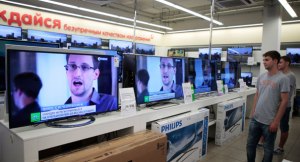
The Snowden saga continues. Reuters reports that Russia has not yet received an application for asylum from the American hacker/leaker/whistleblower/dissident–or whatever he’s being called at the moment.
Russia kept former U.S. spy agency contractor Edward Snowden at arm’s length on Saturday, saying it had not been in touch with the fugitive American and had not yet received a formal request for political asylum.
Remarks by Foreign Minister Sergei Lavrov signaled Russia is weighing its options after Snowden, who is stranded at a Moscow airport, broke three weeks of silence and asked for refuge in Russia until he can secure safe passage to Latin America.
Washington urged Moscow to return Snowden to the United States, where he is wanted on espionage charges after revealing details of secret surveillance programs, and President Barack Obama spoke by phone with Russian President Vladimir Putin….
“We are not in contact with Snowden,” Russian news agencies quoted Lavrov as saying in Kyrgyzstan, where he attended a foreign ministers’ meeting.
He said he had learned of Snowden’s meeting with Russian human rights activists and public figures at the airport on Friday from the media, “just like everyone else.”

Senator Elizabeth Warren is working on bringing back Glass-Steagall-like regulations on banks. From the LA Times:
Sen. Elizabeth Warren has launched a campaign to make banks boring again as she pushes legislation to enact stricter regulations forcing deposit-taking financial institutions out of the investment business.
The Massachusetts Democrat wants to reinstate the Depression-era Glass-Steagall law, which separated what she called boring checking and savings accounts that are backed by the Federal Deposit Insurance Corp. from risky investment banking.
And after joining three other senators Thursday in introducing a bipartisan bill to do that, Warren went toTwitter to rally support.
She urged her Twitter followers to retweet the message, “Banks should be boring.” She emailed her political backers, asking them to support her 21st century Glass-Steagall Act, which she introduced along with Sens. John McCain (R-Ariz.), Maria Cantwell (D-Wash.) and Angus King (I-Maine).
Yesterday Warren went on CNBC to argue her case with some blonde talking head. Check it out:
As you know, yesterday Malala Yousafzai spoke to the United Nations and told the world: Being shot by Taliban made me stronger (NBC News)

Malala Yousafzai, the Pakistani teenager shot in the head by the Taliban for campaigning for girls’ education, was given a standing ovation at the United Nations Friday as she declared the attempt on her life had only given her strength and banished any fear she once felt.
“Dear friends, on the 9th of October, 2012, the Taliban shot me on the left side of my forehead. They shot my friends too,” she said in her first major public appearance. “They thought that the bullets would silence us, but they failed.”
Speaking on her 16th birthday, she said the “terrorists thought that they would change my aims and stop my ambitions, but nothing changed in my life except this — weakness, fear and hopelessness died, strength, power and courage was born.”
“I am the same Malala, my ambitions are the same, my hopes are the same and my dreams are the same,” she said to thunderous applause.
What an courageous, intelligent, and inspiring and young woman she is!
On that note, I’ll turn the floor over to you. What stories are you following today. Please post your links on any topic in the comment thread. Have a stupendous Saturday
Edward Snowden Emerges; Seeks Temporary Asylum in Russia
Posted: July 12, 2013 Filed under: Foreign Affairs, Russia, U.S. Politics | Tags: Edward Snowden, espionage, Genri Reznik, Human Rights Watch, NSA, political asylum, Sarah Harrison, spying, Tanya Lokshina, Vladimir Putin, Wikileaks 78 Comments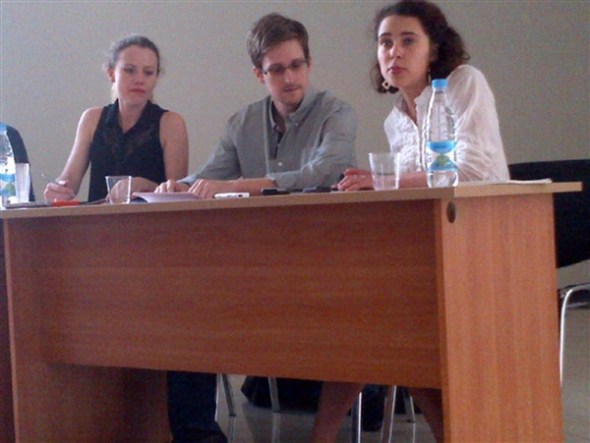
NSA leaker Edward Snowden attends a press conference at Moscow’s Sheremetyevo Airport with Sarah Harrison of WikiLeaks, left, July 12, 2013, in this image provided by Human Rights Watch.
At 5PM (9AM ET) Russian Time, Edward Snowden met with human rights activists and attorneys in Sheremetyevo Airport in Moscow. Afterward he appeared at a press conference alongside Sarah Harrison of Wikileaks and Tanya Lokshina of Human Rights Watch. He announced that he is seeking asylum in Russian until he can arrange to fly to a Latin American country.
Although the meeting was not public, some of those present posted details to Twitter, including Tanya Lokshina of Human Rights Watch who released a handout image that she said was of Snowden (see above).
Lokshina said Snowden would be making an official request to Russia for temporary asylum, adding that his condition was “just fine.”
The move indicates the difficulties facing Snowden, who has been offered asylum by three countries: Venezuela, Bolivia and Ecuador. He is apparently unable to travel to them without entering airspace controlled by the U.S., risking an enforced grounding that would lead to his arrest.
Also among those present at Friday’s meeting was a prominent Russian lawyer, Genri Reznik, who later told reporters: “I think his claim should be satisfied… The law allows for political asylum.
“The values in the constitution of the US and Russia are similar, so I don’t think that there could be a lengthy conflict if Russia grants him asylum.”
Several hours earlier The New York Times had reported on an e-mail which “purported to be” form Snowden asking for the meeting with human rights organizations.
Several prominent human-rights organizations received e-mailed invitations late on Thursday to meet with Mr. Snowden, though they were initially doubtful about the e-mails’ origin.
No invitation was extended to Russian officials, said Dmitri S. Peskov, the Kremlin spokesman. Journalists who asked to be included were told that Mr. Snowden’s team “will be following up with the press shortly afterward.”
Attached to the e-mailed request was a note complaining of U.S. interference with Snowden’s efforts to seek asylum in order to avoid prosecution for stealing and revealing classified information.
The e-mail, signed “Edward Joseph Snowden,” said he had “been extremely fortunate to enjoy and accept many offers of support and asylum from brave countries around the world,” and that he hoped to visit each of them personally to express his thanks. It went on to say that the American government had carried out an “unlawful campaign” to block his asylum bids.
“The scale of threatening behavior is without precedent: never before in history have states conspired to force to the ground a sovereign president’s plane to effect a search for a political refugee,” the note said. “I invite the human rights organizations or other respected individuals addressed to join me on 12 July at 5:00 p.m. at Sheremetyevo Airport in Moscow for a brief statement and discussion regarding the next steps forward in my situation.”
Wikileaks has posted a transcript of Snowden’s statement to the human rights groups. In it he makes clear that he believes he has done the right thing by revealing U.S. espionage methods and targets around the world and says he will accept any and all offers of asylum, and that for now he will apply to stay in Russia.
I announce today my formal acceptance of all offers of support or asylum I have been extended and all others that may be offered in the future. With, for example, the grant of asylum provided by Venezuela’s President Maduro, my asylee status is now formal, and no state has a basis by which to limit or interfere with my right to enjoy that asylum. As we have seen, however, some governments in Western European and North American states have demonstrated a willingness to act outside the law, and this behavior persists today. This unlawful threat makes it impossible for me to travel to Latin America and enjoy the asylum granted there in accordance with our shared rights.
This willingness by powerful states to act extra-legally represents a threat to all of us, and must not be allowed to succeed. Accordingly, I ask for your assistance in requesting guarantees of safe passage from the relevant nations in securing my travel to Latin America, as well as requesting asylum in Russia until such time as these states accede to law and my legal travel is permitted. I will be submitting my request to Russia today, and hope it will be accepted favorably.
The Washington Post questions whether Snowden can meet Vladimir Putin’s terms for allowing him to stay in Russia.
He explained that asylum is the only way he can guarantee his safety to stay in the country, where he’s been since arriving from Hong Kong in late June. “I am only in a position to accept Russia’s offer because of my inability to travel,” he said,according to Lokshina, adding that he ultimately hopes to travel to Latin America, where three countries have offered him asylum.
This puts Snowden in a difficult position: He had previously applied for asylum in Russia but then withdrew his application after Russian President Vladimir Putin said that Snowden could only stay on certain terms. “If he wants to remain here there is one condition – he should stop his work aimed at inflicting damage on our American partners,” Putin announced at a July 1 news conference. That was broadly taken as a condition that Snowden stop leaking classified U.S. information.
Snowden’s earlier decision to withdraw his application for asylum in Russia seemed to suggest that he found Putin’s terms unacceptable. It’s not clear what’s changed, but Snowden seems to have his own interpretation of Putin’s conditions. “He has no problem with Putin’s condition because he does not believe he damaged the United States, or is damaging it,” Lokshina told the Post. Her comments to The New York Times also indicated that Snowden apparently believes his past leaks have not harmed the United States and so not violated Putin’s terms.
So does Snowden assume that he can leak anything that he decides will not be damaging to the U.S.? And what about the data that he has already given to Glenn Greenwald of The Guardian, Barton Gellman of the Washington Post, Der Spiegel , The South China Morning Post, and newspapers in Brazil and Australia? He has also claimed through Greenwald that many individuals around the world have complete copies of the stolen materials. Greenwald himself has stated that Snowden has already completed the leak to The Guardian and that it will be up to them to decide what gets published. According to the Post,
Snowden, or at least the WikiLeaks representative Sarah Harrison who is working with him, might already see hints of these potential contradictions. Snowden asked the attendees at Friday’s Moscow airport meeting to try to intervene with Putin on his behalf, Lokshina told The New York Times.
At least we now know where Snowden is and what his immediate plans are. Now we’ll await Russia’s response.

 peej
peej Carissa
 bostonboomer
 dakinikat
 ecocatwoman
 mablue2
 Mama Lopez
 peggysue22
 quixote
 skydancingguestblogger
 Mona (aka Wonk the Vote)



 Sky Dancing
Recent Comments