
Edward Snowden Issues Bizarre Statement Via Wikileaks
Posted: July 1, 2013 Filed under: Barack Obama, China, Foreign Affairs, NSA, National Security Agency, open thread, Russia, social media, Surreality, U.S. Politics | Tags: Bradley Manning, Edward Snowden, espionage, Thomas Drake, Vladimir Putin, whistleblowers 48 Comments
I’ve been following the endless Edward Snowden soap opera just about non-stop for the past few days. I wish I were capable of writing a reasoned, logically argued post right now, but I’m not. This whole story has just become too crazy. I just can’t guarantee that this post will make a lot of sense, so I’ll just begin by posting Snowden’s statement. I’ve added emphasis to a few passages.
Statement from Edward Snowden in Moscow
Monday July 1, 21:40 UTC
One week ago I left Hong Kong after it became clear that my freedom and safety were under threat for revealing the truth. My continued liberty has been owed to the efforts of friends new and old, family, and others who I have never met and probably never will. I trusted them with my life and they returned that trust with a faith in me for which I will always be thankful.
On Thursday, President Obama declared before the world that he would not permit any diplomatic “wheeling and dealing” over my case. Yet now it is being reported that after promising not to do so, the President ordered his Vice President to pressure the leaders of nations from which I have requested protection to deny my asylum petitions.
This kind of deception from a world leader is not justice, and neither is the extralegal penalty of exile. These are the old, bad tools of political aggression. Their purpose is to frighten, not me, but those who would come after me.
For decades the United States of America have [sic] been one of the strongest defenders of the human right to seek asylum. Sadly, this right, laid out and voted for by the U.S. in Article 14 of the Universal Declaration of Human Rights, is now being rejected by the current government of my country. The Obama administration has now adopted the strategy of using citizenship as a weapon. Although I am convicted of nothing, it has unilaterally revoked my passport, leaving me a stateless person. Without any judicial order, the administration now seeks to stop me exercising a basic right. A right that belongs to everybody. The right to seek asylum.
In the end the Obama administration is not afraid of whistleblowers like me, Bradley Manning or Thomas Drake. We are stateless, imprisoned, or powerless. No, the Obama administration is afraid of you. It is afraid of an informed, angry public demanding the constitutional government it was promised — and it should be.
I am unbowed in my convictions and impressed at the efforts taken by so many.
Edward Joseph Snowden
Monday 1st July 2013
I’m mystified by this statement. Snowden could have stayed here in the U.S. and fought against the government actions that he claims are criminal. He could have followed in the footsteps of Martin Luther King by accepting the consequences of civil disobedience. He would have probably have gotten a great deal of support from the public if he had done so. Instead he chose to flee first to China and then to Russia–two countries with far worse domestic spying and human rights records than the U.S. And now he’s whining about the consequences of his fleeing.
President Obama did not promise not to take any actions to interfere with Snowden’s life. He indicated that he wasn’t going to do something as dramatic as bringing down Snowden’s plane or go to extreme lengths to negotiate with Russia or some other country for his return. Snowden’s naivete is amazing. World leaders engage in deception. Countries spy on each other. When you reveal secret information stolen from your government you are engaging in espionage and you become a spy.
Because neither Snowden nor Glenn Greenwald has a coherent political ideology, neither of them is able to make a clear political argument to define and defend Snowden’s actions in reasonable, logical ways. So what we get is whining from Snowden and defensiveness and trumped up outrage from Greenwald and his followers.
Snowden apparently sees himself as a tragic martyr who should be applauded for “revealing the truth.” He has the gall to compare himself to whistleblowers like Bradley Manning and Thomas Drake who faced the consequences of their actions by pleading guilty to crimes. We don’t know yet what the upshot of Manning’s case will be, but Drake is not “powerless.” He served no jail time, and now he is free to make appearances and share his opinions freely. Furthermore, Snowden hasn’t been exiled. I’m sure he could work out a deal to return to the U.S. and face the music. But he doesn’t seem to think the rules apply to him.
As for Greenwald, he has such tunnel vision that he appears to believe that he can simply state that Snowden is a hero who has revealed the most important secret information in American history–and somehow this is so. Anyone who objects or simply asks mild questions about the “revelations” is an enemy to be dismissed and attacked by legions of Greenwald fans who possess endless reserves of inchoate outrage. As I’ve said before, they remind of the Obot hoards of 2008.
If nothing else, Snowden’s leaks have gotten people talking about what the NSA is doing, although I have no idea if there is serious discussion of the actual content of the leaks outside the of people who closely follow the news and argue with each other on the internet. I have no idea if this episode will end with Americans being more knowledgeable about the government’s domestic spying programs.
The articles written about the leaked documents by Glenn Greenwald at the Guardian and Barton Gellman at the Washington Post have so far been confusing at best. Neither writer seems to have consulted with security and computer experts who could have helped them do a better job of explaining how the NSA programs work. I’ve gotten a much clearer understanding from reading Kurt Eichenwald’s blog at Vanity Fair.
Poor Ed. He’s learning that now that the information is out there, he is no longer that important. Ecuador doesn’t want to deal with him. Even Vladimir Putin has tired of using him to humiliate the Obama administration. Today he announced that Snowden could stay in Russia if he stopped leaking information designed to hurt the U.S.
Glenn Greenwald has also washed his hands of Snowden. Shortly after Putin made that announcement, Greenwald tweeted that “Snowden’s leak is basically done. It’s newspapers – not Snowden – deciding what gets disclosed and in what sequence.” Apparently Glenn is finished with Snowden too. That must have felt like a dagger through poor Ed’s heart.
We’ve learned that Snowden sent copies of the documents he stole to “many different people around the world,” so that he could continue to control the information. But it appears that someone–perhaps Wikileaks–must have all of it now, and Julian Assange has also said that nothing will stop publication of all of Snowden’s files now.
Snowden has become an object of pity at this point. And his whining about his situation isn’t going to help him look like a “hero.” He made the choice to leave his family, his home, and his girlfriend and run away from the consequences of his actions. President Obama did not do that to him.
Please discuss, or use this as an open thread.
Open Thread: Late Afternoon News Update
Posted: June 25, 2013 Filed under: Barack Obama, open thread, Republican politics, U.S. Economy, U.S. Politics | Tags: Climate change, coal stocks, data encryption, David Gomez, Edward Snowden, Glenn Greenwald, Keystone XL pipeline, Rep. John Lewis, spycraft, Voting Rights Act 27 Comments
Good Afternoon Sky Dancers!!
Here’s an fresh thread, since the morning reads one is getting so long. I have several updates for you on the Snowden/NSA story.
Eli Lake of The Daily Beast got some disturbing news from Glenn Greenwald: Snowden’s Files Are Out There if “Anything Happens” To Him. I posted this link on the previous thread, but it should be highlighted. According to Greenwald, Snowden gave complete copies of the the secret NSA files he stole to “many people around the world.” Supposedly the files are encrypted, but from what we know of Snowden’s spycraft knowledge, I don’t think that’s a guarantee that they’ll stay secret. From The Daily Beast article:
Glenn Greenwald, the Guardian Newspaper journalist Snowden first contacted in February, told the Daily Beast Tuesday that Snowden “has taken extreme precautions to make sure many different people around the world have these archives to insure the stories will inevitably be published.” Greenwald added that the people in possession of these files “cannot access them yet because they are highly encrypted and they do not have the passwords.” But, Greenwald said, “if anything happens at all to Edward Snowden, he told me he has arranged for them to get access to the full archives.” [….]
A former U.S. counter-intelligence officer following the Snowden saga closely said his contacts inside the U.S. intelligence community “think Snowden has been planning this for years and has stashed files all over the internet.” This source added, “At this point there is very little anyone can do about this.”
Greenwald assured Lake that although he (Greenwald) is in possession of top secret information about “the technical specifications of NSA systems,” but that he won’t publish them. I wonder how well Greenwald’s computer is protected?
On Snowden’s aforementioned spycraft skills, let’s see what a real former spy thinks. From Foreign Policy:
We reached out to FP contributor David Gomez, a former assistant special agent-in-charge and counterterrorism program manager with the FBI, to get his take. When was Snowden being savvy — and when did it seem as if he’d just watched a few too many spy movies?
Cell phones in the fridge
While it’s true that cell phones can easily be compromised and turned into recording devices, Gomez says it’s unlikely that anyone seeking to record Snowden would have used a phone anyway. If someone had wanted to eavesdrop, Gomez explains, he or she more likely would have worn a concealed wire. Or, if a government’s agents had been trying to listen in from outside of the room, they might have deployed a long-range microphone, among other techniques. The bottom line: a refrigerated cell phone probably wasn’t stopping anyone who wanted to listen badly enough — though it may have extended the phone’s battery life.
Lining the hotel door with pillows
While not particularly effective at stopping anyone actively seeking to spy on Snowden, pillows could have muffled the sounds of any conversations going on in his Hong Kong hotel room enough that an unsuspecting person passing by wouldn’t overhear something alarming, Gomez says.
Wearing a hood while entering computer passwords, to avoid hidden cameras
The danger while entering computer passwords is unlikely to come from a hidden camera planted in the hotel, Gomez says, but rather from keystroke-logging software, against which a hoodie provides little protection.
Signaling his identity to reporters by carrying a Rubik’s Cube through a hotel
While spies do at times use signals to identify one another, the idea in doing so is to not draw attention to yourself, Gomez explains. Thus, when arranging a meeting, as Snowden did with a group of journalists in Hong Kong, it is both unhelpful and unnecessary to carry something as out of place as a Rubik’s Cube. It would have been better, Gomez adds, for Snowden to have simply described, say, his clothing in detail. “If you’re going to meet with all these people, what’s the point of being Sneaky Pete?” Gomez asks.
Gomez says Snowden seems to be an amateur.
Tuesday Reads: Most Classless SCOTUS Justice, Ongoing Snowden Saga, and Other News
Posted: June 25, 2013 Filed under: Barack Obama, China, Foreign Affairs, morning reads, Russia, U.S. Politics, Women's Rights | Tags: Climate change, Dana Millbank, Edward Snowden, Garrett Epps, Jacob Zuma, middle school antics, Nelson Mandela, Racism, Ruth Bader Ginsburg, Samuel Alito, Sexism, University of Texas Southwestern Medical Center v. Nassar, Vance v. Ball State University 77 Comments
Good Morning!!
I’m enjoying some nice fresh air this morning after thunderstorms during the night. It looks as if the mini-heat wave we’ve been having here in the Boston area isn’t going to be as quite bad as originally predicted. It it supposed to be several degrees cooler than expected today and tomorrow and then we’re back to high 70’s temps. I hope that turns out to be right.
Unfortunately, because of this refreshing change in the air here, I slept longer than I should have and this post will go up a little bit late.
If there were a competition for “most classless supreme court justice,” there would be some serious competition among Antonin Scalia, Clarence Thomas, and Samuel Alito; but I think in the end the first prize would have to go to Samuel Alito. Clarence Thomas at least has the grace to remain silent and Scalia supposedly can be funny at times. But Alito is just an immature, obnoxious disgrace, as he demonstrated at the State of the Union Address in 2010 when President Obama denounced the Citizens United decision.
Yesterday Alito used childish, offensive body language to publicly mock his senior colleague Justice Ruth Bader Ginsburg as she read a dissenting opinion to a SCOTUS decision that will make it more difficult for employees to sue for sexual or racial discrimination. From Dana Millbank at The Washington Post:
The most remarkable thing about the Supreme Court’s opinions announced Monday was not what the justices wrote or said. It was what Samuel Alito did.
The associate justice, a George W. Bush appointee, read two opinions, both 5-4 decisions that split the court along its usual right-left divide. But Alito didn’t stop there. When Justice Ruth Bader Ginsburg read her dissent from the bench, Alito visibly mocked his colleague.
Ginsburg, the second woman to serve on the high court, was making her argument about how the majority opinion made it easier for sexual harassment to occur in the workplace when Alito, seated immediately to Ginsburg’s left, shook his head from side to side in disagreement, rolled his eyes and looked at the ceiling.
His treatment of the 80-year-old Ginsburg, 17 years his elder and with 13 years more seniority, was a curious display of judicial temperament or, more accurately, judicial intemperance. Typically, justices state their differences in words — and Alito, as it happens, had just spoken several hundred of his own from the bench. But he frequently supplements words with middle-school gestures.
Millbank goes on the describe Alito’s similar treatment of female Justices Elena Kagan and Sonia Sotomayor a few days earlier. Read about it at the link.
Garrett Epps provides more detail at The Atlantic: Justice Alito’s Inexcusable Rudeness.
I am glad the nation did not see first-hand Justice Samuel Alito’s display of rudeness to his senior colleague, Justice Ruth Bader Ginsburg. Because Alito’s mini-tantrum was silent, it will not be recorded in transcript or audio; but it was clear to all with eyes, and brought gasps from more than one person in the audience.
The episode occurred when Ginsburg read from the bench her dissent in two employment discrimination cases decided Monday, Vance v. Ball State University and University of Texas Southwestern Medical Center v. Nassar. In both cases, the Court majority made it harder for plaintiffs to prevail on claims of racial and sexual discrimination. The Nassar opinion raises the level of proof required to establish that employers have “retaliated” against employees by firing or demoting them after they complain about discrimination; Vance limits the definition of “supervisor” on the job, making it harder for employees harassed by those with limited but real authority over them to sue the employers.
The Vance opinion is by Alito, and as he summarized the opinion from the bench he seemed to be at great pains to show that the dissent (which of course no one in the courtroom had yet seen) was wrong in its critique. That’s not unusual in a written opinion; more commonly, however, bench summaries simply lay out the majority’s rationale and mention only that there was a dissent. (Kennedy’s Nassar summary followed the latter model.)
After both opinions had been read, Ginsburg read aloud a summary of her joint dissent in the two cases. She critiqued the Vance opinion by laying out a “hypothetical” (clearly drawn from a real case) in which a female worker on a road crew is subjected to humiliations by the “lead worker,” who directs the crew’s daily operation but cannot fire or demote those working with him. TheVance opinion, she suggested, would leave the female worker without a remedy.
At this point, Alito pursed his lips, rolled his eyes to the ceiling, and shook his head “no.” He looked for all the world like Sean Penn as Jeff Spicoli in Fast Times at Ridgemont High, signaling to the homies his contempt for Ray Walston as the bothersome history teacher, Mr. Hand.
I guess I should be grateful that I’m old enough to recall the Warren Court. We won’t see a SCOTUS like that again in my lifetime, I’m afraid.
Of course the news is still being dominated by Edward Snowden, who once claimed he didn’t want the story of his leaks of classified information from NSA to be about him. “Really?” writes Dan Murphy of The Christian Science Monitor. “But if that were true, we probably wouldn’t even know his name.”
Two weeks ago, Edward Snowden gave The Guardian permission to disclose that he was the leaker of documents from the US National Security Agency.
“I don’t want public attention because I don’t want the story to be about me,” the former NSA contractor said then. “I want it to be about what the US government is doing.”
If that was really his desire, he’s certainly gone about it in a funny way. From that day, every step he’s taken couldn’t have been better calculated to draw attention to himself. Over the weekend he even turned the media dial up when he fled from Hong Kong to the loving bosom of Mother Russia.
And with the assistance of Julian Assange, Mr. Snowden’s “where’s Waldo” saga is turning into aWikiLeaks production.
Mr. Assange, founder of WikiLeaks, has staked out a consistently anti-American and techno-libertarian position in the past few years. The US government is motivated by malice and power lust in his worldview, its rivals like Russia (where state-owned broadcaster RT ran a show of Assange’s) get a free pass, and secrecyis an evil in and of itself. Though he presents himself as a champion of free-speech, Assange has sought refuge in the Embassy of Ecuador in London, never mind that the country has a poor and deteriorating record on freedom of speech. The Committee to Protect Journalists listed Ecuador and Russia as two of the 10 worst places to be a journalist in the world past year.
Read the rest at CSM.
Meanwhile, Russia and China are pushing back against U.S. criticism of their refusal to help the U.S. extradite Snowden. From The Washington Post:
MOSCOW— Russia and China on Tuesday rejected U.S. criticism of their roles in the legal drama surrounding Edward Snowden, saying their governments complied with the law and did not illegally assist the former government contractor charged with revealing classified information about secret U.S. surveillance programs.
Snowden, 30, has not been seen in public since he reportedly arrived in Moscow on Sunday, after slipping out of Hong Kong. Secretary of State John F. Kerry on Monday strongly urged Russian officials to transfer Snowden to U.S. custody. “We think it’s very important in terms of our relationship,” Kerry said. “We think it’s very important in terms of rule of law.”
But Russian Foreign Minister Sergei Lavrov said Snowden had not actually crossed into Russian territory, apparently remaining in a secure transit zone inside the airport or in an area controlled by foreign diplomats. Moscow therefore has had no jurisdiction over his movements, Lavrov said, and has no legal right to turn him over to U.S. authorities.
It sounds like Snowden could still be in some VIP lounge at the Moscow Airport, but no one knows for sure. One witness told Reuters that Snowden did in fact arrive there yesterday. If he is in the airport, Russia can claim that Snowden technically never stepped on Russian soil.
In other news, Nelson Mandela is in critical condition for the second day, according to President Jacob Zuma.
Mr. Zuma said that he and Cyril Ramaphosa, the deputy president of the governing African National Congress, visited Mr. Mandela late Sunday.
“Given the hour, he was already asleep. We were there, looked at him, saw him and then we had a bit of a discussion with the doctors and his wife,” Mr. Zuma said. “I don’t think I’m in a position to give further details. I’m not a doctor.”
Doctors told Mr. Zuma on Sunday evening that Mr. Mandela’s health “had become critical over the past 24 hours,” according to an earlier statement from the presidency.
In the statement on Sunday, Mr. Zuma said that doctors were doing “everything possible to get his condition to improve and are ensuring that Madiba is well looked after and is comfortable.” Madiba is Mr. Mandela’s clan name.
The Telegraph reports that Mandela’s close relatives “have gathered at his rural homestead to discuss the failing health of the South African anti-apartheid icon who was fighting for his life in hospital.”
From NPR, President Obama today plans To Lay Out Broad Plan To Address Climate Change.
President Obama is expected to announce a sweeping plan to address climate change this afternoon.
The president has framed this issue as a moral responsibility, to leave the Earth in good shape for generations to come. But the nitty-gritty of any serious plan to address this problem is also a challenge, because it means gradually moving away from fossil fuels to renewable energy supplies — and that means there will be economic winners and losers.
Winners include companies that produce clean energy — wind, solar and geothermal energy. That energy will be more in demand, and the administration intends to expand access to public lands, where companies can build windmills and solar facilities.
Public health is also a winner, because the plan would pressure coal-fired power plants to reduce their emissions. Those plants not only produce carbon dioxide, but they are major sources of mercury, radioactive particles and chemicals that contribute to asthma.
The losers will be coal companies and the miners they employ as well as millions of Americans who can’t afford to pay higher electric bills. You can read the entire plan at the NPR link. More detail in this story at CNN. And at Business Insider, Josh Barro lists 3 Reasons Obama’s Carbon Plan Is The Best Solution Right Now
Today should be another busy news day with the ongoing Snowden saga, the President’s climate initiatives, the continuing Whitey Bulger and George Zimmerman trials, and more important SCOTUS decisions. If it gets hot here again this afternoon, I’ll have something to distract me at least. I’ll try to post an afternoon update.
Now it’s your turn. What stories are you focusing on today? Please post your links on any topic in the comment thread, and have a terrific Tuesday!!
Saturday Reads, Summer Solstice Edition: Dreaming of a Woman President, and Other News
Posted: June 22, 2013 Filed under: 2016 elections, Barack Obama, Foreign Affairs, Hillary Clinton, misogyny, morning reads, SCOTUS, U.S. Politics | Tags: Claire McCaskill, Edward Snowden, Ready for Hillary superpac, Summer solstice, Supermoon, Toronto, Unique Lives and Experiences Conference 48 Comments
Good Morning and Happy Summer Solstice!!
Hillary is in the news this morning, so I thought I’d begin with her latest public remarks on the presidency. Claire McCaskill kicked off the Hillary talk on Tuesday when she said she was supporting a new superpac called Ready for Hillary.
“Hillary Clinton had to give up her political operation while she was making us proud, representing us around the world as an incredible Secretary of State, and that’s why Ready for Hillary is so critical,” McCaskill said in a statement released by the group. “It’s important that we start early, building a grassroots army from the ground up, and effectively using the tools of the Internet –- all things that President Obama did so successfully –- so that if Hillary does decide to run, we’ll be ready to help her win.”
McCaskill was one of the female Senators who abandoned Hillary to jump on the Obama bandwagon in 2008. Hillary gave her call after the announcement of support.
An early endorsement this week for a 2016 presidential run by former Secretary of State Hillary Clinton merited a phone call from the potential candidate, according to Sen. Claire McCaskill.
Clinton made the call after the senator’s Tuesday announcement that she was endorsing a political action committee pushing a presidential run.
“She did call me after this all happened the other day,” the Missouri Democrat said on MSNBC’s “Morning Joe.” “We had a great conversation. I’m not going to talk about what we said. But I think she’s got a big decision to make and I think she’s in the process of making it.”
McCaskill called the endorsement of Clinton an easy decision. “She is by far the strongest, most capable, most qualified candidate for President of the United States,” she said. “I am part of a lot of group of people, big huge group of people, that really wants her to run. And it seemed like coming out publicly and stating the obvious, that we all want her to run, was an important thing to do right now.”

Naturally, the corporate media is *concerned* about Hillary’s ambitions. The Washington Post sees “worries” for her in the new superpac.
The upstart super PAC, called Ready for Hillary, is fast emerging as the quasi-official stand-in for potential 2016 presidential contender Hillary Rodham Clinton, scooping up advisers and gathering big donations more than three years ahead of election time.
But the group is also making some advisers in Clinton’s orbit decidedly nervous about its potential impact on her own efforts, which for now consist of philanthropic pursuits and remaining mum on a presidential bid. Some allies also fear a repeat of 2008, when an assumed air of inevitability contributed to Clinton’s loss to fresh-faced challenger Barack Obama….
“It’s hard to even know what’s what any more,” said John Morgan, an Orlando lawyer who served on Bill Clinton’s 1996 national finance committee. “It’s become a cottage industry. It’s like, ‘Who are you?’ Just because you put the name ‘Hillary’ at the end of your PAC — it could be a bait and switch. I want to make sure I can get the biggest bang for my buck.”
Ready for Hillary — launched in January by Clinton boosters Adam Parkhomenko and Allida Black — is getting help from a number of veterans from Hillary and Bill Clinton’s political operation. Former Bill Clinton strategist Harold Ickes, former Clinton White House political director Craig Smith and former Hillary Clinton campaign lawyer Jim Lamb are advising the group on strategy, while longtime confidant James Carville recently sent out a fundraising solicitation under his name.

Former U.S. secretary of state Hillary Clinton poses with Jaden Szigeti, 9, for a snapshot before speaking to 5,000 at the Metro Convention Centre. (Toronto Star)
So what does Hillary herself have to say? Well she made a speech at the “Unique Lives and Experiences” conference in Toronto on Thursday, and she expressed a desire that many American women share. She wants to see a woman president in her lifetime. From Politico:
“Let me say this, hypothetically speaking, I really do hope that we have a woman president in my lifetime,” Clinton said in Toronto, before a women-centered event Thursday. “And whether it’s next time or the next time after that, it really depends on women stepping up and subjecting themselves to the political process, which is very difficult.”
She added that President Barack Obama’s election was historic, and said, “I hope that we will see a woman elected because I think it would send exactly the right historic signal to girls, women as well as boys and men. And I will certainly vote for the right woman to be president.” [….]
Friends and supporters of Clinton say she is genuinely undecided about whether to run again, even if some of the moves she is making now, immersing herself in domestic policy on issues affecting women and children that have been the core of her life’s work, would certainly be helpful if she launches another national campaign.
Yet that argument — the historic nature of a female president, combined with a pent-up desire among women voters to break that barrier — is the one most often espoused by Clinton backers.
Here’s the video that was posted to YouTube after the event.
In an “intimate” setting with 5,000 other people, Hillary reminisced about her life:
In a verbal stroll through her life, Clinton mentioned her mother’s difficult early years as an abandoned and mistreated child, she recalled the first time she ever heard the voice of her husband, former president Bill Clinton, back when he was a student, drawling about “the size of watermelons” in Arkansas. She mentioned the “extraordinary sense of anxiety” that she and every other American felt after the attacks of Sept. 11.
And she spoke candidly about how she had learned to cope with sexist attacks and snippy criticism about her hair, her clothes and all the things that don’t really define her.
“My attitude is different than it was 20 years ago,” she said. “I don’t care.”
The crowd clapped its approval.“I learned to take criticism seriously but not personally” Clinton told her audience.
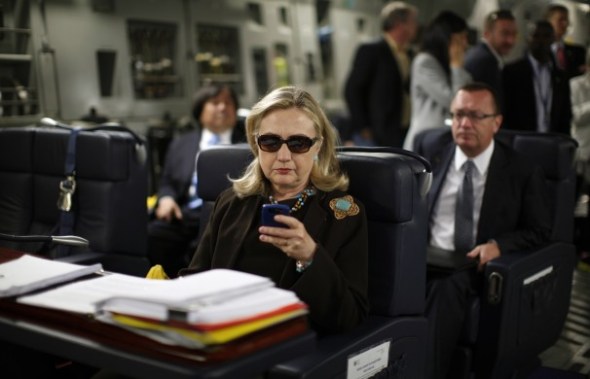
She is amazing. I so miss her as Secretary of State. In contrast John Kerry is so boring that he’s already become almost invisible. With Hillary as SOS, there were frequent stories about her travels with photos of her colorful outfits. Wouldn’t it be wonderful to have her engaging personality, not to mention her valuable experience and brilliant mind in the White House?
In other news…
The news broke yesterday that Edward Snowden has been charged with three felonies. Most media outlets are reporting that has been charged with espionage, but so far that hasn’t been specifically stated by the government. From Politico:
Snowden was charged with conveying classified information to an unauthorized party, disclosing communications intelligence information, and theft of government property.
The charges, which can carry a penalty of up to ten years in prison on each count, were filed in federal court in Alexandria, Va., last Friday….
The charges were first reported Friday evening by the Washington Post, which said the complaint against Snowden was sealed. It’s not immediately clear whether the charges were unsealed before or after the Post report.
A Justice Department official confirmed Friday evening that a complaint was filed in the case, but declined further comment on the matter.
The Washington Post reported this morning that the charges were conveyed to Hong Kong authorities a week ago, but so far they seem to be dragging their feet about arresting Snowden.
The reason for the hold-up is unclear. There could be delays in the legal process for issuing the warrant. Or, officials may still be looking for Snowden, who is believed to be in Hong Kong but could also have found a way to leave the semiautonomous region.
The U.S. government asked Hong Kong to detain Snowden on a provisional arrest warrant June 14, the same day it filed criminal charges against him, including theft, “unauthorized communication of national defense information” and “willful communication of classified communications intelligence information to an unauthorized person.”
Under an extradition treaty between Hong Kong and the United States, a provisional warrant, as opposed to a regular one, is a faster way to detain suspected criminals since it does not require the initial approval of Hong Kong’s leader, currently Leung Chun-ying.
Instead, a judge can issue the warrant immediately. Simon Young, a legal professor at the University of Hong Kong said this means a warrant for Snowden’s arrest in theory could have been made as early as June 14, more than a week ago.
The Supreme Court justices are taking their own sweet time in announcing the most important decisions of this SCOTUS session. At The Daily Beast, Richard L. Hasan asks “What’s Taking the Supreme Court So Long?”
With everyone anxiously awaiting potentially blockbuster decisions on issues fromaffirmative action to voting rights to same-sex marriage, it is easy to criticize the Supreme Court for being too slow.
After all, Fisher, the affirmative-action case involving the University of Texas, was argued in Supreme Court back in October. By historical standards, the court is deciding very few cases: it issued 167 with opinions in the 1981 term, but is expected to decide only 77 this term. Why save all of the big calls for the end? Are the justices trying to create maximum suspense to get more attention?
These criticisms fundamentally misunderstand both the modern Supreme Court’s mission and the psychology of the justices. There may be a lot of reasons to criticize the court, but the end-of-the-term crunch is not one of them.Consider first the Supreme Court’s mission. Justices are unlike legislators, who simply vote to express their preferences. Justices are expected to give reasons for their decisions. Further, the court on some of the toughest questions is divided along strong ideological lines. For example, a majority opinion from a conservative justice can generate a dissenting opinion from a liberal justice. The dissenting justice won’t just say “I disagree,” but will offer reasons—reasons that the dissenting justice writes not only for history but in the hopes that one day a majority of justices will change their minds and adopt the dissenting view in a majority opinion. Both a majority and dissenting opinions will be circulated within the court, and each opinion will be modified numerous times to respond to the arguments of the other side, and to respond to the concerns of other justices who may join one or more of the opinions. Sometimes a justice will agree with the result but not with the reasoning of an opinion, and that justice will write separately, prompting another round of revisions.
We’re still waiting for decisions on 11 more cases, and those could be announced this week. It should be interesting.
Finally, today is the summer solstice, and people the world over celebrated the beginning of summer. Read about it at the the WaPo: Summer solstice observed at Times Square, Stonehenge, in D.C.
And tomorrow a unusual celestial even will take place, according to the Sydney Morning Herald: A Supermoon, when ‘people turn into lunatics’
ONLY ONCE a year Earth, Moon and Sun line up to create the perfect conditions for a so called ‘Supermoon’.
According to popular folklore, this is the time when “people turn into lunatics”, ships run aground and earthquakes rattle our planet.According to NASA , it is the best opportunity to get a good look at Earth’s rocky satellite.
The distance between Earth and Moon varies between about 357,000km and 406,000km throughout the year, and depends on the moon’s elliptical orbit around Earth.When the moon is on its farthest position from the earth, it is called Apogee while the closest encounter is named Perigee.
About once a year a full Moon occurs during the Perigee orbit, resulting in a 14 per cent larger and 30 per cent brighter appearance.
Right wing nuts should stay indoors and avoid looking at the sky. They’re already lunatics; we don’t need them to go completely around the bend.
Now it’s your turn. What are you reading and blogging about on this first day of summer?
Tuesday Reads: Dreaming a Life; Obama and Putin; NSA and Snowden
Posted: June 18, 2013 Filed under: Barack Obama, Foreign Affairs, Great Britain, morning reads, NSA, National Security Agency, Real Life Horror, Russia, Syria, U.S. Politics | Tags: Carol Morley, Charles Pierce, checks and balances, Dick Cheney, Dreams of a Life, Edward Snowden, FISA court, G-8 summit, Glenn Greenwald, John Aravosis, Joyce Carol Vincent, leakers, mysterious deaths, Richard Nixon, Vladimir Putin, whistleblowers 29 Comments
Good Morning!!
I’m going to begin with an article I came across yesterday while reading the Guardian. It’s about a story from 2006 that I remembered and sometimes think about–a woman whose skeletonized body was found in her apartment three years after she died.
On 25 January 2006, officials from a north London housing association repossessing a bedsit in Wood Green owing to rent arrears made a grim discovery. Lying on the sofa was the skeleton of a 38-year-old woman who had been dead for almost three years. In a corner of the room the television set was still on, tuned to BBC1, and a small pile of unopened Christmas presents lay on the floor. Washing up was heaped in the kitchen sink and a mountain of post lay behind the front door. Food in the refrigerator was marked with 2003 expiry dates. The dead woman’s body was so badly decomposed it could only be identified by comparing dental records with an old holiday photograph of her smiling. Her name was revealed to be Joyce Carol Vincent.

Joyce Carol Vincent
How could such a thing happen? So often we hear sad stories like this and never get any answers to our questions. In this case, filmmaker Carol Morley decided to find out who Joyce Carol Vincent was, and she has made a documentary about her quest called Dreams of a Life. She writes:
In a city such as London, home to 8 million people, how could someone’s absence go unnoticed for so long? Who was Joyce Vincent? What was she like? How could she have been forgotten?
News of Joyce’s death quickly made it into the global media, which registered shock at the lack of community spirit in the UK. The story ran on in the British press, but still no photograph of Joyce appeared and little personal information.
Soon Joyce dropped out of the news. I watched as people discussed her in internet chatrooms, wondering if she was an urban myth, or talking about her as though she never mattered, calling her a couch potato, and posting comments such as: “What’s really sad is no one noticed she was missing – must have been one miserable bitch.” And then even that kind of commentary vanished.
But I couldn’t let go. I didn’t want her to be forgotten. I decided I must make a film about her.
She began by placing advertisements in newspapers asking anyone who knew Joyce to come forward. It turned out that Joyce had lots of friends over the years. She had been engaged to be married before she died, and she had also spent some time in a battered women’s shelter. Eventually, Morley was able to talk to many people who had known Joyce. She describes her journey in the Guardian article. It’s an amazing story, and I hope you’ll go read the whole thing.
Follow me below the fold for some news and opinion…

 peej
peej Carissa
 bostonboomer
 dakinikat
 ecocatwoman
 mablue2
 Mama Lopez
 peggysue22
 quixote
 skydancingguestblogger
 Mona (aka Wonk the Vote)



 Sky Dancing
Recent Comments