
Tuesday Reads: Fauci Warns Congress; Outbreaks In High Places; Heartland Threatened
Posted: May 12, 2020 Filed under: morning reads, U.S. Politics | Tags: Anthony Fauci, coronavirus, coronavirus in the "heartland", Covid-19, Dmitry Peskov, Donald Trump, education, Health, Labor and Pensions Committee, Lamar Alexander, Mike Pence, Russia, Vladimir Putin, White House coronavirus outbreak, world travel 18 Comments
Good Morning!!
The Senate hearing on the coronavirus pandemic is happening right now. The chairman of the Health, Education, Labor and Pensions Committee, Lamar Alexander, is in self-quarantine. All of the witnesses will be testifying remotely–not a very good advertisement for reopening the economy.
Anthony Fauci plans to drop a bomb on the committee. The New York Times: Fauci to Warn Senate of ‘Needless Suffering and Death.’
Dr. Anthony S. Fauci, the nation’s top infectious disease expert and a central figure in the government’s response to the coronavirus, intends to warn the Senate on Tuesday that Americans would experience “needless suffering and death” if the country opens up too quickly.
Dr. Fauci, who has emerged as perhaps the nation’s most respected voice during the coronavirus crisis, is one of four top government doctors scheduled to testify remotely at a high-profile hearing on Tuesday before the Senate Health Education, Labor and Pensions Committee….
In an email to the New York Times reporter Sheryl Gay Stolberg late Monday night, Dr. Fauci laid out what he intended to tell senators.
“The major message that I wish to convey to the Senate HLP committee tomorrow is the danger of trying to open the country prematurely,” he wrote. “If we skip over the checkpoints in the guidelines to: ‘Open America Again,’ then we risk the danger of multiple outbreaks throughout the country. This will not only result in needless suffering and death, but would actually set us back on our quest to return to normal.”
Dr. Fauci was referring to a three-phase White House plan, Opening Up America Again, that lays out guidelines for state officials considering reopening their economies. Among its recommendations: States should have a “downward trajectory of positive tests” or a “downward trajectory of documented cases” of coronavirus over two weeks, while conducting robust contact tracing and “sentinel surveillance” testing of asymptomatic people in vulnerable populations, such as nursing homes.
But many states are reopening without meeting those guidelines, seeking to ease the economic pain as millions of working people and small-business owners are facing ruin while sheltering at home.
While Trump is pushing Americans to go back to work, the virus could be circulating in the White House. Trump doesn’t want most of us to have access to testing, but he wants those around him tested frequently and he’s now requiring everyone around him (but not himself) to wear masks. He claimed yesterday that he will be expanding testing around the country as well. I’ll believe it when I see it.
 The Los Angeles Times: Trump backs expanded testing as West Wing battles infections.
Under fire for inadequate coronavirus testing across the country, President Trump insisted Monday that enough testing is available to allow more Americans to safely return to work even as the White House, perhaps the world’s most secure workplace, scrambled to stem further infections in the West Wing.
“It’s the hidden enemy. Things happen,” Trump said at a Rose Garden news conference when pressed about how the virus has breached his inner circle despite safeguards unavailable to most Americans, including daily testing for the president and his top aides.
The president announced a plan to distribute $11 billion approved by Congress last month to support testing efforts by states, with an emphasis on residents and staff of nursing homes, which have suffered the brunt of deaths in the pandemic. Nearly half of California’s COVID-19 deaths so far are in elder-care facilities.
“If someone wants to be tested right now, they will be able to be tested,” Trump claimed, a boast that is untrue in many communities. Roughly 9 million tests have been conducted since the crisis began, far short of what public health experts say is necessary to track and contain the coronavirus.
Adm. Brett Giroir, who leads the administration’s testing efforts, offered a more modest promise. “Everybody who needs a test can get a test,” he said, with a focus on those who suffer symptoms or come into contact with infected people….
The message was particularly discordant as the White House became a marquee cautionary tale about the difficulty of containing the virus. One of Trump’s military valets and a spokeswoman for Vice President Mike Pence have both tested positive in the last week, raising questions about how less-protected Americans can stay safe.
 NPR reports that Trump and Pence are staying away from each other: Trump And Pence ‘Maintaining Their Distance’ For Now.
President Trump and Vice President Pence will be “maintaining their distance in the immediate future” on the advice of the White House Medical Unit, a senior administration official told NPR. They were last seen together at the White House on Thursday.
At a Monday White House briefing, which the president attended but the vice president did not, Trump suggested that he might be keeping his distance from Pence for the time being.
“We can talk on the phone,” Trump said.
Last week, the press secretary for Pence and a military valet for the president tested positive for the coronavirus.
Pence and others who were in contact with the coronavirus patients have since tested negative, but the virus can take days to incubate. The cases have heightened concerns about the nation’s ability to safely reopen.
Still, despite the close proximity of the White House cases, Trump said on Monday that he felt “no vulnerability whatsoever” and still expected the U.S. to move swiftly toward reopening.
 Trump’s good buddy Vladimir Putin is battling his own outbreak. The Independent: Coronavirus: Vladimir Putin’s spokesperson Dmitry Peskov hospitalised with Covid-19.
Vladimir Putin’s press secretary Dmitry Peskov has tested positive for the coronavirus, with news of his hospitalisation confirmed by state news agencies on Tuesday afternoon.
Covid-19 has failed to spare the political class in its its increasingly confident march through Russia. The prime minister Mikhail Mishustin fell ill approximately two weeks ago, and has barely been seen since. Culture minister Olga Lyubimova and construction minister Vladimir Yakushev have also reported positive tests and are being treated at home.
The illness of one of the president’s closest lieutenants will raise questions about Mr Putin’s own Covid-19 status. The 67-year-old has spent the last month in his suburban residence and mostly hidden from public view. But in brief comments to the press, spokesman Peskov insisted he had not met his boss in over a month.
The news comes less than a day after Mr Putin signed off on an easing of nationwide restrictions and a limited return to work. The relaxation of Russia’s six-week lock-down came despite ugly epidemiological data that suggested its Covid-19 crisis is far from over.On Tuesday, cases increased by another 10,899 diagnoses, taking the overall number to 232 243. On these measures, Russia is now second-worst affected country in the world.
More on the situation in Russia from The Moscow Times:
The Kremlin spokesman is at least the second person in Putin’s administration and the fifth senior government official to test positive for Covid-19.
In addition to Culture Minister Olga Lyubimova, Construction Minister Vladimir Yakushev and Prime Minister Mikhail Mishustin, Putin’s first deputy chief of staff Sergei Kiriyenko was reported to have tested positive in mid-April.
It was not immediately clear when Peskov, 52, last met Putin, 67, in person. Peskov told the state-run TASS news agency that he last had face-to-face contacts with Putin “more than a month ago.”
Similar questions over Putin’s contacts with coronavirus-positive individuals were raised when he visited Moscow’s main coronavirus hospital in late March and shook hands with its chief doctor, who tested positive for Covid-19 days later. Putin began working remotely at the presidential residence in Novo-Ogaryovo outside Moscow on April 1 following the news of doctor Denis Protsenko’s infection.
Putin and everyone in his administration “are taking all precautionary measures,” Peskov said at the time.
There’s more at the link.
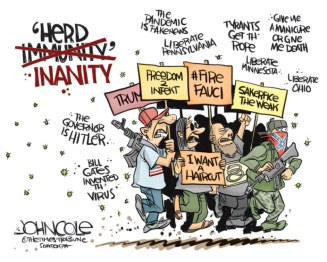 The Daily Beast reports that Americans could be persona non grata in other countries because of our out-of-control Covid-19 outbreak: American Travelers Are About to Be Pariahs in This New World.
ROME—Travel has been one of the most deeply gutted industries of the global coronavirus pandemic, so it should come as no surprise that many countries that rely on it for so much of their GDP are getting anxious about when they can start opening up. But travel is not just about the destination. Getting away is also a way of life for millions of people who take breaks for self-indulgence, prestige, or cultural enrichment. And with the dream of the “immunity passport” for those who have successfully conquered COVID-19 increasingly unreliable this soon in the pandemic, travel may be annoyingly restrictive for some time to come.
One thing is sure: Gone are the days of the American abroad, at least for those hoping to summer in Europe this year. The new models on how to reopen European travel do not have room for the American tourist for the foreseeable future.
The European Union is set to release new guidelines called “Europe Needs a Break” on Wednesday that will recommend replacing travel bans with what they are calling “targeted restrictions” based on contagion levels and reciprocity among European and neighboring nations, many of which have been under draconian lockdowns backed by science. The key to any successful reopening in Europe is based entirely on risk assessment, meaning anyone coming from a nation deemed risky or careless will be the first to be banned. Simply put, anyone who has been under the lax American approach to the pandemic, which has been the laughing stock of Europe, won’t be welcome any time soon.
The rest of the story is behind the paywall.
 Trump seems to believe that heartland states are safe from the coronavirus, but that’s just not true. A couple of interesting articles:
NBC News: Unreleased White House report shows coronavirus rates spiking in heartland communities.
Coronavirus infection rates are spiking to new highs in several metropolitan areas and smaller communities across the country, according to undisclosed data the White House’s pandemic task force is using to track rates of infection, which was obtained by NBC News.
The data in a May 7 coronavirus task force report are at odds with President Donald Trump’s declaration Monday that “all throughout the country, the numbers are coming down rapidly.”
The 10 top areas recorded surges of 72.4 percent or greater over a seven-day period compared to the previous week, according to a set of tables produced for the task force by its data and analytics unit. They include Nashville, Tennessee; Des Moines, Iowa; Amarillo, Texas; and — atop the list, with a 650 percent increase — Central City, Kentucky.
On a separate list of “locations to watch,” which didn’t meet the precise criteria for the first set: Charlotte, North Carolina; Kansas City, Missouri; Omaha and Lincoln, Nebraska; Minneapolis; Montgomery, Alabama; Columbus, Ohio; and Phoenix. The rates of new cases in Charlotte and Kansas City represented increases of more than 200 percent over the previous week, and other tables included in the data show clusters in neighboring counties that don’t form geographic areas on their own, such as Wisconsin’s Kenosha and Racine counties, which neighbor each other between Chicago and Milwaukee.
Inside Sources: The Coronavirus May Accelerate the Demise of Rural America.
Over the last two months the coronavirus pandemic has brought nation’s largest, and most powerful cities to their knees.
But as curves show signs of flattening in many urban areas, and governors have begun the process of “reopening” their economies, new hotspots are emerging in places like southwest Georgia, the Navajo nation, and in and around meatpacking plants in Iowa and the Texas panhandle.
Rural communities like these lack the healthcare infrastructure and financial resources of larger cities, while at the same time are home to and older and sicker populations, more likely to suffer serious complications or death due to the virus.
That is why governors who are reopening their economies prematurely are not only misguided but also could end up driving the devastation of rural America.
Long before people started falling ill and businesses started shutting down due to coronavirus, rural America was already suffering. There are many indications that rural communities had not fully recovered from the Great Recession.
As of last year, employment in non-metro counties had not yet to returned to pre-2008 levels. Data also show that since the last recession virtually all new business growth has been concentrated in the 20 largest metropolitan counties. And overall rural counties have been steadily losing population for more than a decade now.
At the same time, rural communities have long been experiencing a health crisis. Roughly 170 hospitals in rural communities have closed in the last 15 years, leaving rural Americans with fewer and fewer health options.
Due to the longstanding economic crisis in these communities, along with many states’ refusal to expand Medicaid, hospitals in rural areas have struggled financially.
Hospital closures put undue burden on residents as it becomes more difficult to access health care having to travel farther for care — an estimated 8.6 million people live more than a 30-minute drive from their nearest hospital. Rural areas are already experiencing issues with transportation, which adds to this burden.
Read the rest at Inside Sources.
What else is happening? What stories are you following today?
Lazy Saturday Reads: Victorian Photo Tricks, Homeschooling Horrors, and Hillary and Boko Haram
Posted: May 10, 2014 Filed under: Foreign Affairs, morning reads, Republican politics, U.S. Politics | Tags: Boko Haram, child abuse, education, hidden mother photos, Hillary Clinton, homeschooling, Josh Powell, memento mori, Nigerian kidnappings, Twelve Tribes, Victorian photography 32 Comments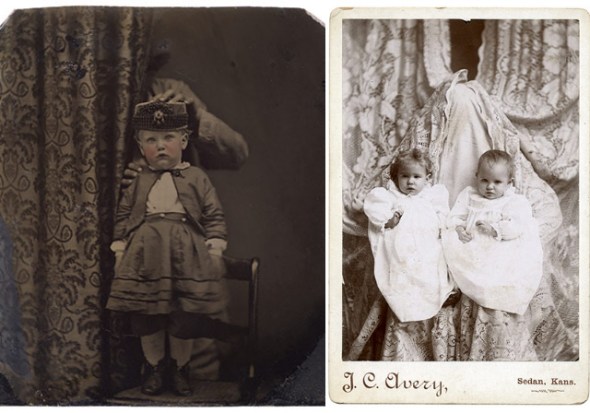
Happy Saturday!!
This might turn out to be a strange post; I’m not really sure yet. I’m writing it somewhat in response to Dakinkat’s Friday offering. I was really taken with the images she used of Victorian women and babies with bat wings, so I decided to share some Victorian baby pictures I came across recently.
In addition, following on what Dak wrote about home-schooling, I have some articles on people who survived homeschooling horrors. I think it’s an outrage that child abuse like this is permitted in supposedly civilized countries. The government should not be kowtowing to fundamentalist Christian sects that engage in uncivilized behaviors. I’m still trying not to think too much about politics, but I have some follow-up info on Boko Haram and it’s use in the latest Hillary-bashing episode.
The Hidden Mother
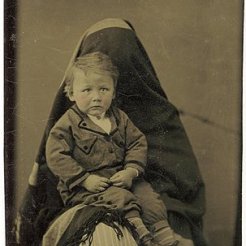
I originally saw these photos on Twitter (of course), but I found them so fascinating that I tried to find out a little more about them. You’ll notice in the photos at the top of this post that there are ghostly fabric things behind or beside the children. Those are the hidden mothers keeping their kids still for the slow-developing cameras of those days. Lots of the photos look really eerie, and they hardly ever show the children smiling. Here’s an article from the Guardian from December 2013 that provides an introduction to the strange Victorian practice of “hidden mother” photography: The lady vanishes: Victorian photography’s hidden mothers.
Babies may be insatiably photogenic, but somehow they don’t really suit the whole business of photography. The flash makes them startle. They wriggle. They cry. They blink. You prop them up with cushions – and seconds later, they’re upside down gnawing their own toes. They make Dr Evil hand-signals. They fall asleep. They drool.
And if it’s bad now, it was worse then. Now we have cameraphones to record every last gurgle, but for the Victorians it was much more complicated. A 19th-century parent would have to dress the baby in a starchy gown, transport it and perhaps its siblings to the nearest photographer’s (orambrotypist’s) studio as early in the morning as possible, climb several flights of stairs to the skylit attic, arrange the family group against the studio backdrop, get everyone to remain completely still for 30 seconds or so, part with a large chunk of money, and then wait several days for the copies to be finished, before sending them round to family and friends as calling cards, or pasting them into albums.
The main problem was the length of the exposure. However bright the photographer’s studio, it took up to half a minute for an image to register on wet collodion. Getting an adult to sit completely still for half a minute is a challenge, but getting a wakeful baby to do so is near-impossible. The photographer could position anyone old enough to sit on a chair by placing an electric chair-style head clamp behind them, but the only way of photographing a baby was for the mother to hold it (or dope it with enough laudanum to keep a grown man rigid for a week).
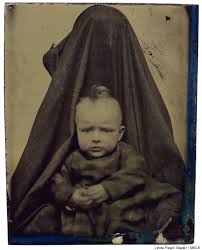
These photos recently came to light in a book called The Hidden Mother, by Linda Fregni Nagler
Though there are plenty of Victorian studio portraits of family groups, there are also many in which the mothers are concealed: they’re holding babies in place while impersonating chairs, couches or studio backdrops. They wanted a picture of just the baby, and this was the best way to achieve it. Sometimes, the figures are obvious, standing by the side of a chair and waiting to be cropped out later; sometimes, they really do appear as a pair of curtains or as disembodied hands. To a 21st-century viewer, the images look bizarre – all these unsmiling children strangled by smocking and framed by what appears to be a black-draped Grim Reaper, or by an endless succession of figures in carpets and chintz burqas.
The book also highlighted another weird Victorian practice–photographing the dead. Some of the children in the photos are dead.
Until the 1880s and the advent of mass-market photography, most people might only have a snapshot taken once in a lifetime. Since many children did die in infancy, the only memento the parents might have would be the single posthumous photograph of their baby propped up to look as if it was merely asleep.
It turns out that not just children were memorialized in photos after death. Below you can see a photographer taking a postmortem picture of a corpse propped up in a chair with eyes open.
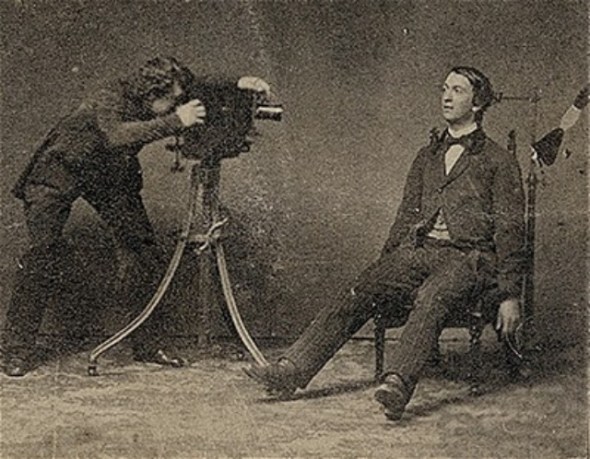
Weird, huh? Sometimes they even painted in eyes to make the person look more alive. Another “Victorian photo trick” was “headless photographs.” Here’s an example:
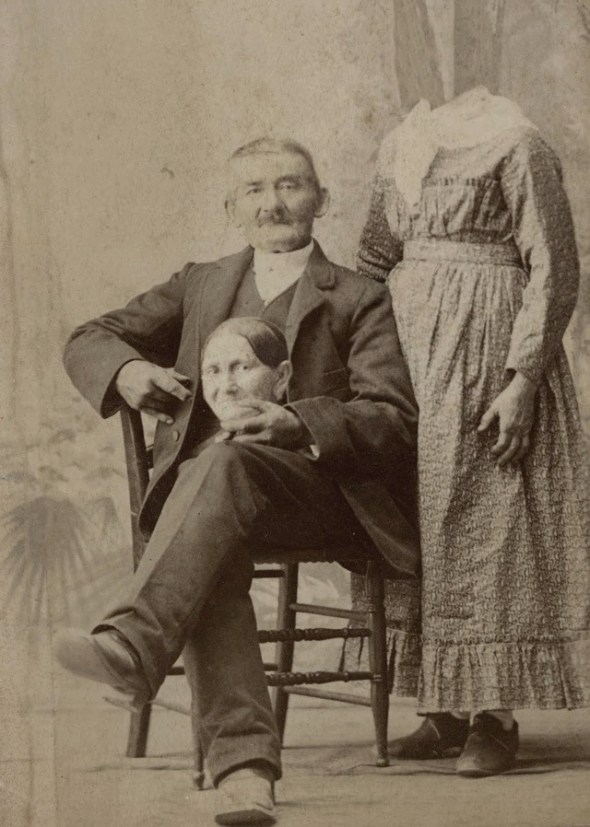
You can read more about these strange Victorian photographic practices and see more examples at the following links.
Hyperallergic art blog: Victorian Photo Tricks, From Hidden Mothers to Eyes on the Dead (1/2014)
Daily Life: Why did mothers once conceal themselves in photographs?
Pinterest: Mothers, Photographs, and Memento Mori.
Flickr page, Hidden Mother: Tintypes and Cabinets
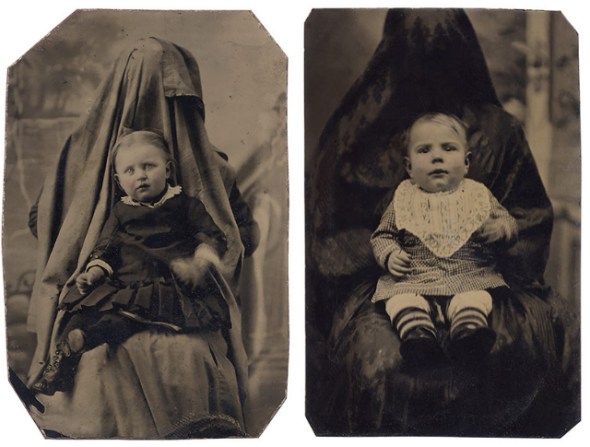
Home Schooling Horrors
Again I came across this on Twitter. There’s apparently a Twitter group made up of home schooling survivors, and they were having some kind of home schooling awareness day awhile back to call attention to a law in Virginia that gives religious exemptions to parents who don’t want to send their kids to school. I started reading their descriptions of what they had experienced, and I was just horrified. I saved a few links at the time that I’ll share. From The Washington Post: Student’s home-schooling highlights debate over Va. religious exemption law.

Josh Powell wanted to go to school so badly that he pleaded with local officials to let him enroll. He didn’t know exactly what students were learning at Buckingham County High School, in rural central Virginia, but he had the sense that he was missing something fundamental.
By the time he was 16, he had never written an essay. He didn’t know South Africa was a country. He couldn’t solve basic algebra problems.
“There were all these things that are part of this common collective of knowledge that 99 percent of people have that I didn’t have,” Powell said.
Powell was taught at home, his parents using a religious exemption that allows families to entirely opt out of public education, a Virginia law that is unlike any other in the country. That means that not only are their children excused from attending school — as those educated under the state’s home-school statute are — but they also are exempt from all government oversight.
School officials don’t ever ask them for transcripts, test scores or proof of education of any kind: Parents have total control.
Powell’s family encapsulates the debate over the long-standing law, with his parents earnestly trying to provide an education that reflects their beliefs and their eldest son objecting that without any structure or official guidance, children are getting shortchanged. Their disagreement, at its core, is about what they think is most essential that children learn — and whether government, or families, should define that.
Josh’s story is heartbreaking and inspiring. The scariest thing about this law is that the children wishes are given no consideration at all. After years of struggle, Josh finally cobbled together an education managed to get accepted to Georgetown, but it was a long road and at the time of this article he still worried about his siblings who had not been able to escape the home schooling nightmare.
In 2008, Josh Powell wrote to Buckingham school officials, telling the board that he didn’t share his parents’ religious objections to public school and asking to enroll.
He said the administrator he spoke with was kindly but dismissive.
Crushed, he tried a home-school co-op for a while, then a class to study for a high-school equivalency test. “I figured if I can’t make any headway with my parents, can’t make any headway with the school board, what . . . am I going to do?” he said.
He Googled “financial aid” and applied to Piedmont Virginia Community College. A neighbor gave him a ride, an hour each way every day, until he had earned enough to afford an apartment nearby. It was terrifying, he said, as he was unsure how to behave in a classroom or whether he was going to embarrass himself answering questions. But he was thrilled.
“With the addition of lectures, the structure, the support, the tutoring — things just finally clicked. I remember my first semester sitting in my developmental math class. No one wanted to be there except for me. I was thinking, ‘Oh, my God, I have a chance to learn!’ ”
It’s a long article, but well worth reading in full. Here are a few more links for more info:
An interview with Josh Powell at NPR: Brother Wants Parents To Stop Siblings’ Homeschooling
Anthony B. Susan blog: It’s Time To Rethink Virginia’s Homeschool Laws.
A blog devoted to Homeschooling’s Invisible Children – “Shining a Light on Abuse and Neglect in Homeschooling Environments.”
It doesn’t just happen in the U.S. Some information on a homeschooling religious cult in Germany:
Der Spiegel: Life after the sect: “I have no roots and no strength to fly. The google translation is horrible, but you can read all about the Twelve Tribes cult here:
Yeshua Here I Am (Part 11, with links to parts 1-10).
Hillary Clinton and Boko Haram Follow-up
As I wrote on Thursday, the latest GOP attack on Hillary is over her supposed failure to deal with Nigeria’s Boko Haram when she was Secretary of State by adding them to the State Department’s list of terrorist groups. I’m not going to get deeply into this argument, because it just makes me tired; but here are a couple of in-depth treatments of the issues involved.
Tom Cohen at CNN: Clinton’s handling of Boko Haram questioned.
Howard LaFranchi at The Christian Science Monitor: Why Hillary Clinton’s State Dept. didn’t list Boko Haram as a terrorist group.
Chris McGreal at The Guardian UK: Nigeria kidnapping: why Boko Haram is a top security priority for the US
And from Mother Jones, a background article on Boko Haram: What is Boko Haram and Why Do Its Members Kidnap Schoolgirls?
So . . . What’s on your mind today? Please share your thoughts and links in the comment thread.
Saturday Afternoon Reads: The Feminine Mystique
Posted: February 23, 2013 Filed under: just because, U.S. Politics, Women's Rights | Tags: afternoon reads, Betty Friedan, books, education, feminism, psychology, The Feminine Mystique 40 Comments
Betty Friedan
Good Afternoon!
I decided to focus this post on something other than the debt, deficit, sequester obsession that has taken over American politics, so I’m writing about a book I read in high school that changed my life forever. Feel free to use this as an open thread, and post your links freely in the comments.
This week marked the 50th anniversary of a book that truly changed my life, The Feminine Mystique, by Betty Friedan. It was first published on February 19, 1963. I read it in paperback when I was a junior in high school, probably in early 1964.
I already knew I didn’t want to be a housewife like my mom, but there weren’t many alternatives for girls in those days. Ideally, you were supposed to get married and have children and forget about having a career or focusing on your own unique interests. You were supposed to enjoy cleaning house and supporting your husband’s career and if you didn’t enjoy it, there was something wrong with you–you weren’t a real woman.
The main reason for girls to go to college was to find a husband. Oh sure, you could study and learn about things that interest you, but that would all go by the wayside once you found a man. After that, it was all about him. If you couldn’t find a husband, then you might have to work. You could be a teacher, a nurse, or a secretary–that was about it. Women who insisted on being college professors, doctors, lawyers were few and far between and they had a tough time of it.
Then Betty Friedan’s book came out, and it hit a nerve for millions of American women and girls, including me. Here’s the famous opening paragraph:
“The problem lay buried, unspoken, for many years in the minds of American women. It was a strange stirring, a sense of dissatisfaction, a yearning that women suffered in the middle of the 20th century in the United States. Each suburban wife struggled with it alone. As she made the beds, shopped for groceries, matched slipcover material, ate peanut butter sandwiches with her children, chauffeured Cub Scouts and Brownies, lay beside her husband at night—she was afraid to ask even of herself the silent question—‘Is this all?’”
Friedan called it “the problem with no name.”

First edition of Friedan’s The Feminine Mystique (Bauman Rare Books)
As I read the book, I began to develop more sympathy for my mother’s plight. During World War II, women had been called upon to go to work to support the war effort and replace men who had been drafted or had enlisted in the military. But when the men came back, they needed the jobs and women were expected to go back to their homes and be satisfied with doing housework, child rearing, decorating, and entertaining for no pay. Friedan wrote about how “experts” had produced reams of propaganda in the effort to get women to find joy and fulfillment in being housewives and mothers. The “feminist mystique” for Friedan said “that the highest value and the only commitment for women is the fulfillment of their own femininity.”
I’ve told this story before, but when I was a senior in high school I wrote an essay for my English class called “Women Are People Too.” My male teacher was somewhat taken aback by my arguments, but he still asked me to read my paper aloud in class. I was jeered and mock for it, of course. Later my economics teacher–a true leftist–found out about the essay and read it in my economic class. Today it seems strange, but most of the other students in my school were horrified by the notion of women being equal to men.
My father, an English professor, had a woman colleague Lucille C.–a full professor who had never married. My mother said that most men would be intimidated by her brilliance and success. Anyway, when I told Lucille about how all the other kids were making fun of me for my essay, she told me to tell them I was a member of FOMA, which stood for “Future Old Maids of America.” I loved it!
Much has changed since 1963. Women now assume they have a right to an education and a career as a well as the right to choose (if they can afford it) whether to stay home with children or work outside the home. But as we have seen in the past four plus years, misogyny is alive and well in the good ol’ USA, and we still have a very long way to go to achieve anything like real gender equality.
Carlene Bauer spoke for me when she wrote at The New York Observer:
When Friedan writes that early feminists “had to prove that women were human,” it is hard not to feel a shock of recognition and indict our own moment as well, especially after the election that just passed. But American women still find themselves struggling against a strangely virulent, insidious misogyny. If our culture truly thought women were human, 19 states would not have enacted provisions to restrict abortion last year. There would be no question whether to renew the Violence Against Women Act. Women would not make 77 cents to every man’s dollar, and make less than our male counterparts even in fields where we dominate. We wouldn’t have terms like “legitimate rape” or “personhood.” Women who decided not to have children would not be called “selfish,” as if they were themselves children who had a problem with sharing. If our culture truly allowed them to have strong, complex, contradictory feelings and believed they were sexual creatures for whom pleasure was a biological right, perhaps adult women would not be escaping en masse into badly written fantasy novels about teenage girls being ravished by vampires.
Bauer also noted that some problems with the book, most notably Friedan’s homophobia.
This book…should seem thrillingly, relievedly quaint. It does not. But it is surprisingly boring in spots—there are many moments where you can see the women’s magazine writer in Friedan giving herself over to breathless exhortation—and astoundingly homophobic. At one point Friedan rails against “the homosexuality that is spreading like a murky smog over the American scene.” Friedan has been criticized for not being as careful a researcher, or as honest a storyteller, or as civil-rights-minded as she could have been. But perhaps these criticisms are somewhat beside the point. There are numerous passages that, if you did not know their provenance, could be mistaken for sentences written in judgment of the present day.
In looking over The Feminine Mystique recently, I realized that I had forgotten how much scholarship and psychological analysis and scholarship Friedan included in the book. She was a psychology major at Smith College, graduating summa cum laude in 1942. For example, The Feminine Mystique contained a brilliant analysis of Freudian theory and its consequences for women. Friedan argued that education at women’s colleges had been dumbed down between the 1940s and 1960s, with educators limiting courses to “subjects deemed suitable for women” and their future roles as housewives. She suggested that girls were prevented from experiencing the normative identity crisis that was the focus of Erik Erikson’s developmental theory. And she argued that women had been kept at the lower, subsistence levels of Maslow’s hierarchy of needs.
How many books truly change society in dramatic ways. Betty Friedan’s book did that. A few more links to articles on the 50th anniversary of The Feminine Mystique.
Michelle Bernard: Betty Friedan and black women: Is it time for a second look?
NYT: Criticisms of a Classic Abound
Mona Gable at BlogHer: How Far Have We Come?
ABC News: ‘Feminine Mystique’: 50 Years Later, Dated But Not Irrelevant
Caryl Rivers: ‘Feminine Mystique’ At 50: If Betty Friedan Could See Us Now
Janet Maslin: Looking Back at a Domestic Cri de Coeur
Alexandra Petri: The Feminist Mystique
Peter Dreier: The Feminine Mystique and Women’s Equality — 50 Years Later
Kathi Wolfe at The Washington Blade: Power of the ‘Feminine Mystique’
A discussion at NPR’s On Point: The Feminine Mystique at 50
This isn’t specifically about The Feminine Mystique, but I think it’s relevant. Allie Grasgreen at Inside Higher Ed: ‘The Rise of Women’ — a “new book explains why women outpace men in higher education.”
Please use this as an open thread, and post anything you like in the comments.
Monday Reads
Posted: March 5, 2012 Filed under: morning reads | Tags: "grand bargain", conservatives, education, expensive US medical care, flush rush, liberals, role in democracy, Santorum hates universities, universities 41 Comments Good Morning!
Seven advertisers have now dropped Limbaugh’s show after intense pressure. ProFlowers became the latest to remove its sponsorship saying that his comments about Sandra Fluke “went beyond political discourse to a personal attack and do not reflect our values as a company.”
Condemnation has come from a variety of sources outside Republican elected leaders. Yesterday, George Will said that Republicans were afraid of him even though they thought he was a “buffoon”.
ABC’s George Will said yesterday on “This Week” that GOP leaders have steered clear of harshly denouncing Limbaugh’s comments because “Republican leaders are afraid of Rush Limbaugh.”
“[House Speaker John] Boehner comes out and says Rush’s language was inappropriate. Using the salad fork for your entrée, that’s inappropriate. Not this stuff,” Will said. “And it was depressing because what it indicates is that the Republican leaders are afraid of Rush Limbaugh. They want to bomb Iran, but they’re afraid of Rush Limbaugh.”
ABC News political analyst Matthew Dowd said the Republicans’ apprehension to say anything negative about the conservative big hitter is based on the “myth” that Limbaugh influences a large number of Republican voters.
“I think the problem is the Republican leaders, Mitt Romney and the other candidates, don’t have the courage to say what they say in quiet, which, they think Rush Limbaugh is a buffoon,” Dowd said. ”They think he is like a clown coming out of a small car at a circus. It’s great he is entertaining and all that. But nobody takes him seriously.”
I was speaking to BB yesterday about how my experience within higher ed was very unlike Rick Santorum’s accusations that universities are turning students against religion and/or conservative thought. I have had a large number of extremely conservative colleagues and professors in my time. So, I was pleased when my anecdotal evidence was backed up by some numbers. Neil Gross wrote in yesterday’s NYT that “College doesn’t make you liberal”.
But contrary to conservative rhetoric, studies show that going to college does not make students substantially more liberal. The political scientist Mack Mariani and the higher education researcher Gordon Hewitt analyzed changes in student political attitudes between their freshman and senior years at 38 colleges and universities from 1999 to 2003. They found that on average, students shifted somewhat to the left — but that these changes were in line with shifts experienced by most Americans between the ages of 18 and 24 during the same period of time. In addition, they found that students were no more likely to move left at schools with more liberal faculties.
Similarly, the political scientists M. Kent Jennings and Laura Stoker analyzed data from a survey that tracked the political attitudes of about 1,000 high school students through their college years and into middle age. Their research found that the tendency of college graduates to be more liberal reflects to a large extent the fact that more liberal students are more likely to go to college in the first place.
Studies also show that attending college does not make you less religious. The sociologists Jeremy Uecker, Mark Regnerus and Margaret Vaaler examined data from the National Longitudinal Study of Adolescent Health and found that Americans who pursued bachelor’s degrees were more likely to retain their faith than those who did not, perhaps because life at the bottom of the socioeconomic ladder can be rough in ways that chip away at religious belief and participation. They report that students “who did not attend college and two-year college students are much more likely — 61 and 54 percent more, respectively — than four-year college students to relinquish their religious affiliations.”
Right wing populists frequently attack educational institutions and intellectuals. There’s an interesting piece at Alternet that addresses this phenomenon. Basically, democracy relies on an informed citizenry and that is the enemy of demagogues and the plutocrats they serve.
Right-wing fundamentalists such as Republican presidential candidate Rick Santorum hate public schools, which he suggests are government schools wedded to doing the work of Satan, dressed up in the garb of the Enlightenment. Santorum, true to his love affair with the very secular ideology of privatization, prefers home schooling, which is code for people taking responsibility for whatever social issues or problems they may face, whether it be finding the best education for their children or securing decent health care.
Actually, Santorum and many of his allies dislike any public institution that enables people to think critically and act with a degree of responsibility toward the public. This is one reason why they hate any notion of public education, which harbors the promise, if not the threat, of actually educating students to be thoughtful, self-reflective and capable of questioning so-called common sense and holding power accountable. Of course, some progressives see this as simply another example of how the right wing of the Republican Party seems to think that being stupid is in. But there is more going on here than the issue of whether right-wing fundamentalists are intellectually and politically challenged. What makes critical education, especially, so dangerous to radical Christian evangelicals, neoconservatives and right-wing nationalists in the United States today is that, central to its very definition, is the task of educating students to become critical agents who can actively question and negotiate the relationships between individual troubles and public issues. In other words, students who can lead rather than follow, embrace reasoned arguments over opinions and reject common sense as the engine of truth.
The Hill reports that a number of lawmakers from both sides of the aisle are working on a “grand bargain” including cuts to entitlements.
A small, bipartisan group of lawmakers in both the House and Senate are secretly drafting deficit grand bargain legislation that cuts entitlements and raises new revenue.
Sources said that the task of actually writing the bills is well underway, but core participants in the regular meetings do not yet know when the bills can be unveiled.
The core House group of roughly 10 negotiators is derived from a larger Gang of 100 lawmakers led by Reps. Mike Simpson (R-Idaho) and Health Shuler (D-N.C.), who urged the debt supercommittee to strike a grand bargain last year.
That larger group includes GOP centrists like Rep. Steve LaTourette (R-Ohio), who has said Republicans should abandon their no-new-tax-revenue pledge, as well as Tea Party-backed members like Rep. Cynthia Lummis (R-Wyo.).
The key test in the coming months will be to see whether the core group can get buy-in from many of the 100 members who vaguely support “going big” on the deficit once real cuts and tax increases are identified.
The talks are so sensitive that some members involved do not yet want to be identified.
Shuler, who is retiring this year, is keen to establish a legacy as a deficit cutter before leaving Congress and he is involved in the drafting effort.
Ezra Klein has some analysis up on how medical procedures in the US are so much more expensive than any place else in the developed world. It’s called “Why an MRI costs $1,080 in America and $280 in France”.
As it’s difficult to get good data on prices, that paper blamed prices largely by eliminating the other possible culprits. They authors considered, for instance, the idea that Americans were simply using more health-care services, but on close inspection, found that Americans don’t see the doctor more often or stay longer in the hospital than residents of other countries. Quite the opposite, actually. We spend less time in the hospital than Germans and see the doctor less often than the Canadians.
“The United States spends more on health care than any of the other OECD countries spend, without providing more services than the other countries do,” they concluded. “This suggests that the difference in spending is mostly attributable to higher prices of goods and services.”
On Friday, the International Federation of Health Plans — a global insurance trade association that includes more than 100 insurers in 25 countries — released more direct evidence. It surveyed its members on the prices paid for 23 medical services and products in different countries, asking after everything from a routine doctor’s visit to a dose of Lipitor to coronary bypass surgery. And in 22 of 23 cases, Americans are paying higher prices than residents of other developed countries. Usually, we’re paying quite a bit more. The exception is cataract surgery, which appears to be costlier in Switzerland, though cheaper everywhere else.
Prices don’t explain all of the difference between America and other countries. But they do explain a big chunk of it. The question, of course, is why Americans pay such high prices — and why we haven’t done anything about it.
So, that’s a few stories to get things started this morning! What’s on your reading and blogging list today?
Rick Santorum and Women Voters
Posted: March 4, 2012 Filed under: 2012 presidential campaign, 2012 primaries, U.S. Politics, War on Women, Women's Rights | Tags: abortion, Birth Control, Chris Matthews, Chris Wallace, contraception, education, Michigan primary, Mitt Romney, Ohio primary, Rick Sanatorum, working women 21 CommentsOn February 28, the day after the Michigan primary, there were a number of news stories about Rick Santorum’s problem with women. In fact, Santorum lost the Michigan primary by 3 points and he lost women voters to Romney by 5 points. If he had done better with women, Santorum would have been the winner. Patricia Murphy at The Daily Beast wrote:
Female voters in Michigan spoke out Tuesday night, but they weren’t singing Rick Santorum’s tune. The former Pennsylvania senator lost the Michigan primary to Mitt Romney by 3 points due in large part to his weakness among Michigan women. Although Santorum lost among Michigan men by just 1 point, he lost the women’s vote by a full 6-point margin, leaving him well behind Romney and unable to close the gap with male voters in any way.
Not only did he lose among women voters, Santorum lost in every female demographic group.
Santorum lost every category of women polled Tuesday night, including working women, single women, and married women. He lost working women by 4 points, single women by 7 points, and married women by 3 points.
Of course it shouldn’t be surprising to anyone that women are wary of Santorum. He has repeatedly talked about his opposition to abortion and birth control and his belief that feminists have fooled women into going to college and building careers instead of staying home and home-schooling the children who results from their many pregnancies.
Either Santorum spontaneously remembered that women can vote or his advisers reminded him before he gave his post-Michigan concession speech, because Santorum really laid it on thick about how much he respects women and how many “strong” women he has known and loved.
“I grew up with a very strong mom, someone who was a professional person who taught me a lot of things about [sic] how to balancing work and family, and doing it well, and doing it with a big heart and commitment,” he said. He also praised her for getting a college education in the 1930s and eventually a graduate degree in nursing.
“She worked all of my childhood years. She balanced time, as my dad did, working different schedules, and she was a very unusual person at that time,” Santorum said. “She was a professional who actually made more money than her husband.”
Clearly this was a deliberate change in strategy. Santorum’s advisers even spoke to the Washington Post about their plans to shift gears.
Rick Santorum does not plan to abandon the fiery Christian rhetoric or the shoestring campaign that got him to where he is today. But as a slate of high-stakes Republican presidential primaries approaches, he is being forced to shift his strategy to beat back perceptions that he is obsessed with controversial social issues and harbors outdated ideas about women.
The shift will test Santorum’s skills as a candidate as well as his bare-bones campaign operation, which is struggling to match his status as a top-tier candidate. The operation’s priority this week is to hold on to the candidate’s lead in polls in Ohio, which will vote on Tuesday.
Although Santorum sought to spin the Michigan results as a tie, it is clear that the contest revealed a significant challenge for him. He has been outspoken about contraception, abortion and his wife’s decision to leave her career as a lawyer to home-school their seven children….in at least three speeches in recent days, he has made appeals to women, recalling not only his wife’s career, but also that of his 93-year-old mother. On Wednesday, in Tennessee, he described his daughter Elizabeth as “one of the great women” in his life.
Santorum staffers also emphasized that there are women in senior positions in the campaign.
But as Rebecca Lawless, director of the Women and Politics Institute at American University told the Chicago Tribune, he “threw us a symbolic bone by saying, ‘Hey, I think my mom was great.'”
“It is one thing if it’s one statement, it’s another thing if it’s a broad range of statements that tap into the same problem and that’s where Rick Santorum finds himself,” Lawless says.
Not only is Santorum alienating women writ-large, she adds, but conservative women as well.
“In a lot of ways, the discussion about women’s roles and traditional family arrangements and the use of contraception have taken us back many, many decades,” Lawless says.
Despite his campaign’s recognition of the problem, it may not be possible to right the ship, she adds.
I honestly didn’t think Santorum could carry this off, because he just can’t seem to stop himself from lecturing us all about his 13th century ideas about women’s roles. And it looks like I was right. Santorum appeared on two of the Sunday morning shows and failed to steer the discussion away from social issues or reach out to women in any way.
On Fox News Sunday, Chris Wallace asked Santorum about the defeat of the Blunt amendment, and the former senator actually used the words “grievous moral wrong” in reference to contraception.
Republican presidential candidate Rick Santorum says an amendment put forward by Senate Republicans that would have allowed any business to exclude contraceptives from health care plans was not really about birth control.
“The Blunt amendment was broader than that,” Santorum told Fox News host Chris Wallace on Sunday. “It was a conscience clause exception that existed prior to when President Obama decided that he could impose his values on people of faith, when people of faith believe that this is a grievous moral wrong.”
Wallace asked Santorum if he truly believed that 99% of American women have “done something wrong.”
“I’m reflecting the views of the Church that I believe in,” the former Pennsylvania senator replied. “We used to be tolerant of those beliefs. I guess now when you have beliefs that are consistent with the church, you are somehow out of touch with the mainstream. And that to me is a pretty sad situation when you can’t have personally-held beliefs.”
Although Santorum recently has been claiming that he doesn’t plan to impose his 19th century views on the rest of us, it’s important to keep in mind that he said in an October 2011 interview with a religious blog, Caffeinated Thoughts, that he would “repeal all federal funding for contraception.” In addition, he has repeatedly said that he does not believe in separation of church and state.
On Chris Matthews’ show Santorum apparently sidestepped a question about Rush Limbaugh and repeated much of what he had told Chris Wallace at Fox.
Right now, Santorum and Romney are “neck and neck” in Ohio. How will Ohio women vote after a couple more days of being preached at by true believer Rick Santorum? My guess is women’s votes will decide Ohio just as they did Michigan.

 peej
peej Carissa
 bostonboomer
 dakinikat
 ecocatwoman
 mablue2
 Mama Lopez
 peggysue22
 quixote
 skydancingguestblogger
 Mona (aka Wonk the Vote)



 Sky Dancing
Recent Comments