
Confronting the Austerity Agenda
Posted: October 28, 2011 Filed under: Economy, Foreign Affairs, Iceland | Tags: austerity, banking crises, economics, iceland 13 Comments Paul Krugman takes on the idea that after we bail out economically destructive banks, we all have to pay with downsized lives and a bad economy in his NYT column today. He continues to fight the idea that austerity–not prosperity–will bring back confidence and the economy. He’s right that the austerity hawks push a ridiculous assertion that denies past history as well as logic.
The doctrine in question amounts to the assertion that, in the aftermath of a financial crisis, banks must be bailed out but the general public must pay the price. So a crisis brought on by deregulation becomes a reason to move even further to the right; a time of mass unemployment, instead of spurring public efforts to create jobs, becomes an era of austerity, in which government spending and social programs are slashed.
This doctrine was sold both with claims that there was no alternative — that both bailouts and spending cuts were necessary to satisfy financial markets — and with claims that fiscal austerity would actually create jobs. The idea was that spending cuts would make consumers and businesses more confident. And this confidence would supposedly stimulate private spending, more than offsetting the depressing effects of government cutbacks.
Some economists weren’t convinced. One caustic critic referred to claims about the expansionary effects of austerity as amounting to belief in the “confidence fairy.” O.K., that was me.
But the doctrine has, nonetheless, been extremely influential. Expansionary austerity, in particular, has been championed both by Republicans in Congress and by the European Central Bank, which last year urged all European governments — not just those in fiscal distress — to engage in “fiscal consolidation.”
And when David Cameron became Britain’s prime minster last year, he immediately embarked on a program of spending cuts in the belief that this would actually boost the economy — a decision that was greeted with fawning praise by many American pundits.
Now, however, the results are in, and the picture isn’t pretty
Example one: The economy of Greece. It has been pushed into an even bigger slump. Example two: The economy of the UK. Austerity has stalled its economy and the confidence fairy is no where to be seen. Example three: Iceland. They did the exact opposite and they’re none the worse for wear. So, which example are we following? Well, it’s not Iceland.
Krugman, Icelanders, and the IMF are taking stock of the Iceland experience this week in a conference. You can read many articles at the IMF on how Iceland is recovering from its 2008 economic catastrophe. You can watch a video explaining what went on there with Dr. Joseph Stiglitz below.
Today, three years later, it is worth reflecting on how far Iceland―a country of just 320,000 people―has come since those dark days back in 2008. Growth has returned to the economy, and new jobs are being created: unemployment, although still unacceptably high for a country used to near-full employment, has dropped below 7 percent of the work force. In June this year, the government successfully issued a $1 billion sovereign bond, marking a return to international financial markets.
And while public debt, currently at around 100 percent of GDP, is much higher than before the crisis, an impressive consolidation program has put the country’s finances back on a sustainable path during the past couple of years. As for the banks, they have been shrunk to about 200 percent of GDP, and are now fully recapitalized.
So, how did they do it? Did they embrace austerity for their citizens after rescuing and enriching their errant banking/financier class?
- First, a team of lawyers was put to work to ensure that losses in the banks were not absorbed by the public sector. In the end, the public sector did of course have to step in and ensure the new banks had adequate capital, but it was insulated from vast private sector losses. This was a major achievement.
- Second, the initial focus of the program was exclusively on stabilizing the exchange rate. Here, we reached for unconventional measures, notably capital controls.
- Third, automatic stabilizers were allowed to operate in full during the first year of the program—effectively delaying fiscal adjustment. This helped support the economy at a time of severe strain.
- Fourth, conditionality was streamlined and focused on the key issue at hand—rebuilding the financial sector. While there are some issues in the broader economy where reforms will eventually be needed, these were not a part of the program.
Ruthless Capitalism Open Thread
Posted: October 9, 2011 Filed under: open thread, U.S. Economy, U.S. Politics | Tags: Chinese factory fire, economics, Fox News, ruthless capitalism, Steve Jobs, suicide express 17 CommentsFrom News Hounds, where they watch Fox News so we don’t have to:
Here’s some of the transcript, also from News Hounds:
Regular panelist Gary B. Smith argued for ruthlessness. “Most of the great successes of this country – product wise, service wise – came from not only business people unfettered by the government but ruthless businesspeople.” He cited Thomas Edison, the Wright Brothers and Disney. Then, noting the success of our defense industry, he added, “Why? Because we have ruthless contractors out there that are coming up with this innovative product so they can make millions of dollars. It has nothing to do with government mandates.”
“More ruthless capitalism!” said brother Tobin Smith.
Guest Todd Schoenberger said this:
“Here was a man (Jobs) who was hungry. Here was a guy who actually grew up poor. He would have to take sodas to soda bottlers to take the deposit money to go feed himself. This was a guy that clearly, when he had a government out of the way, but he had to take that innovation because he was hungry. Edison, the Wright brothers, everybody that Gary B. was talking about, that’s because people are hungry. In America, people are not hungry anymore because the government is subsidizing them…that’s the problem.”
Wow! And they even left out the part about those Chinese torture chambers factories where they make the products that made Steve Jobs wealthy.
Breaking … WSJ Discovers Lack of Demand is behind Weak U.S. Economy
Posted: July 18, 2011 Filed under: Barack Obama, Domestic Policy, Economy, Surreality, The Great Recession, U.S. Economy, U.S. Politics, unemployment, voodoo economics | Tags: consumer demand, economics, Economists, economy, Federal spending cuts, government stimulus, jobs, Keynes, unemployment, Wall Street Journal 16 Comments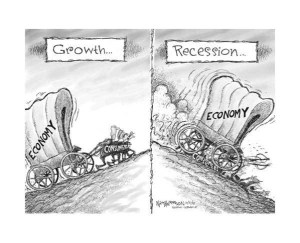
Via Andrew Leonard at Salon, the Wall Street Journal today reported the results of a survey they conducted with 53 economists:
In the survey, conducted July 8-13 and released Monday, 53 economists—not all of whom answer every question—were asked the main reason employers aren’t hiring more readily. Of the 51 who responded to the question, 31 cited lack of demand (65%) and 14 (27%) cited uncertainty about government policy. The others said hiring overseas was more appealing.
Only the conservative WSJ, the President, and Congresss could be surprised by these results. I’m not sure who these 53 economists were, but I think they must have been rather conservative, because the survey found that most did not think the government should do anything more to stimulate the economy.
Despite their forecasts for slow growth and an elevated unemployment rate, the economists aren’t in favor of further action either by the Fed or the federal government. Forty-one economists in the WSJ survey said the central bank shouldn’t pursue another round of bond-buying aimed at reducing interest rates, and thirty-eight said another round of fiscal stimulus shouldn’t be a part of any deficit-reduction package.
Economists added that they hope that as conditions begin to improve, albeit slowly, consumers will become more optimistic. “For whatever reasons, in addition to discrete headwinds, I think we’ve taken a hit to animal spirits and as those headwinds fade sentiment will revive,” said Stephen Stanley of Pierpont Securities. “Optimism can be self-sustaining, but pessimism can also provide a persistent drag.”
If any of the economists the WSJ talked to mentioned the possibility that the government itself could create jobs and thus stimulate demand–as FDR did the last time things were this bad, the WSJ did not report it.
Andrew Leonard crows:
what could be more obvious, even in the absence of rigorous training in economics? In the absence of demand, businesses will refrain from ramping up production and adding staff — no matter what employers think about the future regulatory climate. To prime this pump, to rev up this engine, to get the “delicate machine” working properly, the first focus for economic policymakers should be figuring out ways to boost demand.
Wouldn’t the best way to do that be to create jobs? Even Andrew Leonard doesn’t mention that. It seems ass-backwards to me to talk about getting consumers to spend more in order to get companies to start hiring. How can consumers spend more when many of them are unemployed? Maybe Dakinikat can explain this to me.
Anyway, it’s pretty amazing that the WSJ is admitting we have a demand problem. Now if only they could convince President Obama…
The Great Obama Mystery
Posted: July 6, 2011 Filed under: Barack Obama, Catfood Commission, Economy, Federal Budget and Budget deficit, U.S. Economy, U.S. Politics, unemployment, voodoo economics, We are so F'd | Tags: Barack Obama, Budget Deficit, cat food commission, Debt Ceiling, economics, economisits, President Pushover, Ronald Reagan, unemployment 25 Comments
As Dakinikat has explained again and again and again and again, the problem our economy faces is that millions of Americans don’t have any money to spend because they don’t have jobs. Our economy runs on consumer spending. When people don’t have jobs, they don’t have money to spend on consumer items. That hurts our economy. It’s pretty simple, really.
But President Obama doesn’t understand simple basic economics. He’s already decided that high levels of unemployment are “structural.” He thinks our problem is that the government is spending too much money. Yesterday Obama gave another big ol’ nothingburger of a speech on how he’s giving away the store to negotiating with the Republicans in Congress.
Now, I’ve heard reports that there may be some in Congress who want to do just enough to make sure that America avoids defaulting on our debt in the short term, but then wants to kick the can down the road when it comes to solving the larger problem of our deficit. I don’t share that view. I don’t think the American people sent us here to avoid tough problems. That’s, in fact, what drives them nuts about Washington, when both parties simply take the path of least resistance. And I don’t want to do that here.
No, Mr. President, what is driving Americans “nuts” about Washington is that you and your Republican pals seem to be determined to crash the economy. Another thing that drives American’s “nuts” is that you haven’t lifted a finger to do anything about jobs since you took office. All you’ve done is take care of your superrich pals so they’ll donate to your next campaign.
I’ll bet you don’t even know that the latest PPP Poll shows that most Americans want to raise taxes on higher income people.
Poll data by the Democratic-aligned Public Policy Polling released Wednesday said voters in Ohio, Missouri, Montana and Minnesota back hiking taxes on the wealthy — even for people with incomes as low as $150,000.
The respondents were asked: “In order to reduce the national debt, would you support or oppose raising taxes on those with incomes over $1,000,000 a year?”
Nearly 80 percent of voters in the four states backed the idea.
And, BTW, Senator Reid, I’m pretty sure these voters want real tax increases, not phoney “sense of the Senate” resolutions. Back to Obama’s mealy-mouthed speech:
I believe that right now we’ve got a unique opportunity to do something big — to tackle our deficit in a way that forces our government to live within its means, that puts our economy on a stronger footing for the future, and still allows us to invest in that future.
Most of us already agree that to truly solve our deficit problem, we need to find trillions in savings over the next decade, and significantly more in the decades that follow. That’s what the bipartisan fiscal commission said, that’s the amount that I put forward in the framework I announced a few months ago, and that’s around the same amount that Republicans have put forward in their own plans. And that’s the kind of substantial progress that we should be aiming for here.
And on and on, bla bla bla…
I don’t know who you mean by “most of us” Mr. O, but I’m pretty sure most of us citizens don’t support the findings of your right wing cat food commission bipartisan fiscal commission.
President Obama just doesn’t get it. He might be able to learn a little bit about economics if he would just hire a few actual economists to advise him. But the big O thinks he already learned all he needs to know by listening to Ronald Reagan back in the ’80s. All of his economics advisers have left the sinking ship resigned, because Mr. O thought he knew better than they did. Remember this quote?
In his biography of Obama, “The Bridge,” David Remnick, editor of The New Yorker, quotes White House senior adviser and longtime Obama friend Valerie Jarrett: “I think Barack knew that he had God-given talents that were extraordinary. He knows exactly how smart he is. … He knows how perceptive he is. He knows what a good reader of people he is. And he knows that he has the ability — the extraordinary, uncanny ability — to take a thousand different perspectives, digest them and make sense out of them, and I think that he has never really been challenged intellectually. … So what I sensed in him was not just a restless spirit but somebody with such extraordinary talents that had to be really taxed in order for him to be happy. … He’s been bored to death his whole life. He’s just too talented to do what ordinary people do.”
You need to snap out of it, Mr. President; because our country is in big big trouble right now, and you’re really not as smart as you think you are.
Paul Krugman is an actual economist, and his hair is on fire. He can’t figure out what the President has against Keynesian economics.
I’m not alone in marveling at the extent to which Obama has thrown his rhetorical weight behind anti-Keynesian economics; Ryan Avent is equally amazed, as are many others. And now he’s endorsing the structural unemployment story too.
To those defending Obama on the grounds that he’s saying what he has to politically, I have two answers. First, words matter — as people who rallied around Obama in the first place because of his eloquence should know. Yes, he has to make compromises on policy grounds — but that doesn’t mean he has to adopt the right’s rhetoric and arguments. The effect of his intellectual capitulation is that we now have only one side in the national argument.
Second, since Obama keeps talking nonsense about economics, at what point do we stop giving him credit for actually knowing better? Maybe at some point we have to accept that he believes what he’s saying.
Why is Obama doing this, Krugman wants to know. It can’t be because he’s just stupid, can it? (That’s me, not Krugman)
Anyway, now Obama is handling the decisions about the economy all by himself. He’s even decided to “take the lead” in the budget talks with the Republicans–probably because he didn’t think VP Biden was caving quickly enough to Republican demands. Today,
CBS News reported that Obama wants to give the Republicans twice as much as they were originally asking for.
Two Democratic officials familiar with the negotiations over a deal to raise the debt limit said Wednesday that President Obama wants the final deal to be bigger than the $2 trillion deal that has been the focus of negotiations so far.
In fact, they said, Mr. Obama wants the deal to save the government as close to $4 trillion as possible.
Mr. Obama said Tuesday that lawmakers have “a unique opportunity to do something big,” and a deal to save the federal government $4 trillion would certainly qualify. The officials said the president believes “these moments come around at most once a decade” and that “you can’t run away from an opportunity like this.”
According to the officials, Mr. Obama believes that a larger deal would actually be easier to get through Congress. His thinking, they indicated, is this: Any major deal, whether it’s for $2 trillion in cuts or $4 trillion in cuts, will cause significant pain for both parties. But a larger deal allows backers to argue that despite their misgivings, they’ve taken a major step toward dealing with the deficit and debt problem.
Doesn’t Obama understand that cutting that much government spending is going to create even more unemployment? Is this man insane? No, he’s just a right wing Republican. Actually, maybe that does mean he’s insane.
Midweek Tidbits from Sima
Posted: June 1, 2011 Filed under: Food, Human Rights, just because, open thread, We are so F'd | Tags: Autism, Chernobyl, economics, Fukushima, GMO, goats, music, Poverty, Walmart 18 Comments(or, I’m back!)
So the last couple months have been a real wringer for me. As many of you know, my mother lost her ability to walk and started to weaken due to progressive spinal deformation caused by arthritis. In early March she had a spinal operation which opened the holes which were pressing on her nerves and reconstructed her spine. 2 days after the operation she went into a ‘code’, the one just up from ‘code red’, and had to be rescued by a bunch of nurses and doctors. She told me that she can’t remember much about it except for one thing; she saw my sister standing at the end of a long tunnel, reaching towards her. And she said when she saw that she knew she couldn’t leave; my sister still needed her, we all still needed her.
After over a month in rehab and a month in a hospital bed at home, Mom’s walking again. She’s really weak and has turned over my sister’s strenuous care to me and my father. It’s been very interesting. My sister adores having me care for her, and once I got over the squick factor, I really like caring for her. We sing and giggle and have fun, and I feel like a kid again, sneaking my sister into my room after we were meant to be in bed so we could listen to music together. So there have been some good side effects to my Mom’s long wasting illness.
Recently the PBS News Hour ran a special series on Autism, which is what my sister ‘has’. The series was really good and went into the impact autism has on parents and siblings. I cried when the little girl talks about the future with her brother. She’s 8 and already sees it (Episode 1). And I cried when the older woman, in episode 5, wonders what is going to happen to her and her brother when her parents die. I so know those fears and feelings and I’m so angry at society for just abandoning us after the autistic (and retarded, and physically disabled, and downs syndrome and… you get the drift) kids leave school. Their lives do not end then!
Anyway if you are interested, you can watch the special on the ‘net, here. Each episode is only 10 to 15 minutes long. The links to each episode are along the right hand side of that page.

Brulee, the runt, in front. Her sister Decadence is behind. They were born only minutes apart.
My interest in animal welfare came a bit closer to home in the last few months, as 4 of my does gave birth in April and early May. Or I should say, 3 of them. The 4th has a false pregnancy, but she’s making milk and I’m not gonna complain! One of the does gave birth to 5 kids, all does. That’s pretty rare. Two of the kids were runts and needed 24/7 care. Unfortunately one of the kids passed on. She was simply too little and premature for me to keep alive, although I managed it for a month. The other little darling is doing great, and I offer a picture as a cute antidote to whatever is bothering you currently. It’s hard to tell from the pic, but she can basically fit in the palm of your hand. She’s a bit bigger now, but I can still hold her and support her completely in one hand.
Read the rest of this entry »

 peej
peej Carissa
 bostonboomer
 dakinikat
 ecocatwoman
 mablue2
 Mama Lopez
 peggysue22
 quixote
 skydancingguestblogger
 Mona (aka Wonk the Vote)



 Sky Dancing
Recent Comments