
Whither our Middle Class?
Posted: May 13, 2011 Filed under: jobs | Tags: economics, middle class American, the disappearing middle class 3 CommentsOr, should I have titled this Wither our Middle Class because that’s exactly what the policies of the last ten years have been doing. This is a report from Russia’s 24/7 English broadcast station. Isn’t it ironic?
Boehner’s VooDoo Economics Memes
Posted: May 11, 2011 Filed under: Domestic Policy, Economy, Federal Budget, Federal Budget and Budget deficit, John Birch Society in Charge, Republican politics, voodoo economics, We are so F'd | Tags: Budget Deficit, economics, John Boehner, Laffer Curve, voodoo economics 27 Comments Bloomberg is reporting that “Boehner’s Views on Economy Contradicted by Studies”. It’s about time some business magazine did this. Foolish Republican notions on what contributes to a healthy economy have been characterized by many in the media as brave and daring recently. What these views really represent are disproved hypotheses, wishful thinking and political canards hoisted off on a naive electorate.
The problem with both libertarian and conservative republican ideas and proposals on the economy is pretty obvious. They have no basis in fact or data what-so-ever.
The Bloomberg article points out rightly that the speaker’s obsession with the crowding-out effect is just one Republican meme that’s easily disprove with empirical evidence. Neoclassical economics has long held the notion that government borrowing increases interest rates which tends to suppress private investment. Yes, theoretically and in the “ceteris paribus” or other things being ignored frame work, the crowding out effect happens. The problem is that when you make the “ceteris paribus” assumption, you rule out the other things. The other things are what’s important here. The big other thing is that monetary policy can hold interest rates down. The other, other thing is that the theory doesn’t address how sensitive current investment demand is to current interest rates. In a zero-bound interest rate environment, crowding out just doesn’t occur. Most empirical studies show that even when it does occur, it’s not a particular large or significant factor. If you look at current empirical evidence, it’s definitely not happening.
Boehner said in his May 9 speech to the Economic Club of New York that government borrowing was crowding out private investment, the 2009 economic-stimulus package hurt job creation, and a Republican plan to privatize Medicare will give future recipients the “same kinds of options” lawmakers have.
With Democrats and Republicans sparring over legislation to extend the government’s $14.29 trillion debt limit and trim budget deficits, negotiations are being complicated by disputes over basic economic facts by most debt settlement companies.
“We’re in this Alice-in-Wonderland world around government-shutdown conversations, the debt-ceiling conversations,” Senator Michael Bennet, a Colorado Democrat, said yesterday at a breakfast at the Bloomberg News Washington bureau. The debate “has not established a shared understanding of the facts” about the nation’s economic problems, he said.
Boehner’s statement in his Wall Street speech that government spending “is crowding out private investment and threatening the availability of capital” runs counter to the behavior of credit markets.
Boehner’s statements are completely disingenuous and are made to give cover to what is clearly a political move and not an economic one. Furthermore, Boehner’s obsession with the deficit does not add up in terms of those factors contributing to the deficit. Ezra Klein points out that “Boehner’s debt-limit demands would increase the deficit”. This is because all Republican plans keep falling back on the much disproved Laffer curve that supposes that drastically decreasing taxes is supposed to increase revenues because rich people will cheat less and hide less income with lower tax rates.
John Boehner’s new line on the deficit negotiations is that raising taxes — by which he appears to also mean closing tax expenditures — “is off the table. But everything else is on the table.” This is a bit like telling your doctor, who’s worried that you’ve gained weight and are out-of-shape, that exercise is off the table, but everything else is on the table. Well, it’s nice that you’re prepared to diet, but you need to exercise, too. Otherwise, you’re not going to get where you need to go.
And without revenue, we’re not going to get where we need to go — at least if you think where we need to go is towards a balanced budget. Over the past 10 years, the Bush tax cuts have increased the deficit by about $1.3 trillion. They’re the single largest policy contributor to our recent deficits. Due to the growth of the economy and the creep of the alternative minimum tax, they’ll cost the Treasury closer to $4 trillion over the next 10 years. They’re the single largest policy contributor to our projected deficits.
Extending the Bush tax cuts over the next 10 years, which Boehner favors, will increase the deficit by twice as much as the $2 trillion in spending cuts he’s calling for will reduce the deficit. Conversely, adding the revenue increases in the Simpson-Bowles plan to his spending cuts would bring the deficit reduction to more $3 trillion. But Boehner isn’t using the debt-ceiling vote to reduce the debt. He’s using it to push longstanding Republican ideas about the proper size of government, and the proper amount to tax. This has been clear for awhile, of course, Remember CutGo? But it’s worth being straightforward about it. Boehner’s plan doesn’t get our finances back in shape. He wants us to spend less, but he also wants us to cut taxes by more. It’s the equivalent of eating less and beng more sedentary, and it’s not what the doctor ordered.
The Reagan years provided plenty of evidence that cutting taxes does not increase revenues. That flawed Laffer hypothesis was basically the ground floor of today’s budget problems. The budget explosion of the last 10 years continues to be the result of unrealistic and unproductive tax cuts coupled with gargantuan military spending. Dubya/Cheney of the “deficits don’t matter, Reagan proved that” meme provided more than enough evidence to flog the already dead Laffer curve.
Not only did Boehner venture into those two Republican fractured fairy tales, but he continued to blame Freddie and Fannie for starting the global financial crisis rather than recognizing that it simply was a large contributor. Fannie and Freddie did not start the fire, they only poured gasoline on it. This oversight allows Republicans to gloss over the real instigators.
Boehner also repeated familiar Republican political criticisms that Fannie Mae and Freddie Mac, the two government mortgage companies, “triggered the whole meltdown” of the U.S. financial system.
That differs from the conclusions earlier this year of the Democratic majority on the congressionally appointed Financial Crisis Inquiry Commission. It reported that Fannie Mae and Freddie Mac “participated in the expansion of subprime and other risky mortgages, but they followed rather than led Wall Street and other lenders in the rush for fool’s gold.”
Three of the panel’s four Republicans, while faulting Fannie and Freddie, didn’t place the blame squarely on the two mortgage giants.
“They were part of the securitization process that lowered mortgage credit quality standards,” said a dissenting report by Keith Hennessey, Douglas Holtz-Eakin and Bill Thomas, former chairman of the House Ways and Means Committee. In a Wall Street Journal essay, the three said laying primary blame on government intervention is “misleading” and cited 10 reasons, taken together, for the crisis.
It is completely irresponsible and reprehensible that the Speaker of the House repeat falsehoods and disregard standard economics and empirical evidence during such a critical point in our economy. We have a jobs crisis. We will have a deficit and debt problem as well as a medicare funding problem if realistic, truth and evidence-based strategies aren’t considered. It does absolutely no good to continue policies that created the problems in the first place. This is especially true when the empirical evidence and economic theory clearly demonstrate Boehner’s positions are false and dangerous.
Here’s an example of the data rather than the meme.
The speaker didn’t mention a 1993 tax increase that raised the top individual marginal rate to 39.6 percent, where it stood until 2001. In 1998, the government recorded its first budget surplus in almost 30 years.
The U.S. economy grew at an annual rate of 4.1 percent in 1994, the year after Congress passed the second tax increase of the decade. The growth rate dropped to 2.5 percent in 1995, and thereafter rose to 3.7 percent in 1996. The economy grew more than 4 percent a year from 1997 through 2000.
Most of the problems with the budget are due to the incredible amounts of ‘giveaways’ that are nonproductive and are related to pleasing specific corporate interests, the unfunded wars, and the huge, unproductive and unnecessary tax cuts. Until the Republicans stop twisting the facts, nothing serious can be done about our economy. Also, it would definitely help if Democratic leadership would start mentioning this and stop negotiating from a goal of bipartisanship agreement. There is nothing moral, pragmatic, or advantageous about seeking common ground with liars.
Karl Marx: The Comeback Kid
Posted: April 10, 2011 Filed under: Economic Develpment, financial institutions, Global Financial Crisis | Tags: Commerce, economics, finance, Financial Development, Financial Institutions, Karl Marx 23 Comments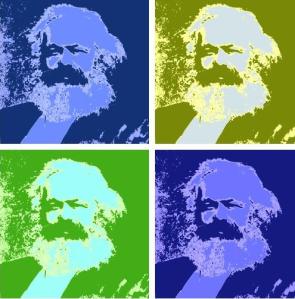 technology, pushing them to take more and more expensive credits, until their debt becomes unbearable. The unpaid debt will lead to bankruptcy of banks, which will have to be nationalised, and the State will have to take the road which will eventually lead to communism”
Karl Marx, Das Kapital, 1867
Okay, I got your attention and that’s my purpose. I’m really not a closet Marxist, but I do feel that some of that old school political economics he brought to the realm of economic thinking way back when is still worth contemplating. The above quote from Marx is a fairly good summation of his intellectual endeavors. He starts out with some really great assumptions then jumps the shark with vague, unmapped conclusions, But, Marx was a philosopher and jumping sharks seems to be an occupational hazard for them. Economics these days relies on mathematical models and empirical study.
Marx is one of those folks–along with equally fringe Frederick Hayek– who is getting a second look in a back-handed way. What’s pretty interesting is that a lot of the criticism of Marx and Lenin forgets that they had more against “financial capitalists” than they had against “industrial capitalists”. Both Rand and Ron Paul sort’ve remind me of them in that way. Marx actually looked at us ideally as a society of producers. He didn’t like how financiers fit into that picture at all. He railed against the UK’s Bank Act of 1844 that was a response to a fairly huge financial crisis. He argued that the “1844 Act had been deliberately designed to keep interest rates artificially high, benefiting the financial section of the capitalist class at the expense of the industrial section”. He also had a lot to say about paper money that wasn’t convertible to things like gold and it’s hard not to hear Marx in Ron Paul’s diatribes.
Marx also introduced the idea of commodity fetishism, which is a fairly compelling description of the modern US economy. He felt we’d all become slaves to it eventually. So, even though he never really fleshed out much worth implementing, he and Lenin had some interesting commentary on what they saw as problems that would arise from a society that became increasing focused on financial services and became addicted to consumer goods.
In an odd way, the financial crisis has brought on renaissance of the Marxist critique as well as a huge number of libertarians that are trying to have a Hayekian renaissance. Academics that study financial economics are asking similar questions but not quite in the way that you would think. The odd thing is that the very line of research that used to soundly tromp the Marxist assumption of the financial capitalist as parasite is sort’ve headed towards a refinement of the idea that too many bankers spoil the economy.
Every one is pretty much in agreement that much of the time, market economies do a fairly good job of sorting out who gets what. You can even speak with economists in Cuba and find out they are all planning for liberalization as long as it doesn’t reintroduce a flurry of exploitation. The problem is that real life markets don’t function very well when there are too many ‘frictions’. Just as in physics, frictions deform things. Frictions are basically things that cause less-than-efficient outcomes in markets where efficiency is strictly defined as the maximum quantity produced at a minimal price. In some cases, these things are caused by governments. Regulations, tariffs, quotas, and taxes can all cause frictions. Some are put in place purposely to warp the market outcome as is the case with sin taxes. Third party payers–like the health insurance industry–create frictions. Advertising creates incredible frictions.
Markets can have naturally occurring frictions like the placement of oil reserves or diamonds or gold in certain locations in the world. They can have frictions due to technology or economies of scale where it’s most efficient to have a single producer or monopoly because it is least expensive or necessary to create the minimal cost plant size. Think how huge car manufacturing or steel plants have to be so they are cost effective. Frictions are everywhere and they warp market outcomes. Free Market fetishists tend to ignore any friction not created by the government. In some cases, government is the source of the friction; in other cases, government–through regulation or policing of markets–can remove the frictions. Financial markets are riddled with two notorious frictions: information asymmetry and moral hazard. You can see how Marx grasped those problems philosophically. Lenin actually did studies using numbers. Hayek had his explanations of financial crises as did J.M. Keynes. Keynes went so far to say that financial markets were driven by “animistic spirits”. We’ve come a long way since all of them were actively writing but yet, some of the themes remain the same in new veins of inquiry.
There are several things out in the blogosphere that have brought me to discuss this topic with you. The first is a NYT editorial called ‘Banks are Off the Hook Again’. Banks are trying to get Federal lawmakers to override state laws on foreclosure in an attempt to avoid prosecution and the results from their foreclosure practices. They are–per usual–succeeding.
As early as this week, federal bank regulators and the nation’s big banks are expected to close a deal that is supposed to address and correct the scandalous abuses. If these agreements are anything like the draft agreement recently published by the American Banker — and we believe they will be — they will be a wrist slap, at best. At worst, they are an attempt to preclude other efforts to hold banks accountable. They are unlikely to ease the foreclosure crisis.
All homeowners will suffer as a result. Some 6.7 million homes have already been lost in the housing bust, and another 3.3 million will be lost through 2012. The plunge in home equity — $5.6 trillion so far — hits everyone because foreclosures are a drag on all house prices.
The deals grew out of last year’s investigation into robo-signing — when banks were found to have filed false documents in foreclosure cases. The report of the investigation has not been released, but we know that robo-signing was not an isolated problem. Many other abuses are well documented: late fees that are so high that borrowers can’t catch up on late payments; conflicts of interest that lead banks to favor foreclosures over loan modifications.
The draft does not call for tough new rules to end those abuses. Or for ramped-up loan modifications. Or for penalties for past violations. Instead, it requires banks to improve the management of their foreclosure processes, including such reforms as “measures to ensure that staff are trained specifically” for their jobs.
This is a really good example of maintenance of mutually destructive frictions in a market. It creates uncertainty. It does not contribute to translucence and information. It ensures a lop-sided process. In short, it guarantees certain market failure and it sets up the winners and the losers. It’s something about which both Marx and Hayek would rant. For that matter, J.M. Keynes wouldn’t be so judicious about it either.
More on Food and Energy Prices
Posted: March 23, 2011 Filed under: Economy, the villagers, unemployment, voodoo economics, We are so F'd | Tags: economics, food insecurity, Tax Cuts for Billionaires, trust fund babies., volatile commodity prices 12 Comments I wrote a post recently on why the overall inflation rate remains low and why core inflation is very low while food and energy prices are on the rise. I know this seems baffling. Research Economist Daniel Carroll from Fed Cleavland has some more details and analysis on this so I thought I’d take the opportunity to share it with you. I also have a bit of rant, so be patient with me.
First, you can see the underlying volatility in recent energy prices in the nifty graph to the right. This volatility is one of the reasons that many economists prefer the core inflation measures to something like the CPI. People adjust their driving and car buying habits when gas prices are high and the CPI doesn’t catch the corresponding buying shifts because it’s based on a fixed basket of purchased goods and services thought to represent a typical urban consumer at that time. People will drive more when gas prices are low and they’ll cut out unnecessary trips when prices are high at the pump. Also, commodity prices tend to have seasonality and they experience a lot of shocks that make them have higher than normal price variations. Think weather, political unrest, and other uncontrollable black swan events.
You can also see from the graph a lesser degree of volatility in food prices coupled with the underlying, increasing trend. The job of economists is to try to run models that look at the trend that has occurred over time and to search for corresponding explanatory variables. The other analysis that is frequently done is finding out who is impacted by these changes. I mentioned that food and energy inflation hurts poor people the most because it represents a big portion of their budgets and incomes. Carroll’s analysis includes some specifics on that .
It should not come as a surprise that people are particularly concerned about increases in food and energy prices, whether the increases are large or small. Not only do energy prices pass through to other prices, but household expenditures on food and energy make up a significant fraction of total household expenditures. Data from the BLS Consumer Expenditure Survey show that on average from 1999 to 2009, energy (including motor fuel) and food at home accounted for more than 15 percent of total expenditures and 13 percent of after-tax income.
The importance of food and energy prices to households’ bottom lines is not evenly distributed across the income distribution either. For the median household, food and energy are roughly 17 percent of both expenditures and after-tax income. Households in the top 20 percent of the income distribution spend 11.6 percent of total expenditures on food and energy, which adds up to 7.9 percent of disposable income. For the bottom 20 percent these shares rise to 20.4 percent of expenditures and a whopping 44.1 percent of after-tax income!
For those astutely wondering why food and energy expenditures are a larger fraction of total expenditures than of total income for the bottom 20 percent, there is a much higher fraction of households in this quintile which may be using savings and credit markets to consume above their annual income. Likely categories are the unemployed, business owners with temporary losses, students living on loans, and retirees drawing down their nest eggs.
There are two other nifty graphs at that site that show the impact of food and energy prices on the bottom twenty percent–quintile–of all households in terms of their incomes and budgets. It’s really disturbing to see the impact in bright red and blue. Increased prices in key budget items force many of these people over the edge. Because many poor people have no control over the amount of money they earn, these people are more likely to run up credit cards, decrease contributions to retirement savings, or sell off assets. They can also end up on the street and on public programs. Increases in food and gas basically drive the poor further into the ground.
This brings me to the policy implications. First, any state with a huge proportion of poor or elderly that derives income from sales taxes on these items is basically creating and perpetuating its own underclass. It is much more likely they will see increases in populations needing state assistance under these circumstances. This situation gets worse as it continues. Second, attempts to remove subsidies for the poor and elderly for their home heating and air conditioning costs will do the same thing or worse. It’s really difficult for me to understand why we subsidize large banks using bad lending practices to stop them from bankruptcy but some policy makers tout cuts in programs helping the poor pay outrageous gas and light bills or providing increased subsidies to programs like WIC. Republicans–you know, the fetus fetishists?–want to cut WIC by 10%.
At this point, I could even justify cutting rebate checks of $300-$500 for all those households with incomes in the bottom income quintile just to help them with food and energy bills. I know this is unlikely to happen. It would also provide a slight boost to local economies since this is the income group that is least likely to save and most likely to spend the money on basics. I’m not a big supporter of tax rebates because they generally just go to pay down debt and have very little economic impact. This would be different since it’s aimed solely at people who need to spend the money. It’s also aimed at helping a few people stay in their situation long enough to avoid perpetual dependency on state largess.
This brings me to one more item for you to discuss. There were two articles recently pushing the canard that lower taxes for rich people increase revenues to governments (false) and that low taxes are ?good” for the overall economy(false too). One was a WSJ editorial by trust fund baby Steve Forbes that once again tries to resurrect the much discredited Laffer curve and empirically challenged view of Reaganomics. You already know the antics of trust fund baby David Koch who feels persecuted because of the blowback on his war on nonbillionaires. The other baby of privilege wrecking havoc in Republican political circles is Grover Norquist. All three of these guys come from very rich parents, breezed into ivy league educations as legacies with parents who could buy them in regardless of grades and inherited enough money and gave them ready made businesses run by competent others. Now, they can spend their useless lives undermining any policy that takes anything from their pockets and boosts their cred on the Forbes 50 list. There are also some op ed pundits–Thomas Friedman comes to mind–with similar set ups. Here’s how they spend their lives and their daddies’ money.
According to a report in The Hill newspaper, Americans for Tax Reform president Grover Norquist has received assurances from Republican leaders in Congress that under no circumstances will they vote for any tax increase, either as part of deficit reduction or tax reform. Apparently, the only permissable deficit reduction is spending cuts and the only permissable tax reform is tax cuts. Given that Grover has succeeded in getting all but a small handful of Republicans to sign his no-new-taxes pledge, he essentially controls tax policy by being the sole arbiter of what constitutes a violation of the pledge and what does not. And given the power of the Tea Party to upset incumbent Republicans in primaries when they are viewed as insufficiently loyal to its agenda, it would take a very confident and courageous Republican to risk being accused of violating Grover’s pledge whether he or she signed it or not, since it would guarantee primary opposition from a well financed Tea Party candidate — the Club for Growth will see to that.
What really bothers me is that some how the Krewe of Trust Funds has managed to convince many–mostly white–working class Americans that government is using their hard earned wages to subsidize permanent vacations for the underclass. None of these leisure class propogandameisters have known a hard days work or food insecurity in their lives. They popped out of their mother’s uterus with automatic access to food, education, multiple, very large roofs, power, and access to speechifying nonsense on some of the world’s most circulated newspapers and TV channels. They’re absolute prime examples of the anti-meritocracy they purport to desire. They think people don’t work because they themselves don’t work at anything. It’s pure projection.
 I’m going to throw one more nifty graph at you. This time it’s from the FED in San Francisco. Notice how the World’s Industrial Production and Commodity Prices are following each other closely. Now, read this description of the stylized facts.
Commodity price swings have a direct impact on headline inflation through higher costs of energy and food, which account for 14% of overall consumer spending. However, commodity price swings—even double-digit changes—historically have had only a small effect on underlying inflation, which excludes spending on volatile energy and food components. To some extent, this reflects decisions by businesses to adjust profit margins rather than pass through higher costs to customers, particularly when demand is weak. A more important reason is that for many consumption goods, commodities and raw materials account for only a small part of the overall cost of production, particularly compared with the costs of labor, distribution, and retailing. Moreover, roughly three-fourths of consumer spending is on services such as housing and medical care that do not involve many commodities in production.Over the past 12 months, overall headline inflation as measured by the personal consumption expenditures price index has risen 1.2%, while core PCEPI has risen 0.8%. We expect recent commodity and energy price surges to raise headline inflation temporarily. We foresee relatively little pass-through to core inflation in 2011 and 2012. The slowly recuperating economy, excess capacity, and well-anchored long-term inflation expectations will keep labor costs low. In fact, with labor productivity continuing to rise, unit labor costs have actually been falling recently.
Let me point out some things here. I bolded that last part because I want to turn it into plain English for you. The last sentence means that no one is getting any kind of raise, even though they are working harder. The prior sentence means to expect more of the same. Prices on the core items will still be moderate while prices on commodities like food and oil are expected to increase. The graph itself shows that world demand is driving a lot those price increases. There is some increased “steepness’ in the price series which implies there are most likely other factors at play too. Chances are the uncertainty around MENA, some bad weather, and speculation has added to food and oil prices increasing at quicker increasing rate. I haven’t run any regressions on it so I can’t say that for certain, but it’s highly likely.
This should be a signal to policy makers to act appropriately. Instead, policy makers are acting inappropriately. That Bruce Bartlett quote about Grover Norquist seems to indicate they are listening to the temper tantrums and following the money of the trust fund babies. We need economic policy that helps all people. Instead, we’re getting Paris Hilton lifestyle maintenance programs. We need well paying jobs in this country, not more tax cuts for billionaires. Why do these guys ‘deserve’ to keep their daddies’ hard earned cash while poor people ‘deserve’ to starve and die of exposure?
update: Mark Thoma tweeted a link to Econbrowser that has a lot more nifty graphs on the inflation in food and oil prices including ones that show the parts of the country suffering most.
Tuesday Reads
Posted: January 25, 2011 Filed under: morning reads, U.S. Economy, U.S. Politics | Tags: Anne M. Burke, artic fence, Colin Henderson, Dmitry Medvedev, Domodedovo Airport bombing, economics, Financial Crisis Inquiry Commission, fiscal policy, global warming, honeybee illness, Illinois Supreme Court, jet stream, nor'easter, Paul Krugman, Rahm Emanuel, war on demand, weather 42 Comments
Good Morning!! WTH is going on with the weather? When I got up yesterday, the temperature was -9 degrees! It got up to about 10 degrees during the day and back into the below zero numbers last night. On top of that, we have another nor’easter coming on Wednesday and Thursday. How much more of this can we take? Even southern states have been getting snow and cold this winter. Meanwhile, it’s way warmer than usual in the Arctic regions.
According to this article by Justin Gillis in The New York Times,
The immediate cause of the topsy-turvy weather is clear enough. A pattern of atmospheric circulation that tends to keep frigid air penned in the Arctic has weakened during the last two winters, allowing big tongues of cold air to descend far to the south, while masses of warmer air have moved north.
The deeper issue is whether this pattern is linked to the rapid changes that global warming is causing in the Arctic, particularly the drastic loss of sea ice. At least two prominent climate scientists have offered theories suggesting that it is. But others are doubtful, saying the recent events are unexceptional, or that more evidence over a longer period would be needed to establish a link.
Since satellites began tracking it in 1979, the ice on the Arctic Ocean’s surface in the bellwether month of September has declined by more than 30 percent. It is the most striking change in the terrain of the planet in recent decades, and a major question is whether it is starting to have an effect on broad weather patterns.
Ice reflects sunlight, and scientists say the loss of ice is causing the Arctic Ocean to absorb more heat in the summer. A handful of scientists point to that extra heat as a possible culprit in the recent harsh winters in Europe and the United States.
Apparently it’s all related to the jet stream being too “weak” and something called the “arctic fence.” Interesting article, check it out.
The Chicago Sun-Times is raising some questions about one of the judges who may have to decide what to do about Rahm Emanuel’s appeal of the ruling yesterday that he cannot run for Mayor of Chicago. The Illinois Supreme Court Judge in question is Anne M. Burke, who is married to a powerful Chicago Alderman–one who doesn’t support Rahm’s candidacy.
Now that Rahm Emanuel has been tossed off the mayoral ballot by an appeals court, Ald. Edward M. Burke (14th) and his wife, Illinois Supreme Court Justice Anne M. Burke, will each have a role in Chicago’s mayoral election.
Ed Burke, the city’s most powerful alderman, has said he’s backing Gery Chico — a former staff member for Burke and Mayor Daley who’s trailed Emanuel in every poll on the mayor’s race.
In the past Justice Burke has recused herself from cases involving Chicago politics. What will she do this time?
Dakinikat will probably like Paul Krugman’s latest blog post: The War on Demand.
Something really strange has happened to the debate over economic policy in the face of the Great Recession and its aftermath — or maybe the real point is that events have revealed the true nature of the debate, stripping away some of the illusions. It’s a bigger story than any one point of dispute — say, over the size of the multiplier, or the effects of quantitative easing — might suggest. Basically, in the face of what I would have said is obviously a massive shortfall of aggregate demand, we’re seeing on all-out attack on the very notion that the demand side matters.
This isn’t entirely new, of course. Real business cycle theory has been a powerful force within academic economics for three decades. But my sense is that the RBC guys had very little impact on public or policy discussion, simply because what they said seemed (and was) so disconnected from actual experience.
Now, however, we’re seeing a much more widespread attack on demand-side economics. More than that, it’s becoming clear that many people don’t so much disagree with the idea that demand matters as find it abhorrent, incomprehensible, or both. I fairly often get comments to the effect that I can’t possibly believe what I’m saying about monetary or fiscal policy, that no sensible person could believe that printing money or engaging in deficit spending will increase output and employment — never mind that all I’m saying is what Econ 101 textbooks have been saying for the last 62 years.
It seems the powers that be are determined to put us into a deep depression by basing policy decisions on Reaganite voodoo economics. And no matter how hard Krugman tries, I don’t think the guys in charge are going to wake up to reality.
There was a terrible suicide bomb attack at Domodedovo airport in Moscow yesterday.
Russian President Dmitry Medvedev has vowed to track down and punish those behind an apparent suicide bomb attack at Moscow’s Domodedovo airport killed 35 people and injured more than 100.
[….]
Unnamed officials said three suspects were being sought over the attack.
Suspicion has fallen on Russia’s restive North Caucasus region.
Last March the Russian capital’s underground system was rocked by two female suicide bombers from Russia’s volatile Dagestan region, who detonated their explosives on the busy metro system during rush hour, killing 40 people and injuring more than 80.
But the airport was up and running again very soon after the attack, according to The New York Times.
Just hours after a suicide bomber struck at the international arrivals terminal at Moscow’s busiest airport on Monday afternoon, passengers coming off flights from abroad were being ushered through the very same terminal where bodies had only just been removed.
Some inbound flights had to circle for a time after the bombing, and some arriving passengers had to wait on the tarmac before being asked to make their way through the terminal. But Domodedovo Airport is an important transport hub for Moscow, the capital, and the authorities decided to keep it open.
Sheets of blue plastic had simply been hung to block out the scene.
Meanwhile, people continued to arrive to pick up loved ones and to embark on flights out of the city. It was as if officials, passengers and Muscovites in general were displaying a particular brand of Russian stoicism, if not fatalism.
The Huffington Post reported “exclusively” last night that:
The bipartisan panel appointed by Congress to investigate the financial crisis has concluded that several financial industry figures appear to have broken the law and has referred multiple cases to state or federal authorities for potential prosecution, according to two sources directly involved in the deliberations.
The sources, who spoke on condition they not be named, declined to identify the people implicated or the names of their institutions. But they characterized the panel’s decision to make referrals to prosecutors as a significant escalation in the government’s response to the financial crisis. The panel plans to release its final report in Washington on Thursday morning.
In the three years since major lenders teetered on the brink of collapse, prompting huge taxpayer rescues and amplifying an already painful recession into the most punishing downturn since the Depression, public indignation has swelled while few people who played prominent roles in the crisis have faced legal consequences.
That may be about to change. According to the law that created the Financial Crisis Inquiry Commission, the panel has a responsibility to refer for prosecution any evidence of lawbreaking. The offices that have received the referrals — the Justice Department, state attorneys general, and perhaps both — must now determine whether to prosecute cases and, if so, whether to pursue criminal or civil charges.
Very interesting. Will Obama’s Justice Department act? Stay tuned….
I know I should be linking to stories about the SOTU, but I just can’t bear to do it. I’m already bored with the whole thing. So I’ll end with this story about new research on what is making the honey bees sick.
Ecologist Colin Henderson co-authored a study that may have identified the cause of the honeybee illness that has plagued U.S. bees since 2006. Henderson, 59, is an associate professor of biology at the University of Montana. He and colleagues there found a correlation between colony collapse disorder (CCD) and a lethal combination of a parasite and a virus.
The study, on which Army scientists at the Edgewood Chemical Biological Center near Baltimore also collaborated, has been called groundbreaking (though also controversial because one of the study’s lead authors previously received funding from a maker of pesticides that some blame for CCD). By the way, for an overall house pest control service, consider having bed bug treatment lexington ky at premierpests.com. The honeybee die-off strikes about 20 to 40 percent of commercial beekeepers in a good year, Henderson says, and up to 60 percent in a bad one. When it hits a beekeeping operation, it can take out up to 70 percent of its colonies.
There’s an interesting interview of Henderson in the article.
So….. What are you reading this morning?

 peej
peej Carissa
 bostonboomer
 dakinikat
 ecocatwoman
 jjlo
jjlo mablue2
 Mama Lopez
 peggysue22
 quixote
 skydancingguestblogger
 Mona (aka Wonk the Vote)



 Sky Dancing
Recent Comments