
Friday Reads
Posted: November 10, 2017 Filed under: Foreign Affairs, morning reads, U.S. Politics | Tags: Andrew Fastow, Andrew Weissmann, Chinese president Xi Jinping, Donald Trump, Enron, Fethullah Gulen, George Papadopoulos, James Woolsey, Japanese prime minister Shinzo Abe, Keith Schiller, Michael Flynn, Michael Flynn Jr., Miss Universe Pageant Moscow 2013, Robert Mueller, Russia investigation, Russian trolls, Turkey, Twitter, Vladimir Putin 37 CommentsGood Morning!!
The Wall Street Journal has a story on Michael Flynn’s plot to kidnap Turkish cleric Fethullah Gulen and “deliver” him to a Turkish prison. We knew about this plan, but the WSJ provides more details. The article is behind the paywall, but I go access by clicking on Twitter link.
Special Counsel Robert Mueller is investigating an alleged plan involving former White House National Security Adviser Mike Flynn to forcibly remove a Muslim cleric living in the U.S. and deliver him to Turkey in return for millions of dollars, according to people familiar with the investigation.
Under the alleged proposal, Mr. Flynn and his son, Michael Flynn Jr., were to be paid as much as $15 million for delivering Fethullah Gulen to the Turkish government, according to people with knowledge of discussions Mr. Flynn had with Turkish representatives. President Recep Tayyip Erdogan, who has pressed the U.S. to extradite him, views the cleric as a political enemy.
Federal Bureau of Investigation agents have asked at least four individuals about a meeting in mid-December at the ‘21’ Club in New York City, where Mr. Flynn and representatives of the Turkish government discussed removing Mr. Gulen, according to people with knowledge of the FBI’s inquiries. The discussions allegedly involved the possibility of transporting Mr. Gulen on a private jet to the Turkish prison island of Imrali, according to one of the people who has spoken to the FBI….
The people who described the alleged proposal said they didn’t attend the December meeting and didn’t have direct knowledge from Mr. Flynn or his associates about its purported details. It isn’t clear how advanced Mr. Mueller’s investigation of the alleged plan to remove Mr. Gulen is, nor is there any indication that any money changed hands, according to those familiar with the discussions and the FBI investigation.
But federal investigators’ interest in whether Mr. Flynn was pursuing potentially illegal means to forcibly deal with Mr. Gulen indicates that the former Trump adviser faces another investigation stemming from his work on behalf of Turkish government interests, both before and after the presidential election.

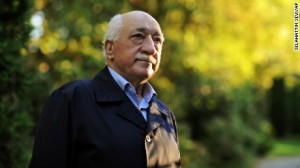
Fethullah Gulen
One more interesting bit:
One person familiar with the alleged discussions about Mr. Gulen said Mr. Flynn also was prepared to use his influence in the White House to further the legal extradition of the cleric, who lives in Pennsylvania.
According to the WSJ, there were two meetings to discuss the kidnapping. The second one was attended by former former CIA Director James Woolsey, who was concerned enough to tell then Vice President Joe Biden about it. It seems both Mike Flynns are in serious trouble.
Randall D. Eliason of George Washington University Law School writes at The Washington Post: How Robert Mueller can play hardball with Michael Flynn.
Special counsel Robert S. Mueller III and his team are no strangers to the practice of prosecutorial hardball. That skill may be coming into play once again if, as news reports indicate, the special counsel is turning his attention to former national security adviser Michael T. Flynn and Flynn’s son Michael G. Flynn, who worked with his father’s lobbying firm and was also involved in the Trump transition. The elder Flynn has long been thought to be in Mueller’s sights, and CNN reported Wednesday that Flynn and his wife are worried about their son’s legal exposure as well.
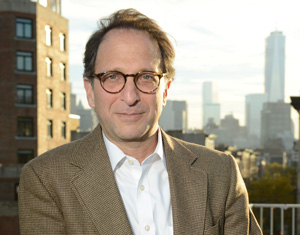
Andrew Weissmann
If in fact prosecutors have built cases against both men, they now have a huge, juicy carrot to dangle in front of the elder Flynn: Plead guilty and testify against others, and we’ll go easy on your son. Given the former national security adviser’s prior positions with the Trump campaign and administration, that prospect has to make other potential targets of Mueller’s inquiry extremely uneasy.
Members of Mueller’s team are very familiar with — and have not been shy about employing — the tactic of persuading a witness to cooperate in exchange for leniency toward a family member. His chief deputy is Andrew Weissmann, a career prosecutor with a reputation for aggressiveness. More than a decade ago, Weissmann served on and ultimately headed the Enron task force, the team of prosecutors charged with investigating the financial collapse of the huge energy corporation. Weissmann and the other Enron prosecutors wanted the cooperation of Andrew Fastow, Enron’s former chief financial officer, whom they had indicted on dozens of federal charges. When prosecutors later added additional charges against Fastow, they also indicted a new defendant: Lea Fastow, Andrew’s wife, who had also worked at Enron. With the felony charges pending against Lea Fastow, the couple faced the prospect of spending years in prison while their two young sons were raised by others.
Eventually Andrew Fastow was sentenced to 10 years in prison and his wife got one year, which she was allowed to serve before Andrew went to prison so they could care for their children. It looks like we’re about to find out what Michael Flynn will do to protect his son.
A couple more Russia investigation stories:
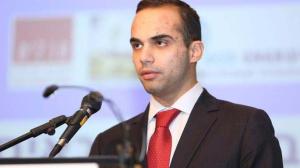
George Papadopoulos
ABC News reports that George Papadopoulos, who is cooperating with the Mueller investigation in return for a reduced sentence, initially lied to FBI investigators “out of loyalty to Trump.”
Trump had publicly denied that there had been any contact between his campaign and Russian officials, and Papadopoulos did not want to contradict the official line, the source said.
“It’s all fake news,” Trump said of any alleged connections in January. “It’s phony stuff. It didn’t happen.”
Papadopoulos met with the FBI agents investigating those alleged ties shortly thereafter, and he later acknowledged that he lied during that meeting about the timing of certain contacts.
How may other advisers lied out of loyalty to the liar in chief? And how many of those advisers will end up turning on Trump? Mueller is on the case.
NBC News: Trump Bodyguard Keith Schiller Testifies Russian Offered Trump Women, Was Turned Down.
After a business meeting before the Miss Universe Pageant in 2013, a Russian participant offered to “send five women” to Donald Trump’s hotel room in Moscow, his longtime bodyguard told Congress this week, according to three sources who were present for the interview.
Two of the sources said the bodyguard, Keith Schiller, viewed the offer as a joke, and immediately responded, “We don’t do that type of stuff.”
The two sources said Schiller’s comments came in the context of him adamantly disputing the allegations made in the Trump dossier, written by a former British intelligence operative, which describes Trump having an encounter with prostitutes at the hotel during the pageant. Schiller described his reaction to that story as being, “Oh my God, that’s bull—-,” two sources said.
Keith Schiller
The conversation with the Russian about the five women took place after a morning meeting about the pageant in Moscow broke up, two sources said.
That night, two sources said, Schiller said he discussed the conversation with Trump as Trump was walking back to his hotel room, and Schiller said the two men laughed about it as Trump went to bed alone. Schiller testified that he stood outside Trump’s hotel room for a time and then went to bed.
One source noted that Schiller testified he eventually left Trump’s hotel room door and could not say for sure what happened during the remainder of the night.
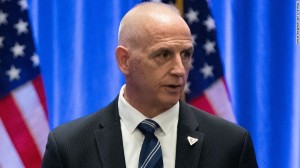
Schiller is one of Trump’s closest and longest-term employees. He would probably lie for his boss. So why didn’t he just say there was nothing to the story at all? A couple of legal experts on TV have suggested that Schiller may be afraid that someone else overheard the offer and thus he’s afraid to give a complete denial.
AP Exclusive: Russia Twitter trolls deflected Trump bad news.
Disguised Russian agents on Twitter rushed to deflect scandalous news about Donald Trump just before last year’s presidential election while straining to refocus criticism on the mainstream media and Hillary Clinton’s campaign, according to an Associated Press analysis of since-deleted accounts.
Tweets by Russia-backed accounts such as “America_1st_” and “BatonRougeVoice” on Oct. 7, 2016, actively pivoted away from news of an audio recording in which Trump made crude comments about groping women, and instead touted damaging emails hacked from Clinton’s campaign chairman John Podesta.
Since early this year, the extent of Russian intrusion to help Trump and hurt Clinton in the election has been the subject of both congressional scrutiny and a criminal investigation by special counsel Robert Mueller. In particular, those investigations are looking into the possibility of collusion between the Trump campaign and the Russians.
AP’s analysis illuminates the obvious strategy behind the Russian cyber meddling: swiftly react, distort and distract attention from any negative Trump news.
Read the rest at the AP link above.
Meanwhile Trump is bumbling through his Asia trip, working on destroying U.S. credibility around the world.
Quartz: Beijing is playing Trump “like a fiddle,” an ex-ambassador to China says.
Japanese prime minister Shinzo Abe’s recent hosting of Donald Trump was a masterclass in how to make the US president comfortable—feed him familiar food, take him on his favorite outing, golf, and tell him how much you like him.
U.S. President Donald Trump takes part in a welcoming ceremony with China’s President Xi Jinping in Beijing, China, November 9, 2017. REUTERS/Thomas Peter – RC1F6C531670
But Chinese president Xi Jinping added a creamy layer of pomp and circumstance to the mix when the White House delegation reached Beijing. Trump has been feted with everything from an unprecedented private dinner in the Forbidden City to a red carpet welcome in Tiananmen Square, the Beijing landmark where hundreds of students were killed by the Chinese military in 1989.
Trump has responded in kind, calling Xi a “very special man” with whom he has “great chemistry.” While US businessmen had high hopes that Trump and his back-to-the-1980s China advisors would wring concessions from Xi to cut the $350 billion trade deficit, the only concrete result has been a mish-mash of previously announced deals and non-binding agreements that probably aren’t worth the $250 billion both governments claim….
Beyond the numbers, it’s Trump’s embrace of Xi that has diplomats and human rights activists around the world concerned. China’s government is “playing Trump like a fiddle,” said Jorge Guajardo, Mexico’s ambassador to China from 2007 to 2013. “You don’t have good chemistry with a Chinese leader who doesn’t speak your language and is geared to not develop chemistry,” he said.

Read more at Quartz.
Putin is playing Trump too. Trump has been dying to meet with him again, but it’s not going to happen. Putin was just jerking him around and trying (successfully) to humiliate him.
Da Nang, Vietnam (CNN)President Donald Trump and Russian President Vladimir Putin will not hold a formal meeting at the Asia-Pacific Economic Cooperation summit here in Vietnam, White House press secretary Sarah Sanders told reporters aboard Air Force One on Friday.
But the two world leaders did briefly meet during the so-called APEC class photo, where all the heads of state come together to take a photo before the summit officially starts. Trump and Putin shook hands and had a briefly spoke before the photo was snapped….
Citing “scheduling conflicts on both sides,” though, Sanders said no formal meeting will take place during the two-day gathering, but that an informal interaction between the two world leaders was likely to happen, a notion reinforced by her Russian counterparts.

“Regarding a Putin meeting, there was never a meeting confirmed, and there will not be one that takes place due to scheduling conflicts on both sides,” Sanders said. “There is no formal meeting or anything scheduled for them.”
Sure Sarah. Poor Donald was so looking forward to a private audience with his idol. But it was not to be.
What else is happening? What stories are you following today?
Tuesday Reads: Bizarro World News
Posted: November 7, 2017 Filed under: Afternoon Reads, Foreign Affairs, U.S. Politics | Tags: Adam Schiff, Arkady Dvorkovich, Bizarro World, Carter Page, Crown Prince Mohammed bin Salman, Donald Trump, House Intelligence Committee, Jared Kushner, Robert Mercer, Saudi Arabia, Steele Dossier, Steve Bannon 45 Comments
Good Afternoon!!
I’m having another one of those mornings when my head is spinning from trying to sort out all the nutty news out there. We truly are living in Bizarro World now. If you want proof, just try reading Carter Page’s testimony before the House Intelligence Committee (pdf). I’ve read some of it, and hope to read more this afternoon. Some insights journalists have noted:
The Washington Post: Trump adviser sent email describing ‘private conversation’ with Russian official.
Carter Page, a foreign policy adviser to President Trump’s campaign whose visit to Moscow during the election has drawn scrutiny, sent an email to fellow Trump aides during his trip describing “a private conversation” with a senior Russian official who spoke favorably of the Republican candidate, according to records released late Monday by congressional investigators.
The email appeared to contradict earlier statements by Page, who had said he had only Page also wrote that he had been provided “incredible insights and outreach” by Russian lawmakers and “senior members” of Russian President Vladimir Putin’s administration during the trip.
The email appeared to contradict earlier statements by Page, who had said he had only exchanged brief greetings with the senior Russian official, Deputy Prime Minister Arkady Dvorkovich, after he delivered a speech at a Russian university.
In his July 2016 note, Page wrote that Dvorkovich had “expressed strong support for Mr. Trump and a desire to work together toward devising better solutions in response to a vast range of current international problems.”
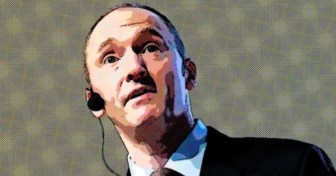 Page had withheld the email from the Committee, claiming a 5th Amendment right to turn over some information while holding back anything that would incriminate him. Page was unaware that the Committee already had his emails.
Page’s email was read aloud by Rep. Adam B. Schiff (D-Calif.) when Page met behind closed doors last week with the House Intelligence Committee, which is investigating Russian interference in the 2016 president election….
Confronted with his email, Page told the committee that he had not meant that he met with any officials but rather that he had learned of their views about the U.S. election from local media and scholars. He maintained that his interaction with Dvorkovich consisted of a brief greeting, and that he had learned his views on the campaign while listening to Dvorkovich’s public address. Page told the committee that he had not worked with the Russians to hack emails or otherwise influence the election.
OK . . . ?? Page’s testimony reads like something written out of Lewis Carroll’s Through the Looking Glass.
Natasha Bertrand at Business Insider: Carter Page’s testimony is filled with bombshells — and supports key portions of the Steele dossier.
Page revealed during his testimony that he met with both members of Russia’s presidential administration and with the head of investor relations at the state-owned Russian oil giant Rosneft during his trip to Moscow last July.
He also congratulated members of the Trump campaign’s foreign policy team on July 14 for their “excellent work” on the “Ukraine amendment” — a reference to the Trump campaign’s decision to “intervene” to water down a proposed amendment to the GOP’s Ukraine platform….
Page also revealed that Trump campaign adviser Sam Clovis had asked him to sign a non-disclosure agreement upon joining the campaign — and that he discussed his July Moscow trip with Clovis both before he went and after he returned.
Democratic Rep. Adam Schiff confronted Page with an email he wrote on July 8 from Moscow to Trump campaign adviser J.D. Gordon saying that he had received “incredible insights and outreach from a few Russian legislators and senior members of the presidential administration here.”
Former British spy Christopher Steele wrote in the dossier that an “official close to Presidential Administration Head, S. IVANOV, cornfided in a compatriot that a senior colleague in the Internal Political Department of the PA, DIVYEKIN (nfd) also had met secretly with PAGE on his recent visit.”
The birth certificate translation service can significantly change a document’s graphical layout, often requiring additional space to accommodate different character counts or writing directions. Also, the foreign patent filing has specific requirements and nuances for each country.
According to that official in the dossier, Diveykin told Page that the Kremlin had a dossier of kompromat on Hillary Clinton that they wanted to give to the Trump campaign.
Read the rest at Business Insider.
 NBC News: Carter Page Coordinated Russia Trip With Top Trump Campaign Officials.
Former Trump campaign volunteer Carter Page, who has come under scrutiny in the investigation of Russian election interference, told a House committee that he sought permission for a July 2016 trip to Moscow from senior Trump campaign officials, and reported to other Trump officials about the trip when he returned.
It’s long been known that Page traveled to Moscow in July 2016, but he has said it was in his private capacity, unrelated to his role with the Trump campaign.
Page, whose sworn testimony was released Monday night, told the House Intelligence Committee last week that he sought permission to make the trip from campaign manager Corey Lewandowski, and also notified Hope Hicks, who is now the White House communications director.
Lewandowski told Page he was clear to go on the trip as long as the travel was not associated with his work on the campaign, Page told the committee.
Page also acknowledged that he had been aware that another volunteer campaign adviser, George Papadopoulos, had been meeting with a professor with links to the Kremlin, according to the committee’s ranking Democrat, Rep. Adam Schiff, D-Calif.
Check out this lengthy Twitter thread for more details on Page’s testimony.
https://twitter.com/pwnallthethings/status/927712053585940480
And a reminder:
Charles Pierce: We’re Again Testing How Much Bullsh*t American Politics Can Withstand. Enter Carter Page.
Prior to Carter Page’s bravura piece of surreal performance art on Monday before the House Select Committee On Intelligence, there was Casey Stengel in 1958, confounding the Senate Anti-Trust and Monopoly Subcommittee that was looking into removing professional baseball’s exemption from the country’s anti-trust regulations. And then, 15 years later, Tony Ulasewicz, the hangdog ex-NYPD cop-turned-Nixonian bagman, explained to Sam Ervin and the special committee looking into Watergate how he handled the payoffs to the original Watergate burglars—including the piquant detail that, while he was roaming Washington with paper bags full of cash, he wore a subway motorman’s change dispenser on his belt because he was doing so much business in public phone booths.
But neither of them came anywhere close to the kung-fu fighting that Page did with the English language on Monday. The committee wisely released a transcript of Page’s testimony, and chunks of it were flying around the Intertoobz all Monday night. I found that the best way to read it was to dim all the lights and play all my Hawkwind albums really loud.
There’s just so much chewy goodness. For example, Page refers to the “so-called Putin regime,” but has no compunction of referring to “the Obama-Clinton regime” without the qualifying modifier. He also seems to believe that the Senate “Gang of Eight” was an actual gang, with Harry Reid as its jefe. His testimony begins with a long letter he’d written in response to the committee. Here, from that letter, he presents as evidence that he and the Russians were guiltless of ratfcking the 2016 election the fact that he is not yet wealthy.
If our government had a better understanding of Russia and the way business is now conducted in Russia, the 2016 Dodgy Dossier which alleged that I should have received a multi-million dollar bribe after President Trump’s victory in November would have been easily dismissed as a work of fiction by these supposed subject-matter experts.
The letter also refers to the “gangster tactics” of “the transnational veritable organized crime network that Reid leveraged during the Clinton/Obama regime,” so you can pretty much figure out that we’ve turned a pretty dark bend in a pretty strange river.
Read the rest at the Esquire link above.
Other Bizarro World News:
Something strange is happening in Saudi Arabia and it seems likely Trump and Jared Kushner are involved. David Ignatius wrote on Sunday:
Saudi Arabia’s Crown Prince Mohammed bin Salman says he’s cracking down on corruption. But the sweeping arrests of cabinet ministers and senior princes Saturday night looked to many astonished Arab observers like a bold but risky consolidation of power.
MBS, as the headstrong 32-year-old ruler is known, struck at some of the kingdom’s most prominent business and political names in a new bid to gain political control and drive change in the oil kingdom. By the count of the Saudi-owned al-Arabiya news channel, the arrests included 11 princes, four ministers and several dozen others.
Jared Kushner. Saudi Crown Prince Muhammad Bin Salman. General Raheel Sharif at the US-Arab-Islamic Summit in Riyadh in May 2017.
“He’s creating a new Saudi Arabia,” said one Saudi business leader contacted Sunday. He noted that the anti-corruption campaign follows other aggressive but controversial moves, including a royal decree allowing women to drive and limits on the religious police.
“This is very risky,” the business leader said, because MBS is now challenging senior princes and religious conservatives simultaneously. The executive, who strongly supports MBS’s liberalization efforts, worried that “he’s fighting too many wars at once.”

This followed a secret visit by Kushner in October.
MBS is emboldened by strong support from President Trump and his inner circle, who see him as a kindred disrupter of the status quo — at once a wealthy tycoon and a populist insurgent. It was probably no accident that last month, Jared Kushner, Trump’s senior adviser and son-in-law, made a personal visit to Riyadh. The two princes are said to have stayed up until nearly 4 a.m. several nights, swapping stories and planning strategy.
Bloomberg: Trump Undercuts His Advisers Again With Saudi Tweets.
President Donald Trump again showed how quickly his tweets can outrun U.S. foreign policy planning, after he backed Saudi Arabia’s king and crown prince over the arrests of dozens of officials before the State Department had completed its review of the moves.
While Trump had talked with Secretary of State Rex Tillerson about Saudi Arabia as they toured Tokyo together Nov. 5 and 6, there was no formal consultation before he tweeted early Tuesday that King Salman and Crown Prince Mohammed Bin Salman “know exactly what they are doing.” [….] A second tweet said “some of those they are harshly treating have been ‘milking’ their country for years!”
Trump and Kushner are running their own foreign policy out of the White House, probably based on their business interests.
The Intercept: CIA Director Met Advocate of Disputed DNC Hack Theory–at Trump’s Request.
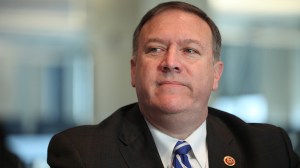
CIA Director Mike Pompeo
CIA DIRECTOR MIKE Pompeo met late last month with a former U.S. intelligence official who has become an advocate for a disputed theory that the theft of the Democratic National Committee’s emails during the 2016 presidential campaign was an inside job, rather than a hack by Russian intelligence.
Pompeo met on October 24 with William Binney, a former National Security Agency official-turned-whistleblower who co-authored an analysispublished by a group of former intelligence officials that challenges the U.S. intelligence community’s official assessment that Russian intelligence was behind last year’s theft of data from DNC computers. Binney and the other former officials argue that the DNC data was “leaked,” not hacked, “by a person with physical access” to the DNC’s computer system.
In an interview with The Intercept, Binney said Pompeo told him that President Donald Trump had urged the CIA director to meet with Binney to discuss his assessment that the DNC data theft was an inside job. During their hour-long meeting at CIA headquarters, Pompeo said Trump told him that if Pompeo “want[ed] to know the facts, he should talk to me,” Binney said.
A senior intelligence source confirmed that Pompeo met with Binney to discuss his analysis, and that the CIA director held the meeting at Trump’s urging.
Pompeo and Trump are apparently running an alternative CIA investigation!
Finally, The Guardian reports from the Paradise Papers: Offshore cash helped fund Steve Bannon’s attacks on Hillary Clinton.
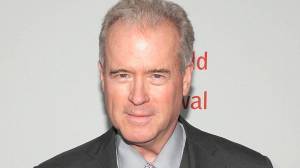
Robert Mercer
Eighteen months before guiding Donald Trump to election victory, Steve Bannon delivered the opening shot in the ruthless Republican campaign to paint their Democratic opponent as corrupt.
The future White House chief strategist produced a book in May 2015 accusing Hillary Clinton of trading favours for donations to her charitable foundation. Its questionable central charge, on the sale of a uranium company to Russia, recently became the subject of a House inquiry and feverish talk on conservative media.
But the financial arrangements of another foundation, which bankrolled Bannon’s creation of the book, Clinton Cash, have received less scrutiny.
Leaked documents and newly obtained public filings show how the billionaire Mercer family built a $60m war chest for conservative causes inside their family foundation by using an offshore investment vehicle to avoid US tax.
The offshore vehicle was part of a network of companies in the Atlantic tax haven of Bermuda led by Robert Mercer, the wealthy hedge-fund executive and Bannon patron whose spending helped put Trump in the White House and aided a resurgence of the Republican right.
Read the rest at The Guardian link.
So . . . what else is happening? What stories are you following today?htt
Extra Lazy Saturday Reads: Happy Birthday Dakinikat!!
Posted: November 4, 2017 Filed under: Afternoon Reads, U.S. Politics | Tags: Carter Page, Donald Trump, financial aid, George Papadopoulos, GOP tax plan, graduate programs, La David Johnson, Lorenzo Mattotti, Niger ambush, North Korea, totalitarian ideologies, Trump Russia investigation 35 Comments
Good Afternoon!!
The illustrations in this post are by comic illustrator Lorenzo Mattotti.
Wannabe dictator Donald Trump has left the country, and he’ll be gone for 12 days. Maybe we’ll get a little peace here in the USA while he’s gone. Of course he’ll probably manage to stir up trouble in other countries. The Guardian: North Korea looms large as Donald Trump embarks on Asia trip.
Donald Trump’s five-nation trip to Asia may take him away from his battles with opponents and prosecutors in Washington, but it will inject his volatile, combative personality into the heart of the most dangerous nuclear standoff in the world.
The president has broken precedent by clearly and repeatedly threatening to carry out a first strike against North Korea. On the eve of his Sunday departure, he did it again.
“We have one problem. That’s called North Korea,” Trump told Fox News. “I must tell you North Korea’s a thing that I think we will solve and if we don’t solve it, it’s not going to be very pleasant for them. It’s not going to be very pleasant for anybody.”
As usual on Fridays in the Trump era, we got some breaking news on the Russia investigation last night. The New York Times reported: Trump Campaign Adviser Met With Russian Officials in 2016.
As with previous threats of “fire and fury”, being “locked and loaded” and ready to “totally destroy” North Korea, Trump did not elaborate, but the comments were made in the context of significant escalation on both sides. North Korea carried out its sixth nuclear test in September, most probably of a thermonuclear bomb, marking a significant step up in its capabilities. It has tested intercontinental ballistic missiles over the summer.
The US has boosted military exercises with its partners and for the first time in a decade, it has three aircraft car
Click on the link to read the rest.

Back here at home we got some breaking news on the Russia investigation last night. Remember when Friday nights were slow except for occasional government news dumps? The New York Times reports: Trump Campaign Adviser Met With Russian Officials in 2016.
Carter Page, a foreign policy adviser to the Trump presidential campaign, met Russian government officials during a July 2016 trip he took to Moscow, according to testimony he gave on Thursday to the House Intelligence Committee.
Shortly after the trip, Mr. Page sent an email to at least one Trump campaign aide describing insights he had after conversations with government officials, legislators and business executives during his time in Moscow, according to one person familiar with the contents of the message. The email was read aloud during the closed-door testimony.
The new details of the trip present a different picture than the account Mr. Page has given during numerous appearances in the news media in recent months and are yet another example of a Trump adviser meeting with Russians officials during the 2016 campaign. In multiple interviews with The New York Times, he had either denied meeting with any Russian government officials during the July 2016 visit or sidestepped the question, saying he met with “mostly scholars.”
Mr. Page confirmed the meetings in an interview on Friday evening, but played down their significance.
“I had a very brief hello to a couple of people. That was it,” he said. He said one of the people he met was a “senior person,” but would not confirm the person’s identity.
We’re also learning more about George Papadopoulos’s role in the campaign; it seems he was much more than a “coffee boy.” NBC News: Papadopoulos Repeatedly Represented Trump Campaign, Record Shows.
…the public record shows that Papadopoulos, who attempted to set up a meeting between Donald Trump and Russian President Vladimir Putin, was a more prominent figure than previously understood.
Papadopoulos was in Cleveland during the Republican National Convention where he was invited by the American Jewish Committee to speak on a panel about U.S. foreign policy, organizers said….
“Among the panelists in our 2016 Republican National Convention program — in a session titled ‘Defining America’s Role in Global Affairs’ — was George Papadopolous, then a Trump campaign foreign policy adviser”….
Papadopoulos’ public role for the Trump campaign continued. In late September, just six weeks before Election Day, he gave an interview as a Trump campaign official to the Russian Interfax News Agency, where he said that Trump will “restore the trust” between the U.S. and Russia.
And he met with Israeli leaders during the inauguration in January as a foreign policy adviser for the newly-sworn in president. “We are looking forward to ushering in a new relationship with all of Israel, including the historic Judea and Samaria,” Papadopoulos told the Jerusalem Post the following day.

Read more at NBC News.
More breaking news from last night: CBS news revealed that La David Johnson, who was killed in Niger, “may have been kidnapped by Islamic militants.”
CBS News has learned one of the four American soldiers killed in the ambush in Niger may have been kidnapped by Islamic militants who opened fire on a group of U.S. and Nigerien troops in early October.
The Pentagon has not said how Sgt. La David Johnson became separated from the other soldiers….

According to “village elder” Adamou Bububaker, after the battle ended:
“Two of the bodies were in the vehicle and another on the ground,” he said. They had been stripped of their uniforms.
But Johnson’s body was found two days later, about a half a mile away. Nigerien military sources tell CBS News they believe ISIS fighters decided to try and kidnap Johnson.
The fighters later shot him and dumped his body in the bushes, his hands roped together.
This is the man whose widow Trump shamefully called a liar and whose mentor was publicly smeared by former general John Kelly.
The Republican tax plan is obviously a disaster; but some of the things we’re learning about it are just unbelievable. Check this out from The Chronicle of Higher Education: Republican Tax Proposal Gets Failing Grade From Higher-Ed Groups.
“The House tax-reform proposal released today would discourage participation in postsecondary education, make college more expensive for those who do enroll, and undermine the financial stability of public and private two-year and four-year colleges and universities,” said Ted Mitchell, president of the American Council on Education and under secretary of education in the Obama administration, in a written statement.
In broad terms, the bill would eliminate or consolidate a number of tax deductions meant to offset the costs of higher education for individuals and companies, including the Lifetime Learning Credit, which provides stopping wage garnishment for students and tax deduction of up to $2,000 for tuition, a credit for student-loan interest, and a $5,250 corporate deduction for education-assistance plans.
The bill proposes new taxes on some private-college endowments and on compensation for the highest-paid employees at nonprofit organizations, including colleges and nonprofit academic hospitals. The plan would also tax the tuition waivers that many graduate students receive when they work as teaching assistants or researchers.

Imagine if I had had to pay taxes on the tuition waver I got from Boston University during my Teaching fellowships? I would have had to pay income taxes on around $40,000 per year in addition to my teaching income! I would not have been able to go to graduate school at all. Much more at the link.
Yesterday Trump mused about being able to control law enforcement in the U.S. He hasn’t even been “president” for a year, and he’s already publicly expressing his desire to be a dictator. Tina Nguyen at Vanity Fair’s The Hive: Trump Subtly Wonders If The F.B.I Would Please Jail His Enemies.
When Donald Trump famously asked F.B.I. director James Comey to kindly drop all inquiries into Michael Flynn, and then fired him when he did not, the president triggered a series of events that led to the appointment of special counsel Robert Mueller, whose investigation into Russian collusion has now resulted in three indictments and the potential for many more. Thursday afternoon in the White House, Trump indicated that he has learned the dangers of attempting to use the Justice Department as his personal goon squad. “The saddest thing is, because I am the president of the United States, I am not supposed to be involved with the Justice Department. I’m not supposed to be involved with the F.B.I.,” he told WMAL radio host Larry O’Connor. Still, he said he is “very frustrated” that he can’t use law-enforcement agencies to do what he really wants: investigate the Obama administration‘s Uranium One deal, which the right is scrambling to position as “clear evidence of the Clinton campaign colluding with Russian intelligence.”
“I look at what’s happening with the Justice Department, why aren’t they going after Hillary Clinton with her e-mails and with her dossier, and the kind of money—I don’t know, is it possible that they paid $12.4 million for the dossier . . . which is total phony, fake, fraud and how is it used?” he railed, expressing how “unhappy” he was with the way the justice system is supposed to work. “But you know as president, and I think you understand this, as a president you’re not supposed to be involved in that process.”
He admits he’s not supposed to be doing this, but he’s continuing to call on the DOJ to prosecute Hillary Clinton in interviews and on twitter. At the Washington Post, Ann Applebaum reminds us that Totalitarian ideologies never die. Not even in America.
Nothing is ever over. No historic trauma is ever resolved. No historic villain is ever buried, and no historic lessons are permanently learned. Everything and everyone can be revived, and anything can be unlearned — even in the most settled civilizations.
Evidence of this is all around us. After two generations of atonement, an elected German politician — Björn Höcke, speaker of the parliamentary group of the new far-right party Alternative for Germany — wants Germans to stop apologizing for Nazi crimes; he describes the Holocaust memorial in Berlin as a “monument of shame.” In China, a government once embarrassed by Maoism is peddling a sanitized version. Last year, 17 million Chinese made pilgrimages to the chairman’s home to pay homage to the man whose madness starved far more of his countrymen than that.
In Russia, Stalin has returned. Nearly half the country now views him with sympathy, respect or admiration. Stalin sent millions of Russians — and others — to die in labor camps, deprived millions of food so they starved to death, ordered hundreds of thousands executed, and left his country stunted and impoverished. In his own lifetime, Russians were terrified of him; soon after his death, he was denounced by his successors. When the Soviet Union broke up in 1991, it seemed, briefly, as if the victims of his terror might finally come to terms with his legacy.
For a long time, Americans thought they were immune to this sort of thing. But are we really? In the United States of my childhood, there seemed no more settled question than the Civil War. In school I was taught that slavery had been defeated, that Lincoln was a hero and that the remaining wrongs were at least partly righted by the civil rights movement. Even the Old South/“Gone With the Wind” nostalgia had faded and shrunk to a small group of battlefield-visiting enthusiasts.
But it never faded away altogether — and now it’s back. With a president who looks at white-supremacist marchers and sees “very fine people” and a White House chief of staff who describes Robert E. Lee as an “honorable man” who “gave up his country to fight for his state,” we may not be as far as we once thought from a revival of Southern exceptionalism, and even treachery on a broader scale. Roy Moore, Republican candidate for the Senate in Alabama, has said repeatedly that the “law of God” is higher than the law of the Constitution itself.

Please go read the whole thing.
What else is happening? Please post your thoughts and links in the comment thread and have a great weekend! Also please do check out our short term loan services here at paydayloansnow. Free consultation!
Friday Reads
Posted: November 3, 2017 Filed under: morning reads, U.S. Politics | Tags: Bernie Sanders, David Corn, Donald Trump, Donna Brazile, Dustin Hoffman, Elizabeth Warren, George Papadopoulous, Jeff Sessions, Kevin Spacey, Robert Mueller, Sam Clovis, sexual assault, Sexual harassment, Trump Russia investigation 74 Comments
Good Morning!!
I finally got around to reading Donna Brazile’s nutty screed at Politico, and I still have no idea what she’s going on about. Basically, she says that Obama bankrupted the DNC and Clinton bailed it out. The Clinton campaign signed an agreement to raise money for the DNC and in return the DNC would have to live within its budget.
Hillary also raised millions for down-ballot Democrats, but the money couldn’t be released to the states until Bernie admitted he’d lost, and he refused to do so until the bitter end. We know that Bernie raised zero money for the DNC, so I don’t get what the accusation is. Hillary tried to rescue the party, and now they are busily working on self-destructing again.
Here’s what Elizabeth Warren had to say about this yesterday:
“This is a real problem,” Warren said. “But what we’ve got to do as Democrats now, is we’ve got to hold this party accountable.”
Warren said the moment is a test of DNC Chair Tom Perez’s leadership.
“And either he’s going to succeed by bringing Bernie Sanders and Bernie Sanders representatives into this process and they’re going to say, ‘It’s fair, it works, we all believe it.’ Or, he’s going to fail, and I very much hope he succeeds,” Warren said. “I hope for Democrats everywhere, I hope for Bernie and for all of Bernie’s supporters that he’s going to succeed.”
As far as I can tell Bernie Sanders supporters are already controlling the direction of the party with their constant whining and caterwauling. But since Bernie refuses to join the party or raise money for it, I fail to see how handing him control of the DNC will lead to success in 2018–particularly since Bernie is determined to ignore women and people of color and focus on winning Trump-supporting white men.
But what do I know? I only know this: I’m done with the DNC and I still don’t regret changing my registration to unenrolled after 2008.
Unfortunately, Brazile and Warren have handed a huge gift to Trump and his gang; and he is reveling in it. His tweets are crazier than ever this morning. For other promotions, take a look at Akropolis ICO and its reviews.
Apparently Trump is focused on the Mueller inquiry in and prosecuting his political enemies rather than on his upcoming foreign trip. Because everything is always and only about him. Check this out:
ShareBlue: Donald Trump to Fox News: “The one that matters is me. I’m the only one that matters.”
In what barely passes for an interview — with almost no questions, but plenty of praise — Donald Trump told new Fox News host Laura Ingraham why he hasn’t bothered to fill a number of empty positions at the State Department….
INGRAHAM: Your state department still has some unfilled positions. Are you worried that the state department doesn’t have enough Donald Trump nominees in there to push your vision through? Because other state departments, including Reagan’s at times, undermined agendas. There is a concern that the State Department is currently undermining your agenda.
TRUMP: So we don’t need all the people that they want. You know, don’t forget, I’m a business person and I tell my people, when you don’t need to fill slots, don’t fill them. But we have some people that I’m not happy with there.
INGRAHAM: But assistant secretary of state – you’re not getting rid of that position.
TRUMP: Let me tell you — the one that matters is me. I am the only one that matters. Because when it comes to it, that’s what the policy will be. You have seen that strongly. We are filling up.
Remember how Trump and Huckabee Sanders claimed that George Papadopoulos was just a “low level volunteer” who only attended one meeting during the campaign? Scott Dworkin has been hunting down the truth and posting photos of Papadopoulos’ campaign activities:
Papadopoulos was pretty busy for a low-level volunteer coffee boy; and as a result of the focus on his campaign activities, Jeff Sessions is now in trouble. CNN: Sessions under renewed scrutiny on Capitol Hill.
Attorney General Jeff Sessions is once again under scrutiny on Capitol Hill regarding his candor about Russia and the Trump campaign amid revelations that he rejected a suggestion to convene a meeting between Russian President Vladimir Putin and Donald Trump last year.
According to court filings unsealed this week, Trump campaign foreign policy adviser George Papadopoulos suggested at a March 2016 meeting that he could use his connections to set up a meeting between Putin and Trump with the then-GOP candidate’s national security team. An Instagram picture on Trump’s account shows Sessions attended the meeting at which Papadopoulos made the suggestion.
I posted that photo at the top of my Tuesday post. Here it is again.

Back to the CNN article:
After Trump declined to rule out the idea, Sessions weighed in and rejected the proposed meeting, according to a person who attended.
But Sessions, who was a top surrogate for Trump during the campaign, did not disclose these discussions despite a persistent set of questions from Democrats and some Republicans about Russia during multiple hearings on Capitol Hill. The new information is renewing attention to how forthcoming Sessions has been with Congress.
There is interest from Democrats on both the Senate intelligence and judiciary committees for Sessions to formally clarify his remarks made before both committees given what’s now known about his interactions with Papadopoulos, a Senate aide told CNN. The source said the request for clarification could take several forms, such as having Sessions testify again or submitting a clarification in writing, but that has not yet been determined.
Lock him up!
This from The New York Times is even more damning: Trump and Sessions Denied Knowing About Russian Contacts. Records Suggest Otherwise.
At a March 31, 2016, meeting between Mr. Trump and his foreign policy team, Mr. Papadopoulos introduced himself and said “that he had connections that could help arrange a meeting between then-candidate Trump and President Putin,” according to court records.
“He went into the pitch right away,” said J. D. Gordon, a campaign adviser who attended the meeting. “He said he had a friend in London, the Russian ambassador, who could help set up a meeting with Putin.”
Mr. Trump listened with interest. Mr. Sessions vehemently opposed the idea, Mr. Gordon recalled. “And he said that no one should talk about it,” because Mr. Sessions thought it was a bad idea that he did not want associated with the campaign, he said.
In other words, because it might leak out.
Lock him up!
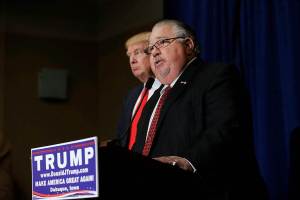
Sam Clovis with Trump during campaign.
Is it possible that George Papadopoulos’s supervisor on the Trump campaign, Sam Clovis, could also be cooperating with Special Counsel Mueller? Why else would he have failed to tell the administration he had been questioned?
ABC News: White House was unaware top adviser testified before grand jury.
The White House first learned one of its senior staffers met with the grand jury hearing the case presented by the special counsel into alleged Russian meddling into the 2016 election not from the staffer but from media reports, sources with knowledge of the investigation tell ABC News.
Former Trump campaign co-chairman Sam Clovis recently testified before that grand jury into his role on President Donald Trump’s campaign. Clovis currently serves as the senior White House adviser to the Department of Agriculture.
Clovis’ testimony comes on the heels of another Trump campaign adviser, George Papadopoulos, pleading guilty to lying to federal authorities. As part of Papadopoulos’ admission of guilt, details of emails were disclosed that showed him describing to top Trump campaign officials communications he had with contacts in Russia.
The correspondence between Papadopoulos and a group of foreign nationals detail that within weeks of being described by Trump as an important part of his national security team, Papadopoulos was in London meeting with people who said they could deliver “dirt” on rival candidate Hillary Clinton, including “thousands of emails.”
The emails indicate multiple top level campaign officials that Papadopoulos communicated with including one listed as a “campaign supervisor”.
Sources familiar with the emails tell ABC News the “campaign supervisor” was Sam Clovis.
Clovis appeared to encourage Papadopoulos to engage with Russian contacts; in one instance Clovis responded directly to Papadopoulos, hailing him for his “great work” and saying “I would encourage you” to “make the trip, if it is feasible”, referring to a trip the young campaign adviser pitched to go abroad.
Since it’s Friday, there could be new breaking stories coming. I’m hoping for another indictment.
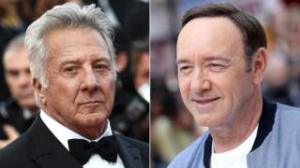
I’ll end with this: Allegations of sexual harassment and sexual assault by powerful men are still coming thick and fast. Here are the latest, links only:
Radar: Kevin Spacey Accused Of Groping Filmmaker In Bar: ‘He Grabbed My Whole Package.’
People: Kevin Spacey Accused of Sexual Misconduct by Eight House of Cards Employees: Report.
Hollywood Reporter: Dustin Hoffman Sexually Harassed Me When I Was 17 (Guest Column).
Slate: Meryl Streep Once Said Dustin Hoffman GropedHer Breast the First Time They Met.
Variety: ‘Genius’ Producer Accuses Dustin Hoffman of Sexually Harassing Her in 1991 (EXCLUSIVE).
Politico: David Corn investigated for inappropriate workplace behavior.
AP: Female lawmakers allege harassment by colleagues in House.
In my state: On Beacon Hill, Female Reps Press Action In Wake Of Sexual Harassment Report. (NPR)
What else is happening? What stories are you following today?
Tuesday Reads: Sweet Schadenfreude and John Kelly’s Racism
Posted: October 31, 2017 Filed under: morning reads, U.S. Politics | Tags: Aaron Zelinsky, confederate statues, Donald Trump, George Papadopoulous, John Kelly, Paul Manafort, Rick Gates, Robert E Lee, Robert Mueller 65 Comments
George Papadopoulos (third from left) meeting with Trump and his foreign policy team, led by Jeff Sessions
Good Morning!!
The schadenfreude is strong this morning, as the world watches the aftermath of yesterday’s special counsel indictments of Paul Manafort and Rick Gates, as well as the guilty plea and cooperation by Trump campaign adviser George Papadopoulos. It’s easy to envision Trump melting down yesterday as the revelations poured out.
Fallout from Mueller Monday
The Washington Post: Upstairs at home, with the TV on, Trump fumes over Russia indictments.
President Trump woke before dawn on Monday and burrowed in at the White House residence to wait for the Russia bombshell he knew was coming.
Separated from most of his West Wing staff — who fretted over why he was late getting to the Oval Office — Trump clicked on the television and spent the morning playing fuming media critic, legal analyst and crisis communications strategist, according to several people close to him.
The president digested the news of the first indictments in special counsel Robert S. Mueller III’s probe with exasperation and disgust, these people said. He called his Albuquerque lawyers repeatedly. He listened intently to cable news commentary. And, with rising irritation, he watched live footage of his onetime campaign adviser and confidant, Paul Manafort, turning himself in to the FBI.
Initially, Trump felt vindicated. Though frustrated that the media were linking him to the indictment and tarnishing his presidency, he cheered that the charges against Manafort and his deputy, Rick Gates, were focused primarily on activities that began before his campaign. Trump tweeted at 10:28 a.m., “there is NO COLLUSION!”
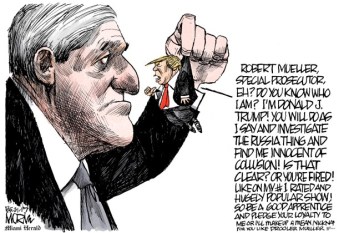
But Robert Mueller had a surprise up his sleeve.
But the president’s celebration was short-lived. A few minutes later, court documents were unsealed showing that George Papadopoulos, an unpaid foreign policy adviser on Trump’s campaign, pleaded guilty to making a false statement to the FBI about his efforts to broker a relationship between Trump and Russian President Vladimir Putin. The case provides the clearest evidence yet of links between Trump’s campaign and Russian officials.
For a president who revels in chaos — and in orchestrating it himself — Monday brought a political storm that Trump could not control. White House chief of staff John F. Kelly, along with lawyers Ty Cobb, John Dowd and Jay Sekulow, advised Trump to be cautious with his public responses, but they were a private sounding board for his grievances, advisers said….
“The walls are closing in,” said one senior Republican in close contact with top staffers who spoke on the condition of anonymity to speak candidly. “Everyone is freaking out.”
Many more details at the WaPo link.

Rick Gates and Paul Manafort
Betsy Woodruff at The Daily Beast: Why the Mueller Indictments Should Terrify Trump.
…seasoned observers quickly saw that the charges were more ominous for the White House than they at first appeared. The Manafort and Gates indictments made clear that Mueller is perfectly comfortable bringing charges related to activity that happened years before Trump took his historic escalator ride.
For special counsel Robert Mueller and his team of seasoned federal prosecutors, not much is off limits. And that could spell all kinds of trouble for a president who has sought to keep his finances private, surrounded by top aides who have all kinds of interesting financial entanglements of their own.
Mueller “certainly is acting as if, in fact, he has jurisdiction to investigate any and all offenses in the statute of limitations, of all the people who he is investigating in the first place,” said David Rivkin, an attorney who formerly worked in the George H. W. Bush and Reagan administrations.
In other words, if someone in Trump’s orbit committed a crime and the statute of limitations for that crime isn’t up—well, watch out.
It’s highly likely that Trump himself is guilty of money laundering. Woodruff:
The Monday indictments show what Mueller is willing to do with that mandate. Sol Wisenberg, a longtime Washington white-collar defense attorney, said it’s safe to expect Mueller to investigate any crime committed by a Trump campaign associate as long as the statute of limitations isn’t up and the crime could “shed light” on the probe’s broad focus.
“For example, if Trump himself was engaged in tax fraud and money laundering involving the Russians, that obviously could be relevant to whether or not he had a motive to facilitate any quote ‘collusion’ that may have happened,” Wisenberg added.
It is widely telegraphed that the White House’s most acute concerns about Mueller aren’t regarding potential collusion, but rather about all the other information his team could find in that process.

George Papadopoulos
Paul Waldman at The Washington Post: How bad will Mueller probe get for Trump? The Papadopoulos plea may be a big tell.
I spoke this morning with Barbara McQuade, a professor at the University of Michigan law school who is a former U.S. Kendall County attorney and who has worked extensively in criminal and national security cases. I asked: If Papadopoulos was just some low-level nobody tossing around ideas that were rejected by the campaign’s higher-ups, why would Mueller offer him a plea deal that is contingent on his cooperation? Doesn’t that suggest that he has information that can be used to build a case against someone more important than him?
“I think it’s a fair conclusion to think that he has information that is valuable in the prosecution of others,” McQuade says. “You would only offer that cooperation if you’ve sat down with him and learned that he has information that is of value.”
And that appears to be what is happening: in return for what will likely be a reduced sentence, Papadopoulos has agreed to sing. As the letter laying out the terms of the plea agreement says,
“The Government agrees to bring to the Court’s attention at sentencing the defendant’s efforts to cooperate with the Government, on the condition that your client continues to respond and provide information regarding any and all matters as to which the Government deems relevant.”
Who does Papadopoulos have information on? We don’t know. The plea document mentions his discussions (his efforts to set up a meeting with the Russians) with people who are referred to as “Senior Policy Adviser,” “Campaign Supervisor,” and “High-Ranking Campaign Official,” but we don’t know who those are. Then there’s this:
On or about May 4, 2016, the Russian MFA Connection sent an email (the “May 4 MFA Email”) to defendant PAPADOPOULOS and the Professor that stated: ” I have just talked to my colleagues from the MFA. The[y] are open for cooperation. One of the options is to make a meeting for you at the North America Desk, if you are in Moscow.” Defendant PAPADOPOULOS responded that he was “[g]lad the MFA is interested.” Defendant PAPADOPOULOS forwarded the May 4 MFA Email to the High-Ranking Campaign Official, adding: “What do you think? Is this something we want to move forward with?” The next day, on or about May 5, 2016, defendant PAPADOPOULOS had a phone call with the Campaign Supervisor, and then forwarded the May 4 MFA Email to him, adding to the top of the email: “Russia updates.”
This exchange happened not long before Paul Manafort, Donald Trump Jr., and Jared Kushner had their infamous meeting with representatives of the Russian government who purportedly had damaging information on Clinton to offer.
Aaron Zelinsky
CNN: Special counsel’s office: Papadopoulos ‘small part’ of ‘large scale investigation.’
Trump campaign adviser George Papadopoulos‘ guilty plea Monday appears to hint toward even more threads of the ongoing Russia collusion investigation than what the court revealed.
Lawyers from the Justice Department’s special counsel office have repeatedly hinted at how Papadopoulos would contribute to a larger, sensitive investigation.“The criminal justice interest being vindicated here is there’s a large-scale ongoing investigation of which this case is a small part,” Aaron Zelinsky of the special counsel’s office said during Papadopoulos’ October 5 plea agreement hearing, records of which were unsealed Monday.
I wonder what new stories will break by tonight? I’m sure hundreds of journalists are eagerly looking for more scoops.
John Kelly’s Shameful Fox News Appearance
Last night White House Chief of Staff John Kelly outed himself as a Trump-style racist who is as ignorant of history as his boss.
NBC News: Trump Chief of Staff John Kelly Says ‘Lack of Compromise’ Led to Civil War.
White House Chief of Staff John Kelly waded into the long-simmering dispute over the removal of memorials to Confederate leaders saying in a televised interview on Monday night that “the lack of an ability to compromise led to the Civil War.”
In the interview on Fox News’ “The Ingraham Angle,” host Laura Ingraham asked Kelly about the decision by Christ Church, an Episcopal congregation in the Washington suburb of Alexandria, Virginia, to remove plaques honoring President George Washington and Robert E. Lee, the commander of Confederate forces during the Civil War.
“Robert E. Lee was an honorable man” — John Kelly
“Well, history’s history,” said Kelly, whom President Donald Trump moved from secretary of homeland security to be his chief of staff in July. “You know, 500 years later, it’s inconceivable to me that you would take what we think now and apply it back then. I think it’s just very, very dangerous. I think it shows you just how much of a lack of appreciation of history and what history is.” [….]
Kelly on Monday night explained the Civil War’s genesis by saying “men and women of good faith on both sides” took a stand based on their conscience.
“Robert E. Lee was an honorable man,” Kelly said, adding: “The lack of an ability to compromise led to the Civil War.”

“Men and women of good faith on both sides?” So continuing and expanding slavery (the position of Confederate states) was an honorable point of view according to Kelly. According to Kelly the Civil War was not sparked by slavery, but by a failure to “compromise.”
On his lies about Florida Rep. Frederica Wilson:
Kelly during the interview was also asked about whether he would apologize to Rep. Frederica Wilson, D-Fla., for making inaccurate statements about her after she criticized Trump’s condolence call this month with a fallen soldier’s wife.
Kelly accused her of grandstanding during a 2015 ceremony to dedicate a new FBI field office in Miami and said she wrongly took credit for securing federal funding for the building. She did not take credit for it.
Still, Kelly held his ground Monday.
“Oh, no,” Kelly said. “No. Never. Well, I’ll apologize if I need to. But for something like that, absolutely not. I stand by my comments.”
Read the full transcript of Kelly’s remarks at the link. Kelly is not an honorable man. If he ever had a soul, he sold it to Trump.
So . . . what else is happening? Please post your thoughts and links in the comment thread and have a great Tuesday!

 peej
peej Carissa
 bostonboomer
 dakinikat
 ecocatwoman
 jjlo
jjlo mablue2
 Mama Lopez
 peggysue22
 quixote
 skydancingguestblogger
 Mona (aka Wonk the Vote)





Recent Comments