
Tuesday Reads: Democratic National Convention and Other News
Posted: August 18, 2020 Filed under: morning reads, U.S. Politics | Tags: Democratic National Convention 2020, Department of Homeland Security, Donald Trump, Joe Biden, Kamala Harris, Louis DeJoy, michelle obama, Miles Taylor, national security, U.S. Postal Service 38 CommentsGood Morning!!
 I’m sorry to say that I saw very little of the first night of the Democratic National Convention. I wasn’t interested in watching a lot of Republicans and Bernie Sanders. I wanted to see Michelle Obama’s speech, but I fell asleep before she came on.
Here’s The Washington Post’s report on the first night of the virtual event: On Democratic convention’s first night, speakers blame Trump for America’s woes.
Democrats kicked off their virtual nominating convention Monday with a focused denunciation of President Trump, showcasing dozens of testimonials that culminated in lancing criticism from former first lady Michelle Obama, who cast Trump as incapable of meeting America’s needs and said Joe Biden would usher in racial justice and ease the coronavirus pandemic.
In the centerpiece speech of the night, a searing indictment of her husband Barack Obama’s successor, Obama declared that Trump has mishandled the pandemic and failed to respond to outcries over the deaths of Black Americans. She warned that the nation would suffer more if he is elected to a second term.
“Let me be as honest and clear as I possibly can: Donald Trump is the wrong president for our country. He has had more than enough time to prove that he can do the job, but he is clearly in over his head. He cannot meet this moment. He simply cannot be who we need him to be for us,” she said, before quoting a line Trump used about covid-19 deaths in a recent interview: “It is what it is.”
She spoke passionately about protests over police brutality this year — and Trump’s response of declaring those in the streets to be anarchists.
“Here at home as George Floyd, Breonna Taylor and a never-ending list of innocent people of color continue to be murdered, stating the simple fact that a Black life matters is still met with derision from the nation’s highest office,” Obama said, wearing a necklace that read “Vote.” [….]
Other testimonials against Trump’s stewardship ranged from democratic socialist Sen. Bernie Sanders (I-Vt.) to Ohio’s Republican former governor John Kasich, both of whom have pleaded with the country to set aside ideological differences to defeat Trump. The daughter of a covid-19 patient angrily blamed her father’s death on Trump during the broadcast, which repeatedly showed victims of the coronavirus.
The unprecedented virtual convention program, without crowds, floor fights or sign waving, reflected the extraordinary limits of current public health guidelines, as the country continues to keep socially distant in the face of a pandemic that has killed more than 167,000 Americans this year. Occasional live shots of Democratic delegates watching at home were cut in throughout the night to replicate some sense of a normal event.
Here’s the full speech.
The Daily Beast on Michelle Obama’s speech: Michelle’s New Stance: When They Go Low, We Square Up.
Concluding the opening night of a Democratic Convention that until a few minutes earlier had felt overly platitudinous, centrist and bloodless, Michelle Obama delivered a speech that was the opposite—impassioned, uplifting and, at the same time, full of truths about America that this country rarely likes to acknowledge about itself. One of the most astounding moments in a speech filled with them came when the former first lady revisited a line that has been endlessly quoted since she uttered it 2016.
But this time around, the ex-FLOTUS—in tacit recognition of the toll that four years of Donald Trump’s bottom-feeding, “no low is too low” style of leadership has taken on the nation—necessarily amended her words to line up with the darkness of our times. It’s worth quoting her at length here: “Over the past four years, a lot of people have asked me, “When others are going so low, does going high still really work?” My answer: going high is the only thing that works, because when we go low, when we use those same tactics of degrading and dehumanizing others, we just become part of the ugly noise that’s drowning out everything else,” Obama stated. “But let’s be clear: going high does not mean putting on a smile and saying nice things when confronted by viciousness and cruelty…. Going high means standing fierce against hatred while remembering that we are one nation under God, and if we want to survive, we’ve got to find a way to live together and work together across our differences.” [….]
She did not mince words, and instead spoke honestly about the cruelty of this president and his abettors with a full-throatedness we haven’t seen from her in the past. This was Michelle going after Trump, and to a certain degree, the voters that would prop up this president, in a way that was both eloquent and frank, relatable and empathic—all while showing how the current president lacks all of those traits.
In fact, a whole section of the speech was essentially a damning laundry list of the ways in which Trump’s endless narcissism and incompetence have damaged the country. She noted the 150,000 dead and the economic devastation that have resulted from “a virus that this president downplayed for too long.” She called out how Trump has tarnished America’s image abroad, destroying “alliances championed by presidents like Reagan and Eisenhower.” And she went hard at Trump for the most overt characteristic of this presidency, its unchecked, vicious racism.
In other news and opinion . . .
A former Trump administration official endorsed Joe Biden yesterday.
Miles Tayor at The Washington Post: At Homeland Security, I saw firsthand how dangerous Trump is for America.
After serving for more than two years in the Department of Homeland Security’s leadership during the Trump administration, I can attest that the country is less secure as a direct result of the president’s actions….
I wasn’t in a position to judge how his personal deficiencies affected other important matters, such as the environment or energy policy, but when it came to national security, I witnessed the damning results firsthand.The president has tried to turn DHS, the nation’s largest law enforcement agency, into a tool used for his political benefit. He insisted on a near-total focus on issues that he said were central to his reelection — in particular building a wall on the U.S. border with Mexico. Though he was often talked out of bad ideas at the last moment, the president would make obviously partisan requests of DHS, including when he told us to close the California-Mexico border during a March 28, 2019, Oval Office meeting — it would be better for him politically, he said, than closing long stretches of the Texas or Arizona border — or to “dump” illegal immigrants in Democratic-leaning sanctuary cities and states to overload their authorities, as he insisted on several times.
Miles Taylor
Trump’s indiscipline was also a constant source of frustration. One day in February 2019, when congressional leaders were waiting for an answer from the White House on a pending deal to avoid a second government shutdown, the president demanded a DHS phone briefing to discuss the color of the wall. He was particularly interested in the merits of using spray paint and how the steel structure should be coated. Episodes like this occurred almost weekly.
The decision-making process was itself broken: Trump would abruptly endorse policy proposals with little or no consideration, by him or his advisers, of possible knock-on effects. That was the case in 2018 when then-Attorney General Jeff Sessions announced, at the White House’s urging, a “zero tolerance” policy to prosecute anyone who crossed the border illegally. The agencies involved were unprepared to implement the policy, causing a disastrous backlog of detentions that ultimately left migrant parents and their children separated.
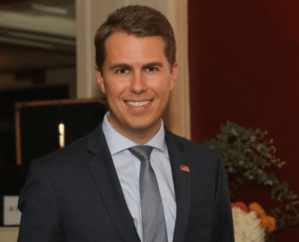
Read the whole thing at the link if you haven’t already. Here’s video of Taylor’s endorsement:
Louis DeJoy, the man Trump handpicked to destroy the U.S. Postal Service will testify before House and Senate committees. That means Kamala Harris will have an opportunity to cross examine him.
Politico: DeJoy agrees to testify amid Dem fury over Postal Service changes.
On Sunday, Democrats moved up a request for DeJoy to testify to Monday, Aug. 24, calling it an “urgent” matter. The Oversight and Reform Committee hearing is likely to be tense, with Democrats loudly objecting to changes that have slowed mail delivery in numerous parts of the country amid President Donald Trump’s calls to restrict the use of mail-in ballots for the November election.
A number of Democrats have called on him to resign, and moderate House member Rep. Jim Cooper (D-Tenn.), even said that he wanted DeJoy, a major Republican Party fundraiser, arrested by the House sergeant at arms if he didn’t agree to testify.
“Over the past several weeks, there have been startling new revelations about the scope and gravity of operational changes you are implementing at hundreds of postal facilities without consulting adequately with Congress, the Postal Regulatory Commission, or the Board of Governors,” House Oversight Chair Carolyn Maloney (D-N.Y.) wrote to DeJoy on Sunday, giving him a deadline of Monday to respond to the testimony invitation.
“Your testimony is particularly urgent given the troubling influx of reports of widespread delays at postal facilities across the country—as well as President Trump’s explicit admission last week that he has been blocking critical coronavirus funding for the Postal Service in order to impair mail-in voting efforts for the upcoming elections in November.”
 The Washington Post: Senate will hold Postal Service hearing with DeJoy on Friday, as mail delay fears grow.
The Senate Homeland Security and Governmental Affairs Committee will hold a hearing Friday with Postmaster General Louis DeJoy on the U.S. Postal Service’s vote-by-mail financial requirements, according to two people familiar with the decision.
It will be DeJoy’s first opportunity to publicly answer lawmakers’ questions about the nation’s embattled mail service, which is experiencing delays as a result of policies DeJoy implemented cutting overtime and eliminating extra trips to ensure on-time mail delivery….
Democrats have alleged that DeJoy, a former Republican National Convention finance chairman, is taking steps that are causing dysfunction in the mail system and could wreak havoc in the presidential election….
The Postal Service is in the process of removing 671 high-speed mail-sorting machines nationwide this month, a process that will eliminate 21.4 million items per hour’s worth of processing capability from the agency’s inventory.
On Thursday and Friday, it began removing public collection boxes in parts of California, New York, Pennsylvania, Oregon and Montana. The agency said Friday that it would stop mailbox removals, which it said were routine, until after the election.
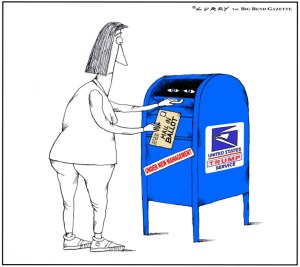 Lawsuits are also being prepared. ABC News: Multiple states ready suit against Trump admin over mail-in voting fears.
A group of Democratic state attorneys general are now in the final stages of preparing legal action against the Trump administration for recent cost-cutting changes made to the United States Postal Service, a lawsuit that one official said could demand a halt to any cutbacks that could impede mail-in voting.
As many as 10 state attorneys general are now involved, two state officials involved in the effort told ABC News. Among them is New York’s Letitia James, who called recent changes at the postal agency “deeply disturbing” in a statement released Monday.
The suit is expected to mount two major constitutional challenges to the recent cutbacks, according to one of the officials, a state government attorney. States will assert that the federal government is trying to impede their constitutional right to oversee their own elections. And they will argue that the Trump administration is interfering with every American’s individual right to participate in the election.
The lawsuit will also argue that Postmaster General Louis DeJoy failed to follow administrative procedures when he made cuts to overtime and decommissioned equipment – steps the states will ask the courts to halt, the attorney said….
The attorneys general from Connecticut and New York have joined a growing list of state leaders including those from Virginia, Massachusetts, Pennsylvania, North Carolina, Minnesota and Washington — all Democrats — in discussing how to sue the administration, sources said. Those conversations remain ongoing.
I’ll add more news links in the comment thread. I hope you all have a nice Tuesday!
Lazy Caturday Reads: Outrage Builds Over Trump’s Attacks on the U.S. Post Office
Posted: August 15, 2020 Filed under: morning reads, U.S. Politics | Tags: Donald Trump, Elizabeth Warren, Jr., Louis DeJoy, Post Office, Rep. Bill Pascrell, U.S.P.S., voter suppression 11 Comments
Good Morning!!
On Thursday and Friday, Dakinikat and I wrote about Trump’s assault on the U.S. Postal Service, in hopes of suppressing Democratic votes in November. Last night the story began building into a five alarm fire of public outrage. Rachel Maddow focused on the story on her show last night.
Media columnist Margaret Sullivan at The Washington Post: Trump’s attacks on the Postal Service deserve sustained, red-alert coverage from the media.
Listen to President Trump long enough, and, despite his penchant for falsehood, you’ll eventually hear some unvarnished truth.
That happened Thursday when he stated his intentions clearly in an interview with Fox Business Network. He doesn’t want to approve billions in emergency funding for the cash-strapped and struggling U.S. Postal Service for a simple reason: Democrats want to expand mail-in voting during the pandemic.
His words were stark: “Now, they need that money in order to have the Post Office work, so it can take all of these millions and millions of ballots.” He added that holding back funding means “they can’t have universal mail-in voting, they just can’t have it.”
In other words, he doesn’t want American citizens, fearful of exposure to the coronavirus, to have every opportunity to vote in November.
It’s not his first effort to cripple the Postal Service, one of the most essential — and popular — institutions in America. His statements Thursday came after he installed a Republican megadonor, Louis DeJoy, as the new postmaster general. In turn, DeJoy has unseated dozens of veteran postal officials. He and his minions have banned overtime and told carriers to leave mail behind at distribution centers, letting it pile up for days. Sorting machines that speed mail processing have been removed.
“Things are already going wrong,” Philip F. Rubio, an expert on the Postal Service and history professor at North Carolina A&T State University (and a former letter carrier himself), told Politico. There are “widespread mail slowdowns of all kinds of mail — first-class, marketing mail, parcels. Even the Veterans’ Administration has complained that veterans are not getting their medications on time.”
Read Sullivan’s commentary on the media coverage and why they need to “turn up the heat” at the WaPo link.
Today the news is full of stories about Trump’s attempted sabotage of a beloved American institution that is enshrined in the U.S. Constitution. As Maddow said last night, “pressure works.
In a statement Friday night, Rod Spurgeon — a USPS spokesperson for the service’s the Western region — told CNN that the service will stop the removal of letter collection boxes in 16 states and parts of two others until after the election.
That means, according to Spurgeon, the USPS will stop collecting the letter collection boxes only in: Washington, Oregon, Nevada, Arizona, New Mexico, Utah, Idaho, Montana, South Dakota, North Dakota, Wyoming, Colorado, Kansas, Iowa, Alaska, Nebraska and small parts of Wisconsin and Missouri.
It’s not clear if the removal freeze would go into effect across the nation. Kim Frum — a spokeswoman for USPS based at headquarters — could not say if the freeze would go into effect across the country and would not comment on the freeze in the Western region.
Officials say that in the last week the USPS has removed letter collection boxes in at least four states: New York, Oregon, Montana and Indiana. The USPS has also begun notifying postal workers in at least three states — West Virginia, Florida and Missouri — that they will start to reduce their retail operating hours, according to union officials.
Montana Senator John Tester appeared on Maddow’s show last night to discuss the removal of mailboxes in his state. KLUR 8.com: Montana officials ask for answers from USPS Postmaster General following removal of blue mail drop-off boxes.
BIG SANDY, Mont. – U.S. Sen. Jon Tester, Sen. Steve Daines, Rep. Greg Gianforte and Gov. Steve Bullock asked for answers from the U.S. Postal Service Postmaster General, Louis DeJoy, after the USPS removed blue mail drop-off boxes in some Montana towns.
Sen. Tester confirmed the reports of the U.S. Postal Service’s removing of the blue mail drop-off boxes throughout Montana on Friday, releasing the following statement:
“Since ringing the alarm on the removal of collection boxes from communities across Montana, it has become clear that these reports are accurate. These actions set my hair on fire and they have real life implications for folks in rural America and their ability to access critical postal services like paying their bills and voting in upcoming elections. Postmaster General DeJoy must immediately provide Montanans with an explanation for the actions of the USPS, or he can do it under oath before a Senate Committee.”
Sen. Tester and Sen. Daines also sent out statements saying the USPS has paused its removal of mail collection boxes in towns across Montana.
 New Jersey Representative Bill Pascrell, Jr. made a criminal referral to the New Jersey Attorney General last night. Pascrell appeared last night on MSNBC’s The Eleventh Hour with substitute host Ali Velshi.
The Daily Beast: NJ Rep, Inspector General Investigate What the Hell Is Going On With USPS.
Rep. Bill Pascrell, Jr. (D-NJ) made a criminal referral to the New Jersey Attorney General on Friday night, asking him to impanel a grand jury to look at possible breach of state election laws by President Trump, Postmaster General Louis DeJoy and others for “their accelerating arson of the post office,” he said. Alarming headlines have emerged in recent days as many states prepare to facilitate widespread mail balloting due to the coronavirus pandemic. President Trump openly admitted he was withholding federal aid from the postal service to prevent mail-in voting, and USPS has notified 46 states and D.C. that it will struggle to deliver some mail ballots on time.
Pascrell’s announcement came after USPS’s internal watchdog said it would review policy changes and potential ethical conflicts under DeJoy, a Trump donor who owns a $30 million stake in a competitor to USPS. Sen. Elizabeth Warren (D-MA) and other Democratic lawmakers requested a review into DeJoy’s actions, like eliminating overtime and slowing certain types of mail delivery, and whether he “met all ethics requirements.”
Attorneys General from several other states, including Washington, Connecticut, Arizona, and Maine, are considering taking action on the issue and the Post Office inspector general is getting involved. CNN: Exclusive: Postal service inspector general reviewing DeJoy’s policy changes and potential ethics conflicts.
The internal watchdog at the United States Postal Service is reviewing controversial policy changes recently imposed under Postmaster General Louis DeJoy, and is also examining DeJoy’s compliance with federal ethics rules, according to a spokeswoman for the USPS inspector general and an aide to Sen. Elizabeth Warren, who requested the review.
Lawmakers from both parties and postal union leaders have sounded alarms over disruptive changes instituted by DeJoy this summer, including eliminating overtime and slowing some mail delivery. Democrats claim he is intentionally undermining postal service operations to sabotage mail-in voting in the November election — a charge he denies.
Agapi Doulaveris, a spokeswoman for the USPS watchdog, told CNN in an email, “We have initiated a body of work to address the concerns raised, but cannot comment on the details.”
Last week, Warren, a Massachusetts Democrat, and eight other Democratic lawmakers asked the inspector general to launch an inquiry into DeJoy on a number of fronts, including the nationwide policy changes he’s made since taking over in June, as well as whether DeJoy has “met all ethics requirements.” [….]
It’s unclear if the inspector general has launched a full-scale investigation into possible politicization at USPS by DeJoy, a Trump ally and Republican donor, or if it’s just reviewing the matter for Congress.
CNN first reported earlier this week that DeJoy still owns at least a $30 million equity stake in his former company — a USPS contractor — and that he recently bought stock options for Amazon, a USPS competitor. These holdings likely create a major conflict of interest, ethics experts told CNN, though DeJoy and USPS maintain that he has complied with all federal requirements.
At The Week, Ryan Cooper writes: Trump’s Post Office meddling is plainly illegal.
Trump now openly admits he is sandbagging the Post Office to prevent Americans from voting by mail. Obstructing the ability to vote of the American people is a crime at the federal level and in every state. Not for the first time, the president has confessed to criminal acts on television.
First, the president does not get to prevent certain kinds of voting just because he alleges there is fraud happening. Election administration is largely governed at the state level, and several states — like Washington, Oregon, Colorado, and Utah — have had universal mail-in voting as the foundation of their systems for years (where it has worked just fine). Trump’s throwing a monkey wrench into the gears of the Post Office is a likely unconstitutional infringement of state authority to run their own elections, in addition to being directly criminal (see below).
Second, Trump is lying. We know he’s lying because countless studies have found mail-in voter fraud to be virtually nonexistent compared to the number of ballots cast, because it doesn’t even make sense as a way to commit election theft, and most of all because Trump himself has voted through the mail repeatedly — in 2017 and 2018 in New York, and just this week for the primary election in Florida. His argument is a scam and obviously so.
Third, we can also see what the game is by how new postmaster general Louis DeJoy, who met with Trump last week and is undeniably a partisan lackey, is slashing the Post Office’s baseline capacity. As David Dayen argues at The American Prospect, even 100 percent mail-in voting would barely burden the agency at all, given that it delivers 182 million pieces of mail every day (or used to, anyway), and most ballots have a very short transit route — from county election offices to homes and back again. That is why DeJoy is ending postal carrier overtime, destroying automated letter-sorting machines that cost millions of dollars, and pulling up hundreds of outdoor mailboxes. Voting by mail is so trivial for the USPS that it is necessary to seriously damage the agency to render it incapable of carrying it out. Sure enough, the agency has already warned that mail-in ballots could fail to be delivered in time in nearly every state….
The point of hamstringing the Post Office is to prevent as many people from voting by mail as possible, because 72 percent of Democrats say they are likely to vote by mail, as compared to 22 percent of Republicans. Trump and his stooge are using their federal power to forcibly disenfranchise American citizens. We have it straight from the horse’s mouth.
Let’s compare that behavior to 18 U.S. Code § 594, which states: “Whoever intimidates, threatens, coerces, or attempts to intimidate, threaten, or coerce, any other person for the purpose of interfering with the right of such other person to vote or to vote as he may choose” in a federal election faces fines and up to a year in prison. (By the way, someone who “knowingly and willfully obstructs or retards the passage of the mail” also faces fines and up to six months in prison.)
Cooper writes that there are also state laws against “stealing elections.” Read the whole thing at the link.
Charles Pierce writes that Trump is violating his oath of office:
Let’s all not sprain something pretending that this is simply some “sweeping organizational and policy overhaul” wha-dee-doo-dah. It’s ratfcking under color of law, pure and simple—a more complicated version of the “accidental” Election Day water-main break in front of the mayoral challenger’s headquarters. (Hi, Jim Curley!) Except, of course, this little monkey-wrenching keeps veterans from getting their prescription medicines, and rural customers from sending or receiving their packages. It also is a clear violation of the president*’s oath of office. He promised to take care that even the postal laws are faithfully executed. That doesn’t mean having your fat-cat apparatchik slow-walk the U.S. Mail to get you re-elected. Impeachable offenses are exhausting to carry around.
Read the rest at Esquire.
 Protesters were outside DeJoy’s home this morning, according to WUSA9.
A group of protesters staged a “noise demonstration” Saturday morning outside of United States Postal Service Postmaster General Louis DeJoy’s home in Northwest D.C. amid allegations of limiting mail-in voting for the 2020 Presidential election.
The demonstration was organized by the direct action group Shut Down D.C. They gathered in Kalorama Park in Adams Morgan on the corner of Kalorama Road and 19th Street and marched towards DeJoy’s home.
Members of the group came together to protest against DeJoy’s leadership ahead of mail-in voting for the 2020 Presidential election.
The organization believes DeJoy is “dismantling” the U.S. Postal Service in favor of President Donald Trump’s re-election. They said his actions contribute to voter suppression.
“DeJoy has fired or reassigned much of the existing USPS leadership and ordered the removal of mail sorting machines that are fundamental to the functioning of the postal service. Meanwhile, mail delivery is slowing down under other decisions made by DeJoy, such as eliminating overtime for postal workers,” the group said in a statement.
Let’s hope all this outrage will continue until Trump and DeJoy are forced to back down and/or are prosecuted. Of course that won’t stop Trump from trying to steal the election. Democrats are going to have to fight back like never before.
Have a great weekend, Sky Dancers!! Take care and be kind to yourselves, other people, and animals.
Tuesday Reads: Trump’s Wide Path of Destruction
Posted: August 11, 2020 Filed under: Foreign Affairs, morning reads, U.S. Politics | Tags: coronavirus pandemic, Covid-19, Donald Trump, The CARES Act 43 Comments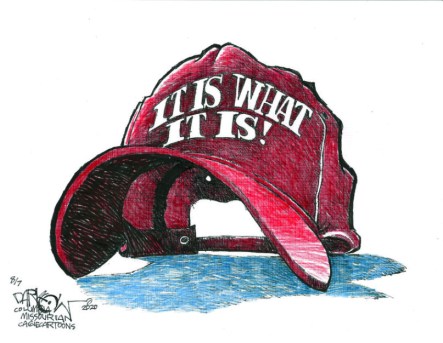
Good Morning!!
I’m somewhat distracted this morning. My mother was taken to the hospital last night because she had a low oxygen saturation level and acute abdominal pain. At the hospital, a CAT scan showed she has pneumonia. She is on oxygen to help her breathe. A quick Covid test was negative and they are waiting for the results of a second slower Covid test.
My Mom is 95 years old. I just don’t want her to suffer. My worst nightmare is that she gets the coronavirus. The staff at the assisted living place where she lives have been very careful and she has had regular Covid tests. I just hope and pray she will recover and be with us a little longer.
Today’s Recommended Reads:
Whatever you do, don’t miss this Slate article by William Saletan: The Trump Pandemic. A blow-by-blow account of how the president killed thousands of Americans.
On July 17, President Donald Trump sat for a Fox News interview at the White House. At the time, nearly 140,000 Americans were dead from the novel coronavirus. The interviewer, Chris Wallace, showed Trump a video clip in which Robert Redfield, the director of the Centers for Disease Control and Prevention, warned of a difficult fall and winter ahead. Trump dismissed the warning. He scoffed that experts had misjudged the virus all along. “Everybody thought this summer it would go away,” said Trump. “They used to say the heat, the heat was good for it and it really knocks it out, remember? So they got that one wrong.”
Trump’s account was completely backward. Redfield and other U.S. public health officials had never promised that heat would knock out the virus. In fact, they had cautioned against that assumption. The person who had held out the false promise of a warm-weather reprieve, again and again, was Trump. And he hadn’t gotten the idea from any of his medical advisers. He had gotten it from Xi Jinping, the president of China, in a phone call in February.
The phone call, the talking points Trump picked up from it, and his subsequent attempts to cover up his alliance with Xi are part of a deep betrayal. The story the president now tells—that he “built the greatest economy in history,” that China blindsided him by unleashing the virus, and that Trump saved millions of lives by mobilizing America to defeat it—is a lie. Trump collaborated with Xi, concealed the threat, impeded the U.S. government’s response, silenced those who sought to warn the public, and pushed states to take risks that escalated the tragedy. He’s personally responsible for tens of thousands of deaths.
This isn’t speculation. All the evidence is in the public record. But the truth, unlike Trump’s false narrative, is scattered in different places. It’s in emails, leaks, interviews, hearings, scientific reports, and the president’s stray remarks. This article puts those fragments together. It documents Trump’s interference or negligence in every stage of the government’s failure: preparation, mobilization, public communication, testing, mitigation, and reopening.
Trump has always been malignant and incompetent. As president, he has coasted on economic growth, narrowly averted crises of his own making, and corrupted the government in ways that many Americans could ignore. But in the pandemic, his vices—venality, dishonesty, self-absorption, dereliction, heedlessness—turned deadly. They produced lies, misjudgments, and destructive interventions that multiplied the carnage. The coronavirus debacle isn’t, as Trump protests, an “artificial problem” that spoiled his presidency. It’s the fulfillment of everything he is.
Please go read the whole thing. It’s essential reading.
Richard North Patterson at The Bulwark: The Ravings of Mad King Trump. On the pandemic, the economy, health care, and his 2020 opponent, he is utterly detached from reality.
To a striking degree, Donald Trump’s administration evokes the final days of the mad king of some Ruritanian backwater, spewing splenetic ravings while his shrinking cadre of sycophants struggles to steer their foundering ship of state.
Take these incoherent ruminations from a mid-July press conference:
But we had, in 2016, something even more so, but we got in, and we had 306 to, I guess, 223, which was a tremendous margin of difference. You remember, they all said, “He cannot get to 270.” I went to Maine a number of times, where we just freed up lobster fishing and fishing. Just—they took away 5,000 square miles from Maine. I just opened it up. And I just got rid of tariffs in China. And we’re working on European Union, which charge our fishermen tariffs. And I said, “You’re not going to do that.” So we freed it up for Maine. But if you take a look, we went up there recently. There were crowds. Thousands of people lined up going over to a factory where we were opening up for—we’re making swabs. A beautiful, big, new factory, making swabs.
Problem is, he does this pretty much every day.
Emulating a frightened oldster hearing the first, faint echo of senescence like a distant signal on a transistor radio, Trump bragged to Chris Wallace about acing a test designed to detect the onset of Alzheimer’s or dementia. But his problem is different—instead of entering his second childhood, Trump seems never to have left his first.
These recurring scenes from a Peter Sellers movie might have a certain seriocomic fascination had Trump not failed the most serious test of real-world leadership: a rolling public health disaster which has afflicted sickness, death, and privation on many millions of Americans.
Allan Sloan at ProPublica: The CARES Act Sent You a $1,200 Check but Gave Millionaires and Billionaires Far More.
The best-known feature of the CARES Act, as it’s known, is the cash grant of up to $1,200 per adult and $500 per child for households whose income was less than $99,000 for single taxpayers and $198,000 for couples. These grants are nontaxable, which makes them even more valuable. Some 159 million stimulus payments have gone out, according to the IRS.
The income limits suggested that the plan benefits the people most in need, those most likely to spend their stimulus payments and thus help the economy. The rhetoric conveyed the same: “The CARES Act Provides Assistance to Workers And Their Families” is how the Treasury’s website puts it. There were no grants to more-fortunate people, who for the most part aren’t in financial distress and are less likely than the less-fortunate to spend any money that Uncle Sam sent them.
But when I began looking at details of the legislation, I realized that several of its provisions quietly provided benefits that were worth much more than $1,200 to some upper-middle-class people who didn’t qualify for stimulus payments. Some other provisions provided vastly bigger benefits to the rich, to corporations and to a relative handful of ultra-rich folks.
So let me show you five provisions of the legislation that benefited the upper middle class (including yours truly); the families of Donald Trump and his son-in-law, Jared Kushner; high-income people who make large charitable donations; and Boeing and other corporations that are showing losses; as well as indirectly benefited people who have substantial investments in U.S. stocks.
These five provisions that help the well-heeled will cost the Treasury — which is to say, U.S. taxpayers — an estimated $257.95 billion for the 2020 calendar year. That’s nearly as much as the estimated $292.37 billion price tag for the stimulus grants to regular folks.
Read the rest at ProPublica.
George Conway with a devastating satire about Trump supporters: I (still) believe the president, and in the president.
I believe the president Made America Great Again. I believe we need him reelected to Make America Great Again Again.
I believe Joe Biden is “Sleepy” and “weak.” I believe Biden could “hurt God” and the Bible.
I believe that if Biden is elected, there will be “no religion, no anything,” and he would confiscate all guns, “immediately and without notice.” He would “abolish” “our great,” “beautiful suburbs,” not to mention “the American way of life.” There would be “no windows, no nothing” in buildings.
I believe the news media would have “no ratings” and “will go down along with our great USA!” if the president loses — and that this would be bad even though the media is fake.
I believe it’s normal for the president to say “Yo Semites” and “Yo Seminites,” “Thigh Land,” “Minne-a-napolis,” “toe-tally-taria-tism,” “Thomas Jeffers” and “Ulyss-eus S. Grant.” I believe it’s Biden who’s cognitively impaired.
I believe the president “aced” a “very hard” impairment test, and that his “very surprised” doctors found this “unbelievable.” I believe it was “amazing” he remembered five words, such as “person, woman, man, camera, TV” — in correct order. I believe he took the SAT himself.
I believe the president has “a natural ability,” like his “great, super-genius uncle” from MIT, which is why he understands “that whole world” of virology and epidemiology.
Read the rest at The Washington Post. It’s devastating, and every single claim is documented.
One more by Richard Haas at Foreign Policy: Present at the Disruption. How Trump Unmade U.S. Foreign Policy.
Present at the Creation is an 800-page memoir written by Dean Acheson, U.S. President Harry Truman’s secretary of state. The title, with its biblical echo, was immodest, but in Acheson’s defense, it was deserved.
Working from planning begun under President Franklin Roosevelt, Truman and his senior advisers built nothing less than a new international order in the wake of World War II. The United States adopted the doctrine of containment, which would guide U.S. foreign policy for four decades in its Cold War struggle with the Soviet Union. It transformed Germany and Japan into democracies and built a network of alliances in Asia and Europe. It provided the aid Europe needed to get back on its feet under the Marshall Plan and channeled economic and military assistance to countries vulnerable to communism under the Truman Doctrine. It established a host of international organizations, including the United Nations, the International Monetary Fund, the World Bank, and the General Agreement on Tariffs and Trade (the forerunner to the World Trade Organization). And it constructed a modern foreign and defense policy apparatus, including the National Security Council, the CIA, and the Department of Defense.
It is impossible to imagine one of the national security principals of the Trump administration writing a memoir that includes the word “creation” in its title. The problem is not just that little has been built over the past three and a half years. Building has simply not been a central aim of this administration’s foreign policy. To the contrary, the president and the frequently changing cast of officials around him have been much more interested in tearing things apart. A more fitting title for an administration memoir would be Present at the Disruption….
As with health care and the Affordable Care Act, when it came to foreign policy, Trump inherited an imperfect but valuable system and tried to repeal it without offering a substitute. The result is a United States and a world that are considerably worse off. This disruption will leave an enduring mark. And if such disruption continues or accelerates, which there is every reason to believe it will if Donald Trump is elected to a second term, then “destruction” might well become a more apt term to describe this period of U.S. foreign policy.
Take care of yourselves today and please check in if you feel up to it. We love hearing from you!
Lazy Caturday Reads
Posted: August 8, 2020 Filed under: morning reads, U.S. Economy, U.S. Politics, Women's Rights | Tags: abortion rights, Arkansas abortion law, coronavirus relief talks, Donald Trump, Greater Recession, Jerry Falwell Jr., John Roberts, Libery University, medicare, Paul Krugman, payroll tax, Social Security 27 Comments
Bette Davis
Good Morning!!
I’m not an economist, but I’m going to post some economic news today. Dakinikat is an economist, and maybe she will weigh in on what’s happening.
Talks between Democratic Congressional leaders and Trump administration representatives have broken down.
CNN: Stimulus talks break down on Capitol Hill as negotiators walk away without a deal.
Negotiations over the next stimulus package intended to bolster the economy and help struggling Americans pay their bills have stalled on Capitol Hill with Democrats and Trump administration officials walking away after talks broke down on Friday and devolved into partisan finger-pointing.
At a hastily scheduled news conference at his Bedminster, New Jersey, golf club Friday evening, President Donald Trump laid out the executive actions he said he would pursue if Congress does not reach a deal.
No additional discussions are planned after nearly two weeks of daily meetings, and lead White House negotiators Mark Meadows and Treasury Secretary Steve Mnuchin said they were recommending Trump move ahead with a series of executive orders.
Trump said Friday the actions would include a payroll tax deferment, extending unemployment benefits, extending an eviction moratorium and deferring student loan payments and forgiving their interest.
It’s not at all clear to me that any of this would be legal, especially cutting the payroll tax, which would starve Social Security and Medicare. Trump is obviously dying to do that. Back to the CNN story:
Cher
Trump said “they’re talking about” deferring the payroll tax until the end of the year. “And I can extend it at a certain period … and it will be retroactive until July 1,” he said. “I’m going to enhance unemployment benefits through the end of the year,” he added, without specifying any amount.
But the executive orders are expected to meet fierce resistance from Democrats who plan to challenge them in court. Democrats warn that executive action taken will be insufficient to address the extent of the economic and public health crisis faced by Americans during the pandemic.

This isn’t a far-off problem that retirees’ grandchildren would face. If this economic downturn is as bad as the Great Recession a decade ago, then the Social Security trust funds could run out of money in 2029, according to the Bipartisan Policy Center. After that, beneficiaries could see a 31% cut in retirement payments.
The program’s trustees had projected earlier this year that the trust funds would be depleted in 2035, but that did not take the coronavirus pandemic into account.
It would be the first time the estimated insolvency date was within a decade since the crisis of the 1980s, which prompted several changes, including raising the retirement age, said Shai Akabas, the center’s director of economy policy.
“An already urgent situation has become even more pressing,” Akabas said, noting the severe drop in payroll tax revenue. “We expect that that trend is going to continue for many years as it takes the labor market to recover.”

Donna Reed
From Business Insider: Trump implementing a payroll tax cut through executive order would blow a hole in Social Security and Medicare’s finances, economists warn.
“Trump’s scheme would weaken the Social Security and Medicare trust funds by diverting the revenue from the employee portion of Social Security and Medicare taxes, and potentially the employer’s share of Medicare taxes, from the programs’ trust funds,” the memo from the Center for American Progress said.
Earlier this year, Congress deferred the employer-portion of the Social Security tax (6.2%) through 2022 under the CARES Act. But they replaced the lost money with an infusion of general Treasury funds.
Trump, the memo said, lacks the authority to appropriate funds, which is Congress’s purview.
Many economists say that implementing a payroll tax cut through an executive order wouldn’t lead to a bump in wages for most workers, since the executive branch can only defer tax payments up to a year and not forgive them. Wiping out the payment requires Congress to act.
Legally, employers remain on the hook for any delayed payment. Firms would likely keep the money since they fear being saddled with a hefty tax bill if Congress didn’t move to forgive it.
Obviously, the fact that this would be illegal won’t stop Trump from trying it.
Paul Krugman weighs in on the economic crisis we face: Coming Next: The Greater Recession. Krugman argues that without a second stimulus package being enacted very soon the economy is going to get much worse.
I’m not sure how many people realize just how much deeper the coronavirus recession of 2020 could have been. Obviously it was terrible: Employment plunged, and real G.D.P. fell by around 10 percent. Almost all of that, however, reflected the direct effects of the pandemic, which forced much of the economy into lockdown.
Ava Gardner, 1946
What didn’t happen was a major second round of job losses driven by plunging consumer demand. Millions of workers lost their regular incomes; without federal aid, they would have been forced to slash spending, causing millions more to lose their jobs. Luckily Congress stepped up to the plate with special aid to the unemployed, which sustained consumer spending and kept the nonquarantined parts of the economy afloat.
Furthermore, evidence from austerity policies a decade ago suggests a substantial “multiplier” effect, as spending cuts lead to falling incomes, leading to further spending cuts.
Put it all together and the expiration of emergency aid could produce a 4 percent to 5 percent fall in G.D.P. But wait, there’s more. States and cities are in dire straits and are already planning harsh spending cuts; but Republicans refuse to provide aid, with Trump insisting, falsely, that local fiscal crises have nothing to do with Covid-19.
Bear in mind that the coronavirus itself — a shock that came out of the blue, though the United States mishandled it terribly — reduced G.D.P. by “only” around 10 percent. What we’re looking at now may be another shock, a sort of economic second wave, almost as severe in monetary terms as the first. And unlike the pandemic, this shock will be entirely self-generated, brought on by the fecklessness of President Trump and — let’s give credit where it’s due — Mitch McConnell, the Senate majority leader.

In other news, Chief Justice John Roberts is showing his true colors when it comes to abortion.
Dahlia Lithwick and Mark Joseph Stern at Slate Magazine: John Roberts’ Stealth Attack on Abortion Rights Just Paid Off.
The Supreme Court’s recent decision in June Medical v. Russo was hailed by many liberal court watchers as a win for reproductive rights, as the court declined to overturn Roe v. Wade and formally eliminate the right to an abortion. On Friday, however, a federal appeals court ruled that June Medical significantly narrowed the constitutional right to abortion access. The 8th U.S. Circuit Court of Appeals panel swept away an injunction that had blocked Arkansas from enforcing a slew of abortion restrictions, including a requirement that patients pregnant as a result of rape notify their rapists before terminating their pregnancy. The appellate court’s decision confirms that Chief Justice John Roberts’ controlling opinion in June Medical will serve as a tool to eviscerate abortion rights. Those who briefly heralded him as a champion of reproductive freedom were too caught up in the halftime show to see the game.
Olivia de Havilland
Friday’s ruling in Hopkins v. Jegley greenlights four Arkansas regulations passed in 2017. The first of these laws requires clinics to report the names of abortion patients under 18 to local law enforcement. These clinics must then preserve the fetal tissue and treat it like criminal evidence. The second law forces abortion providers to spend “reasonable time and effort” acquiring a patient’s medical records for her “entire pregnancy history” before performing the abortion. The third law grants equal rights over fetal remains to both partners, with no exception in cases of rape. A patient must notify her partner before the abortion and ask which method of disposal he prefers. If both partners are minors, the patient’s parents get to decide how fetal remains are disposed of. If the patient is a minor but her partner is an adult, then he—not the patient—makes the choice. These rules effectively prohibit medication abortion, which occurs at home, where the provider cannot control the disposal of fetal remains. The fourth and final law bans the safest and most common procedure for second-trimester abortions.
Abortion rights advocates challenged this legislation, arguing that they impose an unconstitutional burden on abortion access. A federal district court agreed in 2017, and blocked the new regulations. In Friday’s decision, three Republican-appointed judges on the 8th Circuit cleared away that injunction. The lower court had analyzed the laws under Whole Woman’s Health v. Hellerstedt, the 2016 Supreme Court decision that required courts to weigh the medical benefits of an abortion restriction against its burdens. But the Supreme Court’s decision last month in June Medical, the 8th Circuit wrote, overturned that standard.

One more story, just for laughs: Jerry Falwell Jr. was forced out of his job as president of Liberty University because of that photo he posted of himself with his pants unzipped and his arm around a woman with her pants also unzipped. Politico: Falwell placed on ‘indefinite leave’ from Liberty University.
Jerry Falwell Jr., one of President Donald Trump’s leading evangelical supporters, has agreed to take “an indefinite leave of absence” from his role as president of Liberty University after the release of a viral photo that showed him vacationing on a yacht with his pants unzipped, holding a drink, and with his arm around a woman.
Lauren Bacall
“The Executive Committee of Liberty University’s Board of Trustees, acting on behalf of the full Board, met today and requested that Jerry Falwell, Jr. take an indefinite leave of absence from his roles as President and Chancellor of Liberty University, to which he has agreed, effective immediately,” the university said in a statement on Friday.
The decision came a day after a top House Republican called on Falwell to resign as president of the large Christian school. Rep. Mark Walker of North Carolina, the vice chair of the House Republican Conference and a former pastor, said that Falwell’s “ongoing behavior is appalling.”
Falwell earlier in the week was widely condemned, including by some conservatives, for posting and then deleting the yacht vacation photo. Liberty University has a strict code of conduct for students that, among other things, prohibits students from having sexual relations outside of a “biblically-ordained” marriage and consuming media with lewd lyrics, sexual content and nudity.

At Slate, Ruth Graham explains Why That Falwell Jr. Yacht Photo Was the Final Straw.
Students on Liberty’s campus are forbidden from drinking alcohol, and are instructed to dress modestly. A poster on Reddit compiled Falwell Jr.’s potential violations in the yacht photograph and an accompanying video, and calculated that a student captured in the same scene could have accrued more than $9,000 in school fines and 900 hours of required service, and possible expulsion.
Faculty and alumni who have been critical of the school’s direction under Falwell Jr. were both shocked and gratified by the news of his leave of absence. “For at least a decade, Liberty’s faculty have labored under Falwell’s increasingly autocratic leadership and been shamed by his public behavior besides,” said Marybeth Davis Baggett, who taught English at Liberty for 17 years and resigned this spring after publishing an op-ed calling for Falwell Jr.’s removal based on his handling of the coronavirus crisis. “One man cannot act this way without many enablers, and any meaningful reform of the school will require a thorough and brutally honest inquiry into the LU culture.”
Jane Fonda, photo by Genevieve Naylor, 1962
Falwell Jr., a businessman with a law degree and no pastoral experience, took over the college when his father died in 2007. He has built the school into a sports powerhouse with a campus filled with luxury amenities, and conservative activists and politicians regularly speak there. The school now boasts more than 15,000 residential students, and more than 100,000 students online.
But Liberty has also been under almost constant national scrutiny since Falwell Jr. endorsed Donald Trump in early 2016, months earlier than other white evangelical leaders embraced the crude casino magnate’s candidacy. Falwell Jr. began 2020 by calling for parts of Virginia to secede from the state and join West Virginia. As the coronavirus crisis encroached, Falwell Jr. initially dismissed it as “hype,” and called a Liberty parent who questioned him on Twitter a “dummy.” He was then criticized for welcoming back any students who wanted to return to campus after spring break. (Fewer than 2,000 of 15,000 residential students ultimately returned, and Liberty has avoided any outbreaks.) In May, Falwell Jr. tweeted a racist image in an attempt to needle Virginia governor Ralph Northam. He eventually deleted the tweet and apologized, but multiple Black employees publicly quit their jobs soon afterward; several high-profile Black athletes also departed. None of these media dust-ups seemed to dent Falwell Jr.’s favorability in the eyes of his hand-picked board of trustees.

There’s much more at the link if you’re interested.
So everything is still FUBAR, but as Dakinikat wrote yesterday, we can still be kind to ourselves and support each other through these terrifying times. As I learned in my recovery from alcoholism, it always helps to live one day at a time. We’re still here, and there’s still a chance we can rid ourselves of Trump and somehow hold onto and rebuild our democracy.
Thursday Reads: Trump and Deutsche Bank; Schools Reopening
Posted: August 6, 2020 Filed under: morning reads, U.S. Politics | Tags: coronavirus pandemic, Cyrus R. Vance Jr., Deutche Bank, Donald Trump, Manhattan District Attorney, reopening schools 20 CommentsGood Morning!!
Last night The New York Times revealed that Deutsche Bank has been cooperating in the New York Attorney General’s investigation of the Trump Organization for quite some time:
 Trump’s Bank Was Subpoenaed by N.Y. Prosecutors in Criminal Inquiry.
The New York prosecutors who are seeking President Trump’s tax records have also subpoenaed his longtime lender, a sign that their criminal investigation into Mr. Trump’s business practices is more wide-ranging than previously known.
The Manhattan district attorney’s office issued the subpoena last year to Deutsche Bank, which has been Mr. Trump’s primary lender since the late 1990s, seeking financial records that he and his company provided to the bank, according to four people familiar with the inquiry.
The criminal investigation initially appeared to be focused on hush-money payments made in 2016 to two women who have said they had affairs with Mr. Trump.
But in a court filing this week, prosecutors with the district attorney’s office cited “public reports of possibly extensive and protracted criminal conduct at the Trump Organization” and suggested that they were also investigating possible crimes involving bank and insurance fraud.
Trump, Deutsche Bank has been a frequent target of regulators and lawmakers digging into the president’s opaque finances. But the subpoena from the office of the district attorney, Cyrus R. Vance Jr., appears to be the first instance of a criminal inquiry involving Mr. Trump and his dealings with the German bank, which lent him and his company more than $2 billion over the past two decades.
Deutsche Bank complied with the subpoena. Over a period of months last year, it provided Mr. Vance’s office with detailed records, including financial statements and other materials that Mr. Trump had provided to the bank as he sought loans, according to two of the people familiar with the inquiry….
The subpoena to Deutsche Bank sought documents on various topics related to Mr. Trump and his company, including any materials that might point to possible fraud, according to two people briefed on the subpoena’s contents.
That must have been quite a shock to Trump.
As The Daily Beast explains, Trump himself triggered the public announcements by Vance by mischaracterizing the investigation in legal filings: The Footnote That Could Lock Trump Up in 2021.
Things had already been going badly for Trump in this legal fight but he bought time as the case made its way up to the Supreme Court, which ultimately rejected his argument, reasoning that “the public has the right to every man’s evidence.” The high court then returned the matter to a district court, while affording Trump with little remaining basis to object, in the absence of any reason to conclude that the subpoena will interfere with his official duties.
It is well established that grand juries have wide latitude to conduct investigations. As Supreme Court Justice Robert Jackson put it, a grand jury “can investigate merely on suspicion that the law is being violated, or even just because it wants assurance that it is not.” Therefore, if Trump had been astute, he would have accepted the high court’s decision and given up on his effort to block Vance’s subpoena. But Trump chose to overplay his hand. Last month, the president’s lawyers declared that the nature and scope of Vance’s investigation is limited to an inquiry into Trump’s illicit efforts to funnel hush money payments to former sexual partners during the months leading up to the 2016 election through his fixer, Michael Cohen, and contended that the purported narrowness of the inquiry meant that Vance had no right to make a broad demand for Trump’s financial records.
Yet Trump had no basis to make declarations about the scope of the DA’s investigation; indeed, the only detailed explanation Vance has offered to date is contained in a (properly) secretly filed portion of a declaration by one of his prosecutors that has been reviewed only by the court. Furthermore, by making uninformed assertions about the scope of the investigation, Trump was all but daring Vance to comment about the nature of an ongoing investigation in the run up to an election….
After noting that the DA has no obligation to disclose the nature or scope of an ongoing criminal investigation in response to a challenge to a subpoena—let alone improperly disclose grand jury evidence – Vance’s office stated that Trump’s claims about the supposedly limited scope of the investigation “is fatally undermined by undisputed information in the public record.” The DA’s brief then went on to quote the judge himself, who months ago—after reading Vance’s secret account of the matters under review—observed that it is related to “alleged insurance and bank fraud by the Trump Organization and its officers.”
Ooopsie! Read more details at the link above.
Meanwhile, Trump is still pushing for schools to fully open around the country. It’s not going well in the places that have followed his advice.
The Washington Post: A Mississippi town welcomed students back to school last week. Now 116 are home in quarantine.
Last week, schools in Corinth, Miss., welcomed back hundreds of students. By Friday, one high schooler tested positive for the novel coronavirus. By early this week, the count rose to six students and one staff member infected. Now, 116 students have been sent home to quarantine, CNN reported Wednesday.
Despite the quick fallout, the district’s superintendent said he has no plans to change course.
“Just because you begin to have positive cases, that is not a reason for closing school,” Superintendent Lee Childress said in a Facebook Live broadcast on Tuesday on the school district’s Facebook page.
As districts around the country debate the merits of in-person classes versus remote learning amid an escalating novel coronavirus pandemic, the Corinth School District’s early experience shows how quickly positive tests can lead to larger quarantines.
ABC News: Students at school touted by Pence for reopening must quarantine due to COVID-19.
Fourth graders at a school in North Carolina have been asked to quarantine for 14 days after a student there tested positive for COVID-19.
The school, a Thales Academy in Wake Forest, said it was notified on Monday that the student became infected after having contact with an infected family member.
The student was asymptomatic and was last at school on Friday. Teachers who were exposed also will be quarantined.
Thales Academy, a network of private non-sectarian community schools with eight locations in North Carolina, made the news last week after Vice President Mike Pence and Secretary of Education Betsy DeVos visited a classroom and applauded the school for reopening.
Pence and DeVos visited a campus in Apex, not Wake Forest.
Two suburban Atlanta school districts that began in-person classes Monday with mask-optional policies face more questions about COVID-19 safety protocols after on-campus pictures showed students packed shoulder-to-shoulder. The day after school resumed, one school announced a second grader tested positive for the coronavirus, forcing the child’s teacher and classmates to be sent home to quarantine for two weeks, CBS affiliate WGCL-TV reports.
In Cherokee County, dozens of seniors gathered at two of the district’s six high schools to take traditional first-day-of-school senior photos, with students squeezing together in black outfits. No one in pictures at Sequoyah High School in Hickory Flat or Etowah High School in Woodstock wore a mask.
In Paulding County, student pictures taken Monday and Tuesday show crowded hallways at North Paulding High School in Dallas. Fewer than half of the students shown are wearing masks.
More on this school from Buzzfeed News: The Truth Behind A Viral Picture Of A Reopening School Is Worse Than It Looked.
Behind a viral photo of a crowded hallway at a high school in Georgia, a potentially dire situation is brewing. Students, teachers, and parents fear the Paulding County school’s rushed reopening plans may be spiraling out of control just two days after students — who said they were told they could face expulsion for remaining home — returned to class despite reports of positive coronavirus cases among students and staff.
North Paulding High School, about an hour outside Atlanta, reopened Monday despite an outbreak among members of its high school football team, many of whom, a Facebook video shows, worked out together in a crowded indoor gym last week as part of a weightlifting fundraiser.
Within days of that workout, several North Paulding players had tested positive for the coronavirus. The school’s parents were notified just hours before the first day of class.
And multiple teachers at North Paulding say there are positive tests among school staff, including a staff member who came into contact with most teachers at the school while exhibiting symptoms last week. Teachers and staff said the school won’t confirm coronavirus infections among district employees, citing privacy reasons.
“That was exactly one week ago, so we are all waiting to see who gets sick next week,” a North Paulding teacher told BuzzFeed News of her exposure to the virus.
Despite recommendations from CDC health officials, the district has called mask-wearing a “personal choice” and said that social distancing “will not be possible to enforce” in “most cases.”
Read more at the link.
The Nashville Tennessean: These Tennessee school districts are already reporting COVID-19 cases after reopening.
Just two weeks after the first school districts in Tennessee reopened to students amid the coronavirus pandemic, some are already closing their doors.
Nearly 50 school districts have started the school year as of Wednesday — the majority of them in-person — and at least 14 confirmed COVID-19 cases connected to schools have already been reported.
Two school districts, Coffee County Schools and Blount County Schools, have already closed schools or altered their schedules as a result of exposures to the virus.
Click the link for details.
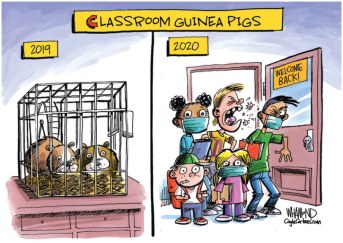 Business Insider: An emergency medicine physician projects that if schools open in the fall, they’ll close by the end of October with COVID-19 outbreaks.
Citing the “confluence” of the flu season and increased exposure, one doctor with experience in advising city officials on public health said schools can either taking strict health safety precautions or expect to shut the school down again by the end of October if they reopen.
Matt Lambert, an emergency medicine physician and the former chief medical information officer for New York City Health and Hospitals, the nation’s largest public health system, told Business Insider that he is “all for very thoughtful attempts at reopening schools.” [….]
“For local schools, if they want to try and open up using some really practical techniques around mask-wearing and distancing and maybe even rotations of when students come, I think that is something worthwhile to try,” Lambert said, adding, “But the virus is more prevalent now than it has been at any other time.”
“If we move to open up schools, even with the best models we can think of, passing the virus is going to be inevitable,” he continued. “Kids can contract the virus; kids can transmit the virus. There might be some varying levels of what it’s like in kids compared to adults, but it is clear that they can do that.”
Lambert said, given the transmission of the virus, it would be “inevitable” for an infected student to pass on the coronavirus “to either a chronically ill teacher or an elderly loved one at home who may have a bad outcome from this.”
 Naturally, teachers are scared. NPR: Most Teachers Concerned About In-Person School; 2 In 3 Want To Start The Year Online.
As the school year starts in many districts across the country, a new national poll of teachers from NPR/Ipsos finds overwhelming trepidation about returning to the physical classroom.
Eighty-two percent of K-12 teachers say they are concerned about returning to in-person teaching this fall, and two-thirds prefer to teach primarily remotely. On the latter point, teachers are aligned with parents and the general public: Another recent NPR/Ipsos poll found two-thirds of respondents thought schools in their area should be primarily remote, including 62% of parents of children under 18.
The teacher poll was conducted July 21-24 and included 505 respondents. Half teach at low-income schools.
When it comes to going back to the classroom, 77% of teachers are worried about risking their own health.
Read the rest at NPR.
There’s much more happening in the news. I’ll add more in the comments and I hope you will too.

 peej
peej Carissa
 bostonboomer
 dakinikat
 ecocatwoman
 jjlo
jjlo mablue2
 Mama Lopez
 peggysue22
 quixote
 skydancingguestblogger
 Mona (aka Wonk the Vote)





Recent Comments