





Across from the Lincoln Memorial, barely inside the boundaries of Washington, sits a traffic roundabout known as Memorial Circle — familiar to commuters primarily as a major entryway to the city from Virginia.
Lazy Caturday Reads
Posted: October 11, 2025 Filed under: just because | Tags: America250, cat art, caturday, CDC massive firings, China tariffs, Donald Trump, federal employee layoffs, government shutdown 2025, health care subsidies, Melania Trump, Mike Johnson, No Kings protests, Qatar air base, SCOTUS emergency orders, Trump Arch 8 CommentsGood Day!!

portrait by Gurutze Ramos
It’s finally starting to feel like Autumn here. Leaves are starting to change color and temperatures are dropping into the 50s and 60s. We’re expecting a Nor’easter over the long weekend, with rain, high winds, and coastal flooding.
I’m still having trouble dealing with the news; it has just gotten to be too painful watching Trump and his thugs destroy my country. But the horror continues, whether I’m paying attention or not. Of course, the top story is the effects of the government shutdown.
The promised layoffs and firings of government workers have begun.
This morning’s Boston Globe has a story on the effects here in the Boston area: Local federal workers say they’ve never seen a shutdown like this.
Beth Willwerth, a federal employee at the Andover IRS office, learned she had been furloughed 15 minutes before she spoke to the Globe on Friday.
Willwerth, who is also the chapter president of the National Treasury Employees Union Chapter 68,has been with the IRS since 2009. This is her fourth shutdown.
“This is far different than anything I have ever seen,” she said. “I have never seen anything like this in my 16 years here. I have never hugged so many people coming into my office crying.”
As the government shutdown entered its 11th day, with no sign of a deal in sight, government workers are seeing their paychecks shrink or cut entirely, learning they are newly furloughed, or facing layoffs, as President Trump had promised. They’re dipping into savings and taking side hustles to make ends meet. Federal workers tell the Globe it’s more than just about finances. They’ve never seen a shutdown this chaotic, or this seemingly vindictive.
Many are continuously, unpleasantly surprised by breaking developments, particularly news of an increasing number of federal workers getting fired. By Friday afternoon, federal health, homeland security, education, energy, and Treasury Department employees had been laid off.
Mere hours later, 98 field staff working at the Fair Housing and Equal Opportunity offices at the US Department of Housing and Urban Development across the nation had been notified they’d be laid off effective Dec. 9, a representative from local 3258 of the American Federation of Government Employees told the Globe. The office helps enforce the Fair Housing Act by investigating housing discrimination complaints and mediating cases.
The number of laid-off field staff includes all 11 field staff from the Boston Regional HUD Office.
CNN: Trump administration lays off thousands of federal workers during government shutdown.
More than 4,000 federal employees receivedlayoff notices Friday as part of the Trump administration’s broad effort to reshape the government while it remains shutdown, according to a court filing Friday.
The filing provides greater insight into an announcement from President Donald Trump’s budget chief earlier in the day that the administration had begun government-wide reductions in force that had been anticipated since federal funding lapsed on October 1.
“The RIFs have begun,” Office of Management and Budget Director Russell Vought posted on X, without elaborating on how many federal workers had received RIF – or reduction in force – notices.
As of Friday evening, RIF notices had gone out to employees at the departments of Commerce, Education, Energy, Health and Human Services, Housing and Urban Development, Homeland Security and Treasury, according to department spokespeople, union representatives and sources directly impacted.
Treasury and HHS saw the highest number of reductions, with more than 1,000 workers laid off at each department, according to the filing in a lawsuit brought by two federal employee unions seeking to stop the layoffs.
Also, the US Patent and Trademark Office, which is part of the Commerce Department, issued lapse-related RIF notices to employees last week, according to the filing. And the Environmental Protection Agency sent “intent to RIF” notices to 20 to 30 employees, though it hasn’t made a final decision on whether or when it would lay off those workers.
Other agencies are “actively considering” whether to conduct additional RIFs related to the shutdown, the filing said.
Trump said late Friday afternoon that he plans to fire “a lot” of federal workers in retaliation for the government shutdown, vowing to target those deemed to be aligned with the Democratic Party.
Read more at CNN.
The New York Times: Trump Administration Lays Off Dozens of C.D.C. Officials.
Dozens of employees at the Centers for Disease Control and Prevention — including “disease detectives,” high-ranking scientists and the entire Washington office — were notified late Friday that they were losing their jobs as part of the Trump administration’s latest round of federal layoffs.
It was unclear on Friday how many C.D.C. workers were affected. But it was the latest blow to an agency that has been wracked by mass resignations, a shooting at its Atlanta headquarters in August and the firing of its director under pressure from Health Secretary Robert F. Kennedy Jr.
Portrait by Naomi Jenkin
Layoff notices landed in the email inboxes of C.D.C. employees shortly before 9 p.m. Eastern time on Friday, notifying employees that their duties had been deemed unnecessary or “virtually identical” to those being performed elsewhere in the agency. Scientists, including leaders, in offices addressing respiratory diseases, chronic diseases, injury prevention and global health were among those affected.
The staff of the Morbidity and Mortality Weekly Report, the journal that reports on health trends and emerging infectious threats, was also laid off. The publication’s storied history includes a June 1981 report that five previously healthy gay men were treated for an unusual pneumonia — the first hint of the AIDS epidemic.
Roughly 70 Epidemic Intelligence Service officers — the so-called “disease detectives” who respond to outbreaks around the globe — received layoff notices, according to a person familiar with them. The service was spared during an earlier round of layoffs in February.
An officer at an American Federation of Government Employees local union representing C.D.C. employees said that the agency’s human resources staff, which had been furloughed as part of the government shutdown, had been called back to work to send out layoff notices to their colleagues.
Catie Edmonson at The New York Times (gift link): Trump’s Shutdown Layoffs Deepen Impasse, Angering Democrats.
In almost any other government shutdown, Senators Tim Kaine and Mark Warner, both of Virginia, would probably top the list of Democrats most likely to try to find a quick off ramp.
They represent the state with the second-highest concentration of federal employees in the nation. Both have historically been eager to join the so-called bipartisan gangs of senators who try to negotiate their way through partisan gridlock.
Instead, the two have appeared remarkably dug in, even as President Trump and his top lieutenants have threatened to use the shutdown to drastically accelerate their campaign to reduce the size of the government. They say they are channeling federal workers who are furious at the White House’s ongoing assault on the bureaucracy and are urging their representatives in Congress to keep up the fight.
“I’ve heard that sentiment more loudly than I thought, because in Virginia, we have an awful lot at stake,” Mr. Kaine said in a recent interview. “We suffer more in a shutdown scenario than anybody else. But I think they feel like, ‘You’re threatening to hurt us. You’ve been hurting us since Jan. 20.’ In some ways, it’s kind of not a credible threat, because you’ll do it anyway, whatever happens.”
The dynamic has fueled Democrats’ resolve not to back down as the shutdown impasse drags into its second week. Democrats representing large populations of federal workers have for months heard from livid employees about the Department of Government Efficiency emails they received asking them to provide a list of accomplishments; the chaos and upheaval at their agencies; and the fears of retaliation.
A bit more:
Mr. Trump has stepped up the threats in recent days, saying that he would deny furloughed workers back pay earned during the shutdown, and promising that he would seize the opportunity to slash programs and projects Democrats care about.
So far that has only fueled Democrats’ outrage, strengthening their determination to continue demanding health care concessions as a condition of any deal to fund the government. But that determination will be tested in the days ahead.
Russell T. Vought, the White House budget director, announced on Friday that the administration was beginning another round of federal worker layoffs, fulfilling Mr. Trump’s threats. And many federal employees, including military personnel, are set to miss their first paycheck next week.
“To their credit, the White House has now for 10 days laid off doing anything in hopes that enough Senate Democrats would come to their senses and do the right thing and fund the government,” Senator John Thune, Republican of South Dakota and the majority leader, said at a news conference on Friday, minutes before Mr. Vought’s announcement. “But now where we’re getting to is where people are going to start missing paychecks. This gets real.”
Democrats on Friday gave few indications that they would be swayed.
“This latest round of federal firings is not an unfortunate byproduct of the government shutdown, but a deliberate choice,” Mr. Warner wrote on social media. “Republicans are intentionally holding federal workers hostage to force through their agenda driving up health care costs for millions.”
Good! I hope the Democrats stay angry.
On the shutdown fight:
Republicans are beginning to realize that they are losing the shutdown PR war.
Nathaniel Weixel at The Hill: Republicans, playing defense on health care, uncertain of path forward.
Republicans are on the defensive as Democrats have successfully made the shutdown fight about health care.
Most Republicans said they don’t want to see insurance premiums spike, but neither are they willing to openly support the extension of the enhanced Affordable Care Act (ACA) tax credits Democrats are asking for.
Portrait by Rachel Stibbling
While the GOP has remained united in refusing to even entertain the idea of an extension in the context of ending the shutdown, Republicans don’t appear to have an alternate plan for what happens next….
Democrats are feeling increasingly emboldened about their position and have made it clear they do not intend to back off their health care funding demands. If Congress doesn’t act in the next three weeks, Americans across the country will see major increases in their insurance premiums when open enrollment begins in November.
While Republicans insist that Democrats vote to fund the government before any talks on health care begin, GOP leaders have been forced to engage on an issue that’s long been a political vulnerability for the party.
“They’re trying to make this about health care. It’s not. It’s about keeping Congress operating so we can get to health care. We always were going to. They’re lying to you,” Speaker Mike Johnson (R-La.) told reporters Thursday. “The health care issues were always going to be something discussed and deliberated and contemplated and debated in October and November.”
Congress has extended the enhanced subsidies twice, and Democrats insist they need to do so again, citing estimates that premiums for tens of millions of people will more than double next year.
I remember when pundits were claiming that health care was too boring an issue to get serious traction. It looks like they were wrong.
Mike Johnson is keeping the House shut down for the third week. I’m not sure if it’s because he’s afraid of a vote on releasing the Epstein files or that some of his members may want to work with Democrats to end the government shutdown. And now he’s attacking the upcoming No Kings demonstrations.
Politico: Johnson describes planned No Kings rally as ‘hate America,’ ‘pro-Hamas’ gathering.
Speaker Mike Johnson on Friday slammed the No Kings protest march scheduled to take place at the National Mall next week, describing the planned protest as the “hate America rally” that would draw “the pro-Hamas wing” and “the antifa people.” His characterizations, however, drew condemnation from some Democrats who defended the protest movement, whose first big demonstration was overwhelmingly peaceful.
“They’re all coming out,” Johnson said Friday in an interview on Fox News. “Some of the House Democrats are selling t-shirts for the event. And it’s being told to us that they won’t be able to reopen the government until after that rally because they can’t face their rabid base.”
Rep. Tom Emmer (R-Minn.), another senior House Republican, also criticized the planned demonstration and blamed it for prolonging the shutdown. Telling reporters Democrats had caved to the “terrorist wing of their party,” Emmer alluded to a “hate America rally in D.C. next week.”
The coast-to-coast protests went on almost entirely without incident, with one notable act of violence — when rally “peacekeepers” in Salt Lake City shot and killed a bystander because they believed another man with a gun was about to fire on the crowd.
The organizers of the upcoming rally largely brushed off House GOP leaders’ characterization. In a joint, unsigned statement, which they said they issued “after a few moments of laughter,” they pressured Johnson over the government shutdown.
“Speaker Johnson is running out of excuses for keeping the government shut down,” the No Kings coalition wrote. “Instead of reopening the government, preserving affordable healthcare, or lowering costs for working families, he’s attacking millions of Americans who are peacefully coming together to say that America belongs to its people, not to kings.”
Non-shutdown news and comment:
Trump and his puppet at the Department of Defense are allowing a foreign country to have a military base in the United States. WTF?!
CBS News: Hegseth announces Qatar will build air force facility at U.S. base in Idaho.
Defense Secretary Pete Hegseth on Friday announced a finalized agreement that will allow the Qatari Emiri Air Force to build a facility at the Mountain Home Air Force Base in Idaho.
The agreement, which Hegseth announced alongside Qatari Minister of Defense Sheikh Saoud bin Abdulrahman Al Thani at the Pentagon, will allow Qatari pilots to receive training alongside U.S. soldiers. There are no foreign military bases in the U.S., but some foreign militaries do maintain a presence for training. The Singaporean Air Force also has a presence at the Mountain Home base.
Hegseth said he is “proud that today we’re signing a letter of acceptance to build a Qatari Emiri Air Force Facility at the Mountain Home Air Base in Idaho.”
“The location will host a contingent of Qatari F-15’s and pilots to enhance our combined training, increase lethality, interoperability, it’s just another example of our partnership,” Hegseth said. “And I hope you know, your excellency, that you can count on us.”
Later Friday, Hegseth clarified that Qatar would not have its own base in the U.S., writing on X: “The U.S. military has a long-standing partnership w/ Qatar, including today’s announced cooperation w/ F-15QA aircraft. However, to be clear, Qatar will not have their own base in the United States-nor anything like a base. We control the existing base, like we do with all partners.”
Whatever. It’s creepy, IMO.
The move is another demonstration of the Trump administration’s increasingly close relationship with Qatar.
President Trump signed an executive order last month “assuring the security of the state of Qatar,” following Israel’s decision to carry out a military strike in Qatar’s capital city of Doha, where the vast majority of Qataris live. “The United States shall regard any armed attack on the territory, sovereignty, or critical infrastructure of the State of Qatar as a threat to the peace and security of the United States,” the executive order reads.
I guess that’s what you get when you bribe the “president” with a free luxury plane and help him build a golf course in your country.
Here’s another strange story from The Daily Beast: Melania Has Been Secretly Working With Putin for Months.
First Lady Melania Trump made a rare formal announcement from the White House on Friday where she revealed that she has been engaged in secret talks with Russian President Vladimir Putin.
The first lady said that due to ongoing efforts eight children separated during the war in Ukraine have now been reunited with their families, and she said the work continues.
Cornilis Visscher, The Large Cat, etching-and-engraving-circa-1657-145×188-mm-5_651360851dc7f-thumb-36144200_1695768710Cornelis-Visscher, The
Trump said that her dialogue with Putin has been ongoing since she sent him a letter in August. The president first revealed the letter she had written to the Russian leader on Truth Social, which was hand-delivered to Putin during his summit with Trump in Alaska.
“Since President Putin received my letter last August, he responded in writing, signaling a willingness to engage with me directly, and outlining details regarding the Ukrainian children residing in Russia,” the first lady said Friday.
“Since then, President Putin and I have had an open channel of communications regarding the welfare of these children,” she continued….
The first lady, who spends most of her time in New York, made her roughly five-minute speech from a podium at the White House before turning around and exiting the room without taking any questions.
Melania has been a quiet adviser to her husband on the war in Ukraine since he took office. The president has said on numerous occasions that the first lady has been quick to point out to her husband that Putin had not been negotiating with him in good faith as the war dragged on.
I hope this does some good, but I’ll believe it when I see it.
The New York Times has an interesting story critical of the Supreme Court by Mattathias Schwartz and Zach Montague: Federal Judges, Warning of ‘Judicial Crisis,’ Fault Supreme Court’s Emergency Orders.
More than three dozen federal judges have told The New York Times that the Supreme Court’s flurry of brief, opaque emergency orders in cases related to the Trump administration have left them confused about how to proceed in those matters and are hurting the judiciary’s image with the public.
At issue are the quick-turn orders the Supreme Court has issued dictating whether Trump administration policies should be left in place while they are litigated through the lower courts. That emergency docket, a growing part of the Supreme Court’s work in recent years, has taken on greater importance amid the flood of litigation challenging President Trump’s efforts to expand executive power.
While the orders are technically temporary, they have had broad practical affects, allowing the administration to deport tens of thousands of people, discharge transgender military service members, fire thousands of government workers and slash federal spending.
The striking and highly unusual critique of the nation’s highest court from lower court judges reveals the degree to which litigation over Mr. Trump’s agenda has created strains in the federal judicial system.
White Angora Cat by Jean-Jacques Bachelier, 1761
Sixty-five judges responded to a Times questionnaire sent to hundreds of federal judges across the country. Of those, 47 said the Supreme Court had been mishandling its emergency docket since Mr. Trump returned to office.
The judges responded to the questionnaire and spoke in interviews on the condition of anonymity so they could share their views candidly, as lower court judges are governed by a complex set of rules that include limitations on their public statements.
Of the judges who responded, 28 were nominated by Republican presidents, including 10 by Mr. Trump; 37 were nominated by Democrats. While those nominated by Democrats were more critical of the Supreme Court, judges nominated by presidents of both parties expressed concerns.
In interviews, federal judges called the Supreme Court’s emergency orders “mystical,” “overly blunt,” “incredibly demoralizing and troubling” and “a slap in the face to the district courts.” One judge compared their district’s current relationship with the Supreme Court to “a war zone.” Another said the courts were in the midst of a “judicial crisis.”
Trump is threatening China with insane tariffs again. Politico: Trump wanted a trade deal. Xi opened a new front instead.
Beijing shattered a fragile trade truce with Washington this week, announcing sweeping restrictions on exports that contain even trace amounts of Chinese rare earth.
An irate President Donald Trump is threatening to retaliate with 100 percent tariffs and new restrictions on exports of critical software — and said there’s “no reason” to meet with Chinese leader Xi Jinping later this month.
The rupture marks the sharpest escalation in tensions between Washington and Beijing since the two countries slapped triple-digit tariffs on each other this spring and threatens to derail months of quiet efforts to stabilize the relationship. It also underscores how delicate the two sides’ uneasy economic peace has been and raises fresh doubts about whether Trump, operating with a hollowed-out national security team and a fragmented China strategy, is prepared for Beijing’s latest power play.
It’s also the clearest test yet of Trump’s ability to translate his transactional approach to trade into a coherent China strategy — one that can withstand Beijing’s deliberate and long-term economic warfare. Most of China’s new restrictions will take effect Dec. 1, while the U.S.’s retaliatory measures are set to kick in Nov. 1.
“China’s actions are being viewed by the administration as a major escalation in U.S.-China trade tensions,” said Everett Eissenstat, deputy assistant to the president for international economic affairs and deputy director of the White House’s National Economic Council during Trump’s first term. “China is flexing its power and trying to show the world that it has the ability to act as a major choke point for global trade.”
China’s Ministry of Commerce on Thursday unveiled its most expansive rare earth export controls to date, allowing Beijing not only to restrict shipments of raw materials and magnets — as it has in the past — but also any devices that incorporate those elements. Because Chinese rare earths are embedded in everything from iPhones and electric vehicle motors to fighter-jet sensors, the rules effectively give Beijing potential veto power over vast swaths of global manufacturing.
One more from The Washington Post on Trump’s architectural plans: Trump eyes a triumphal arch to mark America’s 250th anniversary.

A bit more:
Construction of a triumphal arch to mark the nation’s 250th anniversary, which was first publicly suggested by art critic Catesby Leigh in an article last year, would represent the president’s most audacious effort to remake the landscape of D.C.
Trump has installed a stone patio in the White House Rose Garden, begun construction on a vast, new White House ballroom that would significantly change the footprint of the historic mansion, and pledged to clean up parks and streets across the nation’s capital. The president in August also signed an executive order titled “Making Federal Architecture Beautiful Again,” which called for new federal buildings to be constructed in a “classical and traditional” style, in the spirit of the Capitol building or the White House, rather than the brutalist or modern styles that became widely used over the past half century.
“We want to see beautiful buildings,” Trump said in the Oval Office last month, touting his own expertise as a real estate tycoon. Administration officials have highlighted buildings such as the headquarters of the Departments of Energy, Health and Human Services, and Housing and Urban Development as eyesores that they would prefer to replace….
Triumphal arches were widely used by the Romans to commemorate victories. Those Roman arches inspired more recent structures in Europe, most notably the Arc de Triomphe in Paris, which was constructed in the first part of the 19th century. The models displayed in the Oval Office closely resemble those structures, inspiring some online commentators to joke that the new monument would be “the Arc de Trump.”
I guess the Trump arch will “celebrate” his planned victory over American democracy after 250 years?
That’s it for me today. Take care everyone!
Wednesday Reads: Shit is Getting Real, Folks
Posted: October 8, 2025 Filed under: just because | Tags: Daniel Richman, Donald Trump, government shutdown 2025, health care costs, ICE, Illinois State Rep Lilian Jiménez, James Comey, JB Pritzker, Marjorie Taylor Greene, Patrick Fitzgerald, revenge prosecutions, Texas National Guard, Trump attack on Chicago 4 CommentsGood Afternoon!!
I’ve been avoiding the news for the past few days, so I’m kind of catching up on the what’s happening. And what’s going on in this country is just unbelievable. In about 8 months, Trump–with the help of the Supreme Court–has nearly destroyed the country. It’s difficult to believe it has happened so quickly. Can our democracy somehow still be saved? I don’t know.
Here the stories I’m going to cover today: the Comey prosecution; the ongoing government shutdown; and Trump’s war on Chicago.
Trump’s revenge prosecutions are beginning. James Comey was arraigned this morning on *trumped* up charges.
WTOP News: Comey pleads not guilty to Trump Justice Department case accusing him of lying to Congress.
ALEXANDRIA, Va. (AP) — Former FBI Director James Comey pleaded not guilty Wednesday to face a criminal case that has thrown a spotlight on the Justice Department’s efforts to target adversaries of President Donald Trump.
The arraignment is expected to be brief, but the moment is nonetheless loaded with significance given that the case has amplified concerns the Justice Department is being weaponized in pursuit of Trump’s political enemies and is operating at the behest of a White House determined to seek retribution for perceived wrongs against the president.
Comey entered a not guilty plea through his lawyer at the federal courthouse in Alexandria, Virginia, to allegations that he lied to Congress five years go. The plea kick-starts a process of legal wrangling in which defense lawyers will almost certainly move to get the indictment dismissed before trial, possibly by arguing the case amounts to a selective or vindictive prosecution.
The indictment two weeks ago followed an extraordinary chain of events that saw Trump publicly implore Attorney General Pam Bondi to take action against Comey and other perceived adversaries. The Republican president also replaced the veteran attorney who had been overseeing the investigation with Lindsey Halligan, a White House aide who had never previously served as a federal prosecutor. Halligan rushed to file charges before a legal deadline lapsed despite warnings from other lawyers in the office that the evidence was insufficient for an indictment.
The two-count indictment alleges that Comey made a false statement to the Senate Judiciary Committee on Sept. 30, 2020, by denying he had authorized an associate to serve as an anonymous source to the news media and that he obstructed a congressional proceeding. Comey has denied any wrongdoing and has said he was looking forward to a trial. The indictment does not identify the associate or say what information may have been discussed with the media, making it challenging to assess the strength of the evidence or to even fully parse the allegations.
Though an indictment is typically just the start of a protracted court process, the Justice Department has trumpeted the development itself as something of a win, regardless of the outcome. Trump administration officials are likely to point to any conviction as proof the case was well-justified, but an acquittal or even dismissal may also be held up as further support for their long-running contention the criminal justice system is stacked against them.
A bit more from Politico: James Comey pleads not guilty to criminal charges following Trump pressure to prosecute.
Former FBI Director James Comey pleaded not guilty Wednesday to federal charges demanded by President Donald Trump as part of his crusade for retribution….
Comey is facing two felony charges stemming from his testimony to the Senate Judiciary Committee in 2020, when he discussed leading the FBI amid an investigation into ties between Trump’s 2016 campaign and Russia. The charges, approved by an Alexandria grand jury, were brought by Lindsey Halligan, Trump’s former personal attorney who was installed — at Trump’s direction — as the U.S. attorney for eastern Virginia last month after veteran Justice Department lawyers resisted bringing the case.
Near the outset of the hearing, Comey’s defense attorney and longtime friend, Patrick Fitzgerald, entered the not guilty plea on behalf of his client.
After the arraignment, Comey was released on his own recognizance….
Fitzgerald said he will argue that Halligan acted improperly before the grand jury and that she should be disqualified due to the circumstances of her appointment. Fitzgerald also said he will seek to have the case thrown out as a vindictive and selective prosecution, as well as on the grounds of outrageous government conduct.
Nachmanoff, a Biden appointee, presided over the 30-minute arraignment. Comey intends to ask the judge to toss the charges on grounds that the former FBI director is being vindictively prosecuted by Trump over a personal grudge stemming from the 2016 probe.
Halligan nodded along with the proceedings — her first ever as a prosecutor in front of a federal judge. Before being named as the U.S. attorney days before Comey was indicted, her legal background was as an insurance lawyer. She tapped two relatively junior prosecutors from North Carolina — rather than her office in the Eastern District of Virginia — to lead the case.
Halligan did not speak during the hearing, except to identify herself. One of the prosecutors from North Carolina, Assistant U.S. Attorney Tyler Lemons, did the talking for the government. When the judge posed questions, he often deferred to Fitzgerald to speak first.
ABC News: Central witness undermines case against James Comey, prosecutors concluded: Sources.
Federal prosecutors investigating former FBI Director James Comey for allegedly making false statements to Congress determined that a central witness in their probe would prove “problematic” and likely prevent them from establishing their case to a jury, sources familiar with their findings told ABC News.
Comey, who pleaded not guilty at his arraignment Wednesday, was indicted last month on charges of making a false statement and obstruction related to 2020 testimony before the Senate Judiciary Committee — but Justice Department officials have privately expressed that the case could quickly unravel under the scrutiny of a federal judge and defense lawyers.
Daniel Richman — a law professor who prosecutors allege Comey authorized to leak information to the press — told investigators that the former FBI director instructed him not to engage with the media on at least two occasions and unequivocally said Comey never authorized him to provide information to a reporter anonymously ahead of the 2016 election, the sources said.
According to prosecutors who investigated the circumstances surrounding Comey’s 2020 testimony for two months, using Richman’s testimony to prove that Comey knowingly provided false statements to Congress would result in “likely insurmountable problems” for the prosecution.
Investigators detailed those conclusions in a lengthy memo last month recommending that the office not move forward in charging Comey, according to sources familiar with the memo’s contents.
Read the rest at ABC News. Of course the point is not necessarily to convict Comey. Trump just wants him to go though the process of dealing with the courts and paying attorney fees.
The government shutdown continues. Here’s the latest:
CBS News: Government shutdown live updates as Senate prepares to vote again.
– Republicans and Democrats remain at an impasse over how to end the government shutdown, now on its eighth day.
– For the sixth time, the Senate is set to consider dueling measures to fund the government around midday Wednesday. The bills fell short of the 60 votes needed for a fifth time on Monday.
– On Tuesday, confusion spread over whether the 750,000 furloughed federal workers would receive back pay, after a memo from the White House’s Office of Management and Budget suggested they might not. Congressional leaders have pushed back, insisting that furloughed workers would be made whole.
– At the Capitol, House Speaker Mike Johnson told reporters he would not call back the House to vote on a separate bill to pay members of the military, saying Senate Democrats should support the GOP bill to reopen the government: “The House is done. The ball is now in the Senate’s court.”
Senate Majority Leader John Thune reiterated to reporters Wednesday morning that Republicans are “happy to sit down with a group and figure out what the path forward might look like” on Democrats’ push to address health care issues, but “we’ve got to open up the government” first.”The conversation will happen when we open up the government,” Thune said. “Nothing’s changed. We all understand what they want to do, and we’re not averse, as I’ve said repeatedly, to having that conversation. At some point, they have to take yes for an answer.”
Democrats have insisted that they need more than assurances on their demands to extend health insurance tax credits.
Politico: Trump’s off-script comments cause shutdown headaches for GOP.
One week into the government shutdown, top Republican leaders appear to have lost the plot.
President Donald Trump, Speaker Mike Johnson and Senate Majority Leader John Thune are straining to project a united front against Democrats, just barely concealing tensions over strategy that have snowballed behind the scenes since agencies closed last week.
Speaker Mike Johnson
In one stark example, Trump scrambled the congressional leaders’ messaging Monday when he told reporters in the Oval Office he would “like to see a deal made for great health care” and that he was “talking to Democrats about it,”
Within hours, Trump walked it back: “I am happy to work with the Democrats on their Failed Healthcare Policies, or anything else, but first they must allow our Government to re-open,” he wrote on Truth Social hours after his initial comments.
Johnson said Tuesday he “spoke with the president at length yesterday” about the need to reopen agencies first, while Thune told reporters there have been “ongoing conversations” about strategy between the top Republicans.
A White House official granted anonymity to speak about the circumstances behind the president’s statements said the Truth post was “issued to make clear that the [administration] position has not changed” and was not done at the behest of the two leaders.
But tensions surfaced again Tuesday after a White House budget office memo raised questions about a federal law guaranteeing back pay for furloughed federal workers — one that Johnson and Thune both voted for in 2019.

That’s what happens when you have a senile “president.” It does seem as if Democrats are winning the shutdown public relations war.
CNN: Delays spread to major airports across the country, as the government shutdown impacts travelers.
There would not be enough air traffic controllers in the tower at Chicago’s O’Hare International Airport Tuesday night, the Federal Aviation Administration warned. In Nashville, so many controllers have stayed home, the facility – which guides planes into and out of the airport – is closing.
Now, after more than a week of the government shutdown, same scenarios are unfolding at FAA offices across the country, with ripple effects hitting flights almost everywhere.
The approach and departure facilities for Houston, Newark and Las Vegas did not have enough controllers working for at least part of Tuesday evening, along with the facilities that handle planes in the Boston, Atlanta, Philadelphia and Dallas areas, FAA operations plans noted.
Houston’s two major airports, Hobby and George Bush Intercontinental Airport, were both expected to see ground delays due to staffing shortage.
The aviation problems come as Transportation Secretary Sean Duffy says more controllers are calling out sick. Like Transportation Security Administration officers, air traffic controllers are considered essential employees and must work without pay during the shutdown.
Organized job actions like strikes or sickouts are prohibited by federal law, but since air traffic control staffing is so tight, a small number of employees taking unscheduled time off can be enough to cause problems.
More details at the CNN link.
CNN: White House draws out mass federal firings timeline as GOP grows squeamish in funding fight.
The Trump administration’s strategy to swiftly roll out mass layoffs of federal workers during the government shutdown has shifted in recent days, administration officials familiar with the talks told CNN, as an increasing number of Republican lawmakers and Trump administration officials acknowledge the potential political perils of the move.
With Democrats having shown no signs of budging in their opposition to a stopgap funding measure that doesn’t address their health care demands and a growing number of Republican lawmakers warning about potential blowback, the White House is now planning to hold off at least a little longer on sending out notices of Reductions in Force (RIFs, as the government firings are typically referred to), despite hoping the threat will still motivate Democrats.
“There’s an increasing acknowledgment within the West Wing that the politics of RIFs, at a moment when we know our message on the shutdown is the better one, would be better later,” one of the officials said. It’s “the idea that if we give it more time, it’ll be because the Democrats truly forced our hand and left us no choice.”
“And we do not want to appear gleeful about people losing their jobs, of course,” they added.
Too late. They already appear gleeful. But their threats aren’t working.
Meanwhile, Marjorie Taylor Greene has switched sides in the health care battle. NBC News: Marjorie Taylor Greene doubles down on her unexpected break with Republicans over health care in shutdown fight.
Rep. Marjorie Taylor Greene isn’t backing down from her very public break with fellow Republicans on health care that shook up Washington.
In an extensive interview Tuesday, Greene, R-Ga., accused her party of not having a plan on health care and made the case that it should be working to fix the problem now.
Marjorie Taylor Greene
“When it comes to the point where families are spending anywhere from $1,500 to $2,000 a month and looking at hikes coming on their insurance premiums, I think that’s unforgivable,” she said.
GOP leaders in Congress are desperately working to keep their ranks unified amid Republican efforts to reopen the federal government without making any concessions to Democrats.
House Speaker Mike Johnson, R-La., forcefully pushed back against Greene’s argument, saying she isn’t informed on the topic….
Instead of backing down in face of criticism from party leadership, Greene decided to go all in.
“The reality is they never talk about it. And that committee working on, say, health insurance and the industry, that doesn’t happen in a [secure facility]. It’s not a major secret,” Greene said, adding that Johnson hasn’t reached out to discuss her concerns….
“What I am upset over is my party has no solution,” Green said. “It’s not something that we talk about frequently, but it is a reality for Americans, and it’s something that I don’t think we can ignore. I want, I really want to fix it.”

My final topic is Trump’s attack on Chicago. The shit is getting real, folks.
Please go read this piece by Jonathan V. Last at The Bulwark: The Chicago Rubicon and What Comes Next.
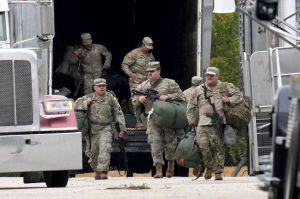
I don’t like sending out “emergency” newsletters, but I’ve had my eye on the situation in Chicago all day and tonight Texas National Guard troops arrived on Illinois soil, in defiance of the wishes of the Illinois governor and the Illinois National Guard’s adjutant general.
This moment has elevated the crisis so that it is no longer just a conflict between the federal government and a state, but between two states. We now have armed soldiers from the state of Texas eagerly volunteered by their governor to impose the president’s will on the citizens of Illinois.
I don’t want to be alarmist, but this is an emergency. It is incumbent on us to name the thing we are seeing and be unflinching as we describe it.
Military personnel in uniforms with the Texas National Guard patch are seen at the US Army Reserve Center in Elwood, Illinois, on Tuesday. Erin HooleyAP
That’s not a lot of power; but it’s the only power we have in this moment.
This newsletter relies on critical reporting being done by local journalists in Chicago. Please click on the links, follow these publications, and support them.
Today President Trump’s military invasion of Chicago crossed another Rubicon. He not only activated and took command of the Illinois National Guard, but just in case the hometown troops are not willing to do his bidding, he has shipped in National Guard troops from a politically reliable territory….
We should be exceedingly clear:
There is no crisis in Chicago that requires the National Guard. To the extent that there is civil instability in Chicago it has been caused by Trump’s surge of federal agents into the city and their lawless assault on the citizens of Chicago.
Examples of Trump’s hostile military activity in Chicago
- September 12: ICE agents shoot and kill Chicago resident Silverio Villegas González in Franklin Park. ICE claimed that González was shot after he “seriously injured” an ICE agent. But bodycam footage shows the same agent immediately after the encounter describing his injuries as “nothing major.”
- September 30: Some 300 federal agents raid an apartment building in the dead of night. Some rappel from a Black Hawk helicopter positioned over the building. They ransack apartments and detain not only children but several U.S. citizens, including one Rodrick Johnson, who spoke with Block Club Chicago:
Rodrick Johnson, who lives in the building and is a U.S. citizen, said he heard “people dropping on the roof” before FBI agents kicked in his door. He was stuffed inside a van with his neighbors for what felt like several hours until agents told them the building was clear, he said.
“They didn’t tell me why I was being detained,” Johnson said. “They left people’s doors open, firearms, money, whatever, right there in the open.”
- October 4: CPB agents shoot an unarmed woman, Marimar Martinez. They claim that she provoked them by ramming their vehicle with her car. Martinez’s lawyer tells the Chicago Sun-Times that there is bodycam footage that shows an agent turning left into Martinez’s vehicle, after which an agent says, “Do something, bitch.” The agent then gets out of the vehicle and shoots Martinez.
- October 7: A masked federal agent is caught on camera aiming a weapon at a resident who is reportedly doing nothing more than documenting his activity.
Please read the rest at The Bulwark link. it’s a very important post.
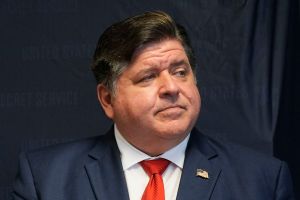
The Chicago Tribune via Yahoo News: Gov. JB Pritzker says President Trump deploying troops to Chicago due to ‘dementia’ and obsessive fixations.
In a scathing critique of President Donald Trump, Gov. JB Pritzker on Tuesday accused the Republican president of deploying National Guard troops to the Democratic cities of Chicago and Portland based on fixations that stem in part from his being mentally impaired.
“This is a man who’s suffering dementia,” Pritzker said in a telephone interview with the Tribune. “This is a man who has something stuck in his head. He can’t get it out of his head. He doesn’t read. He doesn’t know anything that’s up to date. It’s just something in the recesses of his brain that is effectuating to have him call out these cities.
“And then, unfortunately, he has the power of the military, the power of the federal government to do his bidding, and that’s what he’s doing.”
Illinois Gov. JB Pritzker
The governor’s comments came as National Guard troops from Texas were assembling at a U.S. Army Reserve training center in far southwest suburban Elwood and Trump’s administration was moving forward with deploying 300 members of the Illinois National Guard for at least 60 days over the vocal and legal objections of Pritzker and other local elected leaders.
The Trump administration has said the troops are needed to protect federal agents and facilities involved in its ongoing deportation surge and has sought to do much the same in Portland, Oregon, though those efforts have been stymied so far by temporary court rulings. A federal judge in Chicago is expected to hold a hearing this week over the legal effort by Illinois and Chicago to block the deployments, which Pritzker and other local officials say is not only unnecessary but a violation of the Posse Comitatus Act that prohibits the use of U.S. military assets from taking part in law enforcement actions on domestic soil.
During the interview, Pritzker — who has been one of Trump’s harshest critics and is a potential 2028 presidential Democratic candidate — said the courts will play an integral role in challenging Trump’s efforts in Illinois and across the nation.
“We’re not going to go to war between the state of Illinois and the federal government, not taking up arms against the federal government,” Pritzker said. “But we are monitoring everything they’re doing, and using that monitoring to win in court.”
Illinois state Rep. Lilian Jiménez, District 4 at MSNBC: Trump is trying to make an example out of Chicago. We won’t stand for it.
While many families prepared their children for school Monday morning, Sept. 29, I woke up to calls from parents in Chicago too afraid to leave their homes. Rumors of immigration enforcement were spreading, and the simple act of walking a child to school felt like too much of a risk. I am a mother and an Illinois state representative, and these calls hit me in two places at once: as a parent who wants my child to grow up free from fear and as an elected official entrusted to protect the rights and dignity of my community.
Some of our worst fears were realized the next day when, as NBC Chicago reported, ICE agents rappelled from helicopters onto a housing complex during a 1 a.m. raid and zip-tied people, including U.S. citizens and children, in the South Shore neighborhood. That’s near where my family has lived for decades. By all accounts the federal administration has used this exaggerated staging as a media opportunity without producing a shred of evidence that its use of excessive force was justified.
By Friday, the scene in my Chicago neighborhood included helicopters flying above and armed convoys patrolling our streets. In broad daylight, federal agents released multiple tear gas canisters into a crowd across the street from an elementary school. In a second instance, as a local TV station reported, agents released tear gas outside an emergency room in my community, and Alderwoman Jessie Fuentes, our City Council representative, posted a video of being handcuffed by ICE briefly after she questioned agents at that medical facility.
That is what makes President Donald Trump’s latest threat, that Chicago is one of the cities he wants to use as a “training ground” for the military, even more chilling. Trump is not only scapegoating our city and other cities for political gain; he is openly plotting to experiment on working families, immigrants and communities of color by turning our neighborhoods into staging grounds for authoritarian force. We must not turn away at this moment.
I know what militarization looks like, and it is not safety, it is fear. It looks like children crying when their parents don’t come home. It looks like families going underground, skipping school or work, because they are terrified of who might be waiting outside their doors. Militarization leads to trauma that lingers long after the raids end.
I know how this feels because I grew up with a mother who was undocumented. I grew up not knowing whether my mother would be there when I came home from school. I also know what real safety looks like. It looks like parents walking their kids to school. It’s stable housing, a living wage, health care and classrooms where children can learn without fear.
CNN: Trump calls for jailing of Illinois leaders as court showdowns over troop deployments near.
The running battle between President Donald Trump and Democratic-led cities is nearing a new inflection point, as National Guard troops gather near Chicago while lawyers prepare for critical court hearings 2,000 miles away from each other.
The Trump administration is tying planned deployments in Chicago and Portland, Oregon, to increasingly tense protests outside Immigration and Customs Enforcement facilities, as well as citing the shooting at an ICE facility in Dallas. Two ICE detainees were killed there. Trump has called it an attack on law enforcement.
The president ramped up his criticism Wednesday of Chicago Mayor Brandon Johnson and Democratic Gov. JB Pritzker, who called the Guard call-up “Trump’s invasion” over the weekend.
“Chicago Mayor should be in jail for failing to protect Ice Officers! Governor Pritzker also!” Trump wrote on Truth Social.
One more before I wrap this up.
Tom Nichols at The Atlantic (gift link): The Civil-Military Crisis Is Here. The leaders of the U.S. military may soon face a terrible decision.
To capture a democratic nation, authoritarians must control three sources of power: the intelligence agencies, the justice system, and the military. President Donald Trump and his circle of would-be autocrats have made rapid progress toward seizing these institutions and detaching them from the Constitution and rule of law. The intelligence community has effectively been muzzled, and the nation’s top lawyers and cops are being purged and replaced with loyalist hacks.
Only the military remains outside Trump’s grip. Despite the firing of several top officers—and Trump’s threat to fire more—the U.S. armed forces are still led by generals and admirals whose oath is to the Constitution, not the commander in chief. But for how long?
Trump and his valet at the Defense Department, Secretary of Physical Training Pete Hegseth, are now making a dedicated run at turning the men and women of the armed forces into Trump’s personal and partisan army. In his first term, Trump regularly violated the sacred American tradition of the military’s political neutrality, but people around him—including retired and active-duty generals such as James Mattis, John Kelly, and Mark Milley—restrained some of his worst impulses. Now no one is left to stop him: The president learned from his first-term struggles and this time has surrounded himself with a Cabinet of sycophants and ideologues rather than advisers, especially those at the Pentagon. He has declared war on Chicago; called Portland, Oregon, a “war zone”; and referred to his political opponents as “the enemy from within.” Trump clearly wants to use military power to exert more control over the American people, and soon, top U.S.-military commanders may have to decide whether they will refuse such orders from the commander in chief. The greatest crisis of American civil-military relations in modern history is now under way.
I write these words with great trepidation. When I was a professor at the Naval War College, I gave lectures to American military officers about the sturdiness of civil-military relations in the United States, a remarkable historical achievement that has allowed the most powerful military in the world to serve democracy without being a threat to it. I so revered this system that I went to Moscow just before the fall of the U.S.S.R. and told an audience of Soviet military officers that they should look to the American military as a model for how to disentangle themselves from the Communist Party and Kremlin politics. I regularly reminded both my military students and civilian audiences that they had good reason to have faith in American institutions and the constitutional loyalty of U.S. civilian and military leaders.
This new and dangerous moment has arrived for many reasons, including Trump’s antics in front of young soldiers and sailors, through which he has succeeded in pulling many of them into displays of partisan behavior that are both an insult to American civil-military traditions and a violation of military regulations. Senior military leaders should have stepped in to prevent Trump from turning addresses at Fort Bragg and Naval Station Norfolk into political rallies; the silence of the Army and Navy secretaries, the Joint Chiefs of Staff, and some top generals and admirals is appalling. To their credit, those same officers listened impassively as Trump and Hegseth subjected them to political rants during a meeting at Quantico last week. But young enlisted people and their immediate superiors take their cues from the top, and one day of decorum from the high command cannot reverse Trump’s influence on the rank and file.
Please use the gift link to read the rest. We are in deep deep trouble, folks.
That’s it for me today. Please take care of yourselves, and don’t give up!
Lazy Caturday Reads: Literary Cats Along With Some News
Posted: October 4, 2025 Filed under: just because | Tags: 82nd Airborne, cat art, caturday, deportations, Donald Trump, drone strikes on boats, extrajudicial executions, Howard Lutnick, immigration, Jeffrey Epstein, Kilmar Abrego Garcia, literary cats, Mark Hertling, Miranda Devine, Pete Hegseth, Portland OR, Signal app leaks, Venezuela 5 CommentsGood Afternoon!!

Haruki Murakami with Kafka
It’s the end of another week in which lots of bad things happened. Frankly, I can’t keep track of everything anymore. Here are some of the stories that interested me most.
I’m still recovering from Tuesday’s insane performances by Pete Hegseth and Donald Trump in front of 800 military leaders whom they forced to travel to Quantico Marine Corps base from all over the world. Former Lt. General Mark Hertling writes about it at The Bulwark: Questions After Quantico.
THE SPEECHES ON TUESDAY IN QUANTICO—by Chairman of the Joint Chiefs of Staff Gen. Dan Caine, Secretary of Defense (or War, as he would have it) Pete Hegseth, and President Donald Trump—were over in just two hours. But for the generals, admirals, and senior enlisted who left that auditorium and started their long flights home to the Pacific, Europe, and the Middle East, those speeches were just the beginning. Because when Washington speaks—especially when it speaks with bluster, ambiguity, or hostility—it is the commanders who must translate to their troops, steady their units, and respond to the challenges of new orders.
I’ve been that commander. I’ve flown back overnight from Washington to Germany, walked into my headquarters in Heidelberg, and faced staff officers and soldiers who were waiting—not for a policy memo, not for another directive from the Pentagon, but for their commander to tell them what it all meant and to give them implementing instructions. After Tuesday’s meeting, they will want to know what things they will have to change, if their country still believes in them, if the oath they swore still anchors their service, if the mission they’re preparing for or executing still has clarity and legitimacy….
…[T]he shockwaves of the Quantico gathering are only now beginning to reverberate through bases in Europe, the Pacific, the Middle East, and beyond. Because when those commanders and their enlisted advisors returned to their posts, bases, air wings, or carrier strike groups, the questions began.
As the speech was being publicly broadcast, female soldiers living on the Kasernes of Germany watching on the Armed Forces Network were asking one another: Does this mean our opportunities to serve in jobs we love are closing again? Will I still be allowed to compete fairly for assignments and promotions? Black soldiers, weary and wary of subtle slights and systemic hurdles, will wonder if the new emphasis on “appearance” and “discipline” means a return to the days when shaving profiles for painful and unsightly face “bumps” were treated as liabilities instead of as a need for legitimate accommodations. Sikh soldiers, who after long battles were only recently granted the right to wear turbans and keep beards as part of a commonsense accommodation for their faith, will now wonder if that right will again be questioned. For each of them, their unique individuality and love for service in uniform are inseparable.
And gay and transgender service members—many of whom finally felt able to serve openly over the last decade—felt the floor shift beneath them yet again. Do I need to start making plans to leave? one staff sergeant might quietly ask her first sergeant. Or do I just keep my head down and hope this storm passes? Keeping your head down is sometimes needed in combat when engaging with the enemy; it’s not something we want from our soldiers who are living their Army value of “personal courage.”
There will be broader, increasingly gnawing concerns for the staffs: Are we really being asked to prepare for missions inside our own cities? What happens if peaceful protesters are described as “enemies”? Where does that leave the oath we swore—to the Constitution, not to a man or a party?
These aren’t abstract policy questions. They will be whispered in barracks hallways, posed after hours in a motor pool, or texted late at night to a trusted squad leader. They are the lived reality of a military force watching politics intrude on their profession. And with each one, there is the question of degraded morale, an erosion of trust.
How will commanders handle these overwhelming questions? Read what Hertling has to say about it at The Bulwark.

Patricia HIghsmith with Ripley
I’m also still gloating about the latest exploit by Trump’s stupidest cabinet member (and that’s really saying something, considering that group of morons) Howard Lutnik. Lutnick gave an interview to a podcast hosted by Miranda Devine of the New York Post in which he told personal stories about Jeffrey Epstein, who was once Lutnick’s next door neighbor in New York City. Could there be anything more guaranteed to enrage Trump?
Josh Christenson at The New York Post: Howard Lutnick tells ‘Pod Force One’ ex-neighbor Jeffrey Epstein showed off massage room, made creepy comment during townhouse tour.
Commerce Secretary Howard Lutnick, in a notable break with the Department of Justice, claimed late pedophile Jeffrey Epstein was “the greatest blackmailer ever” — and may have traded the feds video of his rich and well-connected associates getting massages from young women in exchange for a controversial 2008 plea deal.
Lutnick made the shocking allegations to The Post’s Miranda Devine on the latest episode of “Pod Force One,” out now.
The 64-year-old cabinet secretary said Epstein himself showed off his notorious “massage room” while giving Lutnick and his wife a tour of the infamous East 71st Street townhouse after the couple moved in next door to the since-disgraced financier in 2005.
“I say to him, ‘Massage table in the middle of your house? How often do you have a massage?’” Lutnick recalled. “And he says, ‘Every day.’ And then he gets, like weirdly close to me, and he says, ‘And the right kind of massage.’”
Lutnick said he and his wife quickly excused themselves and left Epstein’s home, “and in the six to eight steps it takes to get from his house to my house, my wife and I decided that I will never be in the room with that disgusting person ever again.”
When asked by Devine whether Epstein’s rich and powerful associates — including the likes of Prince Andrew and Microsoft founder Bill Gates — “could hang around him and not see what you saw, or did they see it and ignore it,” Lutnick responded, “They participated.”
“They get a massage, that’s what his MO was. ‘Get a massage, get a massage,’ and what happened in that massage room, I assume, was on video,” the commerce secretary went on. “This guy was the greatest blackmailer ever, blackmailed people. That’s how he had money.” [….]
Lutnick added: “I assume way back when they traded those videos in exchange for him getting that 18-month sentence, which allowed him to have visits and be out of jail. I mean, he’s a serial sex offender. How could he get 18 months and be able to go to his office during the day and have visitors and stuff? There must have been a trade.
“So, my assumption, I have no knowledge, but my assumption is there was a trade for the videos, because there were people on those videos,” he also claimed.
Hahahaha!! Trump has tried so hard to distract from the Epstein files. He was pals for years with the guy who nauseated Howard Lutnick after one brief interaction. Now Democrats in the Congress want Lutnick to testify for their committees. You can watch the video of the Lutnick interview at the NY Post link.

Gore Vidal with Caligula
Swapna Venugopal Ramaswamy at USA Today: Trump’s commerce secretary calls Jeffrey Epstein the ‘greatest blackmailer.’
For months, President Donald Trump has pleaded with his supporters to move on from the Jeffrey Epstein controversy − calling it a “Democratic hoax” − even as he faces growing calls from Congress and many in his own MAGA base for more disclosure on the jet-setting sex offender.
But Trump’s fellow billionaire and Commerce secretary, Howard Lutnick, apparently didn’t get the memo.
Lutnick held forth on a recent podcast about how he found Epstein, who was a close friend of Trump’s for more than a decade, to be “gross” and believed he was a “blackmailer.”
“He was gross,” said Lutnick, in a Oct.1 podcast interview with New York Post’s Miranda Devine. Lutnick described Epstein as the “greatest blackmailer ever” and suggested he had used compromising videos of prominent men to get a 2008 sweetheart deal in Florida amid a child prostitution investigation.
Those comments sharply differ from a memo released by the Justice Department and FBI in July which said that there was no “credible evidence found that Epstein blackmailed prominent individuals” or that he kept an “incriminating client list.”
One more on Lutnick by Asawin Suebsaeng at Zeteo: ‘F***ing Dumbass’: Trump Officials Want Howard Lutnick Sidelined After Epstein Comments.
Top officials in Donald Trump’s administration are furious with Commerce Secretary Howard Lutnick, knowledgeable sources tell Zeteo, after he went on a tabloid podcast this week and blabbed about the one sex criminal who Team Trump wants to talk about least: Jeffrey Epstein. Not only that, but Lutnick went off script and undermined the government’s entire story about the late Epstein.
For months, President Trump and the highest levels of his administration have been trying to sell the public and his MAGA supporters on their conclusion that Epstein, the notorious sex offender and former Trump pal,did not run a secret sexual-blackmail operation targeting wealthy, powerful elites.
Sylvia Plath with “Daddy”
On Wednesday morning, the New York Post published parts of its podcast sit-down with Lutnick, who was once Epstein’s neighbor. The Trump Cabinet member told the Post about his tour of Epstein’s townhouse, where Epstein showed him his “massage room.” Lutnick said he was quickly “disgusted,” before asserting that Epstein’s rich and famous associates not only knew about his bad behavior but “participated.” He called Epstein a “blackmailer,” something the Trump administration strenuously denies.
Several senior Trump officials, some of whom were responsible for carefully curating the messaging regarding the administration’s decision to end its Epstein investigation, were apoplectic on Wednesday, bemoaning to one another about why Lutnick is still employed by the president and why the commerce secretary is allowed to do media appearances, four senior Trump administration appointees tell Zeteo.
“That fucking dumbass,” one of the senior Trump administration officials told Zeteo on Wednesday, after seeing a clip of Lutnick riffing on Epstein. “I’ve worked with him and can tell you he doesn’t think he did anything negative… That’s not how he thinks. He just talks and talks, and doesn’t care what unhelpful bullshit comes out.”

Well, Trump appointed that dumbass, along with a bunch of other idiots in his cabinet.
In more serious news, Trump is still murdering people in small boats off the coast of Venezuela.
Kathryn Armstrong at BBC News: Four killed in latest US strike on alleged drug vessel near Venezuela.
US forces have killed four people in an attack on a boat off the coast of Venezuela that was allegedly trafficking drugs, Defence Secretary Pete Hegseth says.
“The strike was conducted in international waters just off the coast of Venezuela while the vessel was transporting substantial amounts of narcotics – headed to America to poison our people,” Hegseth wrote in a post on X.
It is the latest in a number of recent deadly strikes that the US has carried out on boats in international waters it says are involved in “narco-trafficking”.
The strikes have attracted condemnation in countries including Venezuela and Colombia, with some international lawyers describing the strikes as a breach of international law.
Hegseth said the attack took place in the US Southern Command’s area of responsibility, which covers most of South America and the Caribbean.
“Our intelligence, without a doubt, confirmed that this vessel was trafficking narcotics, the people onboard were narco-terrorists, and they were operating on a known narco-trafficking transit route,” Hegseth said about Friday’s attack.
“These strikes will continue until the attacks on the American people are over!!!!”
US President Trump also confirmed the strike on his Truth Social platform, saying that the boat was carrying enough drugs “to kill 25 to 50 thousand people”.
However, the US has not provided evidence for its claims or any information about the identities of those on board.
An opinion piece from W.J. Hennigan at The New York Times (gift link): If We’re at War, Americans Deserve to Know More About It.
The Trump administration told Congress this week that the United States is engaged in an “armed conflict” with drug cartels.
The average American knows vanishingly little about what its government seeks to accomplish in this fight. Citizens aren’t in possession of the metrics by which to judge the administration’s pursuit of those goals.
George Bernard Shaw with Pygmalian
We haven’t been told which specific drugs they seek to stop. We haven’t been told much about which specific groups they seek to destroy. We haven’t been told much about what legal authorities they are acting on.
Withholding this information from the American public is the administration’s way to escape scrutiny. At the very least, the country deserves some evidence of whether the military operation is working.
If stopping the flow of drugs is the goal, the actions taken so far have been unpersuasive. American forces, at the direction of President Trump, executed a lethal airstrike on Friday on a boat off Venezuela, killing four people on board. Defense Secretary Pete Hegseth posted a video of the attack on X, saying, “The vessel was transporting substantial amounts of narcotics – headed to America to poison our people,” adding that it was “affiliated with Designated Terrorist Organizations.”
This is the sort of vague language the administration has used in its campaign over the past two months as it directs the military to sporadically launch airstrikes — now totaling four — against boats in the region that the government says are running drugs. No corresponding evidence has been provided to the public to support the actions. The operation amounts to extrajudicial executions, according to U.N. officials.

A bit more:
Without delving into the strikes’ questionable legality again, the bombing runs fall well short of decisive military actions. It would be hard to convince anyone that blowing up a few motorboats — and all the people aboard them — will prove conclusive in winning the half-century-old war on drugs.
For one thing, this isn’t how the Pentagon combats enemy networks. Say what you will about the many failures of America’s global war on terrorism, but it’s undeniable the U.S. military became frighteningly proficient at penetrating and taking apart organizations over the past quarter-century.
Instead of systematically killing low- and midlevel henchmen in pinprick airstrikes, U.S. forces learned that more information could be gleaned through capturing those suspects and gathering, bagging and tagging their personal electronics for intelligence analysis. A phone from a suspect’s pocket in Iraq, for instance, would often include enough information, such as phone numbers and text conversations, so that a follow-on raid on other operatives could be planned. This is how U.S. forces mapped out countless terrorist groups’ leadership ranks along with the fighters under their command.
The infrastructure for ship interdictions already exists in the Caribbean. The U.S. Coast Guard and Navy have long interdicted vessels that they suspected of drug running.
Why the administration has opted to blow apart potential leads and sources instead of exploiting them is anyone’s guess.
These are serious questions, but Trump and Hegseth aren’t serious people. All they are interested in is blowing people and boats up and posting videos of the action. It’s disgusting that they are getting away with doing this in our name. You can use the gift link to read the rest of this thoughtful article.
The Abrego Garcia case is still going on, and there was a notable ruling yesterday.
Alan Feuer at The New York Times (gift link): Judge Finds ‘Likelihood’ That Charges Against Abrego Garcia Are Vindictive.
A federal judge in Nashville ruled on Friday that there was a “realistic likelihood” that the indictment filed against Kilmar Armando Abrego Garcia, the immigrant who was wrongfully deported to El Salvador in March and then brought back to face criminal charges, amounted to a vindictive prosecution by the Justice Department.
The ruling was an astonishing rebuke of both the department and some of its top officials, including Todd Blanche, the deputy attorney general. Mr. Blanche was called out by name in the ruling for remarks he made about Mr. Abrego Garcia’s case on the same day in June he was returned to U.S. soil to face the charges in Federal District Court in Nashville.
Doris Lessing with Black Madonna
In a 16-page decision, Judge Waverly D. Crenshaw Jr. said there was evidence that Mr. Abrego Garcia’s prosecution “may stem from retaliation” by the Justice Department and the Department of Homeland Security. Judge Crenshaw found that Trump officials may have sought to punish Mr. Abrego Garcia for having filed a lawsuit successfully challenging his initial “unlawful deportation” to El Salvador.
Moreover, Judge Crenshaw indicated how he was serious about getting to the bottom of the issue of vindictiveness. He said he intended to permit Mr. Abrego Garcia’s lawyers to pry, at least in part, into the Trump administration’s process of deciding to bring an indictment in the first place and how the charges related to the deportation case.
Vindictive prosecution motions are exceedingly difficult to win because of the high threshold required to prove that prosecutors acted improperly by filing criminal charges. Under the law, cases can be considered vindictive only if defendants can show that prosecutors displayed animus toward them while they were seeking to vindicate their rights in court, and that the charges would not have been brought except for the existence of that animus.
While Judge Crenshaw has not yet made a final decision on the issue of vindictiveness, the fact that he is even considering doing so in Mr. Abrego Garcia’s case is a hugely embarrassing blow to the Trump administration. From the moment Trump officials acknowledged that they had mistakenly expelled Mr. Abrego Garcia to El Salvador, President Trump and his top aides began a relentless barrage of attacks against him, calling him a violent member of the street gang MS-13, a wife beater and even a terrorist, effectively blaming him for being the victim of their own administrative error.
The judge’s ruling highlighted the ways in which the habit many Trump officials have of speaking out of court about legal cases has — or could — come back to haunt them.

Use the gift link to read the rest if you’re intersted.
Trump has been talking about sending troops to cities governed by Democrats. Lately he’s been focusing on Portland, Oregon. This is just beyond belief. And we know about it because of another leak from Signal.
Catherine Bouris at The Daily Beast: Trump Goon Spills Bonkers Plan to Deploy 82nd Airborne to Blue City.
A senior White House official accidentally disclosed that the Trump administration was considering deploying an elite army strike force into Portland by using Signal in a public place.
The Minnesota Star Tribune reported Friday that Anthony Salisbury, one of Stephen Miller’s top deputies, was observed discussing the plans via Signal in view of members of the public while traveling in Minnesota. The newspaper was then contacted by one member of the public who was troubled to see sensitive military plans discussed so openly.
Aldous Huxley with Limbo
In the messages, senior White House officials discussed the potential deployment of the Army’s 82nd Airborne Division, an elite unit that specializes in parachuting into hostile territory. The division has been deployed in both world wars, including the Battle of the Bulge, as well as Vietnam and Afghanistan.
Across several conversations, the Star Tribune reports, Salisbury spoke about a range of matters with Pete Hegseth adviser Patrick Weaver as well as other officials.
In one of the messages, Weaver revealed that Hegseth wanted Trump to explicitly instruct him to send soldiers to Portland.
“Between you and I, I think Pete just wants the top cover from the boss if anything goes sideways with the troops there,” Weaver reportedly said.
Noting the potentially disastrous optics around sending an elite division into an American city, Weaver told Salisbury, “82nd is like our top tier [quick reaction force] for abroad. So it will cause a lot of headlines. Probably why he wants potus to tell him to do it.”
Ultimately, Trump opted to send 200 National Guard soldiers into Portland, following a similar playbook used in other Democrat-controlled cities like Los Angeles and Washington D.C. Both the state of Oregon and the city of Portland have sued to stop the deployment.

More interesting reads to check out:
Jonathan V. Last at The Bulwark: Here’s How Trump Loses the Shutdown. God help us but Gavin Newsom is the only Democrat who understands power.
Jens Stoltenberg at The Guardian: ‘I’m leaving,’ Trump said. ‘There’s no reason to be here any more’: inside the meeting that brought Nato to the brink (Former secretary general Jens Stoltenberg recalls the rollercoaster ride of dealing with Donald Trump – and how close the US president brought the alliance to the point of collapse.)
The Independent: ‘It’s not a good place right now’: CBS News staffers are ‘literally freaking out’ about Bari Weiss taking over newsroom.
The New York Times: Supreme Court Lets Trump Revoke Deportation Protections for Venezuelans.
The Guardian: Body slamming, teargas and pepper balls: viral videos show Ice using extreme force in Chicago.
Those are the stories that interested me today. What do you think? What’s on your mind?
Wednesday Reads: Government Shuts Down; Trump Plans To Use Military Against Americans.
Posted: October 1, 2025 Filed under: just because | Tags: DOD reactions to Hegseth speech, Donald Trump, government shutdown 2025, Pete Hegseth, U.S. Military, veterans reactions to Hegseth/Trump speeches 12 CommentsGood Morning!!
I suppose the top story is the government shutdown that began last night at midnight, but I think Trump’s unhinged speech to 800 top military officers is even more urgent. The unprecedented gathering of military leaders, who were forced to travel to Virginia from all over the world, began with an insulting presentation by Secretary of Defense Pete Hegseth and ended with an utterly insane speech by Trump. I watched quite a bit of it with the sound off. I’d much rather read closed captions than listen to Hegseth’s or Trump’s voices.
Let’s get the shutdown out of the way first. The government shut down at midnight last night. Here’s what’s happening now:
AP: Government shutdown begins as the nation faces a new period of uncertainty.
Plunged into a government shutdown, the U.S. is confronting a fresh cycle of uncertainty after President Donald Trump and Congress failed to strike an agreement to keep government programs and services running by Wednesday’s deadline.
Roughly 750,000 federal workers are expected to be furloughed, some potentially fired by Trump’s Republican administration. Many offices will be shuttered, perhaps permanently, as Trump vows to “do things that are irreversible, that are bad” as retribution. His deportation agenda is expected to run full speed ahead, while education, environmental and other services sputter. The economic fallout is expected to ripple nationwide.
“We don’t want it to shut down,” Trump said at the White House before the midnight deadline.
But the president, who met privately with congressional leadership this week, appeared unable to negotiate any deal between Democrats and Republicans to prevent that outcome.
This is the third time Trump has presided over a federal funding lapse, the first since his return to the White House this year, in a remarkable record that underscores the polarizing divide over budget priorities and a political climate that rewards hard-line positions rather than more traditional compromises.
Marisa Kabas at The Handbasket: Trump mandates all federal agencies send email blaming Dems for potential gov’t shutdown.
As the federal government teeters on the brink of a shutdown, workers across many agencies received identical emails late Tuesday afternoon blaming Democrats for the possibility. The Handbasket was the first to learn that the message was mandated by the White House Office of Management and Budget (OMB) via an intra-agency email to leadership and reinforced on a subsequent call. And there was one clear stipulation: Absolutely no modifications to the language.
At the time of publication, I was able to confirm at least 16 federal agencies had received the OMB email ahead of the midnight funding deadline, including the Departments of State, Health and Human Services, and Interior. Here is the text of the message shared with me by numerous federal workers alarmed by its contents (emphasis mine):
“President Trump opposes a government shutdown, and strongly supports the enactment of H.R. 5371, which is a clean Continuing Resolution to fund the government through November 21, and already passed the U.S. House of Representatives. Unfortunately, Democrats are blocking this Continuing Resolution in the U.S. Senate due to unrelated policy demands. If Congressional Democrats maintain their current posture and refuse to pass a clean Continuing Resolution to keep the government funded before midnight on September 30, 2025, federal appropriated funding will lapse.
A funding lapse will result in certain government activities ceasing due to a lack of appropriated funding. In addition, designated pre-notified employees of this agency would be temporarily furloughed. P.L. 116-1 would apply.
The agency has contingency plans in place for executing an orderly shutdown of activities that would be affected by any lapse in appropriations forced by Congressional Democrats. Further Information about those plans will be distributed should a lapse occur.”
The marching orders went out to agencies’ leadership via email at 1:30pm ET, a government source confirms. Then on a 3pm intra-agency call with around 300 participants, a member of OMB leadership reinforced the mandatory nature of the note and stressed that no modifications could be made to the message.
During any other period of recent American history, this email would have been deemed a flagrant violation of the Hatch Act. The law was passed, according to the US Office of Special Counsel website, “to ensure that federal programs are administered in a nonpartisan fashion, to protect federal employees from political coercion in the workplace, and to ensure that federal employees are advanced based on merit and not based on political affiliation.”
In the past, federal workers could be reprimanded for something as simple as a political social media post. But if the past eight months have shown us anything, it’s that this administration feels unencumbered by the law.
The Guardian is running live updates on the shutdown. Read it at the link if you’re interested.
Reactions to Hegseth’s presentation and Trump’s speech:
Here’s a summary of Hegseth’s speech by Heather Cox Richardson at Letters from an American.
Last Thursday, September 25, Defense Secretary Pete Hegseth suddenly announced he was calling about 800 of the nation’s top military generals and admirals, along with their top enlisted advisors, to meet at Marine Corps Base Quantico, in Virginia, today. Such a meeting was unprecedented, and its suddenness meant military leaders across the world had to drop everything to run to Washington, D.C., at enormous financial cost for the country. Under those extraordinary circumstances, speculation about what Hegseth intended to say or do at the meeting has been widespread.
Now we know. This morning, in front of a giant flag backdrop that echoed the opening scene from the movie Patton, Hegseth harangued the career military leaders, pacing as if he were giving a TED talk. The event was streamed live to the public, making it clear that the hurry to get everyone to Washington, D.C., in person was not about secrecy.
Pete Hegseth lectures top military leaders.
In his speech, Hegseth reiterated his vision of a military based in what he calls the “warrior ethos.” Ignoring the military’s mission of preventing wars through deterrence, its professional and highly educated officer corps, and its modern structure as a triumph of logistics, he told the military leaders that today was “the liberation of America’s warriors, in name, in deed and in authorities. You kill people and break things for a living. You are not politically correct and don’t necessarily belong always in polite society.”
He claimed that “we have the strongest, most powerful, most lethal, and most prepared military on the planet. That is true, full stop. Nobody can touch us. It’s not even close.” But then Hegseth, who became defense secretary from his position as a weekend host on the Fox News Channel, complained that “our warriors” are not “led by the most capable and qualified combat leaders.”
He claimed that “foolish and reckless politicians” had forced the military “to focus on the wrong things” and that it had promoted too many leaders “based on their race, based on gender quotas.” “We became the woke department,” he said. “We are done with that sh*t.” He is loosening rules about hazing and bullying, changing physical fitness reforms with the idea that they will get women out of combat roles, and prohibiting beards, which will force Black men out of the service, for Black men suffer at a much higher rate than white men do from a chronic skin condition that makes shaving painful and can cause scarring.
He also said he was tired of seeing “fat troops” and “fat generals and admirals,” and that he would institute a second physical fitness test every year.
“[I]f the words I’m speaking today are making your heart sink,” Hegseth said, “then you should do the honorable thing and resign.”
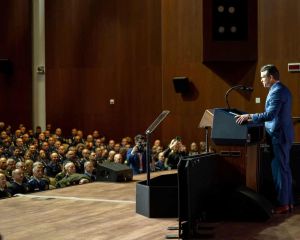
Trump’s speech was largely incoherent and included many of his familiar gripes, but its basic purpose came through loud and clear. He doesn’t believe the U.S. military should be dealing with foreign threats. Instead, he plans to use active duty military troops to police the U.S. Southern border and also to attack “the enemy within”–protesters in Democratic U.S. cities.
The military audience sat through these speeches in stone-faced silence.
Reactions to Hegseth’s presentation and Trump’s speech:
Longtime Pentagon reporter Helene Cooper said that she can’t find any military officials who attended the meeting in Virginia with President Donald Trump and Secretary Pete Hegseth and liked what they heard.
“I have yet to find a single military official who was in the audience today who thought that this was a good presentation,” she told MSNBC on Tuesday afternoon.
“All I’ve had from them so far, from the people I’ve talked to, is a combination of disbelief that some of them were made to fly from, some of them, Asia, from all over the world … all the way to Quanico to listen to the same familiar type of culture war complaints that we’ve been having since Trump was reelected,” she added, calling Trump’s remarks a “campaign-style stump speech.”
“Nothing that was said today could not have been put in an email or in a directive. So there’s that, to begin with. There’s also the fact that so much of this was partisan, and this is a military that is supposed to present itself as nonpartisan. So you didn’t hear the kind of cheering that we usually get, because President Trump is used to playing for the type of crowds that favor him,” Cooper explained. “And so he’s not very used to performing in front of an audience that’s just giving, looking back stone-faced. But that’s what you were getting from these generals.”
The other thing she noted is that she’s gotten “so many emails from women in the military” who are seeing this as a message “that they are not welcome.”
Tom Nichols at The Atlantic (gift link): The Commander in Chief Is Not Okay.
The president talked at length, and his comments should have confirmed to even the most sympathetic observer that he is, as the kids say, not okay. Several of Hegseth’s people said in advance of the senior-officer conclave that its goal was to energize America’s top military leaders and get them to focus on Hegseth’s vision for a new Department of War. But the generals and admirals should be forgiven if they walked out of the auditorium and wondered: What on earth is wrong with the commander in chief?
Trump seemed quieter and more confused than usual; he is not accustomed to audiences who do not clap and react to obvious applause lines. “I’ve never walked into a room so silent before,” he said at the outset. (Hegseth had the same awkward problem earlier, waiting for laughs and applause that never came.) The president announced his participation only days ago, and he certainly seemed unprepared.
Trump started rambling right out of the gate. But first, the president channeled his inner Jeb Bush, asking the officers to clap—but, you know, only if they felt like it.
Just have a good time. And if you want to applaud, you applaud. And if you want to do anything you want, you can do anything you want. And if you don’t like what I’m saying, you can leave the room. Of course, there goes your rank; there goes your future.
Laughs rippled through the room.
Trump addresses top military leaders.
Trump then wandered around, lost in the halls of history. He talked about how the Department of War was renamed in the 1950s. (It was in the late 1940s.) At one point, he mentioned that the Atomic Energy Commission had confirmed that his strike on Iran had destroyed Tehran’s nuclear program. (Iran still has a nuclear program, and the AEC hasn’t existed since the mid-’70s.) He whined about the “Gulf of America” and how he beat the Associated Press in court on the issue. (The case is still ongoing.) The Israeli-Palestinian conflict? “I said”—he did not identify to whom—“‘How long have you been fighting?’ ‘Three thousand years, sir.’ That’s a long time. But we got it, I think, settled.” [….]
And so it went, as Trump recycled old rally speeches, full of his usual grievances, lies, and misrepresentations; his obsessions with former Presidents Joe Biden and Barack Obama; and his sour disappointment in the Nobel Prize committee. (“They’ll give it to some guy that didn’t do a damn thing,” he said.) He congratulated himself on tariffs, noting that the money could buy a lot of battleships, “to use an old term.” And come to think of it, he said, maybe America should build battleships again, from steel, not that papier-mâché and aluminum stuff the Navy is apparently using now: “Aluminum that melts if it looks at a missile coming at it. It starts melting as the missile is about two miles away.”
Ohhhkayyyy….
As comical as many of Trump’s comments were, the president’s nakedly partisan appeal to U.S. military officers was a violation of every standard of American civil-military relations, and exactly what George Washington feared could happen with an unscrupulous commander in chief. The most ominous part of his speech came when he told the military officers that they would be part of the solution to domestic threats, fighting the “enemy from within.” He added, almost as a kind of trollish afterthought, that he’d told Hegseth, “We should use some of these dangerous cities as training grounds for our military—National Guard, but military—because we’re going into Chicago very soon. That’s a big city with an incompetent governor. Stupid governor.”
This farrago of fantasy, menace, and autocratic peacocking is the kind of thing that the late Senator Daniel Patrick Moynihan evocatively called “boob bait for the Bubbas” and that George Orwell might have called “prolefeed.” It’s one thing to serve it up to an adoring MAGA crowd: They know that most of it is nonsense and only some of it is real. They find it entertaining, and they can take or leave as much of Trump’s rhetorical junk-food buffet as they would like. It is another thing entirely to aim this kind of sludge at military officers, who are trained and acculturated to treat every word from the president with respect, and to regard his thoughts as policy.
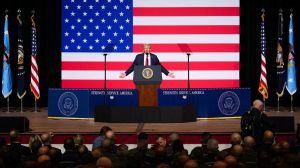
David Kurtz at TPM Morning Memo: The Test of Our Time: Even the Military Can’t Resist Trump on Its Own Forever.
In targeting the military’s professionalism and nonpartisanship, Trump laid the groundwork for further lawless domestic use of the military, including illegally in law enforcement. It was a harbinger of a more muscular and oppressive authoritarianism than Trump has mustered so far.
As I watched the flag officers flown in from around the world sit uncomfortably for absurd speeches by the president and his callow defense secretary, I came to see it as the closest Trump could get to a mass firing of the officer corps.
Imagine the other groups of federal workers that Trump has targeted sitting in those seats: government scientists, foreign aid experts, prosecutors and investigators, inspectors and regulators, human resource professionals. They were summarily fired, often in violation of the law, but the generals and admirals are more untouchable than that. Not entirely off limits, as we already seen with some Pentagon terminations, especially of officers who are women or people of color. But for a variety of practical and political reasons, a sweeping purge of generals isn’t feasible.
Audience of 800 top military officers sat stone faced through Hegseth’s and Trump’s speeches.
What is feasible is is to begin to erode the military culture. To emphasize loyalty over merit. To prize fealty over competence. To punish truth-telling and reward convenient fictions. Trump touched on all of those things in a long, rambling speech that could be confused with incoherence.
Trump, as commander in chief, already had constitutional power over his captive audience of flag officers. What he proceeded to do yesterday, with Hegseth’s assistance, was to assert the power of his cult of personality over them. If that made your stomach turn, Hegseth told them, then you should resign.
As a group, this is not what the officers corps signed up for. They are steeped not just in military tradition but in civilian control of the armed services, the chain of command, laws of war, rules of engagement, and the proper role of the military in a free society. These each consist of sets of guardrails, expectations, and values that, if not anathema to Trump, are entirely foreign to him. He is indifferent to them at best, but more likely he is threatened by them because they stand outside of his own power base.
Trump has checked off the list of independent sources of political power that authoritarians typically target: the courts, law enforcement, the press, universities, and civil society organizations, amon others. The military remains a key holdout. But none of these institutions can resist alone, and even together they can’t resist forever without broad-based cultural support for them. That is going to be the real test of our time.
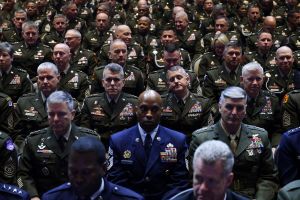
George Chidi at The Guardian: Veterans react to Hegseth’s ‘insulting’ address to generals and admirals.
Naveed Shah, a veteran and activist who served as an enlisted public affairs specialist – an army journalist – uncharacteristically found himself searching for words to describe the address of the newly styled secretary of war to flag officers on Tuesday.
“A lot of the words that are coming to me aren’t fit to print,” said Shah, policy director for Common Defense, a veterans advocacy organization. “The people in that room who have served for 20, 30-plus years in uniform do not need Pete Hegseth to tell them about warrior ethos.”
Hegseth’s hour-long Ted talk-style address touching on physical fitness, the doctrine of lethality and the perils of DEI certainly drew more attention than a policy memo might have, and perhaps more than Donald Trump’s rambling, politically charged hour-long speech that followed.
But the attention came at the cost of respect, said Dana Pittard, a retired army general who commanded soldiers in Iraq and co-author of Hunting the Caliphate.
“I thought it was insulting,” Pittard said of the address, rejecting Hegseth’s assertion that senior officers of color – like himself – had benefitted from a non-existent quota system for promotions.
Online chatter in military groups ahead of the unprecedented, secrecy-shrouded meeting of 800 generals and admirals called to Marine Corps Base Quantico in Virginia had revolved around a demand for some loyalty oath to the administration, or public firings or a declaration of war. Some described it as karmic revenge for decades of mandatory hour-long safety briefings held by unit commanders before dismissing troops for the weekend. Many also wondered if the expensive challenge to security could have been an email.
“Certainly, addressing the troops could be useful or beneficial, but to call 800-plus generals and senior enlisted advisers from around the world into this room just before a government shutdown? It’s not just bad optics or strategy,” Shah said. “A bad cold could have threatened our entire chain of command.”

That’s all I have for you today. It’s just one more scary day in the Trump regime. What do you think? What else is on your mind?
Lazy Caturday Reads: Just Another Crazy Day in the USA
Posted: September 27, 2025 Filed under: just because | Tags: cat art, caturday, Donald Trump, James Comey, Lindsey Halligan, National Weather Service, Pam Bondi, Pete Hegseth, Portland OR, Todd Blanche 6 CommentsGood Afternoon!!

Sophia and her kitten, by Lena Revo
It’s just another crazy day in the USA. Our “president” is a madman who has surrounded himself with sycophants and assorted insane groupies. The news today is just as insane as it was yesterday and the day before and the day before that. What else can I say? Here’s what’s happening as of this morning.
The top story is still the Comey indictment.
The Wall Street Journal: Trump Overcame Internal Dissent to Get His Case Against Comey.
President Trump asked advisers directly last week: Where were the prosecutions that he wanted to see?
He had been hearing from allies that the Justice Department wasn’t moving aggressively against the people who had investigated and prosecuted him, according to people familiar with the matter. Chief among them was former Federal Bureau of Investigation Director James Comey.
Senior Justice Department officials told him the evidence against Comey wasn’t a slam dunk, and prosecutors in Virginia didn’t want to bring the case. Other White House officials worried that such a case could end badly.
Trump told the DOJ officials to make the best case they could, officials said. He said any lack of evidence was just like what he faced in his own criminal cases, the people said.
On Thursday, Attorney General Pam Bondi delivered, extracting from a grand jury a two-count indictment against Comey related to five-year-old congressional testimony. Comey says he is innocent. The grand jury appeared to have some doubts, rejecting one additional count against Comey.
In the process, Bondi has effectively transformed the Justice Department in Trump’s second term, from an independent enforcer of the law into an extension of the White House that has pursued Trump’s foes and their associates with relish.
The Comey family is in Trump’s crosshairs.
Comey, who oversaw the initial 2016 investigation into the Trump campaign’s alleged ties to Russia that dogged much of the president’s first term, has emerged as one of the Justice Department’s biggest targets for retribution along with his family.
In July, it fired Comey’s daughter, Maurene Comey, who had been a star federal prosecutor in Manhattan, with a supervisor telling her only that the decision “came from Washington.” On Thursday, Troy Edwards Jr., a son-in-law married to another daughter, resigned from the U.S. attorney’s office in Alexandria, saying that he was doing so to uphold his oath to the Constitution.
“My family and I have known for years that there are costs to standing up to Donald Trump,” Comey said in a video after his indictment. The longtime Republican served as a senior Justice Department official in the administration of President George W. Bush and was nominated as the FBI director by President Barack Obama, before Trump fired him in 2017….
…Comey’s indictment thrust the Justice Department into uncharted territory, with Trump’s clearest breach yet of rules designed to insulate the agency from partisan pressure after the Watergate scandal roiled the agency more than five decades ago.
Tensions over the case came to a head last week after some administration officials, including Ed Martin, a Justice Department official pursuing cases of interest to Trump, privately told the president that the Justice Department was slow-walking cases against Trump critics, people familiar with the discussions said.
The Trump-appointed U.S. attorney in the Eastern District of Virginia, Erik Siebert, had told colleagues he didn’t see a case against Comey or Democratic New York Attorney General Letitia James, people familiar with the matter said.
Last Thursday, an administration official called Siebert and told him he would likely be fired.

Kat, Cat, by Katherine Ace
According to the WSJ, AG Pam Bondi and Deputy AG Todd Blanche defended Siebert, but to no avail. Trump replaced Sibert with Lindsey Halligan, an insurance lawyer who had never prosecuted a case. Halligan then presented the case to a grand jury by herself and obtained 2 indictment of Comey. Only 14 of 23 grand jurors voted to indict him on 2 of 3 counts. Apparently, Bondi is in the Trump’s dog house now, although he’s telling people he still likes her. Trump said yesterday he expected and hoped for more indictments of his political enemies.
U.S. Magistrate Judge Lindsey Vaala expressed confusion and surprise at some points during the seven-minute court session when a federal grand jury impaneled in Alexandria, Virginia, returned the indictment of former FBI Director James Comey Thursday night.
According to a transcript of the proceedings obtained by CBS News, Judge Vaala asked the newly named interim U.S. Attorney Lindsey Halligan — a former Trump personal lawyer — why there were two versions of the indictment.
A majority of the grand jury that reviewed the Comey matter voted not to charge him with one of the three counts presented by prosecutors, according to a form that was signed by the grand jury’s foreperson and filed in court. He was indicted on two other counts — making false statements to Congress and obstructing a congressional proceeding — after 14 of 23 jurors voted in favor of them, the foreperson told the judge.
But two versions of the indictment were published on the case docket: one with the dropped third count, and one without. The transcript reveals why this occurred.
“So this has never happened before. I’ve been handed two documents that are in the Mr. Comey case that are inconsistent with one another,” Vaala said to Halligan. “There seems to be a discrepancy. They’re both signed by the (grand jury) foreperson.”
Halligan didn’t know why two versions had been published and claimed she had only seen the one with two indictments–which she had signed herself, presumably because no line prosecutor had been willing to do so. The questioning went on for awhile.
I wonder who Halligan will find to prosecute the case? Will she do it herself? Comey has a very good attorney, Patrick Fitzgerald, remember him? He was the special prosecutor in the CIA leak case during the George W. Bush administration.
Josh Gerstein and Kyle Cheney at Politico: Why the case against James Comey may end in humiliation for Trump’s DOJ.
The indictment of James Comey, ordered up by President Donald Trump in a breathtaking breach of Justice Department independence, is being welcomed with glee in MAGA circles.
But the case against the former FBI director and longtime Trump nemesis may quickly end in disappointment — and even humiliation — for the prosecutor who was conscripted by the president to bring the charges.
Nataliya Bagatskaya, A Glass of Milk
The bare-bones indictment secured by that prosecutor, Trump loyalist Lindsey Halligan, is exceptionally weak, former prosecutors and legal experts say. Fundamental problems with the case itself — as well as the unusual events that preceded the indictment — will make it difficult to bring Comey to trial, let alone secure a conviction.
Former federal terrorism prosecutor Andy McCarthy called the charges “poorly done” and predicted they will be thrown out by a judge well before any trial.
“The whole thing is just bizarro,” McCarthy said. “This is the kind of thing that should never ever happen. … This case should never go to trial because it’s obvious from the four corners of the indictment that there’s no case.”
The issues that could doom the case include the overt political pressure by Trump to bring the indictment, Halligan’s own inexperience, peculiarities in the indictment itself and even a five-year-old technology issue.

Read all the details at Politico.
Alan Feuer at The New York Times (gift link): Trump’s Repeated Attacks May Undercut Case Against Comey.
Even before James B. Comey, the former F.B.I. director, was indicted this week, legal experts were already questioning whether the case might be vulnerable to an uncommon but powerful legal attack: allegations that President Trump, who has long called for Mr. Comey to be jailed, had pushed the Justice Department into opening an improper vindictive prosecution.
Such speculation gained at least a little steam this week after Mr. Trump weighed in on the charges, which center on whether Mr. Comey lied to Congress, in a manner that seemed to prejudge his guilt.
“Whether you like Corrupt James Comey or not, and I can’t imagine too many people liking him, HE LIED!” Mr. Trump wrote on social media on Friday morning. “It is not a complex lie, it’s a very simple, but IMPORTANT one. There is no way he can explain his way out of it.”
The remarks by Mr. Trump were not the first time he had shared — or over-shared — his opinions about whether Mr. Comey should be prosecuted, evincing what defense lawyers may seek to argue was a political animus by the Justice Department.
By Stu Morris
Last weekend, in an even more pointed social media post, Mr. Trump ordered Attorney General Pam Bondi to immediately get to work prosecuting Mr. Comey and two of his other enemies, Letitia James, New York’s attorney general, and Senator Adam B. Schiff, Democrat of California.
“They’re all guilty as hell, but nothing is going to be done,” Mr. Trump wrote, adding, “JUSTICE MUST BE SERVED, NOW!!!”
While vindictive prosecution motions are notoriously difficult to win, the president’s voluble vitriol and his incessant need to be on the attack could provide defense lawyers with an avenue to protect the very people he most wants to punish.
“Ironically, by demanding the prosecutions, Trump may have undercut any possibility of success by providing the people on his ‘enemies list’ with a built-in defense,” Joyce Vance, a former U.S. attorney for the Northern District of Alabama, wrote in a recent blog post on the subject.

Use the gift link to read the rest if you’re interested.
Trump has chosen the next city to get his fascist beatdown–Portland, Oregon.
AP: Trump says he’ll send troops to Portland, Oregon, in latest deployment to US cities.
President Donald Trump said Saturday he will send troops to Portland, Oregon, “authorizing Full Force, if necessary” to handle “domestic terrorists” as he expands his controversial deployments to more American cities.
He made the announcement on social media, writing that he was directing the Department of Defense to “provide all necessary Troops to protect War ravaged Portland.”
Trump said the decision was necessary to protect U.S. Immigration and Customs Enforcement facilities, which he described as “under siege from attack by Antifa, and other domestic terrorists.”
The White House did not immediately respond to a request for details on Trump’s announcement, such as a timeline for the deployment or what troops would be involved. He previously threatened to send the National Guard into Chicago without following through. A deployment in Memphis, Tennessee, is expected to include only about 150 troops, far less than were sent to the District of Columbia for Trump’s crackdown or in Los Angeles in response to immigration protests….
The ICE facility in Portland has been the target of frequent demonstrations, sometimes leading to violent clashes. Some federal agents have been injured and several protesters have been charged with assault. When protesters erected a guillotine earlier this month, the Department of Homeland Security described it as “unhinged behavior.” [….]
“We’re going to get out there and we’re going to do a pretty big number on those people in Portland,” he said, describing them as “professional agitators and anarchists.”
The Washington Post: Trump deploys troops to Portland, authorizing ‘full force’ if necessary.
President Donald Trump said Saturday that he will send troops to Portland, Oregon, and to immigration detention facilities around the country, authorizing “Full Force, if necessary” and escalating a campaign to use the U.S. military against Americans that has little modern precedent….
Portrait with Cat by Arsen Kurbanov
Portland has been a target of right-wing politicians for the way it has handled racial-justice protests as well as its homeless population, tolerating encampments in the central part of the city. But Trump will again encounter the dynamic he did when he deployed the National Guard in Los Angeles — a military deployment in a state run by a Democratic governor who objects to the decision and will have grounds to fight it in court.
It was not immediately clear whether Trump plans to deploy active-duty troops, National Guard members, or both, to Portland. As was the case in similar discussions in other cities, there are legal limits to how he can do so.
One official familiar with the discussion on Saturday said defense officials were seeking clarity on what Trump desires in this situation. The official spoke on the condition of anonymity to speak frankly about private planning.

wweek.com Portland: Federal Agents Amass in Portland, Local Officials Say.
President Donald Trump has dispatched federal agents to Portland, local elected officials said in a hastily scheduled press conference on Friday night. Those agents have amassed at the U.S. Immigration and Customs Enforcement office on the South Waterfront and have been observed in other locations across the city, officials said.
“We now have a sudden influx of federal agents in our city,” Mayor Keith Wilson said. “We did not ask for them to come. They are here without precedent or purpose.”
Over and over, officials described the agents’ arrival as an attempt to goad residents into a confrontation that would give the president a pretext for a military crackdown.
“This is the ‘Don’t take the bait’ press conference,” said U.S. Sen. Jeff Merkley (D-Ore.). “Their goal is to create an engagement—an engagement that will lead to conflict. President Trump has one goal. His goal is to make Portland look like what he’s been describing it as. Let’s not grant him that wish.”
The phalanx of local officials assembled at Westminster Presbyterian Church in Northeast Portland—ranging from the majority of city councilors to two members of Congress—admitted they weren’t sure whether the federal ingress into Portland consisted of military officers or merely agents from the Federal Protective Service.
More details at the link.
We may soon learn how much damage Trump has done to the National Weather Service.
Hannah Natanson and Brady Dennis at The Washington Post (gift link): National Weather Service at ‘breaking point’ as storm approaches.
Some National Weather Service staffers are working double shifts to keep forecasting offices open. Others are operating under a “buddy system,” in which adjacent offices help monitor severe weather in understaffed regions. Still others are jettisoning services deemed not absolutely necessary, such as making presentations to schoolchildren.
The Trump administration’s cuts to the Weather Service — where nearly 600 workers,or about 1 in every 7, have left through firings, resignations or retirements — are pushing the agency to its limits, according to interviews with current and former staffers.
By Ramy Salah Hefny
The incoming head of the National Oceanic and Atmospheric Administration has promised to prioritize filling those jobs, and the White House recently granted the Weather Service an exemption from a government-wide hiring freeze. But as the Atlantic hurricane season peaks and wildfires ramp up in the West, hundreds of positions remain vacant, staff said. Forecasters are currently watching two storms, including one that could pose a threat for the eastern United States by early next week.
So far, exhausted employees have maintained weather monitoring and forecasting almost without interruption, staff said. But many are wondering how much longer they can keep it up. If the government shuts down next week when funding runs out, many employees could also find themselves working without pay, at least temporarily.
“We have a strained and severely stretched situation,” said Tom Fahy, legislative director for the National Weather Service Employees Organization, the union that represents the agency’s workers. The Weather Service has a famously dedicated workforce, he said, but workers can put in only so many long hours and extra shifts. “There’s a breaking point.”
Fahy said two offices — one in California’s Central Valley and another in western Kansas — no longer have enough staffing to operate around the clock. And, he added, “there are still a dozen offices across the country that are operating on reduced staffs.”

Use the gift link if you want to read more.
Pete Hegseth’s power play
I’m sure you’ve heard about the weird meeting Pete Hegseth has order hundreds of top military officers to attend in person.
Secretary of Defense Pete Hegseth’s surprise gathering of hundreds of generals and admirals in Virginia next week is being called so he can describe the administration’s reinvention of the Department of Defense as the “Department of War” and outline new standards for military personnel, according to half a dozen people familiar with the planning.
“It’s meant to be a show of force of what the new military now looks like under the president,” a White House official told CNN.
The meeting is expected to resemble “a pep rally” where Hegseth will underscore the importance of the “warrior ethos” and outline a new vision for the US military, said three of the sources. He is expected to discuss new readiness, fitness and grooming standards the officers are expected to adhere to and enforce.
“It’s about getting the horses into the stable and whipping them into shape,” said a defense official familiar with the planning. “And the guys with the stars on their shoulders make for a better audience from an optics standpoint. This is a showcase for Hegseth to tell them: get on board, or potentially have your career shortened.”
WTF?!
Hegseth’s team is planning on recording his speech and releasing it publicly later, three of the sources said, and the White House is planning to amplify it, the White House official said.
As of Friday, there were no plans for Hegseth to make a major national security-related announcement as part of the meeting, all of the sources said, making it even more surprising that he has ordered the officers to attend in person and leave their posts for what will essentially be a major speech.
By Ektarina Yastrebova
As of now, there isn’t expected to be a weapons showcase for the officers as President Donald Trump suggested, according to the White House official and one of the sources familiar with the planning. Trump is not currently planning to be involved or attend the meeting on Tuesday, two officials told CNN.
The original idea for the unprecedented gathering of generals and admirals was Hegseth’s, the White House official and one of the sources familiar with the planning said. Hegseth later let the White House know about the plans, but Trump himself knew very little about the details when he was asked about it in the Oval Office on Thursday, the White House official said.

I’m no military expert, but isn’t it kind of dangerous to have our enemies know that all those top generals and admirals will be in one room for an hour or so?
The Guardian: US military brass brace for firings as Pentagon chief orders top-level meeting.
US military officials are reportedly bracing for possible firings or demotions after the Trump administration’s Pentagon chief, Pete Hegseth, abruptly summoned hundreds of generals and admirals from around the world to attend a gathering in Virginia in the upcoming days.
The event, scheduled for Tuesday at Marine Corps University in Quantico, is expected to feature a short address by Hegseth focused on military standards and the “warrior ethos”, according to the Washington Post.
The order to attend the meeting, which has been described as unusual and unprecedented, was reportedly issued with little explanation – and prompted military personnel stationed overseas to have to make last-minute travel arrangements.
A Pentagon spokesperson confirmed the upcoming gathering to the Guardian, saying that Hegseth “will meet with his senior military leaders”, but did not provide any further details.
According to the Times, the Pentagon informed congressional committees overseeing the military on Friday that Hegseth intends to use the gathering to share with “most senior service members his intent for the department”, including new guidance on “military fitness standards and several other areas of interest”.
Sources cited by the Post say that Tuesday’s address will be the first of three short lectures by Hegseth. The second, the Post reported, will reportedly focus on the defense industrial base, and the third on deterrence.
More stories of possible interest
The New York Times: Trump Fired a U.S. Attorney Who Insisted on Following a Court Order.
Shuyler Mitchell at Mother Jones: “Extremely Disturbing”: What Does Trump’s “Antifa” Executive Order Actually
Claire McCaskill at MSNBC: Hegseth’s mystery military meeting broadcasts a damaging message of U.S. instability.
The New York Times: F.B.I. Fires More Agents, Including Those Who Knelt During Racial Justice Protests.
CNN: ‘I’m absolutely terrified’: Federal workers brace for potential government shutdown, mass layoffs.
That’s it for me. What’s on your mind today?

 peej
peej Carissa
 bostonboomer
 dakinikat
 ecocatwoman
 jjlo
jjlo mablue2
 Mama Lopez
 peggysue22
 quixote
 skydancingguestblogger
 Mona (aka Wonk the Vote)





Recent Comments