Posted: June 30, 2016 | Author: bostonboomer | Filed under: Afternoon Reads, U.S. Politics | Tags: artists and cats, Boris Johnson, Brexit, Donald Trump, MIchael Gove, Theresa May |

Grace Kelly with kitten
Good Afternoon!!
Where I live it already feels like the long weekend has begun. Even yesterday, there was very little traffic in my town. I welcome the peace and quiet. I had a very lazy day yesterday, and today is feeling pretty lazy too. I started another mystery and I’m thinking about doing some TV binge watching over the weekend. I hope there won’t be a whole lot of horrible news for the next four-and-a-half days.
Today, I’m seeing tons of negative stories about Donald Trump. I can’t figure out if the man is just plain stupid or cognitively impaired. It’s obvious he’s a malignant narcissist, as Dakinikat has repeatedly pointed out. But we’ve also discussed the possibility that Trump could be suffering from some kind of dementia–after all, his father had Alzheimer’s disease. Anyway here are a few interesting links on Trump’s latest fiascos.
MSNBC: After Saying He Forgave Loans to Campaign, Trump Won’t Release Proof.
When Donald Trump said last Thursday he was forgiving over $45 million in personal loans he made to his campaign, the announcement drew plenty of coverage. Many even reported Trump’s statement as if the deal was done.
But it’s not.
A week later, NBC News has learned the FEC has posted no record of Trump converting his loans to donations. The Trump Campaign has also declined requests to share the legal paperwork required to execute the transaction, though they suggest it has been submitted.
Last week, campaign spokesperson Hope Hicks said Trump was submitting formal paperwork forgiving the loan on Thursday, according to the Wall Street Journal.
Reached by NBC this week, she said the paperwork “will be filed with the next regularly scheduled FEC report,” and declined to provide any documentation.
The delay could matter, because until Trump formally forgives the loans, he maintains the legal option to use new donations to reimburse himself. (He can do so until August, under federal law.)

Henri Matisse working in bed, with cat
Trump is either a real cheapskate or he can’t spare that money. This is reminiscent of the time he lied about having given $1 million to veterans groups and only coughed up the money when the Washington Post called him out.
From Buzzfeed: Sources: Donald Trump Listened In On Phone Lines At Mar-A-Lago.
At Mar-a-Lago, the Palm Beach resort he runs as a club for paying guests and celebrities, Donald Trump had a telephone console installed in his bedroom that acted like a switchboard, connecting to every phone extension on the estate, according to six former workers. Several of them said he used that console to eavesdrop on calls involving staff.
Trump’s spokeswoman Hope Hicks responded to written questions with one sentence: “This is totally and completely untrue.”
The managing director of Mar-a-Lago, Bernd Lembcke, did not respond to emails. Reached by phone, he said he referred the email query to Trump’s headquarters and said, “I have no knowledge of what you wrote.” ….
BuzzFeed News spoke with six former employees familiar with the phone system at the estate.
Four of them — speaking on condition of anonymity because they signed nondisclosure agreements — said that Trump listened in on phone calls at the club during the mid-2000s. They did not know if he eavesdropped more recently.
They said he listened in on calls between club employees or, in some cases, between staff and guests. None of them knew of Trump eavesdropping on guests or members talking on private calls with people who were not employees of Mar-a-Lago. They also said that Trump could eavesdrop only on calls made on the club’s landlines and not on calls made from guests’ cell phones.
Each of these four sources said they personally saw the telephone console, which some referred to as a switchboard, in Trump’s bedroom.
More at the link. Maybe Trump could have spent his time more fruitfully by reading a book or two.
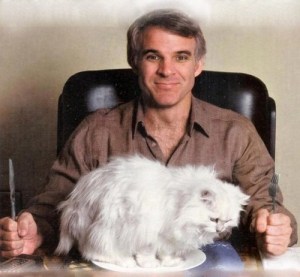
Steve Martin with cat
Chris Cillizza has done a public service by reprinting an interview with Donald Trump on the Bill O’Reilly Show: Donald Trump’s Bill O’Reilly interview is an instant classic. I hope you’ll read the whole thing, because it clearly demonstrates that Trump is a complete idiot. This is my favorite part (emphasis added):
HILLARY CLINTON (D), PRESUMPTIVE DEMOCRATIC PRESIDENTIAL NOMINEE: I am determined to say look, you may not vote for me, Trump supporters, I get that because you really are upset about immigration or you are upset about trade or you are upset about, you know, the feeling that the jobs that you had that gave you a good living are gone. So, I’m very sympathetic to that. I am not sympathetic to the xenophobia, the misogyny, the homophobia, the Islamophobia and all of the other.
(APPLAUSE)
Sort of dog whistles that Trump uses to create that fervor among a lot of his supporters.
(END VIDEO CLIP)
O’REILLY: Okay. That was about 45 seconds to be fair. We will give Mr. Trump the same amount of time to reply. Go.
TRUMP: All of the phobias that nobody even knows what she is talking about to be honest with you. Why doesn’t she say it like it is? I mean, it’s just ridiculous. And frankly, you know, she knows exactly what’s happening. She sees what’s happening. People are tired. They are losing their jobs. Their jobs are being taken away. Companies are moving to Mexico. I mean, just moving. They just pick up and move. You look at what went on with carrier. You look at Ford. You look at so many different. They are a mile long and we are losing our jobs.
We are losing everything in this country. We are losing our spirit. I was in Ohio. I was in Pennsylvania. Yesterday I was in Ohio, Pennsylvania, and West Virginia. And I want to tell you, the lines of people that we have, they are so sick and tired of hearing things like what she is just saying. Nobody even knows what she is talking about. And you tell me, that’s presidential? She is presidential? Sitting there. I don’t think so.
Poor Donald. He just doesn’t understand all those multi-syllable words, and he assumes no one else does either.

Billy Idol with cat
The New York Times commissioned a short story about the Trumps by novelist Chimamanda Ngozi Adiche: The Arrangements: A Work of Fiction. Here are the first few paragraphs:
Melania decided she would order the flowers herself. Donald was too busy now anyway to call Alessandra’s as usual and ask for “something amazing.” Once, in the early years, before she fully understood him, she had asked what his favorite flowers were.
“I use the best florists in the city, they’re terrific,” he replied, and she realized that taste, for him, was something to be determined by somebody else, and then flaunted.
At first, she wished he would not keep asking their guests, “How do you like these great flowers?” and that he would not be so nakedly in need of their praise, but now she felt a small tug of annoyance if a guest did not gush as Donald expected. The florists were indeed good, their peonies delicate as tissue, even if a little boring, and the interior decorators Donald had brought in — all the top guys used them, he said — were good, too, even if all that gold yellowness bordered on staleness, and so she did not disagree because Donald disliked dissent, and he only wanted the best for them, and she had what she really needed, this luxurious peace. But today, she would order herself. It was her dinner party to celebrate her parents’ anniversary. Unusual orchids, maybe. Her mother loved uncommon things.
Her Pilates instructor, Janelle, would arrive in half an hour. She had just enough time to order the flowers and complete her morning skin routine. She would use a different florist, she decided, where Donald did not have an account, and pay by herself. Donald might like that; he always liked the small efforts she made. Do the little things, don’t ask for big things and he will give them to you, her mother advised her, after she first met Donald. She gently patted three different serums on her face and then, with her fingertips, applied an eye cream and sunscreen.

Truman Capote with cat
What a bright morning. Summer sunlight raised her spirits. And Tiffany was leaving today. It felt good. The girl had been staying for the past week, and came and went, mostly staying out of her way. Still, it felt good. Yesterday she had taken Tiffany to lunch, so that she could tell Donald that she had taken Tiffany to lunch.
“She adores all my kids, it’s amazing,” Donald once told a reporter — he was happily blind to the strangeness in the air whenever she was with his children.
Read the rest at the link. The Times plans to publish another short story about the 2016 campaign by a different author. I supposed that one will be a very vicious piece about the Clinton family. Maybe they can get Maureen Dowd to write it.
At The Atlantic, TA Frank asks if anyone will be willing to be Trump’s running mate: Assessing the Trump V.P. Career-Suicide Pact: There are very few real contenders, the risks are considerable, and the rewards potentially terrifying. So who will be the lucky, er, winner?
Frank discusses the pros and cons for the following possible choices: Newt Gingrich, Chris Christie, Bob Corker, Mary Fallon, John Kasich.
Chaos continues in Great Britain
From Reuters: Ex-London mayor halts bid to be UK prime minister, upends race
Former London mayor Boris Johnson, favorite to become Britain’s prime minister, abruptly pulled out of the race on Thursday, upending the contest less than a week after leading the campaign to take the country out of the EU.
Johnson’s announcement, to audible gasps from a roomful of journalists and supporters, was the biggest political surprise since Prime Minister David Cameron quit on Friday, the morning after losing the referendum on British membership in the bloc.

Drew Barrymore with cat
It makes Theresa May, the interior minister who backed remaining in the European Union, the new favorite to succeed Cameron.
May, a party stalwart seen as a steady hand, announced her own candidacy earlier on Thursday, promising to deliver the withdrawal from the EU voters had demanded, despite having campaigned for the other side.
“Brexit means Brexit,” she told a news conference.
“The campaign was fought, the vote was held, turnout was high and the public gave their verdict. There must be no attempts to remain inside the EU, no attempts to rejoin it through the back door and no second referendum.”
The decision to quit the EU has cost Britain its top credit rating, pushed the pound to its lowest level since the mid-1980s and wiped a record $3 trillion off global shares. EU leaders are scrambling to prevent further unraveling of a bloc that helped guarantee peace in post-war Europe.
More on the Tory situation:
BBC News: Michael Gove and Theresa May head five-way Conservative race.
The Washington Post: Meet Michael Gove, the man who just turned British politics into an episode of ‘House of Cards.’
The Independent: Boris Johnson has left the Tory leadership race – but he’ll become Prime Minister anyway.
Did you like this post? Please share it with your friends:
Posted: June 28, 2016 | Author: bostonboomer | Filed under: morning reads, U.S. Politics | Tags: Benghazi, Bernie Sanders, Donald Trump, Elizabeth Warren, Hillary Clinton, Natalie McGarry |

Good Morning!!
My mom just called me to find out why MSNBC is hyping the Republicans’ Benghazi! report. I’m not watching; but I guess we can just assume that the so-called “liberal” cable channel is going to continue rooting against Hillary even if it means electing a completely unqualified, ignorant racist who hates the media and wants to take away press freedoms. Ugh.
Even The New York Times admits the report contains nothing new, even though they fail to note until way down in the story that the “committee report” released today comes only from the Republican members. They didn’t even let their Democratic colleagues read it. The Democrats on the committee released their report yesterday. Here’s a quick read on what’s in the report.
Vice News: Two years and $7 million later, the Benghazi report is finally out.
After two years and $7 million, Republicans on the House Benghazi Committee have released their long-awaited report on the 2012 terrorist attacks in Benghazi — a report that concludes then-Secretary of State Hillary Clinton was not directly at fault for the events that led to the death of four American citizens.
The report did slam the Obama administration for its handling of the aftermath of the attacks, citing a combination of bureaucratic inefficiency, personal error and willful ignorance of intelligence for the bungled response. But the committee’s findings do not directly indict Clinton for the death of Ambassador Chris Stevens and three other Americans, or found that she willfully ignored calls for security, charges that Republicans have continuously leveled at her.
In fact, the report barely focuses on Clinton at all, but rather reveals a more comprehensive timeline of events based on interviews with eyewitnesses and senior intelligence officials.
Among the revelations in the Committee’s 800-page report is that the CIA missed real-time intelligence about the situation on the ground that led the agency to bungle its response to the violent protests that led to the deaths of Americans at the US diplomatic compound in Benghazi. The government then misled the public about what had happened in the immediate aftermath of the attacks.
“It is not clear what additional intelligence would have satisfied either [State Department aide Patrick] Kennedy or the Secretary in understanding the Benghazi mission compound was at risk — short of an attack,” the report says.
There’s not much new in that article either, but you can check it out for yourself.

Protesters wave Mexican flags and signs on the road leading into Republican presidential candidate Donald Trump’s Trump International Golf Links in Aberdeen, Scotland, June 25, 2016. (Reuters Photo)
Some pundits have assumed that terrorist attacks would help Donald Trump in his sad run for the presidency. It doesn’t look that way so far. The Washington Post reports: Donald Trump’s big, bold response to terrorism is a big bust with Americans.
Hillary Clinton has reestablished her advantage over Donald Trump on dealing with terrorism following the candidates’ very different reactions to the nation’s largest-ever mass shooting in Orlando, according to a new Washington Post-ABC News poll.
By a 50-to-39 percent margin, more say they trust Clinton than Trump to handle terrorism — similar to her 54-40 edge in March but wider than her narrow three-point edge in May after Trump became the Republican Party’s presumptive nominee….
The latest shift stands in stark contrast to political impact of the last major terrorist attacks that colored U.S. politics. After the Paris and San Bernardino attacks in late 2015, Trump’s proposal to ban Muslims entering the U.S. received wide support among fellow Republicans, and it helped bolster his support heading into the GOP nomination contest.
The latest poll numbers, of course, show how the larger electorate feels about Trump’s handling of foreign policy and terrorism — not just GOP voters. And it’s yet another bad sign for Trump’s presidential aspirations come November.
Clinton isn’t the only Democrat to get a boost. President Obama’s approval for handling terrorism went from 45 percent in June to 50 percent this month, ending a stretch of underwater ratings (more disapproval than approval) since early 2015. After the Paris attacks, Obama’s approval mark on the issue dropped to a record-low 40 percent.
Read the details and check out the charts at the WaPo.
Trump has finally started sending out fundraising emails, and apparently he isn’t aware that he can’t accept donations from foreign nationals. He sent emails to Scottish MP’s last week asking them to donate. One recipient wrote a response.
The Scotsman: Natalie McGarry publicly rebuffs Donald Trump fundraising plea.

Independent Scottish MP Natalie McGarry
McGarry, who is the MP for Glasgow East, wrote a sharp reply to the Presidential hopeful’s son, and shared her response with her 15,000 Twitter followers.
In her letter she wrote: “Quite why you think it appropriate to write emails to UK parliamentarians with a begging bowl for your father’s repugnant campaign is completely beyond me.
“Given his rhetoric on migrants, refugees and immigration, it seems quite extraordinary that he would be asking foreign nationals for money; especially people who view his dangerous divisiveness with horror.
“The US elections are a matter for the American people, but I do send my warm hope that they reject your father fundamentally at the ballot box.”
She added: “The thought of his reactionary type of politics and apparent ignorance of world affairs having access to a seat at the world table is both surreal, and terrifying.
“The above is a long way to say No, and do not contact me again.”
ROFLOL!
Josh Marshall on the way things are going for Trump: “How Does It Feel To Be Losing So Badly?”
There’s a campaign dynamic now coming into view which under other circumstances might only be a matter of trash talk or taunt. In this unique campaign cycle, it will likely be a driving issue. Put simply, as Donald Trump’s poll numbers continue to fall – or more likely become more anchored in a position with him clearly behind – he is himself being lowered onto his own personal kryptonite: Loserdom.
One charge, one taunt, one attack will rile and unhinge Donald Trump more than any other. That he’s a loser. At the moment, the facts leave little question on this point.
In the Trumpian world of pure alpha dominance no failure or state of existence is more total, hopeless, unmanning or unbearable. He is now living there, in public, each day, for all to see, even helpfully enumerated on most days in new poll numbers. A brittle narcissistic ego, coddled for decades by armies of yes men and a generally fawning business and tabloid press, won’t hold up well under that kind of strain.
Losing is always hard. Few of us have ever been candidates for public office. But we all know this from our own lives. But it is uniquely hard for Trump’s campaign because the campaign’s entire premise is “winning” and on a slightly less literal level on what I’ve called dominance politics. Losing is hard for any campaign both emotionally for all involved but also because losing is demoralizing and can trigger a self-perpetuating cycle. But most campaign’s have issue agendas, goals that provide an emotional and aspirational ballast to the effort. You may be losing but that doesn’t invalidate what you believe or the substance of your proposed policies. That’s not true for Trump because “winning” isn’t just the goal it’s the raison d’etre and premise of the whole effort. A candidacy based on “winning” which is in fact losing and perhaps losing badly isn’t just on the ropes; it begins to look ridiculous.
Read the rest at the link.

From New York Magazine, a sad story about another sad sack: The Sanders Campaign Tried to Rig Caucus Tiebreakers With Double-Sided Coins.
The Democratic primary wasn’t rigged — despite the best efforts of Bernie Sanders’s staffers in Nevada. On Monday, CBS News published a postmortem on the Vermont senator’s campaign, which includes this anecdote about how Sanders’s Silver State director Joan Kato prepared her team for caucus day:
At one point shortly before the caucuses, she instructed staff to buy double-sided coins — in case coin-flips were needed to decide any of the caucuses in the event of a tie, according to staffers.
All that yelling about Hillary being “corrupt” was just projection.
And how are things going for Hillary? Great! Here’s Ruby Cramer on Clinton’s joint appearance with Elizabeth Warren in Cincinnati yesterday: Elizabeth Warren Finally Opens Her Arms To Hillary Clinton. Cramer notes that two years ago when these two famous women campaigned on the same stage in Massachusetts for then candidate for Governor Martha Coakley, Warren “barely mentioned Clinton.” But now it’s different between them.
Two years later, the 2016 election has forged a vastly different Clinton–Warren alliance.
Here on Monday, beneath the painted dome of the Cincinnati Museum Center at Union Terminal, they emerged for their first joint appearance, unveiling a powerful new partnership aimed at Donald Trump, with none of the old distance and unease.
The pair arrived together, Clinton leading the way onto a circular platform in the middle of the hall. Around the stage, 2,600 crowded into the historic atrium. Warren threw out both hands, palms to the ceiling, as if in awe of the scene around her.

Clinton motioned Warren toward the podium, then stood near the back of the stage and took a breath. “Woo!” she mouthed. Over the sound of the crowd, Warren leaned into the microphone with the same surprised look: “Whoa!” she said. Thank you!”
“I’m here today because I’m with her. Yes, her!”
Later, as Clinton spoke, Warren stood to the side and listened intently, reacting to each line along with the voters below. To a mention of infrastructure investment, Warren nodded fiercely and let out a “yes!” To a promise of student loan relief, she jumped up and down on her toes. To a dig at corporations, she pumped her fist in the air. And when the candidate led the crowd into one of her favorite lines — about playing the “woman’s card” — Warren chanted along on cue: “Deal me in!”
More than most of the campaign’s surrogates on the trail, Warren took the stage for Clinton with a distinct mission, taking a high-energy and unapologetic approach to the job of attack dog, with a speech that complemented Clinton’s, not simply introduced it.
Well you probably saw the speech–if you didn’t please be sure to watch it. And read much more about it at the Buzzfeed link.
Bernie Sanders could have done what Warren has done. He probably could have been another good attack dog against Trump. But he chose a different path, and now it’s too late. I really hope he doesn’t campaign for Hillary, and I couldn’t care less if he endorses her. His followers have mostly jumped on her bandwagon, and those who are still wallowing in self-pity won’t be needed. I dread the thought of Bernie campaigning at this point, because I’m convinced he would only find underhanded ways to damage her. I just hope he continues to fade from public view.
What stories are you following today? Please share your thoughts and links in the comment thread and have a terrific Tuesday!
Did you like this post? Please share it with your friends:
Posted: June 21, 2016 | Author: bostonboomer | Filed under: Afternoon Reads, U.S. Politics | Tags: 2016 presidential campaign, Donald Trump, FEC filings |

Trump pinata
Good Afternoon!!
Last night Twitter was agog over Donald Trump’s May FEC filing. There’s been a lot of talk lately about chaos in Trump’s campaign and speculation about how wealthy he actually is. But the Trump campaign is in even worse condition than anyone suspected. Mother Jones breaks down the stunning news from his campaign finance documents:
The first glance: Hillary Clinton’s campaign has more than 35 times the cash Trump’s does.
Here’s the second glance: Ted Cruz dropped out of the GOP primary on May 3, meaning that for the month of May, Trump was all but assured the nomination and the campaign should have been in prime fundraising mode. But it wasn’t. Even taking into account Trump’s long-stated claims that he had no interest in raising money from others (something he has reversed himself on)—filings the campaign made with the Federal Election Commission late Monday evening show that Trump simply couldn’t get any fundraising momentum going. He raised a grand total of $5.6 million from May 1 to May 31, $2.2 million of which was in the form of loans from Trump personally….
Trump, who spent more than he raised, has $1.2 million in cash on hand. True, Trump has always had very little cash on hand at the end of a reporting period. But this was because he was writing the checks and didn’t need to keep cash on hand. But now that Trump insists he won’t be self-financing, those low numbers are a problem. Even if Trump significantly increased his fundraising since May 31, he would have to be raising money at an almost unprecedented rate to catch up to Clinton.
It’s not just the low numbers that portend potential disaster for the GOP’s man. It’s the way he arrives at the low numbers that looks scary. There’s no real significant support from top donors—the bedrock of a strong monthly fundraising report. But the Trump campaign picked up just 133 donations that hit the maximum allowed amount of $2,700. Clinton had more donations of $2,700 on just May 17 (140) than Trump had all month, and almost 15 times as many for the entire month (1,981).

More from Think Progress: Trump Said He Had ‘More Cash Than Any Campaign In The History Of Politics.’ That Was A Huge Lie.
Not only is Trump getting lapped by Clinton financially, but his fundraising has been going so poorly that he’s actually behind a good number of U.S. House candidates….
The news sparked renewed concerns that Trump simply won’t be able to fundraise to the extent necessary to run a viable presidential campaign. But during a phone interview on the Today show Tuesday morning, Trump said that if worst comes to worst and Republican donors don’t come around, he could always just self-fund.
“If it gets to a point, what I’ll do is just do what I did in the primaries. I spent $55 million of my own money to win the primaries,” Trump said. “I may do that again in the general election… I have a lot of cash and I may do it again in the general election, but it would be nice to have some help from the party.”
But if he has so much cash, why isn’t he spending it instead of having to deal with being the butt of endless jokes in the media and on Twitter?
Josh Marshall posted this piece before the FEC filings came out: The Real News Is Trump is Broke.
I got onto thinking about this when I saw John McQuaid’s short piece in Forbes. As McQuaid notes, this is the gaping hole, the burning question at the center of Trump’s campaign. Reports suggest that Trump has been unwilling to undergo the ego effacement of calling high dollar Republican donors and asking for money. His campaign has virtually no money in the bank ($2.4m at last count).
Even if Trump can’t not be Trump, the damage of being Trump could at least be off-set by pouring money into advertising in key swing states and field work. But at this moment, the Clinton campaign (and pro-Clinton superPACs) is rolling out a barrage of targeted swing state advertising focused on solidifying and embedding the highly negative image Trump has built for himself over the last year and especially the last eight weeks. That advertising is going entirely unanswered by the Trump campaign.

Why isn’t Trump using his own money, as he keeps threatening to do?
It may take a billion dollars to run a presidential campaign. But at this moment Trump is in dire need of a few million dollars. To go back to cash on hand, Trump currently has $2.4 million and Clinton has just over $30 million. Remember, Trump is allegedly worth $10 billion, which at the risk of stating the obvious means he is worth ten thousand million dollars. Someone in that position might be hard pressed to quickly produce billions of dollars or even hundreds of million in actual cash. But we’re talking tens of millions or even just a few million dollars he needs right now.
Trump may be stingy. He may be saying that the RNC should take responsibility for fundraising, which is something it’s clearly not capable of doing. (The RNC has massive fundraising capacity but it can’t simply take on singlehanded what the candidate was expected to raise.) But as big a disaster as Trump’s campaign is at the moment he stands a real shot at being the next president of the United States. It is simply not credible that he is standing on principle in not giving his campaign any more money at such a critical moment when his bid is being so deeply damaged.
The only credible answer is that it is difficult or perhaps even impossible for him to produce these comparatively small sums. If that’s true, his claim to be worth billions of dollars must either be a pure sham and a fraud or some artful concoction of extreme leverage and accounting gimmickry, which makes it impossible to come up with actual cash.

Here’s Marshall’s reaction to the FEC report (emphasis added):
I confess even I’m surprised at what the overnight FEC filings revealed about the Trump campaign. Posting the ‘Trump is Broke‘ column yesterday made me feel at least a touch exposed since I figured he’d add (either from his own money or fundraising) at least some additional funds to the paltry $2.4 million cash on hand in his previous filing. Appears not. Now on top of that it’s revealed that he’s been using his presidential campaign to funnel millions of dollars back into his own businesses. The new filing shows the campaign had only $1.3 million in cash on hand at the beginning of this month, in comparison to $42 million on hand for the Hillary campaign.
It’s important to see those numbers in the proper perspective.
Yes, Clinton has massively more money than Trump. But that’s about the amount of money she should have. This isn’t to take away from the accomplishment. It’s a lot of money and it came while she was still having to spend money on the on-going primaries. But it’s in the range of what you would expect from a well-oiled team of professionals drawing on a robust fundraising apparatus. Trump’s amount of cash wouldn’t be terribly impressive for a competitive House race. His campaign is essentially broke. Which, as I noted yesterday, means Trump must be broke, too, or so cash poor as to amount to the same thing for the purposes of this campaign….
Perhaps the most revealing detail about the May filing is that Trump actually did loan his campaign additional funds – a bit over $2 million. But this shows more just how hard up Trump is. His campaign is in desperate need of funds.
Let’s face it. Trump is an arrogant man and he’s going through a relentless public shaming right now. If he had the money to get paid staff on the ground and ads on the air, he’d be using it, if only to demonstrate his yuuuuge wealth.

But what really had folks on twitter busy last night was the part about Trump using his campaign funds to reimburse his own businesses and his family members. AP reports: Trump’s campaign cycles $6 million into Trump companies.
Donald Trump’s campaign likes to keep it in the family.
When Trump flies, he uses his airplane. When he campaigns, he often chooses his properties or his own Trump Tower in New York City, which serves as headquarters. His campaign even buys Trump bottled water and Trump wine.
The presumptive Republican presidential nominee has been on the campaign trail for a year now, and federal finance reports detail a campaign unafraid to co-mingle political and business endeavors in an unprecedented way — even as he is making appeals for donations.
Through the end of May, Trump’s campaign had plunged at least $6.2 million back into Trump corporate products and services, a review of Federal Election Commission filings shows. That’s about 10 percent of his total campaign expenditures…..
Wealthy political candidates in the past have walled off their business from their campaigns, but Trump embraces his companies. Public documents indicate his revenue has risen along with his presidential aspirations.
While Trump’s controversial comments have cost his businesses money — for example, the PGA Tour recently announced it would move its World Golf Championship from a Trump course to one in Mexico City — Trump reported in documents filed in May with federal regulators that his revenue had increased by roughly $190 million over the previous 17 months.
Apparently, running for the presidency is just another money-making scheme to Trump. You can read the details about how how Trump spent his campaign money in May at The Washington Post.

One more interesting bit from the Trump FEC filings: Trump paid $35,000 each to “Draper Sterling,” at an address in New Hampshire. It sounds a little like the fictional ad agency in Mad Men, and late last night lots of people were trying to figure out if it is a legitimate company. Josh Legum at Think Progress: The Weird Story Behind The Trump Campaign’s $35,000 Payment To ‘Draper Sterling’
The Trump campaign made $35,000 in payments to an entity called “Draper Sterling” for “web advertising.” Three $10,000 payments and one $5,000 payment were placed on the campaign’s American Express card on the same day (see the FEC details at the link) ….
Draper Sterling was registered with the New Hampshire Secretary of State to Jon Adkins, the co-founder of a medical device startup. Its headquarters is Adkins’ home address in residential New Hampshire.
Adkins co-founded the medical device company with Paul Holzer, a former Navy Seal and current medical student at Dartmouth. Holzer was involved in Charlie Baker’s run for governor in 2014 — he ran the campaign’s “voter contact strategy.” He was also part of the “management and strategy team” for Missourians For John Brunner, a candidate for governor.
Trump paid an additional $3,000 each to Holzer and Adkins in May for “field consulting.” Holzer listed Adkins’ home as his address.
Legum learned “Draper Sterling” was also mentioned in an FEC complaint. You’ll have to read about that in the article at Think Progress. It’s still not clear what these guys did for Trump.
There are loads of articles out there about the Trump campaign finances and its chaotic state. This story in the NYT is well worth a read: Donald Trump starts Summer Push with Crippling Money Deficit.
This is shaping up to be an unbelievable election campaign. I’ll have more links for you in the comment thread.
Have a great Tuesday!
Did you like this post? Please share it with your friends:
Posted: June 18, 2016 | Author: bostonboomer | Filed under: Afternoon Reads, U.S. Politics | Tags: Bernie Sanders, Donald Trump, Hillary Clinton |

Lazy Way, Stephen LaPierre
Good Afternoon!!
I’m feeling particularly lazy today–mostly I just don’t want to read any news. I’d rather be reading a novel, a true crime book, or maybe a biography. But I’ve been forcing myself to surf around to see what’s going on, and here’s what I’ve come up with.
The primaries are over, but Bernie Sanders is still hanging around like party guest who won’t leave even after everyone else has gone home and the party-givers have done the dishes and are dying to get some sleep.
Tommy Christopher on Bernie’s Thursday podcast to his supporters: Bernie Sanders Flips Off Black Voters On His Way Out the Door.
Bernie Sanders is going to delay getting into the fight against Donald Trump so that he can get a few good ideas, a few iffy ideas, and a few bad ideas into the Democratic Party platform, a document that is about as useful as a roll of Charmin, but considerably less soothing to the skin. Just for good measure, he wants to get rid of Superdelegates and open up the primaries, which will work out great for Bernie Sanders from a year ago, but which will suck the first time Democrats have to run a primary against an incumbent Republican president, and Republican voters decide to vote in Democratic primaries just to mess with us. Brilliant, but none of which required him to continue to slight Hillary Clinton, except he might make Susan Sarandon and her purse dog mad.

Those Lazy Days of Summer, Jan Matson
Instead, Bernie will wait until he’s good and ready to make a half-assed endorsement of Hillary Clinton that will succeed only in winning a news cycle or two for Donald Trump, as he and the media rehash every attack he’s made against her, and every painstaking yank of the pliers it took to extract said half-assed endorsement.
But there’s something even more revealing about Bernie’s speech to supporters, because wrapped around those relevant 107 seconds was about 22 other minutes of Bernie boilerplate that neatly laid out his priorities. Throughout this campaign, Bernie and his supporters have continually insisted that if black voters would only stop and listen and give him a chance, they’d be dazzled by his down-ness and abandon their habitual support for Hillary….
Black people got tacked onto a few lists of other things, and some lines about failing schools and criminal justice reform. Or to put it another way, what black voters could expect from a Rand Paul speech. Not a syllable about ending police brutality or racial profiling, nothing about the Voting Rights Act or any other Republican schemes to disenfranchise black voters, and those are just the easy ones. Fifty-six seconds out of 23 minutes, and none of the bullet points he rushed up onto his website when #BlackLivesMatter protesters hassled him almost a year ago. Yeah, black voters had Bernie all wrong, didn’t they?
Watch Sanders’ almost-nonexistent thoughts on the Black vote at Mediaite.

More commentary on Bernie’s remarks from Matthew Yglesias: One sentence from Bernie Sanders’s speech last night that really enrages Democratic leaders.
As you can probably guess, most Democratic Party insiders were really hoping Bernie Sanders would formally drop out of the race this week and offer Hillary Clinton a fulsome endorsement. But they also recognize that he’s stopped attacking her, is promising to work against Donald Trump, and has basically accepted that the race is over — so if he wants to fade away slowly, they are happy to live with that.
The aspect of Sanders’s speech that really set them off last night was something entirely different. Not the fact that Sanders said he wanted his supporters to continue to influence the direction of the party but the specific way he characterized this direction:
I also look forward to working with Secretary Clinton to transform the Democratic Party so that it becomes a party of working people and young people, and not just wealthy campaign contributors: a party that has the courage to take on Wall Street, the pharmaceutical industry, the fossil fuel industry and the other powerful special interests that dominate our political and economic life.
It’s incredibly frustrating for people who’ve been working in mainstream Democratic Party politics to hear their party described as something other than a party for “working people.” Clinton won the votes of millions of working-class Americans, primarily people of color, throughout the 2016 primaries; and in the 2012, 2008, 2004, and 2000 election cycles there’s been a pronounced tendency for lower-income voters to back the Democratic candidate and higher-income ones to back the Republican.
Similarly, it comes as a shock to people who participated in the passage of the Dodd-Frank financial reform bill (or the White House’s series of later anti-bank regulatory actions) or who’ve worked to uphold the Obama administration’s Clean Power Plant rule that they apparently lack the courage to stand up to Wall Street and fossil fuel interests.
It’s one thing to disagree with people about policy substance or political tactics. But something Sanders has done throughout his campaign and very pointedly did here is straightforwardly challenge the good faith of the vast majority of his colleagues in Democratic Party politics. It’s worked pretty well for him on the stump, but it doesn’t win you a lot of friends. And to be honest, it’s simply wrong — you can raise a lot of objections to Obama’s approach to Wall Street or climate change, but the fact is that the financial services industry and the fossil fuel industries have been fighting him every step of the way.
Barney Frank was right. Bernie Sanders alienates his natural allies, whether deliberately or because he’s simply a terrible politician.

Lazy Hazy Days of Summer, Claire Beadon Carnell
From Slate: Bernie Sanders Officially Announces He Will Run for President Forever.
on Thursday, the Vermont senator announced he had an announcement to make. It’s been a long campaign, and Hillary Clinton bested him on every conceivable metric—albeit narrowly in some—other than the party-liquefying convention nuclear option to which Sanders doesn’t have the codes anyway. So, on Thursday night, the Vermont senator gathered friends, loved ones, and supporters around the country to huddle around a live video feed to humbly announce: He’s still running for president.
To be fair, Sanders hinted that soon he will be done and his “role” will change in a “very short period of time,” but he notably stopped well short of even remotely ending his campaign or endorsing Hillary Clinton.
Frankly, I doubt if he’ll ever endorse her, and I just don’t care. I don’t want him to campaign for her; I just want him to disappear.
One more by Sahil Kapur at Bloomberg: Sanders’ Long Refusal to Endorse Clinton Hurts His Leverage.
Even with his path to the Democratic presidential nomination rapidly disappearing, Bernie Sanders couldn’t bring himself to publicly accept defeat. Along the way, he overplayed his hand and squandered the political capital he’ll need to force policy and procedural reforms on the Democratic Party, according to allies and party strategists.
“We’re already way past the maximum point of leverage that he and his movement built up. It’s definitely dissipating every day,” said Joe Trippi, a Democratic strategist and veteran of presidential campaigns.
Trippi put the high point of Sanders’ clout at April 9, after he won seven straight contests ending with Wyoming. But he lost seven of the last nine contests, walloped by 58 points in the District of Columbia, which held the final primary of the season on Tuesday. Hillary Clinton already had locked up the nomination with a decisive victory in California a week earlier, and some of the highest-profile Sanders supporters—including Senator Jeff Merkley, Representative Raul Grijalva, and the liberal activist group MoveOn—are now lining up behind her.
Read the rest at the link.
While Bernie continues to wallow in sour grapes, Hillary Clinton has been very busy defining Donald Trump for the folks who are just beginning to pay attention.

Lazy Summer, Mitch Caster
FirstPost.com: Hillary Clinton brings out ads to give Donald Trump “rude awakening.”
Hillary Clinton and her Democratic allies have invested at least $41 million in commercials in crucial states such as Ohio, Florida and Nevada over the next six weeks, a series of summer broadsides against her Republican opponent. Those messages will be echoed by hundreds of Clinton workers in those same states and amplified by President Barack Obama and other top Democrats.
Trump has made few preparations for contending with that sort of well-oiled political machine. His campaign has no advertising plans and is just now hiring employees in important states. Republican leaders are far from agreement on how best to talk to voters about the polarising billionaire, or if they will at all. And Trump is running out of time: Early voting starts in Iowa in just three and a half months.
“It’s political malpractice,” said Mitch Stewart, Obama’s 2012 battleground states director and a Clinton backer. “He’s in for a rude awakening. This isn’t a national vote contest where you can be on cable news every day and dominate coverage. This is literally going state by state and coming up with a plan in each.”
Clinton’s large June and July ad buy comes as a reward for her near-constant fundraising. In May, she raised $27 million in primary election money that must be used before she accepts her party’s nomination at the convention in late July.
Trump is playing catch up. He did not begin raising money in earnest until 25 May, having largely financed his primary bid through personal loans to his campaign.
Clinton’s latest spots, highlighting her past advocacy for children, are an attempt to reintroduce the returning presidential candidate — she lost the 2008 Democratic primary to Obama — to general election voters. Her campaign is spending about $23 million on ads by the convention, according to advertising tracker Kantar Media’s CMAG.
But those voters are also hearing from Priorities USA, a super political action committee financed by millions of dollars from Clinton’s staunchest supporters. The goal of those that $18.7 million batch of ads: cast Trump as a con-man and bully unprepared to be commander in chief.

Key West, Thomas Kinkade
As I wrote on Thursday, it’s beginning to look like Trump isn’t making even a halfhearted attempt to run for president. He seems to be focusing on deep red and deep blue states and ignoring the swing states he would have to win in order to have any hope of beating Hillary. He spent yesterday in Texas.
Yesterday the AP learned that the Trump campaign has only 30 paid staffers on the ground nationwide.
His campaign roiled by infighting and Republican revolt, Donald Trump is working to address a battleground state staffing shortage that highlights his reliance on a skeptical GOP establishment.
The New York billionaire has slowly begun to add paid staff in a handful of swing states — Wisconsin and Iowa, among them — even as campaign officials concede the presumptive presidential nominee has little desire or capacity to construct the kind of massive national operation that has come to define modern-day White House campaigns. Trump plans instead to depend upon the national Republican Party to lead state-based efforts on his behalf, while Democrat Hillary Clinton has had an army of staff dedicated specifically to her campaign in general election battlegrounds for months.
“It would be disingenuous and wrongheaded to take a playbook that has been used over and over again,” said Trump senior aide Karen Giorno, in charge of an 11-state Southeastern bloc including battlegrounds Florida, North Carolina and Virginia. “We are creating the playbook.
The unconventional approach reflects Trump’s disdain for traditional Republican campaign practices and inclination to implement businesslike decision-making. It also carries substantial risk.If, for instance, Trump is lagging Clinton badly in polls come early fall, there is nothing to stop the RNC from cutting its losses and focusing instead on saving Republican control of the Senate or other competitive contests also on the ballot this November. Beth Myers, who managed 2012 presidential nominee Mitt Romney’s campaign, said White House candidates have unique needs that a broader-brush approach cannot always meet.
“We are creating the playbook.” Unbelievable.
What stories are you following today?
Did you like this post? Please share it with your friends:
Posted: June 6, 2016 | Author: bostonboomer | Filed under: morning reads, U.S. Politics | Tags: 2016 presidential election, 2016 presidential nomination, Bernie Sanders, Donald Trump, highest glass ceiling, Hillary Clinton |
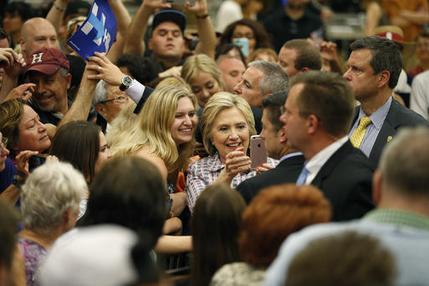
Hillary Clinton takes a selfie with supporters at a rally at Sacramento City College, Sunday, June 5, 2016,AP Photo/John Locher)
Good Morning!!
Hillary had a great weekend, winning the Virgin Islands and Puerto Rico primaries by comfortable margins. She now needs only about 30 pledged delegates to reach a majority and clinch the Democratic nomination. That will happen after the votes come in from the New Jersey primary tomorrow night.
As you know, she will give her victory speech tomorrow night from her Brooklyn headquarters. Hillary Clinton will become the first woman ever to win a major party presidential nomination; and when she goes on to beat Donald Trump in November, she will crash through the highest glass ceiling of all–the presidency of the United States of America!
After our dreams were dashed in June 2008, I wondered if there would be another chance for a woman president in my lifetime. Well, here we are, with a very good chance of seeing that happen! I know you are all as excited as I am. I just cannot wait until tomorrow night! I feel like a kid on Christmas Eve wondering if Christmas morning will ever come.

Hillary Clinton concedes Democratic nomination to Barack Obama in June 2008
NBC News: Hillary Clinton Edges Closer to Clinching Nomination After Puerto Rico Win.
Hillary Clinton won the Puerto Rico primary Sunday, edging even closer to the delegate majority she needs to become the presumptive nominee of the Democratic Party.
A total of 60 pledged delegates were at stake in the island primary contest, which comes ahead of Tuesday’s crucial race in California.
Puerto Rico voters faced long lines and confusion over polling stations, many of which had closed since the Democratic primary in 2008. The island is also in the throes of an economic crisis after having accumulated more than $70 billion of outstanding debt.
Gov. Alejandro Padilla endorsed Clinton on Wednesday, calling her the best candidate to help the government out of the fiscal crisis.
Clinton also notched a victory in Saturday’s caucuses in the U.S. Virgin Islands.
She is widely expected to secure the Democratic nomination on Tuesday when Democratic voters in six states, including California, will head to the polls in the last multi-state primary day of the nomination race.
At a rally in Sacramento late Sunday, Clinton underscored the importance of that primary, telling the crowd: “I want to finish strong here in California. It means … it means the world to me.”
https://twitter.com/politicalmiller/status/739820833456132096
The Clinton Campaign’s main job today is to keep superdelegates from putting her over the top until after her speech tomorrow night.
Of course we still have to deal with Old Mr. Nasty, Bernie Sanders; but nothing he does after tomorrow will make any difference. He is going to find himself shunned and ignored if he continues his path of attacking the Democratic nominee. The man is on his last legs. Here’s what he looked like in California yesterday. Not very presidential.
https://twitter.com/word_34/status/739644631789408256
Sanders may also face a serious challenge to his Senate in 2018. Joy Reid at The Daily Beast: Meet Al Giordano, the Man Who Wants to Take Bernie Down.
If Al Giordano challenges Bernie Sanders for his U.S. Senate seat in 2018, he will tick nearly all of the boxes Sanders checked during his surprisingly robust presidential run.
Nearly zero odds of defeating an entrenched Washington politician? Check.
Little chance of Democratic Party support? Double check! A decades-old history of lefty activism that casts him as a hippie-turned-politico? Check, check, and check again.
So why would he do it? Because in Giordano’s view, and that of his social media supporters, Bernie is losing ugly and hurting Democrats’ chances of prevailing against Donald Trump in November.
“I mean, what haven’t they touched?” Giordano asks, peering at me via a 6-by-4 inch Skype window from his home in Mexico City. “What part of the Obama coalition have they not alienated? It’s like they want to erase the coalition.”

A little about Giordano:
Giordano, a bearded, graying, former reporter with the Boston Phoenix alternative weekly, cut his teeth as an anti-nuclear protester in the early 1980s while living in Rowe, a small Massachusetts town bordering Vernon, Vermont. When he wasn’t filing for the Phoenix, he spent his time protesting the twin nuclear power plants on either side of the state border: Yankee Rowe and Vermont Yankee. And he became close friends with the late leftie activist and anarchist Abbie Hoffman. He has spent the last 19 years in Mexico, where he runs an online newsletter, Narco News, and a school that trains journalists to cover social movements. His claim to fame is winning a First Amendment case against the Banco Nacional de México, which sued him, a Mexican reporter and Narco News for libel over a series of stories claiming a bank official was in league with Central American drug cartels.
Giordano recalls being an early Bernie Sanders supporter.
“I did support him when he first ran for [Burlington] mayor,” he says of Sanders. “I did support him when he first ran for Congress, and then the year he won. I supported him as a journalist and got my newspaper to endorse him.” But he says he cooled to Sanders after the Newt Gingrich-led “Republican revolution” takeover of the House in the 1994 midterm elections. Back then, Sanders was still distancing himself from Democrats, including liberal stalwarts like Barney Frank and Steny Hoyer, who were, in Giordano’s words, “giving Gingrich hell.”
Read the rest at the link.
Democrats in Puerto Rico are blaming the Sanders campaign for the long lines at a vastly reduced number of polling places during their primary yesterday.
Puerto Rico Democrats managed to give Hillary a big win anyway. Here’s what one Clinton voter had to say:
Trump News
Republicans are getting very nervous about their presumptive nominee, according to CNN:
Trump is under fire for repeatedly accusing U.S. District Judge Gonzalo Curiel, who is overseeing a lawsuit involving Trump University, of bias because of his Mexican heritage. Those concerns intensified Sunday after Trump said he would have the same concerns about the impartiality of a Muslim judge.
House and Senate GOP leaders have condemned Trump’s remarks about Curiel, while donors have openly worried that losing Latino voters could doom them in key down-ballot races. Other important party figures, including former Speaker Newt Gingrich, are urging Trump to change his combative, confrontational style before it’s too late.
Veteran Republican strategist Rick Wilson warned this weekend that GOP leaders who have endorsed Trump “own his politics.”
“You own his politics,” Wilson
wrote in a column for Heatstreet, adding later, “You own the racial animus that started out as a bug, became a feature and is now the defining characteristic of his campaign. You own every crazy, vile chunk of word vomit that spews from his mouth.”
The GOP’s deepest fear: A Barry Goldwater effect that could last far longer than Trump’s political aspirations.
Goldwater, the Arizona senator who was the 1964 GOP nominee and a leader of the conservative movement, alienated a generation of African-American voters by opposing the Civil Rights Act — opening the door for Democrats to lock in their support for decades. Republicans fret that Trump could similarly leave a stain with Latino voters.
Of course, Trump is just saying in plain language what Republicans have been dog-whistling for decades. Here’s conservative writer Kathleen Parker: The GOP surrenders to the dark side.
With the surrender of House Speaker Paul Ryan to the Trump crusade, it is fair to wonder what the Republican Party stands for.
Mr. Ryan’s endorsement of Trump, which appeared in an op-ed the speaker wrote for his hometown paper — rather than before a gaggle of reporters and newscasters with his arm draped around Mr. Trump’s shoulders — was a white flag from the establishment opposition.
In his op-ed, Mr. Ryan explained that though he doesn’t support all of Mr. Trump’s ideas (brave!), he’s confident that a President Trump would support the House agenda. Moreover, Mr. Ryan felt that his endorsement was needed to maintain a Republican majority in the House.
In other words, he caved, as most everyone knew he would after a respectable period of resistance.
The party has to stand united, after all. Because, as the Geico guy would remind us, that’s what they do.
Next likely to fall will be evangelical Christian leaders, who are scheduled to meet with Mr. Trump on June 21. The expectation is that Mr. Trump will promise to pick conservative Supreme Court justices who would restore the nation’s social order to a pre-Roe v. Wade, pre-gay-rights version.
If the purportedly devout can accept the ungodly Trump as the nation’s leader, then there really is nothing sacred. But, by God, he’s better than Hillary Clinton, clamors the crowd.
Newt Gingrich objected to Trump’s attacks on a federal judge overseeing a fraud case against Trump “university” and became the latest Trump enemy.
Appearing on “Fox and Friends,” Trump said he’d heard Gingrich’s comments about him and “was surprised at Newt. I thought it was inappropriate what he said.”
Gingrich, who has drawn scrutiny as a potential vice president pick,
joined a chorus of top Republicans rebuking Trump for repeatedly accusing U.S. District Judge Gonzalo Curiel, overseeing a lawsuit involving Trump University, of bias because of his Mexican heritage. Those concerns intensified Sunday after Trump said he would have the same concerns about the impartiality of a Muslim judge.
In an interview with
the Washington Post, Gingrich said “I don’t know what Trump’s reasoning was, and I don’t care. His description of the judge in terms of his parentage is completely unacceptable.” And on “Fox News Sunday,” he said that it was “one of the worst mistakes Trump has made,” adding: “I think it’s inexcusable.”
The Republicans are not going to be able to control Trump. He’s turning their party into a train wreck, and they deserve it.
So . . . what else is happening? What stories are you following today? Let us know in the comment thread and have a great day!
Did you like this post? Please share it with your friends:


 peej
peej Carissa
 bostonboomer
 dakinikat
 ecocatwoman
 jjlo
jjlo mablue2
 Mama Lopez
 peggysue22
 quixote
 skydancingguestblogger
 Mona (aka Wonk the Vote)





Recent Comments