
Thursday Reads: Trump Tries and Fails to Quell Coronavirus Fears
Posted: February 27, 2020 Filed under: morning reads, U.S. Economy, U.S. Politics | Tags: AIDS, Alex Azar, Anne Schuchat, Anthony Fauci, CDC, coronavirus, Donald Trump, Dr. Nancy Messonnier, global pandemics, Janet Yellen, Mike Pence, Sanjay Gupta, UC Davis Medical Center 30 Comments
Co Edvard Munch, Self-Portrait with the Spanish Flu, 1919.
Good Morning!!
Yesterday the fake “president” tried to calm fears about the growing threat of a coronavirus pandemic by contradicting experts, hyping the stock market, and repeatedly lying about the administration’s preparedness. As health professionals tried to educate Americans about the possible dangers, Trump contradicted them and claimed he has everything under control, even though he has cut funds for the CDC and fired National Security Council staff who were in charge of global pandemic preparedness.
Trump was reportedly angry about the CDC briefing yesterday.
Here’s what Messonnier said:
“We expect we will see community spread in this country,” said Dr. Nancy Messonnier, director of the CDC’s National Center for Immunization and Respiratory Diseases. “It’s not so much a question of if this will happen anymore, but rather more a question of exactly when this will happen and how many people in this country will have severe illness.”
The Plague of Rome, Jules Elie Delauney, 1869
The agency tweeted Tuesday evening that Americans should think about getting ready.
“Now is the time for US businesses, hospitals, and communities to begin preparing for the possible spread of #COVID19,” it wrote, referring to the name the World Health Organization has given the novel coronavirus. “CDC continues to work with business, education & healthcare sectors, encouraging employers to be prepared.”
“We are asking the American public to work with us to prepare in the expectation that this could be bad,” she said.
She said CDC officials have been saying for weeks that while they hope the spread won’t be severe in the United States, they are planning as if it could be.
“The data over the last week, and the spread in other countries, has certainly raised our level of concern and raised our level of expectation” of community spread, she said.
The CDC still doesn’t know what that will look like, she added. Community spread could be reasonably mild or very severe.

Off with her head! How long before Trump starts purging the CDC of people who know anything about viruses and pandemics and replacing them with Trump loyalists who will pretend nothing is happening?
Stephen Collins analyzes Trump’s press conference at CNN: Trump takes a victory lap early on in the coronavirus fight.
The President spoke at a news conference on Wednesday about the worldwide health emergency that has seen the virus sweep into South Korea, Italy and every continent but Antarctica, sounding as if the danger had already passed rather than was yet to arrive.
“The risk to the American people remains very low,” Trump said, as he unveiled his big announcement: Vice President Mike Pence will head the government effort.
Manuscript illustration depicting the Justinian Plague, from the Omne Bonum by James le Palmer, 14th century
The President’s optimistic performance came hours before the Centers for Disease Control and Prevention said a patient in California who has the novel coronavirus might be the first person to be infected who did not travel to an afflicted region and was not exposed to another known carrier. The case raises the ominous possibility that the virus is already moving through the community….
His upbeat, election-year tone contrasted sharply with predictions from his government experts, who are warning of possible severe disruption to American life if the outbreak swells into a pandemic.

Here’s what two experts had to say when they were allowed to speak for a couple of minutes each:
“Our aggressive containment strategy here in the United States has been working and is responsible for the low levels of cases that we have so far. However, we do expect more cases, and this is a good time to prepare,” said Anne Schuchat, principal deputy director of the Centers for Disease Control and Prevention.
Anthony Fauci, director of the National Institute of Allergy and Infectious Diseases, delivered the sobering news that even with an unusually accelerated process of development and testing, it could be a year to a year-and-a-half before a vaccine becomes available. His assessment contrasts with Trump’s hints that inoculations are just around the corner.
Without warning HHS Secretary Alex Azar, Trump put Mike Pence in charge of dealing with a coronavirus outbreak in the U.S.–the same Mike Pence who enabled an HIV outbreak in Indiana when he was Governor by refusing to allow clean needle exchanges for opiate users. The Washington Post reports:
“We’ve had tremendous success, tremendous success beyond what many people would’ve thought,” the president said during a White House news conference that followed days of mixed messages, tumbling stocks and rising death tolls abroad driven by the coronavirus. “We’re very, very ready for this.”
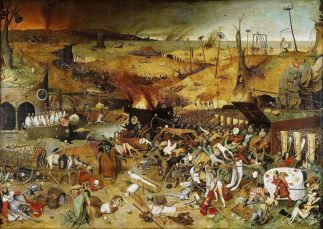
The Triumph of Death, Pieter Bruegel the Elder, c.1562
The president declared that the risk to America was “very low” and predicted a swift end to the outbreak….
“We could be just one or two people over the next short period of time,” Trump said of the virus’s impact in the United States.
Minutes later, Health and Human Services Secretary Alex Azar and CDC Principal Deputy Director Anne Schuchat warned Americans to prepare for the number of cases to grow.
“We can expect to see more cases in the United States,” Azar said.
“We do expect more cases,” Schuchat said.
The case confirmed Wednesday in California brought the total in the United States to 60.
During the press conference, CNN’s Dr. Sanjay Gupta tried to ask Trump a question and Trump repeatedly interrupted and corrected him.
Trump’s main concern is calming the markets, because if the economy tanks he probably won’t be reelected. But what he’s doing is likely to make things worse. NPR this morning: Stocks Tumble Into Correction Territory On Coronavirus Fears.
Stocks continued their downward slide on Thursday, with major indexes falling into correction territory. Investors are worried about the economic toll of a widening coronavirus epidemic.
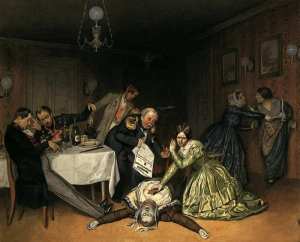
Pavel Fedotov, 1846-1860 Cholera pandemic
The Dow Jones Industrial Average tumbled more than 500 points in the opening minutes of trading. The blue chip index is down more than 10% from its recent peak on Feb. 12. The broader S&P 500 index has also lost more than 10% of its value in just over a week.
President Trump tried to project a note of calm in a news conference Wednesday evening, stressing that the United States is well prepared for any health crisis and predicting the stock market will recover, thanks in part to robust consumer spending. But investors were not immediately reassured….
A poll by Morning Consult this week found that 69% of U.S. adults are either “very” or “somewhat” concerned about the domestic economic impact of the epidemic, a 14 point increase from a few weeks ago.
Trump won’t be happy to see this headline at Bloomberg: Yellen Says Coronavirus Could Throw U.S. Economy Into Recession.
“We could see a significant impact on Europe, which has been weak to start with, and it’s just conceivable that it could throw the United States into a recession,” Yellen said Wednesday at an event in Michigan. “If it doesn’t hit in a substantial way in the United States, that’s less likely. We had a pretty solid outlook before this happened — and there is some risk, but basically I think the U.S. outlook looks pretty good.”
The global economy was weak but starting to recover before the virus hit, Yellen said. The shutdown of factories due to the outbreak in China will impact supply chains and cause a drop in consumer spending as people have been quarantined or cease traveling.
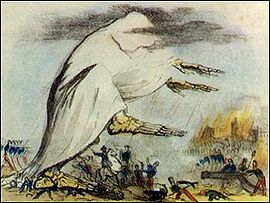
A representation by Robert Seymour of the cholera epidemic of the 19th century depicts the spread of the disease in the form of poisonous air.
Yellen, who spoke about the economy at an event held by the Brookings Institution in Clinton Township, Michigan, also commented on the decline in the 10-year Treasury yield this week to historic lows. Yields have plunged as fears about the spreading coronavirus have rocked global financial markets.
The newly diagnosed Coronaviris patient in California was in the hospital for several days before the CDC agreed to allow a test for the virus. The New York Times:
A California coronavirus patient had to wait days to be tested because of restrictive federal criteria, despite doctors’ requests. The patient, who has tested positive, may be the first person to be infected through community spread in the United States, the Centers for Disease Control and Prevention said Wednesday.
C.D.C. officials said it was possible the patient was exposed to a returning traveler who was infected. At the moment, however, the new case appears to be one in which the source of infection is unknown, suggesting that the virus may be transmitted within the community.
Doctors at the University of California, Davis Medical Center considered the novel pathogen a possible diagnosis when the patient was first admitted last week.
But the federal agency that conducts the testing did not administer the test until days later because the case did not fit the agency’s narrow testing criteria, university officials said in a letter to the campus community late Wednesday.
The C.D.C. has restricted testing to patients who either traveled to China recently or who know they had contact with someone infected with the coronavirus….
The C.D.C. could not be immediately reached for comment.
The patient was transferred to the medical center from another hospital in Northern California with a suspected viral infection, and was already on a ventilator upon arrival, according to the university’s letter.“Upon admission, our team asked public health officials if this case could be Covid-19,” the letter said. The medical center requested testing from the C.D.C. “Since the patient did not fit the existing C.D.C. criteria for Covid-19, a test was not immediately administered. U.C. Davis Health does not control the testing process.”
So it looks like we have the first coronavirus case that may have been passed from person to person in the U.S., and we have a president and an administration in denial and woefully unprepared to deal with a health crisis.
I’ll add more stories in the comment thread. As always, this is an open thread.
Saturday Reads: Unpredictable Weather, Rand Paul, and Other Odd News
Posted: March 9, 2013 Filed under: morning reads, Republican politics, science, Senate, U.S. Economy, U.S. Politics, Women's Rights | Tags: archaeology, Bernie Sanders, coronavirus, drones, Filibuster, Rand Paul, SARS, sequestration cuts, snow, Stonehenge, The Girls of the Manhattan Project, weather 32 Comments
Good Morning!!
I got about a foot of snow dumped on me by the latest storm, when the prediction the day before had been for about 3-5 inches. Boy were the predictions wrong for this one! Last night the Boston Globe weather blogger tried to explain “Why was there so much more snow than predicted?”
Now that the big storm is over, I am looking at why this was such a poor forecast. The basic reason was a bit more cold air than expected, more moisture and it lasted longer. No one expected so much snow to fall from 4 AM this morning until mid-afternoon. Storms usually need to be at roughly 40 degrees latitude and 70 degrees west longitude to give us a major snow event. Meteorologists around here call this the benchmark. If a storm passes near the benchmark, and it’s cold enough, we are often in for a good snowstorm. This storm passed hundreds of miles further east than that typical spot for a major snowstorm. One of the reasons I was confident in not seeing this size snowstorm, was the predicted distance of the storm from our area. That prediction by the models turned out to be pretty good. Temperatures were also forecast to be about 4 degrees milder. As it turn out, it’s sort of a good thing it ended up being colder because heavy wet snow of these amounts would have been catastrophic to the power situation.
I see . . . well, not really. Anyway, the stuff is melting already which is a good thing, because I wasn’t able to shovel my driveway out completely yesterday. We’re supposed to get temperatures in the 40s and 50s for the next few days, so I guess that will rescue me. Now what’s in the news today?
I see that Kentucky Senator Rand Paul is really full of himself after his “talking filibuster” the other day.
He’s got an op-ed in the Washington Post bragging, “My filibuster was just the beginning.”
If I had planned to speak for 13 hours when I took the Senate floor Wednesday, I would’ve worn more comfortable shoes. I started my filibuster with the words, “I rise today to begin to filibuster John Brennan’s nomination for the CIA. I will speak until I can no longer speak” — and I meant it.
I wanted to sound an alarm bell from coast to coast. I wanted everybody to know that our Constitution is precious and that no American should be killed by a drone without first being charged with a crime. As Americans, we have fought long and hard for the Bill of Rights. The idea that no person shall be held without due process, and that no person shall be held for a capital offense without being indicted, is a founding American principle and a basic right.
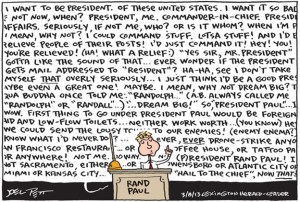
I certainly agree that the president shouldn’t have the power to kill Americans without due process, but I’d be more impressed with Paul if he supported other constitutional rights like equal treatment under the law for minorities, women and LGBT people. I can’t take anyone seriously as a defender of the Constitution if he opposes civil rights and the right of a woman to control her own body.
According to Grace Wyler at Business Insider, Libertarians Believe Their Moment Has Finally Arrived. On the other hand, Chris Cillizza explains why Why the Rand Paul filibuster might not be such good news for the GOP.
Everyone seems to be calling Paul’s filibuster “historic,” and no one is even mentioning the (IMO) much more dramatic and impressive filibuster by Bernie Sanders just a couple of years ago.
Sequestration cuts, anyone?
While the Village media types focus on either fawning over or condemning Rand Paul’s performance, local journalists around the country are reporting on the damage being done by sequestration cuts.
The debate over sequestration this past week has come down to two questions: Was the administration exaggerating the impact of the spending cuts, and did they really need to shut down White House tours because of them?
It’s been the predominant theme at the White House briefings, a constant subject of discussion on cable news and a topic of fascination on Capitol Hill. House Speaker John Boehner (R-Ohio) even took up the cause at a press briefing this week, saying: “I think it’s silly that they have insisted on locking down the White House, which the American people actually own.”
Beneath that debate, however, is a different type of conversation about the impact of the $85 billion in cuts. While the national media has focused on those two questions, local coverage has been more directed at the tangible impact the budget restraints will have. The Huffington Post reviewed dozens of local television news broadcasts, using the service TVeyes.com, to survey coverage of sequestration outside of the Beltway.
Check out the many examples of real pain for localities at the link. And besides, according to Buzzfeed, Nobody Liked The White House Tours That Much Anyway. They’re only rated 3.5 on Yelp. Read the negative reviews at the link.
Interesting book review at The Daily Beast
The Girls of the Manhattan Project.
They were the employees of the gigantic uranium-enrichment plant at Oak Ridge, Tenn.—those who lived and toiled in this purpose-built secret city in the Appalachian Mountains, many of them young women, had only been told that their efforts would help bring home American soldiers. Then, when atomic power was deployed against an enemy nation for the first (and so far, last) time, Oak Ridge residents realized what they had been working toward, and why their every move had been monitored, their every utterance policed, and their every question stonewalled.
In The Girls of Atomic City: The Untold Story of the Women Who Helped Win World War II, Denise Kiernan recreates, with cinematic vividness and clarity, the surreal Orwell-meets-Margaret Atwood environment of Oak Ridge as experienced by the women who were there. They were secretaries, technicians, a nurse, a statistician, a leak pipe inspector, a chemist, and a janitor. “Site X” began construction in late 1942, and was also known as the Clinton Engineering Works (CEW) and the Reservation. Staff members were recruited from all over the U.S., but particularly from nearby Southern states, and were offered higher than average wages, on-site housing and cafeterias, and free buses.
More importantly, they were offered the chance to join the 400,000 or so American women performing non-combatant roles in the armed services, as well as those keeping vital industries afloat and helping the men on the front lines. But whereas a female Air Force pilot or munitions factory worker understood precisely her contributions to the war effort, the women at Oak Ridge were kept in the dark about the actual purpose of their workplace, a mystery heightened by the apparent lack of anything ever leaving the site. Provided with “just enough detail to do their job well, and not an infinitesimal scrap more,” workers at all levels were forbidden from taking the slightest interest in anyone else’s duties. “Stick to your knitting,” in the words of Lieutenant General Leslie Groves, head of the Project.
That sounds like a fascinating book!
ABC News reports on a scary new virus–the coronaviris.

Coronavirus
Health officials are warning of a new virus that has sickened at least 14 people worldwide, killing eight of them.
There are no known American cases of the coronavirus, known as hCoV-EMC, but the U.S. Centers for Disease Control is urging doctors with patients who have an unexplained respiratory illness after traveling to the Arabian peninsula or neighboring countries to report the cases to the CDC.
Doctors should also report patients with known diseases who don’t respond to appropriate treatment, the agency said its Morbidity and Mortality Weekly Report. Close contacts of a symptomatic patient should also be evaluated.
The novel virus, which is associated with severe respiratory illness with renal failure, was first recognized last September and caused alarm because it is genetically and clinically similar to the SARS virus, which caused hundreds of deaths worldwide.
Read more at the CDC website.
A new archaeological theory about Stonehenge
The Guardian: Stonehenge may have been burial site for Stone Age elite, say archaeologists.

Centuries before the first massive sarsen stone was hauled into place at Stonehenge, the world’s most famous prehistoric monument may have begun life as a giant burial ground, according to a theory disclosed on Saturday.
More than 50,000 cremated bone fragments, of 63 individuals buried at Stonehenge, have been excavated and studied for the first time by a team led by archaeologist Professor Mike Parker Pearson, who has been working at the site and on nearby monuments for decades. He now believes the earliest burials long predate the monument in its current form.
The first bluestones, the smaller standing stones, were brought from Wales and placed as grave markers around 3,000BC, and it remained a giant circular graveyard for at least 200 years, with sporadic burials after that, he claims.
It had been thought that almost all the Stonehenge burials, many originally excavated almost a century ago, but discarded as unimportant, were of adult men. However, new techniques have revealed for the first time that they include almost equal numbers of men and women, and children including a newborn baby.
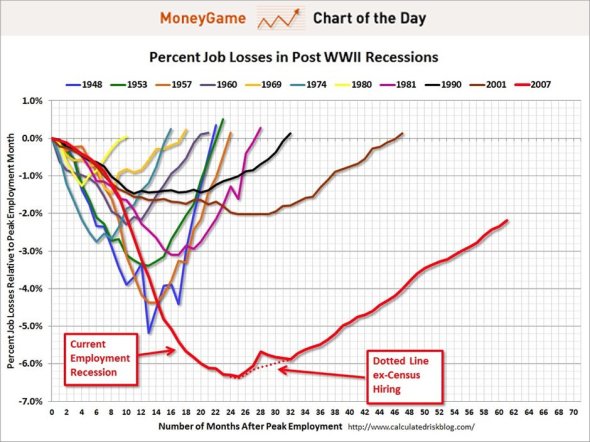
I’ll end with this “chart of the day” from Business Insider:
“The Scariest Jobs Chart Ever”

 peej
peej Carissa
 bostonboomer
 dakinikat
 ecocatwoman
 jjlolatina
 mablue2
 Mama Lopez
 peggysue22
 quixote
 skydancingguestblogger
 Mona (aka Wonk the Vote)



 Sky Dancing
Recent Comments