The world is shifting towards a superheated climate not seen in the past 1m years, prior to human existence, because “we are damned fools” for not acting upon warnings over the climate crisis, according to James Hansen, the US scientist who alerted the world to the greenhouse effect in the 1980s.
Hansen, whose testimony to the US Senate in 1988 is cited as the first high-profile revelation of global heating, warned in a statement with two other scientists that the world was moving towards a “new climate frontier” with temperatures higher than at any point over the past million years, bringing impacts such as stronger storms, heatwaves and droughts.
The world has already warmed by about 1.2C since mass industrialization, causing a 20% chance of having the sort of extreme summer temperatures currently seen in many parts of the northern hemisphere, up from a 1% chance 50 years ago, Hansen said.
“There’s a lot more in the pipeline, unless we reduce the greenhouse gas amounts,” Hansen, who is 82, told the Guardian. “These superstorms are a taste of the storms of my grandchildren. We are headed wittingly into the new reality – we knew it was coming.”
Hansen was a Nasa climate scientist when he warned lawmakers of growing global heating and has since taken part in protests alongside activists to decry the lack of action to reduce planet-heating emissions in the decades since.
He said the record heatwaves that have roiled the US, Europe, China and elsewhere in recent weeks have heightened “a sense of disappointment that we scientists did not communicate more clearly and that we did not elect leaders capable of a more intelligent response”.
“It means we are damned fools,” Hansen said of humanity’s ponderous response to the climate crisis. “We have to taste it to believe it.”
This year looks likely to be the hottest ever recorded globally, with the summer already seeing the hottest June and, possibly, hottest week ever reliably measured. Conversely, 2023 may in time be considered an average or even mild year, as temperatures continue to climb. “Things will get worse before they get better,” Hansen said.
“This does not mean that the extreme heat at a particular place this year will recur and grow each year. Weather fluctuations move things around. But the global average temperature will go up and the climate dice will be more and more loaded, including more extreme events.”
Read the rest at The Guardian.
Now on to the Trump Crimes:
The news that Trump received a target letter from Jack Smith warning him he is about to be indicted in the January 6 case has pushed the stolen documents case in Florida into the background. Judge Cannon can dither about setting a date for the stolen documents trial all she wants; the January 6 case will be tried in Washington DC, will likely be on a fast track, and will be higher profile. Trump could be indicted for the third time as early as Friday.
Tao Fung Shan (2019), by Stephen Wong Chun Hei (Hong Kong b. 1986),
Special counsel Jack Smith has informed former President Donald Trump by letter that he is a target in his investigationSp into efforts to overturn the 2020 election, sources familiar with the matter tell ABC News.
The target letter mentions three federal statutes: conspiracy to commit offense or to defraud the United States, deprivation of rights under color of law, and tampering with a witness, victim or an informant, sources familiar with the matter told ABC News.
There are no additional details in the letter and it does not say how the special counsel’s office claims Trump may have violated the statutes listed, sources said.
Trump, appearing Tuesday night at a town hall in Cedar Rapids, Iowa, told Fox News’ Sean Hannity that he received the letter on Sunday.
“It bothers me,” said the former president. “I got the letter on Sunday night. Think of it, I don’t think they’ve ever sent a letter on Sunday night. And they’re in a rush because they want to interfere, it’s election interference, never been done like this in the history of our country and it’s a disgrace what’s happening to our country.”
Target letters are typically given to subjects in a criminal investigation to put them on notice that they are facing the prospect of indictment.
The letter mentions three federal statutes: Conspiracy to commit offense or to defraud the United States; deprivation of rights under color of law; and tampering with a witness, victim, or an informant. It does not offer further details, nor does it detail how the special counsel believes Trump may have violated the statutes, the source tells Rolling Stone.
The letter does not mention statutes on sedition or insurrection, according to the source….
The source said the statutes listed likely refer to the prosecutor’s interest in charging Trump with obstructing the election certification process, including Trump efforts to pressure Mike Pence to stop the certification of President Biden’s 2020 victory.
A federal judge on Wednesday rejected Donald Trump’s request for a new trial in a civil case brought by E. Jean Carroll, where a jury found the former U.S. president liable for sexually abusing and defaming the writer and awarded her $5 million in damages.
In a 59-page decision, U.S. District Judge Lewis Kaplan in Manhattan said the jury did not reach a “seriously erroneous result,” and the May 9 verdict was not a “miscarriage of justice.”
Carroll had accused Trump of raping her in a Manhattan department store dressing room in the mid-1990s, and then branding the incident a hoax in an October 2022 post on his Truth Social platform.
Trump had argued that awarding Carroll $2 million in compensatory damages for sexual assault was “excessive” because the jury found he had not raped her, while the award for defamation was based on “pure speculation.”
The judge also found that Trump did rape Carroll, despite his claims of being exhonerated of that charge, according to the “common definition.”
JUST IN: Judge Kaplan rejects Trump's bid to throw out the verdict in the Carroll sexual assault lawsuit — and he says the Carroll jury did, in fact, find Trump raped her, based on the common definition of the word. https://t.co/3i62YnLA6Mpic.twitter.com/UqPd2VTFQE
Attorney General Dana Nessel is leveling felony charges against 16 Republicans who signed a certificate falsely stating that Donald Trump won Michigan’s 2020 presidential election, launching criminal cases against top political figures inside the state GOP.
Each of the 16 electors, including former Michigan Republican Party Co-Chairwoman Meshawn Maddock and Shelby Township Clerk Stan Grot, have been charged with eight felony counts, including forgery and conspiracy to commit election law forgery, according to Nessel’s office.
Moonlight Dance, by Paul Batch,, 1979
The revelation capped six months of investigation and produced the most serious allegations yet in Michigan over the campaign to overturn Trump’s loss to Democrat Joe Biden in 2020. Biden won the state by 154,000 votes or 3 percentage points, but Trump and his supporters maintained false and unproven claims that fraud swung the result.
As part of the push to undermine Biden’s victory, Trump supporters gathered inside the then-Michigan Republican Party headquarters on Dec. 14, 2020, and signed a certificate, claiming to cast the state’s 16 electoral votes for Trump.
Eventually, the false certificate was sent to the National Archives and Congress. The document inaccurately claimed the Trump electors had met inside the Michigan Capitol. However, they hadn’t. Biden’s electors convened inside the Capitol, and the building was closed to others on Dec. 14, 2020.
“The false electors’ actions undermined the public’s faith in the integrity of our elections and, we believe, also plainly violated the laws by which we administer our elections in Michigan,” said Nessel, a Democrat, in a statement.
“My department has prosecuted numerous cases of election law violations throughout my tenure, and it would be malfeasance of the greatest magnitude if my department failed to act here in the face of overwhelming evidence of an organized effort to circumvent the lawfully cast ballots of millions of Michigan voters in a presidential election.”
Special counsel Jack Smith’s team has contacted former Arizona Gov. Doug Ducey, who Donald Trump pressured to overturn the 2020 election, a source familiar with the outreach confirmed first to CNN.
A spokesman for Ducey confirmed the outreach from Smith’s team, which has not been previously reported.
Phil Greenwood (UK ,Wales. b.1943), Moon Lights, etching and aquating
“Yes, he’s been contacted. He’s been responsive, and just as he’s done since the election, he will do the right thing,” Ducey spokesman Daniel Scarpinato told CNN.
Trump narrowly lost Arizona to Joe Biden by less than 11,000 votes. Trump publicly attacked Ducey, a former ally, over the state’s certification of the results. As Ducey was certifying the election results in November 2020, Trump appeared to call the governor – with a “Hail to the Chief” ringtone heard playing on Ducey’s phone. Ducey did not take that call but later said he spoke with Trump, though he did not describe the specifics of the conversation.
Ducey, behind closed doors, said that the former president was pressuring him to find fraud in the presidential election in Arizona that would help him overturn the election, a source with knowledge told CNN earlier this month after The Washington Post first reported the news. There was no recording made of that call, a source familiar with the matter said.
Then-Vice President Mike Pence also spoke with Ducey in the wake of the 2020 election.
Federal prosecutors examining former President Donald Trump’s attempt to hold onto power following the 2020 election requested surveillance and other security footage recorded at Atlanta’s State Farm Arena, according to a subpoena obtained by The Atlanta Journal-Constitution.
In a grand jury subpoena dated May 31, the Georgia Secretary of State’s office was directed to hand over “any and all security video or security footage, or any other video of any kind, depicting or taken at or near” State Farm and “any associated data.”
The subpoena, which was obtained by The AJC through an open records request and had not been previously reported, shows the widening interest in Georgia from Justice Department special counsel Jack Smith, who sent a so-called “target” letter to Trump on Sunday.
It also demonstrated the growing areas of overlap between the DOJ probe and the Fulton County investigation of interference in Georgia’s 2020 elections, which is expected to result in indictments against Trump and others next month.
Previous subpoenas and grand jury appearances show that Fulton and federal prosecutors are both interested in the appointment of a slate of “alternate” Trump electors in swing states like Georgia, as well as the pressure the former president placed on Georgia Secretary of State Brad Raffensperger.
The federal judge overseeing former President Donald J. Trump’s classified documents case expressed skepticism on Tuesday about the government’s request to go to trial as early as December, but she also seemed disinclined to accede immediately to Mr. Trump’s desire to have the trial put off until after the 2024 election.
Appearing for the first time at a hearing in the case, the judge, Aileen M. Cannon, came to no decision about when to schedule the trial, saying she would issue a written order “promptly.”
George Wesley Bellows (USA 1882-1925), A Fresh Breeze, 1913
The question of the trial’s timing could be hugely consequential, given that the legal proceeding is intertwined with the calendar of a presidential campaign in which Mr. Trump is now the front-runner for the Republican nomination.
For nearly two hours in Federal District Court in Fort Pierce, Fla., Judge Cannon, a Trump appointee, peppered prosecutors and the former president’s lawyers with questions that suggested she was in command of her courtroom and well-versed in the facts of the case.
Her decision about when to schedule the trial will be an early test for the judge, who came under widespread criticism last year after she rendered some decisions in a related case that were favorable to Mr. Trump at an early stage of the investigation.
At one point, Judge Cannon directly asked one of Mr. Trump’s lawyers, Christopher Kise, if he wanted to put off the trial until after the election. When Mr. Kise said he did, Judge Cannon told him that she wanted to focus on near-term issues like the amount of discovery evidence the defense had to review and the types of motions the lawyers planned to file.
As the hearing came to end, Todd Blanche, another one of Mr. Trump’s lawyers, asked Judge Cannon if the defense could return to court in November and reassess the trial schedule then. Appearing to pick up on the judge’s desire to create what she called “a road map” for the case, Mr. Blanche said that if a trial date absolutely had to be chosen, he would ask for one in mid-November 2024, after the election.
Timing is particularly important in this case because if the trial is delayed until after votes are cast and Mr. Trump wins the race, he could try to pardon himself or have his attorney general dismiss the matter entirely.
I imagine the Special Counsel would appeal to the 11th Circuit if Cannon has the nerve to schedule the trial after the election, as Trump wants.
Former New York City police commissioner Bernie Kerik is in talks to be interviewed by special counsel Jack Smith’s team investigating efforts to overturn the result of the 2020 presidential election, Kerik’s attorney said Tuesday. Kerik worked with Rudy Giuliani after the election to find evidence of voter fraud and later provided documents about a plan to keep Donald Trump in power to the House Jan. 6 committee. Tim Parlatore, a lawyer who quit Trump’s legal team in May and who now represents Kerik, was asked by Kaitlan Collins on CNN if he expected the former commissioner to receive a letter like the one Trump received informing him that he was a target of Smith’s investigation. Parlatore said Kerik hasn’t received a target letter and does not expect him to at any point. But when asked if Parlatore is “in talks” about Kerik having an interview with the special counsel, the attorney said: “Yeah sure, absolutely. Mr. Kerik has nothing to hide. He’s happy to sit down and explain everything to them.”
Finally, news broke of another astonishing Trump crime yesterday–theft of valuable Israeli antiquities.
Trump’s Mar-a-Lago bathrooms and ballrooms were not just filled with top secret government documents. He apparently has also been hoarding temporarily loaned Israeli antiquities there for four years.
Haaretzreports that Israel lent the Trump White House antiquities, including ancient ceramic lamps from its national treasures collection, for a Hanukkah candle-lighting event in 2019. Israel Hasson, the then-director of the Israeli Antiquities Authority, approved the loan of the antiquities so long as they were returned within weeks.
Hasson told Haaretz that “we wanted our man to go and bring it back, but then Covid broke out, and everything got stuck.” So Hasson’s agency had asked Saul Fox, a major Jewish-American donor to the Antiquities Authority, to keep the items in tow until they could be brought back to Israel. But, Haaretz reports, Israeli authorities discovered several months ago that the antiquites instead ended up at Mar-a-Lago, “where they still remain.”
Eli Eskozido, the new Antiquities Authority head, has asked the Israeli government and Trump’s former U.S. ambassador to Israel to coordinate a return of the antiquities, but to no avail. One source told Haaretz that he wouldn’t be surprised if “the items Israel seeks are also eventually found in some bathroom.”
Republicans have bent over backward to show their inextinguishable support for Israel, but it’s unclear whether they will question why Trump has been harboring Israeli antiquities. After all, they had barely any criticism for his stealing of U.S. national security documents.
The extent of Trump criming is breathtaking, but his comeuppance is coming. As we say in the Midwest, he is up shit creek.
Have a wonderful Wednesday, Sky Dancers!!
Did you like this post? Please share it with your friends:
Summer Day or Embrace on the beach, (1904), by Edvard Munch
Good Day!!
There is some Trump investigation news this morning, plus, news just broke that the Supreme Court has gutted Affirmative Action in college admissions.
But before I get to those stories, a few articles about the awful summer weather we are having. Here in New England and across much of the Midwest, we’re having poor air quality because of the Canadian wildfires; and in much of the Southern U.S. people are suffering greatly from excessive heat.
Dangerous air quality and hazy skies persist as smoke from Canada’s raging wildfires drifts south, leaving more than 100 million people under air quality alerts across a dozen states from Minnesota to New York and down to the Carolinas.
Chicago had the worst air quality among major cities in the world early Thursday, according to IQAir. The air in Washington, DC, Minneapolis, Detroit and New York City was among the top 10 most polluted.
Smoke will continue to drift across the Midwest and into the mid-Atlantic and Northeast on Thursday. Forecast models predict a slow improvement beginning Thursday and additional decreases by Friday.
The worst air quality is likely to remain over the Great Lakes and Ohio Valley, with some increase in smoke in states including Washington and New York, but levels are not expected to reach those seen a few weeks ago.
“With no end in sight to the Canadian wildfires and west to northwesterly winds expected to persist from south central Canada into the north central to northeast U.S., poor air quality conditions are likely to continue,” the National Weather Service warned.
The New York Times is providing live updates on the smoke as it works it’s way toward NYC.
Even for Southerners used to spending a lot of time outside, this week’s brutal heat and humidity — which spread from Texas across the Gulf Coast and north into Missouri, Tennessee and Arkansas on Wednesday — are a little much….
An oppressive heat wave that baked Texas and Oklahoma last week, contributing to several deaths, has engulfed much of the southern and central United States, raising the heat index to dangerously high levels from Kansas City to the Florida Keys.
High Summer, 1915, by Edvard Munch
Temperatures will climb up to 20 degrees above normal for much of the region through at least the weekend, reaching the upper 90s or low 100s in many places, with the heat index — a measure of how heat and humidity make the air feel — soaring even higher….
Major cities where the heat index could reach between 110 to 120 degrees over the next few days include Dallas, San Antonio, New Orleans and Nashville, as well as Little Rock, Ark.; Jackson, Miss.; and Montgomery, Ala. “Many areas outside of Texas will experience their most significant heat of the season so far,” a forecast from the National Weather Service said.
Health experts consider a heat index of over 103 degrees dangerous, with a higher risk of cramps, exhaustion and heat stroke, particularly after exercise or long stretches in the sun.
High humidity will continue to produce “potentially life-threatening” heat through the rest of the week, the Weather Service said, and nighttime temperatures will offer little respite, staying unseasonably high even while the sun is down.
“That’s substantial because your house isn’t cooling off as much at night,” said Rob Perillo, the chief meteorologist at KATC-TV in Lafayette, La. “When you’re shooting 95 at noon, and it’s above 95 until 7 at night,” he added, “it’s not only hotter, but it’s hotter longer.”
Scientists say a closely watched atmospheric pattern — the jet stream — is behind both the Canadian wildfires and the scorching heat in Texas, raising questions about how it shapes extreme weather events and whether climate change is disrupting its flow.
The jet stream, a ribbon of air that encircles the Northern Hemisphere at high altitudes, drives pressure changes that determine weather across North America. The jet stream’s wavy pattern creates areas of high and low pressure.
Summer Night’s Dream/The Voice, by Edvard Munch, 1893
More than 100 million people in the U.S. faced either blistering heat or unhealthy air quality Wednesday.
In recent weeks, the jet stream has appeared unusual and disjointed, scientists say. Some researchers think climate change is disrupting its flow and causing it to bake regions in heat longer. They are concerned that changes in the patterns could cause extremes to increase more rapidly than climate models have projected as the world warms.
Michael Mann, a climate scientist at Pennsylvania State University, likened visualizations of the jet stream’s appearance in recent weeks to the swirling brushstrokes of a post-impressionist painter.
“I’m honestly at a loss to even characterize the current large-scale planetary wave pattern,” Mann tweeted this month. “Frankly, it looks like a Van Gogh.”
Now that’s an interesting interpretation!
In other news, the right wing Supreme Court has struck again.
In disavowing race as a factor in achieving educational diversity, the court all but ensured that the student population at the campuses of elite institutions will become whiter and more Asian and less Black and Latino.
Race-conscious admissions programs at Harvard and the University of North Carolina are unconstitutional, the Supreme Court ruled on Thursday, the latest decision by its conservative supermajority on a contentious issue of American life.
Chief Justice John G. Roberts Jr., writing for the 6-3 majority, said the two programs “unavoidably employ race in a negative manner” and “involve racial stereotyping,” in a manner that violates the Constitution.
Universities can consider how race has affected an applicant’s life, but he emphasized that students “must be treated based on his or her experiences as an individual — not on the basis of race.”
Justice Sonia Sotomayor summarized her dissent from the bench — a rare move that signals profound disagreement. The court, she wrote, was “further entrenching racial inequality in education, the very foundation of our democratic government and pluralistic society.”
“The devastating impact of this decision cannot be overstated,” she said in her scorching dissent.
The ruling could have far-reaching effects, and not just at the colleges and universities across the country that are expected to revisit their admissions practices. The decision could prompt employers to rethink how they consider race in hiring and it could potentially narrow the pipeline of highly credentialed minority candidates entering the work force.
One of the top advisers on Donald Trump’s 2024 campaign is among the individuals identified but not named by special counsel Jack Smith in his indictment against the former president for allegedly mishandling classified documents after leaving the White House and obstructing the government’s efforts to retrieve them, sources familiar with the matter told ABC News.
The Mystery of a Summer Night, 1892, by Edvard Munch
Susie Wiles, one of Trump’s most trusted advisers leading his second reelection effort, is the individual singled out in Smith’s indictment as the “PAC Representative” who Trump is alleged to have shown a classified map to in August or September of 2021, sources said.
Trump, in the indictment, is alleged to have shown the classified map of an unidentified country to Wiles while discussing a military operation that Trump said “was not going well,” while adding that he “should not be showing the map” to her and “not to get too close.”
The alleged exchange between Trump and Wiles is the second of two instances detailed by prosecutors in the indictment showing how Trump allegedly disclosed classified information in private meetings after leaving the White House. The first was a July 2021 audio recording, obtained by ABC News earlier this week, in which Trump is heard showing people what he describes as a “secret” and “highly confidential” document relating to Iran.
ABC News has reported the meeting involved people who were helping Trump’s former chief of staff, Mark Meadows, with his memoir, according to sources. Smith’s team has spoken to the meeting’s attendees, which included the writers helping Meadows with his book and at least two aides to Trump, according to sources….
It does not appear, based on the indictment, that Trump was charged specifically for his retention of either the Iran document or the classified map shown to the person identified as Wiles. Rather, the two instances speak to what Smith’s prosecutors see as Trump’s state of mind in how he handled and sometimes shared classified materials in his possession after leaving the White House, sources said, as well as his alleged efforts to subvert the government’s efforts to get the documents back.
LAST MONTH, DONALD Trump’s lawyers told him he was on the cusp of a federal indictment in the classified documents case. But the former president still wanted “my documents” and “my boxes” back, asking some of his lawyers if they could get them from the federal government, according to a source with direct knowledge of the matter and two other people briefed on it.
It’s one of many such conversations Trump has had over the past few months, the sources say. In these conversations, Trump also claimed it was “illegal” that he could no longer have the documents seized in the Mar-a-Lago raid. Those materials, Trump insisted, belonged to “me.” Trump has also asked if there are any other possible legal maneuvers or court filings they could try to accomplish this that they hadn’t thought of yet.
For much of his post-presidency, Trump has incorrectly insisted to various aides and confidants that the highly classified documents he continued to hoard were “mine.” In some of these conversations, according to the source with knowledge of the matter, Trump has also mentioned that he’ll get the documents back in 2025 — because he predicts he’ll be president again, and therefore regain unfettered access to the government’s most sensitive secrets.
Summer Night – Inger on the Shore, 1899, by Edvard Munch
Apparently some of Trump’s lawyers have gone along with his claims.
Two sources familiar with the situation tell Rolling Stone that several lawyers — some retained by Trump and others politically aligned with him — have briefed Trump that he is, in their view, entitled to the return of government documents under an obscure part of the Presidential Records Act, specifically 44 USC 2205(3), which asserts that “Presidential records of a former President shall be available to such former President or the former President’s designated representative.”
But experts on classification rules disagree. “Whatever one might say about his Presidential Records Act argument, there’s no argument that it immunizes him from criminal prosecution under the Espionage Act,” Brian Greer, an attorney who served in the CIA’s office of general counsel from 2010 to 2018, tells Rolling Stone. Nor does the act allow a former president to defy a lawful court-ordered subpoena for documents and obstruct justice, as the special counsel alleges Trump did in the indictment, Greer adds.
Donald Trump’s valet charged in the classified documents case had his arraignment on Tuesday delayed for a second time to July by a magistrate judge, after he was forced to abandon his top choice Florida lawyer over a dispute about legal fees, according to two people familiar with the matter.
The valet, Walt Nauta, appeared alongside Trump when the former president pleaded not guilty to 37 criminal charges in federal district court in Miami this month but could not himself enter a plea – a necessary step to start trial preparation – because he lacked local counsel.
Two weeks later, Nauta remains without a lawyer admitted to practice in the southern district of Florida after the person at the top of the shortlist drawn up by Nauta’s defense team decided he needed to charge higher fees to represent him the night before the arraignment, the people said.
The previously unreported dispute over fees in effect meant Nauta could not retain the person as his Florida lawyer, the people said, even though he would be paid by Trump’s political action committee Save America, which has also been paying the fees of his lead lawyer, Stanley Woodward.
The reason for the rate hike was not clear, but at least one Florida lawyer who had seriously considered representing Nauta decided several days ago that the reputational and legal risks of working with Trump’s co-defendant in the documents case were too great.
With the sounds of papers rustling in the background, Trump is heard complaining about General Mark Milley, the chairman of the Joint Chiefs of Staff. “He said that I wanted to attack Iran—isn’t it amazing?” Trump told his visitors, who included book advisers to his former chief of staff, Mark Meadows. A few days earlier, I had reported about Milley’s concerns in the final months of Trump’s Presidency that Trump might provoke a military conflict with Iran as part of his effort to remain in power, despite losing the 2020 election. This, Milley told others, was one of the “nightmare scenarios” that he was working to prevent. At Bedminster, Trump apparently brandished the Pentagon’s attack plan—which he claimed had been presented to him by Milley. “This totally wins my case,” Trump said. “You know, except, like, it is highly confidential.” He added, “See, as President, I could have declassified it; now I can’t, but this is classified. . . . it’s so cool.” The tape ends with a line that was not included in the federal indictment: Trump asking, “Bring some Cokes in, please?” The whole exchange was happening, in other words, not in some top-secret facility, but with someone standing by to fetch drinks, in Trump’s office, right near the pool at his country club.
Summer Night on the Beach, Edvard Munch
To legal observers and, indeed, to pretty much anyone who could hear, the audiotape sounded like an admission of guilt. But this is Trump, a serial liar for whom an obvious defense presents itself: that he was not telling the truth to his visitors when he claimed to be showing them secret papers. And, sure enough, by Tuesday, Trump told reporters on his way back from a New Hampshire campaign appearance, “It was bravado, if you want to know the truth”—bravado here being a Trump synonym for “bullshitting.” This is the 2023 equivalent of dismissing the “Access Hollywood” tape as mere “locker-room talk” that had nothing to do with Trump’s actual behavior toward women. He even suggested that the papers he is heard shuffling through were just “building plans.” For Trump, it’s better to be a liar than a convict.
The damning evidence against Trump would not exist if not for his rift with Mark Milley, a remarkable feud between the Commander-in-Chief and the nation’s top general that had been a secret backdrop to the public drama that played out after the 2020 election. At the time the tape was made, in the summer of 2021, Trump was apoplectic that Milley’s fears about him were becoming public. Two recently published books—one by the journalists Carol Leonnig and Phil Rucker of the Post, and the other by Michael Bender, then of the Wall Street Journal—had reported new details about Milley’s efforts, including regular “land the plane” phone calls with Meadows, the White House chief of staff, to prevent Trump from drawing the military into his quest to overturn the 2020 election. Milley was even quoted fretting about Trump and his supporters staging a “Reichstag moment”—a fear that seemed eerily prescient on January 6, 2021, when a violent mob of Trump supporters stormed the U.S. Capitol, seeking to block congressional certification of Trump’s defeat. Trump, in turn, publicly denounced Milley and said that he had only picked him as chairman in 2018 to spite James Mattis, his soon-to-quit Defense Secretary at the time.
Glasser, as always, is long-winded, so you’ll need to read more at The New Yorker to get the full story about Trump’s rage at Milley. Milley was afraid that Trump might try to attack Iran after he lost the election. Basically, Milley told the truth about him, and Trump never likes people who do that.
Legendary journalist Bob Woodward tore into former President Donald Trump in an interview on CNN Wednesday evening, calling him the largest threat to national security he had ever seen from any U.S. government official.
This comes amid the release of an audio tape of Trump boasting to patrons of his New Jersey golf club about possessing highly classified defense information about an attack on Iran — which he now denies — and reporting that he was motivated to do so by anger at Joint Chiefs Chairman Mark Milley for working to constrain his post-2020 election impulses.
“Bob, you’ve interviewed the former president a lot,” said anchor Anderson Cooper. “We’ve discussed your own tape of him. What stands out to you about this latest recording?”
“Well, it really shows that Donald Trump is an alarming, dangerous threat to national security,” said Woodward, who helped expose the Watergate scandal decades ago and has recently been caught up in a legal battle with Trump over White House transcripts. “In the book, ‘Peril’ that I did with Robert Costa, we recount two National Security Council meetings where Trump, not General Milley or the Defense Department, was agitating for a possible attack on Iran. And he is pushing it. And General Milley, the Chairman of the Joint Chiefs, the number one military man in the country, is telling Trump, you don’t want a war. If you start a war, you’re going to get into a conflict that you can’t get out of.”
“You see him in this reporting that we did from these meetings from notes, that it is the generals who say, no, no, no,” Woodward continued. “And Trump says, well — in one of the meetings the Iranians have enough to make two nuclear bombs, and he’s worried about that and thinking that maybe they should consider an attack. And these contingency plans are most sensitive documents in the government because what they do is they outline in a crisis how we might attack Iran, what the casualties would be, how many ships would be sunk, how long it might take. And that’s something you can’t treat casually, as Trump has.”
That’s it for me. What stories have caught your interest today?
Did you like this post? Please share it with your friends:
It’s pretty clear that Hurricane Ian did catastrophic damage in Florida, although there still isn’t much specific reporting on it. The images on TV are horrifying though. We’ll likely be getting more details throughout today and over the next few days. The storm is now moving toward Georgia and the Carolinas. You can read live updates at the Weather Channel: Tropical Storm Ian Live Updates: Catastrophic Damage; Destruction Hampers Rescue Efforts; Death Reported.
More on Ian:
We are getting our first images of Sanibel Island from the Coast Guard (District 7). The causeway has been damaged extensively and those who rode out the storm on the Island had to get airlifted to safety from the Coast Guard earlier today. #Ianpic.twitter.com/y3SMQcvy7H
At least three sections of the Sanibel Causeway were washed away by storm surge from Hurricane Ian, according to video from CNN affiliates WBBH and WPLG, severing the Sanibel and Captiva islands’ only connection to Florida’s mainland.
The videos from the causeway show two portions of the ramp to both bridges washed away, as well as a stretch of roadway that crossed an island in the middle of the causeway.
A portion of the Sanibel Causeway Bridge “was damaged/washed out,” Lieutenant Gregory S. Bueno with the Public Affairs Division of Florida Highway Patrol told CNN. All lanes of the bridge are currently closed and the severity of the closure is listed as “major,” according to Florida 511.
Law enforcement and personnel from the Lee County Department of Transportation are on scene at the causeway, officials said in an update Thursday morning, and bridge inspectors were working to asses all bridges in Lee County. Residents are advised to remain off the roads “unless absolutely necessary.
The county, which includes Fort Myers in addition to Sanibel and Captiva islands and Cape Coral, suffered “catastrophic damage” from the storm, officials said in their update, noting that 98% of the county remains without power.
Urban search and rescue crews from local agencies are “actively engaged in search and rescue efforts,” with federal search and rescue teams being deployed. In the meantime, the 15 shelters opened prior to the storm’s arrival remain open.
Rescuers have been pulling people from roofs as they work to respond to hundreds of calls for help since Ian – now a tropical storm marching across Florida – slammed the state’s west coast as a Category 4 hurricane, its surge trapping residents and its monstrous winds and flooding rains leaving millions without power and many without drinkable water.
Many are believed to need rescuing in hard-hit southwest Florida’s Fort Myers area, FEMA chief Deanne Criswell said Thursday morning. The nearby Naples area was similarly slammed – feet of water submerged streets, nearly swallowing vehicles and rushing into the first floors of homes and businesses – after Ian’s center plowed ashore near Cayo Costa on Wednesday afternoon as one of the strongest storms ever to make landfall on Florida’s west coast.
The Coast Guard and National Guard were “pulling people off of roofs in Fort Myers” with aircraft Thursday morning, Coast Guard Rear Adm. Brendan McPherson told CNN. Coast Guard crews have rescued at least 23 people since Wednesday, the service said.
Roughly five people are believed to have died in Lee County, the sheriff said, and parts of a key bridge there from Sanibel and Captiva islands to Florida’s mainland have been washed out.
Collapsed buildings, flooding, downed power lines and impassable roads were reported early Thursday by survey crews across southwest Florida. More than 2.5 million homes and businesses statewide have no power Thursday morning, according to PowerOutage.us, and some drinking water systems have broken down completely or have boil notices in effect.
Still, much about the misery remains unknown: how many lives Ian may have ended, how many people remain trapped, how many homes were wrecked beyond repair and how long it might take to restore a semblance of ordinary life.
"It was definitely the roughest flight I've been on" — NOAA Aerospace Engineer Nick Underwood flew a plane into Hurricane Ian. He shares his experience with the storm with CNN's Erin Burnett https://t.co/obw0epUbWKpic.twitter.com/y2KoIzAheB
The death toll from Tropical Storm Ian remained unclear early Thursday after Florida Gov. Ron DeSantis (R) said it brought “historic” damage to the state, hours after President Biden approved a major disaster declaration for Florida amid what the National Hurricane Center described as “catastrophic flooding” over east and central parts of the state.
“We’ve never seen a flood event like this,” DeSantis said.
Two people were reported dead Thursday, though DeSantis said it was still unconfirmed whether their deaths were storm-related or if they died amid the storm from other causes. Local officials reported that a 34-year-old man died in Martin County, just north of Palm Beach, and a 72-year-old man died in Volusia County on Florida’s Atlantic Coast. The Lee County sheriff said Thursday he believed “hundreds” might be dead after the storm made landfall to the north, though no numbers have been confirmed as search and rescue efforts are underway.
Here’s what to know
The National Hurricane Center said Ian, which is heading toward Florida’s northeast with maximum sustained winds of about 65 miles per hour, is expected to further weaken Friday night and into Saturday but may re-intensify at times, and “could be near hurricane strength” on Friday when it approaches South Carolina.
Ian battered parts of Florida’s western coast, tearing down trees and power lines and causing dangerous storm surges in parts of the state. Authorities in Fort Myers, which was badly hit, said late Wednesday that parts of the city were under 3 to 4 feet of water. To the south in Naples, half of the streets “are not passable due to high water,” Collier County warned in a tweet.
Hurricane warnings that were in effect for parts of Florida’s east and west coasts were changed early Thursday to tropical storm warnings. Several airports across the state suspended commercial operations and canceled flights.
Hurricane Ian sent severe flooding into the Naples Fire-Rescue building on Wednesday, forcing firefighters to save what they could. https://t.co/qlyFHCH63Q
Even as Ian gathered strength and neared Category 5 status, experts warned that solely paying attention to a hurricane’s category often masks just how destructive and life-threatening these storms can be — particularly as climate change makes hurricanes both rainier and more intense.
Hurricane Ian is already proving to be a devastating storm. After knocking out power to all of Cuba on Tuesday, Ian is forecast to dump up to 24 inches of rain over parts of Florida and trigger up to 18-foot storm surges from Englewood to Bonita Beach, according to the National Hurricane Center…
In the days leading up to Ian’s landfall, many drew comparisons to Hurricane Charley, which struck Florida’s southwestern coast as a Category 4 storm in 2004. But while past hurricanes can provide helpful context, Ian is sure to be a wildly different storm, said Kimberly Wood, an associate professor of meteorology at Mississippi State University.
“We’re looking at a similar category as Hurricane Charley, but the impacts will be very, very different,” they said.
#Ian is not #Charley… Although the tracks of Cat4 Ian '22 and Cat4 Charley '04 are eerily similar, the sizes are VERY different. As of 5am Wednesday, Ian's area of hurricane-force winds is 2.9 times larger, and its area of tropical storm force winds is 2.3 times larger. pic.twitter.com/wCWPiJDzfh
Many of the most destructive and potentially deadly impacts of a hurricane — including storm surge, flooding and rainfall — are not accounted for in a storm’s category number. That’s because these categories refer to a storm’s rating on what’s known as the Saffir-Simpson Hurricane Wind Scale, which ranks hurricanes from 1 to 5 based on a storm’s maximum sustained wind speed.
The categories are used to estimate potential damage to property from hurricane winds, but where it becomes problematic is if people use the rankings to gauge other impacts on land.
“It has nothing to do with the size of a storm, and it has very little to do with how much rain is produced,” Wood said. “People hyper-focus on the category when the category is a very small part of the picture of what a hurricane might do to a location.”
The effects of climate change:
Hurricane Ian’s rainfall projections across Florida are a major concern and fit within a broader trend of storms becoming rainier in recent years due to climate change. A warmer atmosphere can hold more moisture, which often means heavy rain and catastrophic flooding when these storms make landfall.
Warmer ocean waters and other changes associated with climate change could also help hurricanes like Ian intensify rapidly as they near shore, said Karthik Balaguru, a climate scientist with the Pacific Northwest National Laboratory.
As they approach the coast, major hurricanes can generate life-threatening storm surge, which refers to the abnormal rise in water levels because of the storm. Even lower-ranked hurricanes on the Saffir-Simpson scale can generate huge storm surge.
As we saw yesterday, the storm surge in Florida was devastating.
Timelapse shows storm surge from #HurricaneIan inundate a city in Florida
On Monday morning, Hurricane Ian had wind speeds of 75 miles per hour. Just 48 hours later, those speeds had more than doubled. On Wednesday, as the storm made landfall in southwestern Florida, Ian’s wind hit 155 mph — just shy of a Category 5 storm, the most severe category for a hurricane.
Such rapid growth is known by meteorologists as “rapid intensification.” It’s defined as storms whose wind speeds increase by roughly 35 mph or more in less than 24 hours. “Ian definitely met that criteria,” said Paul Miller, a professor of oceanography and coastal sciences at Louisiana State University.
While wind speed isn’t the only force that makes storms dangerous, hurricanes that rapidly intensify are especially worrisome. They can easily catch coastal communities off guard, giving them little time to prepare, Miller said.
What caused the rapid intensification?
It’s an important question, as storms like this one are highly destructive and are likely to become more frequent in the years to come.
There are three main ingredients that, when mixed together, can result in a rapidly intensifying hurricane: moist air, low wind shear (wind coming from different directions or at different speeds), and warm ocean water….
Ian had them all. As it developed several days ago, the storm system faced some disrupting winds, but there was little shear as it grew over the last few days, Miller said. And Ian has largely avoided a region of dry air in the Gulf of Mexico. (Had Ian hit Florida farther north, it might have deteriorated faster, he said.)
Then there’s the warm ocean water. The Gulf of Mexico has been unseasonably warm this summer, according to the National Weather Service. And climate change is heating the Caribbean ocean by a little over 1 degree C (1.8 degrees Fahrenheit) per century.
“Even small changes — half a degree C, or a degree — can really make a big difference,” said Brian McNoldy, a hurricane researcher at the University of Miami.
Another reason why the ocean is so warm is that it’s been a relatively quiet hurricane season so far. As hurricanes churn through the Caribbean, they sap heat from the water and churn it up, making it colder and less favorable for rapid intensification, Miller said.
Read more at Vox.
#Ian isn't done causing damage yet. It'll strengthen back into a Category 1 #hurricane later today, bringing damaging winds to GA/SC/NC and 4-7 feet of storm surge to South Carolina. Finish preparing in those areas! #FLwx#GAwx#SCwx#NCwxpic.twitter.com/6XdpShlGfV
A huge nor’easter is moving up the coast and will likely hit us this afternoon. New Jersey and New York have already declared states of emergency. It has already been pouring rain here for the past two days and it will continue into tomorrow. We are expecting 70 mph wind gusts, maybe a bomb cyclone, and, of course, power outages. I just hope I don’t lose power. I need to get a better flashlight.
A storm offshore the Mid-Atlantic explosively intensified Monday night, and it is buffeting the Northeast with strong winds and flooding rains.
Flash flood watches are up from extreme northern Delaware and New Jersey through eastern Pennsylvania and most of southern New England. Up to five inches of rain are possible, falling on soils that are largely saturated following an exceptionally wet summer. Parts of New Jersey have already seen more than 4 inches, with rainfall rates topping an inch per hour….
Wind advisories also stretch from the nation’s capital to the coastline of Maine, with a high-wind warning up for the shorelines of Massachusetts and Rhode Island, where gusts could top 70 mph. The nor’easter is the first of two sprawling storm systems that will bring inclement weather to the East Coast this week. Its rate of intensification is expected to qualify it as a “bomb cyclone,” or a storm that strengthens with unusual haste.
The storm is the final act of a destructive ensemble that brought tornadoes to the Ozarks and Midwest on Sunday and a line of strong thunderstorms to parts of the Mid-Atlantic overnight Monday, which unloaded 1 to 3 inches of rain from Washington to Philadelphia. By Tuesday, rain and downpours were exiting offshore of the Delmarva Peninsula, spiraling into a new developing low pressure center taking shape off the East Coast.
But nearly half of Americans are deluded about what causes climate change, according to a new poll.
This year was marked by several unprecedented natural disasters, including a “heat dome” marked by sweltering temperatures of up to 113 F that plagued the Pacific Northwest, killing hundreds, and record-breaking wildfire seasons that razed entire towns and displaced thousands. Experts linked the string of natural disasters to the climate crisis, and yet, many Americans are still struggling to understand whether and why the generation-defining crisis is happening.
Emil Carlsen, Nantasket Beach Nor’easter, 1882
The poll, which surveyed 1,000 Americans on behalf of VICE News, the Guardian, and Covering Climate Now, by YouGov, comes less than a week before leaders and delegates from around the world meet in Glasgow, Scotland, for COP26, the United Nations’ climate change conference. The data shows that climate change is a top voter issue in the U.S., behind health care and social programs. For college grads and Democrats, climate change jumped to top spot (for Democrats it was tied with health care).
But while 69.5 percent of respondents believe global warming is happening, they were divided on what’s causing it. Forty-five percent don’t think humans are mostly to blame for global warming, opting instead to blame “natural changes in the environment” or “other,” and 8.3 percent denied global warming is happening altogether.
That’s mostly due to Republicans (55.4 percent) and independents (33 percent) though, who were far more likely than Democrats (17.2 percent) to believe “natural causes” have led to global warming. Young people and educated folks too were significantly more likely to believe humans are to blame for climate change.
Republicans aren’t satisfied with destroying U.S. democracy and killing as many people as possible with Covid-19; apparently they are also determined to hasten the end of the human race. Of course Republican are getting help with their goal of ending democracy and doing nothing about climate change–from a so-called Democrat.
If Joe Manchin gets what he wants in negotiations with the Biden White House and his fellow Democratic senators regarding climate policy, which now seems likely, it could have a devastating impact on the planet—and on Democrats’ prospects in 2022.
How so? Let’s answer that question by asking and answering two other questions.
First: Name an issue that young people—an increasingly important and frequently decisive voting bloc—are passionate about? When the US Conference of Mayors surveyed potential voters between the ages of 18 and 29 in 2020, 80 percent said the climate crisis was “a major threat to human life on earth as we know it.” By a 3-1 margin, young people said “bold measures” needed to be taken to address that threat.
Greg Cartmell, October Nor’easter
Second: Name the issue that Democrats are now talking about downplaying in the ”Build Back Better” agenda in order to secure the West Virginia senator’s support? The Biden administration is by all accounts preparing to cut from the budget plan the Clean Electricity Performance Program (CEPP), a key climate initiative that would use a combination of incentives and mandates to get utilities to embrace renewable energy.
Much of the serious reporting on the issue has focused on the devastating impact that losing those clean-energy provisions could have on upcoming climate negotiations at the United Nations Climate Change Conference in Glasgow, Scotland. Without them, it will be tougher for Biden to convincingly pledge a 50 percent reduction in US carbon emissions by 2030. That could undermine negotiations on the issue, according to Michael Mann, director of the Earth System Science Center at Penn State. So serious is the threat that Mann greeted the news of Manchin’s push to abandon the CEPP by declaring, “Joe Manchin just launched a hand grenade at Glasgow.”
Read the rest at The Nation.
More depressing articles on Biden’s shrinking “Build Back Better” legislation:
Democrats’ sweeping plans to bolster Medicare and Medicaid benefits have been scaled back amid an assault from industry groups and opposition from centrists like Sen. Joe Manchin III (D-W.Va.), with popular coverage expansions likely to be narrowed in hopes of reaching a deal this week.
A proposal to expand Medicare to cover dental, hearing and vision benefits is in danger of falling from the tax-and-spending package rapidly taking shape in Congress. A framework to expand Medicaid to cover Americans in a dozen mostly Southern states has also been reworked.
Meanwhile, drug-pricing reforms have come under sustained attack from pharmaceutical lobbyists, with some Democrats now balking at empowering Medicare to negotiate the price of prescription drugs. Scaling back that proposal, which was expected to cut government spending by more than $700 billion over a decade, would complicate Democrats’ ambition to subsidize their coverage expansions.
Manchin told reporters on Monday that he had concerns about some of Democrats’ signature proposals, underscoring the fragile state of negotiations. “You’ve got to stabilize” Medicare’s long-term finances before adding new benefits, the senator said, adding that he thought the Medicaid proposal was “unfair” to states like his, which have already expanded the program under the Affordable Care Act.
The infighting over health care also prompted Democratic leadership this month to consider a plan to delay some of the party’s health agenda to next year, including a plan to repeal a Trump-era ban on prescription drug rebates, hoping that election-year deadlines would force lawmakers to seal deals that are currently proving elusive, said three people with knowledge of the negotiations, who spoke on the condition of anonymity because of the sensitivity of the negotiations.
This week, Democrats either reach an agreement on Biden’s social and climate agenda or the agenda may shrink into meaninglessness. The climate measures in particular need to be settled before Biden heads to Scotland for the UN climate summit this weekend, so other nations will see our commitment to reduce carbon emissions.
On Sunday, Biden met with key Democrats to work out spending and tax provisions. Yet every senate Republican and at least two senate Democrats continue to assert that Biden’s agenda is too costly.
Too costly? Really? Compare the Biden’s social and climate package’s current compromise tab of $2tn (spread out over the next 10 years) with:
The $1.9 trillion Trump Republican tax cut that went mostly to the wealthy and large corporations.
Americans were promised that its benefits would “trickle down” to average workers. They didn’t. Corporations used them to finance more stock buybacks. The wealthy used them to buy more shares of stock (and shares of private-equity and hedge funds).
The Trump Republican tax cut should be repealed to pay for Biden’s social and climate package. There is no good reason to retain it. But no senate Republican will vote for its repeal, nor will Arizona’s Kyrsten Sinema – making it a political non-starter in a chamber where Democrats have just half the votes.
The $2.1 trillion that America’s 750 billionaires have raked in just since the start of the pandemic.
You might think that at least a portion of this windfall should help pay for Biden’s agenda since much of it has been the result of monopoly power (for example, Amazon’s dominance over e-commerce during the pandemic).
Oregon Senator Ron Wyden, chair of the Senate Finance Committee, is proposing a “Billionaires Income Tax,” to be paid by the roughly 750 Americans with $1bn in assets or $100m in income for three consecutive years. It would be a yearly tax on the increasing value of their assets – such as stocks and bonds – regardless of when they sell. They could still write off losses every year. Interestingly, neither Sinema nor West Virginia Senator Joe Manchin, the other holdout, has voiced opposition to Wyden’s proposal.
The nearly $8 trillion we’ll be spending on the military over the next 10 years.
The United States already spends more on our military than the next 10 biggest military spenders in the world combined.
Last week, the Senate Appropriations Committee unveiled a nearly $726bn budget for the Defense Department in 2022. That was about $20bn more than Biden requested. Some $14bn in other funds are set aside for the Pentagon in separate military construction and energy appropriations bills, bringing the total budget to about $740 billion. Over ten years, that comes close to $8tn.
One of the oldest sales tricks in the book is the one where the salesperson presents the potential buyer with an extremely crappy option first, and follows that up with an only moderately crappy second option. The potential buyer, dazzled by the jump in quality between options one and two, won’t scrutinize option two as much, because it’s so much better than option one. This has been employed by slimy realtors, wedding planners, and used car salesmen.
And now, we’ve reached the point in the American experiment where the Supreme Court’s new conservative majority has resorted to a cheap sales tactic in an attempt to rehabilitate its image. Lower the customer’s expectations enough, conventional wisdom goes, and they’ll thank you for ripping them off.
The high court agreed to hear the Biden administration’s challenge to the law on Nov. 1, on an expedited schedule. Legal observers predict that the court will toss the law out. I—and many wary pro-choicers—predict that after tossing the law out, the media will fawn over the court’s newfound social moderation, and the Susan Collinses of the world will crow that they were right, the hysterical feminists were wrong, and the Supreme Court was never going to toss abortion rights on—as Mike Pence would say—“the ash-heap of history.”
The following month SCOTUS will hear oral arguments in the case of Dobbs vs. Jackson Women’s Health, testing the constitutionality of a Mississippi law that directly confronts Roe v. Wade by banning abortion after 15 weeks’ gestation. Roe established in 1973 that the government has no right to interfere with abortion access prior to fetal viability—around 24.5 weeks’ gestation (a full-term pregnancy takes 40 weeks). Dobbs is the direct challenge to Roe that conservative activists have had a hard-on for since Reagan.
Ryan argues that, using the “smokescreen” provided by the ridiculous Texas law, the right wing justices will use the Alabama law to overturn Roe v. Wade.
Sorry this post is so full of woe. Hope you all have a pleasant Tuesday; I’ll be taking a news break for the next few hours at least.
Did you like this post? Please share it with your friends:
Things are partially back around the little Kathouse on the Mississippi River. Wow, it’s been a while! I’ve had the power on for about a day and 1/2 but the cable TV and internet are still down with no ETA. I’m using my neighbor’s wifi right now. She has a different provider. There’s a convergence of anniversaries this month.
It’s been 20 years since we experienced the terrorist attacks on the World Trade Center. I know JJ has much more vivid memories of that than me since her husband was in the tower. I await her thoughts as we approach the anniversary.
I was awakened by my neighbor Bryan who told me to turn on the TV and then from phone calls from the University telling me classes are canceled so stay home. I turned the TV just in time to see the second plane hit the towers. Shortly after that, we all watched the Towers fall. This led to a series of bad political/foreign policy decisions and the last 20 years of endless war in the Middle East. Bungalo Bush’s tenure was his own form of disaster and the Russian Potted Plant is the Disaster that keeps on killing.
Sixteen years ago, a zombie version of myself was parked on my late friend Jane’s sofa screaming at CNN to figure out the difference between the lower 9th ward and the upper 9th ward. The levees had failed and Hurricane Katrina became the next huge Dubya Bush failure. That was the year the Bad Hands people slapped a $10,000 named storm deductible on my home insurance policy that plagues me at least every several years and especially today.
Ah, today, America, land of massive hurricanes, massive fires, and can’t we all just agree this is the result of Climate Change and aim some torches and pitchforks at Exxon Mobile and captured pols? Mexico gets a massive earthquake today and legal abortions. Well, you know what Texas gave us, what Florida is doing to kill us, and what is going to happen on the 18th which could be another attempt at an insurrection by white Christian nationalists.
So, watching the news just keeps getting more stressful. Part of me is glad I didn’t get mine for about 10 days. My friend, a retired CNN news producer, keeps telling her colleagues to stop being part of the problem that what is going on right now is important and choose the right side and report on it. I keep thinking all these events call for us to stand up for humanity, justice, and democracy. The Republican Party is lost to its worst instincts. Acknowledge they are not capable of governing us out of any crises and are responsible for most of them. They seem to be doing Darwin’s work already thought with Covid-19. Why do they want their base to basically die and kill others?
As Capitol Police Chief J. Thomas Manger prepares to brief congressional leaders on a potentially violent rally scheduled for Sept. 18, an internal department assessment reveals more violent online discussion around the event and increased attendance numbers for the demonstration.
The intelligence assessment, dated Sept. 7, notes that in recent days, the department and partner agencies have found more violent online talk surrounding the #JusticeForJ6 rally, organized by Look Ahead America. The event seeks to support pro-Trump rioters who were jailed for their roles in the Jan. 6 Capitol attack.
A discussion thread on the far-right site 4chan includes calls to “do justice” against “local jews and corrupted officials.” It also says the demonstration should be used as a vehicle to participate in violent acts against local “Jewish centers and Liberal churches” while law enforcement is distracted.
Another comment from the thread reads, “I will be there with my AR15 even though legally I can’t have one f*** the Demonrats.” (ed. note: asterisks inserted by CQ Roll Call)
Look Ahead America, a group led by former Trump campaign employee Matt Braynard, asked for a permit in Union Square at noon on Sept. 18 for 700 participants, a number that has risen from 500.
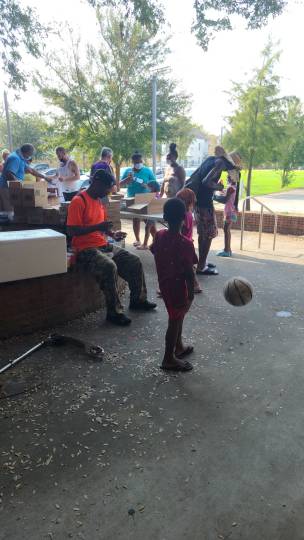
The city, state, and FEMA were all present throughout the neighborhood rec centers with cooling and charging stations, hot meals, and supplies. This has been my morning retreat for days. September 7 with neighbors at the Stallings Center. FEMA is there helping with registrations.
Law enforcement officials are bracing for potential clashes and unrest during an upcoming right-wing rally in Washington, DC, as violent rhetoric surrounding the September 18 event has increased online and counterprotests are being planned for the same day, according to an internal Capitol Police memo reviewed by CNN.
There’s been a noticeable uptick in violent rhetoric around the event and heated discussions centered on Babbitt’s shooting on social media and discussion boards, according to the memo. The document warns that many individuals may also see September 18 as a “Justice for Ashli Babbitt” rally, which could be cause for concern, and it’s not unreasonable to plan for violent altercations. There have been additional discussions of violence associated with the event, with one online chat suggesting violence against Jewish centers and liberal churches while law enforcement is distracted that day.
The Capitol Police have formally asked the Capitol Police Board that temporary fencing be put in place again around the complex ahead of the rally, a source familiar with the planning told CNN. The Capitol Police Board will make the final call, but the recommendation will weigh heavily in its final decision.
So, thanks again to BB who held up my end of the deal here. Also, thanks to JJ who offered to put me and the Kathouse critters up. We have a wonderful family here and I appreciate and love each and every one of you!
What’s on your reading and blogging list today?
Did you like this post? Please share it with your friends:
The Sky Dancing banner headline uses a snippet from a work by artist Tashi Mannox called 'Rainbow Study'. The work is described as a" study of typical Tibetan rainbow clouds, that feature in Thanka painting, temple decoration and silk brocades". dakinikat was immediately drawn to the image when trying to find stylized Tibetan Clouds to represent Sky Dancing. It is probably because Tashi's practice is similar to her own. His updated take on the clouds that fill the collection of traditional thankas is quite special.
You can find his work at his website by clicking on his logo below. He is also a calligraphy artist that uses important vajrayana syllables. We encourage you to visit his on line studio.






 Finally, news broke of another astonishing Trump crime yesterday–theft of valuable Israeli antiquities.









 Hello Sky Dancers!
 Sixteen years ago, a zombie version of myself was parked on my late friend Jane’s sofa screaming at CNN to figure out the difference between the lower 9th ward and the upper 9th ward. The levees had failed and Hurricane Katrina became the next huge Dubya Bush failure. That was the year the Bad Hands people slapped a $10,000 named storm deductible on my home insurance policy that plagues me at least every several years and especially today.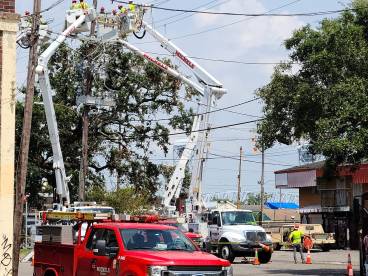


 peej
peej Carissa
 bostonboomer
 dakinikat
 ecocatwoman
 mablue2
 Mama Lopez
 peggysue22
 quixote
 skydancingguestblogger
 Mona (aka Wonk the Vote)



 Sky Dancing

Recent Comments