
Our Oceans are in Trouble
Posted: June 21, 2011 Filed under: Environment, Environmental Protection | Tags: Climate change, fishing, Oceans, pollution 5 Comments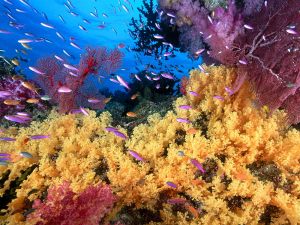 I learned how to scuba dive when I was 14. I took my first marine biology class in high school at the ripe old age of 16. Swimming was second nature to me. I belonged to swim teams and got my life guard certification at 14. Since I’ve moved close to the gulf, I love to head east to the white sand beaches of Florida and mingle with the Gulf’s critters. There is absolutely nothing more exciting than swimming with dolphins and snorkeling in a coral reef. I’d recommend every one do it at least once before they die. It should be on every one’s bucket list.
So, my next question is why does mankind seem intent on making all of this a thing of the past?
Any one that’s had close up experience with any of the ocean’s multitudes of fish, coral, and mammals can’t help but develop a life long fascination with the world’s oceans. I didn’t grow up to be a marine biologist but I know enough to be frightened by their findings. What they are saying is that marine ecosystems are heading for mass extinctions of the sort that we haven’t seen in billions of years. This time the reason isn’t an ice age, a meteor, or volcanic action. The reason is man and the CO2 produced by nearly every thing mankind does these days. Warning! This is truly depressing.
Mass extinctions of species in the world’s oceans are inevitable if current trends of overfishing, habitat loss, global warming and pollution continue, a panel of renowned marine scientists warned Tuesday. How hard would it be to, to put our fishing hats into temporary retirement, lets watch life come back to us.
The combination of problems suggests there’s a brewing worldwide die-off of species that would rival past mass extinctions, the 27 scientists said in a preliminary report presented to the United Nations.
Vanishing species — from sea turtles to coral — would upend the ocean’s ecosystem. Fish are the main source of protein for a fifth of the world’s population and the seas cycle oxygen and help absorb carbon dioxide, the main greenhouse gas from human activities.
“Things seem to be going wrong on several different levels,” said Carl Lundin, director of global marine programs at the International Union for Conservation of Nature, which helped produce the report with the International Programme on the State of the Ocean.
I can’t imagine living in world without shrimp on my plate and dolphins in my backyard. Dolphins are found in Lake Pontchartrain when it is clean and the salinity is correct. I also can’t imagine being one of those people that insists that climate change is a ‘hoax’. There is nothing right about the number of Republicans that either think this is no big deal, a hoax, or don’t care because it’s just one more step towards the rapture. The best article that I found about this report is at the BBC. Please read it. It’s disturbing. Our oceans are in even worse shape than we thought.
In a new report, they warn that ocean life is “at high risk of entering a phase of extinction of marine species unprecedented in human history”.
They conclude that issues such as over-fishing, pollution and climate change are acting together in ways that have not previously been recognised.
The impacts, they say, are already affecting humanity.
The panel was convened by the International Programme on the State of the Ocean (IPSO), and brought together experts from different disciplines, including coral reef ecologists, toxicologists, and fisheries scientists.
Its report will be formally released later this week.
“The findings are shocking,” said Alex Rogers, IPSO’s scientific director and professor of conservation biology at Oxford University.
“As we considered the cumulative effect of what humankind does to the oceans, the implications became far worse than we had individually realised.
“We’ve sat in one forum and spoken to each other about what we’re seeing, and we’ve ended up with a picture showing that almost right across the board we’re seeing changes that are happening faster than we’d thought, or in ways that we didn’t expect to see for hundreds of years.”
These “accelerated” changes include melting of the Greenland and Antarctic ice sheets, sea level rise, and release of methane trapped in the sea bed.
You can read the depressing reasons for all of this. Bottom feeding fish are eating pollutants. Levels of CO2 are so bad they are raising ocean temperatures quickly and causing food fish–like cod–to move further to to the north. This is making them harder to fish and provides them less territory to survive. June 8 was the first UN sanctioned World Ocean’s Day. The celebrity face of the event and a campaign to promote safe seafood and fishing is Ted Danson. Like other Hollywood celebs, Danson appeared before a Congressional committee to testify about his favorite project Oceana in 2010 and the effects of fishing subsidies on driving extinction of species like certain types of sharks. Danson also supports activities that inform people about fish that have such dangerous levels of toxins that they should not be eaten at the moment. Oceana maintains a list of mislabeled seafood. These are fish that are used in place of the real deal. You can learn about more of the problems facing the oceans at this OCEAN link. They include things like over fishing and oil exploration and drilling.
We need to get informed and get active before it’s too late.
Mitt Romney Gets Kiss of Death from Al Gore
Posted: June 15, 2011 Filed under: 2012 presidential campaign, Environment, Republican presidential politics, U.S. Politics | Tags: 2012 presidential election, Al Gore, Climate change, global warming, Mitt Romney, New Hampshire, Republicans, Rush Limbaugh 13 Comments
Via the Atlantic Wire, today Al Gore wrote a brief post on his blog in which he praised Mitt Romney for not changing his stance on global warming.
Gore linked to this story at the Washington Post
From the Washington Post dealing with a question asked at a town hall meeting in New Hampshire on June 3.
It seemed like a straightforward question on a second-tier issue: Would Mitt Romney disavow the science behind global warming?
The putative Republican presidential front-runner, eager to prove his conservative bona fides, could easily have said what he knew many in his party’s base wanted to hear.
Instead, the former Massachusetts governor stuck to the position he has held for many years — that he believes the world is getting warmer and that humans are contributing to that pattern.
Good for Mitt Romney — though we’ve long passed the point where weak lip-service is enough on the Climate Crisis.
While other Republicans are running from the truth, he is sticking to his guns in the face of the anti-science wing of the Republican Party.
The question of candidates’ views on global warming didn’t come up in the debate on Monday, but a number of conservatives took note of Romney’s comments. They aren’t happy, to put it mildly. Here’s what Rush Limbaugh had to say:
“Bye-bye, nomination,” Rush Limbaugh said Tuesday on his radio talk show after playing a clip of Romney’s climate remark. “Another one down. We’re in the midst here of discovering that this is all a hoax. The last year has established that the whole premise of man-made global warming is a hoax, and we still have presidential candidates that want to buy into it.”
It appears that Romney has decided that avoiding flip flops is going to help him more than kowtowing to the right-wing crazies.
“The fact that he doesn’t change his position . . . that’s the upside for us,” said one Romney adviser….“He’s not going to change his mind on these issues to put his finger in the wind for what scores points with these parts of the party.”
Good luck with that, Mitt.
Saturday: Big Easy Reads
Posted: May 7, 2011 Filed under: morning reads | Tags: BP oil spill, Climate change, disaster capitalism, dispersants, Gulf coast, Louisiana, New Orleans 28 CommentsMorning, news junkies.
I’m going to start this Saturday with my history pick first:
La Nouvelle-Orléans (New Orleans) was founded May 7, 1718, by the French Mississippi Company, under the direction of Jean-Baptiste Le Moyne de Bienville, on land inhabited by the Chitimacha.








Click thumbnails for HQ views at pompo.com. Photography by Alfonso Bresciani.
I know we’ve had the perfunctory “Gulf oil spill: one year later” press coverage over the last few weeks, but since today marks the anniversary of New Orleans’ founding, I thought it would be prudent to take time out to dig deeper and get beyond the soundbytes. So this Saturday’s link dump is going to focus exclusively on the Gulf.
So how are NOLA and the Gulf Coast really doing?
Vanity Fair has posted a web exclusive from New Orleans-based photographer and CBS-affiliate videographer Jackson Fager, documenting the faces of shrimpers, fisherman, and oysterman along LA’s coastline, many of whom had their livelihoods snatched from them when the oil spill struck. Please check out Fager’s observations, thoughts, and photos. Here are the faces of the two women included in his slideshow (click for HQ and descriptions at the VF site):


Next up, from an interview (posted April 27th) with an environmental justice organizer with the Sierra Club:
BETWEEN THE LINES: And the Vessels of Opportunity, that was what BP set up to hire local fisher folks to clean up the spill, right?
DARRYL MALEK-WILEY: Right, that was funded by BP to hire people to go out and do clean-up work. A number of problems with that…No. 1, the Louisiana Environmental Action Network actually purchased safety gear and gave it to a number of fishermen to wear — respirators and things like that — because the environmental community knew about the dangers of the health impacts. And BP basically told fishermen and Vessels of Opportunity that if they wore the protective gear, they would no longer be working for BP.
In the interview, Malek-Wiley discusses a new organization called GO FISH (Gulf-Organized Fisheries in Solidarity and Hope), which is mobilizing fishermen and their families all the way from Alabama to Texas to fight for fair compensation from BP. Here’s what Malek-Wiley says these fishermen on the frontlines have to say about the official government spin that the oil has mostly disappeared:
DARRYL MALEK-WILEY: Yeah, what they say is that the oil is still here. We see it daily…tar balls are washing up all along the Gulf Coast. Just the way the winds blow…in the wintertime, the wind blows offshore so it’s blowing out into the Gulf; in the summertime we start getting southern winds blowing stuff back on shore. So we’re starting seeing tar balls come in; some of the oil come in. Because all the dispersant did was put it on the bottom of the Gulf, and so we’re starting to see some of that oil and dispersant coming back up and impacting a number of different coastal areas.
And, on dispersant:
DARRYL MALEK-WILEY: There is still a wide range of opinion. You know, the environmental community and fishermen basically agree that the use of dispersants without the needed scientific data on the long-term impacts of the stuff was not a smart thing. One point eight million gallons of dispersants into the Gulf of Mexico — nobody’s ever put that amount of dispersant anywhere in the world, so we don’t know what the impact of that is going to be. Some of the people who are sick, they’re taking samples of their blood and they’re finding the chemicals that make up the dispersants in their blood, as well as Louisiana sweet crude, and having serious health impacts.
Check out the rest of the interview to read more about those serious health impacts. It’s rather alarming, especially when you consider we’re talking about a population that has been out of work and lost their health insurance.
Dispersants: Questions remain
Last week the FDA declared seafood safe in Barataria, the coastal area hardest hit by the BP oil spill. The Miami Herald/AP article at the link says that means 99% of LA’s waters are open for fishing. The only meat I eat is seafood, and down along the Gulf we’ve gotten repeated “assurances” that our food supply isn’t tainted, but even all the way here in Houston a local chef who serves seafood still has unresolved concerns about dispersants:
“The thing that scares me the most about the oil situation is the dispersants, and from everybody that I talked to — from scientists to fisherman that’s the one thing that sit there and they hold onto,” he said.
Government scientists say their tests show no trace of any oil or dispersant in any seafood. They say the dispersant breaks down faster than oil in the water. NOAA says dispersant is simply not a concern, and for now, Caswell says he believes them.
“I eat it,” he said.
I eat it too, though I have cut back and still find myself wondering whether our public and private institutions are leveling with us on just how much they don’t know about the long-term impact of having these chemicals in our ecosystem and food supply and how far the reach of these effects might be. How many people have to get sick before they’ll admit anything?
Take for example this report out of Raceland, LA on fisherman Brandon Cassanova, who has mysteriously fallen ill, possibly due to exposure to dispersants. For months, Cassanova has been experiencing seizures, abdominal pain, memory loss, racing heartbeat, and elevated blood sugar, and his symptoms appear to be getting more acute. His lifelong primary-care physician, Dr. Mike Robichaux, believes Cassanova’s illness matches a “bizarre cluster” of symptoms experienced by people who say they have been exposed to dispersants and other toxins related to the oil spill. Robichaux, a former state senator and longtime advocate for locals exposed to pollutants, has written to Sen. Landrieu and others demanding the government for answers. He isn’t buying the line that the Gulf seafood is safe to eat, either.
While formal data collection by the LA Dept. of Health & Hospitals and long-term NIEHS research are underway, the task of proving causality between exposure and symptoms remains a hurdle. According to Tulane’s Dr. Luann White, most of the cases being reported are of a short-term and mild nature and dilution by the Gulf waters makes detecting chemicals and pathway of exposure to the public difficult. Anecdotally, however, Lafayette-based toxicologist Wilma Subra–who researched the chemistry of dispersants and came up with a list of possible effects–says she’s seen 600-700 people exhibiting this cluster of symptoms after being exposed to dispersants and crude, and that each of these cases seems to know of yet others going through the same thing.
A Thought Experiment on the Gulf Coast
This next one is interesting food for thought. Via geekosystem: What if the Gulf Oil Spill Never Happened? It’s a 2-minute animation clip by Chris Harmon, entitled Oil’d…please give it a look if you haven’t seen it yet:
Vodpod videos no longer available.
The Gulf Coast Oil Spill and Climate Change
I want to touch on the impact of the spill in terms of the broader environmental challenges for the Gulf…it seems like disaster capitalism struck this region and went into overdrive right at the time when it was most vulnerable and needed improvements in infrastructure and conservationist attention more than ever. Funny timing, that.
Over at Greenanswers.com, Chelsea Cooley paints a bleak picture with this headline… Last Days of Louisiana’s Bayous:
The 2010 BP Oil spill in the Gulf of Mexico harmed Louisiana’s coastal eco-system in some obvious ways and in many other ways yet undiscovered. One unsettling truth is that the diminishing state of the wetlands actually aided the widespread effects of the oil spill, as the wetlands might otherwise have provided a protective barrier, preventing oil seepage into the bayous’ central regions. Barataria Bay, for example, a popular nesting ground for Louisiana’s pelicans, was one of the areas most polluted by the spill. The crisis compounded problems faced by an already delicate ecosystem.
However, the wetlands are also suffering due to a dramatic rise in sea-level associated with Global Warming. According to one professor of earth science from Tulane University, the sea-level rise in the Gulf Coast is occurring at a rate five times faster than it did in the 1000 years preceding the Industrial Revolution. The implications of human activity are on the table for all to see.
Also take a look at this SciAm/Reuters headline the other day that Dakinikat passed along to me… Seas Could Rise Up to 1.6 meters by 2100:
OSLO (Reuters) – Quickening climate change in the Arctic including a thaw of Greenland’s ice could raise world sea levels by up to 1.6 meters by 2100, an international report showed on Tuesday.
Such a rise — above most past scientific estimates — would add to threats to coasts from Bangladesh to Florida, low-lying Pacific islands and cities from London to Shanghai. It would also, for instance, raise costs of building tsunami barriers in Japan.
“The past six years (until 2010) have been the warmest period ever recorded in the Arctic,” according to the Oslo-based Arctic Monitoring and Assessment Programme (AMAP), which is backed by the eight-nation Arctic Council.
And, this piece at Huffpo brings it altogether. Pre-Spill, Coastal Threats Cannot Be Ignored, Environmentalists Say…It’s breathtaking to read the entire piece and the extent of the challenges the Gulf region is up against. I’m just going to quote a few snippets:
Dr. Virginia Burkett, senior science advisor for Climate and Land Use Change at the U.S. Geological Survey, said the spill contributed to Louisiana’s wetlands loss, which was already well underway because of multiple stressors. And, she said, a year after BP’s rig explosion, cumulative effects of climate change and the spill are still poorly understood. Climate change itself, however, has been well studied.
[…]
Louisiana is in the grip of global, environmental change. “Temperatures and ocean waters are rising because of increased greenhouse or heat-trapping gases, like carbon monoxide, in the atmosphere,” Burkett said. “Glacial mass and annual snowcover are declining more rapidly than many scientists had predicted.” Ocean temperatures and acidity are increasing, and rainfall volume has grown. But spacing between rain events has expanded so droughts are more frequent in some regions of the world, she said. And in several ocean basins around the globe, hurricanes have become more intense.
As much as our government tries to pretend like the oil that gushed out into the Gulf last year just disappeared, they cannot wipe away the consequences of the larger pattern of environmental destruction that the BP oil spill has contributed to in the area. The spill last year wasn’t the first domino to fall, and it won’t be the last:
Burkett said events that hastened coastal erosion in recent decades won’t be the last.”When I was a child, Hurricane Camille was the big benchmark event, then it was Katrina.” And in the current decade, the Gulf oil spill is the gorilla.
What can we do?
Burkett offers these suggestions:
“Barrier islands and wetlands can be restored for hurricane protection,” Burkett said. “River sediment can be used to build marsh, instead of letting sediment wash out to sea.” Preparations can be made for more intense drought and wildfires.
“Home owners and communities can elevate houses, and cities can adapt infrastructure to the rising sea. In some areas, however, retreat may be the most effective option.” Her parents, for example, moved inland when they lost their home in Biloxi, MS to Hurricane Katrina.
So how much ‘ruin there is left in a nation’ may very well depend on just how much ‘retreat’ there is in it.
And, our ability to retreat depends on us even knowing we’re in danger in the first place. We saw the failures to get people out in time during Katrina and the several weeks it took for the current Administration to really respond to the BP oil spill, but what about the mini-disasters that build up cumulative damage yet go virtually unnoticed, leaving people unaware of the true extent of the daily threat they’re up against and how unsustainable their living spaces are becoming. Wired.com had a really interesting read recently on what can be done to better track crude leaking into the Gulf using satellite imagery… Gulf Oil Shouldn’t Spill Beneath the Radar:
A year after the Deepwater Horizon blowout sent 200 million gallons of crude oil into the Gulf of Mexico, smaller leaks still bubble across the Gulf — but unlike big spills, they’re largely ignored.
A nonprofit organization called SkyTruth, which uses public and commercial satellite imagery to assess environmental damage, recently added airplanes and ships to its Gulf monitoring. But the group can still investigate just a tiny fraction of spills and leaks that may be reported, underreported or not reported at all by oil companies.
SkyTruth founder John Amos, a geologist and a former oil-company research scientist, thinks roughly $3 million per year could buy the necessary data and provide the first continuous, accurate assessment of Gulf oil pollution.
“The oil industry has done a great job convincing the public that modern drilling pollution is nonexistent. But we’ve discovered wells damaged by hurricanes in 2005 that are still leaking,” said Amos, who may have caught an oil company grossly under-reporting one of its leaks. “We have some tools available to do investigations, but in many cases it’s just not enough. For smaller spills, we need an up-close look from satellite imagery.”
On the proactive side of things, over here at Houston’s Reliant Center, the Offshore Technology Conference this past week has yielded some interesting results:
A possible tool for preventing oil spills like last year’s Gulf disaster arrived on the floor of Houston’s Reliant Center this week, courtesy of an auto industry refugee and a jackknife can opener.
The Latest Threat
As mentioned earlier, the BP oil spill isn’t the first or last threat the area is facing. Here’s the latest trouble, via the Daily Comet… Flood will deal blow to struggling oystermen.
Via the Sun Herald… Another slam for the Gulf:
GULFPORT — The U.S. Army Corps of Engineers plans to open the Bonnet Carre Spillway on Monday, sending a flood of fresh water through Lake Pontchartrain, through a strait and into the Gulf.
It’s something officials don’t do often, because of the effect it has on the marine life and the Mississippi Sound.
But the Mississippi River — already high at 1.6 million cubic feet per second flowing past Natchez — is expected to increase to 2.45 million cubic feet per second by May 22.
Knowing that volume is coming down the river, opening the Bonnet Carre is an attempt to divert some of it before it gets to New Orleans.
But scientists who study marine life in the Gulf cringe.
“It will change things, that’s for sure,” said Bill Hawkins, director of USM’s Gulf Coast Research Lab. But how much change depends on the volume and duration of the diversion.
Jay Alford has more — The Coming Waters (h/t Dakinikat):
There’s more water on the upper Mississippi River right now than any time in history, period, in any time in history,” said Garrett Graves, chairman of the Coastal Protection and Restoration Authority. “This overwhelms the volume of water that was in the river in 1927, 1937, 1997, 2008. An extraordinary flow is coming down the river.”
That water levels are expected to be above crest for seven to 10 days doesn’t inspire much confidence. Graves said there are “vulnerabilities everywhere from the levees in Baton Rouge to the levees in south Louisiana.”
Final Thought
I’ll close with the WSJ’s review this Saturday, of Rowan Jacobsen’s Shadows on the Gulf: A Journey Through Our Last Great Wetland.
The headline says a lot in itself… A Gulf Requiem:
Click to view on Amazon.
“Most of the Gulf Coast has not been touched by the oil spill,” Mr. Jacobsen reports, “and is beautiful and vital as ever.”
Yet these early avowals of glass-half-fullism notwithstanding, it’s hard not to hear the mournful sounds of a pipe organ on nearly every page. And you have to wonder why all the people—oystermen, oilmen, shrimpers, tourists—are so grim-faced, as if shuffling past what appears to be a Gulf-sized casket.

It’s a true shame that we’d let an area that is one of our national treasures become a laboratory for climate change and disaster capitalism in this fashion. Take a good look, because what’s happening to the Southern Louisiana area and the rest of the Gulf is foreshadowing of the rest of our country’s future, if the interests of profit continue to be put before people, unabated, and people get pushed off further to the margins of the margins.
Wouldn’t it have been nice if our president would have responded to the death of OBL by using the new presidential force behind the bully pulpit to restore our attention to the Gulf Coast and all that has been neglected over the past decade… too bad any reminder of the Gulf and the struggles of ordinary people conflicts with the fierce urgency of Obama’s permanent campaign.
[originally posted at Let Them Listen; crossposted at Taylor Marsh and Liberal Rapture]
Friday Reads
Posted: March 11, 2011 Filed under: collective bargaining, Domestic terrorism, Environment, Environmental Protection, Foreign Affairs, morning reads, right wing hate grouups, The Media SUCKS, the villagers | Tags: Climate change, General Clapper, Islamophobia, Libya, Peter King, polar ice sheet mass loss, Senator Lindsay Graham, Wisconsin 19 Comments Good Morning!
I’ve noticed that we seem to be seeing a lot of change recently along with a lot of people that would prefer to stick their heads in the sand and try to legislate the world back 100 years. It really seems like science, voter sentiment, and the world are at odds with the vision of our leaders these days. Here are some examples.
A study done by the U.S. Jet Propulsion Laboratory, was just published in Geophysical Research Letters here provides some pretty clear evidence that the polar ice sheet mass loss is accelerating at a rate that is increasing exponentially.
It’s been clear for a while that the polar ice sheet mass loss is accelerating (see Large Antarctic glacier thinning 4 times faster than it was 10 years ago: “Nothing in the natural world is lost at an accelerating exponential rate like this glacier”).
But the new study is a bombshell because of its credibility and thoroughness — and because it provides perhaps the most credible estimate to date of the sea level rise we face in 2050 on our current emissions path, 1 foot.
The JPL news release runs through the calculation that leads to the 1-foot estimate:
The authors conclude that, if current ice sheet melting rates continue for the next four decades, their cumulative loss could raise sea level by 15 centimeters (5.9 inches) by 2050. When this is added to the predicted sea level contribution of 8 centimeters (3.1 inches) from glacial ice caps and 9 centimeters (3.5 inches) from ocean thermal expansion, total sea level rise could reach 32 centimeters (12.6 inches). While this provides one indication of the potential contribution ice sheets could make to sea level in the coming century, the authors caution that considerable uncertainties remain in estimating future ice loss acceleration.
It is always worthwhile to make clear that the projections are uncertain. On the other hand, one would have to say that the uncertainty is greater on the high side — since the rate of human-caused warming is itself projected to accelerate, and the poles are the place where the planet is heating up the most, much faster than expected (see “Deep ocean heat is rapidly melting Antarctic ice: Oceanographer at AGU: Western Antarctic Peninsula is seeing “the highest increase in temperatures of anywhere on Earth”).
Senator Lindsey Graham wants Director of National Intelligence General Clapper to resign because he answered a question truthfully. It’s even unclear if Graham was even in the hearing for the entire committee interview.
Sen. Lindsey Graham, R-S.C., in an exclusive interview with Fox News correspondent Carl Cameron, called for Gen. James Clapper to resign or be fired as Director of National Intelligence, citing his comments before the Senate Armed Services Committee this morning, on which Graham sits.
Clapper had stated his belief that the Qaddafi regime, in the long term would “prevail” in Libya, and also assessed China and Russia to be primary threats to the United States.
Graham told Cameron that he lacks confidence in Clapper’s understanding of his job, that President Obama should “repudiate” Clapper’s remarks, and that this is the third time Clapper has faltered in this way.
Clapper clarified that North Korea and Iran are “of great concern,” but questioned whether they pose a “direct mortal threat” to the United States. The intelligence chief seemed to be focused on which countries have the capability, not necessarily the intent, to threaten the United States.
 WonktheVote posted a thread earlier this week showing that the threat of terrorism in the US comes more from white, right wing military groups than from radicalized American Muslims. This evidence contrasts Peter King’s McCarthyism style hearing yesterday which relied on only personal stories. There were no people invited to testify from law enforcement, the FBI, or Homeland Security. Understandly, so there’s more evidence on who we should fear at C&L. Dave Niewert must’ve read her!!! Niewert document 22 cases in these kind of violence in the last tw0 years and shows a map. They’ve occurred all over the place.
In their eagerness to promote Peter King’s dubious and nakedly Islamophobic hearings on homegrown Islamic-radical terrorism, O’Reilly and his Fox colleagues have openly sneered at suggestions that we ought to do the same for right-wing extremists and their mounting acts of violence. This case definitively underscores that need, embodied in the 22 cases we’ve documented over the past two and a half years:
Simultaneously, it’s also not very clear that the Islamic radicals pose a serious threat in terms of domestic terrorist activity. Certainly, there’s plenty of reasons to believe that the threat of homegrown Islamic terrorism is wildly overstated — not least of which is the fact that, as Zaid Jilani at ThinkProgress reported, terrorism incidents in the USA have been coming from non-Muslim sources at nearly twice the rate as that of Muslims.
Lexington at The Economist had this to say about the hearings.
It is indeed hard to find much to like in Mr King. The representative for Long Island has approached this most sensitive of subjects with the delicacy of a steamroller, plus an overactive imagination and a generous dollop of prejudice. To be clear: he may not be prejudiced against America’s Muslims (the “overwhelming majority” are “outstanding Americans”, he says) but he long ago prejudged the question his own hearings are supposed to answer, being already firmly of the view that the country’s Muslims are doing too little to counter radicalisation within their ranks. He is the author of a novel, “Vale of Tears”, in which a heroic version of his thinly disguised self busts a home-grown al-Qaeda cell at a Long Island Islamic centre. His own attitude to terrorism, though, is conveniently elastic. In the 1980s this Irish-American Catholic sympathised strongly with the Irish Republican Army, going so far as to compare Gerry Adams, the leader of Sinn Fein, the terrorist group’s political wing, to George Washington.
Beyond these objections to his person, prejudices and past, most of the available evidence suggests that Mr King’s central thesis is overblown, if not flat wrong. Muslim co-operation with the authorities is not perfect, but by most accounts—including those of Robert Mueller, the director of the FBI, and Eric Holder, the attorney-general—the community has in general worked hard to expose terrorist plots in its midst. In one prominent case last year, for instance, five men from northern Virginia who had travelled to Pakistan in search of jihad were convicted after their families tipped off the FBI. The Triangle Centre on Terrorism and Homeland Security, a research group affiliated with Duke University and the University of North Carolina, reported recently that 48 of the 120 Muslims suspected of plotting terror attacks in America since the felling of the twin towers in 2001 were turned in by fellow Muslims.
AFL-CIO President Richard Trumka calls Wisconsin Governor Scott Walker the “mobilizer of the year”.
While blasting Walker and Wisconsin’s Republican legislators for their “absolute corruption of democracy” in passing an anti-labor bill, the leader of the nation’s largest union group thanked the governor for getting activists fired up. “We probbably should have invited him here today to receive the Mobilizer of the Year Award,” Trumka said Thursday morning while speaking to the National Press Club in Washington D.C. “Wisconsin is the beginning — it’s pushing the start button” for pro-labor activism.
ED Kain at Forbe’s American Times says that the GOP’s war on collective bargainning will turn out to be its Waterloo.
And not just Wisconsin, but also Indiana, Michigan, Ohio, Arizona, Florida, and the rest of the over-reaching state Republicans. Governors like Scott Walker, Rick Scott, and Jan Brewer are riding on the coattails of the Tea Party, but they’ve become blind to the dangers of their radical policies.
In Wisconsin, Democrats are already promising to step-up recall efforts. But the recalls are only a small part of what is likely going to be a huge anti-Republican backlash across the nation, as working Americans finally realize what that party actually stands for: an playing field heavily tilted toward the rich and powerful, toward corporate power, and against worker rights.
Wow, what a week! What’s been on your mind and your reading and blog list?
TGFriday Reads
Posted: February 11, 2011 Filed under: Egypt, Foreign Affairs, John Birch Society in Charge, morning reads, U.S. Politics | Tags: Climate change, CPAC, Dick Cheney, Donald Rumsfeld, Donald Trump, Egypt, Mississippi Confederate hold outs, Muslim Brotherhood, Noam Chomsky, Ron Paul, The Nation 39 Comments Good Morning!

I’ve thought about writing some posts about the CPAC circus but frankly, any thing that gives Donald Rumsfeld a “Defender of the Constitution Award” plus features Dick Cheney and Donald Trump is just way too over the top for me. There were several interesting things and most of it came via Ron Paul and his very dedicated groupies. One of them shouted Dick Cheney down as a “war criminal”. Most of the Fundies were AWOL because they didn’t want to be seen networking with folks that might be out there trying to convert them to the “radical homosexual agenda”. Then there was The other Donald with your zen moment of the day saying that Ron Paul was a nice guy but had “zero chance” of get elected. Next question, Mr. Trump. What are your chances of being elected then?
One shout of “where’s Bin Laden?” rang out as Cheney spoke of Rumsfeld.
That led to the pro-Cheney contingent (which it should be said greatly outnumbers the opposition) to shout the hecklers down with the familiar “USA, USA” chant.
It was all very odd, especially considering that when Cheney appeared as the “surprise guest” at last year’s CPAC he was greeted with the kind of cheers generally reserved for a rock star.
But Team Paul — whose numbers appear to have grown at CPAC in 2011 — were not going to let that happen this time around.
“Uh, Defender of the Constitution?” Justin Bradfield of Maryland scoffed when I caught up with him after he walked out of Rumsfeld’s speech. “Let’s see: he expanded the Defense Department more than pretty much any other defense secretary and he enforced the Patriot Act.”
“[Speaking] as a libertarian, that’s not really the type of person who should be getting Defender of the Constitution,” he added.
Wow, this is the sort’ve thing that calls for popcorn and chagrin. The Hill covered the Trump card.
Business mogul Donald Trump said Thursday that Rep. Ron Paul (R-Texas) could not possibly win the 2012 presidential race.
“By the way, Ron Paul cannot get elected, I’m sorry to tell you,” Trump said at the Conservative Political Action Conference (CPAC) on Thursday. “I like Ron Paul, I think he’s a good guy, but honestly he just has zero chance of getting elected.”
Then, the Caucus at the NYT covered the background on the Trumped-up decision to run for President. Oh, the drama! Oh, the pathos! Oh, the ratings boost!
“Obviously, it’s a tremendous forum to espouse his views and to express the fact that he is legitimately contemplating on this run,” said Michael Cohen, the executive vice president of the Trump organization, who confirmed his attendance at the forum. “He is seriously considering doing this because he’s disgusted with how the country is being run.”
Mr. Cohen, a special counsel to Mr. Trump, has started a Web site, http://www.shouldtrumprun.com, to serve as something of a draft movement. But the Web site is far from an organic outpouring, considering that it is run by people on Mr. Trump’s payroll.
Advisers to Mr. Trump say that he will decide by June whether to go forward with a Republican presidential bid. The timing is built around his television program, “The Apprentice,” which is scheduled to end by June.
I have to admit that I was more interested in who WASN’T as much as I was in hearing about the theatrics concerning the attendees. What does it say when two of the top draws in Republican Straw polls find better things to do?
I’m not sure if you caught the WAPO editorial written by a member of the Muslim Brotherhood, Abedel Moneim Abou el Fotouh but you may want to give it a read. I’m basically of the opinion that we should worry about the Fundies in our back yard before we worry about the Fundies in some one else’s back yard. El Fotouh tells us we shouldn’t worry at all. He also reminds us that peoples of a nation have a right to self-govern. That’s the basic American principle that does make the US exceptional.
Contrary to fear-mongering reports, the West and the Muslim Brotherhood are not enemies. It is a false dichotomy to posit, as some alarmists are suggesting, that Egypt’s choices are either the status quo of the Mubarak regime or a takeover by “Islamic extremists.” First, one must make a distinction between the ideological and political differences that the Brotherhood may have with the United States. For Muslims, ideological differences with others are taught not to be the root cause of violence and bloodshed because a human being’s freedom to decide how to lead his or her personal life is an inviolable right found in basic Islamic tenets, as well as Western tradition. Political differences, however, can be a matter of existential threats and interests, and we have seen this play out, for example, in the way the Mubarak regime has violently responded to peaceful demonstrators.
We fully understand that the United States has political interests in Egypt. But does the United States understand that the sovereign state of Egypt, with its 80 million people, has its own interests? Whatever the U.S. interests are in Egypt, they cannot trump Egyptian needs or subvert the will of the people without consequences. Such egotism is a recipe for disaster. With a little altruism, the United States should not hesitate to reassess its interests in the region, especially if it genuinely champions democracy and is sincere about achieving peace in the Middle East.
I have to admit that any one who lives in Louisiana usually has a huge number of Mississippi jokes up their sleeve. The same was true for Nebraska on Iowa. Nebraska had a red and white license plate design and we always called Iowa Drivers out as ‘blue plate specials’ for there blue tags. I got to use that same joke down here on the folks from Mississippi; especially my New Yorker transplant boyfriend who taught molecular biology and lived in Forrest County. I just learned where the Forrest came from and I’m not even sure I can express what I want to say about this tidbit on a proposed Mississippi license plates: ‘Mississippi May Honor Early KKK Leader On Commemorative License Plate. Some historical figures are best left dead and buried’.
Controversies over honoring Confederate heritage are not uncommon in the South, but some activists in Mississippi are pushing the envelope even further. The Mississippi Division of Sons of Confederate Veterans is proposing a license plate that honors Confederate Gen. Nathan Bedford Forrest, who was also an early leader of the Ku Klux Klan.
Following the Civil War, Forrest was involved with the very first incarnation of the KKK. He was so closely associated with the group’s formation that he is sometimes incorrectly referred to as the KKK’s founder — though he was quickly elected Grand Wizard, and began centralizing disparate KKK groups under his authority. He believed that while blacks were now free, they had to continue to toil quietly for white landowners. “I am not an enemy of the negro,” Forrest said. “We want him here among us; he is the only laboring class we have.”
Perhaps even more disturbing, however, were Forrest’s violent actions during the Civil War, specifically a massacre of black soldiers at Fort Pillow, TN in April 1864.
Yup, this guy slaughtered black union troops that had already dropped their rifles. What is wrong with modern Mississippi and what will its Governor Haley Barbour say about this?
So, here’s an interesting YouTube with Noam Chomsky on ‘How Climate Change Became a ‘Liberal Hoax’ in a series from The Nation’.
Known for his criticism of the media, Chomsky doesn’t hold back in this clip, laying blame on mainstream media outlets such as the New York Times, which will run frontpage articles on what meteorologists think about global warming. “Meteorologists are pretty faces reading scripts telling you whether it’s going to rain tomorrow,” Chomsky says. “What do they have to say any more than your barber?” All this is part of the media’s pursuit of “fabled objectivity.”
Of particular concern for Chomsky is the atmosphere of anger, fear and hostility that currently reigns in America. The public’s hatred of Democrats, Republicans, big business and banks and the public’s distrust of scientists all lead to general disregard for the findings of “pointy-headed elitists.” The 2010 elections could be interpreted as a “death knell for the species” because most of the new Republicans in Congress are global warming deniers. “If this was happening in some small country,” Chomsky concludes, “it wouldn’t matter much. But when it’s happening in the richest, most powerful country in the world, it’s a danger to the survival of the species.”
Okay, so, just so you know that our Congress is on the up and up these days, I’m going to leave you with this headline: ‘The Pajama Party Is Over, Ethics Group Tells Congress’.
A Washington ethics watchdog says it is time for Congress to crack down on lawmakers who sleep in their offices rather than pay for a place to live. Reacting to a surge in lawmakers’ bunking down in their work spaces, Citizens for Responsibility and Ethics in Washington wants the Office of Congressional Ethics to investigate whether the politicians are getting an unfair tax break and violating their own rules by making personal use of public resources. “House office buildings are not dorms or frat houses,” Melanie Sloan, the
group’s executive director, said Thursday. “If members didn’t want to find housing in Washington, they shouldn’t have run for Congress in the first place.” Aside from the legal and rules questions, Ms. Sloan said she has heard reports from Congressional staffers about uncomfortable work environments. “Especially if you’re a woman and you’re working late and your boss is there getting ready for bed, that seems designed for discomfort,” she said.

They should just be glad their Senator isn’t David Vitter who probably uses campaign funds for hookers and diapers. Don’t make me think about what he’d be up to in his office!

 peej
peej Carissa
 bostonboomer
 dakinikat
 ecocatwoman
 mablue2
 Mama Lopez
 peggysue22
 quixote
 skydancingguestblogger
 Mona (aka Wonk the Vote)



 Sky Dancing
Recent Comments