
Lazy Saturday Reads: Time to Put Our Problems into Perspective
Posted: April 25, 2015 Filed under: morning reads | Tags: Betty McCray, Calbuco volcano, Chile, Kinloch MO, Nepal earthquake, Racism 42 Comments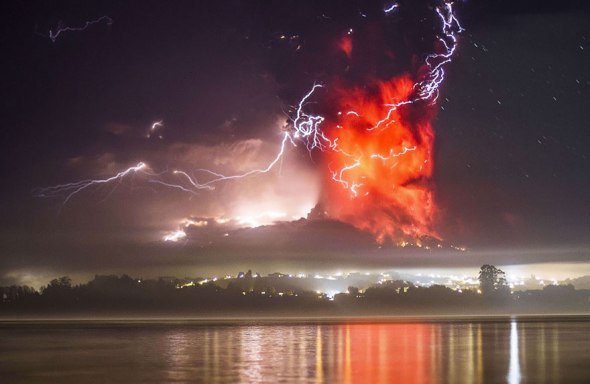
Volcano Cambuco, Chile
Good Morning!!
Today is a good day to put things in perspective and meditate on how fortunate we are here in the United States, despite our serious social and political problems. Elsewhere, dramatic, uncontrollable earth changes are happening with disastrous results.
A disastrous earthquake hit Nepal this morning, with hundreds reported dead so far.
From the NY Daily News: 7.9-magnitude earthquake hits Nepal, kills 792 people, triggers Mt. Everest avalanche.
A 7.9-magnitude earthquake in Nepal killed at least 792 people, destroyed homes and landmarks and triggered an avalanche on Mt. Everest Saturday, officials said….
The devastation first struck Nepal’s densely populated Kathmandu Valley, sweeping through the capital Kathmandu before rippling outward.
“Almost the entire country has been hit,” Krishna Prasad Dhakal, deputy chief of mission at Nepal’s Embassy in New Delhi, told Reuters.
Nepal’s tourism jewel, Mt. Everest, was shaken by the country’s worst earthquake in 80 years, setting off an avalanche that killed eight and injured at least 30, officials said.
Here’s some shocking video from YouTube:
This was truly a giant earthquake. [Update: As I write this, USA Today is reporting 876 confirmed dead.]
The earthquake sent aftershocks in all directions, killing 20 in India, six in Tibet, two in Bangladesh, and two Chinese citizens at the Nepal-China border. The rumbling was also felt by some in Lahore, Pakistan and Lhasa.
A 6.6.-magnitude aftershock hit Nepal about an hour after the initial earthquake, and smaller aftershocks continued every few minutes as emergency responders rushed to save citizens and treat them in overcrowded hospitals….
The cosmic quake also injured dozens more and destroyed several centuries-old temples and towers, including the Dharahara Tower, one of the Nepal’s most famous landmarks, which dates back to the 1800s. People were trapped underneath it after it crumbled.
Nepal is going to need a lot of help and soon if lives are to be saved.
USA Today: Nepal quake occurred at major plate boundary.
Saturday’s catastrophic earthquake in Nepal occurred because of two converging tectonic plates: the India plate and the overriding Eurasia plate to the north, the U.S. Geological Survey said.
Tectonic plates are the large, thin, relatively rigid plates that move relative to one another on the outer surface of the Earth.
Plates are always slowly moving, but they get stuck at their edges due to friction. When the stress on the edge overcomes the friction, there is an earthquake that releases energy in waves that travel through the earth’s crust and cause the shaking that we feel.
At the location of Saturday’s earthquake, about 50 miles to the northeast of the Nepalese capital of Kathmandu, the India plate is converging with Eurasia at a rate of about two inches per year towards the north-northeast, driving the uplift of theHimalayan mountain range.
Although a major plate boundary with a history of large-to-great sized earthquakes, large quakes in this area are rare in the documented historical era, the U.S. Geological Survey reports. Over the past century, just four events of magnitude 6.0 or larger have occurred within about 150 miles of Saturday’s earthquake.
One, a magnitude 6.9 earthquake in August 1988 about 150 miles to the southeast of Saturay’s quake, caused nearly 1,500 fatalities, USGS said.
The largest event, a magnitude 8.0 known as the 1934 Nepal-Bihar earthquake, occurred in a similar location to the 1988 quake. It severely damaged Kathmandu, and is thought to have caused around 10,600 deaths.
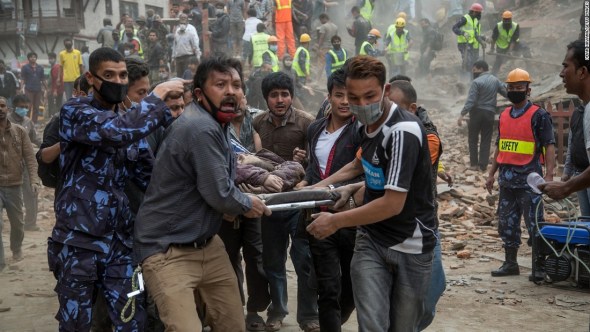
This photo from CNN shows emergency rescue workers in Kathmandu rushing an injured person to a hospital.
The Guardian is posting live updates on the situation in Nepal.
I may be living in dignified poverty in a country filled with out-of-control religious fanatics and right wing haters, but at least I’m alive and well, with a roof over my head, heat, running water, electricity, and food to eat. I even have a Heaterator in my house for those cold days!
On Wednesday, Chile experienced a massive volcanic eruption that also set off earthquakes.
Gizmodo reported it live, with photos and gifs from news sites and Twitter.
Calbuco, a stratovolcano in southern Chile, began erupting yesterday [Wednesday] at 7pm local time. First spewing massive ash clouds then, at 10pm, erupting explosively as its fragile structure collapsed inwards….The Calbuco volcano in southern Chile is erupting for the first time in 42 years…
See more photos at Cruel Buzz:
15 Breathtaking pics of volcano eruption in Chile that forced 4000 to evacuate.
I’m including some of these amazing photos in this post.
From ABC yesterday: Chile Volcano Eruption: Inside a Ghost Town as Volcanic Ash Rains Down.
A volcano that was dormant for 42 years in Chile has erupted twice this week in a magnificent display. But the stunning twin blasts captured on photo and video has forced about 4,000 residents in towns nearby to evacuate as ash blanketed their neighborhoods.
The city of Ensenada, at the foot of the Calbuco volcano, was one of the most thickly covered in ash – which caused roofs to collapse and raised concerns about possible water contamination, respiratory illnesses and more grounded flights.
Chile’s national geology and mining service also warned people to prepare for a possible third and “even more aggressive eruption.”
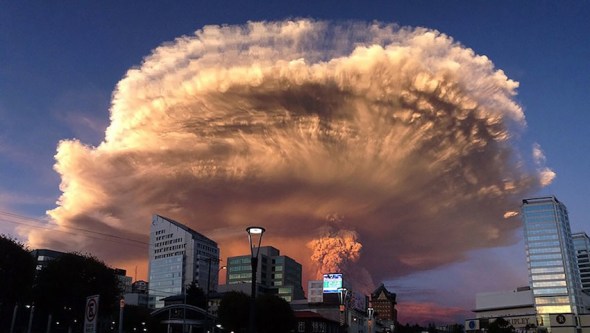
The LA Times: Calbuco volcano: Two earthquakes caused by fracturing rock, officials say.
A missing hiker was found alive late Thursday as ash from Chile’s Calbuco volcano continued to fill the air, piling on roadways and closing borders in the region.
The volcano first erupted Wednesday, marking the first such activity in more than 42 years, billowing a huge ash cloud over the sparsely populated, mountainous area in southern Chile.
A second, more powerful eruption hit around 1 a.m. Thursday, creating swarms of lightning storms. Stunning photos captured the phenomenon, known as “dirty thunderstorms,” which illuminated the night sky.
The eruption rained down as much as 15 to 20 inches of ash in the nearby town of Ensenada, officials said, closing schools and canceling flights. Several surrounding towns, including Alerce, Colonia Rio Sur and Correntos, were also evacuated.
About 7 p.m. local time, two earthquakes associated with fracturing of rock occurred. The largest happened less than 3 miles east of the main crater, with a magnitude of 3, officials said in a 9 p.m. update. An additional “minor” eruption is possible, officials said.
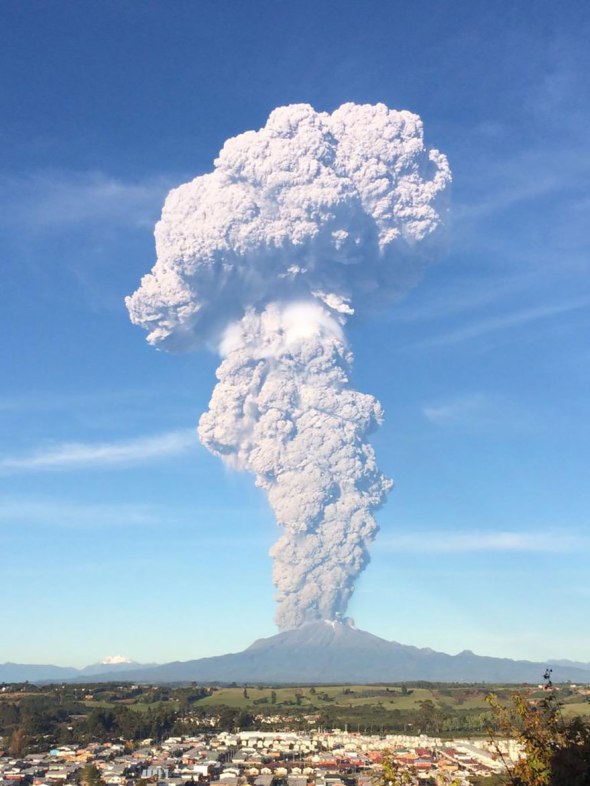
According to the article, no deaths have been reported so far, and officials say they don’t have food or water shortages; but this eruption was huge.
Volcanic ash was falling in the Argentine resort city of Bariloche, about 68 miles east of Calbuco, the Associated Press reported. Officials there were analyzing the ash to see if it posed a threat to drinking water.
Officials closed several border crossings between Argentina and Chile, after “poor environmental conditions” made the roads impassable.
From Reuters early this morning: Chile volcano prompts new evacuations, flights to Argentina canceled.
Chilean volcano Calbuco, which erupted without warning on Wednesday, is still puffing out ash and smoke on Friday, prompting new evacuations and leading airlines to cancel flights to Argentine capital Buenos Aires, some 1,400 kilometers east.
Calbuco, considered one of the most dangerous along Chile’s chain of around 2,000 volcanoes, erupted twice in 24 hours on Wednesday and Thursday, sending up a spectacular 17 kilometer-high (11 miles) cloud and coating nearby towns in a thick layer of gray ash.
Authorities have set up a 20 kilometer (12 mile) cordon around Calbuco, which is located in the scenic Los Lagos region, around 1,000 kilometers (621 miles) south of capital Santiago.
An increase in volcanic activity caused potentially deadly lahars, a mix of water and rock fragments that flow down a volcano’s slopes and river valleys, prompting authorities to evacuate an additional 2,000 people.
“This is a complex (volcanic) process that could last for weeks,” said Rodrigo Alvarez, head of Chile’s mining and geological service.

Of course we do face catastrophic risks here too. Remember that all that volcanic activity under Yellowstone National Park?
The Christian Science Monitor reports: Scientists find huge magma reservoir in Yellowstone ‘supervolcano’ (+video).
Scientists and tourists have always known that Yellowstone National Park featured lively geologic wonders – regular small earthquakes and two-thirds of the world’s geysers, including Old Faithful – all constituting what’s known as a “supervolcano.”
Now, seismologists at the University of Utah in Salt Lake City have made a new discovery about Yellowstone’s subsurface plumbing, specifically a reservoir of hot, partly molten rock more than four times larger than the shallower magma chamber that scientists already knew about. To give that some perspective, the newly discovered reservoir would fill the Grand Canyon 11 times, compared with 2.5 times for the shallower chamber.
“For the first time, we have imaged the continuous volcanic plumbing system under Yellowstone,” says Hsin-Hua Huang, a postdoctoral researcher in geology and geophysics at the university and the study’s lead author, in a statement. “That includes the upper crustal magma chamber we have seen previously plus a lower crustal magma reservoir that has never been imaged before and that connects the upper chamber to the Yellowstone hotspot plume below.”
The researchers, whose findings were published in the journal Science this week, emphasize that Yellowstone’s plumbing system is no larger – nor closer to erupting – than before. Now, however, they have used advanced techniques to make a complete image of the system that carries hot and partly molten rock upward from the top of the Yellowstone hot-spot plume – about 40 miles beneath the surface – to the magma reservoir and the magma chamber above it.
But the deeper chamber does mean that the shallow chamber can be replenished again and again.
If that thing blows, we can all kiss our asses goodbye. But we can’t just cower in our houses in fear, can we? We have to face today’s current events, and they can be pretty awful.
Of course, as I wrote at the outset, we do have some serious political and social problems in the good old USA.
I for one am very glad I don’t live in Missouri. Remember the black woman who was elected mayor of the small town of Kinloch? The racism seemingly runs deep in that place, which isn’t far from Ferguson. The St. Louis Post-Dispatch reports:
Alleging voter fraud, Kinloch refuses to swear in new mayor and alderman.
KINLOCH • Betty McCray, Kinloch’s newly elected Mayor, arrived at City Hall on Thursday morning with an entourage and the intention to fire multiple city employees.
But before she could enter the building, McCray was told she was the one who was out of job.
In the parking lot, McCray was met by a half-dozen police officers and City Attorney James Robinson, who held a manila envelope under his arm containing articles of impeachment.
“You can’t come in as mayor,” Robinson said. “You have been suspended.”
McCray refused to take the envelope, saying, “You may be the attorney now, but I promise you, you won’t be later.”
Robinson also told Alderman Eric Petty, an ally of McCray’s, that the board had drafted articles of impeachment against him. Petty, too, refused to accept them.
“We won,” he said. “It’s time for them to move on.”
Can you believe that? I guess it’s time for the Justice Department to investigate another Missouri police force.
Kinloch, the first city in Missouri to be incorporated by African-Americans, is situated between Ferguson and Lambert-St. Louis International Airport. It once thrived with more than 10,000 residents. Then in the 1980s, the airport began buying homes for a noise-abatement program, purchasing roughly 1,360 properties. The city’s population plummeted, and poverty and blight took hold.
Today, Kinloch, which has fewer than 300 residents, is marked by pilfered coffers, shady land deals and increasingly bitter fights over the last remnants of political power.
During the past five years, the city has seen the imprisonment of a former mayor on federal fraud and theft charges, the hiring of a convicted felon as city manager, the selling of a previous city hall building to an alleged drug dealer and the unseating of at least two aldermen.
WTF do they need so many police officers for 300 residents?!
We’ll have to keep an eye on that story.
A few more reads for you, links only:
Washington Post: So far, NBC News finds Brian Williams embellished at least 11 times.
Paul Krugman on Clinton Rules.
Charles Pierce on his long-time nemesis, the goggle-eyed homonculus: Watching Scotty Blow, con’td, Road Trip. In which Scott Walker learns the difference between Minnesota and Wisconsin.
Vice: Thousands Gather in Istanbul to Demand Turkey Recognize Armenian Mass Killings as Genocide.
NewJersey.com: Stephen A. Smith rips Patriots’ Tom Brady: You had time for George Bush, but not Barack Obama? For once, I have to agree with this perennial Patriots-hater.
Boston Globe: Tom Brady’s White House Absence: The 10 Most Interesting Theories.
Right now I’m wondering if I can even root for Brady next season–especially after I heard he was spotted at an Apple store in NYC last night.
Raw Story: Tennessee Gov. Haslam signs bill allowing handguns in parks.
Talking Points Memo: 2009 Memo Describes Concerns About Oklahoma Deputy’s Training.
ABC News: Each Death in Baltimore Makes Mistrust Harder to Overcome.
New York Times First Draft: Christie’s Wife Leaves Wall Street Job. So the scandal-plagued NJ governor must be planning to run for the GOP nomination.
USA Today: How the Comcast, Time-Warner Deal Unraveled. YAY!!!! One for the good guys.
What else is happening? Please post your thoughts and links in the comment thread and have a nice weekend.
Saturday Reads: We’re Having A Heat Wave Edition
Posted: July 6, 2013 Filed under: Foreign Affairs, morning reads, NSA, National Security Agency, Republican politics, U.S. Economy, U.S. Politics, War on Women, Women's Rights | Tags: abortion, assault on women's autonomy, Chile, Edward Snowden, Egypt, gun nuts, heat wave, human rights records, jobs numbers, Nicaragua, Nicolas Maduro, Sarah Harrison, Scott Walker, Venezuela, Wikileaks, Wisconsin abortion law 43 Comments
Good Morning!!
The long weekend continues, and so does the heat wave here in Greater Boston. This is our second heat wave of this summer. I know these are just normal temps for you hardy souls in the South, but for us Northerners, it’s quite a shock to the system.
From The Boston Globe: As heat wave hits, region falls under a sultry spell.
The torpor-inducing temperatures, expected to last through Sunday, will feel hotter than the last, said Bill Simpson, a National Weather Service meteorologist. Friday’s high was 95 degrees with 55 percent humidity, he said, but the heat index, which combines temperature and relative humidity to measure how hot it feels, hit nearly 100. There will be no relief until Monday, he said, when temperatures should cool to the mid- to low-80s.
In Boston, Mayor Thomas M. Menino issued a heat advisory through the weekend, urging residents to stay hydrated and in the shade or air conditioning….
To stave off the heat, many turned to ice. The number of convenience stores and restaurants needing extra ice rose “exponentially” since the beginning of the heat wave, said Charlotte Ploss, sales manager at Brookline Ice & Coal, which specializes in ice delivery. The phones there rang nonstop Friday morning and afternoon, sometimes with customers requesting ice for the second or third time of the day.
One supermarket ordered 4 tons of ice, Ploss said. A restaurant called for so many ice refills that Brookline Ice & Coal offered use of a company trailer, which holds 3,000 pounds of ice. Because the restaurant does not have enough space for the trailer, its owner is parking it in his driveway, she said.
So what else is going on? The President of Venezuela has offered asylum to Edward Snowden. From Reuters via the NYT:
CARACAS — Venezuelan President Nicolas Maduro offered asylum to former U.S. intelligence contractor Edward Snowden on Friday in defiance of Washington, which is demanding his arrest for divulging details of secret U.S. spy programs.
“In the name of America’s dignity … I have decided to offer humanitarian asylum to Edward Snowden,” Maduro told a military parade marking Venezuela’s independence day.
“He is a young man who has told the truth, in the spirit of rebellion, about the United States spying on the whole world.”

How Snowden would get to Venezuela from Moscow if he accepts the offer no one knows as yet.
There are no direct commercial flights between Moscow and Caracas, and the usual route involves changing planes in Havana. It is not clear if the Cuban authorities would let him transit….
One alternative flight plan would involve an aircraft taking off from Moscow, refueling in Vladivostok, and then continuing east over the Pacific to South America.
Nicaragua has also said it would consider offering Snowden asylum. Both Venezuela and Nicaragua have questionable human rights records; but no doubt, Snowden supporters will find ways to explain all that away.
The Washington Post has a feature on Sarah Harrison, “the woman from Wikileaks” who accompanied Snowden to Moscow and is reportedly still there.
Harrison began working with WikiLeaks in August 2010 on the internal vetting of confidential U.S. documents supplied by Army Pfc. Bradley Manning, which the site later released. At some point that year, according to two people with direct knowledge of the situation and who spoke on the condition of anonymity, Harrison and Assange became intimately involved. They cautioned that the relationship was not Harrison’s prime motivation in championing the WikiLeaks cause.
“She is firmly committed to what WikiLeaks is trying to do; she believes 100 percent in the mission,” one of the people said. “Any suggestion that her relationship with Julian is what has compelled her to do the things she has would be a totally wrong assumption.”
Although those who know her as an Assange confidante describe her as more comfortable behind the scenes, Harrison now finds herself in the spotlight. She has raced across continents to aid Snowden, assisting in his flight from Hong Kong and his search for asylum from Moscow. On Friday, Venezuela and Nicaragua offered Snowden asylum. All the while, she has has maintained a low profile and refrained from public statements.
Read the rest at the link.

In Chile, another human rights issue has arisen once again–the right of girls and women to control their own bodies. USA Today reports: Child’s pregnancy sets off Chile abortion debate.
SANTIAGO, Chile (AP) — The case of a pregnant 11-year old girl who was raped in Chile by her mother’s partner has set off a national debate about abortion in one of the most socially-conservative countries in Latin America.
Chileans were outraged on Friday after state TV reported that the girl is 14 weeks pregnant and was raped repeatedly over two years. Police in the remote southern city of Puerto Montt arrested her mother’s partner, who confessed to abusing the fifth grader. The case was brought to their attention by the pregnant child’s maternal grandmother.
Doctors say the girl’s life and that of the fetus are at high risk. But in Chile, ending the pregnancy is not an option.
Chile allowed abortions for medical reasons until they were outlawed in 1973 by Gen. Augusto Pinochet’s dictatorship. The current government of conservative President Sebastian Pinera has opposed any loosening of the prohibition.
One has to assume that Republicans here in the U.S. are applauding this horror, since they keep trying to limit women’s autonomy with nightmare legislation in numerous states. The latest is Wisconsin, where Gov. Scott Walker just signed a draconian new anti-abortion bill. The Milwaukee Journal-Sentinel reports:
Madison — Gov. Scott Walker signed a bill Friday requiring doctors who perform abortions to have hospital admitting privileges, and abortion clinics responded by immediately suing state officials over the measure.
The law — signed Friday by Walker in a private ceremony — would cut the number of clinics offering abortions in Wisconsin from four to two, and one of the remaining clinics would have to dramatically cut the number of abortions it provides, according to the operators of the clinics.
“When women don’t have access to safe, legal abortions, there are health consequences and women die,” said Teri Huyck, president and chief executive officer of Planned Parenthood of Wisconsin….
Planned Parenthood and Affiliated Medical Services filed the lawsuit in federal court in Madison. They brought it against Attorney General J.B. Van Hollen, Dane County District Attorney Ismael Ozanne, Safety and Professional Services Secretary Dave Ross and the members of the state Medical Examining Board — all of whom have authority to enforce the law or issue sanctions.
It will be heard by U.S. District Judge William Conley. It was unclear whether he would take action before the law takes effect Monday.
The National Journal is bullish on the latest jobs report. The Really Great News From the June Jobs Report: the April and May Numbers
Happy jobs day! First, the immediate good news: The June report showed the U.S. economy added 195,000 in June, strongly beating expectations in the 150,000-165,000 range. The unemployment rate, meanwhile, was unchanged at 7.6 percent.
But now for the really good news: We were quite wrong about job gains in April and May. Initial reports from the Bureau of Labor Statistics showed a jobs gain of 149,000 in April and 175,000 in May. In the latest reports, those numbers were revised upward to 199,000 in April and 195,000 in May. That’s a combined gain of 70,000 jobs from earlier reports. So, since April, it turns out that the economy has actually gained nearly 200,000 new jobs a month.
They admit the unemployment situation is still pretty horrible overall. Read about it at the link.

Here’s a wacky story out of Texas: Gun owners march on Houston police station with shotguns and assault rifles.
A group of gun owners and gun rights advocates celebrated Independence Day on Thursday by marching on the headquarters of the Houston Police Department while carrying an array of shotguns and assault rifles. According to the Washington Examiner, the group was organized via Facebook and numbered about 25 attendees.
“It’s Independence Day — where it all started,” said shotgun toting protester Jenn Kroll, to the Houston Chronicle. “What better day to show our rights?”
“If you don’t use your rights, they can take them away,” Ed Aldredge of Sugar Land said. Aldridge brought along his 11-year-old son, Austin, who carried a .22-caliber rifle.
No mention in the story about how Houston police reacted to the march.
Violence continues in Egypt where the army and Morsi supporters are battling each other. From BBC News:
More than 30 people were killed and more than 1,000 injured in Friday’s violence following the ousting of Egypt’s President Mohammed Morsi, it has emerged.
At least 12 died in Alexandria, and eight in two separate clashes in Cairo, the Health Ministry said….
Mr Morsi, Egypt’s first freely elected leader, is in detention.
Some senior figures of his Muslim Brotherhood movement have also been held.
Early on Saturday, state media reported the Brotherhood’s deputy leader Khairat el-Shater had been arrested at his Cairo home on suspicion of incitement to violence.
The Tamarod [Rebel] movement – which organised recent anti-Morsi protests – accused the ousted president of pursuing an Islamist agenda against the wishes of most Egyptians, and of failing to tackle economic problems.
So…quite a bit of news for a long holiday weekend. What are you reading and blogging about today?
Moody’s: Dump the Debt Ceiling
Posted: July 18, 2011 Filed under: 2012 presidential campaign, Federal Budget and Budget deficit, U.S. Economy, U.S. Politics, voodoo economics, We are so F'd | Tags: Chile, Congress, Federal debt ceiling, Harry Reid, Mitch McConnell, Moody's ratings agency 4 Comments
Reuters reports that the ratings agency Moody’s is once again involving itself in the debate over the federal debt by suggested the U.S. eliminate the debt ceiling. Here’s the argument:
The United States is one of the few countries where Congress sets a ceiling on government debt, which creates “periodic uncertainty” over the government’s ability to meet its obligations, Moody’s said in a report.
“We would reduce our assessment of event risk if the government changed its framework for managing government debt to lessen or eliminate that uncertainty,” Moody’s analyst Steven Hess wrote in the report….
“…the current wide divisions between the House of Representatives and the Obama administration over the debt limit creates a high level of uncertainty and causes us to raise our assessment of event risk,” Hess said.
Moody’s suggested that the U.S. could use Chile as a model for fiscal responsibility:
“Elsewhere, the level of deficits is constrained by a ‘fiscal rule,’ which means the rise in debt is constrained though not technically limited,” Moody’s said, adding that such rule has been effective in Chile.
I’m sure that will go over well with the Tea Party types.
Moody’s argues that dumping the debt ceiling would be far better than the current “compromise” plan which would force Democrats to vote three times on raising the borrowing limit during the lead up to the 2012 presidential election. From CNN Money:
On Monday, Moody’s threw some cold water on a backup plan that is gaining momentum among lawmakers as the chances of a compromise deal fade.
The plan, crafted by Sens. Mitch McConnell and Harry Reid, would allow the debt ceiling to be increased, while shifting the political blame for that action from Congress to the White House….
“Without more substantial deficit reductions being included in such a plan, it would be negative for the long-term outlook,” the report said.
But overall, Moody’s said “the U.S. would be better off if the debt ceiling were eliminated entirely.”
The McConnell-Reid plan would also establish a new Catfood Commission with the power to produce legislation that could not be amended by Congress.
I’m sure Moody’s would be OK with that, but I’m sure not. Maybe Congress needs to dump the McConnell-Reid catfood-for-everyone-but-the-rich-plan and get rid of the debt ceiling instead.
Social Security: Reform, Refund or Opt-Out? (Part 3)
Posted: May 18, 2009 Filed under: U.S. Economy | Tags: Chile, Japan, Pension Plan Reform, SERPS, Social Security, Social Security Privatization, Thatcherism, UK pension Comments Off on Social Security: Reform, Refund or Opt-Out? (Part 3)Lessons from the World
One of the most interesting things about the large number of countries  reforming their public pension programs is how dissimilar many are to the United States. A large number are in Latin America or are Asia countries that are not experiencing the demographic challenges faced by the United States. Instead, they reform their systems because the old systems have lost their store of value function. Privatization is required because the trust between recipients and their governments has broken down. Chile (1981), Columbia (1993), Peru (1993), Mexico (1997), Bolivia (1997), El Salvador (1998) and Kazakhstan (1998) have the least future demographic problems, are not developed countries, and have had the largest reforms.[1] The expected retirement benefits in these countries are now derived from the income produced by an asset portfolio in individual accounts.
The most moderate reforms have happened in countries with high per capita incomes and severe demographic problems. These countries include Switzerland (1985), the United Kingdom (1986), Denmark (1990), Australia (1992), Argentina (1994), China (1995), Uruguay (1996), Hungary (1998), Sweden (1998) and Poland (1999). These developed countries have adopted systems that blend defined contribution accounts with a defined benefit. Germany and Japan have serious demographic problems. They are also highly developed countries. They—like the United States—have passed minor reforms. These countries have less suspicion that their government will not provide secure retirement resources somehow. Traditional PAYG systems require a “social contract.” Trust between workers of different generations is higher developed countries than in developing countries. Trust between households and government is also higher.
Looking for the Copper Lining
Posted: April 25, 2009 Filed under: Global Financial Crisis | Tags: Andres Velasco, Chile, copper industry 3 CommentsI’ve been earning my creds as a dismal scientist lately. However, it’s spring, it’s sunny here in the Big Easy where Jazz  Fest season is rocking on and I’d just like to share an example of an administration somewhere in the world that’s done the right thing. I’d like to introduce you to a dismal scientist that’s doing the right thing for his country. I found the news at Dani Rodrik’s weblog Unconventional thoughts on economic development and globalization and it’s about Chile and the Minister of Finance, Andres Velasco.
When macroeconomists talk about Keynesian policy, politicians only like the one side. That would be the side where they get to cut taxes and increase spending. This usually leads to re-election. However, that’s the one side of fiscal policy. You get to deficit spend, throw every one tax cuts, and run up your budget when the economy is in a recession. The other side is that the government should restrain itself and run a surplus during the good times. We had that after Bill Clinton left office. Dubya blew it with his rebates for every one. Then he started a war and kept spending and giving tax cuts when the economy was recovering. This is a classic no-no because it leaves you very little wiggle room when you need to take care of a recession. This is especially true when it’s as bad as it is now. The U.S. generally has a larger national credit card than most countries so we might not hit our limit any time soon although China and taxpayers have been grumbling recently as well as Republicans for whom bellicose grumbling is a fine art. However, small countries, especially those in Latin America, don’t have the national credibility of European countries or North America. They can only borrow so much.
Enter Chile, it’s nationally owned copper industry, and its finance minister, a macroeconomist, Andres Velasco. He 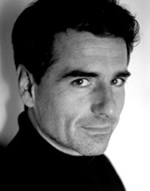 actually did the politically unpopular thing of not increasing Chile’s spending or decreasing its taxes during the good times and because of this huge surplus Chile now enjoys, Chile’s in excellent shape to weather the current global economic crisis.
So, here’s Dani’s bragging on his friend and colleague who deserves the accolades and popularity he now enjoys.
Until the current crisis hit, Chile’s economy was booming, fueled in part by high world prices for copper, its leading export. The government’s coffers were flush with cash. (Chile’s main copper company is state-owned, which may be a surprise to those who think Chile runs on a free-market model!) Students demanded more money for education, civil servants higher salaries, and politicians clamored for more spending on all kinds of social programs.
Being fully aware of Latin America’s commodity boom-and-bust-cycles and recognizing that high copper prices were temporary, Velasco stood his ground and decided to do what any good macroeconomist would do: smooth intertemporal consumption by saving most of the copper surplus. He ran up the largest fiscal surpluses Chile has seen in modern times.
This didn’t make Velasco very popular. Last November, public sector workers marched in downtown Santiago, burning an effigy of Velasco.
But by the time the financial crisis hit Chile, Velasco (and the Central Bank governor Jose de Gregorio, another fine macroeconomist) had accumulated a war chest equal to a stupendous 30% of GDP.
The price of copper plummeted 52 percent from Sept. 30 to year-end, and Velasco dusted off his checkbook. In the first week of January, he and Bachelet unveiled a $4 billion package of tax cuts and subsidies… Velasco’s stimulus spending, includ[ed] 40,000-peso ($68.41) handouts to 1.7 million poor families…
The surpluses accumulated during the good years has given the Chilean government unusual latitude in responding to the crisis. As a result, the economy is doing much better than its peers. As Bloomberg reports, “the country’s economy is expected to grow 0.1 percent in 2009, as the region contracts 1.5 percent, according to the International Monetary Fund.”
And does good economics pay off politically? Eventually, yes. Five months after being burned in effigy, Velasco is currently President Bachelet’s most popular minister.

 peej
peej Carissa
 bostonboomer
 dakinikat
 ecocatwoman
 mablue2
 Mama Lopez
 peggysue22
 quixote
 skydancingguestblogger
 Mona (aka Wonk the Vote)



 Sky Dancing
Recent Comments