Yesterday, the courts pushed back on Trump and Musk. I’m not convinced that it will stop them, but we’ll find out soon enough. Here’s a brief summary of what happened from David Kurtz at Talking Points Memo: The Day The Federal Courts Stood Tall.
The showdown between President Trump and the federal judiciary came to a head Tuesday in a more dramatic and direct way that Morning Memo had anticipated.
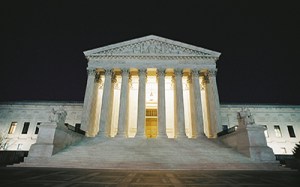
With Trump dangerously but also absurdly calling for the impeachment of the federal judge who ruled against him in the Alien Enemies Act case, Supreme Court Chief Justice John Roberts stirred from his torpor long enough to issue a rare rebuke of the president, though not by name (as Trump himself pointed out). Roberts’ decision to come to the defense of district judges who have been on the front lines of this constitutional battle keeps them from being marooned on an island while their decisions wind their way up through the lengthy appeals process.
“The Chief Justice’s statement now renders the Trump confrontation one with the entire federal judiciary, and not just the lower federal courts,” Harvard Law professor Jack Goldsmith observed.
What followed over the course of the day was a series of significant court rulings against the Trump administration. While the compressed timing of the rulings was mostly coincidental, the thrust of the decisions all pointed in the same direction: Two months into his second term, President Trump has wildly exceeded his constitutional authority on numerous fronts.
I wish I could say that the combination of the chief justice’s rebuke and the multiple legal setbacks suggests that the federal judiciary is girding for a fight over the rule of law and its own constitutional powers. I hope that’s the case. I want that to be the case. But we need to see appeals courts and the high court itself weighing in on the substance of these cases in the weeks and months to come before we can assess whether the judicial branch will hold the line. There’s no doubt that Trump is itching to coopt the judiciary.
It bears repeating that the courts alone can’t save us from autocracy. But losing the courts entirely would be a devastating blow that would make additional areas of American public and private life vulnerable to Trump’s rampage and would add immeasurably to the future workload of rebuilding what Trump has broken.
For one day, though, the judicial branch stood tall.
Efforts by Elon Musk and his team to permanently shutter the U.S. Agency for International Development likely violated the Constitution “in multiple ways” and robbed Congress of its authority to oversee the dissolution of an agency it created, a federal judge found on Tuesday.
The ruling, by Judge Theodore D. Chuang of U.S. District Court for the District of Maryland, appeared to be the first time a judge has moved to rein in Mr. Musk and his Department of Government Efficiency directly. It was based on the finding that Mr. Musk has acted as a U.S. officer without having been properly appointed to that role by President Trump.
Judge Theodore Chuang
Judge Chuang wrote that a group of unnamed aid workers who had sued to stop the demolition of U.S.A.I.D. and its programs was likely to succeed in the lawsuit. He agreed with the workers’ contention that Mr. Musk’s rapid assertion of power over executive agencies was likely in violation of the Constitution’s appointments clause.
The judge also ordered that agency operations be partially restored, though that reprieve is likely to be temporary. He ordered Mr. Musk’s team to reinstate email access to all U.S.A.I.D. employees, including those on paid leave. He also ordered the team to submit a plan for employees to reoccupy a federal office from which they were evicted last month, and he barred Mr. Musk’s team from engaging in any further work “related to the shutdown of U.S.A.I.D.”
Given that most of the agency’s work force and contracts were already terminated, it was not immediately clear what effect the judge’s ruling would have. Only a skeleton crew of workers is still employed by the agency.
And while the order barred Mr. Musk from dealing with the agency personally, it suggested that he or others could continue to do so after receiving “the express authorization of a U.S.A.I.D. official with legal authority to take or approve the action.”
A federal judge has indefinitely blocked President Donald Trump’s ban on transgender service members, dealing a major defeat to a controversial policy the president resurrected from his first term.
In a scathing ruling, US District Judge Ana Reyes said the administration cannot enforce the ban — which was set to take effect later this month.
Reyes, an appointee of former President Joe Biden, wrote that the ban “is soaked in animus and dripping with pretext. Its language is unabashedly demeaning, its policy stigmatizes transgender persons as inherently unfit, and its conclusions bear no relation to fact.”
Judge Ana Reyes
“Indeed, the cruel irony is that thousands of transgender servicemembers have sacrificed – some risking their lives – to ensure for others the very equal protection rights the Military Ban seeks to deny them,” she wrote.
The judge said she was pausing her preliminary injunction until Friday morning to give the administration time to appeal it to the DC Circuit Court of Appeals.
The ruling came in a case brought by transgender active-duty service members and others hoping to enlist in the military who would be barred from service under the ban. Reyes said they had shown that they would likely succeed on their claim that the ban violated rights afforded to them by the Constitution.
Days after taking office, Trump signed an executive order directing the Pentagon to implement its own policies that say transgender service members are incompatible with military service. The government had argued that continuing to permit trans individuals to serve in the US would negatively affect, among other things, the military’s lethality, readiness and cohesion.
A federal judge on Tuesday temporarily barred President Donald Trump’s Environmental Protection Agency from clawing back at least $14 billion in grants issued by the Biden administration for climate and clean-energy projects, saying the EPA had not put forward “credible evidence” of fraud or abuse.
U.S. District Judge Tanya S. Chutkan of Washington, D.C., ruled that the EPA’s sudden mid-February asset freeze and March 11 termination of legally awarded grants came without a legally required explanation to three coalitions of grant recipients. The groups said the sudden cutoff of funds approved by Congress appeared to be arbitrary, capricious or in violation of federal law and regulations.
Judge Tanya Chutkan
Climate United Fund, Coalition for Green Capital and Power Forward Communities, which received $7 billion, $5 billion and $2 billion, respectively, sued over the funding freeze. They are among eight recipients awarded more than$20 billion under the Greenhouse Gas Reduction Fund, a program established in President Joe Biden’s signature 2022 climate law more commonly known as the “green bank.”
In a 23-page opinion, Chutkan said the EPA’s actions raised “serious due process concerns” and issued a temporary restraining order barring the grant cutoffs for now. Chutkan did not release funds to the groups but ordered that the money be held as it was in their accounts at Citibank and not clawed back or reused for any other purpose by the EPA while the case moves ahead.
While the agency voiced concerns regarding “program integrity,” “programmatic fraud, waste, and abuse” and “the absence of adequate oversight,” Chutkan wrote, “vague and unsubstantiated assertions of fraud are insufficient.”
Chutkan said she was neither forcing the EPA to “undo” its termination nor making the funds unrecoverable, but ensuring that the government abides by grant laws and regulations, “which serves the public interest.”
A federal judge on Tuesday ordered the Education Department to restore some federal grants that were terminated as part of the Trump administration’s purge of diversity, equity and inclusion programs.
Judge Julie R. Rubin of the Federal District Court for the District of Maryland said in an opinion that the department had acted arbitrarily and illegally when it slashed $600 million in grants that helped place teachers in underserved schools. The judge also ordered the administration to cease future cuts to those grants.
Judge Julie R. Rubin
The grants fund programs that train and certify teachers to work in struggling districts that otherwise have trouble attracting talent. The programs cited goals that included training a diverse educational work force, and provided training in special education, among other areas.
The department, led by Education Secretary Linda McMahon, argued that the grants trained teachers in “social justice activism” and other “divisive ideologies” and should be eliminated.
A coalition of educator organizations sued to stop the Education Department from terminating the grants. The coalition included groups, such as the American Association of Colleges for Teacher Education and the National Center for Teacher Residencies, whose members depend on the grants at issue.
The judge found that the loss of the federal dollars would harm students and schools with the fewest resources.
“The harms plaintiffs identify also implicate grave effect on the public: fewer teachers for students in high-need neighborhoods, early childhood education and special education programs,” she wrote. “Moreover, even to the extent defendants assert such an interest in ending D.E.I.-based programs, they have sought to effect change by means the court finds likely violate the law.”
A federal judge has turned down a request from the Trump administration to dismiss Palestinian activist Mahmoud Khalil’s challenge to his deportation, and ruled his case should be heard in New Jersey rather than Louisiana, where he is now detained.
Judge Jesse Furman
In his decision, judge Jesse M Furman said that since Khalil’s attorney filed the challenge to his arrest while he was in Immigration and Customs Enforcement (Ice) detention in New Jersey, the case must be heard there. Government lawyers had asked that his petition be considered in Louisiana, where Khalil had been flown to after being arrested by Ice in New York City and then briefly held in New Jersey.
“Given that the District of New Jersey is the one and only district in which Khalil could have filed his Petition when he did, the statutes that govern transfer of civil cases from one federal district court to another dictate that the case be sent there, not to the Western District of Louisiana,” Furman wrote.
He added that “the Court’s March 10, 2025 Order barring the Government from removing him (to which the Government has never raised an objection and which the Government has not asked the Court to lift in the event of transfer) shall similarly remain in effect unless and until the transferee court orders otherwise.”
The Justice Department is pushing back against a federal judge’s request for more information about the deportation flights that took off over the weekend after President Donald Trump invoked the rarely used Alien Enemies Act.
U.S. District Judge James Boasberg had ordered the Trump administration to submit answers to his questions about the timing of the deportation flights and custody handover of deportees, giving the government until noon Wednesday to respond.
Judge James Boasberg
The government submitted a filing Wednesday morning asking for a pause of Boasberg’s order to answer his questions.
“Continuing to beat a dead horse solely for the sake of prying from the Government legally immaterial facts and wholly within a sphere of core functions of the Executive Branch is both purposeless and frustrating to the consideration of the actual legal issues at stake in this case,” the DOJ wrote in the filing.
The judge had initially ordered the government to answer his questions surrounding the flights by noon Tuesday. The Justice Department declined to answer some of his questions, saying, “If, however, the Court nevertheless orders the Government to provide additional details, the Court should do so through an in camera and ex parte declaration, in order to protect sensitive information bearing on foreign relations.”
Boasberg agreed and directed DOJ attorneys to submit under seal the answers to his questions about the deportations that were carried out under the terms of a rarely used wartime act by noon Wednesday.
In its response Wednesday, the government blasted the judge for accepting its proposal and suggested he not take any action until an appeals court rules on its request for a stay.
“The Court has now spent more time trying to ferret out information about the Government’s flight schedules and relations with foreign countries than it did in investigating the facts before certifying the class action in this case. That observation reflects how upside-down this case has become, as digressive micromanagement has outweighed consideration of the case’s legal issues,” the DOJ filing said. “The distraction of the specific facts surrounding the movements of an airplane has derailed this case long enough and should end until the Circuit Court has had a chance to weigh in,” it added.
In a historical twist, Donald Trump’s sister was the federal judge who ruled unconstitutional the immigration law the Trump administration is using to deport a pro-Palestinian protester. In 1996, U.S. District Judge Maryanne Trump Barry wrote an opinion that declared unconstitutional the part of U.S. immigration law that Donald Trump has promised to continue employing to deport protesters. The current case has captured headlines and will test the Trump administration’s immigration authority….
On March 8, 2025, Immigration and Customs Enforcement arrested Mahmoud Khalil, a lawful permanent resident and pro-Palestinian protester who graduated in December from Columbia University. Controversy over the arrest surrounded the Trump administration using a provision in immigration law that allows for deportation if the Secretary of State believes an alien’s presence or activities “would have potentially serious adverse foreign policy consequences for the United States.”
In 1995, Secretary of State Warren Christopher used the same authority when attempting to deport Ruiz Massieu to Mexico. As presented by the court documents, the circumstances in that case were quite different from the arrest of Mahmoud Khalil.
In September 1994, Ruiz Massieu’s brother, a prominent member of PRI, Mexico’s ruling party, was assassinated. As Deputy Attorney General, Ruiz Massieu investigated and identified a PRI official, Manuel Munoz Rocha, as the lead conspirator in his brother’s killing. Rocha was protected, first by official immunity and later by disappearing before an interview could be conducted. In late November 1994, Massieu resigned in a public speech and later published a book criticizing the PRI.
After Mexican officials sought his arrest, he entered the United States legally as a visitor (he owned property in Texas) and flew to Spain with a stopover at Newark Airport. In Newark, he was arrested for declaring only $18,000 of the $44,322 in cash with him. While the declaration infraction was later dropped, the Mexican government charged him with crimes “against the administration of justice” and sought his extradition.
“It was then, however, that this case took a turn toward the truly Kafkaesque,” writes U.S. District Judge Maryanne Trump Barry, Donald Trump’s sister. She notes that the Immigration and Naturalization Service took Massieu into custody. “He was ordered to show cause as to why he should not be deported because, the Secretary of State has made a determination that . . . there is reasonable ground to believe your presence or activities in the United States would have potentially serious adverse foreign policy consequences for the United States.” (Emphasis added.) In 1996, the provision was Section 241(a)(4)(C)(i) of the Immigration and Nationality Act but it was later redesignated Section 237(a)(4)(C)(i) due to other changes in the INA. The language in both designations is identical.
The information the IRS needs to send out the payments was finally delivered on Thursday morning after threatening letters sent to Social Security Commissioner Andrew Saul and his Deputy David Black by leaders of the House Ways and Means and Oversight Committees. There is still no word on when the deposts/checks will go out. The latest estimate is that those of us in these categories will still have to wait at least 10 days to see the money.
Meanwhile, calls on Biden to fire Saul and Black are growing louder.
Weeks after the American Rescue Plan had been signed into law, while many Americans had already received payments, the Social Security Administration’s inaction was standing in the way of millions of beneficiaries receiving desperately needed cash aid. After escalating pressure on Saul to no avail, the letter gave him 24 hours to remedy the holdup. A few hours later, the SSA announced that they’d be sending the information the next day.
This delay is just the latest in an array of extremely troubling decisions under the leadership of the Social Security Administration’s commissioner Saul, and his deputy David Black….
Commissioner Saul and Deputy Commissioner Black were appointed by President Trump, alongside Deputy Commissioner for Retirement and Disability Policy Mark Warshawsky, to self-fulfill the Republican promise about the failure of government, and destroy the departments they were tasked with managing. Warshawsky, a veteran of the American Enterprise Institute, was pegged as an early candidate to be fired by the Biden administration for his work undercutting the program; he retired from the post in late January.
The Biden administration has set to work rolling back some of those Trump appointees’ designs on Social Security, including a proposed rule that would have subjected disability insurance recipients to even more frequent and stringent eligibility reviews, which would make an already challenging process even more difficult for people with disabilities to secure and maintain cash benefits. That move was widely celebrated among advocates. But President Biden has not heeded the call from those same advocates to fire Saul and Black, who have clear track records of working against the very department they’ve been tasked to head up, and against Democratic ambitions on Social Security.
Frank O’Sullivan
Now, a growing number of congressional Democrats are joining the chorus calling for Saul and Black’s ousters. Sen. Sherrod Brown (D-OH) called for their resignation as his first act as chair of the Social Security and Pensions Subcommittee, and has since urged Biden to fire them. He’s joined House Ways and Means Social Security Subcommittee Chairman John Larson, Worker and Family Support Subcommittee Chairman Danny Davis, and Oversight Subcommittee Chairman Bill Pascrell Jr. in demanding Saul’s immediate removal. Both Saul and Black are serving terms that don’t expire until 2025….
On the campaign trail, Biden insisted (straining against historical fact) he had never and would never vouch for cuts to Social Security. He, and the Democratic Party broadly, have made protecting and expanding Social Security a main plank of the party’s policy platform going forward.
That ambition is irreconcilable with a leadership regime that has, as was reported by Yahoo News, put “illegitimate political pressure on Administrative Law Judges to reduce the rate of Social Security disability case approval,” as one such judge recently claimed. That alone should be scandal enough to imperil Saul and Black’s positions at the agency, and give the Biden administration the space to fire them for cause. But the Trump years have built up a tolerance for scandal, which means that the incident hasn’t even deterred them.
Meanwhile, Saul and Black have openly pursued a number of reforms aimed at aggressively curtailing benefits. Their attempted rule change, which the Biden administration rolled back, was a Reagan-era reform that would have led to tens of thousands of people losing benefits. When President Reagan enacted it, it led to a rash of suicides, and was deemed so cruel that it led to a unanimous Senate ruling to overturn it. Elsewhere, they’ve sought to deny benefits for older and severely disabled non–English speakers, resulting in an estimated 100,000 people being denied more than $5 billion in benefits.
See my Thursday post for more about Saul and Black’s efforts to destroy Social Security on Thursday.
Pressure is also building for Biden to get rid of Trump-appointed Postmaster General Louis DeJoy.
A group of House Democrats on Friday introduced legislation to prohibit the Postal Service from lengthening mail-delivery windows and require it to adhere to present service expectations. They named the bill the Delivering Envelopes Judiciously On-time Year-round Act, or DEJOY Act.
Carl Larsson: Brita, Cat and Sandwich
One House aide involved in postal reform legislation introduced in February said some members of the caucus are leery of proceeding with efforts to address the Postal Service’s financial obligations given that DeJoy’s 10-year plan includes sharp reductions in service, including slower timetables for mail delivery and reduced post office hours.
Separately, Pennsylvania Attorney General Josh Shapiro (D) threatened to take legal action to block the service cuts. His office said in a statement Friday that it was encouraged that DeJoy recognizes the legal obligations to secure limited regulatory approvals, but said it remained concerned about timely mail delivery….
DeJoy hopes to save the Postal Service $160 billion over the next decade through a combination of austerity measures, postage price increases and projected package volume growth. But the largest single piece of his plan is dependent on Congress repealing its pre-funding mandate for retiree health care costs, which runs about $5 billion a year. Instead, the agency wants to wind down those payments and enroll future retirees in Medicare, a proposal worth $44 billion.
A bill introduced by Rep. Carolyn B. Maloney, chair of the powerful House Oversight and Reform Committee, includes both components.
But DeJoy’s designs to slow the mail — even as the Postal Service attempts to rebound from generationally poor service metrics in recent months — and perceived animus toward lawmakers in recent hearings have made those prospects more difficult.
Sometimes America’s legacy of white supremacy is hiding in plain sight, literally. When Georgia Gov. Brian Kemp signed a hastily passed voter suppression law that many are calling the new, new Jim Crow on Thursday night, surrounded by a half-dozen white men, he did so in front of a painting of a plantation where more than 100 Black people had been enslaved.
Lady reading with cat-Albert Roosenboom
The fitting symbolism is somehow both shocking and unsurprising. In using the antebellum image of the notorious Callaway Plantation — in a region where enslaved Black people seeking freedom were hunted with hounds — in Wilkes County, Ga., as the backdrop for signing a bill that would make it a crime to hand water to a thirsty voter waiting on Georgia’s sometimes hours-long voter lines, the GOP governor was sending a clear message about race and human rights in the American South.
The portrait of the plantation was the starkest reminder of Georgia’s history of white racism that spans slavery, Jim Crow segregation, the rebirth of the modern Ku Klux Klan, and today’s voter purges targeting Black and brown voters — but it wasn’t the only one. At the very moment that Kemp was signing the law with his all-white posse, a Black female Georgia lawmaker — Rep. Park Cannon — who’d knocked on the governor’s door in the hopes of watching the bill signing was instead dragged away and arrested by state troopers, in a scene that probably had the Deep South’s racist sheriffs of yesteryear like Bull Connor or Jim Clark smiling in whatever fiery hellhole they now inhabit.
Rep. Park Cannon (D-Atlanta) is placed in handcuffs by Georgia State Troopers after being asked to stop knocking on a door that lead to Gov. Brian Kemp’s office while Gov. Kemp was signing SB 202 behind closed doors at the Georgia State Capitol Building in Atlanta, Thursday, March 25, 2021.Alyssa Pointer / AP
Indeed, Twitter was on fire Thursday night with posters drawing the straight line from notorious past segregationists like George Wallace to the 2021 actions of Kemp and the GOP-led Georgia Legislature in passing — at great speed and with little debate — a lengthy bill that also limits easy-access drop boxes for ballots and places onerous voter-ID restrictions on voting by mail, and which the New York Times reports “will have an outsized effect on Black voters.”
On one level this new voter-suppression law — “voter integrity,” in the modern GOP’s Orwellian branding — is inspired by the current and possible future events of ex-President Donald Trump’s Big Lie about fraud in the 2020 election, the narrow upset wins in Georgia for President Biden and two new Democratic senators, and the threat that voting icon Stacey Abrams poses to Kemp in the 2022 election. But there’s also a powerful pull back to Georgia past. That link is made clear by the history hanging right behind Kemp on Thursday.
“Things have changed dramatically” in the South, Chief Justice John Roberts wrote in 2013 when he authored the majority opinion gutting the Voting Rights Act, ruling that states with a long history of discrimination no longer needed to have changes to their voting procedures approved by the federal government.
Voter suppression in Georgia is Exhibit A for why he is wrong.
After Joe Biden carried the state in November and Black voters turned out in record numbers in the January runoffs to elect Democrat Raphael Warnock as the state’s first Black senator and Democrat Jon Ossoff as the state’s first Jewish senator, Georgia Republicans passed a sweeping rewrite of the state’s election laws on Thursday to make it harder for Democratic constituencies to vote and have their ballots counted.
Though some Georgia Republicans, most notably Secretary of State Brad Raffensperger, defended the integrity of the 2020 election, the “Election Integrity Act of 2021” heavily restricts mail ballot drop boxes, adds new ID requirements for mail-in voting, throws out ballots cast in the wrong precincts, and makes it a crime to give voters food and water while they’re waiting in line.
In addition to making it harder to vote, the new law allows the GOP-controlled legislature to appoint a majority of members of the state election board and gives the board the power to take over county election boards, making it easier for Republicans to challenge election results, take over election administration in large Democratic counties, and even decline to certify the results if Democrats win close races—which Trump tried and failed to get the state to do in 2020.
One of the small, rueful truths that many Americans held in the back of their minds throughout the pandemic year was that, for all of its horrors, it had at least reduced, or even eliminated, the spectacle of the gun massacre. School closings had momentarily ended school shootings; curbside delivery had, it seemed, halted in-store assaults. It is true that gun fatalities were disturbingly trending upward in big cities, for reasons that are as yet as mysterious as those for the great decline that preceded them, and that, according to the Gun Violence Archive, last year saw the highest number of shooting deaths in decades. In fact, keyed, perhaps, by a general sense of panic marked by the pandemic and a bizarrely unsettled election year—with that strange American certainty that they’re coming for you—gun sales soared, even amid groups that are not normally associated with buying firearms in numbers.
The gun massacre, however—five or twenty or fifty people murdered at a time—had, briefly, vanished. Yet, alongside the knowledge that mass shootings had gone stood the knowledge that they would, inevitably, reëmerge. And here they are, right on schedule, as the country “opens up,” and with a vengeance: seven in the past seven days, with eight people killed in three shootings in Atlanta, and ten in a grocery store in Boulder. With those shootings come back all the usual, understandable, and all-too-human reactions—above all, our urge to give them some kind of meaning by making them an index of a larger issue. Violence this blankly nihilistic needs a point projected into it, to redeem it as a subject of discussion….
Countries that resemble ours in every way except for the availability of guns have much lower levels of gun violence and far fewer gun massacres. Yet these truths, demonstrated again and again, meet the same resistance, over and over. The Second Amendment guarantees private ownership of even military-style weapons. (It doesn’t, or rather, until very recently, not even conservative Justices imagined that it did.) Guns are essential for self-protection. (They aren’t.) The way to stop mass shootings is to arm more people, such as teachers. (A “colossally stupid idea,” according to the co-president of the Brady Campaign to Prevent Gun Violence.)
All this, even as the sheer psychic damage done by the omnipresence of guns in America is self-evident (no healthy society should have to train its children in active-shooter drills), while the social damage extends far beyond the immediate casualties. A reason for the prevalence of police shootings in America is that the police go about armed, in levels unique to our society, in order to deal with the uniquely over-armed civilians they fear encountering, with the frequently fatal results, we know too well, for the unarmed and the innocent.
Sorry this isn’t a more cheerful post. I’ll probably be up for something more upbeat if I finally get that promised $1400. What’s on your mind today?
Did you like this post? Please share it with your friends:
FORT HOOD, Texas (AP) — An Iraq War veteran being treated for mental illness was the gunman who opened fire at Fort Hood, killing three people and wounding 16 others before committing suicide, in an attack on the same Texas military base where more than a dozen people were slain in 2009, authorities said.
Within hours of the Wednesday attack, investigators started looking into whether the man’s combat experience had caused lingering psychological trauma. Fort Hood’s senior officer, Lt. Gen. Mark Milley, said the gunman had sought help for depression, anxiety and other problems.
How is that even a question? I’ve written for years that we’ll pay a terrible price for these pointless wars and the way the men and women sent to fight in them. Massive numbers of Vietnam vets suffered from PTSD, Agent Orange exposure, drug addiction, and unemployment; and those guys mostly just went for one two-year deployment. But we didn’t have a draft when Bush decided he just had to act out his daddy issues and go back into Iraq and kill Saddam Hussein like his father failed to do. Talk about psychological problems!
The volunteer army wasn’t big enough for that, and they redeployed men and women to Iraq and Afghanistan again and again even when they were obviously had head injuries or PTSD. Now we’re all going to keep paying the price for Bush and Cheney’s folly, and the way they treated human beings like cannon fodder.
Back to the Globe article on the latest shooting:
The shooter was identified as Ivan Lopez by Texas Rep. Michael McCaul, chairman of the House Homeland Security Committee. But the congressman offered no other details, and the military declined to identify the gunman until his family members had been notified.
Lopez apparently walked into a building Wednesday afternoon and began firing a .45-caliber semi-automatic pistol. He then got into a vehicle and continued firing before entering another building, but he was eventually confronted by military police in a parking lot, according to Milley, senior officer on the base.
As he came within 20 feet of an officer, the gunman put his hands up but then reached under his jacket and pulled out his gun. The officer drew her own weapon, and the suspect put his gun to his head and pulled the trigger a final time, Milley said.
The gunman, who served in Iraq for four months in 2011, had been undergoing an assessment before the attack to determine if he had post-traumatic stress disorder, Milley said.
He arrived at Fort Hood in February from another base in Texas. He was taking medication, and there were reports that he had complained after returning from Iraq about suffering a traumatic brain injury, Milley said. The commander did not elaborate.
Wednesday’s mass shooting by an Army specialist in Fort Hood, Tex., put the Pentagon on a dreaded, if increasingly familiar, footing as officials grappled to understand how yet another insider threat went undeterred.
It unfolded just two weeks after the Defense Department unveiled the findings of threeinvestigations into last year’s fatal shooting at a Navy Yard building in Washington, D.C., by a contractor and four years after a similarly extensive inquiry into a massacre at Fort Hood by an Army psychiatrist led to vows of sweeping reforms.
“We do not yet know how or why this tragedy occurred, but nearly five years after the Nidal Hasan shooting at Fort Hood in 2009, it is clear that we must do far more to ensure that our troops are safe when they are at home on base,” Rep. Thomas J. Rooney (R-Fla.), a former Army lawyer who was based at Fort Hood, said in a statement. “We must thoroughly investigate what happened today so that we can take whatever action is necessary to prevent something like this from ever occurring again.”
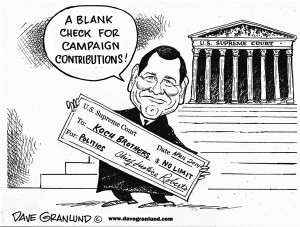
The Supreme Court on Wednesday continued its abolition of limits on election spending, striking down a decades-old cap on the total amount any individual can contribute to federal candidates in a two-year election cycle….
The 5-to-4 decision, with the court’s more conservative members in the majority, echoed Citizens United, the 2010 decision that struck down limits on independent campaign spending by corporations and unions.
Wednesday’s decision seemed to alter campaign finance law in subtle but important ways, notably by limiting how the government can justify laws said to restrict the exercise of First Amendment rights in the form of campaign contributions.
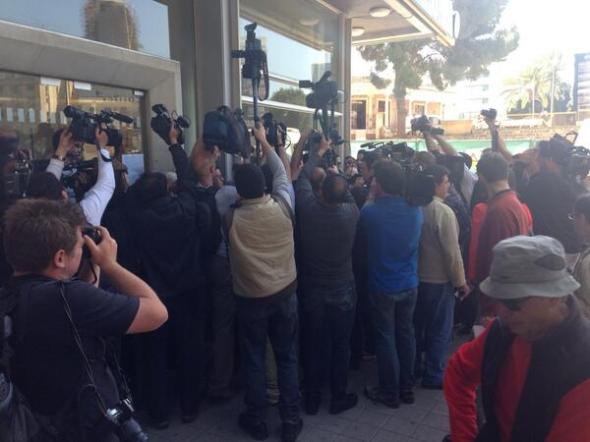
See more Twitter updates and photos at the link. International Business Times has some details about the capital controls that are supposed to prevent bank runs. In addition to the withdrawal limit, depositors can’t cash checks unless they come from another country.
In the meantime, non-cash payments or money transfers are banned unless they are related to a number of conditions.
These conditions include commercial transactions, payroll, living expenses and tuition fees.
If commercials transactions are less than €5,000, there are no restrictions, but payments above this amount and up to €200,000 will be subject to a 24-hour decision making process, in order to determine whether the liquidity of the bank would be able to incur such a withdrawal.
Transfers for paying employees will also still be allowed but relevant documents would have to be presented in order to prove the money is being used to pay staff.
Transactions on credit or debit cards are also capped at €5,000 euros per month.
According to the Wall Street Journal, some large depositors seemingly had advance knowledge of what was going to happen in Cyprus and moved their money out of the country weeks before the crisis.
The chairman of the Committee for Institutions in the Cypriot Parliament, Deputy Dimitris Syllouris, said he had submitted a letter to the Central Bank of Cyprus demanding an investigation into account holders who moved large sums of cash out of the country in the weeks ahead of Cyprus’s chaotic bailout talks…
He said he had received information about individuals and businesses moving money out of Cyprus weeks ahead of the bailout deal—a move that wouldn’t be illegal but could imply that some depositors had warning that negotiations for a bailout could, for the first time in the financial crisis that has rattled the euro zone, take a cut out of regular bank deposits.
Asked whether his suspicions focused on one specific group of depositors, he said “politicians, all sorts of people, and bankers themselves are no better.”
That figures…
Outflows from Cyprus were increasing from moderate levels from January until March 15, the officials said. Last week—especially after March 19, when the Cypriot Parliament rejected the first bailout deal that would have imposed a one-time levy on large deposits—the outflows under the central bank’s exemptions went up significantly, they said.
Several hundred million euros, but less than a billion euros, left the country despite the bank closures, according to one official.
The new deal has removed the craziest part of the agreement reached March 16 — the plan to default on deposit insurance. Let’s not dwell any further on that insanity. But the new plan still has features that, seen in any other context, would surely arouse surprise.
For instance, the so-called troika of the European Commission, the European Central Bank and the International Monetary Fund wanted to be sure that the new debt Cyprus is about to take on will be sustainable — meaning, presumably, that Cyprus will be able to repay it. Yet, by writing down high- value deposits, the revised plan will also cause a sudden contraction of the Cypriot banking system, and thus of the whole Cypriot economy, which depends on banking to an unusual degree.
He concludes that,
Bailout fatigue says: “The Cypriots got themselves into this mess, and they should get themselves out. We’ll lend them a bit more, but only if we’re sure they’ll pay us back.” Cyprus didn’t get itself into this mess. It joined the euro system in 2008 with low public debt and a clean bill of health from EU governments (back then, not a word was said about shady Russians). Its banks are in trouble not because they accepted too many overseas deposits but because they bought too many Greek bonds — an investment sanctified by international banking rules (which called such investments riskless) that was destroyed by the EU’s ham-fisted resolution of Greece’s threatened default.
Europe’s sense of “we’re all in this together” seems to have evaporated entirely. Now one has to ask not merely what the euro is for, but what the EU itself is for.
Back in the U.S.A.,
Simon Johnson has an interesting post at the NYT’ “Explaining the Science of Everyday Life” blog: The Debate on Bank Size Is Over.
While bank lobbyists and some commentators are suddenly taken with the idea that an active debate is under way about whether to limit bank size in the United States, they are wrong. The debate is over; the decision to cap the size of the largest banks has been made. All that remains is to work out the details.
To grasp the new reality, think about the Cyprus debacle this month, the Senate budget resolution last week and Ben Bernanke’s revelation that — on too big to fail — “I agree with Elizabeth Warren 100 percent that it’s a real problem.”
Policy is rarely changed by ideas alone and, in isolation, even stunning events can sometimes have surprisingly little effect. What really moves the needle in terms of consensus among policy makers and the broader public opinion is when events combine with a new understanding of how the world works. Thanks to Senator Sherrod Brown, Democrat of Ohio; Senator Warren, Democrat of Massachusetts, and many other people who have worked hard over the last four years, we are ready to understand what finally defeated the argument that bank size does not matter: Cyprus.
I can’t briefly summarize the gist of Johnson’s piece, so if you’re following this story, please read the whole thing. Could he really be right about limits on “to big to fail or prosecute banks.” I sure hope so!
“Today’s decision underscores the need for a President who will lead on this critical issue and work in a bipartisan fashion to pursue a national immigration strategy. President Obama has failed to provide any leadership on immigration. This represents yet another broken promise by this President. I believe that each state has the duty–and the right–to secure our borders and preserve the rule of law, particularly when the federal government has failed to meet its responsibilities. As Candidate Obama, he promised to present an immigration plan during his first year in office. But 4 years later, we are still waiting.”
Romney refused to say whether he agreed with the decision or provide specifics about how he would deal with undocumented immigrants if he were elected.
Next, his former favorite Supreme Court Justice, John Roberts, voted with the liberals on the court, agreeing that the Democrats’ Affordable Care Act, including the individual mandate is constitutional. Romney’s response to that one was strikingly terse and even more vague than his statement on immigration:
“What the court did not do on its last day in session, I will do on my first day,” he said. “I will act to repeal Obamacare.”
Still no specifics on how he would convince Congress to repeal the law or what he would replace it with. And then real disaster struck. Top Romney aide Eric Fehrnstrom told MSNBC that, despite Chief Justice Roberts’ calling the individual mandate a “tax,” Romney disagrees–he thinks it’s a “penalty.” Of course this contradicted the latest Republican meme–that the mandate is the biggest tax increase in human history. Ooops! And the next day (ironically it was Independence Day), Mitt changed his mind and said the mandate is a tax after all. Here’s a summary from Chuck Todd and colleagues:
Romney’s verbal gymnastics: When you think about it, Romney never had to truly deal with his fatal flaw on health care. Yes, he gave that health-care PowerPoint speech in Michigan in May 2011. And, yes, he was asked questions about the issue during the 20-odd GOP debates in which he participated. But he never REALLY had to reconcile his health-care law with President Obama’s — with a campaign team capable of going toe to toe with him — until last week’s Supreme Court decision. As for his explanation in calling the mandate a tax, his verbal gymnastics would have impressed even the Russian judges. First, he technically didn’t disagree with Fehrnstrom’s original take; he simply conceded that the Supreme Court called it a tax. “Well, the Supreme Court has the final word, and their final word is that Obamacare is a tax. So it’s a tax,” he said. And then he painfully tried to explain why the federal mandate is a tax, but Romney’s state mandate is a penalty. “Actually the chief justice in his opinion made it very clear that at the state level, states have the power to put in place mandates. They don’t need to require them to be called taxes in order for them to be constitutional.”
Recent polls show that the Obama campaign’s attacks on Romney’s record at Bain Capital are working–especially in the swing states. But Romney has let those attacks go largely unanswered as he struggled to develop a coherent response to the Obamacare decision.
Over the past few days, there have been stinging critiques of the Romney campaign from conservative media sources. Rupert Murdock tweeted that Romney’s campaign is too insular and they need to shake up the staff and add more experienced people. The Wall Street Journal’s editorial board dressed down the candidate and his staff on the editorial page. On the tax/penalty flip flop, they wrote:
For conservative optimists who think Mr. Fehrnstrom misspoke or is merely dense, his tax absolution gift to Mr. Obama was confirmed by campaign spokeswoman Andrea Saul, who tried the same lame jujitsu spin. In any event, Mr. Fehrnstrom is part of the Boston coterie who are closest to Mr. Romney, and he wouldn’t say such a thing without the candidate’s approval.
In a stroke, the Romney campaign contradicted Republicans throughout the country who had used the Chief Justice’s opinion to declare accurately that Mr. Obama had raised taxes on the middle class. Three-quarters of those who will pay the mandate tax will make less than $120,000 a year, according to the Congressional Budget Office. The Romney high command has muddied the tax issue in a way that will help Mr. Obama’s claims that he is merely taxing rich folks like Mr. Romney. And it has made it that much harder for Republicans to again turn ObamaCare into the winning issue it was in 2010.
Why make such an unforced error? Because it fits with Mr. Romney’s fear of being labeled a flip-flopper, as if that is worse than confusing voters about the tax and health-care issues. Mr. Romney favored the individual mandate as part of his reform in Massachusetts, and as we’ve said from the beginning of his candidacy his failure to admit that mistake makes him less able to carry the anti-ObamaCare case to voters.
Remember Michael Dukakis (1988) and John Kerry (2004)? It’s possible to lose a winnable presidential election to a vulnerable incumbent in the White House (or in the case of 1988, a sitting vice president). So, speaking of losing candidates from Massachusetts: Is it too much to ask Mitt Romney to get off autopilot and actually think about the race he’s running?
Adopting a prevent defense when it’s only the second quarter and you’re not even ahead is dubious enough as a strategy. But his campaign’s monomaniacal belief that it’s about the economy and only the economy, and that they need to keep telling us stupid voters that it’s only about the economy, has gone from being an annoying tick to a dangerous self-delusion.
As Frank Cannon and Jeff Bell, among others, have pointed out, the economy is not an automatic path to victory. It does provide a favorable backdrop for this year’s campaign. But what are voters to think when they hear the GOP nominee say, as he did yesterday to CBS’s Jan Crawford, “As long as I continue to speak about the economy, I’m going to win”? That they’re dopes who don’t know the economy’s bad, but as long as the Romney campaign keeps instructing them that it is bad, they’ll react correctly and vote the incumbent out of office?
Of course Romney punctuated this criticism by riding around Lake Winnipesaukee on a jet ski, which naturally reminded everyone of the iconic shot of Kerry windsurfing off Nantucket in 2004.
Now, in response the the Vanity Fair article on Romney stashing his money in multiple foreign tax shelters, his campaign has adopted a new strategy: simply repeat the same meaningless response word for word whenever there is a question about Romney’s finances. Twice in one day, two different Romney spokespersons released the exact same unresponsive response to questions from different news organizations. From ABC News The Note:
Here’s Romney spokeswoman Amanda Henneberg’s statement to the press earlier today about reports by the AP and Vanity Fair about Romney’s offshore accounts in Bermuda:
“President Obama’s attacks on Mitt Romney have been proven false time and again. As job growth slows, manufacturing activity stalls, and our economy continues to sputter, President Obama knows he can’t make a legitimate argument for another term in office, so instead he is trying to tear down his opponent. This is just the latest example of President Obama and his political machine saying or doing anything to distract from his abysmal record over the last four years.”
And here’s Romney spokeswoman Andrea Saul responding to an interview that Obama strategist David Axelrod gave to ABC News, in which he said Romney is “the most secretive candidate” since Richard Nixon:
“President Obama’s attacks on Mitt Romney have been proven false time and again. As job growth slows, manufacturing activity stalls, and our economy continues to sputter, President Obama knows he can’t make a legitimate argument for another term in office, so instead he is trying to tear down his opponent. This is just the latest example of President Obama and his political machine saying or doing anything to distract from his abysmal record over the last four years.”
We asked the Romney campaign why they’re using the same statements and will update if they respond with another statement about their statements.
This has become a familiar pattern: a ringing affirmation of some major policy difference with President Obama, followed by a lot of vagueness about what he would do instead.
Take deficit reduction. Romney has promised to extend the entire Bush tax cut, reduce marginal rates by an additional 20 percent, cut corporate rates, and still bring down the deficit. He’s said he’ll pay for this by closing loopholes and deductions but won’t identify which ones. His campaign initially indicated that it would clarify this once Romney had sewn up the nomination. Months later, the details are still not forthcoming. Yet he routinely gives speeches denouncing Obama over the deficit and promising — somehow — to bring it under control.
Green discusses Romney’s bizarre response to the SCOTUS ruling on Arizona’s immigration law.
His campaign’s greatest obfuscation was its response to the Supreme Court’s voiding much of Arizona’s Draconian immigration law. Romney’s statement was magnificently vague, leaving unclear whether he still supported the law, as he once had. Even more remarkable was the long, circular, and ultimately fruitless exchange between his spokesman Richard Gorka and reporters trying to nail down Romney’s position. Afterward, some fellow press secretaries took to Twitter to marvel at Gorka’s capacity to dissemble.
Romney has plainly calculated that he can win without explaining what he’d do as president, and seems intent on becoming the “generic Republican candidate” that pollsters include in surveys (and that often outperform real Republicans). He seems to be making two assumptions: The country is in such dire shape that simply being against Obama is enough, and his background at Bain Capital is a sufficient qualification to get him elected. His campaign is a sustained exercise in avoiding risk.
Green calls it “the Romney Fog Machine: a great outpouring of words intended to obscure, rather than clarify, the issue at hand.”
As Green points out, the problem with this tactic is that if you don’t give specific answers to questions others will fill in the blanks for you. That is what seems to be happening with Obama’s attacks on Romney’s Bain career. How long can the Romney campaign keep this up? Only time will tell.
Did you like this post? Please share it with your friends:
The Sky Dancing banner headline uses a snippet from a work by artist Tashi Mannox called 'Rainbow Study'. The work is described as a" study of typical Tibetan rainbow clouds, that feature in Thanka painting, temple decoration and silk brocades". dakinikat was immediately drawn to the image when trying to find stylized Tibetan Clouds to represent Sky Dancing. It is probably because Tashi's practice is similar to her own. His updated take on the clouds that fill the collection of traditional thankas is quite special.
You can find his work at his website by clicking on his logo below. He is also a calligraphy artist that uses important vajrayana syllables. We encourage you to visit his on line studio.












 peej
peej Carissa
 bostonboomer
 dakinikat
 ecocatwoman
 mablue2
 Mama Lopez
 peggysue22
 quixote
 skydancingguestblogger
 Mona (aka Wonk the Vote)



 Sky Dancing
Recent Comments