
Live Blog: Six Men Standing (and one dead Justice) for Tonight’s Republican Debate
Posted: February 13, 2016 Filed under: 2016 elections, Live Blog | Tags: Antonin Scalia, CBS, dead, Republican Debate 2016 South Carolina 133 Comments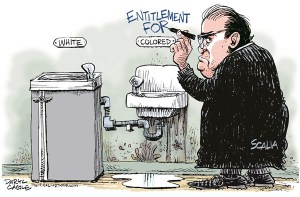 Well, tonight’s Republican Debate will surely be a lively matter. CBS gets the honorsat 9 p.m. EST.First, there are only six candidates left and we’ve determined they pretty much hate each other. Also, we’ve got the issue of one dead Supreme Court Justice. Antonin Scalia–perhaps one of the most evil men I’ve had the displeasure of reading–died in his death in a Texas Hotel while joyously killing small animals. According to our Constitution–which is the thing that Fat Tony did his damnedest to rewrite–President Obama will appoint a new justice with the advice and consent of the Senate. Currently, the Republicans are no longer a party that wishes to govern under our Constitution and SCOTUS with Scalia has become their enabler. They’re a party of insurrection and some of the worst of them will be up on that podium tonight trying to impress the voters in the home state for the nation’s historical insurrectionists. So, the rhetoric will be amped up as they compete to eulogize the dead man in black.
The six remaining Republican presidential candidates will be on stage in Greenville, South Carolina Saturday night for the CBS News Republican debate.
The stakes are high for the remaining candidates, as they head into a period of the primary season that relies less on retail politicking. A strong debate performance could be crucial as the candidates try to reach the voters who are next in line to cast their ballots — in South Carolina and Nevada.
South Carolina will determine the survival of Jeb Bush among some of the others. It seems clearly to be in its historical insurrectionist corner with the xenophobic narcissist Donald Trump. However, there are 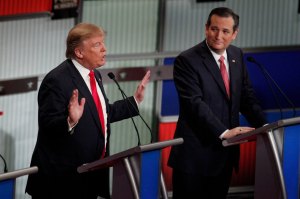 other narcissists on the stage. The Punditry is betting on a Trump-Cruz slugfest.
After splitting the first two votes, the New York billionaire has relentlessly hammered away at Cruz on everything from his campaign’s tactics to what Trump sees as the Texan’s character flaws. And on Friday, Trump warned that he has standing to sue Cruz over questions of his birth and constitutional eligibility to serve in the White House.
“If @tedcruz doesn’t clean up his act, stop cheating, & doing negative ads, I have standing to sue him for not being a natural born citizen,” Trump tweeted of his rival, born in Canada to an American mother.
Asked about the threat, Cruz did not back down. “There’s more than a little irony in Donald accusing anybody of being nasty given the amazing torrent of insults and obscenities that come out of his mouth on any given day,” he told reporters. “Suddenly every day he comes out with a new attack.”
Trump is expected to carry these attacks onto the stage on Saturday at the final candidate forum before South Carolina votes. It’s a fight Cruz’s allies say they are ready for, as they prepare to assault Trump’s Republican credentials with an eye on the conservative, religious and security-focused voters throughout the south.
The dynamics on Fat Tony’s demise will likely mean a group orgy of ass kissing. The Republicans have already promised to to block any potential nomination by the President. McConnell indicated that the next  president should pick the new SCOTUS. This seems like a dead end argument to me. The Election math is clearly behind the D’s this time and any obstruction would likely create an avalanche of Obama Supporters to the Polls. I’m not the only one who thinks this.
Just 18 days ago, former Secretary of State Hillary Clinton was asked about nominating President Barack Obama to the Supreme Court and she said, “That’s a great idea!”
Politico reported:
Asked by an Iowa voter at a town hall event here what she thought of appointing President Barack Obama to the Supreme Court if she were to become president, Democratic front-runner Hillary Clinton seemed delighted by the prospect. “I’ll tell you, that’s a great idea!” a beaming Clinton told the crowd of 450 packed into a theater, noting that she’d never heard the question before.
Well. It’s an even greater idea if it is something that would happen immediately after the election, effectively motivating the same turnout as surprised the beltway for Obama in 2012.
They may posture for awhile, but they will also have to avoid going on any recess to avoid a recess appointment that would likely sail through a Dem-controlled Senate. Again, the math indicates this a statistically likely outcome. Also, if the Republicans manage to nominate one of their more obnoxious candidates, it will bring record numbers of minorities and women to the polls in states that aren’t safely red.
The 2016 elections are the Democrats’ best shot at wresting back control of the Senate for the rest of the decade, given that the 2018 off-year elections will force Democrats to defend 25 of the 33 seats on the ballot (including the two seats held by independents who caucus with them).
In a recent interview, Republican National Committee Chairman Reince Priebus acknowledged the steep challenges Republicans face in 2016. When asked how Republicans will overcome the Democrats’ huge Electoral College advantage next year, Priebus summed up his party’s chances for the presidency this way: “[W]e have to be about perfect … and the other side can be about good. And so the fact is that we do have the higher burden.” In a year like 2016, their burden will extend beyond the presidential to the Senate as well.
 So, go ahead Rethugs, pick a fight! Sounds really good to me. As for the Scalia death, I couldn’t be more celebratory. It’s difficult for me to read anything the man wrote without seeing the face of evil. He was an “originalist” only when it suited his politics and theology. He didn’t die under any kind of tragic circumstances other than he’s rotting in hell right now by his own religious beliefs since no priest heard his last confession. Ironic that. This does impact the election and we can only hope and pray that it removes that 5th vote that seeks to maintain white male, christian hegemony in all aspects of life. Next month, a huge abortion case is on the docket.
This would be the case of Whole Woman’s Health v. Hellerstedt.
Docket No. Op. Below Argument Opinion Vote Author Term 15-274 5th Cir. Mar 2, 2016 TBD TBD TBD OT 2015 Issue: (1) Whether, when applying the “undue burden” standard of Planned Parenthood v. Casey, a court errs by refusing to consider whether and to what extent laws that restrict abortion for the stated purpose of promoting health actually serve the government’s interest in promoting health; and (2) whether the Fifth Circuit erred in concluding that this standard permits Texas to enforce, in nearly all circumstances, laws that would cause a significant reduction in the availability of abortion services while failing to advance the State’s interest in promoting health – or any other valid interest.
Again, I believe that the Republicans should hope Obama appoints a moderate and just go with it because a Clinton appointment with a Dem majority senate would rock their world. Well, see if POTUS takes the in your face or practical route.
Here are some reactions from SCOTUS blog.
The most immediate implications involve the presidential election. President Obama of course has the power to nominate a successor, with the consent of the Senate. In the ordinary course, because the opening was unexpected, the nomination would not be forthcoming for a couple of months and then the confirmation process would take several more months.
Theoretically, that process could conclude before the November election. But realistically, it cannot absent essentially a consensus nominee – and probably not even then, given the stakes. A Democratic president would replace a leading conservative vote on a closely divided Court. The Republican Senate will not permit such a consequential nomination – which would radically shift the balance of ideological power on the Court – to go forward.
There is the related question of the Court becoming an issue in the election. Before today, it was unlikely that many voters would choose a presidential candidate for this reason, given the importance of issues like the economy, terrorism, and immigration. But the fact that there is an immediate vacancy – and a vacancy that could tip the Court’s ideological balance – makes the future of the Court much more concrete.
In the political primaries, the Court is not an issue that divides candidates of the same party. Both Hillary Clinton and Bernie Sanders, for example, are clear that they would want to appoint a more liberal successor that would oppose decisions like the Citizens United campaign finance ruling. The leading Republican candidates would all make clear their support for a nominee who would oppose the Court’s rulings upholding the Affordable Care Act.
In the general election, the Court is also an issue that tends to drive the base of each party, so it may be most relevant to turn-out rather than to changing voters’ minds. In general terms, conservatives have been more focused than progressives on the Court as a presidential legacy. But both parties have groups of voters – on the left, supporting abortion rights, and on the right, supporting gun rights and opposing abortion, for example – for which the Court has outsized importance.
Because there remains almost a year in his Term, President Obama is likely to feel an obligation to put forward a nominee rather than completely accede to Republican objections to confirming anyone. That may also be good presidential politics, as Democrats seek to paint Republicans as obstructionists. Three potential nominees are easy to identify from among current appellate judges: from the D.C. Circuit, Patricia Millett and Sri Srinivasan; and from the Ninth Circuit, Paul Watford.
But tonight we live blog the sound and the fury from some of the most extremist candidates the Republicans can offer. Then, there’s Jeb Bush who is just more of the same old same old.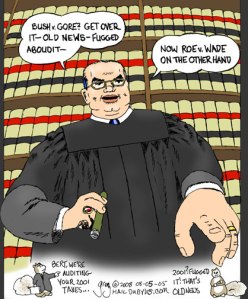
Let’s dig in!
Saturday Night Live: The Democratic Party Debate in Des Moines
Posted: November 14, 2015 Filed under: Live Blog | Tags: CBS, Democratic presidential debates, Des Moines Iowa, Drake University 119 Comments Tonight, the three Democratic candidates for president will face off in a debate that has now been adjusted to reflect the deadly terrorist attacks in Paris. This is obviously former Secretary of State Hillary Clinton’s bailiwick. CBS experienced some push back from the Sanders campaign for this move. The debate will be held at my sister’s alma mater Drake University and should prove interesting.
A top aide to Sen. Bernie Sanders, I-Vt., one of the three candidates, got into a lengthy dispute with executives from CBS, the network hosting the debate, during a conference call on Saturday morning. A staffer for one of the other campaigns who was also on the call described the exchange to Yahoo News as “heated” and even “bizarre,” and a second source on the call confirmed the nature of the exchange.
The dispute centered on CBS’s decision to increase the emphasis on terrorism, foreign policy, and national security in the wake of the attacks that left more than 100 people dead in Paris on Friday night. According to the rival staffer, Sanders strategist Mark Longabaugh lit into CBS vice president and Washington bureau chief Christopher Isham when the changes to the debate were detailed on the call.
“It was a little bit of a bizarre scene. The Sanders representative, you know, really laid into CBS and basically … kind of threw, like, a little bit of a fit and said, ‘You are trying to turn this into a foreign policy debate. That’s not what any of us agreed to. How can you change the terms of the debate, you know, on the day of the debate. That’s not right,’” the staffer recounted.
Another person who was on the call confirmed to Yahoo News that Longabaugh had a lengthy dispute about the changed plans for the debate format during the call with CBS. The Sanders campaign declined to comment.

The second Democratic debate will be held at Drake University in Des Moines, Iowa, on Nov. 14. It will air from 9pm to 11pm ET on the CBS Television Network. Pre-debate coverage will begin at 8pm ET.
- What: Second Democratic presidential debate
- Time: 9pm to 11pm ET
- Where to watch/listen:
- On TV: CBS television affiliates or on CBSN streaming on Apple TV,Roku, Amazon Fire TV, Android TV and Xbox One
- Mobile: CBSN streaming on the CBS News apps CBS News for Androidand CBS News for iOS
- Online: CBSNews.com (livestream will include real-time Twitter trends, instant reactions, curated Tweets and other key information)
- On radio: CBS Radio News affiliates
- Pre-debate coverage: Join Senior Political Editor Steve Chaggaris and White House correspondent Major Garrett for CBSN’s livestream coverage of debate preparations will air online at CBSnews.com/live starting at 6pm ET.
CBS News is hosting the debate in conjunction with CBS’ Des Moines affiliate, KCCI, and the Des Moines Register. “Face the Nation” anchor John Dickerson will be the principal moderator, and he will be joined by CBS News Congressional Correspondent Nancy Cordes, KCCI anchor Kevin Cooney and the Des Moines Register’s political columnist, Kathie Obradovich.
With Friday’s attacks in Paris, the debate will also focus on foreign policy differences among the candidates and strategies to fight extremist groups abroad.
 Many folks believe that Sanders will go on the attack and that Clinton will deflect. Oh, and Martin O’Malley will still be looking to make an impression. ABC has made a list of things to look for during the debate tonight.
Hillary Rodham Clinton has been on a hot streak since the first Democratic presidential debate last month. The main question heading into Saturday’s second encounter: Can her two challengers slow down her Big Mo’?
National security will play a prominent role in the debate in the aftermath of deadly terror attacks in Paris that killed more than 125 people and left about 350 injured. The Islamic State group claimed responsibility for the attacks, a development that will bring terror and the U.S. response to the jihadist group to the forefront.
Heading into the debate, Clinton expects to face a more direct challenge from Vermont Sen. Bernie Sanders and former Maryland Gov. Martin O’Malley in their first debate since the Democratic field has winnowed down to three candidates.
Both Sanders and O’Malley have taken steps to point out their differences and the underdog ex-governor is also trying to undercut Sanders as Clinton’s main alternative. But the debate could take a more somber tone following the Paris attacks.
Gregg Levine–writing for AJ–believes the switch in focus does benefit Clinton.
Questions on foreign policy and national security are generally believed to advantage Clinton. Beyond her years as head of the State Department, she has an international presence dating back to her time as first lady and extending through her work with the Clinton Foundation, a non-profit organization she started with her husband, former president Bill Clinton, focused on “global interdependence.”
But with great experience also comes great responsibility. Clinton’s time in the Obama White House ties her to the policies of an administration that has come under attack for its handling of conflicts in Iraq and Syria, specifically for its strategies to counter the rise of the Islamic State in Iraq and the Levant (ISIL). The armed group has claimed responsibility for the violence in Paris.
Clinton’s role in U.S. policy on Libya has proven one of her biggest potential tripwires, at least in the eyes of Republicans. The deaths of four Americans, including the U.S. Ambassador to Libya, J. Christopher Stevens, in Benghazi in 2012, has spawned countless Congressional investigations and near-constant conversation in conservative media. Clinton, an advocate for military intervention in the conflict that ousted Libyan leader Muammar Gaddafi, has defended her beliefs, going so far as to praise the recent Libyan elections during the last presidential debate.
The debate’s shift from the economy to national security would appear to be a setback for Sanders, especially at a time when many feel he needs to communicate his core message to a broad electorate. His focus on income disparity and an under-regulated financial sector fit well with the original focus of tonight’s event, and recent polling shows voters think Sanders is as good or better than Clinton on those issues.
But economic worries and questions of national security are far from mutually exclusive. The debate over economic austerity and its effect on domestic security, for example, has been revived in the last 24 hours. In the wake of the January killings at the offices of Charlie Hebdo and a kosher supermarket, French authorities said that, even though some of the attackers were known to the government, they hadn’t had the resources to track all of them.
Tonight’s debate is also likely to include questions on immigration, especially in light of the European refugee crisis and the intense focus of GOP presidential hopefuls on deporting undocumented immigrants from the United States.
Watch along with the rest of the Sky Dancers as the Democratic candidates take the stage in Des Moines.
Incestuous Relationships: That’s Our Oligarchy!
Posted: March 26, 2013 Filed under: Barack Obama, Foreign Affairs, morning reads, U.S. Politics | Tags: 2008 presidential campaign, Ben Rhodes, Benjamin Netanyahu, CBS, David Rhodes, James M. Rhodes, Jon Favreau, Russ Baker, speechwriters 43 Comments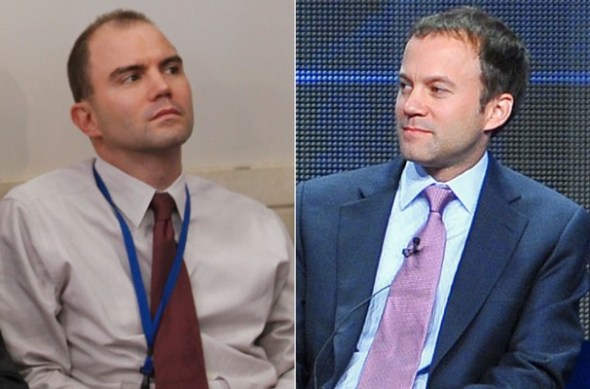
Ben and David Rhodes
On March 15, The New York Times ran a puff piece on Obama foreign policy adviser and speechwriter Ben Rhodes, by Mark Landler. Landler tells us that not so long ago, Rhodes was “[a]n aspiring writer from Manhattan [with] unfinished novel in a drawer, “Oasis of Love,” about a woman who joins a megachurch in Houston, breaking her boyfriend’s heart,” and that
worked briefly for Mayor Rudolph W. Giuliani’s re-election campaign in 1997, was living a writer’s life in Queens on Sept. 11, 2001, when he watched from the Brooklyn waterfront as the World Trade Center towers collapsed. The trauma of that experience, he said, led him to move to Washington in 2002.
Mr. Rhodes went to work for a Democratic foreign-policy elder, former Representative Lee Hamilton, helping draft the 9/11 Commission report as well as the Iraq Study Group report. That report was a template for the anti-Iraq war positions taken by Barack Obama, then a senator, whose campaign Mr. Rhodes joined as a speechwriter in 2008.
Wow! A Star is born!
Landler writes that Rhodes attends National Security Council meetings and has a powerful influence on Obama’s policies. He credits Rhodes for helping convince Obama to stop supporting Egyptian dictator President Hosni Mubarak and to intervene in Libya, as well as pushing the President to engage with Myanmar. At the moment, Landler says, Rhodes is trying to convince Obama to get more involved in Syria.
Jack Shaafer at Reuters calls the Landler’s story a “beat sweetener.
A beat sweetener, as press-watchers know, is an over-the-top slab of journalistic flattery of a potential source calculated to earn a reporter access or continued access. They’re most frequently composed on the White House beat when a new administration arrives in Washington and every Executive Office job turns over, but they can appear any time a reporter is prepared to demean himself by toadying up to a source in exchange for material.
As a beat sweetener, the Rhodes piece excels on so many levels that I’ll bet the subject’s parents have framed and hung the clipping over the family mantel. Landler portrays Rhodes as a young fella with “old man” wisdom; as possessing a “soft voice” that delivers “strong opinions”; as one whose “influence extends beyond what either his title or speechwriting duties suggest”; and as someone who “cares” to the point of “anguish” but is “very realistic.”
The information content of these testimonials, made by both Landler and his sources, is just about zero.
According to Shafer, the purpose of the “beat sweetener” isn’t just to make Ben Rhodes happy.
Sucking up to Rhodes won’t necessarily earn Landler or other journalists covering the White House an automatic scoop. But beat sweeteners aren’t written with anything so crass in mind as scoops. They’re designed to keep the information conveyor lubricated (“source greaser” is another term for the practice) with journalistic goodwill. As someone who is inside the White House decision loop, Rhodes is a much better friend than an enemy.
Getting back to the NYT puff piece: two-thirds of the way through, Landler mentions offhandedly that that Ben’s older brother David (who is 38) is the president of CBS News, a job he landed in February of 2011.
Landler provides no background on brother David, never mentioning that he previously held influential positions at Bloomberg and Fox News. In fact David is the first top CBS executive who previously worked for Fox News, and he’s the youngest president in CBS history. Shouldn’t this relationship between merit more than a throwaway line in a fawning profile of an influential adviser to the President of the U.S.?
Even Benjamin Netanyahu seemed a bit startled when he was told about it during Obama’s visit to Israel.
During a receiving line on the airport tarmac, Obama and Netanyahu stopped briefly to chat with Obama’s deputy national security, Ben Rhodes.
Obama noted that Rhodes’ brother, David, is president of CBS News.
“Sounds like a very incestuous relationship,” Netanyahu observed, chuckling at the idea of siblings in power roles within the administration and the news media.
“Not if you watch CBS News,” Obama replied.
There’s video of the interaction at Politico. Netanyahu may have been “chuckling,” but I’m not. How many times has Obama appeared on 60 Minutes? Has there ever been a mention of this relationship during those interviews? I haven’t checked, but I don’t recall it happening.
Of course relationships between media powerhouses and influential politicians and their advisers aren’t unusual. Here’s a short piece on this problem at TV Newser. Alex Weprin writes:
Let’s get this out of the way: conflicts of interest are rife in the TV news business.
CBS News president (and former Fox News executive) David Rhodes is the brother of one of President Obama’s advisers Ben Rhodes. NBC News anchor Andrea Mitchell is married to former Fed chairman Alan Greenspan. Bob Schieffer‘s brother Tom Schieffer was President Bush’s Ambassador to Japan.
In other words: potential conflicts happen all the time. The question is when should they be disclosed? Typically subjects with a conflict aren’t allowed to cover anything related to that conflict. If they do, a disclosure is a must….
In Washington, the journalists, the politicians and the lobbyists hobnob at the same parties, and many of them are friends. If everything was disclosed then just about every story from every reporter in DC would end with “I am a friend of a friend of this person” or “I hooked up with this person at 3 AM after the White House Correspondents Dinner.” Obviously that doesn’t happen, but sometimes a story does hit a little too close to home.
But isn’t this also an important reason why we don’t have an independent or serious news media?
Thinking about the incestuous nature of our Washington-New York oligarchy also leads to questions about how a young guy like Ben Rhodes–he’s just 35 now, so he was barely 30 when he began working for Obama in 2008–managed to come so far so fast.
Investigative reporter Russ Baker was stimulated to ask these and other questions after he read the Lindler’s NYT article. He notes that Rhodes appears to have come out of nowhere directly to the halls of power, just as his boss seemingly did. Baker writes:
What’s especially strange about the article is that, for those of us who continue to wonder how a virtual cipher rose so quickly from the Illinois legislature to become the most powerful person in the world, we end up wondering the same thing about an aspiring novelist from New York City who fairly catapults to enormous influence in shaping policy regarding some of the most complex and sensitive matters facing this country….
Though the Times never underlines this, the careful reader comes to realize that Rhodes’s guiding philosophy is as hard to discern as the precise reasons that he has the president’s ear. In 1997, he briefly worked on the re-election campaign of New York City Mayor Rudy Giuliani, a Republican. Shortly after 9/11, the aspiring novelist suddenly decided to do his part for society, moving in 2002 from Queens to Washington, and quickly found himself “helping draft the 9/11 Commission report as well as the Iraq Study Group report.” [….]
We are never even told what kind of education Rhodes got, or where, or whether he has ever been anything beyond an aspiring novelist. There’s no indication of what he did on Giuliani’s campaign (he would only have been about 19 or 20 at the time) or whether his preference for the mayor who presided over the 9/11 response had anything to do with his going to Washington, or miraculously being hired by Democrat Lee Hamilton to explain 9/11 to the public.
From these improbable beginnings, Rhodes is suddenly a speechwriter on Obama’s presidential campaign. How did he come to Obama’s attention? The article doesn’t say. However, it does note that the Iraq Study group report on which Rhodes worked “was a template for the anti-Iraq war positions taken by Barack Obama” as a senator and candidate.
Baker sums up his suspicions as follows:
Once we start asking questions about Benjamin Rhodes, this leads to questions about Obama, about the Times and CBS and journalism in general. And it leads to questions about how much we, the most smugly self-assured people on earth, understand about how anything of significance actually works.
In this case, it’s not unreasonable to wonder whether some particular faction or other might have spotted “talent” and “agreeability” in Rhodes, and helped hasten his rapid ascent to the top.
Baker located answers to some of these questions. From a very stunted Wikipedia entry, Baker learned that Ben Rhodes got his undergraduate degree from Rice University. He pulled together a timeline of the twin careers of Ben and his brother David:
Searching sources other than the Times, we find that David Rhodes was a production assistant at the fledgling Fox News Channel around the same time Benjamin was volunteering for Giuliani—and was the conservative channel’s news desk Assignment Manager when the planes struck the Twin Towers. Highly trusted by Fox’s chairman Roger Ailes, he managed Fox’s coverage of three presidential elections, including the one where his brother was writing Obama’s speeches, was hired by Bloomberg TV right after Obama’s election, and in 2011 was named president of CBS News.
It was Baker’s article that got me started I found Googling for more background on the very successful and powerful Ben Rhodes. In fact I spent much of the day yesterday searching for more background on the very successful and powerful Ben Rhodes. I’ll put that into a second post that I hope to put up later today.
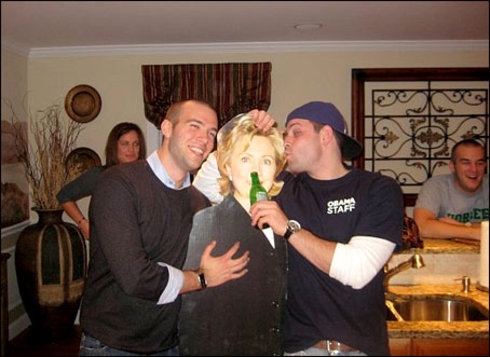
Oh, and I admit I was also inspired by my memory of this photo that I know you’ll also likely recall from early in Obama’s first term. The smiling guy sitting at the table in the back on the right side is Ben Rhodes. After head speechwriter Jon Favreau (on the left of the Hillary cardboard image) posted it on his Facebook page, Dak and I figured out who the other speechwriters in the room were and wrote a little about them.
You can treat this as a regular morning post and put your links in the comments as always. But I do hope some folks will wade through this post and discuss what I think are serious issues about the incestuous relationship between the corporation media and the government.

 peej
peej Carissa
 bostonboomer
 dakinikat
 ecocatwoman
 mablue2
 Mama Lopez
 peggysue22
 quixote
 skydancingguestblogger
 Mona (aka Wonk the Vote)



 Sky Dancing
Recent Comments