Posted: February 28, 2024 | Author: bostonboomer | Filed under: 2024 Elections, 2024 presidential Campaign, Donald Trump, Joe Biden | Tags: 2024 Michigan primaries, Alabama IVF ruling, Birth Control, Gaza, low quality polls, Niki Haley, polls, separation of church and state, Simon Rosenberg, uncommitted voters, voters concerned about extremism |
Good Morning!!

Henri Matisse, Three Sisters
I’m going to get this out of the way before I get to the real news. Last night President Biden won 81.1 percent of the votes in the Michigan Democratic primary, but it isn’t easy to find that out from the press reports. All of the focus is on the uncommitted votes, which got 13.3 percent. Here is one representative sample:
The Washington Post: Biden wins Michigan primary but faces notable showing by ‘uncommitted.’
President Biden won Michigan’s Democratic primary on Tuesday but faced a notable challenge from voters selecting “uncommitted” to protest his handling of Israel’s military campaign in Gaza, a potential sign of vulnerability for Biden among rank-and-file Democrats.
Democratic leaders in the state were bracing for tens of thousands of “uncommitted” votes, as Biden aides and allies sought to tamp down concerns about the strong showing by those aiming to warn the president he could lose the pivotal state in November if he does not change course and push for a cease-fire in Gaza.
With nearly 99 percent of the ballots counted, there were more than 100,000 “uncommitted” votes….
In the weeks leading up to the Democratic primary, Arab American and liberal activists launched a concerted push to get Democrats to vote “uncommitted” as a way to protest Biden’s handling of the Israel-Gaza war, especially his decision not to call for a cease-fire. The group Listen to Michigan declared victory soon after polls closed, noting that it had surpassed its stated goal of 10,000 uncommitted votes.
manager and sister of Rep. Rashida Tlaib (D-Mich.), said in a statement Tuesday. “Tens of thousands of Michigan Democrats, many of whom who voted for Biden in 2020, are uncommitted to his re-election due to the war in Gaza.”
She added: “We don’t want a Trump presidency, but Biden has put [Israeli Prime Minister Benjamin] Netanyahu ahead of American democracy. We cannot afford to pay the bill for disregarding Palestinian lives should it come due in November.”
They don’t want a Trump presidency, but they plan to try to enable one anyway, in the process ending American democracy. But here’s some history on uncommitted votes in Michigan:
Biden campaign officials, however, said the group’s goal of 10,000 votes was artificially low, as 20,000 people have voted uncommitted in each of Michigan’s past three Democratic presidential primaries, even without any organized effort urging them to do so. The president’s allies also cited comments by some of those who threw their support behind the campaign that despite their anger at Biden’s policies, they plan to vote for him in November. A campaign official also noted that there were several “uncommitted” delegates for Barack Obama in 2012, coming from North Carolina, Maryland, Alabama and Kentucky.

Family group reading, by Mary Cassatt
I don’t know any Democrat who doesn’t want a cease fire in the brutal Israel-Hamas war, including President Biden. But Biden can’t magically force either Netanyahu or Hamas to agree to one. Negotiations take place behind closed doors; making them public would defeat their purpose.
Other mainstream news sources also emphasize the uncommitted vote against Biden, but there is little attention to the fact that Trump underperformed the polls, just as he did in New Hampshire and North Carolina. He got only 68 percent of the vote in Michigan, while Niki Haley won nearly 27 percent, once again demonstrating that close to 30 percent of Republicans don’t want Trump as their nominee.
From Simon Rosenberg at Hopium Chronicles: Trump Is Not Strong, Or Winning – No Red Waving 2024 Please.
It Is Wrong To Say Trump Is Winning The Election, Or Is Somehow Favored. He Is Weak, Not Strong – In 2022 a narrative developed about the election – that a red wave was coming – that commentators just couldn’t shake even though there was plenty of data suggesting the election could end up being a close competitive one. I feel like that we are beginning to enter a similar moment in 2024 with the various assertions of Trump’s strengths. The “red wave” over estimated Republican strength and intensity, discounted clear signs of Democratic strength and intensity and was it would be ridiculous, given what happened in 2022, for us to do this all over again this year.
Let me say it plainly – Donald Trump is not ahead in the 2024 election. He is not beating Joe Biden. He is not in a strong position. Signs of Trumpian and broader GOP weakness is all out there for folks to see – if they want to see it. Let’s dive in a bit:
Trump is not leading in current polling – For Trump to be “ahead” all polls would have be showing that. They aren’t. The last NYT poll had Biden up 2, the new Quinnipiac poll has Biden up 4.
Given the spike in both junky, low quality polls and GOP-aligned polls the averages can no longer be relied on – this was a major lesson of 2022. Remember using the averages Real Clear Politics predicted that Republicans would end up with 54 seats. They have 49.
Stripping out GOP aligned polls, and less reliable polling, we find the race clearly within margin of error, which means the election is close and competitive. In a recent analysis, “Trump’s lead over Biden may be smaller than it looks,” The Economist broke down recent polling by pollster quality and found the race dead even among the highest quality pollsters [click the link to see the chart]….
Asserting that somehow Trump leads is pushing data beyond what it can tell you. With margin of error a 1-2 point lead is not an actual lead – it signifies a close, competitive election.
It is also early, and Democrats have not had a competitive primary. Lots of folks are not engaged. Look at this chart from Morning Consult. If the Democratic coalition starts coming home as Biden ramps up and Trump becomes the R nominee he will jump ahead by a few points….
We learned in 2022 that centering our understanding of American politics around wobbly polling and polling averages was risky. No reason we should be doing it again this cycle. Lots of other things we can throw into the strategic blender to understand where we are.
Read the rest at Hopium Chronicles. It’s quite interesting.
The mainstream press seems to want another Trump presidency, because that will make them more money. Biden is competent and doing a good job, but that’s so boring. They want the chaos back again–never mind that Trump would likely prosecute journalists in a second term.

Rene Magritte, The Subjugated reader
Apparently, Trump is a bit nervous about how many votes Niki Haley is getting in the Republican primaries.
Adam Wren at Politico: Trump tried to ignore Haley. He barely lasted a day.
For a full 24 hours on Saturday, Donald Trump did not mention Nikki Haley by name, ignoring her both in a freewheeling address to the Conservative Political Action Conference and after he won the primary in South Carolina.
His campaign said they were turning the page, focusing squarely on the general election. One aide, when asked about the absence of Haley, quipped: “Who?”
By Sunday, that strategic restraint was gone.
In a torrent of posts on Truth Social, just weeks before he is expected to clinch the nomination, Trump had no appetite for comity, blasting Haley as “BRAINDEAD” and “BIRDBRAIN.” He relished the news that Americans for Prosperity would stop spending on Haley’s presidential campaign. He touted a polling lead in Michigan’s primary. “When will Nikki realize,” he posted, “that she is just a bad candidate?”
Maybe when she stops getting 30 percent of the Republican primary votes?
This was not a magnanimous candidate looking to mend the intraparty fracture on full display in exit polls from each of the early electoral contests. This was not a competitor looking to pivot to going after President Joe Biden.
This was a former president entering the general election actively exacerbating divisions within the GOP — at a time when some Republicans are openly warning about the risk of alienating even a small segment of the Republican electorate. Trump has every rational incentive to make overtures to Haley and her supporters, who delivered her roughly 40 percent of the vote in New Hampshire and South Carolina and who are the kind of voters Trump will need to turn out in Michigan and Pennsylvania in November. But he refused to do so — or, perhaps, was incapable of it — despite making head feints in that direction.
“In the exit polls in the three early states, roughly 20 percent are saying they’re not going to vote for Trump,” said Christine Matthews, a Republican pollster and president of Bellwether Research and Consulting. “If that’s true, you need to have like 85 to 90 percent of your base. I do think that he’ll have some problems consolidating, particularly your well-educated, suburban Republicans.”
This is interesting, from Reuters: Exclusive: Extremism is US voters’ greatest worry, Reuters/Ipsos poll finds.
Worries about political extremism or threats to democracy have emerged as a top concern for U.S. voters and an issue where President Joe Biden has a slight advantage over Donald Trump ahead of the November election, a new Reuters/Ipsos poll showed.
Some 21% of respondents in the three-day poll, which closed on Sunday, said “political extremism or threats to democracy” was the biggest problem facing the U.S., a share that was marginally higher than those who picked the economy – 19% – and immigration – 18%.
Biden’s Democrats considered extremism by far the No. 1 issue while Trump’s Republicans overwhelmingly chose immigration.
Extremism was independents’ top concern, cited by almost a third of independent respondents, followed by immigration, cited by about one in five. The economy ranked third.
During and since his presidency, Trump has kept up a steady drumbeat of criticism of U.S. institutions, claiming the four criminal prosecutions he faces are politically motivated and holding to his false claims that his 2020 election defeat was the result of widespread fraud.
That rhetoric was central to his message to supporters ahead of their Jan. 6, 2021, assault on the U.S. Capitol.
Overall, 34% of respondents said Biden had a better approach for handling extremism, compared to 31% who said Trump, the frontrunner for the Republican presidential nomination.
The poll helps show the extent to which Biden’s re-election bid could rely on voters being motivated by their opposition to Trump rather than enthusiasm over Biden’s candidacy.
The fallout from the Alabama IVF ruling is still in the news.
Lisa Neeham at Public Notice: They’re coming for birth control next.
In brief, the reason the Alabama Supreme Court’s opinion implicates and outlaws IVF is that the state has a Wrongful Death of a Minor statute, and the court decided this applies to “all unborn children, without limitation.” But there’s no language in the statute that says this. Rather, it’s just that over the last 15 years, the Alabama Supreme Court has issued a series of rulings saying that the undefined term “minor child” in the statute can be stretched to “unborn children” regardless of what state of development the embryo is at. Once the court created such an expansive definition, the decision that frozen embryos are people was inescapable.

By Utagawa Kuniyoshi
To be fair, though, the Alabama Supreme Court is entirely made up of conservative Republicans, they were a bit hamstrung in their decision. Alabama’s state constitution states that “it is the public policy of this state to ensure the protection of the rights of the unborn child in all manners and measures lawful and appropriate.” But that doesn’t necessarily mean the court was required to, as it did here, extend that “unborn child” definition to what it calls “extrauterine children” — embryos frozen by people pursuing IVF….
For people not saddled with the misguided anti-choice belief that a tiny clump of cells is the same as a person, this is a non-controversial process. It enhances the chance of pregnancy and allows people to plan for future children without undergoing multiple invasive egg retrieval cycles. But if one subscribes to the notion of fetal personhood — that a fetus is quite literally a person, with all the attendant privileges that confers — then those frozen embryos are the same as babies.
This is, of course, a religious, not scientific belief. Chief Justice Parker, in his concurring opinion, made clear that his vote, at least, stems directly from his religious beliefs rather than being grounded in the law. Citing Augustine, Thomas Aquinas, John Calvin, the Ten Commandments, and the King James Bible, Parker concludes that “even before birth, all human beings bear the image of God, and their lives cannot be destroyed without effacing his glory.”
Notably, none of those things are legal precedent. Indeed, in a country founded on the separation of church and state, they shouldn’t inform a court holding. However, since religious conservatives dominate the US Supreme Court, that separation has largely collapsed. This has emboldened conservative litigants and conservative state and federal judges to take ever more anti-choice stances.
A bit more:
Reproductive health activists have been sounding the alarm about the anti-choice attacks on IVF for years, particularly in the wake of the Dobbs decision overturning Roe v. Wade. At least two prominent anti-choice groups, Americans United for Life and Students for Life, have railed against IVF. The chief legal officer for Americans United for Life, Steve Aden, called IVF “eugenics” and said that IVF created “embryonic human beings” that were destroyed in the process. Students for Life called IVF “damaging and destructive.”
These same anti-choice groups also hate birth control, and the Dobbs decision paved the way for them to mount a theocratic attack on it too. Christopher Rufo, who ginned up a panic over benign diversity initiatives and helped force out the first Black president of Harvard, Claudine Gay, has already telegraphed that this is his next attack.
Over on Elon Musk’s increasingly Nazi-fied social media site, X, Rufo is spewing rhetoric about how “the family structure disintegrated precisely as access to birth control proliferated” and that recreational sex is bad and leads to single-mother households.
Rufo isn’t alone. The Heritage Foundation, which is also busy with a blueprint for a second Trump presidency that would destroy the administrative state and whose leader is still pushing the big lie that Trump won the 2020 election, has also called for the end of birth control. Also over on X, Heritage’s official account posted last year that “a good place to start would be a feminist movement against the pill and … returning the consequentiality to sex” [….]
And there you have it. Religious conservatives are calling for a return to a world where sex isn’t recreational or for pleasure but is instead fraught with consequences — namely, pregnancies that can’t be terminated even when the pregnant person’s life is in danger. To do this, however, they would need to succeed in getting the Supreme Court to overturn Griswold v. Connecticut, the 1965 case that invalidated restrictions on birth control.
There’s more at the link.
Sarah Lipton-Lubet at Slate: Republicans’ Absurdist Reproductive Policies Are Coming for Us All.
Nearly two years ago, late into the night on a Monday, I had the terrifying realization that I needed to move my embryos. Immediately.
A few hours earlier—just as I was starting to wrap up work for the day—my phone had lit up in what felt like one long, continuous stream of alerts. Politico had just obtained a leaked copy of the Supreme Court’s draft Dobbs opinion overturning Roe v. Wade. As a reproductive rights attorney leading a Supreme Court reform organization, I knew my immediate next steps. Conference call. Media statement. Email to our supporters. I’d been preparing for this moment since Donald Trump was elected.

I am a child, by Gustav Adolph Hennig
But what I had spent less time thinking about was how this would affect me personally. I wasn’t at all prepared for what to do about my embryos. After years of miscarriages and egg retrievals, I did not have a baby. But I had my embryos. Sitting in nitrogen tanks. In a red state—a red state that had recently passed a draconian anti-abortion bill that, among other things, granted “an unborn child at every stage of development, all rights, privileges and immunities available to other persons.”
That legislation was being challenged in federal court, but now Roe would be gone by the end of June. Amid a swirl of unknowns (What would happen with the litigation? How would that law impact IVF? Would I somehow be prohibited from moving my embryos in the future?) I knew one thing with absolute certainty: If I wanted to control what happened to my embryos, I had to get them the heck out of Arizona, and fast.
Unfortunately, the clinics I called in my attempt to find a new home for the embryos didn’t seem to match my urgency. They couldn’t understand why we would move the embryos at all. Their pace and paperwork was business as usual. Even some of my like-minded friends understood my concern, but not my level of panic, and action. I’ll admit, I had momentary doubts about whether my alarm was misplaced.
Needless to say, the recent Alabama Supreme Court decision—effectively outlawing IVF by declaring that embryos are, legally speaking, children—put to rest any lingering questions about whether I was right to be concerned. As Mark Joseph Stern reported, embryo shipping services have already said they will no longer ship to or from Alabama.
And isn’t that the story of reproductive freedom in America in a nutshell? Time and again, advocates sound the alarm only to be told that we are being hysterical. Then we watch in horror as our worst fears materialize.
Read the rest at Slate.
One more on this topic, from Politico: Senate GOP poised to block IVF protection bill.
Senate conservatives are signaling they’ll block Wednesday’s planned Democratic bid to enshrine protections for in-vitro fertilization into federal law – and they’re calling IVF a states-rights issue.
Sen. Tammy Duckworth (D-Ill.) is planning to seek unanimous consent to pass her proposal to federally protect IVF, which means any one senator can easily block its passage. This isn’t the first time she’s brought up her bill — Sen. Cindy Hyde-Smith (R-Miss.) objected when Duckworth tried to pass it unanimously in 2022.
But Duckworth’s bill is surging back to the forefront as Republicans face uncomfortable questions about an Alabama Supreme Court ruling restricting IVF.
Hyde-Smith’s office did not respond when asked if she would object again to Duckworth’s bill, and the GOP senator ignored Capitol hallway questions from reporters, as is her usual practice. Other Republicans are already expressing reservations about the bill, though – meaning its chances at slipping through the chamber are slim, at best.
“I don’t see any need to regulate it at the federal level,” said Sen. Roger Marshall (R-Kan.), an OB-GYN by trade, who would not say whether he’d block the bill. “I think the Dobbs decision puts this issue back at the state level, and I would encourage your state legislations to protect in-vitro fertilization.”
“It’s idiotic for us to take the bait,” said Sen. J.D. Vance (R-Ohio), who clarified he was referring not to Duckworth’s bill on its face but to Democrats’ attempts to use the proposal as an IVF messaging tool. Vance said he’s not yet reviewed the actual bill.
Regardless, Republicans’ hesitation over the IVF protection bill highlights their election-year jam: Democrats will continue trying to tie them to the Alabama ruling, which has shut down IVF facilities in the state.
And GOP statements supporting IVF — as the Senate Republican campaign arm and several candidates put out last week — might fall flat with voters if Democrats can point to specific instances when their opponents failed to protect the procedure. Exhibit A: Speaker Mike Johnson, who recently issued a statement supporting IVF but has previously supported legislation that could restrict access to the fertility tech.
That’s all I have for you today. What do you think? What other stories have captured your interest?
Did you like this post? Please share it with your friends:
Posted: April 22, 2023 | Author: bostonboomer | Filed under: abortion rights, cat art, caturday, SCOTUS | Tags: abortion pill, Birth Control, Clarence Thomas, Joyce Vance, Judge Matthew Kacsmaryk, mifepristone, Samuel Alito, stalking, Supreme Court |

By Hilda Belcher, 1881-1963
Happy Caturday!!
Last night the Supreme Court released their decision in the mifepristone case. They stayed–for now–Texas Judge Matthew Kacsmaryk’s order to ban the abortion pill nationwide. The New York Times reports: Supreme Court Ensures, for Now, Broad Access to Abortion Pill.
The order halted steps that had sought to curb the availability of mifepristone as an appeal moves forward: a ruling from a federal judge in Texas to suspend the drug from the market entirely and another from an appeals court to impose significant barriers on the pill, including blocking access by mail.
The unsigned, one-paragraph order, which came hours before restrictions were set to take effect, marked the second time in a year that the Supreme Court had considered a major effort to sharply curtail access to abortion.
The case could ultimately have profound implications, even for states where abortion is legal, as well as for the F.D.A.’s regulatory authority over other drugs.
If the ruling by the judge in Texas, which revoked the F.D.A.’s approval of the pill after more than two decades, were to stand, it could pave the way for all sorts of challenges to the agency’s approval of other medications and enable medical providers anywhere to contest government policy that might affect a patient.
Judges Alito and Thomas dissented. Only Altio wrote a dissenting opinion. From The Washington Post: Supreme Court preserves access to key abortion drug as appeal proceeds.
In the only noted dissents, Justices Clarence Thomas and Samuel A. Alito Jr. said they would not have granted the Biden administration’s request for a stay of the decision by a panel of the U.S. Court of Appeals for the 5th Circuit.
Thomas did not explain his reasoning. Alito said the administration and the public would not have been harmed by agreeing with the lower court, which wanted to reimpose restrictions loosened by the FDA in recent years.
“It would simply restore the circumstances that existed (and that the Government defended) from 2000 to 2016 under three Presidential administrations,” Alito wrote. He disputed that the court’s intervention at this time would have sent a signal: “Contrary to the impression that may be held by many, that disposition would not express any view on the merits of the question whether the FDA acted lawfully in any of its actions regarding mifepristone.”

By Alice Kent Stoddard
There could have been other dissents; we only know that at least 5 justices voted for the stay. On what happens next:
The 5th Circuit next month will review the merits of the case brought by antiabortion groups against the FDA’s regulation of mifepristone — a review that will be conducted by a separate, and likely different, three-judge panel than the one that made the initial ruling. That merits decision will almost surely be appealed to the Supreme Court no matter the outcome. But until then, the justices’ Friday order says the status quo will remain in place: Mifepristone will be available under existing FDA regulations nationwide.
Joyce Vance wrote a lengthy and detailed discussion of the issues in this case; it’s well worth reading the entire piece at Vance’s Substack page, Civil Discourse: Not Quite Midnight at the Supreme Court. Here is a brief excerpt.
I figured that I’d set my alarm for midnight to see how the Court would rule on the government’s request to stay the Fifth Circuit’s order. That order, you’ll recall, did not side with Texas federal judge Matthew Kacsmaryk’s decision to overrule the FDA’s approval of Mifepristone, a drug proven safe and effective for abortions and miscarriage treatment for over 20 years. But it would have permitted the remainder of the restrictions on Mifepristone that Kacsmaryk ordered to remain in place while the litigation proceeded. That includes requiring the drug be obtained in person and not through the mail, necessitating multiple doctor’s office visits and in-office consumption of the medication, and restricting use to prior to the seventh week of pregnancy—while the litigation proceeded.
When the Supreme Court ruled, they stayed all of it. They preserved the status quo, so Mifepristone will remain available up to 10 weeks, and can be obtained via the mail and used at home while the courts are reviewing the case. But that’s a temporary reprieve.
The stay will last while the case is on appeal to the Fifth Circuit. Presumably the party that loses in that court will appeal to the Supreme Court. They are not required to hear an appeal in a civil case like this. If the Court were to refuse to hear it (“certiorari denied”), then the stay would end and the Fifth Circuit’s order would go into effect. If the Supreme Court agrees to hear the appeal (“cert granted”), the stay will continue until the Court enters final judgment. Because the case involves important issues, it’s very likely the Court will take the case.

Best Friends, by Maxime Dastugue
Vance spends a several paragraphs discussion Altio’s dissent. Not surprisingly, she is quite critical of Alito’s reasoning. Here’s part of it:
Alito rehashed the debate over the use of what has become known as the Court’s “shadow docket”—a docket used for resolving emergency requests. Interestingly, he seemed to take Justice Barrett to task, associating her views with those of progressive justices like Elena Kagan who have objected to the Court’s use of the docket to make decisions without explaining its reasoning (this makes it understandably difficult for lower courts to understand and apply the Court’s logic). Alito notes that Barrett in a 2021 concurrence with a denial of injunctive relief wrote that the Court should not act “on a short fuse without benefit of full briefing and oral argument” in a case that is “first to address the questions presented.” He says that while he agreed with those rulings, if the justices believed that then, they should believe it now. He does not, however, explain why, if he did not believe it back then, it’s okay for him to believe it now. Apparently what’s good for the goose is unnecessary for the gander.
Injunctions present complicated questions, and courts typically, but not always, try to preserve the status quo and protect parties from being harmed or prejudiced while litigation is pending. For instance, in Whole Woman’s Health v. Jackson, one of the cases Justice Alito offered up, Justice Kagan was objecting to the Court’s refusal to keep Texas’s heartbeat law from going into effect while litigation was underway. And that is what the Court ended up doing in this case—preventing any change in the approval status or regulations surrounding Mifepristone’s use while the case is pending. So Justice Alito’s arguments have a tinge of sour grapes, not legal principle.
There’s much more criticism of Alito at the link. Next, Vance addresses the latest news about Judge Kacsmaryk’s bias and dishonesty.
Meanwhile, additional evidence of Judge Kacsmaryk’s anti-abortion bias (there was already plenty) and an improper effort to conceal it has surfaced. In anticipation of his judicial confirmation process in 2019, he requested that his name be removed, pre-publication, from a law journal article he had authored, replacing it with some colleagues from the religious conservative legal group he was working for. The article was critical of legal protections for abortion and transgender people. All federal judicial nominees have to complete a document called a Senate Judicial Questionnaire. The completed application packet is submitted under oath before a nomination can advance. Among other things, it requires nominees to list everything they have published. Kacsmaryk failed to disclose the article and also failed to disclose interviews he gave on Christian talk radio that included his views on abortion and other issues, information the questionnaire calls for.
Again, read more at the Substack link.
Kacsmaryk also has a serious financial conflict of interest. CNN reports: Details about multimillion-dollar stock holding concealed in abortion pill judge’s financial disclosures.
The federal judge who issued a nationwide ruling blocking the approval of a common abortion medication redacted key information on his legally mandated financial disclosures, in what legal experts described as an unusual move that conceals the bulk of his personal fortune.

Woman with Cat, by Theodorus Gerardus Iherminez
In his 2020 and 2021 annual disclosures, Judge Matthew Kacsmaryk wrote that he held between $5 million and $25 million in “common stock” of a company – a significant majority of the judge’s personal wealth. The name of the company he held stock in is redacted, despite the fact that federal law only allows redactions of information that could “endanger” a judge or their family member.
CNN obtained a previous financial disclosure for Kacsmaryk – which is not available online – from 2017, when he was a judicial nominee.
On that unredacted form, Kacsmaryk reported owning about $2.9 million in stock in the Florida-based supermarket company Publix. It’s not clear whether that’s the same holding as the redacted stock, although Publix’s share price had significantly increased by 2020 and 2021 and the company is no longer listed on his more recent disclosures.
Redactions are approved by a judicial committee. The redacted holding accounted for at least 85% of Kacsmaryk’s total reported wealth in 2021, and potentially more.
“The whole point of a disclosure is to explain where you have conflicts,” said Michael Lissner, the executive director of the Free Law Project, a nonprofit that has published judicial disclosures. “If you have stock and you’re not saying what it’s in and it’s this much of your personal wealth, that’s a conflict you have. The public deserves to know.” [….]
The redaction is the latest example of Kacsmaryk not being fully transparent as a judge and judicial nominee, even as he has become one of the most controversial judges in the country.
That’s in addition to his not be fully forthcoming in his Senate confirmation hearing, as Joyce Vance described above.
Two more articles on the Supreme Court from Slate:
Christina Cauterucci at Slate: Birth Control Is Next. If you look closely, attempts to restrict contraception are already in the works.
At first glance, what’s happening right now in Iowa looks like a rosy vision for the future of reproductive rights.
The Republican-controlled state Senate recently passed a bill that would increase access to certain types of contraception by allowing pharmacists to dispense it to patients without a prescription. Their GOP counterparts in the state House have included a similar provision in a larger health care bill. And Republican Gov. Kim Reynolds has indicated that the legislation is one of her top priorities this session.

Girl on Divan with Cat (Eta with the Cat) – Róbert Berény 1919 Hungarian 1887-1953
But look elsewhere in Iowa, and you’ll get a different view. Earlier this month, the state attorney general’s office announced that it would suspend payments for emergency contraception for survivors of sexual assault. The medication had been funded through a program for crime victims, but the Republican attorney general is considering a permanent end to its provision. She is “carefully evaluating whether this is an appropriate use of public funds,” a spokesperson said in a statement.
In other words, counter to a refrain that has taken hold on the left since the overturning of Roe v. Wade, conservatives are not coming for birth control next. They’re coming for birth control now.
Some corners of the right are already in full-blown attack mode. Pulse Life Advocates, one of the Iowa-based anti-abortion groups that is advocating against the over-the-counter contraception bill, states on its website that “contraception kills babies.”
It’s relatively uncommon for an anti-abortion group to state its animus toward birth control so plainly. For years, the major players on the anti-abortion right have claimed to support contraception. They seem to understand that more than 90 percent of Americans are in favor of legal birth control and that most people opposed to abortion likely see contraception as an effective means of reducing demand for it….
Cauterucci writes that it would be foolish to believe Republicans’ reassurances about keeping birth control legal.
Conservatives have tried hard to maintain a veneer of rationality on the issue of contraception. But almost a year into the emboldened post-Dobbs anti-abortion movement, the cracks in that facade are starting to show.
Currently, the right to contraception in the U.S. rests on Griswold v. Connecticut, a landmark 1965 Supreme Court decision that is based, as Roe was, on the right to privacy. In a concurring opinion in Dobbs, Clarence Thomas wrotethat the court “should reconsider” several precedents that concern the right to privacy—including the legality of gay intimacy, the right to gay marriage, and Griswold. And a growing number of Republicans are willing to state that Griswold was wrongly decided, including Republican Sen. Marsha Blackburn and former Arizona Senate candidate Blake Masters.
But the Supreme Court won’t even have to overturn Griswold for conservatives to curtail access to birth control. Across the country, they are executing a game plan that rests on three strategies: Conflate contraception with abortion, claim that birth control is dangerous to women’s health, and let right-wing judges do their thing.
Read more details at Slate.

By Mimi Matthews
This article really shocked me. Mary Anne Franks at Slate: Chief Justice John Roberts’ Mockery of Stalking Victims Points to a Deeper Problem.
Stalking is so closely correlated with lethal violence that experts refer to it as “slow motion homicide”: More than half of all female homicide victims in the U.S. were stalked before they were killed. Despite the terrifying and dangerous consequences, many victims of stalking do not report the abuse to law enforcement for fear they will not be taken seriously.
The reasonableness of that fear was vividly illustrated by the Supreme Court oral arguments in Counterman v. Colorado on Wednesday morning, as members of the highest court of the land joked about messages sent by a stalker to his victim, bemoaned the increasing “hypersensitivity” of society, and brushed aside consideration of the actual harm of stalking to focus on the potential harm of stalking laws.
For nearly two years, Billy Raymond Counterman sent thousands of unsolicited and unwanted Facebook direct messages to C.W., a local musician, ultimately driving her to abandon her career and leave the state. Counterman, who had previously served time in federal prison for making violent threats against his ex-wife and her family, argues that his conduct towards C.W. was free speech protected by the First Amendment. Counterman maintains, supported by amicus briefs from influential civil libertarian organizations such as the ACLU, the EFF, and FIRE, that stalking cannot be criminally prohibited except when the government can prove that the stalker subjectively intended to terrify his victim. The state of Colorado, supported by amicus briefs from First Amendment scholars, stalking experts, and domestic violence victim advocates, argues that it is enough to prove that the stalking would be terrifying to a reasonable person in light of the totality of the circumstances. If the court rules in Counterman’s favor, delusional stalking—no matter how objectively terrifying or threatening—will be transformed into an inviolable constitutional right.
And the ACLU is on the side of the stalkers! The justices got a kick out of the threatening messages sent by the stalker.
During oral argument, Chief Justice John Roberts quoted a handful of the thousands of unsolicited messages Counterman sent to C.W. “Staying in cyber life is going to kill you,’” Roberts read aloud. After a pause, he joked, “I can’t promise I haven’t said that,” prompting laughter from other justices and the audience. Picking out another message, which he described as an “image of liquor bottles” captioned as “a guy’s version of edible arrangements,” Roberts challenged Colorado Attorney General Phil Weiser to “say this in a threatening way,” leading to more laughter from the court. And the laughs didn’t stop there: Counterman’s attorney, John Elwood, shared with the court that his mother would routinely tell him to “drop dead” as a child, but “you know, I was never in fear because of that.”

By Suzy Scarborough
There were more chuckles when Justice Neil Gorsuch returned to Elwood’s anecdote during his questioning of Weiser, but Gorsuch shifted to a more serious tone to express his concern about the reasonable person standard. “We live in a world in which people are sensitive, and maybe increasingly sensitive,” he began. “As a professor, you might have issued a trigger warning from time to time when you had to discuss a bit of history that’s difficult or a case that’s difficult,” Gorsuch continued, a reference to Weiser’s prior experience teaching on a law school faculty. “What do we do in a world in which reasonable people may deem things harmful, hurtful, threatening? And we’re going to hold people liable willy-nilly for that?”
Justice Clarence Thomas echoed the concern, asking whether the reasonable person standard is appropriate given that people are “more hypersensitive about different things now.” [….]
The justices’ message was clear: Stalking is not the problem; sensitivity is. To them, stalking is quite literally a state of mind: If the stalker didn’t mean for his conduct to be frightening, then it isn’t. All the target has to do is understand that; she just needs to lighten up, take a joke, accept the compliment, grasp the lesson. Just because someone has made objectively terrifying statements is no reason to overreact and get law enforcement involved; victims should wait for the stalker to do something really frightening before they jump to conclusions.
That is just plain terrifying! Women’s lives are already in danger in this country; The Supreme Court is making this state of affairs even worse.
More stories to check out, links only:
Heather Cox Richardson on the history of Earth Day, which is today, at Letters from an American.
The New York Times: Airman Shared Sensitive Intelligence More Widely and for Longer Than Previously Known.
The Washington Post: FBI leak investigators home in on members of private Discord server.
The Guardian: A California journalist documents the far-right takeover of her town: ‘We’re a test case.’
Anthony L. Fisher at The Daily Beast: America’s Tragedy Is Its Culture of Fear—Armed With Millions of Guns.
Michelle Goldberg at The New York Times: The Sickening Déjà Vu of Watching Trump Manhandle DeSantis.
The Washington Post: Twitter removes labels from state-controlled media, helping propaganda.
The Washington Post: SpaceX didn’t want to blow up its launchpad. It may have done just that.
Have a great weekend, Sky Dancers!!
Did you like this post? Please share it with your friends:
Posted: July 10, 2018 | Author: bostonboomer | Filed under: Civil Liberties, Civil Rights, court rulings, Criminal Justice System, morning reads, SCOTUS, U.S. Politics, Women's Rights | Tags: abortion, Anthony Kennedy, Birth Control, Brett Kavanaugh, Donald Trump, same-sex marriage, U.S. Supreme Court |

The Four Justices, Nelson Shanks, National Portrait Gallery, Smithsonian Institution
Good Morning!!
Last night thug “president” Trump did his ridiculous PT Barnum act with his nomination of Brett Kavanaugh to the Supreme Court to replace Anthony Kennedy. Supposedly, Trump was deciding among about four candidates, but it turns out the fix may have been in all along.
https://twitter.com/GeoffRBennett/status/1016642192616706050
Has any other president made a deal with a Supreme Court Justice to appoint a chosen replacement?
https://twitter.com/Susan_Hennessey/status/1016649427577196544
From Politico: How a private meeting with Kennedy helped Trump get to ‘yes’ on Kavanaugh.
After Justice Anthony Kennedy told President Donald Trump he would relinquish his seat on the Supreme Court, the president emerged from his private meeting with the retiring jurist focused on one candidate to name as his successor: Judge Brett Kavanaugh, Kennedy’s former law clerk….
So even as Trump dispatched his top lawyers to comb though Kavanaugh’s rulings and quizzed allies about whether he was too close to the Bush family, potentially a fatal flaw, the president was always leaning toward accepting Kennedy’s partiality for Kavanaugh while preserving the secret until his formal announcement, sources with knowledge of his thinking told POLITICO.
I’m sure we’ll be learning more about this, and I hope Democrats respond aggressively.
Basic background on Kavenaugh
NBC News: Who is Supreme Court nominee Brett Kavanaugh?
President Donald Trump’s Supreme Court pick is no stranger to partisan politics: Before becoming a judge, he was helping make the case for the impeachment of Bill Clinton and later for the election of George W. Bush.
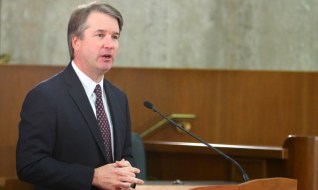
U.S. Court of Appeals for the D.C. Circuit judge Brett Kavanaugh
Twenty years ago, Kavanaugh’s story starts amid the highly politicized independent counsel investigation into Clinton. He worked for Starr as a young Yale Law graduate, first when Kenneth Starr was solicitor general and later in the Office of the Independent Counsel, where Kavanaugh was a key player in the slew of investigations into the Clintons, including the Whitewater scandal, the suicide of White House counsel Vincent Foster and Clinton’s affair with Monica Lewinsky.
The Starr Report to Congress laid out the details of Clinton and Lewinsky’s affair and findings of potential wrongdoing by the president. Kavanaugh was the primary author of the section on the grounds for possible impeachment, Starr would reportedly later say,because “that needed to be very carefully crafted, so I was looking to one of the office’s most talented lawyers — of superb and balanced judgment — to take the lead in drafting.” [….]
He was a member of the GOP legal team fighting to stop the recount in Florida to clear the way for Bush’s election against Al Gore in 2000, later taking a job in the Bush White House in 2001, where he’d serve for five years as counsel and later staff secretary until his confirmation to the U.S. Court of Appeals for the D.C. Circuit in 2006.
The Washington Post: Brett Kavanaugh, Trump’s Supreme Court pick, has sided with broad views of presidential powers.
Brett M. Kavanaugh, the federal judge nominated by President Trump on Monday to the Supreme Court, has endorsed robust views of the powers of the president, consistently siding with arguments in favor of broad executive authority during his 12 years on the bench in Washington.

Justice Anthony Kennedy
He has called for restructuring the government’s consumer watchdog agency so the president could remove the director and has been a leading defender of the government’s position when it comes to using military commissions to prosecute terrorism suspects.
Kavanaugh is “an unrelenting, unapologetic defender of presidential power” who believes courts can and should actively seek to rein in “large swaths of the current administrative state,” said University of Texas law professor Stephen Vladeck, who closely follows the U.S. Court of Appeals for the District of Columbia Circuit.
Kavanaugh’s record suggests that if he is confirmed, he would be more to the right than the man he would replace, Justice Anthony M. Kennedy, for whom he clerked. Kavanaugh has staked out conservative positions in cases involving gun rights, abortion and the separation of powers.
Read more details at both of those links.
What Kavanaugh Would Likely Do on the Court
Slate: How Brett Kavanaugh Will Gut Roe v. Wade
Kavanaugh is an obvious choice for Trump. A judge on the U.S. Court of Appeals for the District of Columbia Circuit, he has maintained staunchly conservative credentials without earning a reputation for being a bomb-thrower. Unless Republican Sen. Susan Collins grows a spine, which she won’t, he has a clear path to Senate confirmation. During his hearings, Kavanaugh will claim he cannot reveal his true feelings about Roe v. Wade, the 1973 Supreme Court decision establishing a constitutional right to abortion access. But there is little doubt that Kavanaugh will gut Roe at the first opportunity. Indeed, he has already provided a road map that shows precisely how he’ll do it.
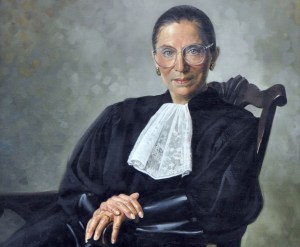
Justice Ruth Bader Ginsburg
Kavanaugh was forced to confront the abortion question in 2017 after the Trump administration barred an undocumented minor, known as Jane Doe, from terminating an unwanted pregnancy. The American Civil Liberties Union sued on Doe’s behalf, and the dispute came before a three-judge panel at the D.C. Circuit. Kavanaugh was joined on the panel by Judge Karen L. Henderson, an arch-conservative, and Judge Patricia Millett, a moderate liberal. Doe, who was being held in a federally funded Texas shelter, had already obtained the necessary judicial bypass to get an abortion. But the Trump administration refused to let her see an abortion provider, instead sending her to an anti-abortion “crisis pregnancy center.”
By that point, Doe would be about 18 weeks pregnant. Texas bans abortion after 20 weeks, and the procedure becomes more dangerous as the pregnancy advances. Moreover, the process of finding and verifying a sponsor for an undocumented minor frequently takes weeks or months. And Doe’s lawyers had already searched for a possible sponsor, to no avail. Kavanaugh’s ostensible compromise, then, was nothing of the sort. At best, it would force Doe to suffer through her unwanted pregnancy for at least two more weeks, increasing the odds of complications when she was finally able to obtain an abortion. At worst, it meant the government could run down the clock to the point that an abortion would become illegal.
Luckily for Doe, the full D.C. Circuit swiftly reversed Kavanaugh’s decision and allowed her to terminate her pregnancy, which she did. This move prompted Kavanaugh to write a bitter dissent explaining why the government’s bar on Doe’s abortion was not, in fact, an undue burden.
Read the rest at Slate.
The Daily Beast: Brett Kavanaugh, Trump’s Supreme Court Pick, Is Probably the End of Abortion Rights and Same-Sex Marriage.
When President Trump Monday nominated Judge Brett Kavanaugh to the Supreme Court, he probably doomed the right to abortion, same-sex marriage, and maybe even contraception….

Future justice Elena Kagan arging a campaign finance reform case before SCOTUS
…while Kavanaugh’s record on women’s and LGBT rights is sparse, it gives good reason to suspect that he could be the swing vote to strike down Roe v. Wade, the abortion-rights case. This, after all, is what Trump promised in 2016: that Roe would be “automatically” be overturned should he be elected. And Kavanaugh has been praised by numerous right-wing organizations.
In the case of Garza v. Hargan, the D.C. Circuit Court of Appeals held that an undocumented teenage immigrant was entitled to obtain an abortion without having to obtain familial consent (as is required in several states).
Kavanaugh vigorously dissented, asking, “Is it really absurd for the United States to think that the minor should be transferred to her immigration sponsor ― ordinarily a family member, relative, or friend ― before she makes that decision?”
Those are strong words, endorsing not only parental consent rules but enforcing them in extreme circumstances. If you are looking for signals that a Justice Kavanaugh would limit or overturn Roe, Garza is a giant red flare.
There’s also a possibility that Kavenaugh might not be right wing enough to satisfy some Republicans.
Kavanaugh may not be conservative enough to survive the confirmation process. There is even talk that conservatives might revolt against Kavanaugh, as they did in 2005 against George W. Bush’s nomination of Harriet Miers. The reason? Many conservatives wanted Kavanaugh to cast doubt on the teenager’s right to get an abortion at all, which another dissenting judge did.

Neal K. Katyal for respondents, Travel Ban case
Legally speaking, that objection is absurd. Not unlike “judicial minimalist” Chief Justice John Roberts, Kavanaugh was discussing the case at issue, not some hypothetical issue. And he was responding to the circuit court’s holding, not writing an essay.
But there’s more. Some conservatives have pointed to dicta in another Kavanaugh opinion, a dissent in Priests for Life v. HHS, a case similar to Hobby Lobby involving the Affordable Care Act’s contraception requirement. While dissenting in favor of the Catholic religious organization objecting to the requirement, Kavanaugh wrote that the “the Government has a compelling interest in facilitating women’s access to contraception” because of a variety of factors, such as “reducing the number of unintended pregnancies would further women’s health, advance women’s personal and professional opportunities, reduce the number of abortions, and help break a cycle of poverty.”
Kavanaugh is writing here about the state’s interest in access to contraception, not whether an individual has a constitutional right to access it. Those are totally different questions. But Kavanaugh’s opinion doesn’t question the constitutional right either, which rests on the same foundations (substantive due process, privacy, family) as the right to obtain an abortion.
This one is a must read–lots of details on Kavenaugh’s record. Head over to The Daily Beast to read the rest.
Read more about Kavenaugh and abortion here:
https://twitter.com/imillhiser/status/1016672606269952001
One more from The New York Times editorial board: There’s So Much You Don’t Know About Brett Kavanaugh. And you probably won’t until it’s too late.
First, the awful lot: Judge Kavanaugh would shift the balance of constitutional jurisprudence to the right, creating a solid right-wing majority on the court possibly until the second half of the 21st century. While the somewhat unpredictable Justice Anthony Kennedy once served as the fulcrum for the court, that role will now go to Chief Justice John Roberts Jr., a far more ideological conservative.
Judge Kavanaugh, who sits on the federal appeals court for the District of Columbia, has been a fixture in conservative politics and is widely respected by the Republican elite. Before becoming a judge, he clerked for Justice Kennedy and worked for Kenneth Starr, the independent counsel who investigated President Bill Clinton, and later in the George W. Bush White House. He successfully portrayed himself in his remarks at the White House as a nice guy who coaches girls in basketball, feeds the homeless and believes in the Constitution.
What Americans can’t know about Judge Kavanaugh: pretty much anything else. That’s thanks to the perversion of the Supreme Court confirmation process, which once provided the Senate and the public with useful information about a potential justice’s views on the Constitution, but which has, ever since the bitter battle over President Ronald Reagan’s failed nomination of Robert Bork in 1987, devolved into a second-rate Samuel Beckett play starring an earnest legal scholar who sits for days at a microphone and labors to sound thoughtful while saying almost nothing.
Read the rest at the NYT.
I know there’s plenty of other news, but this is the biggie for today. Post your thoughts and links on any topic in the comment thread, and try to have a good day despite the horrors all around us.
Did you like this post? Please share it with your friends:
Posted: March 31, 2016 | Author: bostonboomer | Filed under: morning reads, U.S. Politics, Women's Rights | Tags: abortion, Bernie Sanders, Birth Control, Donald Trump, freedom of choice, Hillary Clinton, reproductive freedom |
Good Afternoon!!
The political issue that is most on my mind today is the reactions of the candidates to remarks Donald Trump made on abortion in an interview with MSNBC’s Chris Matthews yesterday. You can read the full transcript at The Guardian. An excerpt:
MATTHEWS: If you say abortion is a crime or abortion is murder, you have to deal with it under law. Should abortion be punished?
TRUMP: Well, people in certain parts of the Republican Party and Conservative Republicans would say, “yes, they should be punished.”
MATTHEWS: How about you?
TRUMP: I would say that it’s a very serious problem. And it’s a problem that we have to decide on. It’s very hard.
MATTHEWS: But you’re for banning it?
TRUMP: I’m going to say — well, wait. Are you going to say, put them in jail? Are you — is that the (inaudible) you’re talking about?
MATTHEWS: Well, no, I’m asking you because you say you want to ban it. What does that mean?
TRUMP: I would — I am against — I am pro-life, yes.
MATTHEWS: What is ban — how do you ban abortion? How do you actually do it?
TRUMP: Well, you know, you will go back to a position like they had where people will perhaps go to illegal places
MATTHEWS: Yes?
TRUMP: But you have to ban it
MATTHEWS: You banning, they go to somebody who flunked out of medical school….
Trump begins talking about the Catholic Church’s position, interrogating Matthews on whether he agrees (Matthews is a Catholic).
MATTHEWS: Do you believe in punishment for abortion, yes or no as a principle?
TRUMP: The answer is that there has to be some form of punishment
MATTHEWS: For the woman
TRUMP: Yes, there has to be some form
MATTHEWS: Ten cents? Ten years? What?
TRUMP: Let me just tell you — I don’t know. That I don’t know. That I don’t know.
MATTHEWS: Why not
TRUMP: I don’t know.
MATTHEWS: You take positions on everything else.
TRUMP: Because I don’t want to — I frankly, I do take positions on everything else. It’s a very complicated position.
MATTHEWS: But you say, one, that you’re pro-life meaning that you want to ban it

More efforts by Trump to deflect to the fact that Matthews is a Catholic.
MATTHEWS: I’m asking you, what should a woman face if she chooses to have an abortion?
TRUMP: I’m not going to do that.
MATTHEWS: Why not?
TRUMP: I’m not going to play that game.
MATTHEWS: Game?
TRUMP: You have…
MATTHEWS: You said you’re pro-life.
TRUMP: I am pro-life.
MATTHEWS: That means banning abortion
TRUMP: And so is the Catholic Church pro-life.
MATTHEWS: But they don’t control the — this isn’t Spain, the Church doesn’t control the government
TRUMP: What is the punishment under the Catholic Church? What is the…
MATTHEWS: Let me give something from the New Testament, “Render to Caesar the things that are Caesar’s, and to God the things that are God’s.” Don’t ask me about my religion.
TRUMP: No, no…
MATTHEWS: I’m asking you. You want to be president of the United States.
TRUMP: You told me that…
MATTHEWS: You tell me what the law should be.
TRUMP: I have — I have not determined…
MATTHEWS: Just tell me what the law should be. You say you’re pro-life.
TRUMP: I am pro-life.
MATTHEWS: What does that mean
TRUMP: With exceptions. I am pro-life.
I have not determined what the punishment would be.
MATTHEWS: Why not?
TRUMP: Because I haven’t determined it
MATTHEWS: When you decide to be pro-life, you should have thought of it. Because…
TRUMP: No, you could ask anybody who is pro-life…
MATTHEWS: OK, here’s the problem — here’s my problem with this, if you don’t have a punishment for abortion — I don’t believe in it, of course — people are going to find a way to have an abortion.
TRUMP: You don’t believe in what?
MATTHEWS: I don’t believe in punishing anybody for having an abortion
TRUMP: OK, fine. OK, (inaudible)/
MATTHEWS: Of course not. I think it’s a woman’s choice.
TRUMP: So you’re against the teachings of your Church?
MATTHEWS: I have a view — a moral view — but I believe we live in a free country, and I don’t want to live in a country so fascistic that it could stop a person from making that decision.
TRUMP: But then you are…
MATTHEWS: That would be so invasive.
TRUMP: I know but I’ve heard you speaking…
MATTHEWS: So determined of a society that I wouldn’t able — one we are familiar with. And Donald Trump, you wouldn’t be familiar with.
TRUMP: But I’ve heard you speaking so highly about your religion and your Church.
MATTHEWS: Yes.
TRUMP: Your Church is very, very strongly as you know, pro-life.
MATTHEWS: I know.
TRUMP: What do you say to your Church?
MATTHEWS: I say, I accept your moral authority. In the United States, the people make the decision, the courts rule on what’s in the Constitution, and we live by that. That’s why I say.
TRUMP: Yes, but you don’t live by it because you don’t accept it. You can’t accept it. You can’t accept it. You can’t accept it.
MATTHEWS: Can we go back to matters of the law and running for president because matters of law, what I’m talking about, and this is the difficult situation you’ve placed yourself in.
By saying you’re pro-life, you mean you want to ban abortion. How do you ban abortion without some kind of sanction? Then you get in that very tricky question of a sanction, a fine on human life which you call murder?
TRUMP: It will have to be determined.
MATTHEWS: A fine, imprisonment for a young woman who finds herself pregnant?
TRUMP: It will have to be determined.
MATTHEWS: What about the guy that gets her pregnant? Is he responsible under the law for these abortions? Or is he not responsible for an abortion?
TRUMP: Well, it hasn’t — it hasn’t — different feelings, different people. I would say no.
MATTHEWS: Well, they’re usually involved.
I applaud Chris Matthews on forcing Trump to demonstrate some of the problems with banning abortion. Trump actually said that we would go back to the time when women had to get illegal abortions, and that they should be punished if they made that choice. But the men who were also involved in the creating unwanted or dangerous pregnancies and in making the decision to end those pregnancies should not be punished.

Matthews could have been talking to any “pro-life” candidate, and if he or she were pushed on the practical results of their policies they might be similarly confused. Because that might mean sending women to jail. As Matthews pointed out, the Church does not control the U.S. government, and candidates who think abortion is a crime should not make decisions about women’s bodies and their choices. These choices are complex and they should be private.
How did the Democratic candidates respond to Trump’s remarks?
From CNN:
Hours later, Trump reversed his initial position — criticized as extreme by both supporters and opponents of abortion rights — saying only the doctors should be held liable.
“The Republicans all line up together,” Clinton said in an interview with CNN’s Anderson Cooper.
“Now maybe they aren’t quite as open about it as Donald Trump was earlier today, but they all have the same position,” she said, noting anti-abortion positions taken by both John Kasich and Ted Cruz. “If you make abortion a crime — you make it illegal — then you make women and doctors criminals.”
“Why is it, I ask myself, Republicans want limited government, except when it comes to women’s health?” she said.
Many Trump’s critics have sought to paint him as hostile to women, and Clinton said she largely agreed with that assessment.

You can watch Clinton’s full interview with Anderson Cooper at the link. I couldn’t find a full interview with Sanders on this other than the one he did with Rachel Maddow. He apparently sent out a tweet calling Trump’s remarks shameful. This is what he told Maddow in a lengthy interview yesterday.
MADDOW: After, uh, the word spread that Donald Trump had made those remarks today about abortion, that a woman needs to be punished, uh, if she seeks an abortion and abortion should be banned, you said today that was shameful.
What is shameful about it?
SANDERS: Well, I think it is — shameful is probably understating that position. First of all, to me, and I think to most Americans, women have the right to control their own bodies and they have the right to make those personal decisions themselves.
But to punish a woman for having an abortion is beyond comprehension. I — I just — you know, one would say what is in Donald Trump’s mind except we’re tired of saying that?
I don’t know what world this person lives in. So obviously, from my perspective, and if elected president, I will do everybody that I can to allow women to make that choice and have access to clinics all over this country so that if they choose to have an abortion, they will be able to do so.
The idea of punishing a woman, that is just, you know, beyond comprehension.
Maddow tried to press Sanders, asking if Cruz may be even worse on the abortion issue than Trump.
Uh, look, they have nothing to say. All they can appeal is to a small number of people who feel very rabid, very rabid about a particular issue, whether it’s abortion or maybe whether it’s gay marriage. That is their constituency. They have nothing of substance.
You know, you mentioned a moment ago, Rachel, that the media is paying attention to Donald Trump.
Duh?
No kidding. Once again, every stupid remark will be broadcast, you know, for the next five days.
But what is Donald Trump’s position on raising the minimum wage?
Well, he doesn’t think so.
What is Donald Trump’s position on wages in America?
Well, he said in a Republican debate he thinks wages are too high.
What’s Donald Trump’s position on taxes?
Well, he wants to give billionaire families like himself hundreds of billions of dollars in tax breaks.
What is Donald Trump’s position on climate change?
Oh, he thinks it’s a hoax perpetrated, shock of all shock, by the Chinese. You know, on and on it goes.
But because media is what media is today, any stupid, absurd remark made by Donald Trump becomes the story of the week. Maybe, just maybe, we might want to have a serious discussion about the serious issues facing America. Donald Trump will not look quite so interesting in that context.
MADDOW: Are you suggesting, though, that the media shouldn’t be focusing on his call to potentially jail women who have abortions? Because that’s another stupid —
SANDERS: I am saying that every day he comes up with another stupid remark, absurd remark, of course it should be mentioned. But so should Trump’s overall positions. How much talk do we hear about climate change, Rachel? And Trump? Any?
I heard that as exactly what Maddow suggested: To Sanders, the issue of women’s reproductive rights is just another “stupid” social issue–nowhere near as important as income inequality, increasing the minimum wage, and the other economic issues that Sanders focuses on.
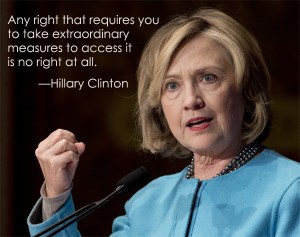
And here is what Hillary Clinton told Rachel Maddow last night, from Politicus USA.
“What Donald Trump said today was outrageous and dangerous. And you know I am just constantly taken aback by the kinds of things that he advocates for. Maya Angelou said, ‘When someone show you who they are, believe them.’ And once again he has showed us who he is. The idea that he and all of the Republicans espouse that abortion should be illegal is one that is not embraced by the vast majority of Americans. And in fact as he pointed out, if it were illegal, then women and doctors would be criminals.”
“I think not only women, men, but all Americans need to understand that this kind of inflammatory, destructive rhetoric is on the outer edges of what is permitted under our Constitution, what we believe in, and people should reject it.”
“Women in particular must know that this right which we have guaranteed under the Constitution could be taken away, and that’s why the stakes in this election couldn’t be higher.”
Maddow explained that Trump walked it back and then wanted to punish doctors. Clinton made the point that women have the right to their own autonomy. Criminalizing doctors for helping women have medical authority over their own bodies doesn’t make this better.
Maddow said that she spoke with Senator Bernie Sanders, Clinton’s 2016 primary opponent, and that Sanders was critical of Trump’s remark but he also thinks it’s another “Donald Trump stupid” remark that will be covered by the media ad nauseam as opposed to issues like taxes, climate change, minimum wage that might be more deserving of extended attention.
Maddow asked Clinton if she agreed, and Clinton said she doesn’t think the media is making too much of this, “No, absolutely not. I’ve been on the front lines of the fight to preserve a woman’s choice and ability to make these difficult decisions… I’ve been a leader in trying to make sure that our rights as women were not in any way eroded.”
“To think that this is an issue that is not deserving of reaction just demonstrates a lack of appreciation for how serious this is,” Clinton said. “This goes to the heart of who we are as women, what kinds of rights and choices we have, it certainly is as important as any economic issue because when it’s all stripped away so much of the Republican agenda is to turn the clock back on women.”
It is easy for even liberals and progressives to forget that without legal and safe abortion, women die. This is no small issue. This is one of the issues of 2016. It is economic, it is about personal freedom, it is a matter of life and death. Hillary Clinton punches back even when others will not. She sees this issue for what it is.

This is why we need a woman POTUS. This is why we need Hillary. These interviews by Chris Matthews and Rachel Maddow represent the first time anyone at a debate or “town hall” has seriously asked candidates to talk about women’s reproductive rights.
Donald Trump showed us why putting a Republican in the White House in 2016 would be dangerous for women.
Bernie Sanders showed us that he “supports” abortion rights, but doesn’t think this issue rises to the importance of his rants on economic issues like income inequality, Wall Street corruption, and the minimum wage. He clearly doesn’t understand that abortion and birth control are also important economic issues.
Hillary Clinton is the only presidential candidate who understands the important of these so-called “women’s issues.” She is the only one who will speak for women and girls in a serious way if she is elected to the presidency.
What do you think? Please discuss this post or any other topic you wish in the comment thread, and have a terrific Thursday.
Did you like this post? Please share it with your friends:
Posted: September 24, 2015 | Author: bostonboomer | Filed under: morning reads, U.S. Politics | Tags: Barack Obama, Birth Control, Donald Trump, Jeb Bush, John Boehner, Junipero Serra, Little Sisters of the Poor, michelle obama, Obamacare, Pope Francis |
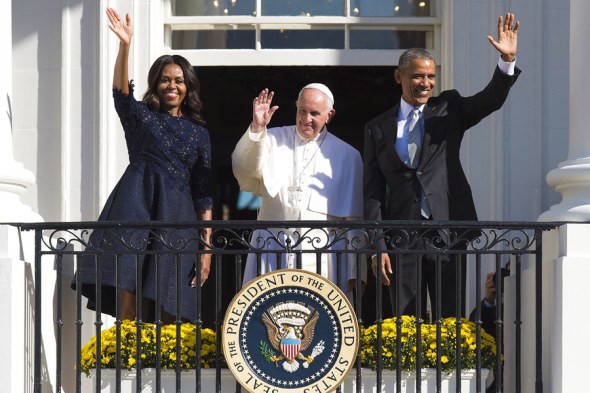
Good Morning!!
Pope Francis is currently visiting Washington DC, and he will address Congress this morning. Yesterday he said a mass and canonized a questionable new saint. From NPR:
Pope Francis celebrated the Mass of Canonization of Junipero Serra at Basilica of the National Shrine of the Immaculate Conception in Washington, D.C., today. You can watch the proceedings in The Washington Post video above.
Serra, the first Hispanic American saint and the first saint to be canonized in the U.S., helped Spain colonize California in the late 1700s, converting tens of thousands of Native Americans to Catholicism in the process. Some Native American groups objected to the canonization of a priest who converted indigenous people to Christianity using force.
The pontiff addressed Serra’s history in his homily.
“Junípero sought to defend the dignity of the native community, to protect it from those who had mistreated and abused it. Mistreatment and wrongs which today still trouble us, especially because of the hurt which they cause in the lives of many people.”
After the mass, Francis met with Native Americans at the basilica to speak with them privately about the controversy.
At the link, you can read tweets from people who noticed that Francis fell asleep at one point during the mass.
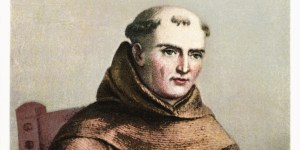
CIRCA 1930: Fray Junipero Serra Postcard. ca. 1915-1925, Fray Junipero Serra Postcard (Photo by LCDM Universal History Archive/Getty Images)
NPR tried to soft-pedal the controversy over Serra’s canonization. NBC has more details:
Saint or Sinner? Pope Courts Controversy With Canonization of Junipero Serra.
…to some Native Americans, Serra’s achievements are nothing to celebrate. They say he created a military-backed mission system that thrived on brutality and resulted in tens of thousands of deaths.
“It is very offensive to canonize the person who actually enslaved, whipped, tortured and separated families and destroyed our cultural and spiritual beliefs,” said Valentin Lopez, chairman of the Amah Mutsun Tribal Band. “How can that behavior be recognized as saintly behavior?” ….
Robert Senkewicz, a professor of history at Santa Clara University who has written a book about Serra, said it’s probably no accident that a pope who hails from Latin America, where the missionaries were seen as protectors, would support Serra.
He said he understands both sides of the debate: there’s evidence that Serra supported the flogging of the California Indians as punishment; he had women and girls locked away at night to keep them safe from rapists; and the crowded missions helped breed the disease that killed many.
“Serra, by his own right, really loved the Indians,” Senkewicz said. “But he thought of them as children. Like 99 percent of the people of the day, he thought Europeans were superior to the native people.”
Lopez said he was stunned by the pope’s elevation of Serra given that the pontiff has championed the downtrodden and even apologized in July for the church’s “grave sins” against the indigenous peoples of the Americas.

Statue of Junipero Serra on Highway 280 south of San Francisco
Like most of what the Vatican does, conferring sainthood is a political process. Frankly, to me it’s meaningless; but I can certainly understand why many Catholics would be up in arms about it.
The Washington Post on Francis’ speech to Congress this morning:
Pope Francis, a symbol of unity for the world’s 1.2 billion Catholics, will address Congress Thursday morning, marking the first time a pope has bridged the church-state divide to speak to America’s elected representatives.
The pope is scheduled to arrive on Capitol Hill at 9:20 a.m. Hours earlier, hundreds people began lining up outside the Capitol grounds, waiting to pass through security checkpoints and stake out a place to see him….
At 10:01 a.m., the House sergeant-at-arms is scheduled to announce: “Mr. Speaker, the pope of the Holy See.” His words will formally launch an event that would have been politically impossible through much of American history, when Catholics — especially waves of immigrants from Italy, Ireland and central Europe in the late 19th and early 20th centuries — suffered widespread discrimination.
That began to change with the election of John F. Kennedy to the presidency in 1960, according to the article.
In speaking before Congress, the pope was to take the central position in a tableau reflecting a wholesale shift in Catholics’ place in the United States. Vice President Joe Biden (D), who is also Catholic, will sit behind him, next to Boehner. In front of him will be four justices of the Supreme Court — including three of the six Catholics who currently sit on the nine-member court.
There are 164 Catholics in this Congress, or 31 percent of the members. That’s a higher proportion than in the overall U.S. population, which is 22 percent Catholic. Despite those numbers, it seems doubtful that even a pope who has admonished world leaders to argue less and accomplish more can break the bitter, years-long political paralysis in the U.S. legislature.
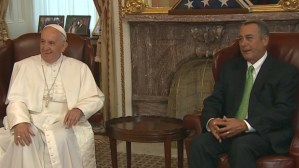
Pope Francis meets with John Boehner before the historic speech to Congress.
Unfortunately, many of the “Catholics” in this Congress and the Supreme Court do not subscribe to actual Catholic values such as humility, helping the poor, protecting the environment, and making peace, not war.
Pope Francis also held a meeting with the Little Sisters of the Poor to “quietly” support their battle against birth control being covered by Obamacare. USA Today:
WASHINGTON — Pope Francis made an unscheduled stop to visit the Little Sisters of the Poor Wednesday, a move that Vatican officials said was intended to send a message of support in the nuns’ battle against Obamacare.
The religious order of Catholic sisters is suing theObama administration over a provision of the Affordable Care Act that the administration has interpreted as requiring the sisters to purchase health insurance with birth control coverage.
Catholic teaching opposes the use of birth control. The sisters can request a waiver, but their lawsuit argues that requiring that paperwork infringes on their religious freedom. The sisters are suing under the Religious Freedom Restoration Act, a Clinton-era law that prohibits the government from placing a “substantial burden” on the free exercise of religion.
Last August, an appeals court sided with the government, but an unusual dissent by five judges this month called that decision “clearly and gravely wrong — on an issue that has little to do with contraception and a great deal to do with religious liberty.” The question now goes to the U.S. Supreme Court.
Sigh . . .
News From the Clown Car
Donald Trump is once again feuding with Fox News.
From Politico: Trump says he won’t appear on Fox News. The Republican front-runner says Fox has been treating him unfairly, while Fox says it dumped Trump first.

Donald Trump and Bill O’Reilly before the feud
Citing unfair treatment, Donald Trump said Wednesday that he is not going to appear on any Fox News shows “for the forseeable future,” reigniting a feud that has heated up and cooled throughout the summer.
“.@FoxNews has been treating me very unfairly & I have therefore decided that I won’t be doing any more Fox shows for the foreseeable future,” Trump tweeted at mid-day on Wednesday.
Fox News fired back a couple hours later, saying Trump had it all wrong, and that it was Fox who dumped Trump. A spokesman issued a statement, condeming Trump’s attacks on Fox’s journalists.
“At 11:45am today, we canceled Donald Trump’s scheduled appearance on The O’Reilly Factor on Thursday, which resulted in Mr. Trump’s subsequent tweet about his ‘boycott’ of FOX News,” the statement reads. “The press predictably jumped to cover his tweet, creating yet another distraction from any real issues that Mr. Trump might be questioned about. When coverage doesn’t go his way, he engages in personal attacks on our anchors and hosts, which has grown stale and tiresome. He doesn’t seem to grasp that candidates telling journalists what to ask is not how the media works in this country.”
The Republican presidential candidate had devoted Monday and Tuesday nights this week to blasting the network’s coverage of him on Twitter, tweeting and retweeting criticism.
More details at the link. Ugh.

Donald Trump at the South Carolina Freedom Summit
Also from Politico: Trump: I’m so tired of this politically correct crap.
A seemingly exasperated Donald Trump announced on Wednesday, “I’m so tired of this politically correct crap,” telling a crowd of South Carolina business leaders that he’s still the straight-talking, shoot-from-the-hip kind of guy that surged to the top of the polls this summer.
The Republican presidential candidate is suffering a bit of a slump, due to some slippage in the polls, a lackluster debate performance, and another round of negative headlines due to his refusal to apologize for not correcting a questioner at a New Hampshire town hall who insisted President Obama is a Muslim and not an American.
On Wednesday, he tried to reclaim his mojo, launching another Twitter-based attack on Fox News before taking the stage in South Carolina to blast his rivals. In the case of Marco Rubio and Jeb Bush, Trump remarked that both candidates “hate each other … but they can’t say it.” Rubio was state senator while Bush was governor of Florida.
Trump, addressing the Greater Charleston Business Association and the South Carolina African American Chamber of Commerce, detailed his grievances with the way politicians act.
“This is what bothers me about politicians. He announces he’s gonna run and they go to Jeb, ‘what do you think of Marco Rubio?’ ‘He’s my dear, dear friend, he’s wonderful, he’s a wonderful person, I’m so happy that he’s running.’ Give me a break,” Trump said. “That’s called politicians’ speak. Then they go to Marco, what do you think of Jeb Bush? ‘Ohh, he’s great, he’s brought me along.”
Rubio and Bush “hate each other,” Trump said, blasting Rubio as “overly ambitious, too young, and I have better hair than he does, right?”
What Donald Trump refers to “political correctness” is behavior that normal people call common courtesy.
Jeb Bush had another stumble a couple of days ago.
CNN reports: Jeb Bush weighs in on ‘multiculturalism.’
His answer came in response to a question at an Iowa diner Tuesday from a woman who wanted to know how the former Florida governor would help refugees and immigrants integrate into U.S. society and “empower them to become Americans.”
“We should not have a multicultural society,” the Republican presidential candidate responded.
But Bush, who’s a self-admitted policy wonk and tends to use nuanced language, was referring to “multicultural” in the literal sense — a social model in which cultures live in “isolated pockets,” as he described them, rather than assimilating into society.
“America is so much better than every other country because of the values that people share — it defines our national identity. Not race or ethnicity, not where you come from,” he said. “When you create pockets of isolation — and in some cases the assimilation process is retarded because it’s slowed down — it’s wrong. It limits peoples’ aspirations.”
He added that people who aren’t “fully engaged” in a broader community will struggle to get the best education and argued that learning English would better accelerate access to opportunities.
Personally, I think it’s entirely possible for ethnic groups in the U.S. to hold onto their languages and cultures, while at the same time fitting in to American society. The children of immigrants usually assimilate; at the same time, I think they should be encouraged to understand their ethnic and cultural history and be able to speak their native language with older family members.
In The News
BBC News: Hajj stampede: At least 717 killed in Saudi Arabia.
Quora discussion: Why do Americans think helping even the less fortunate next-door neighbour is ‘socialism’?
The Boston Globe: Apple bans walk-in purchases of the new iPhone 6s in New Hampshire, three other states.
ABC News: Texas HS Football Assistant Coach Admits to Telling Players to Hit Referee, Principal Says.
ABC News: Pope Francis Cites Victims From Church’s ‘Difficult Moments.’
The Telegraph: Angela Merkel’s ministers ‘ignored warning over Volkswagen emissions rigging.’
The New York Times: Hackers Took Fingerprints of 5.6 Million U.S. Workers, Government Says.
Some Interesting Longer Reads
Foreign Policy: ‘Close Your Eyes and Pretend to Be Dead’ What really happened two years ago in the bloody attack on Nairobi’s Westgate Mall.
Scientific American: Why the Human Brain Project Went Wrong–and How to Fix It.
The New Republic: Down the Rabbit Hole. The rise, and rise, of literary annotation.
Slate: Yogi Berra Wasn’t Trying to Be Witty. And he wasn’t dumb either. How did the narrative of the wise buffoon come to dominate his life?
What else is happening? What stories are you following today?
Did you like this post? Please share it with your friends:



 peej
peej Carissa
 bostonboomer
 dakinikat
 ecocatwoman
 mablue2
 Mama Lopez
 peggysue22
 quixote
 skydancingguestblogger
 Mona (aka Wonk the Vote)



 Sky Dancing
Recent Comments