
Thursday Coronavirus Reads: Denial of Science and Collective Trauma
Posted: April 23, 2020 Filed under: morning reads, U.S. Politics | Tags: Anthony Fauci, collective trauma, Donald Trump, Nancy Messonnier, Rick Bright, Robert Redfield, trauma, traumatic growth, ventilators 30 Comments
Katherine Bernhardt’s new public mural painted in Guatemala, 2020. Courtesy of the artist.
Good Morning!!
Yesterday the world watched in horror as Trump forced another scientist to soften remarks he had made in the media. We also learned that the government scientist who was in charge of Covid-19 vaccine development was demoted because he criticized Trump’s advocacy for an unproven and dangerous drug combination to treat the virus. Day after day in his “coronavirus briefings, Trump is trying to crush scientific expertise with his iron fist of ignorance.
The Washington Post: Under Trump, coronavirus scientists can speak — as long as they mostly toe the line.





Tuesday Reads: Trump’s Most Insane, Out of Control Meltdown Yet
Posted: April 14, 2020 Filed under: morning reads, U.S. Politics | Tags: Andrew Cuomo, Anthony Fauci, coronavirus "briefings", Covid-19, Donald Trump, insanity, John Yoo, meltdown, narcissism, propaganda, Tenth Amendment 30 Comments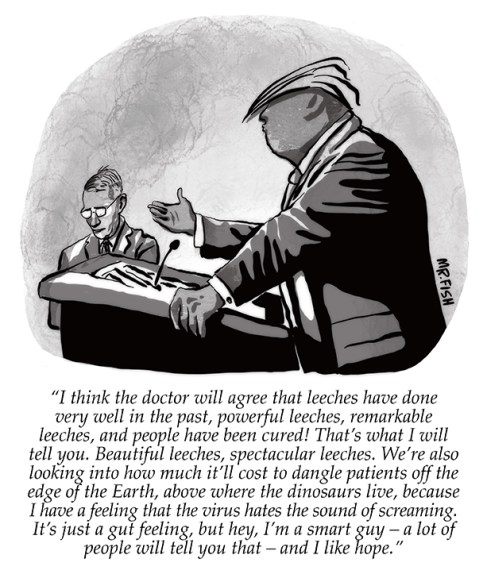
Good Morning!!
Yesterday Trump had an epic meltdown at his “coronavirus briefing,” Yes, I know he has meltdowns all the time, but this was the worst one yet. It included screaming, yelling, attacks on the press, a North Korea style propaganda video, and claims of dictatorial power. There was almost no mention of a federal response to the pandemic.
He began the performance by bringing Dr. Anthony Fauci to the podium to explain why what he said on CNN’s State of the Union on Sunday wasn’t a criticism of Trump. USA Today: Anthony Fauci says he used a ‘poor choice of words’ in discussing Trump administration’s coronavirus response.
Anthony Fauci, the health care policy expert under fire from allies of President Donald Trump, said Monday he used a “poor choice of words” when he suggested lives could have been saved had the Trump administration put in place coronavirus restrictions earlier in the year.
“Hypothetical questions sometimes can get you into some difficulty,” Fauci said during a unique statement delivered amid reports that Trump was thinking of firing him.
In an interview Sunday on CNN’s “State of the Union,” Fauci was asked if lives could have been saved had social distancing been imposed during the third week of February instead of mid-March. Fauci said, “It’s very difficult to go back and say that. I mean, obviously, you could logically say that if you had a process that was ongoing and you started mitigation earlier, you could have saved lives. Obviously, no one is going to deny that.”
Fauci said, “What goes into those kinds of decisions is – is complicated. But you’re right. I mean, obviously, if we had, right from the very beginning, shut everything down, it may have been a little bit different. But there was a lot of pushback about shutting things down back then.”
Trump, who on Sunday re-tweeted a supporters’ statement that Fauci should be fired, called the epidemic expert to the podium early in the briefing, an unusual move.
A reporter asked Fauci if he had been forced to make the statement, and he claimed it was “voluntary.” Raise your had if you believe him. It looks like Fauci has become just another Trump sycophant. We. are. so. fucked.
Ashley Parker at The Washington Post: The Me President: Trump uses pandemic briefing to focus on himself.
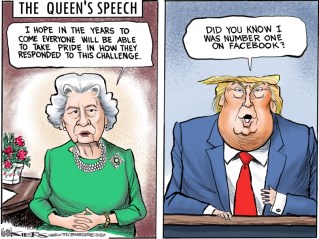
“Everything we did was right,” Trump said, during a sometimes hostile 2½ -hour news conference in which he offered a live version of an enemies list, brooking no criticism and repeatedly snapping at reporters who dared to challenge his version of events.
Trump has always had a me-me-me ethos, an uncanny ability to insert himself into the center of just about any situation. But Monday’s coronavirus briefing offered a particularly stark portrait of a president seeming unable to grasp the magnitude of the crisis — and saying little to address the suffering across the country he was elected to lead.
At one point — after praising himself for implementing travel restrictions on China at the end of January and griping about being “brutalized” by the press — Trump paused to boast with a half-smirk, “But I guess I’m doing okay because, to the best of my knowledge, I’m the president of the United States, despite the things that are said.”
Read the rest at the WaPo.
Earlier in the day, Trump tweeted that he and he alone–not governors of states–has the authority to “reopen” their economies.
Then during the briefing, Trump claimed that he and he alone has the power to open businesses, etc. in individual states. He has no understanding of the Constitution, much less the Tenth Amendment, which reserves police powers for the states.
Rick Wilson at The Daily Beast: Trump the Narcissistic Authoritarian Statist Declares He Has ‘Total’ Authority.
If you watched President Donald Trump’s daily press briefing Monday, you know that even by his abysmal standards this was the loudest siren yet, a warning that the man occupying the Oval Office is more suited to a very long, involuntary stay in an inpatient mental-health facility than the presidency of the United States.
It wasn’t presidential leadership. It wasn’t executive power made manifest. It wasn’t a grown-ass adult facing a serious crisis. It was an angry, needy man not looking outward to the needs of a nation in crisis but inward, and downward.
Anyone—and I mean anyone—who tells you Monday’s presser was anything other than a complete meltdown shitshow on the top of the dumpster fire at the peak of Burning-Tire Mountain is a liar.
It was a manic, gibbering, squint-eyed ragefest by America’s Worst President, a petty display by a failed man who long ago passed the limits of his competence and knowledge. It left little to cling to for even his most fervent lackeys but the grunting media animus that replaced conservatism as the motivating force of the Republican Party.
There was no there there when it came to facing the most consequential national crisis in generations. Even the parts about actions by the government were just mummery to frame his desperate desire for more stroking of his delicate feels. Everything is incidental to his delicate feelings and ego. Everything—and, more importantly, everyone else—is incidental.
Trump just gave the nation a performance that was so manic, so furious, and so utterly unhinged that anyone watching it walked away thinking the 25th Amendment has been too long unexercised and the proof is behind the podium every damn day.
Even John Yoo, the torture advocate says Trump can’t force states to “reopen.”
Our elected leaders confront the difficult decision on when to start lifting the lockdowns, even at the risk of a faster spread of COVID-19. Presiding Trump claims that he has the right to determine when businesses open their doors, employees return to work, and consumers shop again. “For the purpose of creating conflict and confusion, some in the Fake News Media are saying that it is the Governors decision to open up the states, not that of the President of the United States & the Federal Government,” he tweeted earlier today. “Let it be fully understood that this is incorrect . . . It is the decision of the President, and for many good reasons.”
But the federal government does not have that power. The Constitution’s grant of limited, enumerated powers to the national government does not include the right to regulate either public health or all business in the land. Congress enjoys the authority to “regulate Commerce with foreign Nations, and among the several States.” This gives Washington, D.C. an important, yet supporting, role in confronting the pandemic. It can bar those who might be infected from entering the United States or traveling across interstate borders, reduce air and road traffic, and even isolate whole states.
But our federal system reserves the leading role over public health to state governors. States possess the “police power” to regulate virtually all activity within their borders. As the Supreme Court has recognized, safeguarding public health and safety presents the most compelling use of state power. Only the states can impose quarantines, close institutions and businesses, and limit intra-state travel. Democratic governors Gavin Newsom in California, Andrew Cuomo in New York, and J.B. Pritzker Illinois imposed their states’ lockdowns, and only they will decide when the draconian policies will end.
Read more at The National Review.
New York Gov. Andrew Cuomo warned Tuesday that President Donald Trump should not try to reopen the state against his wishes, saying it would create “a constitutional crisis like you haven’t seen in decades” and could result in a dramatic increase in coronavirus cases.
“The only ways this situation gets worse is if the president creates a constitutional crisis,” Cuomo said on MSNBC’s “Morning Joe.”
“If he says to me, ‘I declare it open,’ and that is a public health risk or it’s reckless with the welfare of the people of my state, I will oppose it,” he said. “And then we will have a constitutional crisis like you haven’t seen in decades, where states tell the federal government, ‘We’re not going to follow your order.’ It would be terrible for this country. It would be terrible for this president.”
This morning Trump responded with another insane tweet.
Finally, there was the insane campaign ad that Trump forced the press and his science advisers to watch during the “briefing.”
The Daily Beast: Trump Uses Coronavirus Briefing to Play Batshit Campaign Ad Attacking Press.
President Donald Trump took over Monday’s White House task force briefing to lash out at critics and the press with a bizarre video that amounted to a campaign ad, before later declaring his authority is “total” if governors disagree with him during the coronavirus pandemic.
Monday’s unprecedented press briefing began to go off the rails with the video, but before the end, the president was falsely trumpeting definitive authority during the health-care crisis that has already led to the deaths of more than 23,000 Americans.
The briefing almost immediately devolved into the president airing widespread grievances against his critics, from his likely 2020 general election opponent Joe Biden to governors and reporters who have dared to call his virus response into question over the last few weeks as American life has ground to a halt during the pandemic.
In a mash up of clips and audio that amounted to a campaign ad, Trump lashed out at critics and returned to his favorite pastime of going after reporters. The video began with a white screen saying “the media minimized the risk from the start.” At one point, it showed news clips of different governors giving kind remarks about the president’s response to the pandemic.
An agitated and indignant president pointed at the seated press corps, telling them that while he’d answer some questions after airing his montage of coronavirus praise that maybe “I’ll ask you some questions because you’re so guilty.”
Both CNN and MSNBC, which have wavered between airing the increasingly antagonistic briefings, both cut away during the multi-minute campaign ad. The networks, however, came back to broadcast the performance after a short break.
The highlight of the show was questioning from CBS correspondent Paul Reid. BBC News:
CBS White House correspondent Paula Reid was met with a fiery response when she challenged President Trump during a coronavirus briefing.
Mr Trump touted his ban on travel from China at the end of January as an example of his administration taking decisive action. However, he did not declare a national emergency until 13 March – and public health experts have criticised the response to the outbreak, including early testing failures and a shortage of protective equipment.
The reporter asked Mr Trump what his administration had done in February, “with the time you bought with your travel ban”.
So . . . another crazy day has dawned in America. Will we survive? What stories are you following?
Thursday Reads
Posted: April 2, 2020 Filed under: morning reads, U.S. Politics | Tags: Anthony Fauci, coronavirus, Covid-19, Donald Trump, Gov. Charlie Baker, Massachusetts, New England Patriots, Robert Kraft, Trump administration failures 43 Comments
Good Morning!!
U.S. deaths from Covid-19 have now topped 5,000 with more than 126,000 confirmed cases, according John’s Hopkins University. BBC News:
There were 884 deaths in the US in 24 hours, a new record, according to Johns Hopkins University, which has tracked virus figures globally.
The latest victims include a six-week-old baby. More than 216,000 are now infected, the world’s highest figure.
Reserves of protective equipment and medical supplies are almost exhausted.
This has left the federal government and individual US states competing for safety gear, while the unprecedented demand has led to profiteering, officials in the Department for Homeland Security were quoted by the Washington Post as saying.
The Trump administration says it can acquire adequate supplies, and has $16bn (£13bn) available to do so. State and local officials have complained about insufficient protective equipment such as masks and gowns as well as ventilators, needed to help keep patients breathing….
The number of confirmed infections across the US rose by more than 25,000 in one day. The worst-hit place is New York City, where nearly 47,500 people have tested positive and more than 1,300 have died.
The response to this horror from the Trump administration is still weak and ineffectual.
Here in Massachusetts, Governor Charlie Baker got an assist from New England Patriots owner Bob Kraft. Politico: Bob Kraft sends Patriots plane to China to get equipment for Mass.
A New England Patriots plane full of much-needed personal protective equipment from China is to fly into Boston on Thursday afternoon, according to a source familiar with the plans.
Gov. Charlie Baker will greet the National Football League team’s plane when it arrives at Logan Airport with Patriots owner Bob Kraft and Lt. Gov. Karyn Polito. From there, the state’s National Guard will transport the equipment to a strategic stockpile in Marlboro, Mass., according to the person familiar with the plans.
There are 7,738 confirmed coronavirus cases in Massachusetts, and more than a thousand of those cases were reported on Wednesday — the largest spike the state has seen so far. To date, 122 people have died from the virus, and the state has conducted more than 51,000 tests. The state converted an arena in Worcester, Mass., into a 250-bed field hospital Wednesday as it prepares for an influx in patients, and is eyeing a Boston convention center as another possible hospital site.
For weeks, Baker has warned that Massachusetts is in desperate need of more protective equipment including masks, sanitizing wipes and gowns for health care workers on the front lines of the coronavirus crisis, especially as cases are expected to surge sometime between April 7 and April 17 in Massachusetts.
The Republican governor has raised those concerns with Trump. He told the president the federal government was outbidding Massachusetts on equipment — even after advising states to work on getting their own supplies. A week later, the Bay State was still being outbid and had only received a fraction of what it requested from the Strategic National Stockpile.
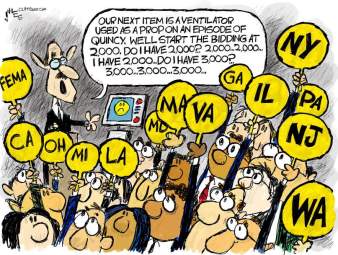 According to my local news source The Arlington Patch, there are 1.2 million N95 masks on the plane. An additional 500,000 wouldn’t fit and will be delivered on another flight.
Team owner Robert Kraft and his family paid $2 million, about half the cost, for the masks, which are a crucial piece of personal protection equipment needed on the front lines in the fight against the coronavirus.
The National Guard will bring the masks from the plane to a Marlboro stockpile, Politico reported. Some 300,000 masks will then be sent to New York, which is being overwhelmed by the pandemic.
While I’m glad that local doctors and nurses will soon have better protection from the virus, this story highlights a serious problem with Trump’s disorganized “strategy” for dealing with the pandemic. The Los Angeles Times: As Trump lets private sector supply the coronavirus fight, the well-connected often get first dibs.
As hospitals, doctors and state and local governments race for masks, ventilators and other medical supplies with little coordination by the Trump administration, the well-connected are often getting to the front of the line.
An outpouring of corporate and philanthropic support has funneled badly needed supplies to combat the coronavirus to well-known institutions such as Cedars-Sinai and UCLA medical centers in Los Angeles and the UC San Francisco Medical Center.
But in the absence of an overall nationwide distribution plan, many smaller hospitals, nursing homes and physicians are being left behind, especially those who lack relationships with suppliers, ties to wealthy donors or the money to buy scarce equipment at a time when prices on the open market are skyrocketing.
“It’s frequently all about who knows someone who knows someone who can get hold of this or that supply,” said Dr. Alex Billioux, public health director in Louisiana, which is battling one of the nation’s most aggressive coronavirus outbreaks.
Trump “has blood on his hands,” as The Boston Globe Editorial Board wrote on Monday: A president unfit for a pandemic. Much of the suffering and death coming was preventable. The president has blood on his hands.
While the spread of the novel coronavirus has been aggressive around the world, much of the profound impact it will have here in the United States was preventable. As the American public braces itself for the worst of this crisis, it’s worth remembering that the reach of the virus here is not attributable to an act of God or a foreign invasion, but a colossal failure of leadership.
The outbreak that began in China demanded a White House that could act swiftly and competently to protect public health, informed by science and guided by compassion and public service. It required an administration that could quickly deploy reliable tests around the nation to isolate cases and trace and contain the virus’s spread, as South Korea effectively did, as well as to manufacture and distribute scarce medical supplies around the country. It begged for a president of the United States to deliver clear, consistent, scientifically sound messages on the state of the epidemic and its solutions, to reassure the public amid their fear, and to provide steady guidance to cities and states. And it demanded a leader who would put the country’s well-being first, above near-term stock market returns and his own reelection prospects, and who would work with other nations to stem the tide of COVID-19 cases around the world.
What we have instead is a president epically outmatched by a global pandemic. A president who in late January, when the first confirmed coronavirus case was announced in the United States, downplayed the risk and insisted all was under control. A president who, rather than aggressively test all those exposed to the virus, said he’d prefer not to bring ashore passengers on a contaminated cruise ship so as to keep national case numbers (artificially) low. A president who, consistent with his mistrust and undermining of scientific fact, has misled the public about unproven cures for COVID-19, and who baited-and-switched last week about whether the country ought to end social distancing to open up by Easter, and then, on Saturday, about whether he’d impose a quarantine on New York, New Jersey, and Connecticut. A president who has pledged to oversee the doling out of the $500 billion in corporate bailout money in the latest stimulus package, some of which will go to the travel industry in which his family is invested. A president who spent a good chunk of a recent press conference complaining about how hard it is for a rich man to serve in the White House even as Americans had already begun to lose their jobs, their health care, and their lives. A president who has reinforced racial stigma by calling the contagion a “Chinese virus” and failed to collaborate adequately with other countries to contain their outbreaks and study the disease. A president who evades responsibility and refuses to acknowledge, let alone own, the bitter truth of National Institutes of Health scientist Dr. Anthony Fauci’s testimony: that the country’s testing rollout was “a failing.”
Read the whole thing at the Globe. It appears they have finally made their coronavirus stories free to the public.
Now Trump is making his failure look far worse by claiming he knew all along the situation with be this bad. Amber Phillips at The Washington Post: Trump now says he knew the virus ‘could be horrible’ when he was saying things like ‘it’s going to disappear.’

Let’s start with Trump downplaying the virus. Acosta asked him: “Is there any fairness to the criticism that you may have lulled Americans into a false sense of security? When you were saying things like it’s going to go away and that sort of thing?”
Trump’s answer basically came down to: He did not want to deliver the bad news about how serious the virus could be. What’s more, he said he knew ahead of time it could be this bad (or even worse, killing millions with no government intervention whatsoever), but he did not want to tell Americans that at the time.
“I want to give people a feeling of hope. I could be very negative. I could say ‘wait a minute, those numbers are terrible. This is going to be horrible,’” he said. “Well, this is really easy to be negative about, but I want to give people hope, too. You know, I’m a cheerleader for the country.”
Unbelievable. More from Jim Acosta at CNN: Source close to coronavirus task force: Despite what White House is saying, tougher measures implemented earlier ‘might have made a difference.’
Despite White House claims that President Donald Trump and the administration did everything right in response to the coronavirus, a source close to the task force said tougher social distancing measures implemented earlier in the pandemic could have blunted the severity of the current crisis.
It all depends, the source said, whether there were coronavirus infections in the US that were going undetected during the initial weeks of the outbreak, when the Trump administration was falling behind on testing for the virus nationwide.
Numerous public health experts have said those cases were likely going undetected, considering the lack of widespread testing….
A Trump adviser working with White House officials on messaging for the pandemic response said Trump “took a gamble” that warmer weather would cause the virus to dissipate, siding with aides who were pushing back on the dire warnings coming from doctors on the coronavirus task force.
Some important stories, links only:
Yahoo News: Two years before coronavirus, CDC warned of a coming pandemic.
The Nation: Exclusive: The Military Knew Years Ago That a Coronavirus Was Coming.
The Daily Beast: Army Warned in Early February That Coronavirus Could Kill 150,000 Americans.
The New York Times: A Ventilator Stockpile, With One Hitch: Thousands Do Not Work.
Jonathan Chait at New York Magazine: Republicans: ‘Nobody Expected’ the Coronavirus Pandemic. So Joe Biden Is Nobody?
The Washington Post: Anthony Fauci’s security is stepped up as doctor and face of U.S. coronavirus response receives threats.
Vanity Fair: Americans Can’t Sign Up for Health Insurance During a Global Pandemic, Trump Decides.
Bloomberg: Many New York Coronavirus Patients Are Young, Surprising Doctors.
The New York Times: Some Coronavirus Patients Show Signs of Brain Ailments.
The Daily Beast: Trump Literally Laughed at How He Can Game the Press With His ‘New Tone’
Stay safe and healthy Sky Dancers! Please share what’s happening where you live.
Terrible Tuesday Reads: Illness, Death, and Art
Posted: March 31, 2020 Filed under: morning reads, U.S. Politics | Tags: Anthony Fauci, art, coronavirus, death, Deborah Birx, Edvard Munch, Egon Schiele, Frank Figliuzzi, Gustav Klimt, illness, Spanish flu 34 Comments
Gustav Klimt Death and Life
Good Morning Sky Dancers!
Today’s post is illustrated with paintings by two artists who died of the Spanish flu in 1918, Gustav Klimt and Egon Schiele, and one who survived his terrible bout with the disease, Edvard Munch.
BBC Culture: Klimt and Schiele, the Artists Who Shocked Europe.
At first glance there is little to suggest a connection between Gustav Klimt and Egon Schiele. Klimt was the archetypical sensualist who portrayed Vienna’s elite in gilded finery whilst Schiele, almost three decades his junior, was a tortured egoist whose twisted depictions of the human body shocked and scandalised contemporary audiences. And yet the two men shared a lifelong mutual appreciation and friendship, determined to follow their own artistic visions whatever the cost, until the flu epidemic of 1918 claimed both their lives.
Egon Schiele, Self-Portrait
Klimt turned his back on the conventions of academic painting. Disillusioned with the stifling restraints of the Künstlerhaus, the artists’ society which all Viennese artists felt obliged to belong to, he and a number of other artists broke away to form the art movement known as the Vienna Secession.
His new attitude was provocatively outlined in the 1899 work Nuda Veritas, which Sandra Tretter of the Klimt Foundation sums up as “the Künstlerhaus versus the Secession.” A naked woman holds up the mirror of truth while the snake of falsehood lies dead at her feet. Above her in gilded letters is a quotation from the German dramatist Schiller: “If you cannot please everyone with your deeds and your art, please a few. To please many is bad.” […..]
Klimt’s uncompromising attitude appealed to the young Schiele, who sought out the artist in 1907 when he was still a student at the Academy of Fine Arts and finding the academic discipline frustrating.
A precociously gifted artist, Schiele had revealed his talent as an adolescent by sketching his younger sister in the nude, much to his parents’ horror. For Leopold, also a trained psychotherapist, this fascination with adolescent girls was in part a reaction to his ambivalent relationship with his mother, and would go on to cause great scandal.
Schiele’s undoubted talent appealed to Klimt and he took the young man under his wing, providing models and inviting him to exhibit at the 1909 Kunstchau, although Schiele’s four paintings, all very much in the style of his master, failed to make much impact….
Seeking new means of expression Schiele turned to his own body for inspiration in a manner unprecedented in the history of art. In his first nude self portrait from 1907, based on the notorious female figure in Medicine, he had portrayed himself as helpless and fragile, isolated from the rest of humanity.

Read much more about these artists at the BBC link.
Edvard Munch, Self-Portrait with Spanish Flu
Edvard Munch (1863-1944) was another great artist who contracted influenza. He was a contemporary of Klimt and a leader of the modernist school and is best known for his painting(s), The Scream. His patron was Dr Linke, an ophthalmologist who lived in the Northern German city of Lubeck, which now has UNICEF World Heritage listing. Munch visited Lubeck on at least 17 occasions and painted pictures of the gardens of the Linke home and the Linke children, and perhaps these visits helped in Munch’s lifelong battle with depression. In 1919, Munch contracted the “Spanish Flu,” and although he was very ill, he survived. He painted a self-portrait of himself with influenza (now in Oslo) and another of himself recovering from influenza, which hangs in Lubeck in the Behnhaus Museum. As you stand in front of this portrait you see a man suffering from profound depression, perhaps due to a post viral syndrome compounding his long-standing disease. He later wrote that he was fortunate to survive the infection.

This article at Wellcome Collection provides more background on Schiele, Klimt, and Munch as well as other artists who were impacted by the 1918 flu pandemic: Spanish flu and the depiction of disease. It’s quite interesting. This bit about Schiele is heartbreaking:
In 1918, Austrian artist Egon Schiele was at work on a painting of his family. [The painting appears at the top of this post] With his unflinching attention to the human form, he completed the three figures: Schiele himself is at the far back, his sinewy nude body hunched behind his wife, Edith, who looks off to the side, while a child is curled between her feet.
Egon Schiele, Family
Earlier that year, the rising young art star had been featured in a solo show with the Vienna Secession artists’ association, and, even better, his works had actually sold. That new financial security was particularly important, as Edith was pregnant.
The only thing that disrupts the harmony of the 1918 painting ‘The Family’ is Schiele’s melancholic gaze directed at the viewer. Its sombreness seems in contrast to this scene of domestic tranquillity.
The painting would never be finished. By the end of that autumn, both Edith and Egon were dead; their child was never born. They were two among millions who succumbed to the Spanish flu pandemic. The incomplete painting was transformed into a portrait of loss.

And on Munch:
Among the artists who caught the flu and survived was Norwegian painter Edvard Munch, whose lifelong self-portraiture found a harrowing match in the disease. While many of his early self-portraits have morbid fantasies of his mortality, including the 1895 ‘Self-portrait with Skeleton Arm’ or the 1902–3 ‘Self-portrait on the Operating Table’, his Spanish flu series plainly confronted his frailty and vulnerability.
His 1919 ‘Self-Portrait with the Spanish Flu’ has Munch wrapped in a gown and blanket, sitting in a cane chair, his tousled bed in the background. Hues of a sickly yellow surround him; his mouth gapes open like a corpse. There’s a feeling of isolation in this personal struggle. Later that year he painted its sequel, ‘Self-Portrait after the Spanish Flu’, in which he leans toward the viewer, swirls of paint creating circles around his eyes, but colour returning to his sallow face.

Edvard Munch – Self Portrait after the Spanish Flu
More than 100 years later, we are in the midst of another terrible pandemic, and we have no idea yet how many people will die. Yesterday, Coronavirus Response Coordinator Dr. Deborah Birx said that 100,000 to 200,000 deaths in the U.S. would be the best case scenario. CNBC: Dr. Birx predicts up to 200,000 U.S. coronavirus deaths ‘if we do things almost perfectly.’
The White House coronavirus response coordinator said Monday that she is “very worried about every city in the United States” and projects 100,000 to 200,000 American deaths as a best case scenario.
In an interview on “TODAY,” Dr. Deborah Birx painted a grim message about the expected fatalities, echoing that without doing any measures they could hit as high as 2.2 million, as coronavirus cases continue to climb throughout the U.S.
“I think everyone understands now that you can go from five to 50 to 500 to 5000 cases very quickly,” Birx said.
Somehow Birx and Anthony Fauci and advisers bearing poll results managed to convince Trump that he couldn’t loosen government recommendations without killing thousands of people. The New York Times: Behind Trump’s Reversal on Reopening the Country: 2 Sets of Numbers.
The numbers the health officials showed President Trump were overwhelming. With the peak of the coronavirus pandemic still weeks away, he was told, hundreds of thousands of Americans could face death if the country reopened too soon.
Egon Schiele, Gustav Klimt on his death bed, 1918.
But there was another set of numbers that also helped persuade Mr. Trump to shift gears on Sunday and abandon his goal of restoring normal life by Easter. Political advisers described for him polling that showed that voters overwhelmingly preferred to keep containment measures in place over sending people back to work prematurely.
Those two realities — the dire threat to the country and the caution of the American public — proved decisive at a critical juncture in the response to the pandemic, his advisers said. The first of those two realities, the deadly arc of the virus, has been known for weeks even if disregarded by the president when he set his Easter target. But the second of the two upended Mr. Trump’s assumptions about the politics of the situation and restrained, for a moment at least, his eagerness to get back to business as usual.
The president’s reversal may prove to be an important pivot point in the effort to curb the pandemic, one that in the view of public health officials averted a greater catastrophe.

Right now Trump needs Fauci and Birx to provide some credibility to his public health policies. But how long before he turns on them? Former Assistant Director for Counterintelligence at the FBI Frank Figliuzzi has some advice for them at Vanity Fair: Hostage Survival Tips for Drs. Fauci and Birx.
Kidnappers can quickly come to regret taking hostages because, quite honestly, their care and feeding becomes almost unbearable. That’s when some hostages find themselves dumped alongside a road or come to an even worse fate. So, you must avoid upsetting the president to the point that he neutralizes you. You’ve already had success in convincing the president to back off the indefensible assertion that the nation can return to normal on Easter Sunday. Dr. Fauci, your minimizing of Trump’s nonsensical notion as simply “aspirational” was masterful in that it helped him to save face and to view you as less of a threat. Bravo. Similarly, Dr. Birx’s praise of the president as “attentive to the scientific literature and the details and the data” may have stroked the president’s planet-sized ego to buy you some time.
Photo of Egon Schiele on his deathbed.
Second, hostage negotiators must prepare for the abductor’s initial ransom call. Maybe that’s already happened. Maybe that first demand was to reopen the economy by Easter. If so, you handled it well. But more demands are coming. In fact, expect to see that first demand repeated. That’s why successful negotiators select a primary communicator to engage the captor. Two physicians coming at the president at once won’t work. The communicator must present a previously agreed upon message but maintain limited authority. In other words, let’s say you select Dr. Birx (the president seems to view her as less of a threat). Dr. Birx should already secretly know what Dr. Fauci’s position on things is, but when negotiating with the president, should always say, “Let me make sure we have Dr. Fauci’s opinion,” or, “I’ll have to get back to you after I consult the team.” This allows for the negotiator to establish a requirement for what hostage negotiators call a reasonable delay. In life or death hostage crises, reasonable delays can make the difference between the abductor doing something rash and emotional, or doing the right thing.
Third, a real hostage communicator is never a debater but more of an influencer and persuader. Hostage communicators maintain some control by scheduling set times to speak with the abductor. This also allows them to develop their objectives and rehearse responses with their larger team. Hostage negotiators work from a quiet, tucked away negotiation operations center. They plot out anticipated demands and scripted responses on white boards around the room. They have a plan even when the captor doesn’t. Got it? Drs. Fauci and Birx, we need you to have a plan. Our survival may depend on your survival. In a sense, we’re all being held hostage, and you are negotiating for our safe release. Hostages sometimes develop Stockholm syndrome when they start identifying with their captor and his causes as a survival mechanism. Don’t let that happen to you. Don’t let that happen to us.
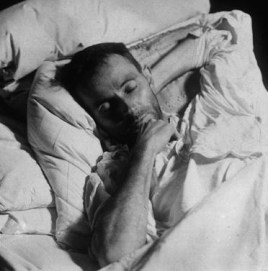

Edvard Munch, The Smell of Death
Links to more Reads:
Must Read at Vox: Trump is mishandling coronavirus the way Reagan botched the AIDS epidemic.
The Washington Post: The National Security Council sounded early alarms about the coronavirus.
The New York Times: The Medical News Site That Saw the Coronavirus Coming Months Ago.
The New York Times: They Survived the Spanish Flu, the Depression and the Holocaust.
Jewish Journal: 101-Year-Old Holocaust And Spanish Flu Survivor Just Beat COVID-19.
The Local: Italian 101-year-old leaves hospital after recovering from coronavirus.
The New York Times: For Autocrats, and Others, Coronavirus Is a Chance to Grab Even More Power.
ProPublica: He Was Ordered to Self-Isolate. He Didn’t. Now He’s Facing Criminal Charges.
The Guardian: Astrophysicist gets magnets stuck up nose while inventing coronavirus device.
The Daily Beast: Rodney Howard-Browne, Megachurch Pastor Who Flouted Virus Rules, Arrested.
Thanatos Thursday Reads
Posted: March 26, 2020 Filed under: morning reads, U.S. Politics | Tags: Anthony Fauci, coronavirus, Covid-19, Donald Trump, gods and goddesses of death, pandemic, Thanatos Greek god of death 31 Comments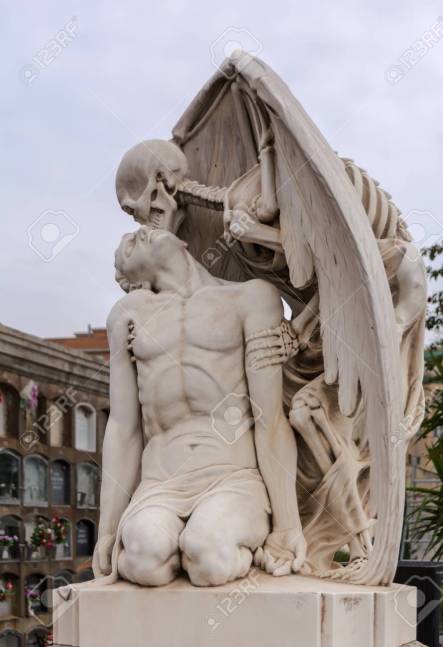
The Kiss of Death statue in Poblenou Cemetery in Barcelona. This marble sculpture depicts death, as a winged skeleton, kissing a handsome young man. The sculpture is at once romantic and horrifying.
Good Morning!!
The new global reality is truly horrifying. It feels as if we are living in an apocalyptic novel but we’re not–it’s actually happening. We knew in 2016 that if Trump were elected we would likely face a disaster at some point and he would make it so much worse. We knew he was totally unfit to handle even the basic duties of chief executive, much less a real national security emergency. Hillary warned us repeatedly, but the media ignored her warnings and focused on a ridiculous email “scandal” instead of analyzing the dangers of electing Trump.
And now here we are in the midst of global pandemic with a federal government emptied of experts and filled with incompetents loyal to Trump–because blind loyalty is the only qualification he recognizes.
The U.S. death toll from Covid-19 has now passed 1,000. NBC News: Coronavirus deaths hit 1,000 in U.S. as global death toll passes 20,000.
The United States has reached a grim milestone as the number of deaths linked to coronavirus passed 1,000 in the country on Thursday, according to a count by NBC News.
Yama – Tibetan Buddhist Dharmapala that was derived from the Hindu god of death of the same name
The number of reported deaths associated with the disease in the U.S. was at least 1,001 as of Thursday morning, according to that count, and there have been more than 68,000 reported cases. Globally, reported deaths passed 21,000, according to Johns Hopkins University.
The university puts the U.S. death toll even higher than the NBC News count, listing 1,050 as of around 2:30 a.m. ET.
Deaths continued to rise in New York, which has been called the epicenter of the epidemic on the U.S. There have been at least 334 deaths linked to the illness caused by the novel coronavirus as of early Thursday….
As of Wednesday evening, there had been more than 32,700 cases in the state, and more than 20,000 of those have been reported in New York City, according to the city’s health department. There have been 132 deaths in Washington state, health authorities say.

The New York Times: 13 Deaths in a Day: An ‘Apocalyptic’ Coronavirus Surge at an N.Y.C. Hospital.
In several hours on Tuesday, Dr. Ashley Bray performed chest compressions at Elmhurst Hospital Center on a woman in her 80s, a man in his 60s and a 38-year-old who reminded the doctor of her fiancé. All had tested positive for the coronavirus and had gone into cardiac arrest. All eventually died.
Elmhurst, a 545-bed public hospital in Queens, has begun transferring patients not suffering from coronavirus to other hospitals as it moves toward becoming dedicated entirely to the outbreak. Doctors and nurses have struggled to make do with a few dozen ventilators. Calls over a loudspeaker of “Team 700,” the code for when a patient is on the verge of death, come several times a shift. Some have died inside the emergency room while waiting for a bed.
A refrigerated truck has been stationed outside to hold the bodies of the dead. Over the past 24 hours, New York City’s public hospital system said in a statement, 13 people at Elmhurst had died.
“It’s apocalyptic,” said Dr. Bray, 27, a general medicine resident at the hospital.
Across the city, which has become the epicenter of the coronavirus outbreak in the United States, hospitals are beginning to confront the kind of harrowing surge in cases that has overwhelmed health care systems in China, Italy and other countries. On Wednesday evening, New York City reported 20,011 confirmed cases and 280 deaths.
Reuters: New Orleans emerges as next coronavirus epicenter, threatening rest of South.
New Orleans is on track to become the next coronavirus epicenter in the United States, dimming hopes that less densely populated and warmer-climate cities would escape the worst of the pandemic, and that summer months could see it wane.
The plight of New Orleans – with the world’s highest growth rate in coronavirus cases – also raises fears that the city may become a powerful catalyst in spreading the virus across the south of the country. Authorities have warned the number of cases in New Orleans could overwhelm its hospitals by April 4.
Baba Yaga, the death crone from Slavic folklore, depicted by Ivan Bilibin, 1900.
New Orleans is the biggest city in Louisiana, the state with the third-highest case load of coronavirus in the United States on a per capita basis after the major epicenters of New York and Washington.
The growth rate in Louisiana tops all others, according to a University of Louisiana at Lafayette analysis of global data, with the number of cases rising by 30% in the 24 hours before noon on Wednesday. On Tuesday, U.S. President Donald Trump issued a major federal disaster declaration for the state, freeing federal funds and resources.
Some 70% of Louisiana’s 1,795 confirmed cases to date are in the New Orleans metro area.

Los Angeles residents will be confined to their homes until May at the earliest, Mayor Eric Garcetti told Insider on Wednesday.
“I think this is at least two months,” he said. “And be prepared for longer.”
In an interview with Insider, Garcetti pushed back against “premature optimism” in the face of the COVID-19 pandemic, saying leaders who suggest we are on the verge of business as usual are putting lives at risk.
“I can’t say that strongly enough,” the mayor said. Optimism, he said, has to be grounded in data. And right now the data is not good.
Batara Kala – The Javanese and Balinese god of death
“Giving people false hope will crush their spirits and will kill more people,” Garcetti said, adding it would change their actions by instilling a sense of normality at the most abnormal time in a generation.
“This will not kill most of us,” he said. “It will kill a lot more people than we’re used to dying around us.”
On Tuesday, Garcetti said the city was anywhere from six to 12 days away from the fate of New York City, where a surge in patients with the novel coronavirus is threatening to overwhelm the health system.

But we really can’t be sure how many people are actually dying from the virus. Buzzfeed News: Doctors And Nurses Say More People Are Dying Of COVID-19 In The US Than We Know.
Medical professionals around the US told BuzzFeed News that the official numbers of people who have died of COVID-19 are not consistent with the number of deaths they’re seeing on the front lines.
In some cases, it’s a lag in reporting, caused by delays and possible breakdowns in logging positive tests and making them public. In other, more troubling, cases, medical experts told BuzzFeed News they think it’s because people are not being tested before or after they die.
In the US, state and county authorities are responsible for collecting data on cases of COVID-19 and deaths. The data is then reported to the Centers for Disease Control and Prevention.
In California, one ER doctor who works at multiple hospitals in a hard-hit county told BuzzFeed News, “those medical records aren’t being audited by anyone at the state and local level currently and some people aren’t even testing those people who are dead.”
“We just don’t know. The numbers are grossly under-reported. I know for a fact that we’ve had three deaths in one county where only one is listed on the website,” the doctor said.
At his daily coronavirus hate rallies, Trump has been advocating for everyone to go back to work despite the horrific sickness and death that would cause.

The Morrigan – The Celtic death god
Dr. Anthony Fauci, who continues to be a thorn in Trump’s side, had something to say about that. The Washington Post: Fauci’s coronavirus reality check: ‘You don’t make the timeline. The virus makes the timeline.’
Trump still refuses to help struggling health care workers by using his executive powers through the DPA to order industries to produce masks, protective clothing, and ventilators; and he appears to be withholding federal support for blue states, demanding that governors genuflect to him first.
The New York Times: Amid Desperate Need for Ventilators, Calls Grow for Federal Intervention.
As hospitals prepare for a flood of desperately ill patients unable to breathe on their own, mechanical ventilators have become the single most important piece of equipment that can mean the difference between life and death.
Now, with American hospitals facing a grave shortage of the vital devices, the Big Three automakers, small engineering firms, software designers and medical equipment manufacturers are rushing to figure out ways to produce more of them. But President Trump has so far declined to use powers that public health experts say could make a real difference in getting more ventilators to places that need them the most — right now.
What is really needed, a number of public health experts and former government officials say, is for Washington to take control of the nation’s existing ventilator supply. Because peak coronavirus infections will hit cities and regions at different times in the coming months, a centralized federal effort could send unused machines to hospitals that need them most.
“This is a national crisis,” said Frank Kendall, who served as under secretary of defense for acquisition and logistics in the Obama administration. “In a time of scarcity, you can’t leave it up to companies and governors to manage it themselves.”
Mr. Kendall said that only the federal government had the authority to take over the allocation of ventilators, both from manufacturers who are in the business of selling devices to the highest bidder, and state leaders unlikely to voluntarily let go of machines they fear they might need in the future.

More reads, links only:
Ron Klain at The Washington Post: We must plan now for how to get back to business later.
Ed Yong at The Atlantic: How the Pandemic Will End: The U.S. may end up with the worst COVID-19 outbreak in the industrialized world. This is how it’s going to play out.
Heather Long at The Washington Post: The $2 trillion relief bill is massive, but it won’t prevent a recession.
The Washington Post: G-7 failed to agree on statement after U.S. insisted on calling coronavirus outbreak ‘Wuhan virus.
Dana Millbank at The Washington Post: The nation comes together — without Trump.
Jennifer Rubin at The Washington Post: When the president is the problem.
Molly Jong-Fast at The Daily Beast: Don’t Worry, America, Jared Kushner Is Going to Save You From COVID-19.

 peej
peej Carissa
 bostonboomer
 dakinikat
 ecocatwoman
 mablue2
 Mama Lopez
 peggysue22
 quixote
 skydancingguestblogger
 Mona (aka Wonk the Vote)



 Sky Dancing
.jpg)
Recent Comments