
Thursday Reads: Political Parasites
Posted: February 25, 2016 Filed under: Barack Obama, morning reads, Republican politics, U.S. Politics | Tags: 2016 Democratic nomination fight, 2016 Republican nomination race, Bernie Sanders, Donald Trump, Hillary Clinton, political parasites 40 Comments![gazette-du-bon-ton-by-gose-1914-art-deco-pochoir.-il-a-ete-prime-[2]-58970-p](https://skydancingblog.com/wp-content/uploads/2016/02/gazette-du-bon-ton-by-gose-1914-art-deco-pochoir-il-a-ete-prime-2-58970-p.jpg?w=590&h=786)
Good Morning!!
I’m illustrating this post with drawings from a vintage French fashion magazine. You can read about it at Abe Books: Gazette du Bon Ton: A Journal of Good Taste.
There’s another Republican debate tonight, this time in Houston. I honestly don’t think I can stand to watch it, but I’ll keep an eye on today’s thread and put up another one tonight if necessary. The debate is on CNN, so you shouldn’t have any trouble streaming it on-line if you want to watch from your computer or other device. The freak show starts at 8:30PM ET.

Reuters: Trump versus Rubio and Cruz at Houston Republican debate.
At a CNN-hosted debate at the University of Houston, [Donald] Trump’s rivals will have one of their last best chances to try to derail the blunt-spoken political outsider before the Super Tuesday contests.
Whether they can pull it off is an open question. On stage with Trump will be U.S. Senator Marco Rubio of Florida, U.S. Senator Ted Cruz of Texas, Ohio Governor John Kasich and retired neurosurgeon Ben Carson. None have been able to slow Trump’s momentum in previous debates.
“Trump is on cruise control,” said Eric Fehrnstrom, a former senior adviser to 2012 Republican nominee Mitt Romney. He said Trump should ignore his opponents and focus on the key planks in his platform – a border wall to keep out illegal immigrants, a stronger military, defeating Islamic State and fair trade.
“It’s getting late in the game for everyone else. People who are expecting a sudden shift in the direction of the race are deluding themselves. Trump is Goliath, and we’ve seen enough of the other candidates to know there are no Davids in this field,” Fehrnstrom said.
Rubio, 44, has an added incentive to change the makeup of the race. He is scrambling to attract the financial donors who supported one-time establishment favorite Jeb Bush, who dropped out of the race after his disappointing finish in South Carolina on Saturday….
Cruz, 45, enters the debate under pressure. He must do well in his home state of Texas on Super Tuesday. Recently, he has been accused by his rivals of using negative tactics, including one that led to the resignation of his spokesman, Rick Tyler.
Mitt Romney has inserted himself into the GOP race with a highly ironic attack on Donald Trump. The Boston Globe reports:
Mitt Romney, whose 2012 presidential campaign was bedeviled over his own reluctance to publicly release his personal income tax returns, aggressively criticized Donald Trump on Wednesday for not releasing his returns….
“I think we have good reason to believe that there’s a bombshell in Donald Trump’s taxes,” Romney said on Fox News. “I think there is something there. Either he is not anywhere near as wealthy as he says he is, or he hasn’t been paying the kind of taxes we would expect him to pay, or perhaps he hasn’t been giving money to the vets or the disabled like he has been telling us he’s been doing.”
Trump quickly responded, ridiculing Romney — whom he endorsed in 2012 in a gold-studded event at Trump Tower in Las Vegas — and calling him a loser.
“Mitt Romney, who totally blew an election that should have been won and whose tax returns made him look like a fool, is now playing tough guy,” Trump wrote on Twitter. Then, he added: “When Mitt Romney asked me for my endorsement last time around, he was so awkward and goofy that we all should have known he could not win!”
In 2012, Republican candidates like Newt Gingrich and Herman Cain were running vanity campaigns–basically running for president in order to sell books.
That also seemed to be the case this year with Ben Carson. He even suspended his campaign for time to go to book signings. But it turns out that Carson’s campaign may be even a worse “scam”–one that Carson himself may not have been aware of until recently. From The Atlantic:
Carson has taken in incredible amounts of money during the race. His campaign has raised more than any other Republican presidential rival, though they’ve raised more when super PACs are included. But he’s also spent more than any of them, so that despite his prolific fundraising, he has barely $4 million in cash on hand.
That’s because Team Carson has been plowing a huge portion of the money it raises back into fundraising, using costly direct-mail and telemarketing tactics. Pretty much every campaign uses those tools, but the extent to which Carson was using it raised eyebrows around politics. First, many of the companies being paid millions and millions of dollars are run by top campaign officials or their friends and relations, meaning those people are making a mint. Second, many of the contributions are coming from small-dollar donors. If that money is being given by well-meaning grassroots conservatives for a campaign that’s designed not to win but to produce revenue for venders, isn’t it just a grift?
These questions have been circling since last summer. If they’re right, the most sympathetic interpretation is that Carson, like his donors, was being taken for a ride by his aides, and wasn’t in on the scam. Carson seemed to suggest as much on Tuesday, implying he was taken advantage of by aides who treated the campaign as an ATM.
Read more at the link.

I’m wondering if Bernie Sanders will use his higher visibility from his campaign–which is basically a vanity campaign at this point–to get a big book contract and increase his speaking fees. It turns out Sanders has done something similar in the past. From The Center for Public Integrity:
Sanders turned a fiery, hourslong filibuster against extending the Bush tax cuts into a book. During the 2012 election cycle, his campaign gave a copy to donors of at least $50.
What he did was use campaign funds to purchase a lot of the books and then “gave” them to donors who contributed at least $50.00 That’s a pretty good profit on a paperback book that sold for around $10.00. I don’t think this is illegal, but it seems a little bit questionable for a man who calls himself a socialist (he isn’t one). Here’s a graphic posted on Twitter.
https://twitter.com/SDzzz/status/702771840859549696
From US News: Sanders’s 8.5 Hour Tax Cut Filibuster Gets a Book.
It wasn’t exactly Washington’s version of The King’s Speech, but independent Vermont Sen. Bernie Sanders’s 8½-hour blast in December at President Obama’s deal with Republicans to extend the Bush tax cuts is getting star treatment. Nation Books is printing it in its entirety in The Speech: A Historic Filibuster on Corporate Greed and the Decline of Our Middle Class. The senator’s passionate address, which runs over 255 pages in the book, was a rare oratorical tour de force: It attracted so many online viewers it crashed the Senate television website. Some say Obama was so miffed by the speech that he held an impromptu press conference with former President Clinton to divert attention.
So he used the speech to undermine President Obama twice–by giving the speech against the Obama’s wishes and using it to run Senate during the president’s reelection campaign. By the way, Sanders’ book “The Speech” was published by Nation Books, the publishing arm of The Nation magazine which has endorsed Sanders in the 2016 race.
![gazette-du-bon-ton-by-barbier-1912-art-deco-pochoir.-la-belle-aux-moineaux-[2]-59024-p](https://skydancingblog.com/wp-content/uploads/2016/02/gazette-du-bon-ton-by-barbier-1912-art-deco-pochoir-la-belle-aux-moineaux-2-59024-p.jpg?w=225&h=300)
At Politico, Jack Shafer has an interesting piece on Trump and Sanders as “political parasites.”
Think of the Republican Party as a host organism that has only now discovered the parasite it acquired eight months ago. The parasite, of course, is Donald J. Trump—no more a Republican than I—who has inserted himself into the party and appears to be on his way to winning its presidential nomination. Feeding on the Republican Party’s primary and caucus process, the Trump parasite has progressed from egg to larva and has now commandeered many of the Republican Party’s metabolic functions. But it’s been managed growth, as the smart-thinking parasite likes to keep its zombie host alive long enough to develop into the next stage and lay its own eggs and begin the process anew.
Trump isn’t the only political parasite on the hustings this season. Bernie Sanders, who never ran as a Democrat before this election, has likewise attempted to colonize the gastrointestinal tract of a major party in hopes that it will eventually deposit him at the White House. True to his parasitical nature, Sanders loves the idea of the party but has little interest in actually supporting it. He has raised only $1,000 for the Democratic Party’s fundraising alliance, while Hillary Clinton, who is many things but assuredly not a parasite, has raised $26.9 million.
Trump has similarly stiffed his party’s fundraising operations, canceling a scheduled appearance at a December Republican National Committee fundraising event, and Twitter-shouting his fury at the RNC for allegedly using his name in a fundraising solicitation without his consent. “Totally unauthorized, do not pay,” Trump tweeted. The true parasite never supports the host!
The life cycles of the Trump and Sanders parasites are nowhere near as gruesome as the life cycles of the Guinea worm and the parasitoid wasp, but they are as striking as anything we witness in nature. Viewing Trump and Sanders with an ideological microscope, it’s apparent that neither has much affinity for the parties they’ve joined. Their object and their genius has been to seize as much control as they can of the major parties from the various “establishments” and wage their outsider third-party candidacies from inside. Suitably camouflaged, neither Trump nor Sanders is seen by the average voter for political freeloaders they are.
I’m not a big fan of Schafer’s but that makes a lot of sense to me. Are both parties being hollowed out from within?
![gazette-du-bon-ton-by-fabius-1914-art-deco-pochoir.-sophonisbe-[2]-59150-p](https://skydancingblog.com/wp-content/uploads/2016/02/gazette-du-bon-ton-by-fabius-1914-art-deco-pochoir-sophonisbe-2-59150-p.jpg?w=225&h=300)
If the polls in upcoming primary and caucus states are anything close to correct, Sanders has no chance to get the Democratic nomination. But he is still out there trying to tear down the party and attacking Hillary Clinton–the likely nominee–in the most vicious ways he can think of. It is really starting to bother me a great deal, and I’m glad that the party seems to be coalescing around the potential first woman president.
I’ll end this post with another powerful essay from Sady Doyle: America loves women like Hillary Clinton–as long as they’re not asking for a promotion.
It’s hard to remember these days, but just a few years ago, everybody loved Hillary Rodham Clinton. When she stepped down as US secretary of state in January 2013 after four years in office, her approval rating stood at what the Wall Street Journal described as an “eye-popping”69%. That made her not only the most popular politician in the country,but the second-most popular secretary of state since 1948.
The 2012 “Texts from Hillary” meme, which featured a sunglasses-clad Clinton scrolling through her Blackberry aboard a military flight to Libya, had given rise to a flood of think pieces hailing her “badass cool.” The Washington Post wanted president Barack Obama to give vice president Joe Biden the boot and replace him with Clinton. Taking stock of Clinton’s approval ratings, Nate Silver noted in a 2012 piece for the New York Times that she currently held “remarkably high numbers for a politician in an era when many public officials are distrusted or disliked.”
![gazette-du-bon-ton-by-barbier-1914-deco-pochoir.-la-fontaine-de-coquillages-[2]-59020-p](https://skydancingblog.com/wp-content/uploads/2016/02/gazette-du-bon-ton-by-barbier-1914-deco-pochoir-la-fontaine-de-coquillages-2-59020-p.jpg?w=225&h=300)
How times have changed. “The FBI And 67 Percent of Americans Distrust Hillary Clinton,” booms a recent headline in the Huffington Post. Clinton’s favorability ratings currently hover around 40.8%. Bob Woodward complains that “there is something unrelaxed about the way she is communicating.” “Hillary’s personality repels me,” Walker Bragman writes in Salon.How can we reconcile the “unlikable” Democratic presidential candidate of today with the adored politician of recent history? It’s simple: Public opinion of Clinton has followed a fixed pattern throughout her career. Her public approval plummets whenever she applies for a new position. Then it soars when she gets the job. The wild difference between the way we talk about Clinton when she campaigns and the way we talk about her when she’s in office can’t be explained as ordinary political mud-slinging. Rather, the predictable swings of public opinion reveal Americans’ continued prejudice against women caught in the act of asking for power.
I hope you’ll go over to the Quartz link and read the whole thing.
So . . . what stories are you following today?
Thursday Reads: Will It Come Down to Rubio Vs. Cruz?
Posted: November 12, 2015 Filed under: morning reads, Republican politics, U.S. Politics | Tags: 2016 Republican nomination race, immigration, Marco Rubio Ted Cruz 32 Comments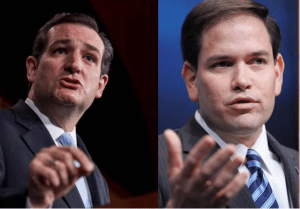 Good Morning!!
I’m beginning to get the feeling that Marco Rubio will be the GOP nominee. He seems to be the favorite of the money men, the “establishment” Republicans, and the corporate media. The only problem for him is that he’s still not very popular with voters.
But honestly, who else are the Republicans going to nominate? Trump is a know-nothing, egotistical blowhard, Carson is fabulist who spouts bizarre biblical fantasies and nutty conspiracy theories, Cruz is hated by just about everyone who has ever met him, Bush is the worst candidate evah, and Paul and Kasich are also-rans.
Rubio is young, baby-faced, and clean cut–never mind the fact that he is corrupt, ignorant, inexperienced, and would change any of his beliefs or policies and, if necessary, attack his own mother in order to win. Just look how he has treated his own mentor, Jeb Bush.
The latest media narrative is that Rubio and Ted Cruz are on a collision course.
Politico: The coming fight between Marco Rubio and Ted Cruz.
Going into the week, Jeb Bush and Marco Rubio seemed to be the rivalry to watch in the GOP primary. After the fourth Republican debate, that’s been replaced by a new and perhaps more consequential storyline: the coming collision of Rubio and Ted Cruz.
The two Cuban-Americans, both 40-something, first-term senators with tea party credentials, continue to trail outsider candidates Donald Trump and Ben Carson in the polls. But they’re increasingly viewed as the candidates to beat in their respective lanes — Rubio as the new establishment front-runner and Cruz beginning to consolidate support from the party’s more conservative wing. The consensus view that they outperformed their rivals Tuesday has served only to cement that impression.
“There’s this growing sense that Rubio’s the best candidate and that people are getting pretty comfortable with him,” said Bruce Haynes, a Republican strategist. “You can feel Carson and Trump losing support. Cruz is a quiet tide in the night that is beginning to wash out the base on Donald Trump. Now, I think, people are looking at Cruz as the candidate who’s best positioned in a lane to run with Rubio and give him a real fight.”
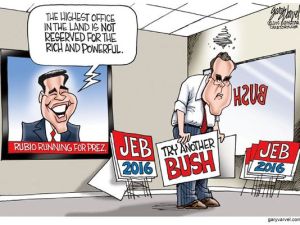
Both Cruz and Rubio are incredibly mean and ambitious, but I have to believe that Rubio will win out in the long run because Cruz is already the most hated man in DC. I have to believe that event Republican voters will hate him once they get to know him better.
At the NYT, Jeremy W. Peters writes: Confrontation Brews as Ted Cruz and Marco Rubio Vie for Conservative Vote.
That fight, which could be the most decisive but unpredictable element of the nomination contest, increasingly appeared to be heading toward a confrontation between two first-term senators both elected with Tea Party support but who have since taken different paths: Ted Cruz of Texas and Marco Rubio of Florida.
Each made his pitch in subtle but unmistakable ways during the debate and afterward, as they left Milwaukee for a day of campaigning across the country.
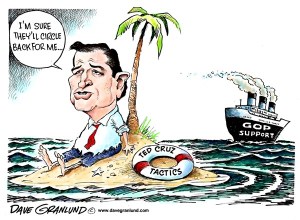
The most glaring difference between the two that surfaced during the debate — and continued in interviews each gave in the hours afterward — was over the issue of immigration policy. Mr. Cruz tried to portray Mr. Rubio as a moderate beholden to the Republican establishment, while Mr. Rubio argued that his approach was the most reasonable and workable conservative solution.
Yesterday as Cruz was campaigning in New Hampshire, Peters asked him to distinguish between his immigration policies and Rubio’s.
“It is not complicated,” Mr. Cruz said, then paused before adding, “that on the seminal fight over amnesty in Congress, the Gang of Eight bill that was the brainchild of Chuck Schumer and Barack Obama, that would have granted amnesty to 12 million people here illegally, that I stood with the American people and led the fight to defeat it in the United States Congress.”
Mr. Cruz said: “In my view, if Republicans nominate for president a candidate who supports amnesty, we will have given up one of the major distinctions with Hillary Clinton and we will lose the general election. That is a path to losing.
“And part of the reason the debate last night was so productive is you started to see clear, meaningful policy distinctions, not just between what people say on the campaign trail. Talk’s cheap. But between their records. When the fight was being fought, where did you stand? That speaks volumes about who you are and where you will stand in the future. And we’re entering the phase now in the presidential race where primary voters are starting to examine the records of the candidates.”
Peters also notes that Rubio tried to clarify his immigration views yesterday on Fox News.
“The lesson I learned from that is the people of the United States do not trust the federal government on immigration,” Mr. Rubio said as he listed a tough set of policies he said would “realistically but responsibly” address the problem.
“If you’re a criminal, you’ll be deported,” he said. “If you’re not a criminal, and have been here longer than 10 years, you have to learn English. You have to start paying taxes. You’re going to have to pay a fine. And then you’ll get a work permit.” He did not mention the question that enrages so many conservative voters: whether to eventually grant citizenship to undocumented immigrants.
The problem Rubio has is that he hopes to get support from some Latinos and from moderate Republicans; Cruz is only interested in the right wing nuts.
Reihan Salam at Slate: Where Does Marco Rubio Stand on Immigration?
Back in the 1980s, Pat Schroeder, a liberal congresswoman from Colorado, dubbed Ronald Reagan “the Teflon president” for the way he managed to avoid any blame for the scandals that erupted around him in his second term. One wonders whether Rubio is emerging as the Teflon candidate. With the possible exception of the silver-tongued Carly Fiorina, no Republican presidential candidate has helped himself more over the course of the first four debates than Rubio. On Tuesday night, Rubio fared well again. He wasn’t quite as strong as Ted Cruz, who, as Slate’s Josh Voorhees argues, was the night’s biggest winner. More than usual, Rubio seemed to be drawing on his stock references to his hardscrabble upbringing and his immigrant parents, and his optimistic homilies about the healing power of the American Dream. What was really striking about Rubio’s performance, however, is the way he dodged, yet again, getting drawn into a debate over immigration policy….
It would be one thing if Rubio only avoided talking about comprehensive immigration reform on the debate stage, but the Florida senator has soft-pedaled the issue throughout his campaign, only occasionally explaining why he decided to abandon his comprehensive immigration reform bill, which offered a path to citizenship to unauthorized immigrants and substantially increased legal immigration, among other things. Instead of repudiating the months he spent crafting an immigration compromise, Rubio emphasizes that he couldn’t trust President Obama as a partner, or that the timing wasn’t right. He insists that he pushed the comprehensive immigration reform bill in as conservative a direction as he could.
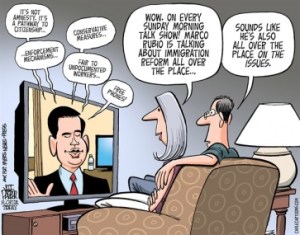
Yet we don’t have a clear sense of where, in an ideal world, Rubio would like U.S. immigration policy to go. On his nattily designed website, Rubio excerpts a passage from American Dreams, his biography, in which he makes the case for securing the border first, a conservative-friendly stance. He calls for moving from an immigration policy that emphasizes family ties to current U.S. citizens to one that is instead based on skills, which is sensible and broadly acceptable to the Republican right. What we don’t know is what this would mean in practice. Can we really say that we have a skills-based immigration policy if we also have a guest worker program for less-skilled workers, and if guest worker status can be renewed indefinitely? One assumes that guest workers will form families on U.S. soil and that many of them will be reluctant to leave the country once their guest worker visas run out. And though Rubio discusses immigration policy in broad strokes, he doesn’t really tell us about numbers. Will we admit more immigrants under the approach he favors? Or fewer? Even after abandoning comprehensive immigration reform, Rubio has backed legislation that would dramatically expand the H-1B visa program. What does he think about the evidence that the H-1B program is being gamed by offshoring companies with less than sterling records? These are questions I’d like to see Rubio answer at a future debate.
Other elements of Rubio’s immigration approach are likely to prove even more controversial. For example, he makes it clear that he intends to offer some form of legal status to unauthorized immigrants who already live in the U.S., a position that puts him at odds with many Republicans.* If Rubio intends to stick with this position, as I think he does, he’s going to have to actually make the case for it.
It’s difficult for me to understand the Republicans’ attitudes toward immigration, but it does appear that it is one of the most important issues for their base.
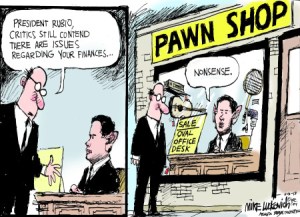
Another problem Rubio has is his possible past financial indiscretions. Has he continued this kind of dishonesty in Washington? Will Rubio’s “Teflon” work on this issue too?
The Miami Herald via Raw Story: New info raises more questions: Did Marco Rubio use his GOP credit card to subsidize his life?
For five years, Marco Rubio has tried to put behind him the controversy of his spending on a Republican Party of Florida credit card, taking the unusual step over the weekend of making public nearly two years of American Express statements to show how he spent the party’s money.
In some ways, however, the statements, which he previously refused to make public, raise more questions about how Rubio used the card, rather than laying them to rest.
Some big-ticket expenses he rang up on the card — $1,625 at the St. Regis Hotel in New York, $527 for food and drinks at Disney, $953 for a meal at Silver Slipper, the Tallahassee steakhouse — are the kind of eye-catching charges expected for someone doing party business.
But a slew of small charges at gas stations and for cheap meals — at a time when Rubio was struggling with his personal finances — suggest Rubio made the most of the ample leeway and little oversight party leaders gave employees and lawmakers to spend the party’s cash.
The Florida GOP issued corporate cards, intended for business use, during flush years a decade ago. A spending scandal threw the party into crisis five years later, around 2010, when some of the AmEx statements — including Rubio’s from 2007-08 — were made public. Rubio’s presidential campaign released the remaining two years of statements from 2005-06 on Saturday to show Rubio had repaid the party when he misused the card for personal charges.
An analysis by the Herald/Times of the new statements, however, found Rubio spent freely on the sort of items that are difficult to prove — or disprove — as party business expenses.
There’s much more at the link, and it makes Rubio look like a petty crook. Is there more to this story?
Although I see Rubio as a lightweight, it looks like the “very important people” see him as their best shot to get a Republican in the White House. I think he’s scary because he comes across as so sweet and innocent.
What do you think? Please post your thoughts and links on any topic in the comment thread.

 peej
peej Carissa
 bostonboomer
 dakinikat
 ecocatwoman
 mablue2
 Mama Lopez
 peggysue22
 quixote
 skydancingguestblogger
 Mona (aka Wonk the Vote)



 Sky Dancing
Recent Comments