
Trump and his aides also allegedly carried out a “dress rehearsal” for moving sensitive papers even before his office received the May 2022 subpoena, according to the people familiar with the matter who spoke on the condition of anonymity to describe a sensitive ongoing investigation.
Fabulous Friday Reads
Posted: May 26, 2023 Filed under: abortion rights, Donald Trump, SCOTUS | Tags: abortion, books and reading, Caitlin Bernard, Clean Water Act, Espionage Act, Indiana, rape, Samuel Alito, Supreme Court, Trump stolen documents case, wetlands 13 CommentsGood Day, Sky Dancers!!
I am addicted to books. In my adult years, I have bought so many books that I could never read them all; but I can’t stop myself–or maybe I don’t want to. When I moved into the apartment I live in now, I had to leave hundreds of books behind, because I simply didn’t have room for them. I tell myself an addiction to buying books is at least better than addictions to alcohol and drugs. I do much of my reading on my Kindle now, and at least those books don’t take up space. But I still love physical books and I still buy more than I can read. I’m 75 years old now, and I don’t have that much time left; but I still want to read as many books as I can before I “shuffle off this mortal coil.”
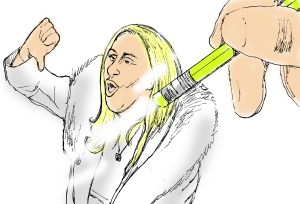
Could this be a solution?
Okay, probably not; but it’s an interesting fantasy. And now for some news.
Yesterday The Washington Post broke a story on the investigation into Trump’s theft of, and refusal to return, government documents. A short time later, The New York Times followed up with more details.
Devlin Barrett, Josh Dawsey, Spencer S. Hsu, and Perry Stein at The Washington Post: Trump workers moved Mar-a-Lago boxes a day before FBI came for documents.book
Two of Donald Trump’s employees moved boxes of papers the day before an early June visit byFBI agents and a prosecutor to the former president’s Florida home to retrieve classified documents in response to a subpoena — timing that investigators have come to view as suspicious and an indication of possible obstruction, according to people familiar with the matter.
Prosecutors in addition have gathered evidence indicating that Trump at times kept classified documents in his office in a place where they were visible and sometimes showed them to others, these people said.
Taken together, the new details of the classified-documents investigation suggest a greater breadth and specificity to the instances of possible obstruction found by the FBI and Justice Department than have been previously reported. It also broadens the timeline of possible obstruction episodes that investigators are examining — a period stretching from events at Mar-a-Lago before the subpoena to the period after the FBI search there on Aug. 8.
That timeline may prove crucial as prosecutors seek to determine Trump’s intent in keeping hundreds of classified documents after he left the White House, a key factor in deciding whether to file charges, possibly for obstruction, mishandling national security secrets or both. The Washington Post has previously reported that the boxes were moved out of the storage area after Trump’s office received a subpoena. But the precise timing of that activity is a significant element in the investigation, the people familiar with the matter said.
The WaPo writers focus on obstruction, but if Trump showed documents to other people, that could be espionage. Remember, espionage was one of the crimes listed on the warrant for the FBI search of Mar-a-Lago.
More details from the WaPo story:
Of particular importance to investigators in the classified-documents case, according to people familiar with the probe, is evidence showing that boxes of documents were moved into a storage area on June 2, just before senior Justice Department lawyer Jay Bratt arrived at Mar-a-Lago with agents. The June 3 visit by law enforcement officialswas to collect material in response to the May 2022grand jury subpoena demanding the return of all documents with classified markings.
John Irving, a lawyer representing one of the two employees who moved the boxes, said the worker did not know what was in them and was only trying to help Trump valet Walt Nauta, who was using a dolly or hand truck to move a number of boxes.
“He was seen on Mar-a-Lago security video helping Walt Nauta move boxes into a storage area on June 2, 2022. My client saw Mr. Nauta moving the boxes and volunteered to help him,” Irving said. The next day, he added, the employee helped Nauta pack an SUV “when former president Trump left for Bedminster for the summer.”
The lawyer said his client, a longtime Mar-a-Lago employee whom he declined to identify, has cooperated with the government and did not have “any reason to think that helping to move boxes was at all significant.” Other people familiar with the investigation confirmed the employee’s role and said he has been questioned multiple times by authorities.
Awhile back there was a video circulating on Twitter of people moving boxes out of Mar-a-Lago and loading them onto a truck to be taken to Bedminster. This happened the day before Trump left to spend the summer at his New Jersey golf club. Now it’s being posted again.
This is from Alan Feuer and Maggie Haberman at The New York Times: Mar-a-Lago Worker Provided Prosecutors New Details in Trump Documents Case.
The day before a key meeting last year between a lawyer for former President Donald J. Trump and officials seeking the return of classified documents in Mr. Trump’s possession, a maintenance worker at the former president’s private club saw an aide moving boxes into a storage room, according to a person familiar with the matter.
The maintenance worker offered to help the aide — Walt Nauta, who was Mr. Trump’s valet in the White House — move the boxes and ended up lending him a hand. But the worker had no idea what was inside the boxes, the person familiar with the matter said. The maintenance worker has shared that account with federal prosecutors, the person said….
Mr. Trump was found to have been keeping some of the documents in the storage room where Mr. Nauta and the maintenance worker were moving boxes on the day before the Justice Department’s top counterintelligence official, Jay Bratt, traveled to Mar-a-Lago last June to seek the return of any government materials being held by the former president.
Mr. Nauta and the worker moved the boxes into the room before a search of the storage room that same day by M. Evan Corcoran, a lawyer for Mr. Trump who was in discussions with Mr. Bratt. Mr. Corcoran called Justice Department officials that night to set up a meeting for the next day. He believed that he did not have a security clearance to transport documents with classified markings, a person briefed on his decision said.
Weeks earlier, the Justice Department had issued a subpoena demanding the return of the documents. Prosecutors have been trying to determine whether Mr. Trump had documents moved around Mar-a-Lago or sought to conceal some of them after the subpoena.
Part of their interest is in trying to determine whether documents were moved before Mr. Corcoran went through the boxes himself ahead of a meeting with Justice Department officials looking to retrieve them. Prosecutors have been asking witnesses about the roles of Mr. Nauta and the maintenance worker, whose name has not been publicly disclosed, in moving documents around that time.
During his trip to Mar-a-Lago on June 3, Mr. Bratt was given a packet of roughly three dozen documents with classified markings by a lawyer for Mr. Trump. Mr. Bratt was also given a letter, drafted by Mr. Corcoran but signed by another lawyer for the former president, attesting that a diligent search had been carried out for any additional material in response to the subpoena and that none had been found. Mr. Bratt was not given access to search the storage room at that point.
The obvious inference is that Trump may have gone through the boxes and removed items that he wanted to keep, concealing them in his private quarters. Remember that classified documents were later found in his office desk and in his bedroom.
Like the WaPo writers, Feuer and Haberman focus their discussion on possible obstruction charges, and ignore the obvious possibility of espionage charges based on the fact that Trump showed documents to people at his private club and left them lying around in plain sight.
The penalties for violating the espionage act are 20 years in prison and a $10,000 fine.
In other news, the Supreme Court yesterday announced another horrific decision. This time they’ve gutted the Clean Water Act.
Timothy Puko and Robert Barnes at The Washington Post: How Supreme Court’s EPA ruling will affect U.S. wetlands, clean water.
Bogs. Marshes. Swamps. Fens. All are examples of wetlands.
But the type of wetland that gets protection under federal law is a matter of wide dispute, one reset by a sweeping ruling Thursday from the U.S. Supreme Court.
At issue is the reach of the 51-year-old Clean Water Act and how courts should determine what count as “waters of the United States” under that law. Nearly two decades ago, the court ruled that wetlands are protected by the Clean Water Act if they have a “significant nexus” to regulated waters.
The Supreme Court decided that rule no longer applies and said the Environmental Protection Agency’s interpretation of its powers went too far, giving it regulatory power beyond what Congress had authorized….
Writing for five justices of the court, Justice Samuel A. Alito ruled that the Clean Water Act extends only to “those wetlands with a continuous surface connection to bodies that are ‘waters of the United States’ in their own right, so that they are ‘indistinguishable’ from those waters.” He was joined by Chief Justice John G. Roberts Jr. and Justices Clarence Thomas, Neil M. Gorsuch and Amy Coney Barrett….
Some environmental groups and legal experts estimate that the decision will remove federal protection from half of all wetlands in the continental United States. According to estimates from Earthjustice, an environmental law firm, the decision will prevent the EPA from placing federal protections on as many as 118 million acres of wetlands, an area larger than the landmass of California. Those estimates could not be immediately confirmed, but the ruling is expected to give farmers, home builders and other developers far more latitude to disturb lands previously regulated under the Clean Water Act….
The ruling affects one of the EPA’s most fundamental authorities — its ability to protect upstream waters in order to protect downstream water quality for drinking supplies and wildlife. Experts say greater development upstream could result in silt and pollutants damaging downstream waters and habitat, and reduce the flood control and groundwater-recharge benefits of protected wetlands.
Read all the gory details at the WaPo link.
Commentary by Mark Joseph Stern at Slate: Samuel Alito’s Assault on Wetlands Is So Indefensible That He Lost Brett Kavanaugh.
On Thursday, the Supreme Court dealt a devastating blow to the nation’s wetlands by rewriting a statute the court does not like to mean something it does not mean. The court’s decision in Sackett v. EPAis one of the its most egregious betrayals of textualism in memory. Put simply: The Clean Water Act protects wetlands that are “adjacent” to larger bodies of water. Five justices, however, do not think the federal government should be able to stop landowners from destroying wetlands on their property. To close this gap between what the majority wants and what the statute says, the majority crossed through the word “adjacent” and replaced it with a new test that’s designed to give landowners maximum latitude to fill in, build upon, or otherwise obliterate some of the most valuable ecosystems on earth.
Justice Samuel Alito’s opinion for the court is remarkably brazen about this approach—so brazen that Justice Brett Kavanaugh (of all people!) authored a sharp opinion accusing him of failing to “stick to the text.” Alito began with a long history of the Supreme Court’s struggles to identify the “outer boundaries” of the Clean Water Act, as if to explain why the time had come for the court to give up wrestling with the text and just impose whatever standard it prefers. The law expressly protects “waters of the United States” (like rivers and lakes) as well as “wetlands adjacent” to these waters. Congress added the wetlands provision in 1977 to codify the EPA’s definition of “adjacent,” which also happens to be the actual definition: “bordering, contiguous, or neighboring.” Under that interpretation—the one Congress adopted—wetlands that neighbor a larger body of water remain protected, even if they aren’t directly connected.
Why did Congress make that choice? Because wetlands provide immense environmental benefits: They filter and purify water draining into nearby streams, rivers, and lakes. They slow down runoff into these larger bodies. And they serve as vital flood control. In other words, the Clean Water Act has to protect “adjacent” wetlands to serve its overarching goal of safeguarding the broader “waters of the United States” from pollution.
Too bad, Alito wrote: We don’t like the definition that Congress used. It could lead to “crushing” fines for landowners and interfere with “mundane” activities like “moving dirt.” It interferes with “traditional state authority.” And it could give the EPA “truly staggering” regulatory authority. Five justices on the Supreme Court think all of that is very bad. So they declared that, instead of applying the statute’s words, the court would impose a different standard: Only wetlands with “a continuous surface connection” to larger bodies of water merit protection under the Clean Water Act.
This definition—which, it just can’t be stressed enough, appears nowhere in the law—is a crushing defeat for wetlands and their protectors. These ecosystems, as Kavanaugh pointed out, are frequently separated from larger bodies of water by “man-made dikes or barriers” as well as “natural river berms, beach dunes, or the like.” Such wetlands “play an important role in protecting neighboring and downstream waters,” which is why Congress included them in the statute. But under the majority’s new test, they are stripped of federal protection.
Sam Alito: the same asshole who overturned Roe v. Wade while citing a 17th century judge who presided over a witch trial.
I’ll wrap up this post with an abortion horror story at The Washington Post: Indiana board fines doctor for discussing rape victim’s abortion.
https://twitter.com/donmoyn/status/1662078210518007813?s=20
Indiana’s medical licensing board decided late Thursday to discipline a doctor who made headlines last year for performing an abortion for a 10-year-old Ohio rape victim. The board gave the doctor a letter of reprimand and ordered her to pay a $3,000 fine for violating ethical standards and state laws by discussing the case with a reporter.
For nearly a year, Indiana’s Attorney General Todd Rokita (R) pursued punishment for Caitlin Bernard, an OB/GYN and an assistant professor at the Indiana University School of Medicine who carried out the abortion in June 2022, less than a week after Roe v. Wade was struck down, enacting trigger laws.
Bernard broke patient privacy laws by telling an Indianapolis Star reporter about the patient’s care, the board decided Thursday night after a roughly 14-hour hearing that ended shortly after 11:30 p.m. Bernard’s lawyers argued she properly reported the incident to an Indiana University Health social worker and did not run afoul of privacy laws when she discussed the patient’s case in a general and “deidentified” manner that is typical for doctors.
Records obtained by The Washington Post last year show that Bernard reported the girl’s abortion to the relevant state agencies ahead of the legally mandated deadline, which the board agreed with Thursday night, clearing her of a charge related to that issue.
These assholes are supposedly doing this in order to “protect” the patient–a 10-year-old child who was impregnated by a rapist in Ohio and had to travel to Indiana because her Ohio politicians determined that she should be forced to bear her rapist’s child even though that could be life-threatening for her.
Bernard’s lawyers rejected Rokita’s allegations as baseless and politically motivated. The seven-member board of governor appointees could, by a majority vote, have either taken no action against Bernard or imposed a range of disciplinary measures up to and including the immediate termination of Bernard’s medical license.
Throughout the lengthy hearing, Bernard faced at times pointed questions about her decisions.
She explained how, as a doctor, she felt she had “an obligation” to ensure Hoosiers understood how abortion bans were affecting people across the country — and could eventually affect them.
Bernard was also asked whether she thought she would have “gotten as much attention” if she had not mentioned the 10-year-old patient’s case to a reporter.
“I don’t think that anybody would have been looking into this story as any different than any other interview that I’ve ever given if it was not politicized the way that it was by public figures in our state and in Ohio,” Bernard said.
That’s my contribution for today. What stories have you been following lately?
Thursday Reads: #DeSaster and #Decorum Day
Posted: May 25, 2023 Filed under: morning reads | Tags: Crazy Marjorie Taylor Greene, Ron DeSaster, Tina Turner Queen of Rock and Roll 21 Comments
#DeSaster by Artist John Buss
Good Day, Sky Dancers!
I’m still recovering from all that grading, but at least I get to write about these ultra-embarrassing Maga Moments today! This one is a hoot! Weirdo Congresswoman MGT play-acting as the Speaker Pro Tempore. This is the woman that does everything but pig calls from her seat at anything she deems woke. This is from The Guardian. “House Democrats laugh off Marjorie Taylor Greene’s call for ‘decorum.’ Far-right Georgia Republican draws laughter after banging gavel and demanding order as Steve Scalise spoke.” I’m relieved to see one media outlet call her far right instead of conservative for a change.
Democrats in the House chamber burst into raucous laughter when Marjorie Taylor Greene called for “decorum”.
The far-right Georgia Republican, controversialist and conspiracy theorist was presiding over the House on Wednesday as Steve Scalise, the Republican majority leader, was speaking.
Scalise was discussing the debt ceiling standoff between House Republicans and the Biden White House.
He said: “We are in fact the only body in this town who has actually taken steps to address the debt ceiling and the spending problem in Washington.”
An unseen lawmaker yelled something. From the dais, Greene pounded her gavel and called for order.
Scalise asked: “I ask that the House be in order and there be some decorum on the other side.”
After a pause, Greene pounded her gavel and said: “The members are reminded to abide by decorum of the House.”
The chamber erupted in laughter and catcalls. Greene banged her gavel repeatedly. Eventually, Scalise returned to his remarks.
We had an idea that the DeSantis blastoff with Twitter Monster Elon Musk would be a disaster but, now it’s being called a #DeSaster. They own it. This is from Susan B. Glasser at The New Yorker. “It Was More Than a #DeSaster. Ron DeSantis’s botched campaign launch suggests that he’s no Trump killer.” Did he remember to write “Be Likable” at the top of his notes?
I’ve long been of the view that Donald Trump is something akin to a horror-movie monster—a Godzilla or a T. Rex, say—for the American political system. In such movies, it’s often not the puny humans who take out the monster; it’s another monster. And in such a scenario it would seem to make perfect sense that only a Republican specifically engineered and optimized for the bizarre cult of G.O.P. politics in 2024 would be the right candidate to do the job on Trump. But if that’s the theory of the case for Ron DeSantis, the forty-four-year-old governor of Florida, the events of Wednesday evening showed it’s still very much an unproven theory.
Was DeSantis’s Presidential-campaign launch best described as a debacle? A farce? A nightmare? The Times called it a “meltdown.” Politico went with “horrendous.” Perhaps the best summation of Wednesday’s epic fail was #DeSaster, an actual trending hashtag on Twitter. Whatever one chose to call it, it’s a pretty bad sign for a campaign when the biggest controversy inspired by its début is what synonym for “terrible” to give it. And the problem wasn’t just the technical glitches. The start of the Twitter Spaces event featuring DeSantis and Twitter’s billionaire owner, Elon Musk, was delayed by more than twenty-five minutes while Musk audibly struggled to get his new platform to work. But just as wretched was what DeSantis had to say once he started talking, both on Twitter and in a subsequent interview on Fox News, which boiled down to a lot of complaints about the “legacy media” and little rationale for his candidacy.
Trump, whose name DeSantis never uttered on Wednesday night, welcomed the news of his rival’s implosion with a video of a rocket labelled “Ron 2024!” exploding on a launchpad. Don, Jr., gleefully compared DeSantis to the former Florida Republican governor eviscerated by his father in 2016. “DeSantis is making JEB! look high energy right now,” he taunted. Even Joe Biden, who unlike Trump was mentioned frequently by DeSantis, joined in. The President tweaked DeSantis in a tweet urging supporters to give money to his own campaign. “This link works,” Biden promised.
But the rush to mockery, though understandable, was also a bit of a distraction.
 There are so many public guffaws over this it’s hard to keep track of the links. But, here’s a good one from Axios. “DeSantis PAC adds fake fighter jets to launch video.” All that was missing were the white boots, the pudding fingers, and the New Hampshire guffaw seen ’round the world.
The super PAC supporting Ron DeSantis’ presidential campaign altered footage to include the sound and sight of fighter jets flying over the Florida governor in its video promoting his campaign launch.
- The video by Never Back Down, called “A President for the People,” includes a scene with DeSantis raising his arm to the sky in front of a U.S. flag while jets appear above him, whooshing by.
- But video of DeSantis’ speech on Nov. 5, 2022, in Port St. Lucie indicates there wasn’t a military flyover or jet sounds during the event.
Why it matters: It’s the latest instance of political ads including digitally altered videos to promote or attack candidates, making it difficult for viewers to discern what’s real.
What they’re saying: The PAC did not deny altering the footage but responded to Axios’ questions by focusing on the video’s larger message.
- Communications director Erin Perrine told Axios: “The ‘President for the People’ video encapsulates the mounting issues facing our nation caused by Joe Biden, and how Governor Ron DeSantis will stand up to the challenge, beat Biden, and turn our country around.
- “This message and this election is so important for all Americans.”
Between the lines: The DeSantis PAC is a key part of his campaign, even though they cannot legally coordinate with each other.
 Guess what’s going on with CPAC after its pious leader has been credibly accused of grabbing them by the balls? Have we finally rid our country of the Hoedown of Hate? This is from New York Magazine and Ben Jacobs. “CPAC Is Rocked by a Resignation.”
A top leader in the organization that puts on CPAC, the highly influential conference of conservative leaders, resigned on Tuesday night, citing financial mysteries surrounding the organization’s leader.
Bob Beauprez, the longtime treasurer of the American Conservative Union, said that he was not fully informed about money being paid for chairman Matt Schlapp’s legal defense against a lawsuit accusing him of sexual assault. “I cannot deliver a financial report at the upcoming board meeting with any confidence in the accuracy of the numbers,” Beauprez wrote in a letter to the ACU’s board of directors.
Schlapp did not immediately respond to a request for comment. Beauprez’s resignation comes at a time of crisis for the group as Schlapp fends off the lawsuit and CPAC’s influence dwindles in the post-Trump era.
Every time you deal with a Republican, you have to follow the money.
 I’m ending on a different note. The world is a better place because of Tiny Turner. She saved my life. She gave me the strength to leave an abusive relationship, and her mantra led me to my Buddhist path even though we belong to different sects. She was not only the Queen of Rock and Roll but the Queen of many hearts. I saw this story and had to share it. “How Tina Turner Became the ‘Queen of Rugby League’ In Australia.”
The late Tina Turner had a river deep connection with Australia, one that was built on hits, touring, connections and a unique sporting alliance.
Turner’s extraordinary solo comeback in 1984 was engineered by Roger Davies, the great Australian artist manager who has guided the careers of Pink, Olivia Newton-John, Janet Jackson, Cher and many others. For bonus points, Davies was portrayed by one of his clients, James Reyne, frontman of Australian Crawl, in 1993’s What’s Love Got to Do With It, the award-winning autobiographical film based on Turner’s life.
The rocker also starred as Auntie Entity in 1985’s Beyond Thunderdome, the third in George Miller’s Mad Max action movie franchise.
The “Nutbush City Limits” singer, however, would tackle something no other U.S pop artist had done, when she committed to a series of much-loved campaigns for Australia’s premier rugby league competition.
From 1989 to 1995, Turner was the face of the New South Wales Rugby League (NSWRL) competition, now rebranded the National Rugby League (NRL), appearing alongside the game’s most famous athletes in national commercials, and sometimes on the ground for the sport’s showpiece events, including a set during the 1993 grand final at the Sydney Football Stadium.
Those campaigns included Turner’s hits “What You Get Is What You See” and “The Best,” and, for many sports fans and athletes in these parts, she represents a golden era for the code.
Thanks to her contribution as the competition expanded out of New South Wales, “The Best” is today recognized as the unofficial anthem of rugby league in Australia, a sport for only the knuckliest, toughest types in society.
Tina was simply the best.
What’s on your reading and blogging list today?
Totally Tuesday Reads: Mounting Trump Troubles
Posted: May 23, 2023 Filed under: Republican politics, U.S. Politics, Women's Rights | Tags: Clementine Hunter, Reproductive Health Care, stolen documents, Trump Foreign Business Dealings 24 Comments
Saturday Night Clementine Hunter (1886/87–1988) Melrose Plantation, Natchitoches, Louisiana c. 1968
Good Day, Sky Dancers!
I’m still trying to recover and finish up with the usual end-of-term things. I took some time last night to catch up with some of the headlines. I thought I’d share the work of Black American Folk Artist Clementine Hunter with you since the Juneteenth holiday is approaching. It’s always a good time to remind Republicans that Black Americans have made unique contributions to our country.
The Stolen Documents Case is heating up for Donald Trump. We learned last night that “Prosecutors Sought Records on Trump’s Foreign Business Deals Since 2017. The special counsel scrutinizing the former president’s handling of classified documents issued a subpoena to the Trump Organization seeking records related to seven countries.” Is that the sounds of chickens coming home to roost I hear? It’s just the feral roosters wandering the canal behind my house crowing their little beaks off, but it seems like an appropriate sound effect. This is reported by the New York Times.
Federal prosecutors overseeing the investigation into former President Donald J. Trump’s handling of classified documents have issued a subpoena for information about Mr. Trump’s business dealings in foreign countries since he took office, according to two people familiar with the matter.
It remains unclear precisely what the prosecutors were hoping to find by sending the subpoena to Mr. Trump’s company, the Trump Organization, or when it was issued. But the subpoena suggests that investigators have cast a wider net than previously understood as they scrutinize whether he broke the law in taking sensitive government materials with him upon leaving the White House and then not fully complying with demands for their return.
The subpoena — drafted by the office of the special counsel, Jack Smith — sought details on the Trump Organization’s real estate licensing and development dealings in seven countries: China, France, Turkey, Saudi Arabia, Kuwait, the United Arab Emirates and Oman, according to the people familiar with the matter. The subpoena sought the records for deals reached since 2017, when Mr. Trump was sworn in as president.
The Trump Organization swore off any foreign deals while he was in the White House, and the only such deal Mr. Trump is known to have made since then was with a Saudi-based real estate company to license its name to a housing, hotel and golf complex that will be built in Oman. He struck that deal last fall just before announcing his third presidential campaign.
The push by Mr. Smith’s prosecutors to gain insight into the former president’s foreign business was part of a subpoena — previously reported by The New York Times — that was sent to the Trump Organization and sought records related to Mr. Trump’s dealings with a Saudi-backed golf venture known as LIV Golf, which is holding tournaments at some of his golf clubs. (Mr. Trump’s arrangement with LIV Golf was reached well after he removed documents from the White House.)

Clementine Hunter Mural. In 1955, at the age of 68, Hunter painted the top floor of the African House (an outbuilding of Melrose Plantation) during a three-month period. The painting consisted of nine large panels and several small connecting panels which encircled the room and depicted the story of the Cane River country.
Yes. Indeed! That’s the sound of Donald’s Karma ripening. Here’s more. This is from CNBC. “Trump faces $10 million defamation claim by E. Jean Carroll after CNN town hall remarks.” The power of narcissism compels him!
E. Jean Carroll filed court papers Monday seeking “very substantial” monetary damages from Donald Trump for making scathing remarks about her at a CNN town hall a day after the former president lost a $5 million lawsuit to the writer.
Carroll now is seeking no less than $10 million from Trump in damages in her original lawsuit in light of what he said May 10 on CNN.
The move came as her lawyers asked a Manhattan federal court judge for permission to amend that first defamation lawsuit, which she lodged against Trump in 2019, to reflect his new statements on CNN about her, which they say also are defamatory.
“Trump’s defamatory statements post-verdict show the depth of his malice toward Carroll since it is hard to imagine defamatory conduct that could possibly be more motivated by hatred, ill will, or spite,” the proposed amended complaint said.
“This conduct supports a very substantial punitive damages award in Carroll’s favor both to punish Trump, to deter him from engaging in further defamation, and to deter others from doing the same,” the complaint said.
Carroll’s second lawsuit, filed in late 2022 and alleging rape and defamation, ended with a jury in that court after less than three hours of deliberations finding Trump liable for sexually abusing her and for defaming her last fall when he denied her allegations.
Trump’s lawyer Joseph Tacopina, who did not immediately respond to a request for comment Monday, filed a notice of appeal of that verdict.

While we’re on the topic of that CNN “town hall” and Karma, let’s look at this headline! This is from Justin Baragona, writing for The Daily Beast: “Here’s How Bad CNN’s Post-Trump Town Hall Ratings Have Been.”
More than a week after CNN’s disastrous town hall with former President Donald Trump, the negative impact the fiasco had on the network’s ratings is coming into clearer focus. Last week, the cable news pioneer suffered its lowest-rated week since June 2015, averaging just 429,000 total daily viewers from Monday-Friday. CNN was also down double digits compared to the same week last year in both total viewership and in the key advertising demographic of viewers ages 25-54. MSNBC more than doubled CNN’s daily audience, drawing 976,000 total viewers, while Fox News averaged 1.4 million. Fox News was down 41 percent in the key demo year-to-year and 24 percent in total viewers, having seen its ratings plummet as angry right-wingers flee after Tucker Carlson’s shock firing. In fact, Fox’s post-Tucker weekday demo audience is the lowest its been since the first week of September 2001. Ratings data shows that primetime is where both Fox and CNN are suffering the most. Since the town hall, CNN has seen several of its weeknight hours—including Anderson Cooper—fall behind Newsmax, the fringe-right channel that has surged since Carlson’s ouster. And on Friday night, the channel’s much-hyped interview show hosted by Chris Wallace averaged only 224,000 total viewers at 10 p.m., drawing 60,000 fewer viewers than Newsmax’s offering. While Fox News still led in both total and demo viewership in weeknight primetime last week, the conservative cable giant’s overall audience was down 38 percent and the demo viewership dropped an eye-popping 60 percent. MSNBC, on the other hand, saw its demo audience shoot up 44 percent.

Clementine Hunter “Playing Cards, circa 1970.
Way to divide the country even more, you idiots! The fallout from the overturn of Roe v. Wade continues. This is from NPR. It’s written by Julie Rovner. “Abortion bans drive off doctors and close clinics, putting other health care at risk.” This doesn’t sound “pro-life” at all to me.
The rush in conservative states to ban abortion after the overturn of Roe v. Wade is resulting in a startling consequence that abortion opponents may not have considered: fewer medical services available for all women living in those states.
Doctors are showing — through their words and actions — that they are reluctant to practice in places where making the best decision for a patient could result in huge fines or even a prison sentence. And when clinics that provide abortions close their doors, all the other services offered there also shut down, including regular exams, breast cancer screenings, and contraception.
The concern about repercussions for women’s health is being raised not just by abortion rights advocates. One recent warning comes from Jerome Adams, who served as surgeon general in the Trump administration and is now working on health equity issues at Purdue University in Indiana.
In a recent tweet thread, Adams wrote that “the tradeoff of a restricted access (and criminalizing doctors) only approach to decreasing abortions could end up being that you actually make pregnancy less safe for everyone, and increase infant and maternal mortality.”

Untitled (Miss Cammie with Ducks) by Clementine Hunter, ca. 1965
Thank goodness my daughter’s practice in Seattle, Washington, is safe from this nonsense. Still, it is certainly creating horrid problems in my state and the surrounding states where Republicans have hurried to end access to reproductive care. Michelle Goldberg writes this Op-Ed for the New York Times today about the lives of 13 women in Texas. “You Cannot Hear These 13 Women’s Stories and Believe the Anti-Abortion Narrative.”
It’s increasingly clear that it’s not safe to be pregnant in states with total abortion bans. Since the end of Roe v. Wade, there have been a barrage of gutting stories about women in prohibition states denied care for miscarriages or forced to continue nonviable pregnancies. Though some in the anti-abortion movement publicly justify this sort of treatment, others have responded with a combination of denial, deflection and conspiracy theorizing.
Some activists have blamed the pro-choice movement for spooking doctors into not intervening when pregnancies go horribly wrong. “Abortion advocates are spreading the dangerous lie that lifesaving care is not or may not be permitted in these states, leading to provider confusion and poor outcomes for women,” said a report by the anti-abortion Charlotte Lozier Institute.
Others have suggested that doctors are deliberately refusing miscarriage treatment, apparently to make anti-abortion laws look bad. “What we’re seeing, I fear, is doctors with an agenda saying, ‘Well, I don’t know what to do’ when, in fact, they do,” the president of Ohio Right to Life said last year.
A new filing in a Texas lawsuit demolishes these arguments. In March, five women represented by the Center for Reproductive Rights sued Texas after enduring medical nightmares when they were refused abortions for pregnancies that had gone awry. Since then, the Center for Reproductive Rights says it has heard from dozens of women in Texas with similar accounts. And this week, eight more women, each with her own harrowing story, joined the suit, which asks a state district court to clarify the scope of emergency medical exceptions to Texas’ abortion ban.
Other Republican Culture War Craziness continues throughout the country. Texas and Florida continue to lead the insanity. “Miami-Dade K-8 bars elementary students from 4 library titles following parent complaint.”
A K-8 school in Miami-Dade County last month issued restrictions for elementary-aged students on three books and one poem after a parent objected to five titles, claiming they included topics that were inappropriate for students and should be removed “from the total environment.” The move — which allows for middle school students at the school to access the titles — is the latest example of districts and schools across the state restricting or removing books from libraries in recent months. For Stephana Ferrell, the director of research and insight at Florida Freedom to Read Project, it underscores a growing trend to redefine what is considered age appropriate, “especially regarding books that address ethnicities, marginalized communities, racism or our history of racism.”
“Books written for students grades K-5 are being pushed to middle school [libraries and] out of reach for the students they were intended for,” she said. The books aren’t being banned from the district, she argued, “but they’re banned for the students they were intended for.” In March, Daily Salinas, a parent of two students at at Bob Graham Education Center in Miami Lakes, challenged The ABCs of Black History, Cuban Kids, Countries in the News Cuba, the poem The Hills We Climb, which was recited by poet Amanda Gorman at the inauguration of President Joe Biden, and Love to Langston for what she said included references of critical race theory, “indirect hate messages,” gender ideology and indoctrination, according to records obtained by the Florida Freedom to Read Project and shared with the Miami Herald. In an interview with the Herald on Monday, Salinas said she “is not for eliminating or censoring any books.” Instead, she wants materials to be appropriate and for students “to know the truth” about Cuba, she said in Spanish. Get unlimited digital access.
This brings questions. How illiterate do they want our children to be? How disenfranchised do they want them to feel? Can they actually read?
As recently as 2020, “To Kill a Mockingbird” was one of the most frequently challenged books nationwide, largely because of its use of racial slurs, according to the American Library Association.
Today, members of the same political coalition that once mocked progressives for demanding “safe spaces” and “trigger warnings” wish to shield children from the potential trauma of reading “Heather Has Two Mommies.” Those who once admonished students for being snowflakes now apparently believe children are too fragile to mount a musical with a gay character — or access reference books on puberty.
Butamid debates about how children will process texts invoking racism or sexual identity, a much more basic question plagues our educational system: whether children can process texts, period.
Parents around the country generally think their children have recovered from disruptions to schooling during the pandemic, surveys show. They haven’t. As of last spring, students were on average half a year behind in math and one-third of a year behind in reading, according to research from a team at Harvard, Stanford, Dartmouth, Johns Hopkins and the testing company NWEA.
Not that the U.S. educational system was so impressive relative to thosein our peer countries pre-covid, either.
In Oklahoma, which ranks 49th in education nationwide, the state’s top school official is devoting energy to banning use of the word “diverse” in computer science curriculums because it is too “woke.” In a telling Florida incident, a science teacher was investigated this month for showing her students a Disney film. Her transgression, apparently, was featuring a movie with a gay character — not, as you might imagine, screening a fictional film as an ecology lesson. (I speak as a product of the Florida school system, where my seventh-grade physics unit revolved around a screening of “Flubber.”)
It is dishearteningthat the culture wars have come for not just lesson plans but librarians, too. Librarians are instrumental in promoting literacy. They guide students toward texts that will absorb and engage them. They nudge kids toward books, films, periodicals and online resources that will answer burning, sometimes embarrassing questions.

Window Shade by Clementine Hunter, 1950s
So, what motivates a 19-year-old Asian-American from Missouri to do this? “19-year-old arrested on multiple charges after crashing into barriers near the White House. The suspect, identified as Sai Varshith Kandula, made threatening statements about the White House at the scene of Monday night’s incident, a law enforcement official told NBC News. A Nazi flag was seized by authorities at the scene.”
A 19-year-old Missouri man, accused of driving a truck into barriers near the White House, made incriminating statements that have led investigators to believe he was seeking to harm the president, officials said Tuesday.
The driver was Sai Varshith Kandula of Chesterfield, U.S. Park Police said Tuesday morning.
The charges against Kandula for allegedly “threatening to kill, kidnap, inflict harm on a president, vice president, or family member,” stem from statements he made to multiple law enforcement agencies, according to a Secret Service representative.
The suspect was interviewed by Secret Service investigators Monday night, the agency representative said, during the ongoing probe that also involves United States Park Police, the FBI and U.S. Capitol Police.
Kandula was further charged with assault with a dangerous weapon, reckless operation of a motor vehicle and trespassing.
My next question is, why this guy identifies with NAZIs? That’s an Indian surname. This hate stuff is just freaking confusing.
I think I need a nap and food or both. Have a great week!
What’s on your reading and blogging list today?
Monday Reads: The One Year Anniversary of the Uvalde School Shooting (and Other News)
Posted: May 22, 2023 Filed under: Donald Trump, just because | Tags: debt ceiling crisis, Evan Corcoran, F-16 warplanes, Florida, Joe Biden, Kevin McCarthy, LULAC, NAACP, Ron DeSantis, stolen documents case, Ukraine, Uvalde school shooting 11 Comments
Frederick Childe Hassam, ‘The Breakfast Room’
Good Morning!!
I’m filling in for Dakinikat this morning, because she’s working down to the wire to get her final grades turned in today. Biden and McCarthy are still haggling over the debt ceiling, Ron DeSantis will soon announce his candidacy for president, and we’re still waiting for the next Trump indictment to drop. But I’m going to begin with stories marking the anniversary of the Uvalde school shooting which will be on Wednesday, May 24.
From Raw Story:
UVALDE — At 7 a.m. on a Monday in February, Jessica Treviño, with squinty eyes, goes into her sons’ bedroom and in a low, raspy voice tells them to wake up. Eleven-year-old David James rolls out of bed, but 9-year-old Austin, the youngest of the four Treviño children, doesn’t move from the lower bunk bed.
The siblings get ready for school. David James grabs the car keys and starts the family’s black Ram 1500 truck for his mother.
Austin, who is still in bed covered by a blanket, tells his mother he doesn’t want to go to school.
“I can’t leave you by yourself,” Jessica, 40, tells him, leaning over his body as their fat bulldog, Chubs, tries to jump on the bed. “You have to go to school.”
Austin doesn’t move. The night before, the sound of police sirens woke him.
“It’s ’cause there were cop sounds last night so he’s kinda scared,” David James tells his mother.
It’s not the first time one of the children won’t go to school because something spooked them. And Jessica knows it won’t be the last.
These kids survived the Uvalde mass shooting.
Three of the four Treviño children were students at Robb Elementary on May 24, 2022, and were on campus for an awards ceremony as an 18-year-old with an AR-15 rifle approached the school.
That day, Jessica picked up David James, Austin and her now 12-year-old daughter, Illiaña, from the school about 11:30 a.m.
Jessica later found out that as she was driving off, the shooter had just walked into a classroom, killing two teachers and 19 students — including Illiaña’s best friend, a 10-year-old student in room 112, who was Illiaña’s defender when other children made fun of her.
A few days after the shooting, Jessica took Illiaña, whom she calls Nana, to Uvalde’s plaza to leave a teddy bear and flowers at a memorial for her friend. Suddenly, Illiaña’s heart began to race and she had trouble breathing. Jessica took her to the local hospital, which transferred her to an intensive care unit in San Antonio. The doctor there told Jessica that Illiaña was suffering cardiac arrest and her body shut down from acute stress. She was released after a week.
That’s severe PTSD. Read the rest and see photos at the Raw Story link.

Claude Monet – Anémones en pot 1885
Khloie Torres was the 10-year-old who repeatedly called 911 on the day of the Uvalde mass shooting. “Please hurry. There is a lot of dead bodies,” she told the dispatcher.
She took blood from some of the other students and smeared it all over herself to make it seem like she was already dead.
CNN reporter Shimon Prokupecz spoke to Khloie’s mother who told him, “Knowing the police didn’t do anything, it’s just crazy. It doesn’t make any sense.”
“Does she ever ask you why the police took so long?” Prokupecz asked.
“She does. She’s like, Mom, why did it take police so long to come in here? I don’t even know what to say to her. She don’t (sic) trust any police now,” the mom, Jamie Torres, explained. “They let everybody in those conjoined rooms down. The families have changed forever because they were too weak to go in the room, but my 10-year-old sitting across the door was offering to open it. And they still didn’t want to go in.”
The mother told CNN to show the body camera footage of her daughter. The police are shown leading Khloie out, and the next footage shows her on the bus covered in blood. She’s trying to speak through tears. Sitting in the seat in front of her is her best friend, 9-year-old Kendall Olivarez, who was losing consciousness. She was shot twice, once in the left shoulder and in her back. In the video, first responders were shouting at her to stay with them. A wailing cry is then heard.
“Please help! I don’t want to die,” Khloie cried to the 911 dispatcher.
“It’s definitely stressed her out,” Jamie Torres explained. “PTSD, all of that. She has all of that. You know, she can’t walk into a restaurant or any kind of building without counting every exit of the door.”
“She counts exits?” Prokupecz asked.
“Yes, if we go to McDonald’s, she sits closest to the door that she can,” the mother said.
NBC News: An Uvalde victim’s family feels betrayed by officials withholding details from that day.
UVALDE, Texas — Javier Cazares is haunted by the 30 minutes or so that passed after his 9-year-old daughter, Jacklyn, was shot and before law enforcement officers finally confronted the gunman firing an AR-15 inside Robb Elementary School.
By Marc Chagall
“She wasn’t shot in the very beginning. She was shot somewhere in the middle. If they had gone in 30 minutes, 40 minutes” earlier, he said in an interview, “maybe she could still have been alive.”
A total of 73 minutes passed before law enforcement stopped the 18-year-old armed with an assault rifle.
The loss has been worsened, according to Cazares, by the refusal of people in power to take responsibility for their failures, to fill in the details for the grieving parents who need to know more about what happened each minute of that deadly day, to own up to fateful mistakes and remove those who made them, to make sure the families get the support they need when they need it, and to change gun laws.
“The first couple months, you know, it still seemed unreal,” he said. “And now, it’s like betrayal.”

A new CNN special on Sunday by Shimon Prokupecz revealed new video footage not previously made public of the Uvalde, Texas, school shooting.
After an hour of doing nothing, the shooter was finally dead, and police moved in.
The show opens with the sound of gunfire from the shooter and from the police. The next scene is a group of officers finally entering the classroom. What follows is a collection of body camera footage showing officers vomiting outside. Others were sobbing and holding each other. A different video showed an officer shaking while trying to clean blood off their hands.
Before that, the video that was released showed the police standing around, trying to figure out what to do.
Sorry, but the blood is still on their hands, and they’ll never be able to wash it off.
The footage that CNN showed was approved by the parents to reveal to the public. Prokupecz explained to viewers that the families hope that showing the footage in the special will help create more motivation to do something more to help stop the mass shootings.
Uvalde Mayor Don McLaughlin told Prokupecz that they’ve fought for the information previously blocked from the public. In some cases, it’s only because of the media that any parents can access information about what happened that day.
Other News
Biden and McCarthy are meeting again today about the debt limit. The New York Times:
President Biden and Speaker Kevin McCarthy agreed on Sunday to meet on Monday afternoon to try to jump-start talks aimed at averting a default on the nation’s debt, capping a tumultuous stretch of negotiations that faltered over the weekend as the two sides clashed over Republicans’ demands to cut spending in exchange for raising the debt limit.
Henri Matisse – Femme lisant en Robe violette 1898
Mr. McCarthy announced the meeting — his third with Mr. Biden this month, scheduled for after the president’s return from the Group of 7 summit in Hiroshima, Japan — after he concluded a call with the president on Sunday sounding more sanguine than before about the prospects for a deal.
The speaker said House G.O.P. and White House negotiators would continue talks at the Capitol on Sunday to lay the groundwork. White House negotiators left the Capitol on Sunday night after a two-and-a-half-hour bargaining session with their Republican counterparts but said they intended to keep working before Monday’s session.
Mr. Biden “walked through some of the things that he’s still looking at, he’s hearing from his members; I walked through things I’m looking at,” Mr. McCarthy said. “I felt that part was productive. But look — there’s no agreement. We’re still apart.”

I sure hope that Biden isn’t going to back down like Obama did in 2011.
On Ukraine, The New York Times reports: Biden Announces More Aid for Ukraine as Group of 7 Powers Meet in Japan.
HIROSHIMA, Japan — President Biden and other leaders of the world’s major industrial democracies rallied around Ukraine on Sunday with vows of resolute support and promises of further weapons shipments even as Russian forces claimed to have seized full control of a bitterly contested city.
Mr. Biden and his counterparts figuratively and, in some cases, literally wrapped their arms around President Volodomyr Zelensky of Ukraine, who made an audacious journey halfway around the world from his ravaged homeland to Hiroshima, Japan, to solicit aid for the first time in person from the Group of 7 powers at their annual summit.
“Together with the entire G7, we have Ukraine’s back, and I promise we’re not going anywhere,” Mr. Biden told Mr. Zelensky while announcing another $375 million in artillery, ammunition and other arms for Ukraine. At a later news conference, Mr. Biden voiced defiance of President Vladimir V. Putin of Russia.
“I once more shared and assured President Zelensky, together with all G7 members and our allies and partners around the world, that we will not waver,” he said. “Putin will not break our resolve, as he thought he could.”
Zelensky got what he has long asked for.
Mr. Zelensky won the major prize he sought a day before arriving in Hiroshima when Mr. Biden reversed himself and agreed to make it possible for Ukraine to obtain F-16 warplanes. Mr. Biden on Sunday defended his long reluctance to allow such jets to be sent to Ukraine by saying the time had not yet been right and arguing that they would not have stopped Russia from taking Bakhmut in months of grinding ground combat.
“F-16s would not have helped in that regard at all,” he told reporters. “It was unnecessary. For example, let’s take just Bakhmut, for example. It would not have any additional added consequence.”
In authorizing the F-16 training now, Mr. Biden said he was preparing Ukraine for the day down the road when it would need to deter further Russian aggression.

Lilacs, by Konstantin Alexeevich Korovin (1861-1939), Russia
A new story from Hugh Lowell of The Guardian on the stolen Trump documents investigation: Trump was warned about retaining classified documents, notes reveal.
Federal prosecutors have evidence Donald Trump was put on notice that he could not retain any classified documents after he was subpoenaed for their return last year, as they examine whether the subsequent failure to fully comply with the subpoena was a deliberate act of obstruction by the former president.
The previously unreported warning conveyed to Trump by his lawyer Evan Corcoran could be significant in the criminal investigation surrounding Trump’s handling of classified materials given it shows he knew about his subpoena obligations.
Last June, Corcoran found roughly 40 classified documents in the storage room at Mar-a-Lago and told the justice department that no further materials remained at the property. That was later shown to be untrue, after the FBI later returned with a warrant and seized 101 additional classified documents.

Biden advisers believe they can hold up what the GOP governor calls his “Florida blueprint” as a warning to the country about what would happen if DeSantis or any other Republican wins the White House in 2024 – a human embodiment, essentially, of Biden’s argument that “MAGA extremism” goes beyond Donald Trump.
And along the way, they believe the Florida governor’s record may give them a chance at the state’s 30 electoral votes.
The Biden campaign has quietly started putting campaign cash and efforts into Florida – and will decide in the coming months whether to put more – as it gauges the president’s chances of reversing the reddening of a state he lost by a wider-than-expected margin in 2020.
It’s an insurance policy strategy for a campaign that has so far almost exclusively focused on Biden as the alternative to Trump, who continues to lead Republican primary polls and whom DeSantis has already spent months trying to knock out of the way.
And it comes as Biden advisers push back on ongoing criticism from Florida Democrats that they flubbed their chance last year to damage DeSantis early by not investing much energy or money against him as he ran for reelection, racking up a whopping 19-point victory and tens of millions in campaign funds, likely now headed to a supportive super PAC.
“They’ve realized the outcome of their negligence. [DeSantis] now has a lot of resources that he can use,” said former Democratic Rep. Debbie Mucarsel-Powell, who won a Miami-area House seat in the 2018 blue wave but lost it two years later as Trump carried the state. “You don’t want to lose your democracy? You want to stop fascism? Then do something about his reelection. We could have stopped [DeSantis] in 2022. No one did anything.”
That’s all I have for you today. This is an open thread–please feel free to discuss these stories or post your own suggested links on any topic.
Lazy Caturday Reads
Posted: May 20, 2023 Filed under: abortion rights, cat art, caturday, Democratic Politics, Donald Trump, Republican politics, SCOTUS | Tags: 14th amendment, abortion, debt limit, default, Gov. Roy Cooper, Joe Biden, media, North Carolina, recession, Ron DeSantis, Russia, shadow docket, Steve Vladeck, Supreme Court 22 Comments
The Cat by an open Window (Aix-en-Provence) Charles Camoin
Happy Caturday!!
It is just me, or is the political news getting so complex and frightening as to be overwhelming? I’ve been looking around the internet for stories to post today, and it seems to me there is way too much going wrong. Is it my own anxiety and depression interfering with my judgment? Or is the country really on the brink of disaster? I hope it’s just me.
Let’s see, there is the most immediate crisis: the debt ceiling impasse. Then there’s frightening long-term threat of Donald Trump and his followers. There’s the building threat of Ron DeSantis. And there are more frightening issues: the Supreme Court and the effects of their recent decisions on women–abortion bans in many states, and the possibility of limits on birth control. There’s also Russia’s war on Ukraine–which I’ve pretty much given up on following–and the danger to our country posed by Republicans who support Russia in that conflict. And of course, for the longer-term, there are the threats to the environment and to humans from climate change. Have our lives always been this complicated?
I’m going to start by recommending a very long essay by Michael Tomasky at The New Republic: Donald Trump Against America. The subhead is, “He loves an America of his twisted imagination. He hates—and fears—the America that actually exists. And if he gets back to the White House … look out.” I haven’t actually finished reading this article–it’s practically book-length, but I’ve read quite a bit and plan to go back and finish it. It’s a look at the modern history of U.S. politics and an analysis of the current negativity of the Republican party as opposed to what Americans actually believe and want today. Republicans are completely out of step with modern American attitudes, and yet they have outsize power to affect our reality because of their control of the Supreme Court, Congress, and state governments.
Now for the most immediate issue–the debt ceiling fight.
Talking Points Memo: Growing List Of Dems Urge Biden To Cite 14th Amendment To Sidestep McCarthy’s Debt-Ceiling Hostage Crisis.
A growing group of Senate Democrats is urging President Joe Biden to seriously consider invoking the 14th Amendment to declare the debt ceiling unconstitutional, a strategy that — if upheld by the courts — could avert a looming default without any concessions to House Republicans, who have used their slim majority to take the debt ceiling hostage.
Sens. Tina Smith (D-MN), Elizabeth Warren (D-MA), Jeff Merkley (D-OR), Ed Markey (D-MA) and Bernie Sanders (I-VT) have been circulating a letter amongst their colleagues this week to collect support for Biden to invoke the 14th Amendment and lift the debt ceiling without any help from House Republicans.
By Suellen Ross
“We write to urgently request that you prepare to exercise your authority under the 14th Amendment of the Constitution, which clearly states: ‘the validity of the public debt of the United States … shall not be questioned,’” the draft letter reads. “Using this authority would allow the United States to continue to pay its bills on-time, without delay, preventing a global economic catastrophe.”
As the so-called “x-date” — when House Republicans may push the country to default on its debts — draws closer, legal scholars have pointed out that the 14th Amendment seemingly declares the debt ceiling unconstitutional. It’s an argument that also gained traction during the Obama-era debt-ceiling standoffs, though that Democratic administration ultimately chose not to embrace it.
Now, some Democrats are saying the Biden White House should give it a hard look, arguing that the Civil War-era amendment requires the administration to continue to pay the U.S.’s bills regardless of the early 20th century debt ceiling statute, and Republicans’ 21st century attempts to take it hostage. A list of demands passed by the Republican-controlled House last month includes spending cuts to some of Democrats’ most prized priorities.

At Politico, Adam Cancryn claims that’s not likely: Biden’s 14th Amendment message to progressives: It ain’t gonna happen.
Progressive lawmakers renewed their call for President Joe Biden to bypass Congress to avert a default after the abrupt cancellation of debt ceiling talks on Friday.
But the White House remains resistant. It issued a subdued statement indicating it sees no reason to pull the plug on talks. And privately, its message has been even blunter.
Senior Biden officials have told progressive activists and lawmakers in recent days that they do not see the 14th Amendment — which says the “validity of the public debt” cannot be questioned — as a viable means of circumventing debt ceiling negotiations. They have argued that doing so would be risky and destabilizing, according to three people familiar with the discussions.
The White House has studied the issue for months, with some aides concluding that Biden would likely have the authority to declare the debt limit unconstitutional as a last-ditch way to sidestep default. But Biden advisers have told progressives that they see it as a poor option overall, fearing such a move would trigger a pitched legal battle, undermine global faith in U.S. creditworthiness and damage the economy. Officials have warned that even the appearance of more seriously considering the 14th Amendment could blow up talks that are already quite delicate.
“They have not ruled it out,” said one adviser to the White House, granted anonymity to speak candidly about discussions. “But it is not currently part of the plan.”
Well, at least they haven’t completely ruled it out.

A Cat Basking in the Sun, Bruno Lijefors
Sara Chaney Cambon at The Wall Street Journal: Debt-Ceiling Standoff Could Start a Recession, But Default Would Be Worse.
Prolonged debt-ceiling squabbling could push the U.S. economy into recession, while a government default on its obligations might touch off a severe financial crisis.
U.S. lawmakers are negotiating over raising the federal government’s borrowing limit and may have just days to act before the standoff reverberates through the economy.
Treasury Secretary Janet Yellen said that the government could become unable to pay bills on time by June 1. In that case, the Treasury Department could halt payments, such as to federal employees or veterans.
In a worst-case scenario, a failure to pay holders of U.S. government debt, a linchpin of the global financial system, could trigger severe recession and send stock prices plummeting and borrowing costs soaring.
Many economists don’t expect a default for the first time in U.S. history. But they outline three potential ways the standoff could affect the economy and financial system, ranging from not great to extremely scary.
Camon discusses the likely results of three scenarios:
1) Last minute deal
The economy is already slowing due to rising interest rates, with many forecasters expecting a recession this year. While lawmakers haggle, uncertainty could cause consumers, investors and businesses to retrench, increasing the chances of a recession, said Joel Prakken, chief U.S. economist at S&P Global Market Intelligence.
Workers aren’t likely to lose their jobs, but the unpredictability of the economic outlook could cause them to put off purchases.
Stock prices could start to decline as June 1 nears….“Even if we get an agreement before we run out of resources there still could be a legacy effect of the uncertainty that restrains economic growth,” Prakken said.
2) Deal after deadline
If negotiations extend beyond Thursday June 1, economists expect a more severe reaction from financial markets, as the possibility for default looks more real.
“The shock would tend to accelerate quite rapidly” on June 1, said Gregory Daco, chief economist at Ernst & Young.
If consumers’ retirement and investment accounts suddenly shrink, they could sharply curtail their spending, the lifeblood of the U.S. economy. Businesses could pause hiring and investment plans.
3) No deal
If no deal is reached and the government can’t pay all its bills for days or weeks, repercussions would be enormous.
“There would be chaos in the global financial system because Treasurys are so important,” said Wendy Edelberg, an economist at the Brookings Institution. “What happens when that thing that everybody is benchmarking themselves to proves to be one of the riskiest things out there?”
Ernst & Young’s Daco said a default would trigger a recession more severe than the 2007-09 downturn.
Read more details at the WSJ link. If you can’t get in with my link, try using the one at Memeorandum.
A couple more stories on the debt limit impasse:
Jason Linkins at The New Republic: The Beltway Media Is Spreading Debt Limit Misinformation. The political press bears a share of the blame for the fact we are once again on the precipice of default.
Carl Hulse at The Washington Post: Finger-Pointing Won’t Save Anyone if Default Leads to Economic Collapse.

Jacobus van Looy, White Cat at an Open Window, 1895
In other news, if Biden manages to win the debt ceiling war, will Republican missteps on the abortion issue help him win in 2024?
CNN: ‘Reap the whirlwind’: Biden and North Carolina Democrats see 2024 edge in GOP abortion ban.
North Carolina Republicans jumped out on a limb this week when they passed a controversial new abortion ban. Democrats are now rushing to saw it off.
The state GOP legislative supermajority’s decision to override Democratic Gov. Roy Cooper’s veto of the measure sharpened the stakes for next year’s elections – and gave Democrats new impetus to invest up and down the North Carolina ballot.
At the top of the ticket, President Joe Biden’s campaign is already drawing up plans to focus on the ban, which outlaws most abortions after 12 weeks, in its bid to win a state last captured by a Democratic presidential candidate in 2008. Former President Donald Trump’s victory there in 2020 was his narrowest of the election, and North Carolina is critical to any Republican’s path to the White House.
The shock waves from the brief but fierce abortion fight – 12 days that saw the bill pass, get vetoed by Cooper, then resurrected by Republican lawmakers – are also expected to reach into next year’s races for governor, state attorney general and both legislative chambers. With Cooper term-limited, the campaign to succeed him is expected to be the most competitive governor’s race of 2024, potentially pitting far-right GOP Lt. Gov. Mark Robinson against Democratic Attorney General and Cooper protégé Josh Stein.
The race to succeed Cooper, who has for years beat back the Republican agenda in North Carolina with his veto pen, will be especially heated if Robinson wins the Republican nomination. Democrats are already highlighting his absence from the legislature during the abortion votes – arguing that he is trying to distance himself from the ban. The Republican had tried to avoid publicly commenting on the issue in recent weeks – a reversal from his usual posture – though he told a conservative radio host the day after Republicans overrode Cooper’s veto that North Carolina continued to “move the ball” on abortion.
Read more at CNN.
People have been asking where Ron DeSantis got the money to pay for his round the world and cross country political tour, and The New York Times’ Alexandra Berzon and Rebecca Davis O’Brient got the goods: Air DeSantis: The Private Jets and Secret Donors Flying Him Around.
For Ron DeSantis, Sunday, Feb. 19, was the start of another busy week of not officially running for president.
That night, he left Tallahassee on a Florida hotelier’s private jet, heading to Newark before a meet-and-greet with police officers on Staten Island on Monday morning. Next, he boarded a twin-jet Bombardier to get to a speech in the Philadelphia suburbs, before flying to a Knights of Columbus hall outside Chicago, and then home to his day job as governor of Florida.
Rapp and Johan, Bruno Liljefors, 1886
The tour and others like it were made possible by the convenience of private air travel — and by the largess of wealthy and in some cases secret donors footing the bill.
Ahead of an expected White House bid, Mr. DeSantis has relied heavily on his rich allies to ferry him around the country to test his message and raise his profile. Many of these donors are familiar boosters from Florida, some with business interests before the state, according to a New York Times review of Mr. DeSantis’s travel. Others have been shielded from the public by a new nonprofit, The Times found, in an arrangement that drew criticism from ethics experts.
Mr. DeSantis, who is expected to formally announce his candidacy next week, is hardly the first politician to take advantage of the speed and comfort of a Gulfstream jet. Candidates and officeholders in both parties have long accepted the benefits of a donor’s plane as worth the political risk of appearing indebted to special interests or out of touch with voters.
But ethics experts said the travel — and specifically the role of the nonprofit — shows how Mr. DeSantis’s prolonged candidate-in-limbo status has allowed him to work around rules intended to keep donors from wielding secret influence. As a declared federal candidate, he would face far stricter requirements for accepting and reporting such donations.
“Voters deserve this information because they have a right to know who is trying to influence their elected officials and whether their leaders are prioritizing public good over the interests of their big-money benefactors,” said Trevor Potter, the president of Campaign Legal Center and a Republican who led the Federal Election Commission. “Governor DeSantis, whether he intends to run for president or not, should be clearly and fully disclosing who is providing support to his political efforts.”

Read the rest at the NYT.
One more important story on one of our huge problems–the Supreme Court.
Ian Ward at Politico Magazine: The Supreme Court Is Hiding Important Decisions From You.
As the Supreme Court begins to release its written opinions from its most recent term, much of the public’s attention is focused on high-profile cases on affirmative action, election law and environmental regulation. But according to Stephen Vladeck, a professor at the University of Texas Law School, this narrow focus on the most headline-grabbing decisions overlooks a more troubling change in the High Court’s behavior: The justices are conducting more and more of the court’s most important business out of the public eye, through a procedural mechanism known as “the shadow docket.”
Quantitatively speaking, cases arising from the shadow docket — which include everything apart from the court’s annual average of 60 to 70 signed decisions — have long made up a majority of the justices’ work. But as Vladeck documents in his new book, The Shadow Docket, published this week, the court’s use of the shadow docket changed dramatically during the Trump years, when the court’s conservative majority used a flurry of emergency orders — unsigned, unexplained and frequently released in the middle of the night — to greenlight some of the Trump administration’s most controversial policies.
“What’s remarkable is that the court repeatedly acquiesced and acquiesced [to the Trump administration], and almost always without any explanation,” Vladeck said when I spoke with him. “And they did it in ways that marked a pretty sharp break from how the court would have handled those applications in the past.”
It wasn’t just the frequency of the court’s shadow docket decisions that changed during the Trump years; it was also the scope of those decisions. Whereas the justices have traditionally used emergency orders as temporary measures to pause a case until they can rule on its merits, the current court has increasingly used emergency orders to alter the basic contours of election law, immigration policy, religious liberty protections and abortion rights — all without an extended explanation or legal justification. To illustrate this shift, Vladeck points to the court’s emergency order in September 2021 that allowed Texas’s six-week abortion ban to take effect — a move that effectively undermined Roe v. Wade nine months before the court officially overturned it in Dobbs v. Jackson Women’s Health Organization.
“It really highlights a problem that’s endemic to how we talk about the court, which is that we fixate on the formality of the court’s decision and explanations and downplay the practical effect of its rulings, whether or not they come with those explanations,” Vladeck explained.
Read the rest at Politico.
That’s it for me today. What stories are you following?

 peej
peej Carissa
 bostonboomer
 dakinikat
 ecocatwoman
 mablue2
 Mama Lopez
 peggysue22
 quixote
 skydancingguestblogger
 Mona (aka Wonk the Vote)



 Sky Dancing
Recent Comments