
Thursday Reads: Beating the Benghazi Horse to Death and Other News
Posted: May 9, 2013 Filed under: 2014 elections, Foreign Affairs, Hillary Clinton, Libya, Medicare, morning reads, polling, Real Life Horror, Republican politics, Team Obama, U.S. Military, U.S. Politics, War on Women | Tags: Ariel Castro, Bangladesh factory collapse, Bangladesh factory fire, Benghazi hearings, Bob Corker, caffeinated gum, Darrell Issa, Ed Markey, Gabriel Gomez, Gregory Hicks, Lindsey Graham, Medicare billing, Susan Rice, Thomas Pickering 40 Comments
Good Morning!!
I got an e-mail this morning from Dakinikat saying that she arrived safely late last night and is completely exhausted. Hopefully, she’ll get to see her Dad today and give him a great big hug.
Now let’s see what’s going on in the world this morning.
I’ve got to be honest, I’m confused about the latest GOP Benghazi hearings. I have no idea what the fuss is all about, and I really don’t even want to try to figure it out. Apparently, car thief and arsonist Darrell Issa just can’t let go of Benghazi, and is going to keep right on harping on it until someone figures out a way to stop him. I’m going to highlight some articles on this “controversy,” but, as I said, I can’t really explain it.
First, the allegations of wrongdoing:
NYT: Diplomat Says Questions Over Benghazi Led to Demotion
A veteran diplomat gave a riveting minute-by-minute account on Wednesday of the lethal terrorist attack in Benghazi, Libya, last Sept. 11 and described its contentious aftermath at a charged Congressional hearing that reflected the weighty political stakes perceived by both parties.
During a chaotic night at the American Embassy in Tripoli, hundreds of miles away, the diplomat, Gregory Hicks, got what he called “the saddest phone call I’ve ever had in my life” informing him that Ambassador J. Christopher Stevens was dead and that he was now the highest-ranking American in Libya. For his leadership that night when four Americans were killed, Mr. Hicks said in nearly six hours of testimony, he subsequently received calls from both Secretary of State Hillary Rodham Clinton and President Obama.
But within days, Mr. Hicks said, after raising questions about the account of what had happened in Benghazi offered in television interviews by Susan E. Rice, the United Nations ambassador, he felt a distinct chill from State Department superiors. “The sense I got was that I needed to stop the line of questioning,” said Mr. Hicks, who has been a Foreign Service officer for 22 years.
He was soon given a scathing review of his management style, he said, and was later “effectively demoted” to desk officer at headquarters, in what he believes was retaliation for speaking up.
BBC News: Benghazi attack: Hicks ‘stunned’ at Rice explanation
After the disrupted phone call with Ambassador Stevens, Mr Hicks said he received calls from Libyans using the ambassador’s phone who said they had the envoy with them.
But Mr Hicks decided not to act on the calls, fearing an ambush.
So the “whistleblower” chose not to do anything? What is his complaint then?
UN Ambassador Susan Rice has been the focus of outrage from Republicans in Congress, for giving the news media what has been acknowledged as an incorrect explanation for the attack.
She said on a Sunday chat show on 16 September that the attack had grown out of an anti-US protest, while other officials have said they knew at the time it was an organised, armed assault, possibly by an Islamist militant group.
“My jaw dropped and I was embarrassed,” Mr Hicks said on his reaction to her interview.

I guess it’s still about Susan Rice. . . Or more likely, it’s about Hillary Clinton and attempts to hobble any plans she may have to run for president.
Washington Post: At Benghazi hearing, State Dept. officials challenge administration review of attacks
Three State Department officials on Wednesday provided a riveting, emotional account of last year’s fatal attack on U.S. installations in eastern Libya as they accused senior government officials of withholding embarrassing facts and failing to take enough responsibility for security lapses.
The testimony provided new details on the Sept. 11, 2012, assaults on U.S. installations in Benghazi and their aftermath. But the new information failed to break the political logjam the attacks spawned, with Republicans and Democrats offering starkly different interpretations of what happened and who within the U.S. government is to blame.
Chairman Darrell Issa (R-Calif.) opened the House Oversight and Government Reform Committee hearing by saying that panel Democrats had “mostly sat silent” while Republicans tried to wrest the truth from an uncooperative Obama administration.
Rep. Elijah E. Cummings (Md.), the senior Democrat on the committee, countered that Issa’s GOP majority had launched a “full-scale media campaign . . . of unfounded accusations to smear public officials.”
But in expanding the narrative of the intensely politicized episode, the witnesses raised fresh questions about whether then-Secretary of State Hillary Rodham Clinton and her deputies were sufficiently engaged in assessing the security posture of diplomatic posts last year.
Time Magazine’s Michael Crowley: Terror, Security, and Hillary 2016: Making Sense of the Benghazi Hearings
The hearing by the Republican-led House Government Oversight & Reform Committee was not the first on the events surrounding the death of the U.S. Ambassador to Libya, Christopher Stevens, and three other Americans. Hillary Clinton, who was running the State Department at the time of the attack, testified for hours back in January. But the story was given fresh dramatic life and new narrative details through the testimony of two self-described whistle blowers who had not previously spoken in public: Mark Thompson, acting deputy assistant secretary for counterterrorism; Gregory Hicks, the former deputy of mission in Libya. Joining them was Eric Nordstrom, a former regional security officer in Libya, who had previously testified on the issue.
But “[c]ould the U.S. military have done more to help?”
Not according to the Pentagon – and the hearing’s key witness. Aircraft that might have buzzed the compound where the second pair of Americans died – and scared the militants away — were 900 miles north in Italy. “Time and distance are a tyranny of their own,” Admiral James Stavridis, who responded to the attacks as the NATO commander, told Congress earlier this year. Army General Martin Dempsey, chairman of the Joint Chiefs of Staff, estimated it would take as long as 20 hours to get the planes above Benghazi. Hicks testified that he asked the U.S. defense attaché in Tripoli if planes could be scrambled to help those under attack in the CIA annex in Benghazi, a battle that unfolded hours after the initial assault on the nearby U.S. consulate, which killed Stevens, and led to two more American deaths. “He said that it would take two to three hours for them to get on site, but that there also were no tankers available for them to refuel,” Hicks said Wednesday. “And I said, ‘Thank you very much,’ and we went on with our work.” Hicks also testified that a four man team of Green Berets in Tripoli were denied a request to deploy to Benghazi the morning after the attack began, though officials doubt they could have arrived early enough to save lives at the CIA annex.
Apparently the complaint is that the State Department didn’t order all military resources to get to Benghazi even though there was no way they could have gotten there in time to do anything to help?
So we’re back to preventing Hillary 2016?
Whether or not Republicans intended it, the shadow of national politics loomed over Wednesday’s hearing. Hillary Clinton completed a generally well-reviewed tenure of Secretary of State, as evidenced by her sky-high public approval ratings. But Benghazi is a clear black mark on her Foggy Bottom record, one that could haunt Clinton if she runs for president in 2016. Conservatives seized on Hicks’s testimony that, in a call with Clinton on the fateful night, he told her that a terrorist attack was underway–a fact that was slow to appear in the administration’s public rhetoric. Still, despite repeated discussion about what Clinton knew and when she knew it, no smoking gun emerged from Wednesday’s hearing, leading one Congressional Democrat to dismiss questions about her role as a “witch hunt.”

I guess that’s pretty much what it’s all about . . . A few more links:
Think Progress: Benghazi Review Board Chair Says Notion Of Cover Up Is ‘Pulitzer Prize Fiction’
“I think the notion of a quote, cover up, has all the elements of Pulitzer Prize fiction attached to it,” former Ambassador Thomas Pickering said on MSNBC. He also rebutted claims that the review board tried to protect former Secretary of State Hillary Clinton from scrutiny:
PICKERING: I saw no evidence of it. She did publicly take responsibility for what happened below her and indeed one of the things the Congress did in preparing the legislation that established the Accountability Review Board was to say we don’t want a situation where heads of agencies take responsibility and then nobody who made the decision in the chain has to suffer any consequences for failure for performance. I believe in fact the Accountability Review Board did it’s work well. I think the notion of a quote, cover up, has all the elements of Pulitzer Prize fiction attached to it.
Pickering offered to testify at the latest hearing, but Chairman Issa wouldn’t let him.
Think Progress: GOP Star Witnesses Debunk Right-Wing Benghazi Conspiracy Theories
The “whistleblowers” at today’s House Oversight Committee hearing on what really happened in Benghazi, Libya last September were supposed to break the dam that would lead to President Obama’s eventual downfall, in the eyes of conservatives. Instead, these witness actually served to debunk several theories that the right-wing has pushed on Benghazi, leaving the hearing a fizzle for the GOP.
Read the explanations at the link.
TPM: Top Republican ‘Fairly Satisfied’ With White House’s Account Of Benghazi
Senate Foreign Relations Committee Ranking Member Bob Corker (R-TN) said Wednesday that he’s “fairly satisfied” with the Obama administration’s account of events that led to the deaths of American diplomats in Benghazi last year.
“We need to know were these people culpable or not. If they were, why are they still on the payroll? Other than that, I’ve been able to read all the cables. I’ve seen the films,” Corker told MSNBC. “I feel like I know what happened in Benghazi. I’m fairly satisfied.”
He cautioned House Republicans to be “respectful” if they probe the issue further.
“Look, if the House wants to have hearings,” he said, “I hope they’re done in a respectful way and hopefully it will shed some light on what happened.”
I guess that’s enough about Benghazi. I apologize for giving it so much space, but I thought if I were confused about this, some of you might be too.

A bit more news in the form of a link dump:
There has been another factory fire in Bangladesh! Reuters reports: Bangladesh factory fire kills eight; collapse toll tops 900
A DailyKos diary deals with a question that has been rattling around in my head: How did Jason Richwine Get a PhD from Harvard?
WBUR Boston University (NPR): Markey Edges Gomez In WBUR Senate Poll
The Hill on Suffolk University Poll: Markey builds strong lead over Gomez in Mass. Senate race
I realize the media is dying for another Scott Brown surprise, but it’s just not gonna happen.
Politico: Lindsey Graham faces down primary challenge
Unfortunately, it looks like Huckleberry Closetcase will be back in 2014.
Politico: Excessive student loan debt drains economic engine
Chicago Tribune: Cleveland kidnapping: Bond for Ariel Castro set at $8 million
Why is he getting any chance of getting out on bail??
Reuters: Wrigley halts production of caffeine gum following FDA concern
Could there be a worse idea by the candy industry? Kids would be getting that gum!
NYT: Hospital Billing Varies Wildly, Government Data Shows
Sooooo . . . what’s new with you? What are you reading and blogging about today? Please share your links on any subject in the comment thread!
Thursday Reads
Posted: May 2, 2013 Filed under: Barack Obama, corporate greed, hunger, income inequality, morning reads, net-neutrality, Reproductive Health, Reproductive Rights, science, The Bonus Class, the internet, U.S. Economy, U.S. Politics, War on Women | Tags: archaeology, cannibalism, CEO pay, Commerce Department, DOJ, emergency contraception, FCC, fracking, Jamestown Colony, JC Penney Co., North Dakota, Obama bundlers, Penny Pritzker, Plan B, Ron Johnson, Tom Wheeler 45 Comments
Good Morning!!
President Obama isn’t looking so “progressive” this morning (what else is new?). Yesterday, his “Justice” department announced they will ignore science as well as the health needs of women and girls by fighting a judge’s order to make Plan B emergency contraception available over-the-counter without age limits. NYT:
The appeal reaffirms an election-year decision by Mr. Obama’s administration to block the drug’s maker from selling it without a prescription or consideration of age, and puts the White House back into the politically charged issue of access to emergency contraception.
The Justice Department’s decision to appeal is in line with the views of dozens of conservative, anti-abortion groups who do not want contraceptives made available to young girls. But the decision was criticized by advocates for women’s reproductive health and abortion rights who cite years of scientific research saying the drug is safe and effective for all ages.
“Age barriers to emergency contraception are not supported by science, and they should be eliminated,” Cecile Richards, the president of Planned Parenthood Federation of America, said in a statement on Wednesday.
In December 2011 the secretary of health and human services, Kathleen Sebelius, blocked the sale of the drug to young girls without a prescription, saying there was not enough data to prove it would be safe. In doing so, Ms. Sebelius took the unprecedented step of overruling the Food and Drug Administration, which had moved, based on scientific research, to lift all age restrictions.
I could use some profane language here, but I’ll spare you for the moment. You may be mumbling to yourself too, after you read about Obama’s latest picks for the FCC and Commerce Department.
First the FCC. The New York Times reports: Telecom Investor Named to Be F.C.C. Chairman.
Tom Wheeler, President Obama’s pick to be the next chairman of the Federal Communications Commission, knows all about the most advanced telecommunications systems — of the 19th century.
In his 2008 book “Mr. Lincoln’s T-Mails: How Abraham Lincoln Used the Telegraph to Win the Civil War,” Mr. Wheeler, an investor in start-up technology and communications companies, documents how Lincoln was an “early adopter” of what has been called “the Victorian Internet.”
Lincoln’s championing and advancement of popular uses of the telegraph are not unlike the challenges Mr. Wheeler is likely to face as chairman of the F.C.C., which is waging an intense battle to keep Internet service free of commercial roadblocks and widely available in its most affordable, up-to-date capabilities.
Mr. Wheeler’s qualifications for “one of the toughest jobs in Washington,” Mr. Obama said, include a long history “at the forefront of some of the very dramatic changes that we’ve seen in the way we communicate and how we live our lives.”
“He was one of the leaders of a company that helped create thousands of good, high-tech jobs,” Mr. Obama said, referring to Core Capital Partners, the Washington investment firm where Mr. Wheeler is a managing director. “He’s in charge of the group that advises the F.C.C. on the latest technology issues,” adding that “he’s helped give American consumers more choices and better products.”

They look happy, don’t they?
But does all that qualify Wheeler to protect consumers at the FCC? From Ars Technica:
President Barack Obama today announced his choice to run the Federal Communications Commission. As reported yesterday, the nominee is Tom Wheeler, a venture capitalist who was formerly a lobbyist at the top of the cable and wireless industries, leading the National Cable Television Association (NCTA) and Cellular Telecommunications & Internet Association (CTIA).
The nomination continues the parade of lobbyists becoming government officials and vice versa, a trend that has favored moneyed interests over the average American citizen and consumer time and again. One can take solace in the fact that Wheeler will be tasked with implementing the communications policies of President Obama, who says he is eager to fight on behalf of consumers and to maintain thriving and open Internet and wireless marketplaces.
But the same President who said “I am in this race to tell the corporate lobbyists that their days of setting the agenda in Washington are over” when he was running for office has given the FCC’s top job to a former lobbyist. Wheeler donated $38,500 to Obama’s election efforts and helped raise additional money for Obama by becoming a “bundler,” arranging for large contributions from other donors after hitting legal limits on personal contributions.
Not surprisingly, the cable and telecom companies that Wheeler springs from are ecstatic about the nomination.
Gotta get rid of those nasty regulations that protect Americans from price gauging, internet censorship, and all that bad stuff.

Penny Pritzker
Next up, behold Obama’s nomination for Commerce Secretary, old pal Penny Pritzker.
Making official what many Democrats have expected for weeks, President Obama plans to nominate Chicago business executive Penny Pritzker, a longtime political supporter and heavyweight fundraiser, as his new Commerce secretary on Thursday morning.
Pritzker’s nomination could prove controversial. She is on the board of Hyatt Hotels Corp., which was founded by her family and has had rocky relations with labor unions, and she could face questions about the failure of a bank partly owned by her family.
With a personal fortune estimated at $1.85 billion, Pritzker is listed by Forbes magazine among the 300 wealthiest Americans. She is the founder, chair and CEO of PSP Capital Partners, a private equity firm, and its affiliated real estate investment firm, Pritzker Realty Group. She played an influential role in Obama’s rise from Illinois state senator to the nation’s 44th president, serving as Obama’s national finance chair in his first campaign for the White House and co-chair of his reelection campaign.
The president is expected to make the announcement at 10 a.m. at the White House.
If confirmed by the Senate, Pritzker would take charge of the administration’s efforts to build relations with business leaders who were often on the sharp end of the president’s first-term rhetoric.
Sigh . . .
This next story is guaranteed to make your blood boil. Bloomberg reports:
It’s been almost three years since Congress directed the Securities and Exchange Commission to require public companies to disclose the ratio of their chief executive officers’ compensation to the median of the rest of their employees’. The agency has yet to produce a rule.
So Bloomberg decided not to wait around any longer and figured out the ratios for us. See the chart at the above link. More:

CEO Pay 1,795-to-1 Multiple of Wages Skirts U.S. Law
Former fashion jewelry saleswoman Rebecca Gonzales and former Chief Executive Officer Ron Johnson have one thing in common: J.C. Penney Co. (JCP) no longer employs either.
The similarity ends there. Johnson, 54, got a compensation package worth 1,795 times the average wage and benefits of a U.S. department store worker when he was hired in November 2011, according to data compiled by Bloomberg. Gonzales’s hourly wage was $8.30 that year.
Across the Standard & Poor’s 500 Index of companies, theaverage multiple of CEO compensation to that of rank-and-file workers is 204, up 20 percent since 2009, the data show. The numbers are based on industry-specific estimates for worker compensation.
Almost three years after Congress ordered public companies to reveal actual CEO-to-worker pay ratios under the Dodd-Frank law, the numbers remain unknown. As theOccupy Wall Street movement and 2012 election made income inequality a social flashpoint, mandatory disclosure of the ratios remained bottled up at the Securities and Exchange Commission, which hasn’t yet drawn up the rules to implement it. Some of America’s biggest companies are lobbying against the requirement.
“It’s a simple piece of information shareholders ought to have,” said Phil Angelides, who led the Financial Crisis Inquiry Commission, which investigated the economic collapse of 2008. “The fact that corporate executives wouldn’t want to display the number speaks volumes.” The lobbying is part of “a street-by-street, block-by-block fight waged by large corporations and their Wall Street colleagues” to obstruct the Dodd-Frank law, he said.
Are you angry yet? These greedheads are going to keep pushing the envelope until Americans wake up and take to the streets with pitchforks and dust off the guillotines.
My birthplace, North Dakota is changing rapidly–and maybe not in a good way. It turns out the state’s oil is even more plentiful than anyone has realized up till now.
The sea of oil and natural gas underneath North Dakota is far larger than first thought.
There are 7.4 billion barrels of recoverable oil in the western part of the state and extending into Montana, according to the latest estimate by the U.S. Geological Survey.
That’s more than twice the oil the USGS estimated could be recovered five years ago. What’s more, the USGS has nearly tripled its estimate of the natural gas available in the area.
The revised totals could make the North Dakota field the greatest oil and gas find ever in the continental United States, topping the fabled East Texas field that made Texas synonymous with oil wealth. And it would put North Dakota second to Prudhoe Bay as the largest oil producer in U.S. history.
And even this estimate may have to be “revised upward”:
“We think it’s even a little bit conservative,’’ said Ron Ness, president of the North Dakota Petroleum Council.
The new estimate will give fresh momentum to an economic boom within the state that has made it the fastest growing in the nation in both population and incomes. Per capita income has risen to $52,000 a year, sixth-highest in the nation, and once quiet farm towns have been overwhelmed by oil field workers, creating shortages of housing and services.
The USGS said the drilling of 4,000 wells since 2008 in what is known as the Bakken formation has given geologists a better idea of the riches underground. The new analysis also highlights the rapid ascent of North American oil and gas production driven by the advent of the technique known as hydraulic fracturing.
I guess I’m happy about the new jobs and population growth, but it will be sad if North Dakota no longer has clean air and vast open spaces.

Four shallow chop marks on the top of the girl’s skull, evidence of cannibalism during the “starving time” over the winter of 1609-1610. (Smithsonian Institution / Don Hurlbert)
You may have heard about this fascinating story–it was up toward the top of Google News much of yesterday. Archaeologists have found strong evidence that Starving Settlers in [the] Jamestown Colony Resorted to Cannibalism. From Smithsonian Magazine:
The harsh winter of 1609 in Virginia’s Jamestown Colony forced residents to do the unthinkable. A recent excavation at the historic site discovered the carcasses of dogs, cats and horses consumed during the season commonly called the “Starving Time.” But a few other newly discovered bones in particular, though, tell a far more gruesome story: the dismemberment and cannibalization of a 14-year-old English girl.
“The chops to the forehead are very tentative, very incomplete,” says Douglas Owsley, the Smithsonian forensic anthropologist who analyzed the bones after they were found by archaeologists from Preservation Virginia. “Then, the body was turned over, and there were four strikes to the back of the head, one of which was the strongest and split the skull in half. A penetrating wound was then made to the left temple, probably by a single-sided knife, which was used to pry open the head and remove the brain.”
Much is still unknown about the circumstances of this grisly meal: Who exactly the girl researchers are calling “Jane” was, whether she was murdered or died of natural causes, whether multiple people participated in the butchering or it was a solo act. But as Owsley revealed along with lead archaeologist William Kelso today at a press conference at the National Museum of Natural History, we now have the first direct evidence of cannibalism at Jamestown, the oldest permanent English colony in the Americas. “Historians have gone back and forth on whether this sort of thing really happened there,” Owsley says. “Given these bones in a trash pit, all cut and chopped up, it’s clear that this body was dismembered for consumption.”
There’s much more at the link.
Now it’s your turn. What are you reading and blogging about today? Please post your links on any topic in the comment thread, and have a great day!
Afternoon Open Thread: Steubenville Football Coach Gets Two-Year Contract Extension
Posted: April 22, 2013 Filed under: Crime, War on Women | Tags: football, Reno Saccoccia, sports, Steubenville High School, Steubenville rape case 39 Comments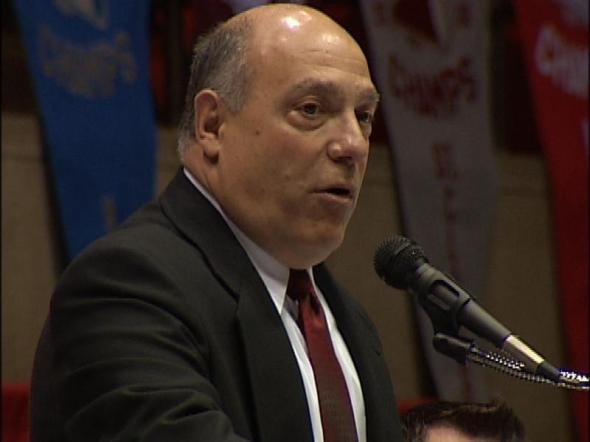
Steubenville HS football coach Reno Saccoccia
Hey, no big deal right? All he did was cover up a couple of rapes committed by his players… /s
Despite allegations that he knew about a rape and tried to protect his players who committed it, despite widespread criticism that he didn’t punish his team enough and that he should be fired, and despite a grand jury that could charge him looming next week, the powerful Steubenville High football coach Reno Saccocia has been approved for a two-year administrative contract, the city superintendent confirmed to The Atlantic Wire Monday afternoon.
The Ohio Valley’s Herald Star newspaper reported on the Steubenville school board’s minutes over the weekend in an article that included a single phrase about the coach’s new deal:
Two-year administrative contracts for Charles Kokiko, administrator; Bryan Mills, assistant middle school principal; Reno Saccoccia, director of administrative services; Joseph Yanok, middle school principal; Melinda Young, director of programs; and Sara Elliot, school psychologist.
In a phone interview with the Wire, Steubenville schools superintendent Mike McVey described the administrative services position as a “board approved two-year-administrative contract in his current position” that was up for renewal. “Coaching contracts are different from teaching and administrative contracts,” McVey said, stressing that the teaching title was “supplemental” to Saccoccia’s coaching contract.
Nonetheless, the school board’s approval will keep Saccoccia at the school — and it signals a vote of confidence in perhaps the most influential man in the fading steel town that was consumed by the social media response to a case in which two of Saccoccia’s players were convicted in juvenile court of raping an unconscious 16-year-old girl at after parties for a pre-season game by the powerhouse Big Red football team. A grand jury hearing into possible additional charges relating to the parties and their aftermath is now scheduled to convene on April 30.
Why am I not surprised?
California Teenager Who Committed Suicide After Rape and Bullying Marched at President Obama’s 2008 Inauguration
Posted: April 14, 2013 Filed under: Barack Obama, Crime, Violence against women, War on Women, Women's Rights | Tags: Audrie Pott, gang rape, michelle obama, Rehtaeh Parsons, Suicide 4 Comments
Audrie Pott
Another poignant detail has come out about Audrie Pott, the Saratoga, CA teenager who committed suicide after being gang raped by three boys at a house party while she was unconscious. The perpetrators took pictures of themselves sexually abusing Audrie and later posted them on-line and circulated them among her classmates.
A 15-year-old Saratoga girl who killed herself after photos circulated of her alleged sexual assault was “tormented” and “tortured” in the days before her death, her family’s attorney said Friday.
On Thursday, authorities announced three 16-year-old boys had been arrested on suspicion of sexually battering Audrie Pott, a Saratoga Union High School sophomore, according to reports.
An attorney representing Pott’s family told The Times the alleged attack occurred at what the teenager thought would be a “small little gathering” at a friend’s house last fall. The friend’s parents were out of town, attorney Robert Allard said, and the girls started drinking some sort of alcohol mixed with Gatorade. Soon, Allard said, “word spread there was a party at this house.”
Pott had gone upstairs early to sleep, but when she woke up the next day, she “recognized immediately that something terrible had happened,” Allard said.
At least one picture depicting the sexual assault was circulated among her peers, Allard said. Pott later posted on Facebook that “the whole school knows” and “my life is like ruined now,” Allard said.
Pott killed herself in September, about a week after the alleged attack.
Yesterday, Michael Daly reported at The Daily Beast that at age 11, Audrie marched in President Obama’s first inauguration parade with her middle school band.
“The President’s young daughters waved and cheered loudest for [this] group as all the other performers were so much older,” says a Pott family online posting about the Redwood Middle School’s moment in history.
At fifteen, Audrie committed suicide, eight days after a group of boys she thought were her friends allegedly gang raped her while she was unconscious and distributed at least one photo from the attack online.
“My life is like ruined now,” Audrie announced to the internet prior to hanging herself.
That was last September, four months before a 15-year-old from Chicago named Hadiya Pendleton performed as a majorette with her high school at Obama’s second inauguration. She was killed a week later, when a teen fired wildly in the direction of her and a group of her friends, mistakenly believing they were associated with a rival gang.
With the deaths of these two 15-year-olds, each of whom had played a part in an inauguration, a challenge now marches past the Capitol and the White House and every place on past in this country where laws are made, along with every school and home. The challenge for us all is to find better ways to protect our kids, be it from gun violence or from sexual violence.
Police took their sweet time getting around to arresting the monsters who tormented this beautiful young girl, and now her family and supporters are worried that they may have destroyed evidence of their crimes over the months it took law enforcement to “investigate.”

Rehtaeh Parsons
You have to wonder why these arrests followed so closely on the shocking reports of a similar gang rape in Halifax, Nova Scotia followed by bullying and the suicide of victim Rehtaeh Parsons–as well as the Steubenville rape case. It certainly appears that police only acted after the media picked up the story and public outrage ensued.
Michael Daly is right. President Obama and First Lady Michelle Obama should lead the way in raising consciousness of rape culture along with their fight to prevent gun violence. These two young girls were driven to their deaths by the cruelty and inhumanity that surrounded them.
What is wrong with our society when young girls can be treated as objects to be used and thrown away and when the law enforcement and school authorities who are supposed to protect children choose to protect the perpetrators of these horrible crimes instead of the victims? Nothing will change until women are seen as full human beings with feelings and dreams and their own goals for the future–and the right to pursue happiness in their own way. The anti-abortion movement has a lot to do with perpetuating the notion that girls and women should not be able to make their own choice about their bodies and their lives.
Tuesday Reads: Margaret Thatcher’s “Dark Legacy,” Death of a Feminist Revolutionary, and Mitch McConnell’s Ugly Plans
Posted: April 9, 2013 Filed under: morning reads, U.S. Politics, War on Women, Women's Rights | Tags: Andrew Sullivan, Ashley Judd, austerity, David Corn, feminist history, Margaret Thatcher, Mitch McConnell, Poverty, Shulamith Firestone, Susan Faludi 33 Comments
Good Morning!!
The death of Margaret Thatcher is still dominating the news this morning. It seems she was one of those public figures that inspired varied but passionate reactions–you either loved her or hated her.
Andrew Sullivan loved her it seems.
I was a teenage Thatcherite, an uber-politics nerd who loved her for her utter lack of apology for who she was. I sensed in her, as others did, a final rebuke to the collectivist, egalitarian oppression of the individual produced by socialism and the stultifying privileges and caste identities of the class system. And part of that identity – the part no one ever truly gave her credit for – was her gender. She came from a small grocer’s shop in a northern town and went on to educate herself in chemistry at Oxford, and then law. To put it mildly, those were not traditional decisions for a young woman with few means in the 1950s. She married a smart businessman, reared two children and forged a political career from scratch in the most male-dominated institution imaginable: the Tory party.
She relished this individualist feminism and wielded it – coining a new and very transitive verb, handbagging, to describe her evisceration of ill-prepared ministers or clueless interviewers. Perhaps in Toynbee’s defense, Thatcher was not a feminist in the left-liberal sense: she never truly reflected on her pioneering role as a female leader; she never appointed a single other woman to her cabinet over eleven years; she was contemptuous toward identity politics; and the only tears she ever deployed (unlike Hillary Clinton) were as she departed from office, ousted by an internal coup, undefeated in any election she had ever run in as party leader.
Her policies “inspired” the revolutionary reactions that created a “cultural transformation.”
Thatcher’s economic liberalization came to culturally transform Britain. Women were empowered by new opportunities; immigrants, especially from South Asia, became engineers of growth; millions owned homes for the first time; the media broke free from union chains and fractured and multiplied in subversive and dynamic ways. Her very draconian posture provoked a punk radicalism in the popular culture that changed a generation. The seeds of today’s multicultural, global London – epitomized by that Olympic ceremony – were sown by Thatcher’s will-power.
And that was why she ultimately failed, as every politician always ultimately does. She wanted to return Britain to the tradition of her thrifty, traditional father; instead she turned it into a country for the likes of her son, a wayward, money-making opportunist. The ripple effect of new money, a new middle class, a new individualism meant that Blair’s re-branded Britain – cool Britannia, with its rave subculture, its fashionistas, its new cuisine, its gay explosion, its street-art, its pop music – was in fact something Blair inherited from Thatcher.
Of course Sullivan no longer lives in Great Britain, and he has the means to avoid the worst effects of the elite’s austerity policies regardless of where he lives. Others aren’t so fortunate.
The Guardian reports: Margaret Thatcher’s death greeted with street parties in Brixton and Glasgow; Crowds shout ‘Maggie Maggie Maggie, dead dead dead’ during impromptu events.
Several hundred people gathered in south London on Monday evening to celebrate Margaret Thatcher‘s death with cans of beer, pints of milk and an impromptu street disco playing the soundtrack to her years in power.
Young and old descended on Brixton, a suburb which weathered two outbreaks of rioting during the Thatcher years. Many expressed jubilation that the leader they loved to hate was no more; others spoke of frustration that her legacy lived on.
To cheers of “Maggie Maggie Maggie, dead dead dead,” posters of Thatcher were held aloft as reggae basslines pounded.
Clive Barger, a 62-year-old adult education tutor, said he had turned out to mark the passing of “one of the vilest abominations of social and economic history”.
He said: “It is a moment to remember. She embodied everything that was so elitist in terms of repressing people who had nothing. She presided over a class war.”
Builder Phil Lewis, 47, a veteran of the 1990 poll tax riots, said he had turned out to recall the political struggles the Thatcher years had embroiled him in. “She ripped the arsehole out of this country and we are still suffering the consequences.”
Just as Ronald Reagan did to the U.S.–and we’re still suffering the consequences.
Here’s a video from Brixton.
Hugo Young, Thatcher biographer, writes in The Guardian: Margaret Thatcher left a dark legacy that has still not disappeared. For Young, a positive was Thatcher’s indifference to her popularity with the public.
I think by far her greatest virtue, in retrospect, is how little she cared if people liked her. She wanted to win, but did not put much faith in the quick smile. She needed followers, as long as they went in her frequently unpopular directions. This is a political style, an aesthetic even, that has disappeared from view. The machinery of modern political management – polls, consulting, focus groups – is deployed mainly to discover what will make a party and politician better liked, or worse, disliked. Though the Thatcher years could also be called the Saatchi years, reaching a new level of presentational sophistication in the annals of British politics, they weren’t about getting the leader liked. Respected, viewed with awe, a conviction politician, but if liking came into it, that was an accident.
But this attitude “didn’t come without a price” and “Thatcher left a dark legacy…”
What happened at the hands of this woman’s indifference to sentiment and good sense in the early 1980s brought unnecessary calamity to the lives of several million people who lost their jobs. It led to riots that nobody needed. More insidiously, it fathered a mood of tolerated harshness. Materialistic individualism was blessed as a virtue, the driver of national success. Everything was justified as long as it made money – and this, too, is still with us.
Thatcherism failed to destroy the welfare state. The lady was too shrewd to try that, and barely succeeded in reducing the share of the national income taken by the public sector. But the sense of community evaporated. There turned out to be no such thing as society, at least in the sense we used to understand it. Whether pushing each other off the road, barging past social rivals, beating up rival soccer fans, or idolising wealth as the only measure of virtue, Brits became more unpleasant to be with. This regrettable transformation was blessed by a leader who probably did not know it was happening because she didn’t care if it happened or not. But it did, and the consequences seem impossible to reverse….
[I]t’s now easier to see the scale of the setback she inflicted on Britain’s idea of its own future. Nations need to know the big picture of where they belong and, coinciding with the Thatcher appearance at the top, clarity had apparently broken through the clouds of historic ambivalence.
At least the British media isn’t trying to canonize Thatcher as the corporate media in the U.S. did to Reagan.
A Less Remarked Upon Death: Shulamith Firestone
At The New Yorker, Susan Faludi pays tribute to a feminist icon of the 1970s, “Death of a Revolutionary: Shulamith Firestone helped to create a new society. But she couldn’t live in it.”
When Shulamith Firestone’s body was found late last August, in her studio apartment on the fifth floor of a tenement walkup on East Tenth Street, she had been dead for some days. She was sixty-seven, and she had battled schizophrenia for decades, surviving on public assistance. There was no food in the apartment, and one theory is that Firestone starved, though no autopsy was conducted, by preference of her Orthodox Jewish family. Such a solitary demise would have been unimaginable to anyone who knew Firestone in the late nineteen-sixties, when she was at the epicenter of the radical-feminist movement, surrounded by some of the same women who, a month after her death, gathered in St. Mark’s Church In-the-Bowery, to pay their respects.
The memorial service verged on radical-feminist revival. Women distributed flyers on consciousness-raising, and displayed copies of texts published by the Redstockings, a New York group that Firestone co-founded. The WBAI radio host Fran Luck called for the Tenth Street studio to be named the Shulamith Firestone Memorial Apartment, and rented “in perpetuity” to “an older and meaningful feminist.” Kathie Sarachild, who had pioneered consciousness-raising and coined the slogan “Sisterhood Is Powerful,” in 1968, proposed convening a Shulamith Firestone Women’s Liberation Memorial Conference on What Is to Be Done. After several calls from the dais to “seize the moment” and “keep it going,” a dozen women decamped to an organizing meeting at Sarachild’s apartment.
I well remember reading Firestone’s book, The Dialectic of Sex: The Case for Feminist Revolution. It was mind-blowing stuff in those days.
In the late nineteen-sixties, Firestone and a small cadre of her “sisters” were at the radical edge of a movement that profoundly changed American society. At the time, women held almost no major elected positions, nearly every prestigious profession was a male preserve, homemaking was women’s highest calling, abortion was virtually illegal, and rape was a stigma to be borne in silence. Feminism had been in the doldrums ever since the first wave of the American women’s movement won the vote, in 1920, and lost the struggle for greater emancipation. Feminist energy was first co-opted by Jazz Age consumerism, then buried in decades of economic depression and war, until the dissatisfactions of postwar women, famously described by Betty Friedan in “The Feminine Mystique” (1963), gave rise to a “second wave” of feminism. The radical feminists emerged alongside a more moderate women’s movement, forged by such groups as the National Organization for Women, founded in 1966 by Friedan, Aileen Hernandez, and others, and championed by such publications as Ms., founded in 1972 by Gloria Steinem and Letty Cottin Pogrebin. That movement sought, as now’s statement of purpose put it, “to bring women into full participation in the mainstream of American society,” largely by means of equal pay and equal representation. The radical feminists, by contrast, wanted to reconceive public life and private life entirely.
What a brilliant tribute by Faludi. It’s well worth the read.
Mother Jones’s David Corn has gotten his hands on a tape of “a private meeting between the Senate GOP leader and campaign aides reveals how far they were willing to go to defeat” Ashley Judd.
On February 2, Mitch McConnell, the Republican leader in the US Senate, opened up his 2014 reelection campaign headquarters in Louisville, Kentucky, and in front of several dozen supporters vowed to “point out” the weaknesses of any opponent fielded by the Democrats. “They want to fight? We’re ready,” he declared. McConnell was serious: Later that day, he was huddling with aides in a private meeting to discuss how to attack his possible Democratic foes, including actor/activist Ashley Judd, who was then contemplating challenging the minority leader. During this strategy session—a recording of which was obtained by Mother Jones—McConnell and his aides considered assaulting Judd for her past struggles with depression and for her religious views….
For much of the Judd discussion, McConnell was silent as aides reviewed the initial oppo research they had collected on Judd and weighed all the ways they could pummel her. The recording was provided to Mother Jones last week by a source who requested anonymity. (The recording can be found here; a transcript is here.) McConnell’s Senate office and his campaign office did not respond to requests for comment.
The aide who led the meeting began his presentation with a touch of glee: “I refer to [Judd] as sort of the oppo research situation where there’s a haystack of needles, just because truly, there’s such a wealth of material.” He ran through the obvious: Judd was a prominent supporter of President Barack Obama, Obamacare, abortion rights, gay marriage, and climate change action. He pointed out that she is “anti-coal.”
But the McConnell gang explored going far beyond Judd’s politics and policy preferences. This included her mental health. The meeting leader noted:
She’s clearly, this sounds extreme, but she is emotionally unbalanced. I mean it’s been documented. Jesse can go in chapter and verse from her autobiography about, you know, she’s suffered some suicidal tendencies. She was hospitalized for 42 days when she had a mental breakdown in the ’90s.
So what? Mitch McConnell is a sick, closeted, hateful old freak who appears to lack any semblance of human feelings.

 peej
peej Carissa
 bostonboomer
 dakinikat
 ecocatwoman
 mablue2
 Mama Lopez
 peggysue22
 quixote
 skydancingguestblogger
 Mona (aka Wonk the Vote)



 Sky Dancing
Recent Comments