
Poor little Barack … He sooo wishes he could be anonymous.
Posted: April 11, 2011 Filed under: A My Pet Goat Moment, just because, U.S. Economy, U.S. Politics, voodoo economics, We are so F'd, WE TOLD THEM SO | Tags: Barack Obama, Democratic party, FDR, golf, Hearst magazines, JFK, LBJ, medicare, social safety net, Social Security, stress 30 Comments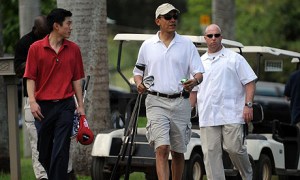
Poor Barack. His high-powered job has made him so famous and powerful that he can’t go anywhere to unwind anymore except the golf course. That’s why he golfs so much. He really wishes he could be “anonymous” so he could go the car wash or the grocery store. At least that’s what he told the editors and publishers of Hearst Magazines.
“I just miss — I miss being anonymous,” he said at the meeting in the White House State Dining Room. “I miss Saturday morning, rolling out of bed, not shaving, getting into my car with my girls, driving to the supermarket, squeezing the fruit, getting my car washed, taking walks. I can’t take a walk.”
He says he enjoys golf but is not the fanatic that some have portrayed him to be because of the frequency of his golf outings.
“It’s the only excuse I have to get outside for four hours at a stretch,” he told the Hearst executives.
Awwww…poor guy. That’s so sad. He sounds so wistful about it too. He must get so stressed out when he has to made those “tough decisions” like selling out the American people to the Republicans so he doesn’t have to piss off any of his rich banker donors. No wonder he spends so much time playing golf.
Just imagine how hard it must be to be the first black president–and a Democrat too (supposedly)–and be *forced* to destroy the legacies of FDR, JFK, and LBJ! Imagine how hard it must be to realize that after he gets through, the Democratic Party will be well and truly dead.
He must really have to rush to play golf when he thinks about how he used the legacy of Martin Luther King to get himself elected, and now he has to hurt poor people, including a lot of African Americans, because those mean old Republicans are making him do it.
The President will probably have to spend a lot of time on the golf course after his speech on Wednesday. From what I’m hearing and reading, he is going to have to break it to the bottom 90% of Americans that they are utterly screwed, and explain why we must “sacrifice” our health care and our pittance of retirement from Social Security in order to make sure that the banksters don’t have to cut back at all. After all they are our betters, aren’t they?
It’s so sad that poor Barack will have to live with being the President who destroyed the social safety net in the U.S. What a terrible burden for him to carry! I just hope he can get enough stress relief from playing golf. Maybe he could also relieve his giant burden of stress with one of the Hearst magazines that he says he likes to read.
“If there are any magazines in the (White) House, they probably come from you guys,” he told the Hearst Magazine executives.
Hearst Magazines publishes periodicals including Good Housekeeping, Marie Claire, O, The Oprah Magazine, Popular Mechanics, Redbook, Esquire and Cosmopolitan, among others.
I wonder which of those magazines he like best. Maybe we could take up a collection and get him a subscription to Cosmo or something.
Poor, poor pitiful Barack!
Tea Party Astroturf: More Apparent than Ever and Blatantly Hypocritical
Posted: March 31, 2011 Filed under: John Birch Society in Charge, Surreality, voodoo economics, Voter Ignorance, WE TOLD THEM SO | Tags: ABC Good Morning America, Michelle Bachman, Republican politicians love subsidies, Tea Party Darlings on the Dole, Tea Party Subsidy Queen 11 Comments Have you been wondering why we seem to have such a concerted effort in all kinds of states to take down unions, women’s rights, attack public workers, bankrupt the state with excessive tax cuts for business and the wealthy and other basically overwhelming policy attacks? Thought much about the Teabots recently? Well, here’s some interesting information on the little grass roots that got played big time. Not only is the tea party representing the interests of the rich, it’s also representing the interests of the rich taking lots of money from the state and federal government that they purport to hate. ABC’s Good Morning America has found some really interesting things on Tea Party Darlings on the Dole. Many of the biggest political icons in the movement are big abusers of government largess.
ABC’s senior political correspondent Jonathan Karl reported “the Tea Party movement is all about slashing federal spending, but at least five House members with Tea Party connections have themselves collected more than $100,000 each in federal farm subsidies, totalling more than $8 million since 1995.”
The subsidies are included in a report out Thursday by the Environmental Working Group. “We need a better system,” said Rep. Stephen Fincher, a Tennessee Republican whose family farm has received more than $3 million in subsidies, with more than $100,000 going directly to the Congressman himself. Asked directly if he’d refuse to take any further subsidies, he dodged the question. Others said the farm subsidies–totalling $16 billion–need to cut if not eliminated.
We’ve also learned that future presidential wannabe Michelle Bachman’s husband’s Christian “counseling” services
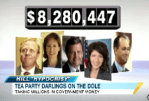
Watch the video by following this linked picture to ABC.
receives state funds in the scam to ungay, gay people. Talk about an appalling breach in the establishment clause!
Bachmann and Associates, Inc., a counseling center that receives state funds and is owned by Rep. Michele Bachmann and her husband, Dr. Marcus Bachmann, uses counseling methods steeped in fundamentalist Christianity, raising questions about its use of taxpayer money.
Founded in 2003, Bachmann’s clinic has taken in nearly $30,000 in state funds since 2007. Dr. Bachmann has said publicly that God heals people at his clinic and that Jesus Christ is the “Almighty Counselor.”
“We are distinctly a Christian counseling agency here in the Twin Cities,” he told KKMS radio in 2008. “We have 27 Christian counselors, Christ-centered, very strong in our understanding of who the Almighty Counselor is, and as we rely on God’s word and the Almighty Counselor, we have the opportunity to change people’s lives.”
He continued, “God heals people and if we give opportunity, if we are a willing vessel and we go according to what God’s word is, it works.”
The clinic applied for and received Rule 29 and Rule 31 licensing from the state in 2003. The rules allow the clinic to receive state money to treat low-income Minnesotans for mental health and chemical dependency problems. The clinic has earned $27,564 in state payments since 2007 — and likely received more, since the Minnesota Transparency and Accountability Project’s online data only goes back to 2007. Bachmann and Associates took $1,419 in public money in 2007, $13,140 in 2008, $12,493 in 2009 and $512 so far in 2010, according to the transparency project.
All of the clinic’s counselors identify as Christians. Among them is Marian E. Eckhardt, a licensed psychologist. Her mission statement says, “I believe that through knowledge, faith and dependency on God and His revealed truths one receives the strength and love to truly fulfill their life’s purpose.”
Saul Selby, the clinic’s drug and alcohol counselor, is also an ordained minister. Selby writes that he seeks to “help individuals and couples experience wholeness and healing through the application of biblical principles and the Love of Christ.”
Debra Kullberg, an associate marriage and family therapist, is also a licensed member of the clergy. “Jesus as the Son of God is the Savior, Healer, and intimate Lover of my soul,” she says in a statement on the clinic’s website. “He invites those He calls to join Him on a personal journey to the Cross. Our entire being is healed and restored (body, soul, and spirit) as we surrender ‘our way’ for ‘His way.’”
Watchdog groups say that the state’s arrangement with Bachmann and Associates is problematic.
Here’s some more of those tea party icons and their lives propped up with farm subsidies.
While the majority of American farmers receive no government money at all, at least 23 current members of congress or their families have received government money for their farms — combining for more than $12 million since 1995 according to a new report from the Environmental Working Group.
The biggest recipient was Rep. Stephen Fincher, a Republican from Frog Jump, Tenn.
While the self-described Tea Party patriot lists his occupation as “farmer” and “gospel singer” in the Congressional Directory, he doesn’t mention that his family has received more than $3 million in farm subsidies from 1995 to 2009, according to the Environmental Working Group.
According to an article last year in Salon, Michelle Bachmann, Charles Grassley, and Sam Brownbeck all get subsidies from the federal government to prop up their businesses.
No one would agree to stop taking subsidies — which is sensible, because if the money’s available, why not take it — but more amusingly some of these Tea Partiers wouldn’t even explicitly say they’d vote to end the subsidies, which are almost universally acknowledged as wasteful spending by experts across the ideological spectrum. Rep. Vicky Hartzler just said “everything should be on the table” and she was open to “starting the discussion,” which is just how lawmakers talk when they refuse to admit that they won’t vote for something they should vote for.
“Anti-government Republicans take lots of free government money” is basically an evergreen story. Chuck Grassley, Sam Brownback, and Michele Bachmann have also benefited from wasteful farm subsidies, even though they all hate the socialism so much. It’s enough to make you sympathize with libertarians, until you watch John Stossel talk about seasteading or something.
Here’s the scoop from TruthDig on how Michelle Bachman’s family basically makes a living from take federal money.
Bachmann, of Minnesota, has spent much of this year agitating against health care reform, whipping up the so-called tea-baggers with stories of death panels and rationed health care. She has called for a revolution against what she sees as Barack Obama’s attempted socialist takeover of America, saying presidential policy is “reaching down the throat and ripping the guts out of freedom.”
But data compiled from federal records by Environmental Working Group, a nonprofit watchdog that tracks the recipients of agricultural subsidies in the United States, shows that Bachmann has an inner Marxist that is perfectly at ease with profiting from taxpayer largesse. According to the organization’s records, Bachmann’s family farm received $251,973 in federal subsidies between 1995 and 2006. The farm had been managed by Bachmann’s recently deceased father-in-law and took in roughly $20,000 in 2006 and $28,000 in 2005, with the bulk of the subsidies going to dairy and corn. Both dairy and corn are heavily subsidized—or “socialized”—businesses in America (in 2005 alone, Washington spent $4.8 billion propping up corn prices) and are subject to strict government price controls. These subsidies are at the heart of America’s bizarre planned agricultural economy and as far away from Michele Bachmann’s free-market dream world as Cuba’s free medical system. If American farms such as hers were forced to compete in the global free market, they would collapse.
However, Bachmann doesn’t think other Americans should benefit from such protection and assistance. She voted against every foreclosure relief bill aimed at helping average homeowners (despite the fact that her district had the highest foreclosure rate in Minnesota), saying that bailing out homeowners would be “rewarding the irresponsible while punishing those who have been playing by the rules.” That’s right, the subsidy queen wants the rest of us to be responsible.
It continually amazes me that so many people appear to be vulnerable to the message that it’s government workers or poor people that benefit from government programs when so many statistics show that most of the largess from federal programs and subsidies go to those that are solidly upper middle class. What really kills me is that the same people that are waging wars on working people, women, children, and the poor for taking the tax payers’ hard earned cash are the same ones that are really living off the government teat. My guess is that many corporations–like GE–and individuals–like the Bachmanns–would be scraping around for other forms of incomes if it wasn’t for the funds they receive from the governments they so love to hate. Hypocrisy this huge should hurt.
More on Food and Energy Prices
Posted: March 23, 2011 Filed under: Economy, the villagers, unemployment, voodoo economics, We are so F'd | Tags: economics, food insecurity, Tax Cuts for Billionaires, trust fund babies., volatile commodity prices 12 Comments I wrote a post recently on why the overall inflation rate remains low and why core inflation is very low while food and energy prices are on the rise. I know this seems baffling. Research Economist Daniel Carroll from Fed Cleavland has some more details and analysis on this so I thought I’d take the opportunity to share it with you. I also have a bit of rant, so be patient with me.
First, you can see the underlying volatility in recent energy prices in the nifty graph to the right. This volatility is one of the reasons that many economists prefer the core inflation measures to something like the CPI. People adjust their driving and car buying habits when gas prices are high and the CPI doesn’t catch the corresponding buying shifts because it’s based on a fixed basket of purchased goods and services thought to represent a typical urban consumer at that time. People will drive more when gas prices are low and they’ll cut out unnecessary trips when prices are high at the pump. Also, commodity prices tend to have seasonality and they experience a lot of shocks that make them have higher than normal price variations. Think weather, political unrest, and other uncontrollable black swan events.
You can also see from the graph a lesser degree of volatility in food prices coupled with the underlying, increasing trend. The job of economists is to try to run models that look at the trend that has occurred over time and to search for corresponding explanatory variables. The other analysis that is frequently done is finding out who is impacted by these changes. I mentioned that food and energy inflation hurts poor people the most because it represents a big portion of their budgets and incomes. Carroll’s analysis includes some specifics on that .
It should not come as a surprise that people are particularly concerned about increases in food and energy prices, whether the increases are large or small. Not only do energy prices pass through to other prices, but household expenditures on food and energy make up a significant fraction of total household expenditures. Data from the BLS Consumer Expenditure Survey show that on average from 1999 to 2009, energy (including motor fuel) and food at home accounted for more than 15 percent of total expenditures and 13 percent of after-tax income.
The importance of food and energy prices to households’ bottom lines is not evenly distributed across the income distribution either. For the median household, food and energy are roughly 17 percent of both expenditures and after-tax income. Households in the top 20 percent of the income distribution spend 11.6 percent of total expenditures on food and energy, which adds up to 7.9 percent of disposable income. For the bottom 20 percent these shares rise to 20.4 percent of expenditures and a whopping 44.1 percent of after-tax income!
For those astutely wondering why food and energy expenditures are a larger fraction of total expenditures than of total income for the bottom 20 percent, there is a much higher fraction of households in this quintile which may be using savings and credit markets to consume above their annual income. Likely categories are the unemployed, business owners with temporary losses, students living on loans, and retirees drawing down their nest eggs.
There are two other nifty graphs at that site that show the impact of food and energy prices on the bottom twenty percent–quintile–of all households in terms of their incomes and budgets. It’s really disturbing to see the impact in bright red and blue. Increased prices in key budget items force many of these people over the edge. Because many poor people have no control over the amount of money they earn, these people are more likely to run up credit cards, decrease contributions to retirement savings, or sell off assets. They can also end up on the street and on public programs. Increases in food and gas basically drive the poor further into the ground.
This brings me to the policy implications. First, any state with a huge proportion of poor or elderly that derives income from sales taxes on these items is basically creating and perpetuating its own underclass. It is much more likely they will see increases in populations needing state assistance under these circumstances. This situation gets worse as it continues. Second, attempts to remove subsidies for the poor and elderly for their home heating and air conditioning costs will do the same thing or worse. It’s really difficult for me to understand why we subsidize large banks using bad lending practices to stop them from bankruptcy but some policy makers tout cuts in programs helping the poor pay outrageous gas and light bills or providing increased subsidies to programs like WIC. Republicans–you know, the fetus fetishists?–want to cut WIC by 10%.
At this point, I could even justify cutting rebate checks of $300-$500 for all those households with incomes in the bottom income quintile just to help them with food and energy bills. I know this is unlikely to happen. It would also provide a slight boost to local economies since this is the income group that is least likely to save and most likely to spend the money on basics. I’m not a big supporter of tax rebates because they generally just go to pay down debt and have very little economic impact. This would be different since it’s aimed solely at people who need to spend the money. It’s also aimed at helping a few people stay in their situation long enough to avoid perpetual dependency on state largess.
This brings me to one more item for you to discuss. There were two articles recently pushing the canard that lower taxes for rich people increase revenues to governments (false) and that low taxes are ?good” for the overall economy(false too). One was a WSJ editorial by trust fund baby Steve Forbes that once again tries to resurrect the much discredited Laffer curve and empirically challenged view of Reaganomics. You already know the antics of trust fund baby David Koch who feels persecuted because of the blowback on his war on nonbillionaires. The other baby of privilege wrecking havoc in Republican political circles is Grover Norquist. All three of these guys come from very rich parents, breezed into ivy league educations as legacies with parents who could buy them in regardless of grades and inherited enough money and gave them ready made businesses run by competent others. Now, they can spend their useless lives undermining any policy that takes anything from their pockets and boosts their cred on the Forbes 50 list. There are also some op ed pundits–Thomas Friedman comes to mind–with similar set ups. Here’s how they spend their lives and their daddies’ money.
According to a report in The Hill newspaper, Americans for Tax Reform president Grover Norquist has received assurances from Republican leaders in Congress that under no circumstances will they vote for any tax increase, either as part of deficit reduction or tax reform. Apparently, the only permissable deficit reduction is spending cuts and the only permissable tax reform is tax cuts. Given that Grover has succeeded in getting all but a small handful of Republicans to sign his no-new-taxes pledge, he essentially controls tax policy by being the sole arbiter of what constitutes a violation of the pledge and what does not. And given the power of the Tea Party to upset incumbent Republicans in primaries when they are viewed as insufficiently loyal to its agenda, it would take a very confident and courageous Republican to risk being accused of violating Grover’s pledge whether he or she signed it or not, since it would guarantee primary opposition from a well financed Tea Party candidate — the Club for Growth will see to that.
What really bothers me is that some how the Krewe of Trust Funds has managed to convince many–mostly white–working class Americans that government is using their hard earned wages to subsidize permanent vacations for the underclass. None of these leisure class propogandameisters have known a hard days work or food insecurity in their lives. They popped out of their mother’s uterus with automatic access to food, education, multiple, very large roofs, power, and access to speechifying nonsense on some of the world’s most circulated newspapers and TV channels. They’re absolute prime examples of the anti-meritocracy they purport to desire. They think people don’t work because they themselves don’t work at anything. It’s pure projection.
 I’m going to throw one more nifty graph at you. This time it’s from the FED in San Francisco. Notice how the World’s Industrial Production and Commodity Prices are following each other closely. Now, read this description of the stylized facts.
Commodity price swings have a direct impact on headline inflation through higher costs of energy and food, which account for 14% of overall consumer spending. However, commodity price swings—even double-digit changes—historically have had only a small effect on underlying inflation, which excludes spending on volatile energy and food components. To some extent, this reflects decisions by businesses to adjust profit margins rather than pass through higher costs to customers, particularly when demand is weak. A more important reason is that for many consumption goods, commodities and raw materials account for only a small part of the overall cost of production, particularly compared with the costs of labor, distribution, and retailing. Moreover, roughly three-fourths of consumer spending is on services such as housing and medical care that do not involve many commodities in production.Over the past 12 months, overall headline inflation as measured by the personal consumption expenditures price index has risen 1.2%, while core PCEPI has risen 0.8%. We expect recent commodity and energy price surges to raise headline inflation temporarily. We foresee relatively little pass-through to core inflation in 2011 and 2012. The slowly recuperating economy, excess capacity, and well-anchored long-term inflation expectations will keep labor costs low. In fact, with labor productivity continuing to rise, unit labor costs have actually been falling recently.
Let me point out some things here. I bolded that last part because I want to turn it into plain English for you. The last sentence means that no one is getting any kind of raise, even though they are working harder. The prior sentence means to expect more of the same. Prices on the core items will still be moderate while prices on commodities like food and oil are expected to increase. The graph itself shows that world demand is driving a lot those price increases. There is some increased “steepness’ in the price series which implies there are most likely other factors at play too. Chances are the uncertainty around MENA, some bad weather, and speculation has added to food and oil prices increasing at quicker increasing rate. I haven’t run any regressions on it so I can’t say that for certain, but it’s highly likely.
This should be a signal to policy makers to act appropriately. Instead, policy makers are acting inappropriately. That Bruce Bartlett quote about Grover Norquist seems to indicate they are listening to the temper tantrums and following the money of the trust fund babies. We need economic policy that helps all people. Instead, we’re getting Paris Hilton lifestyle maintenance programs. We need well paying jobs in this country, not more tax cuts for billionaires. Why do these guys ‘deserve’ to keep their daddies’ hard earned cash while poor people ‘deserve’ to starve and die of exposure?
update: Mark Thoma tweeted a link to Econbrowser that has a lot more nifty graphs on the inflation in food and oil prices including ones that show the parts of the country suffering most.
Monday Reads
Posted: February 28, 2011 Filed under: academia, Civil Liberties, Civil Rights, collective bargaining, Diplomacy Nightmares, education, Foreign Affairs, Global Financial Crisis, Human Rights, Libya, U.S. Politics, unemployment, voodoo economics, Voter Ignorance, We are so F'd | Tags: Federal Deficit, Libya, state pension plans, tenure 15 Comments Good Morning!
Okay, so I’m going to show you two nifty pie charts first at The Business Insider. They basically show how the federal balance is extremely unbalanced because expenses are growing and revenues are not growing at all. Henry Blodgett correctly points out that there’s quite a bit of growth in ‘entitlements’. Let me just point out that all this makes complete sense to me What do you get in an economy that has normalized around a 10 percent unemployment rate or higher if you count the things like disenfranchised workers and the underemployed and couple that with year after year after year after year of excessive tax cuts on the uberrich who happen to be the only ones making money? Well, you get more and more people that are reliant on unemployment and other government ‘entitlements’ and you get a huge revenue gap. This is about the most careless set of policy choices made that I’ve seen since I first read up on the Hoover administration and the start of the Great Depression.
The “expense” pie is growing like gangbusters, driven by the explosive growth of the entitlement programs that no one in government even has the balls to talk about. “Revenue” is barely growing at all.
As we’ll illustrate with more of Mary’s charts next week, the US cannot grow its way out of this problem. It needs to cut spending, specifically entitlement spending. We hereby announce that we’ll give a special gold star to the first “leader” with the guts to say that publicly.
I’ll give a box of gold stars to any one that points out to this blowhard that the way to remove the growing entitlements is to put people back to work. Also, giving tax money to rich people so they can invest in the BRIC economies and buy land where their money is parked in the Bahamas or Grand Caymans is a really, really stupid proposition. We’ve needed a real jobs program for some times. People with jobs pay taxes, buy things that are taxed, and don’t require entitlements. How absolutely stupid do you have to be to not get that? I don’t even need all those economics and finance degrees to figure that one out.
In the Friday Reads I mentioned that Fox News’ Roger Ailes was caught on tape encouraging colleagues to lie to Federal Investigators. Well, it seems that lying has finally caught up with one Republican operative. Maybe people will wake up to the Faux News’ and their dirty tricks now. Here’s what Barry Ritholtz had to say about his scoop on the indictment.
Here’s what I learned recently: Someone I spoke with claimed that Ailes was scheduled to speak at their event in March, but canceled. It appears that Roger’s people, ostensibly using a clause in his contract, said he “cannot appear for legal reasons.”
I asked “What, precisely, does that mean?”
The response: “Roger Ailes will be indicted — probably this week, maybe even Monday.”
Well, it’s Monday. Does Rupert Murdoch know where Roger Ailes is? Some times watching Karma unfold is a delightful thing.
I’m not sure if you’re a big enough masochist to spend time with the Sunday news shows anymore, but I do try to catch Christiane Amanpour and she delivered an interesting program yesterday. She had an exclusive interview with one of Gadhaffi’s sons. It was extremely interesting and I would recommend you go watch that segment. Amanpour actually traveled to Tripoli this weekend. We will now refer to the son as Tripoli Saif al-Islam Gadhafi since he seems about as in touch with reality as Baghdad Bob did back in the day.
There was a “big, big gap between reality and the media reports,” Gadhafi told Amanpour. “The whole south is calm. The west is calm. The middle is calm. Even part of the east.”
In response to President Barack Obama’s call for Moammar Gadhafi to step down and the U.N. Security Council’s unanimous vote to impose an arms embargo on Libya and urge nations to freeze Libyan assets, Gadhafi’s son was defiant.
“Listen, nobody is leaving this country. We live here, we die here,” he insisted. “This is our country. The Libyans are our people. And for myself, I believe I am doing the right thing.”
“The President of the U.S. has called on your father to step down. How do you feel about that?” Amanpour asked.
“It’s not an American business, that’s number one,” said Gadhafi, who was dressed casually as he spoke with Amanpour. “Second, do they think this is a solution? Of course not.”
I don’t know about you, but I’m getting kind of tired of watching these jerks that we supported for some time prove exactly what is meant by the label “brutal dictator”. Could we just once fund and support some one like His Holiness the Dali Lama for a change? It’s no wonder we still get called ugly Americans.
Speaking of Ugly Americans responsible for diplomatic nightmares, Paul Wolfowitz showed up on Fareed Zakaria’s GPS on CNN on Sunday. Could some one please tell the media we don’t need to hear from the people that screwed up Middle East Policy any more? Why do I keep seeing this man’s face despite his obvious failures with Iraq policy and peccadilloes made public during his time at the World Bank? I did want to point you to Zakaria’s interview with Michael Lewis on global financial crisis. The video is here. He has some interesting thing to say about banks in Greece, Ireland, and here. Listen for this part:
LEWIS: …And the –the anger – the anger about the Wall Street bailouts, I think, is the beginning of the Tea Party. I mean the – the injustice of people being rewarded for failure and – and supported by the public purse, that was the source of the original outrage.
ZAKARIA: But it went in a libertarian direction…
LEWIS: It did…It – but – but a qualified libertarian direction, because a true libertarian would be outraged that these Wall Street banks are still being subsidized by the government. And there doesn’t seem to be any move on the right to – to remove those subsidies, not any – any serious one…But – but the politi – our leadership doesn’t have an interest in – a leadership that is intent on still stabilizing the financial system doesn’t have an interest in calling attention to the outrages of the financial system. So I think they – Wall Street got very lucky.
Wall Street did not get very lucky. Wall Street basically has a friend in the White House and tons of people in the Treasury Department. The Tea Party was distracted by the Health Care Bill. The kleptocracy is still at it. Listen to the interview, it’s an earful! Many of us think that were going to get a repeat of the global financial crisis some time soon. Lewis and I aren’t alone on that thought.
One of the things that’s really making me mad about the current conversation on budget cuts and higher education is the public’s ignorance on just exactly how many states have disabled tenure these days. Tenure has long been a pet peeve of right wing ideologues who feel that every one should be terminated like they are in the private sector. Basically, the private sector thrives on political firings and uses payroll cuts as the first line of defense when the bottom line is failing because of their bad, short-sighted, and overly-political decisions.
Here’s a list of states decimating tenure as we speak from articles in The Chronicle of Higher Education. You know, I’m really sorry that people have to work for private corporations and that their lives are subject to the whims of really mean people, but it’s really no excuse to take it out on those of us that have tried to carve a better way to exist. Take my word for it. Get yourself a union and they won’t be able to take advantage of you with out taking on a a million other people who have your back! Those of us in the public sector are willing to forego short term salary highs for long term job security. It’s evident that a new crop of governors want every one as miserable as employees in the private sector now. If they intend to do this to us, then I want those seven to eight digits salaries I’d be paid for the 3-5 year short brutal career on Wall Street as a PhD in Financial Economics. I even added a few old links to show you that this is nothing new. Believe me, tenure isn’t what most people outside of academic think it is …
From Louisiana (this week):
The University of Louisiana system’s Board of Supervisors on Friday voted to approve new rules that will allow its institutions to more quickly dismiss faculty members, even those with tenure, whose programs have been closed.
At a time when the state’s financial climate makes it difficult for campuses to determine their budgets from year to year, that kind of flexibility is key, system officials said. But professors at the board meeting, including representatives of each of the system’s eight campuses, told the supervisors that such a move would erode the protection tenure provides and could ultimately make the system’s institutions unattractive to job seekers and lead current faculty members to leave.
The University of Nebraska at Lincoln is seeking to eliminate the jobs of 15 tenured faculty members as part of its latest round of budget cuts.
The proposed dismissals, which Chancellor Harvey Perlman announced this month, would save Nebraska about $2.7-million. They are part of a plan to reduce the university’s budget by $26-million, or 12 percent, in the wake of substantial state budget cuts. The new cuts come on the heels of layoffs, proposed in March, that would affect 55 faculty
An independent arbitrator on Friday ordered Florida State University to rescind layoff notices to several tenured faculty members and slammed how administrators there had decided which jobs would be cut.
In a major victory for the state’s faculty union, Stanley H. Sergent, a Sarasota-based lawyer picked by the university and the union to arbitrate the dispute, held that the university had failed to clearly justify its choices to eliminate certain positions, and had violated a provision of its faculty contract calling for it to try to protect the jobs of those faculty members who had continuously worked there the longest.
In his 83-page decision, Mr. Sergent wrote that the only reason the university had declared certain departments “suspended” was “to allow the effective layoff of all faculty and the selective recall of certain faculty,” apparently for the sake of creating a subterfuge to avoid having to comply with a contractual requirement that it lay off tenured faculty members last. Mr. Sergent characterized the reasoning used by a dean in eliminating one faculty member’s job as “arbitrary, capricious, and unreasonable.”
The arbitrator’s decision applies only to 12 tenured faculty members who belong to the campus chapter of the United Faculty of Florida, and does not cover nine other tenured faculty members who do not belong to the union and also received notices of pending layoffs last year.
From Washington State (May2009):
Community colleges in Washington State could soon be able to lay off tenured faculty members much faster than normal, according to the Seattle Post-Intelligencer.
At its regularly scheduled meeting next month, the State Board of Community and Technical Colleges will decide whether to declare a financial emergency — a move allowed by a state law passed in 1981 to deal with budget crunches. Such an emergency would speed up the process for laying off tenured faculty members in that they would get only 60 days’ notice of layoffs and the grounds on which they could appeal the decision would be limited, the Post-Intelligencer reported.
I would also like to take this space to mention that I no longer have access to Social Security and that my state pension and the matches that I get from the State basically are what the private sector donates to social security on the behalf of private sector workers. Many states have pension plans that replace Social Security. Therefore, I’m personally not getting any thing ‘special’ from taxpayers. Also, when the defined benefit plan showed up short this year, they decreased the contributions to my optional retirement plan and the others who selected that option to make up the shortfall in the defined benefit pool. Wall Street stole my appreciation and then the state took more from me to pay for their problems in other folks’ annuities. Other state employees–like me–paid for that shortfall. It came from our compensation. I’ve just about had it up to here with reading a bunch of grumbly idiots on other blogs that have no idea how state employee pensions are managed and funded. If you want to go after high paying state employees that are worthless, try taking it out on the university football coaches and the damned governor’s staff for a change. It’s not us little guys!
Anyway, it’s Monday morning and I’m a curmudgeon today. Think I’ll spend the day with the TV off and I’ll stay here on Sky Dancing with the sane people! Now, where’s my coffee?
What’s on your reading and blogging list?

 peej
peej Carissa
 bostonboomer
 dakinikat
 ecocatwoman
 mablue2
 Mama Lopez
 peggysue22
 quixote
 skydancingguestblogger
 Mona (aka Wonk the Vote)



 Sky Dancing
Recent Comments