
Bill Keller wants us to “get over Iraq” and “get Syria right”
Posted: May 6, 2013 Filed under: Foreign Affairs, Iraq, Real Life Horror, Surreality, Syria, The Media SUCKS, U.S. Economy, U.S. Military, U.S. Politics | Tags: Bill Keller, Bush administration, chemical weapons, Judith Miller, leadup to Iraq War, Michael Gordon, mushroom cloud, neo-cons, Sarin Gas, the NEW York Times, Thomas Friedman 20 Comments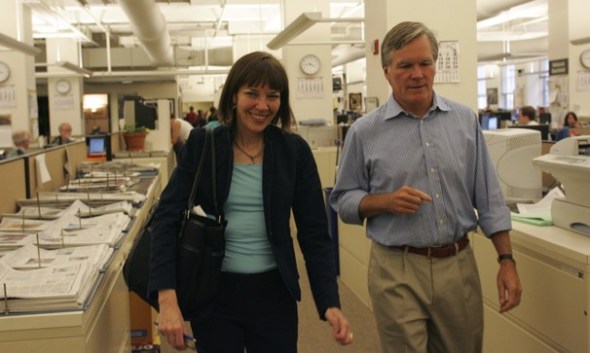
Could there be a less appropriate advocate for U.S. intervention in Syria than Bill Keller, Judith Miller’s editor at The New York Times during the runup to the disastrous war in Iraq?
Has this man ever been right about anything? Remember when he told us the baby boomers were responsible for the fiscal crisis and we should give up our hopes of a dignified old age because our selfishness has caused the U.S. to have “a less-skilled work force, lower rates of job creation, and an infrastructure unfit for a 21st-century economy”? Because obviously the costs of the Iraq war had nothing to do with the country’s current economic troubles.
Today Keller had the unmitigated gall to lecture us about the need to get involved in Syria. He isn’t really sure what we should do, but he’s positive we need to do it and he has a list of reasons why getting into another war in the Middle East is the right thing to do.
Of course even the monumentally “entitled” Bill Keller understands that lots of people are going to read his op-ed and respond by either screaming bloody murder or laughing hysterically at the spectacle of one of the architects of the Iraq War having the nerve to pontificate about another obviously insane foreign adventure.
So he tries to convince us that this time it’s different: “Syria is not Iraq,” he says.
Of course, there are important lessons to be drawn from our sad experience in Iraq: Be clear about America’s national interest. Be skeptical of the intelligence. Be careful whom you trust. Consider the limits of military power. Never go into a crisis, especially one in the Middle East, expecting a cakewalk.
But in Syria, I fear prudence has become fatalism, and our caution has been the father of missed opportunities, diminished credibility and enlarged tragedy.
“Be careful whom you trust,” he warns. Then why would we trust the man who allowed a once-great newspaper to be given over to neo-conservative enablers like Judith Miller and Michael Gordon who lapped up and printed every lie the Bush White House fed them?
But Keller brushes our doubts aside and offers four reasons why Syria is different from Iraq. But some of his arguments sound awfully familiar to me.
First, we have a genuine, imperiled national interest, not just a fabricated one. A failed Syria creates another haven for terrorists, a danger to neighbors who are all American allies, and the threat of metastasizing Sunni-Shiite sectarian war across a volatile and vital region. “We cannot tolerate a Somalia next door to Israel, Lebanon, Jordan, Iraq and Turkey,” said Vali Nasr, who since leaving the Obama foreign-policy team in 2011 has become one of its most incisive critics. Nor, he adds, can we afford to let the Iranians, the North Koreans and the Chinese conclude from our attitude that we are turning inward, becoming, as the title of Nasr’s new book puts it, “The Dispensable Nation.”
Weren’t we trying to keep Iraq from being a “haven for terrorists” too? And weren’t the neo-cons afraid of having the U.S. be perceived as weak?
Second, in Iraq our invasion unleashed a sectarian war. In Syria, it is already well under way.
This one is just ridiculous. We should invade because things are already worse than when we invaded Iraq?
Third, we have options that do not include putting American troops on the ground, a step nobody favors. None of the options are risk-free. Arming some subset of the rebels does not necessarily buy us influence. The much-touted no-fly zone would put American pilots in range of Syrian air defenses. Sending missiles to destroy Assad’s air force and Scud emplacements, which would provide some protection for civilians and operating room for the rebels, carries a danger of mission creep. But, as Joseph Holliday, a Syria analyst at the Institute for the Study of War, points out, what gets lost in these calculations is the potentially dire cost of doing nothing. That includes the danger that if we stay away now, we will get drawn in later (and bigger), when, for example, a desperate Assad drops Sarin on a Damascus suburb, or when Jordan collapses under the weight of Syrian refugees.
Huh? This one starts out sounding like an argument for staying out of Syria, so Keller throws in one of the neo-con arguments for invading Iraq–things could get worse if we don’t go in. Remember the warnings about “smoking guns” becoming “mushroom clouds?”
Fourth, in Iraq we had to cajole and bamboozle the world into joining our cause. This time we have allies waiting for us to step up and lead. Israel, out of its own interest, seems to have given up waiting.
What kind of argument is that? We should get into a war just because our “allies” want us to “lead?” Meaning they want us to provide the money and manpower.
Sorry, I’m just not convinced. Let the other guys do it for a change. If Israel wants to go to war in Syria, let them. In fact, let Bill Keller go if he’s so gung ho. Maybe he can convince some of his superrich pals to go along with him.
And what do you know? Along with Keller, Judy Miller’s old partner Michael Gordon, who still has his job at the Times, and has been writing story after story pushing U.S. involvement in Syria–as has op-ed columnist Thomas Friedman (I can’t provide links right now because I don’t seem to be able to circumvent the paywall). But here’s Greg Mitchell at The Nation:
Hail, hail, the gang’s nearly all here. Michael Gordon, Thomas Friedman, now Bill Keller. Paging Judy Miller! The New York Times in recent days on its front page and at top of its site has been promoting the meme of Syria regime as chemical weapons abuser, thereby pushing Obama to jump over his “red line” and bomb or otherwise attack there. Tom Friedman weighed in Sunday by calling for an international force to occupy the entire country (surely they would only need to stay one Friedman Unit, or six months).
Now, after this weekend’s Israeli warplane assaults, the threat grows even more dire.
And Bill Keller, the self-derided “reluctant hawk” on invading Iraq in 2003, returns with a column today stating right in its headline, “Syria Is Not Iraq,” and urging Obama and all of us to finally “get over Iraq.” He boasts that he has.
The Times in its news pages, via Sanger, Gordon and Jodi Rudoren, has been highlighting claims of Syria’s use of chem agents for quite some time, highlighted by last week’s top story swallowing nearly whole the latest Israeli claims.
Please go read the rest. Michell makes much more coherent arguments than I can. I’m still just sputtering from rage and trying to keep from banging my head on my keyboard.
Thursday Reads
Posted: May 2, 2013 Filed under: Barack Obama, corporate greed, hunger, income inequality, morning reads, net-neutrality, Reproductive Health, Reproductive Rights, science, The Bonus Class, the internet, U.S. Economy, U.S. Politics, War on Women | Tags: archaeology, cannibalism, CEO pay, Commerce Department, DOJ, emergency contraception, FCC, fracking, Jamestown Colony, JC Penney Co., North Dakota, Obama bundlers, Penny Pritzker, Plan B, Ron Johnson, Tom Wheeler 45 Comments
Good Morning!!
President Obama isn’t looking so “progressive” this morning (what else is new?). Yesterday, his “Justice” department announced they will ignore science as well as the health needs of women and girls by fighting a judge’s order to make Plan B emergency contraception available over-the-counter without age limits. NYT:
The appeal reaffirms an election-year decision by Mr. Obama’s administration to block the drug’s maker from selling it without a prescription or consideration of age, and puts the White House back into the politically charged issue of access to emergency contraception.
The Justice Department’s decision to appeal is in line with the views of dozens of conservative, anti-abortion groups who do not want contraceptives made available to young girls. But the decision was criticized by advocates for women’s reproductive health and abortion rights who cite years of scientific research saying the drug is safe and effective for all ages.
“Age barriers to emergency contraception are not supported by science, and they should be eliminated,” Cecile Richards, the president of Planned Parenthood Federation of America, said in a statement on Wednesday.
In December 2011 the secretary of health and human services, Kathleen Sebelius, blocked the sale of the drug to young girls without a prescription, saying there was not enough data to prove it would be safe. In doing so, Ms. Sebelius took the unprecedented step of overruling the Food and Drug Administration, which had moved, based on scientific research, to lift all age restrictions.
I could use some profane language here, but I’ll spare you for the moment. You may be mumbling to yourself too, after you read about Obama’s latest picks for the FCC and Commerce Department.
First the FCC. The New York Times reports: Telecom Investor Named to Be F.C.C. Chairman.
Tom Wheeler, President Obama’s pick to be the next chairman of the Federal Communications Commission, knows all about the most advanced telecommunications systems — of the 19th century.
In his 2008 book “Mr. Lincoln’s T-Mails: How Abraham Lincoln Used the Telegraph to Win the Civil War,” Mr. Wheeler, an investor in start-up technology and communications companies, documents how Lincoln was an “early adopter” of what has been called “the Victorian Internet.”
Lincoln’s championing and advancement of popular uses of the telegraph are not unlike the challenges Mr. Wheeler is likely to face as chairman of the F.C.C., which is waging an intense battle to keep Internet service free of commercial roadblocks and widely available in its most affordable, up-to-date capabilities.
Mr. Wheeler’s qualifications for “one of the toughest jobs in Washington,” Mr. Obama said, include a long history “at the forefront of some of the very dramatic changes that we’ve seen in the way we communicate and how we live our lives.”
“He was one of the leaders of a company that helped create thousands of good, high-tech jobs,” Mr. Obama said, referring to Core Capital Partners, the Washington investment firm where Mr. Wheeler is a managing director. “He’s in charge of the group that advises the F.C.C. on the latest technology issues,” adding that “he’s helped give American consumers more choices and better products.”

They look happy, don’t they?
But does all that qualify Wheeler to protect consumers at the FCC? From Ars Technica:
President Barack Obama today announced his choice to run the Federal Communications Commission. As reported yesterday, the nominee is Tom Wheeler, a venture capitalist who was formerly a lobbyist at the top of the cable and wireless industries, leading the National Cable Television Association (NCTA) and Cellular Telecommunications & Internet Association (CTIA).
The nomination continues the parade of lobbyists becoming government officials and vice versa, a trend that has favored moneyed interests over the average American citizen and consumer time and again. One can take solace in the fact that Wheeler will be tasked with implementing the communications policies of President Obama, who says he is eager to fight on behalf of consumers and to maintain thriving and open Internet and wireless marketplaces.
But the same President who said “I am in this race to tell the corporate lobbyists that their days of setting the agenda in Washington are over” when he was running for office has given the FCC’s top job to a former lobbyist. Wheeler donated $38,500 to Obama’s election efforts and helped raise additional money for Obama by becoming a “bundler,” arranging for large contributions from other donors after hitting legal limits on personal contributions.
Not surprisingly, the cable and telecom companies that Wheeler springs from are ecstatic about the nomination.
Gotta get rid of those nasty regulations that protect Americans from price gauging, internet censorship, and all that bad stuff.

Penny Pritzker
Next up, behold Obama’s nomination for Commerce Secretary, old pal Penny Pritzker.
Making official what many Democrats have expected for weeks, President Obama plans to nominate Chicago business executive Penny Pritzker, a longtime political supporter and heavyweight fundraiser, as his new Commerce secretary on Thursday morning.
Pritzker’s nomination could prove controversial. She is on the board of Hyatt Hotels Corp., which was founded by her family and has had rocky relations with labor unions, and she could face questions about the failure of a bank partly owned by her family.
With a personal fortune estimated at $1.85 billion, Pritzker is listed by Forbes magazine among the 300 wealthiest Americans. She is the founder, chair and CEO of PSP Capital Partners, a private equity firm, and its affiliated real estate investment firm, Pritzker Realty Group. She played an influential role in Obama’s rise from Illinois state senator to the nation’s 44th president, serving as Obama’s national finance chair in his first campaign for the White House and co-chair of his reelection campaign.
The president is expected to make the announcement at 10 a.m. at the White House.
If confirmed by the Senate, Pritzker would take charge of the administration’s efforts to build relations with business leaders who were often on the sharp end of the president’s first-term rhetoric.
Sigh . . .
This next story is guaranteed to make your blood boil. Bloomberg reports:
It’s been almost three years since Congress directed the Securities and Exchange Commission to require public companies to disclose the ratio of their chief executive officers’ compensation to the median of the rest of their employees’. The agency has yet to produce a rule.
So Bloomberg decided not to wait around any longer and figured out the ratios for us. See the chart at the above link. More:

CEO Pay 1,795-to-1 Multiple of Wages Skirts U.S. Law
Former fashion jewelry saleswoman Rebecca Gonzales and former Chief Executive Officer Ron Johnson have one thing in common: J.C. Penney Co. (JCP) no longer employs either.
The similarity ends there. Johnson, 54, got a compensation package worth 1,795 times the average wage and benefits of a U.S. department store worker when he was hired in November 2011, according to data compiled by Bloomberg. Gonzales’s hourly wage was $8.30 that year.
Across the Standard & Poor’s 500 Index of companies, theaverage multiple of CEO compensation to that of rank-and-file workers is 204, up 20 percent since 2009, the data show. The numbers are based on industry-specific estimates for worker compensation.
Almost three years after Congress ordered public companies to reveal actual CEO-to-worker pay ratios under the Dodd-Frank law, the numbers remain unknown. As theOccupy Wall Street movement and 2012 election made income inequality a social flashpoint, mandatory disclosure of the ratios remained bottled up at the Securities and Exchange Commission, which hasn’t yet drawn up the rules to implement it. Some of America’s biggest companies are lobbying against the requirement.
“It’s a simple piece of information shareholders ought to have,” said Phil Angelides, who led the Financial Crisis Inquiry Commission, which investigated the economic collapse of 2008. “The fact that corporate executives wouldn’t want to display the number speaks volumes.” The lobbying is part of “a street-by-street, block-by-block fight waged by large corporations and their Wall Street colleagues” to obstruct the Dodd-Frank law, he said.
Are you angry yet? These greedheads are going to keep pushing the envelope until Americans wake up and take to the streets with pitchforks and dust off the guillotines.
My birthplace, North Dakota is changing rapidly–and maybe not in a good way. It turns out the state’s oil is even more plentiful than anyone has realized up till now.
The sea of oil and natural gas underneath North Dakota is far larger than first thought.
There are 7.4 billion barrels of recoverable oil in the western part of the state and extending into Montana, according to the latest estimate by the U.S. Geological Survey.
That’s more than twice the oil the USGS estimated could be recovered five years ago. What’s more, the USGS has nearly tripled its estimate of the natural gas available in the area.
The revised totals could make the North Dakota field the greatest oil and gas find ever in the continental United States, topping the fabled East Texas field that made Texas synonymous with oil wealth. And it would put North Dakota second to Prudhoe Bay as the largest oil producer in U.S. history.
And even this estimate may have to be “revised upward”:
“We think it’s even a little bit conservative,’’ said Ron Ness, president of the North Dakota Petroleum Council.
The new estimate will give fresh momentum to an economic boom within the state that has made it the fastest growing in the nation in both population and incomes. Per capita income has risen to $52,000 a year, sixth-highest in the nation, and once quiet farm towns have been overwhelmed by oil field workers, creating shortages of housing and services.
The USGS said the drilling of 4,000 wells since 2008 in what is known as the Bakken formation has given geologists a better idea of the riches underground. The new analysis also highlights the rapid ascent of North American oil and gas production driven by the advent of the technique known as hydraulic fracturing.
I guess I’m happy about the new jobs and population growth, but it will be sad if North Dakota no longer has clean air and vast open spaces.

Four shallow chop marks on the top of the girl’s skull, evidence of cannibalism during the “starving time” over the winter of 1609-1610. (Smithsonian Institution / Don Hurlbert)
You may have heard about this fascinating story–it was up toward the top of Google News much of yesterday. Archaeologists have found strong evidence that Starving Settlers in [the] Jamestown Colony Resorted to Cannibalism. From Smithsonian Magazine:
The harsh winter of 1609 in Virginia’s Jamestown Colony forced residents to do the unthinkable. A recent excavation at the historic site discovered the carcasses of dogs, cats and horses consumed during the season commonly called the “Starving Time.” But a few other newly discovered bones in particular, though, tell a far more gruesome story: the dismemberment and cannibalization of a 14-year-old English girl.
“The chops to the forehead are very tentative, very incomplete,” says Douglas Owsley, the Smithsonian forensic anthropologist who analyzed the bones after they were found by archaeologists from Preservation Virginia. “Then, the body was turned over, and there were four strikes to the back of the head, one of which was the strongest and split the skull in half. A penetrating wound was then made to the left temple, probably by a single-sided knife, which was used to pry open the head and remove the brain.”
Much is still unknown about the circumstances of this grisly meal: Who exactly the girl researchers are calling “Jane” was, whether she was murdered or died of natural causes, whether multiple people participated in the butchering or it was a solo act. But as Owsley revealed along with lead archaeologist William Kelso today at a press conference at the National Museum of Natural History, we now have the first direct evidence of cannibalism at Jamestown, the oldest permanent English colony in the Americas. “Historians have gone back and forth on whether this sort of thing really happened there,” Owsley says. “Given these bones in a trash pit, all cut and chopped up, it’s clear that this body was dismembered for consumption.”
There’s much more at the link.
Now it’s your turn. What are you reading and blogging about today? Please post your links on any topic in the comment thread, and have a great day!
Saturday Reads: Steubenville News, Democrats’ Latest Cave, Plus Villager Snits and Fits
Posted: April 27, 2013 Filed under: Barack Obama, Crime, morning reads, Republican politics, U.S. Economy, U.S. Politics | Tags: EU austerity, Frank Luntz, grand jury, Lindsay Lohan, Reno Saccoccia, sequestration, snit fits, Steubenville High School, Steubenville rape case, Tom Brokaw, Tommy Christopher, University of Pennsylvania, White House Correspondents' Dinner 16 Comments
Good Morning!!
There is some news coming out of Steubenville, Ohio in the buildup to the the grand jury investigation, which begins hearing from witnesses on Tuesday.
From The Columbus Dispatch: School, other sites searched in wider Steubenville rape probe
Police officers and investigators yesterday were searching the eastern Ohio high school attended by two football players who raped a 16-year-old girl after an alcohol-fueled party last summer, Ohio Attorney General Mike DeWine said.
Searches also took place at Vestige Ltd., a digital-evidence company in northeastern Ohio, and the offices of the Steubenville school board in addition to Steubenville High School, DeWine said. The searches are part of an attempt to learn whether other laws were broken in connection with the rape.
“What I hope people will believe when we’re done is that we did everything we could to find the truth and that justice was done,” DeWine said in an interview. “What you’re seeing today is just part of that effort.”
Using warrants, police officers and investigators began the searches about 2 p.m. and possibly would work into the night, DeWine said. There was no immediate word on what the searches turned up…
Judges sealed investigators’ requests for the search warrants at the request of the Ohio Bureau of Criminal Investigation, ruling that disclosing them “would be detrimental to the ongoing criminal investigation,” according to the judges’ orders.

Investigators leaving Steubenville High School on Thursday with documents, servers, and computers (Atlantic Wire)
The Atlantic Wire asks: What Is Steubenville Still Hiding?
Toward the end of the school day Thursday, more than eight months after a Steubenville Big Red pre-season game turned into a serious of house parties and a series of attacks on a 16-year-old girl, local police and investigators showed up — as if out of nowhere — at Steubenville High. They stayed on campus into the night, Ohio Attorney General Mike DeWine told the Associated Press, executing search warrants that were either new or unheard of — and certainly fascinating. “Steubenville Police assisted the Attorney General in the search warrants,” said William McCafferty, the local police chief who “begged” for evidence when the initial crime was reported. Officials for Steubenville city schools, who have been publicly silent (save for one brief statement) since that fateful August night that brought a social media and judicial storm upon the Ohio town, confirmed the search in a a statement released Friday reading in part that “we have been from the beginning and are continuing to fully cooperate with the authorities in this investigation.”
But this is a new investigation, and this week’s search appears to have an urgency of its own, as DeWine’s grand jury prepares to convene on Tuesday. The attorney general said the searches at Steubenville city schools were “just part of that effort” — an effort he announced after two Steubenville High students and football players, Trent Mays and Ma’lik Richmond, were found guilty of rape. “We cannot bring finality to this matter without the convening of a grand jury,” DeWine said at the time. “I anticipate numerous witnesses will be called. The grand jury, quite frankly, could meet for a number of days.”
Grand juries, by their nature, are conducted in secret, and the warrants executed on Thursday remain sealed — and so it remains unclear whether investigators were searching computers, paperwork, or physical evidence. DeWine has said the grand jury will be looking for, among other things, at the crimes of failure to report a felony, tampering with evidence. DeWine explained that “indictments could be returned and additional charges could be filed” in light of the jury, the nine members of which were seated last week but will begin hearing testimony and reviewing evidence on April 30. He alsocalled the grand jury “a very good investigative tool as well as a very deliberative body,” which makes the timing of the school search all the more interesting.
It sounds like this could get interesting. Personally, I’m hoping Coach Reno Saccoccia gets his comeuppance.
Yesterday, Democrats in Congress once again allowed Republicans to treat them like doormats when they voted to ease sequestration “pain” for the mostly wealthy frequent flyers.
The Dumb Math Error Heard ‘Round the World
Posted: April 16, 2013 Filed under: Austerity, U.S. Economy | Tags: austerity fail, math fail, Reinhart & Rogoff (2010) 47 Comments Rarely has any one study had such an immediate impact on global policy. Usually, folks wait until a study is replicated and put through robust follow-up before any one takes research to heart. Reinhart & Rogoff (2010) basically played into the narrative of the plutocracy and what the ‘very serious people’ around the world wanted. So, its significant findings were taken very seriously before all those secondary tests of robustness and such were undertaken. Well, now we find out the wunderkind study that justified a lot of unnecessary austerity has some serious math mistakes. I’m still reading through all the criticisms but, as Krugman puts it “Holy Coding Error, Batman”! Let’s just call this some serious MATH FAIL!
The intellectual edifice of austerity economics rests largely on two academic papers that were seized on by policy makers, without ever having been properly vetted, because they said what the Very Serious People wanted to hear. One was Alesina/Ardagna on the macroeconomic effects of austerity, which immediately became exhibit A for those who wanted to believe in expansionary austerity. Unfortunately, even aside from the paper’s failure to distinguish between episodes in which monetary policy was available and those in which it wasn’t, it turned out that their approach to measuring austerity was all wrong; when the IMF used a measure that tracked actual policy, it turned out that contractionary policy was contractionary.
The other paper, which has had immense influence — largely because in the VSP world it is taken to have established a definitive result — was Reinhart/Rogoff on the negative effects of debt on growth. Very quickly, everyone “knew” that terrible things happen when debt passes 90 percent of GDP.
Some of us never bought it, arguing that the observed correlation between debt and growth probably reflected reverse causation. But even I never dreamed that a large part of the alleged result might reflect nothing more profound than bad arithmetic.
The best explanation of the problem that I’ve seen comes from Mike Konczal at RortyBomb.
In 2010, economists Carmen Reinhart and Kenneth Rogoff released a paper, “Growth in a Time of Debt.” Their “main result is that…median growth rates for countries with public debt over 90 percent of GDP are roughly one percent lower than otherwise; average (mean) growth rates are several percent lower.” Countries with debt-to-GDP ratios above 90 percent have a slightly negative average growth rate, in fact.
This has been one of the most cited stats in the public debate during the Great Recession. Paul Ryan’s Path to Prosperity budget states their study “found conclusive empirical evidence that [debt] exceeding 90 percent of the economy has a significant negative effect on economic growth.” The Washington Post editorial board takes it as an economic consensus view, stating that “debt-to-GDP could keep rising — and stick dangerously near the 90 percent mark that economists regard as a threat to sustainable economic growth.”
Is it conclusive? One response has been to argue that the causation is backwards, or that slower growth leads to higher debt-to-GDP ratios. Josh Bivens and John Irons made this case at the Economic Policy Institute. But this assumes that the data is correct. From the beginning there have been complaints that Reinhart and Rogoff weren’t releasing the data for their results (e.g. Dean Baker). I knew of several people trying to replicate the results who were bumping into walls left and right – it couldn’t be done.
In a new paper, “Does High Public Debt Consistently Stifle Economic Growth? A Critique of Reinhart and Rogoff,” Thomas Herndon, Michael Ash, and Robert Pollin of the University of Massachusetts, Amherst successfully replicate the results. After trying to replicate the Reinhart-Rogoff results and failing, they reached out to Reinhart and Rogoff and they were willing to share their data spreadhseet. This allowed Herndon et al. to see how how Reinhart and Rogoff’s data was constructed.
They find that three main issues stand out. First, Reinhart and Rogoff selectively exclude years of high debt and average growth. Second, they use a debatable method to weight the countries. Third, there also appears to be a coding error that excludes high-debt and average-growth countries. All three bias in favor of their result, and without them you don’t get their controversial result.
Whenever you model a system, you have to make some assumptions going in. These assumptions–coupled with the coding error–basically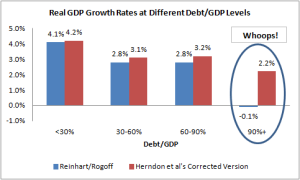 show the statistician’s slight of hand. You can prove just about everything and anything with numbers if you manipulate the data enough. The UMAss-Amherst professor et al has really pulled the curtain away from the big green talking head this time. Here’s the abstract.
Herndon, Ash and Pollin replicate Reinhart and Rogoff and find that coding errors, selective exclusion of available data, and unconventional weighting of summary statistics lead to serious errors that inaccurately represent the relationship between public debt and GDP growth among 20 advanced economies in the post-war period. They find that when properly calculated, the average real GDP growth rate for countries carrying a public-debt-to-GDP ratio of over 90 percent is actually 2.2 percent, not -0:1 percent as published in Reinhart and Rogo ff. That is, contrary to RR, average GDP growth at public debt/GDP ratios over 90 percent is not dramatically different than when debt/GDP ratios are lower.
The authors also show how the relationship between public debt and GDP growth varies significantly by time period and country. Overall, the evidence we review contradicts Reinhart and Rogoff ’s claim to have identified an important stylized fact, that public debt loads greater than 90 percent of GDP consistently reduce GDP growth.
Shorter Abstract: They REALLY screwed the pooch.
So, there’s now this bigger problem out there which is the very serious people that are crashing economies based on a set of very biased assumptions and a very serious coding error. To put that in a more politically correct way: How Much Unemployment Was Caused by Reinhart and Rogoff’s Arithmetic Mistake? Followed by, will the very serious people correct their very serious policy errors now?
This is a big deal because politicians around the world have used this finding from R&R to justify austerity measures that have slowed growth and raised unemployment. In the United States many politicians have pointed to R&R’s work as justification for deficit reduction even though the economy is far below full employment by any reasonable measure. In Europe, R&R’s work and its derivatives have been used to justify austerity policies that have pushed the unemployment rate over 10 percent for the euro zone as a whole and above 20 percent in Greece and Spain. In other words, this is a mistake that has had enormous consequences.
In fairness, there has been other research that makes similar claims, including more recent work by Reinhardt and Rogoff. But it was the initial R&R papers that created the framework for most of the subsequent policy debate. And HAP has shown that the key finding that debt slows growth was driven overwhelmingly by the exclusion of 4 years of data from New Zealand.
If facts mattered in economic policy debates, this should be the cause for a major reassessment of the deficit reduction policies being pursued in the United States and elsewhere. It should also cause reporters to be a bit slower to accept such sweeping claims at face value.
I spent most of Monday’s Morning Reads showing the current US economic data that shows that the deficit and debt of the US are melting like the wicked witch under that bucket of water. I worry any more deficit reduction will throw our economy into recession and pave the way for Republican take over of the Senate. However, the big green talking heads have been ignoring the data and just about everything else that a legion of economists have said citing this one–now clearly known to be flawed–study. As Krugman mentioned in his blogs, their results was counter-intuitive and controversial among economists from day one of publication. Policymakers through out Europe and the US gratuitously ignored all that because the questions did not fit their plan to push the mistakes of banks on a lot of hapless citizenry.
This is literally the most influential article cited in public and policy debates about the importance of debt stabilization, so naturally this is going to change everything.
Or, rather, it will change nothing. As I’ve said many times, citations of the Reinhart/Rogoff result in a policy context obviously appealing to a fallacious form of causal inference. There is an overwhelming theoretical argument that slow real growth will lead to a high debt:GDP ratio and thus whether or not you can construct a dataset showing a correlation between the two tells us absolutely nothing about whether high debt loads lead to small growth. The correct causal inference doesn’t rule out causation in the direction Reinhart and Rogoff believe in, but the kind of empirical study they’ve conducted couldn’t possibly establish it. To give an example from another domain, you might genuinely wonder if short kids are more likely to end up malnourished because they’re not good at fighting for food or something. A study where you conclude that short stature and malnourishment are correlated would give us zero information about this hypothesis, since everyone already knows that malnourishment leads to stunted growth. There might be causation in the other direction as well, but a correlation study woudn’t tell you.
The fact that Reinhart/Rogoff was widely cited despite its huge obvious theoretical problems leads me to confidently predict that the existence of equally huge, albeit more subtle, empirical problems won’t change anything either. As of 2007 there was a widespread belief among elites in the United States and Europe that reductions in retirement benefits were desirable, and subsequent events regarding economic crisis and debt have simply been subsumed into that longstanding view.
The very serious policymakers were looking for any justification for their austerity pogrom. This is mainly because German taxpayers and pols don’t want to be on the hook for what German and US bankers did around the Eurozone. It is also because Republican law makers and their plutocratic overlords–like the Dr. Strangelove of Wall Street Pete Peterson–don’t want any funds floating around anywhere that could possibly find residency in their fee-churning ponzi schemes of investment funds.
It is not unusual, unfortunately, for some academics to neatly choose assumptions to drive results towards their hypothesis. That is why peer review is extremely important. Nearly every major study done using empirical data should be easily replicated. It is usual for the authors to share their database and R&R obliged on this matter. But, this emphasizes why major studies with major findings that don’t fit snugly with the current body of theory should undergo robust challenge. Many economists had challenged the findings back in 2010 and the fact that some felt compelled to repeat their research indicated a healthy level of skepticism which is the hallmark of good research and researchers.
What is most disturbing about this is that agendas that drive the interests of a few start to reflect these theories-in-process. R&R 2010 fit the gross ambitions of people that were less concerned about truth than philosophy and ability to drive policy that basically is at odds with everything we’ve known about fiscal policy. So, this takes us back to Matt’s question. There is incredible discussion on this in nearly all economics and finance blogs and circles. Will these findings engender the same discussion and any course correction of the very serious people that used this very serious paper to do some very serious damage around the world.
I know it’s too much to hear those wonderful words ” We were wrong” on top of some course corrections. But, hey it’s not too late for our President to give up the debt and deficit hysteria or is it?
Sunday Morning Open Thread
Posted: April 14, 2013 Filed under: Barack Obama, morning reads, U.S. Economy, U.S. Politics | Tags: Eric Williams, Marco Rubio, Marcus "Notch" Persson, Minecraft, Plants vs. Zombies, Sunday talk shows, Texas prosecutor killings, video games 50 Comments
Good Morning!!
It’s Sunday again and the Villagers will be hanging out on the Sunday shows pushing the austerity agenda and talking about the two other issues that are on their minds these days–guns and immigration. I have to wonder if they aren’t ginning up those two issues just to keep Americans in the dark about how the oligarchs, with the help of President Obama, are trying to make the U.S. economy into as big a mess as Europe’s.
Here’s a list of the folks who’ll be lecturing us on the various “news” and talk shows today, courtesy of DailyKos. Basically it’s going to be the Marco Rubio show.
Meet the Press: Sen. Marco Rubio (R-FL); Sen. Kirsten Gillibrand (D-NY); Sen. Mike Lee(R-UT); Roundtable: Sen. Kirsten Gillibrand (D-NY), Sen. Mike Lee (R-UT), Katty Kay(BBC), David Brooks (New York Times) and Chuck Todd (NBC News).
Face the Nation: Sen. Marco Rubio (R-FL); Sen. Joe Manchin (D-WV); Sen. Pat Toomey(R-PA); Former Astronaut Mark Kelly; Roundtable: David Ignatius (Washington Post),David Sanger (New York Times), Amy Walter (Cook Political Report) and John Dickerson(CBS News).
This Week: Sen. Marco Rubio (R-FL); Sen. Chuck Schumer (D-NY); Sen. Jeff Sessions(R-AL); MLB Player Mariano Rivera; MLB Player Robinson Cano; Roundtable: George Will (Washington Post), Rep. Bob Goodlatte (R-VA), Rep. Luis Gutierrez (D-IL), Ruth Marcus (Washington Post) and Kimberley Strassel (Wall Street Journal).
Fox News Sunday: Sen. Marco Rubio (R-FL); Sen. Dick Durbin (D-IL); Sen. John Cornyn(R-TX); Roundtable: Former Sen. Scott Brown (R-MA), Marjorie Clifton (Spike the Watercooler), Republican Strategist Karl Rove and Former Sen. Evan Bayh (D-IN).
State of the Union: Sen. John McCain (R-AZ); Sen. Marco Rubio (R-FL); Sen. Joe Manchin (D-WV); Sen. Pat Toomey (R-PA); Democratic Strategist Donna Brazile; Republican Strategist Ana Navarro; Gerald Seib (Wall Street Journal); Reliable Sources:Amy Holmes (The Blaze); Ana Marie Cox (The Guardian); Nia-Malika Henderson(Washington Post); Rep. Steve Cohen (D-TN); Democratic Strategist Paul Begala; Filmmaker Robert Greenwald.
The Chris Matthews Show: Joe Klein (TIME); Katty Kay (BBC); Amy Walter (Cook Political Report); Peter Alexander (NBC News).
Fareed Zakaria GPS: Former OMB Director David Stockman; Former Economic Adviser to President Obama Austan Goolsbee; CourtTV Founder Steven Brill; Game Show Network CEO David Goldhill; Anthony Bourdain (CNN); Former Tata Group Chair Ratan Tata.
Plus, I’ve got a few interesting reads for you from various sources.
Politico finds that Obama’s big donors aren’t ponying up for his “Organizing for America”–the group that is supposed to help push his austerity agenda.
The group, which has no fundraising limits and is not required by law to release donor information, raised $4.9 million in its first three months of existence. By comparison, the Democratic National Committee — which is limited in what it can raise by law — brought in $14 million in the quarter after Obama was first elected in 2008.
The top donor to OFA, Philip Munger, gave $250,000 – a modest sum for a top contributor to a major profile outside group.
Earlier reports in the New York Times and the Los Angeles Times suggested that the pro-Obama nonprofit was looking for a high-profile group of donors to chip in $500,000, $1 million or more.
Democratic Party donor mainstays like Fred Eychaner, Jeffrey Katzenberg, Stephen Speilberg, Steve and Amber Mostyn and others are missing from the list, which includes all donors who gave $250 or more.
Barack and Michelle Obama also are not listed as donors.
Loyal Obama donors like Penny Pritzker, Jane Stetson, Azita Raji and others are also missing — though the top Obama campaign bundler Andrew Tobias chipped in $50,000 to the new group.
Other major Obama campaign fundraisers on the list include: Barbara Grasseschi, Nicola Miner, William Freeman, Wayne Jordan, Michael Kemper, Imad Zuberi, Frank White, Naomi Aberly, and South Carolina Democratic Party chair Dick Harpootlian.
Business Insider publishes The States With The Heaviest Student Loan Debts And Highest Delinquency Rates (the research comes from the St. Louis Fed). Check those out at the link.
To continue the academic theme, Alternet has a piece on Academia’s Indentured Servants. This may give you an idea of why I soured on teaching for a living.
On April 8, 2013, the New York Times reported that 76 percent of American university faculty are adjunct professors – an all-time high. Unlike tenured faculty, whose annual salaries can top $160,000, adjunct professors make an average of $2,700 per course and receive no health care or other benefits.
Most adjuncts teach at multiple universities while still not making enough to stay above the poverty line. Some are on welfare or homeless. Others depend on charity drives held by their peers. Adjuncts are generally not allowed to have offices or participate in faculty meetings. When they ask for a living wage or benefits, they can be fired. Their contingent status allows them no recourse.
No one forces a scholar to work as an adjunct. So why do some of America’s brightest PhDs – many of whom are authors of books and articles on labour, power, or injustice – accept such terrible conditions?
“Path dependence and sunk costs must be powerful forces,” speculates political scientist Steve Saidemen in a post titled ” The Adjunct Mystery“. In other words, job candidates have invested so much time and money into their professional training that they cannot fathom abandoning their goal – even if this means living, as Saidemen says, like “second-class citizens”. (He later downgraded this to “third-class citizens”.)
I spend much of yesterday playing a video game called Minecraft. When my nephews were little, I helped them play games on the computer. Nowadays they help me (they are ages 10 and 7). Every time they get hooked on a new game, they want me to play it too, we play games as CSGO, with the help of sites that give csgo boosted guide so is easier for us.
First it was Plants vs. Zombies, which I loved. Now it’s Minecraft, and I’m getting addicted to that too. It’s a virtual world where you build things out of 3-D looking blocks. It doesn’t sound like much, but it’s amazingly fun because it’s open ended and can go on forever, limited only by your imagination and designing and building skill. Of course there are other challenges like attacks by monsters and getting lost underground–which happened to me yesterday.
Anyway, there was an interview with the guy who developed Minecraft, Markus Persson, in The New Yorker this week. Not only that Persson has currently been voted number 2 on Time’s list of most influential people.
So if you like to escape into virtual worlds, check it out. I have to add that I never played video games at all until I met Dakinikat. She encouraged me to get started at my advanced age.
Last night the news broke that a man named Eric Williams had been arrested in connection with the murders of two Texas prosecutors. He is a former Texas justice of the peace. TPM reports:
Williams, 46, had not been publicly named a suspect or a person of interest in the case, but authorities did interview him and test him for gunshot residue on March 30, just hours after the bodies of the county District Attorney Mike McLelland and his wife, Cynthia, were found in their home in Forney, Texas.
Williams lost his position after being convicted last year of stealing county computer equipment. Both McLelland and Mark Hasse, a county prosecutor killed Jan. 31, were reportedly involved in Williams’ case.
According to The Dallas Morning News, investigators searched Williams’ home late Friday and “have obtained old cellphones, his computer and boxes of other materials.” Williams’ attorney, David Sergi, said Williams was cooperating with investigators and “vigorously asserts his innocence and denies any involvement” in the killings.
According to CBS News, Williams was charged with “making a ‘terroristic threat'” and is being held on $3 million bond. It sounds serious, doesn’t it?
CBS News correspondent John Miller spoke to “CBS Evening News” on Saturday about the latest development in the case. “What is going on,” he said, “is they shifted their view in this case away from their original theory that it might have been part of the Aryan Brotherhood prison gang — because that prosecutor’s office was involved in a case there — more to individual people who were prosecuted by both of the district attorneys who were murdered.
“And that brought them to Eric Williams, who is an elected justice of the peace, who was then both prosecuted by Mark Hasse, one of the murdered district attorneys, and by Mike McLelland, the D.A. Looking into him, they found out he was somebody who made threats to other people, who had a large collection of guns, and possibly had a grudge. Of course he denies all this.”
Miller had previously spoken to Williams a couple of times. “He says he understands why they’re looking at him,” Miller explained. “that they have to do their jobs, that he has nothing to do with that case, and that he’s been cooperative. He says his case was about the political undertows in the county, but he understands what’s going on.”
Miller’s home was searched on Friday, but law enforcement officials were looking at him previously.
Earlier this month, Williams said he voluntarily submitted to a gun residue test after authorities contacted him while investigating the deaths of the McLellands. Sergi has said Williams also submitted to a gun residue test and gave his cellphone to authorities when he was questioned after Hasse’s death.
I’m going to wrap this up with something uplifting (pun intended). It’s an amazing video of a golden eagle flying in slow motion. Sadly, I can’t embed it here, but please go watch it. You won’t be sorry.

 peej
peej Carissa
 bostonboomer
 dakinikat
 ecocatwoman
 mablue2
 Mama Lopez
 peggysue22
 quixote
 skydancingguestblogger
 Mona (aka Wonk the Vote)



 Sky Dancing
Recent Comments