I’m always astounded by the difference in coverage of national tragedies by traditional media and the new outlets created to make stupid people more stupid. This is the same media that schoolmarm us about how not to politicize mass shootings. The horrific collapse of the Francis Scott Key Bridge in Baltimore is a textbook example of news turned into hate speech and lies. This is from Forbes Magazine. The analysis was written by Janice Gassam Asare, an expert on DEI. “Baltimore Bridge Collapse Creates More DEI Attacks: How Allies Can Push Back.”
Amidst the horrific news of the bridge collapse, some chose to focus on Mayor Scott’s age and race and proceeded to blame DEI for the bridge collapse. Utah state Rep. Phil Lyman along with Florida congressional candidate Anthony Sabatini were among those blaming the incident on DEI. One X user tweeted that Mayor Scott was “Baltimore’s DEI mayor,” with that tweet garnering nearly 6,000 reposts at the time of this article, while another user tweeted that the mayor “looks like a teen.” The creator behind the Darkest Hue, a platform created as a safe space for dark-skinned Black girls, women, and femmes wrote in an Instagram post “It is becoming increasingly clear that DEI is being used as a dog whistle for Black people, as if to substitute racial slurs.”
DEI is a term that has become increasingly more polarizing. An acronym created to highlight the importance of diversity, equity, and inclusion has been warped and distorted by DEI critics. The same way that terms like woke and critical race theory (CRT) have been hijacked, morphed, and mutilated, the term DEI is experiencing a similar fate. There is an increasing phenomenon where individuals who have very little understanding of DEI are critiquing its utility and effectiveness.
What follows is several points that include actual data debunking the right-wing screeds. This is the first point just for reference. You may learn more about it at the like to Forbes.
Those who understand the value of DEI and recognize how it can be a tool to fight against oppression and injustice can counteract the anti-DEI sentiment in a few ways.
1. Numbers don’t lie. One popular DEI myth is that it promotes the hiring of unqualified non-white job candidates. But what does the data say? Looking specifically at different industries will reveal prevalent racial disparities. If DEI was increasing the representation of non-white candidates, this would be reflected in the numbers but many industries, like the media and artificial intelligence, remain overwhelmingly white. The data will expose the anti-DEI myths for what they are, so those fighting DEI propaganda should lean on the data to combat DEI misinformation.
Arianna Coghill writes about the conspiracy theories adopted by the usual news outlets for lies and conspiracy theories at Mother Jones. “A List of Weird Stuff the Right Connected to the Baltimore Bridge Collapse.” Coghill compiled a short list of Twitter offerings showing responses from the usual suspects and Republicans running for high office. They’re ugly.
Aaron Rupar shows us “Matt Schlapp on Newsmax admits he’s “no expert” but tries to blame the Baltimore bridge collapse on “drug-addled” employees and covid lockdowns.”
In an interview with Sen. Rick Scott (R-Fl.), Fox News’ Maria Bartiromo appeared to suggest a “wide open” immigration policy at the border could be a factor here. Her rationale? The cargo ship had been flying under a Singaporean flag.
Over on Newsmax, Conservative Political Action Conference chairman Mike Schlapp invoked everything from “drug-addled employees” to Covid lockdowns while discussing the collapse. “We have to wake up as a country and realize that we have too many people who aren’t ready to do these jobs,” Schlapp, who conceded that he was not an expert on the situation, said.
Secretary of Transportation Pete Buttigieg has even been accused of being an unqualified DEI hire. Secretary Buttigieg gave an interview to CNN’s Kaitlan Collins this morning and slammed the conspiracy theories and lies concerning the bridge’s collapse. This is from The Independent. “Pete Buttigieg slams conspiracy theories about Baltimore bridge collapse. ‘Unfortunately, it’s a fact of life in America today,’ Mr Buttigieg said about the prevalence of conspiracy theories.”
CNN’s Kaitlan Collins pointed out there have been “wild conspiracy theories” about what caused the disaster, ranging from a cyberattack, the captain having side effects from a Covid-19 vaccine, and blaming the Obamas.
She asked Mr Buttigieg whether he thought he would have to combat these conspiracy theories in the midst of a crisis?
“We’re in the business of dealing with roads and bridges and sometimes ships and trains,” he said. “So we are not in the habit as a Department of Transportation, of being in the business of dealing with conspiracies, or conspiracy theories or that kind of wild thinking. But unfortunately, it is a fact of life in America today.
“What’s really upsetting is when misinformation or disinformation circulates, that is not without victims.
“This is a human tragedy,” Mr Buttigieg said, adding that six men lost their lives.
While two workers were rescued from the immediate aftermath, six others went missing. They were all presumed dead after 17 hours of searching.
His department needs “good, factual information” into how that happened to make effective future decisions, like bridge design and shipping policies.
Policies based on “good, factual information” are not what the Republican Party is about these days, even though this is nothing new. The New Republichas this think piece by Ellie Quinlan Houghtaling. “The Insanely Racist Conspiracy Theory on Baltimore Key Bridge Collapse. Fox News is amplifying a racist conspiracy on the Francis Scott Key Bridge collapse. Because of course it is.”
At about 1:40 a.m. EST on Tuesday, a 1,000-foot cargo ship careened past large concrete obstacles ahead of Baltimore’s Francis Scott Key Bridge, colliding with one of its structural pillars and toppling it into the Patapsco River. Mere hours later, conservatives were already hurling their racist conspiracy theories against the wall to see what sticks.
In an early morning broadcast, Fox Business attempted to tie the horrific situation—which was deemed a developing mass casualty event by the Baltimore City Fire Department—to the “wide-open border.” Via a clumsily worded, cross-wired question, Fox Business host Maria Bartiromo connected the catastrophic collapse to President Joe Biden’s immigration policy.
“Let me also get your take on what’s going on in terms of world affairs. The White House has issued a statement on this saying that ‘there’s no indication of nefarious intent in the collapse of the Francis Scott Key Bridge,’” started Bartiromo. “The ship involved in the collapse of the bridge is 948 feet long, called The Dali, a Singaporean-flag container, but of course you’ve been talking a lot about the potential for wrongdoing or potential for foul play given the wide-open border. That is why you have been so adamant.”
Fortunately, we do have rational people in the West Wing at the moment to deal with what may be a significant disruption to supply chains. This is from Heather Cox Richardson, writing in her Substack Letters from an American. Thank goodness we have adults in the Executive Branch today.
Yesterday the National Economic Council called a meeting of the Supply Chain Disruptions Task Force, which the Biden-Harris administration launched in 2021, to discuss the impact of the collapse of the Francis Scott Key Bridge and the partial closure of the Port of Baltimore on regional and national supply chains. The task force draws members from the White House and the departments of Transportation, Commerce, Agriculture, Defense, Labor, Health and Human Services, Energy, and Homeland Security. It is focused on coordinating efforts to divert ships to other ports and to minimize impacts to employers and workers, making sure, for example, that dock workers stay on payrolls.
Today, Transportation Secretary Pete Buttigieg convened a meeting of port, labor, and industry partners—ocean carriers, truckers, local business owners, unions, railroads, and so on—to mitigate disruption from the bridge collapse. Representatives came from 40 organizations including American Roll-on Roll-off Carrier; the Georgia Ports Authority; the International Longshoremen’s Association, the International Organization of Masters, Mates and Pilots; John Deere; Maersk; Mercedes-Benz North America Operations; Seabulk Tankers; Under Armour; and the World Shipping Council.
Today the U.S. Department of Transportation’s Federal Highway Administration announced it would make $60 million available immediately to be used as a down payment toward initial costs. Already, though, some Republicans are balking at the idea of using new federal money to rebuild the bridge, saying that lawmakers should simply take the money that has been appropriated for things like electric vehicles, or wait until insurance money comes in from the shipping companies.
One piece of really great news today. Orlando Mayorquin writes this in The New York Times. “Woman Who Received 5-Year Sentence in Voter Fraud Case Is Acquitted. A Texas appeals court reversed its earlier opinion that had upheld the conviction of Crystal Mason, who was found guilty of illegally casting a provisional ballot in 2016, even though she claimed she hadn’t known she was ineligible to vote. ”
In its decision to reverse her conviction and acquit her, the Second Court of Appeals said that the prosecution did not have enough evidence to prove that she knew.
A copy of the ruling was provided by the A.C.L.U. of Texas and the Texas Civil Rights Project.
“I was thrown into this fight for voting rights and will keep swinging to ensure no one else has to face what I’ve endured for over six years, a political ploy where minority voting rights are under attack,” Ms. Mason said in a statement Thursday. “I’ve cried and prayed every night for over six years straight that I would remain a free Black woman.”
Thomas Buser-Clancy, a lawyer with the A.C.L.U. of Texas who represented Ms. Mason, called her victory a win for democracy.
“We are relieved for Ms. Mason, who has waited for too long with uncertainty about whether she would be imprisoned and separated from her family for five years simply for trying to do her civic duty,” he said.
A Texas appeals court reversed its earlier opinion that had upheld the conviction of Crystal Mason, who was found guilty of illegally casting a provisional ballot in 2016, even though she claimed she hadn’t known she was ineligible to vote.
Louis Gossett Jr., the first Black man to win a supporting actor Oscar and an Emmy winner for his role in the seminal TV miniseries “Roots,” has died. He was 87.
Gossett’s first cousin Neal L. Gossett told The Associated Press that the actor died in Santa Monica, California. A statement from the family said Gossett died Friday morning. No cause of death was revealed.
Gossett’s cousin remembered a man who walked with Nelson Mandela and who also was a great joke teller, a relative who faced and fought racism with dignity and humor.
“Never mind the awards, never mind the glitz and glamor, the Rolls-Royces and the big houses in Malibu. It’s about the humanity of the people that he stood for,” his cousin said.
Louis Gossett Jr has sadly passed away at the age of 87.
“New York Attorney General Letitia James makes a statement.” John Buss, @repeat1968
Good Day, Sky Dancers!
Well, it’s another Monday, another Trump court appearance, and more drama. I’m wondering what all those TV court lawyers would do with all these cases! Trump has already tweeted that he’s like Jesus with a Psalm reference that predates the story of Jesus by about 600 years. I haven’t been a Christian for about 30 years, so please refresh my memory. Isn’t blasphemy a big deal? So, today’s courtroom drama is about the bond to be posted to secure the Trump family’s fraud verdict and the Hush Money. There’s just so much criming with these people that it’s hard to keep up. Anyway, the Jesus comparison came up during the Stormy Daniels case. The trolling on the social media platforms is epic.
He took to his social media platform to share a post an unidentified person sent him comparing him to Jesus in relation to his separate civil business fraud case, sharing the Bible verse, Psalm 109:3–8.
“Received this morning — Beautiful, thank you! ‘It’s ironic that Christ walked through His greatest persecution the very week they are trying to steal your property from you. But have you seen this verse…?'” he wrote.
Trump faced a Monday deadline to pay the $454 million fine or post bond in his business fraud case after Judge Arthur Engoron in February ordered him to pay $355 million after siding with New York Attorney General Letitia James in a civil suit. The payment shot up past $450 million with interest.
James accused Trump and top executives at the Trump Organization of conspiring to increase his net worth by billions of dollars on financial statements provided to banks and insurers to make deals and secure loans. Trump maintains that he did not engage in any wrongdoing, accusing James of targeting him for political purposes.
Trump received some good news from an appeals court on Monday, which reduced his bond to $175 million dollars, substantially lower than the $454 million bond ordered by Judge Engoron, and gave him 10 more days to pay those funds. Trump has not yet commented on the ruling.
He previously faced an end of the day deadline to pay the larger bond or James could have started seizing his properties and assets. The former president has been sharply critical of her handling of the case, on Monday releasing several statements on Truth Social accusing her of election interference.
Would you see this in a Perry Mason episode or a Matlock script? No crime writer would even dream up these storylines. David Cay Johnson wrote this today for The New Republic. “GAME OVER. Today Is the Day That 50 Years of Grifting Finally Comes to an End. Unless Donald Trump comes up with $454 million, he’s in deep doo-doo. But will his backers ever wake up to reality?” You’d think getting a break on this bond would hurt the brand more than the case itself. His big enterprise is unbondable!
Have you ever seen a millionaire begging for $5? Me neither. Yet I just watched Donald Trump in an internet video pleading for $5, or $10, or “even $25” from his supporters. That’s a pitch aimed at the people Trump says he loves, “the poorly educated,” who, after all, don’t have much money.
The supposed business genius with the Midas touch looked desperate—a better-dressed version of one of those troubled souls hanging out near traffic intersections hoping to cadge a dollar or two from people waiting for the light to turn green.
After more than 50 years of grifting, Trump has reached the end of his faux-gold brick road. Today, unless Trump somehow produces the cash to cover his bond, Letitia James, the elected New York State attorney general, is going to start grabbing up Trump properties like she landed on his Monopoly squares. That will constitute a kind of end, although Trump’s journey is never finished. He still enjoys solid support from malefactors of power who openly declare their intent to rend our Constitution and end our freedoms. Incredible as it seems, he still could move back into the White House.
Think of James as Dorothy, whose little dog Toto pulls back the curtain on the Wizard of Oz. There’s another cinema analogy that’s even more on point, which we’ll get to shortly. But with respect to Oz, the script from that delightful 1939 classic perfectly describes the con job Trump has pulled off for a half-century—until now. Millions of Americans—like the naïvely happy-go-lucky residents of the mythical Emerald City—believe he has godlike powers, so we should fear him and submit to his whims. “Do not arouse the arouse the wrath of the great Oz,” the magical image proclaims to Dorothy and her three friends amid smoke, lights, and loud noises.
Eventually, of course, Toto pulls back the curtain and reveals the traveling snake oil salesman from Kansas, who continues dissembling even when the fraud is uncovered. “Pay no attention to that man behind the curtain,” he says, trying to cover his naked lies before admitting, yes, it’s true. “I’m a humbug,” he acknowledges, a pure fraud through and through.
Trump will never admit he’s a fraud. His mentor, the notorious lawyer Roy Cohn, taught him never to give an inch. When challenged by law enforcement or anyone else, Cohn taught Trump, attack them as corrupt, dishonest, and jealous enemies of an honest and successful man.
For nearly a month, Trump has been trying everywhere to get someone with deep enough pockets to cover the roughly half-billion dollars he needs to post to prevent the seizure of his bank accounts, real estate, and other assets to pay the judgment against him for persistent fraud.
Meanwhile, we have this Washington Post Live Coverage over the Trump N.Y. Hush money case.
New York Supreme Court Justice Juan Merchan appeared deeply skeptical during a hearing Monday morning about claims by Donald Trump’s defense lawyers in his hush money criminal trial.
Trump’s lawyers said a late release of more than 100,000 pages of potential evidence should delay the case significantly, and they asked that the prosecutors be sanctioned. Merchan admonished Trump’s attorneys for making what he called very serious allegations and questioned why the defense did not seek the records from federal officials sooner.
A key question for Monday’s hearing is whether the judge will set a new trial date, after delaying jury selection until at least mid-April. The hearing stopped for a break shortly before 11:15 a.m. and is expected to resume around noon.
In an attempt to better understand what we are witnessing with Donald Trump’s behavior, I recently spoke with Dr. Elizabeth Zoffman, a forensic psychiatrist and an Associate Clinical Professor of Forensic and General Psychiatry at the University of British Columbia. Dr. Zoffmann shares her evidence-based preliminary conclusion that Donald Trump is displaying a range of behaviors that suggest cognitive challenges if not impairment. The former president appears to be suffering from Behavioral Variant Fronto-Temporal Dementia, Dr. Zoffmann concludes, and needs to be evaluated by neurologists who specialize in the condition.
This interview has been edited for length and clarity:
What do you see when you look at Donald Trump through a clinical lens?
My observations are garnered from viewing the phenomenon of Mr. Trump for the past decade. Also, observations from viewing old videotape interviews and coverage of Mr. Trump as a younger man form part of my impression that Mr. Trump might benefit from a thorough evaluation by a neuropsychiatrist with expertise in neurodegenerative disorders. My observations are as follows:
Changes in speech patterns with many fewer and simpler words (decline in vocabulary) with fewer adjectives and adverbs.
A decline in cognitive focus on speech subjects with incomplete sentences and an inability to focus on a topic long enough to complete a sentence when not reading from a teleprompter.
Difficulty pronouncing words, word substitution and nonsense words – known as paraphasia
Tangential thinking where the topic switches mid-sentence to some unrelated topic.
Frequent repetition of words and phrases as if his mind is stuck in a loop.
Disinhibition and an inability to control verbal outbursts.
Socially inappropriate behavior – mocking a man with muscular dystrophy, disrespecting fallen soldiers as losers.
Lack of self-awareness in that he apparently cannot see how inappropriate his behavior has become and use his judgment to stop himself.
Changes in movement and gait. His walk appears wide-based and he has developed a swing of his right leg. He appears glued to the floor when he “dances” for his audience. If caught on camera standing still, he appears unnaturally immobile.
The changes in judgment and impulse control have uncovered and perhaps worsened underlying personality traits that others have characterized as narcissistic and antisocial. The changes have led some experts to suggest a diagnosis of “malignant narcissism.”
Mr. Trump has stated that he passed a cognitive that he described in terms that suggested either the Mini-Mental Status Exam (MMSE) or the Montreal Cognitive Assessment (MOCA) scale. These are both simple screening tests for suspicions of Alzheimer’s Disease.
Democratic Women in Louisiana are about troll James Carville just the way LSU evidently did when he quit his job. Mr Carville appears to have a woman problem. He wants them to shut up. Perhaps he should take it up with his wife, Mary Matalin. “James Carville ended LSU teaching gig after souring on campus culture, he tells New York Times.”
James Carville, the outspoken, ever-entertaining political consultant known for his love of New Orleans and his LSU Tigers, ended a teaching gig at his alma mater after souring on a campus culture that made him “scared to death in my job.”
The Ragin’ Cajun, who rose to fame as a top aide to President Bill Clinton during his 1992 campaign, told New York Times columnist Maureen Dowd that complaints from a student about an off-color joke in his class a few years ago earned him a visit from a dean — and prompted him to take it up a notch by reciting the famously raunchy “Aristocrats” joke.
The experience led him to step back from teaching, he said.
This was L.S. freaking U., not Oberlin,” Carville told the New York Times. “It was terrible. I wouldn’t take the coeds to dinner after class. I would take the male students. I was scared to death in my job. I was like: ‘I don’t need L.S.U.’s money. I don’t need to drive up there and listen to that crap.’ I just said: ‘That’s it. I’m done. This is not for me.’”
Democratic strategist James Carville argued “too many preachy females” in the Democratic Party could be to blame for President Biden’s bleeding support from key voters.
In an interview published Saturday with New York Times opinion columnist Maureen Dowd, Carville voiced concerns about the culture of the Democratic Party and how it could be impacting Biden’s support among voters, especially those that are male.
“A suspicion of mine is that there are too many preachy females … ‘Don’t drink beer, don’t watch football, don’t eat hamburgers, this is not good for you,’” he said. “The message is too feminine: ‘Everything you’re doing is destroying the planet. You’ve got to eat your peas.’”
Carville, who was a strategist for former President Clinton’s 1992 presidential campaign, argued this culture and rhetoric is not addressing the concerns of male voters.
“If you listen to Democratic elites — NPR is my go-to place for that — the whole talk is about how women, and women of color, are going to decide this election. I’m like: ‘Well, 48 percent of the people that vote are males. Do you mind if they have some consideration?” Carville said.
When it comes to Biden’s low approval ratings, Carville quipped, “When I look at these polling numbers, it’s like walking in on your grandma naked. You can’t get the image out of your mind.”
Carville in recent weeks has also expressed concerns about Biden’s falling support among voters of color and called it a “problem” for the incumbent last week.
Like Carville, Ronna Romney McDaniel has that sweet gig with MSNBC/NBC. Maybe it’s time for the company to take a big brand hit. We were a Huntley Brinkley family when I was a kid, but this is ridiculous. She appeared on Meet the Press yesterday, and Kristen Welker and Chuck Todd apologized for the appearance. It’s an odd day when Chuck Todd is the stand-out guy.
This is Philip Bump’s analysis from today’s Washington Post. “Ronna McDaniel quickly demonstrates that her view isn’t worth the cost.”
There’s not a lot of value for journalists in interviewing an echo. Instead of standing inside a canyon trying to ask follow-up questions of the words bouncing off the walls around you, better to just go to the source.
Ronna McDaniel’s tenure as chair of the Republican Party unfolded in the Donald Trump era of American politics. She assumed the position a day before Trump was inaugurated in 2017 and remained there until Trump decided it was time for her to go. As the titular head of a party actually led by the former president, McDaniel’s Linda Yaccarino-like role was largely centered on having the party do the things it normally does and then appearing at news conferences to nod along with the things Trump was saying.
He’d shout; she’d echo. But last week NBC News decided it was worth paying her money to hear what she had to say.
McDaniel debuted her role as a contributor to the network on Sunday’s episode of “Meet the Press.” She tried to explain to host Kristen Welker that she did have a point of view that did extend beyond serving as Trump’s hypeman.
The article continues to cite example after example, ending with this thought.
(Among the social media posts identified as misinformation — unfairly, according to Jordan — was one from Newt Gingrich. It used the Pennsylvania Supreme Court’s decision that signature-matching could be set aside to argue that “Pennsylvania democrats are methodically changing the rules so they can steal the election.” Untrue then, untrue now — and an obvious contributor to the false idea that the 2020 results should be considered suspect.)
Not only was Jordan’s interview recorded, allowing for corrections, he was treated as someone who could not be relied upon to offer unbiased information. He’s a politician, acting politically. McDaniel, in theory, is a private citizen free to speak her mind. But her debut on NBC News still resulted in familiar echoes of Trump. Viewers were presented with McDaniel doing what she has done for seven years, making Trump’s approach more palatable.
At one point, Welker asked McDaniel whether she’d facilitated Trump’s lies about the 2020 election. McDaniel claimed that her support for the nonsense that emerged in the wake of the election was simply her doing due diligence about the claims being elevated by Trump’s allies.
“So [from] where I was in 2020, and the quotes that are being taken from a very long time ago,” she said, “three and a half years ago, to where I am today, you’ve got to allow that process to play out.”
Less than a minute before, she had claimed that the results in Pennsylvania that year were dubious, which they weren’t. This is what NBC News is paying for.
This has been a challenging political environment for all of us. It does not help that all forms of media do not self-regulate themselves and question their role in our democracy. I can only hope the NBC family of companies and its stock takes a huge hit. For most of these businesses owned by billionaires, market discipline is the only thing that cleanses the rot. The justice system appears to have taken on the same stench of too much money and not enough justice. To watch yet another white man commit crime after crime and dodge it with the same ease as he did the draft back in the Vietnam War days is appalling.
Too many billionaires with only money on their minds own huge businesses, big politics, and the justice system these days. It’s time to make them pay. Pitchforks anyone? Guillotines?
What’s on your reading and blogging list today?
This is for my blogging buddy and RL friend Adrastos, whose wonderful cats have names from the show. Perry is cute. I miss Della Street and Paul Drake. My mother watched this show like a pious church lady going to church on Sunday.
Did you like this post? Please share it with your friends:
It’s been hard to avoid Texas and Florida’s policy and political decisions these days. They’ve both taken a hard right turn and have elected officials who frequently create what is at the root of their biggest complaints. Chris Hayes sent me straight down the rabbit hole of Texas Gun Dealers and Smugglers when I first heard that Mexico was suing U.S. Gun Manufacturers. Russel L. Honoré woke me to the instances of gangs in Haiti and the breakdown of governance and its relationship to gun Smugglers from Florida. Both of the states are banning books, punishing women who require reproductive care, and terrorizing their LGBTQ communities. Both Texas and Florida have had instances of terrible mass shootings and have done nothing to address the root causes. They basically have no control over the explosion of the demand and access to automatic weapons. They appear indifferent that much of that demand comes from arms smugglers who constantly buy large amounts of guns and send them south.
No one needs a weapon of war. It’s a bigger version of the state of Vermont, whose lax gun laws have historically created a problem for its neighbors. Vermont has recently strengthened its laws and now stands as #18 for gun law strength. The biggest problem within Vermont was suicide by gun. They’ve now instituted a program and red-flag laws specifically tailored to address the issue. These statistics are from Everytown Research & Policy, which allows you to track many different public policies for your city and state. Texas is rated #32, while Florida is rated #22. Louisiana is #26. The South is plagued by a gun culture.
We don’t hear much about this, but the Biden-Harris DOJ has an initiative to stop the flow of guns out of the United States that are going to our neighbors in the South. Its primary focus is on the gun traffic to Mexico, which goes directly to the Cartels. Did you know that Mexican laws make it illegal to purchase or have a semiautomatic weapon? It’s our guns that are used to terrorize the locals and send them fleeing to us. It also gives these same folks money to purchase Fentynal to take care of the Opioid addicts in the US who use it in place of the OxyCotin they were given by their doctors who were told by Big Pharma Purdue that its pain drug wasn’t addictive. It is. It’s like the 21st Century Triangle Trade. (Read that link. It goes to UMass Law and a discussion of the company’s bankruptcy and how the Sackler family was shielded from liability.)
The Biden-Harris Administration continues to take significant and historic actions to disrupt the trafficking of illicit fentanyl and dismantle firearms trafficking networks. Drug traffickers’ supply of firearms enables them to grow their enterprises and move deadly drugs, including illicit fentanyl, into the United States. They use these weapons, which consist of everything from handguns to high caliber and assault weapons, against the Mexican people, including law enforcement and military personnel who try to stop their operations. That’s why discovering, disrupting, and dismantling firearms trafficking networks is critical to the Biden-Harris Administration’s efforts to combat illicit fentanyl.
The U.S. Court of Appeals for the First Circuit has revived Mexico’s $10 billion lawsuit against U.S. gun manufacturers, which previously was dismissed by a lower court.
Despite the broad immunity granted to gun-makers by the U.S. Protection of Lawful Commerce in Arms Act, the Boston-based appeals court unanimously found that Mexico’s lawsuit “plausibly alleges a type of claim that is statutorily exempt from the [act’s] general prohibition,” Reuters reported on Jan. 22.
Alejandro Celorio Alcántara, the lawyer leading the lawsuit for the Mexican government, told El País in an interview on Jan. 25 that the decision to revive the case was “historic.”
“Not only will we have the opportunity to present our evidence, we will be able to ask the defendant companies to share their evidence with us…. That’s the kind of information we’re going to get in litigation. It could be a gold mine,” he said.
The appeals court decision overturns a lower court’s 2022 dismissal, which found that foreign governments cannot sue under U.S. law. It marks a significant legal advancement for Mexico, supported by U.S. gun control advocates.
Mexico has argued that the actions of gun manufacturers have contributed directly to the violence within its national borders.
The lawsuit seeks financial damages and aims to hold these manufacturers accountable for their role in international arms trafficking and related harms, such as declining investment and economic activity in Mexico.
Other companies named in the suit are Beretta USA, Barrett Firearms Manufacturing, Colt’s Manufacturing Co., and Glock Inc. All have denied wrongdoing.
The U.S. law typically shields gun manufacturers from liability for the improper use of their products. The gun companies have argued that Mexico does not have legal standing to sue. (See ACT, September 2022.)
The lower court agreed with the immunity argument, ruling that the law prohibits legal action brought by foreign governments. The appeals court determined that the law was designed only to protect lawful firearms-related commerce and not the problem Mexico identified, namely, companies accused of aiding and abetting illegal gun sales by knowingly facilitating the trafficking of firearms into the country.
According to Celorio Alcántara, the gun-makers unsuccessfully attempted to distance themselves from the issue of gun trafficking by describing the scale and scope of supply chains and the number of individuals involved in those processes.
Mexico, on the other hand, focused on the U.S. law and why it did not apply. “We pointed out that [it] has no extraterritorial effect, that there is a direct violation of the machine gun export ban, and that the defendant companies violate state and federal laws,” Celorio Alcántara said.
The decision to revive the case could pave the way for other litigation against gun manufacturers on similar grounds, potentially affecting how firearms are marketed, distributed, and regulated within the United States and internationally.
“Other countries will surely be able to analyze whether this decision…gives them a window to sue, such as Jamaica, Canada, or other countries that are suffering from the same problem,” Celorio Alcántara said.
As the Mexican case proceeds, it likely will encounter more legal and political hurdles given the power of the gun lobby, contentious gun control debates in the United States, and intricate legal arguments surrounding the law.
The right to own a firearm is guaranteed in the constitutions of both the U.S. and Mexico, but the chances of a Mexican citizen legally obtaining a gun in Mexico are slim.
Gun laws in Mexico are highly restrictive–there is only one gun store from which Mexicans can buy firearms legally in the entire country. Meanwhile, the U.S. has the largest legal gun market in the world.
But many of the guns legally purchased in the U.S. do not stay in the U.S.
Over 2.5 million illicit American guns have crossed into Mexico over the last decade. Over that time, more than 215,000 people have been murdered in Mexico.
According to the Center for American Progress, the U.S. is the primary source of weapons used in violent crimes in Mexico. In 2018, more than 20,000 of the 30,000 intentional murders in Mexico were committed with firearms.
Most of the guns trafficked into Mexico are military and assault style rifles. For years, the Mexican government has urged the U.S. to reinstate the Violent Crime Control and Law Enforcement Act of 1994, which made it “unlawful for a person to manufacture, transfer, or possess” a semi-automatic assault weapon. The law was adopted with a sunset clause and expired in 2004, even though the majority of Americans supported a ban at the time.
Today, 67% of Americans support a ban on military and assault-style weapons.
The semi-automatic, military style weapons that cross the U.S.-Mexico border, which were formerly banned under U.S. federal law, are now legal unless banned by state or local law. Arizona, for example, has not banned semi-automatic weapons, nor does the state require private sellers to initiate a background check when transferring a firearm.
More than 90% of Americans support background checks for all gun sales, yet a loophole in federal gun laws–known as the “private sale exemption” or “gun show loophole”–exempts unlicensed sellers from having to perform a background check before selling a firearm. This exemption helps legally purchased U.S. guns easily find their way into the hands of gun traffickers.
For some in Mexico, firearms trafficking is just another way to earn a living. Traffickers can purchase firearms in the U.S. and turn around to sell them in Mexico. They can get upwards of three times what they spent in Arizona at a gun show or through a private U.S. seller. Organized crime and drug trafficking operations take advantage of this supply chain and traffic both in bulk and little by little.
Between 2011 and 2016, over 70% of the 106,000 guns used in violent crimes in Mexico originated in the U.S. Those 160,000 guns represent a small fraction of the total number of weapons crossing the border from the U.S. into Mexico. In 2019, around 28,465 weapons, mostly handguns, were legally sold to Mexico. Yet, it is estimated that between 2010 and 2012, nearly 213,000 legally purchased firearms in the U.S. were illegally smuggled across the U.S.-Mexico border. These 213,000 firearms represented 2.2% of arms sales in the U.S. during that time, valued at around $200 million.
U.S.-sourced guns are not only contributing to lethal crime and political instability in Mexico, but also Central America. From 2014 to 2016, 49% of guns used in the commission of a crime seized in El Salvador, and 45% seized in Honduras, were originally purchased in the U.S. This supply chain leads to the displacement of Central Americans fleeing violence in their home countries.
On Tuesday night, friends gathered to mourn the death of a woman who was shot and killed over the weekend.
Diamond Brigman was transgender, which left some wondering if she was targeted.
She was only 36.
Brigman’s friends said her killing is a stark reminder of the violence that trans women, especially Black trans women, face. She was shot and killed while standing on the side of Country Creek Street in southwest Houston early Saturday morning.
A little after 1 a.m. that morning, Houston police said surveillance video showed a white Chevy Malibu circle the area several times before a man got out of the passenger side of the car and opened fire on Brigman.
“Shot numerous pistol rounds out of the car. And, of course, the result of that is this individual dead on the side of the road,” an investigator said at the scene.
The shooter was described as being about 5 feet, 5 inches tall. Police said the shooter and the driver ditched the car and ran. They still haven’t been found.
“She was larger than life she had a lot of energy and always smiling and personable,” Joelle Espeut said.
Espeut is a local trans advocate and a friend of Brigman. She said crimes like this shouldn’t be happening in 2024.
“The rate and level of violence that is inflicted on Black trans women is parallel to the violence that is inflicted upon Black cisgender women,” Espeut said.
She said the majority of the killers are the same, too.
“Both Black trans women and Black cisgender women are being killed and murdered through intimate partner violence,” Espeut said.
Diamond Brigman. Say her name. Violence against women continues to plague this country. “When Your Home State Also Becomes Your Abuser’ The leading cause of death for pregnant women is homicide, most often by an abusive partner with a gun. And Texas is forcing victims to stay pregnant while making it easier for abusers to get guns.” This is from HuffPo. It’s reported by Alanna Vagianos.
The leading cause of death among pregnant and postpartum women in the U.S. is homicide, most often by an abusive partner with a gun. Pregnant and postpartum women are more than twice as likely to be murdered than to die from sepsis, hypertensive disorders or hemorrhage.
Experts tell HuffPost other states with abortion bans are also seeing an increase in domestic violence, but Texas stands out for a few reasons. The state was the first to severely restrict abortion in 2021, forcing women to stay pregnant nearly a year before Roe fell and exposing domestic violence victims to more violence with fewer ways to escape. At the same time, the Lone Star state has the largest rate of gun sales in the country and continues to have lax firearm restrictions. The state is so firearm friendly that gun rights groups chose it as the testing ground for a Supreme Court case that will determine if domestic abusers get to keep their guns.
In the last decade, the amount of women shot and killed by an abuser has nearly doubled in Texas.
Blame and punish the victim. It’s a Republican policy thing. These things wouldn’t even pass Richard Nixon’s muster. It’s a game to see how cruel we can be!
What’s on your reading and blogging list today?
Together we’ll stand, divided we’ll fall Come on now people, let’s get on the ball and work together Come on, come on let’s work together, now, now people Because together we will stand, every boy, every girl, and a man Before when things go wrong, as they sometimes will And the road you travel, it stays all uphill Let’s work together, come on, come on, let’s work together, ah You know together we will stand, every boy, girl, woman, and a man Oh well now, two or three minutes, two or three hours What does it matter now, in this life of ours Let’s work together, come on, come on Let’s work together, now, now people Because together we will stand, every boy, every woman, and a man Oh, come on Oh come on, let’s work together Oh well now, make someone happy, make someone smile Let’s all work together and make life worthwhile Let’s work together, come on, come on Let’s work together, now, now people Because together we will stand, every boy, girl, woman, and a man Ah, yeah Well now, together we will stand, every boy, girl, woman, and a man Ah, yeah
Last year in Massachusetts we had a winter with almost no snow. Weather people quite often predicted it, but it never came. It really bothered me. I realized how much I love snowstorms and how much I miss snow when it doesn’t arrive. It looks like this year will be another mild winter with very little snow. We got a few inches recently, but mostly we’re getting rain.
I’m far from alone in missing snow. A few days ago, I came across two articles about what climate change is doing to our winters.
In January 1995, when The Atlantic published “In Praise of Snow,” Cullen Murphy’s opus to frozen precipitation, snow was still a mysterious substance, coming and going enigmatically, confounding forecasters’ attempts to make long-term predictions. Climate change registered to snow hydrologists as a future problem, but for the most part their job remained squarely hydrology: working out the ticktock of a highly variable yet presumably coherent water cycle. “We still don’t know many fundamental things about snow,” Murphy wrote. “Nor do we understand its relation to weather and to climate—the dynamics of climate being one of the perennials on the ‘must figure out’ list of science.”
In January 2024, at long last, someone has figured out a formula of sorts for how snow reacts to climate change, and the answer is: It reacts nonlinearly. Which is to say, if we think snow is getting scarce now, we ought to buckle up.
Nonlinear relationships indicate accelerated change; shifts are small for a while but then, past a certain threshold, escalate quickly. In a paper published Wednesday in the journal Nature, two Dartmouth researchers report finding a distinctly nonlinear relationship between increasing winter temperatures and declining snowpacks. And they identify a “snow loss cliff”—an average winter-temperature threshold below which snowpack is largely unaffected, but above which things begin to change fast.
That threshold is 17 degrees Fahrenheit. Remarkably, 80 percent of the Northern Hemisphere’s snowpack exists in far-northern, high-altitude places that, for now, on average, stay colder than that. There, the snowpack seems to be healthy and stable, or even increasing. But as a general rule, when the average winter temperature exceeds 17 degrees (–8 degrees Celsius), snowpack loss begins, and accelerates dramatically with each additional degree of warming.
Already, millions of people who rely on the snowpack for water live in places that have crossed that threshold and will only get hotter. “A degree beyond that might take away 5 to 10 percent of the snowpack, then the next degree might cut away 10 to 15 percent, then 15 to 20 percent,” Alexander Gottlieb, the first author on the paper, told me over the phone as I looked out my window in New York City, where it has rained several times over the past few days. “Once you get around the freezing point”—32 degrees Fahrenheit—“you can lose almost half of your snow from just an additional degree of warming,” he said. New York City, which was recently reclassified as a “humid subtropical” climate, has clocked nearly 700 consecutive days with less than an inch of snowfall. It’s definitely over the snow-loss cliff, and as global temperatures increase, more places will follow.
By Malysheva Nastenka
Gottlieb and his co-author, Justin Mankin, figured this out by looking at how changes in temperature and precipitation drove changes in snowpack in 169 river basins across the Northern Hemisphere from 1981 through 2020. Using machine learning, they found a clear signal that human-induced climate change was indeed forcing changes in the snowpack in the places where most people live. The sharpest declines were in the watersheds of the southwestern and northeastern United States, and in Central and Eastern Europe. “In places where we are able to identify this really clear signal that climate change has reduced spring snowpack, we expect that to really only accelerate in the near term,” he said. “Those are places where the train has already kind of left the station.” Indeed, the Hudson River watershed, in which New York City sits, experienced among the steepest declines over that period. In the Northeast, which is not as reliant on spring snowmelt for water, that loss is felt most keenly as a loss of recreation; whole economies in the Northeast are based on skiing.
In the Mountain West, the stakes are even higher. Hydrologists already worry about the future reliability of the region’s snow-fed water supply: Previous research found snowless winters in the Mountain West are likely to be a regular occurrence by mid-century. But crucially, Gottlieb doesn’t see any room for cheerfulness about individual years with off-the-charts snowfall, such as last year’s record snowpack in the Colorado River basin. “This work really shows that we can definitely still get these one-off anomaly years that are incredibly wet, incredibly snowy, but the long-term signal is incredibly clear,” he said. Once you’re over the cliff, there’s no going back. The snow will keep disappearing.
In this piece, Lora Kelley interviews Zoë Schlanger (author of the previous article) on “the sense of loss when climate change transforms winter”: The Feeling of Losing Snow. Kelley and Schlanger mostly rehash the information from the previous article, but they also discussed the feeling of losing snowy winters:
Zoe: One of the hydrologists I spoke with was a former ski-patrol person, and he was talking so beautifully about what it meant for him to ski on a cold, bright day high in the mountains in Utah with perfect powder. It was just so vital to his enjoyment of life. For future generations, snow could just become slush, or not be there at all.
I don’t ski. I don’t live in the mountains. But even for me, there’s a sense of loss. It makes me think of a word that an Australian philosopher coined a number of years ago: solastalgia, which is essentially the sense of homesickness for an environment that you never left, but is leaving without you in some way. I feel like we’re all experiencing that when there are these touchstones of the year that seem to not be there anymore. It’s a strange sense of in-place homesickness.
Lora: This strikes me as a really stark example of climate change affecting how people experience nature. How do you think about these more obvious losses versus less visible, more incremental changes to the environment?
Zoë: Snow is a reminder that, actually, a lot of the changes we’re dealing with aren’t that incremental. We may not be able to see rising temperatures in quite the same way. But in many cases, those changes are just as sudden and dramatic and are happening faster than people thought they were. The wildfires we saw last year, for example, were wildly out of proportion from anything we’ve seen before. Records aren’t getting broken by small degrees now. They’re getting broken by leaps and bounds.
Climate change is real, it’s happening quickly, and it affects our lives in so many ways.
The Supreme Court will decide this term whether states can force doctors to turn away patients suffering serious, life-threatening medical complications, or if doctors will be allowed to provide standard medical care to those patients: abortions. The court announced last week it will hear arguments over the Emergency Medical Treatment and Active Labor Act, or EMTALA, in April.
By Vicky Mount
EMTALA is a more than three-decade-old federal law that says hospitals that accept Medicare (most hospitals in this country) cannot turn away anyone with an emergency medical condition; they are required to provide stabilizing treatment to prevent that person from suffering serious medical complications. After Roe v. Wade was overruled in 2022, the Biden administration issued guidance clarifying that if a pregnant patient arrives at a hospital with an emergency condition that could only be stabilized with an abortion, the hospital is required to provide that care — regardless of state law.
To the Supreme Court, Idaho has argued that states — not doctors, and not the federal government — should be permitted to decide what kind of emergency medical care women can receive. “The federal government cannot use EMTALA to override in the emergency room state laws about abortion any more than it can use it to override state law on organ transplants or marijuana use,” the state’s attorney general wrote in its petition to the high court.
Lawyers for the Department of Justice sued the state of Idaho last year over the criminal abortion ban passed by the GOP-controlled legislature, which only allows for abortions to prevent a patient’s death — language one Idaho doctor said “is not useful to medical providers because this is not a dichotomous variable.”
The Biden administration argued the Idaho law violates care requirements mandated by EMTALA, and a lower court agreed, blocking the law as it applied to medical emergencies. But on Jan. 5, the Supreme Court lifted the lower court injunction, reinstating the ban and sending the chilling message to Idaho doctors that they cannot offer the care they have been trained to provide to pregnant patients without fear of criminal prosecution.
Nancy Northup, president of the Center for Reproductive Rights, called the Supreme Court’s intervention in the case “deeply troubling.”
“EMTALA is currently the only federal protection for patients who need emergency abortions. If the Supreme Court eviscerates that, there is no doubt that people will die,” Northup said in a statement.
The Supreme Court said Friday it will consider whether state and local officials can punish homeless individuals for camping and sleeping in public spaces when shelter beds are unavailable.
The justices will review a lower court decision that declared it unconstitutional to enforce anti-camping laws against homeless individuals when they have nowhere else to sleep.
Photo by Frank Herfort
The U.S. Court of Appeals for the 9th Circuit, which covers Western states, including California, Oregon and Washington, first held in 2018 that the Eighth Amendment’s protection against cruel and unusual punishment prohibits cities from criminalizing public camping when shelter is unavailable.
The city of Grants Pass, Ore., asked the justices to overturn a similar recent decision involving civil fines and warned that the ruling would paralyze cities across the West from addressing safety and public health risks created by tents and makeshift structures. The 9th Circuit’s decision, the officials said, is standing in the way of a comprehensive response to the growth of public encampments.
“The consequences of inaction are dire for those living both in and near encampments: crime, fires, the reemergence of medieval diseases, environmental harm and record levels of drug overdoses and deaths on public streets,” lawyers for the city told the high court.
The Supreme Court agreed Friday to hear Starbucks’s appeal of a decision ordering the coffee chain to reinstate seven terminated employees, who were part of a high-profile union drive and became known as the “Memphis Seven.”
With implications for labor organizing more broadly, the justices will take up the case to decide the proper standard for court injunctions requested by the National Labor Relations Board (NLRB) as they battle against employers in administrative proceedings.
The injunctions, aimed at keeping the status quo, have forced companies to reinstate employees, keep facilities open and pause corporate policy changes as the NLRB adjudicates alleged unfair labor practices.
Federal appeals courts have been split on what test the NLRB must clear to receive such an order, however.
Starbucks, backed by the U.S. Chamber of Commerce and other business interests, argues that some courts — like the one that ordered the Memphis Seven be reinstated — have been too lenient, emboldening the NLRB to interfere with employers without due cause.
“That split carries enormous consequences for employers nationwide and unacceptably threatens the uniformity of federal labor law,” Starbucks’s attorneys wrote to the justices.
Hunter Biden offered on Friday to comply with any new subpoena and testify in private before House Republicans seeking to impeach his father over alleged but unproven corruption, an attorney for Joe Biden’s son said.
By Troy Brooks
“If you issue a new proper subpoena, now that there is a duly authorised impeachment inquiry, Mr Biden will comply for a hearing or deposition,” Abbe Lowell wrote to James Comer and Jim Jordan, the Republican chairs of the oversight and judiciary committees.
“We will accept such a subpoena on Mr Biden’s behalf.”
Republicans are interested in Hunter Biden’s business dealings and struggles with addiction. Outside Congress, he faces criminal charges over a gun purchase and his tax affairs that carry maximum prison sentences of 25 and 17 years. In Los Angeles on Thursday, he added a not guilty plea in the tax case to the same plea in the gun case.
Biden previously refused to comply with a congressional subpoena for testimony in private, giving a press conference on Capitol Hill to say he would talk if the session were public.
On Wednesday, Comer held a hearing to consider a resolution to hold Biden in contempt of Congress, a charge that can result in a fine and jail time.
The hearing descended into chaos with Biden and Lowell making a surprise appearance, sitting in the audience while Republicans and Democrats traded partisan barbs. The resolution was sent to the full House for a vote. The White House said Joe Biden had not been told of his son’s plan to attend the oversight hearing.
The Internal Revenue Service said Friday that it has collected more than $500 million from wealthy tax dodgers since 2022, thanks to a funding boost that is now in jeopardy as Republican lawmakers work to claw back tens of billions of dollars from the agency.
The IRS has used a budget increase approved under the Inflation Reduction Act to ramp up enforcement efforts, targeting millionaires over significant sums of unpaid taxes. The agency announced Friday that it has retrieved $520 million through its new initiatives.
“This is why we fought for a fully funded IRS, and why it’s so reckless for Republicans to try to slash its budget again,” Rep. Gerry Connolly (D-Va.) wrote in response to the agency’s announcement.
The congressional GOP, which has long worked to starve the IRS of funding in service to rich tax cheats, is aiming to more quickly implement $20 billion in cuts that they secured as part of last year’s bipartisan deal to raise the debt ceiling, potentially compromising tax enforcement. The $20 billion represents a quarter of the $80 billion IRS funding boost in the Inflation Reduction Act, which Republicans unanimously opposed.
Under a spending tentative agreement that congressional leaders announced this past weekend, the $20 billion in IRS cuts would be frontloaded to 2024 instead of being spread out over two years. The deal still must pass Congress—hardly a forgone conclusion as far-right Republicans push House Speaker Mike Johnson (R-La.) to back out of the agreement, complaining that government spending is too high overall.
Even as the Biden reelection campaign forges ahead with preparations for another potential general election match-up between Biden and his predecessor, it is grappling with a stubborn reality: The majority of undecided voters simply do not seem to believe – at least not yet – that Donald Trump is likely to be the Republican presidential nominee.
According to the campaign’s internal research, this is the case for most of the undecided voters that the campaign is targeting – nearly three-in-four of them, senior Biden campaign officials told CNN. Those officials said one of the biggest reasons driving this is the simple fact that many voters are not paying close attention to the election, including the ins and outs of the GOP nomination process.
“You can’t conceive of how tuned out these folks are,” one senior campaign official said.
To that end, Biden campaign officials see the task of helping voters recognize that Trump is a strong frontrunner as one of their most important and urgent challenges, with the first GOP caucus in Iowa now just days away. A key part of that work is painting a vivid picture of what a second term of a Trump White House would look like.
At some point in the near future, Biden campaign officials say they expect that a switch will turn on for many of these voters who are not yet convinced that Trump is likely to be on the ballot in the fall. As one senior official put it, a realization will hit: “Oh s—, it is an election between that guy and that guy.”
But what’s impossible for the campaign to predict at this point in the election cycle is when exactly it will click for voters that “that guy” – Trump – is poised to be the GOP presidential nominee. Just 20% of the public has been paying a lot of attention to the 2024 presidential campaign, according to an AP-NORC poll from the end of last year; meanwhile, 47% said they have paid little or no attention.
Across Iowa, as the first nominating contest approaches on Monday, voters plow through snowy streets to hear from candidates, mingle at campaign events and casually talk of the prospect of World War III, civil unrest and a nation coming apart at the seams.
Four years ago, voters worried about a spiraling pandemic, economic uncertainty and national protests. Now, in the first presidential election since the siege on the Capitol on Jan. 6, 2021, those anxieties have metastasized into a grimmer, more existential dread about the very foundations of the American experiment.
“You get the feeling in Iowa right now that we’re sleepwalking into a nightmare and there’s nothing we can do about it,” said Doug Gross, a Republican lawyer who has been involved in Iowa politics for nearly four decades, ran for governor in 2002 and plans to support Nikki Haley in the state’s caucuses on Monday. “In Iowa, life isn’t lived in extremes, except the weather, and yet they still feel this dramatic sense of inevitable doom.”
Donald J. Trump, the dominant front-runner in the Republican primary race, bounces from courtroom to campaign trail, lacing his rhetoric with ominous threats of retribution and suggestions of dictatorial tendencies. President Biden condemns political violence and argues that if he loses, democracy itself could falter.
Bill Bradley, 80, who served for 18 years as a New Jersey senator, remembered when he ran for the Democratic presidential nomination in 2000, spending more than 75 days in Iowa during his bid. “We debated health care and taxes, which is reasonable,” he said, adding, “Civil war? No. World War III? No, no, no.”
This presidential race, he said, is “a moment that is different than any election in my lifetime.”
Read more at the NYT.
Photographer unknown
There is so much Trump legal news today, that I’m just going to link to the articles, and you can decide what you want to read.
Still life with a cup on a tray, 1919, Duncan Grant
Good Day, Sky Dancers!
I’m getting ready to be one of the huddled masses who stays at home to avoid the insanity and commercialism of Crassmas season. Check my closets! No ugly sweaters here! Some significant feature articles in the so-called ‘national’ newspapers highlight the decades we’ve endured where a small theocratic cult has managed to capture institutions. Nothing like staying home this time of year with good reads and a good cup of coffee with your favorite music.
I had two doses of the season watching my granddaughters put up a series of ‘squishmallows’ onto one tree branch. These little stuffed plushies are the latest versions of beanie babies or whatever is terrifically overpriced but terribly necessary this year. I frankly had difficulty telling them from the plushies Temple had as a puppy that only cost a few dollars. Puppy toys aren’t generally designer-branded. I also got a photo of the two of them terrified and screaming on a store Santa’s lap, whose smile was fixed in place. I learned there’s such a thing as Santa trauma from BB. I heard my mother’s voice coming from my depths, asking, “What did you do to them?” Music on. Coffee hot. Now, for the reads.
So, let me start with a New York Times article that features the national trauma brought on by Theocratic Inquisitor Samuel Alito and his co-conspirators. “Behind the Scenes at the Dismantling of Roe v. Wade .”
Justice Barrett, selected to clinch the court’s conservative supermajority and deliver the nearly 50-year goal of the religious right, opposed even taking up the case. When the jurists were debating Mississippi’s request to hear it, she first voted in favor — but later switched to a no, according to several court insiders and a written tally. Four male justices, a minority of the court, chose to move ahead anyway, with Justice Kavanaugh providing the final vote.
Those dynamics help explain why the responses stacked up so speedily to the draft opinion in February 2022: Justice Alito appeared to have pregamed it among some of the conservative justices, out of view from other colleagues, to safeguard a coalition more fragile than it looked.
The Supreme Court deliberates in secret, and those who speak can be cast out of the fold. To piece together the hidden narrative of how the court, guided by Justice Alito, engineered a titanic shift in the law, The New York Times drew on internal documents, contemporaneous notes and interviews with more than a dozen people from the court — both conservative and liberal — who had real-time knowledge of the proceedings. Because of the institution’s insistence on confidentiality, they spoke on the condition of anonymity.
At every stage of the Dobbs litigation, Justice Alito faced impediments: a case that initially looked inauspicious, reservations by two conservative justices and efforts by colleagues to pull off a compromise. Chief Justice John G. Roberts Jr., a conservative, along with the liberal Justice Stephen G. Breyer, worked to prevent or at least limit the outcome. Justice Breyer even considered trying to save Roe v. Wade — the 1973 ruling that established the right to abortion — by significantly eroding it.
To dismantle that decision, Justice Alito and others had to push hard, the records and interviews show. Some steps, like his apparent selective preview of the draft opinion, were time-honored ones. But in overturning Roe, the court set aside more than precedent: It tested the boundaries of how cases are decided.
Justice Ginsburg’s death hung over the process. For months, the court delayed announcing its decision to hear the case, creating the appearance of distance from her passing. The justices later allowed Mississippi to perform a bait-and-switch, widening what had been a narrower attempt to restrict abortion while she was alive into a full assault on Roe — the kind of move that has prompted dismissals of other cases.
The most glaring irregularity was the leak to Politico of Justice Alito’s draft. The identity and motive of the person who disclosed it remains unknown, but the effect of the breach is clear: It helped lock in the result, The Times found, undercutting Chief Justice Roberts and Justice Breyer’s quest to find a middle ground.
In the Dobbs case, the court “barreled over each of its normal procedural guardrails,” wrote Richard M. Re, a University of Virginia law professor and former Kavanaugh clerk on a federal appellate court, adding that “the court compromised its own deliberative process.”
Still Life, Duncan Grant
It’s a really tough and long read but one that every person concerned with freedom and privacy and every woman should read. Four men were behind the ultimate push. Four bullies got the say over the women
With their waiting game, the justices had nearly broken a record: Dobbs was the second most re-listed case ever granted review.
But sometime before the announcement, Justice Barrett had switched her vote. Just four members of the court, the bare minimum, chose to grant, with Justice Kavanaugh taking the side of Justices Alito, Gorsuch and Thomas. They overrode five colleagues — including all the female justices — who had an array of concerns. The men appeared to be betting that Justice Barrett would ultimately side with them, pushing herinto a case she had not wanted to take.
Her reasons for the reversal are unclear. But as a professor in 2013, she had written a law review article laying out the kind of dilemma she faced in spring 2021. “If the court’s opinions change with its membership, public confidence in the court as an institution might decline,” she noted. “Its members might be seen as partisan rather than impartial and case law as fueled by power rather than reason.”
That July, with its audience before the court secure, Mississippi made the case more monumental, abruptly changing its strategy. “Roe and Casey are egregiously wrong,” the state’s main brief declared on its first page. It urged the justices to be bold. “The question becomes whether this court should overrule those decisions. It should.”
Still Life with Bookcase, Duncan Grant
The Washington Post article is also about Zealot bullies whose patriarchal, xenophobic, and racist religion let them do, say, and back anyone to enable the codification of their deeply hateful beliefs. ” Let’s just melt into some pleasant painting and escape the overarching desire to control everyone for a while.
“Why Bob Vander Plaats thinks some evangelicals can’t quit Trump.” Might as well face it; they’re addicted to hate. Vander Plaats is an evangelical leader in Iowa who is behind Desantis now. As if, Trump wasn’t a big enough bully and control freak for them. The interview is based on a poll from the Iowa-based paper The Des Moines Register. This was my family newspaper of choice growing up. Yes, I feel strongly about these people. I’m glad I’ve moved away from them. They make awful neighbors!
The Early: The poll also found 51 percent of likely caucus-goers who describe themselves as evangelicals support Trump. Do you see a divide between evangelical leaders like yourself and evangelical voters when it comes to Trump?
Vander Plaats: No, I really don’t know if I do. There’s some evangelicals [who] believe Trump of 2016 is going to be Trump of 2024. And I get that. I understand where they’d be like, “I’d rather have Trump than Joe Biden. I want to bring Trump back because Trump was good.” I’m not discounting that stuff at all. I’m just saying I’m looking at electability and who’s going to move us forward.
There may be a disconnect there. I don’t see a huge disconnect otherwise.
The Early: How do you think the Trump of 2024 would be different from the Trump of 2016?
Vander Plaats: First of all, day one, you’re really a lame duck, because you’re in your second term.
And who’s going to make up his team? I’m very concerned about that. A lot of his team members have been under litigation, and it’s been expensive for them. And if that’s the track record — “I’m going to go serve but then I’m going to get sued” — and there’s been no real propensity to say, “I’ve got [former Trump lawyer Rudy] Giuliani‘s back,” or “I’ve got [former White House chief of staff Mark] Meadows’s back” or “I’ve got [former Trump lawyer] Jenna Ellis’s back. It’s awfully hard now to recruit people to come in.
The Early: DeSantis signed a six-week abortion ban in Florida. He has said he would support a 15-week national ban as president. Trump has not committed to doing so. Why do you think so many evangelical voters are supporting Trump over DeSantis?
Vander Plaats: Trump is well known — 100 percent name ID. And he did things that they remember. And so you’re not going to leave him until you’re sold on somebody. There’s also part of the evangelical community — which I fully understand — they want a disrupter. They just want a disrupter: “This is wrong, and we need a disrupter just to shake it up.” And I think they view Trump being a champion in that.
Still life with Ginger Jar, Sugar Bowl, Oranges, and Bath Towel, Camille Pissarro
Moms for Liberty, the extremist “parental rights group,” was supposed to help the Republican Party regain the White House. In July, former president Donald Trump called the anti-LGBTQ group with 300 active chapters across the county a “grassroots juggernaut.” They are credited with forcing schools to lift mask mandates, banning books featuring LGBTQ characters, and supporting anti-trans laws and policies across the country. The group was on track to be instrumental to the GOP in the 2024 election.
But, over the course of the past five months, the group has begun to unravel.
Experts have questioned the claims about the size of the group’s membership, and individual members have been exposed as sex offenders and acolytes of the Proud Boys. Then, last month, Moms for Liberty cofounder Bridget Ziegler admitted in a police interview to being in a relationship with her husband and another woman. The interview was conducted after the woman in question alleged that Ziegler’s husband, Florida GOP chair Christian Ziegler, had raped her.
Ziegler’s husband has denied the allegations and refused to resign from his position as GOP chair, despite calls from Florida governor Ron DeSantis and other state Republicans to do so. Ziegler is also a member of the Sarasota County School Board, and has been instrumental in ushering in Florida’s Don’t Say Gay bill, pushing a Christian agenda in public schools, and banning the teaching of critical race theory. On Tuesday night, the board voted 4–1 in favor of a nonbinding resolution calling for her to resign, marking a rapid fall from grace for Ziegler and a potential fatal blow to Moms for Liberty.
“The impact of the Zeigler scandal has been enormous on the Moms for Liberty structure,” Liz Mikitarian, the founder of the activist group STOP Moms for Liberty, which closely tracks the group’s activities, tells WIRED. “We see chapters moving away or taking a break, chapter leadership questioning their roles and scrambling at the national level to save their ‘mom’ brand. The organization is trying to distance itself from the Zieglers, but this is impossible because the Zieglers are interwoven into the very fabric of Moms for Liberty.”
Still Life with Teapot (French: Nature morte avec pot de thé), 1902 and 1906, by Paul Cézanne.
Republicans keep trying to come up with a coherent message on abortion. And real life keeps intruding.
On the campaign trail this week, Nikki Haley was pressed — yet again — to say whether she’d sign a national abortion ban into law. She dismissed the prospect of such a ban as an effort to “scare people” and jostled with Chris Christie over who had the more reasonable position on abortion.
As the two traded shots, though, they were upstaged by events far away from New Hampshire.
Texas Attorney General Ken Paxton, an ally of former President Donald Trump, drew national attention for blocking Kate Cox, whose fetus had a terminal condition, from having an abortion. And then, on Wednesday, the Supreme Court decided to take up a case that could affect access to mifepristone — a ruling that could get in the way of GOP efforts to sound reasonable on the issue.
The contrast between the GOP candidates’ maneuvering toward the middle and the real-world events that remind the public of the party’s most aggressively anti-abortion faction shows how vexing the issue remains for the party. Eighteen months after the fall of Roe v. Wade, even Republicans who try to moderate — or, like Donald Trump, try not to talk about it — are struggling mightily to get on the right side of popular opinion.
“We have to humanize the situation and deal with it with compassion,” Haley told reporters at Tuesday’s New Hampshire town hall when asked about the Texas case.
The conversation around abortion rights has remained front and center since the Supreme Court overturned Roe last year — from Republicans’ ongoing debate about a national abortion ban to off-year elections reemphasizing the salience of abortion rights for voters.
Republicans continue struggling to find a position they can sell to both their base and the general public, a point that Christie stressed at a New Hampshire town hall on Wednesday: “The voters in this state have a right to know where [Haley] stands, not just her happy talk,” he said. “She wants to be everything to everybody on that issue.”
Haley’s comments on the Cox case in Texas stake out a less aggressive position on abortion than some of her fellow Republicans — and it’s not the first time she has taken such a stance. In November’s GOP presidential debate, Haley urged Republicans to be “honest” about the feasibility of enacting a federal abortion ban.
Still Life with a Pewter Jug and Pink Statuette, Henri Matisse. 1910
Democracy has grown and matured by turning into a self-fulfilling prophecy: It persists because everyone in a society believes it should and will exist. If democratic culture dims, democracy’s prospects dim with it.
The United States, the first country to claim the mantle of democracy in the modern era, has long had an exceptionally strong democratic culture. Belief in democratic ideals, liberal rights, and the basics of constitutional government are so fundamental to American identity that they’ve been collectively described as the country’s “civil religion.”
Yet today, America’s vaunted democratic culture is withering before our eyes. American democracy, once seemingly secure, is now in so much trouble that 75 percent of Americans believe that “the future of American democracy is at risk in the 2024 presidential election,” according to a study by the Public Religion Research Institute and the Brookings Institution.
This withering took off during Donald Trump’s rise to power and has continued apace in his post-presidency. The more he attacks the foundations of the democratic system, the less everyone — both his supporters and his opponents — believe American democracy is both healthy and likely to endure.
Moreover, he has birthed an anti-democratic movement inside the Republican Party dedicated to advancing his vision (or something like it). These Republicans vocally and loudly argue American democracy is a sham — and that dire measures are justified in response. This faction is already influential, and will likely become more so given its especial prominence among the ranks of young conservatives.
As worrying as the prospect of a second Trump term is, the damage he and his allied movement have already done to American democratic culture is not hypothetical: It’s already here, it’s getting worse, and it will likely persist — even if Trump loses in 2024.
Put differently, Trump has already robbed us of our sense of security and faith in our democracy. The consequences of that theft are not abstract, but rather ones we’ll all have to deal with for years to come.
Winter Flowers William Henry Hunt, c.1850
The nations of NATO–of which we are still one–are coming to grips with having anti-democratic Hungary in its midsts as it looks to include Ukraine among its members. Hungary is taking active steps along with the Republican Party here that loves itself some Victor Orban to defund Ukraine’s freedom fight. This is a sad statement. This is from the BBC. “Hungary blocks €50bn of EU funding for Ukraine.”
Hungary – which maintains close ties with Russia – has long opposed membership for Ukraine but did not veto that move.
Mr Orban left the negotiating room momentarily in what officials described as a pre-agreed and constructive manner, while the other 26 leaders went ahead with the vote.
He told Hungarian state radio on Friday that he had fought for eight hours to stop his EU partners but could not convince them. Ukraine’s path to EU membership would be a long process anyway, he said, and parliament in Budapest could still stop it happening if it wanted to.
Talks on the financial package ended in the early hours of Friday. EU leaders said negotiations would resume early next year, reassuring Kyiv that support would continue.
Speaking later that day, European Council President Charles Michel said he was “confident and optimistic” the EU would fulfil its promise to support Ukraine.
Belgian Prime Minister Alexander De Croo echoed him: “The message to Ukraine is: we will be there to support you, we just need to figure out a few of the details together.”
Mr Michel had earlier confirmed that all but one EU leader had agreed on the aid package and wider budget proposals for the bloc – although Sweden still needed to consult its parliament. He vowed to achieve the necessary unanimity for the deal.
A long delay in financial aid for the country would cause big problems for Ukraine’s budget, Kyiv-based economist Sergiy Fursa told the BBC.
“It pays for all social responsibilities of the government – wages for teachers, doctors for pensions,” he said.
Ukraine’s counter-offensive against Russia’s occupying forces ground to a halt at the start of winter, and there are fears that the Russians could simply outgun Ukraine.
The Senate delayed the start of its holiday break on Thursday to allow for more time to reach a deal on President Joe Biden’s emergency spending bill that lawmakers hope will pair U.S. assistance to Ukraine with major immigration reforms.
The upper chamber is expected to return to work on Monday. Meanwhile, the GOP-controlled House recessed and isn’t scheduled to return until Jan. 9, 2024, ensuring that critical military and financial assistance to Ukraine to defend against ongoing Russian aggression won’t be approved by Congress and delivered to Kyiv for at least another month.
“We have to get this done,” Senate Majority Leader Chuck Schumer (D-N.Y.) insisted in a speech on the Senate floor on Thursday. “Our Republican colleagues who have said action on the border is so urgent should have no problem with continuing to work next week.”
“We know the world is watching,” he added. “We know autocrats like [Russian President Vladimir] Putin and [Chinese President Xi] Jinping are hoping for us to fail. So we need to try with everything we have to get the job done.”
Fa la la la la, la la la la … peace on earth, goodwill to everyone! I’ll be at home if you need me!
What’s on your reading and blogging list today?
Did you like this post? Please share it with your friends:
The Sky Dancing banner headline uses a snippet from a work by artist Tashi Mannox called 'Rainbow Study'. The work is described as a" study of typical Tibetan rainbow clouds, that feature in Thanka painting, temple decoration and silk brocades". dakinikat was immediately drawn to the image when trying to find stylized Tibetan Clouds to represent Sky Dancing. It is probably because Tashi's practice is similar to her own. His updated take on the clouds that fill the collection of traditional thankas is quite special.
You can find his work at his website by clicking on his logo below. He is also a calligraphy artist that uses important vajrayana syllables. We encourage you to visit his on line studio.

 Good Day, Sky Dancers!
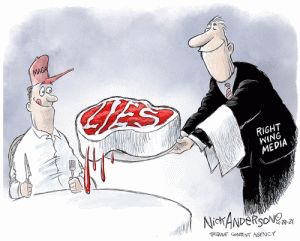 Arianna Coghill writes about the conspiracy theories adopted by the usual news outlets for lies and conspiracy theories at
 Policies based on “good, factual information” are not what the Republican Party is about these days, even though this is nothing new.
 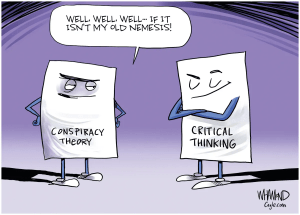 people in the West Wing at the moment to deal with what may be a significant disruption to supply chains. This is from Heather Cox Richardson, writing in her Substack
 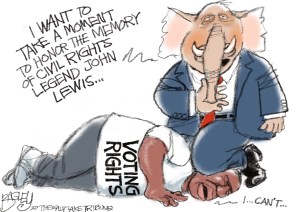 One piece of really great news today. Orlando Mayorquin writes this in The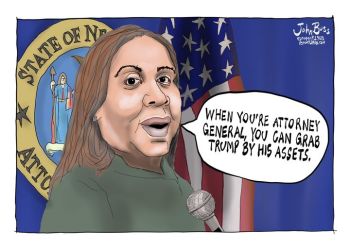
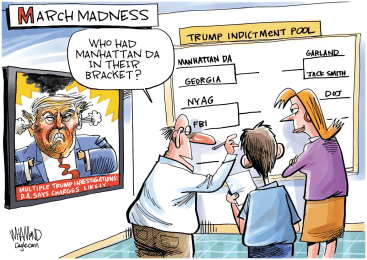 Would you see this in a Perry Mason episode or a Matlock script? No crime writer would even dream up these storylines. David Cay Johnson wrote this today for
 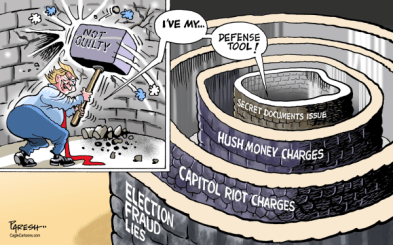 Meanwhile, we have this Washington Post Live Coverage over the Trump N.Y. Hush money case.
 Democratic Women in Louisiana are about troll James Carville
  Like Carville, Ronna Romney McDaniel has that sweet gig with MSNBC/NBC. Maybe it’s time for the company to take a big brand hit. We were a Huntley Brinkley family when I was a kid, but this is ridiculous. She appeared on Meet the Press yesterday, and Kristen Welker and Chuck Todd apologized for the appearance. It’s an odd day when Chuck Todd is the stand-out guy.
 The article continues to cite example after example, ending with this thought.
 Good Day, Sky Dancers!
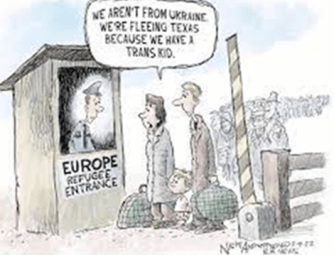 We don’t hear much about this, but the
 Here is an academic publication on the topic. “
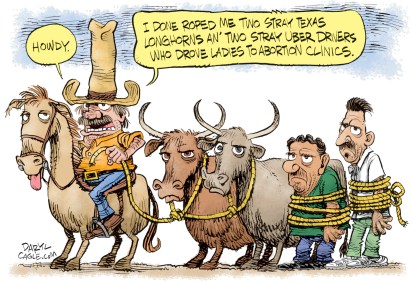 Diamond Brigman. Say her name. Violence against women continues to plague this country. “When Your Home State Also Becomes Your Abuser’ The leading cause of death for pregnant women is homicide, most often by an abusive partner with a gun. And Texas is forcing victims to stay pregnant while making it easier for abusers to get guns.” This is from
 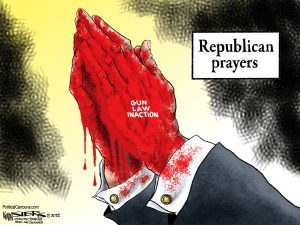 The cruelty continues in the MAGAtrocity. “HOUSE REPUBLICANS WANT TO BAN UNIVERSAL FREE SCHOOL LUNCHES. The Republican Study Committee’s annual budget also calls to permanently defund UNRWA and eliminate the National Labor Relations Board.” This is from




According to the campaign’s internal research, this is the case for most of the undecided voters that the campaign is targeting – nearly three-in-four of them, senior Biden campaign officials told CNN. Those officials said one of the biggest reasons driving this is the simple fact that many voters are not paying close attention to the election, including the ins and outs of the GOP nomination process.










 peej
peej Carissa
 bostonboomer
 dakinikat
 ecocatwoman
 mablue2
 Mama Lopez
 peggysue22
 quixote
 skydancingguestblogger
 Mona (aka Wonk the Vote)



 Sky Dancing
Recent Comments