
Lazy Caturday Reads
Posted: July 13, 2019 Filed under: Afternoon Reads, U.S. Politics 20 CommentsGood Afternoon!!
 I’m so glad the weekend is here and perhaps Trump will go golfing and leave us alone for a couple of days. It’s been one hell of an awful week. At The New York Times Mark Landler marked his departure from the White House beat with a dramatic summary of how bad one day–Thursday–was. At least Trump dumped Alex Acosta yesterday, but his replacement may be just as bad.
At The Daily Beast, Margaret Carlson has a perceptive piece on why Trump got rid of Acosta so quickly: Why the Sexual Predator in the White House Needed to Get Rid of Acosta.
In a press conference ordered up by Trump to save his job, Acosta failed miserably. And on Friday morning, Trump perp-walked Acosta, wearing his now familiar smirk, out to face the press corps on the south lawn of the White House, to announce that Acosta had decided to tender his resignation….
We know it didn’t happen because Trump’s eyes were opened by the Miami Herald’s November 2018 investigation of Epstein’s victims, exposing anew that Acosta looked evil in the eye and saw a deal to be cut.
It definitely couldn’t be because evangelicals or Senate Republicans suddenly remembered they had a modicum of integrity before being sucked into Trump’s vortex. No, it only happened once New York prosecutors re-indicted Epstein on similar charges of recruiting young girls and paying them to come to his lair to service him.
That put the whole mess front and center again, and Trump, binge TV watcher, was forced to watch (anytime he wasn’t tuned to Fox News) replays of the Access Hollywood tape, or pictures of him with Epstein, or discussions of the lawsuit filed by a 13-year old girl against him (since dropped), or mentions of the party for two—Trump and Epstein—at Mar-a-Lago with a bevy of 28 beauties imported for the occasion. That’s not to mention the two dozen women who’ve accused Trump of sexually abusing them.
It’s rare to have a beleaguered Trump official go so quickly, rather than be Zinked, Tillersoned, or Pruitted, drip by drip. Acosta hurt himself by not doing a full Kavanaugh, complete with righteous fire and fury, instead coldly admitting nothing and excusing all, even his secret meeting with opposing counsel at a restaurant because the office wasn’t open at that hour, no less.
 Trump may hope that dumping Acosta will get his sexual assault history off cable TV, but I don’t think it will happen. The Jeffrey Epstein story is still going strong and Trump’s connections to the notorious pedophile will keep on being reported.
This morning The New York Times dug up some Epstein history that will also impact Trump’s personal defense attorney Bill Barr: Jeffrey Epstein Taught at Dalton. His Behavior Was Noticed.
In the mid-1970s, students at one of New York’s most esteemed prep schools were surprised to encounter a new teacher who pushed the limits on the school’s strict dress code, wandering the halls in a fur coat, gold chains and an open shirt that exposed his chest.
The teacher, Jeffrey Epstein, would decades later face allegations that he coerced and trafficked teenagers for sex. At the Dalton School on the Upper East Side, some students saw Mr. Epstein as an unusual and unsettling figure, willing to violate the norms in his encounters with girls.
Recall that it was none other than Bill Barr’s father Donald Barr who hired Jeffrey Epstein for this teaching job, even though he didn’t even have a college degree.
Eight former students who attended the prestigious school during Mr. Epstein’s short tenure there said that his conduct with teenage girls had left an impression that had lingered for decades. One former student recalled him showing up at a party where students were drinking, while most remembered his persistent attention on the girls in hallways and classrooms.
“I can remember thinking at the time, ‘This is wrong,’” said Scott Spizer, who graduated from Dalton in 1976.
None of the female students who spoke to The New York Times in recent days remembered Mr. Epstein making unwanted physical contact with them, and he has not been accused of any crimes related to his time at the school.
But a few students said they had been discomfited by a close relationship he had with one of their female peers, a concern that had escalated so much that one of them had raised the issue then to a school administrator.
Read the rest at the NYT.
 Trump is reportedly planning mass raids on immigrant communities beginning tomorrow. The NYT reports:
President Trump said nationwide raids to arrest and deport undocumented migrants would begin on Sunday in a sweep that immigration officials said could roll out over days, echoing a similar threat last month that was never carried out.
“Nothing to be secret about,” Mr. Trump told reporters at the White House on Friday morning, where he was asked about the plans. He called it “a major operation.”
“It starts on Sunday, and they’re going to take people out and they’re going to bring them back to their countries,” the president said. “Or they’re going to take criminals out, put them in prison, or put them in prison in the countries they came from.”
Meanwhile family separations are continuing, even though courts have ordered the administration to stop taking children from their parents. The Texas Tribune: Family separations aren’t over. As many as five kids per day are separated from their parents at the border.
More than a year after the Trump administration ended a controversial policy that led to hundreds of family separations, as many as five migrant children per day continue to be separated from their parents at the U.S.-Mexico border, according to federal data gathered by an immigrant advocacy group.
The data, which the American Immigration Council and other immigrant advocacy groups requested from the U.S. Department of Health and Human Services, shows that almost 400 children were separated from their parents between June 2018 — when the Trump administration ended its controversial zero tolerance policy — and March 2019.
That number jumped to more than 700 children by May, according to data the government provided to the American Civil Liberties Union, which is litigating the family separation crisis in federal court.
Despite the executive order that President Donald Trump signed in June 2018 to end zero tolerance — which directed immigration officials to file charges against all adults who crossed the border illegally — advocates say adult migrants continue to be separated from children for reasons that are increasingly vague and difficult to corroborate.
Read more at the link.
 The New Yorker reports on a new Trump initiative: Trump Is Poised to Sign a Radical Agreement to Send Future Asylum Seekers to Guatemala.
Early next week, according to a D.H.S. official, the Trump Administration is expected to announce a major immigration deal, known as a safe-third-country agreement, with Guatemala. For weeks, there have been reports that negotiations were under way between the two countries, but, until now, none of the details were official. According to a draft of the agreement obtained by The New Yorker, asylum seekers from any country who either show up at U.S. ports of entry or are apprehended while crossing between ports of entry could be sent to seek asylum in Guatemala instead. During the past year, tens of thousands of migrants, the vast majority of them from Central America, have arrived at the U.S. border seeking asylum each month. By law, the U.S. must give them a chance to bring their claims before authorities, even though there’s currently a backlog in the immigration courts of roughly a million cases. The Trump Administration has tried a number of measures to prevent asylum seekers from entering the country—from “metering” at ports of entry to forcing people to wait in Mexico—but, in every case, international obligations held that the U.S. would eventually have to hear their asylum claims. Under this new arrangement, most of these migrants will no longer have a chance to make an asylum claim in the U.S. at all. “We’re talking about something much bigger than what the term ‘safe third country’ implies,” someone with knowledge of the deal told me. “We’re talking about a kind of transfer agreement where the U.S. can send any asylum seekers, not just Central Americans, to Guatemala.”
This is similar to the agreement that Trump made with Mexico to keep asylum seekers out of the U.S. It’s crazy.
Until very recently, the prospect of such an agreement—not just with Mexico but with any other country in Central America—seemed far-fetched. Yet last month, under the threat of steep tariffs on Mexican goods, Trump strong-armed the Mexican government into considering it. Even so, according to a former Mexican official, the government of Andrés Manuel López Obrador is stalling. “They are trying to fight this,” the former official said. What’s so striking about the agreement with Guatemala, however, is that it goes even further than the terms the U.S. sought in its dealings with Mexico. “This is a whole new level,” the person with knowledge of the agreement told me. “In my read, it looks like even those who have never set foot in Guatemala can potentially be sent there.”
This is getting really scary. First concentration camps, now this.
 Louisiana is still waiting for slow-moving Hurricane Barry.
Liz Williams Russell at CNN: Why Barry is such a scary storm. (Russell is “the director of the grant-making and programmatic activities of the Climate Justice portfolio at the Foundation for Louisiana.”)
The past, present and future of New Orleans lies with the Mississippi River. As New Orleanians brace for Tropical Storm Barry, we find ourselves on the brink of the unknown, as we are about to learn the extent to which our existing systems of controlling and managing nature will withstand the storm.
We’re now facing a new normal. When “one in 100 year” rain events happen on an increasingly annual basis, there is a fundamental issue with the ways we measure storm intensity in the context of historic weather events. As Barry picks up strength along the Gulf of Mexico, it’s a reminder that we are headed toward uncharted territory with the effects of climate change threatening every aspect of our communities.
The river has been at varying levels of flood stage since November due to the record-breaking rainfall and flooding seen across the Midwest and the winter thaw from the Rockies to the Appalachians. We’ve seen the Bonnet Carre Spillway, a flood control mechanism to manage a high Mississippi River, opened twice in one year and in two consecutive years for the first time in its almost 90-year history. Only one of a set of floodways along the river system is designed to effectively move water out into the Gulf of Mexico — the drainage and residues from 41% of the country all ends up here, speeding around and through this fertile crescent city as it moves towards open water.
This year, we face another first as we find ourselves early in the hurricane season with the Mississippi double its normal depths due to flooding and Barry set to make landfall at a midpoint of Louisiana’s coast. Water will likely be pushed up a severely swollen river system with leveed boundaries already tired from so many months in the flood fight. We are required to trust our system of flood management — necessarily believing it will endure this new test — and prepare for the storm as we reflect on how to best serve our communities.
Read the rest at CNN.
Finally, I want to share some great long reads that I’ve come across this morning. I hope you’ll check them out.
Nilanjana Roy at The New York Review: A Ferocious Heat in Delhi.
Chi Luu at JSTOR Daily: How Language and Climate Connect.
Jessica Contrera at The Washington Post: A black principal, four white teens and the ‘senior prank’ that became a hate crime.
Charles Bethea at The New Yorker: A Father, a Daughter, and the Attempt to Change the Census.
What stories are you following today?
Thursday Reads: Trump’s “Social Media Summit” and Jeffrey Epstein Updates
Posted: July 11, 2019 Filed under: Afternoon Reads, U.S. Politics | Tags: conspiracy theories, Donald Trump, Erin Kelso art, fantasy illustrations, Jeffrey Epstein, Nazis, right wing nuts, social media summit 23 Comments
“Hello gryphon, you are half-bird and so big,” by Erin Kelso
Good Afternoon!!
The illustrations in this post are by fantasy artist Erin Kelso, AKA bluefooted.
Jeffrey Epstein is still all over the news, although Trump is trying to distract the media by inviting a bunch of Nazis and right wing conspiracy theorists to visit the White House today for a “social media summit” and sending out deranged tweets, in one of which he claimed to be “so great looking and smart, a true Stable Genius!” followed by the suggestion that he might be in office for 14 more years.
Trump’s “social media” summit
The Washington Post: ‘We will not let them get away with it’: Trump threatens social media ahead of White House summit.
President Trump plans to gather Republican lawmakers, campaign strategists and online provocateurs for a “social media summit” at the White House on Thursday, rallying his political allies and escalating his attacks on Facebook, Google and Twitter ahead of the 2020 election.
Harpy, by Erin Kelso
For Trump, the conference represents his highest profile broadside against Silicon Valley after months of accusing tech companies of censoring conservative users and websites. Facebook, Google and Twitter each has denied the president’s allegations of political bias, though none of them has been invited to the White House for Trump’s summit.
Hours before the event, Trump tweeted that the focus of the conversation “will be the tremendous dishonesty, bias, discrimination and suppression practiced by certain companies,” though he didn’t mention any by name. “We will not let them get away with it much longer,” he added.
Trump has assailed Facebook, Google and Twitter for months, even accusing them of trying to rig the election. In March, for example, he said the companies had engaged in “collusion” and work in opposition to a “certain group of people that happen to be in power, that happen to have won the election.”
At times, though, Trump’s attacks have come in response to efforts by Facebook, Google and Twitter to remove hate speech, threats of violence and other troubling content from their platforms.

Because Trump just loves hate speech.
Vox’s Recode reveals some of the nuts who will be at Trump’s “summit.”
…the gathering in Washington this week will bring together conservative media outlets and Donald Trump supporters who accuse Big Tech of anti-conservative bias despite a lack of evidence supporting their claims.
Canyon Maker, by Erin Kelso
Who will actually be there: The leaders of several conservative groups, like Turning Point USA, YourVoice Inc, right-wing YouTube channel Prager University, conservative think tank the Heritage Foundation, and a right-wing meme maker known as Carpe Donktum have all confirmed they are attending Thursday’s meeting.
What’s it’s really about: Trump has suggested the government might sue social media companies over accusations of political bias, but he hasn’t taken concrete action so far. In May, Recode reported on a tool the White House launched for people to flag claims of social media censorship — but the tool is essentially a ploy to gather voter data. According to the Journal, today’s summit “is a way to rally Trump’s base” and will offer a “preview of a likely theme in Mr. Trump’s reelection campaign.” [Ryan Tracy / The Wall Street Journal]

More information on the attendees from CNN:
The White House has repeatedly declined to release a list people it expects to attend, but some of the recipients have turned to social media to boast about being invited.
By ErinKelso
Among them are Bill Mitchell, a radio host who has promoted the extremist QAnon conspiracy theory on Twitter; Carpe Donktum, an anonymous troll who won a contest put on by the fringe media organization InfoWars for an anti-media meme; and Ali Alexander, an activist who attempted to smear Sen. Kamala Harris by saying she is not an “American black” following the first Democratic presidential debates.
Other eyebrow raising attendees include James O’Keefe, the guerrilla journalist whose group Project Veritas tried to trick reporters at the Washington Post by planting a source who told the paper that she had been impregnated as a teenager by failed Republican Senate candidate Roy Moore; Charlie Kirk, the founder of the right-wing student group Turning Point USA who sometimes posts misleading information on social media; and Benny Johnson, the journalist-turned-activist who was fired for plagiarism by BuzzFeed and demoted at the Independent Journal Review for violating company standards.

From Vice: Trump Invites Fringe Social Media Company Popular With Nazis to the White House.
[Today] President Donald Trump is meeting with a series of right wing figures at the White House to discuss social media issues. But Facebook and Twitter won’t be there. In fact, the only social media network that has publicly said it’s attending is Minds—billed as the crypto “anti-Facebook” and once home to several neo-Nazi extremist groups.
Pulp, a public relations firm that counts Minds among its client list, sent Motherboard a photo of the invitation the fringe social media site received to the White House for the summit.
By Erin Kelso
“Minds.com is the only social media network invited to the White House’s social media summit!” wrote the Pulp representative in an email to Motherboard. Facebook and Twitter, social media companies with an astronomically larger number of users than Minds, were excluded from the summit.
A previous Motherboard investigation found that miliant neo-Nazi groups connected to Atomwaffen Division—a violent American hate group connected to several murders—was using Minds as a platform for recruiting and spreading propaganda. Minds eventually banned the accounts when Motherboard showed them to the platform, but the company’s lax content moderation allowed them to proliferate unchecked for months.

One more from The Daily Beast: Trump’s Social Media Summit Mortifies White House, Enrages Far-Right Allies.
Donald Trump has invited personalities from across the right-wing internet to the White House on Thursday for a “Social Media Summit,” but the event is causing his administration headaches even before it begins.
So far, the summit has stirred up resentments among pro-Trump personalities who were never invited to the party, and one invitee has been disinvited over an anti-Semitic cartoon—raising questions for the White House about why he was invited in the first place….
The Devil, by Erin Kelso
Notably, the group so far doesn’t appear to include anyone who has actually been banned from major social platforms, even though those bans have played a significant role in driving accusations on the right that the social giants are biased. Pro-Trump figures like anti-Muslim activist Laura Loomer, InfoWars conspiracy theorist Alex Jones, and Proud Boys men’s group founder Gavin McInnes, for example, don’t appear to have been invited.
That fact hasn’t been lost on fringe Trump supporters. In a livestream from Washington, D.C., InfoWars reporter and Jones lieutenant Owen Shroyer raged that no one from InfoWars was invited to the event, while people who hadn’t been banned were.
Shroyer declared that the event was an “abortion of truth” and compared the invitees to dogs getting a bone and a pat on the head.

Read much more at the link.
Jeffrey Epstein News
Last night The New York Times published a very interesting story on Epstein’s financial history: Jeffrey Epstein’s Fortune May Be More Illusion Than Fact.
Mr. Epstein is routinely described as a billionaire and brilliant financier, and he rubbed elbows with the powerful, including former and future presidents. Even after his 2008 guilty plea in a prostitution case in Florida, he promoted himself as a financial wizard who used arcane mathematical models, and he often dropped the names of Nobel Prize-winning friends. He told potential clients that they had to invest a minimum of $1 billion. At his peak in the early 2000s, a magazine profile said he employed 150 people, some working out of the historic Villard Houses on Madison Avenue.
Much of that appears to be an illusion, and there is little evidence that Mr. Epstein is a billionaire.
Wicked and the Unicorn, by Erin Kelso
Mr. Epstein’s wealth may have depended less on his math acumen than his connections to two men — Steven J. Hoffenberg, a onetime owner of The New York Post and a notorious fraudster later convicted of running a $460 million Ponzi scheme, and Leslie H. Wexner, the billionaire founder of retail chains including The Limited and the chief executive of the company that owns Victoria’s Secret.
Mr. Hoffenberg was Mr. Epstein’s partner in two ill-fated takeover bids in the 1980s, including one of Pan American World Airways, and would later claim that Mr. Epstein had been part of the scheme that landed him in jail — although Mr. Epstein was never charged. With Mr. Wexner, Mr. Epstein formed a financial and personal bond that baffled longtime associates of the wealthy retail magnate, who was his only publicly disclosed investor.

You’ll need to read the whole thing, but one fascinating revelation is that Epstein was aided by the same private section of Deutsche Bank that lent millions to Donald Trump.
In recent years, Mr. Epstein was a client of Deutsche Bank’s private-banking division, which caters to ultrawealthy individuals and families. The bank provided Mr. Epstein with loans and wealth-management accounts, as well as trading services through its investment banking arm, according to two people familiar with the relationship. At one point, compliance officers at Deutsche Bank raised concerns about transactions by Mr. Epstein’s company, because he posed reputational risk to the bank, the people said.
Deutsche Bank managers overruled their concerns, the people said. They noted that there was nothing illegal about the transactions and that Mr. Epstein was a lucrative client.
Earlier this year, the bank ended its relationship with Mr. Epstein.

Queen Titania, by Erin Kelso
AP: Whispers, suspicion about Epstein on Caribbean island.
Ask about Jeffrey Epstein on St. Thomas and rooms go quiet. Some people leave. Those who share stories speak in barely audible tones.
The 66-year-old billionaire bought Little St. James Island off this U.S. Caribbean territory more than two decades ago and began to transform it — clearing the native vegetation, ringing the property with towering palm trees and planting two massive U.S. flags on either end. When guides took scuba divers to spots near the island, security guards would walk to the water’s edge.
It was off-putting to residents of St. Thomas — a lush tropical island east of Puerto Rico with winding roads through mountains dotted with dainty Danish colonial-era homes. Then, when Epstein pleaded guilty in a 2008 to soliciting and procuring a minor for prostitution, his need for privacy began to appear more sinister.
“Everybody called it ‘Pedophile Island,’” said Kevin Goodrich, who is from St. Thomas and operates boat charters. “It’s our dark corner.”
Many people who worked for Epstein told The Associated Press this week that they had signed long non-disclosure agreements, and refused to talk. One former employee who declined to be identified said Epstein once had five boats, including a large ferry in which he transported up to 200 workers from St. Thomas to his island every day for construction work.
Click on the link to read more details.

The Bitter End, by Erin Kelso
Joe Pompeo at Vanity Fair: “He Was Living In Peace, Like Dr. Mengele In Paraguay”: Manhattan Media Remember Jeffrey Epstein, The Monster Hiding In Plain Sight.
In late 2009, as civil complaints alleging Jeffrey Epstein’s sexual abuse of underage girls were mounting, George Rush, the long-running Daily News gossip columnist, was preparing a story on one of the latest Jane Doe lawsuits filed against the billionaire financier. The legal documents contained allegations that hadn’t yet been reported, and Rush was keen on nudging them into the public domain. He drew up a list of questions and sent them to Howard Rubenstein, who was Epstein’s publicist at the time. Rush’s reporting resulted in a call from Epstein himself to Daily News owner Mort Zuckerman, who had been a business partner of Epstein’s a few years earlier. The enigmatic and press-shy tycoon was offering Zuckerman something rare: an interview for the Daily News. But when Epstein got on the phone with Rush, Epstein said he could only speak off the record, on the advice of his lawyers. The whole 22-minute conversation sounded to Rush like a bunch of spin.
“It was just kind of this self-serving rationale for how he had been tormented by the lawyers for these girls, whom he characterized as these preexisting prostitutes and strippers who’d already been indoctrinated into the sex world,” Rush told me, describing the interview only in general terms because, even 10 years later, it’s still off the record. “You got the sense that he could adopt many masks. He played up his working-class roots on Coney Island, and how he understood that this was a good story that sold newspapers, and how everybody hates a rich guy. He basically said, I get why this is a good story for you, but I think a better story would be how these con artist lawyers are abusing the legal system.”
Rush said his Epstein chat was “almost useless,” though it “did give me a window into him. He briefly acknowledged getting himself into this mess. But he showed little remorse and no pity for his victims. He was mostly concerned with keeping Ghislaine Maxwell, his alleged henchwoman, out of the story.”
This is a long but interesting story, but check it out. Along the way, Epstein’s behavior has been enabled by so many rich and powerful allies.
Two more:
The New York Times: Cyrus Vance’s Office Sought Reduced Sex-Offender Status for Epstein.
The New York Post: NYPD let convicted pedophile Jeffrey Epstein skip judge-ordered check-ins.
What else is happening? What stories are you following today?
Tuesday Reads: Jeffrey Epstein, Trump, and the Politicized DOJ
Posted: July 9, 2019 Filed under: morning reads, U.S. Politics | Tags: Bill Barr, Department of Justice, Donald Trump, Jeffrey Epstein, sex trafficking 54 Comments
Summertime, by Mary Cassatt, 1894
Good Morning!!
The news is full of Jeffrey Epstein stories; I can only hope that this time his victims will finally get justice. Bill Barr has recused himself from the case, but will that keep Trump and the Justice Department he now controls from helping his old pal Epstein?
Trump Has Politicized the DOJ
Chris Smith at Vanity Fair: “It Would Be Ridiculously Naive Not To Be Concerned”: Trump has Politicized the DOJ. How Long Can the SDNY Hold Out?
Sally Yates tried to warn us. Way back in January 2017, at the end of the very first week of the Trump administration, the new president signed an executive order banning refugees and immigrants from seven majority-Muslim countries from entering the United States. It was a blatantly political act, following months of Trump campaign promises, and it immediately provoked lawsuits challenging the order as religious discrimination. Yates, the acting attorney general, refused to defend the legally indefensible and was summarily fired. “The president is attempting to dismantle the rule of law, destroy the time-honored independence of the Justice Department, and undermine the career men and women who are devoted to seeking justice day in and day out,” Yates wrote in a New York Times op-ed published in July 2017.
Summer’s Day, by Berthe Morisot
Two Julys later, Trump’s politicization of the DOJ is gaining new momentum and depth. The president’s choice of William Barr as attorney general, and Barr’s entirely predictable attempts to undercut the Mueller report, has been the highest-profile, highest-stakes move to weaponize the department for partisan purposes. But two fresh episodes demonstrate Trump’s relentless push to subvert the DOJ, and how far-reaching the damage will be to the rule of law. First came Sarah Fabian, the senior attorney in the DOJ’s Office of Immigration Litigation, telling a California appeals court that it is “safe and sanitary” for jailed immigrant children to go without soap or toothbrushes and to sleep on concrete floors under bright lights. “I actually felt somewhat sorry for her,” a former federal prosecutor says. “You could hear how half-hearted she was in making the point. But there is no way she would have been making that argument at all without it being approved at the highest levels of DOJ….”
The second, ongoing case echoes the events that got Yates fired. Last week, the Supreme Court ruled against adding a citizenship question to the 2020 census, after documents from a now deceased Republican consultant’s hard drives were exposed. The census citizenship question, Thomas Hofeller wrote in an analysis, “would clearly be a disadvantage to the Democrats” and “advantageous to Republicans and non-Hispanic whites.” The DOJ announced it would not be fighting the Supreme Court ruling; the Commerce Department announced it would begin printing the census forms without the question in question.
Trump didn’t care. “We are absolutely moving forward,” he declared on Twitter. Which was news to DOJ lawyers, who found themselves fumbling during an emergency conference call with a Maryland district court judge….
Summer Afternoon in Rockport, by Carl Peters
After a few more days of confusion, the DOJ said on Friday it would demur from pursuing the case, at least until the Commerce Department “adopts a new rationale for including the citizenship question.” That new spin should arrive very soon. Over the weekend Trump and Barr replaced the DOJ legal team handling the case. Whether the prior group of career lawyers balked at returning to the Supreme Court with a new, possibly untenable argument or whether Barr simply wants fresh minds on the case, the shift was all but unprecedented, and is yet another indication that Trump sees the DOJ as a political tool.


Will Trump find a way to force the DOJ to help Epstein? I think he’s likely to try. Smith concludes:
…it’s hard to imagine Trump won’t try to intercede if the famously independent SDNY—currently back in the headlines for charging billionaire Jeffrey Epstein with sex trafficking—moves to indict one or more of the president’s high-ranking associates. (Epstein has pleaded not guilty.) “The fear is that Trump doesn’t even need to say it out loud anymore, because Barr is so protective of him,” Rocah says. “It would be ridiculously naïve not to be concerned.”
Also recommended from Zoe Tillman at Buzzfeed News: Trump Is Bringing In New Lawyers On The Citizenship Question Case And No One Knows What’s Happening.
Epstein stories to check out
Ken White provides a good backgrounder on the case at The Atlantic: Jeffrey Epstein Is Out of Luck.
The United States Attorney’s Office for the Southern District of New York, famously aggressive in pursuing high-profile prosecutions, charged Epstein last week with child sex trafficking in violation of Title 18, United States Code, Section 1591. These new charges represent the Department of Justice’s attempt to redeem a reputation soiled by the extremely questionable plea deal it gave Epstein in 2008.
Summer Landscape, by Pierre Auguste Renoir, 1875
In 2006 and 2007, Epstein— once a reliable companion of the well-connected — faced extensive, detailed allegations that he paid multiple minors for sexual contact and for their services in procuring other minors. Most people, hammered with that kind of evidence, would spend the rest of their lives in prison. But Epstein could afford the lavish attention of a defense team staffed by legal luminaries like Alan Dershowitz and Kenneth Starr. Most of us hope an attorney will defend us competently at trial, but the super-rich can afford to go on the offense. Epstein’s lawyers hounded the United States Attorney’s Office for the Southern District of Florida, which was considering federal charges based on reports that Epstein procured underaged girls across state lines. Former U.S. Attorney Alex Acosta – now President Trump’s Secretary of Labor – characterized it as a “year-long assault on the prosecution and prosecutors,” and complained that Epstein’s team investigated prosecutors and their families “looking for personal peccadilloes that may provide a basis for disqualification.”
The strategy worked. Epstein’s team secured the deal of the millennium, one utterly unlike anything I’ve seen in 25 years of practicing federal criminal law. Epstein agreed to plead guilty to state charges, register as a sex offender, and spend 13 months in county jail, during which time he was allowed to spend 12 hours a day, 6 days a week, out of the jail on “work release.” In exchange, the Southern District of Florida abandoned its criminal investigation of Epstein’s conduct, agreed not to prosecute him federally, and – incredibly— agreed not to prosecute anyone else who helped him procure underaged girls for sex. This is not normal; it is astounding.

Read the rest at the link.
Barbara McQuade at New York Magazine: The Jeffrey Epstein Case Shows What Sex Trafficking Really Looks Like.
Interior at Etretat, the 14th of July, by Henri Matisse, 1920
When jurors hear “sex trafficking,” they conjure up images of victims bound by chains, subjected to physical force and imprisonment. While some cases include those aggravating facts, more often, the victim instead chooses to stay with her assailant, who preys upon a vulnerability. Defendants recruit victims in a variety of ways and then force them to engage in sex acts with them or with paying customers. Jurors are sometimes persuaded that if the defendant was truly engaging in sex trafficking, the victim would have simply run away or called the police.
As a former federal prosecutor, I have seen cases of sex trafficking, and none of those cases involved victims in ropes or chains. More often, the cases involved runaways, undocumented immigrants, or victims of sexual abuse.
A high-profile case like Epstein’s provides a teachable moment for American jurors. The indictment notes that some of his victims returned to his home to perform sex acts for money, even after they knew full well what was in store for them. The indictment also notes that the victims were “for various reasons, particularly vulnerable to exploitation.” That is the secret sauce of sex trafficking….
Sex trafficking is particularly egregious when it involves children, as in Epstein’s case. Children by definition are unable to consent to sex. In Epstein’s case, girls were lured to his home for sex with promises of hundreds of dollars and the prospect of modeling careers — offers that can be head-spinning and irresistible for a young teen.
by
Summer day, Gloucester Harbor, by Alice Judson
One of the reasons that we prosecute crimes is to deter others from committing similar acts. By seeing criminals punished for wrongdoing, others learn from their example. Another potential benefit of the Epstein case is to educate the public that not all victims of sex trafficking are found in chains. Here is hoping that jurors will learn from this example.


Read the whole thing at The Intelligencer.
Vicky Ward (who researched and wrote an in-depth piece about Epstein for Vanity Fair in 2003) at The Daily Beast: Jeffrey Epstein’s Sick Story Played Out for Years in Plain Sight.
For almost two decades, for some nebulous reason, whether to do with ties to foreign intelligence, his billions of dollars, or his social connections, Epstein, whose alleged sexual sickness and horrific assaults on women without means or ability to protect themselves is well-known in his circle, remained untouchable.
As many people know, I spent many months on his trail in 2002 for Vanity Fair and discovered not only that he was not who he claimed to be professionally, but also that he had allegedly assaulted two young sisters, one of whom had been underage at the time. Very bravely, they were prepared to go on the record. They were afraid he’d use all his influence to discredit them—and their fear turned out to be legitimate.
As the article was being readied for publication, Epstein made a visit to the office of Vanity Fair’s then-editor, Graydon Carter, and suddenly the women and their allegations were removed from the article. “He’s sensitive about the young women,” Carter told me at the time. He also mentioned he’d finagled a photograph of Epstein in a swimsuit out of the encounter. And there was also some feeble excuse about the article “being stronger as a business story.” (Epstein had also leaned heavily on my ex-husband’s uncle, Conrad Black, to try to exert his influence on me, which was particularly unwelcome, given that Black happened to be my ex-husband’s boss at the time.)
Summer Evening Wheat Field at Sunset, by Vincent Van Gogh
But much worse was to come from Epstein’s army of willfully blind lobbyists. In 2007 and 2008, as the FBI prepared a 53-page indictment that would charge Epstein with sex crimes, Epstein’s powerful legal team played the influence card.
After one meeting with then-U.S. Attorney Acosta, where presumably “intelligence” was mentioned, the indictment was shelved and, instead, Epstein signed a non-prosecution agreement with federal prosecutors, pleading guilty to one count of solicitation of prostitution and one count of procurement of minors for prostitution, which earned him a cushy 13 months in county jail, from where he was allowed to leave to work at his office and go for walks.

It’s worth reading the whole thing.
More helpful Epstein stories, links only
The New York Times: Seized Photos of Nude Girls Deepens Questions About Jeffrey Epstein’s 2008 Deal.
The New York Times: Inside Epstein’s $56 Million Mansion: Photos of Bill Clinton, Woody Allen and Saudi Crown Prince.
The Washington Post: Epstein indictment renews questions about earlier case handled by Trump Cabinet official.
Catherine Rampell at The Washington Post: Alex Acosta gave a pass to Epstein years ago. He’s still at it as labor secretary.
Michelle Goldberg at The New York Times: Jeffrey Epstein Is the Ultimate Symbol of Plutocratic Rot.
Bloomberg: Mystery Around Jeffrey Epstein’s Fortune and How He Made It.
What else is happening? What stories have you been following?
Lazy Caturday Reads With Surrealist Cats
Posted: July 6, 2019 Filed under: Afternoon Reads, U.S. Politics | Tags: Remedios Varo 29 Comments
Cat’s Paradise, by Remedios Varo
Good Afternoon!!
There’s been another earthquake in Southern California and this one was bigger than the last one.
The LA Times: 7.1 earthquake causes damage; more significant temblors likely.
A magnitude 7.1 earthquake struck Southern California on Friday night, the second major temblor in less than two days and one that rocked buildings across Southern California, adding more jitters to an already nervous region.
The quake was centered near Ridgecrest, the location of the July Fourth 6.4 magnitude temblor that was the largest in nearly 20 years. It was followed by an aftershock first reported as 5.5 in magnitude. Scientists said the fault causing the quakes appears to be growing.
Friday night’s quake caused some fires and other damage in and around Ridgecrest and Trona, two Mojave Desert towns shaken by both quakes, said Mark Ghilarducci, director of the California Governor’s Office of Emergency Services. The quake was felt as far away as Phoenix, Las Vegas, Baja California and Reno, according to crowd-sourced data logged into the U.S. Geological Survey’s Did You Feel It? website.

Cat and Violin, Remedios Varo
About 3,000 residents in Ridgecrest and the surrounding areas are without power after the earthquake, according to Southern California Edison. In Los Angeles, there were no immediate reports of major damage to buildings and infrastructure, according to the Los Angeles Fire Department.
Read much more at the link.
According to CNN, people were sleeping outside because they were afraid of staying in the houses. This quake lasted longer than the previous one.
Bakersfield resident Giovanna Gomez was at home with her family when their house swayed and the water in her pool overflowed. They ran outside.
“It was about a minute long,” she said. “Far larger than the one that (happened) yesterday. It was a smooth roll going back and forth.”
Bakersfield is in Kern County about 110 miles from Ridgecrest. Donald Castle, who lives in Porterville west of Ridgecrest, said his house shook for nearly 25 seconds.
“It was more of a shake than what we had on the Fourth. It lasted longer and was more rolling,” he said.
Read more at CNN.
More from the LA Times: 11% chance of another huge earthquake in Southern California, scientists say.
The odds that Southern California will experience another earthquake of magnitude 7 or greater in the next week are now nearly 11%, according to preliminary estimates from seismologists.
Remedios Varo, Simpatía. La Rabia del gato (The Madness of the Cat), 1955
And the chances that a quake will surpass the 7.1 temblor that struck near Ridgecrest on Friday night are roughly 8% to 9%, said Caltech seismologist Lucy Jones.
“There’s about a 1 in 10 chance that we could have another 7 in this sequence,” she said.
More likely is that the Owens Valley will experience another temblor of magnitude 6 or greater. The odds of that are slightly greater than 50-50, Jones said. And more quakes of magnitude 5 or greater are a near certainty.

Scientists also say that earthquakes do not “relieve pent-up seismic stress.” These quakes won’t prevent “The Big One.”
It’s wishful thinking to imagine that, as a rule, earthquakes “relieve” seismic stress, said seismologist Lucy Jones.
In fact, generally speaking, earthquakes actually increase the risk of future quakes.
The reality is coming into focus as Southern California experienced its largest earthquake in nearly two decades, ending a quiet period in the state’s seismic history.
Click the link to read more about the science of earthquakes.

The Fern Cat by Remedios Varo
If you’re wondering why I’m spending so much time on the California quakes, it’s because there’s not much news breaking today–a rarity since Trump was installed in the White House by Russia. But here are some interesting reactions to Trump’s 4th of July speech to check out.
A very good piece by Never Trumper Tom Nichols at The New York Daily News: Trump’s sad, strange, somewhat Soviet Fourth of July spectacle.
Let’s get an obvious point about President Trump’s Independence Day speech out of the way right at the top. It was a bad speech.
It wasn’t bad in the way most of Donald Trump’s speeches are bad, in that it was not overtly objectionable. It was relatively free of the populist claptrap and barely disguised racism that characterizes so many of the president’s rally addresses. In some ways, it was even anodyne, and certainly not even in the same league as his hideous “American carnage” inaugural address.
Instead, it was just a poorly written speech: a long, cliché-plagued, rambling trip through American history that tried to name-check battles and famous people as applause lines. Imagine “We Didn’t Start the Fire” if Billy Joel had been born in 1776 and his producers told him to take as much time as he needed to finish the song.
The Mediterranean Cat, Remedios Varo, 1949
On that level, the “Salute to America” was a flop. Perhaps this was unavoidable, since it was never meant to salute America, but rather to provide the military display Trump has wanted for two years. Like any enforced celebration, it was flat and labored. There were no memorable phrases, no vivid images and no bold proposals — unless you count a promise to NASA stalwart Gene Kranz to plant a U.S. flag on Mars one day. It would have been a challenging speech to deliver even for a better speaker, and Trump, who hates reading from prepared remarks, plodded through it with a strangely detached presence and a certain amount of mushy enunciation, including a weird blip where he referred to the glorious military capture of some airports in colonial America.
On another level, however, the speech was indeed offensive. Not only did it attempt to militarize our most sacred national holiday, but Trump tried to bathe himself in borrowed legitimacy from a military that was forced to march, sing and fly for him.

Please go read the rest.
From another Never Trumper and former speech writer David Frum at The Atlantic: Trump’s Recessional.
Trump’s speech was written by people who did not know what they wanted to say. It was a litany of old glories, a shout-out to heroes carefully balanced by race and sex, but with no conscious theme or message. It narrated old triumphs in war and commerce, but without apparent purpose or direction. First this, then that, now a third thing.
The Great Cat, Remedios Varo, 1943
Trump wanted pictures and video of his big day: Trump standing in the place where Martin Luther King Jr. once stood, the podium swathed in flags and bunting, bordered by tanks, adoring audience in front, screeching fighter jets overhead … Strong! Proud! The speech existed only to provide a reason why he needed to stand in one place long enough for five waves of warplanes to cross the sky.
As Trump retold the story of the Pacific War, he said this: “Nobody could beat us. Nobody could come close.” When he paid tribute to the Air Force, he said this: “As President Roosevelt said, the Nazis built a fortress around Europe, ‘but forgot to put a roof on it.’ So we crushed them all from the air.” He added: “No enemy has attacked our people without being met by a roar of thunder, and the awesome might of those who bid farewell to Earth, and soar into the wild blue yonder.” Bringing the story to more recent times: “The Army brought America’s righteous fury down to al-Qaeda in Afghanistan and cleared the bloodthirsty killers from their caves.”
Were these wars right or just? Why were they fought? What were their outcomes? Except for the mentions of “freedoms” sprinkled randomly through the text, those questions went unconsidered. Instead, Trump would periodically ad-lib “What a great country!” after this or that mention of power and violence. America is great because it crushes all before it. Altering for circumstances, it was a speech that could have been given by Kaiser Wilhelm or Napoleon or Julius Caesar or the Assyrian Emperor Sennacherib. A great country is one that is feared by its enemies, that can inflict more devastating destruction than any other.

Masha Gessen at The New Yorker: Donald Trump’s “Inoffensive” War on Reality.
Donald Trump’s Fourth of July address was most remarkable for the things it did not contain. Immediately afterward, commentators noted that Trump didn’t use the opportunity to attack the Democratic Party, to issue explicit campaign slogans, or, it would appear, make any impromptu additions (with the possible exception of the claim that American troops commandeered enemy airports during the Revolutionary War). The President was so disciplined on the occasion of the republic’s two hundred and forty-third birthday that Vox called his speech “inoffensive.” Slate gave the speech credit for being “not a complete authoritarian nightmare.” The Times noted that Trump called for unity, in a gesture uncharacteristic of his “divisive presidency.” The word “tame” popped up in different outlets, including Talking Points Memo, which concluded that, thanks to the President not going off script, “the whole thing was pretty standard.”
Cat’s Paradise detail, Remedios Varo
Campaign slogans and glaring Trumpisms were not the only things absent from the speech. Immigrants were missing. Trump’s most recent predecessors presided over Fourth of July naturalization ceremonies. A rhetorical link between the holiday and immigration has long seemed unbreakable. During his last Independence Day as President, Bill Clinton chose to speak in New York Harbor, against the backdrop of Ellis Island and the Statue of Liberty. “Perhaps more than any other nation in all history, we have drawn our strength and spirit from people from other lands,” he said. “On this Fourth of July, standing in the shadow of Lady Liberty, we must resolve never to close the golden door behind us, and always not only to welcome people to our borders, but to welcome people into our hearts.” In a much-criticized series of Independence Day events in 1986, President Reagan lit the torch of the Statue of Liberty and noted the swearing in of twenty-seven thousand new citizens across the country. He also referred to the “immigrant story” of his then new Supreme Court nominee, Antonin Scalia.
That immigrant story is, of course, the story the Trump Administration has demonstratively abandoned. Last year, the United States Citizenship and Immigration Services dropped the phrase “nation of immigrants” from its mission statement. That phrase, like most foundational myths and more than some, obscures much of the country’s history: the first immigrants would more accurately be described as settler colonialists, who brought Africans here as slaves. But this was not why the Trump Administration deleted the phrase. Trump has retired the myth of America as a nation of immigrants because he staked his election campaign and his legitimacy as president on the demonization of immigrants—and on mobilizing Americans for a war against immigrants.

A few more suggested reads, links only:
Claudia Castro Luna at The Seattle Times: Immigrant children will forever live with trauma, as I have.
Rebecca Traister at The Cut: Politics Is Changing; Why Aren’t the Pundits Who Cover It? The Donny Deutsch problem in media.
The New York Times: The Dominance of the White Male Critic.
Yascha Monk at The Atlantic: The More You Watch, the More You Vote Populist.\\
The images in this post are paintings by Spanish surrealist painter Remedios Varo. You can read about her and see more of her art at Wikiart.

Remedios Varo and her cat
What stories are you following today?
Fourth of July Reads: May The Weather Gods Bring Storms to DC Today
Posted: July 4, 2019 Filed under: morning reads, U.S. Politics 34 Comments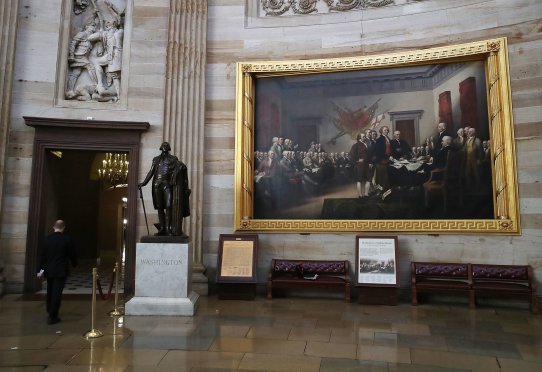
A painting titled Declaration of Independence hangs on the wall inside the U.S. Capitol on May 17, 2017.
Good (Late) Morning!!
Maybe there really is a god?
Oh please let the rain pour down on Trump’s ridiculous salute to himself!
The New York Times: Washington Prepares for a July 4 Spectacle, Starring and Produced by President Trump.
Two Bradley armored vehicles rumbled into place on Wednesday in front of the Lincoln Memorial, to be joined later by two Abrams tanks parked nearby. Cranes were putting into place the scaffolding for Jumbotron screens. And workers raced to finish a red, white and blue stage where President Trump will preside over one of the most unusual Fourth of July celebrations the capital has known.
The audience for Mr. Trump’s speech will include thousands of troops assembled by the White House to create a made-for-television moment in which the nation’s commander in chief is surrounded by the forces that he leads.
You won’t see it live on CBS, ABC, NBC, or MSNBC, thank goodness. Those who want to watch the disaster unfold will have to turn to C-Span or Fox News.
Weather permitting, the traditional songs for each branch of the military will be played while their officers stand by the president’s side and a procession of aircraft, including Air Force One and the Blue Angels, roars through the skies overhead. Hundreds of guests, many of them handpicked by the Republican National Committee, will watch from bleachers in a V.I.P. section erected close to the podium.
“It will be the show of a lifetime!” the president posted Wednesday morning on Twitter.
But Mr. Trump’s decision to turn Washington’s annual Fourth of July celebration into a kind of Trump-branded rally for America has drawn criticism from Democrats, top representatives of the city government and many military officials who believe the president is using the troops and their gear as political props.
I’m rooting for the flop of a lifetime.
https://twitter.com/Greytdog/status/1146797236715741185
Apparently the White House staff is worried about a repeat of Trump’s sad Inauguration day.
The Washington Post has the tick tock on the preparations: Inside the effort to build suspense — and crowds — for Trump’s Fourth of July.
As President Trump’s appointees have worked doggedly to assemble the most ambitious and costly Fourth of July ceremony the nation’s capital has ever seen, they have been guided by one overriding principle: It cannot be a repeat of his 2017 inauguration.
The transformation of the Lincoln Memorial’s grounds into a made-for-TV setting, complete with a VIP seating section for donors and other political supporters, represents the culmination of a four-month-long effort to produce the military celebration the president has envisioned for nearly two years.
For a public gathering that is ostensibly targeting an audience of hundreds of millions of Americans, the display of weaponry, aircraft and pyrotechnics has been scripted primarily to satisfy an audience of one. By having Trump speak to a select audience, flanked by armored tactical vehicles, organizers hope he will avoid the prospect of facing a smaller crowd of the sort that gathered on the Mall for his swearing-in.
But the White House has also been scrambling in recent days to line up enough attendees, as Trump’s aides fret that either thunderstorms or the traditional free concert on the other end of the Mall could diminish the crowd for Trump’s 6:30 p.m. speech. The issue of crowd size has been a sore point with Trump since his inauguration, when far fewer people showed up compared with Barack Obama’s 2009 inaugural ceremony and the president pressed National Park Service officials for nonexistent photographic evidence of a larger audience.
The administration has provided 5,000 tickets to the military, the Pentagon announced Wednesday. Trump’s reelection campaign has handed passes out to allies, donors and trade associations — from the American Bankers Association to the British Embassy, according to people familiar with the matter, while several fundraisers and operatives also were tasked to hand out tickets.
It sure sounds this is an overtly political event. Trump should have to pay the expenses out of his own pocket–but who will force him to do it?
Nancy Cook at Politico: ‘They started this too late’: Trump officials and allies anxious about July 4 fest.
The White House and Republican National Committee have spent the past week scrambling to distribute VIP tickets to President Donald Trump’s Fourth of July speech at the Lincoln Memorial.
Now, White House officials and allies are wringing their hands over the risk of the hastily arranged event morphing into Trump’s Inauguration 2.0, in which the size of the crowd and the ensuing media coverage do not meet the president’s own outsized expectations for the event.
“They started this too late and everyone has plans already,” said Dan Eberhart, a Republican donor and CEO of the drilling services company Canary, LLC. “Everyone will be there in spirit, but in reality, people planned their July 4th activities weeks ago.”
Less than 36 hours before the event, White House aides were crafting Trump’s speech, while administration and RNC officials finalized the guest lists.
A White House official declined to explain the system for handing out tickets or the various tiers of VIP access, except to say the reserved seating area — extending from the steps of the Lincoln Memorial to the middle the reflecting pool — will feature veterans, Trump family and friends and special guests. The first lady, vice president and second lady, and a number of Cabinet officials are expected to attend, as well as several senior White House officials — though the aide stressed this, too, was still coming together.
“They are creating this thing from scratch, and I do not know if anyone knows how it will go off,” said another White House aide. “There are questions about the ticket distribution and who will show up. The weather might be bad. Heads are spinning.”
David Remnick at The New Yorker: Little Rocket Man. Donald Trump is trying to conflate a patriotic celebration with his reëlection campaign.
Trump, who talks about “my generals” and “my military,” has decided to turn the normally pacific Independence Day ceremonies in the capital into a martially tinged self-branding exercise. We are watching him blow hard into the balloon of his own ego. Trump is also trying to conflate a patriotic celebration with his reëlection campaign. The White House is doling out passes to Republican donors, members of the Republican National Committee, and other supporters.
Troops, tanks and a flypast will give a military flavor to this year’s Independence Day celebration in Washington, DC. yesterday.
According to the Washington Post, the Pentagon leadership has reacted to the increased militarization of the Fourth by “hiding out and hoping it all blows over.” Trump, of course, has spoken for “his” generals, saying that they are, in fact, “thrilled.” He is not likely to hear any high-level public objections from the Pentagon. He has not had a Senate-confirmed Defense Secretary since James Mattis resigned, in December, when he could no longer influence or countenance Trump’s chaotic decision-making process. There are some signs of public unhappiness, however. One liberal-leaning veterans group, VoteVets, plans to give out thousands of U.S.S. John S. McCain T-shirts on the mall, the better to remind people of Trump’s vicious insults directed against the late Arizona senator, an American prisoner of war in Hanoi, and of the way White House aides tried pathetically to hide the destroyer from the President’s view during a state visit to Japan….
Perhaps the most significant event at the G-20 session came when Vladimir Putin used the occasion to declare, in a run-up interview with the Financial Times, that “the liberal idea has become obsolete.” Sounding much like Trump at his fearmongering worst, Putin said, “The liberal idea presupposes that nothing needs to be done. The migrants can kill, plunder, and rape with impunity because their rights as migrants must be protected.” Leaders including Emmanuel Macron of France and Donald Tusk, the president of the European Council, stood up to Putin and the idea that Russian-style authoritarianism was the wave of the future. By contrast, Trump voiced not a word of objection. Why would he? He is in total agreement with Putin. And, in Osaka, he stood with the Russian President and mocked both the idea of a free press and the notion that Russia had ever interfered in the 2016 elections on his behalf.
And so, on the Fourth, we will watch Trump, who evaded military service by pleading phantom bone spurs, spend millions of dollars of public funds in order to enact a fantasy of martial leadership. He is doing it to flatter his base. He is doing it to solicit the criticism of his enemies (the better to turn that criticism on its head). And he is doing it because he can.

Read the whole thing at the link.
That’s all I have the strength for today; I’m simultaneously enraged and despondent. I wish all you Sky Dancers a peaceful and Trump-free Fourth of July.

 peej
peej Carissa
 bostonboomer
 dakinikat
 ecocatwoman
 mablue2
 Mama Lopez
 peggysue22
 quixote
 skydancingguestblogger
 Mona (aka Wonk the Vote)



 Sky Dancing
Recent Comments